Showing posts with label 2020s. Show all posts

Sunday, 10 September 2023

#261: Inu-Oh (2021)


Studio: Science SARU

Director: Masaaki Yuasa            

Screenplay: Akiko Nogi

Based on the novel by Hideo Furukawa

Voice Cast: Avu-chan as INU-OH; Mirai Moriyama as Tomona; Kenjiro Tsuda as Inu-Oh's Father; Tasuku Emoto as Shogun Ashikaga Yoshimitsu; Yutaka Matsushige as Tomona's Father; Chikara Honda as Kakuichi

Viewed in Japanese with English Subtitles


Long ago, when Noh theatre was not even named as such, and Japan was split into two factions 600 years ago, one child is born in a performance deformed, an entity that is ostracized for being monsterous but will become a talented dancer. This child, INU-OH, will cross paths with Tomona. Tomona was the son of sea divers who search for treasure, and were assigned to find the artifacts of the Heike clan, lost during history, only for the sword that they find in the se to be blind Tomona as is disembowels his father when the later draws the blade. Thus begins a Masaaki Yuasa film, a historical piece based on a novel by Hideo Furukawa that will take an unexpected route. In its tale of these two helping each other with the curses around them based on the artifacts of the Heike, a clan that were decimated during the Battle of Dan-no-ura of April 25th 1185 on the sea, this serious tale of how the past will be interpreted and forced to tow the official line will be told itself by way of rock musical.

It is a wonderful thing to know Masaaki Yuasa was once an obscure cult figure, only to finally by the end of the 2010s to become an acclaimed animation director, with his work mostly available and with his growth in success from the 2010s without compromising his style. Inu-Oh continues this, with the studio Science Saru co-established by him in 2013 allowing the art style Yuasa has had with his productions to only refine here over two decades since his earliest 2000s works, cleaner here but having the flourishes still there when perfect for scenes, like using watercolor silhouettes for certain moments. The narrative itself is very simple with hindsight even if the real life history this is based upon being incredibly elaborate and to be more well understood for a Japanese audience. Contextually, this is dealing with how this important real life battle, the Battle of Dan-no-ura, has ramifications in the period setting a long time later when it is retold in song and stories, where Tomona, needing to free his dead father from the curse of that sword, one of a few artifacts connected to the Heike with supernatural power, encounters Inu-Oh, who is also as he is due to the curse of another artifact from the past, a demonic performance mask. Tomona, in his quest, joins the ranks of blind biwa players, those who tell through song the tales of the like of the Heike, whilst Inu-Oh, despite being banished by his father, still learns the techniques that would become Noh dance, his own curse with the touch that, the more he appeases the Heike ghosts around him, his limbs will turn into more human ones as he continues to perform. When the pair become aware, in a world where the supernatural is completely around humanity, of the Heike ghosts, Tomona becomes the hype man with his proto-rock star biwa playing to promote Inu-Oh’s renegade theatrical dance and song performances, where he is able to talk directly to the slain Heike soldiers, tell their tales in song, and rest their souls in his art.

This is where the film itself takes its most inventive turn as, with Inu-Oh only eventually needing to hide his face under a mask, and Tomona becoming a biwa god for the masses himself, this is deliberately anachronistic in tone. This predates Beatlemania by a good few centuries, in pre-Edo Japan rather than Liverpool, of screaming female fans, as there are also electric guitars in the soundtrack for these rock opera songs.  This is a real virtue to the film, as with music having played a good part in his earlier work – with opening and ending themes for Yuasa‘s television productions being idiosyncratic and brilliant – this is his first musical in his career, as it is his first ancient Japanese period story, and it really works perfectly. I can proudly write that, at one moment, a break dancing glowing samurai skeleton appears at one point within this, and that is not factoring in that the music itself, by Otomo Yoshihide, is insanely good. Not surprisingly, and wisely, one of your key leads to this playing the titular Inu-Oh is a musician, the lead vocalist and songwriter of the band Queen Bee by the name of Avu-chan, who is really good in their voice acting and performance. Mirai Moriyama, as Tomora, does as much a credible job in his role, singing and acting, with Avu-chan, Masaaki Yuasa, soundtrack musician Yohei Matsui, and the film's compouser Otomo Yoshihide creating the original songs' lyrics. Otomo Yoshihide is someone I know through the experimental rock group Ground Zero, and his work here as the main composer is just as perfect for this melding of rock opera, Japanese history, classic Japanese music, and even some songs you could get away with on a Halloween soundtrack, least the one (with a stage show in the film with Inu-Oh surrounded by fake severed hands) dealing with the poor unfortunate Heike soldiers, beaten and clinging to the enemy ships for dear life, having their hands cut off and leading to a tree to grow with them in.

This is all in reflection of a serious theme of this film, The Tale of the Heike, a huge epic account compiled prior to 1330, dealing with the struggle between the Taira (Heike) clan and Minamoto clan for control of Japan at the end of the 12th century in the 1180–1185 Genpei War 1180–1185. With origins blurred to history, and numerous different interpretations from an oral tradition, through the biwa playing bards Tomono here is part of, a theme here is the tale of Heike and trying to control it in power. Tomono and Inu-Oh bring the rich and varying forms of this story in all forms, whilst in contrast, you have a nod to biwa players being murdered to silence or steal the stories, or how tragedy comes into this film in its finale when, to have an official version of the tale that unites the country, any other interpretations must be silenced even if by execution.

Whilst this naturally leads to tragedy, the performances which make up the centre of the film are bombastic and vibrant, as staying within the world of this film rather than turning into their own sequences out of the period context, we see 20th century Japanese rock band performances reinterpreted in terms of how props like safety harnesses for choreography mid-air would transpire in an ancient setting, or how to depict with giant shadows the tale of summoning an unnatural whale made from a thousand dolphins the Heike clan call for mid-sea battle. As a result, including the eventual drama that comes in, including the envy of Inu-Oh’s father as his performances are being undermined by his son, this is a vibrant film to watch, insanely imaginative to view. Science Saru, whose productions include Western co-productions too, are a really good studio of talented animators just from seeing this film, where even their use of computers for the animation shows the best, when it is used for some very cinematic camera travelling shots, in scenes, that would be painstakingly difficult to have animated hand drawn back in the day and are incredible without context when they happen.

This is still one of Masaaki Yuasa’s more grounded productions in terms of style, in that he commits to the period setting, but with break dancing even transpiring among the peasantry here in this historical setting, the willingness to take Japanese cultural history and still be faithful to it with this sense of risk makes the plot more powerful by its end, including a bitter sweet conclusion where despite all that happens, old friends will reunite as ghosts in modern Japan and rock on together in the afterlife. This does not feel like a compromise at all where his sense of vibrancy as a director, including the talent of the studio behind this, show through, whether it is trying to integrate the modern rock aesthetic, even seventies and eighties glam rock/metal, to the world in visuals or music standing out in its melding of a period setting to its idiosyncratic touches. There is even as well streaks of horror storytelling that do crop up throughout and add to this story’s huge emphasis on the afterlife and the ghosts which haunt the living, including the least expected and gory explosion of a human being even if it contextually makes sense. In terms of its creator stretching himself into a different genre or two, Masaaki Yuasa completely succeeded here.

Saturday, 18 March 2023

#242: Pop Team Epic Season 2 (2022)


Studio: Space Neko Company

Director: Jun Aoki

Screenplay: Jun Aoki

Based on the manga by Bkub Okawa

Voice Cast:

Aki Toyosaki, Asami Sanada, Aya Hirano, Fumihiko Tachiki, Hiroya Ishimaru, Ikue Ōtani, Junko Minagawa, Junya Enoki, Kazuhiko Inoue, Kenyuu Horiuchi, Kōichi Yamadera, Kumiko Watanabe, Mayumi Iizuka, Megumi Han, Megumi Ogata, Nobuhiko Okamoto, Nobuyuki Hiyama, Romi Park, Takaya Kuroda, Tasuku Hatanaka and Toshiyuki Toyonaga as Popuko

Akio Ohtsuka, Atsushi Abe, Hekiru Shiina, Hidenari Ugaki, Inuko Inuyama, Kōichi Yamadera, Kumiko Nishihara, Kyoko Hikami, Mariya Ise, Minako Kotobuki, Minori Chihara, Mugihito, Rie Kugimiya, Ryo Horikawa, Shintarō Asanuma, Toshiki Masuda, Toshiyuki Morikawa, Yū Mizushima, Yuki Kaida, Yūko Miyamura and Yūma Uchida as Pipimi

Shōta Aoi as Shouta Aoi, Shunsuke Itakura as Popuko (Bob Epic Team), Toru Adachi as Pipimi (Bob Epic Team)

Viewed in Japanese with English Subtitles


Why don't we settle this peacefully with some violence?

It was four years, notwithstanding a TV special, before the pair of Popuko and Pipimi returned for a second series. Less anime schoolgirls and more personifications of pure id, their return to television naturally within the first minutes of the first episode befuddles the audience by being a live action parody of a tokusatsu show. Starring everyone favorite time travelling pixie of a male idol singer Shōta Aoi, ever since the last season heroics, it is a straight-faced opening credits sequence using up all the budget, and it will return by the final episode with a vengeance. The fact this was set up with TV special back from 2019, and you see how this series, and the franchise in general, has played with expectations from its beginning.

Speaking of that TV special, it deserves its own review, but it does feel like a necessary aspect to cover as it feels like the gateway between seasons, showing what has changed. That special says goodbye to the sprite based video game parodies from pixel artist Makoto Yamashita, and French animator Thibault Tresca. They are missed, and missed for myself is Hoshiiro Girldrop, one of the strongest candidates for the best anime show to only exist through end of episode previews and one opening. It also marks the first glimpses of Square Enix, in a tie-in that would continue with the video game publisher working with the production onwards in season two, and the tokusatsu parody, which was first hinted at within it. It is own weird beast that can be viewed as Pop Team Epic season 1.5, only imagine a forty minute double episode, which is technically two episodes repeated twice, that repeats four times and has a recreation of a scene from First Blood (1982), the first Rambo film.

Those sadly missed for season two are honored by the new season's tone, as by the second episode Pop Team Epic has broken out a super robot parody. Already they are cracking jokes about going over the budget, with co-producers King Record tolerant again of being joked as being the villains, and the nerdiest of anime references comes in with “Obari'd”, openly making a humorous tribute to Masami Obari, who whilst an anime director is legendary as a key animator and robot designer too, someone who was brought in for said parody because he is that capable of doing robot sequences, and does indeed show (even with the character redesigns for the segment) his talent. Pop Team Epic is still a show of obscure references, jokes which does place it in the reference comedy anime which could age greatly into obscurities in the time passing, if one where the sense of being weird for the sake of weird was also a huge part of its attitude. The references are so prominent they even have to beep many out to keeping on the right side of Japanese parody law or standards, and that will always be a factor which, to an outsider, will put them off this franchise.

For those that viewed this like pure catnip to them, season two does carry a swagger, even if the same as before in structure, of a victory tour from the first season succeeding. The Obari robot parody, with one of the first jokes depicted of Popuko and Pipimi resigned in other character design styles (and genders), is very much alongside the live action tokusatsu parody of the first episode the immediate signs of this. Like before, this follows the template of a fifteen or so minute episode repeated with a female voice duo, and then a male one for the repeat episode, voice actors here including some big names, from the Yakuza videogame franchise from Sega to Neon Genesis Evangelion (1995) alumni, meaning Shinji (Megumi Ogata) and Asuka (Yūko Miyamura) for those who know that series have a very weird reuninion even next to times in their original franchise. As we will get to, the voice actors for the Japanese dub, even if you do not know their best work, prove a huge virtue for me this time round, but for those who know them, this in itself a big aspect for the series, especially as it leads to the surrealism of voice actors iconic for many for the Yakuza games, playing gruff men in the criminal underworld, playing a schoolgirl being tickled to death by her friend.


Even in terms of the opening credits, with its mind boggling take on multi verses of Popuko and Pipimi, and a head banger of an opening theme (PSYCHO:LOGY by Shota Aoi) which you would expect for a far more serious show, Pop Team Epic is gunning for more elaborate and weirder spectacle. The hugest advantage this series already had, like the most interesting of these referential comedy shows, is that even if you do not get ninety per cent of the references, they linger and can last beyond their popularity in worth for how the non sequiturs and ambition is as much the humour. Case in point, I have no idea what playing PlayerUnknown's Battlegrounds (2017) is like, a first person shooter game which is entirely centered around multiplayer elimination death matches, baring an inkling of its content and that it was the likely influence  on one episode's main segment. The joke still works however because, alongside all its action beats, the punch line is that Pipimi will punish cheaters with the ruthlessness of a contact assassin.

The humour when it works and I think is truly ambitious is not the parodies, such as the Final Fantasy parody which comes part of a clear licensing agreement with Square Enix; it does lead to the show parodying deep-only released cuts from their video game history, which has to be still admired, and those who get the Final Fantasy parody should enjoy it with mirth. The more ambitious joke in a fantasy parody though comes without needing even the obvious references, and is absolutely ambitious and ridiculous at the same time, being a recreation of an English language education show that diverges into a power metal music video following the exploits of “Shining Shoulders”. Effectively Pipimi‘s heroic knight alter ego whose shoulder armor gleams brighter than the sun and whose feet smell of citrus, it is hilarious even in the one reference to something that went out of pop culture relevant in the four years from the first season, fidget spinners, that joke becoming funnier with less relevance in a mere name drop at the strangest time.

Sadly there are fewer experimental aspects in certain areas, such as the complete lack of stop motion this time round, but thankfully, the segments in this series become more elaborate to compensate, even an ending credit becoming charming when the main theme is joined by a recorder for a one-off remix. A parody of a romantic visual novel (specially a franchise called Tokimeki Memorial), in which a nameless boy enters high school, takes the joke even further in how, for the repeat of the episode, it drastically changes far more than other examples within the series by turning into an otome, a genre of visual novel video games with female protagonists and male love interests, gender swapping the entire segment, changing the faceless lead to a woman, and even changing jokes for the punch line which involves name checking the original manga Bkub Okawa's romantic life. That is not even mentioning the parody of boys-love/yaoi anime, with gender swapped Popuko and Pipimi; already showing a level of closeness throughout the series that manages to be sweet, even as characters meant to be sarcastic and irrelevant, this obviously plays to the idea of boys romance with recreating old jokes in a new content.  Even the cruel joke, early into this season, that the segment is cancelled mid-segment and will never appear again hits perfectly, particularly as they at least take a building with them.

There are a surprising amount of surprises to be had here – one for me is how a French illustrator and animator famous for his work on his Twitter page, Kéké a.k.a. Kévin Gemin, gets to recreate his style of bouncing cute animals in a cartoonish form with more censored hand gestures here one of the end credit animations. There is also the actual endings where, whilst they are choreographed around the same text, the voice actors working together can sometimes go off script; the best of these proves to be the two actresses from Hunter x Hunter (2011-2014), Megumi Han and Mariya Ise, who openly admit they were hired because new material was coming at the time, deliciously cynical without undercutting either property. Voice actors Junya Enoki and Yuuma Uchida in particular for me, for episode 3 part b, manage to out power even actors from Neon Genesis Evangelion, The Melancholy of Haruhi Suzumiya, and Horiuchi Kenryu and Otsuka Akio, voice actors famous from the Metal Gear Solid games, for completely going off script at times including the penis trauma references. You can see the talent in the voice actors on display, more so for me this season with a huge level of the laughter, even in stuff which makes no sense in any context, coming from how the actors say or shout the line out. Even the fact that there is significant more cursing in the English subtitle translation suggests a sudden energy to this series even next to the magic of the first one.

Then there is Kōichi Yamadera and the AC-Bu, who steal the show even next to great competition, the later duo artistic team of Shinsuke Itakura and Toru Adachi the heroes of the franchise from both their Bob Team Epic segments, returning here, and their Hellshake Yano segment from the first series. AC-Bu, an animation team know for working a variety of fields, managed to top that segment by having the entirety of episode 7 being the return of the Hellshake Yano character, all depicted in sketchbooks with incredible illustrations, the duo voicing the still images and moving the sketchbooks, some cut and changed for certain moments. The fact the segment is also nearly in one take, starting with one member in a locked public toilet and returning to it in the end, with the exception of closing remarks of theirs, is in itself exceptional too. Adding to this achievement is how, for the part b segment, the entire story is told by prolific voice actor Kōichi Yamadera, doing every character in a variety of voices. From the Lupin the 3rd franchise to Donald Duck, and too many roles including dubbing Western actors to count here, Yamadera is a veteran, and his performance here is incredible in how one voice actor can produce so many voices as a single person. He makes the best episode even better, and that is not forgotten the virtues of the show before, after, and how the tokusatsu parody returns with a vengeance by the final episode. Almost entirely a live action episode with it very clear, in the production value, those who work on such shows, from the on screen fighting to the costumes to the CGI effects, were brought in and were gun-ho to commit to the joke, it is an incredible way to end a series. Baffling the viewer whilst presenting a climax bringing live action and animation together in a way that makes Marvel Cinematic Universe films seen bog standard in comparison, this is what Pop Team Epic always was, the pretext of for self-referential, sardonic and reference heavy jokes really an excuse to be as ambitious and ridiculous as it can be. The littlest jokes, not just that final episode, like a Bob Team Epic segment where the leads mock an alien for a terrible crop circle from their UFO, made the series better and anything too strange for me was still that, deliciously bizarre. As someone who really felt cold for the first season, even for its virtues, returning to it allowed me to appreciate the show, and by God, they managed to improve and top themselves with the content here.   

Sunday, 5 April 2020

#145: The Island of Giant Insects (2020)


Director: Takeo Takahashi and Naoyuki Tatsuwa
Screenplay: Shigeru Morita
Based on the manga by Yasutaka Fujimi and Shu Hirose
Voice Cast: M.A.O as Mutsumi Oribe; Chiaki Takahashi as Mirei Jinno/Misuzu Jinno ; Marina Inoue as Inaho Enoki; Misato Fukuen as Ayumi Matsuoka; Momo Asakura as Mami Miura; Rika Tachibana as Chitose Naruse; Takuya Eguchi as Kazuhiko Kai; Wataru Komada as Atsushi Kamijō; Yurika Kubo as Ai Inō
Viewed in Japanese with English Subtitles

Immediately into the 2020s, we have ended up with this curiosity, which is still having its history written and is still managing to soldier on. The Island of Giant Insects has also been a production that has benefitted from the Kickstarter era, which does mean that unlike years before, there is a target audience who have been waiting for this over the time. The title, adaptive from a manga, is a throwback to old school OVA or at least the idea, as this is not remotely like those late eighties and nineties titles but firmly in the era where shows like High School DXD (2012) get sequel after sequel, the not-quite-porn sold on nudity.

From the first trailer it was obvious, in this tale of students stuck on a literal island of giant insects, the main selling point was the transgression of nubile female characters being molested by the likes of giant bees and grubs. Does it say something bad against others and me that we even watched this? I admit a fascinating with the perverse, but by this point, there is a very different nature to "adult" anime in the 2010s from decades earlier, where whilst the older titles can be far more problematic (like Violence Jack), there is something significantly more insidious with a lot of the OVA level work of today, which is more tame in some areas but questionable, as well as a sense they are being manufactured to a target audience knowingly rather than some of the madness you got in older work.

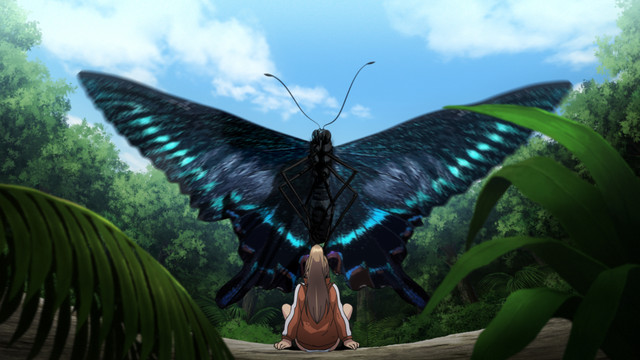
Initially the film existed as a 2019 release short, not a short film but twenty minutes in the middle of the finale feature length work, knee deep into the hell hole of giant butterflies who suck people dry and other content that appears in the final work, just to provide a taster. The film itself is also not the entire work, merely early chapters of the manga, following a group of stereotypes from a manipulative older girl who uses her physical allure to a macho jock, the movie taking a fifties American b-movie but adding a lot more animated nudity and greater nastiness. There are nicer characters in the fold, the heroine Mutsumi Oribe luckily an insect enthusiast who is really of use on an island like this, to the point that whilst others like those above are stupid enough to try to continually get her killed, one male character immediately comes sympathetic because early on he realises her importance and listens to her.

The inherent issue with The Island of Giant Insects is that it is a paradox, between being very scuzzy but also in a very generic way. That sentence might raise some questions, but I am a defender of ero-guro-nonsense and all the deviations in Japanese pop culture, which proves an issue as Giant Insects is both just lurid for the sake of lurid, but not as shocking as it thinks it is and pretty average, not exactly more than trashy and not standing out in creativity. I think, in honesty having seen images, that even if the manga was not great it might be a superior version as that has more of the perverse surrealism that I appreciate even in this type of work. Especially if you check pages of it online, the art style is more distant and the content is stranger in a ghoulish way. The author in particularly really likes insects bursting out of peoples' face, none of which you find in the adaptation but is at least more memorable.


Said insects, as well as being cheesy CGI figures, are not used with interest either. It says a lot that I can just refer to the franchise Earth Defence Force, one of the few video games I have played as an adult, which are cheesy b-movie games which are not the best in graphics and content (at least in the one I have played), but made up for it by having hordes of ants onscreen even if they were also cheesy computer effects. In terms of the premise, the creatures in this are barely used to their fullest, especially in light of all the strange and unique traits of the insect kingdom has, all in spite of there at least being one person or a few involved providing some entomology research. One exception, the one good scene in this entire project, is the horrifying and real life concept of the Leucochloridium, that of a parasitic worm that invades snails' eyestalks, imitate those organs, and mind control that poor host to be out in the open to be eaten by passing birds, all with the intention that the worms breed in the birds' stomachs.  Naturally imagining this happening to one unfortunate human character, as it does here with additional gibbering, is the one single moment Giant Insects ever gets around to the kind of gross, weird and wonderful side of Japanese horror that the likes of Junji Ito or many an ero-guro creation does. If only this had happened more in the story.

Clearly of more interest is nudity, as this film does not hide it, even finding an excuse for all the female cast to bathe nude after a giant tick incident. The odd thing about the production though is that the twenty minute piece was uncensored, whilst the feature length version censors some sex, and almost completely censors the violence, obscuring it off-screen or in black. It could sound more progressive, as someone who has always found it problematic violence was more acceptable than sex, but it comes to the point how this is not like the old lurid titles at all. Say what you want about old titles that painstakingly drew the most grotesque detail in gore and organs, but a lot of OVAs nowadays are tie-ins to existing titles and usually an excuse for more nudity only. The censorship also does not mean these works cannot get away with some problematic content and tones even for me.

None of these characters are particularly memorable, another title with insanely generic female character designs which is always the worse sign, with even the ero-guro aspects deeply problematic for myself. The only sexuality that is nothing to do with the grotesque aspects is not a lot. The evil manipulative woman is not exactly feminist, and the curious lesbian subplot about a timid idol singer who is secretly manipulative too, taking advantage of the female track star in the group being likely gay, is jarring both in that one of the two is not probably a good character either and that it never goes anywhere. There are also the unsavoury moments. It is one thing to have the erotic-grotesque aspect of female nudity against insects, but that should not be the only thing, for the sake of both gender politics and true transgression. Then there is the scene where the evil female character and the jock go full evil, to which a certain piece of dialogue about gagging another female character with something below the belt is completely implying what that suggests, only to thankfully not happen.

It is strange to think that, for all the problematic content, a work like The Legend of the Overfiend (censored or otherwise) can be more defensible for pieces of it than this, but there is always something more problematic for me about anime which follows the rules dictated, i.e. censoring nudity for television, but still sells the uncensored releases and still gets away with some gross content in the censored broadcast. Likewise, a title here that had no excuse being censored, thus not experiencing a full version of the premise promised, which also has questionable content really comes off as hypocritical and far more a concern than a fully offensive work which people are warned about. A scene like lingering on a female character wetting herself in fear in detail just before a butterfly gets her, as seen here, is something which feels a lot grosser to witness than any titillation or gore you could throw at myself.

The production itself is also incredibly bland, and not in the cheap and compelling type. Even the music is terrible metal guitar licks which are off-putting for a metal fan like myself, egregiously cheap when I have heard solidly put together music even in incredible cheap anime. There is even a sequence which is an extreme form of padding, just of the lead character walking down an endless corridor with this music playing, and of nothing more which is pretty offensive in how pointless it is. The real baffling nature of all this is that this has managed to soldier on. As a b-movie premise, I can think of many other ways this could have been made, imagined versions which is better, but this managed to get a feature length cut and has been acquiring funds for an English dub. A complete lack of memorability is found here, but with the aspects there that leaves one feeling dirty rather than provoked. It is strange as well that, due to the unforeseen circumstances about COVID-19, which has effected everything including production of entertainment industries like anime, The Island of Giant Insects could be by accident one of the most prominent titles we know of from the year. That is maddening and baffling at the same time.