Showing posts with label Post-Apocalypse. Show all posts

Tuesday, 4 April 2023

#246: Beast Fighter - The Apocalypse (2003)


Studio: Magic Bus

Director: Kenichi Maejima

Screenplay: Junki Takegami

Cast: Kentaro Ito as Shinichi Kuruma; Nana Mizuki as Ayaka Sanders; Shoko Kikuchi as Maria Tengai; Taiki Matsuno as Tomisaburō Tengai; Atsuko Yuya as Shizue Kuruma; Katsuhisa Houki as Genzo Kuruma

Viewed in Japanese with English Subtitles


How does one describe this adaptation of a Ken Ishikawa manga? The Bible as retold by pulp Japanese anime set in the post-apocalypse and made in the early digipaint 2000s era of anime. Ken Ishikawa, the source author, was a friend and collaborator of Go Nagai, together as a pair creating the Getter Robo franchise, whilst Ishikawa's own career as a manga author was prolific in its own right before his 2006 passing. Nagai's legacy in the West has grown as more of his work is available, especially after the success of Devilman Crybaby (2018), whilst Ichikawa is someone who many might not know of but has had adaptations of his material come to the West. Yakuza Weapon (2011), a live action film by Tak Sakaguchi and Yūdai Yamaguchi, is an adaptation of the manga author's work, whilst infamously there is the anime production Ninja Resurrection (1997-8). An adaptation of Ishikawa's manga, which is an adaptation of Futaro Yamada's 1967 novel Makai Tensho, I would argue it is infamous because a) it never had an ending and leaves on a cliff-hanger after two episodes, one which is more blatant in how the anime never really got going in its plot let alone concludes the manga, b) is pretty lurid for those who have seen it as a period samurai work with horror and supernatural content, and c) was likely released in the West with the desire to sell it off the success of Ninja Scroll (1993),  despite their only connections being a lead named Jubei.

Beast Fighter, if close to the source at all, and with knowledge that a 1990 straight to video version of this tale exists, shows a feverish insanity can seep through its author's work. This is a delirious production, once you get past it being a lower budgeted animated series, where its logical jumps are contrasted by the abrupt and sudden turn into emotional sincerity in its final act. Beast Fighter, as mentioned, is set in the post-apocalypse but one here where barring one ruined wasteland, is mostly well off. There is cities, government, train services, the news and even online porn sites as one joke point out, but there is at least an epicentre where children fend for themselves and murdering punks exist. There is also a credible threat, and this is where spoilers have to be brought up immediately, as in this world, God is an entity that is soon to awake, and there are two sides with their eye on this development. Genzo Kuruma is one of them, an evil scientist who sacrificed his wife, his son and his son's love to attain his power, who wishes to control God with his army of mutated humans, based on dinosaur DNA, and recreate Noah's Ark. The other is his son Shinichi Kuruma, melded with three animals (a lion, a bear and an eagle) into a powerful chimera, who wants pure revenge on his father as a result of all this.

The story begins properly with the introduction of Ayaka, a young woman saved by her father from a fatal heart disease but was an experiment with the intention of Genzo Kuruma to use his plans about God, thus kicking off this thirteen episode series. Alongside Tomisaburō Tengai, his comedy sidekick friend who is yet the head of the ninja clan and the brother of Maria, the woman Shinichi loved, Shinichi with his obvious father issues but with Maria's soul within him alongside the animals can either become a true hero or accidentally be turned into an entity far worse than Genzo that could annihilate humanity for good. Shinichi is going to immediately stick out as a lead. He is stereotypical for this medium, the stoic and angry lead with the positive contrast that he is capable of growing, and even feeling sadness like the best type of characters, but his powers are certainly memorable. Most heroes do not punch with an actual lion's head materialising from their arm in his full form, and it is surreal and certainly fun to witness, making close quarters combat with him dangerous alongside the bear's head in his chest and the eagle that he can send out from his back. Considering, however, this is a series where "pluripotent cells" is a key plot point, as is cloning God and needing "emotionless" blood to get the job done, alongside the evil dinosaur mutants, and you are dealing with an anime where this memorable lead is still one of the saner aspects to the production. It is a pulpy narrative which is an acquired taste but for those in harmony is compelling, and whilst there is gore and some luridness, a lot of the experience of Beast Fighter is a rollercoaster of abrupt plot events and all of its reinterpretation of Judo-Christian spirituality in curious ways.

Considering the screenwriter Junki Takegami also worked on Crystal Triangle (1987), a work about conspiracies which leads one to ask why would God need a spaceship, the tone is probably explained by him as much as the source author. There is also the studio behind this Magic Bus; founded in 1972, whilst they have assisted with other studios and made porn anime, they have their own productions and with the likes of Mad Bull 34 (1990–2) among their titles, Magic Bus has its own specific mood when they decide to make something very weird. Here with Beast Fighter, they proudly tell this tale without batting an eye or winking in irony at the material, and without the problematic threat of sexual violence found in Mad Bull 34 either. For this series specifically, the religious content is going to dumbfound a few, and it itself one of the more distinct pieces of this series. With episode titles based on different books of the Old and New Testament, such as Episode 3 being the Book of Job, this is Christianity from a standpoint of a country where Christianity is a minority religion.

There is a small minority of believers, and a history within the country which is prominent, this is entirely from someone reinterpreting the meanings of the Bible from an entirely different culture, in ways which are fascinating if eyebrow rising. Literalising communion as cannibalism is also going to offend some too, so be warned, as this has the famous story of Mary Magdalene being saved from stoning, "May he who casts the first stone without sin", conclude with everyone being chased off or having their head exploded off. All those willing to go along with this will find some curious interpretations of note, such as the emotionless blood concept being important as, contrary to what one would presume, cloning God's DNA does not lead to one's ideal figure but someone capable of true nobility much to your chagrin.

How this is a lower budget show also needs to be considered. The time period it was made in, the early 2000s, is reflected in how this is a production from the time larger budgeted animated shows in Japan would have been figuring out how to make the new tools look good in digital ink and paint.  Many still dated themselves, let alone this one, and now that this aesthetic style is nostalgic is both proof I am old, but is going to be its own factor. Either you can appreciate this, including the fact you will never get a proper 1080p resolution for this title, or it will be off-putting in itself. Your composer here too, Hiroshi Motokura, only has a few credits under their name including Ikki Tousen (2003), the original series of the franchise, and they are going to be a factor as their music is either going to be too cheesy or fits the tone perfectly. That includes how Motokura skates on thin ice with a heroic melody sounding suspiciously like Queen's We Will Rock You with just some of the notes changed, something which has to be heard to be believed.

It is an absurd series, least until after the halfway mark where it managed to get serious in the midst of all its absurdities, and contrasting this is how this is a very simplistic plot at its core. Genzo Kuruma wants his son's blood, especially as it now has absorbed Maria's, the Virgin Mary figure of this Biblical tale, until he eventually targets Ayaka, and most of the thirteen episode series is one of two henchmen, the scientists Genzo has serving for him, their mutant henchmen or an openly corrupt member of the Japanese government. Though his transformation into a rat man unfortunately leans into racist stereotypes used against Jewish people, that is not the anime's fault in being insensitive either, merely to something to warn of as an accident trigger; the character himself really says a lot, if accurate to the source material, of Ken Ishikawa's own views of his own country's government if the Defence Minister here is willing to blow up an entire hot springs resort with the army, kill everyone in the town, and blame an accident from a nearby chemical plant just to kill Shinichi and claim the powers of God for himself.

The logic of the show can be summed up in how Shinichi can happily sever his own arm off, and be able to reattach it again, just to shake out parasitic insects one enemy infected him with, or how this is the kind of show where the lead fights sharks to the death and then processes to break Leviathan in half with an Argentine Backbreaker without the show batting an eye. It is amazing to think that, by the final episodes, the show manages to get serious in a way than is emotionally sincere, even if the content is still absurd, because it takes a huge risk of killing a main character off and having the entire last episode effectively tackling the lead's grief and inability to mourn those he has lost turns him into a Satanic force. It is a truly strange sensation, for how this show cannot be taken serious at all initially, I found myself doing so by its ending. Because of how the conclusion is actually bleak and tragic, with the subject of mourning its key conclusion, this managed to surpass expectations, gleefully here for its interpretation of Bible stories and its pulpy style, by caring about its cast, the true conclusion not that evil is all defeated but one accepting lost. It was actually quite emotionally stirring, and again, earlier on in this series, even when dealing with children being killed in the cross fire of this religious war, it can have them being bounced off walls onscreen in a tonally absurd moment, or have one of Shinichi's foes being an actual island. So the show is still as mad as a box of frogs too, you will have to be willing to accept its own logic to get to this as I did myself, but this managed to not only live up to the hope of being entertaining, but it managed to actually try being dramatic too even if this is a show fully of moments which are baffling too.

Tuesday, 6 September 2022

#224: New Fist of the North Star (2003-4)


Studio: A.C.G.T

Director: Takashi Watanabe

Screenplay: Hiroshi Toda and Nobuhiko Horie

Based on the serial novel Fist of the North Star: The Cursed City by Buronson and Tetsuo Hara

Voice Cast: Takehito Koyasu as Kenshiro; Akimitsu Takase as Tobi; Gackt as Seiji; Romi Park as Bista (Doha); Unshō Ishizuka as Sanga; Yurika Hino as Sara

Viewed in Japanese with English Subtitles


This was my first Fist of the North Star. This franchise, from the manga by writer Buronson and illustrator Tetsuo Hara, who wrote the source novel which ties this three part anime and their franchise together, had less recognition in the United Kingdom than it did the United States. Manga Entertainment did release a tiny bit of the 1984 television series, but beyond this, especially into the DVD age when I got into anime, all I had to go with was the 1995 live action Fist of the North Star film, which is not a great interpretation of the premise, and this, which we got from ADV Films, tied to the source in that, whilst set after the original story, its creators were directly involved with.

Introducing this franchise to me as an outsider, as the OVA tells it, civilisation was totalled by nuclear war, leaving the survivors to fend for themselves. Those desiring power prey on those wishing just to survive, and as we see early in the set up of the world in the first episode, polluted water which kills you instantly means clear drinkable water is a huge resource, even more so than petrol as, in this version, is never a concern as cars and motorbikes can be used without issue. Kenshiro, our franchise lead, is a wandering martial artist, the sole heir of Hokuto Shinken, an art form which forces only one master to exist, and fights to stop others claiming the art. His talents with this include the ability to touch pressure points that can even cause a man's head to swell up like a balloon and explode. Unlike the 1995 film which briefly touched on this, and censorship for the television anime series, this version has the gore there fully, but also, unlike the live action film where Gary Daniels played a conflicted but one dimensional figure, Kenshiro here is ridiculous as a stoic muscle man but is also one with a moral compass.

The paradox this OVA claims as a virtue, whilst not perfect even in telling it, is that this contrasts its more lurid content with moral dramas. Kenshiro is fully aware his art is a curse, as he must hunt down other practitioners of the art form, and he is heroic too. Though he can violently explode people, his heart is in saving people, protecting them, even for villains to redeem themselves if he has not made them implode already, willing to have let them live if they redeemed themselves as happens in the finale here. The paradox, that this is gory ultra violent macho anime, yet is full of sentimentality and would get away with manly tears and melodrama in its toe, really stood out as its best aspect returning to this anime, effectively a three hour animated film which sets up the virtues of the source to interest me.

Episode one sets up the premise, that a town is attacked by Sanga, the dictator ruling Last Land, a kingdom where he controls clean water supplies and has brought in religious fanaticism, with a boy who can do magician parlor tricks, to keep his subjects under foot. He requires Sara, a female healer from that now destroyed town whose lineage clearly was one of the Hokuto Shinken clans who were beaten, as her skill is in pressure points that can make miraculous and unnatural healing transpire, something Sanga can exploit to pretend she is a goddess. Touches like this is where this as pulp has something more magical to it, such as that this will come to ahead even when Sanga is out of the story, including the downfall of the boy's older brother Tobi, an ally of Kenshiro who will try to weld this religious fanaticism in a Holy War with the newest ruler when power corrupts him. There is nuances, and the story properly begins with the introduction of Seiji, a figure who has acquired the style Kenshiro has but, abandoned by his father as a boy, has turned into a vengeance seeking nihilistic who believes only in power.

Seiji is also voiced by musician Gackt, who provides the opening and ending themes. Clearly this production was as much to sell Gackt as a star too, even in how, unsubtly and heavy handed, this tries its hardest to make a morally evil figure actually a damaged one who finds humanity, the ending credits even looking like a music video when it cuts to Gackt himself in a post-apocalypse costume screaming to the sky. The music is good, so I will not complain, even if I cannot claim to whether his vocal acting is good or not. Trying to make Seiji, a heinous character, into a complex one is among the virtues of New Fist of the North Star but also where this does struggle, try as it does admirably to do, with an almost comedic number of abrupt inclusions, even an aunt never seen before who appears in Episode 3. 

A lot of New Fist of the North Star will put people off. It is violent, where unlike the previous versions as mentioned, you can have intestines and brains here even if this is past the Millennium, meaning we are no longer in the sickening yet lovingly depicted organs of hand drawn OVAs. There is also an implied rape scene, which is attempt at a moral complexity which does fail. It is not too explicit, and not one to damn the production, but alongside that Sara ends up in the skimpiest of costumes, stuck as a caged bird for Seiji, this is where the complexity this story wanted does falter because the storytelling itself slips, trying to deal with this moment that transpires between Sara and Seiji. It is always problematic to have sexual violence, and in this case, the complexity is enough without this - that Sara knows Seiji, because he once saved her from a wolf attack as children, her decision even to ignore a chance to escape clearly a wish to try to save him or try to bring him to reason. It connects with Tobi's own trajectory, infatuated with her, leading him in his downward spiral in trying for a Holy War when he feels she has been seduced by Seiji. Only that there has to be the rape scene, including her own divided reaction to it, causes the problem, entirely because this is not a subject decades on which can easily be broached in narrative story telling well, and with New Fist of the North Star, in its one huge storytelling flaw, not making Seiji's humane side feel less abrupt than it is its one huge flaw, alongside that this one scene, far more tastefully tackled, is still not as carefully dealt with as it could have been.

But that this gory production is trying at complexity, Seiji a nihilistic sadist who yet is psychologically scared by the idea of people having the concept of love, even to die for, is admirable even if it faltered. That this comes off at times schmaltzy is actually a virtue in this production's favour. This is not Violence Jack, Go Nagai's original 1973-4 manga written long before Fist of the North Star, but the notorious 1986-1990 anime OVA clearly coasting from its success. Even the sexual violence here is not a cheap shock tactic, just not told well, whilst much of this story as a simple action tale has moments where it gets morality over better than other anime trying to be complex. The destruction of a town, including the horror that a disabled girl has been killed among the civilians, is actually not cheap and means a lot, as it is shown enough without being shocking, and with emphasis that this Kenshiro, not a brainless thug, is a heroic figure who, whilst a stoic muscle man, takes the deaths of innocents with anger and remorse in his own way. His decision to try to save the boy from tetanus infection, driving through the mountains to where mysterious mountain men kill everyone who tries to pass, leads to the best moment, where I see the virtues of Fist of the North Star as a legacy franchise fully, that it comes apparent these men, a martial arts temple, only do this because their mountain has a huge silo of nuclear and biological weapons from the old civilization they do not want back in the world. In a moment like this, you see this as a macho melodrama written and crafted by creators where it is about morality as much as the animators even make gags about goons in danger of their heads imploding.

In mind that this is not perfect, that some of it has aged, and some of it will come off as ridiculous, I am glad to return to New Fist of the North Star now able to appreciate it. Its only technical flaw, not storytelling, is that made into the early 2000s, you see the early use of computer animation for vehicles, which became more common and looks obvious here. What it has in comparison though is that this became a gateway for me to want to see Fist of the North Star, the original source work, which is a huge virtue for this to have even if it was not seen as a key piece of the franchise.

Wednesday, 27 July 2022

Bonus #14: Fist of the North Star (1995)


Director: Tony Randel

Screenplay: Peter Atkins and Tony Randel

Based on the manga by Buronson and Tetsuo Hara

Cast: Gary Daniels as Kenshirô; Malcolm McDowell as Ryuken; Costas Mandylor as Lord Shin; Downtown Julie Brown as Charlie; Dante Basco as Bat; Nalona Herron as Lynn; Melvin Van Peebles as Asher; Clint Howard as Stalin; Andre Rosey Brown as Sandman; Paulo Tocha as Stone; Chris Penn as Jackal; Tracey Walter as Paul McCarthy; Rowena Guinness as Jill McCarthy; Isako Washio as Julia


Is it peaches? Sounds like peaches.

My knowledge of Fist of the North Star was limited to the point that this, in honesty, was one of the first versions of Buronson and Tetsuo Hara's legendary manga I had seen. The first was anime, New Fist of the North Star (2003-4), but worth mentioning is that, if the history of bringing Fist of the North Star into the United States only took to the late 2010s into 2020s to succeed, we in Britain got less of this legendary series. The United States finally got the full and uncut 1984-8 television series only in 2010s with Discotek, whilst in Britain, we only had 36 episodes of Manga Entertainment's attempt to sell the show, coming in the mid-2000s in a long gone box set. Fist of the North Star, this curious attempt to sell this franchise in the West, had the advantage in the DVD era that Hong Kong Legends picked this up as a title. A British DVD company, now long gone, who strove to preserve and release Hong Kong martial arts cinema with a care for extras and full versions pre-dating the Blu-Ray era, where even Criterion is preserving titles they once released, unexpectedly included Fist of the North Star itself among their catalogue.

This is not the first live action version, bootleg or otherwise, but with Clint Howard having his name over pro wrestler Leon "Vader" White on the opening credits, it is clear this is a curious adaptation. To those with no knowledge of the franchise, as this film tells, the world has descended into the post-apocalypse, with those who wish to acquire power having taken over as marauding hoodlums. One figure named Lord Shin (Costas Mandylor), having dominated with an iron fist, as the practitioner of the Southern Cross martial arts style, has created a city, his desire to improve the world contrasted by his ego and letting his men commit atrocity by invading smaller communities for supplies and slaves. His rival, who he has taken his love Julia (Isako Washio) from, now a caged songbird to him, and marked his body in permanent scars, is Kenshirô (Gary Daniels), practitioner of the North Star style. North Star, as interpreted in the manga, in the anime, but also here, is that contacting certain pressure points on the human body causes that person to explode, as gory as that sounds, and Kenshirô approaches Shin's world in attempt to defeat him.

Gary Daniels as Kenshirô looks like the muscular brother of Benedict Cumberbatch, who can still make your head explode, which is a compliment to both men. Daniels, a martial arts action star of films like Bloodmoon (1996), born in London, was also the person who came to this as a fan of Fist of the North Star, enough to call his son Kenshiro Daniels, who would go on to become a football (soccer) player when he grew up. Things obviously however made it clear the Fist of the North Star, this live action film, is not quite what it should be. It is conventional, which is the biggest sin it commits, that Tony Randel, most famous for Hellbound: Hellraiser II (1988), came to this film and made it very conventional, more concerned with trying to give the character of Kenshirô angst-ridden rather than a narrative exploiting its premise. Even for a lower budgeted film, it has a lot to get the tone right, the production design team and model builders deserving all their praises for a film which, when exterior location shots, feels post-apocalyptic, but those involved beyond this clearly missed the point.

Despite being part of the wave of pop culture films from the 1990s that I am obsessed over, this is just has one pace, to tell a very simplistic tale of this Kenshirô beating Lord Shin, and not a lot else to work with. A film presenting Clint Howard, Ron's memorable acting brother, getting to be a murdering bastard in the first half, shooting people indiscriminately should sound like a lurid pulpy movie, especially as this does have fight scenes, and one of the most curious casts you could imagine for such a film. One thing you cannot deny, and should have excited people coming to this film, because Randel comes to this as a horror director behind films like Ticks (1993), is that they did not ignore how these characters can make people explode with a punch, or Lord Shin's special glowing hands attack causes veins in the biceps to burst in jets of gore. Even then, however, this does pull back, and never was there a film whose personality is against itself with moments this adult and violent, against content you would expect in tone from a child-friendly comic book adaptation.

Explain, for example, that this is a film with moments of gore, where the troops of Lord Shin, the South Crossmen, are explicitly raping, pillaging and murdering nearby locations, but contrasts this with a blond haired teen male character (Dante Basco) who is a goof and a wannabe kung fu expert, whose friend is a cute blind moppet who Kenshirô cures of her blindness. The film’s narrative is incredibly generic, and for a film that needs good fight scenes to work, the compromise to their presentation undermines the whole project, alongside the fact that, for the few moments of gore here, there are also points where the gore from the original manga are removed for the most part too. What it becomes is a strange concoction of who managed to end up in the film. Even in style there are weird moments that show this, like inexplicably, for a sombre toned film with an orchestral score by Christopher L. Stone, for it to suddenly splice in a Machine Head song A Thousand Lives into the soundtrack.

Malcolm McDowell, entirely separated off from everyone in his scenes, is a North Star martial arts master named Ryuken existing in the afterlife, continuing the obvious concern of Western actors having Japanese characters to play, levitating in a room or inexplicably appearing as a zombie to Kenshirô, voicing another actor, to tell him to not flee his role as a hero. Vader, the legendary pro wrestler, especially in Japan as much as in the West, is perfect as a Fist of the North Star baddie, and is just being Vader, pulling a promo on a small girl, as awesome as that sounds whilst performing moves on Gary Daniels. But with that fight ending in an anti-climax belittling both of them, even Vader is misused. Melvin Van Peebles is a really curious choice, a legend in African American cinema for directing Sweet Sweetback's Baadasssss Song (1971) alone, here as an actor, as with Downtown Julie Brown, a British video jockey (VJ) and personality, neither ultimately given much to do as members of a village Lord Shin is terrorising. Unfortunately as a result, neither were really worth having hired in the first place despite both, Van Peebles especially, are inspired figures to have hired.

Costas Mandylor himself is also a curious choice as that unfortunately means, as a former soccer/football player with no martial arts training, they had to work around this with stunt doubles, in a film which has Gary Daniels but not many who can do the martial arts fights. Japanese actress Isako Washio likewise, an actress from films like Bloom in the Moonlight (1993) is also stuck here trying to perform in a language not her own and feeling lost too. The one curious choice who managed to grab something from this is Chris Penn as Jackal. Penn steals the film, the actor from films like Reservoir Dogs (1992), with the advantage, playing a sleaze ball goon who managed to tape his head together before Kenshirô's blows caused his head to explode, that he could find a character he could relish the lines of.

It is a project which ended up with people who really had no idea what to do with this - co-screenwriter Peter Atkins mostly worked on Hellraiser and Wishmaster films, making this frankly a case of someone dropped with a title they had no investment it, Tony Randel likewise feeling entirely out of place here. Even in mind that huge chunks are clearly missing, such as the aforementioned Clint Howard disappearing entirely eventually, the live action Fist of the North Star film feels entirely at odds with what it is was adapting, a franchise which would have to take decades to finally get a lot more recognition in the West. This is a fascinating film to see, and has aspects which are worthwhile, just in how it looks, but never was there a film which really did not have a lot going on despite having such a curious production on and off screen.

Saturday, 7 August 2021

#196: Urotsukidoji III: Return of the Overfiend (1993)


Director: Hideki Takayama        

Based on the manga by Toshio Maeda

Voice Cast: Tomohiro Nishimura as Amano Jaku; Yasunori Matsumoto as Bujū; Yumi Takada as Alector; Hirotaka Suzuoki as Chōjin; Kazuhiro Nakata as D-9; Ken Yamaguchi as Münchhausen II; Kumiko Takizawa as Pedro; Miyuki Matsushita as Himi; Ryūzaburō Ōtomo as Caesar; Takumi Yamazaki as Ruddle; Tsutomu Kashiwakura as Idaten

Viewed in Japanese with English Dub1


[Some Major Plot Spoilers]

Urotsukidôji for myself was always the original Legend of the Overfiend (1989), the most known and notorious, and Legend of the Demon Womb (1990-1), which was helped considerably in the United Kingdom as Manga Entertainment also released it. However, the franchise continued on the straight-to-video format into the mid-nineties, and Kiseki Films, bought out by Revelation Films, brought the two finished sequels to the early British DVD market. This is alien, fascinating territory to get into as, whilst Urotsukidôji is a divisive and uncomfortable to watch narrative at times, here is where you get into new territory as, Legend of the Demon Womb being a side story, we are into the post-apocalypse set up after the original narrative. The prologue, set just weeks after the destruction that climaxed the original's bleak ending, is immediately alien in a tantalising way in imagining the narrative going forth, rather than just reading of this. There is a last ditch attempt to destroy Tatsuo Nagumo, a character reduced to a horrifying monster intended to cleanse the earth for the Chōjin to remake it, alongside the worlds of demons and the beast-people. There is even the sight of the US president being a lascivious tentacle demon fled in his satellite station before he buys the farm, which I cannot help but wonder was political from the part of the creators.

The narrative proper for part three is set much later on, humanity trying to pick up the pieces and a new race called the Makemono, half-beast and half demons, appearing. Caesar, a human who rules Tokyo with an iron fist, intends to take on the Chōjin with his empire, with any Makemono he could enslave becoming slaves, whilst the world around his territory has naturally descended into small communities with rampaging groups committing horrifying acts within them. In amid this, to the surprise of Amano Jaku, one of the central protagonists of all the previous chapters, the Chōjin has been born prematurely than intended in Osaku, as he has reacted to the birth of the Kyo-O in Tokyo, a figure said to be able to destroy the Chōjin. Even in mind to the narrative lore of the series so far, there is a sense that, at a huge change in the world's narrative, we get an ambitious story at hand, with four forty plus minute episodes to work with, even with censorship cuts to appease the British censors, and it does get interesting.

For part one, you do see it initially struggle with its narrative goal, that one of the Makemono raping and pillaging the environments, a giant named Bujū, is introduced as one of the new protagonists, an antihero who will transform from a brute to one with humanity. Execution is always something that has been this franchise's key issue, and this first episode does rush an attempt at complexity. Bujū, whose nickname of the Chōjin of the East leads to him being kidnapped by Caesar's empire, has an inherently interesting narrative from being a monster who escapes, taking Caesar's daughter Alector with him, to becoming a person with empathy when he finds the Kyo-O. Even under the absurd circumstances of having sex with Alector in a Buddhist temple, he finds an infant girl, the Kyo-O, and finds himself slowly developing empathy for a figure that makes him their guardian. Execution is the issue in that his behaviour, including forcing himself on Alector for payment for letting her see the world, is not elaborated on enough for the moral turn. Many will not find it acceptable still, but the idea of a monster finding humanity is a fascinating narrative strand, and for all the mistakes Return of the Overfiend still has, it makes up for this rushed first episode in doing something I never expected from this franchise. That for all its death and sexual violence, this chapter is streaked in humanity and empathy even with the villains and outright monsters.

It is all in the realm of hyper-violent pulp, which is an acquired taste. The fact the franchise has always been sold as porn, likely to get the project off the ground, has always been a cursed aspect too, even if the edgy erotic side is as much part of the franchise's themes. The plot however surprises in how elaborate and dynamic it becomes, where (almost) everyone has a trajectory of great interest. Caesar, whose back-story is told, is a fascinating antagonist to have in that, a stereotypical large man confined in a robotic chair, he was once a young cult leader who, even in another absurd moment of the narrative, trying to kill the Chōjin by way of a super computer powered by a hijacked NASA power supply, lost his daughter Alector as a result. With Alector now an android, one with a consciousness but programmed to love him, you have a suitably Greek tragedy here, with ancient Greek legends and plays happy to deal with very transgressive subject matter centuries ago, where you feel emotions for Caesar as a man literally facing a God even as a megalomaniac, and his complex relations with a daughter figure that is her own person, even if he is a monster in his own right.

There is still a lot of content which is problematic, with the added irony that large parts of the chapter, even if the sexual content is important to the franchise, really have little interest in the hentai genre it originates from before. So much is now focused as a dark action fantasy in a sci-fi world, where there is a lot at stake here in its heightened, over-the-top tone and is elaborated animated in context, making the fact this is still hentai (censored or not) really perplexing in hindsight. More so as Munchhausen II, the antagonist of Legend of the Demon Womb, returns as Caesar's aide and magician, with intentions to use the Kyo-O for dominating the world and slaying the Chōjin, which becomes the central plot point. Not even denying how ridiculous it is, they have created a monstrosity from the souls of anguished dead, in a bloody vat where the Makemono slaves keeping it topped are also thrown in, and "hyper nuclear missiles" they intend to fire at the Chōjin and Osaka, which is bonkers but cannot help but have implicit nods to Japan's real, tragic history with atomic bombs.

There are moments, even with the sense the OVA is shackled to its erotic origins, where the sexual content does actually make sense to include, Toshio Maeda in his adaptations (such as La Blue Girl) clearly fascinating with sexuality as a destructive and magical force, a concept even if unappealing for some viewers (either romanticised, humorous or grotesque) is a concept to deal with. One female demon on Caeser's side, whose real form is a humanoid cicada insect with her torso and head on top, literally traps a victim inside herself, to take as a captive prisoner, after coitus, and whilst sadly Megumi, Amano Jaku's sister, is marginalised again, she is part of a literal use of the sex act as a force, a conduit of a god where the female orgasm is weaponized, even its grotesque touch of a form made from reanimated corpses not tasteless. What is tasteless of that scene, and still mars the franchise, is when degradation, specifically of the female characters, is clearly done as a lurid selling point to sell the anime, which is merely a touch to that scene, but is found more clearly in places and has, alongside the lack of equality and subversion in its transgressive content, been the problem and why people have rightly called the franchise misogynistic. It is unfortunate monkey's paw, that it was sold on the back on this content, found at its worst when the later episodes merely introduces a female solder on Caesar's side merely for this victimisation, even if her lover, an abruptly introduced experimental cyborg, and their relationship if dealt with properly would have been another inspired dramatic beat to deal with.

This is especially a problem here for Return of the Overfiend as I was taken by surprised by how dynamic the four episode narrative got, even next to the previous ones in this cast. All of them are archetypes from the anime medium seen before - Bujū becoming a humane protector of a magical female infant, his romance with Alector, the Makemono who just want to be free and live, Amano Jaku the one man Greek chorus who gets involved to stop Munchhausen destroying Osaka - but all these dynamics work. A sense of this standing on its own feet with intent is found when Tatsuo Nagumo, only seen as the monster he turned into, is killed off in the first episode by Kyo-O unintentional, the show raising the stakes to a new narrative. Even transgressive touches dramatically make sense, such as Caesar's incestuous touches to his relationship to his daughter, and lashing out at her falling in love with Baju. The problem with such an example is when, in a sequence censored from the British release, it led to an explicit scene with mechanical tentacles; the idea of it, even if distasteful, as a dramatic and psychodrama touch, and that even this monster and she love each other as family, is dark and complex in a way that is enough in itself without pushing too far in actual explicit onscreen content. It already has its cake and eat it without these moments, with its drama and having this drama be over-the-top and Caesar even turning into something from Koichi Ohata's Genocyber (1994).

This may have just came from low expectations, but in spite of being ridiculous (those hyper nuclear missiles), being gory, being unpleasant and at times undefendable, Return of the Overfiend really packs a gut punch in its final episode where you suddenly have a lot of humanity and tragedy involved. The doomed nature of Alector and Caesar's love for each other, even if it is a sick one, the fact that Kyo-O becomes explicitly a figure of humanity as much as destruction, where her powers includes resurrecting the dead but also causing the evil to lose their minds in violence, even a scene completely unexpected in this franchise of humans and Makemono bonding in the horrible aftermath of the series where there are maimed and dead everywhere. Even the actual ending, opened for the sequel Urotsukidôji IV: Inferno Road (1993-5), is an optimistic one where the surviving cast with Kyo-O go on a road trip, a trip of heavy significance for all of them to learn their existences as they take Kyo-O towards for Chōjin for their eventual encounter. I will get to Inferno Road, or what little we got of it in the United Kingdom, and that in itself adds a bad taste in all the good will this set up. But as an ending in itself, with few of the characters from the first chapters of the franchise, and a distinct (if still evocative) change in aesthetic look, this was a perfect way to keep the franchise on with a grandiose tone and a weight to it. 

======

1) Viewed in Japanese with English Subtitles, this is inherently better without the ridiculous English dubs of the previous entries.

Tuesday, 29 June 2021

#191: Blue Remains (2001)


Directors: Hisaya Takabayashi and Toshifumi Takizawa

Screenplay: Hisaya Takebayashi, Masatoshi Kimura and Toshifumi Takizawa

Voice Cast: Kazue Fukiishi as Amamiku; Kazuya Ichijou as Reyju; Masane Tsukayama as Glptofane Sex; Hiroko Suzuki as Adenine Unum; Houchu Ohtsuka as Cytosine Tria; Junko Sakuma as Yuri; Kappei Yamaguchi as Mireo; Masashi Sugawara as Ryu; Norio Wakatsuki as Irigaru; Rica Matsumoto as Sari; Takehito Koyasu as Malloz; Tesshō Genda as Thymine Duo; Tomoko Kaneda as Amamiku (child); Yoshiko Sakakibara as Mayzamik

Viewed in Japanese with English Subtitles


Early into the DVD era in Britain, a now defunct label, Art Magic's sub label Eastern Cult Cinema, released three very early attempts at three dimensional animation, that wordiness aware that computers were assisting anime production from the late 90s onwards anyway. They were A.LI.C.E. (1999), the first theatrical film in this form, crude but fascinating as a forgotten historical footnote; Malice@Doll (2001), an OVA worthy for rediscovery as a dark work whose only real issue is its art style, even if the production worked around the restrictions; and Blue Remains, a post-apocalyptic nautical film with an environmental message.

Here, humanity has blown itself up with nuclear bombs, which has always been the way, all watched on from a spaceship helmed by a married pair of ecological scientists with their infant daughter Amamiku. Heading back down to Earth, tragically the couples' bodies are too irradiated to go through with their goal, to plant special seeds which can reawakening the ecosystem, so they place Amamiku in cryogenic sleep with them, and the ship's computer for comfort and guidance, to carry out the goal when they are gone. At the age of fourteen, but ninety plus years later, she has to carry on with the goal to help the Earth.

The film has, from then on, to struggle with the form of its then-new animation style. The film, when Amamiku wakes up, is effectively a sci-fi submarine tale, having to work around its limitations by being almost entirely set underwater or in small environments like submarine cockpits. Amamiku finds herself between those, human and otherwise, wishing to help her in restoring the Earth's vibrancy with the seeds, and an entity known as Glptofane Sex, who believes the absolute law of life should means killing off the rest of humanity to save the planet, against all the philosophical arguments and pleas of his lookalike brethren otherwise.

The film, openly, is a lot of action scenes, of Glptofane's forces of ball-like drones (with buzz saw tummies) and a giant biomechanical squid he is housed in, trying to get Amamiku and the few humans left asked to assist her goal. The film's look is equivalent of a Playstation One era cut scene for a lower budgeted game, but I will not be mean at the film for this, more that much of Blue Remains without the style of another animated format to bring a greater energy feels stiff as a result. That it is a lot of action and dynamic scenes instead of world building neither helps, especially because of the limits of the computer animation which prevent the action from being that dynamic, of 3D animated futuristic submarines floating in a void of dark blue with little background detail baring some ruined underwater buildings and an occasional aquatic life form.

The production does feel it is straining at a budget, where even the lead voice actress Kazue Fukiishi as Amamiku, in her only ever role, plays the character with a curious reflection in lines readings you normally do not get. If we go back to those three films mentioned in the first paragraph together, Malice@Doll out of the three was the most interesting of the trio; it is still strange, struggles against its form, especially as by that point Final Fantasy: The Spirits Within (2001) despite being a box office disaster effectively killed off these early productions at the same time, but it was able to get to something profound with being a surreal and disturbing work with a style and interesting Chiaki J. Konaka screenplay. Blue Remains in contrast is pretty conventional, not elaborate in terms of depth or ideas. Environmental concerns, and villains wanting to commit genocide for environmental preservation, is common in the medium, even if it is fascinating to see the villain's own argue against him and this tale being the lone figure that is misguided. Even that, whilst barely fleshed out, no one is safe barring a couple of figures from death is interesting too.

In fact, the one aspect of Blue Remains which is rewarding is the touches of eccentricity and invention it does have. The villain, and those trying to convince him against his idea, are literally brains with eyes and nervous systems attached, a grotesque aesthetic choice which stands out more because the film looks as crude as it does, fitting a more horror based narrative and the one aspect of this production likely to catch people's attention if you ever come across it (even an old DVD copy). More touches like this, like the submarines having fins to "swim" through layers of the water, or a dolphin which is actually meant to be a robot, are more interesting aspects that could have been ran with. When the film gets more New Age in tone, it is more worthwhile as it comes more to the foreground with the supernatural involved with those seeds Amamiku protects. It is not a spoiler to say a giant life giving tree, with human foetuses growing from it for new life, is part of the conclusion, because that in itself is an abrupt tangent for the film to get to considering its average tone. The end credits, set over real footage of the barrier reefs, is a cheesy and heavy handed environmental song about the life force of the sea and needing to protect it, whose earnestness is misguided but in itself cannot help but be charming. More like this, and Blue Remains would have won me over. Even if it fought against its archaic format, a more overtly surreal or inventive aesthetic, like an old weird video game from this era, would have gained it a cult audience if anything.

Thursday, 30 May 2019

Bonus#11: In the Aftermath (1988)


Directors: Carl Colpaert (Based on a film by Mamoru Oshii)
Screenplay: Carl Colpaert (Based on a film by Mamoru Oshii and Yoshitaka Amano)
Cast: Katie Leigh as Angel (voice); Tony Markes as Frank; Rainbow Dolan as Angel; Kenneth McCabe as Goose; Kurtiss J. Tews as the Psycho Soldier; Bryan Ellenburg as the Soldier; Ian Ruskin as Jonathan (voice); Lisa Maxwell as the Older Angel (voice); Filiz Tully as Dr. Sarah; Mike Hickam as the Officer

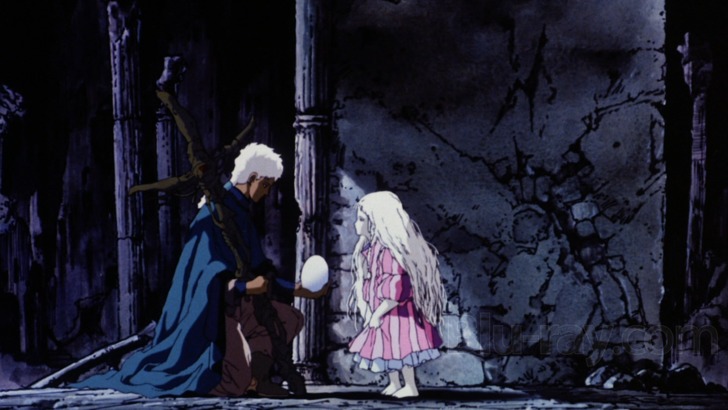
Let's begin with the obvious - how Mamoru Oshii's original version of Angel's Egg (1985) isn't available in the West but this notorious American reinterpretation from Roger Corman's New World Pictures is baffled me as it has for many. I don't blame those who licensed this version mind, neither Code Red in the United States or Arrow Video in the United Kingdom, as its likely the sad case the license for Angel's Egg is difficult to acquire or priced too high. (If by any chance it's due to New World Pictures or Lakeshore Pictures, the later owning this license, then someone would've grumbled about it by now, but bear in mind anime has been notoriously pricy at times to license from Japanese companies). In contrast, In the Aftermath was, from the looks of things, an entirely different license as a New World Pictures creation, Lakeshore Picture owning the rights since 2002. And honestly, whilst it's a ridiculous train wreck at many points and inferior to the original Angel's Egg, I'm glad we still have a 2k restoration of In the Aftermath, even if my own idealised version would'e been as an extra to the superior Japanese production.

As it goes New World Pictures ended up with the license for Angel's Egg, to which the likes of producer Tom Dugan thought it was an incomprehensible work. Angel's Egg, for those who don't know what it is, is an experimental theatrical animation by Mamoru Oshii, cult anime/live action director of the likes of Ghost in the Shell (1995), in collaboration with the legendary illustrator Yoshitaka Amano, who'd become acclaimed enough to have his work in art galleries after a career starting in anime production in the late sixties. Oshii, originally desiring to become a Catholic priest, clearly made Angel's Egg as a parable about religious doubt, with what you do see in In the Aftermath in terms of original footage enough to show it was very open in the conclusion without ever drawing a line onto either side, the title referencing an egg the iconic animated girl character had which either was an angel's or had nothing inside it. The New World Pictures version still also includes the sequence of fishermen trying to catch shadows of giant fish which cling to their city walls, only destroying what they try to hit with harpoons, a metaphorical sequence that, even if Oshii views the film more of a mood piece nowadays, still has this visible message within itself.

A lot of Angel's Egg is understandably abstract, intentionally so and soaked in a post-apocalypse built around the best representation of Amano own work and some of the best animators on staff from the eighties anime boom. It could've, however, been sold to an American audience by New World Pictures, rather than making an even less comprehensible version in In The Aftermath, if you'd just sold it to the art house crowd Roger Corman once did with Federico Fellini and other European films. Hell, for the visuals alone, this could've appealed to the cult film crowd even if the original film has very little dialogue and a lot of slow, languid scenes as it's a trippy, strange film even without the visible existential message.

Somehow, trying to make the film more sellable, another issue being that at seventy or so minutes Angel's Egg was seen as too short, the people behind In the Aftermath making something even less coherent at times just to fit their perceived parameters. To see it to the VHS market (though it did have an Australian theatrical release), the animation is used as an alternative world overlooking ours, actually like the angels of It's A Wonderful Life (1946) where the original protagonists, the white haired girl and a young male soldier, are now siblings and with the young girl to be sent to Earth, in live action, which is a wasteland where the ozone is poisoned and clean air is a precious resource.

It's actually not as disastrous as the reputation is. The infamy is how not only someone thinking this was a good idea, not helped by the original film not being available in the West still, but that to "make sense" Colpaert, an apprentice to Peter Bogdanovich, wrote a new script of utterly ridiculous (and quotable) dialogue about men crying about a world without fish and the girl being spanked by her older brother with asteroids as punishment for falling asleep. The project, even if I wished an English dubbed version of Angel's Egg was the version released rather than this misbegotten belief of trying to make a more "sellable" version to the West, is still compelling now we know it's an utterly perplexing creative decision, a time capsule to this bizarre cultural reinterpretation to sell films that still happened into the 2000s, whenever Miramax got hold of work like martial arts films for example, but is also alien to many world cinema fans as a practice. In 2K resolution on a Blu Ray, Angel's Egg as an animated production is incredible, causing one to weep that it is available outside Japan barring bootlegs; it is a project of the era, a box office failure whose production was only possible due to how the bubble economy grew in Japan during the eighties and, before the bubble burst at the end, there was enough money going around including in the animation industry to fund these bold projects.

From https://images2.static-bluray.com/reviews/14844_1.jpg

Oshii
himself, whilst he can be difficult for many, is an intellectual auteur, who even when he now claims the film is vague in meaning laced the film with too much clear symbology of his own spiritual crisis. This, as mentioned, is the only project to fully capture Yoshitaka Amano's art style too, so it is painstaking in capturing his gorgeous yet highly detailed illustration right down to the difficulty the animators would've had in just animating the movement of the clothes and hair of characters. The production team, with individuals who'd go on to the like of Akira (1988) to My Neighbour Totoro (1988), were not slouches either.

The live action isn't, even if low budget, letting the side down however in ingenuity. I will mock the point of even creating the film as it was, and mock the script, a really bad case of presuming an audience couldn't catch the vibe of the original or even just admiring the pretty pictures in spite of finding it slow, but I won't deny it's a great example in terms of clearly having so little to work with, two locations for sets and a few actors, and trying with some damn good ideas to make something interesting even if the script is gleefully gibberish at point. The two locations were chosen well, the factory in particular also used for Terminator 2: Judgement Day (1991), the kind of evocative set you could find in Andrei Tarkovsky's Stalker (1979) to a b-movie; by all accounts, an actual closed factory, it might've been dangerous to film there with those dust clouds onscreen looking too irradiated in chemicals abandoned there for comfort. Cinematographer Geza Sinkovics does his hardest to help the live action sequences, but its score composer Anthony Moore who deserves a moment of praise. An experimental composer who has worked with the likes of Henry Cow and Pink Floyd, he's a vital element in improving this film, in tandem to some of the other visual tricks at hand the person who comes close to matching the original source material in evocative mood.

Even when the animation is spliced into the live action, to try to make it work, there's also an eeriness that works. The premise, an "angel" sent to save Earth from environmental devastation is depicted by only six cast members (including lead Tony Markes), groans under trying to rationalise an art film into a pulp b-flick, but there's a sense of the unnatural to still appreciate because of this. The anime still has power even in this bastardised form, and the live action is appropriately eerie when you ignore the story.

Instead, the script, by the director, should be appreciated for going into non-sequiturs even weirder than the source, which was strange for its open ended ideas and the psychedelic dialogue but, when characters actually spoke, was very precise and sombre, building to the themes of spiritual ambiguity. Some of what is found here is potent whilst still strange, Markes in a gas mask playing a piano to a female doctor (Filiz Tully) he encounters, but spanking people with asteroids is just the kind of line screaming for baffled reactions. Angel's Egg had limited dialogue, a lot of silence that was clearly seen as unsellable considering the decision to cram voiceover to sell it, all of which adds an unintentional absurdity. Thankfully, it wasn't dull, pedestrian sci-fi exposition; instead, its lore that makes no sense but is fascinating in how this is an attempt to make the original work "makes sense" but becoming something gloriously off. The largest monologue in Angel's Egg, the young soldier retelling the tale of Noah's Ark with the boat drifting on an ocean never finding land, is turned into a nonsensical tale of deception where fish floating in the air on a planet are stolen that has to be heard to be believed.

It makes no sense why this executed plan was meant to be more marketable, but whilst I imagine an alternative world where Angel's Egg was sold as a more avant-garde Ingmar Bergman movie to art film audiences, In the Aftermath was what we got and is still rewarding for how odd it is. The real tragedy is that, whilst it helped introduce Westerners to Angel's Egg, it never lead to Angel's Egg actually being released; New World Pictures, among their work, also released an "Americanized" version of Nausicaä of the Valley of the Wind (1984) as Warriors of the Wind, the original pre-Studio Ghibli film now available whilst that version has vanished, yet nonetheless for a certain generation probably thanked for letting them still see anime for the first time. We thankfully left this need for alternative versions of foreign titles, but considering how extreme and peculiar In the Aftermath is, I am glad it's still available. That it's not an extra to the source and the only restored version in the West of the two films is tragic, but the oddity shouldn't be blamed for that.


From https://admitonefilmaddict.files.wordpress.com/2019/01
/In-the-aftermat-2.jpg?w=672&h=372&crop=1

Monday, 22 October 2018

#77c: Violence Jack Part III - Harem Bomber (1986)

From https://orig00.deviantart.net/640f/f/2017/138/
6/d/violence_jack_harem_bomber_by_mdtartist83-db9mc0j.jpg


Director: Osamu Kamijo
Screenplay: Mikio Matsushita
Based on the manga by Go Nagai
Voice Actors: Julia Braams as Mari; John Bull as the Slumking; Nadia DeLemeny as Yumi; William Roberts        as Harem Bomber; Liza Ross as Rose; Bob Sessions as Violence Jack; Barbara Barnes as Sabu; Colin Bruce as Yamaguchi; David Jarvis as Kenichi

Synopsis: In the post-apocalyptic world, the Slum King rules it with an iron fist with his vast hordes; in the midst of it is Mari, captured for his vast sex slavery group, and one of his soldiers named Kenichi, who were a couple before a comet from outer space destroyed civilisation, find each other and attempt to escape the Slum King's minions like Harem Bomber. Whilst this takes place Violence Jack, the personification of death and mayhem, approaches the Slum King's territory.

[Spoilers and Trigger Warnings Throughout]

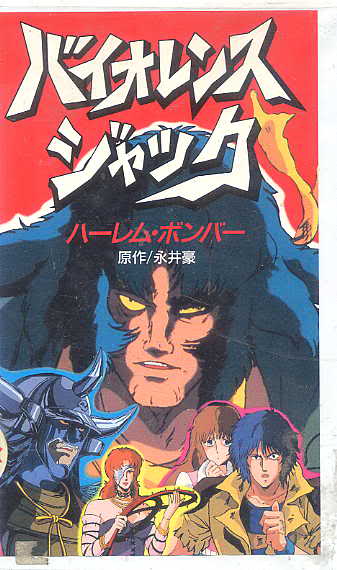
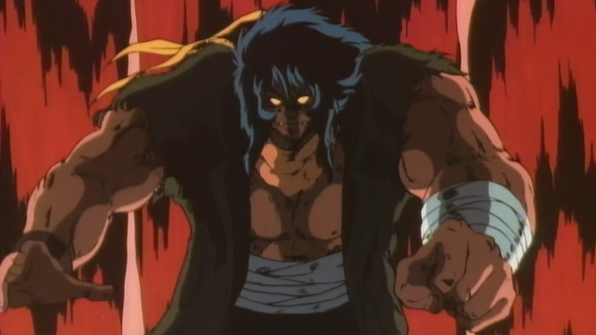
After the gruelling content of Evil Town, than the more rewarding but still tasteless Hell's Wind, there's Harem Bomber, or the Slum King as its Manga Entertainment release dubs it. By this point Violent Jack is just a personification of violence with supernatural powers, all in the shortest of the episodes, the first released and the one with the least censorship for the English release barring a minute or so. It's also so badly put together you could put it on in an art gallery and be compelled by how low a bar in terms of eighties OVA anime is in terms of quality. Revisiting these edited versions, censorship or not, it's a strange emotional trajectory when you don't dare try to marathon all of them, which I made the mistake of for the first time - Evil Town even butchered forcing one to want to take a shower notwithstanding, Hell's Wind watchable, and Harem Bomber so hellishly awful I am amazed I never noticed had bad it was until now. It's bad to the point it's amazing it ever got sequel episodes.

The script's sleazy pulp, Jack versus the samurai helmeted Slum King, all whilst a young couple find themselves in the midst of sexual slavery and Jack causing mayhem, rife in issues and not even ending with a fight against the Slum King, but one of his minions Harem Bomber, a giant nondescript man whose minions (including a bisexual dominatrix with a metal Phantom of the Opera mask who runs the sex slavery harem) are more interesting than him. It also ends anticlimactically as, to defeat the Harem Bomber, Jack throws the helicopter containing the young couple at him, killing the male love interest who decided to help. That in particular stands up as one of the more ridiculous moments of the OVAs, one of the few plot points which is closer to the absurdity found in most "bad" anime from this era rather than distasteful grim. That, and whilst its connected to the grim sexual slavery subplot and the homophobic evil lesbian figure who molests a captive to the point she has instant Stockholm Syndrome, that her male staff are all large men in really, really tiny leather briefs straight out of the infamous Frankie Goes To Hollywood "Relax" music video.

From https://i.ytimg.com/vi/5DsDxGLZFiU/hqdefault.jpg

The animation is also dreadful even by my tolerant standards, a side to myself I openly admit takes masochistic (even sadistic) delight in bad animation and production value, but even here cringed in horror. It's bad to the point that one of the truly infamous lines of the English dub, a case of verbal tourettes, was actually to cover up an animation mistake. The dub, only covered barely so far in these Violence Jack reviews, is ridiculous; whilst its totally inappropriate for the nasty material at points, intentionally and unintentionally, its ironically one of the reasons why the anime is even re-released by Discotek in the current day, its mad failure one of the few reliving aspects to sooth the septic viewing experience. This line, a stream of verbal insults at Jack's way that (in the one single amusing aspect of Violence Jack for myself) I have considered using as an alarm sound, was forced out due to the lip movements of a character being accidental, just as that young male hero Kenichi  abruptly develops a twitch in an eyeball in one shot. This amongst the general presentation is truly bottom of the barrel for anime, compelling but utter trash even technically, ending with Violence Jack not only able to regenerating a lost eye but turning into a phoenix for reasons I don't understand.

The entire Violence Jack project is an inexplicable creation that came from the eighties OVA boom. One that is morally repugnant yet developed a reputation for many to get re-released and even I would wish for a real explanation to why it even came about, the kind of details that would not be revealed by people who worked on this unless forced out of them in a very awkward conversation. Thinking of the individuals behind this, why they made the series even with the fame of Go Nagai behind it, why it took four years and was this sporadic and wildly bad in various ways. The poor female animators having to work on some of the material in the uncensored version, the poor production staff and voice actors of both genders having to work on certain scenes I thankfully never saw, how this project, clearly brought into existence because Go Nagai is an important figure in all manga and anime, blundered along, ended up taking the artistic decisions that happened.

From http://ekladata.com/zF1eojHKulnC49_tyUIHjRQ-NAc.png

And this is all with knowledge the uncut versions, especially with Evil Town, would drastically effect my opinion further, with Evil Town potentially spiritually and psychologically scarring me if it's as bad as I've read it as. If anything, Violence Jack is synonymous now with how for any good or obscure curiosity found in eighties OVAs, it let problematic and artistically incompetent material in the door too, from this to the extremes of hentai porn anime that began when straight-to-video allowed a liberation of content restrictions. The irony is that, even if it was tasteless and offensive for some still, if Violence Jack's worse moments were toned down or flat out removed it would've work provided the quality was improved artistically alongside fixing major script problems. As I'd gladly had Legend of the Overfiend (1989) without the censored sexual violence, Violence Jack even if it has far less defendable content in plot complexity could be remade into something better. Hell, a remake which didn't fall down the same pit holes this did could make sense, especially as of all people the experimental cult anime director Masaaki Yuasa was chosen to helm a Devilman remake in 2018, and that did very well. (And, not knowing enough about the material and not wishing to spoil it, I'd be reprimanded if I didn't mention Violence Jack is secretly a sequel to Devilman in story, so the remake idea isn't that weird).

Go Nagai, frankly, made some dubious creations even if you only watched the anime adaptations rather than the original source material, but it's noticeable that, for every Kekko Karman (the super heroine who wears no clothes) that was originally a joke that backfired, or a Violence Jack, he also made characters like Devilman and Cutey Honey that can thankfully be interpreted in a variety of ways, still flexible as stories and characters for a variety of tones. Nagai's reputation is too important to dismiss him, as important to anime and manga arguably as a Hayao Miyazaki or an Osamu Tezuka, and if it's unfortunate he likes extremes in gore and sex, he at least has characters and properties which can be malleable and reinterpreted in various ways in contrast to this. The same could happen to Violence Jack, the proto-Mad Max apocalypse still a profound advantage even if everyone's done this material over the decades now. Until then, Violence Jack so far is the infamous punch line that has made even the most hardened of anime fans green in the face viewing its content.


The End (Finally...)

From https://i.ytimg.com/vi/hzVIq6agNIk/hqdefault.jpg