Showing posts with label Studio 4°C. Show all posts

Monday, 24 February 2020

#137: Tekkonkinkreet (2006)


Director: Michael Arias
Screenplay: Anthony Weintraub
Based on the manga by Taiyō Matsumoto
Voice Cast: Kazunari Ninomiya as Kuro (Black); Yū Aoi as Shiro (White); Yūsuke Iseya as Kimura; Kankurō Kudō as Sawada; Min Tanaka as Suzuki; Rokurō Naya as Gramps; Tomomichi Nishimura as Fujimura; Mugihito as The Boss; Nao Ōmori as Choco; Yoshinori Okada as Vanilla; Yukiko Tamaki as Dawn; Mayumi Yamaguchi as Dusk; Masahiro Motoki as Snake
Viewed in Japanese with English Subtitles

Tekkonkinkreet stands out in the Japanese animation industry as the first theatrical feature directed by a non-Japanese creator. Michael Arias, originally from the United Kingdom, had a long career before he even got to animation such as visual and digital effects in cinema, and developing and patenting Toon Shaders, rendering software to allow the integration of computer graphics imagery with cel animation, which has been used even in productions like Studio Ghibli's Princess Mononoke (1997). Here, Arias makes an important historical note as the first non-Japanese director of an anime project, adapting this adaptation of a Taiyō Matsumoto project with Studio 4°C.

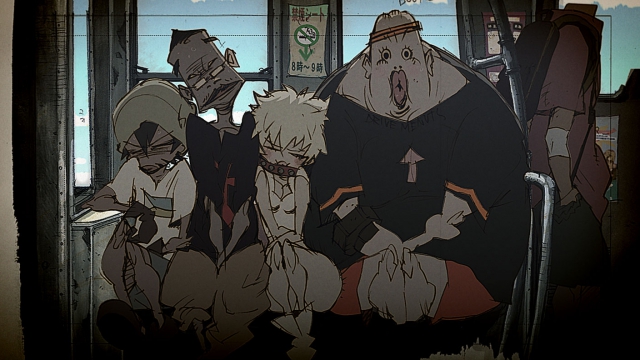
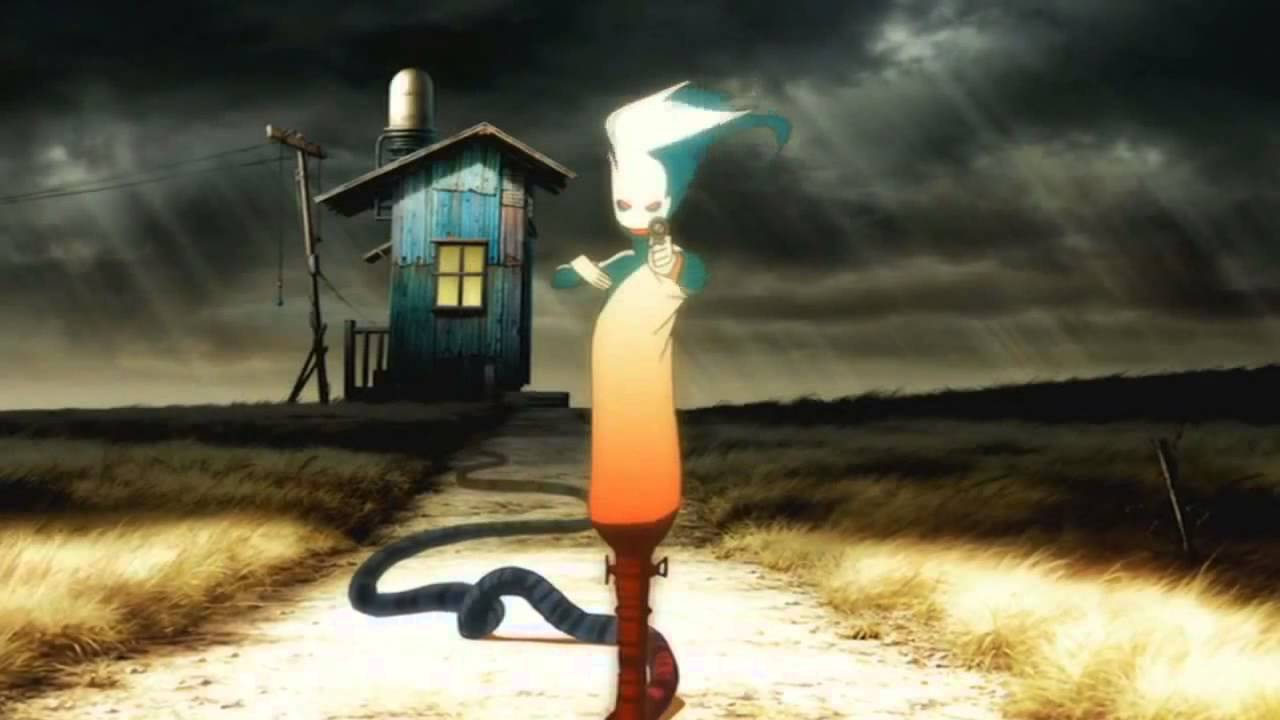
Tekkonkinkreet is set in Treasure Town, an amalgamation of periods which I suspect is as much influenced by the period after World War II, considering a huge plot point being drastic redevelopment including an amusement park replacing slums and strip joints, feeling less like the bubble period of the eighties, and a scene where real film posters are decorating the wall, mostly yakuza and crime films which would've predominantly be popular between the fifties to the seventies at the latest. Personally this feels like one of the sixties yakuza films of the "Mukokuseki" (stateless) era from the likes of Nikkatsu studios, where the yakuza try to take over with a divide between the modern world and a creepy cold blooded figure named Snake, and the old honourable guard, with a super powered boy named Kuro (Black) in the middle in the way of development whilst he protects a child-like boy named Shiro (White).


This being a Studio 4°C production means this is a very idiosyncratic looking work. I cannot really pinpoint what their trademarks are, even if you ignore the Masaaki Yuasa productions, aside from the fact they have always taken risks in distinct animation and exploring unique artistic styles, sustained in commissioned work like music videos. Their work is always artistically bold, taking experimental risks and this action drama immediately shows the talent behind the production when it opens up with characters chasing each other on moving traffic, float in the air after taking leaps off buildings, and the world itself being utterly alien to our own, from its general timelessness to bars the size of cubes having giant eyes on the wallpaper. The designs are also interesting in how manga author Taiyō Matsumoto is very distinctive, exaggerated but with touches of greater realism in his character designs. This is possibly paradoxical but with a sense that when characters are meant to stand out, like the mysterious foreign assassins Snake hires to kill Black who act like aliens, they do; in contrast others such as the wife of Kimura, a yakuza who slowly starts to question his support of Snake especially when he learns he will soon become a father, look far more realistic in context of a lot of anime being very exaggerated already.

The world is openly exaggerated with this clash in tones intention, especially as this is indeed a world of the openly unnatural where super minions can fly and Kuro's spiritual side includes "The Minotaur", an evil side to himself hidden inside.  Tekkonkinkreet is surprisingly dark; the world is kinetic, with incredibly animation and a score by British electronic duo Plaid having a pop electronic buzz to it, but the film's a melancholic tale where change is inevitable to Treasure Town with no way back. Kuro is all anger and passion, whilst Shiro is a rare case of a character who is child-like who isn't annoying, who acts like he is five and likes things like his collection of weird hats, but is someone with moments of supreme wisdom with the tale continuing to the point it clearly shows he is Black's sanity in literal form. The finale act is literally a subconscious struggle in influence as Kuro by this point is insane, staggering around the town as a pure beast of violence, leading to most surreal and enigmatic sequences.

I did initially consider Tekkonkinkreet to probably a flawed film, but with time having passed, it is yet become a spectacular debut that I cannot really suggest any major flaw with, a rush of energy and imagination which does touch on some real emotion. Its darker, grimmer moments stand out, but there's also the subplot of an older gangster who believes in honour and finds the changes to the town utterly alienation, the conclusion where Kimura is forced to finally deal with him played with the male angst of a yakuza film fully and heartfelt. It is a gem, one that also had the benefit of a wider audience beyond anime circles as in the 2000s, when anime was a big trend, Sony Pictures Entertainment released this alongside Satoshi Kon's Paprika (2006) on DVD and Blu-Ray, which means that Tekkonkinkreet was probably more heavily advertised and available for people to stumble across this medium. Certainly, this is a good thing for this production. In terms of Arias' own career, he's been slow but has made more work in the medium, with the added knowledge that his cel shading software innovations would've been enough to provide a huge impact on animation in general beyond just Japan. With this film under his belt, he has an additional success, whilst Studio 4°C, who were more than likely helped by this film's accessibility alongside their growing cult audience, would just stand out as a cool and idiosyncratic company still.


Tuesday, 5 March 2019

#90: Genius Party Beyond (2008)


Directors: Various
Screenplay: Various
Voice Cast: Arata Furuta, Akiko Suzuki, Shôko Takada, Urara Takano
Viewed in Japanese with English Subtitles.

From http://1.bp.blogspot.com/-_A1oJF-NuzQ/VJyH
Kwlt_YI/AAAAAAAAPkU/h8B_mUl1Hg/s1600/Sem%2Bt%C3%ADtulo.jpg

Gala (Director: Mahiro Maeda)
From Genius Party (2007) to Genius Party Beyond, a sequel to Studio 4°C's anthology film, and from the beginning I'll confess this is a much weaker work as a sequel than the original prequel. Gala, by Mahiro Maeda, does thankfully start off the anthology well; what feels like a generic fantasy world tale, in which a giant meteorite lands in a high fantasy period Japan where there's a general male protagonist, gets more interesting when he and his allies (a young woman and an anthropomorphic cat) are hired to be magical musicians riding on giant instruments in the sky and enchanting musical compositions to help soothe the meteorite. Descending into everyone bringing their instruments out into a mass orchestra, it becomes a full blown and beautiful cacophony of music and visuals, the closest to a lot of the motifs in the original Genius Party as a result in aesthetic exhaustion.

From https://jfdb.jp/data/photo/movie/7a/fe/da/24/
af641bb0b6c9bd2260b652deb4097151_640.jpg

Moondrive (Director: Kazuto Nakazawa)
Moondrive's director Kazuto Nakazawa immediately stands out as the man who directed the animated segment of Kill Bill Vol. 1 (2003), one of the most striking moments for anime's recognition in Western culture in the early 2000s. Moondrive looks like the work of the same director only exaggerated even further, a crude farce, set on the moon in the future, about a motley group of thieves whose attempts to find treasure are constantly undercut by pitfalls (no money, losing money in a pool game, the transport not having enough fuel). It's a fun, misanthropic romp, with a distinct visual style although it does have a tasteless running gag which will immediately put many off where one of the two female members, a buxom blonde, is constantly bartered for sexual favours for people by the headstrong male leader who she calls masters. It's a joke, even if one has her audible being a dominatrix for one "client's" masochistic tendencies, which hasn't aged well at all in just a decade.

From http://1.bp.blogspot.com/_t6rfIoGCvjs/T
FwzLawVlNI/AAAAAAAAA2M/kY_tLQZ-Cf4/s1600/wanwa.jpg

Wanwa the Doggy (Director: Shinya Ohira)
Wanwa the Doggy by is definitely the most surreal of the five segments in this film, the fantasies of a young boy as his mother is in labour with a new sibling played out as a nightmarish journey against trolls who've kidnapped her. It evokes Masaki Yuasa's segment from the first Genius Party, notions of death and strange sights from an infant's perspective. Shinya Ohira's short takes a huge risk by making the segment look like a child's drawing in motion, sharp crude images and blocks of colour, It's a style which can became a little bit of an ugly and difficult to grasp in its final version. I have to defend the ambition even if doesn't completely work, although honestly the issue is just that it could've just had a little more pacing in structure to fully work. If that'd been the case, I'd be fully onboard with this ambition being an actual success because it befits what the premise is.

Noticeably with the first three segments, sadly not carried out in the last two, there's always an epilogue which feel meta or pull the rug under the viewer, going on longer than you'd presume in each short but with purpose. I won't spoil Gala's barring it being a circle of life that enters our world, but Moonride's reveals itself as having been a musical production on a red curtained stage with an orchestra, and Wanwa... does soften its flaws when a troll is revealed to be a man in a suit, sad to have not been in the dream we saw, only to be thankful that he got some screen time at the end.

From https://m.media-amazon.com/images/M/MV5BNjY5YWFlOG
MtZTBlNC00OWVhLTkxMWMtNWZiMWM2NDM2MzI5XkEyXkFqcGdeQXVyNTAyODkwOQ@@._V1_.jpg

Toujin Kit (Director: Tatsuyuki Tanaka)
Toujin Kit by Tatsuyuki Tanaka feels unlike the other segments, the most conventionally structure and aesthetically looking but also arguably the best, entering a dystopian world of police enforcers who are literal brains in jars on robot bodies and washed out grey industrial environments are all there is to see. The story simply follows a young woman illegally breeding multi-dimensional organisms within plush toys, giving the toys life as a result, only for law enforcement to crack down on her. Whether they are right to, believing the organisms will damage the dimensional form itself if they don't stop her, or it's a metaphor for the death of imagination is entirely for the viewer's discretion. The biggest surprise is that, expecting a big crescendo, you get an abrupt and bleak ending instead, which argues Toujin Kit is the best segment just for catching you off-guard completely next to everyone else.

From https://i.ytimg.com/vi/tkUukE3xBZo/maxresdefault.jpg

Dimension Bomb (Director: Koji Morimoto)
Sadly Dimension Bomb ends the short anthology on a flat note, more disappointed as its directed by Koji Morimoto, co-founder of Studio 4°C itself and a very good director himself known for stylistic innovation in his work. I'll probably warm to his segment, even understand what exactly it is about, in which you have a slightly spacey but intuitive young woman with powers and a demonic alien being she bonds with, but the immediate problem is that the short's a confusing if beautiful looking creation. Knowing how unconventional Morimoto can be, like with the short Noiseman Sound Insect (1997), the problem's entirely that of being merely confusing than compellingly vague, as well as being aesthetically beautiful in a more conventional way compared to some of his bolder experiments which stood out more.

Ultimately, Genius Party had far more rewarding pieces - as of this review, even Shinichirō Watanabe's Baby Blue (which I unfairly dismissed at first) became so much more stronger and good when thought about. In comparison, Genius Party Beyond feels like the runt of the little, charming but missing a great short in itself. As someone more sympathetic to anthologies than many, I'll warm up to it over time, but its definitely a weaker creation.

Sunday, 25 March 2018

#52: Eternal Family (1997)

From http://3.bp.blogspot.com/_wBAGCeDbBnw/St8qRjOjyoI
/AAAAAAAAFlY/iMBulzJEm-Y/s400/et3uu5.jpg


Director: Kōji Morimoto
Screenplay: Kōji Morimoto and Dai Satou
Cast: Masashi Hirose, Yūko Mizutani, Wasabi Mizuta, Kappei Yamaguchi, Ako Mayama, Tie Kumashiro and Ken'ichi Ogata
Viewed in Japanese with English Subtitles

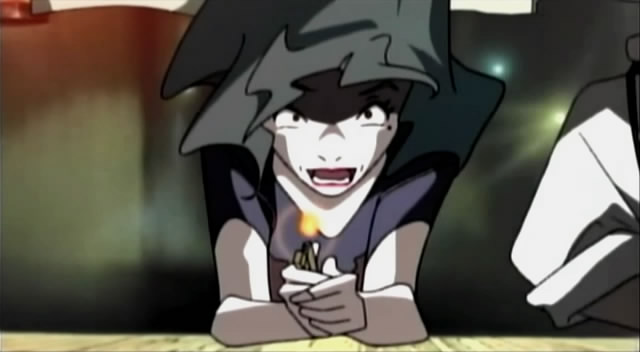
Synopsis: In the future, a group of miscreants are brainwashed into believing they are a family, the footage of them living in an enclosed living environment sold off as reality television. They become popular - Ben, the patriarch of the family who is in on the production itself, eldest daughter and pyromaniac Akiko, baby Michael, obsessed with scissors, violent eldest son Sasuke, mother A-ko, family dog Tamasaburo, and youngest daughter Sae, who speaks through a hand puppet. Unfortunately due to a mistake when the toilet gets blocked, they manage to escape into the real world again and the producers are forced to get them back.

Built from 30 second segments, which make up twenty nine minutes, Eternal Family is an odd proposition for anime marketing nowadays in terms of ever re-releasing it in the West, due to its small length. Yet an area of anime that is neglected, and in dire need of more attention even if it is by MP4 downloads, are experimental anime. Or, in the case of Eternal Family, that which is still pop experimentation but allowing their creators and animators to play and create material that is unconventional from most anime productions. Sometimes these pieces were part of anthologies. And in the last few years the premiers for the annual Japan Animator Expo have been made more easily available online for people to see, allowing new talent and veterans to experiment. Sometimes however these one-offs are released by themselves.

From https://www.animeclick.it/images/
Anime_big/EikyuuKazoku/EikyuuKazoku1.jpg

Studio 4°C
have carved a path for themselves in experimentation and in helping directors like Masaaki Yuasa begin their careers, making a lot of these types of short animation and idiosyncratic productions whilst paying for the bills through working on videogames, music videos and co-productions like the 2011 version of ThunderCats. The man behind Eternal Family, and other projects like Noiseman Sound Insect (1997), is Studio 4°C's co-founder Kōji Morimoto. His most well known work is likely his short for The Animatrix (2003) called Beyond. His most well regarded is his segment for Memories (1995) called Magnetic Rose, the most acclaimed of the three parts, written by the late Satoshi Kon, about a deep space salvage ship who end up trapped on a vessel which infects their memories. His work beyond this, entirely all short form work, is that of someone who likes to make distinct, idiosyncratic experiments which incredible animation. Someone given the keys to make shorts like Eternal Family in the nineties and taking advantage of that fact.

The final result is a combination of great animation, a vibrant and energetic work entirely filtered through very intentionally silly humour. One that should be taken serious in terms of its vibrant animation and colourful aesthetic, a dystopian cityscape of slums and giant electronic billboards with peculiar details, like the employees of the reality television show being dressed like St. Francisco de Xavier or quasi-rabbit costumes. The content itself is entirely ridiculous. You notice the father of this fake family has a sex doll constantly with him, the camera which films the TV show, already showing the tone's tongue in cheek. There is eventually the running gag that his fictitious wife has constipation which is thankfully just ridiculous rather than turning into bad toilet humour. But then the family dog is revealed to be able to balloon in size and throw a bark powerful enough to take out a Dragonball character and you are fully aware this belongs in the camp of surreal comedy anime is very known for. Since animation allows exaggeration and flights of fancy, Eternal Family like many can be as absurd as possible but with the difference that, due to the animation quality, the absurdity comes from the kinetic movement and style rather than gags common in the medium like sweat drops.

In regards to its structure, it was clearly released in segments and the full version does not try to hide this. There is something disarming about the first half all ending on the same flushing toilet shot, but it also evokes the bizarre Cartoon Network and Nickelodeon shorts I grew up with in the nineties. Similar to those experiments in scattergun satire and gross gags, this could have fitted in perfectly if it did not have the few moments of adult humour (or details like Akiko's pyromania, a subplot which is fleshed out with her obsession with a man once in her life connected to setting things on fire). The result is not necessarily high art in story content, but it is compelling as an energetic and fun production which never becomes tiresome. It also manages in such a short amount of time to have a plot with emotional content and progression to it, topping itself in more bizarre content, such as a chicken the family save from eating potentially having connections to an Illuminati group of fellow poultry. As an experiment, particularly in the early days of Studio 4°C it, it sets out and succeeds in its intentions.

From https://4.bp.blogspot.com/-9EFY-8b30nw/V4DZ-AUfndI
/AAAAAAAANHQ/1tGwiob6X5kLpFjKhmyAec
MTEJU_FmmSwCLcB/s1600/eternal-family-anime.png