Showing posts with label Chiaki J. Konaka. Show all posts

Saturday, 24 June 2023

#255: Alice in Cyberland (1996)


Studio: Vega Entertainment (Episode 1); Kyoe Sung Production (Episode 2)

Director: Kazuyoshi Yokota

Screenplay: Chiaki J. Konaka

Based on the videogame by Glams, Inc.

Voice Cast: Yoko Asada as Alice; Kae Araki as Lena; Kikuko Inoue as Rucia; Yūko Miyamura as Juri

Viewed in Japanese with English Subtitles


Once ago we envisioned entering an isolation tank full of water to enter cyberspace, to defeat hackers masquerading as monsters, as explained here in the opening credits animation to this obscure production. Alice in Cyberland in this particular case this is a tie-in to a videogame which came at the same time. With the scenario worked on by Chiaki J. Konaka, better known for his work on Serial Experiments Lain (1998) and The Big O (1999-2003), the game was a Japanese-only adventure game from Glams, Inc., who also co-produced the anime. They have unfortunately not a prolific list of titles under their belt, and I half suspect with the tale of Alice in Cyberland, just in terms of the second of the two episodes having been M.I.A. in existence, that they took a risk at a time where many groups who had never made games jumped onto the original Sony Playstation bandwagon. With the game and anime released in 1996 together, they unfortunately burnt out, not releasing a lot more else barring a couple more games including for the Sega Saturn.

Twenty years into the future, from this anime’s release, and the titular Alice is playing virtual reality games with her female friends. Establishing a multi-media franchise, the first twenty-plus episode cannot do much but establish her, that with an estranged father, she is a stereotypical anime female lead but one with a talent for computers and dealing with hackers. This is useful in a future, for all its technological advancements, that has greater concern from hackers. Ironically it is the second episode, which was once presumed lost as we get into, which explained the context to make sense of all this, that like Serial Experiments Lain, the internet has become a huge entity where people can exist within it as virtual figures, predating the reality of advancing technology in its own exaggerated way and with the potential to be relevant still. In this case, the concern for episode one is cyber-anarchists from Eastern Europe. It is an odd choice, and it does show a cartoonish air to it, where in causing anarchy to important technology in Japan, they are focused on sabotaging school pools by hacking the disinfecting system for the water, and playing music through people’s headphones to cause violent memory erasing amnesia. The other clear influence on this is clear as a magical girl story, only with an internet theme, so there is an air of complete fantasy to this premise still, trying to make a version of this genre that is decades old into a new era of technology.

There is a virtue to this, where we can literalize cybercrimes with a data eating tentacle monster, alongside providing me with my favorite trope of surreal unearthly worlds the protagonists are sucked into. With its title this is nodding to Alice in Wonderland, the later aspect could have been embraced further, as Alice has received emails from a mysterious figure name Lucia who comes to her aid and provides her the ability to freely enter Cyberland, emphasizing this as a more cartoonish take on the subject than the metaphorical and abstract nature of Serial Experiments Lain’ symbology. As with a lot of anime, it is a premise that has a lot of promised, its take on the magical girl genre of its time, especially with the crowbarring of terms like “disinfection sword” to combine the two, but lovable as an idea. Even in a work which does have fan service, such as the female leads looking like their idealized and most attractive ideals in the online world, it also has a cool female lead as for all her goofball moments this is a very smart and computer savvy protagonist able to get the hints to snoop after cyberhackers, which is progressive in its own way back at a time when the internet was a new and exciting concept alongside virtual reality in the west and the east.

It is however a teaser, which means a lot was left off the table, particularly as in the version I was able to see. Alongside the goofier slapstick in the game cut scenes you see previewing the other part of this production, there are preview to other Glams Inc. games including for the Saturn, emphasizing this anime was always going to be an advertisement for the game. It is here that there was also the issue that the second episode, previewed too, was not readily available to see. Only really becoming available online from October 20211, you become aware that something went very wrong with the production of this anime for the worse, not surprising as Glams. Inc has very few releases after this period in the videogame console generation. (According to Chiaki Konaka himself, they even went bankrupt2). The first episode is nicely animated, with original character designs by Daisuke Moriyama, the author of the original Chrno Crusade manga later adapted into the 2003 series from Gonzo. At first nothing is seemingly amiss with the second episode, starting with how episode 1 ends with repeated footage, and explaining a lot of the context of the world, only to reach its first original scene and everything to be clear. The production dropped in a way I have not seen barring some of the most notoriously disregarded anime I have gone out of my way to see.

Knowing how the later episode was seemingly lost to time, that likely explains why it has not gained the infamy for its animation quality. Starting with the amusingly dark opening where, at a children’s fantasy zone, a figure is deleting anything in his path and traumatizing them online, with no pink dragon or princess safe from disintegration, soon my attention was drawn to the animation quality even in terms of the faces of the leads being differently drawn. Animation faults, especially TV series where one has to get the episodes done quickly, have existed with similar issues, of less than stellar depictions of characters’ face, like they are melting off their necks, and the artistic quality visibly having to take shortcuts, which are usually not this frequent and are removed in the modern day for physical media releases. With absolutely respect for the animators on this, it is obvious that this was a) rushed and/or b) undermined by an unfortunate production disaster, neither helped that this is a promise of a story that is slight. There was a prominent change between two different studios for animation production between episodes; episode one was by Vega Entertainment, whose most prominent work is throughout the Doraemon franchise, a huge one in its homeland, but even with the second company hired for the second episode, Kyoe Sung Production has a prolific career into the decades afterwards3. It instead offers the sense that, having to help finish the second episode, no one is to blame but an unfortunate circumstance where people were forced to produce and release a final episode with this level of quality to it.  

With both written by Chiaki Konaka, the second episode still offers a fascinating premise, of artificial intelligence being able to blend in with humans, but with the danger that this one can replicate infinitely and will need to be deleted to prevent significant damage to cyberspace, even if through a potential skuzzy premise of a young boy one of the secondary female leads is smitten with. Alongside the sense of this being a dry run for Konaka to take this premise further, and that the ideas are simplified here through a monster of the week scenario, thus preventing it from getting more elaborate, the drop in animation quality is so surprising it undercuts the interesting ideas. Even if you do get a giant talking turtle, which is funny especially as it is a nonchalant and rude programmer named Bill in disguise online, few would get past however pointless the episode is by its end, and how you cannot get pass the quality drop in production to the first episode.

The one lasting legacy to Alice is Cyberland is the tantalizing realization this was a predecessor to Serial Experiments Lain itself directly. There were plans for a sequel to the video game with Chiaki Konaka2 which never came to be, but alongside Serial Expeiments Lain coming in its place, the protagonists of Alice in Cyberland returned in an entirely different context. There is an Alice Mizuki, one of the main characters, also voiced by Yoko Asada who plays the original Alice, in Lain as an important character to the titular lead, alongside a Juri and Reika like the two other female leads from the older work in other roles.  It is a lovely discovery that this forgotten production, the game and the anime, managed to relive again as clearly Konaka found something he wanted to push with the premise. Serial Expeirments Lain, whilst of its era, has lasted as a relevant and startling series that has lasted, whilst Alice in Cyberland is a fascinating nineties obscurity. The production problems with episode two are tragic, but even that raises so many questions to what happened to Glams, Inc., one of the many who came at both a fascinating time in Japanese videogames and in the anime industry only to disappear so quickly afterwards. Their tale would be fascinating to learn far more of, but what we got at least was this curiosity.


========

1) Quoted from the review of Alice in Cyberland, published originally on September 2nd 2018, from the blog Collectr's Blog and one of its later blog revision updates:

“Update October, 2021: the complete Alice in Cyberland TV broadcast showed up on YouTube, episode 2 intact. The quality is not as good as the laserdisc, but it's good enough. Now to find a translator...”

2) From the page on Alice in Cyberland 2 Seventh Protocol, from Chiaki J. Konaka's site on his career, Alice 6, written 2nd September 1999. It mentions as well that that subtitle “The 7th Protocol” was inherited by Serial Experiments Lain, which does indeed connect the two, as it becomes “Protocol 7”, a key McGuffin to the narrative.

3) Anime News Network’s page on Alice in Cyberland, which is the encyclopedic page for the anime to refer to been two animation production studios on the project, Vega Entertainment for episode 1 and Kyoe Sung Production for episode 2.

Sunday, 2 October 2022

#225: Ayakashi - Samurai Horror Tales (2006)


Studio: Toei Animation

Directors: Hidehiko Kadota and Kouzou Nagayama (Tenshu Monogatari); Tetsuo Imazawa (Yotsuya Kaidan); Kenji Nakamura (Bakeneko)

Screenplays: Yuuji Sakamoto (Tenshu Monogatari); Chiaki J. Konaka (Yotsuya Kaidan); Michiko Yokote (Bakeneko)

Tenshu Monogatari adapted from the drama by Kyōka Izumi; Yotsuya Kaidan adapted from the play by Nanboku Tsuruya IV

Voice Actors:

a) Tenshu Monogatari

Hikaru Midorikawa / Kirby Morrow as Zushonosuke Himekawa; Houko Kuwashima / Willow Johnson as Tomi Hime;  Saeko Chiba / Tracey Power as Oshizu;  Yui Kano / Anna Cummer as Ominaeshi; Kappei Yamaguchi / Alec Willows as Kaikaimaru; Masaya Onosaka / Samuel Vincent as Kikimaru

Yotsuya Kaidan

Hiroaki Hirata / Brian Dobson as Iemon Tamiya; Mami Koyama / Nicole Oliver as Oiwa Tamiya;  Yūko Nagashima / Rebecca Shoichet as Osode Yotsuya; Keiichi Sonobe / Samuel Vincent as Gonbei Naosuke; Ryō Hirohashi / Lalainia Lindbjerg as Oume Ito; Wataru Takagi / Michael Adamthwaite as Yomoshichi Sato

Bake Neko

Takahiro Sakurai / Andrew Francis as Kusuriuri the Medicine Seller; Yukana / Kelly Sheridan as Kayo;  Tetsu Inada / Trevor Devall as Odajima; Chikao Ohtsuka / Scott McNeil as Clan Lord Yoshiyuki; Naoki Tatsuta / Paul Dobson as Lord Yoshikuni; Seiji Sasaki / John Novak as Lord Yoshiaki; Yōko Sōmi / Alison Matthews as Lady Mizue; Kozue Kamada / Tabitha St. Germain as Lady Mao; Yuu Shimaka / Ken Kramer as Katsuyama; Eiji Takemoto / Andrew Kavadas as Sasaoka; Yurika Hino / Tabitha St. Germain as Miss Sato; Kiyonobu Suzuki / Trevor Devall as Yahei

Viewed in Japanese with English Subtitles


Commissioned for Fuji TV's Noitamina block, highly regarded for its artistically and narratively different anime shows - where Masaaki Yuasa's The Tatami Galaxy (2010) or Princess Jellyfish (2010) came from - Ayakashi: Samurai Horror Tales befits the slot early in its existence, as it is three different horror tales between three to four episodes, of period set folktales and yōkai I am fascinated by. Two of the three are adapting classic authors for their tales too, adding to this an air of artistry, and even when the Noitamina started over the decades, from their 2005 inception to step away from a stereotypical young male target audience, to have more action and pulpier productions, this was not a bad thing either. This has led to shows like Samurai Flamenco (2013-14), and  with well regarded productions like The Promised Neverland (2019-2020) getting popular, the block can still claim respect for producing some of the best and most interesting in animated television series. My interest in Samurai Horror Tales beyond just horror anime would have been cemented by its connection to Mononoke (2007), another Noitamina block member and one of the most unique looking series of any genre, having been a spin-off from of the Ayakashi stories itself not based on a classic tale.

The three tales are very straightforward in what they are about, each taking very different directions to how to tell them however. Depending on how you watch this, the Discotek Blu Ray release, released on October 29th 20191, oddly has it that you can watch the second story's episodes, for Tenshu Monogatari, first before the others, but the structure was set up for broadcast as Yotsuya Kaidan (four episodes), Tenshu Monogatari (four episodes), and Bakeneko (three episodes). Going by how I had watched this, Tenshu Monogatari as the first watched is a supernatural melodrama, adapted from a drama by Kyōka Izumi. Izumi was a prolific novelist, dramatist and writer, who I am aware of for Demon Pond. It is a play even one of my favourite filmmakers Takashi Miike, in one of his many idiosyncratic leaps into any type of filmmaking he has wanted to try, tried his hand at filming, in a very good 2005 theatrical production he recorded, based on a Keishi Nagatsuka re-adaptation of the source material. It is a work too also adapted to cinema by Masahiro Shinoda in 1979.

In Tenshu Monogatari, a falconer named Zushonosuke, thanks to his evil feudal lord, has to retrieve a prized falcon only to find a mansion of forgotten gods, housing all women who as immortal beings, figures who succumb to hunger and consume the life force of any mortals who wander there. One, Tomi Hime, starts to fall for him, which has the issue that the more she is drawn to humanity, that will mean she loses her immortality, which is sadly also infectious to everyone else there in the mansion. The evil lord eventually catches wind of this, which leads to him sending his soldiers to take the mansion by the final episode, a tragedy of figures doomed to love each other despite them being different entities, or that at home Zushonosuke has a fiancée named Oshizu who is naturally heartbroken by all of this, becoming involved. This is the most conventional of the three narratives, but as a bittersweet story, that in itself is a curveball. It still has a ghoulish edge, and there is the fact that there are two monsters as a comedy duo and Greek chorus, two thieves who only help Zushonosuke out to steal from the mansion if they can. 


All the stories have their own distinct looks. Also of note is that, throughout the series, they have their own opening credits, with their own visual motifs and designs, even if they all have the same opening theme song. It is probably the least expected in such a context, HEAT ISLAND by Rhymester, a hip hop song with backing by a koto, a traditional Japanese string instrument, which is as strange as that songs but is yet an inspired choice, befitting a production which is idiosyncratic. It befits how, whilst Tenshu Monogatari is a very emotional drama at its heart, even the traditional ghost story, Yotsuya Kaidan, is not conventionally told at all, all the narratives here standing out with their idiosyncrasies. All the stories have their own authors, Tenshu Monogatari's Yuuji Sakamoto, who only has that one credit in their career strangely, Michiko Yokote for Bakeneko someone we will get to for that story later in the review, and a figure I know very well for Yotsuya Kaidan, Chiaki J. Konaka.

Konaka, someone I admired for his work, sadly has to be taken now by me as a fan with a pinch of salt in recent years. A divisive screenwriter for how obtuse he could be, from Serial Experiments Lain (1998) to one of the strangest narrative arches of Mononoke itself, I admire how esoteric and experimental his work is, even when, such as a live action film like Evil Dead Trap 2 (1992), figuring out what is transpiring and in what reality can be lost entirely even on multiple viewings. For a live reading of a script for Digimon Tamers, a follow up to the show that many of us (including myself) saw episodes of as a kid, he had a villain, which took on the form of "Political Correctness," that threatens the real and digital worlds, and had a special attack called "Cancel Culture"1. Thankfully nothing from this raised concerns of far greater and more problematic ideas he has had, but at a time where his own personal blog expressed questioning views on COVID-19's reporting in worldwide news2, sadly it did paint a picture for me of someone undermining himself when, if brutal to say, his work in screenwriting usually, even if frustrated viewers, was a lot more nuanced even with some of his hardest the grasp scripts in anime storytelling. When watching Yotsuya Kaidan even this came up here, as this is a really meta and clever retelling of the titular tale, which feels alien in comparison, originally written as a kabuki play by Tsuruya Nanboku IV, as Tōkaidō Yotsiya Kaidan, which becomes a story in itself as this version tells.

Nanboku himself is the narrator, and the play itself, as much as a new retelling here, is the subject. The story itself is about a woman Oiwa who, when her husband, Iemon Tamiya, is complicit in a poison she is given, which disfigures half of her face, and the disposal of her body after her death, taking revenge on him from the grave Iemon Tamiya is already established as a unscrupulous rōnin, who even killed Oiwa's father, pretending bandits had done so, to win her hand in marraige, before another woman wished him for her own and concocted the plan to disfigure and disgrace her. This is a morbid melodrama, where there is also her sister-in-law, lied to in a deceit by another man who kills her suitor and pretends bandits also did it, and the story takes on additional angst and wrought drama with its betrayals, seductions and heartbreaks. Konaka's take goes further in how the finale becomes Kaidan's lasting legacy, Tsuruya Nanboku IV revealed to have passed his mortal form and existing in an afterlife on the Earth, considering his story and how it has lasted in Japanese popular culture, even developing a curse around the plan where people adapting it have been maimed or even killed. Were it not for a certain tale coming afterwards which is clearly the gem of this entire anthology, I would hold this as a perfect piece in itself worth seeing. All three are, and Yotsuya Kaidan does feel like a perfect retelling of folklore in dissecting the text, something also for me to show Chiaki J. Konaka as a talented writer even if the real man stumbles in some bad ideas too in his thought process.

However it was Bakeneko which became a spin-off show in itself own right, and alongside that spin-off Mononoke, no anime looks and feels tonally like this these stories about a mysterious "Medicine Seller" at all. Bakeneko, alongside its distinct art style and character designs by Takashi Hashimoto, looks like it was illustrated on glossy waxed paper, done with digital animation as I aware of with Mononoke, but absolutely distinct in its composition. It is a horror story which yet uses bright colours, has a precise use of environment design (patterns, illustrations, even setting out locations), and where, clearly indebted to art styles from Japanese history, such as Japanese woodblock prints, it brings it into the modern era as a digitally animated production in movement. Even in mind that the series got Yoshitaka Amano to do the original character designs for Yotsuya Kaidan, and have his illustrations on the opening credits for that tale, one of the most iconic designers in anime and light novels who an acclaimed artist outside of the mediums, Bakeneko is an artistic masterpiece just in appearance, even in mind that this is a prototype to what became Mononoke the series.

It is also, with fair warning, a bleaker narrative than Mononoke could get, bearing in mind that the later series tackled heavy subjects, its first arch surrounding the ghosts of aborted foetuses of brothel workers. It says a lot in context however that Bakeneko manages to have the bleakest narrative of this world, introducing us here to the Medicine Seller, a figure here and in the later series whose job is exorcise demons, a magic sword on his person (alongside other tools) which can only be open when three criteria explaining the entity's existence come to light. A bride is killed on her wedding day in a proud samurai clan, and whilst suspicion comes on him, the Medicine Seller is quickly the only person able to deal with the problem, the Bekeneko. This is a "goblin cat", cats of supernatural form in Japanese mythology which are not necessarily as extreme as this, a monster claiming vengeance, but symbolically meaningful here with the context. This story will be uncomfortable for some, so fair warning is recommended, as this is the case as was in Mononoke that, as the truth and cause of the demon is revealed, it involves showing up the wrongs of human beings, alongside this explicitly dealing with how people lie, forget details or view it in a different perspective. Michiko Yokote was the screenwriter for this story, and whilst multiple writers all contributed good work to Mononoke, Chiaki J. Konaka, this is a great time, with the virtues she shows here, to praise Yokote. She is not someone I have frequently encountered, but I am aware of her, whilst not the only screenwriting contributor, for series composition, the person putting everything narratively together, for Princess Tutu (2002-3), an exceptional and unique fantasy tale about around ballet and fairy tales that, again with Konaka getting briefly involved, was a meta-text on fairy tales which was also a beautiful gem. Here, dealing with an incredibly umcomfortable subject exceptionally at the heart of this tale, the only not adapted from another source, I see another example of her talent.

And that is true as a warning for anyone interest. [Major Spoiler Warning] The cause of the bekeneko here is that the samurai patriarch kidnapped a woman, kept her in a cage as a sexual object, a peasant girl who was raped, beaten and left to starve to death, which is as grim a narrative reveal, too real for some, to consider. [Major Spoiler Warning]. All three tales to their virtue, but especially Bekeneko, show why I came to love these type of horror anime about folklore and figures like the Medicine Seller, stepping in to resolve supernatural entities, as they become morality tales and dramas with one-off characters, examinations of human beings which the Bekeneko pulls no punches in. Among them, for its artistic innovations, and how impactful the narrative in its centre is, clearly Bakeneko is the masterpiece of the entire set, though it is to the credit of the three tales altogether that they all succeed.


====

1) Discotek Media's announcement of Ayakashi: Samurai Horror Tales, dated on Facebook on August 13th 2019.

2) Digimon Tamers Writer Chiaki J. Konaka Responds to Overseas Backlash Over 20th Anniversary Stage Play, written by Kim Morrissy for Anime News Network, dated August 9th 2021.

Friday, 17 January 2020

#131: Parasite Dolls (2003)


Director: Kazuto Nakazawa, Naoyuki Yoshinaga and Yasuhiro Geshi
Screenplay: Chiaki J. Konaka and Kazuto Nakazawa
Voice Cast: Akemi Okamura as Michaelson; Kazuhiko Inoue as Buzz; Soumei Uchida as Kimbell; Kikuko Inoue as Angel; Masaru Ikeda as Takahashi; Toshio Furukawa as Myer
Viewed in Japanese with English Subtitles

I like Chiaki J. Konaka, the divisive screenwriter of a lot of anime, and it is of immediate interest that he worked on the following project. The other figure of note, whilst there are three directors, is Kazuto Nakazawa. Nakazawa is the director who worked on Kill Bill Vol. 1 (2003) no less, the man responsible for the animated back story of the character O-Ren when Quentin Tarantino literally knocked on Production I.G,'s door, probably one of the biggest hit points in anime's mainstream popularity, alongside animating the video for Breaking the Habit, the Linkin Park song whose video was a mainstray of my childhood watching Kerrang television in the early 2000s. Parasite Dolls is also another interpretation of Bubblegum Crisis (1987-1991), a big popular OVA series (in spite of the fact its planned run was cancelled) that got quite a few follow ons At this point with Parasite Dolls, there was the very badly regarded sequel Bubblegum Crash (1991-2), A.D. Police Files (1990) which we will get to in a moment, and two parts of a reboot, Bubblegum Crisis Tokyo 2040 (1998-9) which Konaka wrote, and A.D. Police: To Protect and Serve (1999), another TV series.

A.D. Police Files, the 1990 OVA, is appropriate to talk about here. That title had none of the main cast, a group of women armed with power suits, and was a prequel entirely about the AD Police, set up to deal with malfunctioning robots named Boomers in a world of futuristic Neo-Tokyo where they are mass produced for everything from manual work to even paid sex. It was a dark, violent and seedy OVA, one I have grown to admire in spite of its problematic gender politics because of its style, the three stories told as the dark cyberpunk side of the world where cybernetic implants and robots are commonplace in a rundown metropolis, and an eighties J-pop soundtrack which is endlessly listenable because of how moody it is. For two thirds of Parasite Dolls, you get something trying for this again. Something lurid but still attempting a very thoughtful piece, arguably more so then A.D. Police Files which came from the tail end of lurid eighties OVAs.


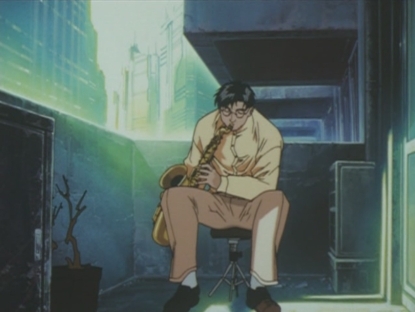
It does have the stereotype of the grizzled old veteran in just his late thirties, who never carries a gun and even plays a saxophone, which presents something a bit absurd to begin with, but for the first thirty minute episode, we get a fascinating snapshot of this world. This is a rundown city, drastically contrasted by the rich being behind dubious behaviour, be it the company behind the Boomers secretly covering up malfunctioned creations, to a dark pleasure to connect to Boomers on a rampage directly through the brain as part of a nude orgy. Building from this, side characters of interest are there, the naive but tough female or the lead's partner, a Boomer on the force whose attempts to gain semblance of human freewill make him a pretty good cop and an immediately rewarding figure to follow.

The style of the OVA is interesting, a very distinct one, matched by an incredibly rewarding soundtrack which immediately caught my attention. The depiction of Neo-Tokyo is not as sordid as A.D. Police Files, Parasite Dolls instead coming from a curious period where the OVA would diminish completely baring as tie-ins to other productions or porn. It's a handsome creation nonetheless, which is definitely felt in episode two when there are more unconventional aspects to consider, about a being killing female sex boomers. Ironically A.D. Police Files had a similar storyline about someone targeting human female sex workers, whilst this take is the episode where the virtues of Parasite Dolls appear, following the female lead and getting into both grotesque horror (the boomer sex worker killer) and weirdness as [Huge Spoiler] I keep coming across titles which teach viewers to distrust cats completely.

Episode Three, the finale one, takes a sudden and surprising direction where all hell breaks loose. This is not glib either, as it immediately gets darker than the other episodes just from the opening where an anti-Boomer fanatic is having sex with one in front of his cult and a corrupt police officer, monologuing only to then blow the poor robot's head off mid coitus and then talk of how they are just machines next to humans, proving this by shooting a young minion in the knee. This episode will eventually lead to most of Neo-Tokyo blown up, with most of the cast dead and a cultural shockwave to permanently scar the world. It would, in a full length Bubblegum Crisis film or series, be jaw dropping and an incredible conclusion.


Here however I have to confess, hiding this until now when I pull the rug under Parasite Doll's legs, I went from having an energy rush from just sitting through the three OVA episodes, thinking it was a forgotten gem, only for it to dissipate in my mind only a few days after. I entirely blame the finale, not its existence but that there's barely any build up to it and that the production shot itself in the legs by only having three episodes and not enough time to make this work. Characters we barely see die and little is witnessed, squandering a lot. That the episodes are only less than thirty minutes each, like a TV series, doesn't help as, more common later on, older OVAs like A.D. Police Files had over forty minutes per its three episodes alongside just being vignettes of separate stories in the same world, having a better effect as a result.  

Whilst I appreciate the technical quality of this anime, I don't feel the enthusiasm. The other thing is that, whilst I applaud the chutzpah with the ending episode destroying the world of a beloved franchise, I find this surprisingly normal for Chiaki J. Konaka. Disappointingly so as one of the few people who love his abstract leaps, which is also why Episode 2 is the best episode of Parasite Dolls, closer to his trademarks whilst taking from this franchise in its bizarreness (a bio-robot death machine), cerebralness (can a female robot have a personality?) in very little time to work with, and abstracting as said Boomer is haunted by a female ghost child.

It sucks how Parasite Dolls is affected by its own slightness as, if it had been longer, every episode here would work and the ending would be perfect. But as it stands, this does become an example of style over substance in a bad way, as there would've been a lot more to appreciate if we had actually gotten enough time for this material, where even the lead not carrying a gun is a reference to a tragic back-story which is abruptly included in at the end, rather than naturally introduced. The lack of balance between what wants to be a serious cyberpunk story and the presentation, which would've been more successful if it had just been an action work, is felt immensely. That this is the last Bubblegum Crisis animated production also adds a sadness in that, whilst I have somehow only seen the spin-offs, that original OVA series was popular. Of the time, as eighties as you could get, but one you'd think would get reboots. A work like Parasite Dolls might've been frankly too controversial, as there's nothing in the original premise here, but it was an attempt at brining the material to the new decade even if it has big problems structurally. Only an anniversary celebration or a drastic reboot coming to be might be the only way we get anything new.


Saturday, 22 June 2019

#105: Serial Experiments Lain (1998)

From https://image.tmdb.org/t/p/w500_and_h282_face/
oM55x1xvdqfW9rJ48Dl7wEkBPC9.jpg


Director: Ryutaro Nakamura
Screenplay: Chiaki J. Konaka
Voice Cast: Ayako Kawasumi as Mika Iwakura; Rei Igarashi as Miho Iwakura; Ryunosuke Ohbayashi as Yasuo Iwakura; Yoko Asada as Alice Mizuki
Viewed in Japanese with English Subtitles

When Neon Genesis Evangelion (1995) became a massive cultural supernova, including its 1997 theatrical alternative ending End of Evangelion, there were many attempts to ride its coat tails in terms of more adult anime. There were many attempts at an "Evangelion Killer", mecha shows which tried to follow varying from highly regarded work like RahXephon (2002) to failures like Brain Powrd (1998). The other aspect about Evangelion is that it almost became a giant flag held aloft for more unconventional and experimental anime television series to appear even if it never had any direct influence. Certainly though, between the controversies surrounding some of Evangelion's content and that, in the last half, Hideaki Anno's known personal and mental health issues were literally leading to episodes using line drawings, the fact Envangelion actually succeeded rather than crashed and burned would've allowed braver work to appear more easily if other production companies wondered if there was now a market to start creating them. Certainly experimental OVAs and theatrical films existed, but in terms of television series before Evangelion? A question to consider, mainly due to the difficult in watching every show that came before and after Evangelion to plot out a history, especially as under its shadow into the modern day, there's been many odd and bold creative works in existence even in micro-series comedies that have appeared. One of the earliest to appear immediately after Evangelion, which can be confirmed, was the cerebral sci-fi series Serial Experiments Lain, which still has a warm reputation in the West to this day.

Lain's story is incredibly relevant in the 2010s, amazingly prescient on issues we are coming to terms with about the internet and the potential existential and sociological problems with it, all in mind that whilst the internet is briefly references, this exists in a world where it's been replaced with the Navi instead of computers and its own form of the internet called the "Wired". Thankfully, this means, regardless of visual details, there's no concern of this having dated anyway since the technology already looked alien to any world and the ideas are of greater concern. It helps, from this, the series never tried to create an accurate vision of the future, instead looking at the fears and concerns of this machinery even in terms of spirituality as we follow the titular Lain, a teenage girl stuck in perpetual childishness at first and utterly computer illiterate until she and the girls in her class start getting texts from a classmate who had commit suicide previously. As she becomes obsessed with the Wired, head screenwriter Chiaki J. Konaka nosedives as she does into a world of philosophy, a potential God on the Wired communicating to her, and some sobering and accurate predictions on concerns we are getting to twenty plus years later from Serial Experiments Lain.

Identity theft and the obscurity the web allows? Lain finds there's an alternative version of herself online who is much bolder and even evil. Data security and personal information being compromised? Said version of Lain leads to Lain herself being accused as a peeping tom at school. Secret online groups and computer hacking? The Knights of Eastern Calculus, eerily similar to the semi-fictional organisation of expert Lisp and Scheme hackers called the Knights of the Lambda Calculus, a hacking group who will even lead people to being harmed or maimed by attacking any technology, such as traffic light systems to blurring a children's tag game with a shooter, who want to break the barrier between the "Real" World and the digital one. Existentialism and post-humanism? The idea some individuals want to evolve human beings to leave their bodies and becoming permanent consciousnesses online. Hell, throw in conspiracy theories in general too, though the only weird detail, which is weird and the only one which dates the series to back when the nineties run of The X-Files was, is where the hell the cameo by a literal green alien came from in Konaka's mind.

Lain as a series does eventually become esoteric; at first, it skims the waters of horror so much it feels like it's going to become a permanent resident, with literal phantoms haunting Lain even in the day and the telephone lines bleeding. It also emphasises how good the show was aesthetically. Now, probably the biggest surprise for me returning was that, having always been available on DVD through MVM, the original version was incredibly muddy in hindsight to the point it added to the mood, leaving the experience of seeing this thirteen episode series again on a recent restoration looking like a brand new work. Its emphasised how even on a television budget the production took its potential restrictions as an advantage, boldness in its natural look contrasting heightened colour and lighting choices. Of note too, more pertinent now in comparison to each other, the character designer is Yoshitoshi ABe, creator of the original dōjinshi of Haibane Renmei, adapted into a 2002 anime which also feels like it's in the shadow of Evangelion in terms of very creative and utterly unique animated television, a very unconventional afterlife parable with the same muted style and slow burn pace Serial Experiments Lain has1.

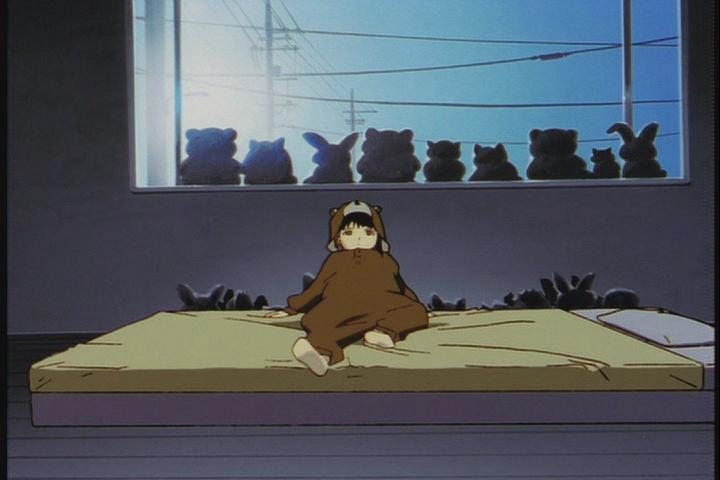
Again, as I've rightly remembered for years, the first few episodes feel like sci-fi horror, the images of humming electrical wires and the sense of desolate streets even in ordinary busy Japanese streets evoking what Kiyoshi Kurosawa would later go with for Pulse (2001). Contrast this with the night time scenes, with heavy neon green lighting, or the increasing influence of the computer technology through the plot, even turning into an almost bio-mechanical entity in Lain's bedroom, the floor wet in coolant, covering the entire room where once she still had plush toys everywhere. The world of the Wired is just as distinct and strange, metaphor and symbolically doing its best to perfectly imaging  an internet chatroom by representing gossiping avatars by being merely lips or eyes, or how in fear of others taking her identity, the same figures have mannequin heads of Lain on their shoulders in a darkened room in cyberspace. In knowledge that in this world, Lain herself practically enters the Wired beyond symbolic meaning, these literal visitations around unique environments are as much there to get to Chiaki J. Konaka's obsession with constantly breaking reality into pieces in most of what he writes, he both notorious and distinct in how the literal and the metaphorical are deliberately blurred in his work even for live action films like Evil Dead Trap 2 (1991); even for a children's show like Princess Tutu (2002) about ballet and fairy tales, when it gets to an inter-dimensional clockwork world where the "author" of the show exists, you can tell which episode Konaka was writing among other script writers when it's the one with the most meta and unconventional philosophy even if the target demographic was kids first.  

From https://i.imgur.com/a6PYSkO.jpg

Sound is also of importance, and not just for the inspired choice of a song by a British band on the opening credits, Bôa given a lasting cult reputation just from anime fans who had their song ] become an earworm, but on the emphasis too on sound design that crawls under the skin. It's completely comparable to Boogiepop Phantom (2000), another highly experimental show fromn this era, between them offering nuisance noise and electronic effects.

[Major Spoiler Warning]

As mentioned, this series is from Konaka, an incredibly divisive screenwriter who leads Lain to becoming difficult at points, early into the series shattering reality when even a giant deity like Lain, to her own surprise, appears up in the clouds for children to stare up to. Later episodes get into even arguments about the existence of God, an entire episode on intermingling real history of the internet and the likes of Project Xanadu with UFO conspiracy and the introduction of "Deus", a figure (Eiri) formerly human who has become a self proclaimed God of the Wired, and one episode (Infornography) whose first half if a compilation of images from previous episodes, all to represent Lain downloading an entire Navi system into her own brain, matched by a guitar riff you could grow a mullet from. Probably the biggest factor, though, which might divide viewers, is when Lain is shown not to merely by an ordinary character, who is brought into these strange events, but is part of a character arch of a unique one-off figure rediscovering her own abilities, a being (possibly through an ESP experiment talked of halfway through) capable of going beyond the Wired to actual God-like abilities. This is controversial as a plot point as, as shown in the worst examples of modern franchise blockbusters in fact, it does limit the connectability of the story from the viewer. I feel however that, especially as the first few episodes feel random, the narrowing of the narrative not only helps the show and but, as it focuses on specific characters, the real virtue of the characterisation appears.

[Spoilers End]

Another thing I forgot, for all its esoteric and eerie shenanigans, was how emotional the show eventually is. Here I admit, for its entire cool atmosphere, and general sense of complete strangeness, actually the real virtue turns out to be the bitter-sweet tale of Lain trying to find happiness. Only close to Alice Mizuki, a school friend, her isolation in the world and how attempt to grow on the Wired (literally) is fraught with further isolation, here a tale which does anchor the entire series with a greater meaning. All the philosophy is weighted ultimately by how as much it connects to her too, evoked when rather than the usual opening before the credits (a male voice over text) she opens the final episode talking directly to us about whether she actually exists or not. All the eccentricities are softened by how utterly emotional the show finally is within the final scenes.

This means Serial Experiments Lain earns its pretensions. Chiaki J. Konaka is notorious for his clear hatred for conventional linear storytelling, but there is so much about the dangers of the physical world against the digital one which have become ever more salient. It also makes sure the characters are of interest around Lain too. Her family, very disconnected, are so for a reason and builds itself to one single scene of emotional resonance; even two men in black, with cybernetic eyeglasses which stalk outside her house, get personalities and enough humanity to why they are there that their fate as everything turns pear shape is significant. That's ultimately, upon returning to this show, why I still love Serial Experiments Lain.

I once, on the first viewing, dismissed it with the same misguidedness I dismissed Boogiepop Phantom, another of these bold and innovative works from under the shadow of Neon Genesis Evangelion. Second time, many years later, it was the surreal and unconventional tone, on the borderline to horror and sci-fi, completely introspective and psychological, which won out. Now, this is in mind still but the drama is all what's left at the end and actually touching in the end. Certainly for me, when you start most series, you should hope for a progression where the final episode is that you'd never expect it to end as from just the first episode, said progression felt throughout natural or at least an escalation in drama, emotional and/or spectracle. Certainly, with Lain this is as good as you could get with this natural progression.

From https://ilarge.lisimg.com/image/754723/
740full-serial-experiments-lain-screenshot.jpg

=====
1) It would be an utter disservice not to mention producer Yasuyuki Ueda, who helped put together this show knowing the risk. He produced Lain, Haibane Renmei (working with Yoshitoshi ABe a lot), and a lot of work between the experimental to more adult, from Texhnolyze (2003) to Hellsing Ultimate (2006), that have been pretty well regarded and even successful.

Monday, 10 September 2018

#67: Princess Tutu (2002-3)

From https://cdn.animenewsnetwork.com/thumbnails/crop900x350/
video/category/410/key_art_princess_tutu.jpg


Director: Junichi Sato (Chief Director), Shogo Koumoto (Series Director)
Screenplay: Chiaki J. Konaka, Mamiko Ikeda, Michiko Yokote, Rika Nakase, Takuya Satō
Voice Actors: Nanae Katou as Duck/Princess Tutu, Nana Mizuki as Rue, Naoki Yanagi as Mythos, Takahiro Sakurai as Fakir, Akiko Hiramatsu as Edel, Erino Hazuki as Uzura, Kyōko Kishida as The Narrator, Noboru Mitani as Drosselmeyer, Sachi Matsumoto as Pike
Viewed in Japanese with English Subtitles

Synopsis: In a fairytale town, a storywriter named Drosselmeyer, even after death, strives forward to complete the tale of the Prince and the Crow in real life. The original story, so far, had the evil crow defeated by at the cost of the Prince sacrificing his heart, shattering it into pieces and as a result losing his emotions. Becoming the emotionless Mythos, he is warded around the ballet school by Fakir, a very protective confidant, and Rue, the girl who loves him. There is also Duck, a literal duck Drosselmeyer turned into a girl with a magical necklace, one which also allows her to become Princess Tutu, a magical figure with the sole intention of recapture all of Mythos' heart shards for him.

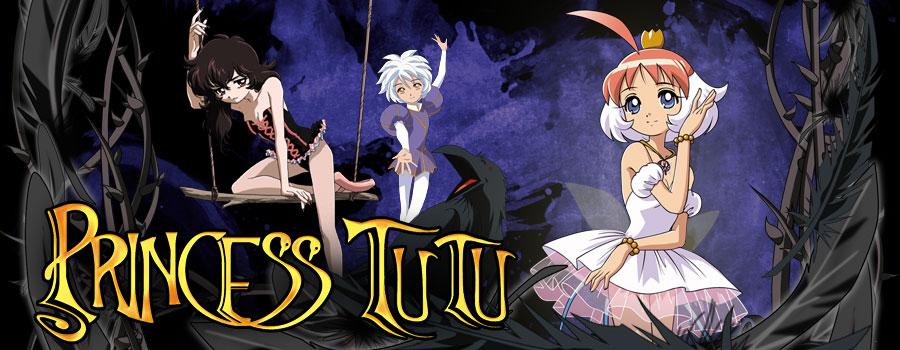
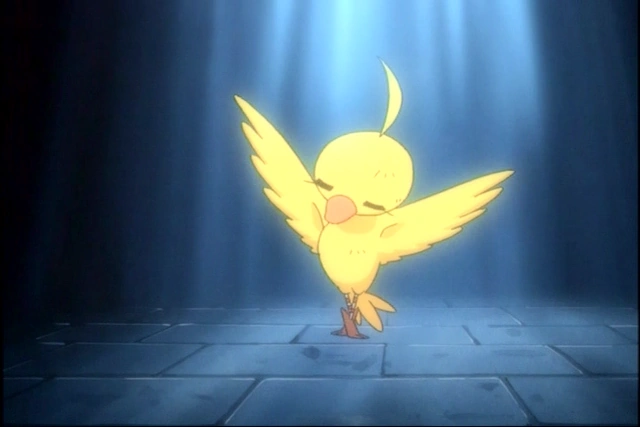
The best way to describe Princess Tutu? Magical. An obvious comment but in awareness that head writer of the two season series Michiko Yokote first came up with her premise of a fairy tale, a tribute to ballet with a girl who was once a duck, long before the series finally came to be in 2002. Encompassing ballet and fairytales, it explicitly references countless examples of both in plot and music, even referencing material outside of them like A Midnight Summer's Dream. Even Drosselmeyer, the mysterious old man beyond death living in a clockwork filled netherworld, is named after a character in the Nutcracker. As a result, its innately a commentary on itself, of these characters and this material because of all these reference, as much as it is  a sweet fantasy series of the age and gender of the viewer. Thankfully, ultimately why Princess Tutu is an underrated gem from the 2000s which deserves wider recognition, what could've gone up its own navel with trite meta commentary is more interesting than that. Instead it's a proper fairytale heard many times before, only the crux being a tale of when these characters realise their positions in the story and overcoming the archetypes they were initially written as.

From http://4.bp.blogspot.com/-KligJQXnjVs/VLL7vuq8THI/
AAAAAAAACDY/KBBisBJ-Ots/s1600/tAG_1097.jpg

Bright, elegant and using very recognisable classical pieces -  segments from Swan Lake appear in most of the episodes especially as Duck becomes a white swan in the opening credit sequence for every episode - it's also effectively a magical girl show. A subgenre which began with Mitsuteru Yokoyama's Sally the Witch, where (stereotypically) a young girl gains the abilities to transform into a magical figure, most well known even outside anime fandom through the Sailor Moon franchise. This never becomes a critique of magical girls - darker examples of that include Puella Magi Madoka Magica (2011) - instead merely a catalyst for the plot. Where, instead, a knight finds himself questioning his position to weld a sword, the villains are not doing a great job and have an existential crisis, and Duck, a squawky klutz in human form, an angelic dancer as Princess Tutu, finds herself conflicted by Mythos regaining his heart shards, the task fraught with him suffering from newly acquired emotions and the other players in Drosselmeyer's story interacting with her.

Whilst it does have the look of a 2000s production, including notable compute effects, its helped considerably by the colourful, openly fantastical world which evokes European culture right down to German translations of the episode titles. Openly fantastical too, as members of the cast are also animals. Humanoid hippo students with birds dressed and talking like schoolgirls. And Mr. Cat, one of the funniest side characters whose portrayal by Yasunori Matsumoto is above the god-awful attempt in the English dub completely, the ballet teacher and anthropomorphised cat who threatens every female student with marriage. It never becomes weird in an abstract way, honestly, but that doesn't matter. Instead everything feels appropriate for what a fairytale is, where the unpredictable happens but in a way logical to its own world.

From https://ibdp.videovore.com/video/50081810?size=600x400

Where it gets more unconventional is as much through the split between its two seasons. The first is very straight forward and could be a great series in its own right with a conclusion. After is where things become much more interesting. Noticeable, the other half was originally split into fifteen minute episodes before they were recreated for the West by ADV Films as regular twenty minute plus episodes. They're where the characters really begin to question and undercut the storytelling tropes being pushed upon them. That the writer is a character in the story, Drosselmeyer a Greek chorus in himself and already established as a bastard in the first season, desiring a tragedy with his cast, immediately raises the stakes. When characters don't follow his plans, due to being emotional complex people, the plan he has falls off the rails. The mix of drama, comedy and occasional moments of grim consequences is sustained throughout both halves but the later half gets more esoteric. When one character briefly turns into a tree, this is definitely the closest the series as a whole gets to be strange.

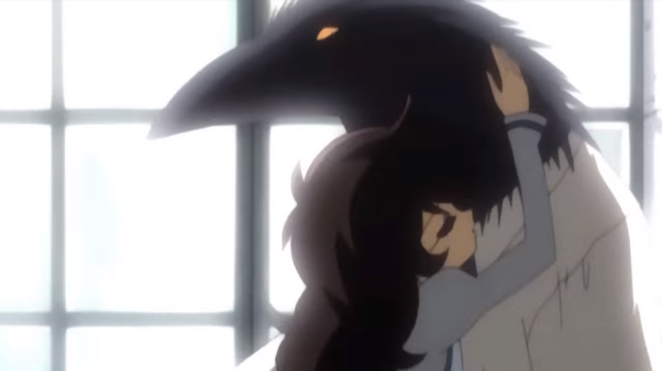
Especially when they hired Chiaki J. Konaka, one of my favourite screenwriters known for his unconventional storytelling, where it gets at its strangest, with puppets dancing and wormholes into the clockwork netherworld, my beloved screenwriter's touch to be found. If anything Princess Tutu proved that, whilst a distinct voice in the director's seat is still important, writers for individual episodes are as much guides for the show's personality as I learnt with this series. In general the project, whilst having to explain a lot more than usually for a show like this due to being a series for an audience of all ages, does a lot of heavy lifting perfectly, particularly  as it does have "situation of the week" style stories for single episodes, having to tie up a narrative with characters only appearing in that one story and make their contributions justifiable. In fact what I presumed, early into the second season, would dangerously become tiring actually gets to the point of the exasperation the villains eventually have with themselves as well as their task. Somehow a narcissitic lothario who feels he cannot love as many women as he'd want and has his man servant gore him with bulls continually, another of the funniest characters of the series despite being in one episode only, manages to have a vital point to him in the story of Rue, the secondary female character who's isolation away from Mythos due to Princess Tutu plays to the tragedy of her own life. This broad, conventional storytelling technique of a short story per episode is actually used in clever ways as a result, little moments having a lot of use from even its most comedic characters - one of the best little moments, from a Konaka scripted episode, has a joke of Mr. Cat trying to ward away a goat woman who likes him help two characters in their series long concerns by overhearing him at the right moment, examples like this bound to grow in rewarding upon rewatching Princess Tutu multiple times.

From https://nerdloveshop.files.wordpress.com/2017/11/tutu11.png?w=663

I also learnt more so with Princess Tutu an even greater appreciation of Japanese voice actors.  Snippets of the late ADV Film's English dub causes me to wonder how my younger self could stand them, a over- sugared recreation of stereotypical anime voices that feeling hollow from what I heard. Everyone in the Japanese dub however feels natural in their roles. Nanae Katou as Duck in particular is perfect, right down to a mallard's squawk to her voice. In a series like this, which is playful and still has humour even into its last episodes when the story gets serious, where it is a family friendly fairytale, there's a lot to admire in hearing characters who are taken serious, even the comedic ones having moments of seriousness to admire them. (And anyway, even that humour's to be loved, characters like Duck's best friend Pike (Sachi Matsumoto) and Lilie (Yuri Shiratori) so easy to make awful if they are played too broadly, more so when Lilie's running gag is that she is so enthusiastic about Duck constantly failing to a fetishishtic degree.)

So whilst not abstract, right from its beginning to an ending that is both bitter sweet but also joyful, Princess Tutu triumphs by being very unconventional. Where it goes to in the second half leads to so many curveballs that, as an anime series should, it feels like you've ended up in an entirely different series from the first episodes and it was built up to fully. And especially as a story that is both a fairytale children could watch, but also is a tribute to fairytales and ballet for adults to learn from, it means a lot. In the former, it's a great story. In the later, Princess Tutu also succeeded for me by introducing this particular viewer to references I hadn't known of. Each episode starts with a female narrator using an existing story, from those you'd recognise to obscurer choices like Hans Christian Andersen's The Red Shoes being twisted into unconventional direction mid-narration. As someone with no knowledge of ballet, its grown my interest considerably. If anything the success, even if as a cult series, of Princess Tutu must've be a wonderful experience for head writer Michiko Yokote and the entire production staff.


From https://vignette.wikia.nocookie.net/princesstutu/images/3/
38/Duck.png/revision/latest?cb=20120624205833