Showing posts with label Erotic. Show all posts

Monday, 3 August 2020

#153-4: Rei Rei / The Gigolo (1993)

Today we deal with an obscure double bill, two erotic OVAs both from 1993 that were released together as a DVD in the United Kingdom in the very era days of the DVD market. These types of titles are fascinating to deal with as, whether good or not, this is an entire history worthy of prodding with morbid curiosity, titles which came, few remember, disappear, but could be found by pure look in a second hand DVD store. In this case, this also means talking about a company Kiseki Films, a long obsolete company whose licences were distributed between the UK, Australia and New Zealand, and ended as a company, to some testimony, when it was bought out by the British company Revolution Films1. Titles they released included Black Magic M-66 (1987), Urotsukidoji III: The Return of the Overfiend (1992)...but also Gunbuster (1988-9), which means this is not the first time I have covered one of their licenses from the early days of the DVD era.

This however, as a double bill, are two very different titles both under sixty minutes each which few may know about, which to my surprise were not what I was expecting for good and for bad in-between them.

 *****

Rei Rei (1993)

Director: Yoshisuke Yamaguchi

Screenplay: Mitsuru Mochizuki

Voice Cast: Naoko Matsui as Kaguya; Katsuyo Endou as Satoshi's mother; Keaton Yamada as the Narrator; Kenichi Ogata as Pipi; Kumiko Nishihara as Mika; Miho Yoshida as Dr. Manami; Misa Watanabe as Tanaka (female); Mitsuaki Hoshino as Satoshi's father; Shinichiro Miki as Satoshi; Takehito Koyasu as Dr. Okabe; Wataru Takagi as Tanaka; Yuri Satou as Ikuko

Viewed in Japanese with English Subtitles


I've got two cherries for you to chew.

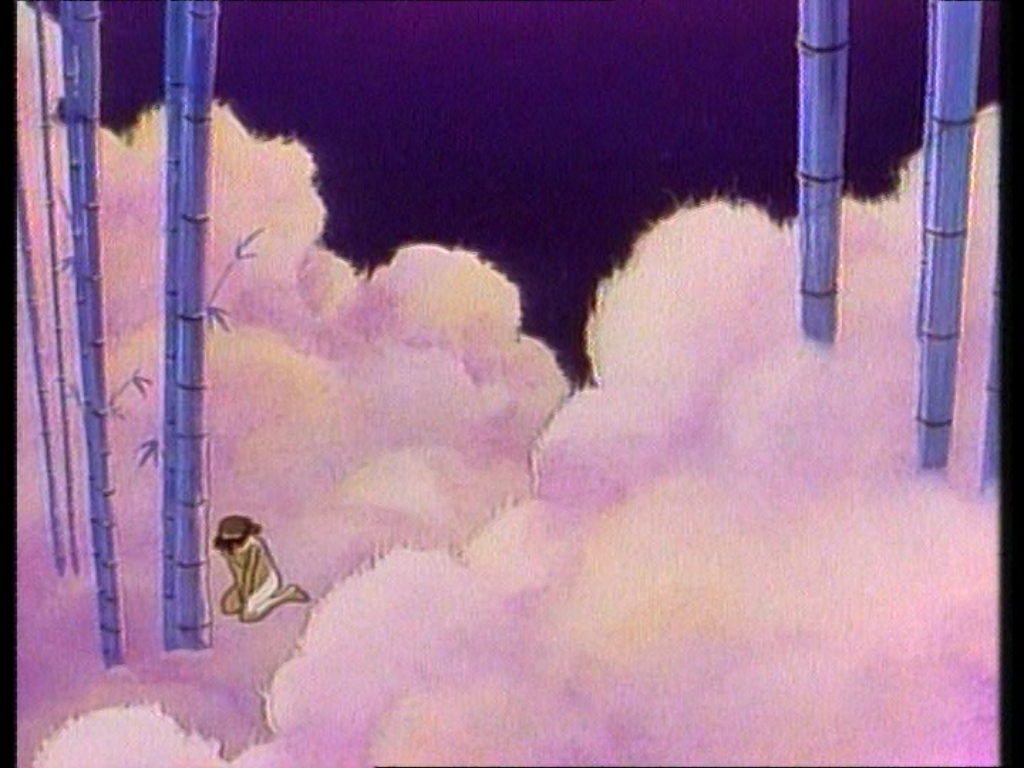
Rei Rei was the one I had the most interest in, and it is a compelling premise, but tragically this proved the most problematic of the duo. There are quite a few titles in anime about supernatural figures, or those who dabble in that realm, becoming involved with the lives of normal people, including for sexual issues, but this is curious as our protagonist is Kaguya, with her diminutive assisting in a fetching purple suit called Pipi, a princess from the Moon who helps mortals who are in crisis with love. She is explicitly, clearly, based on the Tale of the Bamboo Cutter, a 10th century piece of prose about a princess from the moon found as an infant in a egg, a legendary piece of Japanese folktale which was adapted countless times centuries later in anime and manga, including Isao Takahata's last project The Tale of the Princess Kaguya (2014).

That the two thirty minute episodes has issues is more annoying because I love this idea, about a literal magical being, a beauty of unearthly form, who has decided to help mortals whose souls cry out of lovesickness. The first episode initially suggests where tone is going to stay, and how this premise could be sustained as an erotic series but also effectively a form of anthology story formed around a central figure, that of a guy who tries to flirt with a girl he loves called Ikuko, only for her to reveal that she is dating an older female doctor. Unfortunately, we are taken to a deeply problematic tale in which the older woman is a bad person, actually dating a male doctor and purposely injecting raw egg into Ikuko, deceiving her into thinking that it is Vitamin C, to cause anaphylaxis. This is not the aspect of real issue, but that it is compromised by a heteronormative conclusion, that Ikuko has to renounce herself and fall in love with the male lead, a dweeb with a terrible tendency for nearly being hit by vehicles.

It hurts worse for me as I could vibe greatly with the eeriness that this episode had, even having my trope appears where people are whisked off to an alternative dream reality, usually a bridge of symbolic form they have to cross naked in this case. Considering the first episode, by itself, manages to have sensuality and a grace to it, it is sad that this interesting premise, with the art style contrasting urban Japan with a figure of pure fantasy, turns out is more conservative than its own premise is, including some gay panic humour found between episodes. If made a decade later, Rei Rei (also known as Rei Rei: The Sensual Evangelist) could have hopefully embraced a more progressive attitude, particularly as you would not need to change the protagonist in the slightest, a completely supernatural figure who who can be invisible unless she desires to and flies as an ethereal figure leaving behind purple dust. Even her dialogue is completely ethereal too in the first episode - A love lorn soul, a true heart, is calling out in pain - suggesting that even if you could have funded a more sexually explicit television, which do exist either censored or pay per view channels, you could have even made this character actually feminist and ran with a lot of more enlightened (and frankly sexier) content.

And this is stranger as there is a tantalising and subversive streak when Kaguya helps the male protagonist by turning him into a woman. Where it leads to is not exactly progressive, but it definitely touches upon something subversive - that he is going to seduce the male boyfriend of the older female doctor, which really brings about gender fluidity that the show runs the opposite way from immediately when they are in the bedroom down to their underwear. Also, whilst again not necessarily progressive either, the more rewarding ending would have clearly been this boy willing to be a woman for the rest of his life, proudly, for the woman he loves, literally dangled as a premise in front of him in a bag of magical dust. If that ending had transpired, I would have been a drastically different opinion of the OVA even if the second episode had been the same as it was.

This plot point definitely reveals to the weirder side of Rei Rei, which would have been more rewarding if so much of the show had not undercut itself. It also has a weirdness which is also perverse at times to, preparing the viewer for the second episode when about the female doctor has a nightmare about Ikuko entering her body, in a sensitive place which (tastefully but provocatively) is shown in a split second shot. It is a curious mix of a program with a greater aesthetic grace than this type of genre might necessarily have, with clearly a potential for both being bizarre but also having a sensual elegance, only to have the production hit the brakes. One, despite its pleasant comedic tone, which has to cater to heteronormative values and a plot even boring to a heterosexual male like myself in how much of a coward it turned out to be in not taking a risk.

The stranger side grows and runs rampant by episode two, which  is again about another male client, another unlikable bland male dweeb, which is something I have witnessed in other genres and continually ask of in terms of who would think such characters are interesting as male representatives in the first place. This one has an inability to be around the opposite sex without his heart racing; it is a condition so bad he can suffer from sudden collapses where he goes unconscious to the point it can look like he is death, with a comically grimace on his face. This turns into a series of vignettes, with Kaguya now becoming much less serious as a character and a lot more cartoonish, such as when his id and soul are trapped in a "Bentendo" video game which she has to get him out of it. It promises something wonderful, with a world of eye craters and tongues in clouds, only to bring out tentacles for a joke that is thankfully skipped over.

This is however also the episode where Kaguya lets him becomes his girlfriend's bathwater, which is exceptionally bizarre...except that sadly gets to Kaguya letting him become invisible like mist in the shower to her, which he with some morals even questions when she recommends feeling her up to become more comfortable with her desires. The OVA never went beyond these two episodes, which was probably for the best as, tragically, this good premise worthy of a remake was already compromised. Even if it manages a plot threat I had never considered seeing - sexual breast feeding to exorcise his emotional pain from his mother abandoning him and his father - it is more as a peculiar oddity from the nineties than a show that I thought could have actually been good. If it had lasted, we would have gotten this as it stands, which would not be fun even if like car crash television at points. All the good virtues are squandered with what clearly was a show running on fumes and unenlightened ideas for good erotic stories, strange aspects otherwise.
*****

The Gigolo (1993)

a.k.a. The Gigolo - Dochinpira

Director: Hiromitsu Ōta

Screenplay: Wataru Amano

Voice Cast: Kōichi Yamadera as Jin Kaitō; Masako Katsuki as Ai Mizushima; Naoko Matsui as Ranko; Daisuke Gouri as Hazukura Boss; Hideyuki Umezu as Hazakura Yakuza; Hiromi Yokota as Body Conscious Girl; Kaoru Shimamura as Okamoto; Kenyuu Horiuchi as Suzuhata

Viewed in English Dub


They're real bullets!

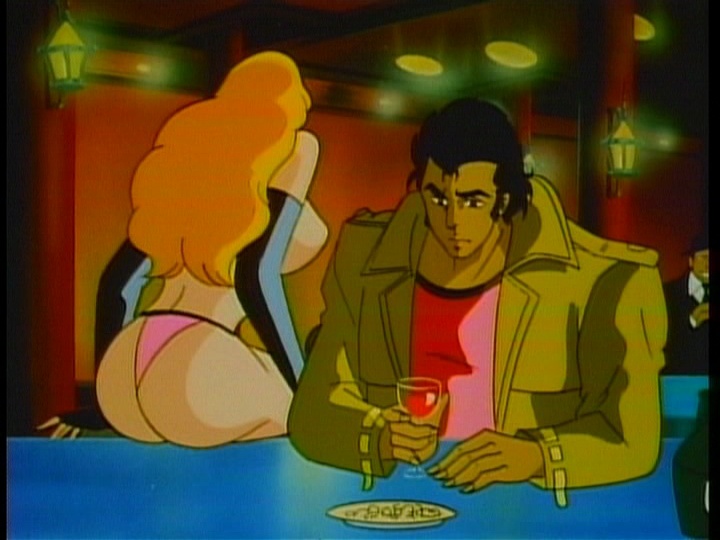
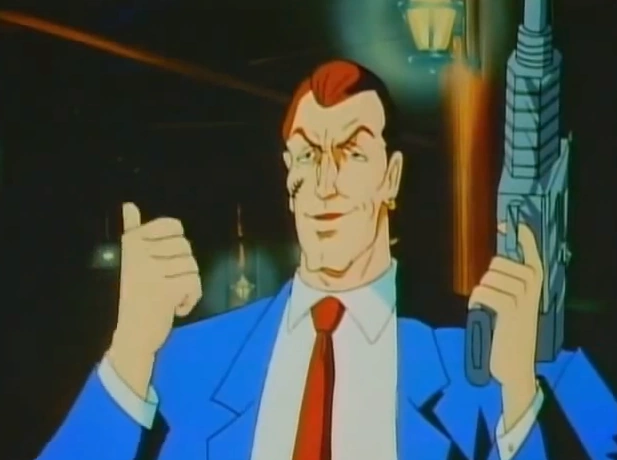
So surprisingly what I considered the trashier of the double bill, which I doubt really was even hentai but just an erotic title, turned out to be a more enjoyable experience. Simply because I expected a censored, junky hentai about a male gigolo, with an insanely deep voiced male voice actor in the English dub2, only to get a c-grade pulp pulp tale which was nonetheless entertaining, a crime narrative where a gigolo finds himself crossing paths between the mafia (yakuza), and a female hit woman out for revenge for her family being killed during an assassination attempt at a restaurant when she was just a child.

Resplendently scored to guitar riffs, this lurid macho storytelling has ebbed away for the most part from anime into the modern day, at least in terms of those found in OVAs we got over in the West sold for their violence and sex, whilst there are likely titles still in existence which tackle this tone in different ways and institutions like the Fist of the North Star franchise still get adaptations but also self referential official parodies. The Giggolo is much more subdued take on, say, the Crying Freeman OVAs, with less of the open absurdities, or an erotic version of the more explicit action melodramas of the OVA era, although this is more tasteful in context and content then I had even considered.


Here a young guy out of his element is only a stereotype of being macho due to all the sex he has, because of his ability to seduce women for work, and having a female roommate happily letting him stay and being proto-friends with benefits. Even then, he gets his head kicked in by thugs until the woman he is with pulls a gun out, and never really is the decisive factor in any for the conflicts, just able to help. He encounters a sado-masochistic client, when it's too late to pull out from the client, who likes her whips and hot wax, and the hit woman even if she feels she has "become a woman" with him is still the one out for revenge, wagering a Cobra sports car for him to win if he can be the first male to actually being good in bed. If it not feminist in the slightest, but is surprisingly more interesting in the gender context because your lead, from his initial introduction as a cool lothario, has this veneer chipped away as the plot continues.

Yes, The Gigolo is still lurid, but considering its double bill title Rei Rei on the same British DVD disc, this tacky and less well made production was actually more defendable as it was also ridiculous. It is sexually explicit, but it deviates fully into its crime drama by the end, much more interested in fully committing to being a melodrama for men, of tears of screaming passion and a sports car full of flowers pushed into the sea like a Viking funeral. The pair does raise the issue of how one tries to write a story with sex as a prominent aspect, espcially as Wataru Amano made their career with titles in hentai like Demon Beast Invasion (1990) and Venus 5 (1994), the later a pornographic parody of the Sailor Moon franchise. Both of the titles I have covered are completely alien to each other in tone and presentation, and both of them offer some curious aspects to consider in terms of how sex is depicted for better and for worse.

Stepping back to these titles by themselves, they are a fascinating pair of oddities. As I am able to dig back and find these titles, I find amusement even in the fact that, as the one person still using a DVD rental service, I am likely the first person in a decade (if anyone at all) who requested this double bill DVD to be posted to me. A title from as far back that you can legitimately fear about laser rot, that sense of investigation in it is entertaining to the point it compensates for the disappointments I did have alongside the unexpected surprises I did have.

==========

1) We have to rely on Wikipedia for that detail, so take the fact with a pinch of salt. 

2) The English is ridiculous, with additional swearing, but especially as the male voice lead (who I thought I recognised but could not tell who) is so deep voiced to a youthful lead it added a level of absurdity to the production.

Saturday, 28 July 2018

Bonus #9: Blue Seagull (1994)


Director: Jung-il Oh
Screenplay: Kyoung-woo Kim
Voice Cast: Choi Min-soo as Hail; Kim Hye-soo as Chaerin; Jeong-hwa Eom as Joshua; Yeong-guk No as Alfonso; Jo Hyeong-gi as Joey
Viewed in Korean with Subtitles

Synopsis: When an ancient sword is stolen, Hail (Choi Min-soo) is hired to travel to the USA to retrieve it back from the Mafia, finding himself against the criminal underworld.

Author Note: This review will spoil the entirety of Blue Seagull. A very difficult film to see, this decision is as much due to the negativity of the review, finding its worth just reading the entire text here rather than for you the reader to sit through the film I experienced. If you still want to see Blue Seagull, at least you was warned. Also, trigger warning for discussion of sexual violent, and also warnings in general as even a description of how bad Blue Seagull could affect you badly.

And I wish I could open the review without those notes of cautious, but unfortunately Blue Seagull is really that bad. A film halfway through, due to a certain plot event I will sadly have to discuss, where even my love technically abhorrent animation has to give over to revulsion or (in the time past since viewing the feature film) a sense of distaste and bafflement at how a production collapses to the extent it does here. Even low rent animation I have sat through over the years, like Beauty and Warrior (2002) from the producer of Ninja Terminator (1985), could look at Blue Seagull and realise it's better than it, and tragically it only takes someone to see this film and the important contributions South Korean animation studios have made in outsourcing of American and Japanese productions to be undermined in comparison. Even next to Armageddon (1996), another failed Korean animated production from only a few years later, and this attempt at an erotic action thriller looks like the Hindenburg disaster.

For three-quarters of its length, even if still an embarrassment, I was willing to still enjoy Blue Seagull as attempting to match the type of sleazy, dumb straight-to-video anime from Japanese from this era, only with a lesser animation quality and meant for theatrical release. For that length of time the film's memorable for all the wrong reasons in a way that's entertaining. At first its deceptive with its stylist opening, turning the voice actors' portraits into their animated characters, only to afterwards jumps right into the kind trashiness Japan was doing at the time too, a mass gunfight and massacre which leads to the McGuffin (a sword) being stolen and the plot to hurdle on in a ramshackle way. With a lead hero, named after a of weather phenomenon, whose only personality trait is stoicism, the film leads to a mix of violence, gore and as per the erotic genre tag sex. Obviously a question arises. Most will ask what "Blue Seagull" as a title actually means, which I have no idea how to answer unless it's an euphemism for something dodgy I have no knowledge on. The other question, more pertinent, is that as this is meant to be an erotic thriller, is it actually sensual or titillating? When the first scene, even before the film starts proper, is of a woman (whose face we never see) being leered at on a motorcycle, a purely animated figure, then the answer is no, it's just tacky and misjudged lavicious behaviour.

From http://www.hardcoregaming101.net/korea/
specials/images-lost2/blueseagull-1.jpg

Even before the problematic scene I will eventually get to, you are watching utterly cheesy softcore images of characters than actual people. It neither helps Blue Seagull's animation is poor. It's the character designs more than the backgrounds which are the issue, alongside how their facial expressions are both between bland and becoming overtly cartoonish despite the story being gritty. One scene in a strip club, meant to be sensual, is closer to the Tex Avery cartoon Red Hot Riding Hood (1943) but crudely produced, so much so the stripper is able to use her breasts to give an over- amorous male patron a black eye as if a sentient body part, the kind of tonal shift (and body morphing) that catches you off guard in a negative way.

It also doesn't help when, to add to the titillation, they include a former love interest named Chaerin (Kim Hye-soo) who has no plot connection onscreen whatsoever with Hail despite sharing flashback related back story. They cross paths but she never encounters him fact-to-face even when the climatic skirmish is a floor above a car show she is part of. It's merely an excuse to draw a voluptuous female character who, bizarrely, has a comical introduction having an erotic dream on a bed  about Hail whilst her pet dog (drawn more overtly cartoonish) licks her to amplify thus fantasy. There are a lot of plot digressions like this which are to be questioned, especially as the film is only over an hour long. The sword, when found, is connected to a deity that appears and abruptly tells Hail he's the chosen one, a point never brought up again. Loose threads are found throughout, the sole fleshed out character within the entire film being Alfonso (Yeong-guk No), who with his red ponytail and facial scaring is also a racist psychopath, an issue I will get to later too.

From https://vignette.wikia.nocookie.net/villains/images/f/f0/
Alfonso.png/revision/latest?cb=20140616184031

If it was all this illogical chaos I would've enjoyed Blue Seagull. Utterly irredeemable but so absurd I would've found something to enjoy. The sort of insane material where, to chase the hero, Alfonso indiscriminately mows down a men's bathroom with a machine gun whilst, part of a tendency in South Korean cinema of all kind, it splices in comedy with a frightened attendee watching this transpire. The plot barely ties together in spite of its simplicity and even minor characters are full of quirks, like the arms dealer who sits in the same chair in the same dingy warehouse watching porn when no one's there. Blue Seagull also has CGI animation, animated scenes involving cars and vehicles entirely done in computer animation, so the environments (like an airport) are also a basic, crude digital construction around them. It's not that different, honestly, from other computer effects from the time so I can let Blue Seagull off the hook, particularly as it adds to the trashiness. Watching the film in Korean, admittedly, also adds unexpected class to material that doesn't deserve it. Interestingly despite her character Chaerin being utterly pointless, Kim Hye-soo would have a prolific career in Korean cinema, as would Jeong-hwa Eom as Joshua, an American secretary who helps Hail and more charisma as a character than many. Eom's involvement is surprising, considering how bad Blue Seagull is, as she is a prolific actress and singer/dancer. Someone of a huge reputation in Korean music who has won awards for her music, has starred in a lot of television and acted in many films, and is considered a major figure in entertainment in the country.   She is possibly recognisable for readers outside of South Korea as  well for playing the lead character in Princess Aurora (2005), a film which rode on the back of the Tartan Extreme influenced popularity for Korean cinema, a revenge film where she presides on the promotional material in a leather jacket and clinging black hair. Even the dodgiest animation gains a lot when it's not the broad, wooden English dubs you're listening to but the original language dubs with named talent, even when that might prove a poisoned chalice for said participant, when there are filmographies of Eom which don't even mention this film, showing a potential sign of utter embarrassment about it as well.  

Then the problematic sequence takes place, which is pertinent as it involves a rape scene with Eom's Joshua character. Joshua, even as a stereotypical attractive figure, is vague interesting as an African American (or mixed raced) woman with bright red hair who gladly helps Hail and introduces him to the world of the US. who becomes a romantic interest for the hero. Unfortunately, when Alfonso has her kidnapped for transgressive against his boss, it leads this scene which thankfully implies the sexual violence but is prolonged in the moments before with him chasing her, arms tied back, around the room in a way that stops being nasty but just uncomfortable in a troubling way, of how the film itself is leering at the moment. Worse, when the deed is committed he flippantly kills her with gunfire, this turning her death into a "woman in the refrigerator" moment where she is merely meant to be a figure to get revenge for, left for a long time as a bloody corpse on the bed before anyone finds her. The entire plot point sucks the life out of Blue Seagull as, alongside her life flashing before her eyes, the entire series of events is the film making a mistake too many, worse when its intercut with a helicopter versus helicopter battle with no sense of story priority involved, merely part of the action.

From http://www.hardcoregaming101.net/korea/
specials/images-lost2/blueseagull-2.jpg

It does cause me to self critique myself, having defended anime which have had similar if not worse scenes of this within them. The first answer is that I've never defended any scene of sexual violence or rape in animated or live action film, and wish they weren't included if not depicted in a way that takes the severity of such an act seriously, a problem in anime of a certain era where (like manga) where it was always meant for shock value rather than carefully thought of. Even a work like Urotsukidôji:The Legend of the Overfiend (1989), where there's the issue of the transgressive tone being deliberately, is the kind of understandably condemned animation I wish hadn't taken the route it had and avoid this leering misogyny within itself. The second answer, based on the first, is also that the context and content around the problematic scene even in a trashy work with debatable artistic value can drastically effect one's reaction to the material.  Contrast Blue Seagull to the 1988-1994 anime adaptation of Crying Freeman [Reviewed here for contrast]. Also an erotic action thriller, there is one rape scene directly taken from the manga which is worse and I wish wasn't included. It was however a single scene in a multi episode series where, whilst it's still lurid and arguably sexist, the sex within the rest of the episodes are consensual or involves characters, male and female of all shapes, inexplicably taking their clothes off even for a fight. There is the context that Crying Freeman is so absurd and ridiculous as well that, even if that scene is problematic and should be condemned, it is dampened (and practically drowned) but how utterly silly the series before and after is, to the point anyone can distance themselves from that moment1. With Blue Seagull however, from its rape scene onwards, collapses completely and wasn't even worth trying at all before the sequence even happened. In general, the moment that problematic sequence happens the film gets worse, becoming a rare example of a true trash fire as the plot starts to get more garbled and the production falls off the cliff it was barely hanging on to.

The severity of Blue Seagull, jarring against the tone, causes one to feel dirty and is visibly unintentional in desired reaction. It neither helps the perpetrator Alfonso is the only vaguely memorable figure throughout. His voice actor is the one who adds flourish to dialogue. The character has charisma barring Joshua. He gets the kind of heroic moment the hero should've, surviving being stabbed in the eye and inexplicably falling out of the window of a skyscraper at the same time, climbing up from outside by pure will power. All which is a problem as he's a sociopath who is openly racist to the Korean and African American characters with his slurs, a murderer and eventually a rapist. The worse part, which makes the use of a rape scene much worse in Blue Seagull than other tasteless anime, is that neither Hail or Joshua's brother, who gets involved are the ones who kill Alfonso despite the deliberate using of her death for cheap emotional effect. No, a mysterious bystander who is also after the sword, seen in the background of scenes, creeps up behind Alfonso whilst he's monologuing to the heroes and snaps his neck instantly. By this point the film's a mess more than before2 - what with the sword's inexplicable (and never mentioned again) mythological side and  Chaerin seeing but never talking to Hail, only adding to the distaste of these particular events. An abrupt conclusion at a gravestone with the heroes crying at Joshua's grave just adds to the horrible experience with an exclamation.

From https://i.ytimg.com/vi/f_MDntLhWWA/hqdefault.jpg

And its becomes a tragedy as the end credits are live action behind-the-scenes footage of Blue Seagull's production. There's a growing sense of despair to be found watching the creation of a film knowing said production, watched beforehand, was dreadful. The intricate illustration of animation cells. The promotional posters for Blue Seagull on the walls. The voice actors in the recording booth. Animators working hard in a small room, each side facing away from each other at their tables, all with the horrible realisation they worked on a project which fails on all levels. The kind of bleak though to possess that just confirms how utterly awful Blue Seagull was. Utterly compelling to witness, compelling to write about and perversely worth having seen, but so toxic as much of this new obsession of mine is potential psychological trauma. Its not even a case of "so-bad-its-good", a childish suggestion and an ill advised one as no one should readily want to watch a film this dreadful to sit through.

From https://s1-ssl.dmcdn.net/-V9J/x1080-04P.jpg

==
1 - When the male anti-hero decides to take revenge against the perpetrator, a wrestler, by going to a wrestling show, wearing a Lucha Libre mask, and challenge him to a match, it doesn't defend the offensive scene but it becomes bizarre in a way that diffuses the material completely.

2 - This is also when the English subtitles, fan made, started to become vaguely incomprehensible in an almost symbolic way of Blue Seagull fully collapsing into a nightmarish experience.

Friday, 21 July 2017

#47: Belladonna of Sadness (1973)

From https://dustyreels.files.wordpress.com/
2016/06/bellaofsadposter.jpg

Director: Eiichi Yamamoto
Screenplay: Eiichi Yamamoto and Yoshiyuki Fukuda
Based on the non -fiction book Satanism and Witchcraft by Jules Michelet
Voice Cast: Aiko Nagayama as Jeanne; Katsutaka Ito as Jean; Tatsuya Nakadai as The Devil; Masaya Takahashi as Milord; Shigaku Shimegi as Milady; Chinatsu Nakayama as Narrator; Masakane Yonekura as Catholic Priest
Viewed in Japanese with English Subtitles

Synopsis: Set in Medieval France, a farmer's wife by the name of Jeanne is lead towards Satan, spurn to him when originally raped by the Lord of her village and furthered to  the Dark One when trying to survive within the context of a poverty stricken environment under said Lord's thumb. Further incidents - the growing suspicions against her attempts at a better life with her husband John, the pressure of war and the need to fund it taking its toll on the village, the jealousy of the Lord's wife when Jeanne does command power - eventually lead Jeanne to fully embracing the Devil, becoming a fully formed, nymph-like witch of great power.

Belladonna of Sadness is unique. Ditto, an obvious assessment dumb to repeat but it's worth mentioning because of how idiosyncratic it is next to what anime is today. Subtle influence does exist - Kunihiko Ikuhara, the director of Yurikama Arashi (2015) (reviewed as #41 on this blog) and Revolutionary Utena (1997) is a known admirer deeply influenced by the feature - but like experimental animation from Japan from the same period its utterly alien next to what anime stereotypically means in the West. It feels like a project that threw caution to the wind and was, the last film created by Mushi Productions before its death. Founded by manga god Osamu Tezuka, his studio would innovate in terms of animation, but before 1973 he'd already left the sinking ship to start creating some of his darkest, adult manga like Ode to Kirihito (1970-71) in response to the more adult manga others were creating, the likes of director/co-writer Eiichi Yamamoto back at Mushi deciding, rather than play it safe, to finish off what was a trilogy of erotic animated films with an openly experimental and politically minded work. It's even alien to what the trilogy originally started as, attestable having seen Cleopatra (1970), a frankly bizarre take on the Egyptian figure full of surreal tangents and flourishes that I love but understand led to it being a box office bomb, the kind that helped led to Mushi Productions sinking financially in the first place. With that in mind, it emphasises how radically different Belladonna still is within anime when its different next to already unconventional productions from Mushi.

From http://files.offi.fr/evenement/61158/images/600/
14bbb3181bd3f29623d937ddb99fe0e0.jpg

The result with Belladonna is a period set erotic drama which sensualises witchcraft and occultism but inherently from its source text is about a figure kicking back at the world that pushes her down. Plenty of softcore, live action films from Europe from this period did the same to varying qualities, but whilst it has the gender politics of its time on the surface, Belladonna of Sadness is still exceptional when considering the period it originates from. Japanese cinema by this period and before reflects a vast conflict in terms of gender depictions, flip-flopping between films about women and their place in the world, from Kenji Mizoguchi to this, to the more problematic erotic and dramatic exploitation films. Even if trigger warnings may be appropriate to bring in when discussing Belladonna, its pertinent that for every individual who views it as being dated there's yet as many male and female to praise Belladonna regardless of it being a seventies film made by men with very explicit sexual content. A lot of the issue is a modern conundrum where inherently the idea of sexuality is immediately bias towards objectifying of women, that nudity and sexuality equals a male gaze, when pro-sexuality feminism and female writers, commentators and academics are pushing back on this bias and emphasising the greater complexity with this view in terms of films like it and how women, as viewers and/or fans of these movies, digest them. Whilst there are plenty of moments in Belladonna which are extreme and purposely transgress, it's a significantly more complicated narrative which, between the sensuality, eventually leads to a figure becoming a dominant, powerful female figure, muddying a response one can have to its attitude.

Jeanne, as merely a drawing of womanly perfection given life by art director Kuni Fukai's obsessive detailed and Western influenced illustration, and voice actress Aiko Nagayama's emotional tenors, is a sexual figure, found in many states of undress but feeling far less a figure of objectification than a figure of purity slowing gaining individuality in a patriarchal and utterly unfair world. Even if it's by means of an openly phallic Devil who starts as a little phallus than turns into a giant mushroom shaft - voiced by one of the greatest actors of all Japanese cinema Tatsuya Nakadai for added startlement - its only because of the evil of the world around her and hierarchal power that Jeanne becomes a witch, not openly embracing her sensuality but becoming a literal forest entity who transformation, much to her initial surprise, isn't the vindictive croon she wished to become but the figure of beauty and love. Paradoxically her hatred is channelled into helping the villagers when the Black Death arrives, the cost for them merely to join her in the bliss of countryside Satanic orgies where everyone is happy and is transmogrified into enough blatant imagery to give Sigmund Freud an aneurism. In fact, for a slight spoiler, the only reason her tale is a downfall is because Jeanne refuses to play ball with the hierarchy and stubbornly refuses to bend to them.

From http://www.theoasg.com/wp-content/uploads/2016/07/Belladonna.jpg

All of this is not something that can just be dismissed as merely erotic animated porn. Its openly sexual and willingly perverse, able to slide into utterly weird sequences of literal beast-human sexual organisms and conga-line coils of human sex trains that are strong images even in the current decade, but like the best of erotica (or porn, mincing terms) it's also utterly gorgeous and sticks a middle figure up to a lacksidasical ideal of this type of material being merely base or without meaning. It's too gorgeous, now restored when thought to be a mere obscurity, the weird uncle in erotic anime's closet, to view as anything but art; having known Belladonna when it was an obscurity covered on a podcast like Anime World Order as a mere fascinating dead-end in anime's history, only viewable on YouTube, seeing its resurrection by Cinelicious is utterly awe-inspiring because the artistry is so pronounced and successful. The story, while rich in meaning, is told (in the best decision) through its simple fairytale-like narrative that leads to tragedy, the focus instead in how to show its story onscreen.

Belladonna was a low budget production when Mushi Productions was on its last legs but used this context as its aesthetic template. The elegance of Fukai's work alongside the animators is helped by the fact most of Belladonna is actually still images, scrolls of illustration where time passes within the same canvas, bleeding through each other as the camera usually pans left or right along like a comic strip. When elaborate movement is done, legendary animator and director Gisaburō Sugii as the animation director for the production it's for the most subtle of facial or body language, or for the most extravagant and/or extreme moments. The willingness to push the form of the film goes as far as even breaking the historical context, suddenly breaking out a mad collage of modern sixties/seventies symbolism like cars and flairs suggesting Jeanne's full transformation into a witch allows one to see the enlightened pop art future centuries later. Keeping all of this sewn together is Masahiko Satoh's music, an academically trained jazz musician and musician who like many of his field willingly experimented into other genres, his here full scale acid rock that, far from feeling out of place as an anachronism, actually fits like many period genre films who flirted with this type of music because of its openly occult, hallucinogenic qualities appropriate for tales of classical mysticism and emotional melodrama you can synch up to wailing cosmic guitar solos.

From http://1125996089.rsc.cdn77.org/wp-content/uploads/2016/
12/BelladonnaofSadness_1973_belladona_hedder1.jpg

Altogether Belladonna of Sadness is an incredible film, one that I am grateful to see properly available and in restored form. Now what was for me a mysterious, vague film in the annuals of anime - like Angel's Egg (1985), a more well known but still difficult to access experimental anime from Mamoru Oshii, another person openly inspired by Belladonna of Sadness - is now available for more to see and had the kind of retrospective premieres and screenings one would find for legendary art house films. Having only known it as a weird cult oddity before, its lush artistry grows in 4k form as does its theme, a greater power in its finale where it suggests many women will become like Jeanne in the end, climaxing in a finale still image originally from a later cut of the film Cinelicious kept in, realising that as a finale, touching upon a legendary piece of French artistry, there was a sincere coda, a meaning, to the production that does strike the heartstrings. It may have taken decades to get to that point, barring its Berlin Film Festival premiere and its box office failure nailing the coffin for Mushi Productions, a least a DVD release in Japan and maybe Germany beforehand, but the wait was entirely worth it. 

From https://mattystanfield.files.wordpress.com/2016/08/use.jpg

Friday, 14 July 2017

#46. Crying Freeman (1988-1994)

http://www.allgoodthings.tv/files/BIG00.jpg.jpg

Directors: Daisuke Nishio and Shigeyasu Yamauchi
Screenplay: Higashi Shimizu and Ryunosuke Ono
Based on the manga by Kazuo Koike and Ryoichi Ikegami
Voice Cast: Chiharu Kataishi (as Emu Hino); Toshio Furukawa (as Yo Hinomura/Crying Freeman); Dump Matsumoto (as Báiyá Shàn); Gara Takashima (as Nina Heaven); Kōhei Miyauchi (as Bǎiba Lóng); Masako Katsuki (as Kimie Hanada); Yoshiko Sakakibara (as Bagnag)
Viewed in Japanese with English Subtitles

Synopsis: Artist Emu Hino crosses paths with an assassin codenamed Crying Freeman by accident during one of his killings. Real name Yo Hinomura, Freeman is a former potter turned brainwashed member of a secret Chinese society of paid assassins, Hino rightly concerned that her is soon to end before her thirtieth birthday because of her interaction with him. However due to the love that blossoms between them on the night of her supposed death, Freeman not only spares her but begins a rollercoaster that includes leading the assassins' guild together and having to face every underworld criminal, lust crazed leader of mercenaries, ancient bear cults, fellow assassin guilds and wrestlers that wants to take their territory.

For a disclaimer, the only actual Kazuo Koike manga I've read is Color of Rage (2008), one of his obscurer titles. Koike however has had a LOT of his work adapted to anime and live action cinema to the point that in terms of context in adaptations, a significant picture of his style is found within them all, one of the most successful manga creators of his kind whose influence spans arguably beyond manga and anime as well, more surprising knowing he only writes his stories, leaving the illustrations to a variety of different collaborators over the decades. His storytelling has visibly influenced pop culture, from Frank Miller being influence by the Lone Wolf and Cub (1970-76) manga for his comics to Quentin Tarantino being influenced by the live action adaptation of Lady Snowblood (1972-3). That's not even taking account that his Gekiga Sonjuku program, which taught manga writers/artists like Fist of the North Star creator Tetsuo Hara, Vampire Hunter D writer Hideyuki Kikuchi and the legendary Rumiko Takahashi, which is nothing to laugh about in terms of the effect he brought to the medium.

The issue with Koike as a storytelling though, to found with this adaptation with Crying Freeman by Toei Animation, alongside other examples like the 1990-2 anime adaptation of Mad Bull 34, is that he is arguably an originator of a very extreme style of gekiga manga; gekiga, a more serious or explicit form of storytelling for adults in theme and content, in his hands leads to a form, from the issues of challenging deadlines and having to constantly make sure readers stay with a series, which pushes the limit of logic and good taste to a delirious level. In fact it actually pushes both off a cliff, which makes even the adaptations of his work a challenge for viewers who may be put off by the extreme content within something like Crying Freeman, or a challenge in how it can become utterly nonsensical if an attempt to rationalise it all is tried. This will be impossible to ignore with this adaptation of Crying Freeman over its six episodes, as much an OVA series which you have to overcome the problematic gender representations, nonsensical plot points and tasteless decisions as you can appreciate its mad illogic even if some of the stranger moments from the manga were likely removed.

From http://www.geocities.ws/kyosan16/Images/freeii.JPG

Really the biggest issue in terms of good taste, where Crying Freeman does feel of its time, is in its portrayal of women, the one real issue I have with the series even in terms of an erotic crime narrative. It's because it leads to what is a frankly bland lead being the kind of figure whose only personality is how perfect he is and how any woman - daughter of a Triad leader, leader of an African assassination guild, even enemies - can fall in love with him and become part of what is affectively a harem in spite of only saying he loves main female character Hino. There's so much sex and nudity over six episodes that its actually possible for a viewer to feel numb if marathoned in how absurd it gets, female character designs objectified to the point either you find it distasteful or just absurd to an unintentional extent. Only the sexual violence the sets up the plot of episode 4, even if its slight in depiction, feels like the show steps too far, something that the episode is stuck with as its from the original source material. The rest, if disconnected from that one scene, feels like a mere bugbear or a farce in how hard it's trying to be; if you can get past the initial reaction to the gender politics, it does become comical, especially as there's no discrimination - between men and women of any age and size including a female character named Báiyá Shàn who is a enormously tall and large woman - suddenly taking their clothes off for sex, to fight or no rational reason in terms of plot in the slightest. In the same way, some of the more ridiculous moments are also too absurd to be offended by even when they're un-PC, the concept of full body blackface for one of the more bizarre examples coming off as less offensive but being so unexpected and something you'd thought to never see in an anime its silly as long as you bear in mind why it would be deemed in poor taste for other potential viewers, and that at the same time the same character than poses as a female golfer, the world of Koike more the result of being scatterbrained than deliberately provocative.

Crying Freeman is a cautious tightrope being stoic, serious action and being as dumb as a plank, and if there's a virtue in spite of its many flaws, it's that the OVA is at least unpredictable. The first episode, which was adapted into the entirety of Christophe Gans' 1995 live action film of the manga, is pretty conventional but from episode 2 on it starts waddling off in into the great absurd quickly, even in the first two sequel episodes being two short stories clipped together into one hour long one for added strangeness. Whilst the main character is the bland perfect hero, the real interest is all the strange plot machinations and characters around him, where the best form of revenge by a female lover of one of Freeman's targets is to dress in a skimpy, entirely metal corset that she can electrify people with upon contact. Where to take revenge on a wrestler who harms one of the women in his life, Freeman actually gets inside a wrestling ring in front of a crowd wearing a luchador mask, or that there's a female leader of a mercenary group called Nina Heaven who captures Freeman as her sex slave to dry hump when he refuses to cooperate with her obsession with him. Whilst Koike's more divisive work more feel too grimy and tasteless to approach, even in terms of the adaptations, there's as much this sense of utter randomness which negates the more tasteless material; it still needs to be brought to mind when experienced, but Crying Freeman the OVA as it goes along is so lost in its own train of logic, you give up the moral high ground or high ground of "quality" and attempt to survive at the end.

From http://i.imgur.com/0h2a5vl.png

It's actually not the strangest material Koike would produce just from the adaptations - the live action Hanzo the Razor films are as extremely poor taste in premise as you can get, even more problematic in gender politics, yet strangely compelling especially as they're still high quality, artistically minded Japanese pulp cinema, whilst Mad Bull 34 has everything from the lead police anti-hero smuggling grenades in his trousers tied to his pubic hair and a Predator-like serial killer in the finale episode roaming New York City. (Even one of the more serious and critically acclaimed adaptations, the Lone Wolf and Cub films, get stranger in later sequels, not in terms of poor taste but plotlines which meander with odd tangents and ideas to how events weave together, soldiers suddenly springing from the snow like anime henchmen or the maddening tangent in one such sequel where the protagonists can only get the entirety of a piece of information from multiple messengers). Where one finds entertainment in Crying Freeman is knowing full well how absurd it is, even offensive, but viewing it with as absurd, its hyper masculinity impossible to take seriously and instead the heightened events within its gritty world standing out as more as pure fantasy, where Freeman naturally has his own submarine early in the series and that's considerably normal next to everything else that happens.

Also ironically, whilst there are action anime with less nonsensical qualities, Crying Freeman does have one legitimate virtue in its style in spite of its low budget; when an anime like Black Lagoon (2006) (reviewed on this blog as number #45) should be superior to this in every way, it yet suffers from feeling homogenised in style and tone whilst this scuzzy, scrappy OVA does have it in buckets even if it's gone off and tastes a little rancid. Baring a transition in look that helps the later episodes, an increase of shading and black in details, Crying Freeman for all its moments of roughness and inexplicable creative decisions nonetheless possesses the aesthetic tone that I find myself attracted to, one shared in late eighties and nineties anime even when scraping the bottom of the barrel. A lot of it is to do with how drastic the changes between hand drawn and computer assisted anime are in appearance, but it's as much how even cost cutting techniques like narration over still images are still a technical design choice even if for cost cutting measures. As much of this is the material too, both the dank underworld environments of metropolises and criminal hideouts, but also in terms of the realistic character designs right down to the elaborate tattoos - dragons, tigers, phoenixes - that many characters have on their bodies. In many ways, whilst it could've been a lot better written and less pointlessly tasteless, even some of the tackier aspects of Crying Freeman in their perverse, janky flair could add a lot to modern anime if honed and done as a purposely aesthetic choice. If something like Black Lagoon, which just missed out greatness for a lack of excitement at the end and feeling too clean in presentation, could marry Crying Freeman's style with aspects far better done in its modern equivalents, then everyone would win.

From http://www.behindthevoiceactors.com/_img/shows/banner_2133.jpg