Showing posts with label Puppetry. Show all posts

Saturday, 16 October 2021

#205: Violence Voyager (2018)


Director: Ujicha

Screenplay: Ujicha

Voice Cast: Aoi Yûki as Bobby; Shigeo Takahashi as Akkun/Yakkun; Naoki Tanaka as George; Nao Hanai as Kyoko; Daisuke Ono as Takaaki; Hitoshi Matsumoto as the Narrator; Tomorowo Taguchi as Koike; Saki Fujita as Yoshiko/Sayaka

Viewed in Japanese with English Subtitles


There was a chimpanzee in the toilet!

For most, without context of Ujicha's previous film The Burning Buddha Man (2013), Violence Voyager would be a shock to witness. Available not from anime distributors, as in the United Kingdom through Third Window Pictures on Blu-Ray with the older film in 2021, this exists in a curious place as, not traditionally "anime", Ujicha creates very idiosyncratic work entirely based on the concept of "geki-mation", paper puppet stop motion. If my view of Violence Voyager somehow tones down some of the bafflement, that is only because I have been baptised in this weirdness for a longer time, due to having seen The Burning Buddha Man and witnessed how proudly bizarre the narratives of these films are too.

There is a perverse streak of a fairy tale here, despite not being suitable for children in the slightest, in which an American boy in Japan called Bobby and his friend Akkun, with his odd grilled marked forehead, do not heed the warning of the wise old man, called Old Man Lucky-Monkey, to not go up the mountain. On said mountain, they encounter a rundown and homemade amusement park called Violence Voyager in the middle of nowhere. Not realising even the name, let alone as a rundown amusement part, is something to avoid, they encounter a place which is a mock alien invasion game with killer robots, played as a water tag game where you have a variety of water pistols (replica rifles to tiny dolphin ones) to shoot robot models. Things already go south when they find a girl there who says she has not been allowed to leave. This is a film I had anticipated seeing, but I will warn viewers has pretty extreme content even if the film is done with paper cut-outs. Even if they does not look realistic in Ujicha's design, and is as much goofy and perverse on purpose as it is disturbing, Violence Voyager has some material you would not be able to get away with in live action like this.

That this passed suitable for fifteen year olds in Britain is something to admire if even for me, as a progressive individual, is dumbfounding, as a British viewer who has seen a form of progressiveness appear over the years as much as contradictions still appear within the British Board of Film Classification. They are much more lax with animation, where you can get away with content that would have gotten a higher rating in animation unless you touch on certain topics1. And trust me, as a horror narrative, Violence Voyager is a twisted little tale involving children, even if grotesque caricatures in some cases, being killed off or, if still alive or useful, being transmogrified into monsters, with corpses mutilated and fed to a figure that was once the dead son of the amusement park's creator.

Taking his influence from Kazuo Umezu's manga Cat-Eyed Boy, specifically a 1976 television adaptation which used paper puppetry too, Ujicha has no qualms with exaggerating his content, befitting a man who named himself after his birth place's green tea. More so as, for gristly effect, he uses real liquids to depict blood and other fluids, especially as transmogrification causes one's digestive system to change. He even uses real fire and firecracker explosions for the final with Chekov's lighter. You could only get away with half of this only in this paper cut-out form, and with some of it, even being paper does not hide the queasy effect, as a certain horrifying bird-mother feeding organism, which feeds the resurrected son with a spiny flesh tube, was icky even for me.

This is, however, a film involving special underwear as a plot point, as Bobby will literally change due to the trauma of this scenario, so Ujicha has a sense of humour. Like The Burning Buddha Man, the plot is depicted seriously but everything is openly bizarre. Naturally as a result of this attitude, this is the kind of one-offs which both had bodily fluid gags, and goes as far as include a troupe from fairy tales (from around the world) of Bobby's kindness to animals leading to them helping him later on, even if here it is his pet cat, a chimpanzee the old wise man keeps, and a bat (as in an actual fairy tale) he showed empathy for. Sometimes anime is bizarre out of accident or the id, combined (as with manga) of being forced to both produce something quickly and has to bring in an audience. There are exceptions, and in the few productions I have seen, Ujicha feels sincerely in touch with these bizarre premises and their idiosyncrasies despite being, as seen in interviews when he steps from behind the camera, an ordinary guy who study design in university2. Knowing his work is entirely done by himself (baring sound design, voice acting and music) emphasises this, his id freely flexed in a context, which is twisted and eyebrow rising, but tempered with a whimsy.

It is an achievement, something painstakingly made, the paper cut-out models having to be designed and drawn, cut out and even moved even in their limited form with hands being seen on camera. Baring what they are when you initially start watching the film, this feels like a handsome production which does not show a limitation from its sources, instead a unique form of animation with a deliberate artifice. So much so, I do not want to elaborate on more. Those with the stomach for this are going to experience something truly unique. Call it cult, but that should not be used to dismiss its artistic qualities, because this is still an exceptional production I was grateful to finally experience.


=========

1) Elfen Lied (2004), in the earlier days of DVD, was another example and that was both extremely violent and with grim subject matter. Nowadays you have to be far more violent even that Violence Voyager, or have certain explicit content, including anime's bad habit of sexualising teenagers, to get the eighteen certificate and even censorship nowadays.

2) Third Window Picture's 2021 Blu Ray has a short self-made interview with him which really helped grow an appreciation for a slightly awkward younger guy just painstakingly doing his work. Even when the distributor asked what he would want with a larger budget, he would still want to move the puppets himself even if he could have appreciated others to help design the backgrounds for work, which is a clear sign of someone passionate for his craft.

Saturday, 20 March 2021

#184: The Book of the Dead (2005)


Director: Kihachiro Kawamoto 

Based on a novel by Shinobu Origuchi

Voice Cast: Kyôko Kishida as the Narrator; Tetsuko Kuroyanagi as the Story Teller; Rie Miyazawa as Iratsume of Fujiwara

Viewed in Japanese with English Subtitles


A new fangled wall would bring curses upon your sons!

A film I had always wanted to see, this is a curveball in that this is a stop motion puppet work, stepping outside the confines of hand drawn animation, and focusing on a figure of high regard in puppet and stop motion filmmaking. Kihachirō Kawamoto is sadly a figure not as widely known, and for me only in passing knowledge, among the string of widely acclaimed international animation directors who sadly seem cut off from wider accessibility. This is prominent in that Yuri Norstein, a legendary Russian animation director behind the likes of Tale of Tales (1979), worked on this project as a guest collaborator.

The Book of the Dead itself would defy categorisation, something which would tragically go against being able to sell it to many. It is not a horror tale, yet it is explicitly about the supernatural. It is also religious as it tells the legend of Chūjō-hime (called "Iratsume" here), the daughter of an imperial minister whose obsession with copying Buddhist mandalas, in a time period when Buddhism was first introduced to Japan historically, will eventually lead to her creating the Taima Mandala. The Mandala, reproduced in this tale, is a real artefact in Japan, part of their own version of Buddhism. In spite of being a sacred object depiction the "pure land" of Buddha, this Mandala in this tale is ironically crafted out of love for another.

This is where The Book of the Dead takes an interesting side, a beautiful film to look at in terms of a well crafted tale told entirely by puppets, even to the point of full locations which, lovingly, have panoramic camera shots overlooking the setting. The film could be considered "dry", if only in the sense that, be you anime fan or film fan expecting a fast pace supernatural story, you are instead watching a sombre and matter-of-fact folktale which, even over just an hour or so, is restrained. It is entirely about a point in Japanese culture where it was first being influenced by Buddhism, and its simple tale has a lot of cultural details specific to the time to adapt to, such as the fact that, when she first sees the visage of a sacred figure who capture her heart, Iratsume transgresses the rule that women are not allowed in the temple ground where that figure looms. What is fascinating is that, for a narrative told of how a real piece of art of such sacredness came to be, this film is as much about the emotions of its creator. A woven cultural object that (even if having sadly degraded over the eras) has still been preserved in real life, and is of great importance in Japan, this film tells the tale of it being the craft of a young woman, a young maiden, smitten by a godlike figure and makes that fact as profound. Specifically a nobleman, as told to her by an old woman, killed and whose ghost still haunts the land.  

For me personally, this tale as told here is captivating. The lack of any "thrills", that his haunting is not to possess her, but are explicitly about wishing to have a child he never had alive, is as rewarding, especially as the course of the narrative instead has her create a clock to wrap his giant beautiful naked form, a cloth that turns into a Mandala of great artistic and spiritual worth, her act of love subversive in itself. A playfulness spans the calm mood of the film, of the dangers of angering spirits of old houses if you include new wall refurbishments, something to learn from in the modern day, or that we encounter a group of gods by a haunted tree briefly, fifty years later returning to the land and feeling old now. A lot in this film, for a story which is as much a tribute to Buddhist ideals, is also fascinating to see as a very human tale of love, including Iratsume's own reaction to her masterwork in the finale, more so as this is told with puppets rather than live action actors. That the ghostly figure she comes to adore is a fictionalised version of a real figure, a poet and a son to an Emperor Tenmu called Prince Ōtsu, continues this film being as much looking to real Japanese history and artistic culture and bringing it alive again.

It would be a disservice, at the moment of writing those words, to not mention this is an adaptation of a novel Shisha no sho by Shinobu Orikuchi, a figure whose reputation in study and writings in countless fields, from Japanese folklore to performing arts to the Japanese language itself, is in itself a nod to what the intention of writing such a work was meant at, his own career and life devoted to looking at his own culture and bringing it in full vibrancy. Likewise, The Book of the Dead itself as an animation does feel like production meant to bring culture alive onscreen, with Orikuchi as much as Kihachirō Kawamoto himself figures in their homeland who have contributed so much for a lasting legacy in looking at their heritage. In terms of the film itself, there are many moments where, beyond itself simple tale, Kawamoto's adapted material has its own idiosyncratic touches which you could easily miss. It is a very deceptively unconventional narrative, a romantic narrative by a living young woman and a figure that wakes up in his tomb dead which blurs the living and the dead, and is entirely a passive romance. That this leads to a creation of a masterpiece, in her love for him which involves painstaking work of her own, is befittingly being adapted too by an animation director, bringing his characters alive with puppets alongside a team of animators.

Monday, 17 September 2018

#69: Thunderbolt Fantasy (2016)

From https://m.media-amazon.com/images/M/MV
5BYWJiMTQyYzItZWU3Yy00OGM0LWJkYz
ItOTE1NzAzMzIxMTRhXkEyXkFqcGdeQXVyNDU
xNjc5NjY@._V1_SY1000_CR0,0,712,1000_AL_.jpg


Director: Chris Huang and Jia-Shiang Wang
Screenplay: Gen Urobuchi
Voice Cast: Junichi Suwabe as Shāng Bù Huàn, Kousuke Toriumi as Lǐn Xuě Yā, Mai Nakahara as Dān Fěi, Tomokazu Seki as Miè Tiān Hái, Kenichi Suzumura as Juǎn Cán Yún, Nobuyuki Hiyama as Shā Wú Shēng, Rikiya Koyama as Shòu Yún Xiāo, Sayaka Ohara as Xíng Hài
Viewed in Japanese (and Taiwanese Hokkien and Mandarin) with English Subtitles

Synopsis: In a world of period fantasy, where the world has been split by a war between human beings and demons, a vagabond named Shāng Bù Huàn finds himself dragged into a conflict when Dān Fěi, a female member of an order known as the Seal Guardians, is the last surviving protector of an ancient sword of incredible power lusted over by the evil Miè Tiān Hái. With Shāng Bù Huàn forced to help by a mysterious and possibly untrustworthy trickster called Guǐ Niǎo, who brings in a demoness and warriors to help, they find themselves on a goal to go directly to Miè Tiān Hái himself and defeat him rather than let him acquire both necessary pieces to gain the sword.

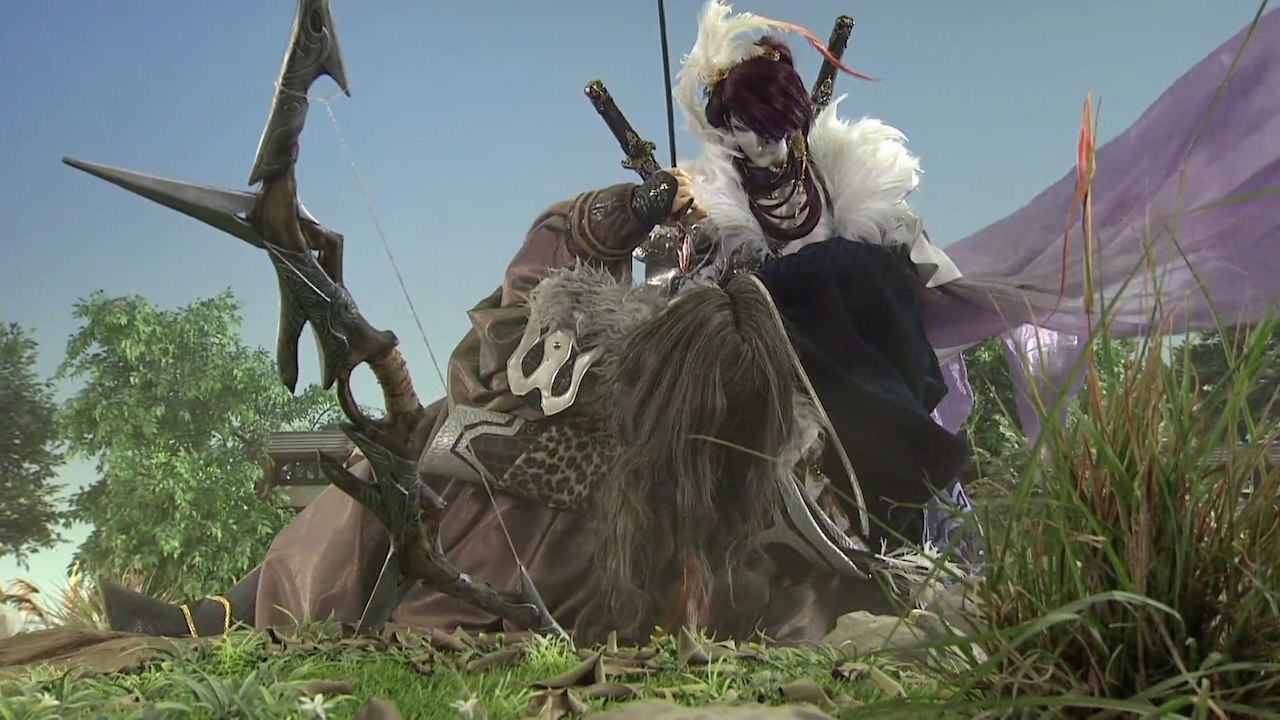
Ah, I've delayed this review enough. I was excited by the idea of Thunderbolt Fantasy when I heard a series had been commissioned using puppetry. For an Englishman like myself who at least has seen one scene from Thunderbirds and such works which used marionettes, this piqued my interest in seeing an older style of entertain be resurrected, but actually starting the series this idea became even more enticing when I knew the full context of Thunderbolt Fantasy. We tend to forget animation includes stop motion and puppetry, and they deserve to be covered whether a Japanese anime steps into this1. Thunderbolt Fantasy, when I started it, is even more intriguing as its a Japanese-Taiwanese co-production based on Taiwanese glove puppetry. Not only is it a case, as the show proudly shows, that this craft in the modern day creates some incredible pieces who move and interact as living characters but is it keeping a tradition alive, one which is not a Japanese one but a Taiwanese cultural staple being brought to a Japanese (and Western audience). It also means Thunderbolt Fantasy wasn't the Japanese action series using puppets as I thought it would be, but Taiwanese wuxia storytelling told with glove puppets, which is an entirely different tone and style to deal with, and is certainly unique for a thirteen episode series to have in terms of standing out from the crowd of anime productions.

If anything, even if the liberal use of CGI and magical projectiles over actual combat is annoying, you cannot argue stylistically Thunderbolt Fantasy is exceptional. The puppets themselves are incredibly well made creations, lavish and in spite of their fixed faces very expressionistic. Screenshots will give you a great idea that; as elaborate hand puppets rather than on strings as I'd originally presumed them to be without context, they move very fluidly within how they are used rather than the other traditional, and particularly for this type of magical fantasy, they are as recognisable and flamboyant as their various names and alias are in their poetry. In either case, the sense of verisimilitude is found so you can fully invest in them as characters regardless of what they actually are. The additional factor is that this is a wuxia story. Not just martial arts, but wuxia, a very specific form of storytelling which allows for more elaborate, even exaggerated events to transpire. Its carte blanche for all the ridiculous fight scenes, even if I wanted more puppet-on-puppet sword fights rather than them calling out special moves, but this is bearing in mind this is about style as much as a descendant and fantastical form of storytelling that can still be appreciated. One that is melodramatic and where martial artists and sword fighters here can perform superhuman feats.

From https://rosesturnblog.files.wordpress.com/2016/07/
thunderbolt-fantasy-for-article.jpg?w=750

Set in its own fantasy, quasi-Asian world, where a war between humans and demons have left a split in the land, it doesn't completely explain the world but thankfully it never becomes about convoluted world building either. It uses its setting for character, which helps, such as it being enough for vagabond, grizzled member Shāng Bù Huàn and his claim to have passed over demonic wasteland to even lead to the murderous sociopath named the Screaming Phoenix to question and feel wary of the statement. The characters are interesting in themselves especially as Thunderbolt Fantasy gladly undercuts expectations by having flat-out villains being recruited into the party trying to defeat the main villain. If anything it's a motley and amoral group worthy of dramatic weight, the one pure figure in heroine Dān Fěi, a sect member protecting an ancient sword, the moral centre without becoming as wet as a dishcloth. A grumbling, out of place vagabond Shāng Bù Huàn, who actually has the most rewarding character arch when you finally figure out who he is. The utterly distrustful, trickster Guǐ Niǎo, whose place in this story becomes a huge crux of the narrative. One eyed archer Shòu Yún Xiāo and his cocky, headstrong apprentice Juǎn Cán Yún. A literal demoness Xíng Hài, who hates Guǐ Niǎo but still decides to join in when knowledge of the ancient sword in the centre of concern is of interest for her. And plenty of other circumstances, screenwriter Gen Urobuchi playfully undercutting expectations - one of the best [Spoiler alert] involves the serial killer Screaming Phoenix being a figure the heroes are forced to work with, when he kills Guǐ Niǎo's master, the stereotypical old and wise martial artist, easily and refuses to give the magical flute required for their task back. [Spoiler Ends].

This is plenty to work with, even when the story's a simple one where they have to try to work together, get to the main villain Miè Tiān Hái's skull lair past three obstacles - a landscape of undead, a stone golem and a labyrinth of death. Unfortunately screenwriter Urobuchi, one of the few that have developed named recognition for anime fans, was on an off-day for me with this series. This review will be controversial, as many liked the series, but Thunderbolt Fantasy suffers from Urobuchi's taste for plot twists in this particular case undercutting all the ripe, potential adventure and suspense this initial plot suggested. He likes plot twists a lot, and when he succeeds, he pens Puella Magi Madoka Magica (2011) [Reviewed here], which was a constant gut punch and bleak take on the magical girl trope, but one with compelling storytelling and an emotional devastation behind every plot point, making all of them worthy of inclusion. Unfortunately the creative decisions completely undermine expectations in ways that fail.

From http://www.bostonbastardbrigade.com/wordpress/wp-content/
uploads/2016/08/Thunderbolt-Fantasy-2.jpg

Characters promoted heavily in the opening credits, in fights more elaborate the show, die quickly on both sides and abruptly. Once or twice would be okay, but it happens a lot robbing a lot of great action scenes, strange to say as someone normally interested in drama. Many don't get as much detail of them when that would've helped the dramatic context grow, or are not given enough time to. In terms of the plot, obstacles in the heroes' quest like the rock golem are used in funny ways, others like the aforementioned labyrinth of nightmares are completely brushed aside and not used. The show eventually feels rushed when it gets to the latter half, not feeding off its potential plotting fully, the ending falling onto a generic demon god whose existence becomes an actual punch line. And its clichéd. As much as this is embracing tropes of wuxia, many don't feel like the right ones appropriate for this genre but from Urobuchi himself.

Ultimately, this emphasises that even though I view animation with such high admiration for the hard work behind them even over live action productions, there is a difference between being able to appreciate the good work even over ridiculous content and when a product becomes so flawed you are distracted from these artistic virtues. Even when thrown about as they are, the puppets deserve better than what happened. The same is for the music; I didn't like the opening credit theme by T.M.Revolution, but the score by Hiroyuki Sawanois eclectic and constantly inspired, deserving more than the clichéd materials here. When Thunderbolt Fantasy comes off as a predictable action fantasy, it feels like a waste of something even more significant as these glove puppets are works of art. It feels worst especially as the storytelling, which is the sole crippling flaw, does detract from the visuals, which makes it difficult to have pleasure in said aesthetics as well.

From http://www.jaydotdee.com/poptardsgo/wp-content/
uploads/2016/11/thunderbolt-fantasy-73.jpg
======
1) One, Star Fleet (aka. X-Bomber) (1980), which is inspired by a Go Nagai manga  is a prominent example worthy of being covered.