Showing posts with label Letter: Z. Show all posts

Saturday, 5 August 2023

#257: Zone of the Enders - Dolores, I (2001)


Studio: Sunrise

Director: Tetsuya Watanabe

Screenplay: Shin Yoshida

Based on the Zone of the Enders franchise by Konami

Voice Cast: Tesshō Genda as James Links; Houko Kuwashima as Dolores; Mitsuru Miyamoto as Leon Links; Narumi Hidaka as Noel Links; Chō as Baan Dorfloum; Fumihiko Tachiki as Sameggi; Yumiko Nakanishi as Rebecca Hunter; Takehito Koyasu as Nathph Pleminger; Yoshiko Sakakibara as Dr. Rachel Links

Viewed in Japanese with English Subtitles


The opening rock theme proclaims the lead may be able to defeat God for all he knows, and this pretty much establishes the tone for what Zone of the Enders the series is. In contrast to the straight to video prologue which began this television adaptation of the Zone of the Enders video game franchise – Idolo (2001), which was a more serious set up for key plot points to this twenty six episode series – Dolores is a much more light hearted, more overtly comedic work whose serious moments are more in tone to an action film. Certainly, whilst with key plot lines also tied to the first 2001 video game, which are not needed for context but appear, this feels a tone different from the other works in this franchise, introducing us to James Links. As a lead he is one you would encounter, as a middle aged man nearing his fifties in futuristic times, piloting his space ship drunk and eyeing up the women. He is however someone with a tragic back-story, with adult children disconnected from him and his wife missing, with the fact he is from Earth and she from Mars part of the world building, as this is a world where the planets despite being both with humans hostile to each other in contrast to their love which crosses literal space. There is also the fact that he is a transporter whose secret cargo will drag him into finding his wife Rachel, said to still be alive after the events of Idolo, and on the run for a murder he did not commit.

It is awesome to have an older male lead, when the joke even for video games from Japan let alone that someone near their thirties or so qualifies them as a grizzled veteran, making this character voiced by Tesshō Genda, a veteran from the seventies who became Arnold Schwarzenegger’s official Japanese dubbing voice, a nice change of pace. It is one of the touches to a story, whilst with clichés, that manages a lot of great things just in terms of a memorable lead, not shy from James being ridiculous with a kitten for an estranged daughter Noel Links’ birthday and a mysterious cargo, pulling him into a conflict between planets, which introduces the titular Dolores, an orbital frame mecha with great power, sentience…but the mind of a teen girl with flights of whimsy who starts calling him “uncle”. Whilst humorous throughout, this with the Zone of the Enders world premise does set up key plot points  - of a racism against Martian born humans from Earth which has caused Martians to secretly plan an extreme coup de trait which will harm both planets, the orbital frames of immense power – even if one of your primary leads is a robot who acts like a naïve niece of the lead, even crushing on him, and a forty nine year old male protagonist who, in attempting to reconnect with him adult children, forced on the lam eventually with him, reads a book of becoming a better father over and over like a sacred scroll. Tragically some family dynamic is lost – Noel, in contrast to her stuffy and gullible brother Leon, is set up as the tough one of the pair, working at the construction site, despite loving her new kitten, only to be sidelined in this factor at some moments – but this show is helped considerably by its characters. A huge virtue coming into this production, with no knowledge of even the games, was that it manages something as simple but difficult to pull off as actually having interesting characters and a world to work with, even if there are plot points here found in many other productions.

In terms of video game adaptations, which are notoriously not well regarded, this is a surprise to see virtually forgotten as, whilst it does play to tropes of this genre, and from Sunrise, a studio behind the Gundam franchise and a lot of mecha shows, this does actually manage to be a solid adaptation. It manages to be respectful and actually create an engaging show even if it clearly takes liberties with the source, in having the comedic undertone, and the idiosyncratic take on sentient artificial intelligence where, alongside the trope of a duality between a wholesome side and the destructive alter ego, your titular lead, especially as she does all the episode preview narration, is a whimsical figure of flights of fancy even if capable of destroying everything in sight. This is more so when she learns the virtue of reading books like Cinderella, and tries to learn by herself how to dance as in episode nine (Lost in Space), or her way of hacking data files envisioning herself in a dress, James in a pink bunny suit, and the hacking interpreted as a fairy tale dream of stealing eggs.

As the story goes, searching for Rachel Links, a key character from Idolo, is of importance, as are the cops after James back from Earth, one of them explicitly a racist against Martians who will even deprive a child of her helmet and oxygen in his psychotic obsession with chasing James down for a murder he was innocent of, as is a character returning from Idolo, becoming the main villain if with the baggage of how they came to be and the problems this world has explaining how he became this villain. There are also requisite child pilots, though thankfully they make sense in context. They are part of the story in which we see, as a result of Earth’s iron grip on Mars and their cruelty, those wanting to find their independence have also unfortunately created those who just want to see Earth burn, even if it destroys Mars by proxy, among the teen trio Rebecca the one member pilot whose only “father” figure is challenged by seeing James’ more heroic fatherly actions, and is the one who represents them fully in character dynamics.

Set five years after the “Deimos Affair”, what is the narrative of the Idolo OVA, this continues the world of Z.O.E., in tiny details which do add character and making one able to invest in this story and producing ideas, even if never seen again, that feed the imagination as sci-fi should. Moving “voice” photos to space catapults that allow fast wormhole-like travel between worlds, or the Sargasso, space garbage dumps for illegally dumping materials by companies around Mars’ orbit. It is all fascinating even if for one episode stories, especially when we get to Mars. Attempting to make Mars habitable is one of the more interesting things, even fantastical, for this think piece burst of imagination, such as Earth creating seaweed which is enormous and producing giant air bubbles to create a breathable atmosphere, famers of giant corn, but also environmental normalists wanting to return Mars to its normal state. An entire new show just looking at Mars would have been compelling from the little we see here, such as a brief section about an abandoned Martian theme park with stereotypical “aliens” as decaying decorations. Sunrise also has an obsession with space elevators, something returned to with Gundam Reconguista in G (2014-15), a maligned and not well regarded entry if for me an entertainingly weird one, as one for Earth in this story is the huge McGuffin in terms of Earth’s peril, one of the more over-the-top science fiction pieces of the show, alongside a fabled ore on Mars which is magical in its abilities in building combat robots, that nonetheless still entice in what they bring up in ideas.

There are layers of cheese at times here – with the cheesiest way to stop Martian and Earth soldiers fighting each other – and until the last episodes, comedy does prevent the story from getting too serious for what is a studio, in Sunrise, used to mecha stories to the point they could produce this one effortlessly. There was clearly a lot of fun here on the production, with just the references alone, from the Martian racist cop figure of Baan starting to call James Links instead “John Carter” after Edgar Rice Burroughs‘ seminal Mars jumping pulp hero, or the person who clearly wanted to name episodes after films like “Total Recall” and “Die Hard”. I highly doubt one episode is named after the Italian director Michelangelo Antonioni‘s Red Desert (1964), even if I wish that is the case, but episode twelve is literally Die Hard (and has that as the title) on a Martial colony ocean lab; the difference is that it has Bruce Willis replaced by a man trying to save the day with a mecha who has a platonic relationship with him and a cat, even joking about it not being set at Christmas.

Individual episodes really do stand out here, even if the whole builds the story well. Episode four, Final Countdown, has the family attempting to escape Earth with the help of a former astronaut, in his old age still wanting to get to Mars on an old NASA spaceship, set at Cape Canaveral at Florida in an abandoned museum, whilst Family Game, episode seventeen, finally brings James together with the man behind the parenting book he has been learning from, a fun episode with the obvious twist being James has to be the one to offer the parenting advice. The tone even by the end is lighter hearted despite with the raising of its stakes, with comedy beats in-between the impending threat, like a gag to cut through the tension before returning to it. With no expectations whatsoever for this it is really strange, tragically damning, that barring ADV Films releasing this back in the day in the West, this show disappeared with a whimper. It was a production I had never heard of, despite the video game franchise still having good regard especially for Zone of the Enders: The 2nd Runner (2003), making its vanishing act from the list of Sunrise releases from this era, and mecha series in the 2000s, a real surprise.  I can guess that tonally, with what this does, this would not have necessarily won fans over for the games, but as its own creation, this manages the one thing that so many video game anime do not succeed with, which is actually be solid in a form in quality and managing to actually stick out to be a good show over its twenty six episodes.

Saturday, 3 June 2023

#254: Zone of the Enders - 2167 Idolo (2001)


Studio: Sunrise

Director: Tetsuya Watanabe

Screenplay: Shin Yoshida

Based on the videogame franchise by Konami

Voice Cast: Takehito Koyasu as Second Lieutenant Radium Lavans; Chiharu Tezuka as Viola; Houko Kuwashima as Dolores; Rumi Ochiai as Melissa; Yoshiko Sakakibara as Dr. Rachel Links

Viewed in Japanese with English Subtitles


Idolo as a tie-in does suffer from the issue that, separated from its source, you are aware of the wider franchise it can grow with or lost virtue from, and the inherent concern that if the rest of the multi-media franchise is forgotten, these type of tie-ins rarely get re-released. Only months after this was released, the 2001 animated series Zone of the Enders: Dolores,i was already being broadcast, so there was a considerable push for adapting in animated form the world of Zone of the Enders, a videogame released that year in a big marketing push. Set in a future Earth and its relationship to other colonies, which Idolo deals with from the Martian colony, Z.O.E. as abbreviated was sold as a killer app from Konami for the Sony Playstation 2, a big cultural phenomenon within itself as a videogame machine riding the height of the original Playstation. Zone of the Enders even had Hideo Kojima as a collaborator, which would have hyped the game even in the West when it was released. Ironically though, the legacy of this franchise is more likely held by Zone of the Enders: The 2nd Runner (2003), which was a much larger work in scale, length and virtues for critics, even having animated cut scenes sourced to studio GONZO.

Obviously, in context to this, Idolo is a tie-in meant to sell the first game as well as expand the story with a prologue, in this case setting up an enticing premise in its sleight original-video-animation length of fifty minutes. That it is produced by Sunrise, the Gundam creators and frequent studio for robot and mecha animation, offers an enticing prospect too this merely touches on. In the future, whilst we have colonised the galaxy there is also unfortunately bigotry, in this case to oppression of those humans born on Mars by Earth, who treat them as second class citizens least when it comes to their army on Mars even beating up Martian soldiers for fun, worse as being born on Martian gravity causes Earthlings to have an advantage in incredible strength. What is enticing to this anime, and is a slight spoiler, is knowledge that this is actually a prologue from the perspective of the future antagonists of the first video game. This sets up the BAHRAM, the military force that will invade and destroy the Jupiter colony the first game's lead survives, setting them up from the perspective that BAHRAM are the product of previous evils; colonial discrimination of the Earth forces sets forth those in this story, lead character and soldier Radium and the character of Viola, one of the more important characters herself from the first game, as those fighting back oppression only to become a destructive force in the future of the narrative. That in itself is really interesting, and this Idolo prologue in itself is tantalising in what you get as, whilst none of this is subtly told, it is a context distinct to tell this narrative from, as wishing to free themselves of the Earthlings, scientists on Mars are covertly developing the titular Idolo, a mecha built from the mysterious material Metatron, which presents a dangerous result both to how it influences the pilot and when the Earth forces catch wind of this machine, wanting to claim it for themselves.

As a piece of a full multi-media project, including that there is a twenty six episode television series which runs from Idolo, set before and after the 2001 game, Idolo does suffer from the fact that it is a slight story, where the scenario is  a prologue to a wider document. As a one-off by itself, I credit this with doing a lot to stand out; it does not, truthfully, have as much visual punch as one could wish for at times but including its bleak ending, which sets up the necessary context for later parts, it has a lot to admire. As a prologue to a larger work, it cannot go further, but beyond this there is a lot to admire in terms of the boldness of its story, as Radium's tale is there are someone being more controlled by the Idolo by its special properties, and simply the entire idea of this being a prologue to the antagonists of this franchise is something distinct, as it forces context of how even villainous figures can be moulded by similarly villainous acts, moral complexity something to admire when done like this and actually succeeding in its little form. Violet in particular, without additional context, would be left a character you wish was developed more, a figure harmed by the evils of the Earth forces, including being a victim as a child of "Space Radiation Sickness", causes by an Earth terrorist attack on Mars' colonies, but who even if a mere fragment has the fascination of where her arch is intended to go. Her emotional attachment to Radium, who brought her into the Special Forces after she tried attacking him on the street as a confused young woman, will become a huge emotional trajectory with the bleak outcome of this story, which does get even some visually striking aspects and a twisted bleakness when it involves the artificial intelligence taking personalities and a hallucinated wedding reception. Considering what the epilogue in the future brings up, and whom Violet comes in the franchise, a key antagonist for the first game and the franchise, and this proves one of Idolo's best aspects.

Even in terms of production, whilst the look and style of the show is not the most elaborate, it is solid, and the music especially by Hikaru Nanase is a stand out from this project, alongside "Kiss Me Sunlight" by Heart of Air as the ending theme a little gem, the group collaborators through this franchise.  Idolo is tethered to this franchise, with its director and key screenwriter continuing with the television series, and these adaptations are obscurer nowadays whilst the games were well regarded. The Zone of the Enders HD Collection in 2012 preserved both games, but it is Zone of the Enders: The 2nd Runner, the sequel which continues this narrative, which clearly left a huge mark for many, including a remaster, called The 2nd Runner M∀RS, which was released in September 2018 for Microsoft Windows and PlayStation 4. This does place concern that Idolo is forgotten among this, which is a shame as, in terms of what it was meant to achieve, it does a commendable job. The series, which follows on with this its own prologue, is an entirely different narrative structure in length, and has new challenges as a long form narrative to deal with, but Idolo by itself, as the only one, would have been commendable as a one-off tie-in worth resurrecting.

Wednesday, 11 March 2020

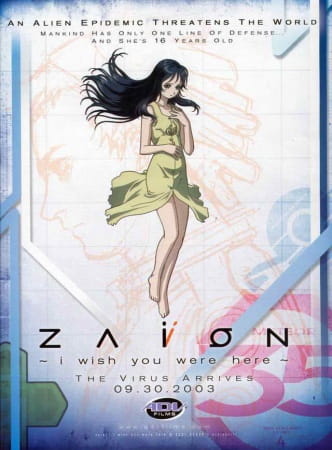
#141: Zaion: I Wish You Were Here (2001)


Director: Seiji Mizushima
Screenplay: Hiroyuki Nakamura, Manabu Ishikawa and Natsuko Takahashi
Voice Cast: Joe Odagiri as Yuji Tamiya; Yukari Tamura as Ai; Daisuke Gouri as Domeki; Hiroaki Hirata as Chanpua; Isao Yamagishi as Tatsumi; Jin Hirao as Kurosawa; Katsuyuki Konishi as Kaneshiro; Kotono Mitsuishi as Mitsuki; Nobuo Tobita as Satake; Romi Park as Tao; Tesshō Genda as Kudou
Viewed in Japanese with English Subtitles

Zaion is very much the project of a new company with too much ambition, not enough resources. Studio Gonzo were the anime studio I grew up with at their height in the 2000s as I got into anime, so there is a certain aura to them that I cannot help to have in spite of the obvious issues they had. The common idea, whether true or not, is that they always start strong on the first episode of their TV series, a company striving for the slicking productions, only for projects to suffer from budget or having to create original material when the manga sources weren't finished, something to attest to twice from my experience from Hellsing (2001-2) and Chrono Crusade (2003-4). This narrative should be held to debate in reality. What I can however say with true is how it's amazing to think that by the 2010s, whilst they're still around, they crashed and burned due to financial difficulties, having been founded in 1992, started anime production in 2000, and ended up having to delist themselves in 2008 and being merged with another company in 2009.

The best way to answer this question for myself, whether Gonzo were a good animation studio or one which failed, is only answerable by actually watching their work from their main period, in which between 2000 to 2008 they were very productive.  Zaion is a little different as, made in 2001, this is very early for the studio, just breaking into the industry in the 2000s as they originally began in video game animation, the same year as one of their earliest big titles Hellsing. It is also an "ONA", an early original net animation streamed directly on the internet.

Zaion also unfortunately has similarities to Mars of Destruction (2005), a notoriously "bad" anime OVA, if on a higher budget which is still a bad comparison for it. Like Mars of Destruction later, this is about a meteorite landing on Earth and causing an alien outbreak to transpire, in this case a virus that creates monsters from those infected. Unlike the later anime where it's a group of schoolgirls with guns inexplicably having to deal with them, this has a team pumped with nanobots in the blood stream that allow them to transform into effectively a sentai team. A new project, a girl called Ai with tremendous psychic powers, is planned to be the new secret weapon, but alongside a burgeoning relationship between her and Yuuji, a member of the team, the virus is evolving and starts to surpass the nanobots that protect from them.

A four part ONA, it is pretty standard material for a plot, but with the notable detail being that it's directed by Seiji Mizushima. I liked Dai-Guard (1999-2000), a real surprise in the transition to computer assisted animation about ordinary office employees having to operate a giant robot, and he's known primarily for the first adaptation of Full Metal Alchemist (2003), which was a colossal boundary passing hit. Zaion, honestly, does feel like a job for hire, particularly as Zaion's biggest weakness is that story wise and in available resources, it's incredibly bland and doesn't do anything of interest with its basic material.


Even in knowledge that this was an attempt at something from a newly created studio, it cannot be denied the OVA feels impoverished. The plot is very conventional for anime, but if you add style, any can grow in quality even in four TV episode length parts. You can make even a generic premise grow. Zaion isn't that anime, not particularly investing any real pathos for the cast, including a bland snarky male lead, whilst the only character of note is one of the scientists being a middle aged slob who eats a lot of junk food for his main diet. Even the aliens aren't that inspired as, whilst a threat when they can melt together into one giant alien or infect anyone who survives them, there's a lack of any distinction between them.

Production wise this is felt too, not in the obviously dated early effects, which stand out jarringly even in terms of frame rate, but for how generic it is. This is particularly felt as, barring one shot of a crowded city of pedestrians (in the day), this exists in some of the most empty locations possible. Not since Mars of Destruction or even Ai City (1986) have I seen such empty environments, where skyscrapers were just background to the film. Zaion follows a pretty obvious plot you can guess from what I have already described, which leaves little space for this bland aesthetic to be deliberately changed.

The only aspect which stands out is that the production hired composer Kenji Kawai, a regular collaborator with Mamoru Oshii and a talented creator who brings his a-level talent here. Zaion to its credit, when everything else isn't interesting, has a great soundtrack, touching upon New Age and electronica with an incredible atmosphere.

Aside from this...yeah, this is difficult without just recounting how the story ends which defeats the purpose of the review. It ends with some tragedy and a happy ending, but I didn't care. There's generic plot points here that could grow and blossom into good stories - that the sentai team are a multinational steam willingly risking their lives by punching infected mutants when the remote controlled combat robots don't work, or the military are both covering up these alien outbreaks, and emotionally isolating a sixteen year old girl to turn her into a hologram projecting laser weapon - but they are the most basic interpretations of them. As a result, this isn't an artistic failure, just an insignificant production which is worse as people worked hard on the episodes only for this to be the result.