Showing posts with label Director: Ujicha. Show all posts

Tuesday, 2 November 2021

‎#207: Tempura (2014)


Director: Ujicha

Screenplay: Ujicha

Voice Cast: Enji Aoyagi, Yuichi Washio and Satoshi Okuda

Viewed in Japanese with English Subtitles


John!

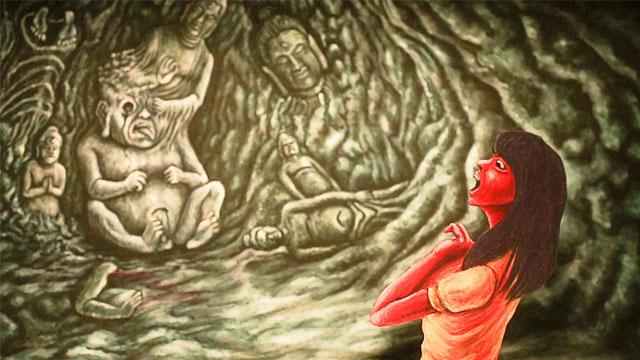
This will be a short, short review as, only a few minutes long, this piece in Ujicha's growing filmography of "geki-mation" is barely more than a fever dream. Searching for John, a dog, two men including a smoker with a robot arm enter a cave where animals are burnt to the wall with tempura batter. John the dog has tragically been deep fried alongside a variety of creatures, and the occupant of the cave has intentions for the intruders.

This, made before Violence Voyager (2018), definitely feels like a prototype to that feature film. A strange block headed creature is armed with small guns which fire dangerous ammo, in this case burning hot tempura batter from two guns. This short, if you had no context of its creator's career, or the fact the creator has a one name pseudonym based on "green tea", would baffle and surprise anyone. Never mind the fact one of the leads is also nude for some reason, but in mind that the art style is unique and tempura will never be viewed the same way again.

It has not really needed to evolve between The Burning Buddha Man (2013) to Violence Voyager, baring that Ujicha has jettisoned the live action sequences from the previous film, as the art style has always been strong. Based directly on a 1976 television adaptation of Kazuo Umezu's manga Cat-Eyed Boy, which was done in paper cut-outs, this is a painstaking art style to even finish for a very short work like this. Even if the animation process involves moving paper cut-outs by hand, and Ujicha (for gross effect) using liquids, the craft to draw these characters and the worlds in the background is a lot to do. It means a great deal, with his unique and grotesque style, that Ujicha can draw extremely well.

Again, this is an extremely short review, but we are dealing with a little fragment here. I am happy to have a piece here, for a little slight piece, just to repeat the virtues of this creator and hope he succeeds with future work.  

Saturday, 16 October 2021

#205: Violence Voyager (2018)


Director: Ujicha

Screenplay: Ujicha

Voice Cast: Aoi Yûki as Bobby; Shigeo Takahashi as Akkun/Yakkun; Naoki Tanaka as George; Nao Hanai as Kyoko; Daisuke Ono as Takaaki; Hitoshi Matsumoto as the Narrator; Tomorowo Taguchi as Koike; Saki Fujita as Yoshiko/Sayaka

Viewed in Japanese with English Subtitles


There was a chimpanzee in the toilet!

For most, without context of Ujicha's previous film The Burning Buddha Man (2013), Violence Voyager would be a shock to witness. Available not from anime distributors, as in the United Kingdom through Third Window Pictures on Blu-Ray with the older film in 2021, this exists in a curious place as, not traditionally "anime", Ujicha creates very idiosyncratic work entirely based on the concept of "geki-mation", paper puppet stop motion. If my view of Violence Voyager somehow tones down some of the bafflement, that is only because I have been baptised in this weirdness for a longer time, due to having seen The Burning Buddha Man and witnessed how proudly bizarre the narratives of these films are too.

There is a perverse streak of a fairy tale here, despite not being suitable for children in the slightest, in which an American boy in Japan called Bobby and his friend Akkun, with his odd grilled marked forehead, do not heed the warning of the wise old man, called Old Man Lucky-Monkey, to not go up the mountain. On said mountain, they encounter a rundown and homemade amusement park called Violence Voyager in the middle of nowhere. Not realising even the name, let alone as a rundown amusement part, is something to avoid, they encounter a place which is a mock alien invasion game with killer robots, played as a water tag game where you have a variety of water pistols (replica rifles to tiny dolphin ones) to shoot robot models. Things already go south when they find a girl there who says she has not been allowed to leave. This is a film I had anticipated seeing, but I will warn viewers has pretty extreme content even if the film is done with paper cut-outs. Even if they does not look realistic in Ujicha's design, and is as much goofy and perverse on purpose as it is disturbing, Violence Voyager has some material you would not be able to get away with in live action like this.

That this passed suitable for fifteen year olds in Britain is something to admire if even for me, as a progressive individual, is dumbfounding, as a British viewer who has seen a form of progressiveness appear over the years as much as contradictions still appear within the British Board of Film Classification. They are much more lax with animation, where you can get away with content that would have gotten a higher rating in animation unless you touch on certain topics1. And trust me, as a horror narrative, Violence Voyager is a twisted little tale involving children, even if grotesque caricatures in some cases, being killed off or, if still alive or useful, being transmogrified into monsters, with corpses mutilated and fed to a figure that was once the dead son of the amusement park's creator.

Taking his influence from Kazuo Umezu's manga Cat-Eyed Boy, specifically a 1976 television adaptation which used paper puppetry too, Ujicha has no qualms with exaggerating his content, befitting a man who named himself after his birth place's green tea. More so as, for gristly effect, he uses real liquids to depict blood and other fluids, especially as transmogrification causes one's digestive system to change. He even uses real fire and firecracker explosions for the final with Chekov's lighter. You could only get away with half of this only in this paper cut-out form, and with some of it, even being paper does not hide the queasy effect, as a certain horrifying bird-mother feeding organism, which feeds the resurrected son with a spiny flesh tube, was icky even for me.

This is, however, a film involving special underwear as a plot point, as Bobby will literally change due to the trauma of this scenario, so Ujicha has a sense of humour. Like The Burning Buddha Man, the plot is depicted seriously but everything is openly bizarre. Naturally as a result of this attitude, this is the kind of one-offs which both had bodily fluid gags, and goes as far as include a troupe from fairy tales (from around the world) of Bobby's kindness to animals leading to them helping him later on, even if here it is his pet cat, a chimpanzee the old wise man keeps, and a bat (as in an actual fairy tale) he showed empathy for. Sometimes anime is bizarre out of accident or the id, combined (as with manga) of being forced to both produce something quickly and has to bring in an audience. There are exceptions, and in the few productions I have seen, Ujicha feels sincerely in touch with these bizarre premises and their idiosyncrasies despite being, as seen in interviews when he steps from behind the camera, an ordinary guy who study design in university2. Knowing his work is entirely done by himself (baring sound design, voice acting and music) emphasises this, his id freely flexed in a context, which is twisted and eyebrow rising, but tempered with a whimsy.

It is an achievement, something painstakingly made, the paper cut-out models having to be designed and drawn, cut out and even moved even in their limited form with hands being seen on camera. Baring what they are when you initially start watching the film, this feels like a handsome production which does not show a limitation from its sources, instead a unique form of animation with a deliberate artifice. So much so, I do not want to elaborate on more. Those with the stomach for this are going to experience something truly unique. Call it cult, but that should not be used to dismiss its artistic qualities, because this is still an exceptional production I was grateful to finally experience.


=========

1) Elfen Lied (2004), in the earlier days of DVD, was another example and that was both extremely violent and with grim subject matter. Nowadays you have to be far more violent even that Violence Voyager, or have certain explicit content, including anime's bad habit of sexualising teenagers, to get the eighteen certificate and even censorship nowadays.

2) Third Window Picture's 2021 Blu Ray has a short self-made interview with him which really helped grow an appreciation for a slightly awkward younger guy just painstakingly doing his work. Even when the distributor asked what he would want with a larger budget, he would still want to move the puppets himself even if he could have appreciated others to help design the backgrounds for work, which is a clear sign of someone passionate for his craft.

Saturday, 30 November 2019

#128: The Burning Buddha Man (2013)


Director: Ujicha
Screenplay: Reo Anzai
Voice Cast: Nao Hanai; Chisako Hara; Moeka Haruhi; Shunsuke Hirai; Mitsuko Hoshi; Munemyôou Hozan; Yuka Iguchi; Reijirô Katô; Ryûki Kitaoka; Tomomi Nijii; Kazuyoshi Sakai; Labor Satô; Saori Takahashi; Minori Terada; Hiroshige Watanabe
Viewed in Japanese with English Subtitles

Named after green tea ice cream, Ujica is unique in the sense that, not since Hiroshi Harada mostly made Midori (1992) by himself, have we seen as with Ujica here and with Violence Voyage (2019) a figure making a Japanese animated work by themselves as a one person band, completely outside the confides of expectation even when the mainstream anime industry does allow for idiosyncratic projects to occasionally appear. Ujica has also acquired a cult interest in the West entirely outside of anime fandom entirely, Violence Voyage having gotten a streaming premiere in the USA in late October 2019, with The Burning Buddha Man available in iTunes. This is interesting as, not looking in the slightest like the stereotype of anime, he has managed to tap into the fan base for "unconventional" Japanese cult films, and being entirely alien to even anime in its popularity as we can see on stream platform.

Ujica calls his style "geki-mation", set up with a live action bookending prologue and epilogue in which a young woman, in a gothic Lolita scenario, is handed scissors and paper by a butler to begin constructing the world we witness. The style of animation here, with paper cut outs, draws back to a Japanese tradition of paper puppetry. "Geki" however is a reference to gekiga, a manga movement headed by the likes of Yoshihiro Tatsumi who wanted move away from children's comics (like Osamu Tezuka's early work) to work for adults, leading to the likes of Golgo 13, authors as acclaimed and notorious as Kazuo Koike, and even Tezuka himself going into a golden run of adult targeted comics in the seventies when he was being challenged by those inspired by this movement creating for more serious, sometimes more graphic and explicit work.  

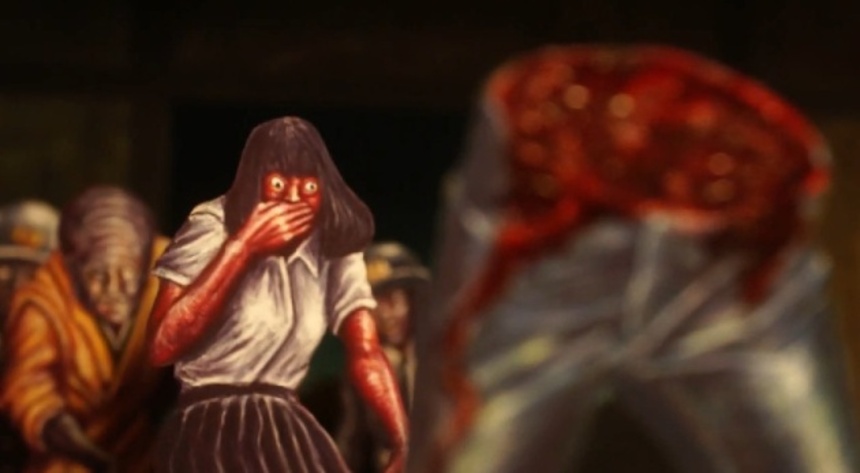
The distinction comes in knowledge of how painstaking Ujica's work is, creating this bizarre body horror action story about people fusing human beings with Buddha statues for greater enlightenment power, the kind that would be impossible to actually animate with the level of detail to characters and locations this has in the current anime industry. It's also a premise which is entirely idiosyncratic and Japanese, leading to tangents on the craft of Buddhist statues yet re-envisioning the religion and its ideas into a violence tokusatsu work at some point where enlightenment is a goal attained by the bad guys just to be more powerful and strong. For the protagonist, a schoolgirl, the theft of a Buddhist statue in her parents' shrine connected to this evil scheme also leads to their deaths, on a journey from then on into a war, between those melding people to stolen statues to attain forced enlightenment, and the marginalised victims of this process who wish to stop this, assisted by her own grandmother who has affectively been in a form of coma over many decades to become enlightened. Said journey will lead her between virtual training and a jaunt into the realm of the dead along the way.

From https://screenanarchy.com/assets_c/2013/10/TheBurningBuddhaMan
-review-main-thumb-860xauto-43353.jpg

Already this is anime at its strangest, where the creator crams in a tribute to giant robots when a team of mutant heroes meld like a Power Rangers zoid to face the villains, but his art style just enhances it further, already showing you at the beginning this is a director with his own distinct world building in just how characters look. His paper-mation, where the characters are cut out 2D figures moved just off screen, had to be drawn multiple times to be able just to have expressions and movements, elaborate to the point as already mentioned that this detail would not be possible even in the best of current animation unless one had the time and budget to pull it off, the kind of ultra large-scale production you don't find a lot in the slightest. He creates a grotesquely compelling world where even the normal characters are exaggerated, even the protagonist as a schoolgirl having bulging eyes and usually red faced in most scenes, all before he lets his imagination run wild with the melding of human, beast and statue together. Arguably the sets, also paper backdrops, are the most naturalistic of the entire production of everything drawn, making a wonderful contrast. Adding to the tone is that, when gore or an effect is required, as if taking a page from Genocyber (1994) whose first episode infamously used clay for inter-cut shots to add to the splatter, Ujica uses liquids and other things for this, be it for gore to vomit, even in one scene actual hair and water to represent someone's tears as they have to cut their hair off to become the right person to protect the Buddha statues.  

Does The Burning Buddha Man have any depth? It's body horror sci-fi pulp at heart, and in another religion, it'd be profane to have symbols like this distorted this way, which in itself is a depth unintentionally to think about in terms of Japanese Buddhism in relationship with modern Japan. It also fits the genre of erotic-grotesque-nonsense perfectly; at first, it's just grotesque in the body horror and nonsensical in the plot, the ero eventually however appearing when mid battle heavy petting and certain types of nude religious statues are brought in.

There is also the underlying fascination which how much a tough, hard earned accomplishment the production would've been, alongside the fact it was done for this particular premise of all things. It has an errant absurdity, when the heroes push aside non violence to kill evil minions, but there's an obvious message that forcibly trying to acquire enlightenment even on a comic book pulp level, at the pain and mutation of others, is wrong, your nephew rebelling when he is a carver of Buddhist statues who takes honourable pride in his craft. All deeply silly yet told sincerely; this in itself is the type of Japanese film I'd rather have sold to Western cult film fans than the middling ironic wave of live action, low budget splatter films that were made by Nikkatsu intentionally for the West from the late 2000s. Its a theatrical film in anime, due to its circumstances, which is utterly idiosyncratic next to most anime from the same year it was released, and in lieu to the fact he's made a second film called Violence Voyage, Ujica has managed to be in a position where (depending on how long his work takes to complete per production) he's able to make these films without the pressure of the mainstream Japanese animation industry and already have a unique voice this early in his career. It's an acquired taste, but I have always admired the utterly idiosyncratic and champion it.  


From http://www.spectacularoptical.ca/wp-content/
uploads/2013/07/the-burning-buddha-man.jpg