Showing posts with label Live Action Film. Show all posts

Sunday, 9 October 2022

Bonus #15: Boogiepop and Others (2000)


Director: Ryu Kaneda

Screenplay: Sadayuki Murai

Based on the light novel series by Kouhei Kadono

Cast: Sayaka Yoshino as Tôka Miyashita / Boogiepop; Maya Kurosu as Nagi Kirima; Daijirô Kawaoka as Keiji Takeda; Ayana Sakai as Minako Yurihara / Manticore; Asumi Miwa as Naoko Kamikishiro; Mami Shimizu as Kazuko Suema; Kai Hirohashi as Kei Shinkoku; Tetsu Sawaki as Akio Kimura; Hassei Takano as Saotome Masami; Hideyuki Kasahara as Shirô Tanaka

Live Action Adaptation


This is not the 2019 animated series by studio Madhouse being covered, but a live action adaptation of the first Boogiepop light novel released the same year as the first ever animated adaptation, Boogiepop Phantom (2000). It offers an interesting layer in explaining Boogiepop as a franchise, in that it is a deeply unconventional story in terms of lore but also in its storytelling in just the adaptations themselves, all of them unconventional even if the 2019 anime series is the most cognizant and does heavy lifting in explaining the lore to its basics.

The live action tale is aptly a puzzle box as much as Boogiepop Phantom, immediately disarming in how it has jazz cocktail piano music set to images such as a high school girl seductively licking the eyeball of another girl who is clearly dead. It is one of a few abrupt fragments we see in the prologue, in this Toei Video co-production, introducing all the students we will follow, as this film is told out of order, told in fragments over a timeline in different chronology to how they actually played out. It is, thankfully, fleshed out fully in the end with only certain passages not seen until the end of the film itself, with interlude segments in-between which add additional context. Screenwriter Sadayuki Murai, whilst working in live action here, is predominantly a screenwriter for animation, including for Boogiepop Phantom. He also penned Satoshi Kon's Perfect Blue (1997) and Millennium Actress (2001), so he is someone I have immense respect for, his craft on hand here in making sure this all makes sense in the end whilst taking a huge risk in depicting this tale in this idiosyncratic method of non-chronological storytelling.

This is also where the logic of Boogiepop is curious, just attempting it like any anime/light novel into live action as the Boogiepop costume alone, the titular figure a mysterious form who shares a body with a highschool girl named Tôka Miyashita (Sayaka Yoshino), looks really strange in the middle of a school or ordinary urban Japan at the time, looking like a Dune planet traveller is striking purple. Boogiepop, an urban legend presumed to kill people, is actually there to protect people from unearthly forms actually responsible for this, co-existing as separate entities in one body, and in terms of the tale being told, it tells the chapter in the 2019 anime which made up episodes one to three, Boogiepop Does Not Laugh. In this tale, there is a "manticore" disguised as a school girl, devouring the brains of fellow female classmates and whose tears, with an assitant, are being peddled as a mind sapping drug to bring more victims to her. There is the boy who loves Tôka who has to contend with how she is unaware of Boogiepop, and there is a girl who has found "Echoes", an alien entity in a human body connected to the manticore but is a form of good against them. And then there is Nagi Krima (Maya Kurosu), whose depiction here I loved. She is the other character of importance just in the Boogiepop adaptations alone - the daughter of a murdered novelist who, learning of the unnatural entities around her and Boogiepop, brings technology and her own martial arts skill to compensate for being a mortal young woman. This version as played by Maya Kurosu, as a short haired tomboy breaking students' arms, is a really cool one that sadly never was followed with and only has a short part to this narrative, one of the issues inherently with adapting merely a piece of this franchise when the series can expand on the character.


Telling a short piece of the source material, it is curious to see this version, which does have the limitations of a lower budget and the limitations of live action, stripping away some of the context and lore to its most practical version to adapt. Boogiepop is odd as a premise anyway, a sci-fi laced work with its horror touches and its esoteric world of artificial people, alien forms and monstrous entities picking on mortals. Boogiepop and Others, the 2019 version is the most conventional version as it is a series of four different stories like an anthology, whilst this live action version, because it shares a same screenwriter, is as esoteric as Boogiepop Phantom in how it plays out, which is a really unconventional experience even in context of this era's Japanese genre and horror films from the time. I have had ambivalence on all the lore, even as someone who admires all three adaptations as their own franchise without the source material, coming entirely from finding the 2000 Boogiepop Phantom an opaque and difficult anime in my youth, fully appreciating it now knowing it was a sequel novel adaptation which barely explains its world, becoming something abstract as a result and compelling as a result. It was also one where the real meat came from how the stories, no matter how unnatural, came from human behaviour, such as a plot line of someone who causes people to escape as their inner children, abandoning their adult selves as living husks in the normal world. Boogiepop Phantom out of all three also has the most distinct and incredible aesthetic and mood, but this live action interpretation glances at many of the franchise's virtues, including in how all these stories still connect to human folly and behaviour, slightly glanced over here with the subplot about the drug being taken for escape by students.

This does thankfully create its own atmosphere even in its own way. The urban Japan of this era of horror movies, especially the lower budget ones, has always compelling for me, more so in the case of this premise which, baring CGI which was aged back then, is having to work around its very unconventional content in the confines of what could be done practically and with the budget. It feels more compelling as horror and genre cinema that, hidden among the Japanese classrooms and in darkened alleyways, these strange visitors and incidents are transpiring, which you do not really see from lower budgeted North American films from the era unless with the lowest of budgets, always feeling restricted in their own confined sets as a result. Also the music, by composer Yuki Kajiura, is just as idiosyncratic as the two animated productions - not only does this have Boogiepop Phantom's opening theme at the end, sultry male vocal lounge music, but the smooth jazz score is delightfully unconventional, proto vaporwave, like the purple hue some scenes have.

Arguably this is the weakest of the three versions, even if the simplest of reasons that the others have longer to expand and shift with their narratives, whilst this has the time to tell just one of these tales. It is however a fascinatingly curious twist to low budget Japanese horror cinema from this era, even without the context of being an adaptation of a light novel, for how esoteric and unconventional the tropes of science fiction and horror are used within it. Able to see this, it is also the one adaptation of a source that became famous with its animated adaptations that managed to not come off as a compromised version. It struggles and it has to minimalize the more out-there aspects of the source work, but it manages to succeed in its own way to adapt the material, which is an achievement in itself.

Wednesday, 27 July 2022

Bonus #14: Fist of the North Star (1995)


Director: Tony Randel

Screenplay: Peter Atkins and Tony Randel

Based on the manga by Buronson and Tetsuo Hara

Cast: Gary Daniels as Kenshirô; Malcolm McDowell as Ryuken; Costas Mandylor as Lord Shin; Downtown Julie Brown as Charlie; Dante Basco as Bat; Nalona Herron as Lynn; Melvin Van Peebles as Asher; Clint Howard as Stalin; Andre Rosey Brown as Sandman; Paulo Tocha as Stone; Chris Penn as Jackal; Tracey Walter as Paul McCarthy; Rowena Guinness as Jill McCarthy; Isako Washio as Julia


Is it peaches? Sounds like peaches.

My knowledge of Fist of the North Star was limited to the point that this, in honesty, was one of the first versions of Buronson and Tetsuo Hara's legendary manga I had seen. The first was anime, New Fist of the North Star (2003-4), but worth mentioning is that, if the history of bringing Fist of the North Star into the United States only took to the late 2010s into 2020s to succeed, we in Britain got less of this legendary series. The United States finally got the full and uncut 1984-8 television series only in 2010s with Discotek, whilst in Britain, we only had 36 episodes of Manga Entertainment's attempt to sell the show, coming in the mid-2000s in a long gone box set. Fist of the North Star, this curious attempt to sell this franchise in the West, had the advantage in the DVD era that Hong Kong Legends picked this up as a title. A British DVD company, now long gone, who strove to preserve and release Hong Kong martial arts cinema with a care for extras and full versions pre-dating the Blu-Ray era, where even Criterion is preserving titles they once released, unexpectedly included Fist of the North Star itself among their catalogue.

This is not the first live action version, bootleg or otherwise, but with Clint Howard having his name over pro wrestler Leon "Vader" White on the opening credits, it is clear this is a curious adaptation. To those with no knowledge of the franchise, as this film tells, the world has descended into the post-apocalypse, with those who wish to acquire power having taken over as marauding hoodlums. One figure named Lord Shin (Costas Mandylor), having dominated with an iron fist, as the practitioner of the Southern Cross martial arts style, has created a city, his desire to improve the world contrasted by his ego and letting his men commit atrocity by invading smaller communities for supplies and slaves. His rival, who he has taken his love Julia (Isako Washio) from, now a caged songbird to him, and marked his body in permanent scars, is Kenshirô (Gary Daniels), practitioner of the North Star style. North Star, as interpreted in the manga, in the anime, but also here, is that contacting certain pressure points on the human body causes that person to explode, as gory as that sounds, and Kenshirô approaches Shin's world in attempt to defeat him.

Gary Daniels as Kenshirô looks like the muscular brother of Benedict Cumberbatch, who can still make your head explode, which is a compliment to both men. Daniels, a martial arts action star of films like Bloodmoon (1996), born in London, was also the person who came to this as a fan of Fist of the North Star, enough to call his son Kenshiro Daniels, who would go on to become a football (soccer) player when he grew up. Things obviously however made it clear the Fist of the North Star, this live action film, is not quite what it should be. It is conventional, which is the biggest sin it commits, that Tony Randel, most famous for Hellbound: Hellraiser II (1988), came to this film and made it very conventional, more concerned with trying to give the character of Kenshirô angst-ridden rather than a narrative exploiting its premise. Even for a lower budgeted film, it has a lot to get the tone right, the production design team and model builders deserving all their praises for a film which, when exterior location shots, feels post-apocalyptic, but those involved beyond this clearly missed the point.

Despite being part of the wave of pop culture films from the 1990s that I am obsessed over, this is just has one pace, to tell a very simplistic tale of this Kenshirô beating Lord Shin, and not a lot else to work with. A film presenting Clint Howard, Ron's memorable acting brother, getting to be a murdering bastard in the first half, shooting people indiscriminately should sound like a lurid pulpy movie, especially as this does have fight scenes, and one of the most curious casts you could imagine for such a film. One thing you cannot deny, and should have excited people coming to this film, because Randel comes to this as a horror director behind films like Ticks (1993), is that they did not ignore how these characters can make people explode with a punch, or Lord Shin's special glowing hands attack causes veins in the biceps to burst in jets of gore. Even then, however, this does pull back, and never was there a film whose personality is against itself with moments this adult and violent, against content you would expect in tone from a child-friendly comic book adaptation.

Explain, for example, that this is a film with moments of gore, where the troops of Lord Shin, the South Crossmen, are explicitly raping, pillaging and murdering nearby locations, but contrasts this with a blond haired teen male character (Dante Basco) who is a goof and a wannabe kung fu expert, whose friend is a cute blind moppet who Kenshirô cures of her blindness. The film’s narrative is incredibly generic, and for a film that needs good fight scenes to work, the compromise to their presentation undermines the whole project, alongside the fact that, for the few moments of gore here, there are also points where the gore from the original manga are removed for the most part too. What it becomes is a strange concoction of who managed to end up in the film. Even in style there are weird moments that show this, like inexplicably, for a sombre toned film with an orchestral score by Christopher L. Stone, for it to suddenly splice in a Machine Head song A Thousand Lives into the soundtrack.

Malcolm McDowell, entirely separated off from everyone in his scenes, is a North Star martial arts master named Ryuken existing in the afterlife, continuing the obvious concern of Western actors having Japanese characters to play, levitating in a room or inexplicably appearing as a zombie to Kenshirô, voicing another actor, to tell him to not flee his role as a hero. Vader, the legendary pro wrestler, especially in Japan as much as in the West, is perfect as a Fist of the North Star baddie, and is just being Vader, pulling a promo on a small girl, as awesome as that sounds whilst performing moves on Gary Daniels. But with that fight ending in an anti-climax belittling both of them, even Vader is misused. Melvin Van Peebles is a really curious choice, a legend in African American cinema for directing Sweet Sweetback's Baadasssss Song (1971) alone, here as an actor, as with Downtown Julie Brown, a British video jockey (VJ) and personality, neither ultimately given much to do as members of a village Lord Shin is terrorising. Unfortunately as a result, neither were really worth having hired in the first place despite both, Van Peebles especially, are inspired figures to have hired.

Costas Mandylor himself is also a curious choice as that unfortunately means, as a former soccer/football player with no martial arts training, they had to work around this with stunt doubles, in a film which has Gary Daniels but not many who can do the martial arts fights. Japanese actress Isako Washio likewise, an actress from films like Bloom in the Moonlight (1993) is also stuck here trying to perform in a language not her own and feeling lost too. The one curious choice who managed to grab something from this is Chris Penn as Jackal. Penn steals the film, the actor from films like Reservoir Dogs (1992), with the advantage, playing a sleaze ball goon who managed to tape his head together before Kenshirô's blows caused his head to explode, that he could find a character he could relish the lines of.

It is a project which ended up with people who really had no idea what to do with this - co-screenwriter Peter Atkins mostly worked on Hellraiser and Wishmaster films, making this frankly a case of someone dropped with a title they had no investment it, Tony Randel likewise feeling entirely out of place here. Even in mind that huge chunks are clearly missing, such as the aforementioned Clint Howard disappearing entirely eventually, the live action Fist of the North Star film feels entirely at odds with what it is was adapting, a franchise which would have to take decades to finally get a lot more recognition in the West. This is a fascinating film to see, and has aspects which are worthwhile, just in how it looks, but never was there a film which really did not have a lot going on despite having such a curious production on and off screen.

Saturday, 27 October 2018

Bonus#10: Avalon (2001)

From http://2.bp.blogspot.com/-pNL6aOmmUX8/U6DxOrukkZI/
AAAAAAAAEEE/CA292vELw0g/s1600/2014-06-18+01:53:11++00001.jpg


Director: Mamoru Oshii
Screenplay: Kazunori Itō
Cast: Małgorzata Foremniak as Ash, Władysław Kowalski as Game Master, Jerzy Gudejko as Murphy, Dariusz Biskupski as Bishop, Bartek Świderski as Stunner, Katarzyna Bargielowska as the Receptionist, Alicja Sapryk as Jill, Michał Breitenwald as Murphy of Nine Sisters, Zuzanna Kasz as the Ghost
Viewed in Polish with English Subtitles

Synopsis: In futuristic Poland, Ash (Małgorzata Foremniak) is a successful player of an illegal virtual reality game named Avalon. Her awareness of someone who has been watching her from afar within the game, who cannot be identified, leads her to the search for the Seven Sisters and a secret level of Avalon only accessed by a literal ghost in the game.

Mamoru Oshii's career trajectory is fascinating. On one hand, he's known for the likes of Ghost in the Shell (1995) and works like the first two Patlabor theatrical films. For most of his career however, with the exception of starting with the likes of the Urusei Yatsura franchise, he's always been an experimental director who yet managed one major success, one that broke into the mainstream and altered pop culture as a result, and has thankfully had the ability to be constantly in work even if his post-2000s work is mainly difficult to find and divisive even for Oshii fans. Beyond this, he was always this experimental director even at the beginning, one of his contributions to Urusei Yatsura the feature film Beautiful Dreamer (1984), a experimental rumination on reality, or Angel's Egg (1985), exploring his own lapsed religious faith by way of Yoshitaka Amano's gorgeous art. He was always "difficult", even in Ghost in the Shell with its turns into philosophy in the middle of action scenes, especially the divisive 2004 sequel. He's also made a lot of live action work since 1987's The Red Spectacles.

From http://1.bp.blogspot.com/-7H1KKPrQIts/U6Dzngw7k0I/
AAAAAAAAEFQ/qbuRn0DPIHE/s1600/2014-06-18+02:03:50++00001.jpg

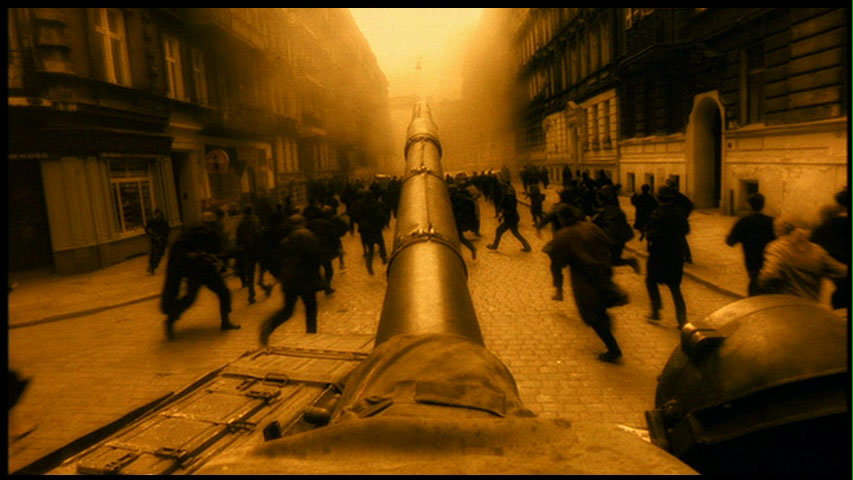
With this in mind, Avalon's an interesting one-off for Oshii as its a Japanese production but set and co-produced with Poland, a curious choice that yet works to Avalon's favour. The spectre of Communist Europe is felt large in the mostly sepia tone and futuristic drudgery of this world, lost in time and with Avalon the whole point of life for many in response to this, an illegal game where many devote their time and can be able to afford luxuries with the pay from, in spite of posters on the walls proclaiming it should stop. The VR game itself is a constant war zone which exists in ruins and isolated industrial environments, evoking the Cold War era but also World War II. Also, it should be kept in mind that Mamoru Oshii has always been influenced by Western culture - as a man who has packed so much philosophy in his world, he references Western culture as much as Japanese culture so it's not surprising he'd eventually make one film outside his homeland once. Avalon the film is entirely about the search for the titular "Avalon" as well, the afterlife realm for heroes found in Arthurian legend, at one point in his trademark exposition dialogue linking it to another similar idea in Norse mythology too, in this futuristic world the closest thing a virtual reality game which allows Oshii to play with the notion of our perception of what reality truly is whilst offering a world for a player to find those lost in a form of afterlife.

If Avalon has a message, it is still a very relevant take on both the subjectivity of reality, as Ash ultimately ends up in an experimental stage where the film manages to pull a rug under another rug it pulled at the start of the segment, a rarity it manages to make work, and also the increasing sense as video games and virtual reality become more precedent in terms of their relation to reality and our lives, where one can make a career out of it and feels more true life than ours out of it. The decision to depict it through an antiquated, post-Cold War aesthetic absolutely helps avoid technical obsoletion in the themes, the computers here inherently old back in 2001, and the world in and out the Avalon game is barring flashes of colour in sepia.

From https://thefunambulistdotnet.files.wordpress.com/2010/12/avalon8.jpg

As with all Oshii works, unless we're talking about the reoccurring Bassett hounds in his work (an animal lover by all accounts), all his films are precise in their references and symbolism. Arguably, Avalon is one of his simpler stories to understand, one that would reward upon repeat viewings but can be absorbed on the first viewing in story and in terms of the spectacle. The film, deliberately artificial in its CGI, dating with grace due to this factor, is matched by its sense of the grandiose, emphasised further by Kenji Kawai's score or the use of classical music especially in the most emotionally powerful moment, an entire performance of the Warsaw Philharmonic Orchestra intercut between an important dramatic incidents in the plot. Whilst known as a cerebral director to a fault for some viewers, Mamoru Oshii was always concerned with human drama and happy to blend it with action, and in this world this is implicit throughout.

This is as well with the danger of the virtual world being unable to be taken seriously. If videogames have a distance to them, then one could never be able to take any threat seriously or any drama involved with it without any sense of absurdity. Here the threat is there, especially when a giant monolithic moving fortress appears at one moment; the drama is here too, Ash part of an undefeated group who collapsed due a moment of failure, or how one member with her in that group has been left comatose in a hospital, the game of Avalon and VR in this world with danger to its use. Whilst it may sound ridiculous to have this type of seriousness to games, Oshii sees games as being worthy of elaborate existentialism, as with even his more light hearted material of yore. And Avalon ultimately succeeds, enough that I wish the film was better known. Unfortunately, Oshii's availability especially from the 2000s, and his career in general, in terms of filmography, is still an issue. A shame especially as Avalon proves worthy of re-evaluation as with a lot of his career.


From https://drnorth.files.wordpress.com/2009/01/vlcsnap-614491.png