Showing posts with label Manga Adaptation. Show all posts

Monday, 15 October 2018

#76: Litchi DE Hikari Club (2012)

From https://m.media-amazon.com/images/M/MV5BZjVmNDI2ZDMtOTM2Yy00ODViLWFkZjUtNTBjO
TRkZjY3OTNlL2ltYWdlL2ltYWdlXkEyXkFqcGdeQXVyNTk2ODMxMzI@._V1_.jpg


Director: Masahiro Takata
Screenplay: Motoichi Adachi
Based on the manga Lychee Light Club by Usamaru Furuya
Voice Cast: Akiyoshi Nakao as Tamiya, Ryou Kimura as Zera, Daisuke Hirose as Kaneda, Hisanori Satō as Raizou, Kōichirō Tomioka as Dentaku, Mao Kato as Dafu, Norihisa Hiranuma as Niko, Ore no Graffiti as Lychee, Rin Honoka as Canon , Yasuko Mitsūra as Yasuko, Yuki Tamaki as Jaibo, Yuya Miyashita as Akobu

Synopsis: Nine boys in an all-boys school create a robot that runs on lychee fruit to kidnap the most beautiful women possible...however unlike the original Usamaru Furuya manga and stage play, the Lychee Club in this world are too busy bickering about commercialising robot Lychee for profit and other tangent delaying their plan to rule the world.

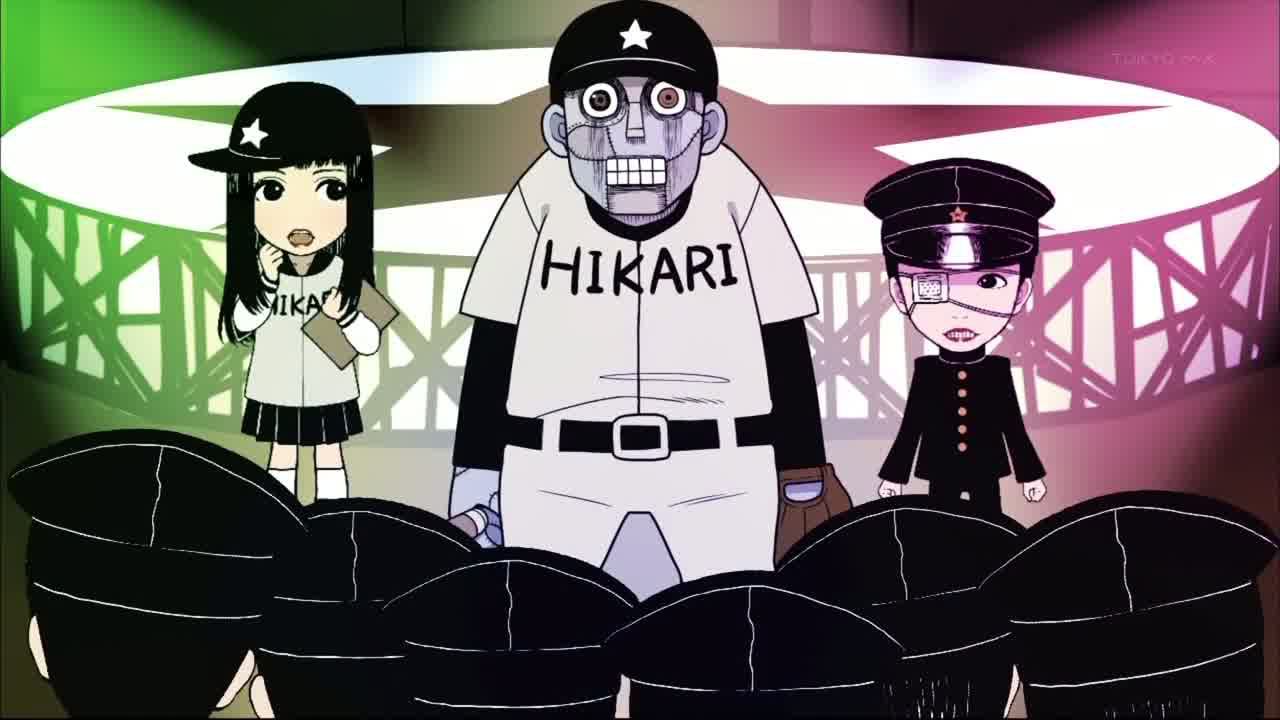
This'll be another confused review. Another micro-series, eight three minute long joke episodes, but peculiar in this case as it's based on Usamaru Furuya's controversial but acclaimed manga, an incredibly dark and disturbing manga which has yet developed a large reputation, enough that the experimental author's source material has been adapted both for this weird spin off and for a live action film. For what has been described as dealing with violence, transgressive sexual content and is generally viewed as a serious work it's managed a strong popularity or enough buzz to lead to these additions. Litchi DE Hikari Club is a perplexing little take whether you have read the manga or (as for me) haven't. Here a group of bishonen boys in uncomfortable fascist looking uniforms, (intentionally disturbing in the manga), have built a robot powered by lychees with the purpose of kidnapping girls, only for one named Kanon to undermine their plans, an important figure in the manga and here the only main female figure in the cast.

Clearly, obviously, context is lost when a gag spin-off to a serious work is watched by itself. These spin-offs are a curiosity which have a long lineage - in some context they make sense when the production staff decide to lighten the mood and have fun, be it the omake specials for serious series like Black Lagoon (2006), literally bonus material or if you have a franchise so vast like Gundam you can get away with a piss-take version with the characters out-of-context and arguing. Sometimes questions have to be asked who came up with some of these one-offs vastly different from their source. This one is still peculiar even in that context as it was made as an anime series in its own right, streamed on CrunchyRoll with the danger that people like me would've presumed it'd be a straight ahead adaptation and not a comedy.
From http://www.anime-kun.net/animes/
screenshots/litchi-de-hikari-club-97761.jpg

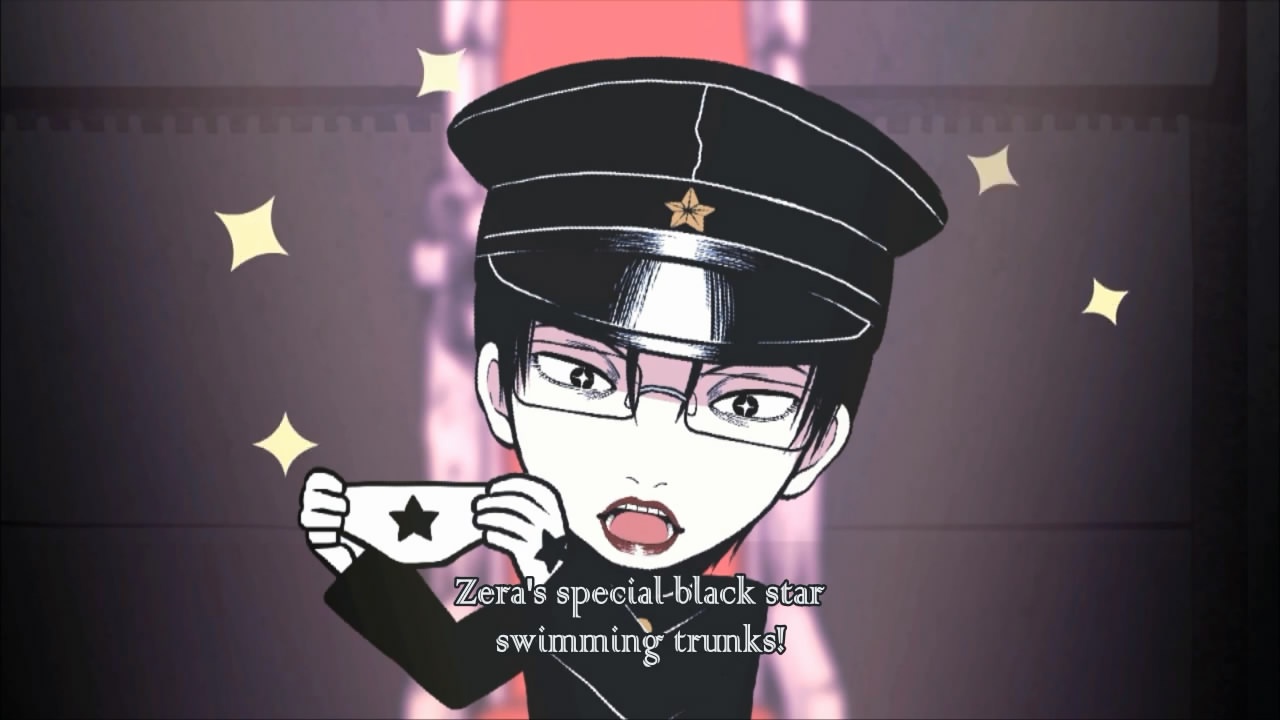
The other issue is that, even if you're going to be an in-joke leaden series for fans, like the Gundam parody, you still have to be a good series, and especially with my introduction with these micro-series, many don't even really use their three minutes or so well enough. One of the few exceptions was Gdgd Fairies (2011-13) which, despite being fifteen minutes per episode, was mainly a series of vignettes and made sure that a) the jokes were funny even if you didn't get the otaku references and b) got far more ambitious and weird over its two seasons. This anime has moments where its premise, about this serious ultra disturbing manga if the cast were mainly idiots, succeeds; in which all the cast baring Kanon and the robot Lychee, who are Best Friends Forever, are completely incompetent and spend their time on inane ideas. Ideas such as wondering if Lychee can eat anything else barring his namesake, accidentally turning him into a gourmet chef or the ill advised creative expansion into black star Lychee Club beach wear, ideas which are funny in any context especially with knowledge of the original source material. It helps that here, with simplified but distinct character designs, every member stands out vocally and in appearance, and all have idiosyncrasies that cause them to be dumber or weirder than the other, a group of immature man-boys who may want to rule the world with their violent ideas and fascist symbolism, but cannot see that sacrificing one's eye if not the same as gimmick objects from a magazine advertisement or a jar of scabs, much to the grievance of the member who sacrificed his eye for use in Lychee when every fellow underling offers the aforementioned examples.

But...it's still a slight work, and never lifts itself into something special or legitimately weird. Definitely not as strange as a band being created to interpret these characters through actual music and concerts, an idea which has all sorts of potential tastelessness behind it alongside being also of interesting or even great as a marketing scheme. This anime, rather than taking advantage of the material, or scared of trying to adapt a manga with the content it had, ended up being the least interest direction you could've gone, a shame especially as this review is another short and befuddle one, and in terms of genre its definitely not horror like its source material in the slightest, as ill-advised as the club leader's ghastly swimwear.

From https://ru.myanimeshelf.com/upload/dynamic/2012-12/19/_
DeadFish__Litchi_DE_Hikari_Club_-_07__
720p__AAC_.mp4_snapshot_01.11__2012.11.13_12.24.54_1.jpg

Thursday, 18 January 2018

Bonus #6: Crying Freeman (1995)

Fromhttps://i.jeded.com/i/crying-freeman.18195.jpg

Director: Christophe Gans
Screenplay: Christophe Gans, Thierry Cazals and Laurie Finstad-Knizhnik
Based on the manga by Kazuo Koike and Ryoichi Ikegami
Cast: Mark Dacascos as Yo Hinomura/Crying Freeman,  Julie Condra as Emu O'Hara, Tchéky Karyo as Detective Netah, Byron Mann as Koh, Masaya Kato as Ryuji "The Blade" Hanada, Yoko Shimada as Kimie Hanada, Rae Dawn Chong as Detective Forge, Mako as Shido Shimazaki

Synopsis: Emu O'Hara (Julie Condra) awaits her death after accidentally witnessing the work of the Crying Freeman (Mark Dacascos), an assassin for the ancient Chinese society known as the Sons of the Dragons. However love blossoms between the two as the Crying Freeman, real name Yo Hinomura, is a brainwashed pawn regaining his humanity. As a result they find themselves in the midst of Japanese yakuza, corrupt cops and the Sons of the Dragons not reacting well to his insubordination.

After covering the animated adaptation of Kazuo Koike's manga [No. 46 on the blog], it seems fitting to also cover the first version of this story I ever saw, one in a small pocket of film adaptations of manga and anime in the nineties when both were slowly becoming popular in the West. Only a handful actually exist, not just speculation like casting Geena Davis as Sailor Moon, and they vary drastically in quality and in terms of their tone next to the source material, as anyone who has watched the Fist of the North Star adaptation from 1995 with Gary Daniels can attest to. Brian Yuzna, famous for producing and directing cult horror films, is behind a couple of these adaptations that actually saw light. One was the not-so successful take on The Guyver  in 1991 [Bonus #3 on the blog] that required a sequel without his involvement to work with more success with the premise. Another is Crying Freeman, a co-production between Japan, the United States and Canada which is strange knowing its source material. Very strange frankly.

If this was the only version you saw as I once was in the camp of, you'd presume the source material was a serious action like many a manga, one very compromised by trying to shove too much narrative into less than two hours. Its co-creator Kazuo Koike however, despite a legendary career that led to Lone Wolf and Cub and Lady Snowblood, is a storytelling of an extreme kind, something you don't learn of from the live action adaptations unless you've managed to see the infamous Hanzo the Razor trilogy. The anime version, which covers the whole narrative over six episodes, shows how utterly silly and bizarre Koike's story was. The live action film turned out to be an adaptation of what was only the prologue, in spite of trying to tie the narrative up in the end. This itself, especially as it's a serious action film, leads to a strange emotional reaction for me returning to the picture.

Between the live action film and the anime, I have to choose the anime even if it's complete trash. Though it is rough - in tone, its attitude to sex and violence, and sometimes in animation quality - the straight-to-video animated version tells the entire story. Even if it falls off the cliff immediately after the first episode, it's a compelling trajectory downwards, where even its more indefensible moments do not affect how utterly compelling the experience altogether is. For the live action film it's the exact same issue I have with the 1991 live action version of Masahiko Takajo and Tetsuya Saruwatari's manga Riki-Oh, apt as Saruwatari was a student of Koike's. Both live action versions are faithful to their source material, but only cover what is effectively the prologue. Riki-Oh especially has lost its power for me, which would amaze people as it's still an infamous Hong Kong film today were it not for the fact I have read the manga, which goes further on and goes beyond mere insanity to madness that exists in its own logic. Crying Freeman is helped by the fact it takes a different tone to the material, at least in how a viewer intentionally reacts to it. The problems are entirely to do with the narrative being slight, which if you didn't know its source is still anti-climatic by the ending and barely covering a lot in the characters etc. If you know the source even just from the anime, you then learn why as its the prologue that sets up a larger story.

It's not a great film in the long run because of this. It barely covers the main character Yo Hinomura  and how he early on in the story takes over the organisation that brainwashed him, Emu at his side and the pair in a narrative that spans multiple plots. Emu's romance to him is weak, with the added issue that Julie Condra is not that great, the character even in Koike's tendencies for problematic gender portrayals still shows her eventually gaining a demonically possessed sword in the anime. The Sons of the Dragons, renamed for the film, aren't talked of greatly as needed for dramatic closure, especially as they still have an unexplained supernatural edge to them, their leader being a hundred plus year old witch and involving an ancient tattoo of a dragon marked on the Crying Freeman with mythological details to it. There are characters like Rae Dawn Chong's Detective Forge who are undercut by her casting and the fact that, in the anime, the Crying Freeman tale is a serialised pulp story which takes place over multiple plots with characters who only appear in one tale than leave. Those that stay don't really appear in the film, a shame especially knowing the existence of Bai Ya Shan in the anime, a giantess of a woman voiced by female professional wrestler Dump Matsumoto who would've been fun to have included in the film if practical.

Where the film is of interest is in its director Christophe Gans. He belongs to the school of directors paying tribute to older genre films and characters, without the sarcasm and irony that seeped into more modern adaptation. He is someone who has always taken his material serious; from his own genre hybrid Brotherhood of the Wolf (2001) to his 2006 adaptation of Silent Hill, his fan base wishes he made more films and even the list of characters he wanted to adapt to screen but couldn't (Fantômas, Space Adventure Cobra) reads as someone very different from even a Quentin Tarantino in attitude. He's also someone who officially got into filmmaking through Brian Yuzna. His first work after making shorts is sadly in the disappointing Lovecraft anthology Necronomicon (1993), but Crying Freeman even if it's a very cheesy mid-nineties action film shows where he got his fan base from onwards.If anything it has a personality that's admirable even if the results are a failure, how sincere it takes its source material an admirable attempt. This in particular is important as, if the film was significantly better, there are aspects that were already in the film we got which would've made it great in another context.  

That it feels like an international co-production and embraces that fact with various languages spoken; it even does Canada a service of filming there but not just to represent other countries, scenes explicitly set in Vancouver. That I loved the music by Patrick O'Hearn immmensely, of its time but moody and compelling. The style of the film in production design is stylish as was the case even with the worst of the nineties adaptations of pop culture. And Mark Dacascos was a great choice to lead the film, who in a list of actors who should've had bigger careers is that most depressing for me. Someone who is striking onscreen, an accomplished martial artist in films like Drive (1997), yet never having a big break. (Not helped by how some of the films he was in the mid nineties were not released in the US (Crying Freeman), were cut down for release (Drive) or were like The Island of Dr. Moreau (1996) where his small role would be barely thought about in the infamy of that film's production history). If anything, whilst the film does not succeed in the slightest, there was at least an admirable attempt at creating an interesting film with the 1995 Crying Freeman adaptation. Whilst the results do not fully come together, like a lot of these early attempts at adapting other media in the nineties, they possess a sense of character that you can even dispute exist equally in the more financially successful ones of a few decades later, films which are more focused but have significantly less personality then their predecessors.

From https://lh5.googleusercontent.com/-87n4SSnyx7E/TY54Zt5MfAI/
AAAAAAAAAV8/98He1zhXK58/s1600/snapshot20110326015217.jpg

Saturday, 7 October 2017

Bonus #5: Uzumaki (2000)

From https://68.media.tumblr.com/2a4329bb612ea30c0552109a5515f3e1/
tumblr_oa0wojrGBY1rnm9y4o1_500.jpg

Director: Higuchinsky
Screenplay: Kengo Kaji, Takao Nitta and Chika Yasuo
Based on a manga by Junji Ito
Cast: Eriko Hatsune as Kirie Goshima; Fhi Fan as Shuichi Saito; Hinako Saeki as Kyoko Sekino; Eun-Kyung Shin as Chie Marayama; Keiko Takahashi as Yukie Saito; Ren Ôsugi as Toshio Saito

Synopsis: In the small town of Kurouzu, things are becoming weirder around Kirie Goshima (Eriko Hatsune). Her childhood friend and crush Shuichi Saito (Fhi Fan) is becoming isolated and morbid, his own father (Ren Ôsugi) becoming obsessed to a disturbing level by spirals. Shuichi himself believes the town itself it cursed by the spirals, something Kirie is quick to react to with bafflement until the first death, a student falling down a spiral staircase at school, acts as a catalyst to bizarre and horrifying things. Where Shuichi's father twists down into an awful path, bodily and even follicle mutation is taking place amongst the populist and the wind's moving in spiralling gusts ominously. 

Junji Ito is a legendary figure in horror manga1. His work is also one, whilst adapted to cinema a lot, that would also be difficult to get right. Practicality in adapting their cosmic and horrifying content, with their surreal panels of bodily and physical mutation, it's going to be nigh on impossible to do some of them accurately unless animated or if  you had the kind of budgets an adaptation of his work would never get. Tomie (1987-2000) has had a lot of films, nine in fact, and that's probably because barring an anti-heroine who regenerates even from death, and can split into duplicates if chopped up into pieces, it's as much a work about the pettiness and worst in human desire as it is the physical horror. Gyo (2001-2), about undead nautical creatures like fish on robotic legs invading the land, had to be adapted into animation in 2012 but that film, which drastically altered characterisation by following a female lead instead of a male one, also showed another potential issue with Ito that, whilst he has main characters, they are bystanders to their worlds and the horrors, undercutting a safety net for viewers to experience the horrors he depicts but also jarring against the desire for narratives film productions usually want for adaptations. Uzumaki (1998-9) would be the toughest of the entire lot, his most well known work and also one whose growing level of spectacle and weirdness could only be possible with a large budget, and is also affected by the fact that until the halfway mark it's a series of separate segments which just have to have the same protagonists involved.

From http://infocult.typepad.com/.a/
6a00d83451b88a69e201761618a97a970c-800wi

And yet Higuchinsky, a Ukrainian born Japanese music video director, took the challenge as his debut feature no less. And while it's not to its level, I'm willing to comparing the result to how experimental filmmaker and commercials director Nobuhiko Obayashi threw every technique he knew at his debut House (1977) and concocted a one-off experience. Likewise Higuchinsky throws everything he can at Uzumaki just in the first ten minutes before anything sinister fully happens. Unconventional camera shots. An obsession with sickly green lighting. Characters speaking directly to the camera for conversations with other characters. Higuchinsky manages from then on, in spite of the issues the adaptation has eventually, to actually turn this adaptation into something entirely of his own. The one glaring issue which does undercut what feels like an entirely unique film is that Uzumaki abruptly ends. With its segments in chapters - using film celluloid textures for added effect to place this all in its own hazy, hallucinated dream - the last of them is just a series of still shots of the gruesome body horror that takes place later in the manga. The problem was clearly that, due to the large scale of the events that take place in the original manga, including the town itself completely changing in form let alone anyone in it, there was no possibility on this film's particular budget in depicting it even in CGI. Unless Higuchinsky and the screenwriters, in their one major flaw, actually took advantage of this issue or rewrote the ending, than Uzumaki would've been a much more successful creation. It does technically have an ending, but it's the one thing that jars badly. When I first saw the film years ago without reading the manga, I found it an issue, and now having fallen in love with said manga it's still a shame.

From http://horror.wpengine.netdna-cdn.com/wp-content/
uploads/2016/05/uzumaki-1024x560.jpg

What Higuchinsky succeeds in, having also to truncate chapters out of the original or blend them into others, is an atmosphere completely different from the source. He has scenes play with a slower, growing sense of dread that turns Uzumaki less outright weird horror but a bizarre supernatural story which grows and grows into that strange body horror as it goes along. (Not to mention, especially with certain uses of CGI, managing to evoke the Black Hole Sun music video by Soundgarden of all things). It's here, with a drastically different pace, that you also see how genius the original source material is. Whilst so much of his work can seen absurd, including the elaborate facial expressions of horror the characters have, he takes weird ideas which however touch upon primal fears. The symbol of the spiral is not that absurd as a force of evil as the notion of a symbol, even words, illicit abomination emotional or physical reactions is found in horror and even myth. Symbols were used as signifiers for greater meanings and with a spiral there's so many unnerving connotations you can think with them. Usually viewed going into the centre rather than outwards, a vortex or a black hole that's synonymous with dizziness and disorientation that one is pulled into. Seeing spirals in everything - how tap water goes down the drain, food, snail shells, springs etc. - was just ripe material for Ito to work with, emphasising this fact with a hilarious (and fake) writer's commentary imagining himself as a deranged manga creator researching the true nature of the spiral as reference material for Uzumaki, playing the genesis as a little weird horror story like the others he's written in the past and emphasising how even the simplest of things like a mere symbol is potentially frightening.

From https://wheresthejump.com/wp-content/
uploads/2017/07/uzumaki-2000-3.jpg

This gives Higuchinsky a lot to work with in terms the material he does use - the spin of a pottery wheel, the way of a character obsessed with wanting Kirie to date him springs out to scare her like a Jack in the Box, the snails which some classmates start to mutate into - which he takes advantage of. He also has the advantage of what you can do differently in cinema compared to the page and various details you don't get in illustration, such as those who begin to become snails speaking slower as well as having wet, dripping slime dripping off them. Even when some sequences are just non sequiturs - like the entire chapter from the manga about a girl's hair becoming living curls reduced to an odd image - it all has a delirious effect of interest. The director has no qualms either, after the slow mood is breathed in for some scenes, in showing gore and gruesome effects like Ito does. He retains Ito's power of suddenly showing the freakish but done in entirely his own style. If it's sad that Uzumaki the film sadly needed more of an actual ending, that doesn't detract from the eccentric imagination that had been shown from before. The result of which is definitely memorable and is one of those rare feats, in spite of that major flaw, where a director manages to take a source material from a very idiosyncratic and unique creator, and produce an adaptation only they could've made. Something that has to be applauded even if Higuchinsky's career after has sadly never punctured the West as it should've done after this.

From https://ciscowong.files.wordpress.com/2008/11/uzumaki.jpg

======
(1) Finally having his work easy to acquire in English as well in the 2010s has been a vital way of bringing more attention to Ito. Mainly the work of Viz Media but even smaller companies are releasing stuff like his biopic manga about raising cats with his wife, with material still planned to be released in  Christmas 2017. This availability and how eclectic its been beyond his major work builds up a reputation for him and shows how distinct he is as a creator in general.