Showing posts with label Studio Shaft. Show all posts

Thursday, 10 November 2022

#234: Sakura Diaries (1997)


Studio: Shaft

Director: Kunitoshi Okajima

Screenplay: Kenji Terada

Based on the manga by U-Jin

Voice Cast:

Japanese:

Kyoko Hikami as Urara Kasuga; Mitsuaki Madono as Touma Inaba; Mako Hyoudou as Koumi Natsuki; Rumi Kasahara as Meiko Yotsuba; Kunihiko Yasui as Tatsuhiko Mashu; Masa Saito as Touma's Mother; Masamichi Ota as Keisuke

English:

Lauren Worsham as Urara Kasuga; Mariela Ortiz as Urara Kasuga (2005 dub); Martin Burke as Touma Inaba; Robert Martinez as Touma Inaba (2005 dub); Monica Rial as Mieko Yotsuba (2005 dub); Rebecca Davis as Meiko Yotsuba

Viewed in English Dub


This sadly was a review, an act of revisiting an anime I saw when I was younger, where I found myself having completely forgotten most of the content, including how one dramatic choice can entirely capsize your production, a reminder of how something can go grossly wrong as an artistic choice, and ruin what sadly also had, even as an average sex comedy, moments of virtues. Sakura Diaries is a twelve episode series, yet it was released straight-to-video, all in spite of the fact that, even as an explicit sex comedy, it only once or twice ever uses the creative freedoms of the medium choice to be more sexually provocative, or even have actual nudity. The rest feels like a quieter comedy with dramatic moments and a lot of innuendo. Trying to get into college, a young guy from the country Touma Inaba fails the entrance exams to get into a university. When he falls for a red headed woman named Mieko Yotsuba, he claims he has passed into that prestigious university in a moment of panic and attraction to her. Wishing not to just damn Sakura Diaries, and instead present the sad minefield where a show can make one wrongheaded choice but still be interesting, it is that this aspect of the story becomes the most fascinating and having had the potential to grow into something inspired.

Namely that Touma, whilst a cliché of a young man protagonist who can be a pervert, also presents all the neurosis of someone in his position, that whilst the show has tone deaf and misogynistic choices, he is a fascinating character of a virginal young guy who is trying to get away from working in the family hot spring. Having fallen in love with Mieko, even if lying that he enter the most prestigious college in Tokyo, he has the desire to enter cram school so he can get into the college for real. His sex fantasies are lewd, sometimes inappropriate, but when the tone works, his flights of fantasy, about romance and losing his virginity, become comedic in how he has his heads in the clouds as much as in his pants, who is stuck masturbating to porn and admits he is neurotic of his inexperience that he would unsatisfying women like Mieko even in bed. Feeling Mieko is entirely out of his league, even his dreams about trying to succeed in cram school are interesting, in a tragically humoured way, in how his subconscious can cruelly make him dream he has failed the exam, even more cruelly making him believe he is awake and has passed to exams, or involve his sexual hang-ups, which are some of the most rewarding moments. Even the crass jokes about Touma realising his libido is preventing his studying, in this anxiety, is thoughtful for being blunt about this.

The facade of being in college is complicated as he is living with his young female cousin Urara Kasuga, who has clearly lied about her father being constantly away on business but managing to keep the lie one. This is something some will find icky, and Urara is viewed as the show's central icon of sexuality, but again with mind that this could have gotten to be a more thoughtful story, Sakura Diaries does have the set up to have been more dramatically complex than it does briefly have. Urara is already eccentric, if questionable, in her relationship with Touma, meeting him by pretending to be a sex worker upon the first time he has seen her grown up, soon into him living at her uncle's wearing only an apron when preparing a meal, all in what is her blatant attempts to attract him to her. In a show if it focused on this drama more than the moments it does, it would have been compelling as a tale of a cousin whose love for Touma comes from a tragic moment in her life, the passing of a close relative, which is complicated by the fact that the emotional dependency involved years on is not healthy for either of them. [Major Spoiler Warning] The ending, where she has to learn to have a broken heart as Touma moves out of the house, realising the relationship is not healthy for either, is a good ending in context for this. [Spoilers End] Mieko realises she herself is in an existential position, where the debonair guy in the college, obsessed with her and trying to undermine Touma, is someone with his own psychological baggage, but also when confronted by her is rightly damned for wanting to own her like a won prize. The drama here is compelling for that reason.

The problem is in the tone. Specifically, and this is why the review now has to come with a trigger warning, entirely for Episode Five where, after a drunken game of strip paper rock scissors, Touma suddenly becoming a violent figure who attempts to rape Urara before realising what he is doing. That, in mind to a show whose tone is soft, lightly coloured and gentle even as a lewd sex comedy, is the most abrupt and inappropriate tonal shift possible. It is ugly, it is unacceptable, and it makes it impossible to like Touma as a protagonist for good reason, especially as the show references this moment a few times over the last episodes rather than pretend it did not happen. It is an absolute disaster in terms of a dramatic choice. The surprising thing is that, if you look into what the source manga is, this one segment is just one moment in a show which entirely jettisoned what the tone was for the manga, which makes this creative choice even more cursed. Even though I do not what to criticise the manga or its author without having seen the source material, there was a lot of content which, if done wrong, would have been far worse than here.  


The Sakura Diaries manga is hentai, which is not a thing to criticise. What is more shocking is that, looking into synopsis on what content is within it, it has a lot of content which sounds absolutely tasteless and crass if it had been presented with the tone of Episode 5's misguided change into serious drama. That it includes Urara becoming pregnant, entering sex work with a friend, and an incident trying to swindle money from a client involving one of them being gang raped. Yes, that in itself does feel, especially for a hentai manga, legitimately uncomfortable to consider as working as good let alone acceptable storytelling. U-Jin, the source manga author, is unapologetically someone, looking at their career, which wrote transgressive content - some, depending on the tone, to kink shame, such as Vixens (1994), which involves BDSM and Omorashi (the arousal from wetting oneself), but other material as plot threads in Sakura Diaries, would dangerously skirt the line between offending people or if they managed to get the tone right. The tragedy is that, for one moment, Sakura Diaries the show makes one mistake with one storytelling choice, and thus ruins itself when it is, for the most part, a gentle comedy drama which, despite some dated sexual politics, had the right trajectory with its production.

It is a shame as, even with the crass sex comedy, of Touma lusting over women, the show is a mostly fluffy story whose drama in the end, accepting a romance that will not happen and growing up, is absolutely alien to its one tasteless shock moment. The opening and ending credits are light coloured and sweet, contrasted by two choices of songs which actually are good for this tone, the first an acoustic song which a gentle earworm. It is however with realisation, a perfect example here, of how one decision is able to capsize a story fully. It does evoke Royal Space Force: The Wings of Honnêamise (1987), a legendary science fiction theatrical anime which made as equally as misguided choice in sexual violence involving the main male protagonist. Honnêamise though, whilst not defendable and a decision which should have been excised in its production, was attempting a moment of great existentialism, a horrible mistake nearly done in a moment of exceptional world bearing crisis, leading to an existential enlightenment learning from this idiocy, even if again a scene which is rightly challenged as nearly capsizing Honnêamise's incredible achievements fully. Honnêamise is however also a film of such magnitude that, in its complexity, this problematic scene is still there and undermines it, but is a work dealing with such complexity on a psychological level, which can be grasped even if that artistic mistake is to be challenged. Sakura Diaries is a light hearted sex comedy, even for its emotional complexity, suddenly shows a horrible misogynistic side in how Touma acts to Urara before the sexual violence is even considered, never meant for real complexity even if misguided. It completely deflates Sakura Diaries fully even if the drama afterwards is interesting and of reward.

The odd thing is that no one on the production is really someone who should have known better. Kunitoshi Okajima, the director, was prolific in the animation side of anime productions the decade before, and screenwriter Kenji Terada, with this one of the last works of their career, had a long filmography beforehand, having penned for franchises including the original series of Kimagure Orange Road (1987-1988) as its key screenwriter. This is a very early production from Shaft as a studio, one which would grow and be prolific over the decades after, including being the home of Akiyuki Shinbo, who started helming productions there in the mid-2000s, and to the current day is his home, meaning they were the ones who brought his big hitters of the 2010s to life. If anything, this feels like an awkward stumble for the studio that, in this time, also brought about Arcade Gamer Fubuki (2002-3), a work with too many tasteless aspects to defend, even if there are grains of gold within it too.

Sakura Diaries, were it not for Episode 5's conclusion, would be an all right, if not perfect drama, one which could have been significantly better but has virtues. As it stands, including Episode 5, that is enough to put people off decades on, and it really emphasises how one mistake in tone, even over anime which is more openly lurid and tasteless, has a far worse influence when, here, there were virtues. The only thing I had remembered from this series originally when I had watched it, which is a tasteless moment, is that there is a scene where exchanging pubic hair is considered a good luck charm. It is something which comes from actual Japan belief1, and is not a bad thing inherently in itself to include, but considering Touma emotionally bullies Urara into it to help him pass his exams, there is a streak of toxicity to the drama which does undermine its tone too. The English dub, one of two ADV Films recorded, and in the UK was the only language track they included in their DVD release for us, neither helps, not good and actually emphasising how, for every moment Touma does come off (if lecherous) as a sympathetic figure, there are so many scenes which do not work because they paint him as a detestable figure we are meant to sympathise with. Sakura Diaries' problems are more than one horrible drama choice, but that one choice does emphasis how this series failed to reach the virtues it occasionally clings to, which is heartbreaking to experience. This should have been a melodrama where the knife stabs into the viewer - like Touma going to karaoke with Meiko, only for Urara to have gone to the same one, with the pain where she lies about being his sister - not stab the viewer in a way that this has aged badly and destroys its own virtues at the same time.

=====

1) Japanese Lucky Charm: Pubic hair, written by Timothy Takemoto for Burogu on April 6th 2012

Thursday, 23 January 2020

#132: Arcade Gamer Fubuki (2002)


Director: Yūji Mutō
Screenplay: Ryota Yamaguchi
Based on the manga by Mine Yoshizaki
Voice Cast: Sakura Nogawa as Fubuki Sakuragasaki; Hiroshi Fujioka as Leader; Kaori Shimizu as Hanako Kokubunji; Masaki Yamamoto as Sanpeita; Megumi Toyoguchi as Honey; Satsuki Yukino as Alka; Shinnosuke Furumoto as Arashi; Toru Furuya as Mr. Mystery; Yuu Asakawa as Chizuru Jyumonji

Veronica Taylor as Fubuki Sakuragasaki; Bob Orlikoff as Masao; Brad Bradford as Arashi/Mr. Mystery; Dan Green as Leader/Narrator; Jamie McGonnigal as Sanpeita; John Paul George Jones as Groepie; Lisa Ortiz as Chizuru Jyumonji; Rebecca Honig as Ruriko Sakuragasaki; Sharon Becker as Alka
Viewed in English Dub

This, viewed by itself without context, would be an embarrassment for someone to see as his or her first anime. It's a title to point to so anyone could dismiss anime as a bad thing. There's no way around this sense of shame with Arcade Gamer Fubuki, and yet it's entirely blameable (no matter how wrong it sounds to write this) because the production was more fixated on teenage panties than a potentially fun fever dream, envisioning an evil cabal wanting to take over the world who can only be defeated by playing video games.

Technically, I viewed Fubuki as a notoriously bad anime, though it's never brought up with the infamy of a Garzy's Wing (1996) and that ilk. It only got to my attention because of Justin Sevakis. Among his many hats over his career, he was the in-house video and subtitle editor for the DVDs of Central Park Media, writer and co-podcaster in the Anime News Network, alongside Blu-Ray/DVD Authoring and Restoration of titles currently for Discotek Media. Authoring is an unsung position, as restoration in cinema let alone anime has always been a task with arduous struggles before the successes, testament to the poor guy with the restoration of Discotek's release of Cyborg 009 The Cyborg Soldier, the 2001-2 TV anime of Shotaro Ishinomori's manga which never got a full run or DVD release in the United States, and was a horror story in when Sevakis got the master materials to restore. Suffice to say, it took a year to complete, just for the uncut dub alone, because the master tapes were in a frightful state, aspects of restoration we don't consider even in terms of non-anime cinema let alone for one man who worked on the project with these issues in front of him.

Sevakis wrote of the subject of this review as part of his Buried Treasures articles on Anime News Network, which I openly admit to still tracing through the archives of to locate titles to see and review, many thankfully getting re-releases but also quite a lot talked of from a man who authored titles like them or from different eras of anime over the decades as obscurities. Fubuki comes from the occasional "Buried Garbage" sections which talk about the worst of anime, the idea like a carnival freak show but with the knowledge of his career so you learn something from them. Arcade Gamer Fubuki is for him the worst anime he ever saw, which wasn't helped when he had to work on the title in his time in Central Park Media; bear in mind, for all the good titles that company released, like part of Revolutionary Girl Utena (1997), but also had the schlock fest MD Geist (1986) as one of its successful titles to sell as well as a lot of hentai (porn) anime that would horrify some, a lot Sevakis has talked about working on in his time there too.

Whether Arcade Gamer Fubuki is the worst is a debate, without wanting him to hear of this review and come punch me in the face. There has been worse made anime, as this is a nicely animated OVA with a handful of redeemable aspects, but good grief besides the toe curling plot point of the "Passion Panties", which I will be forced to get to, this is a premise of some fun squandered in the end. Probably the worst thing that can happen to an anime is when it deflates good will from the first episode onwards. The calibre surprises as it's based on a manga by Mine Yoshizaki, whose Sgt. Frog manga is one of his most popular work, the TV series infamously a property ADV Films got the license to but sat on for a few years in the 2000s despite the company being known for being prolific in their releases and the amount of time they worked on releasing it.

The title as mentioned also has an amusing premise in imagining a standard anime tale, a plucky young heroine versus a world dominated evil group, by way of arcade cabinet tournaments. It's ludicrous, but if anime should teach outsiders anything, along the cerebral and intelligent work it creates, it can have a multi-series work like Yakitate!! Japan (2004-6) which is about competitive bread making, so we can have a plucky young heroine named Fubuki fight a group wanting to take over the world with videogames. We can have a groupthat includes an evil villainess who manages a bunch of despondent masked goons, acting more like the disgruntled staff of an ICT company, and even a velociraptor that is brought back by gene manipulation and can somehow operate an arcade cabinet, let alone perceive with intelligence what to do with it.

It is also bright and slickly made, a handsome four episode production that went as far as even getting license to use Sega videogames of old, such as Fighting Vipers 2 (1998) to Fantasy Zone (1986). The irony is not lost, whilst never a video gamer but just a curious outsider who knows a bit, that this was the time of the Dreamcast, their last games console before giving up on them as, like an ominous sick joke at how Arcade Gamer Fubuki tanks the good will in the license, that console didn't do well in the damndest.  The show itself with all its good ideas - as the heroine wishes to win the world arcade game tournament, fight the villains and find out what happened to her absentee father from her childhood - doesn't even try as that company did with the console.


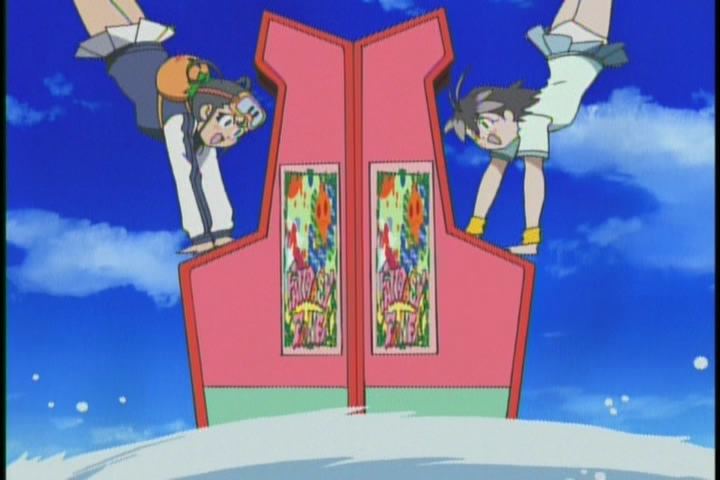
The immediate issue, and where you roll your eyes in embarrassment, is that to power up, as to be the best arcade player you have to jump high into the air and play the arcade cabinets upside down in gravity defying gymnastics, is that she has the "Passion Panties", which means having her female friend expose them with a fan and means exposed panty shots. It's bad enough to have the leering nature of anime, especially as the medium has all the potential to deal with sex with better fun and grace than this, but you then have to realise female characters within them are meant to be underage teenagers a lot of the time, regardless if their character designs and proportions suggest otherwise. Fubuki is, what, meant to be only between ten to twelve, which makes this worse, also with mind her nemesis is another girl, who travels on rollerblades and is an expert on shooter games, is reduced to this as well. It's really low, creepy, idiotic hanging fruit particularly when you know this OVA title is targeted to grown men.

The other issue though is my biggest takeaway, that Arcade Gamer Fubuki is lazy. Its fan service is as much part of the problem, alongside how it squanders its premise. I can thankfully say that its director Yūji Mutō went to better work, as he made Tonari no Seki-kun: The Master of Killing Time (2014), a hilarious micro-series about a guy in a class mucking about with bizarre activities with none of the issues here and perfect comic timing, which makes Fubuki's existence in his early career a shame*. Its say a lot to a four episode OVA that it fails so blandly in spite of having all the weird and potentially fun details you could want, from the velociraptor playing videogames to that the minions, led by a stereotypical female villain who uses the famous noblewoman's "ho ho ho" laugh used in a lot of anime, being a bunch of regular employees who get drunk with her in a bar and put up with their lot clearly just to get paid.

A lot of the premise never is dealt with as a result, like the tournament where a cavalcade stereotypes appear to duel, and most of the cast is underutilised. One character that could've been done without, or shot into space by the cast when he appeared, is a young boy whose obsession with just taking exposed panty shot photos of Fubuki is stalking in all but name. Many however are underutilised, even the stereotypical busty American cowgirl who is the best at dancing games as, in a better work, that she's actually on the villains' payroll but a) is lovely and b) immediately adores Fubuki as a friendly older sister figure is at least fun in premise. Probably the only character who gets fully fleshed out, even though he sadly still has to go on about those damned Passion Panties and a creepiness to his shadow over Fubuki in characterisation, is Mr Mystery. Mr Mystery is the noble masked guide to help Fubuki, a buff guy in just a wrestler's pair of pants and mask whose virtues and strength don't negate that, when he jumps through a plate glass window for example, it still hurts and black humour comes from him being liable to injury even if he does good in the end. As much as this is due to his voice actor Brad Bradford, watching the OVA in English, being the only stand out as he clearly go the memo to boom his lines to the back row of the theatre and in gravitas. The sense that he's of interest is found as much in when he's finally revealed beneath the mask - he looks identical to the protagonist of a 1978-1984 manga called Game Center Arashi about a videogame player, which clearly is meant as a nod and had its own anime in the early eighties.

Beyond this, well, it would still be possible to make four twenty plus minute episodes succeed, just accepting the gross fanservice as the sad aspect most productions are stuck with to sell, but the time is wasted on a lot of dumb jokes like the female rival wearing a dog costume or content which is ignorant of its creepiness, like the villains in Episode 2 stealing Fubuki's Passion Panties. In a perfect world, this would've been a tournament fighting story with tokusatsu villains, absurdity embraced like contests taking on top of a skyscraper or the promise suggested in one of the best and earliest moments, in which the villains try to rid of Fubuki by setting a literal trap on her walk to school, an invisible barrier which forces her and her friend to dodge giant barrels trying to crush them like an actual videogame of yore. The lack of actual videogame logic barring occasionally just adds to the grievances. As much as it pays lip service to the passion of the gamer, with all that lucrative Sega merchandise on display, it barely plays on the aesthetic or style. In a better world, for an example, we could've have Fubuki trying to avoid being crushed by Tetris blocks or a parody of Street Fighter with a world arcade gamer tournament. Maybe it could have even flipped the bird at Nintendo, say by having an evil Italian plumber as a villain. I wonder how much of the many problems are due to sticking to the source manga, but I know animated adaptations can take liberties with only occasionally some fan complaints.

The OVA also suddenly tried to become serious in the fourth and final episode, introducing a main villain who is a cross between Akuma from the Street Fighter series and Go Nagai's Violence Jack. Connected to Fubuki, the villain drags this silly farce into the most abrupt tonal change possible as he's a videogame developer who was horrified when his technology was used for ballistic missiles in warzones. Even if there's an absurd moment where, super strong and buff with his shirt off, he stops a missile with his strength just as it is about to hit him, only for it to explode, this is suddenly Arcade Gamer Fubuki getting into territory that looks ludicrous and misguided to fall into. It's interesting, don't get me wrong, but utterly ill advised in a production that hasn't succeeded at all.

The result was forgotten. I only know of Arcade Gamer Fubuki through someone else's vitriol. Whilst I can find some joys here, I feel exasperation at so much squandered potential that is on display. "Bad" is subjective in use, but "bad" in failing is really the crime here and stinks miserably to witness.


=====
*Studio Shaft, who created the OVA, also thankfully went onto better things. Mainly collecting all that Puella Magi Madoka Magica and Monogatari money.