Showing posts with label Gainax. Show all posts

Tuesday, 28 January 2020

#133: Panty & Stocking with Garterbelt (2010)


Director: Hiroyuki Imaishi
Screenplay: Atsushi Nishigori, Hiromi Wakabayashi, Hiroshi Seko, Hiroyuki Imaishi, Masahiko Otsuka, Shigeto Koyama, Shin Itagaki
Voice Cast: Arisa Ogasawara as Panty, Mariya Ise as Stocking, Ayumi Fujimura as Kneesocks, Hiroyuki Yoshino as Briefs, Kōji Ishii as Garterbelt, Miki Makiguchi as Fastner, Shigeru Chiba as Corset, Takashi Nakamura as Chuck, Yuka Komatsu as Scanty
Viewed in Japanese with English Subtitles

Note to the viewer, alongside some possible spoilers this reviewer has decided to fit a tone appropriate for this series of having more than usual amounts of swearing in the review text. Be assured this isn't going to end in a childish joke where every sentence is full of unnecessary cussing, as I get tired of that in other peoples' work, but considering how much voice actresses Arisa Ogasawara and Mariya Ise swear, it felt the perfect tribute whilst still writing a constructive review. For any new readers, this isn't common in other reviews, just for the joke here. Also as a result this isn't a review suitable for children to read, but anyone who lets their children see this show are bad parents anyway.  

After frankly a few major duds, let's get back track with oodles of profanity, shit and other bodily functions, all whilst having flashbacks to watching Cartoon Network shows like Johnny Bravo in my childhood. It's an unpredictable series, but fucking hell, with swearing the only expectable language for a review of this late era Gainax production, profane and potty mouthed, Hiroshi Imaishi was a much needed kick up the arse for the company wasn't he?

Starting with Dead Leaves (2004), a divisive production, Imaishi however scored a big hit with Gurren Lagann (2007), a tribute to older giant robot shows, but Imaishi really planted his flag in the business in the 2010s onwards, even though Gainax after this series wouldn't be the recipient to this. Imaishi jumped ship, and founded his own studio called Trigger, getting another blockbuster under his belt in Kill La Kill (2013) and wowing everyone still. Starting the 2010s though, he created thus divisive but well remembered tribute to American cartoons, one that is still something to admire if you accept its cuss mouth and attitude.

The plot's simple - two angel sisters are our protagonists, Panty Anarchy who is a proud nymphomaniac who loves fucking, and her sister Stocking Anarchy who is a Goth Lolita who is a sugar junky, and under the orders of a priest named Garterbelt they have to defeat ghosts terrorising a city, the coins left destroying them to save up to get back into Heaven.  Throw in Chuck, a dog-like creature with the capacity to survive being maimed (chopped up, crushed under car wheels, obliterated etc.), and a male geek named Brief who the sisters pick on, and this thirteen episode series is notably not plot driven until the final two episodes. That vignette structure it is instead is clearly influenced by Western animated shows from the late nineties from the likes of Cartoon Network, right down to episodes being split into two smaller stories (or even more in one) baring the finale. It's also crude and lewd, not a show that was successful with otaku but did get a surprising popularity with female viewers and people wanting something different.


Also, when I mean lewd, also include proudly gross. It doesn't show a lot, and for all the English language swearing from voice actresses as the leads, it actually censors language spoken in Japanese. No, the thing is that Panty & Stockings.... goes for stuff that's crude and shocking even for a TV show that has to follow certain rules still. The first story, for the first episode is upfront with this by having a shit monster as the first ghost, and they go through all the bodily fluids quite early on to the point running out of matter to get to. And yes, they even get to semen when, challenging the opening of Ozamu Tezuka's 1970 manga Apollo Song when sperm where depicted as humanoids in a race to the death, all here by having them part of a Saving Private Ryan D-Day landing parody, with spunk soldiers on mass to the doomed mission ahead. There's isn't bodily humour as I remember, but that's because it's literally expended with in the first quarter.

Beyond that is that it's a show about anti-heroines who you eventually love, Panty proudly sleeping with many men, Stockings more elegant but easier to piss off and a visibly masochistic streak, the duo in the centre of numerous deliberately tasteless jokes. One running joke has not aged well, that Garterbelt really likes young boys, an uncomfortable tinge nowadays to revisit, but it cannot be denied that, even in the restrictions of television anime, this went for broke in profaneness. Rarely does one encounter a show which has motherfucker proudly spoken unless Manga Entertainment dubbed it in the nineties with additional swearing in the English dub.

The energy is felt in that, in tribute to Western animation, the unique look is much simpler in design but means the animation can be incredibly kinetic and has movement. It was a huge, amazing surprise to realise how taking a very different direction to most Japanese animation, more detailed designs usually used with limited movement, leads to incredible set pieces for what is meant to be a comedy. Action based, Panty's namesake clothing able to be turned into guns, Stocking's into twin swords, when the series ramps these scenes up they have a level of artistic spectacle even I, someone who finds most live action films dull, admire as the style used even allows the animators to use camera movements that would be insanely difficult to try in a more detailed art style. The best examples of this are in Episode 1, already showing its hand how well made it is by having a prolonged vehicle chase/action scene for one story with a speed demon ghost (even involving a train and police car crashes to top The Blues Brothers (1980)), and Episode 6, which introduces their arch nemesis, two demon sisters Scanty and Kneesocks, who eventually go to cartoon show evil schemes but have a drag out fight/shootout in a high school for the finale.

The music is also fucking incredible. The production hired Taku Takahashi, a hip-hop recording artist/DJ/record producer as the musical director, who career started in the late 90s and can draw from his experience with all the artists he collaborated with for this soundtrack, their synth and electropop tracks created as a result a unique collect, a spectacular and poppy energy that's better than a lot of pop used in anime. Alongside producing earworms - not just the opening and ending credits music, but the song D City Rock which gets introduced later - it's as dynamic as the show itself, always going for broke and varied to a great extent without a sense of it being repetitive unless its key motifs.


So much of why I admire the series is that, even if ideas failed or weren't as funny as expected, the show was individuals allowed to be experimental and bold even in the name of absurd humour and toilet jokes, even in the fact that when ghosts are defeated they cut to live action, filming a model of them that was built just be blown up with explosives on a model set. The production team was visibly having a whale of a time on the production, but all with a sense of creativity that even the tasteless jokes have more whit to them, like the deadpan nature of semen soldiers going forth to their death that is played tonally seriously. Even for the puke ghost, it lead to the hiring of Osamu Kobayashi for that segment, director of BECK: Mongolian Chop Squad (2004-5), a very idiosyncratic figure who made a very divisive early episode of Gurren Lagann; his segment here is actually one of the best, if you want a fucking bleak tale drawn, with realistic character designs, of a downtrodden old salary man living a depressing useless life, all with the lead heroines (drawn in their normal style) only appearing near the end.

Helping the series as much is the Japanese voice cast. Listening to the English dub a little, it's too broad and exaggerated, missing the point entirely. Arisa Ogasawara and Mariya Ise, cussing like sailors as Panty and Stocking respectfully, are incredibly and arguably two of the only people who have managed to make English curse words like fuck being used in between Japanese dialogue work without feeling tonally wooden, mainly because they make these crass characters credible with nusicane even as broad stereotypes. (Tragically Ogasawara's CV isn't large in the slightest, in contrast to Ise who has done a lot and even a big of theme song vocals). Too many individuals stand out here, even with the guest actors standing out, such as the voice of the underwear eating ghost who's magnificently fabulous in his vocal delivery. Personally returning to this series after so long, I also adore Takashi Nakamura as Chuck, just for the absurdity of having to play an animal mascot who can only say his name over and over again, managing to make this work. When a lovely little twist is revealed in the final episode, of him being actually a badass, it's fucking hilarious and pays off as Nakamura has had to spend the series, even in his segments as the star, just saying "Chuck" over and over as a figure usually kicked around and maimed.

The bravery of the show means it takes risks that, even if they don't necessary succeed, you have to admire the big fucking brass balls when many anime series play it safe, something a testament to Hiroshi Imaishi as an auteur anime director as this is reoccurring throughout his career. An entire story that is a parody of the original 1980s American cartoon series of Transformers springs to mind, the "Generation 1" series one that Japanese viewers would know of as it got popular enough in Japan to have Japanese exclusive series being produced afterwards. It clearly throws in constant references to the old work, but still manages to be funny as a story of the lead sisters' arguments getting into being giant robot on robot skirmishes, whilst managing to get away with explicit Transformer on Transformer sex with mechanical genitals.

Probably the most ambitious are the two episodes just before the two part finale, Episode ten multiple mini-stories, from ones entirely about Chuck to a music video that parodies everything from The Beatles to the Gorillaz, a nice throwback as I've always suspected Imaishi's debut Dead Leaves was aesthetically influenced by Jamie Hewlett, the character designer of the Gorillaz and co-creator of the comic series Tank Girl. Episode Twelve meanwhile has on exceptional segment entirely shot in a lounge with only a couple of edits, animated long takes of just characters getting hungry.


To be honest, after this the weakest episodes are the last two of the series because trying to write serious plotted stories for this material and wrap everything up is fucking ridiculous. Plot threads like Panty suddenly becoming a virgin again doesn't make sense even for the show's absurd logic, and being structurally like a Cartoon Network animation for most of its length, but only thirteen episodes long, does make the shift utterly out of place. What succeeds is nonetheless inspired in spite of this obvious problem - it includes the only justifiable compilation of old episode clips I have seen so far in an anime, as its used to push a plot point, and the ending escalates to the best of insane scales, even having effectively a Monty Python moment if significantly more sensual.

Then the series fucks with the viewer with the infamous Gainax ending, and even if I had not gone for the joke of adding more swearing into this review, this would be the one time I could justify this verbal choice, all because this is the first Gainax ending I have had to talk about, and they are infamous for a good reason. Gainax at some point developed a reputation for shows which abruptly curveball in tone, usually at the ending rather than what, say, Gurren Lagann does with juggling tones throughout, to the point this infamous trope became a trademark. Neon Genesis Evangelion (1995), their most famous work, is the most well known example of this concept too, as this morally and psychologically complex giant robot show suddenly ended in its final two episodes with a vague and avant-garde journey into its lead character Shinji finding his self confidence, by way of being represented by a school hall with chairs than apocalyptic robot fights. It ended up pissing audiences off so much that director Hideaki Anno got death threats1. The Gainax ending here in Panty & Stocking with Garterbelt, with the most abrupt heel turn taking place in the last minutes, is clearly meant to be ridiculous and funny, made even more a trolling of the fans as the show ends on "To Be Continued..." actually being on the screen.

Sadly over the 2010s, no sequel was made even if it was hinted at. Imaishi as mentioned would leave Gainax in 2011, this last directorial effort for them. Gainax themselves hasn't done particularly well. They were kings in the nineties, a studio created by anime fans in the early eighties who once had to reuse animation cels just to make amateur work, only to have titles like Royal Space Force: The Wings of Honnêamise (1987) to Neon Genesis Evangelion under their belt. A lot of the problem is that three-quarters of their titles after the 2000s, baring this or FLCL (2000-1) or something that is divisive like Diebuster (2004-6), are unknown or tainted with feeling as if they were catering with fetishes of a fan base, not a lot of their series from a certain period with exceptions ones you might have heard of. Monetary problems have not helped, as it's been sadly chronicled that even in 1999 in their height Gainax president Takeshi Sawamura and tax accountant Yoshikatsu Iwasaki were arrested and jailed for fraud. Evangelion exists more as the project of Anno's own studio Khara nowadays as he started the Rebuild of Evangelion films in the late 2000s, with Anno even suing his old company for unpaid royalties, and to make things worse representative director Tomohiro Maki was arrested on allegations of sexual indecency on an aspiring voice actress in December 2019, the later an awful black mark to a company  that over the Millennium would eventually be battered, crushed and dragged through into public for scandals like this last one. Only a threat of a sequel of The Wings of Honnêamise seems to catch my interest and I don't know if that's even going to happen or if I want to witness it.

And Imaishi himself? Well, Kill La Kill was huge and Promade (2019) had struck a chord with viewers in its theatrical release, so in contrast he had a fucking good decade which he deserved, as alongside Masaki Yuasa never was there a man who earned got a great decade of success in ten solid years, and all with the sense he's a talented one-off we are glad to have and who earned it. And yes, returning to Panty & Stockings with Garterbelt in this long and profanely written review, when its good its fucking glorious.


=========
1) Probably the best for me to represent the Gainax Ending however is This Ugly Yet Beautiful World (2004), a pretty generic sci-fi show of a guy protecting an alien girl for the most part whose most striking feature was that the fan service got to the point of actually drawn nudity from the get-go. Suddenly in the final episodes, everything changes and with no fucking hesitance in spoiling it, as the swearing will be found here in these notes as much as the main review, it the princess was revealed to be the destroyer of the Earth with everything going apocalyptic. It was even back then a show in my early young adult years I found average, only for that ending to be so surprising that the show's still stayed in memory.

Thursday, 13 December 2018

No 79: Gunbuster (1988-89)

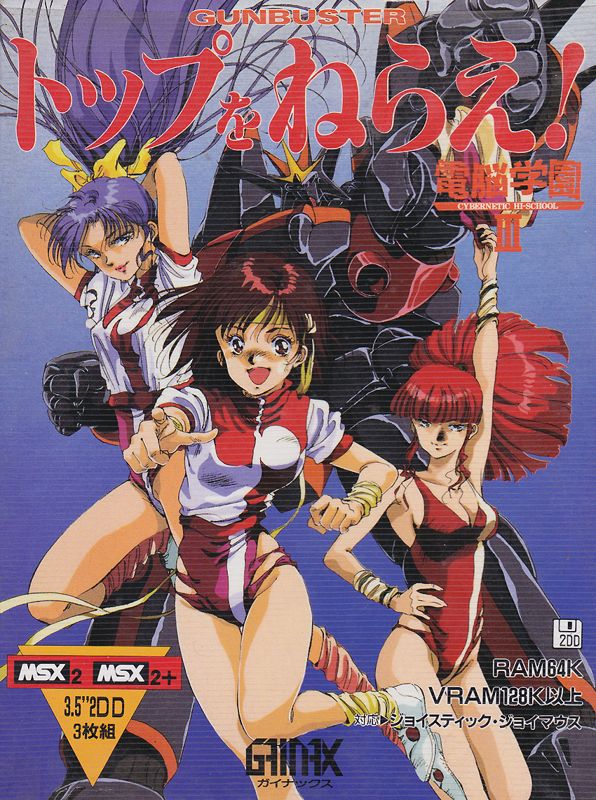
From https://www.mobygames.com/images/covers/l/254841-
cybernetic-hi-school-part-3-gunbuster-msx-front-cover.jpg


a.k.a Aim for the Top! Gunbuster
Director: Hideaki Anno
Screenplay: Hideaki Anno, Hiroyuki Yamaga and Toshio Okada
Voice Cast: Noriko Hidaka as Noriko Takaya; Rei Sakuma as Kazumi "Onee-sama" Amano; Kazuki Yao as Smith Toren; Maria Kawamura as Jung Freud; Masako Katsuki as Kimiko Akai/Reiko Kashiwara; Norio Wakamoto as Kouichiro "Coach" Ohta; Tamio Ohki as Captain Tatsumi Tashiro

Synopsis: In the future, Noriko Takaya (Noriko Hidaka) is a young student at a high school that trains robot pilots to protect the Earth from a hostile alien race. Hoping to follow her father's example, lost to outer space, she strives to become the best regardless of any doubts and handicaps in front of her.

[Major Spoilers Throughout]

Gunbuster has not been helped by its chequered history in terms of availability in the West, nor the potential and pointless handicap in terms of marketability of never having an English dub, is nonetheless a legendary work from Gainax. I will state, outright, that any flaws that I find in the work are subsumed by the lasting thoughts of all Gunbuster does right and what an ambitious project the then-fledgling studio was with hindsight. Being sandwiched between Royal Space Force: The Wings of Honnêamise (1987), arguably Gainax's most intelligent and ambitious projects, and the cultural behemoth that was Neon Genesis Evangelion (1995) doesn't help either as whilst Gainax's legacy is strong due to so many idiosyncratic titles, it does unfortunately mean they have to be jostled in competition for superiority when they're all good.

Six episodes is actually not a lot in terms of length for Gunbuster as, thirty minutes each, they aren't a lot of time for a work which had a bit of ambition beyond its initial premise. In particular it is a curious hybrid of genres and styles that is definitely of the eighties with its synth pop music and style but visibly leaning towards the next decade in themes and tonal shifts. The first episode of Gunbuster however always completely betrays what your expectations are, and also prepare you for the brave if erratic structure of the OVA, that it is entirely an extended parody of the sports drama, in which protagonist Noriko Takaya is the plucky heroine who is chosen to go into outer space, much to the derision of other students, and thus must prove herself to "Coach" Kouichiro Ohta. That it's entirely through giant pilot robots we see using giant skipping ropes, jog across the track and field, and do push-ups is inherently (and deliberately) humorous, right down to a pastiche of Vangelis' Chariots of Fire (1981) score that was removed in subsequent releases.

From http://animuze.com/blog/wp-content
/uploads/2017/01/gubusterscreepcap3-1024x773.jpg

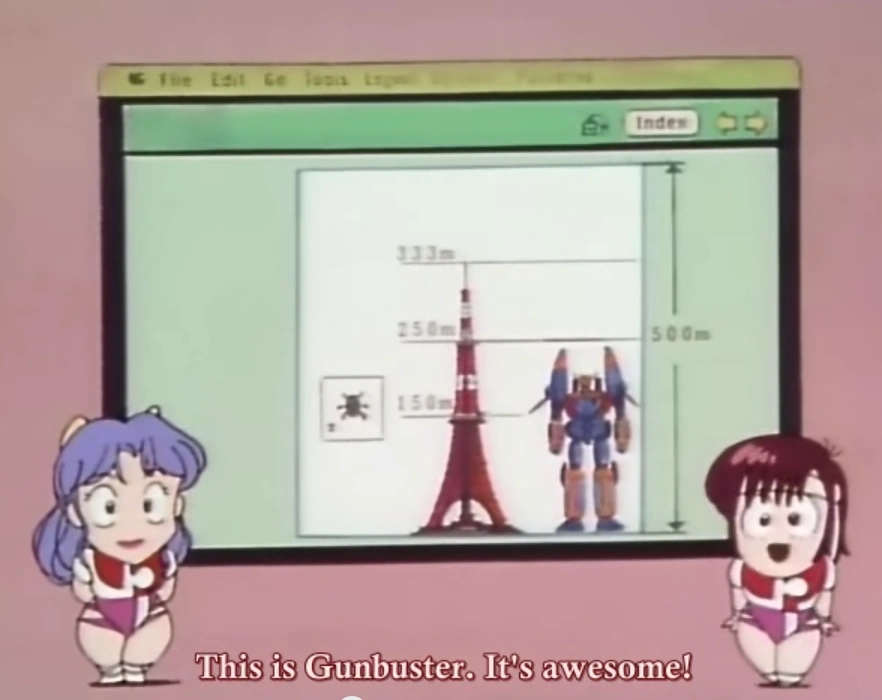
This belies Hideaki Anno's directorial career, how he juxtaposes tones to an extreme. The eighties aesthetic, alongside incredible and painstakingly hand drawn animation, even includes a vibrant and frankly un-cool sweetness to the proceedings, the opening and ending credit songs even into the darker later episodes cute synth pop about striving to be the best, the end credits one even set over crayon drawn comedy gag stills for emphasis. The sense of humour is to be found as well in the omake, made for the series during its production and even with a few additions for later releases, which are parodies of short science lessons where the science by the cast, all drawn in "chibi" form (squat, exaggerated versions like gnomes), is detailed and realistic but utterly made-up. The gag in Episode 3 of having a character's full and convoluted scientific dissertation in white text on a black background, whilst a karaoke duet about a man and a woman getting drunk takes place between the casts' off-time, is just a cherry on the cake for this playfulness. Between these and the first episode, Gunbuster starts off as a light hearted sci-fi romp but it's already establishes clues to where the plot will go.

And in taking such risks, Hideaki Anno having to sacrifice pace for this tonal shifting, there are issues to be had. There is something very unique, in context of when the OVAs were first released in the late eighties, where this even in the early episodes can still have the humour and titillating fan service, introducing a space station and characters like the Russian female pilot Jung Freud with additional space bathing, whilst there's still the gravity of the threat, the alien forces truly monstrous multi-coloured bio-mechanical masses who implant eggs into suns and planets destroying them, the plot emphasising that this feels like humanity fighting against a natural process of the universe in desperation. Some of the risks haven't aged well, mainly episode third to be honest because it falls on a trope, introducing a character only to kill them off in that same piece, that's been done better elsewhere. It's famous for calling a character for that episode Smith Toren, named after the Canadian manga translator and founder of Studio Proteus who had first hand interaction with Gainax staff through his contributions to Western anime and manga fan culture. It's a wonderful tribute to the late Toren, but as the first crush of Noriko's it does have to be compared to other examples of one character being introduced to an episode and a tragedy taking place, to which Kaiba (2008) and a very early episode of Full Metal Alchemist (2003) show a lot more nuisance to this risk.

From https://sqwabb.files.wordpress.com/2013/07/gunbuster-dilation.jpg

It certainly predates by decades Christopher Nolan's Interstella (2014) in terms of the idea of time dilation, an irony that Nolan's career is practically cursed by anime works which predate his films (Paprika (2006) < Inception (2010) for another example) and does the ideas better. The entire plot of Noriko's trajectory, in lieu as well to the time dilation, becomes one of Gunbuster's greatest successes. Bear in mind, whilst it's named after a monolithic robot that is Earth's secret super weapon, one of the largest in anime still until Gainax's own Gurren Lagann (2007) got ridiculous, is only introduced in action in the last minutes of episode four. Instead, alongside a sense of hope and courage against dire situations, it's the emotional drama which Gunbuster tries its damndest with and succeeds with completely.  

It gets melodramatic, plot twists exposed as it weaves Noriko's own conflicts with her abilities with her senior and co-pilot Kazumi Amano's romanctic longings for Coach, Noriko's own doubts and fears fighting the aliens especially confounded by the time dilation, where merely a few hours in space are months on Earth, those she loves like her high school friend aging as she is still a teenager. The swipe at Christopher Nolan's Interstellar is actually appropriate, as, its legitimately arguable Gunbuster is a more subtle work that tackles the subject more fully, as characters' lives beyond the story are what Hideaki Anno actually deals with rather than the giant robot versus alien plot the likes of me expected. And yes, it absolutely sets up Anno's own career trajectory as Neon Genesis Evangelion, even having the silly humour in early episodes, would do the same thing. The marvel is that the proud otaku who by all accounts still plays with Ultraman toys in the bathtub was always interested in human emotions for his pulp characters from the get-go in his career.

From https://deculture101.files.wordpress.com/2008/12/vlcsnap-5083404.jpg

Also in terms of production, Gainax cannot be accused of being poor, even into the 2000s when their reputation weathers financial and political strife in-house and questionable projects are started, because they always have had very distinct works in premise, aesthetic and. Fully embracing high sci-fi here, there's an attention to detail in even the mechanics of spaceships of the imagination that even a laymen to animation would applaud. As the story takes risks, so the hard work on the production is likewise the same.

Then episode six, the last, appears and whilst its one of the best of any OVA or TV series, it makes a case that whilst he's one of Gainax's best voices before departing for his own studio called Studio Khara, Anno at least to the 2000s was cursed for real, as his output from here to the late nineties shows. Nadia: The Secret of Blue Water (1990-1), a NHK/Toho/Korad co-production, took a turn when the infamous "island" episodes had to be made to pad out the series, filler so bad it traumatises viewers to this day. Neon Genesis Evangelion's production history is very well documented, Anno's mental health issues so bad that later next episode previews were actual sketches rather than animation and the more overt experimentation came in as much for practicality. Anyone who has seen The End of Evangelion (1997) can attest to where that went to traumatise viewers and His and Her Circumstances (1998-9) had the unfortunate scenario where the original authoress hated where the series went with her source material, affecting it as it went along. Anno is a good argument for the auteur theory even in terms of how this streak of bad luck, the chaotic production histories, helped shape the final materials as much as his hard work.

From https://vignette.wikia.nocookie.net/gunbuster/
images/a/a6/It_big.png/revision/latest?cb=20150820201753

Gunbuster's
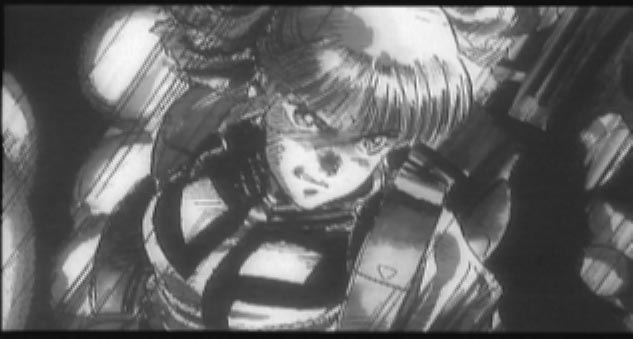
no different as it immediately starts in monochrome; the last episode barring the final moment is entirely animated in black-and-white and the result is a drastic change in tone because of this. It is stylish but it's clearly a production or financial issue which caused this as for a major space battle between the aliens and Earth's space fleets, it's depicted entirely in a montage of still shots and a text scrawl documenting the survivor numbers afterwards1. And yet, in spite of this, ultimately Gunbuster succeeds as it rakes the viewer over the coals in sadness yet is actually a triumphant, happy ending on display, one of the few examples in any art where a story justifies its happy conclusion by making it a worthy thing succeeded in acquiring. And that's why, flaws and all, I see Gunbuster works and know why it's beloved, a very idiosyncratic work that would be a breath of fresh air back in the late eighties, still idiosyncratic today.

Admittedly that's in mind of it being a show of such a status that's not easily available, the existence of a theatrical cut which removes material that was also released in the West complicated things. As even Evangelion has been picked up by Netflix and to be made available again, Gunbuster is one of the last jewels in Gainax's crown that is harder to glimpse, not helped that whilst worthy of its own stature, the ill-advised decision to effectively sell Diebuster (2004-6) as Gunbuster II in the West didn't go down so well, a show set in the same world (and in hindsight, mirroring the ending of Gunbuster with its own ending with a greater meaning now for me) but an entirely different animal. The talk about Diebuster however is for another day...Gunbuster, the prequel, is something that needs to return back in availability.

From https://www.forbiddenplanet.org/Gunbuster/Visual/Episode6/gb604.jpg

======
1) And not necessarily because the black-and-white ink instead of colour being used was a cost cutting measure either...either way, the final episode finds a way to overcome material limitations as is another trademark of Hideaki Anno's.

Friday, 10 August 2018

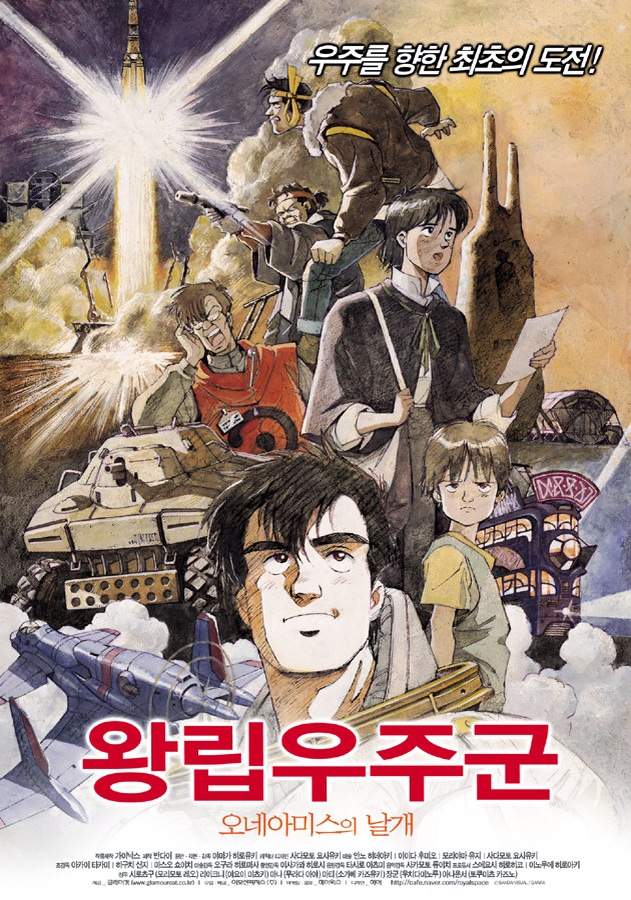
#60: Royal Space Force: The Wings of Honnêamise (1987)

From https://pm1.narvii.com/5628/06a50a48d4
626d2002b86f2ab8882362be39b45e_hq.jpg


Director: Hiroyuki Yamaga
Screenplay: Hiroyuki Yamaga
Voice Cast: Leo Morimoto as Shitotsugh Lhadatt; Mitsuki Yayoi as Riquinni Nonderaiko; Aya Murata as Manna Nonderaiko; Bin Shimada as Yanalan; Hiroshi Izawa as Darigan; Hirotaka Suzuoki as Domorhot; Kazuyuki Sogabe as Marty; Kouji Totani as Tchallichammi; Masahiro Anzai as Majaho; Masato Hirano as Kharock; Yoshito Yasuhara as Nekkerout
Viewed in Japanese with English Subtitles

Synopsis: On a planet similar to ours, the laid back slacker Shitotsugh Lhadatt works at the Royal Space Force of the Kingdom of Honneamise, seen as a joke by everyone with the kingdom as they have never succeeded in sending rockets to space. On the eve of the government finally removing their budget and ending them, the Space Force make one last ditch attempt, an ambitious and dangerous mission to send one member into orbit. Influenced by his attraction to Riquinni, a devoutly religious young woman he has met, Shitotsugh volunteers himself to be that test subject, only for the weight of his mission, the danger and the political machinations around the Royal Space Force to drastically change him as a human being spiritually.

The reputation Royal Space Force has is greater knowing of its origins. Gainax, who most will know as the studio who created the Neon Genesis Evangelion franchise, was always seen as the studio created by fans who managed to get their foot into the door of the anime industry. Figures like Hideaki Anno, before the reputation of the likes of the Evangelion series, who were just fans of anime and the likes of Ultraman who starred in their own fan films. Once they were a group whose first major animation projects, the Daicon III and IV opening films (1981 and 1983 respectively), where made for fan conventions and had to recycle animation cells by washing the paint off them after each segment. They impressed Bandai who, back when projects like this could be a worthy risk, they gave these people the chance to create a theatrical film. Even though, in the time in-between, members of the Gainax worked on big projects as animators, the group who'd become a fully fledged studio in the nineties and into the Millennium still had to hire students to help finish Royal Space Force. The company that'd eventually triumph with Evangelion, FLCL (2000) and Gurren Lagann (2007), but were also fraught with constantly financial problems, having prominent members like Anno leave, and be challenged by the likes of Studio 4°C in terms of being innovators, were a mere glint in the eye still here. And yet with Royal Space Force, you have an incredible one-off, alien to juvenile otaku fetishes and taking on such an ambitious, psychologically and morally complex science fiction story, one even spiritual and philosophical as it follows a character in an alien world through a drastic existential change.

Royal Space Force exists in its own world. Like ours but fleshed out as a planet with its own fashions, languages (at least for a foreign nation who feel the space launch is a political threat), even having the cutlery on tables that's unique. It isn't exaggerated to the point of being flimsy either, worn and fully developed as a pre-fifties world, if to tie it back to our own, a form of dieselpunk sci-fi where everything is heavily mechanised, with elaborate city sprawl, but the idea of space rockets is seen as insane and has claimed the lives of the Royal Space Force many times before. Seen as embarrassments compared to the air force, closer to our own modern military airplanes, they are an absurd dream who attempt one last time. All with the knowledge, in a country with sprawling poverty and constant work strikes, that they are seen as much as a waste of money as much as a popular media event. It builds in terms of storytelling naturally, before the personal journey of Shitotsugh clashes more with political and moral issues which conflict with the dream. As their own government is purposely flexing its muscles with a rival nation, the inherent chance he could die is there too. As is the fact they might've only been allowed to go with the rocket test for military purposes.

From http://www.simbasible.com/wp-content/uploads/
2016/09/unnamed-1-10-1024x597.jpg

Whilst there are a few action scenes, the most prolonged an attempted assassination with purposely drags out into a messy, streets long scramble, this is the slowest of burns in terms of drama. Shitotsugh decides to be the pilot only because he can impress a girl named Riquinni he is attracted to. Deeply religious, she only pays interest to him baring as a friend due to her admiration of the Royal Space Force wanting to enter space rather than commit war. Through severe questions to his own moral compass, through his relationship with Riquinni as well, he is to be challenged for his decision to go into space. The level of complexity goes as far as even include religion, which is rarely done in anime or done well, usually terrible or with foreign religions like Christianity being used symbology to look aesthetically interesting rather than with context. (Something Gainax's own Evangelion has been accused of). Here the religion, even if created for this world, is visibly taking parallels from real ones. The Greek legend of Prometheus stealing fire from the Gods. Eastern beliefs and especially Christian morality, the concern of sin and redeeming oneself felt throughout. It's a film, surprisingly for the science fiction genre when it is more cerebral or action packed in anime, which gets progressively more spiritual as it moves along, following Shitotsugh's own realisation of the worst in humanity as well as wondering if his own kind, through this rocket launch, could strive for better.

It's not a simple moral film either. Shitotsugh is not a perfect, virtuous character, and likewise Riquinni is not a conventional love interest, her devotion to her faith leading her to only seeing him as a friend. Details of her are subtly hinted at, details never explained like the small girl, dressed as a boy, who lives with her like a sister, who possibly could be a daughter as its never explained where she comes into Riquinni's life. Royal Space Force is truly a film in need of multiple viewings, likely to grow for the character details told without dialogue you miss and plot details with are given more meaning with what is discovered later in the running time.

All the following could easily be superfluous if the project wasn't exceptional technically too. How beautifully made and intricate it is as an animated work. How Ryuichi Sakamoto the legendary musician and composer - alongside collaborators Yuji Nomi, Koji Ueno and Haruo Kubota - can add Royal Space Force in his unconventional and fascinating career through an atmospheric score that pushes the material to greater heights, sandwiched between his Oscar winning score for The Last Emperor from the same year and the children's film The Adventures of Milo and Otis in 19861. Finally seeing the film, in the best version possible for me for the first time, it amazes me how it manages with such subtlety to both build its world and how emotionally complex it is. Anime fans pride themselves, as I do, that our favourite work is emotionally complex and mature, but the medium can also be idiotic and trite at its worse; watching Royal Space Force is amazing when you consider how young everyone who worked on the film was, members of Gainax who were once just fans of anime and self professed otaku who decided, when given their first major project, to create a complex and even existential story.

From https://i.warosu.org/data/g/img/0552/04/1466602735623.jpg

[Major Spoilers Warning]

There is one detail, justifying a Trigger Warning, however that has made Royal Space Force impossible for some to love. A sequence under ten minutes long, and it's a moment part of the moral and psychologically complexity to the film which is still talked of to this very day and members of the production consider a mistake. I'd be delusional not to deal with what has caused viewers to dismiss the film's entire series of virtues, a scene of attempted sexual violence which is deliberately more problematic as it is our protagonist Shitotsugh himself who is attempting to molest Riquinni. Abrupt, but a major plot event, one which with our liked protagonist of before dissolves the initial view of him and complicates him to a very uncomfortable territory of characterisation. 

The issue is that it is sewed carefully into the plot, as carefully done as possible, but is a major  challenge to the viewer. He pauses mid attempt, visibly regretting mid way before Riquinni strikes him in the head with an object to knock him unconscious. As much as the controversy is the aftermath and is itself even more dark, as she forgives him the next day as if nothing has happened, Shitotsugh utterly remorseful and shocked by her reaction. I will say that, if anyone is uncomfortable with the sequence, I completely understand them. It is however, whether a justifiable risk or not, as subtly and done as well as such a scene could be. It's also part of a level of moral complexity even live action films do not dare to tread into, which is why even if you ask if it is an acceptable scene there's the inherent challenge of it. A viewer tends, unless they are claimed to be a villain, to sympathise fully with a protagonist of any story, making an act like the one Shitotsugh commits, when we see him as a lovable oaf, problematic and a violation of that trust between story and viewer. For myself the film is completely succinct in dealing with the subject, and it has a purpose that is not a cheap shock tactic but part of its overall existential concerns.   

From http://www.ricedigital.co.uk/wp-content/uploads/2015/
04/the-wings-of-honneamise-thora-113010.png

On the cusp of potential legacy or death, Shitotsugh as he is already challenged by the pressures surrounding him and falls into the worse of human tendencies. His attempt at romance with Riquinni is doomed, and in his lowest moment he commits such a horrible act, one he hesitates whilst knelt on top of her when she knocks him unconscious. Aware of how horrible his act was, Riquinni's blithe reaction is also far from a deeply misogynistic reaction, and anime and manga tragically has a lot of this, but a complex and troubling one for many viewers as it deals with a religious person able to forgive even their own trespasser. (Outside of animation, Abel Ferrara dealt with this in one of his most well known films, Bad Lieutenant (1992), where to the absolute confusion and repulsion of the anti-hero played by Harvey Keitel, a nun who raped by two men and whose case is he investigating has already forgiven the perpetrators their act due to her moralistic religious beliefs, a type of belief few viewers are comfortable to even consider when, rightly, we punish those who commit sexual violence as with other crimes).

It is a dangerous moment for a very young studio to have made, and whilst Gainax have challenged their viewers in the future, none are with this type of discomforting moral greyness. For me personally it is not the moment which capsizes the film, for whilst I sympathise with those who find it offensive, it's one of the few moments that a production is tackling this type of material with the psychological complexity it requires. When anime has an awful track record of offensive and tasteless material, utterly reprehensible material even, Royal Space Force's controversial scene is in a morally higher, more artistically minded place even if some would prefer that Gainax took a different direction More so as, whilst it ends with Riquinni forgiving him, their relationship is tainted by this. It is arguably the catalyst for Shitotsugh himself, through this sin of his, to be pushed towards a spiritual change which, on the day of the rocket launch, he sees the world around and starts to question mankind's tendency to violence, the moment of his own violent behaviour among others forcing him to re-evaluate the mankind itself. Arguably the sin he has nearly committed as much infuses the haunting final monologue where he wonders if they as a species can transcend themselves, followed by the final montage of ordinary life on the planet in its variety. Again, few live action films tackle this. Sadly in cinema we have accepted moral black and whiteness, simplified, to such a point that a story which challenges this is just dismissed when it should be properly pondered as much as asked whether the scenes of controversy were acceptable.

[Major Spoiler Ends]

From https://images.justwatch.com/backdrop/8786003/
s1440/royal-space-force-wings-of-honneamise

Altogether Royal Space Force is a difficult film. A film structurally and in plot which is challenging in its slow paced character study. A challenge just for its notorious and divisive scene still talked of in the current day, but also for how the film even without that sequence is a drama about human complexity. All whilst justifying itself as being acquisitively made, utterly absorbing and one of the few anime films that is truly intelligent. It was the creation of a small group who took such a huge risk and, even if not financially successful, it was a symbol of pride for Bandai. Gainax would continue on with challenging and rewarding material with Neon Genesis Evangelion. For less sombre material, for a sense of fun and energy, no one could argue as well with the virtues of FLCL, Gurren Lagann and Panty and Stocking With Garterbelt (2010). Unfortunately Gainax also become the company who made This Ugly Yet Beautiful World (2004) and shows pass the 2000s, barring one or two, which are not held up high regard or even known in the West. Where the "Gainax Ending", where everything was turned upside down to the surprise of the viewer, can easily be viewed like M. Night Shyamalan plot twists once were as a punch line joke as it was part of their virtues. Long before this twin sided mask, this company just before they wore it however made a film like Royal Space Force which is held in high esteem even next to the incredible work also being produced in Japanese animation in the eighties. Seeing the film for the first time, I am not surprised now.

=======
1 Sakamoto's filmography as a composer is fascinating by itself. Merry Christmas, Mr. Lawrence (1983) obviously. Three films for Bernardo Bertolucci. Donald Cammell's last film Wild Side (1995). The bizarre TV mini-series Wild Palms (1993) [Which I reviewed on my other blog HERE]. Pedro Almodóvar, Brian De Palma, Takashi Miike, Alejandro G. Iñárritu...alongside video games, like the ill fated attempt at modernizing Seven Samurai (1954) with the additional help of French artist Mœbius, Seven Samurai 20XX, and  Sakamoto's first ever film score for Ryu Murakami, the famous author who Sakamoto also worked with on Tokyo Decadence (1992). A film called Daijoubu My Friend (1983) that has American actor Peter Fonda  as a space alien in Japan. That eccentric, strange list is enough to praise Sakamoto for alongside the reputation as a great musician and composer.