Sunday, 30 May 2021

#188: Nurse Witch Komugi (2002-4)


Director: Masato Tamagawa, Masatsugu Arakawa, Yasuhiro Takemoto and Yoshitomo Yonetani

Screenplay: Armstrong Takizawa and Tsuyoshi Tamai

Voice Cast: Halko Momoi as Komugi Nakahara; Ikue Ōtani as Koyori Kokubunji; Yūji Ueda as Mugimaru; Ai Shimizu as Posokichi; Akiko Hiramatsu as Yui Kirihara; Atsuko Enomoto as Megumi Akiba; Ikue Ōtani as Goddess Maya; Masaya Onosaka as Shiro Mibu; Michiko Neya as Runa Tokisaka; Mitsuki Saiga as Kyousuke Date; Yukari Tamura as Asuka Sakurai

Viewed in Japanese with English Subtitles


The immediate detail about Nurse Witch Komugi, a five episode OVA release, is that it is a spin-off to a 2001 television series called The SoulTaker, a very early directorial effort from Akiyuki Shinbo, before he became more famous, which was a dark supernatural story and an attempt by the legendary studio Tatsunoko Production to create a more adult work. Ironically, the humorous tie-in following a side character, recognisable in her nurse's outfit and was a smaller character in the cast, has completely obscured the original work entirely in history. The main lead character, a bland male named Kyosuke, becomes the male love interest for the titular Komugi to become more known as a protagonist, a girl blessed with the power to become a bunny nurse themes magical girl to fight humanised viruses. If ever there was an argument that female characters are usually more interesting as leads for your show, a character that stood out in visual design, allowed to become a bumbling if lovable protagonist is a good example, more so the case as, whilst The SoulTaker vanished, Kumogi got two further straight to video episodes in 2004, and a 2016 reboot in the form of a television series.

The resulting title, which was released without context by itself in the United Kingdom by ADV Films, itself requires no previous knowledge of the original series, another in a line of madcap comedies from the time I saw a lot. This one, following Komugi with her cute bunny mascot Mugi-maru, both the poor subject of abuse but also an undefeatable pervert in certain contexts, is definitely a title that borders on a guilty pleasure, as well being a title that you need to get onto its wavelength to fully appreciate. I will say now, what was once an average OVA when I first saw it has grown on me both in nostalgia from seeing titles like this, affectively a nostalgia for an ADV Vision/Manga Entertainment world of my first anime years, but also because the world and the characters have the virtue that you could elaborate on them in a longer format and, if you kept the same absurdities and colourfulness in look, it would have been great.

It is notable a remake came a decade later, although alongside a clear sense of the character being one with fondness for, or at least the potential to return to as a magical girl parody, they have changed the character designs over time. This is a shame in a way, without wanting to dismiss the 2016 remake in case it proved great in itself, but the premise of the original if funny and open enough to work with. An evil virus has escaped an alternative world, called Vaccine World, and invades ours, using a stand-in called Magical Maid Koyori, an evil representation of maid cafe staff member with magical abilities, to find hotspots that can generate monsters, whether the tensions of a tech convention or distilling a highway's worth of road rage. Komugi is not a perfect heroine, a cosplay idol part of a talent agency called Kiri Pro that is scrapping by, with her own career kneecapped by her continually having to go in her secret persona to fight the monsters. At times greedy and egotistical, Komugi is nonetheless likable, but an added joke (and potential bit of tension) is that Magical Maid Koyori is actually her best friend Koyori Kokubunji, a likable young girl her age who however has a split personality, one she is completely unaware of, which is evil and takes over at unexpected times.

Definitely one of the factors to bear in mind with the original OVA is that, for what I enjoyed about the show, some of the humour has aged considerably. Openly, just to give you a perspective of what some of the humour is, and why the short show can be a title some readers will struggle, can be shown in how one of the most prominent changes I can glace at is that Koyori's character design is significantly less busty. There is no way to move around this, but a lot of Komugi's humour, alongside slapstick and being a Tatsunoko that can parody their back catalogue, is sex comedy, from Mugi-maru being a pervert who keeps making the mistake of being in the bathroom when Komugi bathes, but also about characters obsessing about their lack of a bust or vast amounts of on others. Again this is a title that causes me to wonder whether there is a cultural issue in Japan about the status of a woman's bust, or whether this is just a trope male writers have repeated as a gag in their expense. Particularly with Komgui and her follow Kiri Pro co-member Megumi, who derides Komugi as being as flat as an ironing board whilst she is more physically round in areas, you are going to have to put up with a lot of this humour throughout, just like the skimpy outfits, or the scenes (without actual nudity) of bathing, or a final episode villain, an alien schoolteacher who brainwashes most of Japan and has been comically over-provided in anatomy. Worse and more lasciviousness examples exist in anime I have seen from this period, but the sex humour definitely makes the OVA have some guilt to its enjoyment. More so because it is not subtle, nor really inspired, more an excuse to gander at drawn busts like young boys, which gets repetitive for ever other joke that lands.

You have to bear in mind as well many obscurer (by a Western eyepiece) anime references too, specifically among many Komugi's tendency befitting a cosplayer to suddenly appear in costume as a character from another show for a minute. It is, as a result, meant for a fan base that gets the references. It gets to the point "Nabeshin", the animated persona of anime director Shinichi Watanabe, makes a cameo a character that came to the West thanks to ADV Vision releases, especially Excel Saga (1999-2000), where his animated persona, synonymous for his red jacket with yellow tie and an afro, has an entire running side plot by himself. Merely a cameo here as a disgruntled anime director, he even name checks Puni Puni Poemy (2001), an OVA from this era which is a far more notorious work for its lewd humour and weirdness that managed to be banned in New Zealand. Some of the jokes here even had to be censored, in the Japanese dub and visually on a sign, likely because of crossing Japanese copyright, and in the first, probably referencing a real life case of an otaku who committed a horrible crime for a very sick joke.

Thankfully, within mentality of throwing anything at the wall to see what sticks, you get many which work. This mentality also makes Komugi unpredictable and, with an interest set of characters to work with, it manages to hit the mark a lot between its scattershot of jokes. You may not know about Science Ninja Team Gatchaman, the original version of the Tatsunoko animated series nor its Westernised Battle of the Planets version, but the joke where Komugi suddenly turns into a five person team and their elderly male mentor on a screen, duplicating herself, to ride in a super combat plane is still potentially funny because a) she is fighting a building, which was once for a comics convention, turned into a giant robot, b) because Mugi-maru spends the scenario completely baffled what the hell is going on, and c) with missiles on the plane too dangerous to use, this boils down to the tactic of blowing up one's plane and smashing it into one's opponent for a final move. The show is deeply silly, and for every joke which you do not get the reference for, or has not aged well, a lot are ridiculous and run for the strangest idea.

Surprisingly for an early 2000s title, it is still unfortunately relevant when the first virus monster turns people into internet forum members arguing over fetishes and getting into spats, only with less toxicity. You get a Speed Racer joke, but also a piss take of early computer animated anime where even Mugi-maru comments the frame rate has become broken mid-shot. Episode 3 devotes itself to Komugi being dead for most of it, due to truck, left to languish haunting her colleagues when they are grateful she is gone, and even having a new life become many new lives when she keeps dying. Scattershot is definitely the right choice of term for the show, among many with their manic tones I have seen over the years, but many of these titles as well have their own deliciously surreal mentalities you can easily gloss over if you watch a lot of anime. The show is aware of this as, for its end credit song, you have a bright female sung pop song but with nonsensical lyrics whose strangeness are part of its theme.

This awareness even comes with the way the show had to work around delays per episodes releasing, promising they will get the show out at a certain date or having a seventies giant robot parody with that aforementioned building-robot for an ending preview gag. There is even an Episode 2.5, which is effectively padding and its own special, an excuse for two music videos with their own distinct looks, but also in itself lovable. For what is a tangent, in terms of the show settling down and, set during Komugi and her colleagues working in a festival cafe, allowing for some character building, it adds to the unpredictable nature in its own sedateness. Eventually this is a show where every Japanese monument, set to a licensed Toho studios orchestral march, transforming into a robot or self defence weapon from a kaiju film to defeat a villain, including a scathing critique (even if fictional) of a building which collapses and is merely called a waste of tax payers' money. For ever joke which caused me to roll my eyes, so much revisiting Nurse Witch Komugi was funnier for me. Whilst as much of this is, again as mentioned, nostalgia, as much of that fondness in itself comes from this type of work, specifically as well these early 2000s OVAs, where in little time they do have their own quirks and idiosyncrasies if you were lucky to have had a good one licensed in the United Kingdom. It is with criticisms, but especially with interest in the 2016 television series, there was enough to appreciate on this return too.

Monday, 17 May 2021

#187: Mangirl! (2013)


Director: Nobuaki Nakanishi

Screenplay: Masahiro Yokotani and Reiko Yoshida

Based on a manga by Kagari Tamaoka

Voice Cast: Ayaka Ohashi as Ringo Nishijima; Kanako Miyamoto as Hana Sasayama; Moemi Otaka as Tsugumi Haraki; Yuri Komagata as Aki Torii

Viewed in Japanese with English Subtitles


Another micro-series, thirteen episodes around three minutes each, and yet sadly Mangirl out of all of them feels one of the least rewarding for me at all. So much so I feared this would become a micro review itself.

Mangirl's premise is enticing. Four young women, with no real experience baring one of them working in the doujinshi (fan made and self published work) field, decide to create a manga publication without previous knowledge of being editors or publishers. This will include the stress of trying to figure out how to do this professionally, which is far harder than they anticipated before you factor in de facto leader Hana is head strong and not always the best person to coordinate elaborate plans. You need to find talent to create work for said manga publication, create the aesthetic of each volume each month or so, and if you do actually get off the starting gate, deadlines alongside the additional complications of compiled manga volumes will be in your way.

Truthfully, when Mangirl does occasionally decide to be about the world of manga publication, the briefest of titbit are interesting. An entire passage, with jokes, about there being a variety of fonts you have to choose between to find one appropriate for the genre and tone of the work was fascinating. The tools used to help amend and work on getting your work to look good and be properly collected are too when occasionally shown. This is however a very brief amount of the show, short as it is, which clearly feels like it just wanted to be cute girls being cute.

Which sucks as, even if you sugar coat it a little and include a ska soundtrack, I think of Animation Runner Kuromi (2000 & 2004), both parts an hour or so long work altogether, which in little time did a lot of fascinating storytelling about the nuts and bolts of a tiny animation studio having to work. It did lightly soften the pain of working for such an industry, and played it for comedy, but those laughs could be grim ones and did not hide the stress. Mangirl, brutally, has no interest in this and comes off as a stereotype, also as negative, of an anime being entirely about cute female characters to appeal to a viewer with little under the surface. It really is not that interested in being a story about the manga industry even from this perspective, with episodes entirely off to the side of the subject, such as holding onto the animals and plants of employees whilst they are away.

The worst part of this is that, as a result, these characters do not even stand out as archetypes. Our lead Hana is the figure whose lofty ambitions are contrasted by many mistakes, but she is not given a lot of time to stand out. One likes food, the other I openly admit did not stick out. The one who was interesting is Aki Torii, as the calm collected figure who has to usually steer the ship of this manga publishing company to some success. She is also the one who in back-story who was a popular doujinshi creator who wishes her old persona was kept a secret, likely due to lewder work she may have worked on, but as much a good joke that she wishes to just keep the two sides away from each other. The one episode that stands out, where they go to a manga convention, is funnier as it leads to the one highlight of Mangirl, where she returns to said old persona, effectively becoming the magical girl whose mission is to provide the tired and dehydrated bottle water, actually a good moment and something of progress.

My meanness is entirely in this review because of how little it taken with the premise, three minutes per episode a really tight and difficult length to work with. Mangirl is a light hearted comedy about these characters bumbling through this insane goal, which means there is not a lot that really stands out. My Sister, the Writer (2018), a misguided and notorious misfire that was much about a light novel writer and the world surrounding this, is not going to be evoked as having greater insight on an industry, as it was an incest themed show where infamously the staff wrote coded distress signals in the credits as the animation dipped further and further early on, but the length of that show of full length episodes around twelve episode was probably a wiser idea to make a show about the world of manga publication. Even Animation Runner Kuromi's shorter length and focus on the process was a better structure. Mangirl just wants to be sweet, and sadly, that is not a rewarding result for me personally.

Even when this show abruptly gets meta, as the anime adaptation is not for one of their titles but of themselves, it has not a lot to make this work baring an odd coda. With male characters merely bystanders and readers, even these female characters do not really get to have a lot to stand out even as wacky archetypes or as figures to like straining through this hard work. The manga author trapped in her apartment, which will fill with garbage bags up to the ceiling if her assistant is not there, is someone we could have had a lot more insight and playfulness with. You could have actually gotten darker, and real, even if with a happy conclusion if you showed how bloody difficult this work was. Showing the creation of manga and its publication, especially with the tight deadlines the medium has, had enough potential to be more rewarding without losing the cuddly nature the micro-series desires.

There was also a bonus. For the anime's Blu-ray Disc release, they included an unaired 14th episode called Asobu Henshū Girl for the Japanese audience. Sadly, whilst the longest at nine minutes long, this piece set at a beach is the swimsuit episode, which means it would not add any extended detail. It is does have more of "White Autumn", the doujinshi persona of Aki, but as it says on the tin, it is entirely about the characters being in swimsuits

Even if not a feminist work, at least a show about young women succeeding this task of creating a manga publication would have been great if it had even more time to work with, or focused in the little they had. Eve in their heightened multi-colour, and cute pop song opening with the requisite shots of the cast jumping in the air and dancing, Mangirl would have been better if you had more time to work with. The length here is the Achilles heel for this title to work, but also that the show is far less interested in its premise then you presume.


========

1) HERE.

Saturday, 8 May 2021

#186: Bludgeoning Angel Dokuro-Chan (2005/2007)


Director: Tsutomu Mizushima

Screenplay: Tsutomu Mizushima

Based on a light novel by Masaki Okayu

Voice Cast: Reiko Takagi as Sakura Kusakabe; Saeko Chiba as Dokuro-chan; Ayako Kawasumi as Shizuki Minagami; Rie Kugimiya as Sabato-chan; Akeno Watanabe as Zakuro-chan; Atsushi Imaruoka as Umezawa; Ayako Kawasumi as Shizuki Minagami; Daisuke Kirii as Seargent/Zamuza; Fumitoshi Miyajima as Nishida; Reiko Takagi as Minami-san

Viewed in Japanese with English Subtitles

"It can't be helped that the class representative has been turned into a monkey, so Dokuro-chan may sit next to Sakura-kun."

Tsutomu Mizushima is someone I have developed a fascination to as an anime director. Arguably as much for wrong reasons as his stints in horror have been divisive to say the least, titles which among those I have dug up all have their virtues but so many perplexing aspects. Another (2010), a supernatural mystery, violently contrasts its serious tone with over-the-top deaths which you could even call comedic, such as the first being an unfortunate encounter with an umbrella. The Lost Village (2016), whose main composition was written by acclaimed screenwriter Mari Okada, was definitely divisive, which could be argued to have been an a satire of the genre but for many likely to have taken them aback which its absurd logic. Between a character named Lovepon, whose obsession with execution has made her this writer's spirit animal, and material that even for horror would be balked at like a giant monstrous silicon breast implant, it emphasised the really unpredictable nature of the director, in mind to anime as a collaborative medium, especially with horror stories. Mizushima's career is however diverse, including earlier having worked in comedy and still going into that genre constantly throughout his career. Some more wholesome, like the Girls und Panzer, but a streak of misanthropy found especially in his older work. Plastic Neesan (2011) was obscurer, an original online work about a group of model making schoolgirls which never got to model making, but there was also Magical Witch Punie-chan (2006-7), which envisioned a magical girl if she was the evil despot heir of a magical kingdom whose cute animal mascot was an indentured slave constantly trying to murder her. The most infamous, and arguably one of the titles Mizushima gained a record of accomplishment for at least in the West, was the straight-to-video work Bludgeoning Angel Dokuro-Chan when it was released in the United States by Media Blasters.

Everything, even The Lost Village, makes sense in terms of his career, where he succeeds and fails, now I have seen this series and its sequel. It is a piece of lunacy and since both were also written by him, this really gives me a clearer picture now with its existence a context.

Dokuro-Chan herself is an angel from the future. With a halo and a giant spiked kanabō club called Excalibolg,  which she can use to both resurrect the dead unscathed as well as splatter a torso into chunks with one swing, she was originally assigned to the past to deal with the young teenager Sakura Kusakabe. When he demands an answer for the whole plot, he is foretold he would by accident defy God by giving women immortality...with the unfortunate effect that, wishing to have created a paedophile's fantasy world as an adult, he found the gift of immortality by accident by permanently stunting women from growing biologically from twelve years old. Dokuro-Chan does not play safe with its humour, though it does in its eight fifteen minute episodes place itself at times in regular slapstick with added gory violence, in context that Dokuro decides rather that, than kill him as assigned, that she will try to change him whilst becoming smitten with him. Sakura will die a lot at her hands and the Excalibolg, usually because of her reactions to his lewdness (or accidentally seeing her undressed), or even trying to get a mosquito off him at one point with the club, to the point permanent psychological trauma is likely from the many deaths and resurrections he has had. 

The resulting work, eight fifteen minute episodes compiled into four, is to be honest one you would not show a person if they are new to anime unless you knew their sense of humour or taste in the perverse was strong. A lot of it inherently would baffle or even make someone uncomfortable, particularly as these characters, with many of the sex gag beings about near nudity or perceived, are meant to be younger teenagers than you even find in other anime and manga. It is the kind of work, out of context, which supports all the clichés that give anime a bad name, and it relives one to know Reiko Takagi, who voices Sakura, is actually an adult voice actress who however manages to make Sakura sound like he is actually voiced by a young teen boy who will be battered and smashed into chunks of meat repeatedly by Dokuro.

Within context however, the really misanthropic humour actually softens the discomfort and a lot of it feels like it is playing up to clichés only to twist the knife into them. Dokuro is the lovable heroine if you can get into her headspace, but alongside the cliché of the female lead beating up the male lead for a perceived (even accidental) slight of perverseness being taken to an extreme, she is very much an anti-heroine, someone who can destroy for the sake of it. She will eventually even says very random and illogically things, and is evoked to have tortured a teacher to start a club entirely devoted to the sport of watching woodwork glue dry. In the wrong frame of mind, these characters including Sakura may put you off, but the clichés they are as characters meant to be on add the dark humour.

Such as the fact, when his class is informed he will eventually cause the entire female gender to be stuck at the age of twelve, they do not defend him in the slightest and were already going to beat him up or ostracise him beforehand. The sole exception is Shizuki, whose crush on him is countered by his to her, undercut by Dokuro blundering through, and their own chemistry, alongside another angel (with horns) called Sabato, who with an electric cattle prod powerful enough to kill a sperm whale is just there to murder him. All these characters exhibit the tropes of their archetypes - Sakura the "potato-kun" generic male lead, who is fighting against his puberty badly as a teenager whilst trying to be a good person, Dokuro with aspects of the tsundere (the female character who is stand-offish to the male lead) only in her tendency to violence but mostly the bright, light voiced ditz who happens to have a giant spiked club. The clichés of some anime and manga, the sex comedy, is contrasted by the hyper violence or the perverseness of some of the gags, even cruder ones like the fact that, in this series' dogma, if you remove an angel's halo (as razor sharp as a sword) it causes one to have continuous and life draining diarrhea.

Again, this is not a series to introduce to someone new to anime if any of this is going to be off-putting even in its light hearted tone meant to make the jokes more striking. It is however fully aware of how weird it is, and plays to it well a lot. For all its crassness, there are moments which are deliciously peculiar. No series, in one episode, is just dumb when it inexplicably references Franz Kafka's Metamorphosis, only with the protagonist Gregor Samsa waking up to discover, in a surreal dreamscape of a bedroom, he has grown a bug in terms of morning wood with sexual anxiety apt for Kafka. The class rep, in the first episode when Dokuro is introduced to class as a student, is turned into a monkey, with a real stock image of a howler monkey used for his head in jerky stop motion, a joke paid off in a hilarious moment episodes on when she turns someone into a dog. Little oddball flourishes, such as cutting to two wild bears looking nervously briefly watching at the carnage Dokuro is playing on Sakura in a river (with sweat drops signifiers for this), show even if the humour is crude and playing to vulgarity, it does so with a wink. That the opening theme is a light hearted ditty, feeling like it is about a magical heroine, only to get into Dokuro both describing various ways to torture Sakura and a blatant sadist-masochistic vibe, is enough to explain the transgression of the tropes here.

This explains so much about its director Tsutomu Mizushima for me, even if all his productions are animation made by staffs of various collaborators. Working in comedy greatly, he likes broad and heightened extremes. When this applies to horror, even a goreless work like The Lost Village, the exaggeration is there and a dichotomy can arise. Certainly as well, he does eventually lean further to absurd comedy through the first season, something to bear in mind even if still with the twisted logic of the original premise. The explanation is now there now of why, whilst compelling in themselves, broad is definitely a way to describe a work like Another despite being an atmospheric horror mystery for large portions only to almost be comical when death arises. It emphasises that, if you have any leanings of authorship on your work in any position, the issue of how to work within different genres has to be considered, especially when horror in anime has always been a divisive one to actually pull off for everyone's tastes.

Rather than talk of this at the end, it is best to mention that, two years later, a sequel of four episodes (leading up to an hour's length) was created. It is, in honesty, bonus material. Set after the first series, with new characters fully introduced like Zakuro, Dokuro's nine year old sister who is yet in voice and appearance like an older sibling remotely not of that age, and little changes like Dokuro's hair being turned blue. It has funny moments, including Dokuro trying to get Sakura is eat living chocolate versions of himself for Valentine's Day, but it thankfully is left the equivalent of the bonus gag pages of a manga. It mostly jettisons the dark humour, barring the tragedy of Sabato being a homeless and hungry vagrant, and fully strays into the traditional of strange anime comedy with a lot of sex humour. To an outsider it would be weird without prior knowledge, but as an anime fan myself this is tone is pretty innocuous even if a few moments are deeply weird, such as the Valentine's episode leading to recreating an old folk tale (and a barely covering mermaid costume) being the solution to a hyper sensitive body. It loses the twisted and dark humour, mostly jettisons the classmates who, even if only one stood out as a character, were as much part of the joke and forgoes the premise of the first OVA, that this all comes to be due to Sakura's future self being a pervert. It is entertaining, but contextually it belongs to sequel and bonus animation which, whilst good for fans, is merely bonus, stranger especially as it took two years to be created.

The original, even if the sequel still has Sakura being smashed to bits by Dokuro constantly, is in itself enough, especially if there was a sense of losing its misanthropic attitude. In truth, this leads to the most subversive moment where the show ends on a dramatic conclusion, the cliché of the magical figure being forced to leave for her world which the show plays straight and has had enough time to have built up to. Knowing the premise is based on clichés, which tarnishes them for sick humour but still lets you like the characters if you can catch with the humour, eventually works in its favour as it is mixing the cute with the lurid. (More so, in the least expected scene, when the final episode even has a sombre and strangely ill-eased sequence of Sakura without memories of before and feeling he has lost something whilst spending time with Shizuki at a cafe). It is still a comedy, one whose desire to be both earnest but also have this humour is more stand out. And the entire running gag that this is effectively a male protagonist who is a submissive among more stronger and openly sadistic female figures, with the women in their twisted ways lovable and he the butt of the jokes, is pretty striking, so much so that it reveals another flaw of the second series. That the female characters are also, sadly, toned down in the second series from their almost dominatrix sadist playfulness into more submissive fan service figures, which is no way near as entertaining.

Whether you could have actually gotten this on to a further longer work, in mind to it likely needing to be censored for the television screenings, is merely a guessing game. A title like this however presents, even in its own ballpark, the idea that you can parody the clichés of your genres but still be earnest in them, especially as this manages to skirt around a joke far less palatable as the show aged, that Dokuro wishes to change Sakura because his older self would have lead half the world's population to being permanently twelve years old, and still like these characters. It proved in itself to have been a worthy experience to have, and I say this as something clearly with a very sick sense of humour too.

Sunday, 2 May 2021

#185: Genma Wars (2002)


Director: Tsuneo Tominaga

Screenplay: Shozo Uehara

Based on the mangas by Kazumasa Hirai and Shotaro Ishinomori

Voice Cast: Daisuke Namikawa as Jin; Kenji Nojima as Loof; Akemi Okamura as Rei; Chafurin as Aa; Fumiko Orikasa as Meena/Mimi; Hiroshi Naka as Nuu; Kinryuu Arimoto as Dar; Mami Kingetsu as Namie/ Non; Motomu Kiyokawa as Mah King; Susumu Chiba as Akira; Tamami Kaizuka as Ran; Tomoko Hiratsuji as Parome; Wataru Takagi as Dan

Viewed in Japanese with English Subtitles


I hope they enjoy eating me

Major Plot Spoilers Throughout

After initially being penned in 1967, as a collaboration between science fiction writer Kazumasa Hirai and legendary manga creator Shotaro Ishinomori, Genma Wars would continue over multiple manga and the series has been adapted twice to animation. The first is the Rintaro theatrical feature Harmagedon (1983), of the era of eighties anime theatrical spectacles with its two plus hour length and Keith Emerson, of British progressive rock band Emerson, Lake, & Palmer, composing the score. The other is Genma Wars, a television series which did get a Western release in the United States but is forgotten, and adaptation of Genma Wars: The Eve of Myth (1979-81), a follow up from Ishinomori. It is also, hearing of its negative reputation, something I have had to chew over. Because it is definately bad, a show whose existence comes to emphasise that, for every program which develops into a success and even a legacy, there are countless which are lost in time, and some I watch where I wonder how people reacted to this show in its original context. Screened on AT-X, TV Tokyo's anime satellite channel, I wonder what a Japanese television viewer might have thought, because a lot of the experience of the show far from just a bad production was also felt as if hallucinated as much as have to witness a show so awkwardly, and in cases problematic, wander towards a narrative.

The key aspect of the franchise is "Espers", i.e. psychics and the idea of psychic abilities, a concept in consideration to the New Age and alternative belief boom of sixties on here with characters able to command great power with just their minds. In the 1983 Harmagedon film, it sprawls a narrative where humanity is under threat of a force of entropy slowly coming forth to annihilate the Earth. Genma Wars, whilst from a different piece of the source, can be understood in its own narrative. Here, post-apocalypse, humanity has been crushed. Regressing to even pre-medieval times, they are mostly a slave labour force in what cannot help but evoke Planet of the Apes, with ape people ruling over them, and the main leaders of the landscape now the Mah tribe, demonic figures from afar. The Mah tribe's powerful leader, Genma, to the rage of his own wife has been having human women brought to him to sire children with, conceived with one such women two male twins Loof and Jin. They are separated, Loof raised in the watch of his father, the other Jin with the enslaved humans and their mother, with a former servant turned into a wolf who humanely has gone to look after him.

Obviously, or you would think, the narrative are the twins going to eventually come together and, both with incredible psychic power, will either turn on each other in a tragedy or take on their father. The narrative, and where it trips along, proves one of the aspects which will confound with this production. The immediate thing, that many will be put off with by Genma Wars before you attempt to wrap through the storytelling, is how such a cheap and messy looking show this is. This, especially, is a reminder that anime's origins as a production, with time scales and made on mass for television, is something to consider. This, especially because the earliest 2000s was the era of still having to adapt to the new post-hand drawn era into digital craft, is to be considered, as there are likely so many shows like this in existence which are haphazard or had little to work with in terms of budget.

The low animation quality does become an issue at hand, where the creators have to work around characters moving in cases and its simplified environments, but I will say on my part that this was never detracting. Having adapted to shows like this, and arguably encountered even worse cases, I never had any issues with the animation personally even though I  will be upfront in saying this will be a factor that many will have. Far more the concern for me is that, with its look as much part of the strangeness of the show, it is intertwined with the greater concern for me for what a mess Genma Wars turned out to be narratively. It is far more curious, as much as the programme's downfall, where in its initial stages, it sets out as a concise plot. It has lurid edges, which I will get to later on, but there is nothing that was suggested it would jump to the odd directions it would in its narrative of humanity, kicked to the curb in terms of superiority, fighting an evil demonic overlord by way of his own children. In fact, in the very little that is in existence about this show, very little prepared me for how early into the narrative, with Loof and Jin in separate narratives for a large section after the pilot episode, things get weird.

By Episode 4, after the introduction to the initial narrative, including Loof eventually encountering a young human woman with gifted abilities, you already have the inklings of a show which is scattershot. It is not sure what to be doing, and between the storytelling and its huge artistic problems, it will bumble along. By this earliest of stages of Episode 4, you are already having to wrap around this being a world where human children are apparently a delicacy to the ruling species, with boys' brains being noticeably spicier than girls as is elaborated on in a later episode, and a random tangent for one main character, in the same episode involving a ghost ship with (vibrating) skeleton pirates in the apocalypse wastelands and a super computer, in a tall office building, with its own religious cult.

This unpredictability unfortunately does have an unsavoury touch, in which this is show that racks up a list of terrible streak of the treatment of the women in the cast. Neither is this cheap liberal political correctness either, as it really does have a terrible habit of female characters get killed off frequently, being in the background, and with a lot of rape causally skimmed past. The last is especially common alongside consensual sex scenes, both with the main villain's obsession with lusting after human women, and even one of the leads Loof raping the young woman he meets, which cannot be viewed as anything else, only with them still going on to have a romantic relationship in their journey. Adding to this issue is that, in the original version of the show, there was clearly a lot of female nudity throughout, but for the Western release, it was visibly and crudely censored even for consensual sex scenes. AT-X, alongside having acclaimed shows like Azumanga Daioh (2002) to Mawaru Penguindrum (2011) broadcast is also, because of being a satellite channel, able to show work uncensored with a lot of nudity and titillation, such as Ikki Tousen and High School DxD franchises, so it does come blatantly obvious with the misting effects or strategic use of shadow censorship was introduced for the Western release. Who was responsible for the censorship is not clearly, but it has the unfortunate effect of emphasising the unsavoury content. This stuff is the aspect that I hold as the worst of the whole experience, the sexual violence even if never explicit and arguably tacky in tone context and even existence, as whilst I will warn the reader that Genma Wars  was a farce, nothing within it proved a problem as much as this.

It is just a piece of the show, but the amount of time it is skirted into, even occasionally, is really surprising for how the show touches into dark subject matter with a context (alongside the animation quality) that is out of place. Genma Wars in general contrasts what looks and feels like a very cheap action show for children in aesthetic, with a cartoon talking wolf among the leads, with a lot of adult content for a perplexing contrast. I will eventually get into the later half, but later you even have a brief moment in an urban society where there is a "fruit garden", named such as it is a public park where everyone goes to commit suicide, hanging themselves off tree branches on mass due to being economically destitute, content that in another circumstance would have linked to something more profound, but here is among the many fragments abruptly thrown at the viewer. Contrasting this is that, with the psychic powers, there are no rules to what is possible, with clear budget limitations meaning disintegrating demons, teleporting to compensate walking animation, and some levitation, narrowing what you can depict.

Not a lot progresses for a very simple narrative, one which could have told itself in a concise form in the thirteen episodes, as Jin and Loof's journeys even in terms of being seperate could have expanded this world to emphasis the narrative. Honestly, the animation quality is the least of the issues even if detracting to a huge disadvantage, more that this story feels it has had to cram in content jarringly within itself. It goes on tangents with new characters brought in abruptly, with key ones (especially the women) killed off, even an entire team of psychic warriors abruptly recruited to attack the main villain only for them to quickly be killed off in the same episode by his wife. A psychic demon baby appears at the same time, as the true villain, and throughout this the only character in all honesty who gets anything remotely complicated is Genma's wife, a Nosferatu vampire-like woman who with her female assistant, an eyeball with wings, has now been reduced into alcoholism and trying to kill off her step sons as her husband now just sleeps around with human women, on mass even in his psychic orgies with absorbing flesh walls oblivious to her being there.

Looking like the creation of a lot of old, gaudy toys from a car boot sale in aesthetic, with this strange and adult content, it is compelling for me even if this could have jettisoned the problematic content, for the better. I came into viewing this series with mind to it being held as bad, so I was expecting in a perverse way for this as an "entertainment", even if irony disinterests me, more the experience in terms of watching something unfold. It is frankly, even then, a show many will not get through. This in itself is a shame in its own twisted way as, when many might have understandably escaped the viewing experience half way through if not earlier, Genma Wars as an experience only really exists whether still held as an unwatchable disaster or with entertainment when you actually try to follow the narrative, only for it to get progressively weirder.

Including the fact that, whilst he is the titular figure, Genma as the big villain is quickly brushed aside and for the final four episodes, we abruptly transport the heroes into a dystopia metropolis, with the elite ruling over the humans including humans complicit in the schemes. This is where the "fruit trees" come in. Episode Four was already a warning, but by Episode Eleven, you have evil monkey worshippers, another unsavoury and pointless tangent where demons (including a demon slug) in disguise drug and trick schoolgirls with dreams of being idol singers, only for them to be used for sex by powerful figures in the metropolis, and even weird details like the mayor's private army, as they patrol the streets and occasionally massacre bikers on mass, having cheerleaders in a truck for parades.

Eventually this series, after it was meant to be a post-apocalypse story of two psychic half-humans overthrowing their father to save humanity, with a narrative string as far back as ancient mythology for all its flaws, ends with an invasion by humanoid monkeys from space, from a satellite, and nuclear annihilation in another dimension which is quickly forgotten to return to the heroes' original world. A show that, in truth, ends on an abrupt bitter sweet ending where almost everyone is dead, and the world still needs to be rebuilt and with a lot of problems to sweep up with no epilogue. Yes, this series does not make sense, anywhere in-between a debate to have punched the demon psychic baby now inside a woman's womb, to the tournament to the death, abruptly included with two episodes left, that is quickly jettisoned as a mere trap, Genma Wars caught me off-guard and probably even itself in never really getting anywhere but a lot happening. Rather than the bland title lost in history, it thankfully proved to be more compelling with all its plotting inconsistencies. It is also, however, also with good reason not held with great regard even if you may have never heard of it. The United States got the series through Media Blasters, a company who has quietly chugged on and survived despite large period of absence in the country's market, but even for a company who into the 2020s in their return focus on obscurer licences, this would be an odd one to resurrect even if it would be a morbid curiosity especially in uncut form. It is definitely with mind to Shotaro Ishinomori, a legendary manga creator, and tangent Kazumasa Hirai as well an embarrassment, even in mind that Rintaro's theatrical feature was already a divisive production in critical and fan opinion. It does not look good into terms of adapting the source material, an own goal completely as a result.

Saturday, 20 March 2021

#184: The Book of the Dead (2005)


Director: Kihachiro Kawamoto 

Based on a novel by Shinobu Origuchi

Voice Cast: Kyôko Kishida as the Narrator; Tetsuko Kuroyanagi as the Story Teller; Rie Miyazawa as Iratsume of Fujiwara

Viewed in Japanese with English Subtitles


A new fangled wall would bring curses upon your sons!

A film I had always wanted to see, this is a curveball in that this is a stop motion puppet work, stepping outside the confines of hand drawn animation, and focusing on a figure of high regard in puppet and stop motion filmmaking. Kihachirō Kawamoto is sadly a figure not as widely known, and for me only in passing knowledge, among the string of widely acclaimed international animation directors who sadly seem cut off from wider accessibility. This is prominent in that Yuri Norstein, a legendary Russian animation director behind the likes of Tale of Tales (1979), worked on this project as a guest collaborator.

The Book of the Dead itself would defy categorisation, something which would tragically go against being able to sell it to many. It is not a horror tale, yet it is explicitly about the supernatural. It is also religious as it tells the legend of Chūjō-hime (called "Iratsume" here), the daughter of an imperial minister whose obsession with copying Buddhist mandalas, in a time period when Buddhism was first introduced to Japan historically, will eventually lead to her creating the Taima Mandala. The Mandala, reproduced in this tale, is a real artefact in Japan, part of their own version of Buddhism. In spite of being a sacred object depiction the "pure land" of Buddha, this Mandala in this tale is ironically crafted out of love for another.

This is where The Book of the Dead takes an interesting side, a beautiful film to look at in terms of a well crafted tale told entirely by puppets, even to the point of full locations which, lovingly, have panoramic camera shots overlooking the setting. The film could be considered "dry", if only in the sense that, be you anime fan or film fan expecting a fast pace supernatural story, you are instead watching a sombre and matter-of-fact folktale which, even over just an hour or so, is restrained. It is entirely about a point in Japanese culture where it was first being influenced by Buddhism, and its simple tale has a lot of cultural details specific to the time to adapt to, such as the fact that, when she first sees the visage of a sacred figure who capture her heart, Iratsume transgresses the rule that women are not allowed in the temple ground where that figure looms. What is fascinating is that, for a narrative told of how a real piece of art of such sacredness came to be, this film is as much about the emotions of its creator. A woven cultural object that (even if having sadly degraded over the eras) has still been preserved in real life, and is of great importance in Japan, this film tells the tale of it being the craft of a young woman, a young maiden, smitten by a godlike figure and makes that fact as profound. Specifically a nobleman, as told to her by an old woman, killed and whose ghost still haunts the land.  

For me personally, this tale as told here is captivating. The lack of any "thrills", that his haunting is not to possess her, but are explicitly about wishing to have a child he never had alive, is as rewarding, especially as the course of the narrative instead has her create a clock to wrap his giant beautiful naked form, a cloth that turns into a Mandala of great artistic and spiritual worth, her act of love subversive in itself. A playfulness spans the calm mood of the film, of the dangers of angering spirits of old houses if you include new wall refurbishments, something to learn from in the modern day, or that we encounter a group of gods by a haunted tree briefly, fifty years later returning to the land and feeling old now. A lot in this film, for a story which is as much a tribute to Buddhist ideals, is also fascinating to see as a very human tale of love, including Iratsume's own reaction to her masterwork in the finale, more so as this is told with puppets rather than live action actors. That the ghostly figure she comes to adore is a fictionalised version of a real figure, a poet and a son to an Emperor Tenmu called Prince Ōtsu, continues this film being as much looking to real Japanese history and artistic culture and bringing it alive again.

It would be a disservice, at the moment of writing those words, to not mention this is an adaptation of a novel Shisha no sho by Shinobu Orikuchi, a figure whose reputation in study and writings in countless fields, from Japanese folklore to performing arts to the Japanese language itself, is in itself a nod to what the intention of writing such a work was meant at, his own career and life devoted to looking at his own culture and bringing it in full vibrancy. Likewise, The Book of the Dead itself as an animation does feel like production meant to bring culture alive onscreen, with Orikuchi as much as Kihachirō Kawamoto himself figures in their homeland who have contributed so much for a lasting legacy in looking at their heritage. In terms of the film itself, there are many moments where, beyond itself simple tale, Kawamoto's adapted material has its own idiosyncratic touches which you could easily miss. It is a very deceptively unconventional narrative, a romantic narrative by a living young woman and a figure that wakes up in his tomb dead which blurs the living and the dead, and is entirely a passive romance. That this leads to a creation of a masterpiece, in her love for him which involves painstaking work of her own, is befittingly being adapted too by an animation director, bringing his characters alive with puppets alongside a team of animators.

Monday, 15 March 2021

#183: She, the Ultimate Weapon (2002)


a.k.a. Saikano

Director: Mitsuko Kase

Screenplay: Itaru Era

Based on the manga by Shin Takahashi

Voice Cast: Fumiko Orikasa as Chise; Shirou Ishimoda as Shuji; Miki Itō as Fuyumi; Shinichiro Miki as Tetsu; Tetsu Shiratori as Atsushi; Yuu Sugimoto as Akemi; Atsushi Ii as Kawahara

Viewed in Japanese with English Subtitles


[Major Plot Spoilers Throughout]

Returning to She, the Ultimate Weapon it is amazing to think of how heavily publicized this show was especially in the United Kingdom for its release. A big license for Manga Entertainment, it has effectively disappeared despite also having a lot of praise for it at the time. Whilst this may be odd considering so many anime having these tropes and plot threats this has, She... is also quite a peculiar animated series in hindsight, which in itself becomes part of why it still clings with something of note for me and likely why the tide turned to its obscurity.

Set in a coastal city of Hokkaidō in Japan, this is set up like a conventional anime romance. A shy young woman, technically a teenager but older than most in other stories, named Chise is clumsy and awkward but is lovable. She finally gets the courage to date Shuji, a reserved seventeen year old boy in her school, and they blossom immediately together. She... is however a war story, set in a world where Japan is at war. The touch, adding to the strangeness of how the story is told, which stands out is that this entirely focuses on the world of these characters rather than focusing on the war. We see the battlefield in Japan, soldiers fighting on their own soil in an invasion, and the aftermath, but the show is entirely focused on the effect of the war on the ordinary people from the soldiers to the leads, living in Hokkaidō. This is also a science fiction show where Chise is also a figure of great importance to protect Japan, which is bizarre for an outsider to consider, of a story of a teenager being the ultimate weapon, expect that anime and manga have always had teenagers in war stories like this, as much to appeal to the emotions of a target audience as an obsession to have youthful characters, so we fans accept the logic.

The strangeness and uniqueness is the tone. Completely sober, a lot of the world is never explained. An spin off OVA called Saikano: Another Love Song (2005) explained more detail to why Chise is the titular weapon, in a side story on another human weapon, but in the series we learn little context. We never learn what the war is, with only a few of the opposite side as actual human beings seen, and the war itself is ultimately an apocalyptic one. Chise's use in the war, whilst conventional in any other narrative, emphasises this as she herself is literally the weapon, with body horror tropes that she can even produce heat seeking missiles from her body even against her will which can be painful. The sombreness of the narrative, and how little is explained on the science fiction plot, emphasises the distinct way the show is told, a tragedy where from the get-go the show's subtitle "The Last Love Song on This Little Planet" emphasises that this will become a bleak show in terms of humanity, once mysterious earthquakes hit the country and Chise herself becomes more inhuman to the point she can accidentally obliterate whole cities from existence.

The show does have some levity - even some cartoonish distortion of the characters when Chise and a soldier named Testu she befriends decide to have a day out away from work, including liberal attitudes to going "shopping" by blowing doors open - but this is melodramatic and tragic to an extreme. Eventually by Episode 9, titled after a side character named Akemi, Chise and Shuji's tomboy friend who becomes the latter's consciousness, this show is ill-advised to binge for how bleak it gets. This tone is one of the more divisive aspects of She... as it has no qualms even beforehand of emotional gut punches over and over in-between its very quiet dramatic tone and moments of war which, never depicted as action scenes, are dramatic in their pointlessness. Some of it in hindsight is ridiculous - in mind to how this type of scene makes some viewers uncomfortable, having Shuji slap Akemi twice in the series in a moment of emotional distress is absurd if likely to upset viewers. Some of it is heightened with an appropriate tone, befitting a show where you have to accept this premise of a seventeen year old girl with robot wings as the ultimate doomsday weapon.

The people behind the show are worth looking into to think about the series. A rare female director, Mitsuko Kase has mostly a career of Episode Directors and other positions on projects, but she has been at the helm of a couple of titles. That you have a female director on this project does cause one to think of how she would handle this material very differently from someone else. In mind to this, if this is the same figure and there is no confusion by accident between two people, screenwriter Itaru Era has also worked with Takeshi Miike, of all people to hire for this project also the figure who has worked with him sporadically over the years including on Visitor Q (2001). A notorious film in Miike's career, it is however also a reinterpretation of Teorema (1968), a subversive Pier Paolo Pasolini film, which means Visitor Q is not just a film notorious for having disturbing taboo scenes of incest and breast milk but a social critique. I cannot help but think, in particular with the screenwriter, that She, The Ultimate Weapon was much more carefully built that it may suggests, especially with mind to someone whose career has been focused on a lot of genre and pulp narratives, deciding to bleed them into a much more idiosyncratic narrative.

Some of it falls into the history of the animation studio which created it as well. Studio Gonzo, even before financial struggles eventually kneecapped them in 2009, is a divisive studio from when they started in 2000. At least for Western anime fans, when I got into anime in the early 2000s and companies like Manga Entertainment but especially ADV Films released many Gonzo releases in the United Kingdom. Gonzo has some titled held as gems - particularly the experimental Alexandre Dumas adaptation Gankutsuou: The Count of Monte Cristo (2004) - but alongside titles which never succeeded, they had a few where how they were told and put together became divisive. Some was bad luck, as they adapted titles where they could not finish them as the manga were ongoing (Chrno Crusade and Hellsing) and had to improvise anime exclusive narratives. Others, like Trinity Blood (2005), were just shows which (least to my younger self's eyes) merely fell hard over a long stretch of episodes. She, The Ultimate Weapon is a fascinating title, but one where I completely understand an individual viewer being divided between the moments where it succeeds as a risk in storytelling but also can be both manipulative and as awkward as its leads. It befittingly has a premise about a young woman, shy and innocent, struggling with a sinister dehumanising weapon part of herself now, and about a boyfriend who is the same age and not as mature as he thinks he is, as that is a perfect metaphor for a show which has tenderness and yet also so much darkness. One with characters dying with ease and an ultimately hopeless scenario for the war, exaggerated with the naive earnestness of teen leads in how it emphasises the one true love of one's life, something which may cause viewers to roll their eyes, but also with complete sincerity to it.

At least the show also does not beat around the bush too. It does have these characters be imperfect. Chise is a stereotype, but appropriate a person stuck in a horrible position where she can obliterate so many with ease, mandatory for the military. Shuji is not perfect, and in a subplot, with an older woman he had a crush on as a child comes into his life, there is the danger of him breaking Chise's heart as appropriate angst ridden rather than the show being sleazy, more of him being tragically controlled by lusts when the dehumanisation of Chise physically has an influence. The bluntness of the show to eventually be more than platonic love, but also a physical love between the leads, is a damn sight better than a childish one most characters can have in other anime, with no fan service but eventually a consummated romance. This is surprising rare in anime even if this one has many unsettling aspects surrounding it, not least when the woman you love's arm falls off just beforehand and she is clearly not human anymore.

Another factor, which is merely hindsight, is the look of the show. Tragically, time has changed a lot, so an early digital animated work like She... looks of its era. Neither helping is that, whilst there was progression in sound (such as 5.1. stereo which became a huge thing for Manga Entertainment licenses on DVD), this is in standard definition, which still does not mean not watching the show, but together means the show was struggling with limitations even for an animated show avoiding action sci-fi narrative tropes. This was actually an early title in Gonzo's history, and this becomes obvious to see again even if, thankfully, there is style of its own. It tries in spite of this, helped considerably by the character designs adapted from the source material, softer in features and almost even for the adult characters more likely to evoke a happier story, one which intentionally feels against the tragedy of the show's progressing narrative. The music as well, both composer Takeo Miratsu with various versions of the main theme but also the ending song Sayonara by Yuria Yato, really adds a lot of sincere emotional weight to the show too that is admirable. It is hilarious, adding to the curious history of the show, the composer for a Violence Jack OVA, Hell's Wind (1990), can progress to such a good score based on love and tragedy, but sadly they have not done a lot in their career either. Mostly working in the OVA era, if this was one of the last projects before retirement, it was a great way to bow out and defy expectations.

Returning to this series, as I got into She, The Ultimate Weapon when it was released in the United Kingdom, the obvious point of interest now revisiting the series was its ending. She... to its credit, least for this viewer, has characters that I was connecting to. Even the emotional gut punches could have been worse, though there is a reason this review from the get-go has huge spoiler warnings. The narrative even for a character like Akemi, very likable but with an entire episode dealing with the awful deathbed conclusion, is at least aware to give these moments the time for these characters' sake. The show for me became notorious in my mind, instead, for all these years for how unexpectedly it ends.  

When I said apocalyptic, I was not joking, as this ultimately does become The Last Love Song on This Little Planet. How this comes about in the final episode is still to this day the exclamation mark for how peculiar the show, for good and bad, is. When I first watched this show, engaged with it, the ending did enrage me and to this day, I can still see why. She... is definitely a show that could only work in the heightened, melodramatic world of anime and manga especially with having to make this look credible, something I wonder of now learning a 2006 live action film from Japan exists but has likely disappeared from existence. Even when the obvious is there, that Chise is literally turning into an immortal weapon of God-like power, what happens in pace is perplexing. Even if you see the obvious metaphorical concept not meant to be explained, that the war as a global one that ultimately destroys humankind is there to emphasise the stakes of the central romance, you have to try to depict this and everything ends quickly in the midway of the final episode. The sky is red like this will turn into The End of Evangelion (1997), with Chise apparently now with mechanical tentacles independent of her in the sky, and the world literally being washed away, the earthquakes throughout the series never directly connected to anything in the war or Chise herself. Gonzo is a studio I will evaluate as time goes, but I can immediately see how they developed the notoriety they had for titles for good and bad, stumbling to their finales with an erratic nature, and She... lunges into the world being plunged into total end as abruptly as you can get.

The ending still works, with a bittersweet one, even if the outcome if left open to what will happen to our leads, or that there is some vagueness, such as the possibility this is all due to Chise deciding to kill everything else, something which if the case is definitely vague in its depiction. [Manga Spoiler]] Thankfully, they did not follow the manga by having Chise left as a giant spaceship with Shuji the last human being, though that might have been fascinatingly weird to see animated. [Spoilers End]. If anything, it does emphasise that whilst this is truly a show to divide viewers on its virtues or lack of, I wish She, The Ultimate Weapon was critically evaluated as an example of when anime takes risks. If Gonzo's back catalogue was sadly full of bland titles, which ultimately left them as a studio still in existence today but with less of their status as back then, that would a sad conclusion. Thinking back to when I drifted to Japanese animated television away from Western shows however, live action and otherwise, She... still emphasises why I did as even this deeply imperfect show is taking risks in tone and its curious genre mixing I have to admire. It is a mess in hindsight, but a fascinating one to see again as an adult. One I cannot help but still admire and even, honestly, feel an attachment to. Obviously, nostalgia to seeing this title has to be admitted, as I saw it at an impressionable time. At the same time however, I thankfully liked a show whose actual content even today is very unconventional and still rewarding.

Wednesday, 3 March 2021

#182: Escaflowne: The Movie (2000)


Director: Kazuki Akane

Screenplay: Kazuki Akane and Ryota Yamaguchi

Voice Cast: Maaya Sakamoto as Hitomi Kanzaki; Tomokazu Seki as Van of Adom; Jouji Nakata as Dune / Folken; Aki Takeda as Millerna; Chafurin as Mole Man; Ikue Ōtani as Merle; Jūrōta Kosugi as Dryden; Mayumi Iizuka as Sora; Minami Takayama as Dilandau; Shinichiro Miki as Allen

Viewed in Japanese with English Subtitles


I admit I hesitated watching this, a theatrical reinterpretation of a 1996 television series that I am a huge admirer of. The Sunrise produced television series, spearheaded by Shōji Kawamori, was a fantasy series, proto-isekai, where a young teen girl named Hitomi is whisked off to a realm where there are giant robots but the world is entirely high Western fantasy in iconography, with a huge emphasis on romance as much as drama. It is held with high regard to the modern day, with note to the fact that, whilst gendered audiences are an absurd thing to consider, Escaflowne had a lot on its side to appeal to a female audience, which it did, as well as being an excellent show for any viewer to watch. That aspect of a gendered audience though was a huge influence for Kazuki Akane, director of the series, to take a huge leap in an opposite direction for his theatrical version1 by changing the narrative and, effectively, making it a more serious story for a more male audience as a contrast. The theatrical film is not well regarded at all, as time has passed.

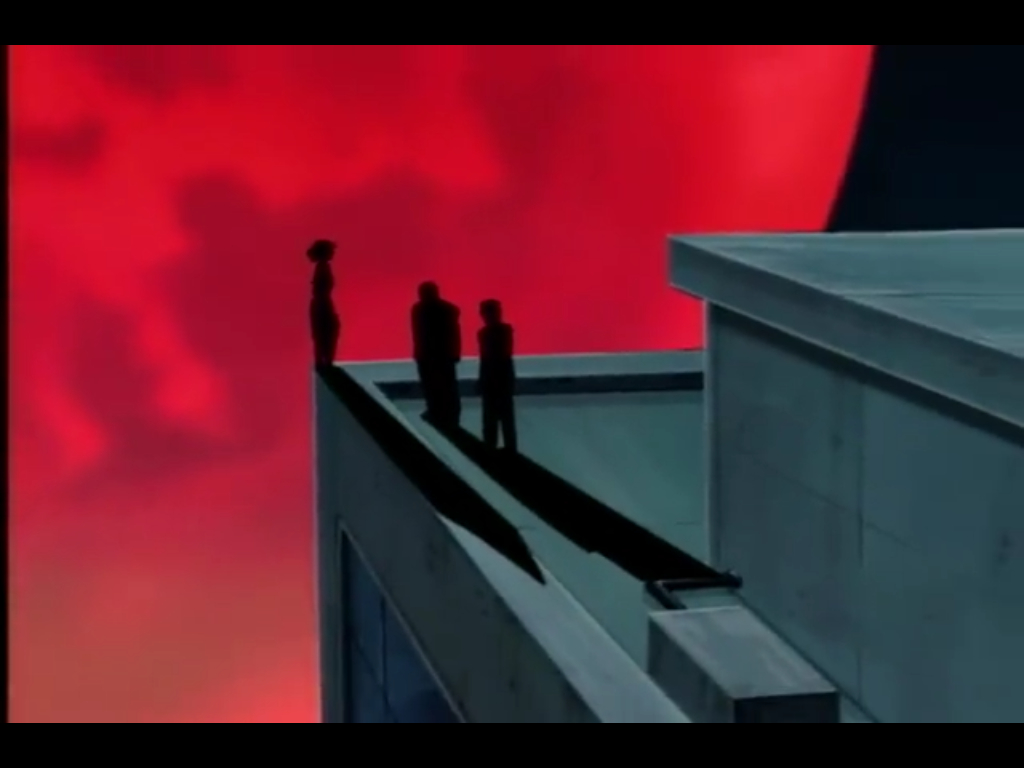
Notably, this film sets a different tone in that, with the original series heavily influenced by Western aesthetics, including medieval iconography and high fantasy tropes, the world of Gaea the film is set in is instead heavily influenced by Eastern and Japanese aesthetics. It is also a beautiful film to behold, and for any comment I will make, Escaflowne the film is a feast for the eyes. Tragically, this also leaves this film in the cursed world of theatrical anime which were gorgeously put together, but divisive in content. One of the biggest changes in terms of the tone is that Hitomi, a bright optimistic figure in the series for those uninitiated to the narrative, is here a depressed teenage who even flirts with suicide, being caught by a friend with a suicide note and her shoes left by her side laying on a school building rooftop when she had changed her mind.

Even if you do not include the shadow of the television series, and view this film as its separate entity, there is a fascinating suicide and depression theme that could have been the most rewarding aspect of the film if fleshed out considerably. It is the most rewarding aspect still in the actual film as, feeling lost and wishing to isolate herself, Hitomi is not connected to a past as was the case in the series, but instead entering Gaea as a person at the point she wished to just disappear as a person. The only lore is that she is the "Wing Goddess" connected to the Escaflowne, a mythological giant robot which can either destroy Gaea or help save it, itself hinted at in this simplistic lore with connections to the depression metaphors. This is effectively a darker take on the material, even if light still thankfully brightens its edges, but that in itself would have been a fascinating new direction to take with a series which did, to its credit, have a lot of serious moments.


In this, there is still a sense of the emotion connection from the series, and even as its own separate story some can be found. Even if Van, the male protagonist, is introduced cutting off limbs without care of his enemies in bloody effect, this film is not as grim as its reputation suggested to me. Even Hitomi herself becomes the optimistic figure of the show eventually, just with some legwork. A lot of the streamlining is due to how extensive the plot and the cast were, for a twenty six episode narrative, and even if you have no idea of the series, the biggest problem is that this film has an overt sense of a film post-Star Wars and eighties high fantasy films that wished to form a plot in 90 minutes with short hand, McGuffins and simplified characterisation, cinema which can entertain from any country but can also be very reductive and unoriginal. I can bang on about the details changed - Princess Millerna has less scenes and now dresses as a warrior woman, important figures like Allen  no longer of any real importance, or Van's brother is now just a villain who destroys only because he was snubbed from their throne - but that would be reductive baring the amusing touch that Mr. Mole, a comedic figure in the series, is the one character who gets upgraded to a quack fortune teller in the one progression in roles. Honestly, the real issue is condensing the premise of an epic into ninety minutes and being very conventional, borrowing from other sources.  

That characters like Van and his brother Folken suddenly have mental force powers, borrowed from Star Wars and anime's flirting with psychics in the eighties, exemplified this. The original series, whilst unbelievably eccentric, was unpredictable with more time to flesh out its cast and leaning heavily on esoteric mysticism, both in Folken being the henchman for a villain never included here and altering fate being a huge narrative (and moral) drama, even managing to make the mythical city of Atlantis a huge plot point. Some details here are interesting especially in contest to the series - the beast people of the world get prominence here, and in mind to the dangers of piloting the Escaflowne originally, as it connects to a person's spirit, this brings in body horror of literally bleeding the pilot into the machine itself to run it. The suicide and depression metaphors, finding hope and purpose, including Van as a king with no land to rule and Hitomi gaining a bond to him, would have worked. But the Achilles' Heel is that this is an oversimplified and bland take undercut as much by its length as it is by the story changes.

This is more miserable as the visuals offer moments of pure beauty. The white wings characters produce from their backs, feathers falling in the air. Hitomi's entrance to Gaea, of a sports stadium in twilight, and suddenly water rising up to her knees as she enters an alien world. The fantasy world itself, of lush natural landscape of green foliage and animals in the wild. The music as well by Yoko Kanno, with Hajime Mizoguchi and Inon Zur, even having to challenge her work against the series is special to consider too in its ethereal and even quieter tone. There will be moments which I will not forget from this film, enough for it to eventually gain a fondness to the feature, but there will be the unfortunate emotion lingering of how it made many mistakes still.

Even without the emotional connection to the series, this has issues, and even in the world of theatrical anime which look beautiful and yet have huge plotting issues, it has a lot which is too predictable to fully embrace as I have found in other titles. I think of Rintaro's X (1996), which must have frustrated fans of CLAMP's unfinished manga, trying to cram a narrative including its own ending into just ninety minutes, yet I still see a gothic dark piece of incredible beauty I admit the flaws of but also adore. Escaflowne the Movie could end up in the same place for me, but knowing as well the original series was also weirder as much as more emotional - blood transfusions which provide luck based powers for example - Escaflowne the film also has the issue that the creators decided to take less risks in places as much as do so in others. As a result, it turned into a bad idea.

======

1) Taken a 2002 Bandai interview him for the US R1 DVD, referred in an Anime UK News review HERE: "I wanted the Escaflowne television series to be supported by female fans. And it happened. But it turned out to be too popular among girls (80% of the fans are female in Mr. Akane’s opinion). In addition, there were certain elements that were not allowed on TV – I wanted to show a battle of life and death. To emphasize life, namely sword battles – that automatically requires there to be more graphic visuals – blood, swordplay etc.. These elements led the theatrical version to be different."