Showing posts with label AIC (Anime International Company). Show all posts

Thursday, 29 June 2023

#256: Campus Special Investigator Hikaruon (1987)


Studio: AIC

Director: Kazuhiro Ochi

Screenplay: Kazuhiro Ochi

Voice Cast: Mika Doi as Adzumi Hadzuki; Toshihiko Seki as Hikaru Shihodo; Kazuyuki Sogabe as Shirou Amakusa; Miina Tominaga as Yayoi Shiina; Shōzō Iizuka as Demonic Beast; Tesshō Genda as Kyousuke Gomi

Viewed in Japanese with English Subtitles


Continuing into the catalogue of obscure eighties OVAs, this is the last of the "Pink Shock" trilogy which I have seen all of. Produced by AIC, it was a brief series which came with no real consitent aspect to them barring some eroticism. One was Maryū Senki (1987-9), a three part horror-action release of interest in that genre. The other Call Me Tonight (1986) is one some viewers may have learnt of as it has gained interest in the internet age, a fascinating short predating the notorious Urotsukidôji anime adaptations by parodying it, by way of a lead male character who turns into a tentacle monster when horny and the female phone sex employee who can tame his heart, all in a work that is more progressive for the time then you release. Campus Special Investigator Hikaruon, in vast contrast, feels like a pilot to a show that could have been, a tribute to the likes of live action tokusatsu "Metal Hero" shows like Space Sheriff Gavan (1982-3) only with a darker slant.

At a school an alarming number of suicides are transpiring, and a young male hero, able to turn into an armoured battler, has snuck in as a new transfer student with his female colleague there already as a teacher. There is a female student pulled into the secret force harming the students, and the sense of this feeling like one episode to a longer work than never came to be is felt. The more adult tone is that this entity, masquerading in the school, drives people to suicide or to be devoured by a supernatural force. There is a sense of style to this anime too; the opening, set in a train station almost white with just outlines, the patrons all blank faced, has the one character in colour and fully drawn jumping in front of a train, an inspired opening for any production which emphasises the shock of the scene as a set up. There is also my favourite trope of the older era of anime, maybe still into the modern day if I ever encounter it, of characters being transported to an alien realm, here a surreal chess motif of black and white tiles, and gravity defying steps against a crimson sky. Add to this that the villain is at first a harlequin Pied Piper in appearance, tempting a new victim with wine of her demise. The best of these sequences cross into another of my passions as, with the best of these older anime of strange alternative realms, you could imagine them as the art appearing the front of a metal or prog rock LP.

Hikaruon also has an uncomfortable of victimising the female characters sadly. The other Pink Shock titles as mentioned had an eroticism, and here this is sadly an implicit threat of sexual violence, be it a group of bullies targeting the female student, or how the female heroine, when the number of goons in a bar are too many to fight, is left with clothes shredded and on the floor implicitly suggesting a rape scene to transpire. She is brainwashed to fight the hero thankfully, in another cool aesthetic choice in a paper walled pastiche of samurai combat, wearing an omi demon mask, but that hint is tonally out of place. The hero also sexually harasses her, such as groping her behind, as humour which definitely has not aged well at all. Out of the three Pink Shock entries, this feels like a contractual requirement and out of place, as this feels like a tribute to this genre it is recreating, and only is darker in the villains' plans, not the special abilities or how the episode finishes with fighting a monster.

Maryū Senki has sexually crossing with the grotesque which could be accused as offensive, and out of place for something meant to be erotic, but felt more befitting as ero-guro, a horror story where the sexuality is more for the horror edge than meant to be sexy, whilst Call Me Tonight as mentioned is surprising for what themes it covered in less than thirty minutes. Hikaruon, whilst entertaining, is a disappointment in how I do need to advise a trigger warning for those watching this, and how it really is undercut by this undefendable, and arguably pointless, way to still sell eroticism like the other Pink Shock titles did. It does not even, if the eroticism was not problematic, seem a fit, where it would been more appropriate if this had been a more explicitly erotic pastiche or take on the tokusatsu genre. Considering the opening credits is a sincere animation of the show it could have been, like the pilot of a longer production, shows it is an odd production in some of the creative choices. It becomes, out of the Pink Shock series, the weakest of the trio for the reason it feels like a pilot for a show we never got the whole of.

Tuesday, 18 October 2022

#229: Nightwalker - The Midnight Detective (1998)


Studio: AIC (Anime International Company)

Director: Kiyotoshi Sasano and Yutaka Kagawa

Screenplay: Genki Yoshimura, Ryota Yamaguchi and Toji Gobu

Voice Cast: Takumi Yamazaki as Shido Tatsuhiko; Emi Shinohara as Yayoi Matsunaga; Maaya Sakamoto as Riho Yamazaki; Ai Uchikawa as Asami Akiba; Akira Ishida as Shunichi; Ayumi Kida as Miharu; Chiemi Chiba as Yuki; Eiji Maruyama as Shuzo Akiba; Hideyuki Tanaka as Cain

Viewed in Japanese with English Subtitles


[Major Spoilers Throughout]

Always a title I wished to get to, Nightwalker is especially a case of my tastes winning over some clear flaws with this thirteen episode horror show. It is also a curious chimera as, for four episodes, it is visibly clear this could have been a straight-to-video production if there was no success getting a television deal, a literal line between when it could have been and that which became the series, both in the look in little details of the show and having two different directors. It was also adapted from a video game for the PC-9801 personal computer in 1993, an eroge (“erotic”) production which should not be a dismissal as a surprising number of titles for anime are adapted from erotic sources which strip the eroticism out from them. Type-Moon, the creators of the Fate/Zero franchise, originally created it as an erotic visual novel game, only to adapt it into a multi-part work with a huge fan base, so they are a great example of this what Nightwalker attempted to do in the late 1990s, reaching a wider potential of fan base.

Nightwalker is an occult detective story, in this case a vampire named Shido Tatsuhiko who, centuries old, deals with forms called “nightbreeds“ who try to possess human beings’ bodies, such as one possessing an actress, promising talent to her in favour of a craving for flesh, local pets insufficient eventually for the victim of this Faustian pact in that episode. With him are Yayoi Matsunaga, a female agent for an anti-night breed group who is his willing blood donor, as an honourable vampire who does not attack humans and because, in her own back-story episode, she crossed paths with Shido and has a debt to him for emotional baggage. There is Guni, a sardonic demon fairy creature, their Greek chorus, who just appeared when he caught the boat to the city, and Riho Yamazaki, high school girl who, after a tragedy with her family he was involved with dealing with, is hired as a maid and coffee maker for his office. She is why there has to be a spoiler warning ahead, as the show is split between when she is mortal, and when she becomes a vampire when fate forces the hands of those involved.

The first four episodes begin as if this is like other occult detective/warrior/mystic anime I have seen, where it is a series of episodic tales of dealing with monsters and the dark forces where Shido has the advantage of being a vampire, including the ability to use his own blood as weaponry. Where it is clear there was a contingency plan, or this was a show that could have been extended for the television series, is that there is visible differences in things as simple (even compared to the opening credits) in the characters’ hair colour and small touches. More pronounced is that, for the final two episodes of this section, this show significantly becomes more adult suddenly. The antagonist for the franchise is Cain, a vampire who turned Shido, explicitly playing to them as lovers in a former life. The arch is quick to finish, but suddenly there is an escalation in eroticism with actual nudity, and in terms of the violence, becoming closer to an actual straight-to-video release in terms of some gore involved even if entirely of blood. If a significant change transpired in the creation of the series, which was jettisoned midway through the production, note as mentioned that there are two directors. Neither have considerable directing credits. Yutaka Kagawa is more a prolific story boarder, only really directing a few things such as Wonder Momo (2014), a bizarre Namco Bandai original net animation promotion for rebooting their old game catalogue through Western developed web comics and animation, which they just dropped a month after Wonder Momo's animated premiere. Kiyotoshi Sasano only has this and Legend of Basara (1998) credited to them on Anime News Network1, which is a strange thing to see, causing one to speculate who they were and how they got involved twice in the industry in pretty significant roles on a production.

The first four episodes could have been an ending – as it does led to the fact that Riho is turned into a vampire when caught in the crossfire – if slight. What we get afterwards could be argued, to be honest, to be a drop in quality as it becomes a very conventional horror show. Like the Vampire Princess Miyu's 1997-8 TV series, this is a series of episodic monster tales driven by their mood, in that these slight episodes do not have enough time to really draw them out and relay on the tone of the series and its cast to flesh them out. Some of the episodes are good even in these twenty plus minute narratives. One is the moral implications when a nightbreed is a child. One involves Shido finding himself stuck in a well with a child and a demon, and another tells Yayoi's story, one of two female twins in an emotionally stark relationship when one was disfigured in a fire in their childhood. The best episode plays as a gleefully macabre tale where a family decide to bump off the patriarch of their family for his money, only for the body to have started wandering around town now possessed by a nightbreed, leading them to become paranoia as Shido and his team finds themselves abruptly involved, all because he and Riho were shopping and had the china tea set they were purchasing broken in a moment of pure chance.

Some of the content is fleshing out these main characters, including the moral implications of Riho's life, now having to severe her ties to her school friends and accepting her new life as it stands. This includes the final episode, which commits a sin found even in Western live action television of how it imagines the worse circumstances for Shido - in which Riho turns evil out of anger of her existence, attacking mortals, and eventually managing to kill everyone around Shido - before it turns out to be a dream. It is a cheap ending twist, but in this case, I can leave it as a guilty pass, in that it turns out to be the anxieties of Shido being fed upon, a slither of this throughout his characterization of his past being one dominated by lost family, an ill advised attempt to bring family to life, and trying to amend his sins. Here it least makes sense even if contrived, and at least leaves the show on a memorable moment.

A lot of the show is instead carried by its mood, both as a late nineties hand drawn series and in deliberate touches. The music is a great example of this. The opening song, an existing one, is Gessekai by BUCK-TICK, a band who started in the eighties and was clearly going through a creative metamorphosis at this point, their albums in the mid to late nineties as a Visual Kei band experimenting with electronica and industrial music in sounds like this, an appropriately moody and gothic song to start the show. The soundtrack by Akifumi Tada, throughout the series, descends into progressive jazz rock at times, like a seventies LP is about to break out, which is a curious if inspired choice for a horror show.

In terms of horror anime, this is not one of the significant ones from even that time, but I am glad to have seen it. A lot of the appreciation for me is from its style, the late nineties animated television screening after midnight on Japanese television, all purple and blacks and dark colours, mostly set at night, and with the monster designs all unconventional. For all its flaws, simply because it never gets a chance to expand and develop a greater weight, there was more than enough for me to enjoy.


=====

1) Kiyotoshi Sasano's Anime News Network biography.

Sunday, 10 October 2021

#202: Maryuu Senki (1987-89)

Director: Hiroaki Oogami

Screenplay: Hiroaki Oogami, Junichi Watanabe and Noboru Aikawa

Voice Cast: Tesshō Genda as Kyōichi Hiyū; Chikao Ohtsuka as Gendō; Katsuji Mori as Mukuri; Rumiko Ukai as Tamaki; Ryōsuke Kaizu as Ryōra; Sakiko Tamagawa as Shiho Murase; Shūichi Ikeda as Miki Chiyoe; Toshihiko Seki as Kinshū

Viewed in Japanese with English Subtitles


Another obscure anime OVA, in this case interesting from the get-go that the manga came afterwards rather than this title being adapted from a source text. From AIC (Anime International Company), the company was prolific even into the 2000s for the straight-to-video market alongside adapting the likes of Ah My Goddess in various formats, from the notorious Genocyber (1994) for video to Amagami SS (2010) for television, a visual novel adaptation where the various paths, depending on which girl the male lead dates, turns into an entirely different narrative in a quasi-form of interconnecting anthology. This is a very eclectic and prolific company, so naturally there would be obscure titles in their catalogue like Maryuu Senki. There is an added aspect, however, that this is also a Bandai Visual anime too, as AIC are credited to episode 1, whilst the defunct subsidiary of Bandai Namco Holdings, which dealt with animation and film, worked on episodes two and three. There is, ahead of time, a noticeable sense of the first episode could have ended as an abrupt (if conclusive) finale, but thankfully, the sense of a disjointed nature to the narrative is never felt between the episodes. Only the episode preview at the end of episode one for a version which never happened suggests anything happened. It does paint a much seedier and potentially questionable proposed sequel, with the female lead Shiho in a sexually threatened scene with the main villain, that thankfully never happened, stil a lurid anime in the end but one of a different taste and only that preview suggesting there was a lurch from what was planned.

With some very creepy music to start the first episode, traditional Japanese instruments used through the three episodes, it turns into something more compelling than grot. The opening sequence does set up this era of hyper-adult content in anime - two drunk women walk under an underpass only for one to be tempted to go through a secret door, led to become a sacrifice to a cult called the Spirit Isle. They intend to kill the other women with their group of ninja whilst the sacrifice encounters the first slice of ero-guro of the anime, where the shrine maiden-like figure the main villain Miki has with him turns into a sexually provocative body horror monstrosity. Thankfully, the other woman survives, introducing us to Gendō, an older Buddhist monk whose resourcefulness includes even beating an entire group of ninja through (actual) drunken martial arts. His protégée, and adoptive heir, found abandoned on his temple's doorstep in the back-story, is the main protagonist Kyōichi. He will become part of the four figures representing the Four Symbols of the Chinese constellations, a real piece of Chinese mythology of the four beings who guard the cardinal directions, the compass points of North, South, East and West.

Kyōichi is the "White Tiger" of the West, with Gendō the "Black Turtle" of the North. The main villain Miki is the "Green Dragon" of the East, wishing to acquire immortal power, in a war between him and Kyōichi that is longer than Kyōichi has presumed, by marrying and taking the soul of Shiho, the love interest of Kyōichi who represents the "Vermillion Bird" of the South. That even Chinese mythology and ideas enter anime and manga a lot, in mind to the influences Chinese culture have had in Japanese culture such as religion, it has always been impressive and compelling, even in these hyper violent and provocative titles, you have these idiosyncratic concepts be used. The OVA does not really delve into mythology, [Spoiler] though it is revealed to be a battle between the leads which has happened over lifetimes, emphasising Buddhism and Eastern religions' influence even in this type of anime [Spoilers], instead a horror-action narrative where in place of suspense there is a lot of blood spilt, a lot of combat scenes with ninjas, and a lot of horror and even body horror tropes, as Miki has a twisted habit of using the dead as mutated figures, such as what horrifically happens to Shiho mother in the first episode, or employing members of his group who transmogrify into tentacles and jawed monsters. This does even do something arguably progressive in even having female monsters, when even a more known and notorious title like Urotsukidôji is problematic for always victimising its female characters and never letting them being the monsters; you can argue admittedly, whilst transgressive, moments like a female ninja who turns into the tentacled grey skin creature, though her sensual and feminine monstrosity itself can be artistically provocative, was as much likely to try to sell sex to a target audience in really brazen ways, especially with the strategically torn off top.

The only real disappointment with anime like this is that the male leads, here the stoic adult lead, are the least interesting aspect, as is with anime in later decades with teenager male protagonists, and that Shiho is merely a damsel in distress, a shame as she is of the four constellation beings and has pyrokinetic abilities, something you could have exploited in a really interest way even if her plot still involves Miki wanting to literally take her body and soul in union. Beyond this, Maryuu Senki was entertaining, a surprise in that this more than likely never got a Western release in the old days on VHS in the United States let alone Manga Entertainment in the United Kingdom, the kind of title they would have licensed when selling anime as for grownups. Certainly, among these horror based anime of the era, the tropes are there. The obsession with colours like purple, reds and blues is here, the aesthetic in general fascinating and rewarding, an art style throughout that occasionally breaks out into something beautiful. Episode three, for example, opens with a scene with Miki and his new lead ninja, the scene clearly done with mostly a black base, with the characters and parts of the darkened interior environment depicted, among the really artistically minded moments in even this pulpy genre work.

Some of this show could have been fleshed out further, even if you had left it in the ninety minute narrative film it effectively is, less in terms of how the production abruptly changed over time between switching animation studios, more taking advantage of what transpires. Such as, in the abrupt change of animation studio for the second episode, Kyōichi when presumed dead but is instead found almost more animal than man, his ability literally a supernatural super tiger who, when not punching people with ghostly tiger heads, becomes a superhuman monster man who can rip heads off, dangerous to anyone regardless of moral compass. Even the trope, which was clearly used to sell these titles, of sexual occultism is a fascinating idea in that, with anime happily tackling the erotic as much as the grotesque, it would be fascinating to see more ero-guro depicted in pop culture.

The luridness here thankfully stays closer to a distinct artistry than other titles from this era, especially with the talents of the production, and in terms of pure pulp entertainment, you have a lot to work with. The narrative in episode two arguably takes a generic first episode, even if it has interesting body horror already, and bring into it more narrative tropes for the better, which is notable because Noboru "Shō" Aikawa wrote the second episode, a veteran who is acclaimed in the modern for anime screenwriting but in this era was cutting his teeth on notorious but memorable transgressive anime of the time. Whatever the case, Maryuu Senki plays up its action orientated and playful nature much more, even introducing two, even dorky, younger monks, best friends, who are just as capable of taking on monstrosities and even outright zombies on the heroes' side and, in their little screen time, become characters to care for even if they talk too much for their own good.

In mind to the use of mythology, it is cool to see that in a pulp anime like this, between them and Gendō, Buddhist monks are able to be capable and powerful figures that are also affable. That the lead is so conventional, to the point he even starts to rock black shades and tank top, is a shame, but a sense of playfulness is to be found throughout to compensate for the tropes which are generic from this era of anime. Even to the point that, because of the supernatural logic, you can have a scene I have rarely seen, someone passing the hero his severed arm back when they are introduced into a scene, stands out because eventually this particular example of anime horror of the time, whilst still violent and lurid, had people on staff enjoying themselves with a sense of playfulness.

This turns out to be a surprise, with a sense the staff wanted to take some risks too as, without spoiling Maryuu Senki without warning, this does have a bleak and bittersweet ending. [Major Spoiler] Literally everyone dies, which is haunting in how, for a pulpy story which is more entertaining than horrifying, it ends with the endless reincarnations of these characters likely to continue when Shiho, finally showing more than being a victim, steps in when already losing her soul to self immolate the villain, a gut punch end credits scene to finish. [Major Spoilers End] Again, it is surprising how obscure this is when, even with a cheesy Manga Entertainment dub, this would have easily sold in the heyday of titles being imported to the West initially. The only reason why this likely is obscure is simply that so many OVA titles were being made at the time this was missed - whilst it is not perfect, Maryuu Senki was definitely a surprise in a positive way that could have appreciated that early era audience.  

Sunday, 12 September 2021

#199: Demon of Steel - Battle of the Great Demon Beasts (1987)


a.k.a. Daimajū Gekitō: Hagane no Oni

Director: Toshihiro Hirano

Screenplay: Noboru Aikawa

Voice Cast: Toshio Furukawa as Takuya Gloose; Kazuhiko Inoue as Haruka Alford; Mayumi Shō as Lyse Morn; Osamu Saka as Galun Hayetz; Sakiko Tamagawa as Rui; Shūsei Nakamura as Kim/Narration; Toshio Furukawa as Takuya Gorozu

Viewed in Japanese with English Subtitles


Demon of Steel is an okay work, an obscure straight-to-video animation which is surprising in regards to who worked on this. An AIC (Anime International Company) production, the studio behind the likes of the Tenchi Muyo franchise, directed by Toshihiro Hirano, who would be known in earlier decades for the likes of Vampire Princess Miyu (the 1988-89 OVA or the 1997-8 television series) or Fight! Iczer One (1985-7), a director I have liked for idiosyncratic work, even for the notorious Apocalypse Zero (1996). A nice turn has come in his career in the 2010s when, an older veteran, he directed the newest original net animation adaptation of Baki (2018-2020), a Keisuke Itagaki manga adaptation which streamed to success on Netflix. The screenplay is by Noboru 'Shō' Aikawa, who around this time was behind notorious work like Urotsukidôji: The Legend of the Overfiend (1987-9), but decades later would become an admired writer for the likes of Full Metal Alchemist (2003-4).

This is fascinating then, even as a dry production which could have gotten to its plot quicker and with more bombast, that Demon of Steel is a work clearly with a bit of production behind it. With names of weight, it is however forgotten and was obscure even for myself. The economic bubble Japan had in the eighties, and the animation industry benefited from, allowed the industry to produce the likes of this, this for everyone involved just part of their full filmographies. Nearly an hour long, Demon of Steel is categorised as horror, but for me really is not. Here, an experiment with a mysterious energy, the "Quark of Malhuder", leads to an incident three years prior to the main plot when, using a weaponized version for a satellite in a test in destroying a battleship, a giant form suddenly falls out of the sky into the ocean.

In the present, a former member of an island research base Takuya reluctantly returns to it when a male colleague still working there, Haruka, has sent him a letter in a desperate plea of help. The problem with Demon of Steel is simply that it takes too long in exposition to set up a very obvious plot trajectory. That, feeling like a bromance with Takuya throughout despite there being a female love interest working at the base, Haruka has been working with the strange discoveries found as a result of the Malhuder energy experiment which is altering him. All based on a theory that the Malhuder can open alternative dimensions and that strange entities were summoned by accident. The horror aspect is that Haruka is changing, acting weird, and eventually reveal with superhuman strength and a violent temper as the entity he is working with has influenced him. In truth, this is just sci-fi, specifically that this is actually a mecha narrative, as the entities that fell into our world are sentient bio-mechanical figures of monstrous height you can pilot. They in themselves are only really horror, especially because of Haruka's, due to mecha design possibly indebted to H.R. Giger.

It is an entertainment piece, and if this review seems dismissive in its slightness, that is only because the story takes too long to explain the obvious, and loses the chance to expand its denouement. It feels idiosyncratic to another time, a very serious sci-fi with adult characters, and is still a solidly made production with reward in just that. Even without the absurd rock song montage near the end, this is a pulpy genre work. The score by Masahiro Kawasaki is a snappy soundtrack full of moody synth, and nothing in the OVA is bad, just okay. Again, many titles were being created back at this point, of an hour or less, so this is one of many you could find from back then. It is still, among them, a fascinating curiosity to have found.

Saturday, 4 July 2020

#149: Amagami SS (2010)

Director: Yoshimasa Hiraike

Screenplay: Yoshimasa Hiraike

Based on the videogame by Enterbrain

Voice Cast: Tomoaki Maeno as Jun'ichi Tachibana; Shizuka Itou as Haruka Morishima; Rina Satou as Kaoru Tanamachi; Hiromi Konno as Sae Nakata; Yukana as Ai Nanasaki; Ryoko Shintani as Rihoko Sakurai; Kaori Nazuka as Tsukasa Ayatsuji; Kana Asumi as Miya Tachibana; Takuma Terashima as Masayoshi Umehara; Risa Hayamizu as Maya Takahashi; Yū Asakawa as Hibiki Tsukahara

Viewed in Japanese with English subtitles


I can't believe you tried to eat me.

In terms of premises, this attempt to adapt a Playstation 2 era light novel does take a distinct approach to the whole issue with that medium, that many are designed around forking paths in the narrative based on one's choices. Here, instead of merely one romantic comedy/drama over twenty four episodes based around one figure our lead Jun'ichi Tachibana is attracted to, you have six narrative arches over four episodes each, all based around one of six female school students the male protagonist becomes romantically involved with.

If anyone wants to raise concerns immediately, than yes, whilst this show has surprisingly more nuisance than most, it does have to struggle over its own structure being around choosing and picking a perfect girlfriend, a concern as all the narratives do end positively one way or another, from simple romance to even one leading to when the couple married and had a daughter in the conclusion years later from high school. If taken negatively, it is fetishistic unintentionally. Positively, it is a nice touch of odd cosmic unpredictability that we can see six different worlds where six women can cross the lead Jun'ichi's life. It is never addressed why the structure exists, and baring the end episode preview for the next one, nor does the show ever get self aware of this structure until the OVA episodes that came after. Thankfully, whether the source material is wholesome or insidiously more problematic than it looks, Amagami SS is a show with a lot more heart than anything more duplicitous, especially in mind there are worse works in existence in anime about multiple female love interests.

Boiled down, each arch is about one female classmate. Haruka Morishima begins Arch 1, the flighty and eccentric popular girl. Kaoru Tanamachi, for Arch 2, Jun'ichi's tomboy best friend. Arch 3 is about Sae Nakata, a first year and friend of his youngest sister Miya, who is timid and quietly spoken. Arch 4, about another first year and a friend of Miya called Ai Nanasaki, at arm's reach in mood and standoffish. Arch 5 is about Rihoko Sakurai, a childhood friend of Jun'ichi's, who is always concerned about her weight, likes to eat, and is a very sweet person. Arch 6, the last, is about the school head for the Christmas Founder's festival Tsukasa Ayatsuji, which is apt as all these arches follow that Jun'ichi was spurned at Christmas two years before each story on a date, and each story involves or concludes around the Founders festival for Christmas, both leading to dramas for their female characters but also his own anxieties about having his heart broken once before.

Tonally, Amagami SS is a high school romantic comedy with some drama and a bit of sex humour. It is the type of show that is prolific, and can be argued as placating to fetishes of the perfect high school, as it is common in anime and manga, to the point it is probably an uncomfortable testament to how gruelling adult life in the work place is in Japanese culture. It is also the kind of show anime criticism I listen to tends to warn people like myself against, which lead me to being hesitant coming to this show despite being intrigued by the premise. Thankfully, the show always stays on the side of charming, helped for once by our male protagonist Jun'ichi having some actual characterisation. From the extreme of a first person camera stand in who never talks, any male protagonist remotely with personality would raising the bar to the better, but here we have someone we can actually like.  He is still the meek and polite male stereotype, and girl crazed, but he shows virtue, shows a clear sense of kindness that would lead him to being attractive to his female classmates, and has little touches which help considerably build his personality, such as acrophobia, a fear of heights, which is never a plot point but naturally comes up as it would in real life in situations like going to a tall building with a glass floor on a date. The only really exaggerated aspect about him, with his best male friend Masayoshi Umehara, is that the pair trade "porn" between each other, which is absurd especially when you realise they are treating magazines with bikini models as precious contraband. To Amagami's credit, Jun'ichi is depicted as still being a horny heterosexual male, but one with actual aspects to him which you can admire, just happening to also been a young adult and thus in a time where romance is still a confused experience.

Knowing the cast are mostly between sixteen and seventeen, which is surprisingly older than I had presumed for anime high school, you can see the case as being more mature in aspects, but still having the prangs, hesitancies and concerns of being young adults. Likewise the female cast is given time to grow, especially as even in other characters' arch the other five female characters still appear in the stories. Fanservice is there but thankfully minimal, the focus on romance and character development. Personally, my heart sides with Kaoru Tanamachi being the real narrative path as, alongside being the best arch, it did touch upon the fact that, having a female best friend when I was a teenager, there is a chemistry there even if you remain merely friends, something which is played upon in this case when Kaoru as the female tomboy with Jun'ichi joshes and teases him. The same can be said for Rihoko Sakurai as, showing what a sad sack I am, I am naturally going to be more sympathetic to the character who is a childhood friend who has hidden her crush for him, especially as her arch is more from her perspective. Interestingly hers is the only with there not being any romance, only the optimistic hope for one, set around her tea club instead.

Honestly, everyone in the female cast, in the annuals of characterisations I have encountered, are a lot better depicted here. Haruka Morishima is the only one I would not want dating the lead as, whilst her arch as the first starts the series, the eccentric Japanese-British student eventually, even if unintentionally, has a potential gay reading which is so much more intriguing then a generic romance. This flighty figure who skirts around school clubs and collecting images of cute dogs is much more interesting when she (questionably) is spying on the female swimming team, as she also finds them cute, or (more positively) in the relationship with her best friend, the sane person to reprimand her indulgences, whose relationship together yet is sweet and even involves in one arch participating in a best couples competition which is meant for male and female couples but they compete in for a lark. Even in terms of a character like Tsukasa Ayatsuji, the last and in danger of being such a bland figure from how she is only in the other arch the person getting the Christmas festival ready, plays that off actually to an advantage as she is insanely complex with many layers, to the point of even being very manipulative and dark just to complete a noble act when she finally loses all her masks, even playfully toying with the idea the show will turn into horror story for a joke.

Structurally as well, there being two opening themes throughout the series, each narrative arch has a different end credits and song, from the perspective of the female love interest and sung by their voice actress. If ever Japanese anime evokes the old era of the variety entertainer, it's in examples like this. The arches themselves do not really differ from each other. Amagami is paradoxically able to create feature films effectively with their four episode stories, and have a leisured pace between them, story wise gentle with any tension coming from seeing parts of the female lead's own personal lives which affect them, never any drastic. Production wise, it is bright but naturalistic in depiction, the characters not as exaggerated and in this world none likely to have pink hair unless any dyed their locks or for a single scene joke. The only real exception is for Sae Nakata. She is the character in most danger of the show revealing its hand as a stereotypical "perfect girlfriend" show. A freshman, meek and shy, she can easily be confused as being a middle school student (i.e. younger), as it found when she wants to go to a tokusatsu team performance for kids as she loves the show in question1, but as a common running gag has a big bust even her female friends wish they had.

It is a character, especially for the last detail, you could roll your eyes at. The arch however decides to go for a broader tone, noticeable in a male narrator you never hear outside this arch, his melodramatic delivery deliberately adding to the more comedic tone of the arch. He is also voiced by Jouji Nakata, whose career in anime but also video games has allowed him to voice a lot of bold, mighty voiced figures between M. Bison, Albet Wesker, Alucard and Megatron among many, characters I have mentioned if you look into suggest why his inclusion here is an inspired comedic touch. There is also the haunted house sequence, when Junichi takes Sae to the amusement park, which is the weirdest moment of the series and legitimately strange. Somehow this attraction has been allowed access to a powerful hallucinatory gas, which alongside creating creepy monsters in an ancient Egyptian pyramid setting, also leads to Sae turning into a bowl of ramen, which gets kinky when Junichi cannot stop himself from considering eating her. Yes, even I was caught off-guard that this transpired.

In fact, whilst a quaint series altogether which pulls away from lurid fanservice, it is amazing how Amagami SS get kinky a lot in unexpected ways. Kissing a girl's belly button over an extended period of time, kissing the back of another's knee, the obsession with swimming team uniforms, a reminder that Japanese culture if merely viewed from a stereotype of being very meek and polite forgets that eroticism can appear in unexpected places in their pop culture quite a bit. For Ai Nanasaki's arch as well, it is just explicit, romantically having them eventually taking a bath naked (to his surprise) in a secret outdoor hot spring on land her family owns. I have to admit, whilst the kinkiness of some of this series is odd, especially the bowl of ramen scene, I am happy the show does not shy away from this as, whilst nothing is consummated, it does deal with the likely tension of having someone stay over you like and having to share the same bed as takes place. It also, for all the aspects that are usual in anime, like someone accidentally seeing something out of context or accidentally stumbling in on someone in the bath, usually the lead's sister, the decision to not ogle its cast means that when it does decide to be more sensual, it is in good taste for once.

The two OVA episodes, if you are a completist, do end the show on a poor note. Thankfully, they are bonuses, two regular length episodes, both offering tantalising attempts to cross all these divergent paths but having points that undermine them. The first offers a really interesting shift, actually radical in context, as it interconnects all the beginnings of each romance, only to have a female admirer break up potential relationships between the female cast and Junichi by bringing each one to the same back alley at the school and lying that he has a girlfriend already. It is still romanticising a stalker mind, and the problem with the two OVAs is that they are one episode for two different stories. As a result, what could have been a redeemable character, who is attracted to Junichi and becomes romantically attached to him, is just left as a problematic figure even if the end credits sequence is her actually apologising to everyone one set to music.

The last is about Junichi's little sister and meat bun obsessive Miya, thankfully the show never turning into an incestuous romance like a My Sister, The Writer (2018), instead from the perspective of a regular character trying to figure out why her older brother has no girlfriend yet, learning that he is yet surprisingly popular among women as she (alongside the girl introduced in the first OVA) secretly follow him on a day. It is in many ways a sweet episode, the sister bonding with her older brother in the end. The problem with the episode is that it does stumble badly into bad taste, namely not having enough time to address her obsession that he has to have a girlfriend, less like a natural concern but one implanted into her thoughts as necessary. There is also a scene where she does wonder if he is gay - if this had been a four episode arch, this scene where the two characters blunder into toe curling defensiveness could have worked (even shot by shot and same dialogue) if he had learnt from it and Miya especially grew up a lot during an arch. If she has to accept her brother is his own person, then what could have started as a first episode to an interesting, non-romantic arch would have been special. More so, in a scene that would grow in a longer arch, that she even rejects interest from a boy her own age smitten with her and thus has a bit of complexity to work on.

Thankfully those OVAs are side material, though any material which builds into a canon narrative sadly does shadow the final result even if you can separate them, especially those bonus episodes shoves the series' own foot in its mouth with questionable aspects, raising the issue this series' premise always had of the "perfect girlfriend" to the "perfect (i.e. bland) heterosexual couples" story regardless of tact. Excluding them, than the show as it transpired is actually quite nice, because really, beyond this, I enjoyed Amagami SS a lot and am fond of it. A guilty pleasure? Partially, entirely because, as mentioned, you cannot help but read ideals into the material that are an issue even if accidental, a greater issue of there are a lot of anime (and visual novels) about dating from a heterosexual male perspective, a lot of which I will eventually also be getting to. There is also the existential concern, which the premise accidentally raises, that you think of all the female characters sympathetically as Junichi is dating someone else in another timeline. That definately is unintentional; who would have thought that a romantic comedy anime would offer the perils of omnipresence?

That in itself was why I found the premise fascinating coming to the series, unconventional in content but one of the unique premises in spite of the show never being unconventional or weird in tone. The juxtaposition adds a distinction the more you think about it, baring one scene with ramen tonally normal.

Usually a premise like this is a Groundhog Day scenario or Jorge Luis Borges'  The Garden of Forking Paths, the later a famous short story talking about parallel realities and all the various forms of it.  Whilst one would usually hope for any show to tackle this existentially, anime with a great record of accomplishment for exploring these ideas, for once I am glad Amagami never went that direction but instead played with it for fun. It was more concerned with being the teller of the romantic stories, and it did so with a wink, as even the OVAs for all my issues ended the show perfectly...the final episode preview being for the first arch, creating an ouroboros.


================

1) At this point in my anime viewing, I am now aware that these live "hero shows", for tokusatsu programs, are more than likely common at Japanese theme parks and events. This is not surprising and actually ridiculous for me to have only considered now as, if you have live spectacle shows at Western theme parks, why wouldn't you have similar ones for tokusatsu programming?

Friday, 17 January 2020

#131: Parasite Dolls (2003)


Director: Kazuto Nakazawa, Naoyuki Yoshinaga and Yasuhiro Geshi
Screenplay: Chiaki J. Konaka and Kazuto Nakazawa
Voice Cast: Akemi Okamura as Michaelson; Kazuhiko Inoue as Buzz; Soumei Uchida as Kimbell; Kikuko Inoue as Angel; Masaru Ikeda as Takahashi; Toshio Furukawa as Myer
Viewed in Japanese with English Subtitles

I like Chiaki J. Konaka, the divisive screenwriter of a lot of anime, and it is of immediate interest that he worked on the following project. The other figure of note, whilst there are three directors, is Kazuto Nakazawa. Nakazawa is the director who worked on Kill Bill Vol. 1 (2003) no less, the man responsible for the animated back story of the character O-Ren when Quentin Tarantino literally knocked on Production I.G,'s door, probably one of the biggest hit points in anime's mainstream popularity, alongside animating the video for Breaking the Habit, the Linkin Park song whose video was a mainstray of my childhood watching Kerrang television in the early 2000s. Parasite Dolls is also another interpretation of Bubblegum Crisis (1987-1991), a big popular OVA series (in spite of the fact its planned run was cancelled) that got quite a few follow ons At this point with Parasite Dolls, there was the very badly regarded sequel Bubblegum Crash (1991-2), A.D. Police Files (1990) which we will get to in a moment, and two parts of a reboot, Bubblegum Crisis Tokyo 2040 (1998-9) which Konaka wrote, and A.D. Police: To Protect and Serve (1999), another TV series.

A.D. Police Files, the 1990 OVA, is appropriate to talk about here. That title had none of the main cast, a group of women armed with power suits, and was a prequel entirely about the AD Police, set up to deal with malfunctioning robots named Boomers in a world of futuristic Neo-Tokyo where they are mass produced for everything from manual work to even paid sex. It was a dark, violent and seedy OVA, one I have grown to admire in spite of its problematic gender politics because of its style, the three stories told as the dark cyberpunk side of the world where cybernetic implants and robots are commonplace in a rundown metropolis, and an eighties J-pop soundtrack which is endlessly listenable because of how moody it is. For two thirds of Parasite Dolls, you get something trying for this again. Something lurid but still attempting a very thoughtful piece, arguably more so then A.D. Police Files which came from the tail end of lurid eighties OVAs.


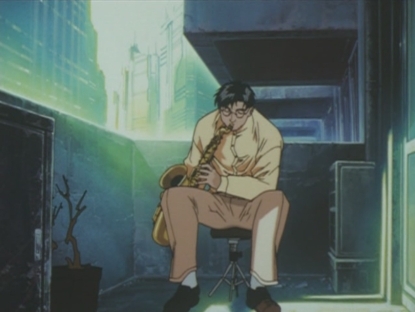
It does have the stereotype of the grizzled old veteran in just his late thirties, who never carries a gun and even plays a saxophone, which presents something a bit absurd to begin with, but for the first thirty minute episode, we get a fascinating snapshot of this world. This is a rundown city, drastically contrasted by the rich being behind dubious behaviour, be it the company behind the Boomers secretly covering up malfunctioned creations, to a dark pleasure to connect to Boomers on a rampage directly through the brain as part of a nude orgy. Building from this, side characters of interest are there, the naive but tough female or the lead's partner, a Boomer on the force whose attempts to gain semblance of human freewill make him a pretty good cop and an immediately rewarding figure to follow.

The style of the OVA is interesting, a very distinct one, matched by an incredibly rewarding soundtrack which immediately caught my attention. The depiction of Neo-Tokyo is not as sordid as A.D. Police Files, Parasite Dolls instead coming from a curious period where the OVA would diminish completely baring as tie-ins to other productions or porn. It's a handsome creation nonetheless, which is definitely felt in episode two when there are more unconventional aspects to consider, about a being killing female sex boomers. Ironically A.D. Police Files had a similar storyline about someone targeting human female sex workers, whilst this take is the episode where the virtues of Parasite Dolls appear, following the female lead and getting into both grotesque horror (the boomer sex worker killer) and weirdness as [Huge Spoiler] I keep coming across titles which teach viewers to distrust cats completely.

Episode Three, the finale one, takes a sudden and surprising direction where all hell breaks loose. This is not glib either, as it immediately gets darker than the other episodes just from the opening where an anti-Boomer fanatic is having sex with one in front of his cult and a corrupt police officer, monologuing only to then blow the poor robot's head off mid coitus and then talk of how they are just machines next to humans, proving this by shooting a young minion in the knee. This episode will eventually lead to most of Neo-Tokyo blown up, with most of the cast dead and a cultural shockwave to permanently scar the world. It would, in a full length Bubblegum Crisis film or series, be jaw dropping and an incredible conclusion.


Here however I have to confess, hiding this until now when I pull the rug under Parasite Doll's legs, I went from having an energy rush from just sitting through the three OVA episodes, thinking it was a forgotten gem, only for it to dissipate in my mind only a few days after. I entirely blame the finale, not its existence but that there's barely any build up to it and that the production shot itself in the legs by only having three episodes and not enough time to make this work. Characters we barely see die and little is witnessed, squandering a lot. That the episodes are only less than thirty minutes each, like a TV series, doesn't help as, more common later on, older OVAs like A.D. Police Files had over forty minutes per its three episodes alongside just being vignettes of separate stories in the same world, having a better effect as a result.  

Whilst I appreciate the technical quality of this anime, I don't feel the enthusiasm. The other thing is that, whilst I applaud the chutzpah with the ending episode destroying the world of a beloved franchise, I find this surprisingly normal for Chiaki J. Konaka. Disappointingly so as one of the few people who love his abstract leaps, which is also why Episode 2 is the best episode of Parasite Dolls, closer to his trademarks whilst taking from this franchise in its bizarreness (a bio-robot death machine), cerebralness (can a female robot have a personality?) in very little time to work with, and abstracting as said Boomer is haunted by a female ghost child.

It sucks how Parasite Dolls is affected by its own slightness as, if it had been longer, every episode here would work and the ending would be perfect. But as it stands, this does become an example of style over substance in a bad way, as there would've been a lot more to appreciate if we had actually gotten enough time for this material, where even the lead not carrying a gun is a reference to a tragic back-story which is abruptly included in at the end, rather than naturally introduced. The lack of balance between what wants to be a serious cyberpunk story and the presentation, which would've been more successful if it had just been an action work, is felt immensely. That this is the last Bubblegum Crisis animated production also adds a sadness in that, whilst I have somehow only seen the spin-offs, that original OVA series was popular. Of the time, as eighties as you could get, but one you'd think would get reboots. A work like Parasite Dolls might've been frankly too controversial, as there's nothing in the original premise here, but it was an attempt at brining the material to the new decade even if it has big problems structurally. Only an anniversary celebration or a drastic reboot coming to be might be the only way we get anything new.