Showing posts with label Computer Animation. Show all posts

Monday, 12 August 2024

#278: Cybervenus FeiFei (2001)


Studio: Blue Moon Studio

Viewed in Japanese with English Subtitles


In my obsession with digging up obscurities, I finally close off the trilogy of three Virtual Idol releases which got DVD releases in the United Kingdom. They exist in an unconventional place in terms of anime, as CGI productions connected to Pony Canyon, a publisher huge in the Japanese music industry with involvement other pop culture industries like anime, but as DVD directed collections of segments which were released in the boom period of British DVD distribution when the format was new. This film in its trailers promised a fourth, which feels like it was falling back into the idea of the sexy virtual female idols of the other titles I have covered, but the three we got were Yuki Terai - Secrets (2000), Virtual Stars (2002), and Cybervenus FeiFei, which focuses on a Chinese woman who was created through motion capturing the movements of real actress. It feels like, from the three we got, this was the most ambitious in terms of ideas and artistic presentation, making the fact this was not the final one somewhat strange. Virtual Stars was really falling back into the idea of sex appeal of their virtual starlets, whilst this feels more like it should be the conclusion, where Blue Moon Studio wanted to figure out where they could go with this production concept they had, as FeiFei becomes significantly more existential in tone than appealing to a cute idol who can appear in music videos.

Like the others, this is a collection of shorts, beginning with Doll, where FeiFei initially is wandering through giant cogs. Ahead of time, I find the computer effects here compelling, beautifully obsolete, especially in mind that there is a clear care to make FeiFei as realistic as possible, as will be seen in the later shorts, even if prioritized over overtly detailed locations. As a result, she is a proto-virtual idol in the truest sense of pushing the realism to a quality you can admire, but aside from actual live action footage being used later on, the journey through mazes in this first short is very abstract in comparison to the person wandering them. Add the ambient techno the scores the segment as she finds feminine robots and a transparent monolith, and it is brain candy for Millennials. RGB takes this further by looking like the cool Dreamcast game we never got, FeiFei cybersurfing a spiral environment in pure white void which wandered out of the videogame Rez (2001). Even the spoken word fuzz rock that scores this segment feels like something Sega would commission whilst she is riding a metallic shark in a green sea of fish. Arguably the best thing about this entire project, as here, is how work like this can have a pretense of a plot but also be purely dreamlogic as FeiFei’s birth, as this short is meant to represent, includes all the following but also requires her gaining colour pigmentation for his body beyond grey.


These shorts all have poetic introductions to them, suggesting Blue Moon Studio were more earnest in their work with this one in terms of meaning. Voice, as FeiFei travels through a room in its own existence and learns to speak, also brings in the touch distinct to this collection of animations, blending live action with FeiFei interacting with the real world. The soundtracks are a smorgasbord of the era – whale sounds, nu jazz, ambient lounge and dub music, sometimes in the same short as with Real, focusing on more live action as FeiFei sees the world through the pieces of recorded footage, and is interacting with a real actress who can talk to her through a laptop. These shorts build a narrative over these segments, unlike the others in the series, where she is slowly growing into a real person fully immersed in our world, which also makes understanding the dialogue more a concern. “Dream and reality are the same” is spoken at one point, and whilst we are seeing the limits of the animation at times, we see something very ambitious in spite of this. By Messenger, we are definitely seeing a more New Age tone to the project too, Messenger emphasizing this as an experiment in a character as a radio host, or waiting in-between her recordings of messages from listeners.  We have moved from random zombies being fought off by a sexy dancer in Virtual Stars or music videos to more perfected movements for speaking dialogue or communicating her messages of love in turntablism.

Labyrinth is the most ambitious of them all for being seventeen minutes long. Splicing our lead into real footage of Rome, they do have to fudge around her presence around real people in the streets, like a ghost no one sees, but even in painstakingly animating her operating a phone booth, the short is trying for a more ambitious short film with emphasis on mood. It begins attempting a plot of FeiFei trying to find a man she cares for living in Italy, only for reality to start to bleed and distort in digital code, all with knowledge eventually he has disappeared. As she travels around Rome, witnessing masks with her face on them in store windows or with the walls closing in on her, it is cool to see Blue Moon Studio suddenly take the project series to this point, feeling like the last thematically in their ambition in spite of the true chronology of the releases. After FeiFei goes to a church the short becomes more abstract, a mood piece where she is transported to a tropical island, eventually to her painting herself on the moon on grassy field. It might be seen as a cop-out, but in mind that this entire product feels like the right mix of old CGI, dream logic and these moments of expanding the production with ambition, I would let Labyrinth have a pass if it was entirely just obsolete CGI being used in imaginative ways by this studio, only to also admire that they were wanting to push their interest in terms of artistry too. Sadly, this entire series of works are as obscure as you could get, and in mind that we even got DVD releases of these in the United Kingdom, I ponder whether any of this, from the films themselves to the making of documentary material also included, are even properly preserved. Finally closing the trilogy off they are a compelling dead end in the history of Japanese animation, though it is clear to see that we would have not gotten a Cybervenus FeiFei even if the project continued into the 2010s. When Virtual Stars was released, the production realized the sex appeal sold more, so even if they were able to prosper, this more esoteric tone would have likely been ditched soon after anyway.

Sunday, 9 August 2020

#155: Virtual Stars (2002)

A short film compilation

Viewed in Japanese with English Subtitles


I'm your magnet of love, and I'm here to serve you.

The following is a very idiosyncratic release from the early years of British anime DVDs, and a return to the Virtually Real releases, a group of DVD compilations that I first came across years ago for my anime reviews with Yuki Terai - Secrets (2000), a compilation of music videos and shorts that were both tech demos and also trying to sell a virtually animated female character as a figure of affection and sensuality. Off the bat, whilst this is usually something we are meant to end a review on as the point, these six short films (usually around five minutes each) evokes for me that in so much culture in general people have attempted to capture an idealised form of femininity. This is a problematic idea, rightly challenged over the years by feminism, but it is also inherently a failed cause too. Called "computer-generated femininity" on the British DVD blurb, the six female designs here are meant to be attractive, in the same way in the modern day you have eroticised female drawings and even otaku rejecting the "three dimensional woman" for the 2D one, hug pillows and all.

This compilation, with connection to Pony Canyon, a music/anime/videogame company who I have come across for the notorious failure The Lost Village (2016), is long forgotten. In its obsession, which stems from many, of the idealised woman, an ideal which is ancient and can go as far back as fertility statues, this compilation is fascinating when you step back and take it into consideration from how it is trying to attain this inherently doomed goal as well as a snapshot of old computer animation. A form that is not appreciated, I find looking at obsolete animation strangely pleasurable and unique, even in this case too where there are complications to also bare in mind.

Hikary - A Jellyfish Day begins this with the girl next door, the notion of the idealised version of the woman you as a (male) viewer could meet in the street, here a normal young woman who, in this music video sung in English, is in a Laundromat mopping the floor singing directly to camera. The uncanny valley effect is felt here1, but with the irony knowing this idealised figure was still created by real people for her to even exist. Both by motion capture of an actor, and a real female singer recording the song, as seen in behind the scenes footage in the end credits, the vibrancy of a human being is noticeable over the equivalent of a statue made from 1s and 0s. Created by "Yamag's Garage", Ryoko - In Japan is a vast contrast. A glamorous figure - first with silver hair, silver (very) mini-skirt and top, and silver boots just walking in a corridor of silvery shapes. This music video also includes text, speculating about virtues of beauty from a perspective of a simplistic masculine view which can be brought into question. The animation for all the shorts has aged, but what is fascinating is how, having to worm with new technology, the female character designs have to pull back on aesthetic due to the materials they are working, the complexity established in how the DVD includes making of shorts going into various aspects of digital animation. Unlike the appraisable creativity I have encountered in other anime at this time, even if you cast "Ryoko" in skimpy clothes you have to deal with the fact that she has been created at a time where the animators, in their hard work, had to even attempt to bring a figure to life let alone concern themselves about aesthetic.

Misty is another character who just walks, only she is brash and confident. This if anything is a time capsule to the nineties - nineties techno music on the soundtrack and a sequence of car driving which leads me to not be surprised if any of the animators, creating the scene of a sports car speeding along to camera, worked on a racing videogame. The moon is so ominous and close to the skyscrapers in the city locations I was expecting a horror aesthetic, and that there would be tidal disruptions across the globe as a result. Yukari - Run & Run just go directly for the T&A, a figure who is insanely busty, barely kept in an insanely skimpy sci-fi bikini with giant unnatural eyes and also goggles attached to her head garment. Running in space, the jiggle physics for her bountiful bust are ridiculous though also crude; it evoked whilst I was watching the short, since we are on videogames, the beat em up videogame franchise Dead or Alive which became notorious not only for a jiggle physics for the first game in 1996, but that they kept developing it as the sequels went along. (Sometime into the mid 2000s, with a spin beach volley ball game, it was impossible not to get past the cheesecake fan service even if the main games were well regarded). Naturally this is one of the longer shorts, one where the earlier test footage showed fewer saucer eyed figures and less concerns about how one runs in heeled boots. Objectification like this, the insane exaggeration of the female body, is something you find in anime in general, this case so blatant it is frankly absurd.

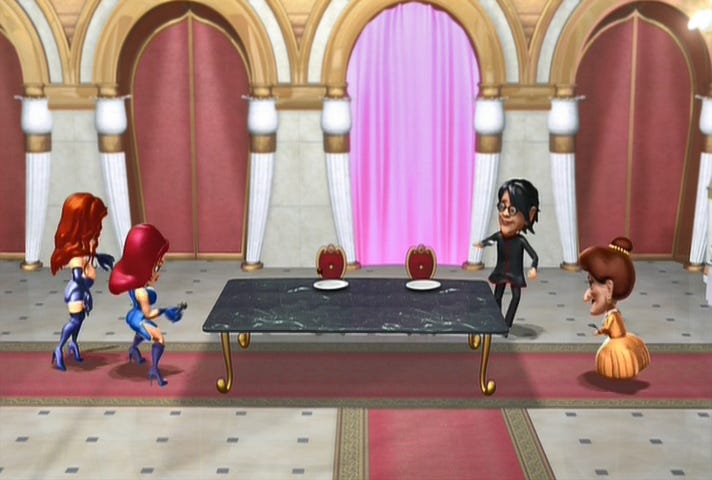
Out of all the shorts, the following is the one which actually has anything explicit but also an attempt at something creative, called Super Sonic Jet Girl. It frankly becomes like a Robert Rodriguez fever dream in digital form, a director who has skirted a fine line with his super strong female characters who can yet wear fetishishtic costumes. Set in a dark dungeon that goes to a demonic nightclub, where a giant demon with a snake phallus sits watching and a skeleton band plays, an exotic danger in skimpy underwear and covered in tattoos dances until she has to right off zombies, rather than restage the Michael Jackson Thriller music video. The tattoos are a surprise as even in hand drawn animation from the nineties and eighties, even for theatrical, it would have been a nightmare to draw any character with a vast snake on their back alongside the variety on this female character's body. The joke reference to Rodriguez, and films like From Dusk Till Dawn (1996), is not out of place as this involves her acquiring a samurai sword and well as twin pistols, someone on staff for this production predating the neo-grindhouse films by a considerable time. In fact the one adult detail of this entire compilation, which is likely why it got a fifteen certificate alongside the other content in this segment, is that it ends with this figure topless covered in gore on her chest returning to dancing, which is definitely a distinction in terms of an idealised figure, closer to the alt and goth model movements in the West like SuicideGirls. It is still objectifying but it is at least fun, clearly a production where people were enjoying themselves and thus the best thing here.

Aya - Chat returns to the idea of the girl next door, an even meeker form who wears a long skirt and jumper, beginning with a montage of telephone lines set over real locations. This music video is interesting as it has the CGI character of Aya set over real standard definition shot real footage of streets and environments. It can be awkward, like when she is placed on a swing, but it is a fascinating aesthetic touch. Openly, I enjoyed the experience of Virtual Stars but with mind of how strange and frankly superfluous this entire project is, where the extra shorts, more cruder animation but with more variety, were at times more dynamic. At three of these sets exist planned, CyberVenus Fei Fei (2001) the other I am aware of. They are materials likely to be lost to time, and with good reason as for their problematic gender issues and technical obsoletion, but they would be fascinating to preserve as they raise aloft a case of attempting the idealised female figure, creating her artificially than with even an actress, that is against the reality of the vastness of human personality and individuality but is something that can be argued is an obsession the likes of even high art, painting and literature, became obsessed with for aeons, still representations to prod and scrutinise.

It has not even become aged as an idea as, in June 2020, a sci-fi production was backed with a robot named Erica as a star, an artificially created actress with artificial intelligence. Playing a robot, and a creation of Japanese scientists Hiroshi Ishiguro and Kohei Ogawa, Erica does nonetheless alongside raise the issue of an idealised female image, especially as unintentionally the fact her creators were both men does raise the concern of objectification, rather than if Hiroshi Ishiguro's own android double he has was cast instead2. That is not even including the pop culture figure that is Hatsune Miku, a Vocaloid software voice bank developed by Crypton Future Media and its official anthropomorph, who has become a popular figure or those aforementioned otaku obsessed with drawings over real women. Far from a cultural item doomed to irrelevance, Virtual Stars ironically was a good signpost, though not a trendsetter, to ideas we would be tackling with decades later, those which raise plenty of issues on the notion of representation, alongside gender politics, but still stuck ahead of us to scrutinise.

=======

1) Robotics professor Masahiro Mori coined the term in 1970, as "bukimi no tani genshō", before the term was first translated as "uncanny valley" in the 1978 book Robots: Fact, Fiction, and Prediction, written by Jasia Reichardt. It does connect back to the notion of the "uncanny", first introduced by  Ernst Jentsch and elaborated upon by Sigmund Freud, the idea of the "strangely familiar" which can cause ill-ease, something found in the likes of dolls, waxworks, and with the uncanny valley, robots and even CGI figures.

2) Source HERE.

Thursday, 10 January 2019

#84: Abunai Sisters: Koko & Mika (2009)

From https://cdn-images-1.medium.com/max
/712/1*Htn7Pp3RJturXaeBLg_mlA.jpeg


Director: Hiroyuki Nakao
Screenplay: Hiroyuki Nakao
Voice Acting: ???
Viewed in English

Synopsis: The Abunai sisters Mika and Koko are two female secret agents who must protect the "Booby Stone" [sic] from Paparazzi Matsumoto and his evil boss Madam Hokuroda.

Urgh...if, after Gunbuster (1988-1989) and the myriad of good anime I've covered, this is my decision to surf the drain downwards further than even the M.D. Geist double bill. Even by my standards, this is a low bar, practically on the floor, and with the added menace that even Japan didn't want it in the end. The story goes that Production I.G., who are famous from great productions like Ghost in the Shell (1995), worked on a project with the Kano Sisters, who had the desire to have a production that would be of international interest starring them, at least in the sense that the pair even travelled to the 2008 Otakon anime convention in Baltimore USA to promote the project.

The Kano Sisters, before the reader asks who exactly they area, are the half sisters Kyoko and Miko who are professional celebrities, in the exact same way for Japan at that time that Paris Hilton and the Kardashians are in the USA. Unfortunately, the Abunai Sisters series never had any success and only two episodes were ever aired in Japan on channel AT-X, the rest of the eight mini-episodes seemingly lost to a void even obscurer anime of better regard survived from thanks to bit torrent. Thankfully, or unthankfully depending on your viewpoint, Abunai Sisters resurfaced or hence this review wouldn't have even existed.

From https://www.watchcartoononline.io/thumbs/
abunai-sisters-koko-mika-episode-2-english-dubbed.jpg

Consisting of ten x three minute episodes, it's not a surprise who it's been covered up as it's a garish CGI animated series with an utterly lobotomised sense of humour and probably more filthier to sit through than ecchi anime. The premise, just because of the series McGuffin being literally a Booby Stone, is enough of a warning alongside the minimal quality of the animation. The Kano sisters, openly using plastic surgery in real life, are unflatteringly depicted as two lewd caricatures made of plastic and treated at times as being air headed; surprisingly dubbed in English in squeaky voices (though that is likely a change from the original pitch of the recording), with no Japanese VA track in existence, they're in a vague position of being celebrities but clearly having licences to kill as they pack pistols.

In terms of super abilities, the noticeable buoyancy of our leads is a deliberate theme as, designed like Jessica Rabbit in portions, (I kid you not) not only do their well endowed chests vibrate at any sign of danger like Spider Senses tingling but can expand in size as a literal pair of personal air bags or a nice super punch. The last episode even ends with their secret super weapon being the fact their own nipples are detachable grenades, just adding to this weirdness. In comparison, their enemies are just as odd, an older woman who surprisingly looks like Yubaba from Hayao Miyazaki's Yubabawith her geeky bespectacled male henchman dubbed Paparazzi, constantly doomed to his mistress's displeasure to be distracted by the sisters' figures rather than complete his goals. These villains, the ten episodes set around the same recycled beach house, are doomed like Hanna Barbara cartoon villains to constantly try to capture the Booby Stone and fail.

From https://www.watchcartoononline.io/thumbs/abunai-
sisters-koko-mika-episode-7-english-dubbed.jpg

They even follow the Hanna Barbara style of having ridiculous plans, starting the series off with a giant mechanical shark which fires machine gun bullets from its maw. Eventually it gets to Paparazzi wearing a handsome masseuse mask or dressed as a Chinese food vendor with a stereotypical accent trying to lure the sisters to eat a pair of poisoned meatballs that get used in an improvised table tennis game. This would actually be funny or at least compellingly weird weren't it not for the fact that, like a lame Saturday morning cartoon with blatant sexual references, it's the most generic of slapstick that's awkward and sluggish, these figures drawn ugly and cheaply animated, in generic slapstick scenes that usually would be pandered to five year olds against their wishes.

And honestly, that's the real issue with these ten episodes, in which they have the bad animation and tone of a bad children's show but also have completely inappropriate to show to such an audience due to the sex humour. Also as Gdgd Fairies (2011-13) proves, "bad" animation is subjective if you can use it to humorous advantage, but that's not the case here; the sexual humour itself is crass as much because it's as asinine, marvelling over the ample figures of the heroines (or showing one using a special butt attack to break open a locked door of a shack) but with the tone of adolescents writing it, without actual explicit sexual content or maturity to it. The repetition, closer to children's television than the view western anime fans have that anime has an ongoing narrative, is that these characters will be doomed to an endless cycle of trying to acquire a McGuffin, an overlarge pink diamond, until someone loses the will to live or when in real life the production gave up after ten episodes.

From https://www.watchcartoononline.io/thumbs/abunai-sisters-
koko-mika-episode-1-english-dubbed.jpg

Arguable why the series vanished even in Japan is that it was just a job for Production I.G. and not one to be particularly proud of; the anime industry is an industry, where even animation companies known for incredible artistic work have to pay for its company and have profit, so they'll work. Many will work other mediums, such as Studio 4°C being known for a lot of commercials and music videos, but other times they're probably forced to churn out rubbish to without enough time to construct it into gold. Neither should one expect all anime to be available, only because of the internet and anime fandom why even a lost title like Abunai Sisters gets out of the animated necropolis.

Irony is once and a while a factor to these mistakes getting another chance (in the West, Chargeman Ken! (1974) getting a Discotek licence after it already developed an infamy in its homeland for example) but if it never gets a cult or a real release, there's the likes of Abunai Sisters which will sink through the cracks until someone is mad enough to put it online and someone else (i.e. myself) to watch it all and review it. Just another job that reminds you the anime industry is one that creates product like any business market especially in the 2000s onwards where more produce was being made to an alarmingly growing extent, not all of it meant to be archived anyway. Now Abunai Sisters has (through bootlegged form) achieved god like form of all things, you still have to deal with the fact the entire series, at less than thirty minutes long, is still more insufferable than a sole episode of one bad anime series because of how bland it is.

The Kanno sisters themselves? As of 2018 cosplaying between them, especially as a lot of female characters whose proportions they themselves can credibly portray, going to anime and manga conventions like AnimeJapan 2018 with the likes of Go Nagai. And in 2017 Mika Kano was even searching for love by way of very provocative Instagram uploads. Honestly, whilst I dismiss the Abunai Sisters anime, I'd never demean myself to cheap attacks at anyone even when it comes to the world of professional celebrities and tabloids, so I'm actually glad they have more interesting things to do; as long as they're happy giving otaku nosebleeds, all the power in the world to the pair and hopefully this series will be a comical side note.

From https://cdn-images-1.medium.com/max/1600/
1*dVztT-TtJ2xFx3O52go3Ig.jpeg