Showing posts with label Co-Production. Show all posts

Saturday, 27 October 2018

Bonus#10: Avalon (2001)

From http://2.bp.blogspot.com/-pNL6aOmmUX8/U6DxOrukkZI/
AAAAAAAAEEE/CA292vELw0g/s1600/2014-06-18+01:53:11++00001.jpg


Director: Mamoru Oshii
Screenplay: Kazunori Itō
Cast: Małgorzata Foremniak as Ash, Władysław Kowalski as Game Master, Jerzy Gudejko as Murphy, Dariusz Biskupski as Bishop, Bartek Świderski as Stunner, Katarzyna Bargielowska as the Receptionist, Alicja Sapryk as Jill, Michał Breitenwald as Murphy of Nine Sisters, Zuzanna Kasz as the Ghost
Viewed in Polish with English Subtitles

Synopsis: In futuristic Poland, Ash (Małgorzata Foremniak) is a successful player of an illegal virtual reality game named Avalon. Her awareness of someone who has been watching her from afar within the game, who cannot be identified, leads her to the search for the Seven Sisters and a secret level of Avalon only accessed by a literal ghost in the game.

Mamoru Oshii's career trajectory is fascinating. On one hand, he's known for the likes of Ghost in the Shell (1995) and works like the first two Patlabor theatrical films. For most of his career however, with the exception of starting with the likes of the Urusei Yatsura franchise, he's always been an experimental director who yet managed one major success, one that broke into the mainstream and altered pop culture as a result, and has thankfully had the ability to be constantly in work even if his post-2000s work is mainly difficult to find and divisive even for Oshii fans. Beyond this, he was always this experimental director even at the beginning, one of his contributions to Urusei Yatsura the feature film Beautiful Dreamer (1984), a experimental rumination on reality, or Angel's Egg (1985), exploring his own lapsed religious faith by way of Yoshitaka Amano's gorgeous art. He was always "difficult", even in Ghost in the Shell with its turns into philosophy in the middle of action scenes, especially the divisive 2004 sequel. He's also made a lot of live action work since 1987's The Red Spectacles.

From http://1.bp.blogspot.com/-7H1KKPrQIts/U6Dzngw7k0I/
AAAAAAAAEFQ/qbuRn0DPIHE/s1600/2014-06-18+02:03:50++00001.jpg

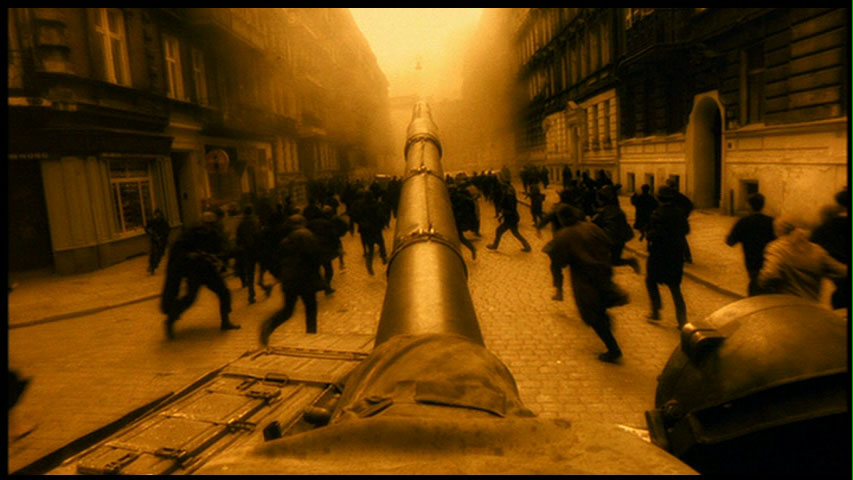
With this in mind, Avalon's an interesting one-off for Oshii as its a Japanese production but set and co-produced with Poland, a curious choice that yet works to Avalon's favour. The spectre of Communist Europe is felt large in the mostly sepia tone and futuristic drudgery of this world, lost in time and with Avalon the whole point of life for many in response to this, an illegal game where many devote their time and can be able to afford luxuries with the pay from, in spite of posters on the walls proclaiming it should stop. The VR game itself is a constant war zone which exists in ruins and isolated industrial environments, evoking the Cold War era but also World War II. Also, it should be kept in mind that Mamoru Oshii has always been influenced by Western culture - as a man who has packed so much philosophy in his world, he references Western culture as much as Japanese culture so it's not surprising he'd eventually make one film outside his homeland once. Avalon the film is entirely about the search for the titular "Avalon" as well, the afterlife realm for heroes found in Arthurian legend, at one point in his trademark exposition dialogue linking it to another similar idea in Norse mythology too, in this futuristic world the closest thing a virtual reality game which allows Oshii to play with the notion of our perception of what reality truly is whilst offering a world for a player to find those lost in a form of afterlife.

If Avalon has a message, it is still a very relevant take on both the subjectivity of reality, as Ash ultimately ends up in an experimental stage where the film manages to pull a rug under another rug it pulled at the start of the segment, a rarity it manages to make work, and also the increasing sense as video games and virtual reality become more precedent in terms of their relation to reality and our lives, where one can make a career out of it and feels more true life than ours out of it. The decision to depict it through an antiquated, post-Cold War aesthetic absolutely helps avoid technical obsoletion in the themes, the computers here inherently old back in 2001, and the world in and out the Avalon game is barring flashes of colour in sepia.
From https://thefunambulistdotnet.files.wordpress.com/2010/12/avalon8.jpg

As with all Oshii works, unless we're talking about the reoccurring Bassett hounds in his work (an animal lover by all accounts), all his films are precise in their references and symbolism. Arguably, Avalon is one of his simpler stories to understand, one that would reward upon repeat viewings but can be absorbed on the first viewing in story and in terms of the spectacle. The film, deliberately artificial in its CGI, dating with grace due to this factor, is matched by its sense of the grandiose, emphasised further by Kenji Kawai's score or the use of classical music especially in the most emotionally powerful moment, an entire performance of the Warsaw Philharmonic Orchestra intercut between an important dramatic incidents in the plot. Whilst known as a cerebral director to a fault for some viewers, Mamoru Oshii was always concerned with human drama and happy to blend it with action, and in this world this is implicit throughout.

This is as well with the danger of the virtual world being unable to be taken seriously. If videogames have a distance to them, then one could never be able to take any threat seriously or any drama involved with it without any sense of absurdity. Here the threat is there, especially when a giant monolithic moving fortress appears at one moment; the drama is here too, Ash part of an undefeated group who collapsed due a moment of failure, or how one member with her in that group has been left comatose in a hospital, the game of Avalon and VR in this world with danger to its use. Whilst it may sound ridiculous to have this type of seriousness to games, Oshii sees games as being worthy of elaborate existentialism, as with even his more light hearted material of yore. And Avalon ultimately succeeds, enough that I wish the film was better known. Unfortunately, Oshii's availability especially from the 2000s, and his career in general, in terms of filmography, is still an issue. A shame especially as Avalon proves worthy of re-evaluation as with a lot of his career.


From https://drnorth.files.wordpress.com/2009/01/vlcsnap-614491.png

Monday, 17 September 2018

#69: Thunderbolt Fantasy (2016)

From https://m.media-amazon.com/images/M/MV
5BYWJiMTQyYzItZWU3Yy00OGM0LWJkYz
ItOTE1NzAzMzIxMTRhXkEyXkFqcGdeQXVyNDU
xNjc5NjY@._V1_SY1000_CR0,0,712,1000_AL_.jpg


Director: Chris Huang and Jia-Shiang Wang
Screenplay: Gen Urobuchi
Voice Cast: Junichi Suwabe as Shāng Bù Huàn, Kousuke Toriumi as Lǐn Xuě Yā, Mai Nakahara as Dān Fěi, Tomokazu Seki as Miè Tiān Hái, Kenichi Suzumura as Juǎn Cán Yún, Nobuyuki Hiyama as Shā Wú Shēng, Rikiya Koyama as Shòu Yún Xiāo, Sayaka Ohara as Xíng Hài
Viewed in Japanese (and Taiwanese Hokkien and Mandarin) with English Subtitles

Synopsis: In a world of period fantasy, where the world has been split by a war between human beings and demons, a vagabond named Shāng Bù Huàn finds himself dragged into a conflict when Dān Fěi, a female member of an order known as the Seal Guardians, is the last surviving protector of an ancient sword of incredible power lusted over by the evil Miè Tiān Hái. With Shāng Bù Huàn forced to help by a mysterious and possibly untrustworthy trickster called Guǐ Niǎo, who brings in a demoness and warriors to help, they find themselves on a goal to go directly to Miè Tiān Hái himself and defeat him rather than let him acquire both necessary pieces to gain the sword.

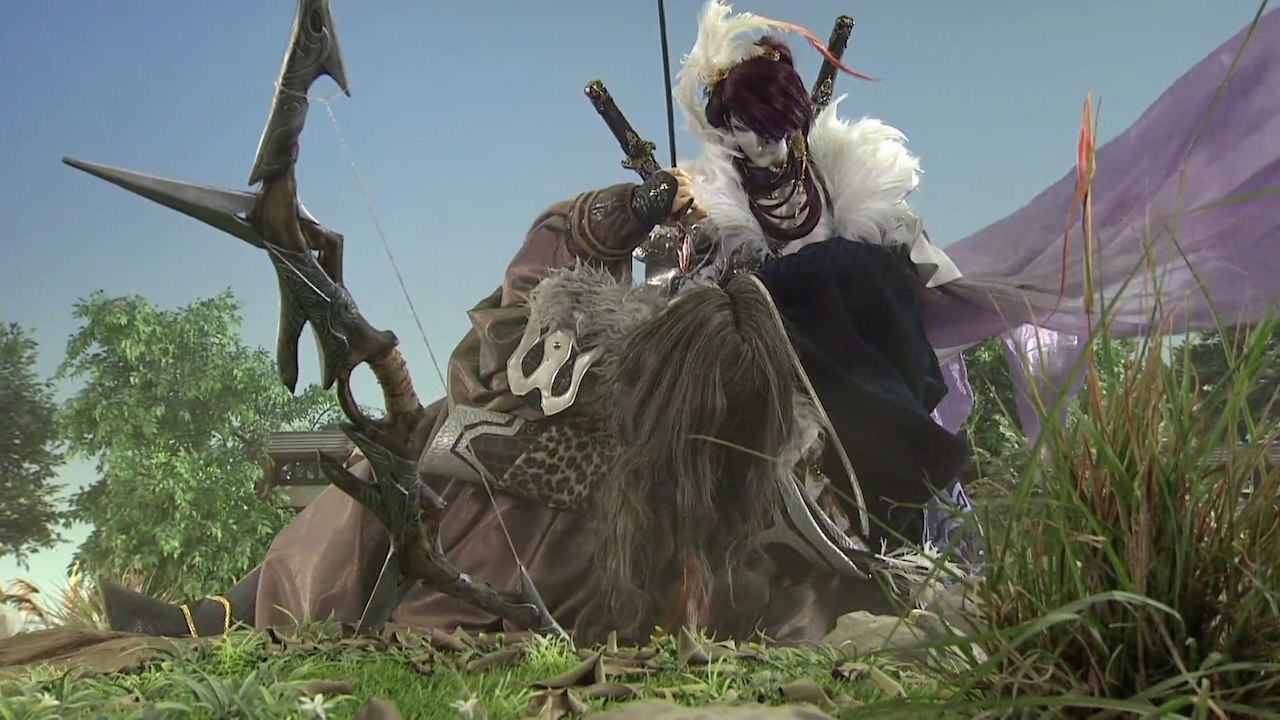
Ah, I've delayed this review enough. I was excited by the idea of Thunderbolt Fantasy when I heard a series had been commissioned using puppetry. For an Englishman like myself who at least has seen one scene from Thunderbirds and such works which used marionettes, this piqued my interest in seeing an older style of entertain be resurrected, but actually starting the series this idea became even more enticing when I knew the full context of Thunderbolt Fantasy. We tend to forget animation includes stop motion and puppetry, and they deserve to be covered whether a Japanese anime steps into this1. Thunderbolt Fantasy, when I started it, is even more intriguing as its a Japanese-Taiwanese co-production based on Taiwanese glove puppetry. Not only is it a case, as the show proudly shows, that this craft in the modern day creates some incredible pieces who move and interact as living characters but is it keeping a tradition alive, one which is not a Japanese one but a Taiwanese cultural staple being brought to a Japanese (and Western audience). It also means Thunderbolt Fantasy wasn't the Japanese action series using puppets as I thought it would be, but Taiwanese wuxia storytelling told with glove puppets, which is an entirely different tone and style to deal with, and is certainly unique for a thirteen episode series to have in terms of standing out from the crowd of anime productions.

If anything, even if the liberal use of CGI and magical projectiles over actual combat is annoying, you cannot argue stylistically Thunderbolt Fantasy is exceptional. The puppets themselves are incredibly well made creations, lavish and in spite of their fixed faces very expressionistic. Screenshots will give you a great idea that; as elaborate hand puppets rather than on strings as I'd originally presumed them to be without context, they move very fluidly within how they are used rather than the other traditional, and particularly for this type of magical fantasy, they are as recognisable and flamboyant as their various names and alias are in their poetry. In either case, the sense of verisimilitude is found so you can fully invest in them as characters regardless of what they actually are. The additional factor is that this is a wuxia story. Not just martial arts, but wuxia, a very specific form of storytelling which allows for more elaborate, even exaggerated events to transpire. Its carte blanche for all the ridiculous fight scenes, even if I wanted more puppet-on-puppet sword fights rather than them calling out special moves, but this is bearing in mind this is about style as much as a descendant and fantastical form of storytelling that can still be appreciated. One that is melodramatic and where martial artists and sword fighters here can perform superhuman feats.

From https://rosesturnblog.files.wordpress.com/2016/07/
thunderbolt-fantasy-for-article.jpg?w=750

Set in its own fantasy, quasi-Asian world, where a war between humans and demons have left a split in the land, it doesn't completely explain the world but thankfully it never becomes about convoluted world building either. It uses its setting for character, which helps, such as it being enough for vagabond, grizzled member Shāng Bù Huàn and his claim to have passed over demonic wasteland to even lead to the murderous sociopath named the Screaming Phoenix to question and feel wary of the statement. The characters are interesting in themselves especially as Thunderbolt Fantasy gladly undercuts expectations by having flat-out villains being recruited into the party trying to defeat the main villain. If anything it's a motley and amoral group worthy of dramatic weight, the one pure figure in heroine Dān Fěi, a sect member protecting an ancient sword, the moral centre without becoming as wet as a dishcloth. A grumbling, out of place vagabond Shāng Bù Huàn, who actually has the most rewarding character arch when you finally figure out who he is. The utterly distrustful, trickster Guǐ Niǎo, whose place in this story becomes a huge crux of the narrative. One eyed archer Shòu Yún Xiāo and his cocky, headstrong apprentice Juǎn Cán Yún. A literal demoness Xíng Hài, who hates Guǐ Niǎo but still decides to join in when knowledge of the ancient sword in the centre of concern is of interest for her. And plenty of other circumstances, screenwriter Gen Urobuchi playfully undercutting expectations - one of the best [Spoiler alert] involves the serial killer Screaming Phoenix being a figure the heroes are forced to work with, when he kills Guǐ Niǎo's master, the stereotypical old and wise martial artist, easily and refuses to give the magical flute required for their task back. [Spoiler Ends].

This is plenty to work with, even when the story's a simple one where they have to try to work together, get to the main villain Miè Tiān Hái's skull lair past three obstacles - a landscape of undead, a stone golem and a labyrinth of death. Unfortunately screenwriter Urobuchi, one of the few that have developed named recognition for anime fans, was on an off-day for me with this series. This review will be controversial, as many liked the series, but Thunderbolt Fantasy suffers from Urobuchi's taste for plot twists in this particular case undercutting all the ripe, potential adventure and suspense this initial plot suggested. He likes plot twists a lot, and when he succeeds, he pens Puella Magi Madoka Magica (2011) [Reviewed here], which was a constant gut punch and bleak take on the magical girl trope, but one with compelling storytelling and an emotional devastation behind every plot point, making all of them worthy of inclusion. Unfortunately the creative decisions completely undermine expectations in ways that fail.

From http://www.bostonbastardbrigade.com/wordpress/wp-content/
uploads/2016/08/Thunderbolt-Fantasy-2.jpg

Characters promoted heavily in the opening credits, in fights more elaborate the show, die quickly on both sides and abruptly. Once or twice would be okay, but it happens a lot robbing a lot of great action scenes, strange to say as someone normally interested in drama. Many don't get as much detail of them when that would've helped the dramatic context grow, or are not given enough time to. In terms of the plot, obstacles in the heroes' quest like the rock golem are used in funny ways, others like the aforementioned labyrinth of nightmares are completely brushed aside and not used. The show eventually feels rushed when it gets to the latter half, not feeding off its potential plotting fully, the ending falling onto a generic demon god whose existence becomes an actual punch line. And its clichéd. As much as this is embracing tropes of wuxia, many don't feel like the right ones appropriate for this genre but from Urobuchi himself.

Ultimately, this emphasises that even though I view animation with such high admiration for the hard work behind them even over live action productions, there is a difference between being able to appreciate the good work even over ridiculous content and when a product becomes so flawed you are distracted from these artistic virtues. Even when thrown about as they are, the puppets deserve better than what happened. The same is for the music; I didn't like the opening credit theme by T.M.Revolution, but the score by Hiroyuki Sawanois eclectic and constantly inspired, deserving more than the clichéd materials here. When Thunderbolt Fantasy comes off as a predictable action fantasy, it feels like a waste of something even more significant as these glove puppets are works of art. It feels worst especially as the storytelling, which is the sole crippling flaw, does detract from the visuals, which makes it difficult to have pleasure in said aesthetics as well.

From http://www.jaydotdee.com/poptardsgo/wp-content/
uploads/2016/11/thunderbolt-fantasy-73.jpg
======
1) One, Star Fleet (aka. X-Bomber) (1980), which is inspired by a Go Nagai manga  is a prominent example worthy of being covered.