Showing posts with label Mystery. Show all posts

Monday, 8 April 2024

#274: The Big O (1999–2003)


Studio: Sunrise

Director: Kazuyoshi Katayama

Screenplay: Chiaki J. Konaka, Keiichi Hasegawa, Masanao Akahoshi and Shin Yoshida

Voice Cast: Mitsuru Miyamoto as Roger Smith, Akiko Yajima as R. Dorothy Wayneright, Motomu Kiyokawa as Norman Burg, Tesshō Genda as Dan Dastun, Unshō Ishizuka as Alex Rosewater, Emi Shinohara as Angel, Gorō Naya as Gordon Rosewater, Hōchū Ohtsuka as Beck Gold, Katsunosuke Hori as Michael Seebach / Schwarzwald, Issei Futamata as Alan Gabriel (Season Two)

Viewed in Japanese with English Subtitles


The Big O begins with Batman. The animation studio Sunrise was commissioned to help on the legendary Batman: The Animated Series (1992-5), and in the creation of The Big O, you have a work paying tribute to this and Western popular culture like film noir films. They were also clearly inspired by older manga and anime such as Mitsuteru Yokoyama's Giant Robo, which is important as director Kazuyoshi Katayama and others on this series worked on Giant Robo: The Day the Earth Stood Still (1992-8), an straight-to-video production which adapted the source manga but also a tribute to Yokoyama's other manga, including characters from even period tales being placed into this sci-fi narrative. The final show inspired from these two sides of influence in The Big O however could have ended up a different way though. It was also a series which managed the near impossible, of how it was not actually a success in its first season in Japanese broadcast, to the point it was cancelled, but was able to continue and finish the narrative for a second series because of its importation to the West and success on Cartoon Network’s Toonami slot on television, commissioning the second series when it did well and the abrupt end the first season came to be.

The Big O is set in Paradigm City, where forty years earlier a cataclysm left it seemingly the last city, part protected in domes and everyone forgetting memories of the past. Enough survived for a proper urban civilization to still function, and latent memories still allow figures to operate even giant robots. One such figure is the Bruce Wayne of this world, Roger Smith a former member of the military police who is now a “negotiator”, a cross between what you would expect for the title and a detective. Good at his job but with eccentricities, like everyone working for him having to wear black and refusing to use a gun on the job, he also has latent memories that gave him access to the titular O, a member of multiple “megadeus“, a giant robot clearly inspired by the comic character Popeye in the piston arms as much as a tribute to the likes of Giant Robo and Tetsujin 28, especially as like those robots, Smith uses a wristwatch communicator to bring him when needed to his location.

His Alfred the butler is Norman, who is also a cool butler, with a clear military history, and calm enough to be cooking dinner whenever Roger is on the job knowing his boss will return at the right time for a fight to enjoy it. The best side character though has to be Dorothy Wainwright, and that is in mind this is one of the strongest casts in general for an anime series, so that is a high bar. Her full name is R. Dorothy Wainwright, and that is explicitly referencing how Isaac Asimov, the legendary sci-fi author, had androids name themselves, as she is one of the few androids in the cast, though explicitly the one who looks entirely human and seemingly is. The show, among tropes it explores, includes how these figures are so close in seemingly having freewill, such as her deadpan rebuttals of Roger’s moments of heroics, that they bleed the lines of what consciousness. She is also just an awesome female character to have, with the amount of times she is threatened with being hacked or destroyed in the series meaning a lot more because she is a perfect foil to a great lead, introduced over the two part first episodes for the show. The English dub for this series is as well regarded as the Japanese one, but I have to confess as much the virtue for this character is Akiko Yajima's robotic yet almost human sense of bluntness, making the fact her most prolific voice acting role funny in a great way, being Shinnosuke "Shin-chan" Nohara, the lead of the hugely popular Crayon Shin-chan franchise. Whilst bowing out as the lead voice for the character eventually, the fact this is the same actress who played a sarcastic and scatological obsessed five year old boy from the first anime adaptations in 1992 to 2018 is evidence of the talent of a lot of voice actors and actresses in their diverseness.

That cast is one of the best aspects of the show, even when I will admit there are some visible pacing issues in the plot that will be addressed later in this review. Office Dastun, who knew Roger Smith in the military police force and stayed friends, is a great side character who has a lot of angst to also work with, as the military police he is part of, the closest to enforcement, is under the pocket of the shady group who run Paradigm City, and are powerless when they need to constantly bring in Smith and The Big O to deal with threats they cannot even with tanks and military weaponry.  Antagonists are the same: Alex Rosewater is perfect as the sinister head of Paradigm City, given more by the second series as he collects fallen foes of Smith’s, resurrecting the robots and unlocking their memories for nefarious means. Beck Gold, who looks like a parody of Lupin the 3rd, is a lovable git even if his constant crimes and smugness definitely makes him a villain, and thankfully he gets a few episodes for himself, including a parody of Japanese super robots, and even stays by the end of series two when you would presume he would stay merely a tertiary figure. Then there are the more ambiguous figures. One, the femme fatale for Roger Smith named Angel, will become a much more complex character, seemingly a “foreigner” in a world without other countries, by the end an integral part to the complicated twists that key screenwriter Chiaki J. Konaka set up. The other is the one character who should have had more time devoted to him, though thankfully in a form he gets to the ending of his goals: that will be a former journalist who became Schwarzwald, seemingly a villain in his mission to cause mayhem but, standing out for his bandaged visage, he is a figure who will use any means to learn the truth of Paradigm City and open the public’s eyes to the reality of the world. He emphasizes how, from the get-go for all the episodic stories, the huge concern in the series' narrative is how this amnesiac city came to be and what is the truth of its origins, which Schwarzwald is obsessed with learning.


Schwarzwald‘s smaller role does present the issues with The Big O, that whilst it leads to a proper conclusion, and that I already view this as a gem from the era it was made, it suffered in terms of pacing itself out and telling said story. When I first saw the series, it was only season one I had access to, which has episodic stories I now enjoy more but were clearly the backdrop for a larger story already being drip fed. Infamously, when cancelled and seemingly gone for good, the first series ended on an abrupt “To Be Continue” moment without any chance for anything to be explained. Sadly when I first saw this, the Bandai DVD releases in the mid-2000s in Britain, through their Beez Entertainment arm in Europe, never released the second series, leaving this with some disappointment. Thankfully we did get that second series in the first place even if it never had a UK physical release, one I have now seen and was able to finally complete the story as supposed to be told, all because of this being one of those cases, in its form getting good ratings on Cartoon Network, where a Western company invested in the franchise seeing potential for more.

Set up in the final episode of season one, where Roger locates Rosewater's father, the founder of the city now going senile on a tomato farm in the countryside, and finds repressed memories are starting to cause him to question his position, it sets up Season Two where Chiaki J. Konaka wrote all the stories, rather than season one where three others contributed stories too. It however also leads to a conclusion itself which did not allow itself to breath, and all of this is entirely due to the final episode feeling rushed. The irony is not lost that, for a series I will praise to the high heavens for so much, the one caveat I have to make is that the final reveal, just the last ten or so minutes of the final episode, is likely to peeve or confuse a few people, and I say this as a person who likes and would normally defend the more unconventional and vague story reveals found in Konaka's other work, where they feel deliberate and not abrupt as here. Some may find the second series too esoteric when a more pulpy narrative twist would make sense, but for me, it is the case that everything works in logic, but that this literally rushed the final moments for what is a very existential story. [Huge Spoiler] That being that this literally all a stage, all an artificial construct but having gained existence and wanting to still exist [Spoilers End]. Thankfully so much works up to the middle of the last episode that means the ending does not ruin the show. So much before is set up well that it thankfully does not become a crushing disappointment for a show with a lot on its mind, merely one you are going to need to stop after finishing the series and digest carefully. Even by those last episodes a lot is already set up to the show's create to expose the real story, this being not a world of amnesia, people being killed for returning memories at one point, but that there is also by the end people who find their memories are being recreated on stages, and that Angel herself becomes far more important as mentioned to how the world works without realizing it. It is really a case that, for someone who even enjoyed Konaka's more vague endings for work like Malice @Doll (2001) that an exposition dump or a more visually explained conclusion for the last episode was really needed.

Thankfully so much did work, and that includes the plot build ups and the one-off stories. Stories of Dorothy adopting a cat in Season One, with its bittersweet end, or the abrupt Christmas episode involving a demon tree now stand out more for when they are connected to a story which, barring that final lack of clarity, get so much right. Even when Konaka took over the scripts for season two fully, he has his moments. to the season, Smith so unconfident his existential crisis literally throws him into an alternative reality of Paradigm City as a homeless man, is inspired as the Japanese robot parody is, the later more so for becoming as a work from a Japanese animation studio a parody of Japanese archetypes. Even plot growth works, between the growing involving of a splinter group of foreigners Angel is connected to, or the ways this can combine the episodic stories with this, such as a threat against all androids with memories like Dorothy which allows a story involving one android detective being brought in as an awkward buddy cop partner with Dastun.

It is a world too with so much rich detail that you do get some proper denouement over the second series, as Rosewater becomes more megalomaniacal and wanting to become God, and the sides clashing over it becoming more prominent, also introducing a season two only character, Alan Gabriel, as a suitably nasty sociopath on his side. It is also helped by the style being incredible through the two series. Inspired by Western works, and very clearly inspired by Batman in the Art Deco style let alone the character designs, it is a sumptuous looking series both visually and audibly, mixing its metropolis location and combining it by a jazz heavy score by Toshihiko Sahashi. Also of note for his own musical compositions is Rui Nagai, though his work sadly had to be re-dubbed over due to how heavily it paid tribute to other music. For the first broadcasts, season two used a piece indebted to British 1970 sci-fi series UFO's own theme, which was replaced quickly. Sadly that even included season one's awesome opening theme, which was on the DVD release I had, a Queen tribute specifically indebted to their song Flash for the 1980s Flash Gordon film, also eventually axed. Thankfully, Rui Nagai composed Big-O! Show Must Go On, as a replacement to both, which is awesome in its own way as a surf riff guitar song with a bad ass solo.

As a giant robot show as well, all this provides a distinct attitude for a title in the genre, especially as the aesthetic style is distinct. Batman and film noir are very distinct touches for a mecha show to have, feeling close to what Tim Burton brought to the Batman franchise with the 1989 film, which influenced the Batman animated series. Even its tribute to its own country's mecha stories is distinct though, as this also a world where these robots feel like giant tanks slowly lunging about, and where alongside its distinct “typewriter-punk” mechanics has details like how the robot punches are literally piston powered. Thankfully The Big O, despite not being a success for the first Japanese broadcasts, had its day in the sun eventually, with tie-ins like an audio drama, inclusion in the Super Robot Wars video game franchise with other cult mecha anime, and a lot of models/figures both for the Big O himself and its cast. It is a franchise I wish was better known in the United Kingdom, as nothing in this barring its final ten minutes rushing too fast would ever be challenged as being divisive. After my initial disappointment with the first series a long time ago, seen in its full form it is with positivity that they could have continued the story a little longer and avoided ever making a bad episode, still getting to the eventual final with everything as good as it was. If anything, this is the kind of show you introduce to someone curious about giant robot anime, and they could be made fans of the genre just from what this does differently whilst paying tribute to the genre's tropes, which is as high praise as I could write for this.

Friday, 26 April 2019

#96: Paranoia Agent (2004)


Director: Satoshi Kon
Screenplay: Seishi Minakami and Tomomi Yoshino
Voice Cast: Daisuke Sakaguchi as Shonen Bat; Mamiko Noto as Tsukiko Sagi; Halko Momoi as Maromi; Makoto Tsumura as Shogo Ushiyama; Ryūji Saikachi as Old Person; Shōzō Iizuka as Keiichi Ikari; Toshihiko Nakajima as Masami Hirukawa; Toshihiko Seki as Detective Maniwa                                       
Viewed in Japanese with English Subtitles

Synopsis: One night a female illustrator Tsukiko Sagi is assaulted by whom she describes as a young male wearing golden inline skates with a bent, golden baseball bat. Thus "Lil' Slugger" (or Shonen Bat in the original Japanese) is christened, and to the police's bafflement, he can abruptly appear to all his targets, all of which are seemingly people either connected to each other and/or pushed to the edge of despair.

In his short and tragically short career, only living to forty six due to pancreatic cancer, Satoshi Kon made four films and this one anime series, but has developed a cult reputation that has even stepped outside of anime itself. When being in your forties is still considered a young upstart in the anime industry, Kon could've (and likely) would've pushed the medium of anime into more idiosyncratic directions. Based around various strands of ideas he felt shouldn't be wasted, what Paranoia Agent is isn't necessarily vignettes but all tied into a very elaborate thirteen episode series. Contrary to my original beliefs, such a long time since seeing this series, Paranoia Agent is a very precise tale.

Ten episodes follow the tale of Lil' Slugger, an urban legend who yet is actually responsible for smashing people in the skull with a golden baseball bat, strangely targeting people all interlinked by them reaching a crisis point in their lives. The three episodes which feel like side plots, the entirety of disc three of the original UK DVD release, back when anime used to be (inexplicably) released by three or four episodes over many months, are still connected to the main story and add character to the world being depicted.

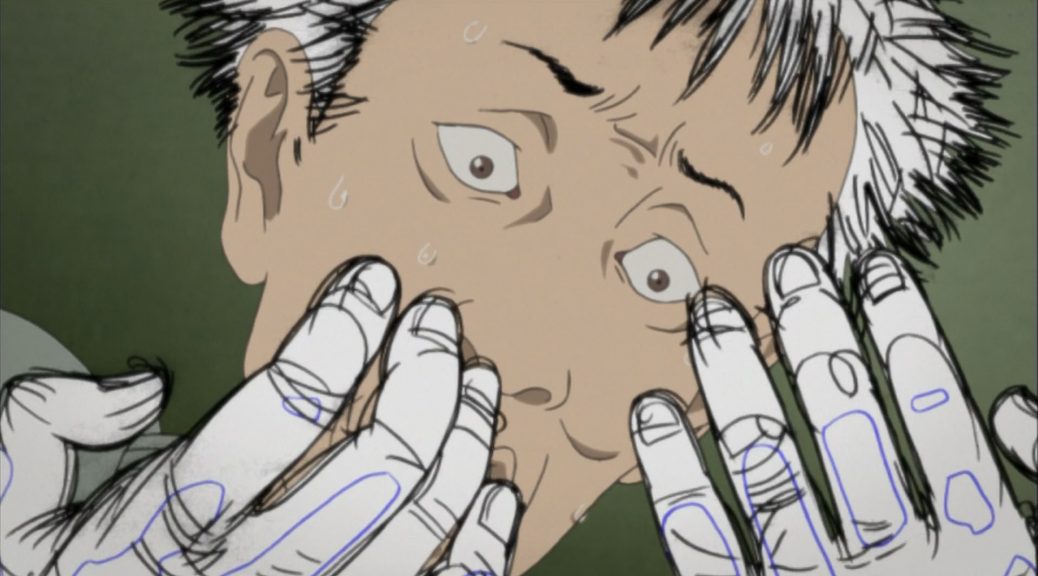
In said world, as his other work, Kon blurred reality itself with the exception of Tokyo Godfathers (2003), tackling subjects like dreams or subjectivity under mental distress. Even when Paranoia Agent can only work as being supernatural for certain plot incidents, it's using a lot of visual metaphors to depict the distorting mental states of its cast. Flights into an idolised youth, literally a cardboard town of two dimensional people, a woman whose split personality in combat with her leaves answering machine messages, a police interview which (in the funniest episode) turns into a stereotypical Western high fantasy quest based on delusions of being in a video game, or the first victim of Lil' Slugger, character illustrator Tsukiko Sagi, having her mascot character Maromi as a talking figure who constantly tells her to just ignore any prang of concern she has about anything.

Ultimately, Kon emphasises a long trodden obsession of his of the absolute dangers of escaping reality no matter how painful it is, one of the only exceptions being Millennium Actress (2001), a tale of an aging actress which was clearly indebted to real life Japanese actresses Setsuko Hara and Hideko Takamine. Here in Paranoia Agent is his most overt thesis of this concern as it's the central plot. Following intertwined characters - Sagi, two cops Keiichi Ikari (older and old fashioned) and Mitsuhiro Maniwa (younger and dangerously open minded), and various reoccurring side characters - the tale of Lil' Slugger, at first seen merely as a hoodlum, is visibly even in the subjective world view of the series a supernatural entity or one giant metaphor for escape that has become an actual, real destructive force. He targets those pleading to escape pain - neurosis, anxiety, a downward spiral of crime, general chaos in one's life - called in hope he'll roll in on golden inline skates and in one case knock someone's skull in so hard they completely forget who they are and all they've suffered through.

From https://i0.wp.com/the-avocado.org/wp-content/uploads/
2018/02/PA12_shot4.png?zoom=2.625&resize=371%2C173&ssl=1

Not desiring to spoil the series, his mirror is Maromi, that lovable cartoon dog that Tsukiko Sagi created at the beginning of the series, a stand-in to a phenomenon like Hello Kitty who is an immediate success and becomes an insanely huge marketing property that the populous becomes obsessed with. We'll get to Susumu Hirasawa's music later, but it's not a surprise in lieu to how sinister this dog's influence is, at least in Kon's eye, that the end credits has every character laid asleep around a giant version of Maromi, in a grassy field, whilst an unnervingly calm but eerie piece of music is playing.

The series also an attempt at tackling various cultural issues; Kon's work all did, Tokyo Godfather breaking a taboo by talking about the homeless in Japan, but Paranoia Agent is basically sewing together various different issues at once through one long form project. The anime obsessed otaku, a minor side character, who in the gaze of all his female figurines hires a sex worker. The gossiping women, who have an episode, trying to have more elaborate tales about Lil' Slugger over the others. The episode on suicide, as three members of an online forum for this act meet up, an elderly man and a young man horrified the third in a young girl.* The general sense, coming to ahead in the finale, of a collective attempt to bury one's emotions that becomes completely destructive.

In lieu to how TV anime is likely more hectic to produce and with less time to manage resources, Paranoia Agent is still a great series in terms of craft, even with a sense of humour at the expensive of this area of the medium being incredibly stressful as, for an episode, it follows a lowly and useless staff member on an upcoming Maromi animated show, explaining various details of real staff member positions in digressions and probably touching on some real angst, being let out, of how utterly agonising working on a show production schedule probably is. Kon is also a fascinating case where, an absolute definition of an "auteur" where his directorial work bares his obsessions, he also shows how many auteurs how important voices working under them who don't negate their status as directors, but are great collaborators. Character designer Masashi Ando, who worked on him on Tokyo Godfather and his last film Paprika (2006), has helped a lot in terms of the trademark realistic character designs which have allowed a grounded sense of reality to these works, perfect for when they transition into the unnatural.

Likewise is his frequent musical collaborator Susumu Hirasawa, who started working with Kon fron Millennium Actress and, alongside his work in anime like the soundtracks for the various Berserk adaptations, is likely better known through them than his musical albums in the West. This is sad, but not a detrimental argument against said soundtracks, Paranoia Agent just as compelling. The best way to describe him is Peter Gabriel's soundtrack to Birdy (1984) crossed with New Age and electronic pop, folk ideas matched with all the peculiar electronic equipment he has had on stage over the years, all matched by a falsetto to die for. That, and I swear to this, even yodelling or the closest thing to it. Seeing his work in a TV series, whilst it does repeat motifs, is a very interesting change of pace, even an amusing choice of using the opening theme within an episode to freak a character out. And befittingly, whilst it's joyful, the lyrics in translation are aptly dark and for consideration alongside the opening credits animation itself, held with high regard as an opening itself by a puzzle box to decipher. Even the next episode previews, including a side character of an old man who is presumed to be delusional but has a strange knowledge, add to this by using animal nicknames for characters for part nonsense, part clue based monologues.

Sadly, this was Satoshi Kon's only television series, but among his small output, Paranoia Agent stands out as also one of the best series from the 2000s with good cause. Arguably, with a career that beforehand included being a manga author and working up in the anime industry itself to also consider, Kon had one of the best runs as a director regardless of medium, four films and one series which are as high a bar in talent as you could get. Again, its stepped in tragedy and loss, but God he was good.

From https://blog.sakugabooru.com/wp-content/
uploads/2017/12/tfw-houkai-1038x576.jpg

======
* Unfortunately, within the UK, whilst the offending scene is seen in the next episode preview beforehand, that episode was censored for a hanging scene and is still like this in 2019. At the same time, when this took place, an episode of Ren & Stimpy was censored for a gag about hanging too for DVD; despite Paranoia Agent being an adult work still rated for only eighteen year olds to see due to this episode, I have always speculated that it was picked on as well for being animated and depicting a form of suicide as well. It's still one of the biggest reasons, despite all their good virtues, I have always had a distrust of the British Board of Film Classification (BBFC) where every motion media work has to be rated through.

Tuesday, 3 October 2017

#48: Mononoke (2007)


Director: Kenji Nakamura
Screenplay: Chiaki J. Konaka; Ikuko Takahashi; Manabu Ishikawa; Michiko Yokote
Voice Cast: Takahiro Sakurai as the Medicine Seller, and various others
Viewed in Japanese with English Subtitles

Synopsis: A series of different stories, mostly set in Edo period Japan ], following a mysterious, nameless Medicine Seller. Found wherever there is a mononoke - when a supernatural spirit (a ayakashi) is corrupted by the worst of humanity and starts to interact with the human world in violent ways - he can only be able to exorcise them with his magical sword when he finds out their shape (form), truth (truth) and reasoning (reason in the English subtitles).

A series I had always wanted to see, Mononoke was actually a spin-off from a 2006 horror anthology series Ayakashi: Samurai Horror Tales. Both came from the Noitamina bloc, a syndicated time space on Fuji Television which has started to broadcast more mainstream anime, or to be more technically honest anime that will appeal to stereotypical otaku more, but has always been a place syinominous with experimental animated programming and shows which strayed away from the stereotypes of modern anime. It is where Eden of the East (2009) came from or, for the perfect example, Masaaki Yuasa's The Tatami Galaxy (2010) which shows how these shows, original tales or adaptations, are idiosyncratic both in look and the storytelling they have. Ayakashi was a series of three stories told over multiple episodes. Two were adaptations, of folklore and a play, whilst the third was an original story by Mononoke director Kenji Nakamura with a co-writer for the spin-off series Michiko Yokote, the original tale introducing the world that first introduced the world to the Medicine Seller, a figure in his own series the exact definition of what Wikipedia calls an "Occult Detective" story, a sub genre where figures exist to investigate supernatural and paranormal mysteries.  

From https://i0.wp.com/www.silveremulsion.com
/wp-content/uploads/2016/10/Mononoke_2.jpg

The Occult Detective genre is more common than I once thought - John Constantine of DC Comics one of the most well known characters from the sub-genre, but it's a trope that especially thrives in anime and manga if you step back and see how much it's been used. Just in anime, there are works that I've seen (The Garden of Sinners (2007-2013)), to those I've yet to see (Nightwalker: The Midnight Detective (1998)). Even anime with different genre tropes brush up with this subgenre - like Chrono Crusade (2003-4) and the original 2001-2 version of Hellsing - because their set ups follow organisations that deal with strange cases even if they're more likely to use firearms than detective skills to deal the mysterious involved. All of them usually have enigmatic figures, male or female, in the centre for which everything paranormal circles around them, be they on their own and with a team behind them. It's a great trope to use as, if the character has a drama, it can be built upon from episodic tales beforehand until they fully take centre stage. If they are like in Mononoke, with the Medicine Seller an aloof and even sarcastic figure between the mortal and supernatural world, then the characters and tales that they encounter if done well are engaging by themselves but with a constant onlooker between them that can drive the narratives to their ends.

The series, from the first (two episode) tale Zashiki-warashi, immediately stands out as a beautiful production. The tale's pretty obvious in which a pregnant young woman on the run stays in a brothel with a sinister past, but the way Mononoke presents it is entirely unique. It's an exceptional looking show which appears to have been made with cut outs or even with paper used as animation cels, making the fact (as behind the scenes footage on its US DVD shows) that it's a computer animated production which layered this two dimensional look on top of computer drawn sketch lines a perfect marriage between the two styles. It argues, if used as a lecture tool, the balance between the old hand drawn era and the new digitised era perfectly, having aged without fault from 2007, and that some of the best anime of the 2000s onward made a conscious decision to marry the two sides or embrace the expressionistic. The use of colour as well is also significant in how bright and vivid a show with such morbid subject matter is, something that was lost in Western appropriation of Japanese "J-Horror" a decade back. Even with stories which had intentionally dank, dark  looks, the visual and colour palette significant with a lot of these stories in terms of aesthetic detail when with the absence of colour, used to signify details carefully.

From https://images-na.ssl-images-amazon.com/images/M/MV5BM
jA4Nzc0NjA4N15BMl5BanBnXkFtZTgwOTEyNTQyNzE@._V1_.jpg

The stories tread on well worn tropes but the unconventional look through the stories, alongside the time given to them over two to three episodes, gives them new personality here. The tone for Mononoke as a result, even with realistic character designs that are rarely distorted, is openly symbolic and surreal both for style and to tackle exceptionally grim subject matter, where the titular beings known as Zashiki-warashi in the first story are connected to unborn children, symbolic imagery blatant in meaning like red ribbon but allowing material that would be gristly to actually depict to be show in a heightened, meaningful manner. Sometimes it's useful for the limitations of a TV anime production whilst presenting an utterly artistic flair, such as the final arc of the series replacing moving crowds of bystanders with mannequins in costume.

A story like Umibōzu, in which there are a group of people on a boat in the midst of a haunted area of the sea, shows how all the stories are effectively chamber pieces, supernatural detective stories where the Medicine Seller is the judge of mortal sins as he has to figure out the cause of the mononoke to cleanse them away, the auditor who usually extracts the truth from all the characters with him in each particular story. Rather than laborious plot twists, its closure to peeling away the layers of an onion and using the stories to depict human fallacies, Umibōzu particularly poignant for this as its about guilt, the masks people in any stature wear and how cleansing it actually transforms a person for the better. This could also alienate the viewers in place expecting actual monsters, the next story Noppera-bō about a woman who might've murdered her husband and his family becoming an existential drama all within her own head, but constantly in these tales they are using conventional plot structure to tackle human drama through these folk creatures. That most folklore is naturally based on human behaviour and the acts we commit, than it feels more sincere to depict them as such than the (usual) Western model of such creatures being mere monsters outside our species.

From https://i2.wp.com/www.bateszi.me/wp-content/
uploads/2007/10/vlcsnap-5199554.jpg?w=840

Also as a result of this, openly existential and psychological tales using the wild and wonderful yōkai of Japanese folklore, the series openly embraces the strange even if it's by means of rewriting said creatures of Japanese culture for new meanings for the stories too. One thing that can never be denied is that the penchant for the strange in Japanese storytelling is embraced and is not just a "cute" thing for non-Japanese outsiders to be patronising about, but idiosyncratic creativity where the combination of the country's rich folk heritage and idiosyncratic creativity gives carte blanche for undead fish musicians and faceless mask wearing entities to wandering in story arch without needing to explain their existences to the viewers. One of my favourite stories, Nue, is openly weirder than the others, a literal chamber piece involving two dead bodies, four people including the Medicine Seller and a mystery to solve...only that its surrounded by an incense smelling competition between three of the individuals where, for one game, the answers have to be named after chapters of Murasaki Shikibu's The Tale of Genji (1021). Alongside writing the arc Umibōzu, naturally the oddest arc of the series, which includes visual clues that on future watches will immediately show the story showing its hand early, comes from one of my favourite anime screenwriters Chiaki J. Konaka who has made a career of this type of distinct writing. Both loved and notorious for his existential and abstract plotting, his goes from fan favourite Serial Experiments Lain (1998) to frustrating viewers of the second season of The Big 0 (1999-2003), a legitimate candidate for an auteur screenwriter in anime who just happens to be in a production like Mononoke where the scripts by all the screenwriters involved are all strong too.

From http://2.bp.blogspot.com/-U5TOm3k18kQ/VE7i661qIoI/
AAAAAAAAEZ8/w2CwvLTlGG8/s1600/Mononoke%2B4.jpg

The only issue with Mononoke is that it could've been longer. A risky proposition as the future stories might've dropped in quality, but like the best of anime series, unless they have full conclusions with finite endings, they always leave you wanting more. Mononoke offers a tantalising conclusion by jumping forward abruptly in time to the 1920s, the story Bakeneko about a group of people trapped on an underground train who may have all been responsible for a death of a young female journalist. I actually find it to be the best of all the story arcs in the series for how far more bold in style it is even against the others, with moments of legitimately gruesome horror by way of expressionistic imagery and the nihilistic tone it has for three quarters of its length. It's a great way to have ended the series but with the obvious connotations, with the Medicine Seller ageless on the train, it does leave one gasping for more episodes that will never be about the character existing in modern day Japan, standing out in his appearance but still have a cool, humorous air to him dealing with mononoke still.

From https://i.ytimg.com/vi/d1KXxD4ClkU/maxresdefault.jpg