Showing posts with label Letter: I. Show all posts

Sunday, 10 September 2023

#261: Inu-Oh (2021)


Studio: Science SARU

Director: Masaaki Yuasa            

Screenplay: Akiko Nogi

Based on the novel by Hideo Furukawa

Voice Cast: Avu-chan as INU-OH; Mirai Moriyama as Tomona; Kenjiro Tsuda as Inu-Oh's Father; Tasuku Emoto as Shogun Ashikaga Yoshimitsu; Yutaka Matsushige as Tomona's Father; Chikara Honda as Kakuichi

Viewed in Japanese with English Subtitles


Long ago, when Noh theatre was not even named as such, and Japan was split into two factions 600 years ago, one child is born in a performance deformed, an entity that is ostracized for being monsterous but will become a talented dancer. This child, INU-OH, will cross paths with Tomona. Tomona was the son of sea divers who search for treasure, and were assigned to find the artifacts of the Heike clan, lost during history, only for the sword that they find in the se to be blind Tomona as is disembowels his father when the later draws the blade. Thus begins a Masaaki Yuasa film, a historical piece based on a novel by Hideo Furukawa that will take an unexpected route. In its tale of these two helping each other with the curses around them based on the artifacts of the Heike, a clan that were decimated during the Battle of Dan-no-ura of April 25th 1185 on the sea, this serious tale of how the past will be interpreted and forced to tow the official line will be told itself by way of rock musical.

It is a wonderful thing to know Masaaki Yuasa was once an obscure cult figure, only to finally by the end of the 2010s to become an acclaimed animation director, with his work mostly available and with his growth in success from the 2010s without compromising his style. Inu-Oh continues this, with the studio Science Saru co-established by him in 2013 allowing the art style Yuasa has had with his productions to only refine here over two decades since his earliest 2000s works, cleaner here but having the flourishes still there when perfect for scenes, like using watercolor silhouettes for certain moments. The narrative itself is very simple with hindsight even if the real life history this is based upon being incredibly elaborate and to be more well understood for a Japanese audience. Contextually, this is dealing with how this important real life battle, the Battle of Dan-no-ura, has ramifications in the period setting a long time later when it is retold in song and stories, where Tomona, needing to free his dead father from the curse of that sword, one of a few artifacts connected to the Heike with supernatural power, encounters Inu-Oh, who is also as he is due to the curse of another artifact from the past, a demonic performance mask. Tomona, in his quest, joins the ranks of blind biwa players, those who tell through song the tales of the like of the Heike, whilst Inu-Oh, despite being banished by his father, still learns the techniques that would become Noh dance, his own curse with the touch that, the more he appeases the Heike ghosts around him, his limbs will turn into more human ones as he continues to perform. When the pair become aware, in a world where the supernatural is completely around humanity, of the Heike ghosts, Tomona becomes the hype man with his proto-rock star biwa playing to promote Inu-Oh’s renegade theatrical dance and song performances, where he is able to talk directly to the slain Heike soldiers, tell their tales in song, and rest their souls in his art.

This is where the film itself takes its most inventive turn as, with Inu-Oh only eventually needing to hide his face under a mask, and Tomona becoming a biwa god for the masses himself, this is deliberately anachronistic in tone. This predates Beatlemania by a good few centuries, in pre-Edo Japan rather than Liverpool, of screaming female fans, as there are also electric guitars in the soundtrack for these rock opera songs.  This is a real virtue to the film, as with music having played a good part in his earlier work – with opening and ending themes for Yuasa‘s television productions being idiosyncratic and brilliant – this is his first musical in his career, as it is his first ancient Japanese period story, and it really works perfectly. I can proudly write that, at one moment, a break dancing glowing samurai skeleton appears at one point within this, and that is not factoring in that the music itself, by Otomo Yoshihide, is insanely good. Not surprisingly, and wisely, one of your key leads to this playing the titular Inu-Oh is a musician, the lead vocalist and songwriter of the band Queen Bee by the name of Avu-chan, who is really good in their voice acting and performance. Mirai Moriyama, as Tomora, does as much a credible job in his role, singing and acting, with Avu-chan, Masaaki Yuasa, soundtrack musician Yohei Matsui, and the film's compouser Otomo Yoshihide creating the original songs' lyrics. Otomo Yoshihide is someone I know through the experimental rock group Ground Zero, and his work here as the main composer is just as perfect for this melding of rock opera, Japanese history, classic Japanese music, and even some songs you could get away with on a Halloween soundtrack, least the one (with a stage show in the film with Inu-Oh surrounded by fake severed hands) dealing with the poor unfortunate Heike soldiers, beaten and clinging to the enemy ships for dear life, having their hands cut off and leading to a tree to grow with them in.

This is all in reflection of a serious theme of this film, The Tale of the Heike, a huge epic account compiled prior to 1330, dealing with the struggle between the Taira (Heike) clan and Minamoto clan for control of Japan at the end of the 12th century in the 1180–1185 Genpei War 1180–1185. With origins blurred to history, and numerous different interpretations from an oral tradition, through the biwa playing bards Tomono here is part of, a theme here is the tale of Heike and trying to control it in power. Tomono and Inu-Oh bring the rich and varying forms of this story in all forms, whilst in contrast, you have a nod to biwa players being murdered to silence or steal the stories, or how tragedy comes into this film in its finale when, to have an official version of the tale that unites the country, any other interpretations must be silenced even if by execution.

Whilst this naturally leads to tragedy, the performances which make up the centre of the film are bombastic and vibrant, as staying within the world of this film rather than turning into their own sequences out of the period context, we see 20th century Japanese rock band performances reinterpreted in terms of how props like safety harnesses for choreography mid-air would transpire in an ancient setting, or how to depict with giant shadows the tale of summoning an unnatural whale made from a thousand dolphins the Heike clan call for mid-sea battle. As a result, including the eventual drama that comes in, including the envy of Inu-Oh’s father as his performances are being undermined by his son, this is a vibrant film to watch, insanely imaginative to view. Science Saru, whose productions include Western co-productions too, are a really good studio of talented animators just from seeing this film, where even their use of computers for the animation shows the best, when it is used for some very cinematic camera travelling shots, in scenes, that would be painstakingly difficult to have animated hand drawn back in the day and are incredible without context when they happen.

This is still one of Masaaki Yuasa’s more grounded productions in terms of style, in that he commits to the period setting, but with break dancing even transpiring among the peasantry here in this historical setting, the willingness to take Japanese cultural history and still be faithful to it with this sense of risk makes the plot more powerful by its end, including a bitter sweet conclusion where despite all that happens, old friends will reunite as ghosts in modern Japan and rock on together in the afterlife. This does not feel like a compromise at all where his sense of vibrancy as a director, including the talent of the studio behind this, show through, whether it is trying to integrate the modern rock aesthetic, even seventies and eighties glam rock/metal, to the world in visuals or music standing out in its melding of a period setting to its idiosyncratic touches. There is even as well streaks of horror storytelling that do crop up throughout and add to this story’s huge emphasis on the afterlife and the ghosts which haunt the living, including the least expected and gory explosion of a human being even if it contextually makes sense. In terms of its creator stretching himself into a different genre or two, Masaaki Yuasa completely succeeded here.

Friday, 25 December 2020

#169: Interstella 5555: The 5tory of the 5ecret 5tar 5ystem (2003)


Directors: Kazuhisa Takenouchi (with Daisuke Nishio, Hirotoshi Rissen and Leiji Matsumoto)

Original Premise by Thomas Bangalter, Cédric Hervet and Guy-Manuel De Homem-Christo

Music by: Daft Punk


In the early 2000s, we had quite a few moments where anime crossed into the mainstream. Hayao Miyazaki's Spirited Away (2001) won the Academy Award for Best Animated Feature at the 75th Academy Awards. Quentin Tarantino one day knocked on Production I.G.'s doorstep, and thus they contributed an animated sequence to Kill Bill Vol. 1 (2003)1. The Animatrix (2003) was also commissioned, where Japanese animators (alongside figures like Peter Chung) worked on short films based on the world of The Matrix, with the added weight that the Wachowskis were anime fans, which influenced with their work but also meant that, directly working on the project, they would have allowed the creators they were inspired by to flex their crafting muscles. Another, sadly becoming obscurer, is when the French electronic music duo Daft Punk, in the midst of one of their most well regarded albums Discovery, was coming up with a narrative and ended up collaborating with a childhood hero Leiji Matsumoto.

France has had a healthy relationship with Japanese anime and manga, as Daft Punk themselves Thomas Bangalter and Guy-Manuel de Homem-Christo) came into this project having grown up as children on the likes of Captain Harlock2, which, whether the 1978 or 1982 animated television adaptation of Matsumoto's original manga, was a character exported to France and given the name Albator. Just the fact that Matsumoto, in 2012, was knighted in France made a Knight of the order of Arts and Letters by the French government, a title gained by the likes of Bob Dylan to fellow manga author/anime director Katsuhiro Otomo among many, says a lot of how his work came to the country and left an impression3

Matsumoto's history and reputation just in his own country, in manga but also direct interaction with anime productions, is a huge one not only for characters he created like Harlock, but also for shows like the famous Space Battleship Yamato (1974-5), a cultural monolith to say the least in Japanese culture he was an original creator and director on. Note that Leiji Matsumoto is not the director on this project - those would be Kazuhisa Takenouchi as the main director, with Daisuke Nishio and Hirotoshi Rissen as unit directors, and Matsumoto himself the visual supervisor. His trademarks are still visible in Interstella 5555 even just in terms of the character designs, one of his biggest trademarks.

Coming up with the premise early into the album's origins, the pair does co-exist as they embrace an openly over-the-top plot which is entirely told visually without any dialogue. That on their alien home world, a band is kidnapped and shipped to Earth by the evil Earl de Darkwood, transforming and even brainwashing them to blend with the human populous as the band the Crescendolls. His plan is openly ridiculous - a centuries old prophecy powered by 5555 golden records won at award shows for smash hit singles - but in a world where another alien, Shep, commands his guitar shaped spaceship to rescue the band, this is the house music equivalent to a rock music, suspending conventional reality as it has to also work entirely on visuals provided by Toei Animation, which they pull off.

The music is, well, entirely dependent on your love of Daft Punk or lack of it. Discovery was a huge album at the time it dropped in 2001, and also worth mentioning is that even before Interstella 5555, the enigmatic duo who dressed as robots were already smart with providing the right visuals to their music from working with Michel Gondry and Spike Jonze among others. All their albums have distinct personalities as well, and whilst it was a long time from having listened to the Discovery, just starting this film, that is the length or so of the album and has all the tracks, reminded me of how much I did listen to Discovery. How even the melancholic instrumental piece Nightvision stayed in memory, and that, still to this day, Face to Face is an underappreciated song from the album. Especially for Digital Love, where Shep (in love with the female bassist Stella) has a fantasy of them flying through a psychedelic dream sequence, you have a perfect matching of visuals to audio full of life, the projects intertwining to the point that the singles for the album had sequences from the film as their music videos.

It helps Matsumoto's character designs are uniquely his. Not of any era but very distinctly his, his female characters especially (based on actresses like Marianne Hold, Eleanor Parker, Danielle Darrieux, and Kaoru Yachigusa4) like thin ethereal figure than human beings, a style which is helped by the amount of adaptations of his work that exist in anime. Even if the likes of Star Blazers: Space Battleship Yamato 2199 (2012-2013) updated the designs, he lent himself a timeless aesthetic to his work even if Interstella 5555 was also meant as a nostalgia piece. He was happy to weave in themes meaningful to him alongside this openly exaggerated premise, of self sacrifice and heroics alongside a film involving such pulpy details like cyborg bodyguard and a Gothic castle full of hooded cultists who push musicians into a volcanic hole. Even in spite of the violence that does transpire through the film, and one very tragic death, it ends on a reconciliation of Earth with the aliens by helping them back home, including the amusement of a world having to explain in the news that aliens do exist in the first place. And the final images, of a boy in a bedroom dreaming all this film, do really gain a power knowing that the musicians who created Daft Punk were able to make a work like this with their childhood hero. It also makes sense that, a decade on, they purposely stepped away from the electronic music they helped solidify by making Random Access Memories, an album stripping back as much artifice as possible and working back to seventies ideals of music without being delusional rose tinted glasses. The likes of Giorgio Moroder and even Paul Williams appearing on that album in itself was them managing to find more childhood heroes and giving them a platform to stand out too.

Contextually, and even now, this film looks gorgeous and was an achievement, a bright and elaborate work whose ability to tell this tale entirely without words, and only breaking from the musical tracks with some ambient noises, shows how much you can pull off in animation just in said visuals. Out of its directors, naturally many of them, working for Toei Animation, worked on Dragonball properties among the many properties the company hold. It is hilarious as one final note, but with a charming weight, that main director Kazuhisa Takenouchi early in his career helmed Vampire Wars (1990), a lurid OVA title that is not fondly remember. I did not know this until writing this review, very familiar with both of them, making this as charming as it is amusing that one man can go from such a title, an old Manga Entertainment license which ended up with vampires from outer space as a plot twist, to something like this a decade later which he can take completely pride in, in collaborating on this impressive production, and has a more positive image of visitors from outer space as two planets in the final scenes get to rock out across space and time.


========

1) According to Production I.G.'s own website on the subject (as can be read HERE): "Reportedly a fan of Ghost in the Shell and Blood: The Last Vampire, movie maker Quentin Tarantino personally asked Production I.G to produce the animation sequence included in his world-hit Kill Bill..."

2) As documented in a review HERE.

3) As referred to HERE.

4) As revealed in an interview HERE.

Sunday, 5 April 2020

#145: The Island of Giant Insects (2020)


Director: Takeo Takahashi and Naoyuki Tatsuwa
Screenplay: Shigeru Morita
Based on the manga by Yasutaka Fujimi and Shu Hirose
Voice Cast: M.A.O as Mutsumi Oribe; Chiaki Takahashi as Mirei Jinno/Misuzu Jinno ; Marina Inoue as Inaho Enoki; Misato Fukuen as Ayumi Matsuoka; Momo Asakura as Mami Miura; Rika Tachibana as Chitose Naruse; Takuya Eguchi as Kazuhiko Kai; Wataru Komada as Atsushi Kamijō; Yurika Kubo as Ai Inō
Viewed in Japanese with English Subtitles

Immediately into the 2020s, we have ended up with this curiosity, which is still having its history written and is still managing to soldier on. The Island of Giant Insects has also been a production that has benefitted from the Kickstarter era, which does mean that unlike years before, there is a target audience who have been waiting for this over the time. The title, adaptive from a manga, is a throwback to old school OVA or at least the idea, as this is not remotely like those late eighties and nineties titles but firmly in the era where shows like High School DXD (2012) get sequel after sequel, the not-quite-porn sold on nudity.

From the first trailer it was obvious, in this tale of students stuck on a literal island of giant insects, the main selling point was the transgression of nubile female characters being molested by the likes of giant bees and grubs. Does it say something bad against others and me that we even watched this? I admit a fascinating with the perverse, but by this point, there is a very different nature to "adult" anime in the 2010s from decades earlier, where whilst the older titles can be far more problematic (like Violence Jack), there is something significantly more insidious with a lot of the OVA level work of today, which is more tame in some areas but questionable, as well as a sense they are being manufactured to a target audience knowingly rather than some of the madness you got in older work.

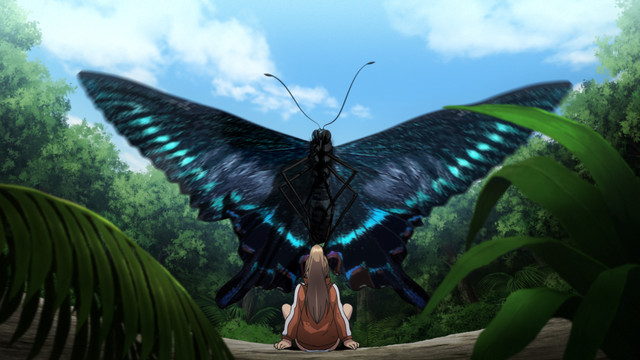
Initially the film existed as a 2019 release short, not a short film but twenty minutes in the middle of the finale feature length work, knee deep into the hell hole of giant butterflies who suck people dry and other content that appears in the final work, just to provide a taster. The film itself is also not the entire work, merely early chapters of the manga, following a group of stereotypes from a manipulative older girl who uses her physical allure to a macho jock, the movie taking a fifties American b-movie but adding a lot more animated nudity and greater nastiness. There are nicer characters in the fold, the heroine Mutsumi Oribe luckily an insect enthusiast who is really of use on an island like this, to the point that whilst others like those above are stupid enough to try to continually get her killed, one male character immediately comes sympathetic because early on he realises her importance and listens to her.

The inherent issue with The Island of Giant Insects is that it is a paradox, between being very scuzzy but also in a very generic way. That sentence might raise some questions, but I am a defender of ero-guro-nonsense and all the deviations in Japanese pop culture, which proves an issue as Giant Insects is both just lurid for the sake of lurid, but not as shocking as it thinks it is and pretty average, not exactly more than trashy and not standing out in creativity. I think, in honesty having seen images, that even if the manga was not great it might be a superior version as that has more of the perverse surrealism that I appreciate even in this type of work. Especially if you check pages of it online, the art style is more distant and the content is stranger in a ghoulish way. The author in particularly really likes insects bursting out of peoples' face, none of which you find in the adaptation but is at least more memorable.


Said insects, as well as being cheesy CGI figures, are not used with interest either. It says a lot that I can just refer to the franchise Earth Defence Force, one of the few video games I have played as an adult, which are cheesy b-movie games which are not the best in graphics and content (at least in the one I have played), but made up for it by having hordes of ants onscreen even if they were also cheesy computer effects. In terms of the premise, the creatures in this are barely used to their fullest, especially in light of all the strange and unique traits of the insect kingdom has, all in spite of there at least being one person or a few involved providing some entomology research. One exception, the one good scene in this entire project, is the horrifying and real life concept of the Leucochloridium, that of a parasitic worm that invades snails' eyestalks, imitate those organs, and mind control that poor host to be out in the open to be eaten by passing birds, all with the intention that the worms breed in the birds' stomachs.  Naturally imagining this happening to one unfortunate human character, as it does here with additional gibbering, is the one single moment Giant Insects ever gets around to the kind of gross, weird and wonderful side of Japanese horror that the likes of Junji Ito or many an ero-guro creation does. If only this had happened more in the story.

Clearly of more interest is nudity, as this film does not hide it, even finding an excuse for all the female cast to bathe nude after a giant tick incident. The odd thing about the production though is that the twenty minute piece was uncensored, whilst the feature length version censors some sex, and almost completely censors the violence, obscuring it off-screen or in black. It could sound more progressive, as someone who has always found it problematic violence was more acceptable than sex, but it comes to the point how this is not like the old lurid titles at all. Say what you want about old titles that painstakingly drew the most grotesque detail in gore and organs, but a lot of OVAs nowadays are tie-ins to existing titles and usually an excuse for more nudity only. The censorship also does not mean these works cannot get away with some problematic content and tones even for me.

None of these characters are particularly memorable, another title with insanely generic female character designs which is always the worse sign, with even the ero-guro aspects deeply problematic for myself. The only sexuality that is nothing to do with the grotesque aspects is not a lot. The evil manipulative woman is not exactly feminist, and the curious lesbian subplot about a timid idol singer who is secretly manipulative too, taking advantage of the female track star in the group being likely gay, is jarring both in that one of the two is not probably a good character either and that it never goes anywhere. There are also the unsavoury moments. It is one thing to have the erotic-grotesque aspect of female nudity against insects, but that should not be the only thing, for the sake of both gender politics and true transgression. Then there is the scene where the evil female character and the jock go full evil, to which a certain piece of dialogue about gagging another female character with something below the belt is completely implying what that suggests, only to thankfully not happen.

It is strange to think that, for all the problematic content, a work like The Legend of the Overfiend (censored or otherwise) can be more defensible for pieces of it than this, but there is always something more problematic for me about anime which follows the rules dictated, i.e. censoring nudity for television, but still sells the uncensored releases and still gets away with some gross content in the censored broadcast. Likewise, a title here that had no excuse being censored, thus not experiencing a full version of the premise promised, which also has questionable content really comes off as hypocritical and far more a concern than a fully offensive work which people are warned about. A scene like lingering on a female character wetting herself in fear in detail just before a butterfly gets her, as seen here, is something which feels a lot grosser to witness than any titillation or gore you could throw at myself.

The production itself is also incredibly bland, and not in the cheap and compelling type. Even the music is terrible metal guitar licks which are off-putting for a metal fan like myself, egregiously cheap when I have heard solidly put together music even in incredible cheap anime. There is even a sequence which is an extreme form of padding, just of the lead character walking down an endless corridor with this music playing, and of nothing more which is pretty offensive in how pointless it is. The real baffling nature of all this is that this has managed to soldier on. As a b-movie premise, I can think of many other ways this could have been made, imagined versions which is better, but this managed to get a feature length cut and has been acquiring funds for an English dub. A complete lack of memorability is found here, but with the aspects there that leaves one feeling dirty rather than provoked. It is strange as well that, due to the unforeseen circumstances about COVID-19, which has effected everything including production of entertainment industries like anime, The Island of Giant Insects could be by accident one of the most prominent titles we know of from the year. That is maddening and baffling at the same time.


Thursday, 30 May 2019

Bonus#11: In the Aftermath (1988)


Directors: Carl Colpaert (Based on a film by Mamoru Oshii)
Screenplay: Carl Colpaert (Based on a film by Mamoru Oshii and Yoshitaka Amano)
Cast: Katie Leigh as Angel (voice); Tony Markes as Frank; Rainbow Dolan as Angel; Kenneth McCabe as Goose; Kurtiss J. Tews as the Psycho Soldier; Bryan Ellenburg as the Soldier; Ian Ruskin as Jonathan (voice); Lisa Maxwell as the Older Angel (voice); Filiz Tully as Dr. Sarah; Mike Hickam as the Officer

Let's begin with the obvious - how Mamoru Oshii's original version of Angel's Egg (1985) isn't available in the West but this notorious American reinterpretation from Roger Corman's New World Pictures is baffled me as it has for many. I don't blame those who licensed this version mind, neither Code Red in the United States or Arrow Video in the United Kingdom, as its likely the sad case the license for Angel's Egg is difficult to acquire or priced too high. (If by any chance it's due to New World Pictures or Lakeshore Pictures, the later owning this license, then someone would've grumbled about it by now, but bear in mind anime has been notoriously pricy at times to license from Japanese companies). In contrast, In the Aftermath was, from the looks of things, an entirely different license as a New World Pictures creation, Lakeshore Picture owning the rights since 2002. And honestly, whilst it's a ridiculous train wreck at many points and inferior to the original Angel's Egg, I'm glad we still have a 2k restoration of In the Aftermath, even if my own idealised version would'e been as an extra to the superior Japanese production.

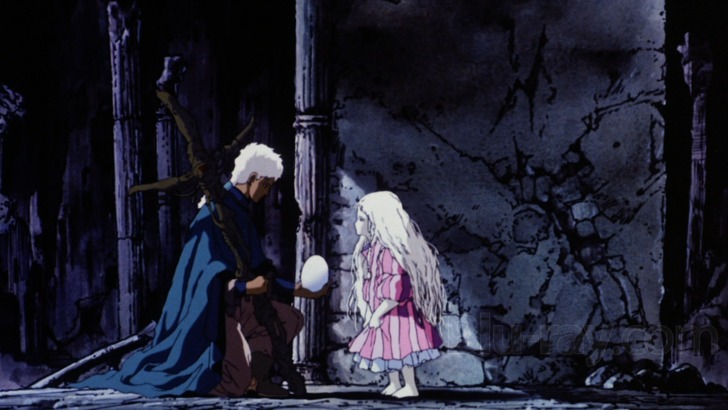
As it goes New World Pictures ended up with the license for Angel's Egg, to which the likes of producer Tom Dugan thought it was an incomprehensible work. Angel's Egg, for those who don't know what it is, is an experimental theatrical animation by Mamoru Oshii, cult anime/live action director of the likes of Ghost in the Shell (1995), in collaboration with the legendary illustrator Yoshitaka Amano, who'd become acclaimed enough to have his work in art galleries after a career starting in anime production in the late sixties. Oshii, originally desiring to become a Catholic priest, clearly made Angel's Egg as a parable about religious doubt, with what you do see in In the Aftermath in terms of original footage enough to show it was very open in the conclusion without ever drawing a line onto either side, the title referencing an egg the iconic animated girl character had which either was an angel's or had nothing inside it. The New World Pictures version still also includes the sequence of fishermen trying to catch shadows of giant fish which cling to their city walls, only destroying what they try to hit with harpoons, a metaphorical sequence that, even if Oshii views the film more of a mood piece nowadays, still has this visible message within itself.

A lot of Angel's Egg is understandably abstract, intentionally so and soaked in a post-apocalypse built around the best representation of Amano own work and some of the best animators on staff from the eighties anime boom. It could've, however, been sold to an American audience by New World Pictures, rather than making an even less comprehensible version in In The Aftermath, if you'd just sold it to the art house crowd Roger Corman once did with Federico Fellini and other European films. Hell, for the visuals alone, this could've appealed to the cult film crowd even if the original film has very little dialogue and a lot of slow, languid scenes as it's a trippy, strange film even without the visible existential message.

Somehow, trying to make the film more sellable, another issue being that at seventy or so minutes Angel's Egg was seen as too short, the people behind In the Aftermath making something even less coherent at times just to fit their perceived parameters. To see it to the VHS market (though it did have an Australian theatrical release), the animation is used as an alternative world overlooking ours, actually like the angels of It's A Wonderful Life (1946) where the original protagonists, the white haired girl and a young male soldier, are now siblings and with the young girl to be sent to Earth, in live action, which is a wasteland where the ozone is poisoned and clean air is a precious resource.

It's actually not as disastrous as the reputation is. The infamy is how not only someone thinking this was a good idea, not helped by the original film not being available in the West still, but that to "make sense" Colpaert, an apprentice to Peter Bogdanovich, wrote a new script of utterly ridiculous (and quotable) dialogue about men crying about a world without fish and the girl being spanked by her older brother with asteroids as punishment for falling asleep. The project, even if I wished an English dubbed version of Angel's Egg was the version released rather than this misbegotten belief of trying to make a more "sellable" version to the West, is still compelling now we know it's an utterly perplexing creative decision, a time capsule to this bizarre cultural reinterpretation to sell films that still happened into the 2000s, whenever Miramax got hold of work like martial arts films for example, but is also alien to many world cinema fans as a practice. In 2K resolution on a Blu Ray, Angel's Egg as an animated production is incredible, causing one to weep that it is available outside Japan barring bootlegs; it is a project of the era, a box office failure whose production was only possible due to how the bubble economy grew in Japan during the eighties and, before the bubble burst at the end, there was enough money going around including in the animation industry to fund these bold projects.

From https://images2.static-bluray.com/reviews/14844_1.jpg

Oshii
himself, whilst he can be difficult for many, is an intellectual auteur, who even when he now claims the film is vague in meaning laced the film with too much clear symbology of his own spiritual crisis. This, as mentioned, is the only project to fully capture Yoshitaka Amano's art style too, so it is painstaking in capturing his gorgeous yet highly detailed illustration right down to the difficulty the animators would've had in just animating the movement of the clothes and hair of characters. The production team, with individuals who'd go on to the like of Akira (1988) to My Neighbour Totoro (1988), were not slouches either.

The live action isn't, even if low budget, letting the side down however in ingenuity. I will mock the point of even creating the film as it was, and mock the script, a really bad case of presuming an audience couldn't catch the vibe of the original or even just admiring the pretty pictures in spite of finding it slow, but I won't deny it's a great example in terms of clearly having so little to work with, two locations for sets and a few actors, and trying with some damn good ideas to make something interesting even if the script is gleefully gibberish at point. The two locations were chosen well, the factory in particular also used for Terminator 2: Judgement Day (1991), the kind of evocative set you could find in Andrei Tarkovsky's Stalker (1979) to a b-movie; by all accounts, an actual closed factory, it might've been dangerous to film there with those dust clouds onscreen looking too irradiated in chemicals abandoned there for comfort. Cinematographer Geza Sinkovics does his hardest to help the live action sequences, but its score composer Anthony Moore who deserves a moment of praise. An experimental composer who has worked with the likes of Henry Cow and Pink Floyd, he's a vital element in improving this film, in tandem to some of the other visual tricks at hand the person who comes close to matching the original source material in evocative mood.

Even when the animation is spliced into the live action, to try to make it work, there's also an eeriness that works. The premise, an "angel" sent to save Earth from environmental devastation is depicted by only six cast members (including lead Tony Markes), groans under trying to rationalise an art film into a pulp b-flick, but there's a sense of the unnatural to still appreciate because of this. The anime still has power even in this bastardised form, and the live action is appropriately eerie when you ignore the story.

Instead, the script, by the director, should be appreciated for going into non-sequiturs even weirder than the source, which was strange for its open ended ideas and the psychedelic dialogue but, when characters actually spoke, was very precise and sombre, building to the themes of spiritual ambiguity. Some of what is found here is potent whilst still strange, Markes in a gas mask playing a piano to a female doctor (Filiz Tully) he encounters, but spanking people with asteroids is just the kind of line screaming for baffled reactions. Angel's Egg had limited dialogue, a lot of silence that was clearly seen as unsellable considering the decision to cram voiceover to sell it, all of which adds an unintentional absurdity. Thankfully, it wasn't dull, pedestrian sci-fi exposition; instead, its lore that makes no sense but is fascinating in how this is an attempt to make the original work "makes sense" but becoming something gloriously off. The largest monologue in Angel's Egg, the young soldier retelling the tale of Noah's Ark with the boat drifting on an ocean never finding land, is turned into a nonsensical tale of deception where fish floating in the air on a planet are stolen that has to be heard to be believed.

It makes no sense why this executed plan was meant to be more marketable, but whilst I imagine an alternative world where Angel's Egg was sold as a more avant-garde Ingmar Bergman movie to art film audiences, In the Aftermath was what we got and is still rewarding for how odd it is. The real tragedy is that, whilst it helped introduce Westerners to Angel's Egg, it never lead to Angel's Egg actually being released; New World Pictures, among their work, also released an "Americanized" version of Nausicaä of the Valley of the Wind (1984) as Warriors of the Wind, the original pre-Studio Ghibli film now available whilst that version has vanished, yet nonetheless for a certain generation probably thanked for letting them still see anime for the first time. We thankfully left this need for alternative versions of foreign titles, but considering how extreme and peculiar In the Aftermath is, I am glad it's still available. That it's not an extra to the source and the only restored version in the West of the two films is tragic, but the oddity shouldn't be blamed for that.


From https://admitonefilmaddict.files.wordpress.com/2019/01
/In-the-aftermat-2.jpg?w=672&h=372&crop=1

Tuesday, 27 June 2017

#44: Ichi the Killer: Episode Zero (2002)

From https://myanimelist.cdn-dena.com/
images/anime/11/34131l.jpg

Director: Shinji Ishihira
Screenplay: Sakichi Sato
Based on the manga Ichi the Killer (1998-2001) by Hideo Yamamoto
Voice Cast: Chihiro Suzuki (as Ichi); Sayaka Ohara (as Midori); Shinpachi Tsuji (as Jijii); Takashi Miike (as Kakihara); Atsushi Imaruoka (as Nobuo); Daisuke Sakaguchi (as Hirose); Ema Kogure (as Jiro); Eri Saito (as Mother)

Synopsis: A prequel to the Ichi the Killer narrative, following the origins of the titular figure, a sadistic assassin who cries as he kills and yet paradoxically enjoys inflicting pain on others in an extreme fashion. This short animation shows both how as a high school student constant bullying and a series of events placed him in prison for murder, and how after he's released a mysterious benefactor turn him into the cry-baby sociopath of the Ichi the Killer story.

Ichi the Killer: Episode Zero is a fascinating extra for Takashi Miike's infamous 2001 adaptation of the Hideo Yamamoto manga. However the word "extra" is apt. It even feels at odds with the film its meant to be an addition of in spite of the presence of the same screenwriter Sakichi Sato between them. Miike's film is a much more complex, subversive creation, which shows horrifying and taboo material only to twist a knife into the viewer's stomach for viewing it. Episode Zero instead of this feels like one of the final throwbacks to the idea of anime, especially in the West in the nineties, being adult and transgressive. Violent and adult anime is still being made, but particularly with the straight-to-video market (OVA) there was a lot of this nasty (and sometimes utterly cheap) anime in the late eighties and nineties before it ebbed out with this being one of the last gasps.

And Episode Zero is grotty, explicitly depicting material. That Ichi's parents, through consensual S&M sex the room next to their oldest son, are part of the cause of the confusion he has between sex and violence. How it depicts Ichi beginning to torture and kill small animals in school to relieve his inferiority from bullying, including the school rabbit which leads to him being blackmailed by another student. Clichés mixing with pertinent topics on Japanese culture, especially the issue of bullying and the stress school students and teenagers go through which appears in a lot of Japanese films, but without enough time forty minutes (six or so for end credits) to fully work. It's also an entire rewrite of the far more interesting back story for the Ichi character that you get in the live action film, a far more vague figure whose only past detail, about a trauma at high school, is fake and his handler (played by director Shinya Tsukamoto) being a much more interesting figure than the version found in the animated version. The cameo by the character Kakihara, voiced by Takashi Miike in what counts as merely grunts and a few words, isn't that interesting either when you have Tadanobu Asano as a fully fleshed out character in the feature film.

From https://assets.mubi.com/images/film/58024/image-w856.jpg?1445938925

The tone for Episode Zero, whilst with potential to be a deliberately provocative story like the live action film, does merely become scuzzy to the point I actually felt guilt viewing this, questioning having actually sat through the film. It's brazen in what it explicitly details but can come off as pointlessly offensive, particularly when you get to female martial artist, Midori, who takes an interest in Ichi only to be shown to be turned on by violence and eggs him on in a motel room to beat her up to erotic climax, barely stumbling on top of a knife's edge in terms of avoiding being crass and dubious. It's strange considering that the screenwriter was able to take similarly problematic ideas in the live action version and make such subjects more nuisance and provocative, the same found in a later Miike work Gozu (2003). As much the issue, alongside the tiny length, comes from the production itself feeling low budget, cheap and nasty in a way that's befitting the early processors but from a weird transition period of the early first few years of the 2000s, where the switch from hand drawn to computer assisted animation was awkward.

Even when placed next to another problematic anime from the yesteryear like Violence Jack (1986-1990), as notoriously cheap as some of them were gruesome, Episode Zero is dank in appearance even to those controversial works in character design and style. The exception is the music by Yui Takase which is the one thing of legitimate positive to take away from Episode Zero, memorable and helping to bandage up the glaring issues a little, an unnerving and edgy soundtrack to match the nastiness onscreen, including a peculiar hip hop song on the end credits where the rapped lyrics are heard under dialogue clips from the anime in a ramshackle way. (Sadly his only other credit on Anime News Network is Samurai XXX (2004), samurai themed hentai porn). Value to Episode Zero will vary drastically; for myself, it's curiosity, but as someone who'll defend the Miike film as an intelligent, transgressive cult movie, this pales in complete comparison and doesn't look good next to it. 

From https://2.bp.blogspot.com/-3aBMwrwEfy8/WSF-OhEG2aI/AAAAAAAAxww/7
J50YyZGY1Ajht_KUXkpf1jpYdM-rRdHQCLcB/s1600/cheiradora%2Bde%2Bpo%2Btentando%
2Bcheirar%2Bo%2Bbraco%2Bdo%2Bcara.png