Showing posts with label Bonus. Show all posts

Wednesday, 15 March 2023

Bonus #16: Wonderful Days (2003)


a.k.a. Sky Blue

Director: Moon-saeng Kim

Screenplay: Moon-saeng Kim, Michael Keyes, Jay Lender, Jun-Young Park, Sunmin Park (adaptation), Yong-jun Park, Howard Rabinowitz (English Language adaptation), Jeffrey Winter and Micah Wright

Voice Cast: Andrew Ableson as Zed / the Digger Leader; Cathy Cavadini as Jay / Young Shua / Cheyenne; David Naughton as Commander Locke / Dr. Noah; Bob Papenbrook as Goliath / Governor / Typon

Viewed in English


A Korean production, I wish I could more enthusiastic out of respect for a country's animation industry, especially as this was clearly an ambitious attempt for wider recognition. Sky Blue, as we got it called under in Britain, is as far further than you could get from Blue Seagull (1994) and Armageddon (1996), two Korean animated films which are strange and risible productions I admit were the first two from this country I had seen, which I admit I found enjoyment in but are two titles which struggled to come into existence. The former is an erotic thriller made recognisable in the internet era, the later one of two Manga Entertainment releases of South Korean animation in the VHS era that managed to get a 3DO Multiplayer Interactive game in its homeland, they are films I feel sympathy for the staffs on, especially as Blue Seagull ends with behind the scenes production footage over the end credits. They were titles which would have been dogged on by cruel reviewers, especially as Blue Seagull had some questionable content. South Korean cinema is a rich vein in itself to be admired, whether art cinema or genre pictures, and whilst there have been some prominent and well regarded animated work, such as The King of Pigs (2011), there is an entire culture of television and theatrical Korean animation which is not as readily available still. Sky Blue, or to use its original name Wonderful Days, was a prominent title to appear even in a trimmed down form with an English dub back in the 2000s, and could have been a chance for wider recognition if it had succeeded, certainly coming with a significantly bigger scope in visual design and animation than the two films I have mentioned.

There was even a theatrical push in Britain when it was licensed by Tartan Video. Tartan Video, when they existed, were a big name, especially when it came to helping the push for cult Asian cinema, the people who brought us in Britain the likes of Takashi Miike's Audition (1999), Ring (1998) and Park Chan-wook's Oldboy (2003), a huge proponent for how we learnt of South Korea's rich genre and cult cinema, introducing the likes of Park Chan-wook to us in the West. Even with the DVD release of Wonderful Days, as I acquired cheaply second hand, it was sold on two DVDs, in a deluxe set with a three hours worth of extras on another disc, in the same way they had with the likes of Oldboy, pushing it as a big title in the day. It has a premise which has been readily sold before. Still evoking uncomfortable issues about climate change, Wonderful Days is set in a post apocalypse where the environment collapsed, toxic rainfall and all. The first and only living city, the Echoban, was built to protect civilisation from this, but even as it stands proudly in the midst of this as a bastion of hope, there is rife class divide, where the elite live in the Echoban, and everyone else is outside in the slums, workers to mine resources for the living metropolis and keep it alive. It is a story told many times before, and that is not a bad thing, with class war and a romantic triangle divided between sides, as Jay, a female law enforcer, is connected from childhood to the man Shua from the slums trying to activate a secret Echoban system meant to save everyone, all whilst her male superior Cade wishes to prevent this but also loves her since they all know each other from childhood before Shua was forced out of Echoban. Add in this a kill crazy superior from the elite in the midst of this, and everything here can be made into something great.  Truthfully, the biggest problem is entirely that this is just okay, something we will get into later into this review, that this just in terms of making a lavish production, and making sure it has a story which gets from A to B well, was a goal that it cleared but Wonderful Days does not get further from.

It is staying safe, so much so with its narrative it is within the slithers of this plot where you see something more dynamic occasionally appear. I find myself more concerned for the petty thieves introduced, especially when they are revealed not to be villains but merely denizens of the slum wasteland who can be sympathetic, like a tiny rat like member who I had sympathy for over the traditional leads, all because he was made less a thug but someone who can be scared, be brave, and when he went from a dubious figure to one with sympathy for when he laments for his fallen comrades. Whilst it has aged, the film's visual palette even with obvious use of computer animation is to be admired too. Attempts at blending this into interesting directions can be seen onscreen, such as a chase into the Time Capsule in the Echoban, one of the few moments where world building, which is not as fully seen as it should have been, appears; a museum presuming what has survived in human culture from before, it mixes live images with the likes of Roy Lichtenstein and Gustav Klimt's art for a set piece with idiosyncratic visual choices. The production team were clearly trying their hardest, and one sequence does suggest what could have been; in context it is still a curious choice, a nightmarish dream of biblical images and multi-eyed rams closer to a Ken Russell live action film, a British director acclaimed (and notorious) for this type of hyper intense imagery, including actual Biblical images with multi-eyed rams in Altered States (1980). That scene is disturbing and abrupt in Wonderful Days, but shows an attempt at characterisation, that for Shua it is symbolic in his fear for Jay's life, and the state of the situation for him, showing how the production team for this film, as they continued making films or animated projects in other formats, could have taken this further. In fact, prominently, the production was more than just animation of the 3D and 2D form, as additional work included filming real model sets which the animation was layered over, even using real shots of clouds and the sky, symbolically meaning for the film's story, and layering animation over them1.

Sadly, beyond two short films after this, director-writer Moon-saeng Kim has not done anything else, and there is the unfortunate sense that Wonderful Days, even with its shortened length for global release, was a production with many issues in spite of these clear visual virtues. Even in mind to Tartan Video putting their weight behind it in Britain, even the esteemed Japanese animation studio Gainax creating a dub for the Japanese market which was less "alien" rather than merely adapting it to distribute it in Japan2, Wonderful Days was always going to struggle with how conventional the plot proves to be. An expensive production1, all the problems really come from the fact that its story is quite conventional and not even that particularly idiosyncratic either. With knowledge of numerous individuals being involved with the writing process, even unaccredited work by Micah Wright, a prolific American writer for the likes of comic books, and Jay Lender, a prolific American writer especially in the Spongebob Squarepants franchise, it was clear that whilst visually the film, even with its aged CGI, was ambitious and is still to be admired, the production's story needed that much strengthening of ambition. Especially when some of the more idiosyncratic touches, like the blind girl, are clichés which really are not that distinct when they have been seen before, this film whilst having so much still I appreciated also suffers from this lack of personality. Sky Blue as we got it in the British Isles is okay, a case of a production which just goes to show how much of a struggle it is just to get an animated theatrical film off the ground, where the challenges are not just the visuals but even making sure to have something in its story to tell to last.

=====

1) Take with a pinch of salt, as it comes from one perspective for a film, but this chronicle My Beautiful Korean Movie written by Micah Wright, for his personal website on April 9th 2003, does raise some poignant aspects that, if confirmed, do raise up a lot of the issues with Wonderful Days, as an unaccredited co-writer with Jay Lender, which undermined it.

2) Gainax to Adapt Wonderful Days, written by Christopher Macdonald for Anime News Network and published on November 5th 2004.

Wednesday, 27 July 2022

Bonus #14: Fist of the North Star (1995)


Director: Tony Randel

Screenplay: Peter Atkins and Tony Randel

Based on the manga by Buronson and Tetsuo Hara

Cast: Gary Daniels as Kenshirô; Malcolm McDowell as Ryuken; Costas Mandylor as Lord Shin; Downtown Julie Brown as Charlie; Dante Basco as Bat; Nalona Herron as Lynn; Melvin Van Peebles as Asher; Clint Howard as Stalin; Andre Rosey Brown as Sandman; Paulo Tocha as Stone; Chris Penn as Jackal; Tracey Walter as Paul McCarthy; Rowena Guinness as Jill McCarthy; Isako Washio as Julia


Is it peaches? Sounds like peaches.

My knowledge of Fist of the North Star was limited to the point that this, in honesty, was one of the first versions of Buronson and Tetsuo Hara's legendary manga I had seen. The first was anime, New Fist of the North Star (2003-4), but worth mentioning is that, if the history of bringing Fist of the North Star into the United States only took to the late 2010s into 2020s to succeed, we in Britain got less of this legendary series. The United States finally got the full and uncut 1984-8 television series only in 2010s with Discotek, whilst in Britain, we only had 36 episodes of Manga Entertainment's attempt to sell the show, coming in the mid-2000s in a long gone box set. Fist of the North Star, this curious attempt to sell this franchise in the West, had the advantage in the DVD era that Hong Kong Legends picked this up as a title. A British DVD company, now long gone, who strove to preserve and release Hong Kong martial arts cinema with a care for extras and full versions pre-dating the Blu-Ray era, where even Criterion is preserving titles they once released, unexpectedly included Fist of the North Star itself among their catalogue.

This is not the first live action version, bootleg or otherwise, but with Clint Howard having his name over pro wrestler Leon "Vader" White on the opening credits, it is clear this is a curious adaptation. To those with no knowledge of the franchise, as this film tells, the world has descended into the post-apocalypse, with those who wish to acquire power having taken over as marauding hoodlums. One figure named Lord Shin (Costas Mandylor), having dominated with an iron fist, as the practitioner of the Southern Cross martial arts style, has created a city, his desire to improve the world contrasted by his ego and letting his men commit atrocity by invading smaller communities for supplies and slaves. His rival, who he has taken his love Julia (Isako Washio) from, now a caged songbird to him, and marked his body in permanent scars, is Kenshirô (Gary Daniels), practitioner of the North Star style. North Star, as interpreted in the manga, in the anime, but also here, is that contacting certain pressure points on the human body causes that person to explode, as gory as that sounds, and Kenshirô approaches Shin's world in attempt to defeat him.

Gary Daniels as Kenshirô looks like the muscular brother of Benedict Cumberbatch, who can still make your head explode, which is a compliment to both men. Daniels, a martial arts action star of films like Bloodmoon (1996), born in London, was also the person who came to this as a fan of Fist of the North Star, enough to call his son Kenshiro Daniels, who would go on to become a football (soccer) player when he grew up. Things obviously however made it clear the Fist of the North Star, this live action film, is not quite what it should be. It is conventional, which is the biggest sin it commits, that Tony Randel, most famous for Hellbound: Hellraiser II (1988), came to this film and made it very conventional, more concerned with trying to give the character of Kenshirô angst-ridden rather than a narrative exploiting its premise. Even for a lower budgeted film, it has a lot to get the tone right, the production design team and model builders deserving all their praises for a film which, when exterior location shots, feels post-apocalyptic, but those involved beyond this clearly missed the point.

Despite being part of the wave of pop culture films from the 1990s that I am obsessed over, this is just has one pace, to tell a very simplistic tale of this Kenshirô beating Lord Shin, and not a lot else to work with. A film presenting Clint Howard, Ron's memorable acting brother, getting to be a murdering bastard in the first half, shooting people indiscriminately should sound like a lurid pulpy movie, especially as this does have fight scenes, and one of the most curious casts you could imagine for such a film. One thing you cannot deny, and should have excited people coming to this film, because Randel comes to this as a horror director behind films like Ticks (1993), is that they did not ignore how these characters can make people explode with a punch, or Lord Shin's special glowing hands attack causes veins in the biceps to burst in jets of gore. Even then, however, this does pull back, and never was there a film whose personality is against itself with moments this adult and violent, against content you would expect in tone from a child-friendly comic book adaptation.

Explain, for example, that this is a film with moments of gore, where the troops of Lord Shin, the South Crossmen, are explicitly raping, pillaging and murdering nearby locations, but contrasts this with a blond haired teen male character (Dante Basco) who is a goof and a wannabe kung fu expert, whose friend is a cute blind moppet who Kenshirô cures of her blindness. The film’s narrative is incredibly generic, and for a film that needs good fight scenes to work, the compromise to their presentation undermines the whole project, alongside the fact that, for the few moments of gore here, there are also points where the gore from the original manga are removed for the most part too. What it becomes is a strange concoction of who managed to end up in the film. Even in style there are weird moments that show this, like inexplicably, for a sombre toned film with an orchestral score by Christopher L. Stone, for it to suddenly splice in a Machine Head song A Thousand Lives into the soundtrack.

Malcolm McDowell, entirely separated off from everyone in his scenes, is a North Star martial arts master named Ryuken existing in the afterlife, continuing the obvious concern of Western actors having Japanese characters to play, levitating in a room or inexplicably appearing as a zombie to Kenshirô, voicing another actor, to tell him to not flee his role as a hero. Vader, the legendary pro wrestler, especially in Japan as much as in the West, is perfect as a Fist of the North Star baddie, and is just being Vader, pulling a promo on a small girl, as awesome as that sounds whilst performing moves on Gary Daniels. But with that fight ending in an anti-climax belittling both of them, even Vader is misused. Melvin Van Peebles is a really curious choice, a legend in African American cinema for directing Sweet Sweetback's Baadasssss Song (1971) alone, here as an actor, as with Downtown Julie Brown, a British video jockey (VJ) and personality, neither ultimately given much to do as members of a village Lord Shin is terrorising. Unfortunately as a result, neither were really worth having hired in the first place despite both, Van Peebles especially, are inspired figures to have hired.

Costas Mandylor himself is also a curious choice as that unfortunately means, as a former soccer/football player with no martial arts training, they had to work around this with stunt doubles, in a film which has Gary Daniels but not many who can do the martial arts fights. Japanese actress Isako Washio likewise, an actress from films like Bloom in the Moonlight (1993) is also stuck here trying to perform in a language not her own and feeling lost too. The one curious choice who managed to grab something from this is Chris Penn as Jackal. Penn steals the film, the actor from films like Reservoir Dogs (1992), with the advantage, playing a sleaze ball goon who managed to tape his head together before Kenshirô's blows caused his head to explode, that he could find a character he could relish the lines of.

It is a project which ended up with people who really had no idea what to do with this - co-screenwriter Peter Atkins mostly worked on Hellraiser and Wishmaster films, making this frankly a case of someone dropped with a title they had no investment it, Tony Randel likewise feeling entirely out of place here. Even in mind that huge chunks are clearly missing, such as the aforementioned Clint Howard disappearing entirely eventually, the live action Fist of the North Star film feels entirely at odds with what it is was adapting, a franchise which would have to take decades to finally get a lot more recognition in the West. This is a fascinating film to see, and has aspects which are worthwhile, just in how it looks, but never was there a film which really did not have a lot going on despite having such a curious production on and off screen.

Thursday, 14 July 2022

The Guyver (1991)


Director(s): Steve Wang and Screaming Mad George

Screenplay: Jon Purdy

Based on the manga by Yoshiki Takaya

Cast: Jack Armstrong as Sean Barker/The Guyver; Vivian Wu as Mizky Segawa; Mark Hamill as Max Reed; David Gale as Fulton Balcus; Michael Berryman as Lisker; Jimmie Walker as Striker

Bonus Review


Note: The version of The Guyver (1991) watched is the director's cut, which involved a flashy editing technique added to cut between scenes, but also visibly removing shots of violence which is brought up in the review.

This review will also be re-posted at my other blog Cinema of the Abstract for a little cross-promotion between them. Please take a look at a wide selection of reviews I do there as well.


Yoshiki Takaya's manga The Guyver was at one point one of the first Japanese manga and anime franchises to transition over to the West, and one of my earliest memories as a child to the idea of "manga" or "anime" involved the 1991 film itself, a small news article about The Guyver with the exceptionally deceiving poster of co-star Mark Hamill's face against one-half of the iconic Guyver helmet. In Japan itself, Yoshiki Takaya's manga started in 1985 and is still going thirty plus years on through multiple magazines, with two anime adaptations for straight-to-video, 1986 and 1989, and one I grew up with getting into anime, a television series between 2005 to 2006 which was an attempt rejuvenate the franchise. The OVAs, specifically the 1989 multi-episode one, gained an infamy when released in the West for its violence, whilst the TV series was undermined by not having ultra-violence that made the anime notorious, despite the late anime distributor ADV Films selling the series off this infamy, and that it does not have an actual ending. In the West, two live action films were made, one produced by Brian Yuzna with Steve Wang and Screaming Mad George making their directorial debuts, the sequel three years later with Steve Wang on his own in the director's chair and taking a drastically different direction in tone. Together they are curiosities.

Made as a Japanese co-production, Yuzna himself is a man I admire. Connected to Stuart Gordon, the director famous for Re-Animator (1985), Yuzna himself as a filmmaker has a fascinating series of strange and imaginative horror films, some involving Screaming Mad George, birth name Joji Tani, a practical effects designer from Japan whose reputation when he moved to the United States and worked in cinema have had a lasting legacy. Steve Wang, a Taiwanese makeup artist and creature designer who emigrated to the USA as a child, would comes into the directorial chair in his small filmography here as a co-director, and especially with a film called Drive (1997), gained himself cult recognition.

The Guyver, as the 1991 film, is however a strange mess. The plot is from the source - an evil corporation called Chronos are after an alien bio-armour, the titular Guyver. Set in the United States, a young man named Sean Barker (Jack Armstrong) finds the Guyver and is infected by it, creating living armour which grows from his body when he needs it. The Guyver is a tokusatsu influenced production, like an ultra-violent Power Rangers in the image most have of it, as Chronos has its members and test victims used in experiments where they turn into horrifying monsters. This is contrasted by the weapons the Guyver has, with its arm blades to a chest laser beam, designed to slice them the pieces.

Yuzna's Japan-US co-production decided not to follow his wheelhouse of gore and elaborate special effects in films like Society (1989) or Bride of Re-Animator (1990), but only have the special effects...at least at times. The director's cut, the more readily available version, has scenes of gore cut, but even the film without these missing fragments is incredibly goofy at times, creating a contradiction of a film you could not give to a child without causing potential nightmares, at least its most lasting moments, but other times has incredibly silly humour. The first Guyver film, the more easy to find, is a peculiar thing with its tendrils connected to Stuart Gordon and Yuzna, with the evil Chronos Corporation headed by leader Fulton Balcus, played by David Gale who is famous for Re-Animator. Balcus wants the Guyver bio-armour and sends "Zoanoids", humans who can turn into humanoid monsters, after Sean Barker.

The one success, the only success, in terms of consistency is the practical effects. Screaming Mad George is legendary and notorious for his work, from the human cockroach sequence from A Nightmare on Elm Street 4: The Dream Master (1988) to the "Shunting" scene from Society, visceral body horror which even if you can see the seams is so nightmarish and gooey that it borders surrealism. Moments show this in The Guyver, seeing him and everyone in the practical effect department having a field day with the premise. Whether it is horror film veteran Michael Berryman and various actors turning into various humanoid beasts or the spectacular Guyver armour itself, a warrior with cyberpunk and insect-like traits, they are all applaudable. It is, however, a film struggling with a premise, possible in anime and manga, which has an apocalyptic tone on a large scale, and also requires martial arts to pull off even fights between men in rubber suits. Guyver: Dark Hero will try to overcome this, to greater success, but this prequel struggles.

It is a really strange film, not in surrealism, but how it ended up as it did. Mark Hamill, the legendary Star Wars actor a year before he took on the voice of The Joker in Batman: The Animated Series, creating for him a career flourish as iconic as Luke Skywalker, does stand out, playing a cop on the edge trying to get the scope on the Chronos Corporation, with a sense of grandeur to his appearance. The late David Gale steals scenes with his bizarre intonations and wall chewing, even enraged by burning toast as he is by the incompetence of his minion. Vivian Wu, as the female love interest, is visibly struggling with her dialogue and not helped in the slightest by a wet, one dimensional female character she has. Alongside the fact she is cast as a Japanese character, which is dubious for her as it is as casting, she is a really strange inclusion as between Bernardo Bertolucci's The Last Emperor (1987), a huge film in his later career which was her onscreen debut, and Peter Greenaway's The Pillow Book (1996), Wu, a Chinese actress whose career is mostly in dramas in the West and China, found herself in this film sandwiched between a Bernardo Bertolucci film and Greenaway which is a curious tangent. Even her appearance in Teenage Mutant Ninja Turtles III (1993) at least makes sense as a second sequel to a franchise which was huge at the time and whose first feature film was a box office success.

Jack Armstrong as the hero sadly struggles out of the whole cast, in a role that, to be brutally honest, was made an a absolute charisma vacuum even by the standards of a pulp story that emphasises practical effects first, which does not help him out at all. These stories, and this is something I think of in terms of the Guyver television anime, is structured around protagonists, male leads, who are usually bland, especially in many ultra-violent anime too where the worlds and context around them are more meaningful. More so as he is put against Hamill, the advertising cynically suggesting a key Star Wars figure as the lead in some posters, as well as against Michael Berryman as the main henchmen, one of the most visually striking figure in cult cinema. Even Spice Williams, a prominent stunt actress who stands out physically here with Berryman as a physically imposing female henchwoman, gets to play out a more memorable and playful romance with Berryman in one of the few jokes of the film which do work.

Despite Steve Wang's later work such as with the Guyver sequel and Drive (1997), with fight choreography from the tokusatsu school, and of an incredibly high quality in terms of fighting and stunt work, the fights here look stilted and suffocated by the presentation, lacking what the sequel did. In sacrificing some of the practical effects in terms of beast designs in favour of men in rubber monster suits, likely injuring themselves in painful stunts but bringing an exhilarating air of chaos to the proceedings, that sequel as we get to found a kineticism which works. The result beforehand in the prequel is as stiff. More surprising is the lack of scale even by the standards of a small budget genre film, feeling like only a couple of rooms and some exterior shots were used, the script as swift in getting to its end without any sense of dramatic conflict being found.

The final issue, ultimately the creative decision which maims the film fatally at many times throughout itself, is deciding to play most of the film as a comedy, coming clearer to me now as a result of having to work around the limitations. Even if it worked on other Brian Yuzna productions like Re-Animator, the humour in those cases was incredibly grim even if there was slapstick. This has more broad, goofier with characters being buffoons, and one of the more contentious running gags being the character of Striker. Jimmie Walker, playing him, is a prolific comedian and actor especially in television, all the way back into the seventies with shows like Good Times (1974–1979), a spin-off of a series called Maude which is significant in terms of an American sitcom from that time period about an African-American family. I can see Walker's completely natural charisma here, though when he suddenly indulgences in some early nineties cheesy rap, you realise with The Guyver how tonally this is not an adaptation of Yoshiki Takaya's manga. His fish-monster character is a memorable costume, and he has one good gag of accidentally wandering on a cheap horror film scene with a Linnea Quigley cameo, but his character in general has mostly cringe inducing humour from Striker as a gag character, more an issue as his character in general and especially how his monster version looks has uncomfortable stereotyping that cannot be ignored.

This version of the concept does not really work with its material at all, and it is telling that, with a Director's Cut cutting out violence, there is a misinterpretation of the source material that undercuts it. There are moments you could not show children, and yet they are actually some of the most striking moments. Taken from the source, and recreated in the TV- series, is that the giant orb in the centre of the Guyver's head is its weakness, leading to the death of the lead and an absolutely memorable sequence of body-horror resurrection. Even if it is played for goofiness, with a knock-off Jaws theme riff, that sequence has a morbid grace, and has some humour which actually works beforehand, mainly the fact that Yuzna alumni Jeffrey Combs, of Re-Animator, makes a cameo chewing the scenery and is involved as a weird goat creature by that point. Famously [Spoiler Warning] this is the film where Luke Skywalker gets painfully turned, with Hamill submerged in practical effects latex, into a cockroach-locust hybrid, a moment that if it had been in another production would haveve been up there in Yuzna and Screaming Mad George's filmographies as being iconic. Here, the film around it does not live up to what, in between both films, is the best sequence of these American adaptations, a scene which is actually horrifying, actually tragic and adult, and is one of Screaming Mad George and the prosthetic team's best moments on this film. It is a scene which has clearly stayed with George as, alongside the woman turning into a cockroach in an Elm Street sequel, he is referring to this idea with Paranoiascape (1998), an experimental pinball game he worked on exclusively for the Japanese Playstation One market that explicitly references this as much as Society in some of the grotesque sights within it. [Spoilers End]

The Guyver is a film so painfully bad in its humour at times that it both makes little sense tonally but loses its power in context. It feels like a cheesy American action film from this era, not in terms of when they are fun, but just the clichés, whether it is the moment with a multi-ethnic gang of clumsy hoodlums, or the humour being at the expense of Michael Berryman, rather than embracing his comic timing and imposing nature more, or that no one is taken seriously even as comic characters. Jimmie Walker is even paired up with an actor named Peter Spellos as bumbling henchmen, with Spellos having a vague Eastern European accent, in scenes that undercut the actors themselves. Peter Spellos, who can go from Jim Wynorski films like Sorority House Massacre II (1990), sometimes playing the same character of Orville Ketchum, to a career in anime voice acting for work like Naruto to Cowboy Bebop (1998), is someone with clearly a lot of charisma to try to make this material work, but The Guyver is a case of a cast of fascinating individuals, from a variety of idiosyncratic areas of pop culture, not being helped by the script and tone. From anime voice acting to Star Wars to Peter Greenaway art films to prolific American sitcoms, everyone in and behind the film camera is a fascinating figure who could bring a lot to the table, but the work onscreen from the production really does not connect together.

Ultimately, it is the emphasis on the humour especially, against the paltry production, which makes The Guyver insufferable at times even when it can be charming at other times. A Jeffrey Combs goat demon, or Vivian Wu and Mark Hamill running away from what apparently is a flea monster, like characters in a one-reel silent film comedy, are charming to see, but in mind that this is The Guyver, a tokusatsu work at heart, whether you kept the gore or not, this feels like a project which grabbed at the wrong point. This is stranger considering Brian Yuzna, even if he might have not had a taste for martial arts, had a taste for horror films which got the tone for humour and the monstrous perfectly, or his fellow producer Aki Komine, who produced a series of films with Yuzna or by himself which did attempt manga adaptations with heavier leanings on action, by it Christoph Gans' Crying Freeman adaptation from 1995, or the Fist of the North Star film from 1995 which, whether good as an adaptation or not, was an attempt to get the original violent post-apocalyptic narrative to the screen1Komine, with Steve Wang, would also work on Kamen Rider: Dragon Knight (2008-9), Wang's attempt to bring the legendary Kamen Rider series from Japan to American children's television, so there was a sense of Komine being interesting in the type of storytelling The Guyver did not turn into inexplicably. With these curious names involved within its production, it feels instead a sense that, together, The Guyver whilst fascinating just did not gel at all in terms of creativity.

In contrast, Guyver: Dark Hero even with its own flaws managed to be more successful, but that is a review for another day....

To Be Continued...


=====

1) That and this Fist of the North Star adaptation has the curious mix of action star Gary Daniels, Malcolm McDowell, professional wrestler Leon "Vader" White,  Costas Mandylor, Downtown Julie Brown, Chris Penn, and African-American cinema pioneer Melvin Van Peebles involved, which is a strange cast to ever get in an adaptation of a Japanese manga.

Monday, 9 August 2021

#196 Part B: Urotsukidôji IV: Inferno Road (1993-5)


Director: Hideki Takayama (eps 1-2), Shigenori Kageyama (ep 3)

Based on the manga by Toshio Maeda

Voice Cast: Tomohiro Nishimura as Amano Jaku, Yasunori Matsumoto as Buju, Yumi Takada as Amano Megumi, Ken Yamaguchi as Münchhausen II, Masami Kikuchi as Ken, Miyuki Matsushita as Himi, Rei Igarashi as Yoenki, Takumi Yamazaki as Ruddle, Tsutomu Kashiwakura as Idaten, Yumi Takada as Yumi, Daisuke Gouri as Makemono, Ken Yamaguchi as D-9, Miyuki Matsushita as Kyō-Ō, Norio Wakamoto as Suikakujū, Tsutomu Kashiwakura as Kuroko

[Major Spoiler Warnings Throughout]

This will not be a proper review of Inferno Road. As much of this series was to cover how this notorious series, Urotsukidôji, was released in the United Kingdom as it was to get to the later seuqles, and here is the moment this is more of a scan of the period of early DVD anime releases than the former. The little we got provoked a strong reaction, enough for a semblance of review, but the elephant in the room is that, continuing as three episodes, Chapter IV in this franchise only came to us in the third episode by itself. Rather than attempting to explain this in detail without their voice, the British Board of Film Classification themselves should speak their minds on what happened when Kiseki Films tried to pass this through them for its DVD release:

"Before rejection, the Board carefully considered whether cuts would remove the dangers. However, they would have to be so extensive that no viable version of the work would remain. Indeed, it is doubtful if any version of the work would be acceptable."1

The reason why is not hard to realise, when you realise what the narrative of the two episodes were and in mind, even before the "Dangerous Cartoon Act" passed in 2010 in Britain that included non-photographic images being possible to prosecute, the United Kingdom's law has been very cautious when it comes to what it feels, to be blunt, pornographic depictions of children or anything which could be considered as such. Even in mind a lot of anime has passed unscathed through this country well off, despite one of its bad habits being having teen characters in very lewd scenarios, the narrative of the first two episodes of Inferno Road, The Secret Garden and The Long Road to God, knowing full well how explicit this franchise had been crossed the BBFC's line where the episodes could not be even have content snipped out.

From what is included in the DVD extras, the English dubbing scripts which do not completely tell the scenario of the episodes but were kindly included in the release, Inferno Road was meant to start as Part III ended with the surviving characters on a journey from post-apocalypse Tokyo to Osaka, for the Kyo-O, a magical female figure, to meet the Chōjin, a God who intends to wipe away the world of before for a new one2. The events, one plot line over two episodes, led them to a city when the children took over, ruled by two evil child brothers with magical powers whose society has their parents and adults breed to sire new children, and puberty or the desire to leave are punished by a tentacle monster. This, only going off speculation than any images, is naturally going to be a problem for the BBFC, and this review is not going to discuss the morals of art, whether defendable or not, tackling this very taboo subject of children and sexuality even in animated form. In the area where they are merely drawings, with adults voicing them, and the result when they are put together in audio and visual is where the ethical question lays, there is an even bigger moral quandary in terms of imagination and purely fictional imagery which I feel has to be raised, i.e. the human imagination when on paper than actual events, but that is as far as I will go, knowing this is a troubling subject to discuss for anyone.  

How episodes one and two are depicted on the UK DVD.
Not as elaborate as I always envisioned it.

All that will be left to say, not going into a hypothetical argument for or against, is with awareness the US release was censored too, whilst the German release was uncut3 as far as excluding the censorship you would naturally find in Japanese media as, ironically, even actual pornography in their country is blurred. The bigger issue in hindsight, with the one episode we got merely having a bit a material edited from it, comes with the stark realisation that, after Part III set up an incredibly elaborate follow up, this franchise whether due to production issues or management capsized horrifically. This review will not trivialise the circumstances of how this was censored this significantly in my country and the uncomfortable question of whether those episodes, for anyone who has seen them, can be defended or not. But good grief, I should have realised that, after Part III, three episodes for this conclusion was not a lot and, taking three years to finish, something went amiss and failed miserably.

There is a sense this project should have been longer. The subtitle script evokes, with Kyo-O (dubbed Himi) having rapidly aged and grown from the last episode of Part III to throughout Part IV, that she will have to face these various hurdles that will hurt her emotionally, on her way towards the Chōji.  Forgiving the potential tastelessness of the joke, considering the content of the first two episodes, the set up for Chapter IV is like a regular television series of the past of a merry band of misfits getting into adventures, for as long as the series last, in a variety of towns and environments, based on the McGuffin of finally meeting the Chōjin. The one story we ever get lasts two episodes, gets forced off the UK release and was censored for the American releases, and you only have one episode released after three years, in 1995, called The End of the Journey to tie this narrative up. It is not even directed by Hideki Takayama, who worked on the first chapters of this franchise, which is not a dismissal of Shigenori Kageyama, but felt with an e in hindsight that this chapter did not go the direction it was meant to.

The third episode is immediately off to a questionable start, with a flashback to a conflict from Legend of the Overfiend (1989) between Amano Jaku and a demon named Suikakujū. Only here, when Amano has been generally a good person throughout the previous chapter, he willingly kills civilians in a subway and even throws a baby in front of a subway train to get Suikakujū harmed and finish him off. One would presume this was a fabrication by Suikakujū's sister, introduced wanting to get revenge on Amano, but this is canon in this chapter, and should have been an even greater alarm bell to how tonally off this chapter would become. One of the least expected results of Inferno Road would be that the censorship this got in my country is far less concerning that a chapter managing to chuck the entire franchise's lore down the toilet.

It feels like a production stretched to a breaking point, the look and animation notably lacking in quality, as this has to quickly set up the Kyo-O encountering the Chōjin, deal with a large cast of characters wandering the wasteland in a tank, and a lot of plot points from before. Part III contained a lot of loose ends, even if it could have worked as a finale itself, such as Amano's sister Megumi having been made a conduit for the Chōjin's will, let alone splicing a new plot point, the desired revenge of Suikakujū's sister Yoenki, whose desires reintroduces Münchhausen II, returning as a major character hoping to use the Kyo-O to rule the worlds, more so now as she in her rapid aging has now entered puberty. The lack of time to tell this story is a huge handicap, even in mind that there are a few things of reward, some grotesque character and monster designs, to still keep some virtue to this entry such as a giant monstrosity whose form is built from victims forced to stay alive to sustain it within the flesh. Characters introduced from Part III will have to be hastily killed off, and unfortunately, even figures like Munchhausen II, brought into this franchise far earlier and established, have their narratives conclude in a way that is insultingly disposable.

There is no real point either to raise the concern of whether this Chapter has overcome the problems this franchise had with its transgressive content, which goes to show how hastily this is wrapped up. The little we get even censored is explicit, to the point you have actual swirling distortions in the image to hide very well defined anatomy, but with the sole exception of a female demon being able to transport people to the moon mid-sex to suffocate them, there are greater concerns to raise in how Inferno Road looks likes a cheap knock-off of this franchise and eventually finishes this entire franchise on a terrible series of conclusions.

All the lore, all the aspects of this franchise that were worth defending, are shattered in the finale after it rushes through the plot points, the spoiler warning at the beginning here for a reason. The Chōjin, when he appears in the final, as our Godlike entity that destroyed three worlds within intentions to build them, does not properly meet Kyo-o, and with the tiniest drops of menstrual blood, is evaporated within an instance. And, almost deciding to top the "this was all a dream" ending twist that is infamous whenever brought up in any media, the final shot of this Chapter, when major characters have been hastily killed and everything rushed, is Amano regaining consciousness only to realise he is back in 1988 Osaka and almost, looking to the heavens, ready to scream "Noooooooooooooooooooooooo!" if not something similar.

The sense this chapter misfired so badly as to wreck the franchise is clear with the existence of Urotsukidôji V: The Final Chapter (1996). With only one episode completed, and by accounts not even finished in animation entirely, it retcons the ending of Chapter IV, having had to tie itself in knots to explain the Chōjin we find in the previous chapters was a fake. Gone are characters from part III and IV, returning to figures from the first two instalments, and with mind The Final Chapter was never finished, left an unfinished book, there is the tragedy, for all the undefendable moments of this franchise, of arguably one of the most ambitious in its genre collapsing in a way that is frankly tragic. Chapter V was never released in the West, and the only follow up beyond this in animated form was a reboot, 2002's New Urotsukidōji: New Saga, which never got a sequel for itself as a set-up of the new narrative. It is, in its own way, sad that for all the moments that failed this franchise, one which left a lasting mark in the West in its notoriety as much as what did work ended up eventually winding down this violently itself.

I did not expect to end a review of Inferno Road to be this sad. I openly admit my interest was the morbidness of this as one of the extreme examples of anime being censored in my homeland, back in the early days of the British DVD industry at its crudest form when a glut of titles, regardless of cuts, was released. Instead, when this should have been a dissection of the censorship, we get in one episode we did get in the United Kingdom a franchise kill itself in a massive cock-up.


==========

1) As replicated and archived on the censorship documentation site Melon Farmers HERE. Search for Urotsukidôji IV: Inferno Road, and the other entries, for more details.

2) I will not say this is confirmed, but so this is on record, information does exist online, like in the following HERE, that the first two episodes were penned by the original creator Toshio Maeda as "a vestigial meander in the overall plotline", which if ever fully confirmed would fully raise issues of this chapter having hit something amiss in its production history.

3) Referred HERE, though with a warning that, just text based, Movie Censorship does go through descriptions of what was exactly cut, which may be upsetting for some to read.

Thursday, 23 July 2020

Bonus #12: Red Hawk: Weapon of Death (1995)


Directors: Jung Yul Hwang and Sangil Shim

Based on the original manhwa by Sang Wol Ji and Ju Wan So

Voice Cast: David Lucas as Jan Chang; Tessa Ariel as Hongylung; Dorothy Melendrez as Village Kid; George C. Cole as the Narrator; Jimmy Theodore as Liu; Jonathan Charles as Mounja; Mona Marshall as Ko Wan; Peter Spellos as Morlyung; Simon Isaacson as Lord Seobong; Sparky Thornton as Muklyong; Wendee Lee as Lunyung

Viewed in English Dub


Didn't they even give you a welcoming ceremony? How rude of them.

We return to a bonus review, a return to Korean animation, to which Manga Entertainment licensed two titles back in the era where, on VHS, they made themselves and their infamies within from the likes of The Legend of the Overfiend (1989) too. Armageddon (1996), becoming a guilty pleasure for me, and Red Hawk, in comparison a much more conventional and consistently put together production than that film or, (shudder), Blue Seagull (1994). This does raise an interesting question, in how things might have been different if Manga Entertainment, having decided to acquire these titles in the nineties, invested in others from other Asian countries beyond Japan alongside anime.

Sadly, as has been the issue with non-Japanese Asian animation and comic books, I seriously doubt they were released with any distinction of their origins, Red Hawk still finding itself in the Collection, my own personal obsession from the company, alongside Violence Jack (1986-1990) to Bubblegum Crash (1991) without any distinction. Tellingly neither Korean title even had an entry on the trailer to that Collection, burnt into my mind from playing it on their old DVDs for too long alongside Mad Capsule Market songs. Red Hawk was sold, likely, as the simple action tale it is. In period Korea in the past, a former ally of villains becomes Red Hawk, a mysterious hero for the people who is masked, wears red and has a hawk. He becomes embroiled in the death of an artisan and counterfeit money, all whilst a likable goof protagonist and a group of friends are on the same mystery. It does evoke how many of these titles were created for their own national audiences, which can be seen in the more esoteric anime which is based on lore or their history; likewise, alongside this, the English voice actors have to negotiate around Korean names as a further reminder of this.

Technically, it does feel more consistent to the other Korean animation I have seen. I will be honest that, however, whilst it is just okay, it is not really that interesting. The meat and potatoes are able to be turned into something interesting, even having a strong female lead who we are introduced to beating up a man the size of a small hill and his ninja lackeys, all of which could go to somewhere. The issue is entirely with execution, where there is a sense that Red Hawk was a production tentatively put together, possibly aware of Blue Seagull as a disaster, possibly not, but definitely cautious in its production. One of the directors made beforehand Street Fighter (1992), a knock-off of the Capcom videogame franchise with the cast now looking exceptionally cartoonish but definitely the copyrighted figures, meaning that this was definitely a foot into a different direction with higher aspirations.

There is a little spice, but this is a very basic film. It also shows that tropes do travel countries, as well as the fact that comedy and drama mix a great deal, as this has a lot of serious moments but also pure slapstick, the lead hero mostly acting like a prat, able to rescue a young girl from a bull but fleeing from being gored when she is safely out of its way. Unfortunately, the film is very predictable. The little spice is some of the few esoteric details - mainly one henchman who is a very elaborately dressed man, even designed to look flamboyant without becoming a stereotype, who deals in the likes of a "Dismal Spirit" poison down the throat that kills most people, to a dark room where spider web can be found that allows him to predict his opponents moves. He is the only idiosyncratic character on the villains' side, right down to the fact his boss still slaps him around despite being a dangerous figure, only acceptable because said leader, whilst an old man, can suddenly grow giant amounts of muscle and is clearly the final boss. It helps that, whilst the English dub is a terrible example of Manga Entertainment adding swearing to raise the age rating, this at least results with that henchman having a scathing comment when he is proved disposable.

Beyond this, sadly even Blue Seagull is compellingly awful, whilst this really does not stand out at all. This is a shame as, among the aforementioned Collection licenses from Manga Entertainment, this was the last of them for me to actually see, rather than review, tragically one of the least interesting of the lot. Beyond elaborating on the plot, which is a bad sign, even in terms of the production, it is not necessarily good or bad, just competent in context. (The only idiosyncratic touch turns out to be the nineties techno music that occasionally appears in the score.) Red Hawk leaves open the promise for a sequel which never came, as the real villain is left unscathed, but the two directors never went on to direct any more feature length anime.

Sangil Shim does have a career, which means I can at least be happy that they went on to continue working and with a lot of fascinating little tangents in their filmography, working in a lot of animation for the United States and Japan too, between Æon Flux (1991) and The LeBrons (2011) to Claymore (2007)1. If their IMDB credits are right, they have even been a "food and food stylist" which raises a fascinating little question of what that job entails, especially as it involved working on Park Chan-Wook's 2009 vampire film Thirst. Jung Yul Hwang I cannot find anything on, whilst another fascinating detail is that, for the Korean dub, the only figure who went on to greater roles is Gwang Jang, an actor who has acted in live action and for voice acting who has been prolific, especially into the 2010s, and even narrated Thomas & Friends, which means I can inexplicably end this review referencing Thomas the Tank Engine with credibility.

====

1) Also Skysurfer Strike Force  (1995-6), an American production I am amazed managed two seasons, one of the many ridiculous American cartoons that came from the nineties, though not one I watched, but trying to chase the trend for sky surfing. Yes, I would like to watch the two seasons.

Thursday, 30 May 2019

Bonus#11: In the Aftermath (1988)


Directors: Carl Colpaert (Based on a film by Mamoru Oshii)
Screenplay: Carl Colpaert (Based on a film by Mamoru Oshii and Yoshitaka Amano)
Cast: Katie Leigh as Angel (voice); Tony Markes as Frank; Rainbow Dolan as Angel; Kenneth McCabe as Goose; Kurtiss J. Tews as the Psycho Soldier; Bryan Ellenburg as the Soldier; Ian Ruskin as Jonathan (voice); Lisa Maxwell as the Older Angel (voice); Filiz Tully as Dr. Sarah; Mike Hickam as the Officer

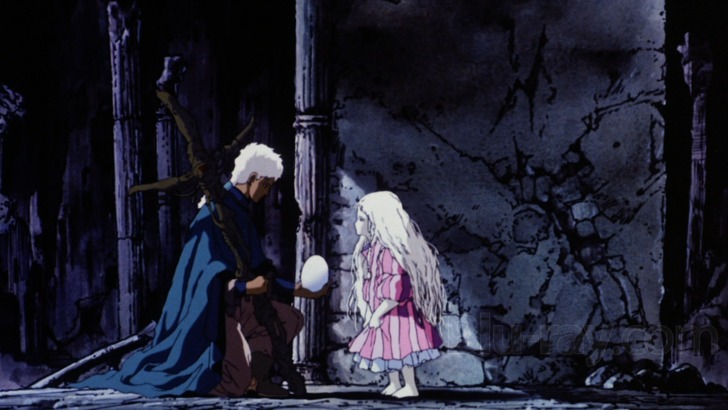
Let's begin with the obvious - how Mamoru Oshii's original version of Angel's Egg (1985) isn't available in the West but this notorious American reinterpretation from Roger Corman's New World Pictures is baffled me as it has for many. I don't blame those who licensed this version mind, neither Code Red in the United States or Arrow Video in the United Kingdom, as its likely the sad case the license for Angel's Egg is difficult to acquire or priced too high. (If by any chance it's due to New World Pictures or Lakeshore Pictures, the later owning this license, then someone would've grumbled about it by now, but bear in mind anime has been notoriously pricy at times to license from Japanese companies). In contrast, In the Aftermath was, from the looks of things, an entirely different license as a New World Pictures creation, Lakeshore Picture owning the rights since 2002. And honestly, whilst it's a ridiculous train wreck at many points and inferior to the original Angel's Egg, I'm glad we still have a 2k restoration of In the Aftermath, even if my own idealised version would'e been as an extra to the superior Japanese production.

As it goes New World Pictures ended up with the license for Angel's Egg, to which the likes of producer Tom Dugan thought it was an incomprehensible work. Angel's Egg, for those who don't know what it is, is an experimental theatrical animation by Mamoru Oshii, cult anime/live action director of the likes of Ghost in the Shell (1995), in collaboration with the legendary illustrator Yoshitaka Amano, who'd become acclaimed enough to have his work in art galleries after a career starting in anime production in the late sixties. Oshii, originally desiring to become a Catholic priest, clearly made Angel's Egg as a parable about religious doubt, with what you do see in In the Aftermath in terms of original footage enough to show it was very open in the conclusion without ever drawing a line onto either side, the title referencing an egg the iconic animated girl character had which either was an angel's or had nothing inside it. The New World Pictures version still also includes the sequence of fishermen trying to catch shadows of giant fish which cling to their city walls, only destroying what they try to hit with harpoons, a metaphorical sequence that, even if Oshii views the film more of a mood piece nowadays, still has this visible message within itself.

A lot of Angel's Egg is understandably abstract, intentionally so and soaked in a post-apocalypse built around the best representation of Amano own work and some of the best animators on staff from the eighties anime boom. It could've, however, been sold to an American audience by New World Pictures, rather than making an even less comprehensible version in In The Aftermath, if you'd just sold it to the art house crowd Roger Corman once did with Federico Fellini and other European films. Hell, for the visuals alone, this could've appealed to the cult film crowd even if the original film has very little dialogue and a lot of slow, languid scenes as it's a trippy, strange film even without the visible existential message.

Somehow, trying to make the film more sellable, another issue being that at seventy or so minutes Angel's Egg was seen as too short, the people behind In the Aftermath making something even less coherent at times just to fit their perceived parameters. To see it to the VHS market (though it did have an Australian theatrical release), the animation is used as an alternative world overlooking ours, actually like the angels of It's A Wonderful Life (1946) where the original protagonists, the white haired girl and a young male soldier, are now siblings and with the young girl to be sent to Earth, in live action, which is a wasteland where the ozone is poisoned and clean air is a precious resource.

It's actually not as disastrous as the reputation is. The infamy is how not only someone thinking this was a good idea, not helped by the original film not being available in the West still, but that to "make sense" Colpaert, an apprentice to Peter Bogdanovich, wrote a new script of utterly ridiculous (and quotable) dialogue about men crying about a world without fish and the girl being spanked by her older brother with asteroids as punishment for falling asleep. The project, even if I wished an English dubbed version of Angel's Egg was the version released rather than this misbegotten belief of trying to make a more "sellable" version to the West, is still compelling now we know it's an utterly perplexing creative decision, a time capsule to this bizarre cultural reinterpretation to sell films that still happened into the 2000s, whenever Miramax got hold of work like martial arts films for example, but is also alien to many world cinema fans as a practice. In 2K resolution on a Blu Ray, Angel's Egg as an animated production is incredible, causing one to weep that it is available outside Japan barring bootlegs; it is a project of the era, a box office failure whose production was only possible due to how the bubble economy grew in Japan during the eighties and, before the bubble burst at the end, there was enough money going around including in the animation industry to fund these bold projects.

From https://images2.static-bluray.com/reviews/14844_1.jpg

Oshii
himself, whilst he can be difficult for many, is an intellectual auteur, who even when he now claims the film is vague in meaning laced the film with too much clear symbology of his own spiritual crisis. This, as mentioned, is the only project to fully capture Yoshitaka Amano's art style too, so it is painstaking in capturing his gorgeous yet highly detailed illustration right down to the difficulty the animators would've had in just animating the movement of the clothes and hair of characters. The production team, with individuals who'd go on to the like of Akira (1988) to My Neighbour Totoro (1988), were not slouches either.

The live action isn't, even if low budget, letting the side down however in ingenuity. I will mock the point of even creating the film as it was, and mock the script, a really bad case of presuming an audience couldn't catch the vibe of the original or even just admiring the pretty pictures in spite of finding it slow, but I won't deny it's a great example in terms of clearly having so little to work with, two locations for sets and a few actors, and trying with some damn good ideas to make something interesting even if the script is gleefully gibberish at point. The two locations were chosen well, the factory in particular also used for Terminator 2: Judgement Day (1991), the kind of evocative set you could find in Andrei Tarkovsky's Stalker (1979) to a b-movie; by all accounts, an actual closed factory, it might've been dangerous to film there with those dust clouds onscreen looking too irradiated in chemicals abandoned there for comfort. Cinematographer Geza Sinkovics does his hardest to help the live action sequences, but its score composer Anthony Moore who deserves a moment of praise. An experimental composer who has worked with the likes of Henry Cow and Pink Floyd, he's a vital element in improving this film, in tandem to some of the other visual tricks at hand the person who comes close to matching the original source material in evocative mood.

Even when the animation is spliced into the live action, to try to make it work, there's also an eeriness that works. The premise, an "angel" sent to save Earth from environmental devastation is depicted by only six cast members (including lead Tony Markes), groans under trying to rationalise an art film into a pulp b-flick, but there's a sense of the unnatural to still appreciate because of this. The anime still has power even in this bastardised form, and the live action is appropriately eerie when you ignore the story.

Instead, the script, by the director, should be appreciated for going into non-sequiturs even weirder than the source, which was strange for its open ended ideas and the psychedelic dialogue but, when characters actually spoke, was very precise and sombre, building to the themes of spiritual ambiguity. Some of what is found here is potent whilst still strange, Markes in a gas mask playing a piano to a female doctor (Filiz Tully) he encounters, but spanking people with asteroids is just the kind of line screaming for baffled reactions. Angel's Egg had limited dialogue, a lot of silence that was clearly seen as unsellable considering the decision to cram voiceover to sell it, all of which adds an unintentional absurdity. Thankfully, it wasn't dull, pedestrian sci-fi exposition; instead, its lore that makes no sense but is fascinating in how this is an attempt to make the original work "makes sense" but becoming something gloriously off. The largest monologue in Angel's Egg, the young soldier retelling the tale of Noah's Ark with the boat drifting on an ocean never finding land, is turned into a nonsensical tale of deception where fish floating in the air on a planet are stolen that has to be heard to be believed.

It makes no sense why this executed plan was meant to be more marketable, but whilst I imagine an alternative world where Angel's Egg was sold as a more avant-garde Ingmar Bergman movie to art film audiences, In the Aftermath was what we got and is still rewarding for how odd it is. The real tragedy is that, whilst it helped introduce Westerners to Angel's Egg, it never lead to Angel's Egg actually being released; New World Pictures, among their work, also released an "Americanized" version of Nausicaä of the Valley of the Wind (1984) as Warriors of the Wind, the original pre-Studio Ghibli film now available whilst that version has vanished, yet nonetheless for a certain generation probably thanked for letting them still see anime for the first time. We thankfully left this need for alternative versions of foreign titles, but considering how extreme and peculiar In the Aftermath is, I am glad it's still available. That it's not an extra to the source and the only restored version in the West of the two films is tragic, but the oddity shouldn't be blamed for that.


From https://admitonefilmaddict.files.wordpress.com/2019/01
/In-the-aftermat-2.jpg?w=672&h=372&crop=1