Showing posts with label Kunihiko Ikuhara. Show all posts

Tuesday, 16 August 2022

#221: Mawaru Penguindrum (2011)


Studio: Brain's Base

Director: Kunihiko Ikuhara and Shōko Nakamura

Screenplay: Kunihiko Ikuhara and Takayo Ikami (with collaborations from Shingo Kaneko and Tomohiro Furukawa)

Voice Cast: Miho Arakawa as Himari Takakura; Ryohei Kimura as Shōma Takakura; Subaru Kimura as Kanba Takakura; Marie Miyake as Ringo Oginome; Akira Ishida as Keiju Tabuki; Mamiko Noto as Yuri Tokikago; Yui Horie as Masako Natsume; Yutaka Koizumi as Sanetoshi Watase

Viewed in Japanese with English Subtitles


[Contains some plot spoilers]

This is a special work to cover, and in the time period it was released, Mawaru Penguindrum, mostly known for many as just Penguindrum, was the first title Kunihiko Ikuhara worked on in the driver's seat for twelve years. This was my first production from Kunihiko Ikuhara, going off a reputation of a work out of availability in the United Kingdom, in the legendary 1997 TV series Revolutionary Girl Utena, at the time, yet was the perfect period to discover his work. Made by Brain's Base, with co-direction of the series with Shōko Nakamura, those involved with Penguindrum are just as worthy of praise, but this was significance that Ikuhara had effectively been in exile since The Adolescence of Utena (1999), returning with this complex production. Penguindrum was a considerable return, and it is a heady production in content, aesthetics and themes, with the grace that, as if making up for not working throughout the 2000s, Ikahara in the 2010s effectively made a triptych of titles with Penguindrum, Yurikuma Arashi (2015) and Sarazanmai (2019), which share the aesthetic touches and his attitude to telling serious points.

Penguindrum out of all of them is the more ambitious to return to, juggling a precarious challenge between humour and empathy against some of the most sombering subject matter a show can have even from the get-go, with the set up that brothers Shōma and Kanba Takakura have a terminally ill younger sister Himari. Collapsing whilst visiting the aquarium, it sadly seems she has passed, until the flamboyant penguin hat they found at the gift store resurrects her, and has a personality within it which is brazen and requests that, to save her life, they need the acquire the titular Penguindrum. The Penguindrum itself is something which is vague throughout the series, but becomes a huge connector in themes and mood, all initially stemming with a young teen girl named Ringo Oginome and her diary, someone Shōma goes with but realises is stalking his male homeroom teacher Keiju.

The show is already challenging even if, at first, its first act is initially humorous, the tone comedic as Ringo's goal to win over Keiju to love her is playfully absurd, but all in mind, including literally sleeping under his house, her goals are problematic. The comedy of this initial set-up, including the more problematic nature of Ringo's goal, and the sympathy you yet have for her when you learn quickly why she is doing this, part of a trauma of her parents simply divorcing, is an initial gamble for the story to have take. Penguindrum is entirely a gamble, with one outright villain notwithstanding, all about damaged and traumatised people trying to find themselves even if they will consider deeply objectionable choices, even that villain the result of a world within itself, while love is the answer, marked as equal by cruelty. This is more a challenge in how this is depicted in the style that would be Ikuhara's 2010s aesthetic style with his production teams. Originally he was openly inspired by the Japanese avant-garde to the point that, for Utena, J. A. Seazer, known for his collaborations with film maker and experimental theatre creator Shuji Terayama, to compose music for that series and partially for the theatrical film. The difference here is that this feels of the 2010s as the later shows in tone.

When I had reached Ikuhara, he made his first toe dips with digital animation with The Adolescence of Utena, embracing the modernism of the changes in the animation industry without losing his initial style, a pop surrealism but a style with distinct layers. It is a style which takes real drama but with metaphors to it that over-the-top at times, but also capable of incredibly subtlety in evocative imagery. The Penguin hat's real world, setting this up, with the pace and tone of a magical girl transformation sequence, if combined with a music video, has enough to unpack in just the first time it appears. The bear mecha, elegant costumes, bright colours, music for the show which is symbolically interlinked, symbolism which only is unpacked by the ending and can be missed, and even the incestuous tone of the first "Survival Tactic" sequence, which begins the quests with the sensual gripping of the heart and has loaded meaning when more is learnt of these characters back stories.

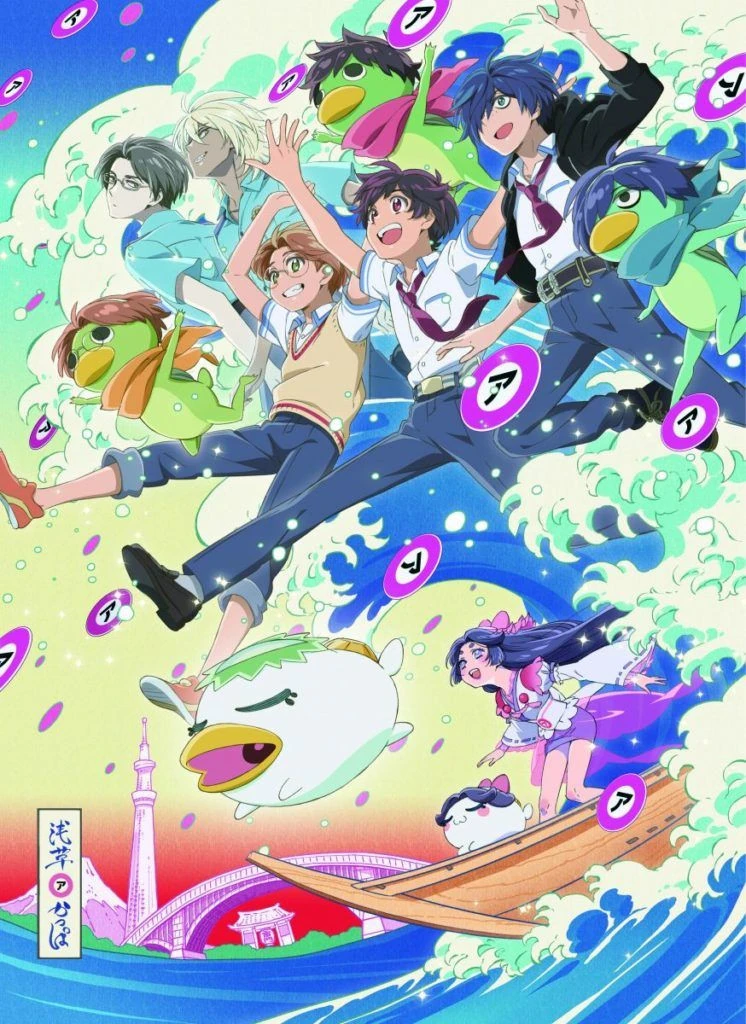
That is not even mentioned the penguins. The three shows from their creator are all symbolised by animals or mythological creatures - later bears for Yurikuma Arashi, kappa for Sarazanmai - with penguins the mascots here, sent to the Takakura family as representatives for each of them, which cannot be seen by anyone else but are very real. There is so much within Penguindrum - referencing Kenji Miyazawa's Night on the Galactic Railroad explicitly throughout, dealing with parental trauma, both of a terrorist act and also parental sexual abuse, abandonment for children, cults and even explicitly the 1995 Tokyo subway sarin attack by the Aum Shinrikyo cult - and yet Ikuhara and the production team still have the anthropomorphic penguins even in serious moments present, symbolically connected to the themes but openly comedic. This for me, back when I first saw the show, and still now, show the bar of quality Penguindrum has above many animated series, in how this takes some huge dives into plot twists about the skeletons in characters' past, and yet can within the same scene combine moments of pure sincerity even with comedic penguins. The penguins present the ids of those involved, less Himari's ,but for Shōma a neat freak with an obsession with eating anything and everything, Kanba 's following his womanising a perverted penguin with nudie mags and stealing women's underwear, and this touch manages to even make jokes which would be cringe worthy work, such as a joke about women' underwear managing to actually be funny when it involved a sentient penguin.

There is a fourth penguin, and whilst later shows from Ikuhara were around twelve episodes or so, Penguindrum has twenty four, and a lot of characters to flesh out, all with their own traumas and self discovery to find including Masako, owner of the fourth penguin who is removing the memories of Kanba from his ex-girlfriend and wishes him to be by her side. Ikuhara and the screenwriters, with the creative team involved, manage with all these characters to tackle some incredibly adult and even transgressive material in a show which on the surface is incredibly bright and will be playful in tone. Characters will commit to awful acts, and yet everyone will be revealed to be sympathetic, be it Keiju with his fiancée, a Takarazuka actress Yuri, Ringo with her own need for closure when she is trying to bring her parents back together, and her late sister Momoka, a girl with the unnatural ability to change fates who is central to the Penguindrum itself and the narrative. In its centre is a terrorist attack in 1995 the Takakura children' parents were involved with and is a lasting scar for the boys, a ghost to return when a character named Sanetoshi, a literal ghost, wishes to try for their destructive act again even if it means playing with the hearts of many and even try to corrupt one of the Takakura siblings to his side.

It is a show where from the first episode to the last, the world has drastically altered over the time, the perceptions of the characters so radically changed as secrets are revealed, to the point the tone has drastically changed too, all linked to the diary that Ringo inherited from her late sister Momoka, Ikuhara's style using fantastical metaphors for people's emotions and fantasies, even for incredibly bleak material such as the theme of child abandonment, dubbed " The Child Broiler" in this series where children who in real life would be ignored and left in the cycle of foster homes, or on the streets, even ordinary children who never get a chance to stand out even if they had ordinary lives, are shredded here and become "invisible", not allowed to stand out as individuals. The light touch to its content is set up within the first episodes with a character who is at first an unapologetic stalker in Ringo, wishing for Keiju as an older man to fall for her as a teenager, a perfect set-up for how severe some of the content is, yet can have risks taken to them such as these episodes being incredibly funny despite being about a female stalker.

One of the best earlier episodes about her goal in this, only to realise its folly and find herself falling for Shōma instead, is set around a fantasy, one of many in her delusions designed like a pop up fairy tale book based on 18th century French/European aesthetics, a farce for the whole episode in trying to win over Keiju at the park involving his fiancée, a pet skunk that has gotten loose, and a disastrous attempt to use a hairy caterpillar. Yet even within this first act, which spirals out and even undercuts the relationship between the Takakura siblings, it is a still a grim tale for Ringo which she learns to escape from before she makes a legitimate mistake, one with psychological damage likely to happen for herself and for Keiju if she had committed to it. Even when done for humour this is a constant, Masako's back story one of the later episodes which is exceptional too, episode sixteen with credit to co-writers Shingo Kaneko and Tomohiro Furukawa, for a one-off between them, landing fully. It reveals she was raised with her sibling Marion by their grandfather, a giant in industry she inherited the wealth and power from, but a horrifying figure of toxic masculinity where, even as a child, she has dreams of assassinating him just to protect Mario from being turned "into a man". It is done with humour, so much so that, even in mind with the limitations of English acting in Japanese dubs, knowledge of Ikuhara having spent time in the United States makes even the casting of the grandfather's Western male assistant, with his wooden exclamations, likely to have been on purpose. Based around a series of macabre farces, imagining herself killing her grandfather, before his idiotic attempt to prepare poisonous blowfish by himself becomes his ultimate demise, it is a great episode within any other series, fleshing out a major side character, but here is one of many raking risks.

In these fantasies and light flourishes are however still the grim content, including material which some will find deeply uncomfortable in watching. One plot thread which is reoccurant, and is the one which was a risk to include but manages to find a dramatic weight in, is that characters nearly commit the act of drugging individuals with the intention of sexual relations with, which is an even bigger taboo with good reason a decade after the show was made. One is a joke involving the aphrodisiac from a rare toad, but the other two have Ringo herself, and then Yuri, nearly make the mistake of something harmful for them and the person involved. Yuri's is more transgressive, and why despite its light touch this was a rare anime to get an eighteen certificate in the United Kingdom, a rating for physical media which only very sexually explicit or violent work get.

That episode in another's hands would have turned Yuri into a predatory lesbian with severe psychological damage from her childhood, as crass and offensive as that would be. In mind to Utena and Yurikuma Arashi being explicitly LGBTQ narratives about women, escaping patriarchal views and true love between women, and Sarazanmai touching upon a male lead admitting a crush on one of the others, Ikuhara is someone admired for these works for these characters and themes, someone whose contributions to depicting gay characters in his work and how beautiful the depictions of them were will be one of his lasting legacies. Here Yuri's story is a huge risk he could have failed at, still could have been disastrous even with all the well wishes from other work, but as well, this is far more nuanced. Her back story is as bleak as it gets in the show, of a father's abuse of both a sexual and harmful kind, metaphor through the chiselling of stone so he makes her "beautiful", and that her life like others is embraced around the loss of Momoka, a figure who brought happiness to characters who were in despair and was lost when they were all still children, reflected later when another tries to get revenge for her death on Takakura family for the sins of their parents. In mind that these two bleak moments, one a male victim of drugging, the other Ringo herself, they do need to be warned about as they are extremely adult subjects to have tackled, but these are the moments where the show has nuances some anime never reach in managing, somehow, to make these characters, on both sides of the scenes, sympathetic and the content with meaning.

There is of course the subject at this anime's centre, which manages to have been an even greater risk to tackle. In 1995, the religious cult of Aum Shinrikyo set sarin gas off in the Tokyo Metro subway, killing fourteen bystanders and injuring over a thousand, a subject whose resonance as a tragedy over the years has been broached in art including Haruki Murakami's Underground, a 1997-8 non-fiction book interviewing victims of the attacks and members of the Aum Shinrikyo cult, a book which is included in a scene in the background with a Murakami short story, Super-Frog Saves Tokyo, explicitly referenced in an episode whilst the character cannot remember its exact title. Penguindrum is explicitly referencing this tragedy in its opening credits of the first episode, with the terrorist attack here set in 1995 too, with subway trains and fate being interwoven on them the common metaphor. Fate is a huge subject of this, including that baring one villain, everyone here is a person of complexity, even the terrorist group's undefendable attack stemming from what they thought was a cruel world, one which abandoned children they adopted in the Child Broiler, and they felt such an extreme act was necessary. The show manages, with such a real subject and uncomfortable subject, to succeed, and with its vast amount of plot strands, its various repeating metaphors (the apples for example) and its many risks including all the comedy and whimsy still here, it is an ambitious success for televised anime. It is, out of the three from Ikuhara's 2010s, the most complicated and arguably the most challenging. It is however also something beautiful, literally in its craft and in its heart, and absolutely a gem from the decade it was made in.

It was the first of Kunihiko Ikuhara's work I had seen, as mentioned early in this review, and it is in hindsight such a vast production to have discovered him through, but one whose lasting impact left me a fan of his work, and returning to was stronger now than it was before, right up to the final episodes, with the explicit Night of the Galactic Railroad references, a bittersweet happy ending and full abstract metaphors beautifully depicted. The project's lasting influence can be seen in the curious choice, in 2022, Ikuhara with studio Lapin Track created the two part compilation films, for theatres, called the Re:cycle of Penguindrum (2022). Compilation films are a curious concept in anime, especially in trying to tell the nuisances of Penguindrum's original twenty four episodes in two films, but alongside new material, and Momoka's prominence as a character taken further, clearly there was a reason for Ikuhara to return to this show's themes. There was material worthy for him to bring back to the public as much as, even if I view this 2011 series as perfect, he felt he could retell differently in a new way. The source material for this decision enough is still special even in the modern day, and further attention on it was worthwhile.

Monday, 9 March 2020

#140: Adolescence of Utena (1999)


Director: Kunihiko Ikuhara
Screenplay: Yōji Enokido
Based on the manga by Chiho Saito and the Be-Papas
Voice Cast: Tomoko Kawakami as Utena Tenjou; Yuriko Fuchizaki as Anthy Himemiya; Aya Hisakawa as Miki Kaoru; Kotono Mitsuishi as Jury Arisugawa; Kumiko Nishihara as Shiori Takatsuki; Mitsuhiro Oikawa as Akio Ohtori; Takehito Koyasu as Touga Kiryuu; Takeshi Kusao as Kyoichi Saionji; Yuka Imai as Wakaba Shinohara
Viewed in Japanese with English Subtitles

Even into the 2010s, the United Kingdom never got Kunihiko Ikuhara's seminal 1997 series Revolutionary Girl Utena as a release. MVM nonetheless released the 1999 tie-in film as Revolutionary Girl Utena: The Movie. This film is a thirty nine episode story condensed into less than ninety minutes, which does prove an obvious issue for a first form of this franchise to see. I however am externally grateful to them for this curious decision as I've now seen Adolescence of Utena, which eventually doesn't become something under the series' shadow but something greater. The result in just ninety minutes is a surreal one-off that ties Ikuhara's work, a franchise with a huge significance for LGBT anime and manga fans, LGBT themes being discussed in a major project in the series, and is tied to even Japanese avant-garde art and the films of Shūji Terayama in some of Ikuhara's creative choices.

Ikuhara, alongside likely directing episodes of Teenage Mutant Hero Turtles, cut his teeth in the anime industry through the Sailor Moon franchise, which is notable as it deviated from the original Naoko Takeuchi manga with the nineties anime franchise its own huge cultural beast. Reolutionary Girl Utena was his seismic powerhouse, let loose and still having a profound effect today, to the point most people probably don't realise it's based on a 1996 manga created as part of a circle involving him called the Be-Papas.

Trying to assess a full plot is going to be an issue as this is a retelling of a series, but sticking to the film's form alone, it can be boiled down to this: in a school existing out of time, an ever shifting entity like a living M.C. Escher painting, sword duels between students are taking place with the prize for the winner being the "Rose Bride" Anthy, who is explicitly for this film a figure who will be with the victor even in bed. The titular Utena, a new female student, discovers about these duels and intervenes out of indignation and by pure accident, having accidentally found a ring important to her is a symbol of dualists, winning a duel when provoked and thus tying herself and Anthy together.

You cannot talk about any Utena, even just the film, without considering just how significant it was for LGBT fans as, ironically alongside Sailor Moon which had a lesbian couple awkwardly dubbed as cousins in the American export, this is a love story about two young women. Utena in this film is hostile and pining for a male friend, but the romance between her and Anthy grows over the course of the film. It's explicit in the film at the beginning what is intended in how Utena is introduced in the first scene, very short pink hair and dressed in boy's clothes, before their slowly growing romance blossoms and becomes the crux of the narrative. A lot of people to this day speak of how much of a watershed moment this franchise was, such as Erica Friedman, a proud gay former publisher of yuri (girl's love) manga, a writer on the subject, and who got to present Adolescence of Utena at the Frameline Film Festival in San Francisco, the British LGBTQ Film Festival and the Tampa LGBTQ Film Festival back in the early 2000s1.

Coupled with this, and still felt profoundly even in this abridged version of the series, is the delusions and heteronormative trap of fairy tales. The "prince" who rescues the princess as in old Disney films aren't good, either an illusion or an unhealthy concept,  the back-story of Anthy with her brother having a dark, incestuous aspect as Ikuhara never pulls his punches in dealing with adult subjects in bright colours, especially as this back-story is elaborated on further in the television series. The only good prince is Utena herself, who decided to become one even if she eventually reveals full length feminine hair in contrast to her masculine dress. Set in an ever changing, shifting fantasy school Utena whilst beautiful to look at constantly reveals the artifice throughout, a place that is an illusion that eventually crumbles in shadows and horrors.

Significant to this is how gorgeous this production is. Ikuhara is someone I call "pop surrealism" because for me, the "pop" is his use of bright colours, very clear symbolic motifs (roses here) and the energy of his work that can juggle comedy to drama, such as the abrupt cameo of a character Nanami but only in a gag segment as a cow stood against very serious subject matter. This is the only theatrical film Ikuhara has made - a production even co-produced with Sega, which is likely explained with them collaborating on a 1998 Utena Sega Saturn game - and it's stunning to witness in the quality and the early use of computer animation which thankfully gels.


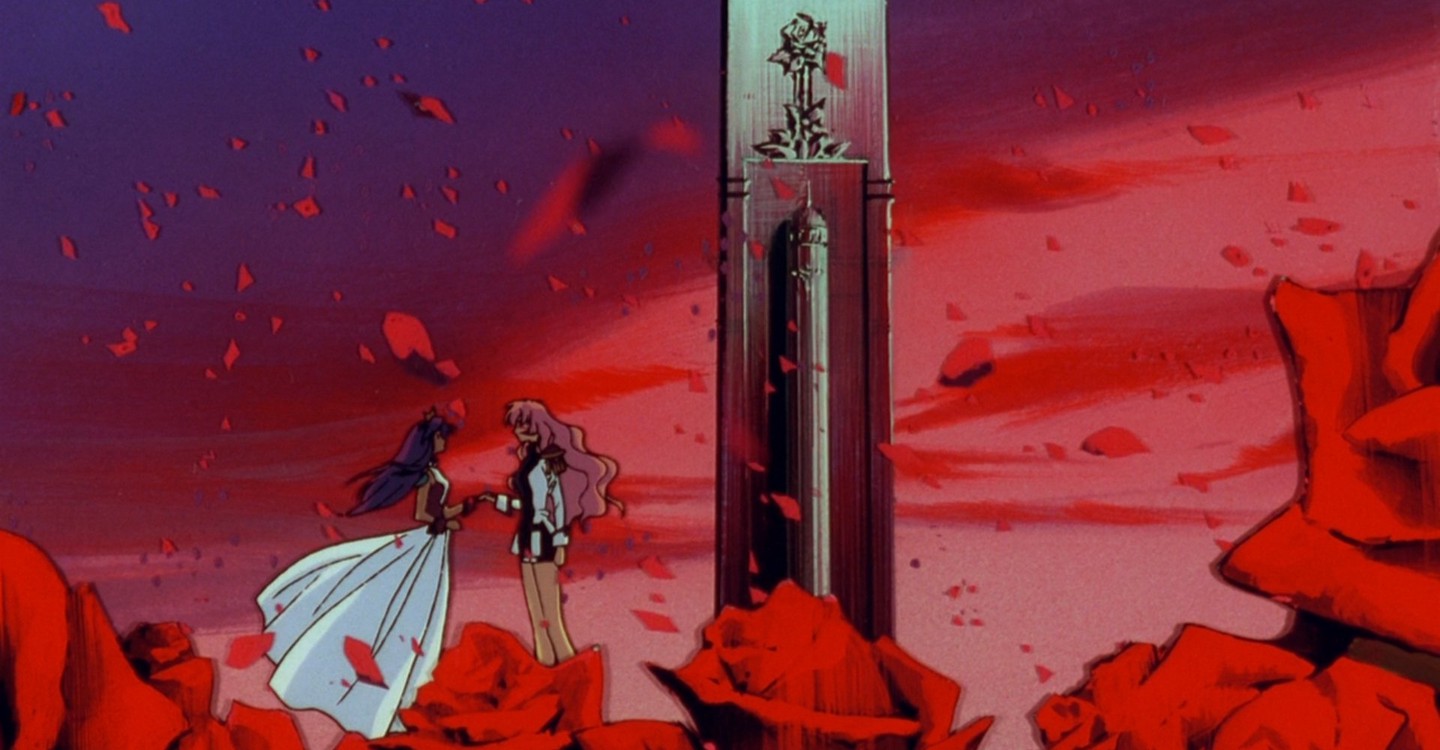
Here it's notable how much Ikuhara was influenced by Japanese avant-garde art. Probably one of the trademarks of this tale, found here, are the silhouette girls, schoolgirls entirely as black shadows (without any features) in school uniforms, who act as a Greek chorus, even acquiring a salacious videotape involving Anthy and her brother. One of the most striking sequences, when the leads fully connect, is literally staged on a pool supported on top of a tower full of roses. The other pronounced choice is J. A. Seazer, an experimental composer whose trademark is combining theatre and rock music who Ikuhara explicitly hired for the television series to compose songs for. With his trademark chorus singing to acid rock guitars, Seazer's only other anime contribution was to the notorious independently made Midori (1992). Beyond this, he's famous for his work in live action cinema with Shūji Terayama, the experimental filmmaker who is tragically under seen and whose work clearly inspired Ikuhara in hindsight for myself, productions like Pastoral: To Die in the Country (1974) very much psychodramatic and surreal films with bold visuals and choice of colour. The Seazer music here, especially in the few duels seen, is exceptional as is the score by composer Shinkichi Mitsumune.

Also of note is screenwriter Yōji Enokido, who deserves a lion's share of the praise as, as I look into his career, whilst it is smaller than other's he's made a career of idiosyncratic work. Penning the story for FLCL (2000) in particular on his resume immediately suggests someone very comfortable with surreal and unconventional storytelling, and considering he also penned the TV series, it's for the better the person who worked on the TV series tried to compact this into a smaller and more subjective piece.

Does the film actually work though, especially as I have never seen the series? If we were talking about just the first three-quarters, it's a gorgeous piece to watch, but a curiosity only from Ikuhara. Things change considerably in the final act, starting for me from a sequence in an elevator involving water, which brings on from there and onwards a level of great emotional relevance to the characters barely touched upon that cannot help but over take me. Then the divisive final sequence happens, and Adolescence of Utena becomes incredible. I cannot spoilt it, because just describing the scenes in a sentence isn't the same as watching the finale as I have learnt thinking of this film over the years, that a character is turned into a car and the final act is a car chase to escape into the real world.

It is one of the most surreal things I have witnessed, where even the mech animators hired were baffled infamously why they were hired for a Revolutionary Girl Utena film themselves. The result also happens to be one of the best things to have been done in theatrical anime, an exceptional short in its own length of animation, spectacle, emotional power and symbolic power. The car metaphors in the film are strange but a) Ikuhara has been quoted in being inspired by a craze for supercars in the seventies which he viewed as a juvenile fantasy2, connectable to the dangerous fantasy of fairy tales and found in the TV sereis, and b) there's loaded symbolism in Anthy's brother and his madness which we eventually see being connected to his desperate search for car keys, fearing if they cannot be found the "car" will rust.

The finale is something to behold when, if considered, the symbolism is simple and understandable with a spectacular result. The leads must traverse the perils of a fairytale castle, now a monstrous hundred wheeler that can crush cars underneath, to find happiness. Even if happiness is in a literal wasteland, as it is no longer the delusional fantasy, reality is found and the ending sequence turns the Adolescence of Utena beyond a curiosity in Kunihiko Ikuhara's career, but a crowning gem.

And thankfully, it has lasted. This franchise is still held highly to this day, to the point that arguably this work is just as monumental to anime in the nineties as Neon Genesis Evangelion and Cowboy Bebop (1998-9) are, the kind of show that has been itself an influence, as can be attested to Stephen Universe creator Rebecca Sugar admitting this for her own famous work3. At the time, this was followed by an absence from Ikuhara in the industry, still working on other projects as well as in other mediums, but never directing any titles throughout the 2000s. Thankfully, in 2011 we got Mawaru Penguindrum, leading to a trilogy throughout the 2010s alongside Yurikuma Arashi (2015) and Sarazanmai (2019). What the 2020s will lead to for him will be of interest and baited anticipation. For myself, until the TV series itself, this is a pretty big title in my own personal fandom to finally have seen, and by God did it exceed expectations.


=========
1) HERE

2) "When I was little there was a supercar boom. Maybe because of that, even now such a car is something that satisfies childish desires in the adult world. A car seems like that sort of thing. As you grow up toys tend to disappear quickly from your life. Even if, as a child you wanted a model of robot, when you’re an adult these sort of things that you want seem to disappear, isn’t that so? Well, you may want something like a house, but obviously, it’s a little different from wanting a toy. My idea of a car is something that is exceedingly close to an adult’s toy..." - "Be-Papas Interview". Animage. 20 (1): 4–13. May 10, 1997. [Found HERE]

3) HERE

Thursday, 5 September 2019

#117: Sarazanmai (2019)

From https://vignette.wikia.nocookie.net/sarazanmai-kunihiko-ikuhara/images/
2/23/Sarazanmai.jpg/revision/latest?cb=20190526195430


Directors: Kunihiko Ikuhara and Nobuyuki Takeuchi
Screenplay: Kunihiko Ikuhara and Teruko Utsumi
Voice Cast: Ayumu Murase as Kazuki Yasaka; Kouki Uchiyama as Toi Kuji; Mamoru Miyano as Reo Shinsei; Shun Horie as Enta Jinnouchi; Yoshimasa Hosoya as Mabu Akutsu; Junichi Suwabe as Keppi; Kenjiro Tsuda as Chikai Kuji; Mariya Ise as Otone Jinnai; Rie Kugimiya as Haruka Yasaka; Takaya Kuroda as Otter; Teiko as Sara Azuma
Viewed in Japanese with English Subtitles

[Some Major Plot Spoilers]

Kunihiko Ikuhara's weakest? Well, no that's a first sentence designed to bait a reader, but also in context of Ikuhara's career as a huge fan, I have to weight it against his career so far, which means that Sarazanmai in any other anime auteur's CV would be a great production, but here has to weight itself against a lot.

And bear in mind, I am a fan who has only been able to see his 2010s work, where after a decade of absence throughout the entirety of the 2000s, (baring some storyboard work on productions like Diebuster (2004-6)), Ikuhara finally came back into the director's chair with Mawaru Penguindrum (2011). This does mean I still have Revolutionary Girl Utena (1997) and its 1999 theatrical film, huge parts of his career, as well as his entire work with the Sailor Moon franchise left in front of me. This does however mean that there's Penguindrum and Yurikuma Arashi (2015) to be compared to up to the release of this 2019 production, which are as insanely strong and unique productions for the 2010s as you could get. Against them, Sarazanmai is definitely a more streamlined and, for his standards, conventional production. This is still a strong and idiosyncratic tale of three boys who are turned into kappa, a cucumber obsessed mythological creature, to stop kappa zombies so he hasn't thankfully become boring.

Notably, when his career has mainly dealt with female protagonists and with Penguindrum prominent female cast members in key roles, this is a show about men, which bearing a couple of female characters of note is a huge creative change for Ikuhara. It's also a show, eleven episodes for Fuji TV's Noitamina block, known for unconventional anime, which is about explicitly gay themes as well, interlaced with his ideas of emotional connection and stabs about the modern world. If there was any issue with the show, it is that with deliberate repetition involved, it's streamlined in comparison to the director's previous work I have seen, felt symbolically as this is a co-created work with Nobuyuki Takeuchi even if the later has been working with him since at least the Utena years. But it still has a lot of great reward.

The three leads represent ultimate three potential breaks from human connection. Kazuki is the normal kid, a talented soccer/football player, who is however revealed to not be the biological son of his family and thus having existential crisis which leads him to "no beginning", more so as drama involving this led to his younger brother being left disabled, the guilt leading to various behaviours to try to ask for forgiveness. There's been concern as one such act, masquerading as a female celebrity who does predictions and news reports on television, which has been called "trans baiting", presenting a potential transgender character only for this not to be, something I'll disagree with. There's a difference in gender binaries, which makes it inherently problematic to merely perceive a person dressing as the other gender as transgender, which needs to be taken in account in real life let alone in fiction, especially as being transgender is more than in terms of the physical appearance and dress, especially as the issue of cross-dressing in manga and anime where it was very common in the medium over the decades. Sarazanmai's only possible flaw here, looking at this character, is that it didn't have the time to explore Kazuki's decision to do this as there's clearly a pleasure to be found in it beyond text images to his brother to help him believe this famous figure is talking to him. That is not necessarily the flaw of the series but merely a practical problem.

Enta, his bespectacled friend, feels Kazuki is drifting away from their friendship, which is explicitly a romantic longing for his friend too. It is covered fully thankfully, even to the point that fearful of losing him, whilst ultimately a good person, does lead to him falling into petty actions beneath himself alongside showing clear love, left in a scenario of "no end" as this ending is only possible with Kazuki ever showing affection back. Having "no connection" whatsoever is Toi, the younger brother of a yakuza member who ended up murdering someone in childhood, scarring him, and in his teens is already cultivating marijuana plants to sell, an even bigger taboo as a crime in Japan with their extremer punishments for drugs, alongside other criminal activities. With a brother who told him the bad only survive, Toi is the one with the biggest issues of the trio.

The words "no beginning", "no end" and "no connection" are important as, without revealing everything, their opponents are literally controlled by an entity, portrayed as an evil shadow otter, who calls itself a mere concept and is a representation of despair. (Not as strange as a choice as you'd think as, if you research Kawauso, otters are shape shifters in Japanese who fool humans like foxes and tanuki, continuing Ikuhara's obsession with animal mascots for his shows). The kappa zombies are explicitly humans killed for their desires with the issue that, when exorcised, they are literally removed from memory and existence. Adding to these themes are the two otter cops, two minions of the evil otter named Mabu and Reo who have a tragic story of their own. As a result these two men who romantically love each other are caught in a Faustian trap which involved them literally picking up fresh subjects constantly - men who long for women for the most part - to turn them into the zombies which steal anything from cats, pouch bags and even women as brides around the central city of the story.

From http://www.allyouranime.net/wp-content/uploads/2
019/04/Sarazanmai-PFI.jpg

Ikuhara
likes to mix dark and adult themes with strangeness like this, even humour as Penguindrum even in its most serious moments; implicitly dealing with the 1995 Sarin Gas attacks on the Tokyo subway among other details, late episodes of that series when it got completely serious still had anthropomorphic penguins prating about in the background without it ever feeling inappropriate. Sarazanmai, initially vague in what is going on, ultimately becomes the theme of choosing between love or desire, which becomes itself the theme of despair or connection, even if to symbolise this the otter uses a giant factory which boxes victims, to extract their desires, and then shreds them. Surrealism for Ikuhara is a template for him to tell stories of emotional existentialism, though with "Kappazon" boxes everywhere and the otter's kingdom boxing victims before using them, he also clearly wants to take a dig at modern, cold high tech society with a swift punt. Thankfully, Ikuhara, working with Teruko Utsumi here, has never been a "political" creator, of obvious shallow takes on political and social themes, but someone who thankfully fleshed out such ideas in greater detail, be it challenging the patriarchal oppressions of gay women in Japan and their storytelling in Yurikuma Arashi to this with its swipes at Amazon. He has never shied away from difficult subjects, and the fact that he wraps it up in such colourful, idiosyncratic pop symbolism is why he got the auteurist name tag and deserved it.

And that's because he is wonderfully vibrant, subversive and colourful. It's noticeable, and dangerous to ignore, that he co-created this series with Takeuchi, which might explain the more streamlined approach, but this is still Ikuhara's themes and ideas. It's dangerous in anime, and frankly with any medium with auteurs (barring literature), to just say one person is responsible for a great work, especially as to even exist as an auteur Ikuhara had the help of an entire production staff on each of these shows I've referenced of his. But he is idiosyncratic and you can tell it's his work; he's thankfully someone then who has always had a damn good production staff, and his own past career in the industry before he got to helm whole projects, to work from. It's strange, having only known of his work from the 2010s, as his older work isn't really available in the British Isles at all, he skipped an entire decade of the anime industry and negated the difficult transitional period from hand drawn to digitally assisted animation of the 2000s. Even the late 2000s, if in subtle ways difficult to describe, looks very different from the type of anime in the 2010s which is vibrant and distinct in its own way, the style his work fits like a perfectly sized glove.

Nothing in Sarazanmai is aesthetically disappointing, the use of repetitious symbolism common in his work one of his prominent trademarks. Football becomes a symbol of friendship. Kappa good, otter evil. Boxes and conveyor belts oppressive. The idea of exiting existence, cutting all connections, reduced to a two dimensional diagram of a ball pushed into a black void like a pinball machine. And I have not even mentioned how Ikuhara snuck past the producers that to exorcise desire, never mentioning it and then adding it afterwards, is to absorb the force out of the anus, or if the figure is large enough to climb up its rectal passage and extract a giant orb of desire to bring back. It's amazing that this can be gotten away with, as it's very graphic, but I guess that the inherent comedy of the scenario completely separates it from anything too much for TV. Of course, Ikuhara never mentioned it, which is dangerous to have done but also awesome to know as a detail.

Neither have I mentioned this is a musical for large portions of the series. Music has always been important to Ikuhara's work, but this is another different change of pace for the director. Many of these details, when you are used to Ikuhara's style, makes sense in his own logic, the musical numbers expressing the themes and characters' motivations a lot more poetically than exposition. Even the butt obsession, with the knowledge of the custom of kanchō, a prank performed by clasping the hands together in the shape of an imaginary gun and attempting to poke an unsuspecting victim's anus, befits the idea that, if you have a vulnerable area of the human body, you'd presume it to be the weak spot. Especially as the desires extracted, including wanting to be someone's dog to quote Iggy Pop and the Stooges, are explicitly sexual or about the conflicts of romance and desire in the first place, it isn't a surprise if he took a risk here too. The man who ran with the flower symbolism in Yurikuma Arashi to the point it was just openly sexual wouldn't shy from this either here, and with the erotic caressing of a robot heart involved too, he gets away with this type of material on Japanese television, makes it nonetheless approach and even sensual, and never feels crass for it.  His style, of bright colours and yet layering it with this type of explicit subversion, has always been a commonality for him and these details are just examples of this.

A complaint can be made that the show, as mentioned, is very repetitious, reusing scenes and playing as a monster of the week story over half its length, repeating these events mentioned in the last paragraph over and over again. Thankfully the show builds to a huge climax in the final four episodes, a huge risk were it not for the fact the episodes before built towards detail and characterisation being spoon-fed slowly to the viewer. Forced to work together as the desire souls will provide them a "dish of hope" that grants wishes if they collect enough, the process of exorcism leads to accidental leaks of the central trios' secrets to each other; it feels already a better spin on this type of material, that such paranormal/supernatural work would lead to leaks of thoughts, but it also builds a lot of the drama, especially as these characters to find happiness will have to sacrifice their desires and find love instead. That the "villains", baring the otter, aren't truly evil, a commonality also for Ikuhara, and eventually grow in plot exposition means that once the show fully escalates, it deserves the patience you had for its repeating narratives.

And Ikuhara always balances out the darkness of his tales with happiness, even stories which have bleak endings still bitter sweet. Arguably this has the happier ending of the three shows that will make Ikuhara's 2010s work, though it's not without some drastic changes in pace and plot revelations throughout. His style, due to how unpredictable it is, allows for this to fit altogether for these major changes especially in the final episodes, and it's clearly the work of a man who is a hopeful person who champions love and virtue. He thankfully comes from the school of having to earn that happy conclusion, showing as much the heroes' futures likely to not always be good, and playing with a clever structural trick with the opening and ending credits for the final episode for a dramatic build.

Kunihiko Ikuhara's weakest? Of the 2010s, yes as the two previous anime series he's helmed are so good this finish of this decade's trilogy had a lot to compete against in expectations. But the series itself is better than most from the last few years anyway from what I have covered. His weakest is still thankfully excellent, so it was a wonderful experience to see him again, especially as in this particular case the world of streaming anime means you could catch up with it the same year, only months after, it premiered on Japanese television. Time before I would have to wait impatiently, and that's as much because, annoyingly, he's a cult director who isn't a huge mega selling star; as we wait impatiently in the United Kingdom for Revolutionary Girl Utena to actually get a release here, my view of his work from these 2010s trilogy is still so unique, their conclusion unless he suddenly snuck a fourth surprise by the end of the decade a perfect one.


From https://i2.wp.com/anitrendz.net/news/wp-content/uploads
/2019/07/Article-2.jpg?fit=1280%2C720&ssl=1

Friday, 7 April 2017

#41. Yurikuma Arashi (2015)

From http://altairandvega.net/wp-content/uploads/2015/01/kumashock.png

Director: Kunihiko Ikuhara
Screenplay: Kunihiko Ikuhara and Takayo Ikami
Voice Cast: Miho Arakawa (as Ginko Yurishiro); Nozomi Yamane (as Kureha Tsubaki); Yoshiko Ikuta (as Ruru Yurigazaki); Ami Koshimizu (as Konomi Yurikawa); Aoi Yūki (as Mitsuko Yurizono); Aya Endo (as Reia Tsubaki); Junichi Suwabe (as Life Sexy); Kazutomi Yamamoto (as Life Beauty); Kikuko Inoue (as Yuri-Ka Hakonaka); Mariya Ise (as Eriko Oniyama); Mitsuki Saiga (as Life Cool);
Viewed in Japanese with English Subtitles

Ironically my love of Kunihiko Ikuhara as an anime director who can qualify as an auteur Ironically, this love is entirely just from Mawaru Penguindrum (2011)  and now Yurikama Arashi, Revolutionary Girl Utena (1997) and his contributions to the Sailor Moon franchise, which he is the most beloved for in general, difficult to access in the United Kingdom. Without the weight of his work in either, the former his own fully formed break out including the series and 1999 feature film, it's a love of his work growing naturally through how he pushes the bar higher in television anime higher than many.

It's blatantly pro-homophile in theme, a moral fairytale where Ikuhara is openly explicit in wanting to tackle negative portraits of lesbianism in Japanese culture within a fairytale where bears have become sentient and eat human beings, causing a wall to have to be erected between the two species. The catch is that, unlike other fairytales, there are no male princes or that many men either, every human onscreen female set within an all female school, and almost every bear female too. (Even with the few male bear characters as well, only two of than are actually voiced by male actors as well). This is also a world very much like Beauty and the Beast where, with protagonist Kureha in the middle, most of the human girls around her are part of a mob mentality called the Invisible Storm, a group who ostracise and punish "non-invisible" girls who have individuality out of the herd. The bears themselves, even those wanting to merely devour Kureha, are far more complicated, disguised as humans and having their own emotion strifes to deal with. Two of them, Ginko and Ruru, are in fact at the school for more moral and meaningful reason, Ginko connected to Kureha with Ruru there to help her whilst openly admitting her love for her fellow bear.

Its exceptionally obvious in message, a fairytale that the creator openly indulges in the tropes of including fairytales within fairytales, but how this message is shown is done with so much open imaginative and metaphorical tropes to a stunning extent that it gets away with the obviousness easily. Bizarrely, the other tale that Yurikama evokes the most for me is Angela Carter's The Bloody Chamber, her 1979 short story compilation, and especially Neil Jordan's 1984 film adaptation The Company of Wolves, imaging the beast people (werewolves and here girl bears) being representations of people freed from the puritanical confines of society and sexuality. They at least  are far more complex and fascinating against the faceless normals, their plot strands having more emotional affect when Ikuhara plays a scene fully seriously. How Ikuhara adapts this idea is completely his own, a cute and fluffy tone even when he's dealing with serious subject matter, managing to even make the scenes of bears eating characters completely gore-less and still perversely cute. Considering he managed to tackled even more serious subject in Mawaru Penguindrum, (affectively a metaphor on the long lasting effect of  the 1995 Sarin gas attacks on the Tokyo subways a decade and more after), with success, so he's fully able here in this intentional small scale narrative to play up the cuteness and eccentric humour without any problems in the tone and still playing the drama seriously when vitally necessary.

Openly drawing on obvious symbolism (fairytale castles, bear princesses, the sexual and cultural symbolism of lilies etc.) and a director with a knack for combining it with the modern with incredible ease (as is seen in how, even next to other current day anime, he's so good at using technology like mobile phones here to drive the narrative along), he's able to make the story work because the style takes the blatant and gives it a sumptuous beauty. Not only is the show beautiful to look at but he has no qualms with the show taking on a fully dream-like tone for scenes. Even if the characters stay on template in animation, the bear girls in beast form are literal anthropomorphic bears with more cartoonish movements, compared to the penguins in Mawaru who can play out slapstick and absurity whilst still, miraculously, fitting into tragic scenes too. The world around them is just as capable of distorting instead to represent psychological and fantastical states, of stairways into jury courts between worlds and goals to happiness, not to mention the creator's penchant for just openly weird humour - thus never imagining a scene such as a snowy war terrain covered in the bodies of cute bears on the ground with rifles, but having such a scene on display. That he repeats symbols and motifs constantly helps in this, allowing it to all start to interconnect. This animated playfulness goes to the music as well, standard J-pop for this type of anime show but actually good music, legitimately affecting for scenes but also, with its frank Sapphic and beast imagery in the lyrics, having a subversive side to its candy coated electronic beats.

From http://www.bostonbastardbrigade.com/wordpress/wp-content/uploads/2015/
01/yuri-kuma.mp4_snapshot_00.48_2014.12.25_09.45.41.jpg

The subversive side is very much also why Yurikama Arashi succeeds. Even if its moral point of tolerance is as subtle as a sledgehammer, the really progressive aspect of the series is its completely relaxed attitude to sexuality and how upfront it is in depicting it. Without explicitly drawing characters in appearance, it gets away with artistic but explicit nudity without qualm, and the sexuality is so prominent, including gratuitous symbolism involving flowers and honey, that its even in the opening credit animation for the first episode. Its constant and gladly viewed through both humour, fantasies played for laughs that the characters themselves have for others, to seriously in romantic moments. The frankness is startling, whilst not "explicit" or even ecchi softcore, celebrating lesbianism the depiction of lesbianism casual to a form that's beyond progressive but amazing. Even within the Invisible Storm, relationships between women, between friends, between classmates, even between teacher and student, are numerous, in terms of romance, jealousy, power play and entire spectrums of drama.

The almost entire lack of men in the cast turns the world shown into an almost all-matriarchal one, going as far with cheeky humour to have a "yuri" supermarket with magazines with two women cuddling on the cover with the tagline of how to win a lover over through her stomach, in the type of feminine reality where the cops and even the soldiers in the war that took place between bears and humans being all female. Even in terms of the bears, while there is a boy bear character important to Ruru's back-story, the only ones with real prominence (and only two of them audibly voiced by male actors) are the trio of bear judges, those who live within the wall who judge the humans and bears alike, allowing them to eat girls, to become human, to be judged for their desires and grant their wishes. Even they however, as a Greek chorus, have to step aside in the end of the series and let the female characters conclude their tales.

After a long wait from Mawaru Penguindrum, waiting for a new Kunihiko Ikuhara project is an event for me as much as it is waiting for either Hiroyuki Imaishi or Masaaki Yuasa, which shows how he's stood out so much from the crowd as a one-off auteur whose work has mainly consisted, like the other two mentioned, in television. It's one thing to be like a Mamoru Oshii or the late Satoshi Kon, careers mainly been built from theatrical films, but having an auteurist style mainly from anime television is a unique cap to wear in itself. In all three cases, the execution and tangents they add to well worn stories is why they succeed as they do, all three idiosyncratic in their styles even when other directors and writers create individual episodes within the projects. All three naturally as well appeal to my love for the surreal and openly fantastical out of animation even when they tackle serious subject matter. If Imaishi is hyperactive, and Yuasa is eccentric and philosophical, Ikuhara is a flamboyant pop surrealist who's sincere even when proudly camp at points, Yurikama a pretty story whose theme is aptly described in its English title translation as 'Lily Bear Storm', a blast of eroticism and fairytale whose ending is both sad but also triumphant, carrying you alongside fully. 

From https://rayoutblog.files.wordpress.com/2015/11/ykadesire.jpg