Showing posts with label Yoshiaki Kawajiri. Show all posts

Wednesday, 3 January 2024

#273: Cyber City Oedo 808 (1990–1991)


Studio: Madhouse

Director: Yoshiaki Kawajiri

Screenplay: Akinori Endo

Voice Cast: Hiroya Ishimaru as Shunsuke Sengoku, Kaneto Shiozawa as Merrill "Benten" Yanagawa, Tesshō Genda as Rikiya "Goggles" Gabimaru, Emi Shinohara as Remi Masuda, Kyousei Tsukui as Versus, Mitsuko Horie as Kyōko "Okyō" Jōnouchi, Norio Wakamoto as Juzo Hasegawa

Viewed in Japanese with English Subtitles


Madhouse would have success with Wicked City in 1987, one of their more infamous titles which helped when its director Yoshiaki Kawajiri pushed for a theatrical release and it paid dividends for the studio1. That was however an adaptation, based on the work of author Hideyuki Kikuchi, and with Cyber City Oedo, Madhouse and Kawajiri decided to create their own original intellectual property, one which was meant to be a multimedia one. This came to be true as there was a video game, the 1991 game for the PC-Engine CD-ROM², and a novel1. Cyber City itself, made for the straight to video format, was only to last for three forty plus minute episodes, never leading to anything further, but still became a cult anime in the decades after, even if by way of alternative dubs and music tracks being created for the images as we will get into.

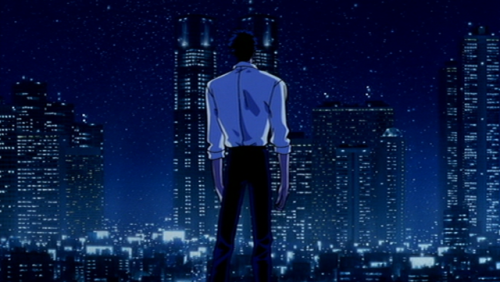
Oedo is a cyberpunk tale where, with criminal sentences possible to reach longer than the average human lifespan, prisoners are forced to live in the orbit of space, presumably in a way to extend their lives to suffer for their cybercrimes. Three prisoners housed in an orbital prison are offered an alternative by Juzo Hasegawa, a police chief, that they can reduce their life sentences for each criminal they bring in, with each having to ability to return with life on Earth but with explosive neck collars permanently on that, able to be timed, prevents any prisoner to take this offer to flee once they are back in public. This explicitly nods to period chambara tropes places in the future as "Oedo" is likely a reference to "Edo", the original name for Tokyo, whilst in Japanese history, the weapon they are all assigned, jitte, if a science fiction version of a weapon, with sai-like blunt ends, that was used by police in Edo-period Japan. Beyond this, the straight to video series is a hyper-exaggerated world, where in episode one, the main location is a space-scraper, a skyscraper so comically impractical in height, now in orbit at the top, that if the central threat managed to disable the gyroscope fully and cause it to fall, it would have led to a natural disaster of cataclysmic proportions. This has a variety of tropes and clichés of this type of “cyberpunk” of androids, cyborgs with psychic powers, and one of our leads having monomolecular wire, a concept the likes of author William Gibson, a huge figure in cyberpunk fiction, among other writers were obsessed with where you have weaponised wire so sharp on a molecular level that it could cut through anything, even through the neck of a cyber enhanced saber-toothed tiger. The leads, interconnecting as regular characters, however do get the starring role each for the three episodes, Shunsuke Sengoku the lead for episode one in the space-scraper. Sengoku is your typical hothead, who is heroic as an anti-hero figure but also anti-authoritarian, with a love-hate relationship with Juzo and especially against the sentient computer that occupancies them. This computer is arguably the fourth lead and deserving it, as the deadpan retorts in the Japanese dub are very funny, all from the perspective as an AI which cannot understand some of the insults thrown at it, such as when it has to explain how, with an internal geo-map system, it cannot possibly “get lost” on command. For episode one, with Sengoku and his constant argument with this robot, you get a great first episode to begin this work, where the serious tone in spite of how absurd this is in truth works fully.


Rikiya "Goggles" Gabimaru stands out as a character that would rarely get to be a lead in an anime, an older man if with a Mohawk, the more conventional of the noble anti-heroes despite his visual look.  His is the type of macho melodrama, which is secretly sentimental and melancholic if filtered through acion tropes, encountering an old partner of crime who was also his old flame, involved in a conspiracy involving the corrupt military project of psychic robots. The owner of the monomolecular wire, and lead of the third episode, is Merrill "Benten" Yanagawa. Benten inherently stands out of the cast as, among very distinct characters in the history of anime, even minor ones, you have here an ultra androgynous final lead, a really distinct figure who is probably the most iconic for the whole production, bringing up a combination of glam rock feminization, with red lipstick and hyper feminine features, with kabuki aesthetic and a shock white mullet, aged in designed but entirely timeless. His episode also is the most idiosyncratic even in a very stylish and creative production, in that this brings horror tropes into science fiction with artificially created vampires. The result of this brings a gothic and moody sensibility to the proceedings with the first ounces even of tragedy to the production, as it involves a woman cryogenically preserved doomed in this life forced onto her by another, as it ups the gore in imagining an undead individual being driven out an airlock in space. It is this episode particularly where the show's ability to be serious despite also being ridiculous shows the virtue of this tightrope act, intentionally and unintentionally.

It is a ridiculous anime in a good way, where we are dealing with a premise where there is never a moment stopping to question its own logic or feeling contrived in a way that undercuts faith in the material. Cybernetic saber tooth tigers is a high watermark in the absurd, as mentioned earlier in the review, but found in episode three, this takes it further with them kept in a cryogenic hub in tubs among three hundred year old patients, a place in outer space connected to a hospital by a space elevator, and armed with lasers, with the anime managing to add more flourishes to these sort of moments. This is throughout each episode with all these "questionable" moments becoming highlights alongside the tone and style of the work winning you over. The seriousness of the production helps, feeling like the delirium usually found in a video game from this time, and helping this is how this is Madhouse at their highest of quality. Yoshiaki Kawajiri is an insanely talented figure in anime, even when he is in the animation department after his directorial career seemingly ended into the 2010s, but as much of the virtues is the entire staff too, where your mechanical animation director for an example is Takeshi Koike, the future director of Redline (2009), one of the most underrated theatrical anime in need of greater attention and showing where his work here before came from.

The audio is its own curious history for the OVA. I watched this in the original Japanese version, but the history needs to be marked how, whilst Manga Entertainment bought the license with great interest, they took their own decisions which added more to the story beyond a good pulp anime. They were known infamously for "fifteening" their dubs already, where to increase the age rating with the British film classification for all physical home releases, they added swearing into the dialogue alongside adding their own flourishes. This is an idiosyncratic production however in that they went further in changing the music track. I like the moody synth provided by composer Kazz Toyama, but if you are talking of Cyber City Oedo, specifically to its British release as the Central Park Media/U.S. Manga Corps release decided to not go forwards with this choice in the United States, you have to talk about this version as it is part of the legacy in the West. Rory McFarlane's contribution, combining hard rock, thrash metal and synth, even influenced by Mountain's Nantucket Sleighride (to Owen Coffin)1, is a distinct score to hear, and thus it is worth talking about too as a highlight even heard in snippets. For Kawajiri himself, this is getting into the golden period of his career between the late eighties to the 2000s, one where you see here that, for all his notoriety with certain titles for their transgression, what his trademark was, whether the screenwriter of the story or not as in this case, his trademark where these kinetic stories of larger than life figures, in larger than life scenarios, which never for all their moments of absurdities feel entirely a high quality in grandeur for this era of pulp anime storytelling. Even Ninja Scroll (1993), which shared in the more notorious content of his career, showed this and, in spite of the knowledge Cyber City Oedo was not the biggest hit as Manga Entertainment hoped for1, that would benefit from the virtues found here, in a period chambara tale, and gain even bigger status in Western anime pop culture among the other titles Kawajiri would helm.

=======

1) Taken from the documentary Inside Cyber City Oedo (2020), directed by Andy Hanley.

Thursday, 28 December 2023

#272: Bio Hunter (1995)


Studio: Madhouse

Director: Yūzō Satō

Screenplay: Yoshiaki Kawajiri

Based on a manga by Fujihiko Hosono

Voice Cast: Kazuhiko Inoue as Koshigaya, Toshihiko Seki as Komada, Chikao Ohtsuka as Bokudo Murakami, Tarô Ishida as Seijuro Tabe, Yuko Minaguchi as Sayaka Murakami

Viewed in Japanese with English Subtitles


Recreating Wicked City (1987) in the opening, this feels like a throwback to eighties ultraviolent anime with breast dentata and someone actually getting their hand bitten off. We still got violent anime in the nineties, especially in the straight to video market, but notably, this has a connection to the past that, whilst in a screenwriting role, Wicked City's director Yoshiaki Kawajiri is involved in this production. This does mean this feels like a return to the films he and studio Madhouse made in the eighties, only with another director taking on the reigns in Yūzō Satō, and also the unfortunate sense of this feeling like a weaker Kawajiri work, still worth a rediscovery, but having to be compared to someone who became more interesting when the more controversial aspects of Wicked City were being removed from his own work. There is also the difference here that this is, in context, a very late era OVA. Whilst many would still be made into the 2000s, they changed in mood entirely as different technology was being brought into animation production, changing them even in how they look right down to the use of colour even next to works just from the early nineties.

Molecular scientists and professors Koshigaya and Komada work in an illegal but virtuous side job for the sake of humanity, in which this world has a "Demon Virus" which mutates people into flesh eating monsters. Like the young woman in the opening who becomes host to a few on her form like parasites, faces and mouths appearing on her body, whilst another later on eventually has gone so far he is effectively undead and controlled by the parasite in the centre of his chest, this has the potential to be a huge problem for humanity as a whole, as well as allow some of the most creative aspects of the production, meaning our leads have had to research ways to stop cases and also kill them if need be. One of our leads is infected himself, able to control his condition as far as be able to shape shift back and forth in forms, thankfully at first just needing to eat a ridiculous amount of food to sate an evolutionary take on yokai and monsters. It is certainly a shift for its original author Fujihiko Hosono, who contributed the source to another curious one-off OVA Judge (1991), explicitly a supernatural story about the supernatural judge of sinners, especially in his case those who are practice corrupt business tactics. Touches like this make Hosono's work quite a curious one in how he shifted tones per manga.

The condition our lead Komada has will still become a problem over this one-off story, alongside the angst of his position, especially as control is slipping and a young woman comes into his life named Sayaka, connected to a grandfather and famous fortune teller who has gone missing. Her existence, more of a damsel sadly for most of this, raises the question of whether he could ever in his position fall for someone or end up eating said girlfriend if the control vanishes entirely. A serial killer who chews on intestines and eats the livers of young women is connected to this, unfortunately connected to a powerful politician and his armed goons who are a credible threat to both leads. As an hour OVA, you only have enough time for a short tale, though this is an adaptation for what was actually a very short manga from Fujihiko Hosono himself, and possibly told the entire tale there in animation here.

Revisiting Bio Hunter, it feels like an object from a different time period, one which should be approached with in some caution due to this streak of transgressive sexuality, namely having female victims to these monsters being undressed, which will be understandably uncomfortable for some. Most of this film though is just gore, from the blood to a severed hand moving independently on its own free will on a rescue mission, and a set up to a literal punch line with a heart being ripped out. Truthfully, alongside its weird mishmash of scientific rationalism with occult leanings it still wants to get into, including trying to rationalise fortune telling as a superpower, the leads are the least interesting thing as in many of these, next to the mood and tone. It loses a bit of this due to Kawajiri sticking in the screenwriting position. Whilst Yūzō Satō became a veteran by the modern day, this does miss some of the tonal choices which did make Kawajiri's work his own, such as his trademark for a "Kawajiri Blue" in depicting night-time scenes.

There is enough here which evokes the atmosphere a lot of these anime had. Even without the monster designs - the final villain a host with the creature in his chest, and a discomforting nod to tentacle symbolism of Urotsukidôji and its ilk - it has something of its own that, even as a slight story, does stand out with interest. By this point however, whilst Ninja Scroll (1993) does have some discomforting scenes, it showed that this type of action anime, with tangents into horror, fantasy and/or science fiction, from Yoshiaki Kawajiri was far more than this, whilst Bio Hunter is more of a curiosity in his filmography. It is entertaining for what it is, but just missing out something to make it stand out more than this or its style.

Sunday, 24 July 2022

#219: Wicked City (1987)


Studio: Madhouse

Director: Yoshiaki Kawajiri

Screenplay: Norio Osada

Based on the book series by Hideyuki Kikuchi  

Voice Cast: Toshiko Fujita as Makie; Yūsaku Yara as Renzaburo Taki; Ichirō Nagai as Guiseppe Maiyart; Mari Yokoo as Spider Woman; Takeshi Aono as Mr. Shadow

Viewed in Japanese with English Subtitles


This is a significant film for me to reach - one of the key films of Yoshiaki Kawajiri, a director who became a name in Western anime fandom in the nineties, but one painted for me getting into the medium as a notorious one. Kawajiri in truth, getting into anime in the 2000s, was once for me the director known for sex and violence, but when it comes to actually viewing his work, which is not a lot of his career. Action anime and a high quality to the work with his collaborators, as a studio Madhouse director, is more his trademark. The infamy I heard second hand of him came from Wicked City and Ninja Scroll (1993), and even then, Wicked City was a title available in the United Kingdom, as in the United States, but Ninja Scroll was more freely available and a stock title for Manga Entertainment to have into the early DVD days. Ninja Scroll has held up well, and whilst it is transgressive in a lot of its content, it feels like a pulp narrative whose content was trying to be more thoughtful even if it dealt with gore and sexual violence. This is something to consider as, whilst of its era, anime in the decades afterwards even if not more explicit in these subjects, or having to work around television censorship, have tackled just as extreme content to this day, whilst Ninja Scroll's shock nowadays in how it tackles it explicitly as a high budgeted production. Wicked City was the title I hesitated to get to from the director, and for all its virtues, you cannot ignore that just ten percent of the film's content, some of its more controversial aspects, are going to be off-putting and unacceptable for anime fans. The irony is that, yes, it is only a part of the film altogether and that Wicked City itself has more to consider even beyond what I considered it would have been.

A factor to consider with Kawajiri's career is how significant author Hideyuki Kikuchi is to parts of it for source material, especially with some of the more adult work in content. His most well known work is the novel series Vampire Hunter D, which has now become a multi-medium franchise and has not stopped since the first novel in 1983, but he has worked on other titles, Wicked City based on the novel series of the same name from 1985 to 2016. Barring Ninja Scroll, more of the overtly horror and violent titles in Kawajiri's career come from Kikuchi source material, and Wicked City would have been released after the third novel came out, set in a world where demons and humans co-exist in a treaty skating on thin ice. A new treaty after centuries is to be signed, with a demon terrorist group wishing to snuff out the demon representative, Guiseppe Maiyart, sent to our side to sign it. He is to be protected by a human member of the Black Guard, secret agents guarding the "Black World" of the demons against ours, called Renzaburo Taki, with Makie, a female demon member of the Black Guard as his mirror to also protect Guiseppe. In terms of the Wicked City itself, it has a basic plot, which is traditional for a few Kawajiri titles, although in terms of his career, this one does feel the weakest. Compared to Ninja Scroll's, which is surprisingly more complex in back story, this does have a huge contrivance that, to get Renzaburo and Makie to fall in love, which is the real goal for peace, this film does have to work around some abrupt emotional whiplash and contrivances which other Kawajiri productions avoid.

You also have to accept that Guiseppe Maiyart's main characteristic, despite being someone revealed to be wiser and being a diminutive man with thunder abilities, is also having a horniness bordering on a suicidal streak in the risks he takes to please this. Among a curious duo with Ninja Scroll's Dakuan of Kawajiri having a fixation on short old men who are cocky tricksters, It has humour as well. You also have to accept that Guiseppe Maiyart's main characteristic, despite being someone revealed to be wiser and being a diminutive man with thunder abilities, who is also with a horniness bordering on a suicidal streak in the risks he takes to please this. This will put viewers off too, among a curious duo with Ninja Scroll's Dakuan of Kawajiri having a fixation on short old men who are cocky tricksters, but thankfully this does succeed with some light humour as much as it feels like another aspect Wicked City as an early work from Kawajiri does feel like a template for his later work, including the fact the villains in later stories would stand out more than the one here.

Wicked City also has a huge caveat already hinted at which cannot be ignored, even in mind to this being a film which I will talk about having incredible aspects to it, and has left a lasting legacy alongside other Kawajiri productions which influenced Todd MacFarlane for the creation of Spawn1, to being admired by Hideo Kojima2. That being, that in representing its transgressive sexual body horror content, where sex is used as a weapon including rape, this has the exact same problem you deal with in Urotsukidôji; that being, whether you think those subjects in transgressive depictions would still be defendable or not, how this is depicted is with having this subject always involving a female victim, and is clearly lurid for the sake of it with no reason to be there. The problem is worse when the sole figure of this content is Makie herself, the sole female character of note, which makes the content more problematic. This is worse here as, alongside undercutting a character who is a demon who has inhuman abilities that should make her powerful, she is the figure who exists to mirror Renzaburo Taki as well as emotionally connect to him, someone too who like Jubei in Ninja Scroll, is deliberately the male lead who scrapes by and gets maimed in scenarios as much as he succeeds.

Some may actually be offended by the suggestion you can tackle sexual violence in a way in art or even pulp storytelling which can be transgressive on purpose, but the problem is that, before you can either get to the subject of whether it can be defended or not, Wicked City alongside other anime fall into the issue that these subjects this same way. Always involving the victimisation of female characters, and always feels like it is done for shock value than with note. That this is just a fragment of Wicked City makes this worse, making this a difficult film to defend, even with aspects involving the sexual body horror, whilst grotesque, which are startling in a way without these issues and can be defended. It was not as explicit as I had feared, but with one scene in particularly reaching a fine line, this ten percent or so of the film's content of how Makie is victimised is uncomfortable. We did get Wicked City for VHS and for even cinema releases back in the nineties from Manga Entertainment, but is was censored for these scenes, only coming to us uncensored in 20223. These scenes once censored neither have any real weight to the content or narrative of Wicked City either, making them pointless to even have had.

Beyond this, Wicked City is still a very violent and very grotesque film from Kawajiri, and it is infamous as much for its body horror, yet I feel I can defended this even if, on purpose, they are startling too with the advantage of the production being as highly crafted as it is. This film has the most infamous moment of his career, within the first scenes, where Renzaburo Taki is introduced courting a lady for a one night stand, only for her to have been knocked unconscious and had a demon spider woman masquerade as her in the hotel room. Explicit vagina dentata is involved, starting this film's melding of sensuality with the perverse, where he just avoids death as she casually scuttles out the window on her spider legs out the hotel room. This is where Wicked City, like Urotsukidôji, is still extreme, but has transgression be the ero-guro (erotic grotesque) which has artist merit, flourishes in its imagination to striking effect as much to horrify. An argument can be made most of these have the theme of the female body being dangerous, with a couple of womb-like metaphors and one blatant one, but these scenes will make the men just as likely victims as the women to these horrifying threats. One literally involves a giant stomach vagina and Renzaburo Taki literally return to the womb before he snaps out of it. Some anime fans, understandably, will find this scene disgusting, but rather than alien the viewer with transgression of the sexual kind which is exploitative, this is the kind of perversity that at least has more meaning to it, significantly in this example as it transpires within the same scene as some of the problematic sexual violence, which does not have these virtues.

Some will not be able to get through Wicked City because of some of its content, which is tragic as well as, one of Kawajiri's earliest productions by himself in the director's chair, this also has incredible artistry, the horror contrasted by a lot of the film even in its quietest moments which are startling to see in the modern day for how more subtle it can even be. A lot of Kawajiri's work is very simplistic in their characterisations, even in how they are structured around figures the protagonist has to fight to reach the main boss, like a video game template, but his productions, especially with the original character designs by himself, are incredibly ornate and aesthetically beautiful even in spite of how some are very gory and nasty. One of the biggest surprises for me as I became more a fan of Yoshiaki Kawajiri has been how  mood plays a role in his films, even when the action stops and the characters are allowed to breathe in his narratives. Wicked City embraces the horror genre even in terms of eeriness within sequences, and it is also a film, unlike the reputation it has been painted for me, with a willingness to stop and contemplate. It is a film only eighty minutes long but stops for Renzaburo Taki, when they initially have Guiseppe Maiyart secured in a hotel with a security barrier, playing chess with the hotel owner and contemplate his place as a bachelor.

As mentioned earlier on in this review, it feels Yoshiaki Kawajiri is still early in his career here, and Wicked City feels as much a prototype of Ninja Scroll. This is not to downplay the virtues of this film, which is a gorgeous production, possessing an atmosphere which, whilst not redeeming its major problems, which is compelling. It looks gorgeous, the music is gorgeous with Osamu Shoji's moody score, leaving Wicked City a fascinating production unlike other lurid and controversial anime from the eighties in that its artistic value is higher than the likes of Violence Jack from the decade. Kawajiri, even for his OVA work, had a high bar of quality of work, which makes the sad fact he stopped having directorial work in the late 2000s onwards more tragic, if thankfully contrasted by the fact, even if in the storyboarding credits later on, he still had his mark on big television series in the 2020s. Finally seeing Wicked City, my concerns which caused me to hesitate watching this were proven, and it is entirely per individual viewers if they feel comfortable sitting through the scenes whether to watch the film or not, rather than say whether it is recommended. In terms of the film's virtues beyond these scenes, this for horror anime shows the director's talents and those of Madhouse altogether exceptionally.

=========

1) Examining the Work of Anime Director Yoshiaki Kawajiri, written by Padraig Cotter, published for Den of Geek on May 26th 2015.

2) My Favorite Films by Hideo Kojima, translated by Marc Laidlaw from METAL GEAR SOLID naked (2004), published by Kadokawa Shoten and with the translation from Junkerhq.net. For a side tangent, for fans of Kojima's, and speaking of a huge cineaste myself, this is a fascinating selection of films, including some obscurer gems like Burst City (1982), even I would dig through for the titles I have missed over the years.

3) "Wicked City... 1987 Japan anime horror previously cut but now released uncut on DVD and Blu-ray", published on December 21st 2021 for Melon Farmers, a site dedicated to documenting film classification, censorship and censorship of culture in general. Their name, before anyone asks with curious bafflement, is based on the infamous "TV Edit" of Alex Cox's punk genre film Repo Man (1984), for another tangent about a film (and that infamous edit) worth looking into.

Wednesday, 8 December 2021

#209: Ninja Scroll (1993)


Director: Yoshiaki Kawajiri

Screenplay: Yoshiaki Kawajiri

Cast: Kōichi Yamadera as Jubei Kibagami; Daisuke Gouri as Genma Himuro; Emi Shinohara as Kagerou; Takeshi Aono as Dakuan; Akimasa Ohmori as Shijima; Gara Takashima as Benisato; Junichi Sugawara as Shinkurou; Masako Katsuki as Zakuro; Norio Wakamoto as Utsutsu Mujuurou; Reizō Nomoto as Mushizou; Ryūzaburō Ōtomo as Tessai; Shuuichirou Moriyama as Sakaki Hyobu; Toshihiko Seki as Yurimaru

Viewed in Japanese with English Subtitles


Ninja Scroll for a certain generation was a huge title. It says a lot that, out of many of the old titles from Manga Entertainment during their VHS years, Ninja Scroll still has a cache, even if now a nostalgic one. Coming to the film at the turn of the DVD era, back when we once madly had three to four episodes per disc released individually, we even got Ninja Scroll in two separate DVD cases for different versions from Manga Entertainment for some reason. That bulky DVD case release does linger in memory, long after it was replaced for a Blu Ray, as an introduction to Yoshiaki Kawajiri's most well known directorial work.

The surprise coming to Ninja Scroll is that, a notoriously violent and dark tale of Edo era Japan and superhuman ninja, was that as far back as 1959 we got this genre of superhuman ninja with unnatural powers, all because of the novel The Kouga Ninja Scrolls by Futaro Yamada, which would be adapted into anime, and can be seen as a home for the notion of ninjas having monstrous and outright supernatural abilities. The other surprise is that Yoshiaki Kawajiri's reputation for graphic content is more complicated than I presumed at a younger age. Wicked City (1987) is the notorious film in his career, in terms of sex and violence and sexual violence, but his whole career is diverse, with something of note that one of his highest regarded projects Vampire Hunter D: Bloodlust (2000), was drastically different from the source material by Hideyuki Kikuchi, with Wicked City itself an adaption of one of his titles too. Even Ninja Scroll, which is extreme at times, is complicated now to consider as, from an era of "adult" animation being sold to the West from Japan, even in mind to titles like Ninja Resurrection (1997-8) which were sold off the back of Ninja Scroll's success, it is a much more considered title even for what is an action period story at heart.

In fact, viewed in its original Japanese dub, looked at in the current I realise that for all Ninja Scroll's gore and sexual content, it is an elegant and superbly crafted production as a theatrical length film. Story wise, it is surprisingly complex even if the results are simple. Jubei, inspired by the real life figure of Yagyū Jūbei Mitsuyoshi, is a wandering warrior who finds himself dragged into a conspiracy with the Eight Devils of Kimon, ninja with inhuman abilities hired by a shadowy clan who, in a plot involving secret gold stashes, wish to overthrow the ruling heads of Japan. Jubei is stuck in helping prevent this as Dakuan, a sinister magical old man working for the government, has poisoned him and holds the antidote hostage. In contrast, however, there is the heart of Kagero, the female ninja who, alongside having been a food taster for so long her body is resistant to all poisons, has enough toxins in her own body that any person who has contact with her will die, be it by kiss or anything else. Already resourceful, her group sent to investigate a village which has been wiped out by a disease is massacre, and she finds herself with Jubei and Dakuan.

It is very simple beyond this. The film is also both a tribute in many ways to classic Japanese genre films, though one about ninja that is far darker, openly fantastical and bloodier in comparison. Interestingly, whilst these ninja have the ability to control snakes or turn their body to stone, they negate so many clichés the likes of American cinema and Godfey Ho created about ninja lore at the same time. There are still exaggerations, shurikens been thrown and all, but there are details like ninjas being involved in espionage or disguising as monks/nuns, based on what actual ninja were doing. The nod to genre films is that, with mind of known works like the Lone Wolf and Cub franchise, this finds a balance between an incredibly serious tone, with a bleak emotional core as Jubei will be stuck as a permanent loner, and the hyper exaggerated characters and abilities.

One trademark of Kawajiri's, even far less well regarded work like Highlander: The Search for Vengeance (2007) showing this, is his interest in idiosyncratic looking characters, where even grunts stand out in character design and traits (abilities, monstrous mutations etc.). The very realistic character designs which appear in most of his career, whilst not in all his work, helps considerably, and is because of the talents of reoccurring collaborator Yutaka Minowa, the character designer for so many of his projects. Another is that, when allowed creative control. Kawajiri is very creative. It is, whilst a very serious period film with a complex narrative of secret factors wishing to overthrow the government, it is still an action film which has a man with a bee's nest growing out of his back and also welding a trident. Why the film avoids coming off as ridiculous is the quality of the animation, exceptional from studio Madhouse, alongside the striking cinematography in animation, especially the use of shadow and colour.

Most, when this was first released, came when this was promoted as a very violent anime. The gore is definitely from another era. Whilst nastiness can still occasionally be witnessed nowadays, it is less common and not as lovingly (and gristly) depicted in this at times, back from an era where a lot of anime especially for the straight-to-video OVA market was clearly made with shock value in mind, to keep a viewer glued. This is something you can accuse with this for the nudity and the hints to sexual violence and rape. Ninja Scroll though, lovingly animated and produced, has a greater impact. It feels it has more in mind, even if on a shock level, it effects too seeing a lovingly rendered depicted of a man's arms being ripped off and having the geyser of blood from them being drank. I will say that, if you would feel uncomfortable even seeing the content, especially the threats of sexual violence to Kagero, I do not recommend this film at all. There is something more here, even as pure pulp, due to tone which is more meaningful, even if this is still a work some may have great issue with.

The other thing is an awareness Kawajiri's career is very diverse. Again, as mentioned previously, one of the more notorious works Wicked City, which has a lot of sexual violence, comes from Hideyuki Kikuchi, the novelist whose work Kawajiri adapted a great deal of. Kawajiri as a director is more interested in a very elegant type of action animation, alongside tangents into other genres, painstakingly animated and only easy to forget because, with some titles, there are some inherently ridiculous aspects within them. This, even with pulp characters, does have moments of contemplation, where Kagero is the most sympathetic character, and even the villains have their own personalities, including a rivalry which proves in Jubei's favour by pure chance.

Production wise, Ninja Scroll is exceptional. You can argue the pace is reminiscent of an old video game in plot structure, from boss battle to boss battle, but the film itself has grown for me as being so distinct that it stands head and foot over other ultraviolent titles of the era. As a film also referring to the period action stories of Japanese history, this evoking the chambara films with a swordfight in the middle of forest with a blind swordsman, one with a considerably level of grace when, honestly, a lot of the ultraviolent anime from this time period have less class, for a lack of a better term, than this. Reputation wise, when the title was released in the West, it stood out. Insanely well, that Manga Entertainment tried to sell Sword of Truth (1990), not one of Osamu Dezaki's finest moments, afterwards or when ADV Films tried to sell Ninja Resurrection (1997-8), an unfinished OVA, as an actual sequel. It is a cultural touchstone for a certain generation before my generation, but seeing it in its original form, once you step away from the gore it is, from its traditional instrumental score to its art style, amazingly elegant even if this is also a film where Jubei head butts a man repeatedly to death until the skull is mush.

There is an additional tragedy that, as his career went on, Yoshiaki Kawajiri never got to make a sequel. A Western co-financed series Ninja Scroll: The Series (2003) was commissioned, by Kawajiri  did make a "sizzle reel" for Ninja Scroll 2, which looked gorgeous and just as elaborate, including Jubei on a giant paper swan and various supernatural ninja, but it led to nowhere. Our only condolence is that, one of the best animators as well in the industry, even if Kawajiri's directorial work dried up by the end of the 2000s, he worked on shows like One Punch Man, and those in the know of who animate what scenes do lionise him as being an incredible veteran who contributes his skills to big titles.

Thursday, 4 July 2019

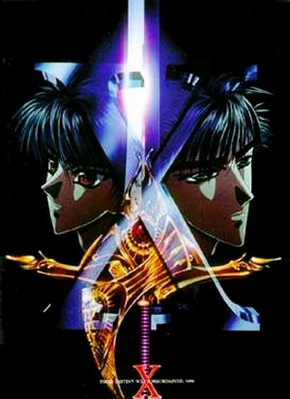
#107: X - The Movie (1996)

From https://media.fstatic.com/k4LYngYddm5-DOg8ex-MXfSiCCo=/fit-in/290x478/smart/media/movies/covers/2009/12/25fe3547f4adaf3b85f41d88fe495d88.jpg


a.k.a. X/1999
Director: Rintaro
Screenplay: Nanase Ohkawa and Asami Watanabe
Based on the manga by CLAMP
Voice Cast: Junko Iwao as Kotori Monou; Ken Narita as Fuuma Monou; Tomokazu Seki as Kamui Shirou; Atsuko Takahata as Kanoe; Emi Shinohara as Arashi Kishyuu; Hideyuki Tanaka as Seiichirou Aoki; Issei Miyazaki as Subaru Sumeragi; Jouji Nakata as Kusanagi Shiyuu; Kazuhiko Inoue as Yuuto Kigai; Kōichi Yamadera as Sorata Arisugawa; Kotono Mitsuishi as Satsuki Yatoji; Mami Koyama as Karen Kasumi; Rica Matsumoto as Nataku; Tohru Furusawa as Seishirou Sakurazuka; Toshihiko Seki as Shougo Asagi; Yukana Nogami as Yuzuriha Nekoi; Yuko Minaguchi as Hinoto
Viewed in Japanese with English Subtitles

X - The Movie was a damned project from the get-go. It is a notorious tradition to adapt anime, even a theatrical film here, from unfinished manga as a tie-in, but the further irony is that, even with direct interaction from a member of the original authors CLAMP for the screenplay, this is a project that came from a manga, started in 1992, that was postponed in 2003. Despite its lasting reputation in CLAMP's back catalogue, no one's picking up a pen to finish its dark action fantasy tale, something even Kentaro Miura with Berserk, despite starting in 1989, can at least be ahead of in that he still (intermittingly) carries on with new chapters. It's a surprise as CLAMP - a group of four women (Nanase Ohkawa, Mokona, Tsubaki Nekoi and Satsuki Igarashi who started as doujinshi (self published) manga - are still held as monolithic force in manga just for titles like Cardcaptor Sakura.

Madder still, and probably the decision that kneecapped X - The Movie when it was taking the risk to even have its own conclusion with a CLAMP member's involvement, is that it's merely ninety minutes. That little length, with the number of characters and plot involved, is the death kneel to a high reputation over these years, and its only because we have Rintaro, who has been working since the start of modern anime in the sixties, at the helm with an all-star team of animators, and his (if divisive) history of adapting long form works into little lengths, that we got anything remotely worth returning back to and in need of some admiration for all the glaring issues. What we got was a film whose scars, abridged, are as part of its beauty as well as its detriments, a gorgeous and insanely dark, incredibly violent and melodramatic spectacle.

The film is about two sides, the Seven Dragons of Earth who, viewing the Mother Earth as dying, wish to rid human society to heal it and begin anew, whilst the Seven Dragons of Heaven have to stop them, protagonist Kamui Shirō in the middle as a chosen one whose allegiances is as effected as another like him being found, dragging in childhood friend Fūma and his younger sister Kotori. It's a gory, hyper melodramatic tragedy, as angst as an emo goth hybrid album but with teeth as CLAMP, whilst purveyors of beautiful illustration and gorgeous characters in their elaborate costumes, were also fan girls of seinen work like JoJo's Bizarre Adventure which are insanely nasty and melodramatic (not to mention the known influence of Go Nagai's Devilman manga on X). Unfortunately, with over fourteen characters and ninety minutes to spare, that's many characters that are likely fan favourites appearing and then being dispatched. And dispatched as in death, no bullshit involved, which is the infamous part about X - The Movie in both it quickly jumping through the story, killing off characters (sometimes nastily) and even more controversially for fans had to create an ending involving Fūma's turn to evil that might've not been the desired goal if CLAMP ever got to an actual ending for the manga1.

But returning to the production, it's a creative dream, a legitimate (with emphasis) darkness permeating the work, mostly set at night or in moody atmospheric urban or symbolic locations, a cast who have supernatural powers and exaggerated costumes but can vary from a former female sex worker to a father who works as a salary man; even the stereotypical fourteen year old school girl, with a magical wolf only she and her own kind can see, is such but with a teenager's naivety and everyone on her side very protective of her. Even the villains, as barely scratched but absolutely fascinating, are only wanting to destroy civilisation, by breaking seals set under certain important Tokyo landmarks, to both save the Earth and with the female leader, a "dreamgazer", whose sister as the leader of the other side plays an emotional part of their goals. When it goes over to top aesthetically top, X hits for pop Gothic delirium; giant dragon ghosts fighting over the Earth in outer space, love one's sacrificing themselves to create magical swords out of their chests, crucifixion with razor wire over a lake of blood, insanely psychotropic in imagery.

From https://vintagecoats.files.wordpress.com/2014/07/x-the-movie-x1999
-kamui-shiro-running-to-kotori-monou-crucified-river-of-blood.jpg

And not surprisingly, with the talent on hand behind the images, X is gorgeous. Rintaro is a divisive director, but with a career most well known in the West for Metropolis (2001), a highly regarded anime known a bit outside of anime fandon, his long (and ongoing) is that of someone whose been in these tough day jobs before to have an idea of what to do. Yoshiaki Kawajiri is more famous for directing anime like Ninja Scroll (1993) but, like here, he's been on other's productions into the modern day and, whether your opinion of his directorial work, he is held as an incredible animator; his protegee Takeshi Koike, who learnt from his master well and later made the incredible sci-fi racing anime Redline (2009), is on the team too and that's not ignoring people in the production like Yutaka Minowa and Yoshinori Kanada either, the former the character designer whose trademark style gave Kawajiri his trademark character designs,  and Kanada an acclaimed key animator who even had Hayao Miyazaki singing his praises after his death.

Musically, Yasuaki Shimizu's score can be potentially divisive, a very unconventional genre leaping one switching between sombre saxophone over a premonition of ruined Japanese metropolis or use of traditional Japanese instruments, but it worked perfectly for me2. Hell, they even got X-Japan to compose the end credits song, possibly (alongside the divisive nature of this film) an issue for a re-release, but arguably the biggest metal band in Japan at the top of their career; this is however potent as, whilst a different versions, it's from their last album (Dahlia (1996)) a year before the band would breakup due to their lead singer being brainwashed by a religious cult to leave the band, said band splitting up and the tragic death of lead guitarist hide dying in 1998, the potent melancholia added to the film's ending having more resonance knowing this real life history.

Also worthy of mention is lead voice actor Tomokazu Seki in the Japanese dub, as Kamui, doing his damndest for a character (in spite of the limited plotting) to wrench an incredible emotional core in his performance. So there is a lot of talent here. If anything, X was also an admirable attempt, something which in premise at least has so much in terms of a sober, sadder take on this type of dark fantasy. It's pertinent, in what little we learn of the Eight Dragons of Earth, that they intend to destroy human society because of environmental reasons, a really chilling detail in the 2010s which emphasises the greater moral complexity in manga and anime even in the villains. The tone is closer to Ancient Greek drama in its sense of scale and inevitable tragedy - individuals who fight for their causes thinking they are right; each lead by women who are siblings; friend against friend. Unfortunately the length and pace cuts out so much detail that could've added greater meaning, but the drama is still disquieting at least because the production is so gorgeous.

Adding to its odd history is that, just a year before the manga was put on hiatus between 2001-2, Yoshiaki Kawajiri himself, still under the banner of the studio Madhouse, directed an entire television series based on the series which is more highly regarded in terms of getting the story told from a beginning to an ending. That, however, is for another day...

From https://66.media.tumblr.com/168d94688bcbe537e60d95c11943877
e/tumblr_p72iu7oi111qzqnxxo7_500.png

======
1) We'll leave what was actually done in the manga for you the reader to decide, as the manga did reach an important dynamic point and was being released in English.

2) Growing in my knowledge of music still into my thirties, I have become already acquainted to Yasuaki Shimizu by, of all things, Music for Commercials (1987), his proto-vaporwave compilation of music designed for actual commercials which is gorgeous. A composer, saxophonist and producer, it's amazing the longer you dive into the production credits what fascinating figures worked on these animated films.

Friday, 12 August 2016

#31: Vampire Hunter D: Bloodlust (2000)

From http://static1.comicvine.com/uploads/
original/3/38826/2379618-bloodlustposter.jpg
Director: Yoshiaki Kawajiri
Screenplay: Yoshiaki Kawajiri (and Brian Irving)
Based on the light novel Demon Deathchase by Hideyuki Kikuchi
Voice Cast: Andy Philpot (as D); Mike McShane (as D's Left Hand); John Rafter Lee (as Meier Link); Wendee Lee (as Charlotte Elbourne); Pamela Adlon (as Leila); Matt McKenzie (as Borgoff)
Viewed with English Dub

Synopsis: In the far future, the world is left in a post-apocalyptic state where vampires and other creatures of the night exist within the land. D, a half vampire and half human dhampir, is one of the best and most feared hunters of vampires, sent after the Baron Meier Link when he is said to have abducted the mortal woman Charlotte Elbourne. With another group called the Marcus Brothers, led by Borgoff, sent after the Count as competition, the result will become violent and morally complex with both the mutants hired to protect Meier Link extremely dangerous and the real nature of his relationship with Charlotte having real love behind it.

From http://comp.judging.it/content/Vampire%20Hunter%20D%20-%20Bloodlust/720p-1/Xell%20SD/Vampire.Hunter.D.Bloodlust.2000.German.DTS.ML
.576p.HDTV.x264-Xell_(00-01-22.415)_01.png
Many view Bloodlust as the superior take on Vampire Hunter D. I'd argue that if the 1985 anime adaptation represents its era - the bright coloured but phantasmagoric content of the era - than Bloodlust is the full blown gothic symphony in terms of aesthetic and presentation. Created as a Japanese-American co-production, the franchise gladly entrenched itself with Western influences which allows this version to work incredibly. Like the first adaptation, one of the best aspects of the world is how it combines numerous genres - gothic horror, sci-fi-, the western - into one seamless form which can cherry pick from them all in plot and visual palette.

From http://i2.photobucket.com/albums/y2/MaverickHunterZero
/936full-vampire-hunter-d-bloodlust-screenshot.jpg
Bloodlust more than the original takes advantage of this further, helped by the fact that the film is helmed by Kawajiri; known for making films like Ninja Scroll (1993) with simplistic plots but exceptional production quality, he also has the gift of having so many ideas that he attempts to cram into each work that the material around the plots is always compelling. It can be easily argued Bloodlust is one of his best films as, while the earlier work that made his name is notorious for its extreme content, this fully embraces the world's template for his most outlandish and imaginative ideas but is also haunting in how its depicted. While gory and violent it lashes onto the chance to be as elegant as possible. It's an anime which can have its cake and eat it, starting like a classic Universal horror movie with a phantom carriage traversing cobble streets from a Victorian city only to quickly become a sci-fi western hybrid when D is introduced, gunslingers with rifles on the beams of a gothic ruin when the dhampir takes on a bounty where, if Charlotte is turned into a vampire, he is asked to kill her.

From http://i.imgur.com/rS4PLgQ.png
The high quality of the feature film is matched by how imaginative it is. The realistic character designs that are a trademark of Kawajiri's productions, the emphasis on the characters looking like real people even when they're superhuman or distorted, allows the tone to get away with the more fantastical content. The world itself is already one of the truly strange and unexpected in terms of what the source material has, such as D's talking left hand, a parasitic entity with a face on his palm that, here, is a comedic sidekick who whinges or mocks D as they move along, taken further than in the original 1985 adaptation as a cranky but lovable entity. Kawajiri, known for his taste in the bizarre especially for villainous henchmen and writing the screenplay, is allowed to bring in henchmen with supernatural powers through the world's conceit of mutants also existing, from a demon clown with shadow abilities similar to a minion from Ninja Scroll to a wolfman who, in his full lycanthrope transformation, has a giant wolf's head with sharp teeth grow from his chest. With Bloodlust the world feels so detailed and fleshed out that the result has a visceral beauty to it; while the 1985 anime was a spectacle of morbid colourfulness, with splatter and nudity, this is closer to a symbolist's wet dream, one filtered through gorgeous animation and a score by Marco D'Ambrosio that fittingly crosses genres, classical orchestra mixed with soul stirring choral chants and brief moments of science fiction electronic hums.

From http://www.animeviews.com/images/screenshots/vhd3.jpg
The other significant reason Bloodlust is amongst Kawajiri's best work is that, for a man infamous for gore and simplistic action plots, this film attempted a greater emotional scope for him because of the source novel's plot and actually succeeded even if there's moments of sincerely naivety to it. The world of Bloodlust itself is depicted, after hundreds of years of the apocalypse reshaping the land, as both a threatening but also awe inspiring place, the usual signs of the wasteland found but also western frontier towns and magical places existing, from an immense garden where a key dramatic scene plays out or the desert landscape where giant, flying mantas - the aquatic creatures mixed with the worms from the Dune novels - flying out from under the sand on mass into the air. The high level of artistic production allows it to be a menacing but also colourful world that does add an emotional effect already. The other is in the plot itself, Kawajiri as the screenwriter stepping out of his comfort zone. The main plot is between D and Leila, a female member of the Marcus Brothers who develops a mutual bond with him, but the really interesting aspect is Meier Link and Charlotte, how they are actually in love with each other and how much of a conflict is involved with the bounty hunters after them when they realise this. Even when the real antagonist is introduced near the end, a full on vamp feeding into the characters' subconscious and a costume off a catwalk, the result is still gothic melodrama delightfully found in the midst of an action horror film. That Bloodlust is as dynamic in style as it is, where rocket ships like look like church spires with actual stain glass windows on their sides, adds to this emotion with morbid beauty.

From http://comicattack.net/wp-content/uploads/2012/
08/4687043505_4aed47b173_z.jpg
Of course, there's the one conundrum that, if this is an American co-production where the English dub came first, does this technically count as an anime for this blog? Yes for me in the sense that, based on a work legendary in its homeland, this feels like a connection of two different countries to create an epic regardless of which country is was designed to be released in first, paradoxically entrenched in gothic influences from the West but undeniably a Japanese anime in style and tone. The only real disappointment with Vampire Hunter D: Bloodlust is that, barring some other high profile American-Japanese co-productions (The Animatrix (2003) and Production I.G's animated sequence for Kill Bill Vol. 1 (2003), these type of productions dwindled immensely by the late 2000s. Especially for Kawajiri his later co-productions with the US became compromised creatively, Highlander: The Search of Vengeance (2007) having the potential to be great but merely a deeply flaw, and at times silly, curiosity. Thankfully there is a significant attempt from two American companies, Unified Pictures and Digital Frontier, to bring back Vampire Hunter D as a television series, giving this world another tale if they succeed. One of the most interesting things about Vampire Hunter D is that, not only have the light novels that originated it created a franchise that's lasted, but the franchise at least in the animated versions developed a following the US, Bloodlust likely to be one of the best ways to introduce a person new to anime to the medium in how it does everything right. While I still hold the 1985 version as a good anime itself, I realise its limitations, whilst Bloodlust is a high recommend and one of the best horror based anime of its kind, a magnum opus even if it's only ninety or so minutes that still stands strong in quality. 

From http://www.judging.it/wp-content/gallery/vampire-hunter-d/Judgment-
Vampire-Hunter-D-Bloodlust-55687BCB_01-24-02.496_01.png

Wednesday, 18 November 2015

#12: Lensman (1984)

From http://1.bp.blogspot.com/-k-6gpDtB8AI/UyHvX9veE0I/
AAAAAAAAJoY/DQrXqiKFBic/s1600/1984+lensman+a.jpg
Directors: Kazuyuki Hirokawa and Yoshiaki Kawajiri
Screenplay: Soji Yoshikawa
Based on the novel franchise by E.E. Smith
Voice Cast: Toshio Furukawa/Kerrigan Mahan (as Kimball Kinnison); Chikao Ohtsuka/Michael McConnohie (as Peter vanBuskirk); Katsuya Kobayashi/Gregory Snegoff (as DJ Bill); Mami Koyama/Edie Mirman (as Clarissa MacDougal); Nachi Nozawa/Steve Kramer (as Worsel); Seizo Katou/Tom Wyner (as Lord Helmuth)
Viewed in (a good Streamline) English dub

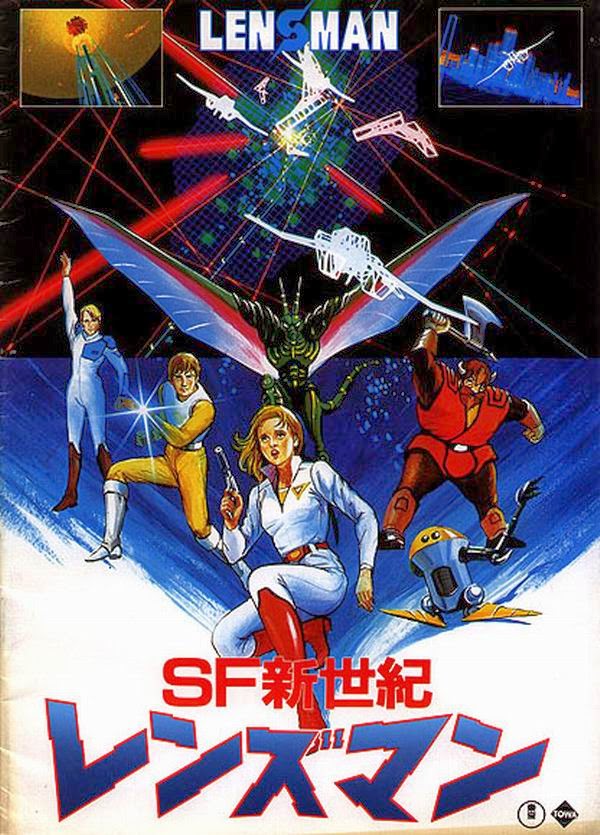
I had to cover an eighties anime. Seen as the golden age of anime, there's unfortunately a dearth of older anime in the UK that only Anime Limited and Discotek Media in the US is making amends for in a vast quantity - second hand DVDs and YouTube have had to make up for the lack of older titles for me as well as the rare release. Lensman however is a curious choice to begin the eighties on the blog however, an adaptation of a famous American sci-fi novel series that's not seen in high regard. The novels are an old statesman of sci-fi literature with a great reputation and heritage, but it's only had adaptations through anime, one this theatrical film and the other a TV series. The Lensman adaptation is about a young adolescent Kimball Kinnison becoming a Lensman by accident when a orb that imbeds itself into someone's hand transfers itself from a dying member to his after a spaceship crash on his home planet. This orb pulls him into the intergalactic organisation and embroiled in a war between the good Galactic Fleet and the evil Boskone Empire. The other aspect of this film, which is far odder, is that it's the debut of Yoshiaki Kawajiri, co-directing a film from an era before Akira (1988) that will be drastically alien to many casual anime fans, an era vastly different from the anime made after Akira, including Kawajiri's own, where you had uber-budgeted anime theatrical epics, many of which have been long out-of-print in the West.

From http://i21.photobucket.com/albums/b300/spacemonkey_fg/Blog%20Pictures%20III/Blog
%20Pictures%20III127/Lensman%201984%2012_zpsw4lnwgq0.jpg
Starting with then-cutting edge 3D animation to depict spaceships fleeing a hostile environment, the Lensman adaptation is clearly indebted to the original Star Wars trilogy. This becomes a severe crutch for Lensman to hobble along on. This is far from the longest film during the pre-Akira era, when anime theatrical films could be as long as two hours and a half like with Odin (1985) or Harmageddon (1983), but it manages the paradox of barely depicting enough detail for its simple plot and also being immensely sluggish at the same time. There's not a lot of plot following Kinnison and his friend - the giant, horned Peter vanBuskirk, the frankly useless female character Clarissa and the statuesque pterodactyl  alien Worsel - baring being perused by the Boskone Empire and ending up on one of their industrial planets where a narcotic is being mined. Somehow it doesn't take advantage of what's there already to add flourishes to deepen the characters' personalities or sci-fi intrigue more. Lensman misses a lot of opportunities and considering how long and vast the back story of the original novels are, this makes the narrative confusion of David Lynch's Dune (1984) a lot more acceptable when it still tried to cram so much into its feature length. This is baffling as well considering its screenwriter Soji Yoshikawa directed and scripted the Lupin 3rd film The Secret of Mamo (1978), and if there ever was a film that could've done with that one's strangeness it'd be Lensman.

Fromhttps://thedrunkenodyssey.files.wordpress.com/2014/02/untitled-5.jpg
Unfortunately like a lot of sci-fi and fantasy, Kinnison is an incredibly bland lead. Especially as the lens which makes up the film's MacGuffin is barely dealt with, a psychic contact to a whole federation which sounds similar to the Green Lantern Core's rings in DC Comics, and the lensmen themselves are barely covered, Kinnison is as bland as you can get. Even when his father's death in the first act should start an obvious character progression, signposted by him looking out a spaceship window with a J-metal song with eighties riffs playing to emphasise the growth, he's still a non-entity afterwards. The female lead is even worse, the only female character who, despite being a medic with military training, spends most of the film screaming or in vaguely dodgy situations tangled up by furry tentacles or stretched out in tendrils. Admittedly Kawajiri's female characters can by utterly objectionable in his later films, but this somehow feels worse than someone like Kagero in Ninja Scroll (1993). The film, like many sci-fi and fantasy stories, is helped by the side characters, such as vanBuskirk as the lovable giant who is entertaining in his gentle goliath personality and prayers to give up drinking or gambling when he's in mortal danger Then there's Worsel who's part of the interesting character designs for the aliens - part hand glider, part confident gunslinger - but he does unfortunately have a name which will immediately provoke sniggers from British listeners who know of Worzel Gummidge; even if they didn't, naming your Hans Solo equivalent Worsel is still going to cause Brits to giggle because it invokes that his home planet is somewhere in Yorkshire where the spaceships are tractors and everyone is drinking cider.

From https://visocki.files.wordpress.com/2011/03/lensman_graphics4.jpg
The best part of Lensman, as can be found even in the most disappointing of works, are the visuals and animation quality. Despite the limitations of the plot and characterisation there's still a vast creativity amongst the animators and cel painters where each planet, each farm land on an alien land, even of an eighties discotheque with skyscraper sized piston light shows are lovingly created. I've yet to stumble on a bad straight-to-video or theatrical anime for this blog, and while it's still early days, only if I cover a notorious example or scrape the bottom of the barrel will either lead to a terrible mess of doodles. From the Boskone Empire's biomechanical aesthetic - their various shapes to their cancer-like, Cronenbergian spaceships - to the settings across the universe, Lensman certainly has a lot to please the eye. Even the 3D computer effects, while dated, have an immense charm. In fact, during the final confrontation with the Boskone Empire leader where Kinnison is thrown through a series of hallucinations, there's an interesting mix of a 2D character design with three dimensions that's far from a mess.

From https://i.ytimg.com/vi/KSDl_t7Lrjo/sddefault.jpg
It's just a shame how predictable and plodding Lensman is as a story. It's viewed as utterly unfaithful to the original source material, so badly that this might have affected its lack of DVD availability, and the fact the plot comes off as utter derivative and disinteresting makes the decision to have made the film as it is such a terrible idea with nearly thirty years of hindsight behind it. An anime shouldn't be stuck with a plain white meat hero fighting a generic villain, and ironically whilst the plots were still as simplistic, Kawajiri's solo work including more charismatic heroes and a series of bizarre adversaries, as if subconsciously he learnt from the mistakes here for his career. As Kawajiri's debut, this is merely a curiosity when his (usually) gorier and darker material later kept the animation quality but followed his more trademark peculiarities for better results.