Showing posts with label Kōtarō Ishidate. Show all posts

Sunday, 23 February 2020

#136: Tesagure! Bukatsumono Spin-off Purupurun Sharumu to Asobou (2015)


a.k.a. Tesagure! Season 3
Director: Kōtarō Ishidate
Screenplay: Kōtarō Ishidate
Cast: Asuka Nishi as Yua Suzuki, Ayaka Ohashi as Koharu Tanaka, Karin Ogino as Aoi Takahashi, Mikako Komatsu as Hina Usami, Natsumi Takamori as Yui Enjoji, Reina Ueda as Mobuko Sonota, Rumi Okubo as Kanon Izayoi, Satomi Akesaka as Hina Satō, Shiori Mikami as Rin Arisugawa, Sumire Uesaka as Tomomi Okonogi, Kaoru Mizuhara as Mio Watanabe
Viewed in Japanese with English Subtitles

The Tesagure train finishes, and with a considerable risk in how it jumps up from fifteen minute episodes to full length ones. The other change is that Tesagure is invaded by an entirely different series, in this case bringing in the case of a manga series called Minarai Megami Puru Purun Sharumu, revolving around five personalities part of the radio program A&G NEXT GENERATION Lady Go!!. Effectively a spin-off than a third series, these new characters are only really defined as being five high school girls meant to train as cosmic goddesses, a detail which is quickly dismissed in favour of them joining in on long absurd discussions.

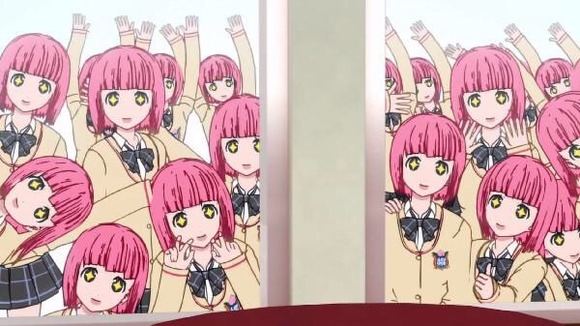
Whatever the case the length was necessary, as the show through the character Yua Suzuki, who now for most of the episodes speaks to the audience and her cast members in the openings of the show, is now openly as much a way to promote the characters in-between them organising what to do for each episode. They shuffle the cast members, or have full group events, but it's usually the Puru Purun Sharumu cast first, than the original Tesagure cast. Tragically the Mobuko family, the insanely numerous identical sisters, get put by the wayside as there's not a lot of activities anymore baring a couple. Thankfully, voice actresses Reina Ueda got the end of episode previews, which tell a strange Mobuko family tale rather than preview the main show, as compensation.

The show is mainly conversations now for Season 3 and continuing improvisation with the voice actresses, more about the casts coming up with new and wacky takes on ideas like zoos to dentists. Some of the more focused and sillier jokes, like a card game of constructing sentences which lead to incompetent zookeepers who still have jobs or having to complete a mathematic test as you get your teeth done, are legitimately funny. When the voice cast break character, or find the work funny in character, is when Tesagure succeeds.

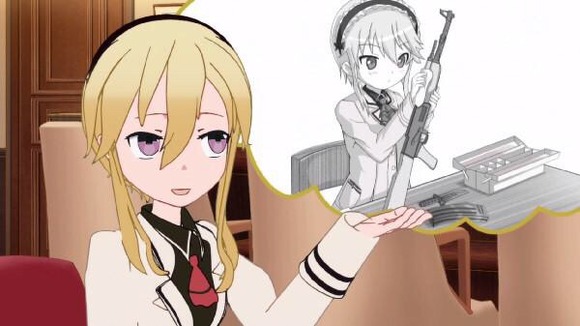
Unfortunately stretching this premise to over twenty minutes per episode is with huge pacing issues, creator Kōtarō Ishidate's obsession with improvised dialogue one which cannot be extended this long without respite. The activities from the two series before sadly don't appear frequently as mentioned which causes a problem, a sense of malaise felt as cast are just sat around chairs for the most part, never necessarily building to a great deal as, whilst the original Tesagure characters have established personalities, the Puru Purun Sharumu cast don't stand out except in rare occasions. Examples like this, occasional, are such as one voice actress breaking character to explain to another heavy metal or a Russian speaking girl who has access to a tank but is tragically not as frequently used as possible, possibly in a fourth wall breaking joke due to her actress having scheduling conflicts.

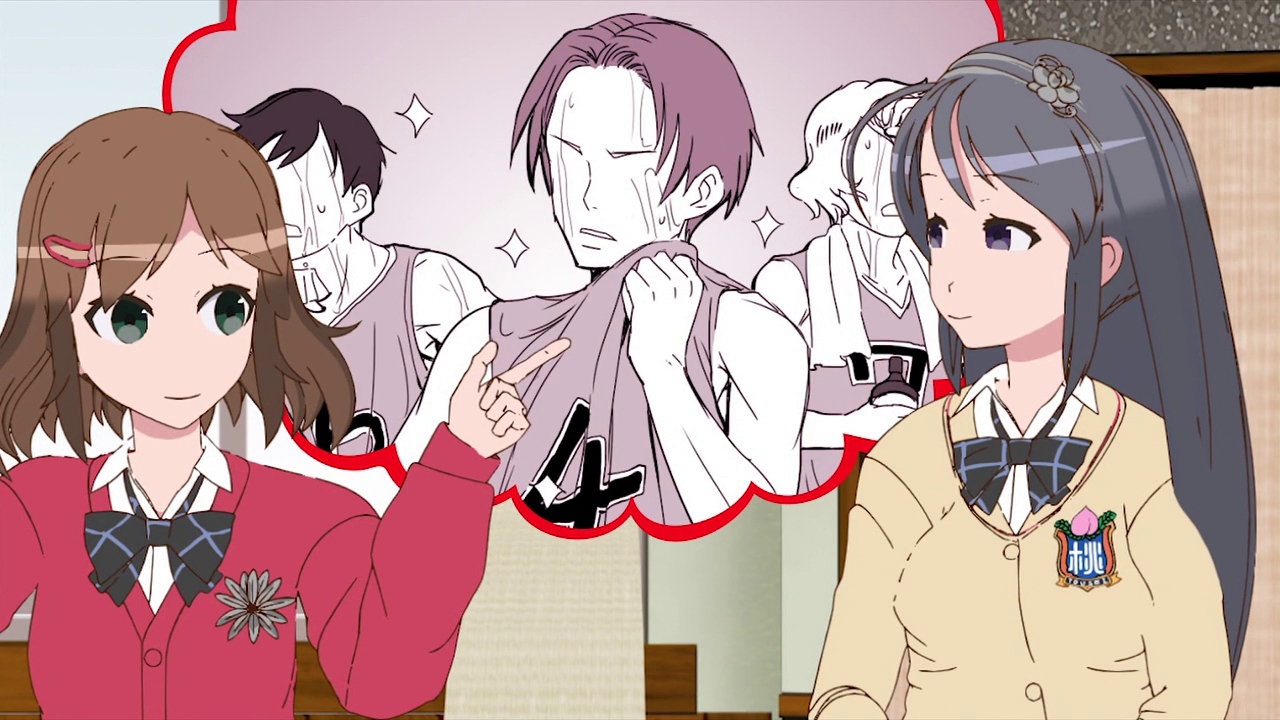
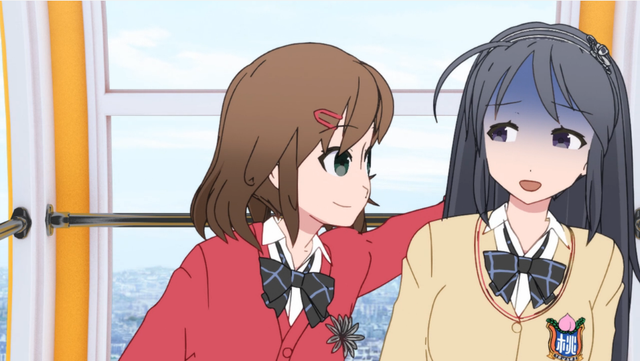
When the activities do appear, like a musical theatre version of the show or ping pong with intimate questions needing to be answered as you strike the ball back over the net, its appreciated. Thankfully the production gets a much needed shot in the arm when it was decided to send the original Tesagure actresses off to real life locations, like a haunted house or a zoo, record the real exchanges and scenic sounds as they try to "stay in character" and animating the results. This does really stretch what is required of the cast to a virtue, also really getting into some unexpected things rarely found in anime, such as the one recorded on a Ferris wheel where unless she's acting Satomi Akesaka as Hina really doesn't like heights and shows it in that escapade. Also its sweet just to hear voice actors get easily amused by meerkats, even if the critters animated are caught about to get it on in the open.

Unfortunately, the attempts at new ideas do lead to two bad episodes, the two part "Yuriwolf" game. Ishidate likes having his casts playing games, felt when a later show Himote House (2018) ends with an intentional whimper of a card game for the last sequence. The game here is "Werewolf", in which two people have are assigned as werewolves and in trials the group have to try to vote out them to win, with the later picking off a person after each trial if not voted off and deceiving everyone else1. Changing it to "yuriwolf", in reference to "yuri" (lesbian or gay female) stories, has an unfortunate connotation someone didn't think too carefully of, though Ishidate to his credit with Himote House had the "Yuri Game of Life" episode, an episode that has stuck with me in a flawed series which was probably as biting about the problematic LGBT politics in Japan as you could get away with and then some. It doesn't excuse the Yuriwolf episodes, actually called Let's play with werewolves and yuri ((1) and (2)), being frightfully boring, painfully so as the two episodes drag. What makes it worse as, showing clips of another bonus game, the final episode tells use this can only be found on the Blu-Rays as extras, suddenly turning this series in an advertisement for material we cannot get in the West for added insult to injury.

The question of whether the entire three seasons of Tesagure ultimately works is a complicated one. Everyone clearly had fun, managing to get away with a clip show that's good at one point by having it redubbed, the cast sorted by categories as esoteric as who accidentally called their teacher "mother" for rounds where some may have to say everything in the verge of sexual arousal to shouting from outside the recording booth. With the original cast too, they have grown these characters into idiosyncratic figures over time. Or there's the further existential adventures of Karin Ogino, as the boisterous Aoi, who eventually becomes more puerile, biting and bored as she continues onwards baring her continued obsession with making all her jokes puns, culminating in the final episode where she's meant to play her character in a comedy competition against everyone only for baffled amusement at what mood she is in to take place.   

I will be blunt though in saying, if taken as a whole, the franchise doesn't succeed. Mainly this is because fifteen minute micro episodes are bite sized but as a whole, there's not as many successes as there should be even if the cast are admirable in personality. There is a lot of experimentation here which does indulge without enough risk or pay off, to which I will always go back to gdgd Fairies (2011/2013) which Ishidate worked on for the first season. That series did stand out for the improvised sequences but was both focused on one idea with rich potential (the magical "dubbing lake" of 3D models taken off the internet crudely animated), and also had many other segments which were great and became some of the funniest material by the season.

There's also not a lot of growth in Season 3 here, as baring the much welcomed sequences at public attractions the only aspects which succeed are the jokes that lasted ("worn panties" a reoccurring gag since season one that clearly caught on) or characters who have been able to evolving a little over time, such as the initial "protagonist" Koharu now the put upon and sympathetic butt of a lot of jokes. Neither most of the manga and anime references, nor many of the conversations in themselves, beyond this stand out. It is a surprise for me that the series got three seasons, as it's really peculiar. The likelihood is that, as I have found, there's developed a taste in these type of simple shows about esoteric con esoteric conversations and jokes which usually rely on puns more fluid in Japanese, but even then this franchise's a real curiosity in its longevity.

Arguably, as animation, it's always skirted on the seat of its (worn) pants by being very basic and improvised. Even in spite of how easily it must've been to produce, which is a thing to consider as the show is constantly joking in season three in some of the better jokes that the production is behind, even early on recycling sequences from before for jarring results. Even then, I look to the strange experience that was Virtual-SAN Looking (2019), a show I missed most of the humour of but still liked, as a show which sold itself on the hot trend of virtual YouTubbers and thus becoming a fascinating sociological piece in the making. Tesagure in contrast ebbed into something I am glad to have completed the whole of but may sadly disappear entirely from memory barring few highlights. Even in terms of Kōtarō Ishidate's career, which I want to continue and find as much of in interest of his very unique style, the good moments through two (and a spin-off's) worth of a franchise don't necessarily hit as high moments as other projects I've seen of his.

=======
1) According to history, it's been traced back to 1986 to a Russian named Dimitry Davidoff as a social deduction game originally called Mafia, befittingly with the Russian speaking character here the one that plays the hostess/narrator.

Monday, 14 October 2019

#122: Tesagure! Bukatsu-mono Encore (2014)

From https://blogger.googleusercontent.com/img/b/R29vZ2xl/AVvXsEjRxBk5VbchYNILizad0evFVeLXZWYhD1mNJLPkhyS8Tg1dkd3XM4UQF7tir7vJbkOafEtliFMeXXQAk_FIAu3Fs3KOiICTCn0eHGkLV0eM4vyh4O5fYUC8KkPrVlbXrkn1WGhUHD7u9zA/s1600/tesagure+bukatsu-mono+encore+0.jpg


Director: Kōtarō Ishidate
Screenplay: Kōtarō Ishidate
Voice Cast: Asuka Nishi as Yua Suzuki; Satomi Akesaka as Hina Satou; Karin Ogino as Aoi Takahashi; Ayaka Ōhashi as Koharu Tanaka
Viewed in Japanese with English Subtitles

This is going to be difficult to review as, following from Season 1, Kōtarō Ishidate's micro-series Tesagure... doesn't drastically change the template in the slightest. The premise is a high school club of girls that doesn't officially exist on the books, but exists regardless, devoted to entirely be about talking about other clubs and new alternatives, going through anime and manga clichés along the way. To its advantage, Tesagure... never explicitly references any other manga or anime, so even a novice to this medium could appreciate this series as you'd learn about these clichés, even for genres you've never encountered, and still find it funny. Like Ishidate's other work, improvisation where the voice actresses, who are predominantly the main leads for his work rather than voice actors, takes place where they have to actually improvise jokes even if the mistakes and embarrassment are kept in and animated around.

Here, redacting the melancholic ending of the first season, the youngest members Koharu (shy, put upon) and Aoi (the brash and energetic one obsessed with puns) decide to not follow a natural chronology and instead just repeat their original school year with their seniors Yua (the club leader) and Hina (meek, and explicitly this time uncomfortable with even saying crude things) again. It leads to more conversations about group activities and leading to the actresses involved building off the initial characterisations for further humour.

The series does even begin by breaking the fourth wall, the cast having to work around the animators being restricted in resources, even leading to what can be described as the most jarring (but funny) uses of recycled footage in even shots of the characters you could get. If anything, this season feels over the usual length of episodes, twelve that are merely eleven minutes each, as a stretching the original minimalist template to new layers, just in terms of playing with the opening credits being "sung" on the first lyric by different people to the content afterwards.

The only structural difference is there are less of the group activities this time, which ended the episodes with reinterpretations of famous games, some episodes happy to drag the conversations out for the whole episode. The few activities we get are memorable - kaiju volleyball, where you have to project model buildings on your side of the net from the giant volleyball, or a game of trying to create poetry by way of painting abstract images quickly. There's even a school festival episode where the quartet have to take over from the absent musical band meant to perform, which is also memorable.

From https://ikilote.net/Galeries/News/Anime/
#AR/Tesagure!_Bukatsu-mono_Encore_-_ep02_015.jpg

Notably as well, the characters have grown in ticks even as stereotypical figures, as little aspects of their personalities (and, frankly, their actresses' as well) grow - be it Koharu not being able to catch a break, until the one moment she succeeds by slurring her words for a joke, and getting nicknames she doesn't want, to Hina being meek to the point she doesn't like cruder topics in the slightest, the shots stretching her position as far back in the room used well. Even the running gag about "worn panties" from the first season returns, more than likely the result of letting your cast improvise and, getting a friendly banter, recollecting old jokes as friends would.

Anime clichés are still parodied, still without using examples so anyone can still learn from the joke, but more striking if you get the references. Probably the best, as it's a question I have always asked myself, is about the fact anime high school always has characters eventually going on the roof, when they should be locked; others including the oblivious male protagonist having a male friend who knows everything, and an amusing touch in this show where the apparently prolific amount of security cameras around this campus are actually modesty protectors for the female students, demonstrated to Koharu'ss chagrin.

Even the Sonata sisters, insanely numerous identical sisters introduced from the first series, looking the same as star eyed and pink haired schoolgirls all voiced by the same person, have more to do this time. Even the voice actress Reina Ueda gets a moment, getting annoying at one point when the other cast members demand her to create new family siblings, male and female, just to have her do more silly voices.

Again, they even manage to have a sweet final ending again, seeing a side of a character when they were not quite the pun obsessed figure of after. In general, its small steps taking place here, but in this context it's all very well done. This type of dialogue heavy and minimal work is becoming more common, as its likely to be a lot more easier and cheaper to produce, but alongside being a great training ground for actors, just because comedy usually demands them eventually pulling out odd voices on various ranges of the tonal and emotional scale, even helium voice here, but because even this is a fine art as a series to try to pull off. Even the limited animation quality becomes a joke in the first quarter, so the creators are even aware of how to economise their limitations and even make jokes at its expense.

From here, the final series takes a different director. A larger cast and normal twenty plus minute episodes are what are added to this franchise for Season 3, which could make or break the premise completely in execution; whatever the result, it'll be fascinating to see Tesagure... take a giant leap in structure. Certainly in terms of this type of series, when it's hard to say any particular episode stands out but the quality is so high it sticks, the greater risk does evoke questions of what to expect.


From https://3.bp.blogspot.com/-Z2lyUfVr8pU/WWYPmWv2l9I/AAAAAAAAn-0/mwdkr
A42mY4ui8TCKjcqTmzwt5A-Hnq8gCLcBGAs/s1600/tesagure%2Bbukatsu-mono%2Bencore%2B3.jpg

Monday, 16 September 2019

#118: Tesagure! Bukatsu-mono (2013)

From https://cdn.shopify.com/s/files/1/0318/2649/products/
51N7_2B1mu3CL_large.jpeg?v=1417967489


Director: Kōtarō Ishidate
Screenplay: Kōtarō Ishidate
Voice Cast: Asuka Nishi as Yua Suzuki; Satomi Akesaka as Hina Satou; Karin Ogino as Aoi Takahashi; Ayaka Ōhashi as Koharu Tanaka
Viewed in Japanese with English Subtitles

Returning to Kōtarō Ishidate, co-creator of the first season of gdgd Fairies (2011), Tesagure! presents an interesting conundrum for me as whilst it follows his trademark style - improvisations from the voice actresses, sketches, absurdity and thought bubbles with absurd whims being depicted - this is definitely his style distilled down to its most purified form, almost entirely dialogue in which four high school girls, one roped into this unofficial club of three, spend the first season here discussing the clichés of various clubs, and anime/manga clichés about their activities, until it descends into silliness. Baring some sketches where the cast play out these activities with absurd new premises - like baseball with players blindfolded and being told where to hit/throw/catch by bystanders - and sometimes a cold opening which mocks a troupe of anime, it's mostly this dialogue, with the cast speaking around their club room table.

It is definitely difficult work to scrutinise as that premise never drastically changes, and yes, this is made more poignant as this has three seasons in existence, meaning this is technically in terms of time Ishidate's most successful creation so far. Series one, the subject of today, is frankly as idiosyncratic as you can get. Openly, its cast do spend their time playing very predictable characters, which proves a problem in terms of actually reviewing them as, barring those few exceptions I mentioned, the show is mostly in the cast's club room and dialogue. The cast does grow into idiosyncrasies, but they are definitely caricatures - the meek older student who blushes at the others' crudity, the eccentric red head who hates almost every hobby and is energetic, the one who is roped into the club, and the fourth who is the club leader - meaning that the fact that improvisation is an integral part is a godsend, as it leads to farces where these characters develop far more personality then their initial profiles. Also of mentioned are the Sonota sisters - an insane number of identical sisters, pink hair and stars for eyes, who are helpful if they need players for a baseball game or an audience when one of their ideas is put their conversations on stage as acted theatre.

Production wise, it's a low budget cel shaded 3D animated work, not as deliberately crude as gdgd Fairies but definitely working to its limitations, helped by the show being about the conversations primarily. The depth of references is severe, but never referencing actual manga and anime - instead, almost quickly to the point you can miss content if you even get distracted for a few seconds, these characters elaborate on the clichés and always create their own anime/manga story based on said clichés, so much so as whilst it could be off-putting for some viewers, others might find this rewarding for prodding types of storytelling in these mediums new to them. People who might get the references will definitely find them funnier, but its poignant I didn't need to get baseball manga reference but could hear about all the absurd clichés and get a lot of humour from them anyway. The references lead to tiny additional sketches and jokes which add a lot as well, such as the fact a pair of students, one male and one female, will always get trapped behind a closed door, or that one joke that cheerleaders should wear worn panties leads to a running gag about worn panties to the main cast, one where it feels like the voice actresses themselves are gleefully ribbing each other and having so much fun in their work.

From https://img1.ak.crunchyroll.com/i/spire1/c
7096b7945d08a90de4270144bd6c28e1447503112_full.png

Experiencing Ishidate's work so far, and these micro-series in general, (here, eleven minutes per twelve episodes), I realise there is a huge danger to dismiss these anime programmes, particularly when they are minimal in animation, not to be expansive and artistically incredible. But even Tesagure! is still pushing the format in some way; here, whilst very subdued, the show is taking the piss out of the medium in a warm hearted way, coming from a love of it, but in a way that even an outsider with some patience could get the joke is worthwhile, never namedropping a single anime to my memory and getting the absurd plot clichés over as the joke instead. This is very different from what a lot of anime does, which makes it insolar and in danger of dating greater, whilst this could age very well. For me, some references I did get and were funny as a result, but for others I didn't still there was a pleasure in still having them explained as the joke, leading to a silly air especially when the plots the cast come up with got more idiosyncratic as these characters barnstormed them. The sketches, where they attempt new versions of the activities, are also funny enough, especially as you could try to make them real in some cases.

And of course, the improvisations are the real meat of Ishidate's style, more subdued but with the same style as before as the animation is clearly built around what the actresses do and react, even out of character which is audibly apparent. A lot stands out for this - when the cast members stumble into failed jokes which are commented upon by the others,  get into crude tangents which always leads to the character of Hina, the meek one, to blush and be depicted far away from the table briefly, or the running gag of Aoi, the energetic redhead, trying to find word play puns in everything they talk about no matter how laboured they could be to reach.

Its charming, and god bless the series, whilst they deliberately undercut this in the second season with humour, the final episode of Tesagure! is actually bitter sweet, to the point the series could've ended here and ended on a high note, as the two seniors graduate and try to leave their club to the youngest members, heartbreak following. Even the ending animation, which is the same one, is given life as, based around a dance, there's new dialogue each time which builds on the awkward attempts to improve with a lot of self-deprecation. The result is sweet like tea and cake than Himote House (2018), a latter work which hit for more absurd and bolder jokes but did feel unfortunately a victim to an erratic structure. It's fascinating that this got two more seasons, and already before I even cover them, arguably Kōtarō Ishidate is an auteur on the basic level as he's honed this style over and over again. Pointedly with Ishidate, barring one show about Transformers where they from my knowledge argue about their franchise's lore, he's been obsessed with a female cast in new character roles playing to this dialogue based premises, and keeps going. That he's always provided voice actresses, in shows which from what I've seen of his never have any male characters of prominence, and give them so much to do, is awesome especially as he's creative. (And that's also from seeing how, for all the show's flaws, Himote House could suddenly turn into a critique of Japan mistreats the LGBT community in a "Yuri Game of Life" episode, thus exposing an even more surprising side to him and anyone involved with that show that's positive). That's going to be interesting to come back to when it comes to seasons two and three, and best thing is that, for all my fear this review would've been stupidly short, stuck in trying how to describe this show, I can thankfully (hopefully) give it the positive review it deserves.


From http://livedoor.blogimg.jp/tekitou_matome-sao/imgs/a/9/a922ac1e-s.jpg