Showing posts with label Splatter. Show all posts

Sunday, 27 October 2019

#125: Pupa (2014)


Director: Tomomi Mochizuki
Screenplay: Tomomi Mochizuki
Based on a manga by Sayaka Mogi
Voice Cast: Nobunaga Shimazaki as Utsutsu Hasegawa; Ibuki Kido as Yume Hasegawa; Mamiko Noto as Sachiko Hasegawa; Kōji Yusa as Shirō Onijima; Kyōko Narumi as Maria; Kenjiro Tsuda as Makoto Hotoki
Viewed in Japanese with English Subtitles

Concerning previous "terrible" anime I have covered, Pupa is not as bad as its reputation suggests. Unlike, say, Mars of Destruction (2005), where for my enjoyment of it the result of a technical embarrassment, Pupa was a compelling premise, one which is grotesque and likely as much to have been dismissed by many due to its offensiveness. However, there is also the issue that Pupa was compromised by the worst case scenario of how a production shouldn't have ended up.

Pupa is pure ero-guro-nonsense, in the sense of the erotic (ero) in its transgressive incest themed content, grotesque (guro) in its gore and disturbing plot details, and nonsense for how over-the-top it is, in which a virus has left two siblings, Utsutsu Hasegawa the older brother and Yume Hasegawa his little sister, mutated. Yume, inside her stereotypical cute Moe schoolgirl form, is actually a human flesh eating monstrosity that'll devour anything that moves if she gets hungry but, watched over by a shady organisation, a compromise is found in that her brother Utsutsu can regenerate grievous bodily injuries, thus decided upon himself to be the Prometheus to her crow by letting her eat pieces of him when she feel the cravings. It's made inherently sexual just in the sounds the voice actors make during the few eating scenes, chomping on her brother's stomach in the gym during physical education classes, and is more disturbing as they're mere underage teenagers and related. One scene, where they are undressed and Yume's allowed to feed on him in one of their bedrooms just deliberately evokes an even more sordid air to already provocative content. I find in this case however it's an acceptable form of transgression, as its meant to provoke with a reason, deliberately set up to be freakish and yet perversely compelling, and its set up to.

Mainly, in spite of the huge production flaw of how Pupa's structured we'll get to, because there is enough set up in terms of complexity. That these are psychologically damaged figures whose symbiotic relationship comes from the older brother wishing to protect his little sister. Their father was abusive, and the mother even before birth outright rejected to her second child as a monster, forcing the siblings in a relationship of closed in isolation where they depend on each other. Incest is, frankly, a taboo subject for a reason, and its particularly an issue as it's a common theme to be found in anime and manga even in porn, which raises an issue of when it's used at all; it's gotten so pronounced in subculture that an increasing amount of "step-sibling" plots in Western porn may be an attempt to reach a fan base that's into those Japanese works originally. Here in Pupa, in this context, it feels acceptable as a deliberate provocation trying to be more dramatically richer, and one of the virtues of Japanese horror is that, even when it's nasty and gory, a surprising amount of it has a lot of potential for nuisance than much in the West. Pupa from its tone is inherently more nuisance and even when it leads to a darkly humoured tone with how their awkward feeding relationship plays out near the end, it's with reason with context.

Probably the biggest surprise is that Pupa was directed and written by Tomomi Mochizuki, who directed Ocean Waves (1993), a Studio Ghibli project, and one of their most obscure titles, in which they let younger talent create a TV animated movie, thus (as Ocean Waves was a high school drama) you have both the abrupt change of pace and a review that can quote Ghibli and body horror in the same sentence which also happen to both be about teenage angst. Unfortunately, when Pupa was originally meant to be a full length anime TV series, the production went through a drastic choice that proves a huge issue. First, this is a micro series, twelve episodes that are four minutes long each, which is a format I have covered and come to admired, but leaves Pupa with barely the surface in terms of its plotting. It does mean you have a full narrative here of interest, but details are lost to the side, such as the character of Maria, dressed as a Goth witch that looks out of place as a costume, the villainess who is involved in the experiments on the siblings and even willingly becomes the expecting mother of another flesh eater, a plot thread we never see as that closes out her story. Likewise, the show ends with another medical group, for unknown reasons, kidnapping the pair and taking a morally dubious stance that, just because he can regenerate even amputations, cutting Utsutsu up with anaesthetic is just pure evil no matter how much good you claim to be studying for.

From https://www.fandompost.com/wp-content/
uploads/2014/02/Pupa-Episode-7.jpg

Not helping was apparently, with full knowledge this is a nasty premise, this was released censored in a comically atrocious way, as in black obscuring blood to the point the screen's black, white bars covering sibling eating to the point of almost becoming more obscene looking, even the censorship of a knife being held aloft. It's an embarrassing result, as you can see comparisons between the censored and uncensored versions, and beggars the question of why adapting horror anime like this unless you have it PPV or on the equivalent (which exists) of cable where you can show stuff like this with more ease in Japan. In general, Pupa is not an example of dreadful anime, but an example of all the production choices that can mess up a compelling work.

Visually the show is okay, the generic character designs actually helping with the luridness of the premise if you aren't going to be more ambitious, especially as the whole stereotype of the innocent little sister-figure to protect, which is a common and a problem in terms of its fetishisation in this medium, is made more interesting here when the character looks and sounds as doe eyed and soft voiced as possible before she turns into a monster reptile creature eating your leg. The emphasis on this is also decided to depict the more real disturbing content, like the abuse background to their childhood, through the motif of teddy bears representing the family, innately the bright colours of animation useful for making bright cute things more disturbing when representing the worst in humanity. The show even ends on a sweet note as, rather than horror, it's a childhood flashback to a game Utsutsu tries to win as a small boy for his sister that emphasises his love and protectiveness to her.

So there was more ambition here than some of the bad or boring anime I have encountered would never have. There's enough in just thirty seven minutes or so altogether to redeem the work from its infamy, but of course the fragmented version in existence offers barely a slither of a work that could've been more interesting. I cannot imagine fans of the original manga, by Sayaka Mogi, would be happy when the work lasted over five volumes leaving a lot on the table left to potentially cover1. It's a "what-if" instead, the chance likely to have been compromised permanently as this is an obscure work and, if Western reactions had any influence in the slightest, it's like angry peasants welding burning torches than defences for the most part. So the result is admiration for what is there, but a lot of disappointment too, which is a shame as in knowledge of how perverse, disgusting and adamant to many clichés Pupa is, I actually enjoyed it for what it was immensely.  

From https://moesucks.files.wordpress.com/2014/03/pupa-1102.jpg

=========
1) As of 2019, no English translation of this manga exists sadly, though if you can speak French, France with its healthy number of manga titles of intrigue being published there did get it.

Monday, 15 July 2019

#109: Mad Bull 34 (1990-2)

From https://images-na.ssl-images-amazon.com/
images/I/61VHFNHD4eL._SY445_.jpg


Director: Satoshi Dezaki
Screenplay: Kazumi Koide and Toshiaki Imaizumi
Based on the manga by Kazuo Koike and Noriyoshi Inoue
Voice Cast: Akio Ohtsuka as John "Sleepy" Estes (a.k.a. Mad Bull); Yasunori Matsumoto as Daizaburō "Eddie" Ban; Gara Takashima as Perine Valley; Takkou Ishimori as Captain Allen; Masako Katsuki as Cindy Murphy; Naoko Matsui as Jaqueline Moyert ; Mitsuo Senda as Nichol the Electrician
Viewed in Japanese with English Subtitles1

It wasn't a good idea to revisit Mad Bull 34 in one sitting, over three hours for all four episodes, yet it feels befitting in a perverse way. One episode by itself is enough to melt the brain, mainlining the entirety of it is insane but the only right experience for a truly notorious OVA series. The fact that this is one of the first anime I ever knew of as a kid, from an advertisement for the first episode (as released by Manga Entertainment) was included in a gaming magazine I had, is sickly humorous if mortifying. It's the promotional image everyone knows for Mad Bull 34 if they know of it: the iconic image of a New York police car approaching the viewer, a burly policeman with a shotgun, woman (head unseen) merely wearing revealing underwear. Little do you know, from a manga by Kazuo Koike, that it wasn't really a suffice warning for the easily offended, as good God Mad Bull 34 isn't politically correct or even palatable for me at times, hardened on weird perversity, and wasn't really a warning for how, when it is at least entertaining rather than gross, it's as mad as a box of frogs and then some.

The late Koike is an acclaimed manga writer, not the illustrator to which Noriyoshi Inoue drew Mad Bull, and its known whilst he has a deserved legacy, from the likes of Lone Wolf and Cub (1970-76), Koike did belong to a type of extreme pulp that, forced on hard and short work schedules and having to top his previous work, meant he was using a lot of extreme content, which includes sexual violence which is problematic but not synonymous to only his work, or even anime and manga for that matter, nor just Japanese pop entertainment. Honestly the issue with Mad Bull 34 for me and likely many, in which Episode One follows new cop Daizaburō "Eddie" Ban on his first day with the worst cop to be placed with, a veteran named John "Sleepy" Estes known for "shot-first, ask-later" Dirty Harry tactics and working with sex workers for cash on the side, is the sexual violence and threat of rape through the first three episodes, worst as its depicted as titivating as it is lurid, always threatened to the female cast only and gross.

I don't view it as a damnation of Koike, director Satoshi Dezaki or anyone who worked on the OVA, especially aware that there are significantly worse examples in anime, (the uncensored version of Ichiro Itano's Violence Jack: Evil Town (1988), for example, is probably more deplorable by account), but unfortunately it became an easily plot point for rising escalation to have female characters threatened like this, that this was the only valid threat to a female character, and it was played for sexual as well as plot reasons. American exploitation is as duplicitous for this, and frankly even implied threats without any nudity or violence are a trope in multiple forms of storytelling, even D.W. Griffith with The Birth of a Nation (1915) effectively having this, when Lillian Gish's character is in peril, within a film with layers of other significant problems a viewer has to deal with.

As a result, you have to endure this material with Mad Bull 34. When it isn't this, or the incredible sexism, the OVA is batshit insane and memorable, where if those problematic details weren't there you would have plenty of ridiculous, cheap but memorable schlock to ingest. For, you see, Sleepy is actually shown to be a good guy, one who blows a masked roller-skating store thief's head off with a shotgun, but loves his community and, whilst having sex with all the sex workers he is with and steals their money, uses said money to help them and rape victims. Yes, this is all in bad taste, and even this as the first episode conclusion is enough to dismiss the OVA as utter tripe, but it all comes off as absurd, the material which has nothing to do with the problematic scenes having a tone so earnest inspite of their unintentional exaggeration that the only reflect even for the gore and prurient content is to laugh.

A pertinent idea to consider is how Mad Bull 34 feels like an interpretation of American exports of their television and cinema. Some have suggested the OVA is an extreme parody, whilst I wonder this is just what happened when Koike tried to make a story set in New York City, with an insane amount of detail (like his original manga) in terms of depicting the city, right down to the aesthetic of the cop cars and locations. But the material instead blended together all the worst clichés of American pop culture into this extreme distillation. Certainly, this is still New York City before Rudolph Giuliani, whose public image is that when he became major of New York City he cleaned up the cesspool it was at least depicted and exaggerated in American cinema, rife with crime and poverty, to the modern city we have now. Certainly, the material in this, even the more overt sci-fi details as we will get to with Episode Four, isn't that far off strange material that this had. 

From https://66.media.tumblr.com/tumblr_p7dh0rAY491um3c88_frame3.jpg

I forgot so much. That it spliced humour in at even deeply inappropriate moments. That Sleepy Eddie who is slowly being won over by his senior's beliefs, prevent a near rape of a female reporter whilst dressed up as women. That the first episode has, and I kid you not, a James Brown song even on the Discotek DVD release over the end credits, Brown someone who would've been horrified if he found out his song (against three pop songs over the other episodes) was used for an OVA where someone gets minced by a passing subway train for the first episode's finale.

Animation wise, it's just better than many titles from this era, but also part of the notorious amounts of schlock from the late eighties and early nineties which was just competent, still with detail and style but not exactly the highest bar of this era. It's also made by Satoshi Dezaki - not, as presumed, legendary director Osamu Dezaki, but his older brother. The same who also directed They Were Eleven (1986), a great sci-fi story which is the polar opposite to this in its mood, a tale adapted from legendary female shōjo manga writer Moto Hagio, which (from a source originally for a young female audience) locks various alien space cadets in a dangerous situation and, with the creator's themes of gender politics within it, very feminist readings especially for a character whose world has the young choose their gender despite her initially being the sole woman in the crew, with all the biases for women on her planet a burden to the choice. How he also, by all accounts, made Mad Bull 34 raises more than an eyebrow. Screenwriter Kazumi Koide too, who wrote Episodes Two to Four of Mad Bull 34 but also They Were Eleven.

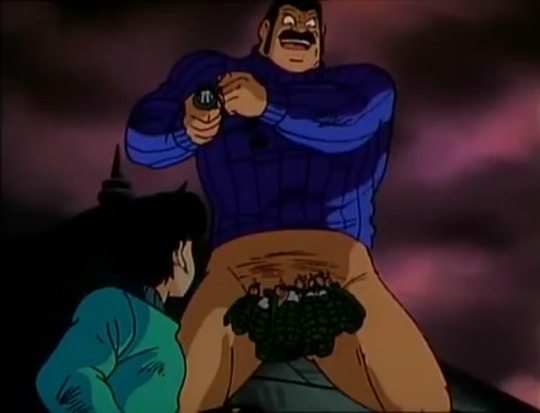
Episode two, introducing female officer Perine Valley who Eddie develops a crush on, does show the schism you do have to deal with. It's scuzzy, and with a mob boss with revenge desired on Perine for leaving him mostly robot stuck in a wheelchair, the desired revenge also unfortunately includes sexual violence of a leering, objectifying sort. Yet there's also the insane detail that, if by itself, would've developed the reputation Mad Bull 34 has but without the caveat of all the uncomfortable details. Like Sleepy bringing hand grenades to a stake out, hidden in his trousers tied to his pubic hair, or the challenge of picking the right canned coffee that isn't actually an explosive, introducing a fun side character who Sleepy can always pick out for his scent of urine and sugar, a homeless (yet dangerous) guy who will help the good guys later but still wants to be the guy who offs Sleepy in a perverse form of honour. Or the death bed wedding, which in itself represents the famous odd logic of Koike, even found in the live action adaptations where a Lone Wolf and Cub sequel had the titular Wolf having to kill various people to be lead to the target he is actually meant to be killing.

Arguably Episode Three is the same story repeated, as a result the weakest episode, following a female reporter chasing after a supposed rapist-murderer with a lot of power on his side, again the ongoing issue still there of that theme being too much of an obsession of the OVA. It does have a merciless (and openly suicidal) Chinese mercenary gang that, possibly offensive or just from the Crying Freeman school of intercontinental ridiculousness, at least offers something much more serious and a credible threat. It does also lead to their leader bursting into the finale with a tank. As evoked, the 1988-1992 anime adaptation of Crying Freeman, also a Koike manga originally, is felt as a comparison and honestly, whilst there is one plot threat later on which is offensive, Freeman despite being prurient and lurid feels like Mad Bull 34 if you felt less guilty for its uncomfortable content and instead was on the right side of lurid weirdness which you could feel less guilty about.

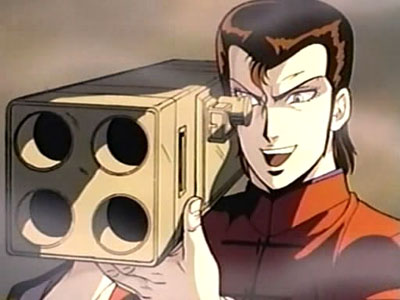
Thankfully, Episode Four, even if it has the questionable ender politics still, thankfully changed the pace and is arguably the most entertain episode, getting some actual atmosphere in the first night time city shots before a Predator wanders onscreen killing police officers. A literal one, as much as you could get away with for copyright reasons, just after Predator 2 (1990) had an actual one carved through future Los Angeles rather than a figure here in high tech armour attacking the New York Police force.  It becomes a convoluted and at times hilarious melodrama, in-between a challenge in Yankee Stadium with a power suit borrowed from Aliens (1986), and a finale of over ripened drama which involved a marriage-suicide, and as a result its naturally so much more compelling than repeating the grime of the previous episodes, even with all the strangeness with a love interest/enemy that borders into strange incestuous undertones adding to the oddness.

It thankfully also jettisons to nastiness of the previous three episodes, still utter trash but with its final shots of snow falling on the New York Streets set to synth pop ballad, it's the kind of compelling absurdity which, in honesty, is what Kazuo Koike at least in adaptation should be. It's this we should return to these infamous adaptations and as much why, whilst not a lot of his career is actually published in English, his manga should be revisiting, the heightened emotion and insanity of his male dominated stories which followed his belief that character, not plot, was of greater importance. It's not that bizarre in hindsight his apprentices can vary between Tetsuya Saruwatari, co-author of the original Riki-Oh manga (even more insane than the 1991 Hong Kong adaptation), and Rumiko Takahashi, the legendary and insanely successful authoress of the likes of Urusei Yatsura; maybe the gore and luridness might not apply to both, but distinct characters and escalation is likely what Koike drilled into his students' heads. Mad Bull 34 is NOT the best way to experience his work, for good reason, but let it be known the infamy of the OVA, whilst also for tasteless material we could live without, is also from a strain of hyper-storytelling whose ridiculousness is compelling to say the least.

From https://www.animeclick.it/images/serie/MadBull34/MadBull3423.jpg

=====
1) Adding to Mad Bull's notoriety is the infamous English dub by Manga Entertainment, in which British voice actors attempted playing their characters with New York accents. Honestly, the prospect wasn't a tempting one, so forgive my sin of not watching these OVA episodes in the way many have come to know and even love them through.

Friday, 4 January 2019

#83: M.D. Geist II - Death Force (1996)

From https://media.fstatic.com/QH9lyhbsTpagQwRZ
fYJDjVlCKZQ=/fit-in/290x478/smart/media/movies/covers/
2014/12/m-d-geist-ii-death-force_t112526_3.jpg


Director: Koichi Ohata
Screenplay: Koichi Ohata
Based on the original script by Riku Sanjo
Voice Cast: Jason Beck as M.D. Geist, John Hollywood as M.D. Krauser, David Fuhrer as Eagle, Greg Stuhr as Breston, Joan Baker as Vaiya, Vincent Bagnall as the Major
Viewed in the English Dub
Part 3 of the Koichi Ohata Power Hour

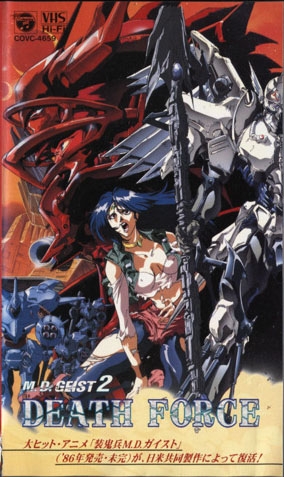
Rather than write the usual synopsis, let us combine the synopsis of the sequel to the infamous M.D. Geist (1986) and the real life story of its creation together. Ten years after M.D. Geist was made and became a successful release for Central Park Media in the US, head John O'Donnell alongside being a huge fan of the original helped both a Director's Cut of the original to be funded, fixing major animation and plot hole flaws with questionable success, and allowing Koichi Ohata to make a sequel. Obviously, spoilers come ahead now as for the sequel itself, but as a viscous sociopath with an erratic behaviour spectrum, super soldier M.D. Geist set off a Death Force of robo centaurs to destroy the world of Jerra in the prequel, and everything's worse than before.

Now robo centipedes which eat human beings for an unknown sustenance reason exist, and the last vestige of humanity is a fortress ran by M.D. Krauser, a blue skinned former super soldier whose nobility is unfortunately matched by a God-like ego. Things are already signposted to get very silly and actually worse in quality from the first anime just from the first scene - a car fleeing from robo centipedes, messily animated with the set-up exposition in the English dub a words-per-second stream of consciousness from a character we never see again. This first sequence alone enforces just how this can top any incompetence and hilarity of the first anime completely.

From https://oavwatch.files.wordpress.com/2018/
06/r1.png?w=620&h=253&crop=1

If the first M.D. Geist represented the notorious anime OVAs of the eighties, then befittingly its sequel is the representative of trashy poor taste nineties equivalents, where it belongs to the kind of gruel and absurdity that would get replaced in the 2000s onwards by fetishes and the OVA market being phased out. The English dub arguably adds a great deal, especially as Krauser has all his lines e m o t e d as to reach the back of the theatre. Of the pair of M.D. Geist anime, Death Force is the more entertainingly bad anime. It has the convoluted plot trajectory of whatever Geist himself is meant to be, the villain destroying everything in the end yet at times presented as meant to be an anti-hero, alongside M.D. Krauser in contrast, who has erected the last bastion of hope for humanity, a moving fortress, but is doomed for the hubris of believing himself to be a God alongside hiring a scientist who unfortunately wants to capture Geist to experiment on. Vaiya is still useless as the lead heroine too, now with amnesia and with a sense of more rudimentary existence despite having a lot more to do with her romantic relationship with Krauser than she did last time.

Death Force, with its jarring plot twists, is the true epic of the awful pair for unlike the expected rules of sequels this feels the more ambitious, with a larger plot by Ohata yet more magnificently awful in comparison. More vivid characters populate the environment (such as an evil scientist or his henchmen, a mere torso who uses robotic limbs that can be attached and detached to him), and just more gruesome in lieu of Ohata's reputation. It does thankfully return with a score that (sincerely) is good in its jazz epicness too; it wasn't necessarily the sax that lead to M.D. Geist getting a sequel ten years later, but the music is still the strongest aspect of the entirely lot and thankfully returned too.

From http://i.imgur.com/bS9EV5l.png

Death Force
even does a Gunbuster (1988-9), its last act abruptly cutting to black-and-white animation as M.D. Geist and M.D. Krauser have their final fight. It's significantly worse than the prequel - ending in an abrupt child impalement that shouldn't be funny weren't it not for the voice performance in the English dub, followed by an even more abrupt death as the animation budget is even less existent, all of it is completely bad but compelling, this sense of trying to force out excitement when, from the first shots, its already doomed. The sense of struggle in production is as much visible here but without the context of before of the prequel; however unlike the first M.D. Geist, the ramshackle nature feels far more interesting here. Certainly it has the bright, gaudy colour of the era, not comparable in the slightest to the original's eighties production even if the character designs and world hasn't changed drastically. The irony is how far later the production was funded, not because it was ten years exactly after or so, but because by the late nineties OVAs were past the boom of them during the bubble economy of eighties Japan and were about to see the righting on the wall the decade soon after.

As much of it is a sympathy for its weird history too why I liked this sequel over the other - some of it has to be derision from my part by in an affectionate way, wondering how the hell the original M.D. Geist got a wider legacy than better or schlockier OVAs, even without John O'Donnell's involvement still selling tapes. Even if O'Donnell's the reason the sequel even exists alongside the Director's Cut, the prequel even if it was the sole release of a non-existent franchise still sold well in the USA. Some of it is admiring the car crash as a whole; all with a bad taste as its childish nihilism with an anti-hero whose morality is entirely absent barring about killing people, who makes Violence Jack look positively chivalrous of all people. And it's ridiculous - so silly, amazing to think Ohata made bad anime like this when Genocyber (1994) (for most of it) succeeded, and that even now Central Park Media is gone their more infamous catalogue titles like this even without a Discotek re-release yet are still known and could actually get one.


From https://positroniko.files.wordpress.com/2012/05/m-d-geistii-02.png

Tuesday, 1 January 2019

#82: M.D. Geist (1986)

From https://www.dvdplanetstore.pk/wp-content/uploads/
2018/01/l0FyuJB44dnpPHmXBH3BKMFII2n.jpg


Directors: Hayato Ikeda and Koichi Ohata
Screenplay: Riku Sanjo
Voice Actor: Jason Beck as M.D. Geist, Dave Couch as Colonel Kurtz, Joan Baker as Vaiya, Kip Kaplan as Marsh
Viewed in the English Dub
Part 2 of the Koichi Ohata Power Hour

Synopsis: On the futuristic planet of Jerra, a member of an experimental super soldier project, christened M.D. Geist, reappears on the lands in the midst of a full blown war between the Nexrum Army and the Regular Army, alongside the threat of a robotic doomsday weapon called the Death Force being unleashed.

Ah, this is as momentous to cover as a Studio Ghibli production, only in the spectrum of suck. And I speak of this as a fan of Koichi Ohata's Genocyber (1994), but M.D. Geist is infamous for a reason. In fact one of the biggest surprises with the original M.D. Geist, bearing in mind its complicated production history, is how slight it actually is when seen by some anime fans as one of the worst anime ever made, or how it was a very successful release from Central Park Media in the videotape era.

Truthfully, the head of CPM John O'Donnell LOVED M.D Geist and used his influence to push the OVA, even turning the titular Geist as the company's mascot. It's a sympathetic thing - we all have favourites that baffle others or you'd be cold blooded - but O'Donnell had a company which he used to fund a director's cut, fund a 1996 sequel and create the equivalent of a Criterion Collection DVD release even when many (including actual CPM staff) thought it was garbage1. And, personally, M.D. Geist is really nihilistic, dumb trash. Now, it has to be established that I viewed the Director's Cut, the original version from Japan Ohata's debut with a co-director (Hayato Ikeda) arguably included in the credits to contrast the perceived inexperience of Ohata. The original version was haphazardly put together with screenwriter Riku Sanjo to the complaints of the animators themselves, and also had some notorious animation faults, all of which the Director's Cut was meant to pad over.

From http://www.otakuusamagazine.com/uploads/
public/images/anime/mdgeistvault1.jpg

The Director's Cut draws out an actual plot and corrects the animation mistakes, but with jarring changes in the type of animation, adding to the fact that M.D. Geist originates from the vast production line of 80s OVAs that this was another half delirious, scribbled mess where there was enough money around to allow them to be made. Arguably, though, even with explanation to what's happening it's not one of the most entertaining from that category at all. It's, at only forty seven minutes, not a long OVA and barely covers a lot, and barely really rises to the level of truly wonderfully bad anime let alone anything good. It's instead a generic post apocalypse tale, openly riffing on what the Mad Max films and Fist of the North Star brought to the table earlier in the eighties, but trying to justify a bland blond grunt named Geist as a badass. We'll get to the murkiness of his characterisation when I cover the sequel in another review, but tough macho figures are common throughout this era, Geist a cipher, but he's not even interesting in terms of absurd stoicism either barring the American football-like body armour.

More underserved, and an unfortunate to be honest in the entire franchise, is Vaiya who is a female leader of a gang who becomes enamoured to Geist for some unexplained reason, trying to seduce him only for this to be the rare chauvinistic anime to not have a male character with a libido and sex scenes. Her character, through both parts, is one of the most trodden on in terms of how visibly useless she's made, her monologue of the idiocy of war and soldiers as hyenas not exactly touching Toshiro Mifune's rant against the samurai in Seven Samurai (1954) no matter how hard it tries. At this point, it's worth emphasising that the English dub, though it gets funnier and worse in the sequel, is dreadful and ridiculous as well which just adds to the absurd lack of seriousness to the material no matter how it tries to be cool. It of course leads to the infamous "Brain Palace" moniker, where the Death Squad hides and launched a thousand memes out to sea on the internet, the dub probably adding a lot more to the material itself in terms of infamy amongst other things.


M.D. Geist
itself only gets interesting with its action scenes, which are a little competent as they're also a mess too, especially when you get to the finale becoming utterly shambolic, the sole plot drive inevitably the Regular Army (sic) attempting to stop their own doomsday device of killer robots (who look like robo centaurs) from wiping out the planet. All, as documented, from the context the creators came up with cool scenes without any particular sense of logic at all, especially in the ending where, for the hell of it, Geist turns the Death Force back on for an abrupt twist. I don't want to bother with a spoiler tag for it either; it'll not rob the context for how absurd it is and an almost deadpan comedy to the scene in the English dub.

Viewed in lieu of its reputation, M.D. Geist is pretty average even in the annuals of badness. As I'll get to in the review for the sequel another time, its far more glorious a car crash whilst the original prequel feels like a generic OVA that were dime-a-dozen back in the eighties, only standing out because of O'Donnell's obsession with the title got it a wider reputation. One legitimate piece of praise, however, is the music. The songs by Hironobu Kageyama, famous for the Cha-La Head-Cha-La theme from the first Dragonball series and throughout that franchise, are bombastic, especially in the one solidly entertaining scene of Geist fighting the robotic death machine equivalent of a Russian stacking doll. I didn't expect though, in the one real surprise of M.D. Geist, is legitimately interesting synth jazz in the score, graphic moments of intestines being split and robots exploding being set to eighties saxophone and a nicely dense, odd score that is better and more original than anything else here. It probably wasn't that however that led to the sequel in 1996 however...

From http://www.rq87.flyingomelette.com/RQ/C/MD/2/60.jpg

======
1) As documented Justin Sevakis - Anime News Network founder, a former employee of Central Park Media, and founder of video/DVD/Blu-ray production company MediaOCD - about M.D. Geist's reltation in the company HERE.

Monday, 22 October 2018

#77c: Violence Jack Part III - Harem Bomber (1986)

From https://orig00.deviantart.net/640f/f/2017/138/
6/d/violence_jack_harem_bomber_by_mdtartist83-db9mc0j.jpg


Director: Osamu Kamijo
Screenplay: Mikio Matsushita
Based on the manga by Go Nagai
Voice Actors: Julia Braams as Mari; John Bull as the Slumking; Nadia DeLemeny as Yumi; William Roberts        as Harem Bomber; Liza Ross as Rose; Bob Sessions as Violence Jack; Barbara Barnes as Sabu; Colin Bruce as Yamaguchi; David Jarvis as Kenichi

Synopsis: In the post-apocalyptic world, the Slum King rules it with an iron fist with his vast hordes; in the midst of it is Mari, captured for his vast sex slavery group, and one of his soldiers named Kenichi, who were a couple before a comet from outer space destroyed civilisation, find each other and attempt to escape the Slum King's minions like Harem Bomber. Whilst this takes place Violence Jack, the personification of death and mayhem, approaches the Slum King's territory.

[Spoilers and Trigger Warnings Throughout]

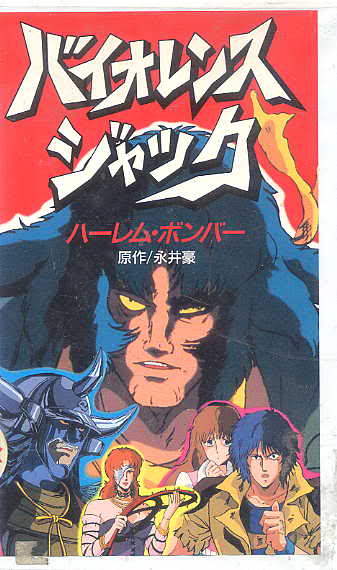
After the gruelling content of Evil Town, than the more rewarding but still tasteless Hell's Wind, there's Harem Bomber, or the Slum King as its Manga Entertainment release dubs it. By this point Violent Jack is just a personification of violence with supernatural powers, all in the shortest of the episodes, the first released and the one with the least censorship for the English release barring a minute or so. It's also so badly put together you could put it on in an art gallery and be compelled by how low a bar in terms of eighties OVA anime is in terms of quality. Revisiting these edited versions, censorship or not, it's a strange emotional trajectory when you don't dare try to marathon all of them, which I made the mistake of for the first time - Evil Town even butchered forcing one to want to take a shower notwithstanding, Hell's Wind watchable, and Harem Bomber so hellishly awful I am amazed I never noticed had bad it was until now. It's bad to the point it's amazing it ever got sequel episodes.

The script's sleazy pulp, Jack versus the samurai helmeted Slum King, all whilst a young couple find themselves in the midst of sexual slavery and Jack causing mayhem, rife in issues and not even ending with a fight against the Slum King, but one of his minions Harem Bomber, a giant nondescript man whose minions (including a bisexual dominatrix with a metal Phantom of the Opera mask who runs the sex slavery harem) are more interesting than him. It also ends anticlimactically as, to defeat the Harem Bomber, Jack throws the helicopter containing the young couple at him, killing the male love interest who decided to help. That in particular stands up as one of the more ridiculous moments of the OVAs, one of the few plot points which is closer to the absurdity found in most "bad" anime from this era rather than distasteful grim. That, and whilst its connected to the grim sexual slavery subplot and the homophobic evil lesbian figure who molests a captive to the point she has instant Stockholm Syndrome, that her male staff are all large men in really, really tiny leather briefs straight out of the infamous Frankie Goes To Hollywood "Relax" music video.

From https://i.ytimg.com/vi/5DsDxGLZFiU/hqdefault.jpg

The animation is also dreadful even by my tolerant standards, a side to myself I openly admit takes masochistic (even sadistic) delight in bad animation and production value, but even here cringed in horror. It's bad to the point that one of the truly infamous lines of the English dub, a case of verbal tourettes, was actually to cover up an animation mistake. The dub, only covered barely so far in these Violence Jack reviews, is ridiculous; whilst its totally inappropriate for the nasty material at points, intentionally and unintentionally, its ironically one of the reasons why the anime is even re-released by Discotek in the current day, its mad failure one of the few reliving aspects to sooth the septic viewing experience. This line, a stream of verbal insults at Jack's way that (in the one single amusing aspect of Violence Jack for myself) I have considered using as an alarm sound, was forced out due to the lip movements of a character being accidental, just as that young male hero Kenichi  abruptly develops a twitch in an eyeball in one shot. This amongst the general presentation is truly bottom of the barrel for anime, compelling but utter trash even technically, ending with Violence Jack not only able to regenerating a lost eye but turning into a phoenix for reasons I don't understand.

The entire Violence Jack project is an inexplicable creation that came from the eighties OVA boom. One that is morally repugnant yet developed a reputation for many to get re-released and even I would wish for a real explanation to why it even came about, the kind of details that would not be revealed by people who worked on this unless forced out of them in a very awkward conversation. Thinking of the individuals behind this, why they made the series even with the fame of Go Nagai behind it, why it took four years and was this sporadic and wildly bad in various ways. The poor female animators having to work on some of the material in the uncensored version, the poor production staff and voice actors of both genders having to work on certain scenes I thankfully never saw, how this project, clearly brought into existence because Go Nagai is an important figure in all manga and anime, blundered along, ended up taking the artistic decisions that happened.

From http://ekladata.com/zF1eojHKulnC49_tyUIHjRQ-NAc.png

And this is all with knowledge the uncut versions, especially with Evil Town, would drastically effect my opinion further, with Evil Town potentially spiritually and psychologically scarring me if it's as bad as I've read it as. If anything, Violence Jack is synonymous now with how for any good or obscure curiosity found in eighties OVAs, it let problematic and artistically incompetent material in the door too, from this to the extremes of hentai porn anime that began when straight-to-video allowed a liberation of content restrictions. The irony is that, even if it was tasteless and offensive for some still, if Violence Jack's worse moments were toned down or flat out removed it would've work provided the quality was improved artistically alongside fixing major script problems. As I'd gladly had Legend of the Overfiend (1989) without the censored sexual violence, Violence Jack even if it has far less defendable content in plot complexity could be remade into something better. Hell, a remake which didn't fall down the same pit holes this did could make sense, especially as of all people the experimental cult anime director Masaaki Yuasa was chosen to helm a Devilman remake in 2018, and that did very well. (And, not knowing enough about the material and not wishing to spoil it, I'd be reprimanded if I didn't mention Violence Jack is secretly a sequel to Devilman in story, so the remake idea isn't that weird).

Go Nagai, frankly, made some dubious creations even if you only watched the anime adaptations rather than the original source material, but it's noticeable that, for every Kekko Karman (the super heroine who wears no clothes) that was originally a joke that backfired, or a Violence Jack, he also made characters like Devilman and Cutey Honey that can thankfully be interpreted in a variety of ways, still flexible as stories and characters for a variety of tones. Nagai's reputation is too important to dismiss him, as important to anime and manga arguably as a Hayao Miyazaki or an Osamu Tezuka, and if it's unfortunate he likes extremes in gore and sex, he at least has characters and properties which can be malleable and reinterpreted in various ways in contrast to this. The same could happen to Violence Jack, the proto-Mad Max apocalypse still a profound advantage even if everyone's done this material over the decades now. Until then, Violence Jack so far is the infamous punch line that has made even the most hardened of anime fans green in the face viewing its content.


The End (Finally...)

From https://i.ytimg.com/vi/hzVIq6agNIk/hqdefault.jpg

Sunday, 21 October 2018

#77b: Violence Jack - Hell's Wind (1990)

From https://orig00.deviantart.net/f5dc/f/2017/144/9/f
/violence_jack_hell_s_wind_by_mdtartist83-dbaaje7.jpg


Director: Takuya Wada
Screenplay: Takuya Wada
Based on the manga by Go Nagai
Voice Cast: Barbara Barnes as Jun; Sean Barrett as Dante; Julia Braams as Keiko; Adam Henderson as Saburo; Bob Sessions as Violence Jack; Jesse Vogel as Gokumon
Viewed in the English Dub Censored Version

Synopsis: After her boyfriend is killed with a gang and she is raped, Jun decided to hone herself into a stronger figure to take revenge, targeting the same gang as they move their evil intentions to target Hope Town, a community trying to survive in the post-apocalypse. In the midst of this, the monstrous Violence Jack appears and even makes the gang nervous, teaming with Jun and a young boy named Saburo from Hope Town to rescue the boy's teacher, and advocate for a better life, named Keiko.

[Spoiler and Trigger Warnings Throughout]

The obvious question, to ask of Violence Jack in general, is whether the premise was actually any good. Go Nagai is too important and interesting to merely dismissed, even in the little I have read, that even if he sadly relied too much on sex and violence his work is compelling for me to begin to explore. There's also the fact that, unless any older example is brought up, this manga when began in 1973 is the first to ever depict the post-apocalypse as a wasteland full of marauding bikers and gangs with Mohawks, leathers and eccentric costumes. The first Mad Max film was released in 1979, whilst the Japanese equivalent Fist of the North Star only began being published in manga form from 1983 onwards. This means this is the nucleus for this idea, which is continued to this day, unless there are equivalents found in literature. Even Mad Max: Fury Road (2015), whilst more mainstream and progressive, deals with subject matter and aesthetic you find in Violence Jack, even the forced sexual slavery of women as Immortan Joe, the villain of Fury Road, has female brides to sire his children and is just one samurai helmet away from looking like the Slum King, a character introduced in Hell's Wind's coda despite the fact Harem Bomber, the episode about his kingdom, was released four years before this one.

From https://vintagecoats.files.wordpress.com/2013/10/
violence-jack-hells-wind-jun-bow-arrow.jpg

This is poignant to talk of with Hell's Wind as, even if it's still offensive and misguided, there's the germ of a much more interesting anime here, Hell's Wind the one out of the three Violence Jack anime OVAs that can be "watchable". The issues with these works are still rife here, to discuss, and the censorship was just as severe here, if with the caveat that after the depravity of Evil Town that few would defend, reading up on the exact material cut and seeing fuzzy clips on YouTube, the later in some cases unfortunately set to generic heavy metal riffs and following the worst stereotypes of the gore hound fan base, there's just nasty violence that was edited out here. Some of it awful by the descriptions, others like the boyfriend of a character called Jun being lopped into pieces with a chainsaw awful as well but more in the juvenile gore tone. In context, it'd probably be miserable for myself to sit through, regretting those words, but against we've thankfully strayed away from Evil Town to the kind of nastiness that is more usual in ultraviolent anime from this era, obsessed with hand drawn intestines as the basic form of guts on displayed. It's not necessarily to be proud of, especially as Hell's Wind isn't even comparable to other anime in this lowly sub genre, but we've had worse.

Considering the low budget nature of these trashy episodes, the transgressive pulp with its synth score would be rewarding for me if it wasn't for the guilt for these episode's nasty content, right down to the opening title credits being live action footage of "Violence Jack" being burnt through metal with a blow torch, touches that in a type of anime like Genocyber (1994) which, even if its off-putting for many, has more going on of interest than the tone these Violence Jack episodes sadly fell onto. It's more the case as, boiled down, there are juvenile plots in the midst of all this debauchery. If Evil Town ends with Violence Jack massacring gang members gruesomely, Hell's Wind is the same only with a "Violence Jun" out for revenge against the gang too, all with the sense that its generic bad guys to get their comeuppance, literally figures you'd find in a Mad Max  film that get destroyed only with less gruesome gore on display.

Despite the fact it's a dark story, where (in that unfortunate of stereotypes) Jun's growth is caused by revenge for her rape and the death of her boyfriend in a gruesome chainsaw limb lopping sequence removed from the English version, the story's tone eventually comes more and more cartoonish. For all the death Manga Entertainment had to excise, not as bad as Evil Town but still severe, it leads to Violence Jack having a rocket launcher missile fired directly at him, Jack catching the missile mid-air and surviving even when the rocket still blows him up. It's the kind of sequence you'd get in a JoJo Bizarre Adventure chapter and the tone for that sort of thing, even if it's still gory, is vastly different from what takes place around such scenes here. Frankly the tone is off throughout, between the optimism of Hope Town, and the slither of good found here in the young boy Saburo wanting to help beat the gang, and scenes (also excised from the English version) like hanging a person between two motorbikes and ripping them asunder. If this was a more overtly absurd tone, and wasn't obsessed with fetishising the gruel as all these episodes let alone this one does, maybe it might work but that's the most questioning of "maybes" I could say.

From http://ignis.anime-sharing.com/vault/thumbs/large/84320_f1fz3/[A-FanRips]_Violence
_Jack_-_Hell's_Wind_(1990)_[H264_AC3]_[50C8363A].mkv_-_17_56.png

The misogyny is still rife, worse as Violence Jill never gets revenge, incapacitated and suffering a scene of mutilation whose removal from the censored version is so abrupt and jarring in being snipped out even the blind would notice it, making her brief moment of power taking people out with explosive arrows a cruel tease. (And again, empowering characters through sexual violence is understandably problematic). The issues with the tone make things worse as, ironically, this has the most fleshed out of the plots, where Violence Jack is an actual hero, the kind so inhuman he can have more holes in him "then Swiss chess" per the English dub when hundreds of rounds are fired into him and still survive, even the blood splattering on a horrified Saburo in the midst of it not straying too far from this in terms of extremeness but closer to the more cartoonish ultraviolent anime where it's never an issue for myself. The real issue is that it's still about depraved material, mostly excised, when frankly Violence Jack should've been the more absurd type of ultraviolent anime, which turned down the grotesque material and been more about the exaggerated gore. In general, the ultraviolent anime from the eighties and nineties, even if they have issues in their material, managed a balance in the best and most interesting in them which never left a bad taste in their mouth.

More so as, whether it's too nihilistic or not, you could've wrangled an interesting plot here from such simplistic material about trying to survive the apocalypse, the good hearted female teacher trying to help lead the children to become better people whilst their parents are obsessed with just surviving as they are. The nastiness the gang deals too them, if toned down a little, wouldn't be inappropriate especially as, in spite of it, the town joins Violence Jack to take them on. A shame that really doesn't happen, as Jack fights everyone and a helicopter by himself, but it's the right frame of mind to have gone to and made something that even simplistic would've been more rewarding. Considering Go Nagai is the creator of more exaggerated, hyperactive works like all his contributions to the giant robot genre, a salvageable version of this entire OVA episode would've taken this direction.

Production wise, it's pretty average although in Hell's Wind defence, arguably it's the best technically of the three episodes. Stuck with what we have, rather than an armchair theory of what the OVAs should've been, Hell's Wind is arguably the one of the trio you could survive with the least trauma - even if I had watched the uncensored version including the graphic removal of limbs with a chainsaw, merely seen in the Italian dub in bad quality, or the other little cuts, even the bad taste on the tongue and distressed would've not been as awful as the many other things I can sadly imagine myself suffering through, like the aforementioned uncensored version of Evil Town. It's just a shame, from the laundry list of material, it's still not great and the notion of defending any of Hell's Wind is pointless barring suggesting the materials could've worked if it was done better, a really desperate argument for any to fall on their swords (or jack-knives) for. It would also be criminal not to mention that Takuya Wada, the episode's director, is listed as well for the screenplay, for the storyboards, for the character designs and for animation director, alongside working on Evil Town. Unfortunately, he would not direct anything else in the anime industry, only as an animation director, so if Violence Jack claimed one confirmed victim, it was he.

Sadly there isn't any funny lines in the English Dub to soften the viewing experience of Hell's Wind, but this screenshot thankfully makes up for it.
From https://i.ytimg.com/vi/NCbDHFpQtOg/hqdefault.jpg


To Be Continued...

Saturday, 20 October 2018

#77a: Violence Jack - Evil Town (1988)

From https://images-na.ssl-images-amazon.com/
images/I/51VN4YQQX1L.jpg


Director: Ichiro Itano
Screenplay: Shou Aikawa
Based on the manga by Go Nagai
Voice Cast: Bob Sessions as Jack; Alan Marriott as Blue; John Bull as Saulus; Garrick Hagon as Tahei; Sharon Holm as Rikki; William Roberts as Kawamori;
Viewed in the English Language Censored Cut

Synopsis: After the world is decimated and Japan levelled by a mega earthquake, a post-apocalyptic society ran by marauding gangs who rape, murder and pillage have taken on whilst pockets of humanity try to survive. In the midst of them, let loose from the rubble, a mysterious and almost immortal goliath christening himself Violence Jack walks into this living hell as the personification of death.

[Due to the length these reviews would be altogether, I felt it wiser to review the three episode OVA in three small reviews. Be advised of Spoilers and potential Trigger Warnings as well]

Before I start this trip down the lurid world of Violence Jack, I'll clarify the version I watched is the censored English dub version. I did, for reference, view fuzzy clips of some of the gore scenes and read up on what was censored from the original Japanese versions of this infamous series. It does drastically change the tone of Violence Jack but that as much is an issue when dealing with these OVAs.  For starters, it was appropriate to cover the English version as, obsessed with Manga Entertainment's DVD repackage of old licenses called "The Collection", the version made available for that series was the drastically butched version clearly taken from a flickering VHS rip.

For a long time this English version was the only one available in the West - Manga Entertainment's reason for censoring the three part OVA are unknown but whatever spooked them was significant, and with good reason especially for the Evil Town episode. Another factor would have to be that, whilst this was the era of lurid and notorious anime releases like Legend of the Overfiend (1989), it was also the era when James Ferman ran the British Board of Film Classification; in this era, other areas like horror and action cinema were drastically effected by a man whose obsession with removing inappropriate material became the stuff of infamy, let alone anime which was frankly indefensible in its content. Eventually the company, known for releasing these ultraviolent and controversial anime in the nineties, would find their tactic for anime definitely not for children would bite them in the backside when La Blue Girl (1992-3) was rejected outright by the BBFC for release in December 1996, the same year they released the censored Violence Jack into the Western world.

The decisions behind releasing titles like this in the West was of the time - that with the likes of Legend of the Overfiend, for good and bad especially in the mainstream view of anime in the United Kingdom and USA, they were significant enough to warrant licensing these titles be they what the distributors thought they should sell or were selling well. And so Violence Jack, a three part Go Nagai adaptation which took over four years to be churned out, was one such title, one whose uncensored version was very elusive. For a long time the only uncensored versions was one early US VHS tape, from the same time through Right Stuff at the same time as the English dub release, for a long time only an Italian DVD afterwards, and then in the 2010s the uncut and cut versions put together by Discotek.

If I was only dealing with the episodes Hell's Wind and Harem Bomber, I might've bought that Discotek release or at least tracked down the uncensored versions. It'd still be an indefensible work, misogynistic and offensive, and especially with Harem Bomber an embarrassment to animation in general, but it would be a fascinating look at the era of eighties and nineties OVA anime which churned out so much that, for every artistic gem, there were oddities and perversities like this. Weighing on whether to track down the uncensored version was enough to even hesitate ever covering Violence Jack at all, debating whether it was acceptable to only review the cut versions,  seeing the gore scenes excised online at least even if not in the desired way (i.e. in actual sequence in the episodes). In hindsight, even the infamous necrophilic cannibalism that takes place in Evil Town, which is something I can only imagine rather have seen, wouldn't have been to too off-putting. That sort of material would just be tasteless, body horror material effected by the issue that these OVAs are excessively nihilistic in tone to be entertaining.

The problem is entirely with Evil Town, where the creators decided not only to depict lengthy rape scenes but went as far as having to have digital pixalisation, which raised alarm bells when I learnt of these excised moments originally. Having read a blown-by-blow written article of all the scenes removed described in clinical detail, which is not a pleasant activity even though I have always had a morbid obsession with the Violence Jack anime, didn't exactly defend any of this stuff for artistic value either. I fear I would feel morally disgraced inside if I watched Evil Town uncensored, a step too far and requiring a damn good argument to not stay away from it. Hence, stuck with an old DVD that will circum to laser rot, I hesitate to import that Discotek release for a very justifiable reason. There's a fine line in watching transgressive anime and that which crosses a line even for me.

From https://i.ytimg.com/vi/X7sDQnTIiJ0/hqdefault.jpg

Evil Town
is the first episode of the three chronologically...already the strange production history of Violence Jack comes to mind as, logically, you start from Evil Town, which introduces the character of Jack found underground by a group of people trying to reach the surface world again. Then tonally, it should go to Hell's Wind, then Harem Bomber, the later with an actual ending even if it makes no sense. The truth is, in the Japanese release order, it was Harem Bomber first, and then Evil Town, then Hell's Wind, the convoluted order being rearranged one of the few good ideas Manga Entertainment had.

Evil Town is the notorious one of them all, the most censorship and arguably where this series went too far even for hardened anime viewers, where for myself the version which has necrophilic cannibalism (censored for the UK cut) wouldn't be an issue, but the eroticised and pixelised rape is why this review starts with a lengthy prologue. Annoyingly it's also the most artistically distinct of the three; Violence Jack is a case of something, aesthetically, in its cheap and nasty post-apocalyptic presentation which is compelling, but the material inside the work varies in different ways per episode to why it's bad.

The issues with Evil Town are enhanced by the fact that, for an incredibly simplistic tale, the extreme content especially the sexual violence is superfluous, as evidenced by the censored version (barring the clear cutaways from minutes that were excised) still working in pace in spite of their absence. It's to debate whether Go Nagai's original manga is as to blame, despite originally being a shonen work (for children) it was notorious back then for gore and sexual content, back in an era before drastic changes in demographics refocused material like this for adults and the likes of Naruto for children. As much of it is frankly the anime episode itself being to blame above anything else, by itself feeling like it went too far in obsessing over this content to a point that it was too repugnant.

From https://i.ytimg.com/vi/gBpYz2fcghw/hqdefault.jpg

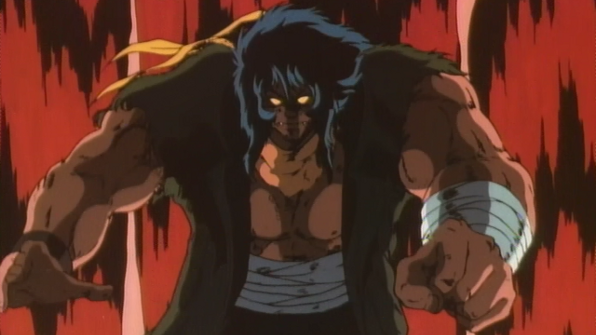
Even censored, with it very clear that material was removed in the cut version, its repugnant and against the very nihilistic view of the world on display feels uncomfortable. The cynical worldview does lead to an interesting plot based around three groups and Violence Jack - one group men proven to be hypocrites worse than the evil psychopathic gang against them, as depraved, whilst the women have decided to be their own gang after what had been done to them before - but the desire for a cross between an atrocity exhibition meant to be titillating against a Shonen Jump-like action story is a hellish combination to have to deal with. And frankly, we are dealing with a titular character who, whilst closer to a slasher movie villain than an actual hero, is also completed out of a childish power fantasy especially with his inexplicably yellow scarf, bandages around the waist and jacket combination, which raises questions of the entire premise of what the tone should've been.

If we were dealing with a Fist of the North Star tone, then things might've been different; in Evil Town, as most of it is set underground after an earthquake has levelled an entire Japanese city, children advising each other how to eat insects and a rat for dinner is the worth of gold, it's not the right time to discuss this aesthetic unlike in the other two episodes, but that tone would be acceptable here too. Even if it left grime on the viewer's eyes, there wouldn't have been an issue if it also embraced the inherent silliness of its villains being mohawk wearing gang members. It doesn't help that, in lieu of a homophobic streak a mile long throughout these episode, among them is an evil transsexual and an evil lesbian stereotype, but looking at times like outtakes from Mad Max (1979) and The Warriors (1979), especially with the figures of Mad Saurus, a behemoth, and Blue, the evil transgendered character but (if that unfortunate aspect wasn't part of him) also decked out like a bizarro Jem and the Holograms member, the materials wrong for this level of nastiness. Even reading a slither of Go Nagai's work, even if his attitude to sex and violence can be objected to, I know already his style is laced with black humour and deliberate weirdness which you definitely don't get in these OVAs.  

And tonally, the story itself falls into this as well as, suffering through even the implication of sexual depravity and gore, it's about two giant men (Violence Jack and Mad Saurus who, after eating his girlfriend blue in the aforementioned scene removed from the English release and turning into a monster) kicking the shit out of each other, which makes none of the horrifying content even in tone creatively in place. Any notion of darkness beyond this with a point, the men of Section A who are so monstrous for all their apparent civilised behaviour they'd drug and rape a group of women as told in flashback, is lost in a work where it's entirely about visceral gore and action in the first place, so expecting anything profound is lost within the sludge.  Instead it just makes things worse as the women are merely victims, left half naked and (between the script lines) more traumatised stood outside among ruined skyscrapers with no sense of real meaning.

From http://www.imfdb.org/images/thumb/5/5c/
Violence_Jack_ET_revolver_1_2.jpg/600px-Violence_Jack_ET_revolver_1_2.jpg

The blame on why Evil Town is objectionably gross, even censored, is to be debated. All the following is my pure speculation, but it's like a Rashomon scenario where we have no one willing to talk about this production in honest detail unless someone had a gun directly pulled at their head, more so as in the Japanese version you have big names in voice acting among the cast, the likes of Norio Wakamoto appearing throughout all the episodes, a production meant to go somewhere but ending like this.

One possible explanation is that screenwriter Shou Aikawa went through a very dark period in his life. Long before he became the major screenwriter for the likes of Full Metal Alchemist (2003), he wrote scripts for ultraviolent work like Legend of the Overfiend, Genocyber (1994) and, with the same director of Evil Town, the notorious Angel Cop (1989-1994). The thing is that, in lieu of a career with the likes of Full Metal Alchemist, which are so drastically different and where his own contributions separate from the source material (like overt Iraq War metaphors) were acclaimed and drastically different from the likes of Evil Town, as were later anime he worked on past his blood and guts era like The Twelve Kingdoms (2002) and Martian Successor Nadesico (1996).

So it leads the question to the infamy of Ichiro Itano. As an animator, he is one of the best, immortalised by the "Itano Circus", coined after his trademark of (painstakingly) animated missiles in a scene to moving in individual directions. As an anime director, he is panned and notorious - Gantz (2004), his most well known work, is still a divisive ultraviolent work, and he is held up by his petard for the likes of Evil Town and Angel Cop; for the latter, whilst this has never be confirmed and is pure speculation, the infamous turn to full anti-Semitism in the story alongside its fascist nationalist turn, as an ultraviolent action sci-fi, has to be taken in mind that Shou Aikawa only wrote the first few episodes, or at least the first, whilst Itano wrote the rest when that turn took place. The third potential reason, which would be the most disturbing, is that adaptation of a very violent Go Nagai work they either reproduced it or exaggerated the content to sell the material, especially as anyone who witnessed the car crash that was Harem Bomber, which I will get to later.

The episode itself, removed of its nastier material, is pretty cruddy in honesty, any sense of enjoyment from its sickly tone undermined by knowing of the content being removed. That, far less extreme but as liable to put people off from the uncensored version, this anime goes to having a villain killing children in graphic detail or someone being split in half like a wishbone. Trying to deal with the misogyny on display, the female group not complex figures in the slightest and sexually victimised twice, is not even worth wasting time on to write on, it's that bad.

Curiously this is Violence Jack at his most eloquent, a curious anti-hero who will protect people if he isn't prevented by hulking gang members, but takes his punishment of villains to sadistic and gleeful extremes which drastically contrasts this. The English dub is utterly inappropriate as, whilst I liked Bob Sessions as Jack, this begins the conversation that will carry through this three part review, the infamous dubbing of the anime where Manga Entertainment amplified the foal language to a lot of their work but here went into even ridiculous territory, the one aspect of the entire work that could ever be "fun". They decided to have this gigantic monster anti-hero use the term "Captain Buttwipe" twice, as tonally in appropriate from an anime episode obsessed with offensive material as you can get, but you are grateful for the comedy to briefly relieve the tone.  

Sadly as well, whilst I might be in a minority, this is all within an aesthetic I like. It's cheap, but thankfully isn't as bad in animation as when I cover Harem Bomber, with music (barring one or two tonally inappropriate pieces) that fits the era and a grungy colour palette which stands out. It's an aesthetic that feels dangerous and edgy but, in another work, didn't need to actually make me feel grossed out like here but could've been instead better without it. Evil Town, as much as I hate its existence, has the one artistically stylish piece of the whole OVA series with a fight scene taking place with the participants in red outline against a black screen, one of the other moments which were vaguely interesting in the midst of the mire. Unfortunately, I have to extract these little virtues from something that doesn't deserve to be defended for many reasons. Thankfully, whilst the other episodes have their share of uncomfortable material, the worst was the first episode in the Manga Entertainment release before you get to Hell's Wind...

To Be Continued...

From https://i1.wp.com/hmturnbull.com/wp-content/uploads/
2017/11/Violence-Jack_Death-of-Mad-Saurus.jpg?resize=300%2C157