Showing posts with label Parody. Show all posts

Saturday, 23 December 2023

#271: Cromartie High School (2003-4)


Studio: Production I.G

Director: Hiroaki Sakurai

Based on a manga by Eiji Nonaka

Voice Cast: Takahiro Sakurai as Takashi Kamiyama, Norihisa Mori as Tabata/Takeshi Hokuto, Ryo Naitou as Yutaka Takenouchi, Takaya Kuroda as Masked Takenouchi, Takuma Suzuki as Shinjiro Hayashida, Tetsu Inada as Akira Maeda, Norio Wakamoto as Shinichi Mechazawa, Youto Kazama as Noboru Yamaguchi, Megumi Hayashibara as Maeda's Mother

Viewed in Japanese with English Subtitles


Cromartie High School was an early series in my interest in anime, one of the many ADV Films licenses brought over the United Kingdom. The origins of Cromartie, even before the first chapters were being published in the year 2000 by its creator Eiji Nonaka, comes from the Japanese "yankii" (juvenile delinquent) manga of the 1970s and 1980s. Cromartie High School, without all the music references and surreal tangents, is a deadpan parody which images these archetypes if they were dense, clueless and/or were hung up on the littlest details even when considering whether to go to a rival school and fight the yankii there.

Our introduction to this titular school is Takashi Kamiyama, who is not someone meant to be there, but with the first episode explicitly telling the audience the reason for ending up in there has to be read in the manga. Suffice to say, he is not the sort of student to end up in Cromartie, a place of ruffians and hooligans. He has at least some intelligence, where in a world of doofuses he will be King, the lamb sleeping among lions (and a gorilla) as Shinjiro Hayashida, a fellow student who befriends him, states. He is the most imposing figure and can become a) the strongest delinquent in the country in a competition, all because of knowing in a quiz yogurt is made with milk, b) will defend his title by hosting a quiz himself to confuse his challengers.

Before you get to the gorilla, Mechazawa the robot student or Freddie Mercury - yes, that Freddie Mercury - the joke is undeniably the idea of the sixteen year old rebel who wins fist fights, or is supposed to if fights ever were to break out in this series, like those Takashi Miike made Crow Zero 1 & 2 about between 2007 and 2009, when they do not live up to these expectations. This is done with both absurd touches but also their own idiosyncratic personalities. Most people may have motion sickness on transport which they live with, but imagining the head of the first years, an imposing figure named Yutaka Takenouchi, having to hide this to keep his toughness status, and looking so even when struggling, is inherently funny. The innocuous undercutting a trope is one of the funnier types of humour throughout anime, and Cromartie provides this in many ways which succeed. This is before the show is also proudly strange, such as providing an entire one-off episode, each less than twelve minutes each with opening and ending credits, about a wise gorilla sushi chef who helps mend the wounds between father and son with a banana sushi. Without highlights like that episode, which goes so hard with the premise that you have messages on the screen reminding viewers this was still Cromartie High School, some of the funnier jokes in a pure matter of fact tone involve adding the banal and ordinary to heightened anime tropes. These weird characters, alongside how magnificently dumb and charming they can be, have to contend with ordinary things a viewer has to put up with, like whether they have gotten off the right stop on a train, only with the bombast of their reactions to these events being these archetypes the combination which adds different layers to the gag.

Kamiyama's friends include Hayashida himself, whose purple Mohawk has a mind of its own and more secrets to it; there is Maeda, who puts up being the one dismissed and also frequently kidnapped by rival schools; Takeshi Hokuto, who is introduced attempting a coup to rule the school with his lackey, only known as Hokuto 's lackey and not able to say his real name aloud, only to realise he transferred to the wrong school; and more characters including a figure, later on, who is an older man in a mask who, attempting to hijack a plane in one episode when introduced, hides among the students whilst wearing the mask still. Gorilla the gorilla is literally a gorilla, and Freddy, literally based on Queen singer Freddie Mercury, based on an iconic concert costume with him shirtless wearing red suspenders, is as close as they could get away with. Freddie in this interpretation is more a big older man with a magnificent moustache, never talking and with even his friends wondering of what transpires in his mind. Then there is Mechazawa, played by Norio Wakamoto, a prolific voice actor who started in the late seventies and has a very distinct voice. Mechazawa is a literal robot, who does not realise he is one as a student, but does get rebooted like a PC, and does end up crashing a motorbike and ends up becoming one afterwards himself, allowing multiple parodies of Kamen Rider heroes if imagining what would happen, rightly, if the police arrested the driver for not having a motorcycle license.


Kamiyama, a lovable goof who yet has more smarts, is our centre but in the twenty six episodes, this show switches to other characters a lot, and this is always a good thing throughout, even when it comes of a pair of actors in a fictional comedy show in the world, Pootan, who are deadpan in the humour whilst wearing giant cuddly bear-like costumes with their faces visible. My favourite character is actually Noboru Yamaguchi, the leader of a rival school with a giant afro, whose real passion is as a connoisseur of comedy who wants to become a comedian. His stuff is hilarious even if you have no real knowledge on the intricacies of Japanese comedy, including the language barrier, whether debating in internal thoughts the structure of a punch line mid-meeting with his underlings, who are misinterpreting his behaviour, or assigning a ventriloquist as his second-in-command, which leads to the issue whether he or the puppet is actually given the position.

The cast is all male, with the one segment about an all-girls' school just redesigning your original cast as "princesses" and the voice actors not changing their vocals, a really good final episode gag especially as it clearly references the music video for Queen's I Want to Break Free even by accident at one point. There are some cameos with female actresses in the cast, but Cromartie, as a story about young male delinquents being goofballs, is an example for me to rediscover, in showing how talented the male voice actors in this series, from Takahiro Sakurai as Takashi Kamiyama to Tetsu Inada as Maeda, are. Surreal comedy anime has been a genre where I have seen how talented a lot of female voice actresses are for the medium, entirely because they have to turn on a dime in terms of the bizarre scenarios the writers and directors provide them, so Cromartie is just as rewarding in the Japanese dub to see this for male actors, the subdued reactions from many in this case adding more to the moments for how they bat off scenarios that, rightly for a viewer, would be ridiculous if they ever transpired. Even this becomes a joke, with some knowledge of voice actors, in that they hired Megumi Hayashibara. By that point she would have been a megastar in anime voice acting, most famous for many in the West for Rei in the Neon Genesis Evangelion franchise, but someone who would have been huge by that point for how many roles in leads and main cast in anime in the nineties, also a prolific singer and musician who would be heard singing the opening and ending themes for many titles she worked on like the Slayers franchise. They cast her, in a cameo, as Medea's mother, who only makes one sound; if you get that they choose such a prolific actress for just making a single noise, and probably how expensive that would have been to cast her, unless she did it as a favour or thought was hilarious, it is funny and one case, for a show which is mostly able to be gotten for its humour without context, able to even add little in-jokes to anime in itself once in a while for an additional layer.

Many moments in this, some of the funniest, are about taking strange and elaborate tangents within an idea. Many times, the joke begins with Kamiyama and the cast debating the logic of a scenario, with layers suddenly being added to jokes that would be funny in another show already, such as Maeda trying to imaging himself as a cat for a week, to the point of wearing cat's eats, when Kamiyama argues no human being really knows how to fully communicate to a cat, even when it comes to petting them. Even with some cultural differences to consider, such as the references and debates to Japanese stand-up comedy tropes, a most of this works without the context needed because it is entirely about characters over thinking scenarios and/or being idiots. Some jokes are just punch lines to pure weirdness, like the only logical reason a train announcer would require a green grocer and a sumo wrestler to help in one of the carts.

It is a series that could have continued, ending without a dramatic climax or a tearful send off, but it manages to be consistent, feeling right when it closed out without any moment it stumbled, with no weak episodes or having petered out. I roared a few times, chuckles or snorted many times, and ultimately the best take to describe why you should watch Cromartie High School is that this fully succeeds as a comedy on a gut level.

Monday, 30 January 2023

#239: Pop Team Epic Season One (2018)


Studio: Kamikaze Douga

Directors: Aoi Umeki and Jun Aoki

Screenplay: Jun Aoki

Based on the manga by Bkub Okawa

Voice Actors for Pipimi and Popuko:

As Pipimi: Akiko Yajima, Akira Ishida, Akira Kamiya, Asami Imai, Atsuko Tanaka, Ayana Taketatsu, Azusa Tadokoro, Banjou Ginga, Bin Shimada, Chisa Yokoyama, Daisuke Namikawa, Haruka Tomatsu, Houchu Ohtsuka, Jouji Nakata as Pipimi, Jun Fukuyama, Kaito Ishikawa, Kaori Fukuhara, Kaori Nazuka, Kenichi Ogata, Kensho Ono, Kikuko Inoue, Koji Yusa, Kotono Mitsuishi, Kousuke Toriumi, Mamiko Noto, Nao Tōyama, Noriko Hidaka, Norio Wakamoto, Rei Sakuma, Satomi Satou, Shigeru Chiba, Sumire Uesaka, Suzuko Mimori, Takehito Koyasu, Yousuke Akimoto, Tomokazu Sugita, Wataru Takagi, Yū Kobayashi, Yui Horie and Yuuki Kaji

As Popuko: Aoi Yūki, Emiri Katō, Eriko Nakamura, Etsuko Kozakura, Hikaru Midorikawa, Hiro Shimono, Hozumi Gōda, Junko Takeuchi, Kana Hanazawa, Kappei Yamaguchi, Mami Koyama, Mariko Kouda, Masashi Ebara, Masaya Onosaka, Mikako Komatsu, Nana Mizuki, Nobuo Tobita, Rikiya Koyama, Ryusei Nakao, Sakiko Tamagawa, Satomi Koorogi, Sho Hayami, Showtaro Morikubo, Sōichiro Hoshi, Sōma Saitō, Sora Tokui, Sumire Morohoshi, Takahiro Sakurai, Tesshō Genda, Tomokazu Seki, Tomoko Kaneda, Toshihiko Seki, Toshio Furukawa, Yōko Hikasa, Yūichi Nakamura, Yuji Mitsuya, Yukari Tamura, Yūki Ono, Yuko Sanpei and Yumiri Hanamori

For Bob Epic Team: Toru Adachi as Pipimi; Shunsuke Itakura as Popuko

For Japon Mignon: Christine Bellier as Pipimi; Fanny Bloc as Popuko

Viewed in Japanese and French with English Subtitles


If I am to be truthful, Pop Team Epic is as scattershot as a musket round exploding from a gun, but that comment itself even feels absurd knowing the creators of this made the series with this intention, and that the work based on a manga mocks itself as being “shit” throughout the first animated season multiple times. Already as time has passed, until 2022 when the second series was unleashed, references this has cracked have become more obscure or less current to that moment the show was released, and the amount of censorship just of certain images, due to how Japanese parody laws work, means there are some curious insights to be gleamed as a time capsule, such as how in the first episode (for the Crunchyroll version) the Pokemon parody stays intact but they felt blurring the My Neighbour Totoro (1988) one was wiser in fear Hayao Miyazaki might frown at them. By now the parody in the first episode of Your Name (2016), Makoto Shinkai's blockbuster success of an anime film, is now a canonical hit rather than the sudden shock surprise, and yet at the same time, even as a show with a lot of parodies, it makes a joke about a viewer writing a disgruntled letter to Pipimi and Popuko, our leads, about them relaying too much on parodies for the jokes. This show always had the sense of being deliberately irrelevant, knowing the jokes could be cheap, and this also, especially for the video game parodies, gets really esoteric. How else do you explain a parody of Death Crimson (1996), one of the most notorious video game productions for the Sega Saturn console, a perfect example of the labour this show puts in for what is, to be blunt, a thirteen episode shit post disguising itself as a sketch anime comedy like gdgd Fairies (2011-13).

Pop Team Epic, and its school girl leads Pipimi and Popuko, closer to goblin personifications of ids than teenagers, were birthed into the world in 2014 by Bkub Okawa, creating the 4koma manga for Takeshobo. Pipimi (taller and more sedate) and Popuko (shorter, more prone to violence and flipping the bird) are less characters in a sitcom than forces of misanthropy in a series of strange and even nonsensical gags. Openly preferring surreal jokes or moments which are weird without an apparent punch line, imaging these two with more "conventional" designs is actually one of the jokes the series keeps coming back too. There is even a joke that, set up in the first and last episode as the closest to a plot, the evil cabal behind the show (parodying Neon Genesis Evangelion (1995)) regret their moe schoolgirl show with more cute designs for the pair turned into the equivalent of taking a dump on viewers’ television. In fact one of the funniest jokes, one I admire, is that the next episode previews are not for Pop Team Epic in season one but for Hoshiiro Girldrop, a show which does not exist which is parodying a stereotypical one, about a schoolgirl who is also an idol singer in her other life and has a crush on her male senpai. [Spoilers] The joke is funnier for the abrupt punch line, that this even has the abrupt tonal shift out of nowhere for the final preview that our heroine died and the male love interest resurrected her afterwards, as abrupt to what is a cute idol programme as what may actually happen in an actual thirteen episode show or two. [Spoilers End]

The first series was divisive for me when I had first seen the episodes, and even now, it is a show of what does not land, what does and what hits with complete success, completely unpredictable in where it is in either of these categories even in just one episode. The first episode, still, is weak, more of a series of parodies which does not fully get to the weirdness the others from the second get to quickly. One of its best virtues, which grow returning to the series, is how to even depict the dumbest of jokes, this brings a murderer's row of talented and imaginative creators and animators in a variety of formats, even crafts with sewn felt dolls, to depict them. To mock itself as merely shit again for a joke is not enough when this can parody Isao Takahata's The Tale of the Princess Kaguya (2013), his last film and an incredible animated production which used incredibly lavish digital animation to depict watercolour-like images. Not merely to pastiche it is enough for a joke but, knowing even for a minute or two it would take a lot of resources, copy the exact animation style from that film's lavish production.

The collaborative nature is a huge virtue of Pop Team Epic. Barring the first and last episode having a story, the episodes baring one prominent segment, usually a parody, is a series of small skits of a variety of different art styles and tones. There is also only fifteen minutes of them including opening and ending credits, as one of the strangest touches, which I was first pushed away back but watched properly finally, is how this replicates the same episode to make up the full twenty plus minute length. There are differences between them - usually tiny touches, some major one offs which are different to the same scenes, and subtitles for the Japon Mignon segments about French culture - but the biggest differences are is that different voice actors in Version 1 and 2 are used for Pipimi and Popuko. And they can be male and female, over the two versions of the same episode and allowing a huge variety of prominent figures in voice acting to try even ad libbing, not even taking into consideration the English dub took the same attitude. For a great example, if you wished for the titular Madoka, of Puella Magi Madoka Magica (2011), to play Popuko, then Aoi Yūki is one such figure here, in a parody of a high fantasy anime which has not even been finished where Popuko/ Yūki is forcing the voice actors in character to perform impersonations upon threat of grievous implied harm.

There are reoccurring segments, and one of the season's best aspects is that, even if jokes do not land, this let anyone create idiosyncratic segments in their own ways. The most infamous is the "Bob Epic Team" segments by AC-bu. The creators Toru Adachi and Shunsuke Itakura, who also do the voice performances, created these garish and surreal splatters of visuals with carte blanche, and these works for all their notoriety in their ugliness were intentional aesthetically. A duo who was working in commercials and music videos since the late 1990s, they came to this production knowing what to do, and getting some of the strangest and funniest moments as a result even if also replicating material from the original manga. (Such as finding an alien in the cat bed, posing as one, and having none of it.) The parodies of numerous obscure video games (and some big hitters like Undertale (2015)) in exact pixel styles, were done by an amateur pixel artist Makoto Yamashita who was still a student at the time of the production1, and UchuPeople, who use a variety of different multi-craft tools, are stop motion specialistis responsible for the felt and knitted versions of one collaborator provided coquetted versions of Pipimi and Popuko, used for music numbers (including a Earth, Wind and Fire parody) that usually are sweet sounding songs about wanting to kill the subject being sung to. This becomes the best aspect of this deliberately scattershot production, which embraces a variety of figures and allows them to be creative, something attesting to how one entire reoccurring segment Japon Mignon, was handed to French born 3D animator Thibault Tresca2, living in Japan, who was allowed to create (mostly) wholesome 3D animated stories with fluent French speaking voice actresses about the clichés of French culture.

Its scattershot nature is its biggest vice, as surreal comedy in anime is something that is bountiful and in a variety, meaning that there are many others in this format including with more elaborate stories to embrace and compare to. Its scattershot nature however too, when it lands, leads to some brilliant moments. “Hellshake Yano”, a talented guitarist and originally a joke character from the manga itself, is probably the thing that will be brought up for Pop Team Epic’s first season, enough that in 2022, Stephen Lee "Thundercat" Bruner, a Grammy Award winning bass guitarist/singer/producer/musician, is proclaiming his love for the show and him by rocking out on a paper craft guitar designed like Yano’s on social media3. AC-bu were tasked in season one to use kamishibai, a form of street theatre and storytelling from between Japan in the 1920s/1930s to the time television became popular, even as far back as 9th-century emaki (picture teller) scrolls4. Telling stories with paper images, with a storyteller voicing the characters, this format even past the growth of television in the 1950s found its way to continue. (Ujicha, the cult film maker of the likes of Violence Voyager (2018), is effectively doing paper theatre himself with his cult and sometimes shocking work). AC-bu, when approaching this tradition in their own way made an utter epic by itself which could even outlast the rest of the show, the duo operating a painstaking put together, drawn and cut sketchpad depicting Hellshake Yano having to appease the crowd at a concert as they voice the performance onscreen. It was an incredible production which won me over back even when I was cold to the series, and it stands out still but as a gem in a show which had a lot of inspired moments. Even then, I have to also credit that, returning to the series, countless other jokes are just as funny: the ghost story parody where a group of young adults rent a cabin which suspiciously have a pair of guns and axes mounted onto the walls, and end up killing each other; the second version of this with a seemingly random man doing audio commentary that, whilst not fully successful as a joke, is bold and does have the hilarious moment where he finds them having a watermelon out of season suspicious; that sudden attempt at a sad ending, using the repeated episode format on purpose, which is resolved by Shōta Aoi, voice actor and singer, looking like a cosmic pixie as he puts everything right again through his dapper dress sense and ability to travel back in time; that one random time, whilst acting out orgasm, one of the actresses uses “Marilyn Monroe” over and over, or the abrupt shout out by a male actor to neoclassical metal guitarist Yngwie Malmsteen; and way too many else to count.

There is one which fully encapsulates the show and its entire attitude, which is that aforementioned parody of Death Crimson, faithfully recreating its entire opening full motion video even with a fuzzy image of a red door. A game never released outside its home country, though the sequel did, Death Crimson was an attempt by the company Ecole Software as part of their transition into video game software as outsiders. A light gun game, it is held as one of the worse games ever released for the Sega Saturn, but instead of destroying the company it was loved by those who played it, sold very well when eventually the notoriety started to be passed on, and developed a cult around them. Proclaimed “Emperor of Kusogē”5, and something those who made the game are proud of in spite of its notorious low production qualities, bear in mind “kusogē” does mean “shit game”, even if the term is for notorious Japanese productions in the medium which are loved even without irony; that in itself makes the perfect encapsulation, for good and for moments which do not work, of Pop Team Epic itself, proudly calling itself shit, made with complete love of the art form of anime through the talented people in various positions on the production, and spending its resources, including a large portion of the climatic episode, parodying a notorious Sega Saturn light gun game.

========

1) The Alternative Faces of Pop Team Epic, or How a Shitposting Cartoon Became an Experimental Animation Stronghold, written by KViN for Sakuga Blog, published on December 20th 2022

2) The About page for Thibault Tresca's personal site.

3) Thundercat Won't Let You Stop Thinking About Hellshake Yano, written by Kim Morrissy and published on Anime News Network on January 5th 2023.

4) Kamishibai - A Brief History, written by Tara McGowan and published on Kamishibai.com.

5) The (loving) article on Death Crimson's production history and legacy, including the Pop Team Epic parody, from Bad Game Hall of Fame.

Sunday, 30 May 2021

#188: Nurse Witch Komugi (2002-4)


Director: Masato Tamagawa, Masatsugu Arakawa, Yasuhiro Takemoto and Yoshitomo Yonetani

Screenplay: Armstrong Takizawa and Tsuyoshi Tamai

Voice Cast: Halko Momoi as Komugi Nakahara; Ikue Ōtani as Koyori Kokubunji; Yūji Ueda as Mugimaru; Ai Shimizu as Posokichi; Akiko Hiramatsu as Yui Kirihara; Atsuko Enomoto as Megumi Akiba; Ikue Ōtani as Goddess Maya; Masaya Onosaka as Shiro Mibu; Michiko Neya as Runa Tokisaka; Mitsuki Saiga as Kyousuke Date; Yukari Tamura as Asuka Sakurai

Viewed in Japanese with English Subtitles


The immediate detail about Nurse Witch Komugi, a five episode OVA release, is that it is a spin-off to a 2001 television series called The SoulTaker, a very early directorial effort from Akiyuki Shinbo, before he became more famous, which was a dark supernatural story and an attempt by the legendary studio Tatsunoko Production to create a more adult work. Ironically, the humorous tie-in following a side character, recognisable in her nurse's outfit and was a smaller character in the cast, has completely obscured the original work entirely in history. The main lead character, a bland male named Kyosuke, becomes the male love interest for the titular Komugi to become more known as a protagonist, a girl blessed with the power to become a bunny nurse themes magical girl to fight humanised viruses. If ever there was an argument that female characters are usually more interesting as leads for your show, a character that stood out in visual design, allowed to become a bumbling if lovable protagonist is a good example, more so the case as, whilst The SoulTaker vanished, Kumogi got two further straight to video episodes in 2004, and a 2016 reboot in the form of a television series.

The resulting title, which was released without context by itself in the United Kingdom by ADV Films, itself requires no previous knowledge of the original series, another in a line of madcap comedies from the time I saw a lot. This one, following Komugi with her cute bunny mascot Mugi-maru, both the poor subject of abuse but also an undefeatable pervert in certain contexts, is definitely a title that borders on a guilty pleasure, as well being a title that you need to get onto its wavelength to fully appreciate. I will say now, what was once an average OVA when I first saw it has grown on me both in nostalgia from seeing titles like this, affectively a nostalgia for an ADV Vision/Manga Entertainment world of my first anime years, but also because the world and the characters have the virtue that you could elaborate on them in a longer format and, if you kept the same absurdities and colourfulness in look, it would have been great.

It is notable a remake came a decade later, although alongside a clear sense of the character being one with fondness for, or at least the potential to return to as a magical girl parody, they have changed the character designs over time. This is a shame in a way, without wanting to dismiss the 2016 remake in case it proved great in itself, but the premise of the original if funny and open enough to work with. An evil virus has escaped an alternative world, called Vaccine World, and invades ours, using a stand-in called Magical Maid Koyori, an evil representation of maid cafe staff member with magical abilities, to find hotspots that can generate monsters, whether the tensions of a tech convention or distilling a highway's worth of road rage. Komugi is not a perfect heroine, a cosplay idol part of a talent agency called Kiri Pro that is scrapping by, with her own career kneecapped by her continually having to go in her secret persona to fight the monsters. At times greedy and egotistical, Komugi is nonetheless likable, but an added joke (and potential bit of tension) is that Magical Maid Koyori is actually her best friend Koyori Kokubunji, a likable young girl her age who however has a split personality, one she is completely unaware of, which is evil and takes over at unexpected times.

Definitely one of the factors to bear in mind with the original OVA is that, for what I enjoyed about the show, some of the humour has aged considerably. Openly, just to give you a perspective of what some of the humour is, and why the short show can be a title some readers will struggle, can be shown in how one of the most prominent changes I can glace at is that Koyori's character design is significantly less busty. There is no way to move around this, but a lot of Komugi's humour, alongside slapstick and being a Tatsunoko that can parody their back catalogue, is sex comedy, from Mugi-maru being a pervert who keeps making the mistake of being in the bathroom when Komugi bathes, but also about characters obsessing about their lack of a bust or vast amounts of on others. Again this is a title that causes me to wonder whether there is a cultural issue in Japan about the status of a woman's bust, or whether this is just a trope male writers have repeated as a gag in their expense. Particularly with Komgui and her follow Kiri Pro co-member Megumi, who derides Komugi as being as flat as an ironing board whilst she is more physically round in areas, you are going to have to put up with a lot of this humour throughout, just like the skimpy outfits, or the scenes (without actual nudity) of bathing, or a final episode villain, an alien schoolteacher who brainwashes most of Japan and has been comically over-provided in anatomy. Worse and more lasciviousness examples exist in anime I have seen from this period, but the sex humour definitely makes the OVA have some guilt to its enjoyment. More so because it is not subtle, nor really inspired, more an excuse to gander at drawn busts like young boys, which gets repetitive for ever other joke that lands.

You have to bear in mind as well many obscurer (by a Western eyepiece) anime references too, specifically among many Komugi's tendency befitting a cosplayer to suddenly appear in costume as a character from another show for a minute. It is, as a result, meant for a fan base that gets the references. It gets to the point "Nabeshin", the animated persona of anime director Shinichi Watanabe, makes a cameo a character that came to the West thanks to ADV Vision releases, especially Excel Saga (1999-2000), where his animated persona, synonymous for his red jacket with yellow tie and an afro, has an entire running side plot by himself. Merely a cameo here as a disgruntled anime director, he even name checks Puni Puni Poemy (2001), an OVA from this era which is a far more notorious work for its lewd humour and weirdness that managed to be banned in New Zealand. Some of the jokes here even had to be censored, in the Japanese dub and visually on a sign, likely because of crossing Japanese copyright, and in the first, probably referencing a real life case of an otaku who committed a horrible crime for a very sick joke.

Thankfully, within mentality of throwing anything at the wall to see what sticks, you get many which work. This mentality also makes Komugi unpredictable and, with an interest set of characters to work with, it manages to hit the mark a lot between its scattershot of jokes. You may not know about Science Ninja Team Gatchaman, the original version of the Tatsunoko animated series nor its Westernised Battle of the Planets version, but the joke where Komugi suddenly turns into a five person team and their elderly male mentor on a screen, duplicating herself, to ride in a super combat plane is still potentially funny because a) she is fighting a building, which was once for a comics convention, turned into a giant robot, b) because Mugi-maru spends the scenario completely baffled what the hell is going on, and c) with missiles on the plane too dangerous to use, this boils down to the tactic of blowing up one's plane and smashing it into one's opponent for a final move. The show is deeply silly, and for every joke which you do not get the reference for, or has not aged well, a lot are ridiculous and run for the strangest idea.

Surprisingly for an early 2000s title, it is still unfortunately relevant when the first virus monster turns people into internet forum members arguing over fetishes and getting into spats, only with less toxicity. You get a Speed Racer joke, but also a piss take of early computer animated anime where even Mugi-maru comments the frame rate has become broken mid-shot. Episode 3 devotes itself to Komugi being dead for most of it, due to truck, left to languish haunting her colleagues when they are grateful she is gone, and even having a new life become many new lives when she keeps dying. Scattershot is definitely the right choice of term for the show, among many with their manic tones I have seen over the years, but many of these titles as well have their own deliciously surreal mentalities you can easily gloss over if you watch a lot of anime. The show is aware of this as, for its end credit song, you have a bright female sung pop song but with nonsensical lyrics whose strangeness are part of its theme.

This awareness even comes with the way the show had to work around delays per episodes releasing, promising they will get the show out at a certain date or having a seventies giant robot parody with that aforementioned building-robot for an ending preview gag. There is even an Episode 2.5, which is effectively padding and its own special, an excuse for two music videos with their own distinct looks, but also in itself lovable. For what is a tangent, in terms of the show settling down and, set during Komugi and her colleagues working in a festival cafe, allowing for some character building, it adds to the unpredictable nature in its own sedateness. Eventually this is a show where every Japanese monument, set to a licensed Toho studios orchestral march, transforming into a robot or self defence weapon from a kaiju film to defeat a villain, including a scathing critique (even if fictional) of a building which collapses and is merely called a waste of tax payers' money. For ever joke which caused me to roll my eyes, so much revisiting Nurse Witch Komugi was funnier for me. Whilst as much of this is, again as mentioned, nostalgia, as much of that fondness in itself comes from this type of work, specifically as well these early 2000s OVAs, where in little time they do have their own quirks and idiosyncrasies if you were lucky to have had a good one licensed in the United Kingdom. It is with criticisms, but especially with interest in the 2016 television series, there was enough to appreciate on this return too.

Tuesday, 29 December 2020

#172: Gakuen Handsome (2016)


Director: Toneso Kiashi

Based on a video game by Team YokkyuuFuman

Voice Cast: Natsuki Hanae as Yoshiki Maeda; Kazunori Nomiya as Renji Kagami; Ryohei Kimura as Sakuya Mitsurugi; Satomi Akesaka as Yū; Satoshi Tsuruoka as Shingo Shiga; Taiten Kusunoki as Jirō; Tetsuya Kakihara as Takuya Saotome; Yuuto Suzuki as Teruhiko Saionji

Viewed in Japanese with English Subtitles


[Newspaper headline] Michupero goes mad! Popular amateur model sumo wrestles on the runway...

Gakuen Handsome, if you were to look at the screenshots, would require some explanation as you look at the bishonen ("beautiful boy") character designs and their pronounced chins, sharp enough to open envelopes with. Yes, this is a parody; originally, a BL (Boys Love) video game, first I have to explain that this is a parody of the Yaoi genre, a genre targeted to women about romances between men. The genre is different from actual storytelling about gay men for gay men, such as the bara genre. Also, Gakuen Handsome's existence can be emphasised that there is another BL game in existence called Gakuen Heaven (2002), a romance between male high school students which this is clearly taking the piss out of among others.

Micro-series, a twelve episode production here with three minutes per episode, do seem a place you can get away with some crude animation or barely move the images at all for humour. The end credits for this show, for emphasis of this, has the main cast distort their limbs like worn out rubber dolls in time to the upbeat J-pop song. One aspect of the joke here, which many including myself may not appreciate, is that this is also a parody of some of the worst qualities of the yaoi genre even in aesthetic, the character designs being terrible on purpose for a genre where the term "yaoi hands" is a meme, where aggrandized hands (or them accidentally grow enormous in the next panel) has been a common issue in the art. This particular show's trademark, referring to this, is obviously a love of glamorously over-the-top chins.

Beyond this, you can get most of the humour even without context as a surreal piece. Lead Yoshiki, who stands out because he is not even drawn with eyes, is your typical anime male protagonist starting at Baramon High School, an all-boy's school where immediately he is flirted with by his new teacher Teruhiko, which in another context would be deeply problematic, as is the principal being blunt encouraging him into romances, but here is thankfully not going to go in that direction for the humour. Instead, in mind of parodying the genre it is based on and thankfully never crossing a problematic line, here the only joke in regards to this is that even Yoshiki's own little sister, drawn better than anyone else with actual eyes too, asks him why he has not started a romance with a fellow student from the first day. Neither is the joke ever about the characters being gay, as this show, for all its silliness, is definitely earnest with all its manly crushes even if proving this involves blowing a building up on purpose to escape an idol contract.

You do not have a lot of time in this world, as is expected with many micro-series, so instead the narrative is a series of bizarre vignettes surrounding these handsome bishonen figures, clichés taken to their extreme. The buff sports player; the strict school council member; the best friend; the other new student, a gruff voiced outsider who is tough....and secretly loves cats, to the point he dies once due to the cuteness of stroking one in a cat cafe in the best episode. Even if the show is slight, only twenty four minutes long altogether, you get an eclectic cast which thankfully leads to the bizarre. You learning flying is illegal at Baramon High School's sports day, already a curious competition with abrupt boiling curry bun eating and pit holes in the race course. You learn that true fashion according to Sakuya, who gets a two part story as a result, is just a sumo loincloth in public, gaining him an immediate modelling career as a result. That if you go by interpretation, in the second best episode after Shingo's adventure to the cat cafe, all representations of yourself in art class by fellow students is accurate, even if it turns you into a squiggle or playfully includes better drawn versions of the cast. That the best way to welcome a student to the school is to dress him as a disco-ball, and hang him off the roof for his own welcoming party, after previous attempts and having random costumes laying around does not work.

Like a few of these micro-series, this will be a short review but it does say a lot that, even if a parody, it still has a lot of heart. Heart that, even involving a few buildings being blown including by accident, these are still characters who eventually bond in their own man crushes, none of the humour mean or gross or at the expense of the characters, beyond them being a bit dumb or Renji the strict school rep's ill advised (but eventually successful) attempt at a part time job at a bakery. Heart because, with each episode ending in fan art, the fan base of the show was really in love with the franchise, to the point they even helped crowd fund to get the series for Team YokkyuuFuman, the original game creators, with stretch goals to increase the scope of the anime's release1. It is a reoccurring trend to micro-series when they work, that even due to their length, they are so distinct and charming they all have personalities, more so as you learn in this case that they gained a fan base like this willing to help the show even exist.

=======

1) As referred to HERE.

Sunday, 13 December 2020

#168: Butt Attack Punisher Girl Gautaman (1994)


Directors: Iku Suzuki (Episode 1), Hiroshi Yoshida (Episode 2)

Screenplay: Yū Yamamoto

Based on a manga by Masakazu Yamaguchi

Voice Cast: Yuri Shiratori as Mari Amachi; Miki Itō as Saori Minami; Tomokazu Seki as Ryo Tobishima; Akiko Yajima as Hibari Misora; Kenichi Ogata as Buddha; Kenichi Ono as Kyoshirou Inemuri; Kinryuu Arimoto as Vice Principal; Kouji Totani as Pope; Ryūzaburō Ōtomo as Dark Vader; Tomohiro Nishimura as Mutsugorō; Tsutomu Kashiwakura as Scary Newspaper Man


What's Buddha doing here?

From the ultra obscure realm of anime OVAs, a two part straight-to-video work, Gautaman is a title which has only been available in the West up to the 2020s on German DVD and only known to anyone if they have found it online. It is, after years of wanting to see both parts, upon finally seeing it a work which lived up to being utterly insane but also something with two aspects to consider. One is that, unfortunately, it has content as I will get into which people will find inappropriate and uncomfortable for good reason, as this belongs to the area of anime where jokes and scenes about women being forcibly undressed and molested are found, especially feeling bolted on to a work which could have just stayed as a weird and kinky parody of superheroes with some sex comedy without this content. The more positive thing of note, and the reason why I would actually recommend people track this down if they can pass the former concern, and why I wish this had a proper Western release, is that it is compelling. It is shambolic at times, skirting copyright precariously with jokes which are just strange, but managing to juggle genres and even have emotional whiplashes. There is nothing like Gautaman even if the premise is not original, in which to protect a school for all future religious leaders, a shy Catholic girl has to dress in a stupid hero costume because Buddha of all deities rather than the Virgin Mary answered her prayers. One which manages in two forty plus minute episodes has a lesbian (yuri) subplot with a fellow Hindu roommate, henchmen like "Dark Vader", and even a bitter sweet ending.

At this school, where all major religions coexist in harmony, naturally it has an evil cult known as Black Buddha among them, who indoctrinate members by kidnapping students, to the point they even develop new personas with masks in case they need henchmen. Mari Amachi is a Catholic and a new student, insanely shy having been brought up in a Catholic school before, and having not been around men baring her father and school principals beforehand. Gautaman for all its dumbness has virtues, including a lead character I wanted to follow and wished had more stories about, someone who is the zenith of stereotypically awkward yet cute figures, with her big red hair in a ribbon and long dress. Adding to her character with another interesting figure, Mari immediately finds a friend in Saori Minami, a practicing Hindu student she shares a room with and is eventually hiding a romantic crush from Mari.

When the Black Buddha decides to kidnap Saori, because she stopped a member indoctrinating Mari by intriguing her with religious discussion, Mari's prayers on her knees does not get the figure she would presume. She gets Buddha of all people, and if you have knowledge on the religion, it is not actually Buddha himself but someone who people confuse the Buddha for she receives for help, the jolly rotund figure, here a gold talking statue who floats, who was originally Budai, a 10th-century Chinese monk who, unlike Siddhartha Gautama who is Buddha, is a different figure honoured in Chinese and also Japanese Buddhism. He is still a figure of high regard, getting the name of "the Laughing Buddha" even if it might be confusing, which is why he is parodied here in a way which is a bit crass and profane. I would prefer to call this Buddha neither Siddhartha Gautama nor Budai, even if Budai is referenced and the name "Gautaman" Mari's alter-ego is called is clearly based on the former, as it makes more sense in this bizarre comedic anime to have this parody be his own thing. This is an incompetent deity who, floating in the background abruptly when unexpected, gives away her weakness to the villains continually and leads to a sentence of someone hitting Buddha taking place in dialogue, something that would not make sense anywhere else expect here.

Contextually this anime has a lot of similarities to the 1991-2 OVA adaptation of Kekko Kamen; Kamen was a Go Nagai creation, which managed to spin off into numerous live action films too, a concept meant to have been a joke he sent to his editor only for them to actually like it. Kaman shares this show's unfortunate interest in non-consensual sexual content in a jokey, eroticised form although was far more extreme. The titular Kekko Kamen herself, a girl with a secret persona to protect her fellow classmates at the evil Sparta Academy, was a mask with a scarf, gloves and shoes with nothing else on, completely naked beyond this. Mari as Gautaman, protector of religious freedom, is covered in costume but is more ridiculous - wearing a turban, wraparound shades, a sports bra, and Mari's power source, a sumo belt with nothing underneath.

The show, to be crass for once, is from the same well as Sir Mix-A-Lot found his inspiration for Baby Got Back, the ode to women's behinds even though this show has none which are rendered as large. Black Buddha do attempt to find out her real identify from a plaster cast at one point in the first episode, of her behind left on an unfortunate victim as a result of her special move; leaping in the air and moving herself in a jack knife with her legs to her head to do what we, in professional wrestling parlance, sometimes have called the "thump" with the gluteus maximus to the chest at high speed. This is, again, crass, but just in all I have put, you could have easily removed some of the unpalatable moments, like a Teenage Mutant Hero Turtles parody with squid tentacles molesting the female students, and easily turned this premise into just a sex comedy parody of superheroes instead. It would have improved even if still juvenile. Particularly as, whilst not nuisance and with her religious beliefs never really coming into play, the premise of Catholic schoolgirl, from a very restricted upbringing, being stuck having to become this very sexually upfront super heroine, because she does want to help people, is still amusing especially as the character is interest and the Black Buddha clan is full of oddballs and parodies in terms of the opponents.

Split into two separate OVAs, the first which is just called Butt Attack Punisher Girl Gautaman, is merely an introduction but does show the two sides. One that unfortunately the production had to fall into perverse content that is not palatable today, such as following Kekko Kaman a little and having Saori in compromising positions including being whipped. Thankfully it also emphasises that, with some re-adaptation, the story could have easily jettisoned this content entirely unlike Kekko Karman¸ which is work that is far more problematic even if managing to be released on DVD in Britain in the 2000s. It also emphasises already how odd the OVA is, the sense Gautaman was never meant for an international audience beyond Japan. Our two lead characters Mari and Saori are named after famous female idol singers who were still very much alive at the time, which causes you to wonder how those real women might have reacted, and for a future release they had to censor the real name of the school this story is set in, suggesting immediately that the writers crossed a line in terms of Japan's copyright laws even for parody, something which has been an effect on older titles which were more flagrant in referring to real life pop culture1.

The antagonists themselves, led by a leader who is one of the male students Ryo Tobishima, are also a motley bunch of strange parodies and concepts, based upon students being brainwashed and gaining new personas to go after Mari (or in one case, "Frankenmuscle", never even getting to see action as, in a funny joke, Tobishima just bats him into a wall so his second in command, the vice principal of the school, stops interfering with his plans). When the first you encounter is literally "Scary Newspaper Delivery Man", whose secret weapon is a newspaper which is lethal to read, there is a lot of cultural aspects that have clearly been lost in translation to why that is a villain to have, either that or either the original manga author or the creators of this OVA went for something ridiculous. That is the case with an identical group of elderly students whose names are puns on Japanese numbers and whose main attacks are to impersonate animals. Yes, that is just the beginning of how peculiar this show gets, and this I would rather have than those aspects leanings towards Kekko Karman, which again is a much more problematic show considering its first villain was a Nazi dominatrix teacher. Instead here, just from the first episode, you have an explicit parody of the "Sleepy Eyes of Death" Nemuri Kyōshirō, a famous pulp samurai character known for his purple clothes who, replicating the samurai character in Kamen who cut women's clothes off, is here as a villain alongside the aforementioned Dark Vader, a giant sumo with a very suspiciously familiar looking helmet of a Disney owned property.

It does establish as well that, whilst not reinventing the wheel, there is a lot here I liked as well even if it befuddled me. There is a lot of comedy, with the usual trademarks of characters breaking from their usual forms for exaggerating which is always amusing, especially as the duality of Mari against Gautaman, who gets attention both as a hero in the school but also wearing very little, does leave the poor girl with a lot of concern and a lot of obvious jokes which still work. It also sets up the potential drama of how Tobishima actually meets Mari outside his evil persona and they fall for each other, despite neither knowing their masked identities. Episode two, titled Butt Attack Punisher Girl Gautaman R, escalates the plot and just escalates the tone. With a different director on board, it increases in how bizarre it gets, how much more perverted the content can be, and how the emotional tone gets surprisingly serious somehow in spite of most of the work being unable to be taken seriously at all.

What was a light hearted sex comedy, with some unfortunately dated content, gets a lot more explicit, both with a scene of Mari and Saori sharing a bath with the eyebrow raising subtitle of "bottoms touching", and a parody of the famous Dream of the Fisherman's Wife ukiyo-e woodblock print by Katsushika Hokusai, as that trope of squid ninja, a Mutant Ninja Turtles parody that gets the joke across with its own designs2, have an expanding squid as their secret weapon against Gautaman. Again, the lewder content does put one off; the absurd moments, like a fantasy in Episode 1 of Mari being burned like a martyr on a pyre of butts rather than burning wood, is lewd and weird but comes from a more digestible and more entertaining in its weirdness rather than creepy. If it had just been as mad as a box of frogs, I would be less concerned with this review having to stress that it does cross the line a few times, where even some of the "WTF" levels of surprise would still be acceptable even if very dark in its humour. Like the likelihood one set of villains are defeated by being cooked on a giant pan in the middle of a class and being eaten by their fellow students, which I suspect was cannibalism3. A joke like that, from the second OVA, is at least tasteful in that it does not feel inappropriate, just twisted in a palatable way to surprise anyone with not datedness to its shock value.

It feels especially as if the production team were doing whatever they wanted with peculiar results. So the real final fight involves a Terminator parody, with a character design that really looks like Arnold Schwarzenegger with a T-800 underneath which perilously inches towards the copyright line. So, even when the story gets serious with Mari and Tobishima ultimately having to fight despite being unaware of each other's real identities, you randomly get the sight, whilst he is ritually preparing under a waterfall, that Tobishima possesses something the size of a tree trunk between her thighs which is never a plot point and is dumbfounding as a sight joke. What you get instead of what you expect for this light hearted and dumb premise is the surprisingly bleak conclusion, where Mari risks being removed from the school by her father if she turns into Gautaman again. How he is introduced, and reveals how he knew of her true identity, is uncomfortable and definitely part of that side I wished the OVA did not have, but where it leads to with the finale suddenly turning into a drama, with Saori the sympathetic figure in love with Mari sincerely, was a surprise. One in fact that actually left the anime etched in my thoughts as much as the bizarre content before.  

The two episode production is not that elaborate - distinct but certainly not one of the higher tier OVAs in terms of artistic quality - but it definitely shows just how unpredictable the format was. We thankfully still get anime like this, good or bad, in the modern day with television series, but the OVA era of the eighties to the nineties as seen here saw such unexpected combinations of genre released straight to video, both here the memorable in a bad way but also in a way which legitimately surprises. The original manga, Dengeki Oshioki Musume Gōtaman, lasted for six volumes, and is obscure despite its author Masakazu Yamaguchi having one of his works Arm of Kannon (1998-2003) available in the West through Tokyopop, so whether this adapts the work accurately or trailed off in its own direction is a question for another day. Something like this is not necessarily the best, and I could completely understand people who hated it, especially as some moments are cringe worthy. And yet I wish it was more easily available, not likely to perish outside of bootlegged digital copies, because it definitely is memorable in positive ways and for the moments you were not prepared for.

=====

1) Japan's laws on this and how it can affect anime can be summed up in a famous modern day example. For the 2015 update of Osomatsu-kun, a sixties comedy manga adapted into anime about sextuplet brothers, called Mr. Osomatsu, their first ever episode parodied multiple other work such as the insanely popular manga/anime franchise Attack on Titan. It was so explicit that the first episode has effectively been cancelled due to copyright, including for home media, regardless of it being for parody.

2) Knowing that Japan did try at their own licensed and official adaptation of the Ninja Turtles, in the 1996 OVAs Teenage Mutant Ninja Turtles: Legend of the Supermutants, adds an additional humour to the squid villains, especially when the official anime adaptation did not turn out well at only two episodes and was weird itself.

3) [Major Spoiler Warning] Those unfortunate squid ninja find themselves in that fate, and it definitely comes off as one of the moments of Gautaman you will remember, especially as they are clearly students wearing living squid masks, thus making it actual cannibalism [Spoilers End].

Monday, 2 March 2020

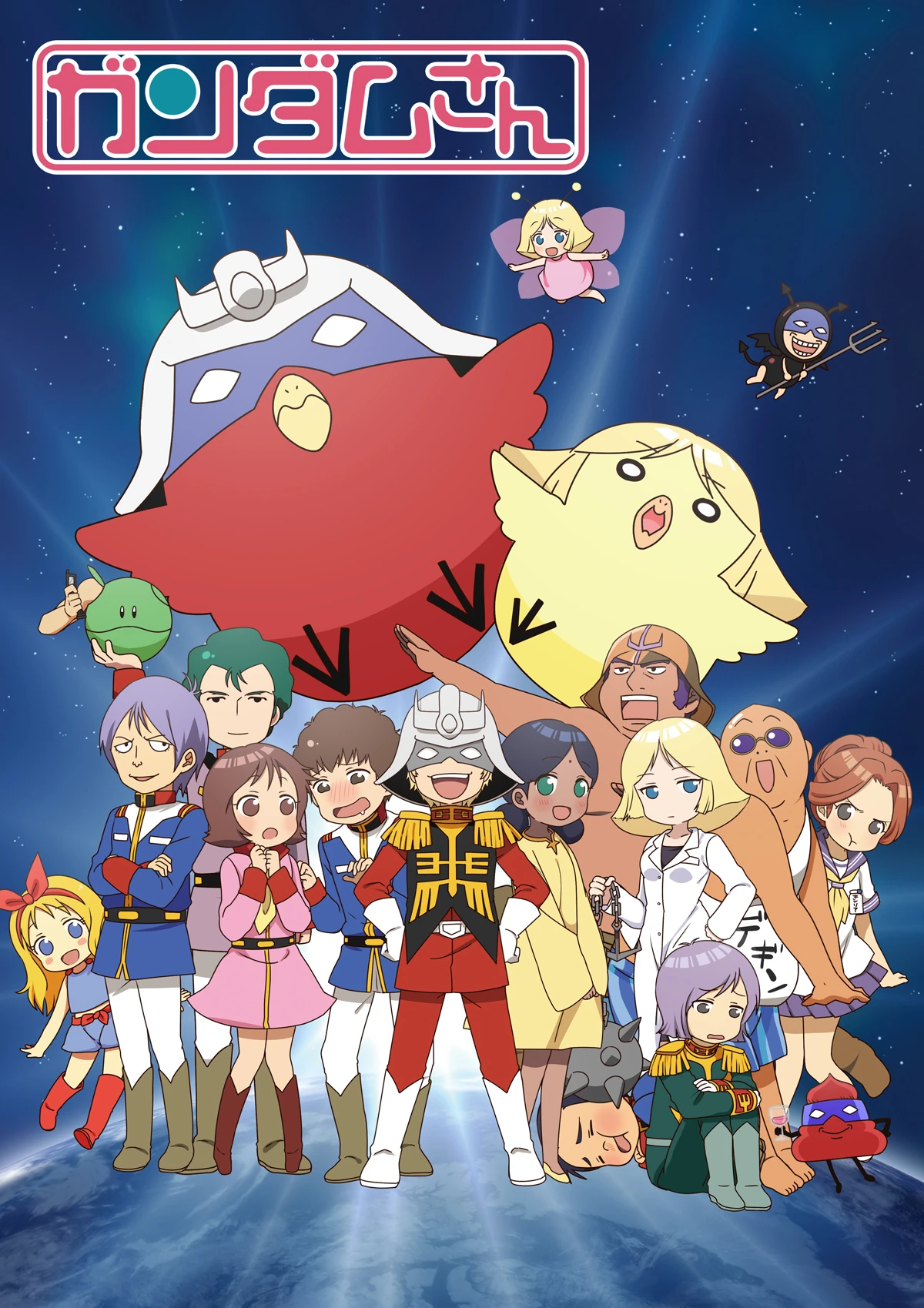
#138: Mobile Suit Gundam-san (2014)


Director: Mankyū
Screenplay: Hideki Ohwada and Mankyū
Based on the parody manga by Hideki Ohwada
Voice Cast: Katsuyuki Konishi as Char-san/Suisei Hiyoko; Megumi Han as Lalah-san; Tsubasa Yonaga as Amuro-san; Kaori Nazuka as Artepiyo/Sayla-san; Kazuyuki Okitsu as Garma-san; Keiko Han as Proverb explanations; Rikako Yamaguchi as Fraw-san; Ryotaro Okiayu as Bright-san
Viewed in Japanese with English Subtitles

I promise I'll actually review a true Gundam series, as yes, it's ridiculous that I have yet to see any of the main titles of this legendary franchise started with Mobile Suit Gundam (1979-1980). (No, Gundam Reconguista in G (2014) doesn't qualify even if I have fondness for its scatterbrained weirdness, because if any show really shouldn't be recommended as your first Gundam as it was for me, that's it). For the third, I promise, to watch an actual series in the main franchise or alternative world versions, be it the original, Seed, Destiny, maybe be wary of OO and its divisive sequel, maybe Wing as a breakout mainstream success, definitely not G Gundam as whilst I want to see it, a strange decision to turn a show about war and politics into giant robot tournament fights with humour is not connected to the franchise's main premises.

Until then, Char Aznableas interpreted as an evil red chick wearing a little helmet.

Because if anything, parodies of original properties which are officially sanctioned is a common concept in anime and manga, and a great way for an outsider like myself to be slowly introduced into these shows. Even if half the jokes here only really make sense to a fan, like the character of Garma Zabi who is clearly infamous for a series of misfortunate events to himself, if I can still see this officially commissioned piss take based on a four panel manga and find stuff of interest, I can now see the original serious work's significance in popularity, get a taste of it and now want to see the show both because of this and in happiness the Gundam creators at Sunrise have a sense of humour.

Parodies are their own cottage industry, even in the midst of a production of a sereis a chance of a short comedy micro-series to be created for the physical releases as a bonus, something I have come to love when they actually exist just for seeing the voice cast and production unwind and subvert their material. Neon Genesis Evangelion (1995) had a radio drama Evangelion: After the End (1996) where Megumi Hayashibara, who played the meek character Rei, got to play her as a motor mouth slapping cast members and creator Hideaki Anno himself as an evil villain. Fist of the North Star (1983-8) and its 1984-7 TV series, the influential manga that inspired the likes of JoJo's Bizarre Adventure, is as sustained as much now by DD Fist of the North Star (2013) (about the cast of post apocalypse muscle men if the nuclear apocalypse didn't happen and they had to find work) as much as tie-in and remakes. Manga even has "omake", side pieces which might not always be directly about the work, or even a parody, but can have light hearted, and even have the creators both talk about their work and be playful about their persona, be it horror author Junji Ito for Uzumaki depict himself as going almost crazed researching the power of the spiral, or in Miyuki-chan in Wonderland (1993-5), the whole of the four woman manga team CLAMP to admit they drew that manga just because they wanted to see questionable girl on girl titillation.

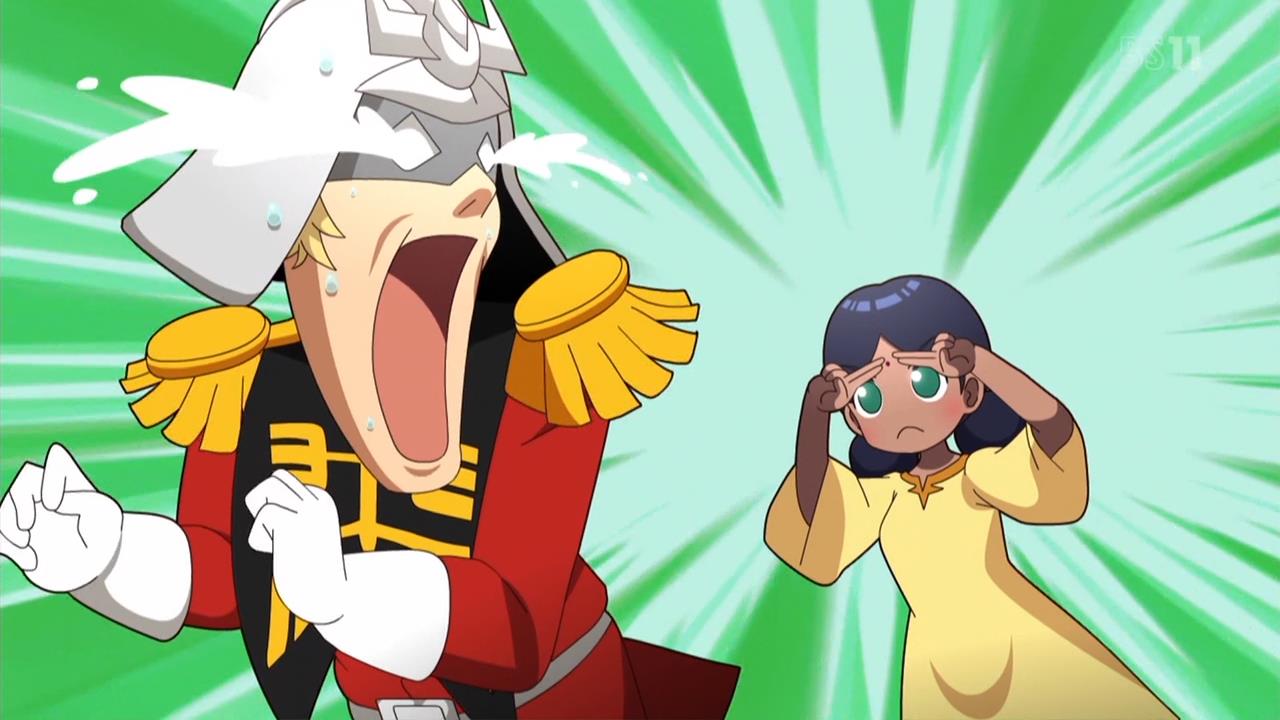
Gundam-San, as a licensed product by the creators of Gundam, also can get away with being profane. I know, even having never seen Gundam yet, the importance of a character like Char, the famous antagonist who wears red and never takes off an iconic helmet that obscures his face. The first episode takes a scorched earth policy to this image, in less than three minutes, with a) Char being an idiots who gleefully likes being nude, and b) having his female second-in-command Lalah Sun (who is by all accounts much meeker in the original series) devastate him when she informs him painting his giant robot red doesn't make it go faster. It's completely hilarious even if I have no context for either character in their importance to the fanbase.


Gundan-San is slight, I'll be upfront with it, but if they ever bankrolled a longer series, I'd be there to watch it with interest because these versions of the characters can be played with for many possibilities. Char is useless, Lalah much more reliable. The male protagonist of the original Amuro Ray, the stereotypical plucky teenage hero, is a gleeful mocking of teenage hormones as awkwardly portrayed as possible, especially as he is a psychic (a "Newtype" in Gundam lore) which allows him to notice if someone's bra is unhooked. Likewise the female protagonist Sayla Mass gets to confess to a sadistic side to enjoying slapping people about, part of a funny traditional of gentle or/and stoic female characters getting to be played by voice actresses in bawdy, crude or even comically violent ways. Probably the best episode, number three, informs us the robot mascot Haro has actual flesh arms inside itself who also, on the phone when not seen, is a working guy with a family and issues with if wife, as if say Star Wars had R2D2 had to go off to the side and deal with his wife leaving him over a mobile phone between space battles.

Then there's chicken Char, which envisions Char as a red feathered chick with the exact same helmet. The closest thing to a narrative in the thirteen episodes is the ongoing struggle between Char and chicken Char, who are trying to off each other behind Lalah's back. I think my one disappointment with Gundam-San is that this semblance of a plot could've been taken to another funnier climatic punch line and ended the series on a high note, just instead abruptly ending with the last episode just being about Char presuming the mole on Lalah's head allowing her to psychically shot lasers out of it. Obviously, this is extra material for a fuller work, so the slightness is to be expected, but that running gag would've paid off if ran for at least one more episode.

What you get, like many of these parodies, is a more relaxed and playful attitude to animation too, as they play up to the greater limitations of it for humour.  I swear, when the titular Gundam robots appear, they're actual models. These type of pastiches are a way to have fun, and if anything even a novice on this subject has to be impressed that the end theme, a traditional Japanese sing-along, has three versions to reflect Char, Amuro and Garma, that hapless guy whose episode is entirely about Char being a dick tormenting him. The playfulness comes from an institution, so even those songs have a refrain to shout aloud the three's famous lines to play this up for a sense of amusement among fans. It even mocks some details that might be unintentionally funny from the main series, such as leader of Amuro's ship Bright Noa clearly liked to slap crew around, as an episode is based around him going to consoling about this fact and sharing a similar bond with Sayla.

The crassness, from the sex gags to the end credits even having Amuro nude tied up on a gym horse in red bondage ropes and a S&M gag, is felt with a healthiness to it rather than being tasteless, in allowing a series to become stronger by commissioning a sacred cow to be mocked officially. And it's consistently funny, so Gundam-San at least got right what it was meant to do.   Even if it's an odd choice to have made for myself in seeing this as one of the first Gundam properties, it does show promise when the official parody is as enticing to the main material as it is. Whilst there are probably equivalents in Western pop culture, this is definitely a concept very prevalent in Japanese anime and manga for the better, something heart warming to the fact its encouraged for production star and talent to let their hair down and do something as ridiculous as this from time to time.


Tuesday, 9 April 2019

#95: The Special Duty Combat Unit Shinesman (1996)

From https://childrenoftheburningfist.files.
wordpress.com/2011/11/index1.jpg


Director: Shinya Sadamitsu
Screenplay: Hideki Sonoda
Based on the manga by Kaimu Tachibana
Voice Cast: Daiki Nakamura as Shi Nakamura; Hekiru Shiina as Princess Hekiru Shiina; Hiroko Kasahara as Hitomi Kasahara; Kenichi Ono as Shotaro Ono/Shinesman Sepia; Kōichi Yamadera as Shogo Yamadera/Shinesman Grey; Noriko Hidaka as Riko Hidaka/Shinesman Salmon Pink; Nozomu Sasaki as Sugura Sasaki; Rica Matsumoto as Youta Matsumoto; Sho Hayami as Ryoichi Hayami/Shinesman Moss Green; Toshihiko Seki as Shujin Seki; Yasunori Matsumoto as Kosuke Matsumoto/Shinesman Red; Yoshiko Sakakibara as Kyoko Sakakibara
Viewed in English Dub

Synopsis: Kosuke Matsumoto, when he joins the Right Trading company as a paid employee, is surprised to learn that, alongside his normal salaryman responsibilities, he's also hired by the head of human resources Kyoko Sakakibara for the Shinesman project, as a super sentai team with four co-workers who don costumes and fight evil.

Director Shinya Sadamitsu has had some bad luck - Dragon Half (1993), a beloved piss take on high fantasy, only got two half hour episodes before it was canned, and Shinesman whilst not cancelled also only got two half hour episodes. Sadly, whilst it has its moments, Shinesman (about a corporate superhero team) suffers more from its brisk length, never taking full advantage of its premise as I'd wish. It starts off well, with the team fighting a horrible monster that was stealing/sabotaging corporate information, but sadly, the show drifts off into a simplistic tale against two aliens, posing as humans, trying to take over the world that isn't taken advantage of for its slight length.

A shame as, in the twilight years of OVAs in the late nineties, brightly coloured and so very different to modern anime in style, there's a lot here of promise and that shines through occasionally. The heroes, baring lead hero Kosuke Matsumoto in red, are fellow office staff in ill-advised colour choices even their leader, head of human resources Kyoko Sakakibara, hates, the co-workers fitting stereotypes - Riko Hidaka (Salmon Pink) is the only female member, an office girl stuck constantly getting drinks and cigarettes at the vending machine for staff when she's a lot more tougher than she looks, or Shogo Yamadera (Grey) whose passion and romantic life is entirely for his car, a Montero, not to mention the others have for costuming sepia and Moss Green. There's even a fake in-anime ad for Shinesman themed bath merchandise, where the two episodes should've gone in less than sixty minutes in terms of playing up to this absurd premise, alongside the fact that their business themed weapons (like the business card cutter) are bemoaned as usually being useless.

It's all reminiscent of Samurai Flamenco (2013-14) in all honesty, where this type of hero was taken on a much more serious and expansive version with the humorous contrast between the heroics and banal life even more creative and fleshed out. The length didn't stop Dragon Half cramming enough jokes (and a Beethoven piece with new lyrics about lunch over the end credits) to thus become an iconic work even in the 2010s, but Shinesman decided to try to have a story when there wasn't enough time to without feeling paltry. A shame as, as part of the tone, the villains are also set up with ripe comic potential - posing as business men for another corporation, an alien overload and his assistant are trying to take over through corporate tactics. Unfortunately, in the biggest plot piece, the overlord's sister has appeared and presumes the Earth is like the cartoon recordings sent back, emphasising that whilst its broad and wooden at times, the English dub was regarded well for good reason for how it played up Shinesman's moments of comic goodness, particularly with playing up how these villains, stuck as unthreatening figures in truth, have to get around their own banal problems.

From https://i.ytimg.com/vi/dSZDimSu6IQ/hqdefault.jpg

It's a shame that, to pinpoint where the two episodes falter, the second episode tries to focus on plot knowing all too well there's not enough time to care for it in investment. Episode 2, where the villains try to take over a fairground exhibition, goes for a conventional story with jokes, weaving plot threads left unattended to like the minion's sister being secretly part of the hero's side, an alien herself trying to snap him out of being brainwashed, or the sister being romantically connected to the hero. Dragon Half managed to survive, and even get a Discotek re-release in the 2010s, because in spite of its stunted length its legacy was managing to pull off so much with what was there to stand out. Shinesman in hindsight should've followed this same template, and it's a wise reference to make as, not only are they from the same director, but Dragon Half's reputation is enough that the manga from 1988 was finally being released in the West from 2017.

Shinesman instead belongs to that period especially in the nineties of OVAs which were made as manga tie-ins, with the problem that without the source material being released in the West, they were merely references, like apocrypha for a sacred anime text. A shame as, considering Samurai Flamenco promised and executed it perfectly, this idea of combining superheroes ordinary lives had legs; hell, even Excel Saga's 1999 TV anime has a sub plot about a corporate superhero team too, the idea of marketable heroes a joke that is practically money on the table for anyone to do a story upon. What little of Shinesman got to this, like the Shinesman soap and towel set, showed what we should've gotten.

Even more interesting, and barely covered, is knowing that this was a shoujo manga, meaning that its target audience was initially for women, an interesting detail as, whilst the men in the hero and villain sides are all very handsome, even the older father with a daughter who is Shinesman Sepia, there's a sense here of demonstrating just how diverse a genre tag like "shoujo" actually is as would be its mirror Seinen, targeted to young men. It offers a nice bow to know that a great premise like this has no defined bias for its target audience.


From http://3.bp.blogspot.com/-b0pqnF-T0iY/UxaMDqynPLI/
AAAAAAAADoc/JGhSwPdlAJw/s1600/Shinesman+1.jpg