Showing posts with label Anthology. Show all posts

Thursday, 17 October 2024

#282: Theatre of Darkness - Yamishibai Season 1 (2013)


a.k.a. Yamishibai: Japanese Ghost Stories

Studio: ILCA

Director: Tomoya Takashima

Screenplay: Hiromu Kumamoto

Voice Cast: Kanji Tsuda as the Story teller


Starting here in 2013, ILCA's Yamishibai franchise would continue on until October 2024*. Its name is taken from kamishibai, a form of paper play storytelling and theatre, using drawn illustrations where the narrator would tell a story around them. This became popular during the 1930s, and the Yamishibai series nods to its origins, always opening its episodes for the first series with an older man with his little wooden theatre about to tell the stories to young children, an art form which dwindled against the advent of television. It has found itself being paid tribute to and resurrected in a variety of ways, from revivals of the original art form to works paying tribute to it in influence, like Suehiro Maruo taking influence for his ero guro manga Shōjo Tsubaki (1983-4), translated into the West as Mr. Arashi's Amazing Freak Show, for the main character and plotting.

Yamishibai is probably one of the most successful examples of a "micro-series", those that are usually less than ten minutes long including opening and ending credits, in how it has now had over thirteen series from this original 2013 production. It felt appropriate to start off and review the first series by itself with what could have been a one-and-done, thirteen ten plus minute episodes less than an hour altogether only to lead to this lineage, and the animation studio behind the series, ILCA, have mostly focus on these sorts of short form programmes. They have produced the likes of Onara Goro (2016), the deadpan surreal comedy by Takashi Taniguchi, and whilst they have produced some anime series in length, they have still focused as much on these micro-length productions as much as help out on live action and animated productions in CG production like Kingsglaive: Final Fantasy XV (2016). Their core focus is clearly on programmes, including the long standing renewal of the Yamishibai franchise, allowing the staff to flex their creativity. Whilst minimalism with the production values certainly helped, with a friendly budget to allow so many seasons to exist - Yamishibai does include more animation than merely illustrated images with dialogue, but it follows the idea of kamishibai of letting the still images with the voice acting convey the horror - I can already see how this was intriguing enough to become a regular event on TV Tokyo and AT-X in its original broadcasts.

As much of it is clearly because the project a nice crossing of modern day pop culture meeting the traditions of the past, especially as just in the first season along, you are seeing crossed together traditional ghost story structures with modern and vintage technology, rural and urban locations, and even Japanese online urban legends. The stories themselves, with little time to work with, tend to be more eccentric than traditionally scary haunting tales, with episode one entirely about a man moving into a new apartment only to be creeped out by the woman on the other side of the street and her paper talismans he keeps finding in the apartment. A lot of them obviously set up twist endings, as this does or episode 2, about a guy who broke his foot and finds his fellow male patients in the hospital creep him out, barring in mind there is not a lot of time to set up stories whatsoever. There is not even enough time for more than a creepy minute of a distorted pop song, sounding like Hatsune Miku if demonically possessed.


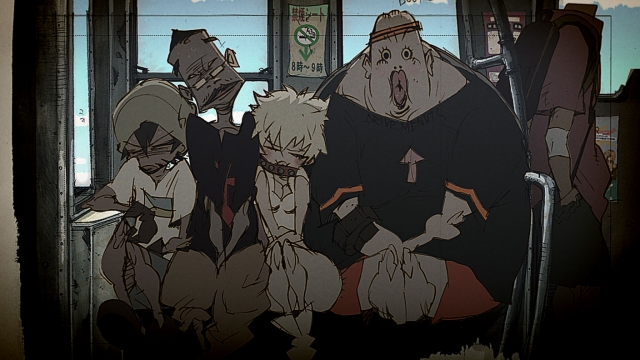
Some of the stories even have a slightly misanthropic side to them, like the cursed girl of episode 9 who, trying to be cured by a Shinto temple, ends up with her infliction by the wrath of others on their ancestors not going away. Working with this artistic medium, there is aptly too the crossing of times and culture too. Shinto temples and modern apartments intermingle as mentioned, with a good amount as set in the rural communities as in the urban cities, where horror can come as in episode six where a guy on a crowded train notices a flesh creature in the baggage overhead no one else sees. The last episode is clearly based on a Kunekune, a figure that spread on Japanese websites as an urban legend from 2001, one which drives people insane and into fits of wiggling frantic movement if you directly look at them.

It naturally follows a tradition too that Japanese horror was arguably quicker to consider how ghosts and the supernatural would adapt quickly to technology. It does have some stranger moments around this - episode four is about a female primary teacher working late at night, baffled by hair lines in her photocopying - but that adds to the personality, alongside natural conclusions like a girl getting a phone call in episode 7 from a friend who made the ill advised decision with her boyfriend to enter a deserted hospital, or the riff on the Ring premise in episode 11 where three male middle school students, rather than do homework, make the decision to watch a video with a ghost supposedly on it. Even the toilet is not safe, with episode 10, about a high school baseball team at a training camp lodge, and the one who blanked out falling into a pit toilet when he was younger there and finding himself in a phantom world with a monster in the bog.

It is ridiculous at times, but it is not like The World Yamizukan (2017), a spin-off of a similar structure which was explicitly inspired by American pop culture and had the fingerprints of a future collaborator on the Yamishibai project by season two involved, live action filmmaker Noboru Iguchi, who started in the adult video industry and working on over-the-top films like The Machine Girl (2008) before this interesting growth in his career, working with ILCA on these projects, and Tales of Bliss and Heresy (2023), an anthology romance film I would have never expected from the director when I first learnt of him but feels like his attempt (nobly) to flex his own creativity. One of the other prominent reasons I choose to cover the first Yamishibai by itself is because it was the only one without Iguchi or Takashi Shimizu involved, the later a prolific filmmaker most famous for creating Ju-On/the Grudge franchise, and seeing how before they came onboard the series' first tentative steps for a single season.

From the initial pitch of Yamishibai being a way to flex storytelling ideas from classic ghost and horror story tropes, both presented matter-of-factly or deliberately exaggerated, I get the appeal for this even if this had never sadly gotten all those additional seasons onwards. Some episodes suggest morality plays, like the father who regrets shirking his wife and daughter on the latter's birthday trip to a shopping mall because he needs to go back to work, only to end up in the elevator of the unknown, but a lot of the stories in themselves are there for their pure macabre natures, with the art style itself distinct and relishing the still images for spooky effect. When a lot of these projects exist only up to thirty to an hour long when you binge all the episodes, never to get the change to last any further, it is interesting, tantalising even, to know this will be one which lasted and has to now figure out how to constantly tell stories for the decade it lasted for.


* The review acknowledges that, written in October 2024, there could easily be more Yamishibai series to come.

Saturday, 21 October 2023

#265: The World YAMIZUKAN (2017)


Studio: ILCA

Director: Noboru Iguchi

Screenplay: Noboru Iguchi, Oolongta Yoshida, Takashi Iizuka and Uuronta Yoshida

Voice Cast: Takumi Saitou as the Storyteller

Viewed in Japanese with English Subtitles


A micro-series of weird tales, this has made me more fascinated with its creator, studio ILCA, who come off as real experimenters with what can be described as a magnificently bleak and screwed up tale of alien abduction in less than four minutes. With a company name that literally is “I Love Computer Art”, they have worked in video games, supporting the production of the likes of Pokémon Brilliant Diamond and Shining Pearl (2021), as well as animation, specifically in terms of what I have called “micro-series”, productions where the episodes are less than fifteen minutes, where I have encountered their work before. They have worked in a variety of genres, such as with animator Takashi Taniguchi, the original creator of such idiosyncratic looking titles like Onara Goro (2016), a deeply strange set of stories about sentient farts, but have made a name for themselves in horror. Alongside titles like Kowabon (2015), their most successful franchise in terms of number of series is Yamishibai: Japanese Ghost Stories, directly inspired by the kamishibai method of story-telling, street storytellers who used illustrated miniature stages, which started in 2013 and continued into the 2020s. Yamishibai is explicitly about Japanese folklore and ghost stories, whilst YAMIZUKAN is its one-series sibling, which is affectively an interpretation, with exceptions, of American horror tropes.

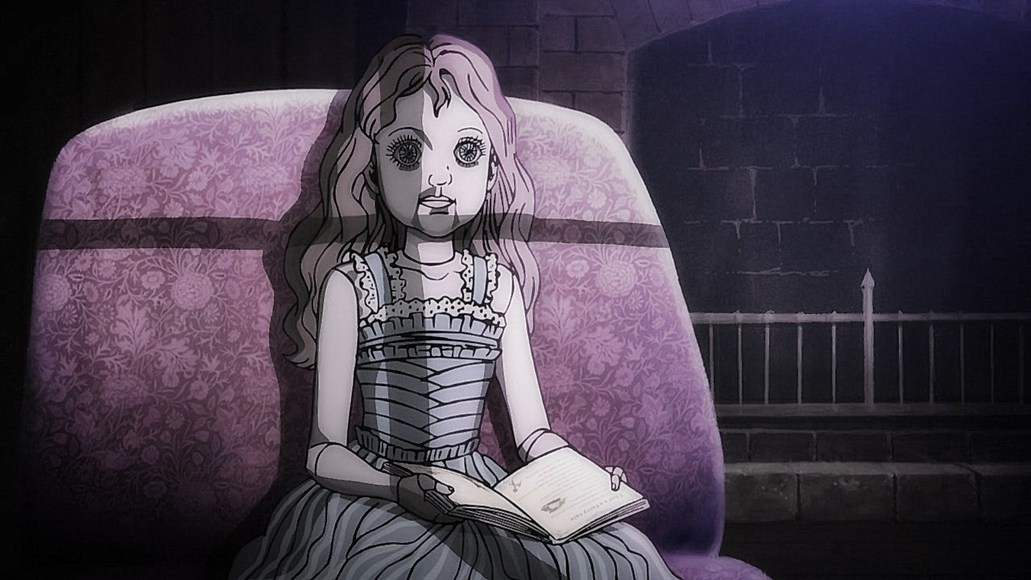
To give an accurate description of what this visually looks like, most of this series is still images, clearly influenced by the kamishibai storytelling style as well – some paper cut animation is used, but mostly it is hand drawn images, set to voice acting, the score and the narrator. Each episode however takes on a different art style, something seen in the contrast from episode one to two, the later even more misanthropic in tone in suggesting the 1982 animated interpretation of Raymond Briggs's The Snowman, a Christmas tradition in Britain, if the snowman was more likely to eat the child. One aspect about YAMIZUKAN, alongside the bleakness of many of these narratives, is how ridiculous some become, and there is a sense as much of this is a pastiche, where the plot twists are more entertaining the least conventional and strange they turn out.


I think everything is explained by who the chief director is, an unexpected surprise for me as it is Noboru Iguchi, a man I only knew for his live action work and was surprised to learn has worked with ILCA with the likes of this and a season of Yamishibai. Iguchi is a man, part of the Sushi Typhoon group of cult Japanese cinema in the 2000s on, behind films like The Machine Girl (2008) and Dead Sushi (2012), knowingly ridiculous genre films which do wink to the audience. These films can be hit and miss to me over the years, but here Iguchi’s sense of the strange, writing many of the scripts with others, works entirely for me. The emphasis on American tropes, with all Western named characters, with some exceptions based on European tropes is clear, obsessions with fortean concepts of UFOs to the perils of hitchhiking, even for episode five with a very distinct art style based on American pulp illustrations the sci-fi trope of mechanical man for a gleefully nihilistic narrative. This is a really good series to show how the micro-series as I have called them, short multiple episode works, are at their best in allowing experimentation and artistic creativity. Still images, mid-show, stand out as incredible and gleefully weird here, where here you have to take a pinch of salt at how deliciously ridiculous this can get, like man-eating cars or mimicking Akane Shimizu’s series Cells at Work (2015-21) in anthropomorphising antibodies, but the art and craft behind them are magnificent.

Throughout, there are a lot of memorable episodes. Episode seven, about a dangerous clown who travels in reflections, is even live action, with actors photographed in a series of still images. One episode is the entire premise for an American horror film, about a cursed musical box, that even brings in The Exorcist (1973) and becomes an over-the-top tribute, or pastiche, of the country’s genre films, as is the throwback to older b-movies about a mad scientist turning people into a gill man army. The two inspired by European tropes make nice contrasts too, like the case of a cursed mask that sees the end of many found in an antique store, like a pulp tale from the eighteenth century, or the last episode, a bittersweet tale of an orphan girl which is actually haunting for all the content here, a great end tale and a surprise change of pace as it is one of Noboru Iguchi’s stories. For a work up to fifty minutes long altogether, these breezed pass with such a vibrancy, and sense of fun, where I have come from the end of YAMIZUKAN with a greater respect for ILCA and so much of their productions I now want to see.

Sunday, 2 October 2022

#225: Ayakashi - Samurai Horror Tales (2006)


Studio: Toei Animation

Directors: Hidehiko Kadota and Kouzou Nagayama (Tenshu Monogatari); Tetsuo Imazawa (Yotsuya Kaidan); Kenji Nakamura (Bakeneko)

Screenplays: Yuuji Sakamoto (Tenshu Monogatari); Chiaki J. Konaka (Yotsuya Kaidan); Michiko Yokote (Bakeneko)

Tenshu Monogatari adapted from the drama by Kyōka Izumi; Yotsuya Kaidan adapted from the play by Nanboku Tsuruya IV

Voice Actors:

a) Tenshu Monogatari

Hikaru Midorikawa / Kirby Morrow as Zushonosuke Himekawa; Houko Kuwashima / Willow Johnson as Tomi Hime;  Saeko Chiba / Tracey Power as Oshizu;  Yui Kano / Anna Cummer as Ominaeshi; Kappei Yamaguchi / Alec Willows as Kaikaimaru; Masaya Onosaka / Samuel Vincent as Kikimaru

Yotsuya Kaidan

Hiroaki Hirata / Brian Dobson as Iemon Tamiya; Mami Koyama / Nicole Oliver as Oiwa Tamiya;  Yūko Nagashima / Rebecca Shoichet as Osode Yotsuya; Keiichi Sonobe / Samuel Vincent as Gonbei Naosuke; Ryō Hirohashi / Lalainia Lindbjerg as Oume Ito; Wataru Takagi / Michael Adamthwaite as Yomoshichi Sato

Bake Neko

Takahiro Sakurai / Andrew Francis as Kusuriuri the Medicine Seller; Yukana / Kelly Sheridan as Kayo;  Tetsu Inada / Trevor Devall as Odajima; Chikao Ohtsuka / Scott McNeil as Clan Lord Yoshiyuki; Naoki Tatsuta / Paul Dobson as Lord Yoshikuni; Seiji Sasaki / John Novak as Lord Yoshiaki; Yōko Sōmi / Alison Matthews as Lady Mizue; Kozue Kamada / Tabitha St. Germain as Lady Mao; Yuu Shimaka / Ken Kramer as Katsuyama; Eiji Takemoto / Andrew Kavadas as Sasaoka; Yurika Hino / Tabitha St. Germain as Miss Sato; Kiyonobu Suzuki / Trevor Devall as Yahei

Viewed in Japanese with English Subtitles


Commissioned for Fuji TV's Noitamina block, highly regarded for its artistically and narratively different anime shows - where Masaaki Yuasa's The Tatami Galaxy (2010) or Princess Jellyfish (2010) came from - Ayakashi: Samurai Horror Tales befits the slot early in its existence, as it is three different horror tales between three to four episodes, of period set folktales and yōkai I am fascinated by. Two of the three are adapting classic authors for their tales too, adding to this an air of artistry, and even when the Noitamina started over the decades, from their 2005 inception to step away from a stereotypical young male target audience, to have more action and pulpier productions, this was not a bad thing either. This has led to shows like Samurai Flamenco (2013-14), and  with well regarded productions like The Promised Neverland (2019-2020) getting popular, the block can still claim respect for producing some of the best and most interesting in animated television series. My interest in Samurai Horror Tales beyond just horror anime would have been cemented by its connection to Mononoke (2007), another Noitamina block member and one of the most unique looking series of any genre, having been a spin-off from of the Ayakashi stories itself not based on a classic tale.

The three tales are very straightforward in what they are about, each taking very different directions to how to tell them however. Depending on how you watch this, the Discotek Blu Ray release, released on October 29th 20191, oddly has it that you can watch the second story's episodes, for Tenshu Monogatari, first before the others, but the structure was set up for broadcast as Yotsuya Kaidan (four episodes), Tenshu Monogatari (four episodes), and Bakeneko (three episodes). Going by how I had watched this, Tenshu Monogatari as the first watched is a supernatural melodrama, adapted from a drama by Kyōka Izumi. Izumi was a prolific novelist, dramatist and writer, who I am aware of for Demon Pond. It is a play even one of my favourite filmmakers Takashi Miike, in one of his many idiosyncratic leaps into any type of filmmaking he has wanted to try, tried his hand at filming, in a very good 2005 theatrical production he recorded, based on a Keishi Nagatsuka re-adaptation of the source material. It is a work too also adapted to cinema by Masahiro Shinoda in 1979.

In Tenshu Monogatari, a falconer named Zushonosuke, thanks to his evil feudal lord, has to retrieve a prized falcon only to find a mansion of forgotten gods, housing all women who as immortal beings, figures who succumb to hunger and consume the life force of any mortals who wander there. One, Tomi Hime, starts to fall for him, which has the issue that the more she is drawn to humanity, that will mean she loses her immortality, which is sadly also infectious to everyone else there in the mansion. The evil lord eventually catches wind of this, which leads to him sending his soldiers to take the mansion by the final episode, a tragedy of figures doomed to love each other despite them being different entities, or that at home Zushonosuke has a fiancée named Oshizu who is naturally heartbroken by all of this, becoming involved. This is the most conventional of the three narratives, but as a bittersweet story, that in itself is a curveball. It still has a ghoulish edge, and there is the fact that there are two monsters as a comedy duo and Greek chorus, two thieves who only help Zushonosuke out to steal from the mansion if they can. 


All the stories have their own distinct looks. Also of note is that, throughout the series, they have their own opening credits, with their own visual motifs and designs, even if they all have the same opening theme song. It is probably the least expected in such a context, HEAT ISLAND by Rhymester, a hip hop song with backing by a koto, a traditional Japanese string instrument, which is as strange as that songs but is yet an inspired choice, befitting a production which is idiosyncratic. It befits how, whilst Tenshu Monogatari is a very emotional drama at its heart, even the traditional ghost story, Yotsuya Kaidan, is not conventionally told at all, all the narratives here standing out with their idiosyncrasies. All the stories have their own authors, Tenshu Monogatari's Yuuji Sakamoto, who only has that one credit in their career strangely, Michiko Yokote for Bakeneko someone we will get to for that story later in the review, and a figure I know very well for Yotsuya Kaidan, Chiaki J. Konaka.

Konaka, someone I admired for his work, sadly has to be taken now by me as a fan with a pinch of salt in recent years. A divisive screenwriter for how obtuse he could be, from Serial Experiments Lain (1998) to one of the strangest narrative arches of Mononoke itself, I admire how esoteric and experimental his work is, even when, such as a live action film like Evil Dead Trap 2 (1992), figuring out what is transpiring and in what reality can be lost entirely even on multiple viewings. For a live reading of a script for Digimon Tamers, a follow up to the show that many of us (including myself) saw episodes of as a kid, he had a villain, which took on the form of "Political Correctness," that threatens the real and digital worlds, and had a special attack called "Cancel Culture"1. Thankfully nothing from this raised concerns of far greater and more problematic ideas he has had, but at a time where his own personal blog expressed questioning views on COVID-19's reporting in worldwide news2, sadly it did paint a picture for me of someone undermining himself when, if brutal to say, his work in screenwriting usually, even if frustrated viewers, was a lot more nuanced even with some of his hardest the grasp scripts in anime storytelling. When watching Yotsuya Kaidan even this came up here, as this is a really meta and clever retelling of the titular tale, which feels alien in comparison, originally written as a kabuki play by Tsuruya Nanboku IV, as Tōkaidō Yotsiya Kaidan, which becomes a story in itself as this version tells.

Nanboku himself is the narrator, and the play itself, as much as a new retelling here, is the subject. The story itself is about a woman Oiwa who, when her husband, Iemon Tamiya, is complicit in a poison she is given, which disfigures half of her face, and the disposal of her body after her death, taking revenge on him from the grave Iemon Tamiya is already established as a unscrupulous rōnin, who even killed Oiwa's father, pretending bandits had done so, to win her hand in marraige, before another woman wished him for her own and concocted the plan to disfigure and disgrace her. This is a morbid melodrama, where there is also her sister-in-law, lied to in a deceit by another man who kills her suitor and pretends bandits also did it, and the story takes on additional angst and wrought drama with its betrayals, seductions and heartbreaks. Konaka's take goes further in how the finale becomes Kaidan's lasting legacy, Tsuruya Nanboku IV revealed to have passed his mortal form and existing in an afterlife on the Earth, considering his story and how it has lasted in Japanese popular culture, even developing a curse around the plan where people adapting it have been maimed or even killed. Were it not for a certain tale coming afterwards which is clearly the gem of this entire anthology, I would hold this as a perfect piece in itself worth seeing. All three are, and Yotsuya Kaidan does feel like a perfect retelling of folklore in dissecting the text, something also for me to show Chiaki J. Konaka as a talented writer even if the real man stumbles in some bad ideas too in his thought process.

However it was Bakeneko which became a spin-off show in itself own right, and alongside that spin-off Mononoke, no anime looks and feels tonally like this these stories about a mysterious "Medicine Seller" at all. Bakeneko, alongside its distinct art style and character designs by Takashi Hashimoto, looks like it was illustrated on glossy waxed paper, done with digital animation as I aware of with Mononoke, but absolutely distinct in its composition. It is a horror story which yet uses bright colours, has a precise use of environment design (patterns, illustrations, even setting out locations), and where, clearly indebted to art styles from Japanese history, such as Japanese woodblock prints, it brings it into the modern era as a digitally animated production in movement. Even in mind that the series got Yoshitaka Amano to do the original character designs for Yotsuya Kaidan, and have his illustrations on the opening credits for that tale, one of the most iconic designers in anime and light novels who an acclaimed artist outside of the mediums, Bakeneko is an artistic masterpiece just in appearance, even in mind that this is a prototype to what became Mononoke the series.

It is also, with fair warning, a bleaker narrative than Mononoke could get, bearing in mind that the later series tackled heavy subjects, its first arch surrounding the ghosts of aborted foetuses of brothel workers. It says a lot in context however that Bakeneko manages to have the bleakest narrative of this world, introducing us here to the Medicine Seller, a figure here and in the later series whose job is exorcise demons, a magic sword on his person (alongside other tools) which can only be open when three criteria explaining the entity's existence come to light. A bride is killed on her wedding day in a proud samurai clan, and whilst suspicion comes on him, the Medicine Seller is quickly the only person able to deal with the problem, the Bekeneko. This is a "goblin cat", cats of supernatural form in Japanese mythology which are not necessarily as extreme as this, a monster claiming vengeance, but symbolically meaningful here with the context. This story will be uncomfortable for some, so fair warning is recommended, as this is the case as was in Mononoke that, as the truth and cause of the demon is revealed, it involves showing up the wrongs of human beings, alongside this explicitly dealing with how people lie, forget details or view it in a different perspective. Michiko Yokote was the screenwriter for this story, and whilst multiple writers all contributed good work to Mononoke, Chiaki J. Konaka, this is a great time, with the virtues she shows here, to praise Yokote. She is not someone I have frequently encountered, but I am aware of her, whilst not the only screenwriting contributor, for series composition, the person putting everything narratively together, for Princess Tutu (2002-3), an exceptional and unique fantasy tale about around ballet and fairy tales that, again with Konaka getting briefly involved, was a meta-text on fairy tales which was also a beautiful gem. Here, dealing with an incredibly umcomfortable subject exceptionally at the heart of this tale, the only not adapted from another source, I see another example of her talent.

And that is true as a warning for anyone interest. [Major Spoiler Warning] The cause of the bekeneko here is that the samurai patriarch kidnapped a woman, kept her in a cage as a sexual object, a peasant girl who was raped, beaten and left to starve to death, which is as grim a narrative reveal, too real for some, to consider. [Major Spoiler Warning]. All three tales to their virtue, but especially Bekeneko, show why I came to love these type of horror anime about folklore and figures like the Medicine Seller, stepping in to resolve supernatural entities, as they become morality tales and dramas with one-off characters, examinations of human beings which the Bekeneko pulls no punches in. Among them, for its artistic innovations, and how impactful the narrative in its centre is, clearly Bakeneko is the masterpiece of the entire set, though it is to the credit of the three tales altogether that they all succeed.


====

1) Discotek Media's announcement of Ayakashi: Samurai Horror Tales, dated on Facebook on August 13th 2019.

2) Digimon Tamers Writer Chiaki J. Konaka Responds to Overseas Backlash Over 20th Anniversary Stage Play, written by Kim Morrissy for Anime News Network, dated August 9th 2021.

Tuesday, 5 March 2019

#90: Genius Party Beyond (2008)


Directors: Various
Screenplay: Various
Voice Cast: Arata Furuta, Akiko Suzuki, Shôko Takada, Urara Takano
Viewed in Japanese with English Subtitles.

From http://1.bp.blogspot.com/-_A1oJF-NuzQ/VJyH
Kwlt_YI/AAAAAAAAPkU/h8B_mUl1Hg/s1600/Sem%2Bt%C3%ADtulo.jpg

Gala (Director: Mahiro Maeda)
From Genius Party (2007) to Genius Party Beyond, a sequel to Studio 4°C's anthology film, and from the beginning I'll confess this is a much weaker work as a sequel than the original prequel. Gala, by Mahiro Maeda, does thankfully start off the anthology well; what feels like a generic fantasy world tale, in which a giant meteorite lands in a high fantasy period Japan where there's a general male protagonist, gets more interesting when he and his allies (a young woman and an anthropomorphic cat) are hired to be magical musicians riding on giant instruments in the sky and enchanting musical compositions to help soothe the meteorite. Descending into everyone bringing their instruments out into a mass orchestra, it becomes a full blown and beautiful cacophony of music and visuals, the closest to a lot of the motifs in the original Genius Party as a result in aesthetic exhaustion.

From https://jfdb.jp/data/photo/movie/7a/fe/da/24/
af641bb0b6c9bd2260b652deb4097151_640.jpg

Moondrive (Director: Kazuto Nakazawa)
Moondrive's director Kazuto Nakazawa immediately stands out as the man who directed the animated segment of Kill Bill Vol. 1 (2003), one of the most striking moments for anime's recognition in Western culture in the early 2000s. Moondrive looks like the work of the same director only exaggerated even further, a crude farce, set on the moon in the future, about a motley group of thieves whose attempts to find treasure are constantly undercut by pitfalls (no money, losing money in a pool game, the transport not having enough fuel). It's a fun, misanthropic romp, with a distinct visual style although it does have a tasteless running gag which will immediately put many off where one of the two female members, a buxom blonde, is constantly bartered for sexual favours for people by the headstrong male leader who she calls masters. It's a joke, even if one has her audible being a dominatrix for one "client's" masochistic tendencies, which hasn't aged well at all in just a decade.

From http://1.bp.blogspot.com/_t6rfIoGCvjs/T
FwzLawVlNI/AAAAAAAAA2M/kY_tLQZ-Cf4/s1600/wanwa.jpg

Wanwa the Doggy (Director: Shinya Ohira)
Wanwa the Doggy by is definitely the most surreal of the five segments in this film, the fantasies of a young boy as his mother is in labour with a new sibling played out as a nightmarish journey against trolls who've kidnapped her. It evokes Masaki Yuasa's segment from the first Genius Party, notions of death and strange sights from an infant's perspective. Shinya Ohira's short takes a huge risk by making the segment look like a child's drawing in motion, sharp crude images and blocks of colour, It's a style which can became a little bit of an ugly and difficult to grasp in its final version. I have to defend the ambition even if doesn't completely work, although honestly the issue is just that it could've just had a little more pacing in structure to fully work. If that'd been the case, I'd be fully onboard with this ambition being an actual success because it befits what the premise is.

Noticeably with the first three segments, sadly not carried out in the last two, there's always an epilogue which feel meta or pull the rug under the viewer, going on longer than you'd presume in each short but with purpose. I won't spoil Gala's barring it being a circle of life that enters our world, but Moonride's reveals itself as having been a musical production on a red curtained stage with an orchestra, and Wanwa... does soften its flaws when a troll is revealed to be a man in a suit, sad to have not been in the dream we saw, only to be thankful that he got some screen time at the end.

From https://m.media-amazon.com/images/M/MV5BNjY5YWFlOG
MtZTBlNC00OWVhLTkxMWMtNWZiMWM2NDM2MzI5XkEyXkFqcGdeQXVyNTAyODkwOQ@@._V1_.jpg

Toujin Kit (Director: Tatsuyuki Tanaka)
Toujin Kit by Tatsuyuki Tanaka feels unlike the other segments, the most conventionally structure and aesthetically looking but also arguably the best, entering a dystopian world of police enforcers who are literal brains in jars on robot bodies and washed out grey industrial environments are all there is to see. The story simply follows a young woman illegally breeding multi-dimensional organisms within plush toys, giving the toys life as a result, only for law enforcement to crack down on her. Whether they are right to, believing the organisms will damage the dimensional form itself if they don't stop her, or it's a metaphor for the death of imagination is entirely for the viewer's discretion. The biggest surprise is that, expecting a big crescendo, you get an abrupt and bleak ending instead, which argues Toujin Kit is the best segment just for catching you off-guard completely next to everyone else.

From https://i.ytimg.com/vi/tkUukE3xBZo/maxresdefault.jpg

Dimension Bomb (Director: Koji Morimoto)
Sadly Dimension Bomb ends the short anthology on a flat note, more disappointed as its directed by Koji Morimoto, co-founder of Studio 4°C itself and a very good director himself known for stylistic innovation in his work. I'll probably warm to his segment, even understand what exactly it is about, in which you have a slightly spacey but intuitive young woman with powers and a demonic alien being she bonds with, but the immediate problem is that the short's a confusing if beautiful looking creation. Knowing how unconventional Morimoto can be, like with the short Noiseman Sound Insect (1997), the problem's entirely that of being merely confusing than compellingly vague, as well as being aesthetically beautiful in a more conventional way compared to some of his bolder experiments which stood out more.

Ultimately, Genius Party had far more rewarding pieces - as of this review, even Shinichirō Watanabe's Baby Blue (which I unfairly dismissed at first) became so much more stronger and good when thought about. In comparison, Genius Party Beyond feels like the runt of the little, charming but missing a great short in itself. As someone more sympathetic to anthologies than many, I'll warm up to it over time, but its definitely a weaker creation.

Monday, 18 February 2019

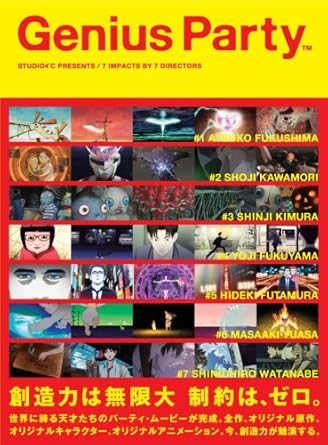
#87: Genius Party (2007)

From https://images-na.ssl-images-amazon.com
/images/I/61rGbDkHpoL._SY445_.jpg


Directors: Various
Screenplay: Yoji Fukuyama, Hideki Futamura, Shôji Kawamori, Mitsuyoshi Takasu, Masaaki Yuasa
Voice Cast: Tomoko Kaneda, Rinko Kikuchi, Kaoru Mizuhara, Lu Ningjuan, Taro Yabe, Yûya Yagira
Viewed in Japanese with English Subtitles

From https://cdn.animeuknews.net/app/uploads
/2017/12/Genius-Party-2-1-1024x576.jpg

Genius Party:
Director: Atsuko Fukushima
Known for their innovative, idiosyncratic animation you can forgive Studio 4°C for both creating two anthologies released over two years and calling them both "Genius Party". Befittingly the first segment by Atsuko Fukushima is also called Genius Party.

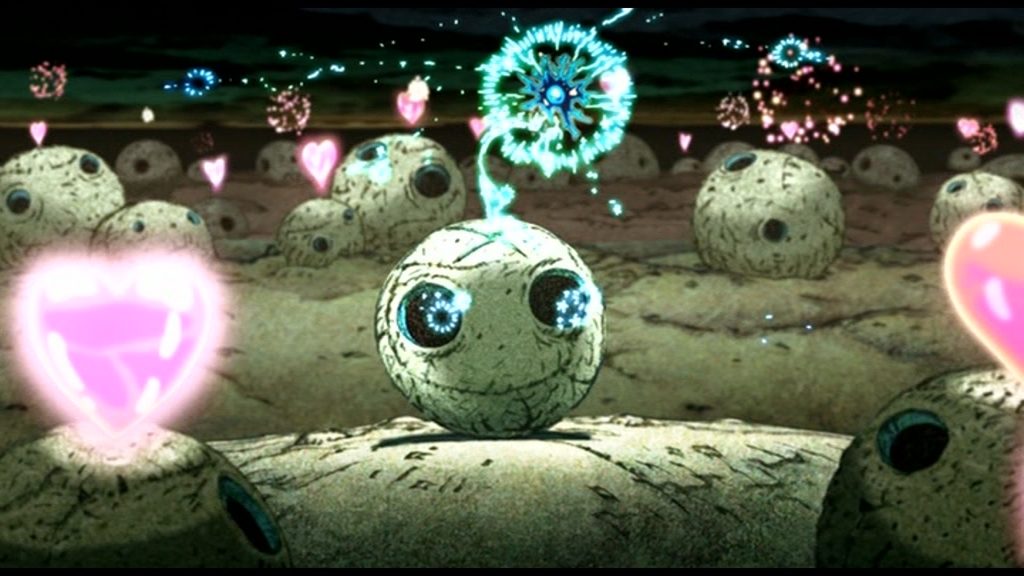
In a strange sci-fi desert, a birdman finds a living sphere with a soul heart attached to it, leading to a giddy enlightenment where all those involved (including the sphere and its peers) transform in an animation enthusiast's wet dream. Naturally it leads to these creatures inventing cinema, which is hilarious and acts as a long but perfect introduction for any anthology, only matched by Katsuhiro Otomo's humorously misanthropic bookends with added explosions for Robot Carnival (1987).

From https://jfdb.jp/data/photo/movie/bb/de/d3/
85/9ea3cc44b7ab386859941dd62473a417_640.jpg

Shanghai Dreams:
Director: Shoji Kawamori
Shanghai Dreams, from this beginning, splits Genius Party between two action heavy tales at the start before they become more introspective. Kawamori is definitely a genius before anyone asks, the legendary mecha designer/anime director/screenwriter/visual artist starting whilst a teenager in the industry, and among the anecdotes to him the kind of man at an anime panel in the US gladly demonstrating his craft by bringing intricate versions of his designs made out of Lego as tangible examples. He can also claim, among a large career CV, being the original creator of The Vision of Escaflowne (1996) and being involved with all the legendary Macross franchise baring Macross II (1992).

He decided to set a story in a present day China, with two languages including Japanese used, and envisions an alien invasion that can only be stopped by a distractible five year old boy given the ability to make his imagination real. Its befitting I mentioned Kawamori as someone with a healthy creativity, because it feels like a personal side is being shown here even if this premise doesn't go as you'd expect, a nice anti-climax with humour because giving a very young boy who interested in flights of fantasy isn't necessary the person expected to stop actual alien machinery. It does instead turn into a sweet ode to childhood imagination where the two soldiers from the future involved, with the their cybernetic bodies and guns, sympathise with the boy and the smarter young girl after it all blows over, lamenting and celebrating the idea of imagination that children are capable. Its arguably is one of the best shorts in a strong anthology, both as a sumptuous visual feast and feeling like a sincere creation from a very well regarded veteran.

From https://guriguriblog.files.wordpress.com/2010/02/bss_
genius_party_-_deathtic_4_dbe77e84-mkv_snapshot_01-06_2010-01-19_03-34-52.jpg

Deathtic 4:
Director: Shinji Kimura
Deathtic 4 shows us the world of the undead, where a young ghoul with a trio of super powered but thankless boys attempts attempt to take a living frog back to its world. Its idiosyncratic aesthetic stands out, alongside again being a kinetic short which emphasises a cleverness to action in giving it vibrancy and making every short count as its animated, not always found in live action. The aesthetic details given also invoke a living world with its own logic you wish you could see more of, just for the police force who are the show stealers of the segment, literal person sized balloons who use peddle bikes with bells as their pursuit vehicles.

From https://antiotaku.files.wordpress.com/2010/08/geniusparty042.png

Doorbell:
Director: Yoji Fukuyama
Doorbell as with the last segment, whilst they have grown in admiration, do have the unfortunate place of being the most conventional films to an anthology that mainly pushes for very unconventional art styles and structures within them in comparison. However, that's not necessarily a bad thing as Doorbell to its credit, in which a young male is cursed by a doppelganger that, when they reach a person's door first, leaves him an invisible spectre wandering the streets, is still an immensely engaging tale. Its neither merely metaphysical or supernatural, just a very open minded and curious tale open to interpretation whose more conventional art style, bright and calm, is helpful in making sure its tale and emotional depth is of priority.

From https://blogger.googleusercontent.com/img/b/R29vZ2xl/AVvXsEi1eH7_NjSUNhX3J8kDvxYyBoT_sRfO1Z1LlfcMmLN0l7w_oBn0yPo5XyCZbA2OcRC1v0hyEJFyySMtA0vPwcKA5PdJrf1BWcawWkwUwmCwZ04r7nYuwMCT0dfyUrg0DWVGlhWVMavW3PK4/s1600/%5BBSS%5D_Genius_Party_-_Limit_Cycle_%5B79563821%5D%5B13-12-22%5D.JPG

Limit Cycle:
Director: Hideki Futamura
Out of all the Genius Party, Futamura's segment is going to be the most divisive. Following a James Dean lookalike, this is a religious/spiritual mosaic in moving form, his life in a futuristic city a deadbeat job, blurred figures passing by and wanton sex with women as he searches for the truth of his existence. With a narrator talking of existential ideas in an oblique way, and with real religious and alchemical symbols and drawings onscreen, Limit Cycle could turn people off easily.

It asks, if you know exactly what everything used or spoken of means, whether it has actual depth or not, but an obvious problem is that religion and especially the alchemist material is subject matter not talked about by many unless you're a scholar (amateur or professional) of this material. It's clearly more deliberate than most anime and with a point, not like the notorious fact that, for all its depth, the Neon Genesis Evangelion franchise just used Christian and Judaic references just to look cool. Helping Limit Cycle is that, connecting the images together, it has a cognisant and easy to follow plot - one man finds his spiritual other half, his soul, and then finds God.

The monologue and the symbolism (including the Jewish symbol of the Tree of Life Evangelion has used itself) needs to be decoded, alongside the real life figure God himself is clearly designed as, in particularly as Alchemy is a very unconventional and fascinating choice to have referred; viewed in stereotype as men trying to turn base materials into gold, which many actually tried, it has however been interpreted especially with the Hermetic philosophy (based on the figure who dubbed himself Hermes who influenced alchemy over centuries) to clearly have a spiritual meaning, the transformation to gold a person's spirit rather than a base wealth. That kind of reference doesn't get used a lot, or properly to the actual source materials, so in the middle of Genius Party it's a curious and divisive choice to have done. Because I have some knowledge of this type of material, I'll confess to being the who admires Limit Cycle especially as it's still a visual feast, helped by its New Age score, whilst also recommending viewers to take the segment with a pinch of salt, particularly as I'd argue the narration more than the visual content is the aspect people will struggle with more.

From http://2.bp.blogspot.com/_eNuuX3apRtE/TSTZLiPpXDI/AAAAAAAAFFE/
0UQTsZ508sE/s1600/Genius%2BParty%2B-%2BHappy%2BMachine_1.JPG

Happy Machine:
Director: Masaaki Yuasa
After the divisiveness of Limit Cycle, trust Studio 4°C's genius Masaaki Yuasa to steal the entire anthology with Happy Machine, so visibly a metaphor of life and death in a curious tale of a baby who, raised in an artificial nursery with a robot wet nurse, then wanders the alien desert outside and encounters various creatures, all until a circle of life analogy takes place without the Elton John score from The Lion King (1994) being required.

Yuasa's style is clearly his own, but it is difficult to pinpoint why in clear precise detail despite all the work being visibly categorisable as his - he is referenced in lieu of the Superflat movement, and takes styles like cartoon exaggeration and using images of real people for characters amongst his many other idiosyncrasies. The influences he's opened up about (like Yellow Submarine (1968)) are visible in his world here, one with a beloved plant creature who eats all waste alongside denizens who could have cameoed in René Laloux's Fantastic Planet (1973). It stands tall as the best of Genius Party, a tale of a bitter sweetness nonetheless also with gleeful eccentricity that has always been his best trait as a director, someone whose work is legitimately adult in its emotional spectrum but playfully weird. Happy Machine also feels like it was made without breaking a sweat on his part, adding to the aura around him.

From https://goboiano.com/wp-content/uploads/2017/
08/Genius-Party-Baby-Blue.jpg

Baby Blue:
Director: Shinichiro Watanabe
In lieu of this, Cowboy Bebop director Shinichiro Watanabe's Baby Blue is unfairly forced to follow it and to end a strong line-up for the entire anthology. It's still a good segment, and in vast contrast to my original review I've grown fonder to it as a result, in which a boy and a girl decide to skip school and travel to a far off beach one day, one in the territory of naturalistic drama.

There is a mountain to climb with a premise like Baby Blue's in lieu to Makoto Shinkai making this type of subject his domain, and high school being a pathological obsession of anime in general nowadays, but it helps Watanabe's is a sweet hearted tale, one with some eccentricity to be allowed in which there's a subplot about a hand grenade of all things, something that in a tale of two people who love each other but are to depart definitely gives this domestic tale an edge with how that goes. It's modesty was what I originally (and unfairly) dismissed it with, when in reality it ends what was an anthology that was for too long difficult to see and now has been a worthwhile experience to finally see.

Monday, 8 October 2018

#74: Junji Ito Collection (2018)

From https://pm1.narvii.com/6695/
a6eaeafd6acef60657dd093b81b39a10eb6e535a_hq.jpg


Director: Shinobu Tagashira
Screenplay: Kaoru Sawada
Based on the manga of Junji Ito
Voice Cast: Hikaru Midorikawa as Handsome Man at the Crossroads, Hiro Shimono as Oshikiri, Kaori Nazuka as Yūko, Mami Koyama as Fuchi, Rie Suegara as Tomie, Yuji Mitsuya as Souichi Tsujii
Viewed in Japanese with English Subtitles

Synopsis: An anthology that adapts stories from the legendary manga author Junji Ito.

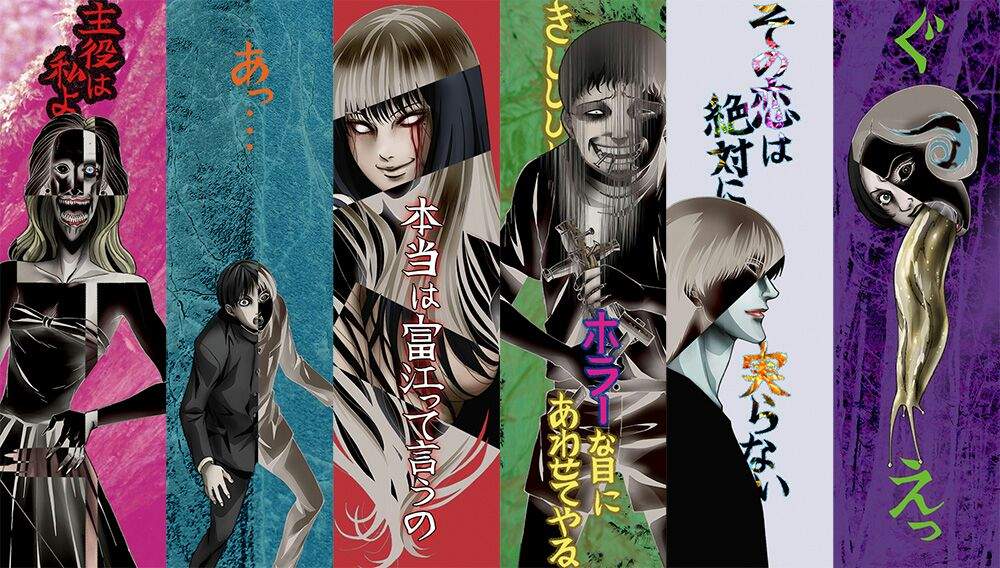
I had been prepared that the Junji Ito Collection, after the initial excitement running up to its January 2018 premier from Junji Ito fans like myself, that enthusiasm had started to drain away, finishing with a lot of disappointed viewers, one YouTube video describing how bad the series is compared to Ito's original manga, and a general air of this being one of the biggest failures of 2018 for anime. I don't think this adaptation is the worst it could've been. I will agree with this series' detractors that, production wise, Studio Deen dropped the ball horribly in visually depicting the legendary horror author's work, but even in this state, Junji Ito's work is too good to prevent this anthology from being entertaining. As a fan of even schlocky anime horror, as long as it's actually horror and not an action story with monsters, I have a high patience with this type of episode tale, my own brand of catnip.

The problem with the Junji Ito Collection is the presentation, looking like a cheap show and with moments, having collected and read the source material that's been translated in English, where the drop in style compared to Ito's original pages does sting. I think however as much of the issue is that Junji Ito's idiosyncratic style is incredibly difficult to adapt unless you have the style and budget. It is neither that all his work is too difficult to adapt. Some of it is as with Gyo (2012), the adaptation of his robo-fish apocalyptic tale which is trashy and not helped by the look of the film even as an OVA being closer to a trashy cheaper one of yore amongst its other issues. In other cases, as with the Junji Ito Collection adapting more slow burn and less ambitious stories, there was no excuse for this.

From https://www.dreadcentral.com/wp-content/uploads/2018/01/Junji-Ito.jpg

Arguably the only adaptation which has succeeded is the live action adaptation of Uzumaki (2000), because Higuchinsky in spite of not having a proper ending, still compromising the adaptation, he purposely adapted the material into his own style. Ito is an exceptional illustrator as well as a good storyteller of bizarre and freakish events, and unfortunately in terms of adaptation, one of his trademarks is reliant on how detailed he is in his shading and etching of everything from facial expressions to the monstrosities he shows on the page. This is very difficult to animate, even in live action as was the case with Uzumaki, unable on its budget to adapt the truly surreal ending of that novel, and if you are not going to provide good OVA or theatrical level quality of production for an animated adaptation, even a healthy TV anime budget, this is going to be impossible to recreate perfectly especially in a tight schedule.

It also didn't please many that, whilst the first episode ends on a short minutes long story of a girl turning into a puppet, it is mainly devoted to a comedic story of Souichi Tsujii, a creepy boy who knows how to induce curses and hexes on his fellow school students. He is the character who appears the most in multiple episodes, even over Tomie, and is a character that hasn't to my knowledge ever been adapted into English publications, which would make this abrupt beginning in farce a jarring choice for many expecting the creepy and disturbing material Ito is most well known for. I grew to love Souichi Tsujii - a character who is lovable even though he is obnoxious and spiteful as much because he always gets his comeuppance every time he appears, the first story taken from Souichi's Diary of Curses (1997) and many others shown in this series belying that Ito has written a lot of eclectic material over his long career, only really known for us in the West through Junji Ito's Cat Diary: Yon & Mu (2009), his autobiographical book on raising cats with his wife, being released.

From https://asianmoviepulse.com/wp-content/uploads/2018/07/Juniito3.jpg

The eclectic nature of the Collection helps with the series' major flaws. When a story like Long Dream - where a patient in a hospital feels like his dreams for what can feel like days to eventually years - loses its potency due to the average art style, you are yet introduced to Smashed, a tale where a sacred nectar can only be eaten when not noticed - if you are, it's a grotesque and sickly humorous tale reminiscent to the Monty Python foot from the sky, squishing people like strawberry jam for a reason which is even more perverse when revealed. Two very sombre Ito stories appear here and they are among the best - Gentle Goodbye (available in English in the Shivers collection as Lingering Farewell) is about a family who wishes their recently deceased into copies, a story which stands strong even if seeing it in this animated version raises logic gaps in the plot twist, while Bridge is about an ill advised funeral custom of floating the recently dead under a bridge, emphasising as well Ito's really wide talent for a variety of tones. One story, Used Record, benefits from being able to hear the song on a mysterious record which causes people to go insane to try to possess it; whether the song played is actually appropriately macabre or not, it at least gives a hipster's nightmare actual sound. One other story Greased, which is entirely about the most disgusting ways Ito could talk about grease (natural in the skin or cooking oil) and even made me feel ill in this animated adaptation.

And in spite of everything, you cannot diminish the perverse imagery of Ito's work, just softening the blow enough with the production and still hooking a fan of the author's work like me regardless. Here the [Spoilers] have to be implemented to describe such nightmarish imagery such as an entire century of family continued through their brains and foreheads being connected on the next heir, or blood fruit that grows from your wounds, or the results of trying a growth serum causing a horrible elongation effect all in the midst of dealing with your doppelganger from another realm... [Spoilers End] here but that is just part of the many a horrible yet utterly imaginative thing that Ito could come up with, all of which is still grotesque even in this anime series. If anything seeing these stories, new or old material together, Ito never lost his creative juices. In fact, this anthology's one success is that the variety of Ito's world, from cosmic horror to black humour with a few morality tales thrown in-between, emphasises both his talent but also makes this one anthology work with enough different tones to never get boring. You couldn't when one episode can go from the bizarre episodes to spring up in a town when a transfer student appears, like every cliché of anime supernatural high school appearing, but also has a sombre tale of the dead being idolised by scarecrows.

From https://blogger.googleusercontent.com/img/b/R29vZ2xl/AVvXsEgwQjHbdmHsHrZoyvRznAJBbHEpFgBn7goGIRlS6ExvPAmv4XNJiHyE25UKqd4U6pazipFnE8fJ-w99M9BT3fEzCDKnXK6mxY8CVqNQjvcQ6Iy5iVvPgp9yhDICGrXks0_WRhbnpezjYGw/s1600/Junji-Ito-Collection-The-Ongoing-Tale-of-Oshikiri.jpg

The fact many of these tales, those available in the West or not in their original manga form, are not the biggest titles in Ito's career is to the Collection's advantage as well. With one exception, which is the character of Tomie, the Junji Ito Collection whilst it could've done with a lot more care in its animation and design is still a very good introduction to Ito in terms of his prolific output. Noticeably each story, always two per episode of varying lengths, is numbered but vary leaving gaps, as if this numbering is actually the real chronological order of when Ito's manga were first published. The choice in tales is enough to encourage some to take an interest in Ito's work, making this as an Ito fan still a good work to have been made. And if anything, at least the music's interesting - the opening title is good but the real standout, in front of end credits which include the figures of both tales of that episode appear together, is a fascinating and memorable little song with math rock rhythms that's wormed itself into my head.

Since it hasn't been brought up, yes Tomie is one of the stories adapted, once in the main series and with two of its tales in the OVA thirteenth episode, split into two halves strangely with the question of, if they were released separately, how much the Japanese fans were ripped off in terms of money to get those fifteen minute pieces. Tomie was one of the biggest draws in terms of promotion especially for the Western fans as Tomie is a major work in Junji Ito's career. It's also one of his best as, what could be initially a deeply misogynistic story about an evil temptress who eventually drives men to slaughter her, has a deeply complex side to it about the worst in men who obsess over her and, yes, usually kill and dismember her, only with the issue that not only does she come back to life and regenerate, but that dismembered pieces grow into their own Tomies, multiplying her over the landscape. The first story of the OVA, the first Ito ever drew, even takes the story to an entire class male or female being drawn to evil by their worst emotions. There is a potential controversy that, for an OVA, how this evil is shown is censored, obscuring what would be the most horrifying moment in the entire Collection with a disposal of a body, but there needs to be emphasis that, no matter how horrifying Ito's work can be and even gory, he has never been about splatter, not only the implied nature of the scene (with sound and dialogue) being more horrifying than drawn intestines, but actually more faithful to his source material as a result. It neither stops the final half, another Tomie story but with a reoccurring character, ending the Collection on a high if gruesome note, a head where it shouldn't be conversing with the doctors involved. That the end theme song is a one-off, a freakish electronic string piece, fits the spike the ending provides even for disappointed viewers of the series.

From https://100wordanime.files.wordpress.com/2018/03/junji10c.jpg?w=648

Altogether, I liked the Collection. In spite of the elephant in the room - that Studio Deen should've made a series with a significantly better production style if they were going to adapt Junji Ito - the material is still too rewarding despite this. As much because I lowered my expectations approaching this series, the merits outweigh the anger other fans have shown.