Showing posts with label Letter: C. Show all posts

Monday, 12 August 2024

#278: Cybervenus FeiFei (2001)


Studio: Blue Moon Studio

Viewed in Japanese with English Subtitles


In my obsession with digging up obscurities, I finally close off the trilogy of three Virtual Idol releases which got DVD releases in the United Kingdom. They exist in an unconventional place in terms of anime, as CGI productions connected to Pony Canyon, a publisher huge in the Japanese music industry with involvement other pop culture industries like anime, but as DVD directed collections of segments which were released in the boom period of British DVD distribution when the format was new. This film in its trailers promised a fourth, which feels like it was falling back into the idea of the sexy virtual female idols of the other titles I have covered, but the three we got were Yuki Terai - Secrets (2000), Virtual Stars (2002), and Cybervenus FeiFei, which focuses on a Chinese woman who was created through motion capturing the movements of real actress. It feels like, from the three we got, this was the most ambitious in terms of ideas and artistic presentation, making the fact this was not the final one somewhat strange. Virtual Stars was really falling back into the idea of sex appeal of their virtual starlets, whilst this feels more like it should be the conclusion, where Blue Moon Studio wanted to figure out where they could go with this production concept they had, as FeiFei becomes significantly more existential in tone than appealing to a cute idol who can appear in music videos.

Like the others, this is a collection of shorts, beginning with Doll, where FeiFei initially is wandering through giant cogs. Ahead of time, I find the computer effects here compelling, beautifully obsolete, especially in mind that there is a clear care to make FeiFei as realistic as possible, as will be seen in the later shorts, even if prioritized over overtly detailed locations. As a result, she is a proto-virtual idol in the truest sense of pushing the realism to a quality you can admire, but aside from actual live action footage being used later on, the journey through mazes in this first short is very abstract in comparison to the person wandering them. Add the ambient techno the scores the segment as she finds feminine robots and a transparent monolith, and it is brain candy for Millennials. RGB takes this further by looking like the cool Dreamcast game we never got, FeiFei cybersurfing a spiral environment in pure white void which wandered out of the videogame Rez (2001). Even the spoken word fuzz rock that scores this segment feels like something Sega would commission whilst she is riding a metallic shark in a green sea of fish. Arguably the best thing about this entire project, as here, is how work like this can have a pretense of a plot but also be purely dreamlogic as FeiFei’s birth, as this short is meant to represent, includes all the following but also requires her gaining colour pigmentation for his body beyond grey.


These shorts all have poetic introductions to them, suggesting Blue Moon Studio were more earnest in their work with this one in terms of meaning. Voice, as FeiFei travels through a room in its own existence and learns to speak, also brings in the touch distinct to this collection of animations, blending live action with FeiFei interacting with the real world. The soundtracks are a smorgasbord of the era – whale sounds, nu jazz, ambient lounge and dub music, sometimes in the same short as with Real, focusing on more live action as FeiFei sees the world through the pieces of recorded footage, and is interacting with a real actress who can talk to her through a laptop. These shorts build a narrative over these segments, unlike the others in the series, where she is slowly growing into a real person fully immersed in our world, which also makes understanding the dialogue more a concern. “Dream and reality are the same” is spoken at one point, and whilst we are seeing the limits of the animation at times, we see something very ambitious in spite of this. By Messenger, we are definitely seeing a more New Age tone to the project too, Messenger emphasizing this as an experiment in a character as a radio host, or waiting in-between her recordings of messages from listeners.  We have moved from random zombies being fought off by a sexy dancer in Virtual Stars or music videos to more perfected movements for speaking dialogue or communicating her messages of love in turntablism.

Labyrinth is the most ambitious of them all for being seventeen minutes long. Splicing our lead into real footage of Rome, they do have to fudge around her presence around real people in the streets, like a ghost no one sees, but even in painstakingly animating her operating a phone booth, the short is trying for a more ambitious short film with emphasis on mood. It begins attempting a plot of FeiFei trying to find a man she cares for living in Italy, only for reality to start to bleed and distort in digital code, all with knowledge eventually he has disappeared. As she travels around Rome, witnessing masks with her face on them in store windows or with the walls closing in on her, it is cool to see Blue Moon Studio suddenly take the project series to this point, feeling like the last thematically in their ambition in spite of the true chronology of the releases. After FeiFei goes to a church the short becomes more abstract, a mood piece where she is transported to a tropical island, eventually to her painting herself on the moon on grassy field. It might be seen as a cop-out, but in mind that this entire product feels like the right mix of old CGI, dream logic and these moments of expanding the production with ambition, I would let Labyrinth have a pass if it was entirely just obsolete CGI being used in imaginative ways by this studio, only to also admire that they were wanting to push their interest in terms of artistry too. Sadly, this entire series of works are as obscure as you could get, and in mind that we even got DVD releases of these in the United Kingdom, I ponder whether any of this, from the films themselves to the making of documentary material also included, are even properly preserved. Finally closing the trilogy off they are a compelling dead end in the history of Japanese animation, though it is clear to see that we would have not gotten a Cybervenus FeiFei even if the project continued into the 2010s. When Virtual Stars was released, the production realized the sex appeal sold more, so even if they were able to prosper, this more esoteric tone would have likely been ditched soon after anyway.

Wednesday, 3 January 2024

#273: Cyber City Oedo 808 (1990–1991)


Studio: Madhouse

Director: Yoshiaki Kawajiri

Screenplay: Akinori Endo

Voice Cast: Hiroya Ishimaru as Shunsuke Sengoku, Kaneto Shiozawa as Merrill "Benten" Yanagawa, Tesshō Genda as Rikiya "Goggles" Gabimaru, Emi Shinohara as Remi Masuda, Kyousei Tsukui as Versus, Mitsuko Horie as Kyōko "Okyō" Jōnouchi, Norio Wakamoto as Juzo Hasegawa

Viewed in Japanese with English Subtitles


Madhouse would have success with Wicked City in 1987, one of their more infamous titles which helped when its director Yoshiaki Kawajiri pushed for a theatrical release and it paid dividends for the studio1. That was however an adaptation, based on the work of author Hideyuki Kikuchi, and with Cyber City Oedo, Madhouse and Kawajiri decided to create their own original intellectual property, one which was meant to be a multimedia one. This came to be true as there was a video game, the 1991 game for the PC-Engine CD-ROM², and a novel1. Cyber City itself, made for the straight to video format, was only to last for three forty plus minute episodes, never leading to anything further, but still became a cult anime in the decades after, even if by way of alternative dubs and music tracks being created for the images as we will get into.

Oedo is a cyberpunk tale where, with criminal sentences possible to reach longer than the average human lifespan, prisoners are forced to live in the orbit of space, presumably in a way to extend their lives to suffer for their cybercrimes. Three prisoners housed in an orbital prison are offered an alternative by Juzo Hasegawa, a police chief, that they can reduce their life sentences for each criminal they bring in, with each having to ability to return with life on Earth but with explosive neck collars permanently on that, able to be timed, prevents any prisoner to take this offer to flee once they are back in public. This explicitly nods to period chambara tropes places in the future as "Oedo" is likely a reference to "Edo", the original name for Tokyo, whilst in Japanese history, the weapon they are all assigned, jitte, if a science fiction version of a weapon, with sai-like blunt ends, that was used by police in Edo-period Japan. Beyond this, the straight to video series is a hyper-exaggerated world, where in episode one, the main location is a space-scraper, a skyscraper so comically impractical in height, now in orbit at the top, that if the central threat managed to disable the gyroscope fully and cause it to fall, it would have led to a natural disaster of cataclysmic proportions. This has a variety of tropes and clichés of this type of “cyberpunk” of androids, cyborgs with psychic powers, and one of our leads having monomolecular wire, a concept the likes of author William Gibson, a huge figure in cyberpunk fiction, among other writers were obsessed with where you have weaponised wire so sharp on a molecular level that it could cut through anything, even through the neck of a cyber enhanced saber-toothed tiger. The leads, interconnecting as regular characters, however do get the starring role each for the three episodes, Shunsuke Sengoku the lead for episode one in the space-scraper. Sengoku is your typical hothead, who is heroic as an anti-hero figure but also anti-authoritarian, with a love-hate relationship with Juzo and especially against the sentient computer that occupancies them. This computer is arguably the fourth lead and deserving it, as the deadpan retorts in the Japanese dub are very funny, all from the perspective as an AI which cannot understand some of the insults thrown at it, such as when it has to explain how, with an internal geo-map system, it cannot possibly “get lost” on command. For episode one, with Sengoku and his constant argument with this robot, you get a great first episode to begin this work, where the serious tone in spite of how absurd this is in truth works fully.


Rikiya "Goggles" Gabimaru stands out as a character that would rarely get to be a lead in an anime, an older man if with a Mohawk, the more conventional of the noble anti-heroes despite his visual look.  His is the type of macho melodrama, which is secretly sentimental and melancholic if filtered through acion tropes, encountering an old partner of crime who was also his old flame, involved in a conspiracy involving the corrupt military project of psychic robots. The owner of the monomolecular wire, and lead of the third episode, is Merrill "Benten" Yanagawa. Benten inherently stands out of the cast as, among very distinct characters in the history of anime, even minor ones, you have here an ultra androgynous final lead, a really distinct figure who is probably the most iconic for the whole production, bringing up a combination of glam rock feminization, with red lipstick and hyper feminine features, with kabuki aesthetic and a shock white mullet, aged in designed but entirely timeless. His episode also is the most idiosyncratic even in a very stylish and creative production, in that this brings horror tropes into science fiction with artificially created vampires. The result of this brings a gothic and moody sensibility to the proceedings with the first ounces even of tragedy to the production, as it involves a woman cryogenically preserved doomed in this life forced onto her by another, as it ups the gore in imagining an undead individual being driven out an airlock in space. It is this episode particularly where the show's ability to be serious despite also being ridiculous shows the virtue of this tightrope act, intentionally and unintentionally.

It is a ridiculous anime in a good way, where we are dealing with a premise where there is never a moment stopping to question its own logic or feeling contrived in a way that undercuts faith in the material. Cybernetic saber tooth tigers is a high watermark in the absurd, as mentioned earlier in the review, but found in episode three, this takes it further with them kept in a cryogenic hub in tubs among three hundred year old patients, a place in outer space connected to a hospital by a space elevator, and armed with lasers, with the anime managing to add more flourishes to these sort of moments. This is throughout each episode with all these "questionable" moments becoming highlights alongside the tone and style of the work winning you over. The seriousness of the production helps, feeling like the delirium usually found in a video game from this time, and helping this is how this is Madhouse at their highest of quality. Yoshiaki Kawajiri is an insanely talented figure in anime, even when he is in the animation department after his directorial career seemingly ended into the 2010s, but as much of the virtues is the entire staff too, where your mechanical animation director for an example is Takeshi Koike, the future director of Redline (2009), one of the most underrated theatrical anime in need of greater attention and showing where his work here before came from.

The audio is its own curious history for the OVA. I watched this in the original Japanese version, but the history needs to be marked how, whilst Manga Entertainment bought the license with great interest, they took their own decisions which added more to the story beyond a good pulp anime. They were known infamously for "fifteening" their dubs already, where to increase the age rating with the British film classification for all physical home releases, they added swearing into the dialogue alongside adding their own flourishes. This is an idiosyncratic production however in that they went further in changing the music track. I like the moody synth provided by composer Kazz Toyama, but if you are talking of Cyber City Oedo, specifically to its British release as the Central Park Media/U.S. Manga Corps release decided to not go forwards with this choice in the United States, you have to talk about this version as it is part of the legacy in the West. Rory McFarlane's contribution, combining hard rock, thrash metal and synth, even influenced by Mountain's Nantucket Sleighride (to Owen Coffin)1, is a distinct score to hear, and thus it is worth talking about too as a highlight even heard in snippets. For Kawajiri himself, this is getting into the golden period of his career between the late eighties to the 2000s, one where you see here that, for all his notoriety with certain titles for their transgression, what his trademark was, whether the screenwriter of the story or not as in this case, his trademark where these kinetic stories of larger than life figures, in larger than life scenarios, which never for all their moments of absurdities feel entirely a high quality in grandeur for this era of pulp anime storytelling. Even Ninja Scroll (1993), which shared in the more notorious content of his career, showed this and, in spite of the knowledge Cyber City Oedo was not the biggest hit as Manga Entertainment hoped for1, that would benefit from the virtues found here, in a period chambara tale, and gain even bigger status in Western anime pop culture among the other titles Kawajiri would helm.

=======

1) Taken from the documentary Inside Cyber City Oedo (2020), directed by Andy Hanley.

Saturday, 23 December 2023

#271: Cromartie High School (2003-4)


Studio: Production I.G

Director: Hiroaki Sakurai

Based on a manga by Eiji Nonaka

Voice Cast: Takahiro Sakurai as Takashi Kamiyama, Norihisa Mori as Tabata/Takeshi Hokuto, Ryo Naitou as Yutaka Takenouchi, Takaya Kuroda as Masked Takenouchi, Takuma Suzuki as Shinjiro Hayashida, Tetsu Inada as Akira Maeda, Norio Wakamoto as Shinichi Mechazawa, Youto Kazama as Noboru Yamaguchi, Megumi Hayashibara as Maeda's Mother

Viewed in Japanese with English Subtitles


Cromartie High School was an early series in my interest in anime, one of the many ADV Films licenses brought over the United Kingdom. The origins of Cromartie, even before the first chapters were being published in the year 2000 by its creator Eiji Nonaka, comes from the Japanese "yankii" (juvenile delinquent) manga of the 1970s and 1980s. Cromartie High School, without all the music references and surreal tangents, is a deadpan parody which images these archetypes if they were dense, clueless and/or were hung up on the littlest details even when considering whether to go to a rival school and fight the yankii there.

Our introduction to this titular school is Takashi Kamiyama, who is not someone meant to be there, but with the first episode explicitly telling the audience the reason for ending up in there has to be read in the manga. Suffice to say, he is not the sort of student to end up in Cromartie, a place of ruffians and hooligans. He has at least some intelligence, where in a world of doofuses he will be King, the lamb sleeping among lions (and a gorilla) as Shinjiro Hayashida, a fellow student who befriends him, states. He is the most imposing figure and can become a) the strongest delinquent in the country in a competition, all because of knowing in a quiz yogurt is made with milk, b) will defend his title by hosting a quiz himself to confuse his challengers.

Before you get to the gorilla, Mechazawa the robot student or Freddie Mercury - yes, that Freddie Mercury - the joke is undeniably the idea of the sixteen year old rebel who wins fist fights, or is supposed to if fights ever were to break out in this series, like those Takashi Miike made Crow Zero 1 & 2 about between 2007 and 2009, when they do not live up to these expectations. This is done with both absurd touches but also their own idiosyncratic personalities. Most people may have motion sickness on transport which they live with, but imagining the head of the first years, an imposing figure named Yutaka Takenouchi, having to hide this to keep his toughness status, and looking so even when struggling, is inherently funny. The innocuous undercutting a trope is one of the funnier types of humour throughout anime, and Cromartie provides this in many ways which succeed. This is before the show is also proudly strange, such as providing an entire one-off episode, each less than twelve minutes each with opening and ending credits, about a wise gorilla sushi chef who helps mend the wounds between father and son with a banana sushi. Without highlights like that episode, which goes so hard with the premise that you have messages on the screen reminding viewers this was still Cromartie High School, some of the funnier jokes in a pure matter of fact tone involve adding the banal and ordinary to heightened anime tropes. These weird characters, alongside how magnificently dumb and charming they can be, have to contend with ordinary things a viewer has to put up with, like whether they have gotten off the right stop on a train, only with the bombast of their reactions to these events being these archetypes the combination which adds different layers to the gag.

Kamiyama's friends include Hayashida himself, whose purple Mohawk has a mind of its own and more secrets to it; there is Maeda, who puts up being the one dismissed and also frequently kidnapped by rival schools; Takeshi Hokuto, who is introduced attempting a coup to rule the school with his lackey, only known as Hokuto 's lackey and not able to say his real name aloud, only to realise he transferred to the wrong school; and more characters including a figure, later on, who is an older man in a mask who, attempting to hijack a plane in one episode when introduced, hides among the students whilst wearing the mask still. Gorilla the gorilla is literally a gorilla, and Freddy, literally based on Queen singer Freddie Mercury, based on an iconic concert costume with him shirtless wearing red suspenders, is as close as they could get away with. Freddie in this interpretation is more a big older man with a magnificent moustache, never talking and with even his friends wondering of what transpires in his mind. Then there is Mechazawa, played by Norio Wakamoto, a prolific voice actor who started in the late seventies and has a very distinct voice. Mechazawa is a literal robot, who does not realise he is one as a student, but does get rebooted like a PC, and does end up crashing a motorbike and ends up becoming one afterwards himself, allowing multiple parodies of Kamen Rider heroes if imagining what would happen, rightly, if the police arrested the driver for not having a motorcycle license.


Kamiyama, a lovable goof who yet has more smarts, is our centre but in the twenty six episodes, this show switches to other characters a lot, and this is always a good thing throughout, even when it comes of a pair of actors in a fictional comedy show in the world, Pootan, who are deadpan in the humour whilst wearing giant cuddly bear-like costumes with their faces visible. My favourite character is actually Noboru Yamaguchi, the leader of a rival school with a giant afro, whose real passion is as a connoisseur of comedy who wants to become a comedian. His stuff is hilarious even if you have no real knowledge on the intricacies of Japanese comedy, including the language barrier, whether debating in internal thoughts the structure of a punch line mid-meeting with his underlings, who are misinterpreting his behaviour, or assigning a ventriloquist as his second-in-command, which leads to the issue whether he or the puppet is actually given the position.

The cast is all male, with the one segment about an all-girls' school just redesigning your original cast as "princesses" and the voice actors not changing their vocals, a really good final episode gag especially as it clearly references the music video for Queen's I Want to Break Free even by accident at one point. There are some cameos with female actresses in the cast, but Cromartie, as a story about young male delinquents being goofballs, is an example for me to rediscover, in showing how talented the male voice actors in this series, from Takahiro Sakurai as Takashi Kamiyama to Tetsu Inada as Maeda, are. Surreal comedy anime has been a genre where I have seen how talented a lot of female voice actresses are for the medium, entirely because they have to turn on a dime in terms of the bizarre scenarios the writers and directors provide them, so Cromartie is just as rewarding in the Japanese dub to see this for male actors, the subdued reactions from many in this case adding more to the moments for how they bat off scenarios that, rightly for a viewer, would be ridiculous if they ever transpired. Even this becomes a joke, with some knowledge of voice actors, in that they hired Megumi Hayashibara. By that point she would have been a megastar in anime voice acting, most famous for many in the West for Rei in the Neon Genesis Evangelion franchise, but someone who would have been huge by that point for how many roles in leads and main cast in anime in the nineties, also a prolific singer and musician who would be heard singing the opening and ending themes for many titles she worked on like the Slayers franchise. They cast her, in a cameo, as Medea's mother, who only makes one sound; if you get that they choose such a prolific actress for just making a single noise, and probably how expensive that would have been to cast her, unless she did it as a favour or thought was hilarious, it is funny and one case, for a show which is mostly able to be gotten for its humour without context, able to even add little in-jokes to anime in itself once in a while for an additional layer.

Many moments in this, some of the funniest, are about taking strange and elaborate tangents within an idea. Many times, the joke begins with Kamiyama and the cast debating the logic of a scenario, with layers suddenly being added to jokes that would be funny in another show already, such as Maeda trying to imaging himself as a cat for a week, to the point of wearing cat's eats, when Kamiyama argues no human being really knows how to fully communicate to a cat, even when it comes to petting them. Even with some cultural differences to consider, such as the references and debates to Japanese stand-up comedy tropes, a most of this works without the context needed because it is entirely about characters over thinking scenarios and/or being idiots. Some jokes are just punch lines to pure weirdness, like the only logical reason a train announcer would require a green grocer and a sumo wrestler to help in one of the carts.

It is a series that could have continued, ending without a dramatic climax or a tearful send off, but it manages to be consistent, feeling right when it closed out without any moment it stumbled, with no weak episodes or having petered out. I roared a few times, chuckles or snorted many times, and ultimately the best take to describe why you should watch Cromartie High School is that this fully succeeds as a comedy on a gut level.

Thursday, 29 June 2023

#256: Campus Special Investigator Hikaruon (1987)


Studio: AIC

Director: Kazuhiro Ochi

Screenplay: Kazuhiro Ochi

Voice Cast: Mika Doi as Adzumi Hadzuki; Toshihiko Seki as Hikaru Shihodo; Kazuyuki Sogabe as Shirou Amakusa; Miina Tominaga as Yayoi Shiina; Shōzō Iizuka as Demonic Beast; Tesshō Genda as Kyousuke Gomi

Viewed in Japanese with English Subtitles


Continuing into the catalogue of obscure eighties OVAs, this is the last of the "Pink Shock" trilogy which I have seen all of. Produced by AIC, it was a brief series which came with no real consitent aspect to them barring some eroticism. One was Maryū Senki (1987-9), a three part horror-action release of interest in that genre. The other Call Me Tonight (1986) is one some viewers may have learnt of as it has gained interest in the internet age, a fascinating short predating the notorious Urotsukidôji anime adaptations by parodying it, by way of a lead male character who turns into a tentacle monster when horny and the female phone sex employee who can tame his heart, all in a work that is more progressive for the time then you release. Campus Special Investigator Hikaruon, in vast contrast, feels like a pilot to a show that could have been, a tribute to the likes of live action tokusatsu "Metal Hero" shows like Space Sheriff Gavan (1982-3) only with a darker slant.

At a school an alarming number of suicides are transpiring, and a young male hero, able to turn into an armoured battler, has snuck in as a new transfer student with his female colleague there already as a teacher. There is a female student pulled into the secret force harming the students, and the sense of this feeling like one episode to a longer work than never came to be is felt. The more adult tone is that this entity, masquerading in the school, drives people to suicide or to be devoured by a supernatural force. There is a sense of style to this anime too; the opening, set in a train station almost white with just outlines, the patrons all blank faced, has the one character in colour and fully drawn jumping in front of a train, an inspired opening for any production which emphasises the shock of the scene as a set up. There is also my favourite trope of the older era of anime, maybe still into the modern day if I ever encounter it, of characters being transported to an alien realm, here a surreal chess motif of black and white tiles, and gravity defying steps against a crimson sky. Add to this that the villain is at first a harlequin Pied Piper in appearance, tempting a new victim with wine of her demise. The best of these sequences cross into another of my passions as, with the best of these older anime of strange alternative realms, you could imagine them as the art appearing the front of a metal or prog rock LP.

Hikaruon also has an uncomfortable of victimising the female characters sadly. The other Pink Shock titles as mentioned had an eroticism, and here this is sadly an implicit threat of sexual violence, be it a group of bullies targeting the female student, or how the female heroine, when the number of goons in a bar are too many to fight, is left with clothes shredded and on the floor implicitly suggesting a rape scene to transpire. She is brainwashed to fight the hero thankfully, in another cool aesthetic choice in a paper walled pastiche of samurai combat, wearing an omi demon mask, but that hint is tonally out of place. The hero also sexually harasses her, such as groping her behind, as humour which definitely has not aged well at all. Out of the three Pink Shock entries, this feels like a contractual requirement and out of place, as this feels like a tribute to this genre it is recreating, and only is darker in the villains' plans, not the special abilities or how the episode finishes with fighting a monster.

Maryū Senki has sexually crossing with the grotesque which could be accused as offensive, and out of place for something meant to be erotic, but felt more befitting as ero-guro, a horror story where the sexuality is more for the horror edge than meant to be sexy, whilst Call Me Tonight as mentioned is surprising for what themes it covered in less than thirty minutes. Hikaruon, whilst entertaining, is a disappointment in how I do need to advise a trigger warning for those watching this, and how it really is undercut by this undefendable, and arguably pointless, way to still sell eroticism like the other Pink Shock titles did. It does not even, if the eroticism was not problematic, seem a fit, where it would been more appropriate if this had been a more explicitly erotic pastiche or take on the tokusatsu genre. Considering the opening credits is a sincere animation of the show it could have been, like the pilot of a longer production, shows it is an odd production in some of the creative choices. It becomes, out of the Pink Shock series, the weakest of the trio for the reason it feels like a pilot for a show we never got the whole of.

Sunday, 23 April 2023

#249: Uchida Shungicu no Noroi no One-Piece (The Cursed One Piece) (1992)


Studio: Kyoto Animation and Shin-Ei Animation

Director: Yoshiji Kigami

Screenplay: Miho Maruo

Based on the work of Shungicu Uchida

Voice Cast: Chisa Yokoyama as Michiyo, Hiroko Moriguchi as Kaori, Mariko Kouda as Yuuko

Viewed in Japanese with English Subtitles


A short horror special based on the work of Shungicu Uchida, this production by Kyoto Animation is sadly too short to easily distribute outside of digital streaming or purchase, which is a shame as making this widely available to non-Japanese anime fans would lead to a lot of people embracing this production, in its thirty minute form, to their hearts with what it has, a sumptuous little horror anthology based on gender peer pressure. About three girls in three tales, the stories are based around the titular one piece dress, a thing of horror in elegance whose existence also comes with themes of gender stereotypes.

Shungicu Uchida herself is distinct, someone I had known in the least expected way but emphasising her as a provocative creator, as she plays the mother in Takashi Miike's Visitor Q (2001), an infamous film even in the career of an infamous cult director like Miike's. A controversial film, it is like a retelling of Pier Paolo Pasolini's Theorem (1968), in which a man (Terrence Stamp in the Italian film) seduced the men and the women of a family, even the maid, taking a seemingly steady middle class/upper class family and breaking their facade. Visitor Q was about an already broken family, a male stranger named Q coming into their lives, and bringing them together as a happy family even if it involved murder and necrophilia among the many taboos broken onscreen. A satire, Uchida's role as the mother was a brave one, as alongside baring her body in nude scenes, one of the taboos broken, even though it is a natural part of the human body, was lactation, taken to its extreme with the kitchen floor covered in breast milk in the film's exaggerated and extreme humour. Hers was a good performance, and it is delightful to realise this, one of my few encounters with her creativity, was to someone whose career as an author/manga artist/singer/essayist/actor was openly confrontational even when it came to her semi-autobiography Father Fucker, or how one of her works was adapted into a genre film, Vampire Girl vs. Frankenstein Girl (2009).

This adaptation, for its luscious style, is a series of simple horror tales with twists, trademark for the genre, which however are all connected by peer pressure and expectations of teen girls to look feminine, the dress (brought by ghosts of malicious intent to their door steps barring one) an elegant gown of prettiness. Yuuko's tale is entirely that, wishing to be pretty to attract a boy, a monkey's paw scenario as to attract him, her clothes her mother buy looking inferior especially next to the popular girl they are going to the birthday party of, who is able to look ultra stylish and has an eye on him too. Immediately as well, you see, as this TV special has been preserved and made available in higher definition, how beautiful it is to look at. Sumptuous to look at, Kyoto (with Shin-Ei Animation) is well regarded for shows like The Melancholy of Haruhi Suzumiya (2006), but this is a surprise in their early career for experimentation. It offers an interesting contrast in the catalogue of anime horror too as because, whilst the stories have horror beats, the horror twists here are mostly in pure day light in homes and quaint locations, between teen bedrooms to outside in the day, presenting a significant contrast. Depicted in mostly bright colours and with distinct character designs, what was originally a shoujo story for young women shows horror contrasted by how gorgeous the visuals are, even if, with little time here to elaborate, the visuals will get to the goods when it comes to the horror itself, such as the dress being cursed and turning one briefly into a possessed demon.

Kaori, the next victim, is brought the dress by the young brother of family, finding herself waking up wearing the dress constantly as a living nightmare, literally becoming a skin as a costume of elegance can for people. All of this is in mind the show can have scenes drawn like pastels, or with distinct use of space, for simplifying the image to only what needs to be drawn to the viewer's attention even if outlines, to get the point across perfectly, a visual style which is distinct and also precise for very simple tales, making them work far more in the little time they are afforded. When it wishes to be more detailed, the production does, and even ends this second one on a face of madness manga author Junji Ito would be proud of. Michiyo's tale, sad to know a boy she knew has transferred schools, emphasises gender stereotyping as she internalises guilt of never being able to comment fully to him, with emphasis as a teenager who is a tall tomboy, not good at sports and even teased by her own mother for not fitting the ideas of being ladylike at all. Hers is a radio drama twist waiting to happen, involving ghosts, but together with the other two shorts, Noroi No One Piece is a compelling production which took me by surprise. Tragically, it comes with the knowledge that Kyoto Animation's history includes the July 2019 arson attack that took place to their studio, one which took the life of this production's director Yoshiji Kigami among others, an attack which thankfully has not undercut their legacy in producing titles but was a tragedy no one would want and took the likes of Kigami who were visibly creative as here. One Piece itself was one title I had no knowledge of even in terms of horror anime's more obscure productions, as it was not an OVA either, and it did floor me without any expectations. If you can find it, it is recommended, and more voices becoming aware of this could like make the title properly appreciated.

Wednesday, 23 June 2021

#190: Cat Shit One (2010)


Director: Kazuya Sasahara

Screenplay: Kazuya Sasahara and Hiroshi Sekisakai

Based on the manga by Motofumi Kobayashi

Voice Cast: Hiroshi Tsuchida as Packy; Satoshi Hino as Botasky; Masashi Nitta as Bowen; Sawaki Akimoto as CP; Kenta Sakai as Militia; Yuki Hirako as Militia

Viewed on Japanese with English Subtitles


Subtitled "The Animated Series", this original net animation was meant to go on to have a full season of storytelling based on the Motofumi Kobayashi manga of the same name1, more politely titled in the West Apocalypse Meow by ADV Vision's manga arm, ADV Manga, for release for the United States and United Kingdom. That was not a pointless change either, as the original manga was set during the Vietnam War and progressed on into the eighties for a later follow-up. Here, you have a story set within the Middle East during a conflict you could easily pluck from real life politics, be it the first or the second Gulf War. The weird thing is that, entirely grounded as a war narrative, these tales are told through anthropomorphic animals, the lead Packy both a sergeant in the manga but also a bunny rabbit.

Only a regular anime episode length, Cat Shit One is deceptively a strange title to witness, as in another context, it acts and feels like it could have been a live action American actor film, say Lone Soldier (2013) by Peter Berg with Mark Wahlberg for one I saw in the cinema in the past, only you have cast the leads with rabbits. Very un-politically correct, this has Arab Taliban cast with anthropomorphic camels, and they are explicitly Taliban in their costumes, and that with their dialogue not in Japanese or subtitles I swear to have least heard Allah a couple of times. The episode follows two members of Cat Shit One, set within this more modern day scenario in a ruined town in the middle of the desert, after two hostages ("canaries") captured by the Taliban. There is Packy, the cooler and more collected veteran and Botasky, the more nervous sniper who is criticised for having too many gizmos on his rifle, which make it heavier to carry, until it proves useful against blocking blades. They have no backup until they can get the hostages to safety and have to go into the enemy territory by themselves.

One thing clear with the episode as well is that this is a "military otaku" show in form, in that Cat Shit One was made to be a realistic war narrative and that, in the variety of nerd culture in Japan, otaku for military aesthetic and hardware exist to, in knowledge and obsession, so that I would not be surprised if the firearms and military vehicles you witness in this short action piece were accurate. This is all in mind you are watching, in three dimensional animation, cute rabbits in military fatigues with guns shooting at camels stood on hind legs with their costumes cut out in the back for their humps and with hands, with is surreal to witness.

Using the unnatural as metaphor is interesting as a concept. Retelling a narrative with anthropomorphic animals adds surreality but also a lot of great potential, including the metaphors between human and animal which it could offer. Art Spiegelman took a huge risk with Maus (1980-1991), his graphic novel telling his father's experience as a Jew during the Holocaust, by having the Jews depicted as mice and the Nazis as cats among choices, something we could forget when Maus proved a masterpiece of the medium, and that we do not consider the artistic choice a risk anymore that could have been tasteless and gauche. In a less serious contact, the choice of rabbits for American G.I.s is actually a pun, as the Japanese for rabbit is "usagi", a.k.a. USA G.I. being literalised. Cat Shit One might have skirted risks by having the Vietnamese as cats, but reading up on it they went as far as depict every country with the source material by various animals, including the Japanese themselves as monkeys and other choices which deliberately evoke stereotypes whether a wise decision or not. In Cat Shit One '80, the follow up which dealt with U.S. operations in Afghanistan against the Soviet Unions, the Middle Eastern characters are depicted not just with camels but cows and sheep, which could be considered offensive still but is in the same boat as the French in the manga being depicted as pigs, the British as rats or Russia as bears. The ONA is strange in that, looking closer to the first or second Gulf War in form, it does deviate from the sources considerably as the original cast, in the source, would be significantly older veterans by the early nineties or old rabbits by the 2000s.

Due to the little here, it is difficult anyway to speculate where this show would go as a pilot for a programme that never became. It feels like an action reel, even if a narrative is here, an eye catching attempt to win over potential investors as this was originally released on YouTube. It is fascinating as an oddity, especially as in terms of an ONA which uses 3D computer animation, I have seen considerably worse and this case being much more ambitious in look. It even involved motion capture actors, which adds a considerably weirder edge knowing an actor performing the motions of a military soldier would eventually be animated as a big fluffy bunny with big eyes, still moving with the worth of a soldier, and getting head shots on Taliban members. Thinking about this, an actor in a form that for many in another context is cuddly which is waddling along the Middle Eastern desert being shot at, is perversely funny the longer I think about it.

The source material fascinates reading more of it for this review's context, because whilst the use of stereotypes in casting nationalities per species may have been questionable, it does feel like Motofumi Kobayashi's source text is much more serious at least in that it has the cast interact with real figures of the wars being dealt with, in animalised form, and that it does not sanitise the conflicts at all even if it had action scenes like a Western military action comic book. The author Kobayashi is absolutely someone who deals with the subject of war, whether biographical or alternative history, with a complete fascination likely matched by extensive amounts of research, between this alongside the likes of tackling Operation Barbarossa (the Nazi invasion of Soviet Russia in 1941) in a 2001 manga or another title called Vietnam War (1999), a non- anthropomorphic telling of the story of that war.

Cat Shit One the animated product is curious. Director and co-writer Kazuya Sasahara helmed one other work after this, and honestly, I could not see Cat Shit One the show going on well even if it had gotten the series the project had intended to have. For starters, it may have eventually proved problematic tackling the Gulf War as it did, or in how, that would eventually make the show difficult to sell. Even fans of the source material may have had issues, as this adapts neither the source material nor the sequel, which took on earlier military history that eventually led to the likes of the Taliban in the Middle East. Whilst the source may have had action for the sake of action, the references to the likes of how the Gulf Wars have been depicted in Hollywood films I have seen is as much something this pilot was aiming to replicate, including short implements of slow motion for visceral effect, which honestly including the tone, mostly deathly serious, might have not sold well. I also see, whether a viewer's individual opinion of the animation, that unless you had a film or a huge budgeted show, you could not keep up the quality and use of motion capture acting to a steady form unless you were lucky or with skill in management, as television schedules would cause a show like this to possibly look dreadful or cheap as it chugged along.

As a one-off, it is in many ways the type of spectacle being pulled off that would appeal to others but I find dull, and honestly not the kind of thing normally found in anime. With the prolific voice actor Hiroshi Tsuchida in the lead, very much playing his character Packy as a tough veteran who can with one other person take on an entire group of Taliban by himself least for a while, it is well executed but paradoxically the kind of title that, were it not depicted with rabbits, feels university in appeal as a war action story, but does not stick out. Time has made this an obscurity for a television series that never came to be, too short and probably obscure despite that ADV Manga's release. Again, it is a subtly bizarre production just for one creative choice that makes it weird. And knowing this was not the first for this - Penguin’s Memory: A Tale of Happiness (1985), a very serious Vietnam War tale only with anthropomorphic penguins, as a feature length anime based on mascots for Suntory, a major alcoholic beer producer in Japan known for being involved with a lot of art to promote their work - just makes this an even weirder thing to consider.

=====

1) Twelve to be precise as is detailed HERE.

Friday, 19 June 2020

#148: Calamity of a Zombie Girl (2018)


Director: Hideaki Iwami

Screenplay: Kenichi Kanemaki

Based on a Light Novel written by Ryō Ikehata and illustrated by Hagane Tsurugi

Voice Cast: Saori Hayami as Euphrosyne Studion; Yui Ogura as Alma V; M.A.O as Yui Minagawa; Miyuki Sawashiro as Sayaka Kamoshida; Mugihito as Miyake; Ryoko Shiraishi as Mako Takanashi; Takahiro Miwa as Hiroshi Azuma; Tatsuhisa Suzuki as Masahiro Abe; Tomokazu Sugita as Shūichiro Takanashi; Yurika Kubo as Noriko Sudo

Viewed in Japanese Subtitles


Your text book kung fu won't work!

[WARNING - Some major plot spoilers are to be had in this review.]

Calamity of a Zombie Girl is an odd creature. Undoubtedly, this ONA (original net anime) feature length tale is one of the few modern titles to edge close to the old school era of adult, lurid OVA titles of the yesteryears, back when it was for videotape. Titles with that old school attitude, usually the gore, are rare nowadays. Most OVAs focus on extra story or selling nudity of the female cast, whilst even a throwback like The Island of Giant Insects (2020) does this (and in a version on Crunchyroll which warns of adult content) even censors the gore. It has been a while since I have seen a newer title which even renders spilt brains and detached eyeballs. Call it prurient, but it has a distinction for the tone and immediately stands out.

It is not quite a work like Genocyber (1994), because this light novel adaptation, which has surprisingly gained a UK blu-ray release in 2020, does feel of two sides. It is split between those old weird and lurid one-off genre titles Manga Entertainment used to release, who have now become more mainstream and safer for the most part in their releases whilst this is the release of Anime Limited, and a skewered tone that is partially because the tastes of the target audiences have changed over the decades. It is also because this is its own trashy and perplexing curiosity most have dismissed.

It is also a GONZO production. Co-made with studio Stingray, it is oddly befitting that this company that once dominated anime in the 2000s when they began, only to fade when finances eventually dealt a fatal blow, returns to the ONA format, something they did early in their first years with obscurities like Zaion: I Wish You Were Here (2001). Seeing Kadokawa in the credits, the Japanese publishing company to which the light novel was a release of their Kadokawa Sneaker Bunko imprint, also raised a smile as they have had an interesting relationship with anime over the years, specifically when Haruki Kadokawa, son of its founder Genyoshi Kadokawa, inherited the presidency of the company and stepped out into the film anime industries. In the eighties, his name as an executive producer can be found on titles like Rintaro's Harmagedon (1983), a figure of the era where he had so much money that he could have a full-size replica of Christopher Columbus' flagship Santa Maria built, sailed from Barcelona to Japan, in his free time before his unfortunate 1994 conviction for drug smuggling. Seeing the company here felt appropriate, considering that this is evokes old anime titles from the time despite being very much of its own period.

The premise begins with an old but necessary cliché. A group of young adults, part of an occult club, break into the secret room in a university library to steal a valuable object; said object, which one of the female members secretly pockets, is a gem from inside a female corpse, one of two preserved in a mummified state in caskets held in the room. Obviously, this is always a bad idea, and whilst it confuses what these two figures are (Mummies? Zombies? Revenants?), it does play to the idea that tampering with the past for greed is always of a dangerous game. It was also a stupid idea as, upon waking up this figure Euphrosyne Studion, with her maid/friend Alma V, she is revealed to be an immortal homunculus from the past. From the "Holy Roman Empire" explicitly in dialogue, meaning she comes from a multi-ethnic complex of territories in Western and Central Europe that originated during the Early Middle Ages and dissolved during the Napoleonic Wars in 1806, she is in flashback shown to be the daughter of a baron who, when she died, was brought back by supernatural black arts and continued on with each Baron who succeeded her father. With what residue energy from the gem left inside her, she and Alma want it back, and she is superhumanly strong and thus able to acquire the object keeping her immortal back even if it means things will get bloody.

We however are in a surprising position though that Euphrosyne and Alma are clearly meant to be sympathetic as we follow them the most. Whilst their European origin does undercut the point, it feels befitting that, rather than follow the old and problematic chestnut of the foreign and exotic form attacking the status quo, the individuals who are behind the theft have instead made a terrible mistake, and are not as innocent for many of them as you would presume from the initial prologue. Consider that this plot point of the ancient form, which could have been found in an old thirties or forties American b-picture, has inherent issues of this sinister exoticism, it is befitting this Japanese production decided to show some love to that exotic figure just in her costume design over everyone else. Euphrosyne is also a goof as, constantly, there is a lot of comedy which undercuts the presumed nature of this film, such as her research into Japanese culture when she just wakes up involving a gag of Alma noticing she was on a gaming website. However, there is also a curious tonal and emotional position with these two too...considering that, by this point upon waking up, they will have already killed a harmless janitor. Accidentally from Euphrosyne because of her superhuman strength, but Alma deliberately knowing this would happen, as his cranium gone flying into a pillar in the library Euphrosyne is doing research in when she swats him away.  

This film also has death by toilet mind, which is abrupt when it suddenly flied into shot and crushed a man's head, clearly humorous in a ghoulish way. The context of the film changes constantly as it goes along as, unlike the ultra serious OVAs in the past like Violence Jack (1986-1990), this has a lot of comedy throughout it which tonally is a 180 degree turn from the more serious moments. Euphrosyne in particular can be a klutz and even has to superglue her head back on at one point, all whilst Alma has that awkward moment when, knocking on a possible victim's door, she is caught off guard, has to apologise in a shirt sizes too long for her, with the sleeves hanging down, and leave to try again later embarrassed. Considering Euphrosyne was the Greek goddess of Good Cheer, mirth and joy, it is befitting (if strange) the monster is voiced and acted as a light hearted, sweet figure who yet happens to be able to swing a grown human being around by a mere leg and bash their brains in if provoked.

Yet Calamity of a Zombie Girl can be serious and lurid. There is nudity, some very explicit and detailed violence and, in one scene that viewers would understandably find uncomfortable, we see how evil the real villains are, a scientist and his maleficent young sister, as their experiment to turn her pet dog into a zombie involves first strapping it to its distress on a medical table and bashing its brains in with a cartoonish giant mallet, the closest to those older anime nasties of yore which had scenes like this in them for shock value. Even Alma, as she and Euphrosyne are not precisely defined to what type of undead they re, eats corpses, even able to bite a piece off someone alive or dead to be able to turn into them for a temporary time period. Even the nudity story wise is connected to Alma's ability to shape shift and that clothes naturally do not change sizes, diguising as these figures so she can help her friend.


Is this meant to be sickly funny? Well, aspects are serious, such as one character's death being humiliating and a betrayal by those they thought were with them. We also however witness someone have his arm ripped off clean in one distressed reaction to him perving on Euphrosyne, yet run away and go crying for help despite the fact even in terms of adrenaline he should be in shock and suffering from extreme blood lost, barely reacting to an appendage being missing. That the Occult Club is more complex in who they are then initially expected adds complication. Students still at the dorms where this story transpires, in the middle of Summer, they have made the ill advised mistake to rob the secret room in their library but they are not necessarily evil. One is proven an arrogant coward, one succumbing to lusts, and one woman in the group tragically is being toyed with. It is early on established they are all being used - as the door one is meant to unlocked is done so from a control panel by the real villains - but as the stereotypical leads usually found in an anime, they are the normal mortals who have accidentally crossed into a world that they will be maimed and killed within.

Call it nihilistic, but with the actual heroines in a realm of the supernatural different to our world, this is a common trope in Japanese anime horror, of the world in its own rules, that befits a country where spirituality and the mythological is still relevant to their culture. Instead, it is sad that the home schooled kung fu girl, who is likeable, makes the mistake to goad a figure to protect friends, only for that to be her undoing, whilst another female character, the innocent of the bunch, is to be left traumatised by her encounter with emissaries of the dark for all her life.

So yes, this is a weird experience if you dissect the film, particular as this film cuts from a church, lingering on those who have died within one scene in a sobering moment, to abruptly being at an indoor basketball court where basketballs are being thrown hard enough to dent walls and Euphrosyne getting her head stuck in a basketball net. Bear in mind, dear reader, I have an undeniable obsession and taste for anime horror even when it is trashy, and unlike The Island of Giant Insects, which was tedious and felt like you needed a bath afterwards, this is lurid but far more interesting than a lot of reviews suggest of it. Animation wise, it is adequate. There is a curious nature to the character designs where everyone has a big saucer eye; that sounds ridiculous when the stereotypes of anime include schoolgirls with big eyes, but Calamity of a Zombie Girl has characters that are on one hand more realistically drawn, yet their eyes are big and wide. I suspect a bit of digital touch-up has been used, which gives everything a surprisingly clean aesthetic in spite of the content.

In fact, if I have one real issue with this ONA, whilst I am happy with the realistic look of the film, and that they will go as far as lovingly depict a ripped out heart in anatomical detail, everything is too clean and lit. One aesthetic, for how indefensible some nasty anime OVAs from the past can be, I wish was taken back from them is that they almost all had a rich and intense atmosphere, even in terms of their use of shade, a lot of use of the colour black and shadow. A problem with some horror nowadays in anime is the crisp, post-digitally animated work is without texture or mood with some cases, and this is unfortunately one such case. The music at least, whilst updated to current day instruments than the synthesisers, is appropriately atmospheric with a leaning of electronica, but this aesthetic is the one actual detriment to a project I had low expectations for.

Which is a shame as, unlike a title like The Island of Giant Insects, this manages to have a ghoulish nature which stands out. Those sickly comedic moments or the completely nasty ones do work. There is even a scene, where Alma has to reattach Euphrosyne's head to a spare body, which does bring in an ero-guro tone perfectly, between eroticism and perversity of a headless body that is sensual in its nakedness but the host's head having to be sutured on, especially as it can move by itself and the neck has a perfect cut at the top like a piece of cartoon steak. Certainly this could have been ickier, more creative and so and so, but coming to this thinking I was going to sit through a terrible, bland attempt at a horror story from yore (again, burying The Island of Giant Insects a third time), this was a surprise.

In fact, the entire nature of the story, murkier in its very simple pulp narrative, is still a hell of a lot more compelling compared to an example of this from live action American cinema which would never want to dare play this tone. And, again, when I said I came to this anime ONA with low expectations, I was thinking low expectations. In fact this type of production, Calamity of a Zombie Girl initially announced in 2012 and only being released in 2018, is the type I wished was more common still alongside the bold and unique productions in any format for anime. Whilst we thankfully moved on from the more problematic aspects of the old OVAs, this type of adult material which is not just to titillate the fan base would be more welcome once in a while just to keep us on our toes, the mad and constant production of OVAs leading to a lot of strange and idiosyncratic productions as much as junk. Certainly more one-off titles, the kind which do not need to have time invested in them for a television series length, were vital for encouraging the fanbase to grow back when Manga Entertainment focused on them, and I would not be surprised in between major hits like Makoto Shinkai's Your Name (2016) or canonical titles like Perfect Blue (1997) that Anime Limited acquired the license out of this mentality.

Because someone would spot this on a shelf or on Amazon, would be intrigued by it even though its Goth Lolita dressed protagonist would appeal more for an anime fan base, and buy it out of curiosity whilst it had caught their eye. This is a common practice in anime, be it the rental era for the American fan base or even the DVD era here in Britain when companies like Manga Entertainment especially where releasing one-shots, not necessarily gory horror either, which caught the eye. That in itself is a wise attitude to return to, and this thankfully scratched an itch of mine that I enjoyed. Even as cheese, such as the jump scare with a cat which bookmarks the start and post end credits of the film, it was enjoyable to have the experience I have had recovering second hand old licenses, many I have covered, only for this to be a brand new title that was released for once.

Saturday, 22 February 2020

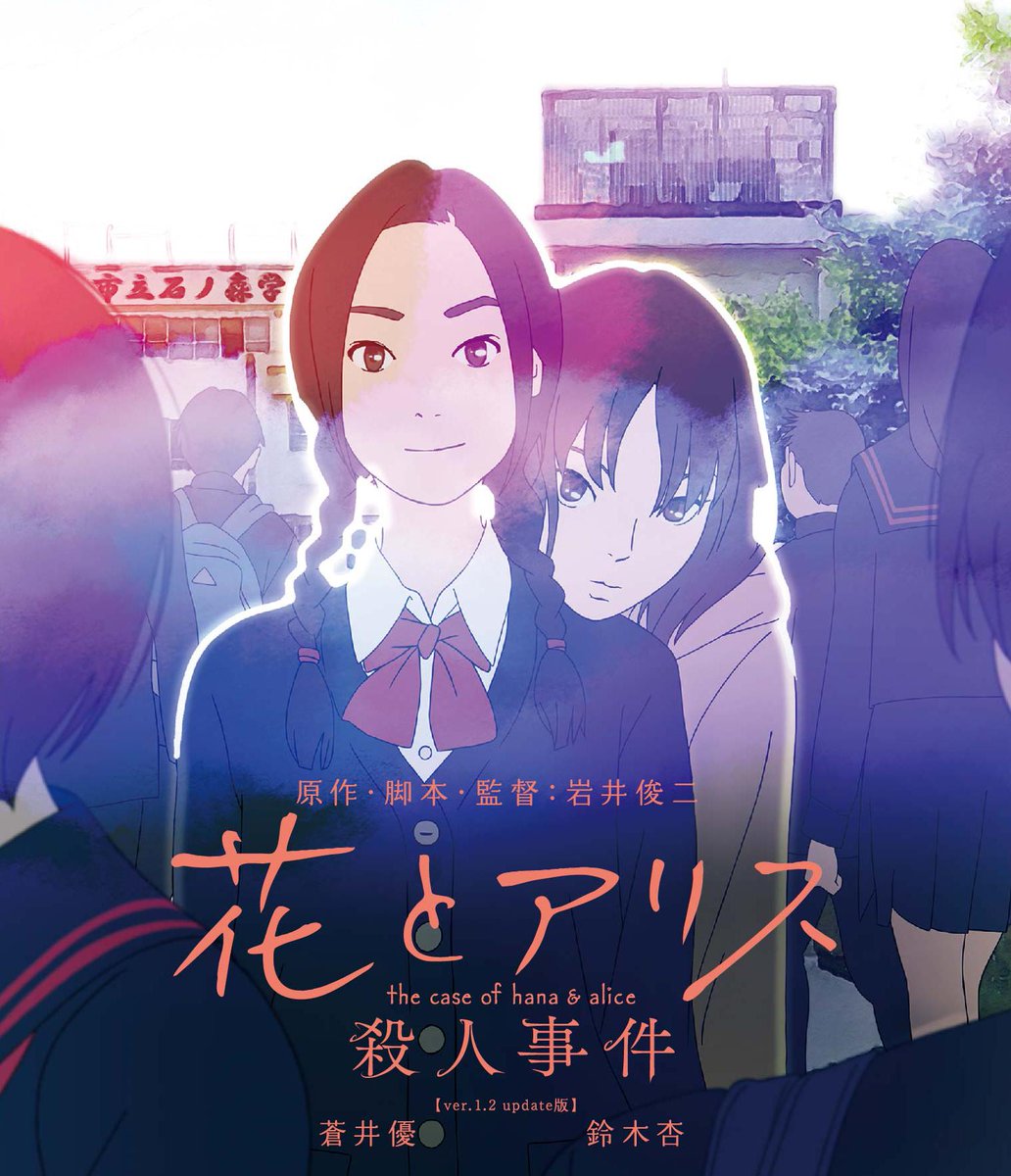
#135: The Case of Hana & Alice (2015)


Director: Shunji Iwai
Screenplay: Shunji Iwai
Cast: Yū Aoi as Tetsuko "Alice" Arisugawa; Anne Suzuki as Hana Arai; Ryo Katsuji as Kotaro Yuda; Haru Kuroki as Ogino; Tae Kimura as Yuki Sakaki; Sei Hiraizumi as Kenji Kuroyanagi; Shoko Aida as Kayo Arisugawa; Ranran Suzuki as Mutsu Mutsumi; Tomohiro Kaku as Tomonaga; Midoriko Kimura as Tomomi Arai
Viewed in Japanese with English Subtitles

Today we have a curious one-off in that the director of Hana & Alice is not an anime industry director but Shunji Iwai, a well regarded Japanese director behind titles like All About Lily Chou-Chou (2001), a figure still obscure to many but is held highly by others who know of him. In context, The Case of Hana & Alice follows from Vampire (2011), an American set horror film which qualifies as a tangent in itself as his first English language film, whilst the film I am talking about today makes more sense when you know it's a prequel to a live action 2004 production of his called Hana and Alice.

That the same leads Yū Aoi (as Alice) and Anne Suzuki (as Hana) have return explains the choice for animation as time has passed for this tale following two schoolgirls. We are first introduced to who we learn to be Alice, the other Hana not fully introduced until considerably later on, a mysterious girl next door to Alice's new home who keeps in her bedroom as a hikikomori. Live action directors making animation is rare, the likelihood for more animators to make live action films, with one of the few exceptions being Wes Anderson, who has done two films in stop motion and has effectively suggested as much that the first wasn't an oddity but a considered interest.

There's also Richard Linklater, who's the perfect person to evoke as his tangents into animation were rotoscope, which is the exact technique The Case of Hana & Alice uses. It's a type of animation which is divisive; I half suspect it's partially a sense of dismissal compared to drawing from scratch, but also because it's a curious aesthetic with very real figures (actors) and sometimes locations drawn over in drawings with a strange aura as a result. The only other prominent example of rotoscope in anime from the same period was The Flowers of Evil (2013), a TV series which was ultra divisive for this aesthetic choice and because it really looked different from the source manga.


It works in Hana & Alice, actresses reprising roles they would be too old to play, fourteen or so year old girls, but with many advantages of actually having actors in staged performances. Once you past the look, and weight is one of the aspects rotoscope has to try to traverse alongside a sense of distance even animation doesn't have, you get the advantage of actor ticks and movements difficult to animate. Prominently Alice is a former ballet student getting back into this among her various charming eccentricities, alongside Hana being the odd figure of the pair whose distinct personality is felt a lot more easily in body language than with a fully animated figure. That the world drawn around them is a heavily detailed modern urban Japan which is just as rich as the best examples found in other theatrical anime helps considerably make the choice of rotoscoping absolutely perfect and a rich aesthetic by itself.

Plot wise, Hana & Alice pulls a fast one. It originally starts as almost as a set-up to a horror anime as the students in Alice's new homeroom have bizarre rituals over the "death" of a male student, even leading to her being spiritually purified by the girl in the class behind this all, said to have been possessed by a ghost and now top dog as a result. It ducks and dives expectations, really coming ahead when Hana is introduced - to the initiated, hikikomori are people who shut themselves off from the outside world fully, a huge phenomenon in modern Japanese culture which is a major issue and a subject that has been covered in anime and manga before. Her choice to be as this is connected to this mysterious death, until eventually her encouragement of Alice to solve the mystery pulls her from her fears out the door.

As an outsider to the medium, Iwai does bring some idiosyncrasy to his tale, yet he could have made a great side job in anime screenwriting if he ever wants to, taking this initial premise and using it to spin a lot of personality in his characters. Little changes and layers are found in them which are peeled away or revealed, and when he gets to the investigation of the case, the film plays as a comedy with wrong people being followed, late night ramen on the run, and eventually a lot of soul searching. His sense of humanity is just to be found in the side plot of an older salaryman who is roped into this case, not play for anything else but light comedy and tenderness as a generational divide doesn't stop some emotional bonding. This is all in mind that, initially setting up a mystery, the story eventually deflates it completely and becomes a great film as a result, the script sparking with a considerable mix of playfulness and heart. The result shouldn't be elaborated on any further. It was a curiosity and a one-off which got a decent release from Anime Limited in the United Kingdom, so it has proudly sat among big titles on the DVD shelf. Again, if Iwai wants to come back to anime at some point he'd be welcomed by me with open arms as he was great here.