Showing posts with label Go Nagai. Show all posts

Saturday, 14 October 2023

#264: Demon Prince Enma (2006-7)


Studio: Brain's Base

Director: Mamoru Kanbe

Screenplay: Takao Yoshioka

Based on the manga by Go Nagai

Voice Cast: Yukitoshi Tokumoto as Enma; Saeko Chiba as Yukihime; Setsuji Satoh as Kapaeru; Yūichi Nagashima as Grandpa Chapeauji

Viewed in Japanese with English Subtitles


There have been a few different versions of Demon Prince Enma, a Go Nagai creation first from a 1973 manga called Dororon Enma-kun, which has appeared in a variety of different forms over the decades - animated television series for kids from 1973, very child unfriendly manga from Nagai with a gender swapped Enma, Dororon Enbi-chan (2000-1), which would cross over with a version of Enma in animated form in 2011, for a more wacky and lewd comedy series, and this, based on another Nagai reinterpretation, a 2006 manga, followed by this 2006 Bandai produced work. Four straight to video episodes, it is a significantly more adult and serious take which unfortunately feels too swift in concluding it when, truthfully, playing as just four episodic stories of its leads dealing with demons in a Nagai-approved misanthropy would have been better. As with its source manga, Enma is a prince of the underworld sent to deal with yokai and demons running amok in the human world, with this the more horror leaning interpretation as he either drags back the demons and monsters who have already killed, or jus destroy them as here, accompanied by Kapaeru, a kappa of Japanese legend, and Yukihime, taken from the Japanese legend of the Yuki-onna ("snow woman"), beautiful women in legend who exist in snow covered environments and in some stories take victims, here instead a figure whose metaphorical coldness to Enma is however contrasted by the crush she has for him. There is also Enma's talking hat Grandpa Chapeauji, who is a grumbling entity that usually is asleep, all them finding themselves in modern Japan and in a work directed by Mamoru Kanbe, someone I have grown admiration for in contributing a lot to horror anime through the late 1990s to the next few decades. They are a director who has worked in a variety of genres but also had a streak of titles from the late nineties OVAs to Elfen Lied (2004) to The Promised Neverland (2019–2021) in the horror genre, adding titles to a genre which for a while had fewer entries than you would presume for the medium

There is a lot to this premise, especially as there is still some corpse humour. A bit of the humour has not aged well, from the source of Enma being a pervert, something Yukihime will reprimand him for, but other aspects when the serious tone shift to goofiness thankfully have. Despite being the Prince of the Underworld, Enma like Yukihime is oblivious to modern human society, in one of the running gags which is however aged like fine wine, where it is the kappa who is keeping up to date with mobile phones and modern ways of sourcing information, like off the internet, for connections of ghost stories and rumours they can chase up. Setting up a supernatural detective agency to catch the enemies, there is a great premise here in a trope found in a lot of anime, where horror and supernatural tales are interpreted as episodic morality tales where the one-off characters can suffer the consequences and these supernatural entities are there to clean the mess up. Add to this the two leads being clueless of human terms whilst Kapaeru struggles with the practicalities, and having to take jobs where he can pretend he is in a kappa disguise, and you have a throwback to the old era of horror anime - the gore and the moments of salacious nudity - with the nod to a humour where these entities have to adapt to the modern day.

The first two episodes, forty plus episodes each, present this well, introducing the leads chasing a woman only to banish a baby-like monstrosity from her mouth before burning it up. Episode one proper deals with a vampire-like entity killing people and creating gristly crime scenes, dragging mortal characters into the arching narrative like a detective who, hearing of a young man in a strange witch hat, naturally finds himself as a potential antagonist. The lurid nature of the anime, as alluded to, only really comes with Enma's less than tactful attitude especially to Yukihime, content which becomes more problematic in terms of sex comedy in the medium, whilst a lot of the narrative context, until you get into something just over-the-top in the last two episodes, is in contexts like a hostess bar which becomes the central location of episode 2, or a character who is a sex worker in the first episode, or a scene in a bathtub for episode one, dealing with a Japanese-German woman who is finding herself slowly disconnecting around reality, where of more concern is reality literally bleeding into the bathtub than explicit nudity.

The gore is strong, but even next to its forefathers, which had lovingly hand drawn intestines spilling out in low budget efforts, this is not even as extreme as Elfen Lied, Mamoru Kanbe's television series, with the same screenwriter Takao Yoshioka, which is arguably more shocking both in gore and its sexual content. What this does stray into, whilst episodic, is its stories having a reason behind their violence, where the first episode deals with the suffocating (and uncomfortable incestuous) protective bond of a father over his daughter, especially with the mother passed, whilst episode 2 introduces a killer doll in connection to a young woman, a bar hostess, who is treated as dirt by many. Starting to enter a downward spiral when she barges in on her boyfriend cheating on her, the doll targeting those who did her wrong, even if it gets into her possessing the other women in the hostess club with the doll, it becomes about her sense of meaningless and lashing out in the middle of this. Aesthetically this has a different mood from its eighties to nineties forbearers too, emphasising real modern metropolis with the more overt phantasmagorical content the cast and the monstrocities they are after themselves, rather than a trope I love in those older works of characters entering dreamt realities and stylised uses of colours. An obvious exception to this, which is greatly appreciated in the final episode despite my issues with the final plot line, does lead Enma himself into a nightmare reality, where you also see that even as far back as Psycho Diver: Soul Siren (1995), one of his first directorial efforts in the straight-to-video format, Mamoru Kanbe has a very good eye for horrific and surreal imagery through his career in the genre. There is obvious computer CGI here, but it itself is used with careful choice, such as the killer doll of episode two, which is obvious but working as an eerie killer item in this look and not feeling as obsolete in terms of animation.

Where this production lost me was that part three to four, tiding the production up, abruptly closes the story, with key characters killed off despite the fact, for a work longer than most theatrical films, it still feels abrupt for something which is set up to be a longer story and should have stayed episodic for its four episodes even if no more were created. Part three involves strange entities possessing people and Yukihime eventually being one such victim of this, alongside the twisted image of a mother turned to try to kill her daughter (and having killed the husband), but it feels strange to completely sideline the leads of the story. Even if they should not be the central figures of each episode, they really become sidelined in favour for a haunted house slasher film set up where a group of characters, some we have seen and others not, are picked off by traumas from their lives, who have not really had any context for their lives when the story begins. It is interesting as an idea for a two parter, dealing with ideas such as one guilty over their ex-boyfriend in school actually throwing himself out of a window when she dismisses him, but  it does however feel like these characters have barely existed for this grand conclusion. Even if one, prominent in the four episodes before, does have the epilogue for a bleak conclusion, stuck as a ghost in the aftermath, they have not had enough time before a surprising amount of back story does get thrown in about her. Even more so than episodes before, this does end up with a slasher chase scene with a further lurid edge as it involves a female character in a contrived state of undress, which does feel abrupt, being pursued.

It feels weird, and in general, even OVAs which have a lot of time in just a few forty minute episodes do not feel like they can escalate as this does in such short time, to one key character dying, and the slate being entirely cleared, without it feeling too short to reach that point. Even twelve episode anime for me can feel like it is abrupt in ending, so this does feel out of place. Even here, when there is still some distinct horror aesthetic, including the really gross sight of someone birthing a baby creature through their mouth, Demon Prince Enma does end on a disappointment. Enma was released in a time when the original video anime finding itself becoming less prominent than television anime, which could be allowed to be more adult (even if censored) with the likes of cable channels, and Enma as a release was part of Bandai Visual, an ill-advised attempt to bring the pricing style for limited edition DVD releases from their home country, presenting titles like this and Yukikaze (2002-5) to little fanfare.  They lasted from 2005 to 2008, and in terms of obscurer titles from Mamoru Kanbe at the time, Denpa teki na Kanojo (2009) (a.k.a. Electromagnetic Girlfriend), which did not even get a Western release, feel like more successful attempts at dealing with idiosyncratic horror tales within very little time. Demon Prince Enma is still fascinating to watch, definitely with an entertainment value, but to be approached in knowledge it is slighter among Go Nagai adaptations.

Thursday, 16 September 2021

#200: New Cutey Honey (1994-5)


Director: Yasuchika Nagaoka

Screenplay: Higashi Shimizu, Isao Shizuya and Sara Uemura

Based on the Go Nagai manga

Voice Cast: Michiko Neya as Honey Kisaragi; Junko Iwao as Natsuko; Kousei Tomita as Danbei Hayami; Rica Fukami as Daiko Hayami; Rica Matsumoto as Chokkei Hayami; Sho Hayami as Mayor Light; Taeko Yamada as Black Maiden; Wataru Takagi as Akakabu Hayami; Yusaka Yara as Dolmeck; Hirohiko Kakegawa as Peeping Spider

Viewed in Japanese with English Subtitles


I reach an iconic character in anime and pop culture, and like her persona, of a heroine able to transform her costume and persona, Cutey Honey varies per adaptation since her 1973 manga. Created by Go Nagai, a 1973 television series co-existed at the same time of this manga, to which New Cutey Honey is set a hundred years afterwards, with the character becoming flexible in the type of narrative tones you could create with her. The character is fascinating from the get-go as, with the capacity to have been sold to a female audience, a strong female heroine who can transform in a variety of costumes and personas, Honey's manga was actually penned for a young male audience originally, with mind that some of the adaptations, especially New Cutey Honey, emphasised the titillation of each transformation involving the costumes disappearing. That Honey is also an android is a weird touch, as she acts like a human being and can even feel pain, but she is a striking figure who naturally stood out. In her main form, a tomboy with vibrant short red hair who fights with a sword, this character had the potential to also be a strong female lead as much as an eroticised super heroine.

Nagai, never one to shun his kinky side, would have not minded this OVA adaptation's direction, which he had his involvement in including even hand picking the English dub voice actress, Jessica Calvello, for the ADV Films dub1. Cutie/Cutey Honey has however had multiple variations - a 2004 live action film directed by Hideaki Anno, another sci-fi live action film in 2016, a 2004 OVA Re: Cutie Honey produced by Gainax and involving Hiroyuki Imaishi, a live action television series, and in 1997 a three season series Cutie Honey Flash (1997-8) which took over the television slot the final original Sailor Moon series - so this character has sustained herself for a long time.

New Cutey Honey is a slight work, which is not an insult but in mind that this was meant to be pure entertainment. Eight television series length episodes, just over twenty minutes each, this is split into two halves with different opening and ending sequences. The first follows a narrative of a cabal of villains led by Dolmeck, desiring dominance over the main setting of Cosplay City, the last four episodic stories of Cutey Honey fighting a variety of villains, feeling like the OVA series was cut off from a grander plan to continue. The narrative's centre is Cutey Honey herself; set a hundred years after the original series, once she realises who she is, Honey is ahead with fighting villains with a new gang. A dirty old man Danbei Hayami, a returning character in the franchise whose android body however makes him a powerhouse as well as still be alive in this world, and the Hayami, the parents two former rival gang members, and their son Chokkei a teenager who develops a crush on Honey.

One of the biggest factors to bear in mind for this adaptation is that, juggling between seriousness and comedy, a lot of this includes sex comedy. As an OVA title, this can have as much female nudity as it wants, a paradox in Honey being a potentially strong character yet her gimmick involving her clothing exploding off and reforming into different costumes. The bigger concern, and what has aged, is when the comedy includes the likes of groping or trying to spy on someone in the shower. We have not really progressed decades later, and these being adults is at least more palatable is not defendable, but this in tone is something that does stand out. Thankfully it does not detract entirely, and the character's various forms over the years means that even the sexual side of her persona has been played with in very different ways. It is just that here, you will at least roll your eyes at least once or not feel happy about some of the jokes, none of which is an issue in regards to this having some much nudity and sexual humour but some of how it is dealt with.

What also stands out however is how entertaining this still was. This is a spectacle, a pure colourful piece of pop, a monster/villain of the week narrative but allowed to be more lewd and adult. The playfulness of a Saturday morning cartoon is here, with slapstick and background pedestrians that stand out against the regular characters for absurd effect, but also tonal whiplash as, due to be adult, you can still have deaths. It is somewhat alarming and unpredictable, in a positive way to the content here, that a villainess, despite playing to a dated predatory lesbian undertone, has been capturing and turning innocent young women into decorations in her lair, all preserved in a way that they cannot be brought back unless magic had existed in this world. The show does get serious at moments, but this is definitely an exaggerated fun piece but one that reminds me that this is still a Go Nagai property, the creator of Devil Man and Violence Jack. Even some of its dated content can suddenly pull out something unexpected, such as that villainess being surprised by Honey turning into a dominatrix and that clearly being played out in a way that might subvert the aged aspects greatly.

It is also well made. This is a big, bright production, even in spite of a central location of a giant grey dystopian city, where its theme tune about the lead character is a catch earworm to adore, and the show has enough behind its production to make everything shine. This is a case of spectacle taking priority, which is not really an issue here as, for the criticisms you can have especially about the dated aspects, nothing here was bad. No bad episodes, no dull patches, one episode the highlight where of a female pupper master who, whisking the cast to a feudal Japan setting and armed with human marionettes from samurai fiction, also allows for the lead to dress up as pop cultural figures of ancient Japan. That one episode has Cutey Honey dressed as Jushin Thunder Liger, a legendary professional wrestler who looks like a space alien crossed with a Power Rangers villain in his distinct horned mask with white and red aesthetic, really goes to show how much of the show is gleefully indulging itself.

That the episode where that visual reference appears is also about a prison island, where a pain fixated female leader forces gangs to fight her minions to the death for her sadist pleasures, reminds you how ridiculous this show is but knows. Go Nagai also created Kekko Kamen, which was him just wanting to create a prank character, an almost all-nude heroine, and here especially by the final episode, a children's show character of a gold obsessed female thief who stole a dimensional teleporter, you see that this franchise character is allowed to just be a playful farce. One that is as broad and exaggerated with more sexual humour than could be possible for a weekend morning television show. New Cutey Honey does have a strange structure in that its most dynamic narrative ends in episode four, only to progress with a variety of episodes which vary between the serious to this final one, ending on a gang of disgruntled police trying to force a taxi driver to ship them all back to the city.  For the DVD release in Japan, the closest thing to a continuation of this adaptation was a CD drama, effectively a Christmas based episode, which does suggest this had plans to continue at least for a few more episodes. What we got was nonetheless memorable, and again, this like many iconic characters from manga and anime manage to last due to how her world could be altered and reinterpreted, so Cutey Honey is a figure I will find interesting directions with as the adaptations continue to exist.


============

1) As referenced in the following.

Monday, 22 October 2018

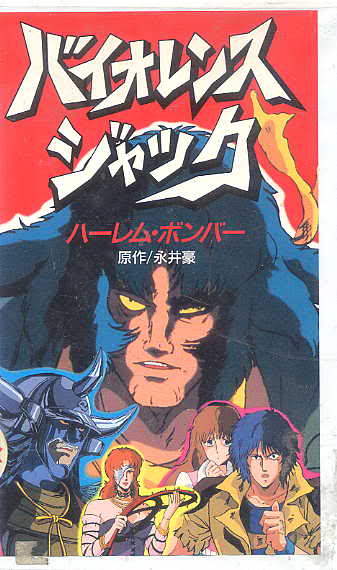
#77c: Violence Jack Part III - Harem Bomber (1986)

From https://orig00.deviantart.net/640f/f/2017/138/
6/d/violence_jack_harem_bomber_by_mdtartist83-db9mc0j.jpg


Director: Osamu Kamijo
Screenplay: Mikio Matsushita
Based on the manga by Go Nagai
Voice Actors: Julia Braams as Mari; John Bull as the Slumking; Nadia DeLemeny as Yumi; William Roberts        as Harem Bomber; Liza Ross as Rose; Bob Sessions as Violence Jack; Barbara Barnes as Sabu; Colin Bruce as Yamaguchi; David Jarvis as Kenichi

Synopsis: In the post-apocalyptic world, the Slum King rules it with an iron fist with his vast hordes; in the midst of it is Mari, captured for his vast sex slavery group, and one of his soldiers named Kenichi, who were a couple before a comet from outer space destroyed civilisation, find each other and attempt to escape the Slum King's minions like Harem Bomber. Whilst this takes place Violence Jack, the personification of death and mayhem, approaches the Slum King's territory.

[Spoilers and Trigger Warnings Throughout]

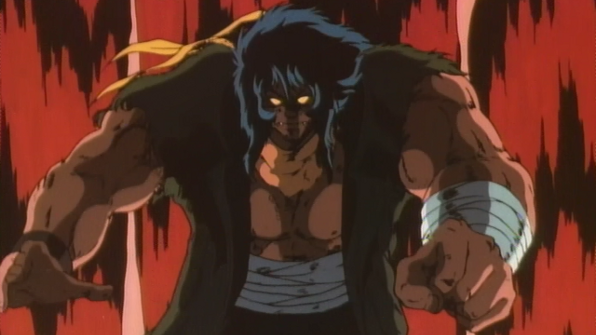
After the gruelling content of Evil Town, than the more rewarding but still tasteless Hell's Wind, there's Harem Bomber, or the Slum King as its Manga Entertainment release dubs it. By this point Violent Jack is just a personification of violence with supernatural powers, all in the shortest of the episodes, the first released and the one with the least censorship for the English release barring a minute or so. It's also so badly put together you could put it on in an art gallery and be compelled by how low a bar in terms of eighties OVA anime is in terms of quality. Revisiting these edited versions, censorship or not, it's a strange emotional trajectory when you don't dare try to marathon all of them, which I made the mistake of for the first time - Evil Town even butchered forcing one to want to take a shower notwithstanding, Hell's Wind watchable, and Harem Bomber so hellishly awful I am amazed I never noticed had bad it was until now. It's bad to the point it's amazing it ever got sequel episodes.

The script's sleazy pulp, Jack versus the samurai helmeted Slum King, all whilst a young couple find themselves in the midst of sexual slavery and Jack causing mayhem, rife in issues and not even ending with a fight against the Slum King, but one of his minions Harem Bomber, a giant nondescript man whose minions (including a bisexual dominatrix with a metal Phantom of the Opera mask who runs the sex slavery harem) are more interesting than him. It also ends anticlimactically as, to defeat the Harem Bomber, Jack throws the helicopter containing the young couple at him, killing the male love interest who decided to help. That in particular stands up as one of the more ridiculous moments of the OVAs, one of the few plot points which is closer to the absurdity found in most "bad" anime from this era rather than distasteful grim. That, and whilst its connected to the grim sexual slavery subplot and the homophobic evil lesbian figure who molests a captive to the point she has instant Stockholm Syndrome, that her male staff are all large men in really, really tiny leather briefs straight out of the infamous Frankie Goes To Hollywood "Relax" music video.

From https://i.ytimg.com/vi/5DsDxGLZFiU/hqdefault.jpg

The animation is also dreadful even by my tolerant standards, a side to myself I openly admit takes masochistic (even sadistic) delight in bad animation and production value, but even here cringed in horror. It's bad to the point that one of the truly infamous lines of the English dub, a case of verbal tourettes, was actually to cover up an animation mistake. The dub, only covered barely so far in these Violence Jack reviews, is ridiculous; whilst its totally inappropriate for the nasty material at points, intentionally and unintentionally, its ironically one of the reasons why the anime is even re-released by Discotek in the current day, its mad failure one of the few reliving aspects to sooth the septic viewing experience. This line, a stream of verbal insults at Jack's way that (in the one single amusing aspect of Violence Jack for myself) I have considered using as an alarm sound, was forced out due to the lip movements of a character being accidental, just as that young male hero Kenichi  abruptly develops a twitch in an eyeball in one shot. This amongst the general presentation is truly bottom of the barrel for anime, compelling but utter trash even technically, ending with Violence Jack not only able to regenerating a lost eye but turning into a phoenix for reasons I don't understand.

The entire Violence Jack project is an inexplicable creation that came from the eighties OVA boom. One that is morally repugnant yet developed a reputation for many to get re-released and even I would wish for a real explanation to why it even came about, the kind of details that would not be revealed by people who worked on this unless forced out of them in a very awkward conversation. Thinking of the individuals behind this, why they made the series even with the fame of Go Nagai behind it, why it took four years and was this sporadic and wildly bad in various ways. The poor female animators having to work on some of the material in the uncensored version, the poor production staff and voice actors of both genders having to work on certain scenes I thankfully never saw, how this project, clearly brought into existence because Go Nagai is an important figure in all manga and anime, blundered along, ended up taking the artistic decisions that happened.

From http://ekladata.com/zF1eojHKulnC49_tyUIHjRQ-NAc.png

And this is all with knowledge the uncut versions, especially with Evil Town, would drastically effect my opinion further, with Evil Town potentially spiritually and psychologically scarring me if it's as bad as I've read it as. If anything, Violence Jack is synonymous now with how for any good or obscure curiosity found in eighties OVAs, it let problematic and artistically incompetent material in the door too, from this to the extremes of hentai porn anime that began when straight-to-video allowed a liberation of content restrictions. The irony is that, even if it was tasteless and offensive for some still, if Violence Jack's worse moments were toned down or flat out removed it would've work provided the quality was improved artistically alongside fixing major script problems. As I'd gladly had Legend of the Overfiend (1989) without the censored sexual violence, Violence Jack even if it has far less defendable content in plot complexity could be remade into something better. Hell, a remake which didn't fall down the same pit holes this did could make sense, especially as of all people the experimental cult anime director Masaaki Yuasa was chosen to helm a Devilman remake in 2018, and that did very well. (And, not knowing enough about the material and not wishing to spoil it, I'd be reprimanded if I didn't mention Violence Jack is secretly a sequel to Devilman in story, so the remake idea isn't that weird).

Go Nagai, frankly, made some dubious creations even if you only watched the anime adaptations rather than the original source material, but it's noticeable that, for every Kekko Karman (the super heroine who wears no clothes) that was originally a joke that backfired, or a Violence Jack, he also made characters like Devilman and Cutey Honey that can thankfully be interpreted in a variety of ways, still flexible as stories and characters for a variety of tones. Nagai's reputation is too important to dismiss him, as important to anime and manga arguably as a Hayao Miyazaki or an Osamu Tezuka, and if it's unfortunate he likes extremes in gore and sex, he at least has characters and properties which can be malleable and reinterpreted in various ways in contrast to this. The same could happen to Violence Jack, the proto-Mad Max apocalypse still a profound advantage even if everyone's done this material over the decades now. Until then, Violence Jack so far is the infamous punch line that has made even the most hardened of anime fans green in the face viewing its content.


The End (Finally...)

From https://i.ytimg.com/vi/hzVIq6agNIk/hqdefault.jpg

Sunday, 21 October 2018

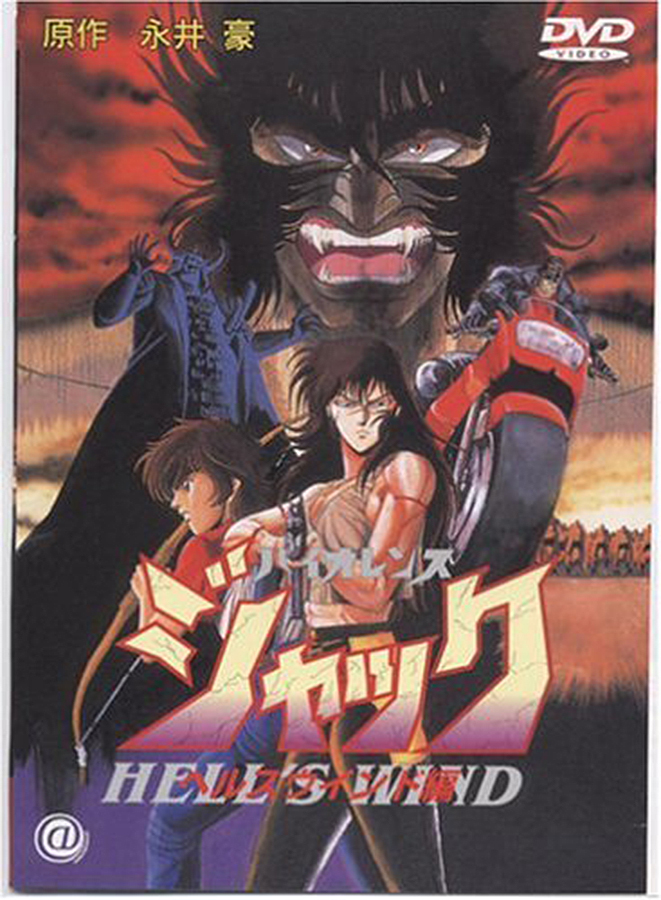
#77b: Violence Jack - Hell's Wind (1990)

From https://orig00.deviantart.net/f5dc/f/2017/144/9/f
/violence_jack_hell_s_wind_by_mdtartist83-dbaaje7.jpg


Director: Takuya Wada
Screenplay: Takuya Wada
Based on the manga by Go Nagai
Voice Cast: Barbara Barnes as Jun; Sean Barrett as Dante; Julia Braams as Keiko; Adam Henderson as Saburo; Bob Sessions as Violence Jack; Jesse Vogel as Gokumon
Viewed in the English Dub Censored Version

Synopsis: After her boyfriend is killed with a gang and she is raped, Jun decided to hone herself into a stronger figure to take revenge, targeting the same gang as they move their evil intentions to target Hope Town, a community trying to survive in the post-apocalypse. In the midst of this, the monstrous Violence Jack appears and even makes the gang nervous, teaming with Jun and a young boy named Saburo from Hope Town to rescue the boy's teacher, and advocate for a better life, named Keiko.

[Spoiler and Trigger Warnings Throughout]

The obvious question, to ask of Violence Jack in general, is whether the premise was actually any good. Go Nagai is too important and interesting to merely dismissed, even in the little I have read, that even if he sadly relied too much on sex and violence his work is compelling for me to begin to explore. There's also the fact that, unless any older example is brought up, this manga when began in 1973 is the first to ever depict the post-apocalypse as a wasteland full of marauding bikers and gangs with Mohawks, leathers and eccentric costumes. The first Mad Max film was released in 1979, whilst the Japanese equivalent Fist of the North Star only began being published in manga form from 1983 onwards. This means this is the nucleus for this idea, which is continued to this day, unless there are equivalents found in literature. Even Mad Max: Fury Road (2015), whilst more mainstream and progressive, deals with subject matter and aesthetic you find in Violence Jack, even the forced sexual slavery of women as Immortan Joe, the villain of Fury Road, has female brides to sire his children and is just one samurai helmet away from looking like the Slum King, a character introduced in Hell's Wind's coda despite the fact Harem Bomber, the episode about his kingdom, was released four years before this one.

From https://vintagecoats.files.wordpress.com/2013/10/
violence-jack-hells-wind-jun-bow-arrow.jpg

This is poignant to talk of with Hell's Wind as, even if it's still offensive and misguided, there's the germ of a much more interesting anime here, Hell's Wind the one out of the three Violence Jack anime OVAs that can be "watchable". The issues with these works are still rife here, to discuss, and the censorship was just as severe here, if with the caveat that after the depravity of Evil Town that few would defend, reading up on the exact material cut and seeing fuzzy clips on YouTube, the later in some cases unfortunately set to generic heavy metal riffs and following the worst stereotypes of the gore hound fan base, there's just nasty violence that was edited out here. Some of it awful by the descriptions, others like the boyfriend of a character called Jun being lopped into pieces with a chainsaw awful as well but more in the juvenile gore tone. In context, it'd probably be miserable for myself to sit through, regretting those words, but against we've thankfully strayed away from Evil Town to the kind of nastiness that is more usual in ultraviolent anime from this era, obsessed with hand drawn intestines as the basic form of guts on displayed. It's not necessarily to be proud of, especially as Hell's Wind isn't even comparable to other anime in this lowly sub genre, but we've had worse.

Considering the low budget nature of these trashy episodes, the transgressive pulp with its synth score would be rewarding for me if it wasn't for the guilt for these episode's nasty content, right down to the opening title credits being live action footage of "Violence Jack" being burnt through metal with a blow torch, touches that in a type of anime like Genocyber (1994) which, even if its off-putting for many, has more going on of interest than the tone these Violence Jack episodes sadly fell onto. It's more the case as, boiled down, there are juvenile plots in the midst of all this debauchery. If Evil Town ends with Violence Jack massacring gang members gruesomely, Hell's Wind is the same only with a "Violence Jun" out for revenge against the gang too, all with the sense that its generic bad guys to get their comeuppance, literally figures you'd find in a Mad Max  film that get destroyed only with less gruesome gore on display.

Despite the fact it's a dark story, where (in that unfortunate of stereotypes) Jun's growth is caused by revenge for her rape and the death of her boyfriend in a gruesome chainsaw limb lopping sequence removed from the English version, the story's tone eventually comes more and more cartoonish. For all the death Manga Entertainment had to excise, not as bad as Evil Town but still severe, it leads to Violence Jack having a rocket launcher missile fired directly at him, Jack catching the missile mid-air and surviving even when the rocket still blows him up. It's the kind of sequence you'd get in a JoJo Bizarre Adventure chapter and the tone for that sort of thing, even if it's still gory, is vastly different from what takes place around such scenes here. Frankly the tone is off throughout, between the optimism of Hope Town, and the slither of good found here in the young boy Saburo wanting to help beat the gang, and scenes (also excised from the English version) like hanging a person between two motorbikes and ripping them asunder. If this was a more overtly absurd tone, and wasn't obsessed with fetishising the gruel as all these episodes let alone this one does, maybe it might work but that's the most questioning of "maybes" I could say.

From http://ignis.anime-sharing.com/vault/thumbs/large/84320_f1fz3/[A-FanRips]_Violence
_Jack_-_Hell's_Wind_(1990)_[H264_AC3]_[50C8363A].mkv_-_17_56.png

The misogyny is still rife, worse as Violence Jill never gets revenge, incapacitated and suffering a scene of mutilation whose removal from the censored version is so abrupt and jarring in being snipped out even the blind would notice it, making her brief moment of power taking people out with explosive arrows a cruel tease. (And again, empowering characters through sexual violence is understandably problematic). The issues with the tone make things worse as, ironically, this has the most fleshed out of the plots, where Violence Jack is an actual hero, the kind so inhuman he can have more holes in him "then Swiss chess" per the English dub when hundreds of rounds are fired into him and still survive, even the blood splattering on a horrified Saburo in the midst of it not straying too far from this in terms of extremeness but closer to the more cartoonish ultraviolent anime where it's never an issue for myself. The real issue is that it's still about depraved material, mostly excised, when frankly Violence Jack should've been the more absurd type of ultraviolent anime, which turned down the grotesque material and been more about the exaggerated gore. In general, the ultraviolent anime from the eighties and nineties, even if they have issues in their material, managed a balance in the best and most interesting in them which never left a bad taste in their mouth.

More so as, whether it's too nihilistic or not, you could've wrangled an interesting plot here from such simplistic material about trying to survive the apocalypse, the good hearted female teacher trying to help lead the children to become better people whilst their parents are obsessed with just surviving as they are. The nastiness the gang deals too them, if toned down a little, wouldn't be inappropriate especially as, in spite of it, the town joins Violence Jack to take them on. A shame that really doesn't happen, as Jack fights everyone and a helicopter by himself, but it's the right frame of mind to have gone to and made something that even simplistic would've been more rewarding. Considering Go Nagai is the creator of more exaggerated, hyperactive works like all his contributions to the giant robot genre, a salvageable version of this entire OVA episode would've taken this direction.

Production wise, it's pretty average although in Hell's Wind defence, arguably it's the best technically of the three episodes. Stuck with what we have, rather than an armchair theory of what the OVAs should've been, Hell's Wind is arguably the one of the trio you could survive with the least trauma - even if I had watched the uncensored version including the graphic removal of limbs with a chainsaw, merely seen in the Italian dub in bad quality, or the other little cuts, even the bad taste on the tongue and distressed would've not been as awful as the many other things I can sadly imagine myself suffering through, like the aforementioned uncensored version of Evil Town. It's just a shame, from the laundry list of material, it's still not great and the notion of defending any of Hell's Wind is pointless barring suggesting the materials could've worked if it was done better, a really desperate argument for any to fall on their swords (or jack-knives) for. It would also be criminal not to mention that Takuya Wada, the episode's director, is listed as well for the screenplay, for the storyboards, for the character designs and for animation director, alongside working on Evil Town. Unfortunately, he would not direct anything else in the anime industry, only as an animation director, so if Violence Jack claimed one confirmed victim, it was he.

Sadly there isn't any funny lines in the English Dub to soften the viewing experience of Hell's Wind, but this screenshot thankfully makes up for it.
From https://i.ytimg.com/vi/NCbDHFpQtOg/hqdefault.jpg


To Be Continued...

Saturday, 20 October 2018

#77a: Violence Jack - Evil Town (1988)

From https://images-na.ssl-images-amazon.com/
images/I/51VN4YQQX1L.jpg


Director: Ichiro Itano
Screenplay: Shou Aikawa
Based on the manga by Go Nagai
Voice Cast: Bob Sessions as Jack; Alan Marriott as Blue; John Bull as Saulus; Garrick Hagon as Tahei; Sharon Holm as Rikki; William Roberts as Kawamori;
Viewed in the English Language Censored Cut

Synopsis: After the world is decimated and Japan levelled by a mega earthquake, a post-apocalyptic society ran by marauding gangs who rape, murder and pillage have taken on whilst pockets of humanity try to survive. In the midst of them, let loose from the rubble, a mysterious and almost immortal goliath christening himself Violence Jack walks into this living hell as the personification of death.

[Due to the length these reviews would be altogether, I felt it wiser to review the three episode OVA in three small reviews. Be advised of Spoilers and potential Trigger Warnings as well]

Before I start this trip down the lurid world of Violence Jack, I'll clarify the version I watched is the censored English dub version. I did, for reference, view fuzzy clips of some of the gore scenes and read up on what was censored from the original Japanese versions of this infamous series. It does drastically change the tone of Violence Jack but that as much is an issue when dealing with these OVAs.  For starters, it was appropriate to cover the English version as, obsessed with Manga Entertainment's DVD repackage of old licenses called "The Collection", the version made available for that series was the drastically butched version clearly taken from a flickering VHS rip.

For a long time this English version was the only one available in the West - Manga Entertainment's reason for censoring the three part OVA are unknown but whatever spooked them was significant, and with good reason especially for the Evil Town episode. Another factor would have to be that, whilst this was the era of lurid and notorious anime releases like Legend of the Overfiend (1989), it was also the era when James Ferman ran the British Board of Film Classification; in this era, other areas like horror and action cinema were drastically effected by a man whose obsession with removing inappropriate material became the stuff of infamy, let alone anime which was frankly indefensible in its content. Eventually the company, known for releasing these ultraviolent and controversial anime in the nineties, would find their tactic for anime definitely not for children would bite them in the backside when La Blue Girl (1992-3) was rejected outright by the BBFC for release in December 1996, the same year they released the censored Violence Jack into the Western world.

The decisions behind releasing titles like this in the West was of the time - that with the likes of Legend of the Overfiend, for good and bad especially in the mainstream view of anime in the United Kingdom and USA, they were significant enough to warrant licensing these titles be they what the distributors thought they should sell or were selling well. And so Violence Jack, a three part Go Nagai adaptation which took over four years to be churned out, was one such title, one whose uncensored version was very elusive. For a long time the only uncensored versions was one early US VHS tape, from the same time through Right Stuff at the same time as the English dub release, for a long time only an Italian DVD afterwards, and then in the 2010s the uncut and cut versions put together by Discotek.

If I was only dealing with the episodes Hell's Wind and Harem Bomber, I might've bought that Discotek release or at least tracked down the uncensored versions. It'd still be an indefensible work, misogynistic and offensive, and especially with Harem Bomber an embarrassment to animation in general, but it would be a fascinating look at the era of eighties and nineties OVA anime which churned out so much that, for every artistic gem, there were oddities and perversities like this. Weighing on whether to track down the uncensored version was enough to even hesitate ever covering Violence Jack at all, debating whether it was acceptable to only review the cut versions,  seeing the gore scenes excised online at least even if not in the desired way (i.e. in actual sequence in the episodes). In hindsight, even the infamous necrophilic cannibalism that takes place in Evil Town, which is something I can only imagine rather have seen, wouldn't have been to too off-putting. That sort of material would just be tasteless, body horror material effected by the issue that these OVAs are excessively nihilistic in tone to be entertaining.

The problem is entirely with Evil Town, where the creators decided not only to depict lengthy rape scenes but went as far as having to have digital pixalisation, which raised alarm bells when I learnt of these excised moments originally. Having read a blown-by-blow written article of all the scenes removed described in clinical detail, which is not a pleasant activity even though I have always had a morbid obsession with the Violence Jack anime, didn't exactly defend any of this stuff for artistic value either. I fear I would feel morally disgraced inside if I watched Evil Town uncensored, a step too far and requiring a damn good argument to not stay away from it. Hence, stuck with an old DVD that will circum to laser rot, I hesitate to import that Discotek release for a very justifiable reason. There's a fine line in watching transgressive anime and that which crosses a line even for me.

From https://i.ytimg.com/vi/X7sDQnTIiJ0/hqdefault.jpg

Evil Town
is the first episode of the three chronologically...already the strange production history of Violence Jack comes to mind as, logically, you start from Evil Town, which introduces the character of Jack found underground by a group of people trying to reach the surface world again. Then tonally, it should go to Hell's Wind, then Harem Bomber, the later with an actual ending even if it makes no sense. The truth is, in the Japanese release order, it was Harem Bomber first, and then Evil Town, then Hell's Wind, the convoluted order being rearranged one of the few good ideas Manga Entertainment had.

Evil Town is the notorious one of them all, the most censorship and arguably where this series went too far even for hardened anime viewers, where for myself the version which has necrophilic cannibalism (censored for the UK cut) wouldn't be an issue, but the eroticised and pixelised rape is why this review starts with a lengthy prologue. Annoyingly it's also the most artistically distinct of the three; Violence Jack is a case of something, aesthetically, in its cheap and nasty post-apocalyptic presentation which is compelling, but the material inside the work varies in different ways per episode to why it's bad.

The issues with Evil Town are enhanced by the fact that, for an incredibly simplistic tale, the extreme content especially the sexual violence is superfluous, as evidenced by the censored version (barring the clear cutaways from minutes that were excised) still working in pace in spite of their absence. It's to debate whether Go Nagai's original manga is as to blame, despite originally being a shonen work (for children) it was notorious back then for gore and sexual content, back in an era before drastic changes in demographics refocused material like this for adults and the likes of Naruto for children. As much of it is frankly the anime episode itself being to blame above anything else, by itself feeling like it went too far in obsessing over this content to a point that it was too repugnant.

From https://i.ytimg.com/vi/gBpYz2fcghw/hqdefault.jpg

Even censored, with it very clear that material was removed in the cut version, its repugnant and against the very nihilistic view of the world on display feels uncomfortable. The cynical worldview does lead to an interesting plot based around three groups and Violence Jack - one group men proven to be hypocrites worse than the evil psychopathic gang against them, as depraved, whilst the women have decided to be their own gang after what had been done to them before - but the desire for a cross between an atrocity exhibition meant to be titillating against a Shonen Jump-like action story is a hellish combination to have to deal with. And frankly, we are dealing with a titular character who, whilst closer to a slasher movie villain than an actual hero, is also completed out of a childish power fantasy especially with his inexplicably yellow scarf, bandages around the waist and jacket combination, which raises questions of the entire premise of what the tone should've been.

If we were dealing with a Fist of the North Star tone, then things might've been different; in Evil Town, as most of it is set underground after an earthquake has levelled an entire Japanese city, children advising each other how to eat insects and a rat for dinner is the worth of gold, it's not the right time to discuss this aesthetic unlike in the other two episodes, but that tone would be acceptable here too. Even if it left grime on the viewer's eyes, there wouldn't have been an issue if it also embraced the inherent silliness of its villains being mohawk wearing gang members. It doesn't help that, in lieu of a homophobic streak a mile long throughout these episode, among them is an evil transsexual and an evil lesbian stereotype, but looking at times like outtakes from Mad Max (1979) and The Warriors (1979), especially with the figures of Mad Saurus, a behemoth, and Blue, the evil transgendered character but (if that unfortunate aspect wasn't part of him) also decked out like a bizarro Jem and the Holograms member, the materials wrong for this level of nastiness. Even reading a slither of Go Nagai's work, even if his attitude to sex and violence can be objected to, I know already his style is laced with black humour and deliberate weirdness which you definitely don't get in these OVAs.  

And tonally, the story itself falls into this as well as, suffering through even the implication of sexual depravity and gore, it's about two giant men (Violence Jack and Mad Saurus who, after eating his girlfriend blue in the aforementioned scene removed from the English release and turning into a monster) kicking the shit out of each other, which makes none of the horrifying content even in tone creatively in place. Any notion of darkness beyond this with a point, the men of Section A who are so monstrous for all their apparent civilised behaviour they'd drug and rape a group of women as told in flashback, is lost in a work where it's entirely about visceral gore and action in the first place, so expecting anything profound is lost within the sludge.  Instead it just makes things worse as the women are merely victims, left half naked and (between the script lines) more traumatised stood outside among ruined skyscrapers with no sense of real meaning.

From http://www.imfdb.org/images/thumb/5/5c/
Violence_Jack_ET_revolver_1_2.jpg/600px-Violence_Jack_ET_revolver_1_2.jpg

The blame on why Evil Town is objectionably gross, even censored, is to be debated. All the following is my pure speculation, but it's like a Rashomon scenario where we have no one willing to talk about this production in honest detail unless someone had a gun directly pulled at their head, more so as in the Japanese version you have big names in voice acting among the cast, the likes of Norio Wakamoto appearing throughout all the episodes, a production meant to go somewhere but ending like this.

One possible explanation is that screenwriter Shou Aikawa went through a very dark period in his life. Long before he became the major screenwriter for the likes of Full Metal Alchemist (2003), he wrote scripts for ultraviolent work like Legend of the Overfiend, Genocyber (1994) and, with the same director of Evil Town, the notorious Angel Cop (1989-1994). The thing is that, in lieu of a career with the likes of Full Metal Alchemist, which are so drastically different and where his own contributions separate from the source material (like overt Iraq War metaphors) were acclaimed and drastically different from the likes of Evil Town, as were later anime he worked on past his blood and guts era like The Twelve Kingdoms (2002) and Martian Successor Nadesico (1996).

So it leads the question to the infamy of Ichiro Itano. As an animator, he is one of the best, immortalised by the "Itano Circus", coined after his trademark of (painstakingly) animated missiles in a scene to moving in individual directions. As an anime director, he is panned and notorious - Gantz (2004), his most well known work, is still a divisive ultraviolent work, and he is held up by his petard for the likes of Evil Town and Angel Cop; for the latter, whilst this has never be confirmed and is pure speculation, the infamous turn to full anti-Semitism in the story alongside its fascist nationalist turn, as an ultraviolent action sci-fi, has to be taken in mind that Shou Aikawa only wrote the first few episodes, or at least the first, whilst Itano wrote the rest when that turn took place. The third potential reason, which would be the most disturbing, is that adaptation of a very violent Go Nagai work they either reproduced it or exaggerated the content to sell the material, especially as anyone who witnessed the car crash that was Harem Bomber, which I will get to later.

The episode itself, removed of its nastier material, is pretty cruddy in honesty, any sense of enjoyment from its sickly tone undermined by knowing of the content being removed. That, far less extreme but as liable to put people off from the uncensored version, this anime goes to having a villain killing children in graphic detail or someone being split in half like a wishbone. Trying to deal with the misogyny on display, the female group not complex figures in the slightest and sexually victimised twice, is not even worth wasting time on to write on, it's that bad.

Curiously this is Violence Jack at his most eloquent, a curious anti-hero who will protect people if he isn't prevented by hulking gang members, but takes his punishment of villains to sadistic and gleeful extremes which drastically contrasts this. The English dub is utterly inappropriate as, whilst I liked Bob Sessions as Jack, this begins the conversation that will carry through this three part review, the infamous dubbing of the anime where Manga Entertainment amplified the foal language to a lot of their work but here went into even ridiculous territory, the one aspect of the entire work that could ever be "fun". They decided to have this gigantic monster anti-hero use the term "Captain Buttwipe" twice, as tonally in appropriate from an anime episode obsessed with offensive material as you can get, but you are grateful for the comedy to briefly relieve the tone.  

Sadly as well, whilst I might be in a minority, this is all within an aesthetic I like. It's cheap, but thankfully isn't as bad in animation as when I cover Harem Bomber, with music (barring one or two tonally inappropriate pieces) that fits the era and a grungy colour palette which stands out. It's an aesthetic that feels dangerous and edgy but, in another work, didn't need to actually make me feel grossed out like here but could've been instead better without it. Evil Town, as much as I hate its existence, has the one artistically stylish piece of the whole OVA series with a fight scene taking place with the participants in red outline against a black screen, one of the other moments which were vaguely interesting in the midst of the mire. Unfortunately, I have to extract these little virtues from something that doesn't deserve to be defended for many reasons. Thankfully, whilst the other episodes have their share of uncomfortable material, the worst was the first episode in the Manga Entertainment release before you get to Hell's Wind...

To Be Continued...

From https://i1.wp.com/hmturnbull.com/wp-content/uploads/
2017/11/Violence-Jack_Death-of-Mad-Saurus.jpg?resize=300%2C157

Friday, 21 September 2018

#71: Black Lion (1992)

From https://m.media-amazon.com/images/M/MV5BNjMx
NWFjNjMtMTNjNy00NjE1LTg2ZjctNzJiZmY5
OTYzNWY4XkEyXkFqcGdeQXVyMzM4MjM0Nzg@._V1_.jpg


Director: Takashi Watanabe
Screenplay: Ritsuko Hayasaka and Yasunori Takagi
Based on a manga by Go Nagai
Voice Cast: Yasunori Matsumoto/David Stokey as Shishimaru, Yūsaku Yara/Jose Brown as Ginnai Doma, Ai Orikasa/Kathryn Dineen as Hayabusa, Kan Fujimoto/Robert Rudie as Momoji, Kazuyuki Sogabe/Charles Campbell as Oda Nobunaga
Viewed in English Dub

Synopsis: In feudal Japan, the legendary figure Oda Nobunaga has acquired futuristic weaponry like tanks and rifles and is dominating the country as a result. Amongst his allies is Ginnai Doma, a man whose family was killed by ninja and would've have passed on to another life were it not for Nobunaga's intervention, turning him into an unstoppable killer hell bent for revenge on all ninja. One such ninja, Shishimaru, desires revenge Ginnai Doma for the loss of his clan, begrudgingly joining another clan of ninja to stop Doma immediately before he finishes them all off.

Black Lion, a straight-to-video anime, is so ridiculously manly one enthusiastic anime podcaster for the Anime World Order podcast showed his love for the forty minute plus program by punching himself in the testicles mid-recording1. And considering this is an adaptation of a Go Nagai work, that's not surprising either. Nagai is a legendary manga author, one of the most influential in the medium whose creations - from Cutey Honey to Devilman - are still be adapted to anime today. He even challenged Osamu Tezuka, the "Godfather of Manga", at least being an influence, even if subconscious, on Tezuka going into his more adult and explicit content of the seventies alongside the other bludgeoning manga authors charting that course. Nagai, going through anime adaptations of his work and now able to start on his actual manga, is also an incredible illustrator. Also, he's as mad as a box of frogs.

It's not surprising in lieu of this he created Black Lion - part of an ongoing obsession in Japanese culture of modern technology landing in their past of samurai. Black Lion starts off abruptly with said samurai mowing down ninjas with machine guns, and even a leader of the later having a secret room to his paper wall compound with a super computer, housed behind an iron mechanical door, but it does eventually make sense of this. In this world, the legendary historical figure Oda Nobunaga has ended up encountering evil aliens, who through time travel provide him with future technology, and eventually evoking in this mere fragment of the original manga also good aliens about to take part in this conflict of anachronisms. The spaceship over period Japan that closes the OVA is itself as strange a juxtaposition as it sounds.

From https://lh5.googleusercontent.com/-rUbYpEwYAQ8/TW3CixhsiCI/
AAAAAAAAATw/tAzuJZmligk/s1600/vlcsnap-2011-02-23-21h50m16s191.png

This is also a work obsessed with Oda Nobunaga, the real life 16th warrior who was one of the first to unify Japan during a chaotic period of war through the Sengoku Period. He was very culturally minded, had little issue with interacting with Westerners (to the point he is viewed/confused as having been Christian) and took advantage of it, and is also a divisive figure for how ruthless and violent he was in war and as a ruler. In Japanese pop culture, he's been depicted as being a demon or being in the pocket of demons. He's also been gender swapped into a girl twice - The Ambition of Oda Nobuna (2012) and Sengoku Collection (2012) - and tried to control the world with a demonically possessed satellite and time travel against a heroic samurai and Jean Reno in Onimusha 3: Demon Siege (2004). In their vast and weird interpretations, his representations centuries later are so numerous he inexplicably deserves a blog tag himself as his own subgenre, only if he has a cameo here providing the mortally wounded Ginnai Doma the robotic body and murderous urge to be a threat to all ninja.

All of Black Lion is focused on Ginnai Doma being Terminator-like and ninja dying on mass trying to stop him, our cocky lead Shishimaru with his own vendetta against him established at the beginning. A parade of gore and violence takes place for the whole forty minutes which is trashy; something I openly admit is an acquired taste. It has the decency, however, to just make the entire OVA about just trying kill Doma, over that length of time actually compelling as the ninja become more and more exasperated and the maddening attempts to just him finish off lead to more of them dying, usually in horrible ways. Its sickly humorous if you feel that way inclined, but also has more interest to it than if just another ultraviolent OVA from the nineties which juggled multiple plot threads at this running time with no rhyme or meaning behind them, because at least it sticks to one idea and runs it into the ground with all the sense that it couldn't have forgotten anything that would've made it better than it is.    

From https://lh5.googleusercontent.com/-o1bcf4ZDhC4/TW2pVF8joWI/AAAAAAAAATY/
yZQKXMDduQA/s1600/vlcsnap-2011-02-24-21h52m07s156.png

Aside from this, you're enjoyment is entirely how absurd this becomes and how much you can appreciate it. Viewing the OVA in English may prove better for some viewers just for David Stokey's constantly shouted and loud performance as lead Shishimaru, as unlikable a ninja as you could get in his attitude, an obnoxious individual who refuses to play ball and gets at least one person killed if not more, adding the tone. The OVA is adequately animated, entirely more about the content itself rather than any elaborate style. Where someone is going to blow up everyone with a nuclear powered battery within himself or herself, lasers are fired from mouths, and the body count is stupidly high. Even illusions with burning marijuana used are involved and the dialogue especially in shouted English is going to add to the absurdity of it all. All of it is silly, but with Go Nagai, I realise soon into my proper introduction to his original work Nagai is both a very talented artist, but in his ability to mix wackiness with the nightmarish, he indulges to his id to conjure his stories. Even if they are potentially problematic or absurd, he writes material like this as with many manga authors to make each page compelling, which is entirely why you get stuff between this or a Mad Bull 34 (1990) which baffle and amuse decades later now we have ironic and non-ironic viewing.

Black Lion is no different, only with the issue that, merely a fragment which completes its small narrative but with an open conclusion, it's entirely about the most outlandish gore, stunts and twists rather than anything more in-depth. Its, frankly, insubstantial even next to other insane action OVAs of the time, and Nagai's work has been adapted into more memorable and batshit forms. Some were even legitimately good. It is however, if you can be enthused by it, providing enough energy to encourage other viewers to punch themselves in the crotch, so be prepared. I wasn't one such person, but I can sympathise with the masochistic energy that would encourage one to.

From https://lh5.googleusercontent.com/-ctOGZeTQgz4/TW2_FuRBVII/
AAAAAAAAATk/tuUYYSnIxR8/s1600/vlcsnap-2011-02-24-22h15m19s254.png

====
1) Episode # 54c. Not one of their usual shows, running over ten years plus, so I wouldn't necessarily choose it as your first; it is however memorable just for the Black Lion review.

Wednesday, 20 September 2017

#48: Kekko Kamen (1991-2)

From https://images.myreviewer.co.uk/fullsize/0000213691.jpg

Directors: Kinji Yoshimoto, Koji Morimoto, Nobuhiro Kondo and Shunichi Tokunaga
Screenplay: Masashi Sogo
Based on a manga by Go Nagai
Voice Cast: Emi Shinohara as Kekko Kamen; Arisa Andou as Takahashi Mayumi; Jouji Yanami as Principal Toenail of Satan; Kazue Komiya as Gestapoko; Kikuko Inoue as Yuka Chigusa; Kiyoyuki Yanada as Mizutamari Tsuyokarou; Mika Kanai as Tanaka Hanako; Mitsuaki Hoshino as Teacher Ben Kyoshi; Tesshō Genda as Shuwarutsu Negataro
Viewed in Japanese with English Subtitles

Synopsis: At the Sparta Academy, a strict system of punishment is carried out by the head master, a masked jester known as Principal Toenail of Satan. Openly uninterested in any of the male students succeeding in life, and openly a pervert alongside his sidekick and teacher Ben, he employees bizarre punishment teachers to sexually humiliate female students who fall behind in their studies, especially drop out Mayumi Takahashi who takes the constant brunt of the staff's interest. Unfortunately for the evil school staff, or fortunately for them, there's always a mysterious female figure there to protect Mayumi. A figure named Kekko Kamen who wears a mask, a scarf, boots...and completely nothing else.

As the synopsis describes, and images of either the anime, the manga or the live action films show, this is one of those franchises which could be embarrassing to talk about. Not necessarily the salacious sexual content either but its blunt, crass surface appearance and how eyebrow raising it sounds in said synopsis. And yet one should never automatically fall into the trap of "weird Japan", that phrase in various forms which dismisses this as something normal from the country. It never factors in what pop culture bizarre to Western eyes is actually mainstream in the country. It never factors in whether certain, controversial examples are actually made for a very niche, small minority, even the most offensive. That the internet has become an echo chamber that amplifies the existence of centre works that are, and will remain, obscure in regular Japanese pop culture. It also doesn't factor in how Kekko Kamen was actually a joke Go Nagai created to send to his manga editor at the time. A parody of Gekkō Kamen, a legendary superhero figure and one of the first of Japanese superhero characters, it was meant to only get a reaction out of said editor only for that person to actually want to publish it as a continuing series. Nagai is not one to have shied away from the perverse in his time. Between becoming a legendary figure in manga and anime, including his significance in giant robot stories, his first successful manga, Shameless School (1968-1972), was a sex comedy which made him a pariah of moral standards groups. However the fact that Kekko Kamen, this joke he created, managed to last for five volumes, had a 1991-2 anime for the video market, and eleven live action films, is probably something he's still baffled about to this day.

From https://images.myreviewer.co.uk/fullsize/0000213683.jpg

Brutally, the anime of Kekko Kamen is a chore to sit through. It never drags strangely. Four episodes, twenty or so minutes long, it passes by under two hours quickly without the pain of time being lost. Instead it's really the fatal combination of how icky the premise is and how utterly lame it all is. Even the masochist in me who likes weird, crudely made anime from this era was numbed by it. Even the masochist in me who can find virtues in works with issues in gender depictions and are in poor taste cannot find a lot to defend in this anime between the crassness on display. All four episodes follow the same template exactly. A new punishment teacher is introduced, they always torment the main female character Mayumi, and Kekko Kamen eventually steps in to save the day, usually with her nunchakus and with a finishing attack that cannot be described any more politely as nude spread legged suffocation. Even with the Barbie Doll nudity, it's a fetish anime full of ripped underwear and fan service that's off putting because it's all at the expense of the female characters. It's not kinky, where kink or a fetish really denotes participation from all the individuals male and female involved. It's not like fanservice in other anime where there's a cheek, a sense of humour, and male characters being smacked in the face and being called perverts. Its harassment and its distasteful here. Even BDSM has this sense that everyone is participating in acting out a scenario they've all worked on with the desire to enjoy it equally, even if on the surface images of it might shock outside onlookers. Here its uncomfortable, like adolescent boys who've really gotten to a weird viewpoint on the opposite gender.

From https://images.myreviewer.co.uk/fullsize/0000213687.jpg

It's worse because Kekko Kamen's meant to be a comedy but dies on its arse immediately. Even if you are less uncomfortable with the sexual content than I am, the comedy will mortally wound even a viewer tolerant of bad anime. It's meant to be distasteful on purpose when the first punishment teacher is Miss Gestapoko, BDSM queen from (sic) Auschwitz Academy and ranked by fully uniformed Nazis, as offensive as you can get but (actually) dumb to witness, never followed with anything similar and quietly buried afterwards. (The other punishment teachers stay with a gay bodybuilder whose muscles are the heroine's kryptonite, a female android and a stereotypical ronin samurai). The rest of the humour is meant to be light-hearted, contradicting most of its content, and very meta. Where the villains complain about Kamen not appearing with her main super heroine theme playing in the background. The humour's more painful rather than if the show took itself seriously, the only consistency funny joke the end credit songs, usually penned by Go Nagai himself, sung in earnestness by female singers and deserving a better sex comedy anime.

From https://images.myreviewer.co.uk/fullsize/0000213704.jpg

Production wise, it's a cheap show. As much as I reveal in this type of crackerjack, cheap OVAs from this period, with Kekko Kamen the only thing of considerable interest is composer Keiju Ishikawa's score, of its time and low budgeted but still more interesting and diverse than what's onscreen1. After that it's the various little details, the rare moments where the humour work, which made the viewing experience worth it. That the Toenail of Satan has nightmares of Kamen entering his bedroom while he's sleeping to give him permanent testicular pain, or how Mayumi's friend Chigusa Yuka can break the fourth wall, aware of the viewer and able to talk to the screen away from the rest of the cast. The rest of the four episodes are full of numerous resolved questions and illogical decisions. That barring her appearance Kamen's a vacuum and utterly useless as a heroine, only there to protect Mayumi and none of the other female students in the school who are also molested by the staff. That the Toenail of Satan and his lackey Ben come up with an un-villainous and only partially perverse method to improve grades - create a charismatic and beautiful female student who'll coach fellow students - and realise that barring Mayumi the quality of the students' test scores increase far more than if they continued with their physical punishment. That hiring a gay bodybuilder un-phased by a super heroine who uses her sexuality, whilst inspired for the villains, gets whittled down into a sexist idea of Kamen being completely paralysed by his physic and that it takes an entire episode for her to realise she can close her eyes to fight him.
   
From https://images.myreviewer.co.uk/fullsize/0000213689.jpg

Coming from someone who believes that almost any idea, no matter how bad or tasteless it is, can work if the tone or point of the premise is exactly right, Kekko Kamen is completely misguided in presentation and point. It should be, even if an embarrassing anime to show others, a light hearted comedy. Without the Nazis. Without the uncomfortable harassment fetish. Without the awful jokes. Something which, even if the idea of a super heroine who parades herself completely naked barring a mask and accessories is still juvenile, was fluffy and silly, sex comedy with a farcical edge to it. Everything that this anime never was. Considering its origins as a gag, the chance of sustaining it was virtually slim from the beginning and the anime proves it.

========
1) Not the last Go Nagai anime he's composed for either. Inexplicably I've seen Iron Virgin Jun (1992), which no one talks about and is just as tasteless in places.