Showing posts with label Videogame Adaptation. Show all posts

Saturday, 5 August 2023

#257: Zone of the Enders - Dolores, I (2001)


Studio: Sunrise

Director: Tetsuya Watanabe

Screenplay: Shin Yoshida

Based on the Zone of the Enders franchise by Konami

Voice Cast: Tesshō Genda as James Links; Houko Kuwashima as Dolores; Mitsuru Miyamoto as Leon Links; Narumi Hidaka as Noel Links; Chō as Baan Dorfloum; Fumihiko Tachiki as Sameggi; Yumiko Nakanishi as Rebecca Hunter; Takehito Koyasu as Nathph Pleminger; Yoshiko Sakakibara as Dr. Rachel Links

Viewed in Japanese with English Subtitles


The opening rock theme proclaims the lead may be able to defeat God for all he knows, and this pretty much establishes the tone for what Zone of the Enders the series is. In contrast to the straight to video prologue which began this television adaptation of the Zone of the Enders video game franchise – Idolo (2001), which was a more serious set up for key plot points to this twenty six episode series – Dolores is a much more light hearted, more overtly comedic work whose serious moments are more in tone to an action film. Certainly, whilst with key plot lines also tied to the first 2001 video game, which are not needed for context but appear, this feels a tone different from the other works in this franchise, introducing us to James Links. As a lead he is one you would encounter, as a middle aged man nearing his fifties in futuristic times, piloting his space ship drunk and eyeing up the women. He is however someone with a tragic back-story, with adult children disconnected from him and his wife missing, with the fact he is from Earth and she from Mars part of the world building, as this is a world where the planets despite being both with humans hostile to each other in contrast to their love which crosses literal space. There is also the fact that he is a transporter whose secret cargo will drag him into finding his wife Rachel, said to still be alive after the events of Idolo, and on the run for a murder he did not commit.

It is awesome to have an older male lead, when the joke even for video games from Japan let alone that someone near their thirties or so qualifies them as a grizzled veteran, making this character voiced by Tesshō Genda, a veteran from the seventies who became Arnold Schwarzenegger’s official Japanese dubbing voice, a nice change of pace. It is one of the touches to a story, whilst with clichés, that manages a lot of great things just in terms of a memorable lead, not shy from James being ridiculous with a kitten for an estranged daughter Noel Links’ birthday and a mysterious cargo, pulling him into a conflict between planets, which introduces the titular Dolores, an orbital frame mecha with great power, sentience…but the mind of a teen girl with flights of whimsy who starts calling him “uncle”. Whilst humorous throughout, this with the Zone of the Enders world premise does set up key plot points  - of a racism against Martian born humans from Earth which has caused Martians to secretly plan an extreme coup de trait which will harm both planets, the orbital frames of immense power – even if one of your primary leads is a robot who acts like a naïve niece of the lead, even crushing on him, and a forty nine year old male protagonist who, in attempting to reconnect with him adult children, forced on the lam eventually with him, reads a book of becoming a better father over and over like a sacred scroll. Tragically some family dynamic is lost – Noel, in contrast to her stuffy and gullible brother Leon, is set up as the tough one of the pair, working at the construction site, despite loving her new kitten, only to be sidelined in this factor at some moments – but this show is helped considerably by its characters. A huge virtue coming into this production, with no knowledge of even the games, was that it manages something as simple but difficult to pull off as actually having interesting characters and a world to work with, even if there are plot points here found in many other productions.

In terms of video game adaptations, which are notoriously not well regarded, this is a surprise to see virtually forgotten as, whilst it does play to tropes of this genre, and from Sunrise, a studio behind the Gundam franchise and a lot of mecha shows, this does actually manage to be a solid adaptation. It manages to be respectful and actually create an engaging show even if it clearly takes liberties with the source, in having the comedic undertone, and the idiosyncratic take on sentient artificial intelligence where, alongside the trope of a duality between a wholesome side and the destructive alter ego, your titular lead, especially as she does all the episode preview narration, is a whimsical figure of flights of fancy even if capable of destroying everything in sight. This is more so when she learns the virtue of reading books like Cinderella, and tries to learn by herself how to dance as in episode nine (Lost in Space), or her way of hacking data files envisioning herself in a dress, James in a pink bunny suit, and the hacking interpreted as a fairy tale dream of stealing eggs.

As the story goes, searching for Rachel Links, a key character from Idolo, is of importance, as are the cops after James back from Earth, one of them explicitly a racist against Martians who will even deprive a child of her helmet and oxygen in his psychotic obsession with chasing James down for a murder he was innocent of, as is a character returning from Idolo, becoming the main villain if with the baggage of how they came to be and the problems this world has explaining how he became this villain. There are also requisite child pilots, though thankfully they make sense in context. They are part of the story in which we see, as a result of Earth’s iron grip on Mars and their cruelty, those wanting to find their independence have also unfortunately created those who just want to see Earth burn, even if it destroys Mars by proxy, among the teen trio Rebecca the one member pilot whose only “father” figure is challenged by seeing James’ more heroic fatherly actions, and is the one who represents them fully in character dynamics.

Set five years after the “Deimos Affair”, what is the narrative of the Idolo OVA, this continues the world of Z.O.E., in tiny details which do add character and making one able to invest in this story and producing ideas, even if never seen again, that feed the imagination as sci-fi should. Moving “voice” photos to space catapults that allow fast wormhole-like travel between worlds, or the Sargasso, space garbage dumps for illegally dumping materials by companies around Mars’ orbit. It is all fascinating even if for one episode stories, especially when we get to Mars. Attempting to make Mars habitable is one of the more interesting things, even fantastical, for this think piece burst of imagination, such as Earth creating seaweed which is enormous and producing giant air bubbles to create a breathable atmosphere, famers of giant corn, but also environmental normalists wanting to return Mars to its normal state. An entire new show just looking at Mars would have been compelling from the little we see here, such as a brief section about an abandoned Martian theme park with stereotypical “aliens” as decaying decorations. Sunrise also has an obsession with space elevators, something returned to with Gundam Reconguista in G (2014-15), a maligned and not well regarded entry if for me an entertainingly weird one, as one for Earth in this story is the huge McGuffin in terms of Earth’s peril, one of the more over-the-top science fiction pieces of the show, alongside a fabled ore on Mars which is magical in its abilities in building combat robots, that nonetheless still entice in what they bring up in ideas.

There are layers of cheese at times here – with the cheesiest way to stop Martian and Earth soldiers fighting each other – and until the last episodes, comedy does prevent the story from getting too serious for what is a studio, in Sunrise, used to mecha stories to the point they could produce this one effortlessly. There was clearly a lot of fun here on the production, with just the references alone, from the Martian racist cop figure of Baan starting to call James Links instead “John Carter” after Edgar Rice Burroughs‘ seminal Mars jumping pulp hero, or the person who clearly wanted to name episodes after films like “Total Recall” and “Die Hard”. I highly doubt one episode is named after the Italian director Michelangelo Antonioni‘s Red Desert (1964), even if I wish that is the case, but episode twelve is literally Die Hard (and has that as the title) on a Martial colony ocean lab; the difference is that it has Bruce Willis replaced by a man trying to save the day with a mecha who has a platonic relationship with him and a cat, even joking about it not being set at Christmas.

Individual episodes really do stand out here, even if the whole builds the story well. Episode four, Final Countdown, has the family attempting to escape Earth with the help of a former astronaut, in his old age still wanting to get to Mars on an old NASA spaceship, set at Cape Canaveral at Florida in an abandoned museum, whilst Family Game, episode seventeen, finally brings James together with the man behind the parenting book he has been learning from, a fun episode with the obvious twist being James has to be the one to offer the parenting advice. The tone even by the end is lighter hearted despite with the raising of its stakes, with comedy beats in-between the impending threat, like a gag to cut through the tension before returning to it. With no expectations whatsoever for this it is really strange, tragically damning, that barring ADV Films releasing this back in the day in the West, this show disappeared with a whimper. It was a production I had never heard of, despite the video game franchise still having good regard especially for Zone of the Enders: The 2nd Runner (2003), making its vanishing act from the list of Sunrise releases from this era, and mecha series in the 2000s, a real surprise.  I can guess that tonally, with what this does, this would not have necessarily won fans over for the games, but as its own creation, this manages the one thing that so many video game anime do not succeed with, which is actually be solid in a form in quality and managing to actually stick out to be a good show over its twenty six episodes.

Saturday, 3 June 2023

#254: Zone of the Enders - 2167 Idolo (2001)


Studio: Sunrise

Director: Tetsuya Watanabe

Screenplay: Shin Yoshida

Based on the videogame franchise by Konami

Voice Cast: Takehito Koyasu as Second Lieutenant Radium Lavans; Chiharu Tezuka as Viola; Houko Kuwashima as Dolores; Rumi Ochiai as Melissa; Yoshiko Sakakibara as Dr. Rachel Links

Viewed in Japanese with English Subtitles


Idolo as a tie-in does suffer from the issue that, separated from its source, you are aware of the wider franchise it can grow with or lost virtue from, and the inherent concern that if the rest of the multi-media franchise is forgotten, these type of tie-ins rarely get re-released. Only months after this was released, the 2001 animated series Zone of the Enders: Dolores,i was already being broadcast, so there was a considerable push for adapting in animated form the world of Zone of the Enders, a videogame released that year in a big marketing push. Set in a future Earth and its relationship to other colonies, which Idolo deals with from the Martian colony, Z.O.E. as abbreviated was sold as a killer app from Konami for the Sony Playstation 2, a big cultural phenomenon within itself as a videogame machine riding the height of the original Playstation. Zone of the Enders even had Hideo Kojima as a collaborator, which would have hyped the game even in the West when it was released. Ironically though, the legacy of this franchise is more likely held by Zone of the Enders: The 2nd Runner (2003), which was a much larger work in scale, length and virtues for critics, even having animated cut scenes sourced to studio GONZO.

Obviously, in context to this, Idolo is a tie-in meant to sell the first game as well as expand the story with a prologue, in this case setting up an enticing premise in its sleight original-video-animation length of fifty minutes. That it is produced by Sunrise, the Gundam creators and frequent studio for robot and mecha animation, offers an enticing prospect too this merely touches on. In the future, whilst we have colonised the galaxy there is also unfortunately bigotry, in this case to oppression of those humans born on Mars by Earth, who treat them as second class citizens least when it comes to their army on Mars even beating up Martian soldiers for fun, worse as being born on Martian gravity causes Earthlings to have an advantage in incredible strength. What is enticing to this anime, and is a slight spoiler, is knowledge that this is actually a prologue from the perspective of the future antagonists of the first video game. This sets up the BAHRAM, the military force that will invade and destroy the Jupiter colony the first game's lead survives, setting them up from the perspective that BAHRAM are the product of previous evils; colonial discrimination of the Earth forces sets forth those in this story, lead character and soldier Radium and the character of Viola, one of the more important characters herself from the first game, as those fighting back oppression only to become a destructive force in the future of the narrative. That in itself is really interesting, and this Idolo prologue in itself is tantalising in what you get as, whilst none of this is subtly told, it is a context distinct to tell this narrative from, as wishing to free themselves of the Earthlings, scientists on Mars are covertly developing the titular Idolo, a mecha built from the mysterious material Metatron, which presents a dangerous result both to how it influences the pilot and when the Earth forces catch wind of this machine, wanting to claim it for themselves.

As a piece of a full multi-media project, including that there is a twenty six episode television series which runs from Idolo, set before and after the 2001 game, Idolo does suffer from the fact that it is a slight story, where the scenario is  a prologue to a wider document. As a one-off by itself, I credit this with doing a lot to stand out; it does not, truthfully, have as much visual punch as one could wish for at times but including its bleak ending, which sets up the necessary context for later parts, it has a lot to admire. As a prologue to a larger work, it cannot go further, but beyond this there is a lot to admire in terms of the boldness of its story, as Radium's tale is there are someone being more controlled by the Idolo by its special properties, and simply the entire idea of this being a prologue to the antagonists of this franchise is something distinct, as it forces context of how even villainous figures can be moulded by similarly villainous acts, moral complexity something to admire when done like this and actually succeeding in its little form. Violet in particular, without additional context, would be left a character you wish was developed more, a figure harmed by the evils of the Earth forces, including being a victim as a child of "Space Radiation Sickness", causes by an Earth terrorist attack on Mars' colonies, but who even if a mere fragment has the fascination of where her arch is intended to go. Her emotional attachment to Radium, who brought her into the Special Forces after she tried attacking him on the street as a confused young woman, will become a huge emotional trajectory with the bleak outcome of this story, which does get even some visually striking aspects and a twisted bleakness when it involves the artificial intelligence taking personalities and a hallucinated wedding reception. Considering what the epilogue in the future brings up, and whom Violet comes in the franchise, a key antagonist for the first game and the franchise, and this proves one of Idolo's best aspects.

Even in terms of production, whilst the look and style of the show is not the most elaborate, it is solid, and the music especially by Hikaru Nanase is a stand out from this project, alongside "Kiss Me Sunlight" by Heart of Air as the ending theme a little gem, the group collaborators through this franchise.  Idolo is tethered to this franchise, with its director and key screenwriter continuing with the television series, and these adaptations are obscurer nowadays whilst the games were well regarded. The Zone of the Enders HD Collection in 2012 preserved both games, but it is Zone of the Enders: The 2nd Runner, the sequel which continues this narrative, which clearly left a huge mark for many, including a remaster, called The 2nd Runner MRS, which was released in September 2018 for Microsoft Windows and PlayStation 4. This does place concern that Idolo is forgotten among this, which is a shame as, in terms of what it was meant to achieve, it does a commendable job. The series, which follows on with this its own prologue, is an entirely different narrative structure in length, and has new challenges as a long form narrative to deal with, but Idolo by itself, as the only one, would have been commendable as a one-off tie-in worth resurrecting.

Tuesday, 21 March 2023

#243: Ninja Gaiden (1991)


Studio: Studio Junio

Director: Mamoru Kanbe

Screenplay: Tomofumi Nobe

Based on the video game by Tecmo

Voice Cast: Keiichi Nanba as Ryū Hayabusa; Norio Wakamoto as Robert T. Sturgeon; Yumi Touma as Irene Lew; Daisuke Gouri as Jeffrey Hammond; Saori Suzuki as Katherine Friedman; Shinji Ogawa as Prof. Bucky Wise; Unshō Ishizuka as Dr. Ned Friedman; Yoshiko Sakakibara as Sarah

Viewed in Japanese with English Subtitles


An eighties straight-to-video title at heart, though finding itself published in the early nineties, this is an obscure anime adaptation of a video game. This particular one has a fascinating history, as many may know this video game franchise first through a reboot series from Team Ninja, which were released entirely for Microsoft's consoles, part of their history of attempting to make the Xbox successful in Japan against stiff competition, starting with Ninja Gaiden (2004). This is adapting from the first era, of the Nintendo NES/Famicon era though with the original game a 1988 arcade cabinet. This anime was released at the time between Ninja Gaiden II: The Dark Sword of Chaos (1990) and Ninja Gaiden III: The Ancient Ship of Doom (1991), a franchise which had already established Ryū Hayabusa, a figure you may also know from the Dead or Alive beat em up game franchise, as Team Ninja developed those games and brought him from his own franchise to become a key member for that one, which is interesting as a rare case of someone not being a cameo character. It is also in knowledge that game series got a live action adaptation, DOA: Dead or Alive (2006), which means Hayabusa has also been played by Kane Kosugi, son of Japanese martial arts film star Sho Kosugi, a huge figure of the ninja boom of pop culture in the eighties which lead to Ninja Gaiden and Sega's Shinobi video game franchise existing, which is a deliciously intricate web of influences and crossovers.

The story here is very simple off the back of this franchise, good ninja versus an evil group in a forty plus minute anime, connecting to a previous demonic villain being defeated and the aftermath with the threat of their return transpiring. The feeling of this being an eighties anime in tone was a legitimate mistake, not realising until later this was released in the nineties, as it feels from the get-go from the same lineage of eighties straight-to-video titles, even the lower budget ones, which still had a style to them. It begins here with a shot, set in New York City, at night in the fog covered streets where our lead finds him being accosted by two masked assassins in suits and arm hidden blades, which shows there is some creativity that sparkles at times throughout. This is still the era you could get away with recreating the exact poster to Les Misérables, the 1980 musical version of Victor Hugo's novel, in the background to establish the location where Ryu the ninja is drawn closer to the Friedman Corporation, up to no good as with other corporations, with their head Professor Ned Friedman behind diabolic human experiments of a biotechnical kind. The gore in the work as well, and the weird monsters thrown about, regardless of the era it was actually made in feels distinct to at least the time when straight-to-video anime from these decades.

Anime straight-to-video titles were once so prolific that numerous ones like this existed, likely never had a Western release anywhere, and were entirely unknown of once time had passed. It is a generic story with only some drama in Ryu's love for a woman, working in a store with him, who forces him to confront the duality of his life, but this is an action work with a slant into horror first-and-foremost. It does evoke the most curious and enticing video game from this period you wish you could play with this horror slant, inexplicably evoking Castlevania if with ninjas, when you will have freakish white fish men or goons who have skinless faces with just eyes under their masks as antagonists, casually introduced in the character designs for a scene never to be seen again. (Let alone the human headed wolf in a motley crew of them in the final skirmish at the Friedman Corporation). It justifies the idea of how much creativity was burnt up even on a moderately interesting title like this one from the time, let alone one of the future classics of this medium of anime.

Studio Junio is a more obscure studio, one which has collaborated with other studios in areas like in-between animation. Their own work is a curious mix, from Amada Anime Series: Super Mario Brothers (1989), an obscure Mario tie-in in which the Nintendo characters reinterpret fairy tales, to Saber Marionette J (1996-7), likely their biggest title in terms of how it developed sequels and was once a huge title in the nineties. Founded in 1970 by Takao Kozai, their last title in animation was the 1999 film Gundress. Infamously an "unfinished" version had a theatrical premiere in Japan, this work based on the work of Masamune Shirow involved test animation and animatics being used for the ninety minute length in a story1. It was infamous for how customers were greeted with an apology note from the producers ("This film isn't finished at all") and a form to be sent a free finished VHS copy upon its release2. Tragically, this was how Studio Junio finished in the animation industry.

 Ninja Gaiden itself is not something to convert people to, one of the virtues also a flaw to these many OVAs from the past that so many of them were made, to the point that you will encounter ones like this that can have moments of virtue but also may not entirely be the best of its genre. What this is a generic story about guys with the tropes its small plot usually have,  one which eventually becomes macho, with a band of male soldiers who, unfortunately, when their female reporter friend wishes to help in the last raid, tie her at the base on a chair for a joke scene. Admittedly, there is also the moment where one of them named Jeff, mid-gun battle, talks of how military man like men as much as women and alcohol, so I also give credit for unexpected progressiveness in this anime too.

Beautifully as well, this slight work still introduces director Mamoru Kanbe back in my writings, who I knew original for the notorious Elfen Lied (2004), a television series whose flaws cannot undercut, for its lurid and transgressive content, the ideas which did stick out for me. He went on with The Promised Neverland (2019), the first season at least acclaimed at the time, and it is cool to stumble on this early production he directed without realising it; there is nothing here which could suggest a trademark, but when he was not directing comedy like Robonimal Panda-Z: The Robonimation (2004), which is literally about a giant panda robot, Kanbe throughout his career lent into horror and you can see it even here, a genre he would return to or be the right person to bring in for the likes of The Promised Neverland to a Go Nagai adaptation Demon Prince Enma (2006) which took the source into a much more adult version. He is becoming the unsung person I admire the more I find his work, and whilst the screenwriter only has a few credits, and the studio had a tragic ending, this also an obscure title for its animation director and character designer Osamu Horiuchi. Horiuchi would go on with a healthy career from this with the likes of the Full Metal Panic franchise in similar roles, making them a figure of note to pick out too if not a more prominent one. Figures already working in the industry at the time, and those who would be working into the 2000s on, crossed paths on this obscurity in a variety of roles, and yes, the fact that Ninja Gaiden would get a significant reboot in the original video games cannot be ignored either. That franchise would struggle into Ninja Gaiden 3 (2012) which adds its own tale-within-a-tale here too; with the controversial figurehead of Tomonobu Itagaki leaving, those in Team Ninja attempted to take a franchise into a more accessible form, originally designed to be hardcore difficult in gameplay, leading to a divisive inclusion. Alongside the Dead or Alive franchise slipping alone in later sequels, Ryū Hayabusa has found himself in a fascinating number of tales, even when they have been disasters or part of the unfortunate nature of any industry where your next title can fail or be released unfinished in the cinemas. This anime is one of the minor tales from his career, be it commerce or evil demon warriors, but it is an enticing curiosity which, at forty minutes, is too short and with enough within it to not watch.

=====

1) Shirow's Kids, part of The Mike Toole Show series of articles, written by Mike Toole and published for Anime News Network on July 3rd 2011.

2) Do Movies Experience "Production Crunch" Like TV Series Do?, written by Justin Sevakis and published by Anime News Network on June 12th 2019.

Tuesday, 29 December 2020

#172: Gakuen Handsome (2016)


Director: Toneso Kiashi

Based on a video game by Team YokkyuuFuman

Voice Cast: Natsuki Hanae as Yoshiki Maeda; Kazunori Nomiya as Renji Kagami; Ryohei Kimura as Sakuya Mitsurugi; Satomi Akesaka as Yū; Satoshi Tsuruoka as Shingo Shiga; Taiten Kusunoki as Jirō; Tetsuya Kakihara as Takuya Saotome; Yuuto Suzuki as Teruhiko Saionji

Viewed in Japanese with English Subtitles


[Newspaper headline] Michupero goes mad! Popular amateur model sumo wrestles on the runway...

Gakuen Handsome, if you were to look at the screenshots, would require some explanation as you look at the bishonen ("beautiful boy") character designs and their pronounced chins, sharp enough to open envelopes with. Yes, this is a parody; originally, a BL (Boys Love) video game, first I have to explain that this is a parody of the Yaoi genre, a genre targeted to women about romances between men. The genre is different from actual storytelling about gay men for gay men, such as the bara genre. Also, Gakuen Handsome's existence can be emphasised that there is another BL game in existence called Gakuen Heaven (2002), a romance between male high school students which this is clearly taking the piss out of among others.

Micro-series, a twelve episode production here with three minutes per episode, do seem a place you can get away with some crude animation or barely move the images at all for humour. The end credits for this show, for emphasis of this, has the main cast distort their limbs like worn out rubber dolls in time to the upbeat J-pop song. One aspect of the joke here, which many including myself may not appreciate, is that this is also a parody of some of the worst qualities of the yaoi genre even in aesthetic, the character designs being terrible on purpose for a genre where the term "yaoi hands" is a meme, where aggrandized hands (or them accidentally grow enormous in the next panel) has been a common issue in the art. This particular show's trademark, referring to this, is obviously a love of glamorously over-the-top chins.

Beyond this, you can get most of the humour even without context as a surreal piece. Lead Yoshiki, who stands out because he is not even drawn with eyes, is your typical anime male protagonist starting at Baramon High School, an all-boy's school where immediately he is flirted with by his new teacher Teruhiko, which in another context would be deeply problematic, as is the principal being blunt encouraging him into romances, but here is thankfully not going to go in that direction for the humour. Instead, in mind of parodying the genre it is based on and thankfully never crossing a problematic line, here the only joke in regards to this is that even Yoshiki's own little sister, drawn better than anyone else with actual eyes too, asks him why he has not started a romance with a fellow student from the first day. Neither is the joke ever about the characters being gay, as this show, for all its silliness, is definitely earnest with all its manly crushes even if proving this involves blowing a building up on purpose to escape an idol contract.

You do not have a lot of time in this world, as is expected with many micro-series, so instead the narrative is a series of bizarre vignettes surrounding these handsome bishonen figures, clichés taken to their extreme. The buff sports player; the strict school council member; the best friend; the other new student, a gruff voiced outsider who is tough....and secretly loves cats, to the point he dies once due to the cuteness of stroking one in a cat cafe in the best episode. Even if the show is slight, only twenty four minutes long altogether, you get an eclectic cast which thankfully leads to the bizarre. You learning flying is illegal at Baramon High School's sports day, already a curious competition with abrupt boiling curry bun eating and pit holes in the race course. You learn that true fashion according to Sakuya, who gets a two part story as a result, is just a sumo loincloth in public, gaining him an immediate modelling career as a result. That if you go by interpretation, in the second best episode after Shingo's adventure to the cat cafe, all representations of yourself in art class by fellow students is accurate, even if it turns you into a squiggle or playfully includes better drawn versions of the cast. That the best way to welcome a student to the school is to dress him as a disco-ball, and hang him off the roof for his own welcoming party, after previous attempts and having random costumes laying around does not work.

Like a few of these micro-series, this will be a short review but it does say a lot that, even if a parody, it still has a lot of heart. Heart that, even involving a few buildings being blown including by accident, these are still characters who eventually bond in their own man crushes, none of the humour mean or gross or at the expense of the characters, beyond them being a bit dumb or Renji the strict school rep's ill advised (but eventually successful) attempt at a part time job at a bakery. Heart because, with each episode ending in fan art, the fan base of the show was really in love with the franchise, to the point they even helped crowd fund to get the series for Team YokkyuuFuman, the original game creators, with stretch goals to increase the scope of the anime's release1. It is a reoccurring trend to micro-series when they work, that even due to their length, they are so distinct and charming they all have personalities, more so as you learn in this case that they gained a fan base like this willing to help the show even exist.

=======

1) As referred to HERE.

Tuesday, 3 September 2019

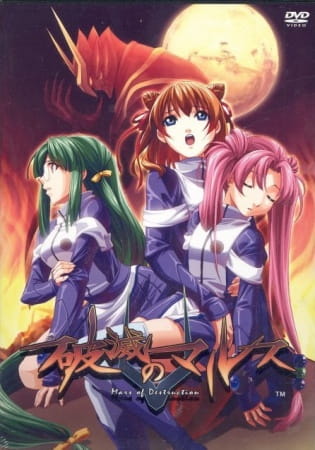
#115-6: Skelter+Heaven & Mars of Destruction (2004/5)

From https://cdn.myanimelist.net/
images/anime/7/68855l.jpg


Skelter+Heaven
Director: Yoshiaki Sato
Screenplay: Yoshiaki Sato and Toshihiro Sugiyama
Based on a video game by Idea Factory
Voice Cast: Megumi Nasu as Rin Ichikawa; Yukitugu Miyoshi as Otsuya Hunagai; Hideyuki Tanaka as CEO Mishima; Kaori Nazuka as Konomi Tamura; Minori Chihara as Ayaka Matsumoto; Naoko Suzuki as Misaki Kashima; Shizuka Itou as Midori Matsumura

Mars of Destruction
Director: Yoshiaki Sato
Screenplay: Kouji Takeuchi and Tsunekiyo Fujisawa
Based on a video game by Idea Factory
Voice Cast: Nozomu Taiga as Takeru Hinata; Erina Nakayama as Tomoe Nakahara; Asuka Aizawa as Yamabuki Unno; Minori Chihara as Aoi Kurita; Kaori Nazuka as Shizuka Isono; Yukari Kawabuchi as Kyouko Kawagoe
Both viewed in Japanese with English Subtitles

Let us plummet to the bottom...though in terms of titles on the bottom of bottom lists for anime, is it really constructive to pick on two obscurities like this that, as I'll get onto, were made by a company in their infant period when there are probably worst higher produced creations in existence to rag on? It's a subject to get to later, but less than twenty minutes each, these aren't as painful as anime I have suffered through that are much longer. Don't get me wrong, in the history of anime viewing, these are two are among the most technically flawed and messy productions I have sat through, so on a technical level they are the worst you can find, but twenty minutes a pop can be endured, whilst I can only wonder in an alternative reality if a thirteen episode series of this production quality each might be a greater hell. That doesn't suggest a defence of these Idea Factory properties, but in terms of notoriety there's also the irony that their infamy has brought more people to watching them as I have than when they were first released, a la the Gun-dou Musashi effect (that 2006 series is for another time). This is ultimately a victory particularly as the case for me comes off as picking on a minority in terms of the anime industry.

Mainly because Idea Factory, the creators of both, have made some notorious anime (Diabolik Lovers (2013/15) is possibly a bigger concern as that's a two season series), but they're predominantly a video game company. Mars of Destruction and Skelter+Heaven, ordered here by level of notoriety between the two, are tie-ins to video games and, honestly with a little research, are from a time when Idea Factory were a very different company to how they look now. Nowadays, their material on Steam worldwide, is a lot more boosted in style and production even if their JRPGs and visual novels do look the stereotype of anime. Mars of Destruction and Skelter+Heaven as video games, seeing clips, are mainly still screens of text with an occasional scene of interaction where you move a crosshair to shoot things. This was a period where, and I will be incredibly careful in my words, they belonged to a type of a budget videogame that was imported to Europe and Britain on consoles like the Playstation 2 in the early 2000s. Now there were some highly regarded budget priced or obscure cult imports from Japan in this era, including for the Playstation One, and I am being specific in console choice as this denotes a period in my life and that these games were for that console, but there were likely a lot of small companies who work struggled against technical issues. Sometimes they still created unconventional games admired today, sometimes for ironic reasons, but there was likely also incredibly minimal work like Mars of Destruction and Skelter+Heaven which, if you can see clips of online, are as minimal as games as you can get. Hell, I suspect animation from Mars of Destruction the video game was used for the anime tie-in at least as a template.

So this comes from a very different place as a review. They have come up in the world in terms of the time that has past, so I seriously doubt anyone would be offended by a review like this. In fact I wouldn't be surprised if they aren't laughing to the bank, as they now have a much bigger boost in production, a lot of titles sold around the world, and a shitton of merchandising (including for titles not their own) to sell. It would be interesting to see them revisit Mars of Destruction and Skelter+Heaven even if it was just to screw with the Western anime viewers who talk about these shorts still.

From https://s3.narvii.com/image/zbhuf2djx2tjbqykrapvr2qqnudkt67z_hq.jpg

Befittingly, I watched the duo in wrong chronological order, but Mars of Destruction is the most well know of the pair. The story's simple, a mere slither like a dream of a half remembered anime, beginning with a crudely depicted space expedition to Mars crashing on the way back with entities terrorising parks at night in Japan, only a super group of young female (teenage) soldiers and the son of the head honcho in super armour to stop them. Notably someone was taking notes from Neon Genesis Evangelion (1995), as this is a tale of humans versus Martians that is muddier than this, whilst the son is forced by his father to wear the armour against his will whilst being moody. This may present a bigger issue for Idea Factory in terms of the originality of their content, which I will get into.

The proper first scene sets up the infamy, as three high school girls in battle armour and rifles approach three aliens in an empty park at night. With no helmets on, one of them wearing military approved bows in her hair, you realise how absurd the common trope in anime of teenagers in combat scenarios truly is, even Neon Genesis Evangelion until I revisit it having to explain why hormone driven and usually emotionally confused teenagers were the wisest idea to save the world and handle military equipment, something entirely blameable on Mars of Destruction in bursting the illusion of. Mars of Destruction rubs the salt in, as unlike Evangelion where despair and psychological breakdowns were common, these girls can see their colleague get her head blown off in a gravity defying burst of blood rain, the most infamous gif of the series, and not bat an eyelid until one scene later of mourning.

Skelter+Heaven takes this common anime trope and makes it even more absurd now as, set in a world where a large Christmas tree decoration/Christmas tree/beige CGI octopus hovers menacingly over a Japanese metropolis, the soldiers are again young teen girls or barely into adulthood, this time similar to Sakura Wars1, originally a dating sim crossed with a period diesel punk tactical combat video game where a squad of women commanded machines with one male as their captain who was clearly the player stand-in. That premise itself is problematic in how there has to be a male form organising what could've been an already strong matriarchal combat squad, but the least of issues in Skelter+Heaven's take. The bigger issue that, even though these are meant to be artificially created super soldiers, to debate whether still human or not as it's vague and blood is still bled, one of the main female pilots has a crush on their male captain and this compromises the mission to save the city. Alongside being sexist, the example suggests that no sane military commander should leave the fate of the world in the hands of hormone driven teenagers of any age, regardless of super soldier abilities, unless you really were stuck or the screenwriter could make it more fleshed out. 

From https://i.imgur.com/ZqU3hLV.jpg

Mars of Destruction
in general is a lot more subdued than its notoriety suggests. The huge gaping flaws don't lead to any real insanity, barring that the only other main action scene has no one else barring cops to be dismembered on the streets in a metropolis. There's not as much unintentional humour as you'd hope, the one exception in how the major plot twist, that Earthlings are the real aliens on Earth, is disclosed so abruptly, cutting to two older men in a corridor, leading to another bad habit (copying the Americans in Hollywood) of anime where all major events happen in Japan first, just to annoy one of these characters who is actually American.

Beyond this, Mars of Destruction is actually disappointing for me in terms of if I wanted a hellish car crash. Skelter+Heaven on the other hand is that though and through. Crowbarring even a title sequence, Minori Chihara who sang the themes for the Melancholy of Haruhi Suzumiya franchise of all people providing songs to both shorts, Skelter+Heaven comes with a knowledge of it being a short tie-in to a low budget game, but is still more than what everyone presumed these two to be notorious for, having the greater issues. It's too peculiar to hate, but good Lord, those abrupt flashback cuts, lunging into them, are enough to knock the viewer out briefly. The training montage including girls strapped to vibrating chairs that look uncomfortably sexual due to how the actresses have been asked to moan in distress, or suggesting that blowing up balloons is adequate military training. The voice acting, and even the echoing sound effects especially for footsteps, is rougher. (Also embarrassing, per both shorts, as they have actors who have gone on with further work). The mouth movements on a particular female staff member in the control centre where it looks like they've superimposed a person's mouth moving over her face crudely than animate lips. Cheating fan service where, crudely, they put in a shower scene but with the greater sense of exploitation of there being no actual nudity, or that the CGI, for the giant robots and the alien squid they're meant to fight, look definitely low budget to the point they enter a particular pleasure of mine of obsolete digital animation.

Together I view these titles as a company in very early days of their career, technically in the middle of their existence but still at the point, this project would be them biting more off than they could chew. Arguably what is a bigger concern for me, but with the two too slight to be painful to sit through, is the sexist gender aspects, which are frankly an issue for the whole of anime and manga in general in their clichés, where having cute schoolgirls welding military grade equipment is obviously meant to appeal to otaku, but can also lead to a curious fetish which can also be demeaning to their portrayals depending on how its handled. As a result, I cannot call Mars of Destruction or Skelter+Heaven the worst in my books. They are among some of the worst in terms of technical achievement, but my own personal criterion is very different. In fact, Skelter+Heaven's too amusing in its failures to really hate.

Besides, the director also helmed Spectral Force (1998), another OVA based on a video game of Idea Factory's but also one hour long. An hour a slightly different scale to work in and to fail miserably within...

From https://i2.wp.com/www.weebswire.com/wp-content/uploads
/2019/07/Mars-of-destruction.png?fit=641%2C412&ssl=1

========
1) Sakura Wars is actually an incredibly good premise with many virtues. Unfortunately, up to the 2000 TV series, none of the initial OVAs and that series tell the tale of the video games, instead set between events or side stories instead of telling the video game story; the series itself is a prologue, right on the cusp of the transition to digitally assisted animation which looks ropey, which unless anything changed is frankly one of the biggest missed chances in terms of creating a super hit anime.

Friday, 28 December 2018

#81: Biohazard 4D-Executer (2000)

From https://m.media-amazon.com/images/M/MV5BMzczNTBkYTAt
YjhhMy00NTYwLTgzZjAtMmJiYWMyNTNjNGQwXkEyXkFqcGdeQXVyNjMwODY0MTg@._V1_.jpg


Director: Koichi Ohata
Screenplay: Daisuke Okamoto
Based on the video game franchise Biohazard/Resident Evil
Voice Cast: Masaki Aizawa as Claus; Hiroto Torihata as Roger; Hideto Erihara as Ed; Tadasuke Ohmizu as Robert; Yoshyiunki Kaneko as Norman; Yurika Hino as Dr. Cameron
Part 1 of the Koichi Ohata Power Hour

Synopsis: Originally, a 3D interactive experience at theme parks and in booths, Biohazard 4D follows in the world of the legendary videogame series as a group of soldiers are sent to locate a female scientist Dr. Cameron, someone who has been working on the T-Virus.

Ah, Koichi Ohata...that's a name that both strikes both fear in to the heart and yet pricks up the ears of many an anime fan from an era before my own.  Fear because, whilst it has a fan base, the notoriety of M.D. Geist (1986) exists as much because it, infamously, was the pet obsession of Central Park Media's head John O'Donnell, who helped get it released, paid for a newer Director's Cut and a 1996 sequel, and was rewarding with the OVA selling hotcakes on VHS despite being a bad anime. Bad to the point, as well, even in regards of ridiculous, lurid anime from the same era it stands out as being terrible in comparison to others which are defended.

Pricking up ears however because, whilst it has its detractors and the last two episodes of the five are dreadful, Genocyber (1994) has its defenders who I'll pitch my tent alongside with, defendable just for the first episode for its lurid and grotesque body horror nonetheless having a nihilistic nuisance, even going as far as using shots of wet clay in just that first episode because Ohata clearly felt drawn gore was woefully inefficient. Arguably as much of its interest comes from Shou Aikawa during his nasty era as its screenwriter, a man behind some deplorable material, some controversial work (Legend of the Overfiend (1989)), but who also went on with acclaim to pen the scripts for the likes of Full Metal Alchemist (2003).

From http://s019.radikal.ru/i608/1603/0c/cf446d6a5d9b.jpg

After the nineties to today, though, Koichi Ohata like many from the OVA era have had odd careers as working anime directors. Ohata did have Burst Angel (2004), a briefly successful if not highly regarded series which existed; after that, well, Ikki Tousen sequels and far less ultraviolent schlock, more otaku bait shows with lots of titillation. You can map the history of anime, in aesthetic and trends, easily with directors as infamous as Ohata, not viewed as a great director, viewed more as a curious one-off, and with the caviets that you'd have to dare watch everything that came after his infamous career high. But he's still someone you can track anime's history with from the nineties with some legitimately interesting tangents.

However, for a mere taster, a bite sized snack of a review, how interesting it was for me to discover in 2000 he worked, with Capcom directly, on a Resident Evil tie-in. Now, Biohazard 4D (a far superior name than Resident Evil ever was) was an interactive movie you saw as a ride, so I confess not only of the dubious nature of seeing the short; but I know I'm missing out on it being in 3D and with other interactive aspects that were included, including a gimmick chair William Castle would be proud of that blew air at the back of a viewer's neck and moved.

From https://img.youtube.com/vi/u44WcBZi-XY/0.jpg

Unfortunately, whenever you have these unique examples of the motion image which have unconventional aspects (3D, even Smell-O-Vision) which are not easy to replicate, companies effectively lop off the ability to see a work over a long time and not even by their own fault. Unless a true archival action is taken so even a country bumpkin like myself could one day see an old 3D production like Disneyworld's Captain EO (1986), directed by Francis Ford Coppola and starring Michael Jackson, in its original context outside a large metropolis we're stuck into an accidental cultural elitism where few (if many) can see these productions. This'll be worst when Biohazard 4D, despite being part of a major and global franchise, was only available in its home country, in a Japanese dub only, with the added issue that bootlegs that exist don't recapture the full experience unless you get friends to move your chair and use a hairdryer.

Not helping in terms of historical virtue for some potential viewers, and immediately feeding into my obsession with obsolete polygons, is that it's part of the very early stage of three dimensional CGI animation in anime. This is a budget higher, clearly, than early pioneers like A.Li.Ce (1999) [Reviewed here], but nowadays it does look like a Playstation One cut scene. Old CGI is more difficult to sell than old hand drawn animation or sprites and naturally, Biohazard 4D has a stroke unfairly against it in terms of critical opinion. Ironically, considering this was Ohata's first try with polygons, and the two MD Geist anime are a t r o c i o u s in terms of their animation and production, he did quite well here to my surprise for what was always a schlocky haunted house ride.

From https://i.ytimg.com/vi/rHtRPbgGLrc/hqdefault.jpg

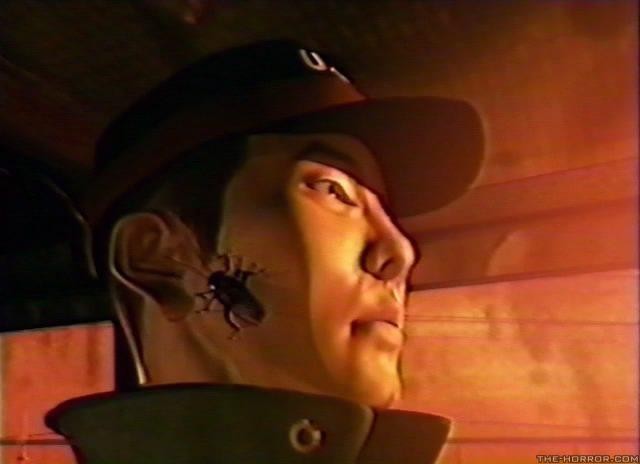
In fact, for what is for twenty minutes pure and un-defendable body horror schlock full of grossness, getting the director of Genocyber was actually a creative and clever staff choice. Executer proves the premise of Resident Evil is ridiculous, as no sane villain (even the Umbrella Corporation) should consider an uncontrollable and easily spread virus which regenerates and zombifies any living creature a wise financial investment, but Ohata for a large part of the film literally takes a viewer through the first person perspective of a zombified cockroach among the treats on offer, which is quite funny and awesomely inventive, clearly someone who wasn't going to take the project seriously and thankfully playing it up to the ghoulish delight of viewers like myself seeing it a decade or so later.

For a director who infamously, on the first M.D. Geist, just put together cool scenes with the screenwriter without logic and pissing off the animators as a result, giving him an interactive spectacle and telling him he can be as gory with sprite figures as possible was like giving a child access to a perverse chocolate factory. This is a major spoiler, but it shouldn't spoil the experience if you locate it, that when our soldier lead finally meets the elusive Dr. Cameron, her face growing out of another's say by him, it does evoke the second and third episode of Genocyber when an entire military warship becomes a living Lovecraftian horror who absorbs crewmembers, all arguing that Ohata should've with some helping hands become a much more well regarded figure if he either just provided the ideas for these images or you have Sho Akiwara and well regarded figures involved to spin the material out. Ohata's too nihilistic for his own good, man eating centipede robots in MD Geist II for no reason and an obsession with humanity destroying itself including the innocent in ridiculous ways, but he's clearly someone who with good screenwriters and animators to guide him along should've made some of the most striking body horror anime he could get his hands on.

From https://i.ytimg.com/vi/ugdW2MY4pHA/maxresdefault.jpg

Sadly, whilst gore anime is still made, his brand of gore anime with lovingly rendered split intestines dried out by the 2000s, another fascinating cultural trend is that for every infamously nasty production that still appears (many like Blood-C (2011) not well regarded for other production reasons), they don't have the same sticking power in the conscious. Or, for another theory, they've been replaced by the logic that it's acceptable to spill a lot of blood but a sense of being wildly less of interest just for the fact that, in his own career and for others, its more bankable for Ohata to draw nubile schoolgirls with physically impossible figure shapes rather than a niche he made. Usually I'd advocate more love, less violence in creative art in general, but when it's an uncomfortable sexualisation of underage characters and blinkered sex comedy without an ounce of eroticism, I might be mad enough to want someone to fund MD Geist III instead for a change of pace.

And yes, in lieu to referencing Captain EO, it's perverse in a funny way that, exhibited (probably) at theme parks Japan, a nasty and gory film short like this, with demonic crows pecking at people and spiked dismemberment, was once an interactive ride experience for a large public even if there were edited down versions to trim the gore. Its why in this case, I now wonder if Biohazard was a far better name in context as well as preference for a franchise than Resident Evil, one which is respected and acclaimed (especially after Resident Evil 4 (2005) and 7 (2017)) , but also wallowed in the schlock until the cows came home.


From https://kinolexx.ru/files/film/2017/9/5/39438/
obitel-zla-4d-palach-004.jpg

Tuesday, 6 June 2017

#42. Professor Layton and the Eternal Diva (2009)

From http://vignette1.wikia.nocookie.net/professor-layton/images/8/8d/
Professor-Layton-and-the-Eternal-Diva.jpg/revision/latest?cb=20100622142647

Director: Masakazu Hashimoto
Screenplay: Aya Matsui
Based on the videogame franchise Professor Layton from Level-5.
Voice Cast: Yo Oizumi (as Professor Layton); Maki Horikita (as Luke Triton); Fumiko Orikasa (as Melina Whistler); Nana Mizuki (as Janice Quatlane); Atsuro Watabe (as Jean de Scole); Houchu Ohtsuka (as Inspector Clamp Growski); Iemasa Kayumi (as Oslo Vislar); Saki Aibu (as Remi Altava); Sumire Morohoshi (as Nina)

I have no previous experience with the Professor Layton franchise baring a passing knowledge of a videogames. I gave up videogames at the start of my twenties, or at least at the time of the Playstation 2, due to the ludicrous costs of the game themselves let alone the consoles, so I've stuck to films for nearly ten years and have missed at least a two generations of gaming consoles. But I have to admit that, separate from them entirely, there's some success in that this film spin-off does intrigue a layman like me with its universe. Imagine a tribute to Sir Arthur Conan Doyle's profound influence only instead of Sherlock Holmes, it's a new type of period English detective called Professor Layton, archaeologist by day and one of the greatest solvers of puzzles who's assisted by a young boy called Luke Triton, "apprentice number one" learning to become as good as his mentor. The influence of Holmes is found even right down to the film being bookmarked by the pair recounting a previous mystery they investigated, an opera singer called Janice Quatlan who brings them into a mystery about an ancient civilisation called Ambroisa and an elixir for eternal life being offer to the winner of a contest based on intelligence.

I like the world that's depicted in particular. A whimsical depiction of London stuck in a nebulous past that never existed, not the modern day but mixing cultural periods without any sense of modern 20th century technology being visible. It's steampunk neither in this one story, which makes an interesting change of pace, closer to actual Sherlock Holmes stories but with a greater expansion into the purely fantastical with its fantastic tone. It also has a very welcome sense of cartoonish exaggeration where opera houses turn into cruise ships that look like giant crowns, and a black castle later in the narrative looks like it was built from Lego. The world particularly stands out with its character designs, a mix between dolls and Looney Tunes, facial features of all shapes and sizes., heads larger than the bodies, and each character, even minor ones, standing out in silhouette with their own distinct physical depictions. It allows a sense of humour to this adventure just in the exaggeration and means that a film which has a very sedate, pleasant tone still has energy to it as everything bounces or distorts with cartoon physics. Amongst such highlights is the henchman of the possible villain, forcing people to go through puzzles and riddles until only one can have immortality, that kind of look like William Finley's titular character from Phantom of the Paradise (1974) to the Scotland Yard detective and comic foil Inspector Clamp Grosky, who has a giant grey pompadour and a barrel chest covered in so much chest hair you could fill a cushion with it. Adding to the mood too is the score; it's been a long time since I've heard an xylophone in a soundtrack, but the vibrancy of Tomohito Nishiura and Tsuneyoshi Saito's music helps immensely add to its adventurous tone.

The only thing that comes off as a disappointment is that, as one would expect for a feature film in such a big franchise, it doesn't really have any sense of greater dramatic weight for the central characters and entirely depends on those only found in this narrative to be greatly affected by any plot events that happens. This is an issue with pulp storytelling, where the protagonists are never effected by events of stories and normalcy resolves itself, which varies on each story. Sherlock Holmes stories could get away with this because they don't end with a giant robot rampaging across a woodland like The Eternal Diva does, this Professor Layton film just in the ending somewhat undermined by the action scenes that take place near the end feeling like a quick resolve. It also does seem to descend into probably what the games are in how it becomes a series of riddles for Layton in the middle of the narrative to solve, not necessarily interesting without more drama to it or being able to solve them oneself with a game controller. This is a shame as the film takes a risk in it does tackling death explicitly as a family film, the narrative about a figure having to accept the loss of a loved one that's incredibly painful after denying this led to destructive behaviour. Japanese cinema will talk of this subject differently than Western ones for family audiences, but since I haven't seen an anime here that wasn't for adults only, it was a surprise to see. The only shame is that, when it does wrap up with some great emotional content to it, a sweetness even in the end credit epilogue, there's still more that could've been done to make the film stand out as something even more triumphant beyond being a videogame tie-in. It's one of the best, especially in anime, I've seen, but I only wish that The Eternal Diva had been more ambitious alongside its initial virtues.

From https://image.tmdb.org/t/p/original/
4TcDPSCyCFZG9OiNReljatOVvn3.jpg

Tuesday, 8 March 2016

#20: Final Fantasy - The Spirits Within (2001)

From http://vignette2.wikia.nocookie.net/finalfantasy/images/4/
4a/FFTSWPoster.jpg/revision/latest?cb=20130405010722
Director: Hironobu Sakaguchi
Screenplay: Al Reinert and Jeff Vintar
Inspired by the videogame series produced by Square Enix
Voice Cast: Ming-Na Wen (as Doctor Aki Ross); Alec Baldwin (as Captain Gray Edwards); Ving Rhames (as Ryan); Steve Buscemi (as Neil); Peri Gilpin (as Jane); Donald Sutherland (as Dr. Sid); James Woods (as General Hein)
Viewed with English Dub

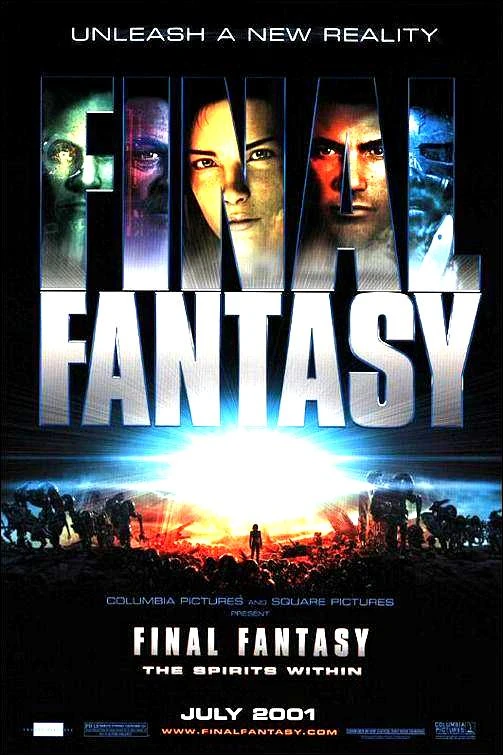
Over the last twenty reviews there's been an inexplicable build-up towards a review of Final Fantasy: The Spirits Within, a spin-off adaptation of the legendary RPG videogame franchise. A US-Japan co-production, it would be the only feature film made by Square Enix's film department Square Pictures before the box office failure of this film collapsed them,  only to be heard again one last time to contribute to The Animatrix (2003), an anthology tribute to The Matrix's clear anime influences. The first anime film which used three dimensional character designs and landscapes was (entry #3) A.LI.CE (1999), a brave experiment but less than the sun of its parts, whilst many films and straight-to-video works that would come after it of the same ilk would become doomed  by the hype that surrounded this big blockbuster. The likes of A.LI.CE, Malice@Doll (2001)  and (entry #16) Galerians: Rion (2002) would become immediately obsolete in comparison to this film and its than state-of-the-art and realistic character designs and budget. The hype, that I remember still to this day growing up when this film was supposed to mean something, was huge, the scope of it meant to revolutionise this type of filmmaking. Like many of hyped blockbuster before it actually gets released, the future is reaped with irony. What might've been a warning sign that this hype might've been a bit silly, if I was an adult back then, was that like anime heroines and fictitious female characters from games like Lara Croft, there was already a cheesecake shot of Professor Aki Ross, who in the film is a meek and sombre woman who is more interested in gathering plants and animals to save the Earth, in a bikini before there was proof that she'd be remembered as an iconic character. There were plans for the character design to be a reoccurring actress in more animated films like one of Osamu Tezuka's favourite roll call of characters who'd appear in multiple roles in different manga of his.

From http://theredlist.com/media/database/graphisme/3d/3d_begginings/final_fantasy_creatures
_de_lesprit/021_final_fantasy_creatures_de_lesprit_theredlist.jpg
Then it failed at the box office. With fifteen years of hindsight, it was an admirable and important push for realism and scope that shouldn't be ignored. The idea that it would lead to actors being replaced with computer generated people however is utterly comical and ironically, based around the destruction of humanity by ghost-like aliens who can literally pull the life-essence from people, the last surviving humans living in closed-off cities, it was like many videogames used to promote new graphics first than plot that's dated greatly as technology improved. Now it's as dated as a work like A.LI.CE; whilst it's still technically superior than many anime that use three-dimensional designs, its shown its age compared to how this computer animation would greatly improve over the decade in large budget cinema, and without a distinct look that wouldn't have aged it shows cracks in the sheen. You can see how few actual characters and environments there are, even a massively expensive and bold project like this limited by the practicalities of the technology, able to make realistic looking characters but not able to be ridiculously expansive in the mythology of its world. Baring the main cast, you mostly have soldiers who wear the same masks or faceless civilians, whilst locations are wasteland, an empty wasteland city and corridors only. Exactly like Galerians: Rion but on a significantly bigger budget, to fill in more detail would've cost prohibitive and more time consuming than it already would've been.

From http://i1.2pcdn.com/node14/image/article/
201506/01/20150601051532a0e40c55bwizczwv.jpg
The area which hasn't aged, and is the main draw now, is the non-human entities which populate the film; non-human characters are less problematic in animation, and not surprisingly for a work based on Final Fantasy, they're inventive from malformed humanoid grunts, flying snake dragons and strange monolithic entities with tendrils and spiders' legs straight from HP Lovecraft fan art. The bright idea to make the aliens orange and the life-force of Earth blue, the later to be collected by the heroes as a final way to end the alien threat, also helps in preventing the grey and golden brown post-apocalyptic environments from becoming drab, adding some aesthetic distinction to the proceedings. Particularly now when, for the hard work on them, the human cast shown the limits of the time badly now, these designs make up for the beginnings of trying to create realistic human beings onscreen. A lot of lavish care was put on the female lead Aki with her freckled, meek look but the rest of the cast particularly the males are as generic as you can get in this day and age. The worst offender, for example, being the main villain General Hein with permanently sinister brow line, frozen in maliciousness in his desire to use his giant space laser on the aliens by any means necessary and signposted as bad from the facial deformity before you recognise James Wood is voicing him.

From http://cineplex.media.baselineresearch.com
/images/305294/305294_full.jpg
As for the plot, this is where the film was ultimately doomed. One could immediately go to the mythology and blame it as esoteric gobbledegook - that the heroes, including the heroine and soldiers lead by an old flame, need to tap into the life-force of Gaea, Earth as a living entity, found in anything from plants to soldiers' bio-battery packs, to protect themselves from what are actual alien ghosts with no consciousness of their violence, restless and destructive - but that's the interesting part of the film that's barely dealt with. These parts are the clear influence of this being a part-Japanese production as this is the type of storytelling you find in many anime - like the failed, but admirable, attempt to make Hein and his scowling frown a more complicated character, with a moral reason behind his malice, these are admirable attempts at bringing greyness and a more interesting depth even for an action sci-fi film. The problem I'd squarely blame on the US side of the co-production, adapting the film for a Western audience. As much as a film from Japan could be just as terrible as one from the US if the script is poor, the problem exactly is an irksome tendency prevalent in American cinema, one still plaguing current blockbusters, where there's a common and over repeated through line for the plot, the repetition of the hero's journey plot with the same character archetypes and, worse, a stagnated and marketed version of the phrase "believing in yourself" rather than letting the viewers think this for themselves. When I now spot these habits, I have a Pavlovian reaction suspecting a film's going to immediately collapse in quality even after the first ten minutes.

From http://1.bp.blogspot.com/-xi59pyCjgM8/UcDf5Zy415I/AAAAAAAAI8E/
x9UPLSqEbJU/s1600/finalfantasyphantom.jpg
The interesting ideas that the film had eventually become complicit in its failure, making the obsession with Gaea theory and life force padding on the rotten structure. The characters are so generic and provided with such bad dialogue that, considering the calibre of some of the voice actors for the English dub, it becomes worse. Steve Buscemi has made a name for himself, as well as being a great character actor, for being the comedic sidekick too, the one here without any decent jokes. Ving Rhames is stuck in the background, James Wood is the aforementioned villain only defined for most of his screen time by a menacing brow, and inexplicably its Alec Baldwin who's the romantic love interest, as bland as white bread military captain Aki loves, when he should have literal brass balls in his hand as he does in Glengarry Glen Ross (1992). Slight desperation can even be found in the tough female solder (clearly copying Pvt. Vasquez from Aliens (1986) without the charisma or anything to differentiate that archetype from this version. Probably the worst thing is that, given a leading voice role for something she immediately wanted to make, Ming-Na Wen as Aki Ross, in a curious career that includes The Joy Luck Club (1993) to playing Chung-Li in Street Fighter (1994) to Mulan (1998) and voice acting, is stuck with a film around her that lets down the chance to get centre stage.

From https://galacticpillow.files.wordpress.com/
2001/07/final-fantasy-the-spirits-within_02.jpg
I had hoped to write about a folly, possibly one with virtues to redeem it or at least memorable as a box office bomb and in context of all the other three dimensional anime that faded into obscurity because of it. What I've ended up with however is a casebook example of the many flaws with English language plot writing for mainstream films.  This is not like a Battlefield Earth (2000) in collapsing spectacularly, or in context of anime a compelling example of ambition crashing and burning at the box office like Odin: Photon Space Starlight (1985), but a bland, lifeless movie that has thankfully disappeared into obscurity baring its innovation in CGI. I sadly couldn't come to this as a fan of the original games, haven't never played a whole of one, but as a videogame adaptation, as tentative a one as possible, this is the sort of thing that'd crush a fan's heart if they went to see it on its original cinema release. In general it would've been a worse sensation for a devoted fan as, with the exception of Final Fantasy: Advent Children (2005), which was a direct sequel to one of the most loved games of the series, the anime adaptations of Final Fantasy have been infamous for their lack of quality. The Spirits Within would probably be the most painful to sit through, with those other adaptations all possible to cover depending on their accessibility to me, due to the expectation and budget behind it, collapsing like many videogame adaptations have. It ends with a shot of a valley with a dreary, Lord of the Rings-light ballad, one that finishes it appropriately with a deathly wheezing.