Showing posts with label Superhero/Tokusatsu. Show all posts

Thursday, 29 June 2023

#256: Campus Special Investigator Hikaruon (1987)


Studio: AIC

Director: Kazuhiro Ochi

Screenplay: Kazuhiro Ochi

Voice Cast: Mika Doi as Adzumi Hadzuki; Toshihiko Seki as Hikaru Shihodo; Kazuyuki Sogabe as Shirou Amakusa; Miina Tominaga as Yayoi Shiina; Shōzō Iizuka as Demonic Beast; Tesshō Genda as Kyousuke Gomi

Viewed in Japanese with English Subtitles


Continuing into the catalogue of obscure eighties OVAs, this is the last of the "Pink Shock" trilogy which I have seen all of. Produced by AIC, it was a brief series which came with no real consitent aspect to them barring some eroticism. One was Maryū Senki (1987-9), a three part horror-action release of interest in that genre. The other Call Me Tonight (1986) is one some viewers may have learnt of as it has gained interest in the internet age, a fascinating short predating the notorious Urotsukidôji anime adaptations by parodying it, by way of a lead male character who turns into a tentacle monster when horny and the female phone sex employee who can tame his heart, all in a work that is more progressive for the time then you release. Campus Special Investigator Hikaruon, in vast contrast, feels like a pilot to a show that could have been, a tribute to the likes of live action tokusatsu "Metal Hero" shows like Space Sheriff Gavan (1982-3) only with a darker slant.

At a school an alarming number of suicides are transpiring, and a young male hero, able to turn into an armoured battler, has snuck in as a new transfer student with his female colleague there already as a teacher. There is a female student pulled into the secret force harming the students, and the sense of this feeling like one episode to a longer work than never came to be is felt. The more adult tone is that this entity, masquerading in the school, drives people to suicide or to be devoured by a supernatural force. There is a sense of style to this anime too; the opening, set in a train station almost white with just outlines, the patrons all blank faced, has the one character in colour and fully drawn jumping in front of a train, an inspired opening for any production which emphasises the shock of the scene as a set up. There is also my favourite trope of the older era of anime, maybe still into the modern day if I ever encounter it, of characters being transported to an alien realm, here a surreal chess motif of black and white tiles, and gravity defying steps against a crimson sky. Add to this that the villain is at first a harlequin Pied Piper in appearance, tempting a new victim with wine of her demise. The best of these sequences cross into another of my passions as, with the best of these older anime of strange alternative realms, you could imagine them as the art appearing the front of a metal or prog rock LP.

Hikaruon also has an uncomfortable of victimising the female characters sadly. The other Pink Shock titles as mentioned had an eroticism, and here this is sadly an implicit threat of sexual violence, be it a group of bullies targeting the female student, or how the female heroine, when the number of goons in a bar are too many to fight, is left with clothes shredded and on the floor implicitly suggesting a rape scene to transpire. She is brainwashed to fight the hero thankfully, in another cool aesthetic choice in a paper walled pastiche of samurai combat, wearing an omi demon mask, but that hint is tonally out of place. The hero also sexually harasses her, such as groping her behind, as humour which definitely has not aged well at all. Out of the three Pink Shock entries, this feels like a contractual requirement and out of place, as this feels like a tribute to this genre it is recreating, and only is darker in the villains' plans, not the special abilities or how the episode finishes with fighting a monster.

Maryū Senki has sexually crossing with the grotesque which could be accused as offensive, and out of place for something meant to be erotic, but felt more befitting as ero-guro, a horror story where the sexuality is more for the horror edge than meant to be sexy, whilst Call Me Tonight as mentioned is surprising for what themes it covered in less than thirty minutes. Hikaruon, whilst entertaining, is a disappointment in how I do need to advise a trigger warning for those watching this, and how it really is undercut by this undefendable, and arguably pointless, way to still sell eroticism like the other Pink Shock titles did. It does not even, if the eroticism was not problematic, seem a fit, where it would been more appropriate if this had been a more explicitly erotic pastiche or take on the tokusatsu genre. Considering the opening credits is a sincere animation of the show it could have been, like the pilot of a longer production, shows it is an odd production in some of the creative choices. It becomes, out of the Pink Shock series, the weakest of the trio for the reason it feels like a pilot for a show we never got the whole of.

Wednesday, 31 May 2023

#253: Karas - The Prophecy and The Revelation (2005-2007)


Studio: Tatsunoko VCR

Director: Keiichi Sato

Screenplay: Shin Yoshida

Voice Cast: Asuka Shibuya as Hinaru; Kasumi Suzuki as Yurine; Keiji Fujiwara as Nue; Toshihiro Wada as Otoha; Hiroto Torihata as Kure Narumi; Hitomi Nabatame as Homura; Kiyoyuki Yanada as Suiko ; Mai Nakahara as Chizuru / Mery ; Rokurō Naya as the Chief; Saeko Chiba as Sagizaka Yoshiko; Takahiro Sakurai as Houshun'in Ekou; Tetsuo Goto as Minoru Sagisaka

Viewed in Japanese with English Subtitles


Created to commemorate the 40th anniversary of Tatsunoko studios, the best way to describe Karas is an ambitious and very interesting premise but one, including the notable delay in between releases of all six episodes, which needed time to breath, rushing with all the ambition of a debut of a man, Keiichi Sato, who started out as a character and mecha designer who finally got to direct a production. It is a simple premise at its heart combining Tatsunoko's history of superhero characters in their animation like Gatchaman or Yatterman, with horror and Japanese folklore, and then-modern CGI animation which is meant for style for the sake of style even if the premise is elaborate in lore. Considering this has sword welding armoured figures fighting in the sky of Shinjuku at Christmas at the beginning of the first episode, the style is there, as is the director Keiichi Sato spelling his own name out in episode one with ants.

Karas is absolutely of its era, very much of the 2000s in style with the CGI and looking as expensive as possible, alongside the emphasis on a more muted art style. Voice casting for the English dub, which brought in Matthew Lillard and Jay Hernandez for key roles, definitely evokes how by the mid 2000s there was a push for making anime more mainstream, and as a straight-to-video project licensed by Manga Entertainment, this is also of the time. Whilst there were a few prominent ones at the time like this, that format was losing traction for these types of projects and TV series were easier to access on DVD finally at that point, Manga Entertainment eventually becoming less prominent as a British and US distributor, and more British one who releases mostly television series and some key films in the decade onwards. Karas however to its credit has a fascinating premise - in Shinjuku a mysterious figure known as Karas, a denoted figure meant to protect the city on behalf of the demons and the yōkai of the city from evil doers, stops demons from killing the humans and consuming their blood. The current one is Otoha, a man in a coma for the first three episodes who spends his time as a doctor for the yōkai in their world. A demon hunter about to stop time, he is under the watch of Yurine, the woman behind our lead who a) is an unexpected catgirl, and b) exists as a concept, more than one Yurine in existence as part of this lore using both Japanese mythology and various Asian disciplines of spirituality as its influence, Yurine existing for all the Karas and all looking the same, including for Eko, the former Karas of Tokyo who, having become disillusioned to its corruption, seeks to annihilate all humans there with what is effectively a plan to turn everyone into his own personal tap of human blood to be able to power his ultimate form.

The style, even under all the CGI, which is used for Karas and his opponents, mechanically altered supernatural demons, is inspired, running both with this idiosyncratic style but also melding it with ancient Japanese folklore.  The first monster emphasises this, whilst pulling no punches even if the later episodes are much gorier, with a water demon draining human blood from victims in a specific public bathroom near the subway, introducing us too to Narumi, a new police officer assigned to the one man behind their paranormal department, with his own concerns with his daughter in a mental asylum for seeing her whole classroom massacre by a demon. You however also see that Karas' first episode is arguably stylish to the point you cannot understand half of it, and also rushing through a premise which had legs for longer episodes than the thirty each gets. Effectively taking horror monsters, and having them as life draining robot ones, tackled by a doctor for good yōkai, a huma, who returns to his world to slay evil ones from a former Karas, we have a premise that is rewarding, but this show really needed to have been longer even if it was forty minute episodes. The first three episodes known as The Prophecy for Western release from Manga Entertainment feels like it is bolting through so much without explaining enough, including a demon in human disguise named Nue, after Eko and his monsters too. There are aspects you have to expect are there for the creativity of the production, like all Karas being able to turn into fighter planes for combat, but it is telling, alongside there being too many characters, that The Revelation as the last three episodes are called, all released two years after in 2007, has to start episode four with a huge amount of exposition to explain itself. Characters who barely get detail on them, like a female female Karas and her Yurine watching on as a preppy girl, get more to do, and it explains key lore points alongside Otaha's back story as a mob enforcer.

As quickly as his tortured history is disposed of, even if it means quickly getting past his crime father and an unexpected bromance that dies a quick death, The Revelation however has to quickly deal with ending the show, so even this is rushed despite explaining the premise. The rush undercuts Karas so much as by those three episodes, we are already into an apocalypse scenario where, with the notable shift in more gore and limb severing, we are in a far more violent doomsday tendril situation. As a result of the rush, even this, which is a scary and gruesome scenario, actually gets into something I have I have always hated in anime - just killing random bystanders off in vast amounts in elaborately gory scenarios as we see here. It is odd but, even with the trashiest of horror anime I have seen that are bad, they seem more justifiable even with an archetype once you known them a little, even one dimensional stereotypes, to be able to exist as a singular figure with their own existences for how long the tale is. Focusing on having their death as one person than merely part of a mass, no matter how gruesome especially with the eighties straight to video era, takes it into an exclamation mark to the scene that works. Here because you do not have enough time to digest the stakes, sadly Karas despite its moody nature even ups with randomly drawn bystanders getting horrifying ends which feels like shock value. This even makes the ending of the notorious Urotsukidôji: The Legend of the Overfiend (1989), its own world ending scenario, powerful ina horrifying way because we had more build up and warning of the threat at stake in that film in spite of its own problematic nature.

A lot of Karas'  fault is that, with this premise, Karas is an imaginative and vivid production which had so much work and production preparation clearly placed into it, but was really rushed to a scenario that, even in another slightly longer OVA work, would have needed slightly longer to reach what is this extreme an end. It is also a conventional superhero plot at its heart, despite the gore, that made a bad decision to not get the exposition out of the way or having time to slow down and let its lore sink in even if the production wanted to avoiding too much talking. What stands out in its tone, its horror-occult premise, is pushed to the backburner, which becomes its biggest sin. Particularly with how the designs are so elaborate and idiosyncratic even with clichés - there is requisite spider woman on the evil side, but her monster form and how she drains the blood for humans by hundreds of tiny spiders is entirely idiosyncratic here - it feels gauche to rush through a premise which has at its heart the additional subtext of modernisation conflicting with Japan's past. Details I can expect most will miss, such as how to activate the Karas form, Yurine chants a Shinto mantra, but there is an elaborate metaphor here that anime has tackled a lot and is worth doing so over and over, modernisation and Japan's past in conflict, the old traditions and the modernisation clashing as the demons of yore are forgotten and humanity in the city sinks into crime and corruption. Details like the mayor of Tokyo betraying humanity due to his hatred for all the crime, in another adaptation, would have become more loaded if allowed to breathe.

You can see the production value onscreen, not just in the computer effects, but costume design touches, like the Yurine all having goggles with idiosyncratic and cute markings for eyes on them, or that people cared for this work's lore, that in this world cities are still alive with the unnatural, the crows to the stray cats part of the spirits living in them that denote a human to become a Karas and keep all under control. As a result, this does have the disappointment of what could have been. For me this was always a title from this era getting into anime I wished to get around to, but never did. I am glad to see there was so much passion to the production as an original premise, which I have to admire now I have seen Karas and realised more was on its mind than presumed, but it is with the cost that, unfortunately, it missed the mark. This premise with the cost of its style clearly put on the production in time and effort did not get to the stage it needed to in being fully fleshed out, and it also needed to have been worked on more carefully before it came out. Thankfully, the epilogue of this production is that someone like Keiichi Sato, with this debut as a director, would go on to make helm more productions into the modern day, such as the first series of Tiger & Bunny (2011), so this ambition would lead onwards into other productions.

Wednesday, 10 August 2022

#220: The Skullman (2007)


Studio: Bones

Director: Takeshi Mori

Screenplay: Yutaka Izubuchi (with writing by Hiroshi Ohnogi, Seishi Minakami and Shingo Takeba)

Based on the manga by Shotaro Ishinomori

Voice Cast: Hiroshi Tsuchida as Skull Man; Makoto Yasumura as Hayato Mikogami; Ayako Kawasumi as Kiriko Mamiya; Fumiko Orikasa as Maya Kuroshio; Hiroyuki Yoshino as Akira Usami; Katsunosuke Hori as Kyouichirou Tachigi; Masayuki Katou as Yoshio Kanzaki; Toshiyuki Morikawa as Masaki Kumashiro; Tomokazu Seki as Tsuyoshi Shinjou

Viewed in Japanese with English Subtitles


Skullman was created in 1970 as a one shot by the legendary manga author Shotaro Ishinomori, and in that text, including an expanded 1998-2001 manga by Kazuhiko Shimamoto with Ishinomori's contributions, the character was always an anti-hero, making this 2007 anime series not a bleak interpretation of a bright tokusatsu like character, but apt for the figure even if its own story. Skullman the series works as an interpretation in how the series is entirely around the titular figure, but for most of it, he is not the central character, instead a mystery in its centre of who he is and what his motives are, a mystery which will expand further on from this even when these two questions are answered in this interesting genre hybrid.

Set in an alternative world, where Japan is caught in a civil war, our protagonist is actually reporter Hayato Mikogami, who wishes to go to Ōtomo City, his place of birth and one caught in a tense political situation in terms of the ongoing war, with the intention of discovering who the urban myth of the Skullman is, the figure said to be behind the series of seemingly random murders of men and women in the city. Even in the opening credits, Skullman is first depicted as a monster, seemingly killing innocents, his first victim being a woman whose death is shot like a thriller not without purpose for hinting at this. Soon it becomes apparent, however, his mission, whilst at times edging to unjustifiable, is part of a more problematic conspiracy, much more dangerous to the world, and all circling all the victims seemingly being connected to the White Bell Association, a small religion entirely within Ōtomo City only that has a grip on the town and is very cultish. With Kiriko, a young woman who manages to wriggle her way into Hayato's life against his will, the pair finds themselves in a show where that, with only thirteen episodes to work with, does a stupendous job in using all thirteen economically to tell this tale.

There would be no time to have tangents or filler, but the production and writing team's credit, this manages to tell this story concisely, with a plot with juggles many genres which could not work, and manages to still have a unique personality, even humour of a cartoonish form at times. One of the twists, which it early on and really not a spoiler, is very reminiscent of Yoshiki Takaya's The Guyver, in which people are being turned into monsters, and the show is also a noir-tinged work of mystery, of drama, yet with a titular character who stands out, despite his anti-hero origins, influenced by tokusatsu action characters. It's tone is really idiosyncratic just from the opening, heavily leaning on the horror mood until one of the most curious opening tracks can be heard begins, jazz with funky layers, but the trumpet playing at a very odd time to the rest of the rhythm, or the backup vocals, whilst yet managing to work. One key character, an older man named Kyouichirou Tachigi who to Hayato seemingly knows everything, is a cool character but as much because of delightfully odd touches, like finding him fishing near the White Bell's church location, or that he is not only a man capable of handling himself, but within one scene revealed as a coffee aficionado who knows his obscurer blends in a coffee shop greatly.

The series composition was by Yutaka Izubuchi, with screenplay help from collaborators, and what is fascinating is that he is far more prolific as a mecha and character designer, with only a few screenplay credits in his prolific. This fact makes it to his credit and the other collaborators - Hiroshi Ohnogi, Seishi Minakami and Shingo Takeba - how good and interesting The Skullman's story is. The Skullman is a show whose episode titles are long, poetic and bleak, and Frederick Nietzsche is referenced and becomes a dialogue point between Hayato and Father Yoshio Kanzaki, a Christian priest who Hayato knows fondly from their youths. Until it gets completely serious, there is even exaggerated humour which fits the tone, such as a scene with food leading to characters having giant bellies, or the character of policeman Tsuyoshi Shinjou, who dogs Hayato believing him to be a suspect. That does not factor in, even very early in the show, the violence whether with the monsters or more conventional means which is still bloody and nasty. It manages as a curious tight walking act to all work, and it is a pulpy feat.

The Guyver comparison is apt, as in mind to spoilers, this involves alien artefacts, people being turned into monsters, against their will or willingly, and a conspiracy that involves a group very obviously connected to it, but there is more in just thirteen episodes which elaborates beyond this. Of government conspiracies, of an illegitimate son fostering contempt, of politicians being murdered by the Skullman which are more sobering to consider decades after, and that this is set in a war, one where a foreign group, even with the cartoonish super villain name of Brain Gear, are here to exploit the climate. With weapons that can literally disintegrate people, they are their own entity off to the side, in a show which pays a huge tribute to Shotaro Ishinomori by having characters and references based on his entire career, where there is a religious cult involved, and a far right imperialist Japanese group who wish to militarise and get hold of nukes, planning to stage a coup de trait even against the corrupt police force. The Skullman, as a result, also taps into some real politics even as a genre piece, which makes its ability to tell this all well even against monsters and a sci-fi plot more a further credit.

The Skullman's ending was open to a second season, even if a bleak turn, with characters becoming figures from Shotaro Ishinomori's Cyborg 009, yet still works as a conclusion in striking a balance between the tragedy that ends it, when a figure has their spirit crushed and becomes a weapon of the true villains, and the hope with the characters who have survived. There are a few side characters, and they are all interesting, be it Kyouichirou, a mysterious brother and sister revealed to be test subjects who can control their monster forms, Tsuyoshi, or even the daughter of a major political figure who acts as the voice of the White Bell Association, a frail and sympathetic figure clearly in love with Yoshio Kanzaki, transgressing her mother's views of talking to religious heretics by helping at his orphanage for children.

Even one off figures are interesting, such as episode ten introducing a troop of soldiers, from a war Yoshio was a front-line minister of rites on, who have been turned by cyborg killing machines by Brain gear, a sense of tragedy at hand just with one of them, unstable even for his peers, traumatised by not being called by his real name and a shell now giving dangerous access to a missile launching rig. The Skullman staying on path through its plot means there is not a lot of filler, its curious tangents all leading to a finale, all done with reward, with all characters getting a conclusion even if a bleak one. Even the fact there will be more than one Skullman is not worth marking as a spoiler as, without explaining detail, it comes instead as part of the really good dramatic turns of the show, actual drama even in the midst of a show as proudly a violent tokusatsu monster show with gore, with the downfall for one in sacrificing his soul for saving other, the other broken as a person whilst Ōtomo City turns into chaos in the final episodes, full on the streets of fanatics turning into monsters, a doomsday scenario being prepared for, and a coup de trait or two also transpiring.

It is an exceptional show, one that does stand out as being idiosyncratic as a sombre action take finds the balance between the genre touches fully, feeling adult without being contrived and manages to be serious even with explicitly fantastical touches. It was a title suddenly released in the United Kingdom in 2022 from MVM, a DVD only title for another curious touch, having been a Sentai Filmworks release in the United States before. Suddenly coming here decades after its first release adds something special as, clearly, this was worth release for all its virtues. It feels like a title very different from the type of anime show usually released, back then and still now, something very idiosyncratic and fantastic.

Thursday, 31 December 2020

#174: Wonder Momo (2014)


Director: Yutaka Kagawa

Screenplay: Ayumi Inabe

Based on the arcade game by Namco

Voice Cast: Yuka Fujiwara as Momoko; Atsushi Imaruoka as Glooder; Atsushi Tamaru as Natsuhiko; Misaki Komatsu as Akiho/Amazona; Anju Inami as Yumi; Halko Momoi as Momo/Original Wonder Momo

Viewed in Japanese with English Subtitles


But secretly eradicating aliens after school and not telling me?

This is an example of an extremely short anime, one whose back story is probably more significant than the anime itself. Wonder Momo is based on a Namco arcade from 1987 - a parody of the legendary Ultraman franchise, with a female lead, which involved playing an actress who played the heroine in a live stage show. It does predate the type of risqué stuff you would find in anime about female heroines, as it had a bit of fan service in pixel form; interestingly, whilst it suggests as much in the character designs and costumes, this anime adaptation is surprisingly restrained and not the title it suggests on the packaging. Instead, and more interesting, is that it was part of a project by ShiftyLook, a subsidiary of Bandai Namco Holdings that was focused on revitalizing older Namco franchises, starting with web comics for the likes of this, Klonoa, even a less obscurer title like Katamari Damacy among others. Wonder Mono's web comic began in 2012 with Wonder Momo: Battle Idol by Jim Zub, Erik Ko, and Omar Dogan, also one of the ones before the company's eventual closing to get a hardback published release.

From there, we got an online net animation for Wonder Momo1, which does have the immediate issue to deal with that, over five episodes long, each episode is only seven minutes long including opening and end credits, making the entire thing less than thirty minutes long. The premise is pretty obvious - a high school girl Momoko wishes to become an idol singer, but is approached by a weird green man who shots a super powered orb into her body in a subway. Thankfully, this is not for any nefarious reason, as he is one of the two aliens concerned to protect the Earth from another alien race. This abrupt intervention on Momoko's life allows her to be able to turn into a super heroine when the Putty Patrol, genderless goons in skin-tight black body costumes with red masks, terrorise the high school basketball players soon afterwards.

There is the inevitable problem of trying to review this when this is as short as it is. Even in mind to some of the bizarre short works I have seen you can cover a lot within, around this length, Wonder Momo at this length includes all the same opening and end credits footage you excise, followed by a lot of conventional plot moments you would expect in a longer version of this premise of a high school super-heroine. Suffice to say, if a long form title over thirteen episodes had existed, this would have been a goofy parody, where the super weapon is an energised hula hoop ("Wonder Hoop") and the monsters, in mind to this premise's clear debt to tokusatsu storytelling, look like weird creature costumes or toys. There is a potential love interest Natsuhiko, a student news photographer at her school who catches her first transformation and becomes a close confidant, and Akiho, a popular idol figure who is also Amazona, a loner super heroine who thinks Momoko butts in and is inept, the rival figure who together would inevitably have to team up to fight the big evil of the narrative at the ending.


Then there is the one character where Wonder Momo, if it had been a longer work, could have been inspired. Suddenly, in the midst of watching this, I had a thought about the magical girl genre, which this is also effectively a part of, a genre in which teen girls are able to become heroines like Sailor Moon. Sometimes the mind wanders and likes to imagine plot lines that would intrigue me, like whether an show or manga even as a joke imagined when any magical girl reached their thirties or even older, only for this anime the suddenly tease me with something brilliant in that similar idea. Actually revealed to be a sequel to the video game, it clearly read my mind when Momoko's mother Momo appears. Representing the original Wonder Momo from the video game, she could have been a central character to a premise herself, and in another longer title would have immediately delighted many anime fans if they have executed the character perfectly. An entire series of a mother who was once, or still is, a magical (woman) girl with her daughter now following her footsteps is a funny or even memorable premise in itself, barely covered here beyond getting her daughter and Akiho to stop arguing, and getting Momoko to do sit-ups at night to improve her cardio.

But, this is a short little titbit. In terms of its reputation, Wonder Momo was not held in high regard, but low expectations for me coming into viewing this title. I was surprised that this was not as bad as its reputation suggests. I feel as well Wonder Momo is excessively short to ever be able to shoot its own feet off with terrible creative decisions unless it did something insane bad, and that whilst we are on this decision, Namco with ShiftyLook could have done worse with a project. My mind went to Arcade Gamer Fubuki (2002-3), an OVA adaptation to a Mine Yoshizaki manga where Sega were perfectly happy to have their licensed titles shown in the three episodes. Some of it was actually funny, usually involving the figure of Mr. Mystery, a masked hero whose bravado is countered by moments like actually feeling the pain of jumping through a plate glass window. But it was also a show fixated on very young teen girls' panties among content which would make you embarrassed to be an anime fan, which makes Wonder Momo positively Shakespeare in comparison.

Wonder Momo's shortness is confounded by the fact it does not even have an ending. Even the recorded press conference for the series, included on the Crunchyroll streaming site alongside the five episodes, was over forty plus minutes long, double the length of the project itself. Even in terms of animation, I will argue there has been worse. Premise wise, it may have likely spun its wheels if longer but could have worked. Some of the humour means it would have been funny (even the Putty Patrol, actually called the Waru Soldiers, need to use pay phones to get backup). It could have likely indulged in a lot more fan service then it did, though it likely may have been tamer than most even when one of the gags was one of the good aliens finding a bikini photo of Akiho. (Dodging around one villain being a creepy octopus headed monster, a dime-a-dozen in anime, shows the series would have not likely have gone in that direction too far least to defeat the point of this reboot). Mom being an older Wonder Momo, with even her own retro attacks, is a funny idea especially as she is never mocked as being older, just as good if not the strongest of the three female leads who just has a cheery demeanour, with the unexpected thing (as no one probably thought about it) being her also being a single mother to Momoko. Even the show, for its modest animation and fights taking place under very cheap CGI purple haze, having the touch of on-screen sound effect text for attacks, even ones for "Victory" after battles, would have been fun to see if this had embraced its goofball antics and videogame origins.

That there is no ending or length means it is more a test run, and ShiftyLook themselves would be closed down by Namco only two years after its founding in March 2014, only a month after this show premiered in February of the same year. That proves a much more tragic and perverse ending for the series, than if we actually got to see the heroes, after entering an impromptu space portal, into the villains' headquarters, but it is memorable. Thus, we end this review with looking at a weird anomaly which blipped into existence and left; certainly, reading up on all this detail, this show has become a lot more fascinating just reading up this detail from when I was expecting this to be comically short as a piece.


======

1) A piece of a news announcement, which elaborates on the back story of this multi-media reboot, can be found HERE.

2) As disclosed HERE.

Sunday, 13 December 2020

#168: Butt Attack Punisher Girl Gautaman (1994)


Directors: Iku Suzuki (Episode 1), Hiroshi Yoshida (Episode 2)

Screenplay: Yū Yamamoto

Based on a manga by Masakazu Yamaguchi

Voice Cast: Yuri Shiratori as Mari Amachi; Miki Itō as Saori Minami; Tomokazu Seki as Ryo Tobishima; Akiko Yajima as Hibari Misora; Kenichi Ogata as Buddha; Kenichi Ono as Kyoshirou Inemuri; Kinryuu Arimoto as Vice Principal; Kouji Totani as Pope; Ryūzaburō Ōtomo as Dark Vader; Tomohiro Nishimura as Mutsugorō; Tsutomu Kashiwakura as Scary Newspaper Man


What's Buddha doing here?

From the ultra obscure realm of anime OVAs, a two part straight-to-video work, Gautaman is a title which has only been available in the West up to the 2020s on German DVD and only known to anyone if they have found it online. It is, after years of wanting to see both parts, upon finally seeing it a work which lived up to being utterly insane but also something with two aspects to consider. One is that, unfortunately, it has content as I will get into which people will find inappropriate and uncomfortable for good reason, as this belongs to the area of anime where jokes and scenes about women being forcibly undressed and molested are found, especially feeling bolted on to a work which could have just stayed as a weird and kinky parody of superheroes with some sex comedy without this content. The more positive thing of note, and the reason why I would actually recommend people track this down if they can pass the former concern, and why I wish this had a proper Western release, is that it is compelling. It is shambolic at times, skirting copyright precariously with jokes which are just strange, but managing to juggle genres and even have emotional whiplashes. There is nothing like Gautaman even if the premise is not original, in which to protect a school for all future religious leaders, a shy Catholic girl has to dress in a stupid hero costume because Buddha of all deities rather than the Virgin Mary answered her prayers. One which manages in two forty plus minute episodes has a lesbian (yuri) subplot with a fellow Hindu roommate, henchmen like "Dark Vader", and even a bitter sweet ending.

At this school, where all major religions coexist in harmony, naturally it has an evil cult known as Black Buddha among them, who indoctrinate members by kidnapping students, to the point they even develop new personas with masks in case they need henchmen. Mari Amachi is a Catholic and a new student, insanely shy having been brought up in a Catholic school before, and having not been around men baring her father and school principals beforehand. Gautaman for all its dumbness has virtues, including a lead character I wanted to follow and wished had more stories about, someone who is the zenith of stereotypically awkward yet cute figures, with her big red hair in a ribbon and long dress. Adding to her character with another interesting figure, Mari immediately finds a friend in Saori Minami, a practicing Hindu student she shares a room with and is eventually hiding a romantic crush from Mari.

When the Black Buddha decides to kidnap Saori, because she stopped a member indoctrinating Mari by intriguing her with religious discussion, Mari's prayers on her knees does not get the figure she would presume. She gets Buddha of all people, and if you have knowledge on the religion, it is not actually Buddha himself but someone who people confuse the Buddha for she receives for help, the jolly rotund figure, here a gold talking statue who floats, who was originally Budai, a 10th-century Chinese monk who, unlike Siddhartha Gautama who is Buddha, is a different figure honoured in Chinese and also Japanese Buddhism. He is still a figure of high regard, getting the name of "the Laughing Buddha" even if it might be confusing, which is why he is parodied here in a way which is a bit crass and profane. I would prefer to call this Buddha neither Siddhartha Gautama nor Budai, even if Budai is referenced and the name "Gautaman" Mari's alter-ego is called is clearly based on the former, as it makes more sense in this bizarre comedic anime to have this parody be his own thing. This is an incompetent deity who, floating in the background abruptly when unexpected, gives away her weakness to the villains continually and leads to a sentence of someone hitting Buddha taking place in dialogue, something that would not make sense anywhere else expect here.

Contextually this anime has a lot of similarities to the 1991-2 OVA adaptation of Kekko Kamen; Kamen was a Go Nagai creation, which managed to spin off into numerous live action films too, a concept meant to have been a joke he sent to his editor only for them to actually like it. Kaman shares this show's unfortunate interest in non-consensual sexual content in a jokey, eroticised form although was far more extreme. The titular Kekko Kamen herself, a girl with a secret persona to protect her fellow classmates at the evil Sparta Academy, was a mask with a scarf, gloves and shoes with nothing else on, completely naked beyond this. Mari as Gautaman, protector of religious freedom, is covered in costume but is more ridiculous - wearing a turban, wraparound shades, a sports bra, and Mari's power source, a sumo belt with nothing underneath.

The show, to be crass for once, is from the same well as Sir Mix-A-Lot found his inspiration for Baby Got Back, the ode to women's behinds even though this show has none which are rendered as large. Black Buddha do attempt to find out her real identify from a plaster cast at one point in the first episode, of her behind left on an unfortunate victim as a result of her special move; leaping in the air and moving herself in a jack knife with her legs to her head to do what we, in professional wrestling parlance, sometimes have called the "thump" with the gluteus maximus to the chest at high speed. This is, again, crass, but just in all I have put, you could have easily removed some of the unpalatable moments, like a Teenage Mutant Hero Turtles parody with squid tentacles molesting the female students, and easily turned this premise into just a sex comedy parody of superheroes instead. It would have improved even if still juvenile. Particularly as, whilst not nuisance and with her religious beliefs never really coming into play, the premise of Catholic schoolgirl, from a very restricted upbringing, being stuck having to become this very sexually upfront super heroine, because she does want to help people, is still amusing especially as the character is interest and the Black Buddha clan is full of oddballs and parodies in terms of the opponents.

Split into two separate OVAs, the first which is just called Butt Attack Punisher Girl Gautaman, is merely an introduction but does show the two sides. One that unfortunately the production had to fall into perverse content that is not palatable today, such as following Kekko Kaman a little and having Saori in compromising positions including being whipped. Thankfully it also emphasises that, with some re-adaptation, the story could have easily jettisoned this content entirely unlike Kekko Karman¸ which is work that is far more problematic even if managing to be released on DVD in Britain in the 2000s. It also emphasises already how odd the OVA is, the sense Gautaman was never meant for an international audience beyond Japan. Our two lead characters Mari and Saori are named after famous female idol singers who were still very much alive at the time, which causes you to wonder how those real women might have reacted, and for a future release they had to censor the real name of the school this story is set in, suggesting immediately that the writers crossed a line in terms of Japan's copyright laws even for parody, something which has been an effect on older titles which were more flagrant in referring to real life pop culture1.

The antagonists themselves, led by a leader who is one of the male students Ryo Tobishima, are also a motley bunch of strange parodies and concepts, based upon students being brainwashed and gaining new personas to go after Mari (or in one case, "Frankenmuscle", never even getting to see action as, in a funny joke, Tobishima just bats him into a wall so his second in command, the vice principal of the school, stops interfering with his plans). When the first you encounter is literally "Scary Newspaper Delivery Man", whose secret weapon is a newspaper which is lethal to read, there is a lot of cultural aspects that have clearly been lost in translation to why that is a villain to have, either that or either the original manga author or the creators of this OVA went for something ridiculous. That is the case with an identical group of elderly students whose names are puns on Japanese numbers and whose main attacks are to impersonate animals. Yes, that is just the beginning of how peculiar this show gets, and this I would rather have than those aspects leanings towards Kekko Karman, which again is a much more problematic show considering its first villain was a Nazi dominatrix teacher. Instead here, just from the first episode, you have an explicit parody of the "Sleepy Eyes of Death" Nemuri Kyōshirō, a famous pulp samurai character known for his purple clothes who, replicating the samurai character in Kamen who cut women's clothes off, is here as a villain alongside the aforementioned Dark Vader, a giant sumo with a very suspiciously familiar looking helmet of a Disney owned property.

It does establish as well that, whilst not reinventing the wheel, there is a lot here I liked as well even if it befuddled me. There is a lot of comedy, with the usual trademarks of characters breaking from their usual forms for exaggerating which is always amusing, especially as the duality of Mari against Gautaman, who gets attention both as a hero in the school but also wearing very little, does leave the poor girl with a lot of concern and a lot of obvious jokes which still work. It also sets up the potential drama of how Tobishima actually meets Mari outside his evil persona and they fall for each other, despite neither knowing their masked identities. Episode two, titled Butt Attack Punisher Girl Gautaman R, escalates the plot and just escalates the tone. With a different director on board, it increases in how bizarre it gets, how much more perverted the content can be, and how the emotional tone gets surprisingly serious somehow in spite of most of the work being unable to be taken seriously at all.

What was a light hearted sex comedy, with some unfortunately dated content, gets a lot more explicit, both with a scene of Mari and Saori sharing a bath with the eyebrow raising subtitle of "bottoms touching", and a parody of the famous Dream of the Fisherman's Wife ukiyo-e woodblock print by Katsushika Hokusai, as that trope of squid ninja, a Mutant Ninja Turtles parody that gets the joke across with its own designs2, have an expanding squid as their secret weapon against Gautaman. Again, the lewder content does put one off; the absurd moments, like a fantasy in Episode 1 of Mari being burned like a martyr on a pyre of butts rather than burning wood, is lewd and weird but comes from a more digestible and more entertaining in its weirdness rather than creepy. If it had just been as mad as a box of frogs, I would be less concerned with this review having to stress that it does cross the line a few times, where even some of the "WTF" levels of surprise would still be acceptable even if very dark in its humour. Like the likelihood one set of villains are defeated by being cooked on a giant pan in the middle of a class and being eaten by their fellow students, which I suspect was cannibalism3. A joke like that, from the second OVA, is at least tasteful in that it does not feel inappropriate, just twisted in a palatable way to surprise anyone with not datedness to its shock value.

It feels especially as if the production team were doing whatever they wanted with peculiar results. So the real final fight involves a Terminator parody, with a character design that really looks like Arnold Schwarzenegger with a T-800 underneath which perilously inches towards the copyright line. So, even when the story gets serious with Mari and Tobishima ultimately having to fight despite being unaware of each other's real identities, you randomly get the sight, whilst he is ritually preparing under a waterfall, that Tobishima possesses something the size of a tree trunk between her thighs which is never a plot point and is dumbfounding as a sight joke. What you get instead of what you expect for this light hearted and dumb premise is the surprisingly bleak conclusion, where Mari risks being removed from the school by her father if she turns into Gautaman again. How he is introduced, and reveals how he knew of her true identity, is uncomfortable and definitely part of that side I wished the OVA did not have, but where it leads to with the finale suddenly turning into a drama, with Saori the sympathetic figure in love with Mari sincerely, was a surprise. One in fact that actually left the anime etched in my thoughts as much as the bizarre content before.  

The two episode production is not that elaborate - distinct but certainly not one of the higher tier OVAs in terms of artistic quality - but it definitely shows just how unpredictable the format was. We thankfully still get anime like this, good or bad, in the modern day with television series, but the OVA era of the eighties to the nineties as seen here saw such unexpected combinations of genre released straight to video, both here the memorable in a bad way but also in a way which legitimately surprises. The original manga, Dengeki Oshioki Musume Gōtaman, lasted for six volumes, and is obscure despite its author Masakazu Yamaguchi having one of his works Arm of Kannon (1998-2003) available in the West through Tokyopop, so whether this adapts the work accurately or trailed off in its own direction is a question for another day. Something like this is not necessarily the best, and I could completely understand people who hated it, especially as some moments are cringe worthy. And yet I wish it was more easily available, not likely to perish outside of bootlegged digital copies, because it definitely is memorable in positive ways and for the moments you were not prepared for.

=====

1) Japan's laws on this and how it can affect anime can be summed up in a famous modern day example. For the 2015 update of Osomatsu-kun, a sixties comedy manga adapted into anime about sextuplet brothers, called Mr. Osomatsu, their first ever episode parodied multiple other work such as the insanely popular manga/anime franchise Attack on Titan. It was so explicit that the first episode has effectively been cancelled due to copyright, including for home media, regardless of it being for parody.

2) Knowing that Japan did try at their own licensed and official adaptation of the Ninja Turtles, in the 1996 OVAs Teenage Mutant Ninja Turtles: Legend of the Supermutants, adds an additional humour to the squid villains, especially when the official anime adaptation did not turn out well at only two episodes and was weird itself.

3) [Major Spoiler Warning] Those unfortunate squid ninja find themselves in that fate, and it definitely comes off as one of the moments of Gautaman you will remember, especially as they are clearly students wearing living squid masks, thus making it actual cannibalism [Spoilers End].

Tuesday, 9 April 2019

#95: The Special Duty Combat Unit Shinesman (1996)

From https://childrenoftheburningfist.files.
wordpress.com/2011/11/index1.jpg


Director: Shinya Sadamitsu
Screenplay: Hideki Sonoda
Based on the manga by Kaimu Tachibana
Voice Cast: Daiki Nakamura as Shi Nakamura; Hekiru Shiina as Princess Hekiru Shiina; Hiroko Kasahara as Hitomi Kasahara; Kenichi Ono as Shotaro Ono/Shinesman Sepia; Kōichi Yamadera as Shogo Yamadera/Shinesman Grey; Noriko Hidaka as Riko Hidaka/Shinesman Salmon Pink; Nozomu Sasaki as Sugura Sasaki; Rica Matsumoto as Youta Matsumoto; Sho Hayami as Ryoichi Hayami/Shinesman Moss Green; Toshihiko Seki as Shujin Seki; Yasunori Matsumoto as Kosuke Matsumoto/Shinesman Red; Yoshiko Sakakibara as Kyoko Sakakibara
Viewed in English Dub

Synopsis: Kosuke Matsumoto, when he joins the Right Trading company as a paid employee, is surprised to learn that, alongside his normal salaryman responsibilities, he's also hired by the head of human resources Kyoko Sakakibara for the Shinesman project, as a super sentai team with four co-workers who don costumes and fight evil.

Director Shinya Sadamitsu has had some bad luck - Dragon Half (1993), a beloved piss take on high fantasy, only got two half hour episodes before it was canned, and Shinesman whilst not cancelled also only got two half hour episodes. Sadly, whilst it has its moments, Shinesman (about a corporate superhero team) suffers more from its brisk length, never taking full advantage of its premise as I'd wish. It starts off well, with the team fighting a horrible monster that was stealing/sabotaging corporate information, but sadly, the show drifts off into a simplistic tale against two aliens, posing as humans, trying to take over the world that isn't taken advantage of for its slight length.

A shame as, in the twilight years of OVAs in the late nineties, brightly coloured and so very different to modern anime in style, there's a lot here of promise and that shines through occasionally. The heroes, baring lead hero Kosuke Matsumoto in red, are fellow office staff in ill-advised colour choices even their leader, head of human resources Kyoko Sakakibara, hates, the co-workers fitting stereotypes - Riko Hidaka (Salmon Pink) is the only female member, an office girl stuck constantly getting drinks and cigarettes at the vending machine for staff when she's a lot more tougher than she looks, or Shogo Yamadera (Grey) whose passion and romantic life is entirely for his car, a Montero, not to mention the others have for costuming sepia and Moss Green. There's even a fake in-anime ad for Shinesman themed bath merchandise, where the two episodes should've gone in less than sixty minutes in terms of playing up to this absurd premise, alongside the fact that their business themed weapons (like the business card cutter) are bemoaned as usually being useless.

It's all reminiscent of Samurai Flamenco (2013-14) in all honesty, where this type of hero was taken on a much more serious and expansive version with the humorous contrast between the heroics and banal life even more creative and fleshed out. The length didn't stop Dragon Half cramming enough jokes (and a Beethoven piece with new lyrics about lunch over the end credits) to thus become an iconic work even in the 2010s, but Shinesman decided to try to have a story when there wasn't enough time to without feeling paltry. A shame as, as part of the tone, the villains are also set up with ripe comic potential - posing as business men for another corporation, an alien overload and his assistant are trying to take over through corporate tactics. Unfortunately, in the biggest plot piece, the overlord's sister has appeared and presumes the Earth is like the cartoon recordings sent back, emphasising that whilst its broad and wooden at times, the English dub was regarded well for good reason for how it played up Shinesman's moments of comic goodness, particularly with playing up how these villains, stuck as unthreatening figures in truth, have to get around their own banal problems.

From https://i.ytimg.com/vi/dSZDimSu6IQ/hqdefault.jpg

It's a shame that, to pinpoint where the two episodes falter, the second episode tries to focus on plot knowing all too well there's not enough time to care for it in investment. Episode 2, where the villains try to take over a fairground exhibition, goes for a conventional story with jokes, weaving plot threads left unattended to like the minion's sister being secretly part of the hero's side, an alien herself trying to snap him out of being brainwashed, or the sister being romantically connected to the hero. Dragon Half managed to survive, and even get a Discotek re-release in the 2010s, because in spite of its stunted length its legacy was managing to pull off so much with what was there to stand out. Shinesman in hindsight should've followed this same template, and it's a wise reference to make as, not only are they from the same director, but Dragon Half's reputation is enough that the manga from 1988 was finally being released in the West from 2017.

Shinesman instead belongs to that period especially in the nineties of OVAs which were made as manga tie-ins, with the problem that without the source material being released in the West, they were merely references, like apocrypha for a sacred anime text. A shame as, considering Samurai Flamenco promised and executed it perfectly, this idea of combining superheroes ordinary lives had legs; hell, even Excel Saga's 1999 TV anime has a sub plot about a corporate superhero team too, the idea of marketable heroes a joke that is practically money on the table for anyone to do a story upon. What little of Shinesman got to this, like the Shinesman soap and towel set, showed what we should've gotten.

Even more interesting, and barely covered, is knowing that this was a shoujo manga, meaning that its target audience was initially for women, an interesting detail as, whilst the men in the hero and villain sides are all very handsome, even the older father with a daughter who is Shinesman Sepia, there's a sense here of demonstrating just how diverse a genre tag like "shoujo" actually is as would be its mirror Seinen, targeted to young men. It offers a nice bow to know that a great premise like this has no defined bias for its target audience.


From http://3.bp.blogspot.com/-b0pqnF-T0iY/UxaMDqynPLI/
AAAAAAAADoc/JGhSwPdlAJw/s1600/Shinesman+1.jpg

Tuesday, 2 April 2019

#93: Samurai Flamenco (2013-14)

From https://static.tvtropes.org/pmwiki/pub/images/
samurai_flamenco_1705.jpg


Director: Takahiro Ōmori
Screenplay: Hideyuki Kurata
Voice Cast: Tomokazu Sugita as Hidenori Goto; Toshiki Masuda as Masayoshi Hazama/Samurai Flamenco; Chie Nakamura as Sumi Ishihara; Erii Yamazaki as Moe Morita; Haruhisa Suzuki as Haiji Sawada; Haruka Tomatsu as Mari Maya; Jūrōta Kosugi as Joji Kaname; Kenn as Anji Kuroki; Kōji Ishii as Shintarō F. Okuzaki; M.A.O as Mizuki Misawa; Satoshi Mikami as Akira Konno
Viewed in Japanese with English Subtitles

Synopsis: By day, Masayoshi Hazama is a model, by night (fixated since a child on superheroes) a wannabe crime fighter helping to fight even against littering. Thankfully with the help of Hidenori Goto, a policeman he bonds with after a chance encounter, his work starts to become more meaningful. Starting with the idol singer Haruka Tomatsu wanting to join in however, the story of his secret identity as Samurai Flamenco is going to get a life that is more elaborate, threatening and strange as he becomes a media sensation.

Spoiler Friendly Review
Samurai Flamenco is a gem - I'm surprised to learn it has been divisive for many. One detail that influenced this opinion, the notorious struggles the production had on a low budget and a deadline to animate each episode, leading to some notorious gaffs on the broadcast version, is just the unfortunate nature of televised anime, someone clearly cleaned up for the Blu Ray version I saw. The other issue is that Samurai Flamenco wrong foots its viewer, abruptly doing a hairpin turn from its modest, amateur vigilante beginning into something over-the-top and changing the reality of the world depicted onscreen.

I know where, in episode seven to be precise, the series "jumped the shark" for many, but from the beginning Samurai Flamenco is a tribute/meta commentary/pastiche of tokusatsu storytelling, in which even the West will recognise the imagery of a colour coordinated team that appears in various forms through the Power Rangers, a series adapted from the Japanese franchise Super Sentai and still chugging along in Westernised versions since the nineties. As a result, the idea of a character like Samurai Flamenco, and the various ones that pop up, can be grasped and even then, with some noticable differences from the American superhero, even that get briefly referenced in a character, and exists within the concept that, for all the times Flamenco gallops proudly through every clichés and plot twist it can sometimes pull out of its backside, it's also playing with the trope of imagining these heroes as regular folks and the world around them as a banal one, the titular Samurai Flamenco, Masayoshi Hazama, still having to work  as a model alongside the growing pains of his awkward first attempts to stop crime. He doesn't even begin the series with fighting abilities and how he finally does is as much because he ended up with a crazed showboat, posing as him, as his mentor.

Screenwriter Hideyuki Kurata is known for some hyper imaginative work; I know him warmly as the premise creator and writer on Read or Die (2001), an inspired smash hit which combined superhero action based around unlikely (real) historical figures for such a work like entomologist Jean Henri Fabre and aviation pioneer Otto Lilienthal. It's not a surprise, in lieu of this, he'd go for this series' whiplash inducing shifts and ambition.

Thankfully, director Takahiro Ōmori was hired too, the man who made Baccano! (2007) - a show difficult to reveal a lot of too in case of spoilers, but an ultraviolent  gangster farce in 1920s America with a non-liner plot structure for most its length - perfect for keeping things together. And he's helmed other work like Princess Jellyfish (2010), a complete tonal shift as a comedy about female nerds and a young man who dresses as a woman who befriends them, so he's as capable of dealing with the grounded, everyday banality Samurai Flamenco has in character building and for comedy.  
He's turning into a director of an underrated virtue, especially as he comes off in a work like this as an all-purpose figure able to work in any context. The production crew in general, in spite of the known issues with getting episodes completed, were also clearly inspired with a desire to make a great work, right down to the right soft jazz piece in the score to contrast the abrupt and bombastic sentai theme tune to proudly appears halfway though, everyone involved humanising the material. The series, as a result, is absolutely worth tracking down; any further detail would be spoiling it for the reader of this review.

From https://caraniel.files.wordpress.com/2013/11/commie-samurai
-flamenco-06-a38f6e35-mkv_snapshot_19-54_2013-11-16_13-00-19.jpg

Spoiler Heavy Review
Not bad for a series where, when episodes even introduces actual monsters after just ordinary hoodlums, Samurai Flamenco goes into full blown villain of the week twists with breakneck plot twists, but also contrasting it to ordinary life in a Japanese city. Even in a series where Masayoshi Hazama later encounters God, effectively so in the form of the voice of the galaxy who points out (with a literal shelf of Samurai Flamenco DVDS in a metaphysical store) his life as a hero is itself a story to be viewed by other dimensions, the unpredictability is contrasted by the bureaucracy of dealing with this even when they celebrate the heroes like Samurai Flamenco. Even the conspiracy plot point of government corruption is skewered in what can only be described as poll powered super armour. That sense of the banality behind the story is a risk, alongside having episodes which then switch between actual deaths and injury taking place against humour, but it works as it imagines how, even when a monster is vanquished, the police still have to do the paperwork. Where the final plot line, after literally invoking reality itself, is based on our hero facing the idea of love for himself and others to fight another figure.

And its kept together because the characters in the centre of it all are sincere and deep, potential one joke characters having newer layers to them as the series progresses with the advantage that, playing off the averageness of the world in spite of the plots, they have ordinary internal lives and all the emotionally baggage that comes with it, just in the midst of dealing with crazy (frankly silly) monsters.

Alongside Masayoshi is his friend and grumpy straight man Hidenori Goto, not only an implied homoeroticism played upon throughout, but with the added fact they are utterly lovable figures, Goto as a cop having his own right plot trajectory, both where his law enforcement changes depending on the circumstances of heroes and monsters appearing, alongside a huge subplot twist about his girlfriend and his mobile phone that turns Samurai Flamenco into even psychological drama. They're followed in tow by various great side characters - Sumi Ishihara, Masayoshi's strict but ultimately caring female manager, Joji Kaname, his mentor and eventually revealled as the leader of the Samurai Sentai Flamenger, a group of sentai heroes who (introduced halfway through) could've been too many additions weren't it the fact they all have fascinating aspects to them, from the stereotypical hot blooded anime lead if he was now nearing his thrities, and the open animosity between the sole female memeber and Kaname's wife visibly from a previous adulterous relationship. Even the Q of this series, Jun Harazuka, is working in stationary, basing Samurai Flamenco's tech on office supplies.

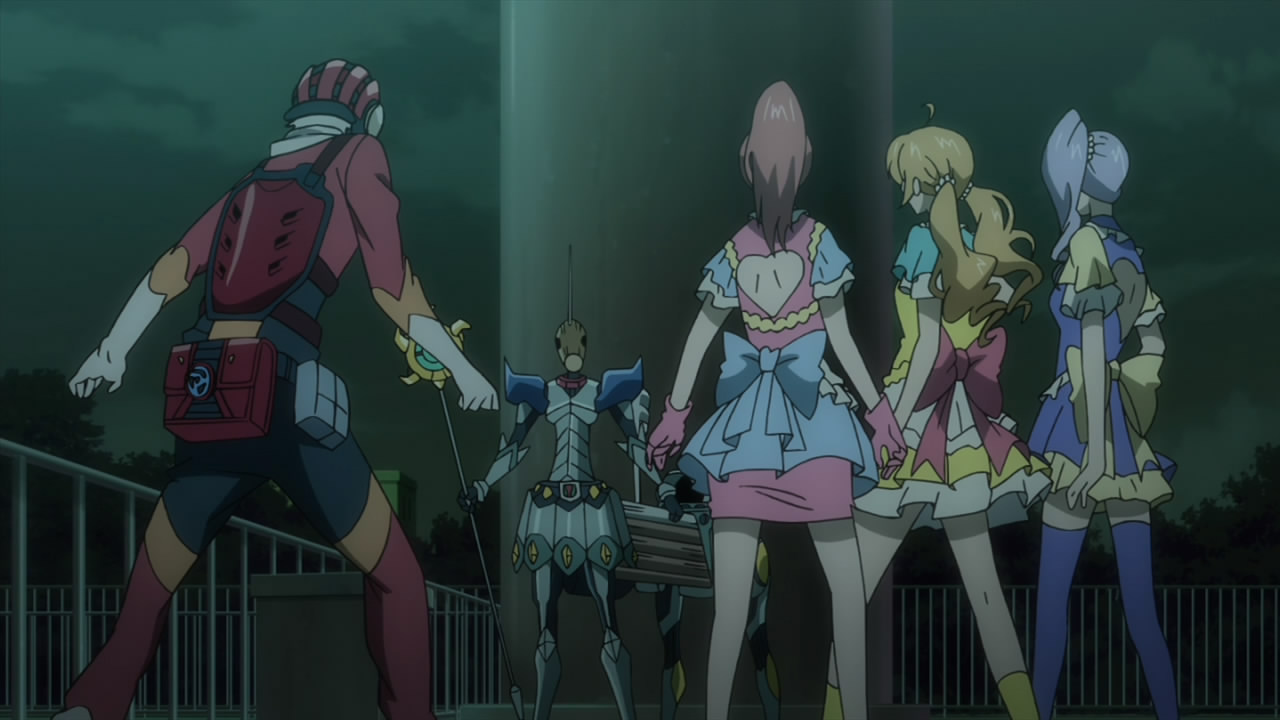
And then of course there is my favourite characters Mineral Miracle Muse, an idol trio who starts with main member Mari Maya, growing up with magical girls, deciding to become one by way of a magical wand/cattle prod/spike mallet hybrid and kicking men in the testicles a lot, eventually roping in Mizuki Misawa (serious minded) and Moe Morita (shy, explicitly romantically attracted to Mari). Their plot trajectory, even when they are sidelined for a chapter, are a great example of how the series in general succeeds; immediate jokes about them subverting magical girl tropes into violet interpretations, alongside the explicit yuri references and Mari's uniform fetish, give way to Mari's own existential crisis, some of the darkest material in the show, and the complex relationship between the three women that, in them being just as complex and diverse, keeps the viewer on their toes.

The subversion of the genre tropes allows Samurai Flamenco to get away with its whiplash inducing plot threads, a fleshed out world with ordinary characters that merely exist in this particular realm. It also, in among ridiculous villains who look like children's show rejects, a lot of serious moments and questions made of the tokusatsu genre itself. What it means to be a hero and fight for good, enhanced by the fact that not only is there real deaths, and even torture and psychological damage, but that two of the main villains throughout were even influenced by these heroes, one from growing up with sentai shows wanting to instead become a villain, the other inspired by Samurai Flamenco himself to become his ultimate nemesis. Even the humorous aspects of the jokes have weight to them, an early episode where a ransom being made on the internet to unmask Flamenco leads to one night becoming a nightmare for him, another in the From Beyond chapter, about such an evil group, eventually leading to so many monster fights in the metropolis that everyone becomes bored and apathetic.

As a result, I loved the series, an utter spectacle which was cleverly written and with a sense of its hecticness deliberately used to keep it being inventive and never slacking like many anime series, especially in their middle chapters, can get. Major plot threads in this series get finished in one episode in a way that's almost hilarious, and yet I never dismissed anything throughout Samurai Flamenco as anything but inspired.  


From https://caraniel.files.wordpress.com/2013/11/horriblesubs-samurai
-flamenco-08-720p-mkv_snapshot_13-10_2013-11-30_14-41-48.jpg