Showing posts with label OVA. Show all posts

Thursday, 10 October 2024

#281: Vampire Princess Miyu (1988-89)


Studio: AIC

Director: Toshiki Hirano

Screenplay: Shō Aikawa

Based on the manga by Toshiki Hirano and Narumi Kakinouchi

Voice Cast: Naoko Watanabe/Anne Marie Zola (Manga UK dub)/Pamela Weidner as Miyu; Mami Koyama/Stephanie Griffin as Himiko Se; Kaneto Shiozawa/Zach Hanner as Larva

Viewed in English Dub


If one wants a really moody late eighties anime, the original Vampire Princess Miyu stands out as one which neither gets into the gruesome ballpark of some of the more notorious from the straight-to-video era, instead a significantly more melancholic horror story. It is also a personal project for its director Toshiki Hirano, who was also the original manga author with the illustrations done by his wife Narumi Kakinouchi, prolific in both the animation industry, in manga and book illustrations. Credit to Hirano and the teams on both animated adaptations, they made sure to transfer her career designs and style to the moving image, Miyu beginning as a manga in 1988 and concluding in 2002, with additional spin-off titles. This franchise, beginning with four straight-to-video episodes, also marks as much a distinct part of Toshiki Hirano's career, an animation director who was as much one of the names part of that streak of more ghoulish and lurid anime from the eighties into the nineties, especially for the straight-to-video market, as much as for adapting giant robot stories. One adaptation which he had a firm hand in adapting all the entries for Iczer franchise, based on an hentai manga, but as an adapted in the first and most well known entry, Fight! Iczer One (1985-1987), is definitely one to cover at some point as a mecha story with explicit body horror, as a race known as the Cthulhu (in that spelling explicitly nodding to H.P. Lovecraft) are secretly invading Earth by sending down parasites which mutate human beings in horrifying body horror mutations, only for a female alien, teaming with a schoolgirl distraught from her family and friends being victims to synchronize with a giant mecha's ultimate power, to fight back with an explicit all-female yuri romance nodded to.  That is definitely as idiosyncratic as you can get for a title, though the sequels would move in their own directions, as Vampire Princess Miyu is in both forms, and as notorious his adaptation of Apocalypse Zero (1996) also was, which was not able beyond two episodes to really adapt a body horror post-apocalypse super hero with explicitly grotesque and Freudian monster designs. He has also had a remarkable comeback into consciousness with the 2021-2023 adaptation of Baki the Grappler, Keisuke Itagaki's martial arts series which was picked up for the streaming platform on Netflix and Toshiki Hirano has been a large part of the adaptation for.

The Miyu adaptations have their shared familial traits - Miyu herself is a dhampir, half-vampire and half-human, given temporary immortality and the ability to give this gift as a vampire to humans, in servitude to banishing the "Shinma", figures between the Japanese yōkai and general monsters who are terrorising the morals and not in the otherworld where they should be. After that however, there were notable revisions for the 1997-8 television series, felt with the first episode about a possible vampire stalking Kyoto, draining all the blood from female victims and terrorising the area. With the name of Shō Aikawa as the screenwriter as important to bring up, both notorious for many lurid anime straight-to-video titles from this era but also acclaimed for his later works in the decades after, you feel the pessimistic take on human beings throughout these four episodes even if there is a clear flaw to this adaptation, that at only four episodes it feels too short to stretch itself.

There is an exclusive character to this adaptation, a female spiritualist named Himiko who is introduced to a possible real possession of a girl asleep for days. Also noticeable is that, even if the English dub may complicate this, Miyu herself in this version is a very different character to the TV series, even if we learn of her tragic back-story in the last two episodes. She is more glib, happy (even gleeful) to feed off people, and has none of the melancholia of the version of her in the later series, instead a teen girl in attitude, the kind of macabre vampire who would frolic along the streets even if aware of the importance of her job, more so as she has all the advantages of being able to walk in sunlight and holy water being ineffective. The set up of the episode establishes the animosity of Himiko to her, in Himiko's own moral code seeing Miyu's glib attitude to the incidents. It also sets up this as a visually stylish work whilst also a pessimistic one about the Shinma fed by human incidents, Miyu's nonplussed way of disposing of them even if still with human causalities angering Himiko. Another prominent name, and a big get to have even if this was very early in his career, is Kenji Kawai, who would become a huge name in composing especially with his collaborations with director Mamoru Oshii, someone who would return for the 1997 Miyu series when he was a big name with a sense of respect for those involved for this production, one clearly made with love.


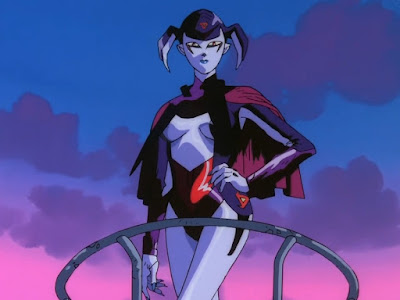
Episode two opens with a room of mannequins - some eyeless, some laid about like about like corpses - the result of a female Shinma who looks and dresses like a traditional Japanese doll if made flesh in her human disguise, one who at a high school turns people into said dolls as a literalisation of staying young forever, including the fact they can still bleed and are alive. This was my favourite episode as it plays with the mood and characterisation the adaptation was able to convey, in a work arguably too short to feel fully fleshed out able to have an episode here with the most complexity. Himiko is our assumed consciousness, believing Miyu (as a true anti-heroine here) is after the handsome male student the Shinma is after too just to take all his blood, only to complicate this further in that, as a teen girl, it reveals she was crushing on the mortal. He is entirely falling for a Shinma who does not realise her own love for him until the conflict hits it's fullest, and that one dynamic makes this really interesting especially with how the story ends. It is a really interesting one, [Spoiler] one where the Shinma wins but with the guy, even now as a doll as she is, finding true love dancing in the afterlife with her as sentient dolls [Spoilers End]. With a really distinct surreal style of these uncanny anatomically complex doll creatures involved and a romantic love triangle involved, this is the highlight for this adaptation.

Episode three is the team up story between Himiko and Miyu, if a begrudging one, with greater emphasis on the back story of Miyu and her friend/assistant Larva, who emphasises how, as vampires are not in Japanese folklore, many Japanese stories which have them reference their histories as foreign in origin, Larva a Western vampire part of explaining Miyu's bloodline origins, only to become her servant when she consumed his blood at a younger age, losing his voice and having to wear a mask as a result, details excised from the TV series. The last two episodes intertwine in dealing with Miyu's back-story, this surrounding Larva's brother trying to get to Miyu through a sentient suit of armour possessed by a dead soul, whilst episode four is set in Kamakura, around a story from Himiko's childhood in a strange house that turns out to be Miyu's old family home, explaining the tortured origins of Miyu becoming the Guardian whilst leaving the Himiko character, never to return, with the suggestion she may become like Miyu in a delayed reaction.

Then this version of the story was closed. The sense of this version of Vampire Princess Miyu ended abruptly cannot be ignored, still with a sumptuous mood and bittersweet attitude to humanity, but we would have to wait for the 1997 TV series to be able to try to flesh out this story. That was a reboot of this titular character in tone and details, losing the likes of Himiko as a character and replacing her with others, even a cute demonic Shinma rabbit, and using an episode tone to tell its story. My interest in both is for their ideas and their styles, something made with a distinct tone and attitude that is felt with one of its creators in the director's seat for both. Even in terms of a purely glib enjoyment, as horror anime, this wins me over for its tone, even in the fact that one of my favourite obsessions, a troupe of the straight-to-video and older anime of phantom worlds within reality characters kept ending up in which are surreal, are found in both because Miyu has her own pocket dimension she can enter on whim, which is a win on a petty level as a viewer.

Toshiki Hirano and Narumi Kakinouchi would continue, even after the end of the original manga series, to continue this franchise on in published comics to the 2020s, a beautiful collaborative life as a married couple who adored these characters and moods to these stories to continue them. Annoyingly most of this series in published form never got English translations, which is a shame as, especially with the success of Baki the Grappler under Hirano's directing hands, I would have thought a series he held so dear to him as his own creation would have caught interest. Especially in just this adaptation, its melancholic tone with a female protagonist that is noticeably in power, never sexualised in either of the adaptations in creepy ways, but in a series even known for yuri readings with certain character relationships, and this would be a franchise who would have won so many new fans in the modern era. It is a huge compliment to say that I could imagine a new Vampire Princess Miyu and, if Hirano was allowed to keep control of it, it would do gangbusters in popularity.

Saturday, 17 August 2024

#279: Giant Robo - The Day the Earth Stood Still (1992-8)


Studio: Mu Animation Studio (Episode 1–6)/ Phoenix Entertainment (Episode 7)

Director: Yasuhiro Imagawa

Screenplay: Yasuhiro Imagawa and Eiichi Matsuyama

Based on the work of Mitsuteru Yokoyama

Voice Cast: Kappei Yamaguchi as Daisaku Kusama, Sumi Shimamoto as Ginrei, Akio Ōtsuka as Kaei, Iemasa Kayumi as Chief Shizuo Chūjō, Kazue Komiya as Yōshi, Kazuo Harada as Dr. Shizuma de Montalban III, Kōichi Chiba as Dr. Franken Von Vogler, Masashi Ebara as Professor Go Gakujin (Wu Yong), Norio Wakamoto as Taisō, Rokurō Naya as Kōshin Chin Sanzan, Shinji Ogawa as Genya, Shōzō Iizuka as Tetsugyū, Tadashi Nakamura as Shokatsuryō Kōmei, Takeshi Aono as Issei (Gongsun Sheng), Tarō Ishida as Hanzui the Evil Messiah, Tomokazu Seki as Kaihō, Yasuyoshi Hara as Ivan, Yousuke Akimoto as Shockwave Alberto, Yūji Mikimoto as Inspector Kenji Murasame, Akio Ōtsuka as Professor Shimure, Chikao Ohtsuka as Jūjōji the Bell of Life, Fuyumi Shiraishi as Sanny the Magican, Hiroyuki Satō as Gen Shōgo, Hōchū Ohtsuka as Gen Shōji (Ruan Xiao'er)

Viewed in Japanese with English Subtitles


Giant Robo is not the best mecha anime ever made, but it is one of the best. That may seem a paradox, but I went into The Day the Earth Stood Still, an ambitious straight-to-video series with arguably too much build up as the best anime mecha work in existence. To those who know of this, it is a high bar for the genre, and thankfully by the final episode, it had earned that reputation, all in mind that with a protracted production length and a tragic inability to reach its intended original intentions, this could have easily become a flawed gem which we would have looked back on with a bittersweet "what if". It is more that to call something "the best" is a dangerous choice of wording, forcing a straightjacket which robs the power of the production, something that can be attested to when, to use another example from another medium, people may be put off from watching Orson Welles' Citizen Kane (1941) because when people called it the best film ever made, that forced it into a form of permanent stasis rather than the fact people love that film for a naturally developed admiration. Also it is impossible to say what the best mecha anime is as, being able to dig into the sub-genre, something as simple as a story involving a giant combat robot or two has been able to have so many idiosyncratic and inspired entries even in terms of flawed gems, let alone the canonical ones, that it seems pointless to compare them to find a superior one. The Visions of Escaflowne, a 1996 television series which finished its twenty six episodes when the final seventh episode was still being waited for from Giant Robo, is a completely different type of story set in an alternative fantasy world, making it ridiculous to compare it to Giant Robo's atompunk morality tale, or other works in their own molds, because they are drastically different to each other despite their genre tag.

Giant Robo could be called a throwback to an older school of mecha stories, but even that is not quite right, and not the same as mecha anime which were openly throwbacks, such as Masami Ōbari's Gravion (2002/4), with their own distinct touches. What I can call Giant Robo is a serious minded action tale at its heart, one that fully and totally succeeds in its conclusion, with a full narrative arch, in spite of the tragic knowledge this was always meant to continue on with more entries we will never get. This was originally meant to the second to last of a giant, ambitious tribute to the work of manga artist Mitsuteru Yokoyama. It adapts as its centre Yokoyama's 1967 manga Giant Robo, but one of the immediate things to point out is some of the idiosyncratic characters here. Set in the future, we have on Earth moved away from fossil or nuclear power to Shizuma Drive, a sustainable power source, whilst there is a war between the heroic International Police Organization and antagonists the BF Group (Big Fire) which involves a machine that can destroy this power source and send the world back into darkness. Part of the work’s idiosyncrasies is that for a modern day tale with giant robots, there are quite a few figures who have seemingly wandered out of an adaption of Chinese period epic. This is because, when the project was being put together, copyright meant side characters were not allowed to be used. Giant Robo had been adapted before, as a live action series screened in 1967 to 1968, and the confounding red tape which prevent most of the cast from the source being available lead to an inspired creative improvisation. This was that, with this a tribute to Yokoyama's work, they got carte blanche to use characters from his entire career, including so from an adaptation of The Water Margin, based on a legendary Chinese novel.

The decision had a drastic effect on the story, when the female lead Ginrei is from two manga, Wolf Constellation and The Name is 1011, which makes this an even more compelling tale if you knew of this, as this is legitimately a tribute to Mitsuteru Yokoyama‘s career. It is however not interested in pure service, but a serious story where characters do die and the stakes are legitimate in terms of dramatic tension. Even Big Fire is the same, with characters from a Romance of the Three Kingdom manga, and Yokoyama's magical girl Sally the Witch, one of the earliest examples, as the daughter of one of the villains1. With a story where even their morality becomes more complicated when facing the threat, a character from one of Yokoyama‘s period dramas, Genya1, is turned into the son of a scientist deemed responsible for destroying an entire country when experimenting with the Shizuma Drive, desiring to blackout the entire world in revenge for the distorted truth of that tragedy. Even characters from Tetsujin 28, Mitsuteru Yokoyama‘s other mecha creation, which is a huge influential entity in its own right, rock in for the story in probably the coolest nod to the show’s ambitious crossovers1.


The only characters from Giant Robo directly lifted include the main lead Daisaku Kusama, a young teen boy who has inherited the power of the titular Robo, who he can command from a wrist watch communicator. Whilst he has great power in his hands, alongside the fact it is later revealed Giant Robo is nuclear powered, causing concerns on his side of the potential threat if the machine malfunctions, he is a mere boy burdened with the chaos that will transpire. The villain has a justification for his rage, made worse as he is Ginrei’s brother, and the war to initially stop a series of experimental Shizuma Drive canisters getting into BF Group’s hands becomes one of dealing with an ultra powerful floating sphere which robs all energy sources of power in radius. Even among his side, there is the fact that, whilst she can teleport, Ginrei’s power sacrifices her life little by little using it, and that despite having a member who cannot die and is immortal, the International Police Organization throughout are fighting as the underdogs. The ironic tragedy of Genya's goal, what his father actually intended him to do with the power he weaponized, and all the sacrifices that lead up to this reveal makes this more potent. This is a case where, rather than the contrived sense that tragedy happens for upping the stakes, everything here is felt as dramatically powerful and this is where the legacy of this series is felt. It earns its drama, all through telling what a simple action story with giant robots lumbering around, all because it is taking itself seriously with the deftest of touches.

It is with knowledge the production was tumultuous. It started in 1992, and it took three years alone from episode six to get the final seventh one in 1998, enough time for director/co-writer Yasuhiro Imagawa to pen scripts for other work, including the 1997 Berserk adaptation, and direct the unconventional Gundam continuation Mobile Fighter G Gundam (1994-5), a big fifty plus episode production, whilst still helming the sixth episode from 1994. The solace is that these production issues are not seen in the slightest on the work itself. It has a strong aesthetic, arguably a “throwback” to older character designs from the decades before, but without any bias to this for me. By itself, this style is one of its own, based on its influence’s work, which provides its own distinct appearance. There is no sense that the time and budget that would have gone into this production, whilst likely torturous as was visibly a lot of resources, was compromised in the quality of the production. The closest thing to throwback it moving away from the kind of robots Gundam itself has, and whilst some in the story are more over-the-top in form, our titular Giant Robo whilst exaggerated feels like a construction built from pistons where each movement causes the earth beneath it to tremor, which adds to its own personality.

Considering what is on paper, a version of Giant Robo could have been a mess. It is a sci-fi giant mecha series with figures who have legitimate supernatural powers, from the ability to project fireballs to teleport, with the likes of a blue skinned Amazonian warrior from the Water Margins adaptation with a Monkey approved extending staff weapon among the roster, and a large amount of the cast not hidden in having ancient Chinese dress or military combat maneuvers in a story which has guns and air blimps.  Yet, it all gels together in a consistent logic of its own with spectacular set pieces and deep character telling, which is a huge accomplishment. There is of course the musical score, composed by Masamichi Amano with collaboration with the Warsaw Philharmonic Orchestra and Choir. A sweeping, appropriately operatic score to a production, it fits the tone alongside bucking trends, as it neither has any traditional pop songs for the opening and ending credits either that could have been sold off the back of the series. The gravitas of the story and how the production values is used to tell it, even in terms of how the likes of this score was chosen and put together, is why Giant Robo succeeds.

Sadly it was a work that struggled in its time, and only got the recognition it deserved as time went. My initial hesitance about the show, from all its weight of expectation, meant that it was a slow burn having to watch all seven episodes until the ending, where when the landing was fully executed perfectly in the last one. By its bitter sweet post-credits, it was a success entirely. Its pulpy veneer hides a pretty simple moral quandary – the idea of whether sacrifice is actually necessary to accomplish any event – and lets the characters and story run from this. Even if there is a nod to a future story that never came to be, it does not detract from the fact this does have a fully accomplished and told narrative by itself, and that in itself is a huge triumph.

======

1) Behind the Night's Illusions - the characters of Giant Robo: the Animation, originally published by Anime Jump in 1999. Archived from the original on 13th July 2003, and retrieved on the 1st January 2001.

Saturday, 20 July 2024

#277: Casshan - Robot Hunter (1993–1994)


Studio: Tatsunoko, Artmic

Director: Hiroyuki Fukushima, Masashi Abe and Takashi Watanabe

Screenplay: Emu Arii, Hideki Kakinuma, Hiroyuki Fukushima and Shō Aikawa

Based on Neo-Human Casshern

Voice Cast: Takeshi Kusao as Tetsuya Azuma / Casshan, Yumi Touma as Luna Kozuki, Hirohiko Kakegawa as Admiral Montgomery Dr. Lester, Ikuya Sawaki as the Narrator, Issei Futamata as Akbone, Isshin Chiba as the Operator, Junichi Sugawara as Barashin, Juurouta Kosugi as Commander Tork, Keaton Yamada as Dr. Kotaro Azuma, Kenichi Ogata as Elder Asari, Kenji Utsumi as Buraiking Boss

Viewed in Japanese with English Subtitles


Tatsunoko, over its decades of existence since Tatsunoko, has been retelling and rebooting its franchises repeatedly, always trying to keep them in consciousness, and to their credit, they take artistic risks to do this. It is not just the nostalgic market or all the video game tie-ins over the years, but how their retellings of their most popular characters over the years can vary from the pretty radical, or in a case like this, at least stepping up to the new decade they were made within. It does not always work - rebooting Speed Racer (1967–1968) in the nineties led to an animated series Mach GoGoGo (1997) which most may not know of, a take which told one giant race for a large portion of its length alongside changed the character dynamics. Some have been really drastic, like Gatchaman Crowds (2013/2015), readapting its tokusatsu team dynamic that some may know from its Westernised Battle of the Planets form, and turning it into something which striped the costumes, changed the tone, and was a superhero series over two seasons about mobile phone and online technology's potential to corrupt but also do good. Casshan himself has had some really idiosyncratic takes, created in 1973 as a superhero of android form defeating the robot empire of Buraiking Boss, who have enslaved humanity as this nineties re-adaptation sets up.  I think if I was to return to it, I would even defend the 2004 live action film, which was done in then-era CGI green screen with more emphasis on philosophical dialogue, for at least trying to be different. The 2008-9 Casshan Sins adaptation is the more radical for being a depressing epilogue to the original story, suggesting Earth is doomed anyway, as there is a rust-like virus even kills robots, and Casshan has to accept he is to blame for it over the series.

Robot Hunter is the least radical of the three, closer to its source premise even if with dashing of more adult content for the straight-to-video market, four half hour episodes released between 1993 and 1994, compiled into a feature length work for the Western Manga Entertainment release. In the world, robots have taken over and enslaved humanity, effectively predating The Terminator in the 1973 source material if with the caveat that, rather than kill us all, the Buraiking Boss realised we could be useful as slave labour in his robot factories. Casshan is spoken in reverence here, before his real introduction, as someone who will save humanity. He is actually Tetsuya Azuma, who in this story was a young man who willingly sacrificed himself to place his consciousness into an android to fight the Buraiking Boss, someone who, as in a lot of Japanese anime in terms of moral complexity, saw the only solution to preserve the Earth's natural resources and save the planet was to take over the planet.

The biggest issue with this adaptation is its length. It is nearly two hours long altogether, but if ever there was an anime that needed more episodes or lengthier ones over the forty minute mark even, Robot Hunter could have done with more elaboration on plot details. His father created Buraiking Boss whilst his mother's soul, literal and not metaphorically, was preserved by Buraiking inside a mechanical swan who without him realising she is passing her son information on his plans. There is enough in that in it, let alone the other plot aspects, to add greater melodrama to the proceedings. There is enough here even in this simple premise to pull form for at least a few more episodes, to elaborate on its science fiction premise, not just Casshan himself, accompanied by his android dog, man's best friend with flamethrower abilities, but also the human resistance. They still have enough forces and resources to fight back around the globe, but having to fight on the back foot. This includes the female lead Luna Kozuki, a love interest from Casshan's past that is yet emphasised as a member of the human resistance who is capable of handling herself.


She does emphasise the few moments of edginess this adaptation has too, not just the fact that, even in the apocalypse, she can dress resplendently in short skirt and immaculate ponytails. More telling alongside the few moments of blood, it is from an era where if even Chung-Li, the Street Fighter 2 video game character, had a gratuitous shower scene in the (uncensored) version of Street Fighter II: The Animated Movie (1994), and there is a blatant one here for Luna. That is crass to have to point out, but whilst she thankfully has enough moments of being a competent heroine herself, Robot Hunter's more curious aspects are these nudges of adult content which stick out more because most of this is not close to the edgier titles Manga Entertainment were realising in the United Kingdom for the "beer and curry anime" image on videotapes. Most of this could be shown to a younger audience than the one it has for a few scenes, rated as suitable for twelve year olds in Britain, and with content in live action that would be fifteen certificate if still tamer than most action films at that rating. Barring the few nude scenes, the grittiness of seeing people shot by the villains, and one revolutionary's unfortunate end, crushed under a bridge girder with lots of raspberry jam around him in one moment in episode three, it really is not a gritty adaptation whatsoever, with the robot enemies effectively allowing one to get away with cartoonish violence. Maybe it is over thinking this when the bar for edginess, even in terms of additional swearing added to the English dubs from Manga Entertainment, but it feels like a concession with some of these scenes for this release. The shower scene especially feels like fan service for the sake of it.

The actual production is solid, though this is a case where three directors and four screenwriters does evoke, even if not necessarily the issue here, of a title which lack a complete voice of one figure. There is Shō Aikawa among the screenwriters, once a notorious screenwriter of ultra-violent work who became a more acclaimed one, but there is also the consistent voice of Yasuomi Umetsu as one of the production's two character designers. Notorious for his work in hentai, and titles like Kite (1998) that could only be created originally under that genre, Umetsu is nonetheless well regarded for his craft and detail, and alongside Tomonori Kogawa as his co-character designer, you get a then-update to the franchise which is good and would have been spectacular to image with an expanded narrative which let the pair take the designs they had further. Even Luna's character design, despite my joke about her immaculate costume jarring against the world, is still memorable, alongside whoever (including other designers on the title) who decided to give the Buraiking Boss a Goth female robot henchwoman, looking like cyber harlequin in black eyeliner. (For obvious reasons as well, with its elaborate action scenes, the mecha designers and animators also deserve their credits for their hard work too). Working with Tatsunoko, the studio Artmic are a product of this era, with their last work in the late nineties. Their catalogue of films and straight-to-video work is a cornucopia of nineties and eighties anime aesthetics and tropes in a filmography, from Bubblegum Crisis (1987-1991) to Genocyber (1994), always collaborating with other studios on their projects.

All my issues are with the plot structure. The plot as it is mapped out makes perfect sense - setting up the world and Casshan, with the final conflict as played here between him and Buraiking Boss as well done as you could hope - but is more the sense we could have done with more story beats. There is teased more androids with the ability to control the ecosystem, living on an isolated island, who sadly never properly appear, and the middle of the production, episodes two and three, could have been have multiplied and increased into more tangents and depth to details like these figures, from episode three, or the main characters themselves. Casshan himself, alongside the limitations of his body, including requiring solar energy to power, has the additional primary crisis of whether he will lose consciousness and become a killing machine, whilst Luna, from the original series, has the conflict of needing to both help save humanity, but naturally concerned for the man she loved and hoping for the likelihood of him becoming Tetsuya Azuma again once the fight is over. There could have, in general, been more elaboration on the scenario, more emphasis on the human rebellion and the Buraiking Boss' forces, including a general sense of the grit and stakes at hand, especially with the uncomfortable idea leant into Buraiking's desire to replace humanity comes from his belief we humans will just destroy our planet, our failure to preserve it causing his existence to be. The slightness of some straight-to-video works has been a problem I have seen in quite a titles, and sadly this is a case, where everything here is perfect and could have been spectacular even as just a fun OVA, but we are just missing enough detail to nag.

Wednesday, 3 January 2024

#273: Cyber City Oedo 808 (1990–1991)


Studio: Madhouse

Director: Yoshiaki Kawajiri

Screenplay: Akinori Endo

Voice Cast: Hiroya Ishimaru as Shunsuke Sengoku, Kaneto Shiozawa as Merrill "Benten" Yanagawa, Tesshō Genda as Rikiya "Goggles" Gabimaru, Emi Shinohara as Remi Masuda, Kyousei Tsukui as Versus, Mitsuko Horie as Kyōko "Okyō" Jōnouchi, Norio Wakamoto as Juzo Hasegawa

Viewed in Japanese with English Subtitles


Madhouse would have success with Wicked City in 1987, one of their more infamous titles which helped when its director Yoshiaki Kawajiri pushed for a theatrical release and it paid dividends for the studio1. That was however an adaptation, based on the work of author Hideyuki Kikuchi, and with Cyber City Oedo, Madhouse and Kawajiri decided to create their own original intellectual property, one which was meant to be a multimedia one. This came to be true as there was a video game, the 1991 game for the PC-Engine CD-ROM², and a novel1. Cyber City itself, made for the straight to video format, was only to last for three forty plus minute episodes, never leading to anything further, but still became a cult anime in the decades after, even if by way of alternative dubs and music tracks being created for the images as we will get into.

Oedo is a cyberpunk tale where, with criminal sentences possible to reach longer than the average human lifespan, prisoners are forced to live in the orbit of space, presumably in a way to extend their lives to suffer for their cybercrimes. Three prisoners housed in an orbital prison are offered an alternative by Juzo Hasegawa, a police chief, that they can reduce their life sentences for each criminal they bring in, with each having to ability to return with life on Earth but with explosive neck collars permanently on that, able to be timed, prevents any prisoner to take this offer to flee once they are back in public. This explicitly nods to period chambara tropes places in the future as "Oedo" is likely a reference to "Edo", the original name for Tokyo, whilst in Japanese history, the weapon they are all assigned, jitte, if a science fiction version of a weapon, with sai-like blunt ends, that was used by police in Edo-period Japan. Beyond this, the straight to video series is a hyper-exaggerated world, where in episode one, the main location is a space-scraper, a skyscraper so comically impractical in height, now in orbit at the top, that if the central threat managed to disable the gyroscope fully and cause it to fall, it would have led to a natural disaster of cataclysmic proportions. This has a variety of tropes and clichés of this type of “cyberpunk” of androids, cyborgs with psychic powers, and one of our leads having monomolecular wire, a concept the likes of author William Gibson, a huge figure in cyberpunk fiction, among other writers were obsessed with where you have weaponised wire so sharp on a molecular level that it could cut through anything, even through the neck of a cyber enhanced saber-toothed tiger. The leads, interconnecting as regular characters, however do get the starring role each for the three episodes, Shunsuke Sengoku the lead for episode one in the space-scraper. Sengoku is your typical hothead, who is heroic as an anti-hero figure but also anti-authoritarian, with a love-hate relationship with Juzo and especially against the sentient computer that occupancies them. This computer is arguably the fourth lead and deserving it, as the deadpan retorts in the Japanese dub are very funny, all from the perspective as an AI which cannot understand some of the insults thrown at it, such as when it has to explain how, with an internal geo-map system, it cannot possibly “get lost” on command. For episode one, with Sengoku and his constant argument with this robot, you get a great first episode to begin this work, where the serious tone in spite of how absurd this is in truth works fully.


Rikiya "Goggles" Gabimaru stands out as a character that would rarely get to be a lead in an anime, an older man if with a Mohawk, the more conventional of the noble anti-heroes despite his visual look.  His is the type of macho melodrama, which is secretly sentimental and melancholic if filtered through acion tropes, encountering an old partner of crime who was also his old flame, involved in a conspiracy involving the corrupt military project of psychic robots. The owner of the monomolecular wire, and lead of the third episode, is Merrill "Benten" Yanagawa. Benten inherently stands out of the cast as, among very distinct characters in the history of anime, even minor ones, you have here an ultra androgynous final lead, a really distinct figure who is probably the most iconic for the whole production, bringing up a combination of glam rock feminization, with red lipstick and hyper feminine features, with kabuki aesthetic and a shock white mullet, aged in designed but entirely timeless. His episode also is the most idiosyncratic even in a very stylish and creative production, in that this brings horror tropes into science fiction with artificially created vampires. The result of this brings a gothic and moody sensibility to the proceedings with the first ounces even of tragedy to the production, as it involves a woman cryogenically preserved doomed in this life forced onto her by another, as it ups the gore in imagining an undead individual being driven out an airlock in space. It is this episode particularly where the show's ability to be serious despite also being ridiculous shows the virtue of this tightrope act, intentionally and unintentionally.

It is a ridiculous anime in a good way, where we are dealing with a premise where there is never a moment stopping to question its own logic or feeling contrived in a way that undercuts faith in the material. Cybernetic saber tooth tigers is a high watermark in the absurd, as mentioned earlier in the review, but found in episode three, this takes it further with them kept in a cryogenic hub in tubs among three hundred year old patients, a place in outer space connected to a hospital by a space elevator, and armed with lasers, with the anime managing to add more flourishes to these sort of moments. This is throughout each episode with all these "questionable" moments becoming highlights alongside the tone and style of the work winning you over. The seriousness of the production helps, feeling like the delirium usually found in a video game from this time, and helping this is how this is Madhouse at their highest of quality. Yoshiaki Kawajiri is an insanely talented figure in anime, even when he is in the animation department after his directorial career seemingly ended into the 2010s, but as much of the virtues is the entire staff too, where your mechanical animation director for an example is Takeshi Koike, the future director of Redline (2009), one of the most underrated theatrical anime in need of greater attention and showing where his work here before came from.

The audio is its own curious history for the OVA. I watched this in the original Japanese version, but the history needs to be marked how, whilst Manga Entertainment bought the license with great interest, they took their own decisions which added more to the story beyond a good pulp anime. They were known infamously for "fifteening" their dubs already, where to increase the age rating with the British film classification for all physical home releases, they added swearing into the dialogue alongside adding their own flourishes. This is an idiosyncratic production however in that they went further in changing the music track. I like the moody synth provided by composer Kazz Toyama, but if you are talking of Cyber City Oedo, specifically to its British release as the Central Park Media/U.S. Manga Corps release decided to not go forwards with this choice in the United States, you have to talk about this version as it is part of the legacy in the West. Rory McFarlane's contribution, combining hard rock, thrash metal and synth, even influenced by Mountain's Nantucket Sleighride (to Owen Coffin)1, is a distinct score to hear, and thus it is worth talking about too as a highlight even heard in snippets. For Kawajiri himself, this is getting into the golden period of his career between the late eighties to the 2000s, one where you see here that, for all his notoriety with certain titles for their transgression, what his trademark was, whether the screenwriter of the story or not as in this case, his trademark where these kinetic stories of larger than life figures, in larger than life scenarios, which never for all their moments of absurdities feel entirely a high quality in grandeur for this era of pulp anime storytelling. Even Ninja Scroll (1993), which shared in the more notorious content of his career, showed this and, in spite of the knowledge Cyber City Oedo was not the biggest hit as Manga Entertainment hoped for1, that would benefit from the virtues found here, in a period chambara tale, and gain even bigger status in Western anime pop culture among the other titles Kawajiri would helm.

=======

1) Taken from the documentary Inside Cyber City Oedo (2020), directed by Andy Hanley.

Thursday, 28 December 2023

#272: Bio Hunter (1995)


Studio: Madhouse

Director: Yūzō Satō

Screenplay: Yoshiaki Kawajiri

Based on a manga by Fujihiko Hosono

Voice Cast: Kazuhiko Inoue as Koshigaya, Toshihiko Seki as Komada, Chikao Ohtsuka as Bokudo Murakami, Tarô Ishida as Seijuro Tabe, Yuko Minaguchi as Sayaka Murakami

Viewed in Japanese with English Subtitles


Recreating Wicked City (1987) in the opening, this feels like a throwback to eighties ultraviolent anime with breast dentata and someone actually getting their hand bitten off. We still got violent anime in the nineties, especially in the straight to video market, but notably, this has a connection to the past that, whilst in a screenwriting role, Wicked City's director Yoshiaki Kawajiri is involved in this production. This does mean this feels like a return to the films he and studio Madhouse made in the eighties, only with another director taking on the reigns in Yūzō Satō, and also the unfortunate sense of this feeling like a weaker Kawajiri work, still worth a rediscovery, but having to be compared to someone who became more interesting when the more controversial aspects of Wicked City were being removed from his own work. There is also the difference here that this is, in context, a very late era OVA. Whilst many would still be made into the 2000s, they changed in mood entirely as different technology was being brought into animation production, changing them even in how they look right down to the use of colour even next to works just from the early nineties.

Molecular scientists and professors Koshigaya and Komada work in an illegal but virtuous side job for the sake of humanity, in which this world has a "Demon Virus" which mutates people into flesh eating monsters. Like the young woman in the opening who becomes host to a few on her form like parasites, faces and mouths appearing on her body, whilst another later on eventually has gone so far he is effectively undead and controlled by the parasite in the centre of his chest, this has the potential to be a huge problem for humanity as a whole, as well as allow some of the most creative aspects of the production, meaning our leads have had to research ways to stop cases and also kill them if need be. One of our leads is infected himself, able to control his condition as far as be able to shape shift back and forth in forms, thankfully at first just needing to eat a ridiculous amount of food to sate an evolutionary take on yokai and monsters. It is certainly a shift for its original author Fujihiko Hosono, who contributed the source to another curious one-off OVA Judge (1991), explicitly a supernatural story about the supernatural judge of sinners, especially in his case those who are practice corrupt business tactics. Touches like this make Hosono's work quite a curious one in how he shifted tones per manga.

The condition our lead Komada has will still become a problem over this one-off story, alongside the angst of his position, especially as control is slipping and a young woman comes into his life named Sayaka, connected to a grandfather and famous fortune teller who has gone missing. Her existence, more of a damsel sadly for most of this, raises the question of whether he could ever in his position fall for someone or end up eating said girlfriend if the control vanishes entirely. A serial killer who chews on intestines and eats the livers of young women is connected to this, unfortunately connected to a powerful politician and his armed goons who are a credible threat to both leads. As an hour OVA, you only have enough time for a short tale, though this is an adaptation for what was actually a very short manga from Fujihiko Hosono himself, and possibly told the entire tale there in animation here.

Revisiting Bio Hunter, it feels like an object from a different time period, one which should be approached with in some caution due to this streak of transgressive sexuality, namely having female victims to these monsters being undressed, which will be understandably uncomfortable for some. Most of this film though is just gore, from the blood to a severed hand moving independently on its own free will on a rescue mission, and a set up to a literal punch line with a heart being ripped out. Truthfully, alongside its weird mishmash of scientific rationalism with occult leanings it still wants to get into, including trying to rationalise fortune telling as a superpower, the leads are the least interesting thing as in many of these, next to the mood and tone. It loses a bit of this due to Kawajiri sticking in the screenwriting position. Whilst Yūzō Satō became a veteran by the modern day, this does miss some of the tonal choices which did make Kawajiri's work his own, such as his trademark for a "Kawajiri Blue" in depicting night-time scenes.

There is enough here which evokes the atmosphere a lot of these anime had. Even without the monster designs - the final villain a host with the creature in his chest, and a discomforting nod to tentacle symbolism of Urotsukidôji and its ilk - it has something of its own that, even as a slight story, does stand out with interest. By this point however, whilst Ninja Scroll (1993) does have some discomforting scenes, it showed that this type of action anime, with tangents into horror, fantasy and/or science fiction, from Yoshiaki Kawajiri was far more than this, whilst Bio Hunter is more of a curiosity in his filmography. It is entertaining for what it is, but just missing out something to make it stand out more than this or its style.

Tuesday, 21 November 2023

#269: Maris the Chojo (1986)


Studio: Pierrot

Director: Motosuke Takahashi

Screenplay: Tomoko Konparu and Hideo Takayashiki

Based on a manga by Rumiko Takahashi

Voice Cast:

Japanese: Mami Koyama as Maris, Jouji Yanami as Murphy, Junpei Takiguchi as Colonel, Sumi Shimamoto as Zombie Sue, Toshio Furukawa as Koganemaru Matsushita

English Dub: Sharon Holm as Maris, Dominic Taylor as Rogane, Harry Ditson as General, Kerry Shale as Murphy, Stacey Jefferson as Sue

Viewed in English Dub


Rumiko Takahashi is one of those huge names in Japanese pop culture, a huge author in manga since her beginnings from 1975 under the guide of Kazuo Koike and 1978 professionally, and like so many like Go Nagai to Koike himself, there are the titles which became her calling cards and other obscurer ones which also managed to get animated adaptations due to the status Takahashi gained. For Takahashi, obvious bigger hitters include the Ranma ½ and Urusei Yatsura franchises, whilst Maris the Chojo, also known as Maris the Wonder Girl or Supergirl, was a one-shot manga from 1980, part of titles which would be collected under the Rumic World reprinted sets of short stories years later. A beautiful looking opening in outer space introduces the titular Maris, causing one to presume this is a serious action sci-fi story in which this figure, a space bikini wearing space cop who has to stop crimes across the galaxy in this well animated eighties production. What it also turns out to be is a comedy as Maris has the worst of luck despite her talent for terrorizing evil doers.

Maris does have a tragic back story, a riff on Superman to befit an alternative title for the Central Park Media release when they sold this on VHS, where her surviving species were forced to become intergalactic refugees when their planet imploded, but mostly this follows a trope that works exceptionally in anime when it succeeds, that of the hero/heroine who is hopeless and out of luck we sympathize with. With the strength of more than six humans, as all her species, the choice of bikini is less of note than the bindings she has to remove to be able to use her full strength, allowing her to kick alien goons to the other side of the room and causing villains to literally urinate themselves in fear, but also leading her to accidentally break her entire ship when she forgets to put the restraints back on. With a talking seven tailed fox helper named Murphy at her side, able to transform into anything if in sevens only, and amusingly given a broad Irish accent in the English dub, this is clearly more playful in tone when the story proper begins, and I find it sad this was never expanded beyond its one-shot nature originally, as these characters immediately have a lot to work with.


Including two extended music video sequences, the first on an intergalactic beach resort with a Jaws parody and a bandaged mummy enjoying their sunbathing, this is a farcical action comedy where our space cop Maris is sent after a kidnapped son of a billionaire. It is more of a character piece as this is a trope as old as time in anime, that of the hapless hero constantly in debt, her family all having restraints which they forget to keep on, leading to property damage their daughter has to pay off alongside her mother’s shopping sprees, whilst her diminutive (i.e. pixie sized) boss has debts from every spaceship they have lent her she keeps breaking or letting get destroyed. Maris is sympathetic, even if her fantasies of marrying the kidnap victim are less romantic but for all the money he has. She is someone forced to take other jobs on vacation because she is constantly broke, even tricking horny male customers with her good looks to actually pay for a human taxi service where she just carries them, and even in her imperfect form, she is the kind of lead you get so much sympathy from as a lovable goof. This is added to by both being ahead of her time as an ultra strong female character and also because, metaphorically, characters like this in anime even in fantasy settings cannot help but suggest their real life counterparts. More so this as the daughter and sole breadwinner to a family constantly being hassled by phone calls from her parents needing money, Maris is s single woman having to put up with debts, even with the equipment for her job that gets damaged by pure accident, and finding it sucks like if for anyone else in a less fantastic job who could have read the first ever one-shot manga.

She is of that time as well as, visibly, another influence on this story was female (joshi) professional wrestling, which was a previous job for Maris alongside the villainess making the reference explicit; stuck with a broad southern accent in the English dub like too many did, this figure of Sue is noentheless another sympathetic figure from the same planet as Maris, who for her scheming just wants to buy her own elaborate lair, a former in-ring rival to Maris who also like to get payback from previous loses likely involved in their history. This has aged like fine wine as a joke, as the legacy of women's wrestling in Japan has gained more recognition and burns brightly still decades later, but it also plays to the fact that, as another eighties franchise Dirty Pair was explicitly inspired by female wrestling too, when coming up with two female space mercenaries, Maris also shows when this spectacle in Japan was a huge pop cultural phenomenon too that was influencing other mediums too. There is a rematch in the squared circle in the climax between the two female figures central to this story, and what little we get here from Studio Pierrot is clearly them having fun. A studio with a long history in the medium, the creators were indulging here in the positive way like so many of these one-shot productions, getting in references like to Star Wars characters in the background you would not be allowed to get away with in later decades, due to the stricter copyright practices that would come in, to the end credits having faked outtakes, all of Maris and other characters tripping, getting injured or even blown up. As a one-off OVA, sadly, you cannot go further than this in speculating where this could go with the central character, and in this case, there is also the knowledge Rumiko Takahashi only wrote and drew one single manga story for this, not a vast volume of chapters. As with so many of these titles we could have gotten a longer OVA series if not a TV series, only with the knowledge that the material this adapts was not as long either to consider, there is enough to admire, but it leads to feeling like a taster to a work you can only imagine the vaster adventures of.

Sunday, 12 November 2023

#268: Offside Girl (2007)/University Girls (2001)


Studio(s): MS Pictures (Offside Girl)/Obtain Future (University Girls)

Offside Girl based on a manga by Ippon Nagare

Voice Cast for Offside Girl: Nene as Miyajima, Kenkou as Akira, Nanami Natsukawa as the Coach, Ryoko Tanigawa as Nanami

Viewed in Japanese with English Subtitles


Attempting to cover what most know it as "hentai", alongside any self-consciousness you may feel in whether it presents a negative image of you to strangers or not, is confounded with how like some erotica, they focus on their subject, the act of sex, even if the story is very simple or pushed to the side. In a case like this, you are also confounded by the fact that, combining the two episodes together, Offside Girl makes up less than thirty minutes, and University Girls is only twenty two minutes as one single piece, neither being continued and leaving not a lot to work with. But there is something worth prodding even if you will get into NSFW content with how these works, and erotica in general, say a lot about people, more so as the reason I wanted to cover these was not really to cover hentai just by itself. I wanted to cover them as much because as of November 20231, these are the lowest ranked hentai anime on Anime News Network's list of lowest ranked anime, which means as per viewers of the site, this pair is in handshaking distance to notorious works like M.D. Geist (1986), Tekken: The Motion Picture (1998) and EX-ARM (2021) which have gained infamy. The hentai is itself is less likely to be as talked about as titles which could get a wider range of access without the restrictions on selling hardcore materials, which makes it interesting to wonder how they got on that list. Among hentai in terms of premise, when many I would even want to touch with a barge pole let alone ever witness, thankfully these two are tamer in ideas, even if Offside Girl gets into curious kinks, and all their notoriety comes from their production.

Truthfully, we watch action films as much for set pieces as much as the stories, horror films for the vicarious and gruesome moments, and erotica for their sensuality, and with outright pornographic content, in mind to all the issues of their gender politics and attitudes, the ideal is an idealised and in cases exaggerated take on human desire, even if dealing with fetishes and kinks which may come off as weird for some viewers, meant to deal with these ideas in a consenting construct between creator and viewer. That is one of the reasons "hentai" is a term I feel less happy to have to use as its literally the Japanese term for "pervert" and ridiculous to implement, when "eroge" for Japanese erotic video games is one I wish I could steal for this review but have to keep to the parlance we use in the West to avoid confusion. Animation has the advantage, even if it may cause viewers to feel weird to feel desire to figures that do not exist and can be un-human in look, to inherent emphasise a creative fantasy, something to bear in mind as Offside Girl and University Girls are ultra low budget works who struggle with this, and that is why they got the bottom ranks. One of the issues with eroge anime too is that, like live action pornography, the medium is pushed more for content than to try to emphasis artistic content, ostracised in society and with the medium a way for people to access them. This is not to dismiss the potential for this in the medium or manga, let alone live action erotica, as you can envision purely titillation in work made with authorial creativity and a wider scoop like LGBTQ themes, but in mind that it has become a genre, as much as live action where it has been attack and forced to be its own industry selling the sexual content, you have an uphill struggle in making a large budget an acceptable choice in terms of a market. The best example of this in hentai was when the acclaimed illustrator and manga artist Satoshi Urushihara co-directed a high budget hentai Another Lady Innocent (2004), a melodrama set in the period American South, only for one episode to ever to be created in his life time due to how its production, legitimately well made as an animation work, likely cost too much time and money to make when anime in the industry can be made quicker and sell the sex in a faster time. The two being covered today show an extreme which did not gather very well regarded reactions to them, in trying to make erotic anime for audiences in a compact time, but even if the artistic side of the genre should not be dismissed, so much is made and not really talked of that it is like a crap shoot trying to pluck something out, let alone two chosen here for this review as the "worst" for some of their kind.

Offside Girl was the more interesting one because of its premise, and to pull back the curtain was meant to be the single title covered until University Girls turned out to be lower in the rankings, in which its lead, a female student, is smitten with a guy far more interested in being on the men's soccer team at their school. Soccer is as popular in Japan as globally, and imagining a tale of a young woman having to work around his obsession is interested in any genre. You can have a sex comedy premise about this in Britain, where it is called "football", and there is in fact a film called Fever Pitch (1997), a romantic comedy, in which actor Colin Firth played a man obsessed with the sport, based around a memoir by Nick Hornby and set around the team Arsenal's First Division championship-winning season in 1988–89 and its effect on the protagonist's romantic relationship. It is a far more curious premise though to mix porn with sports, just to imagine if you let the soccer nerds get away with references to the sport, and parodies of franchises like Captain Tsubasa, one of the biggest in terms of Japanese manga and anime for the sport, without getting into copyright trouble, against what is effectively a tale of two people who discover they like each other very quickly physically. He tricks her into becoming the manager of the team as part of its comedy tone, effectively the dogsbody who cleans the uniforms and keeps their spaces clean, but when they are forced to hide in a cupboard, soon into the first episode their crush becomes a physical one, and baring in mind aspects of this I would understand being criticised and viewed as sexist, this effectively suggests as a premise two young people, around the sport of soccer, realising they love each other but in a very kinky and polygamous way. The immediate issue is that, if you were expecting the soccer references, be disappointed as you do not even see a soccer ball, barring a musty one in their main team building, nor any sports, as this barely has any content beyond the set-up.

Neither expect more than this. You get barely any context beyond the basic interactions, and most of this is actually depicted in close-ups where you do not see many feet let alone soccer appropriate footwear on people, and it is here the true reason this got so low a rating really comes in on Anime News Network, in that Offside Girl also at times feels like a motion comic or actually a manga if the speech bubbles are replaced by the voice acting. Some of the illustrations of the cast, mostly drawn in minimal close-ups, do look wonky, our female lead finding herself eroticised but also distorted physically in a work which had few resources to work with. The studio behind this, MS Pictures, have made anime beyond this and before, titles with evocative names like Fleshdance (2007) from the same year as this, and yes, that is clearly a pun on Flashdance (1983). They were not going to lose sleep over this production, one where it feels as if the production became less a priority or was allowed to fall down, as this is insanely raggedy for any level of budget.

It actually emphasises the commitment the cast have to put in, even before we get to the absurd dialogue, the voice actresses especially having to go from nought to up to eleven to get this exaggerated form of eroticism over in their bellows. This is where, if I had been worried as a viewer being viewed as a perverse covering this, or anyone was to be put off the subject, you cannot dodge covering the sexual content itself as the driving force of the animation. You have to factor in with both of these works that, with millennia of objectification and oppression of women, this factor will always effect a person's reaction to a work that is geared clearly for a male heterosexual audience, in its eroticisation of the female figures even as mere drawings; like the two female leads in University Girls this follows a fixation on larger bra cup sizes, here with the obvious concern that this is a figure in school despite age being vague this never dares get into, and to how when the second female character is brought in, they can have sexual relations in a fantasy scenario for men, but this would have not teased with male bisexuality too. In mind to all the issues surrounding erotica for their portrayals of the subject, it is clearly exaggerated and unless one is documenting one's own real sexual experiences, the bigger issues alongside confusing this with the reality of sexual relationships is when they forget that people (men and women) are fully formed people, and even if the issue is a bias towards focusing on certain audiences and stereotypes, it is also in mind that many do not play to this to their better in letting the cast even in a fantasy for a heterosexual male audience feel like they are in on the pleasure as the male character/audience. This is more of an issue here as, whilst I would utterly understand someone labelling Offside Girl sexist, it is pretty tame baring touches, and the greater issue alongside the like of time and budget this had is that you do not get characters even as broad stereotypes. Especially with the female lead, who should be the focus on the character dynamics and journey in this tale, where she comes to appreciate soccer and also discovers her own sexual desires, this should be as much where she gets to have fun as the lead, not just go through the motions. Clearly, because this barely establishes the story let alone actually tells one, you cannot tell the direction this went unless you go to the original manga by Ippon Nagare, but even here, you could have had a few more touches to her in what little time you have.

Some would argue, if they saw the second episode where a female coach is introduced with a fetish for managers of all kinds, male or female, that it crosses a line when she could be seen as molesting the lead, and then is "punished" by a male member of the soccer team. In context, the scene is frankly evidence of the production's flaws, vague and confused, and a huge issue with erotica in general where, unless you are dealing with something legitimately misogynistic in tone, you are dealing with fantasies without the appropriate sense of the construction of a consenting world between characters, and between the work and the viewer, where arguably the issue here is also one you need to challenge anime outside of hentai in general for the same issue, as unfortunately that type of scene is one found as the "joke" for many works even into the Millennia. The rest of it comes off more like a really kinky four person fantasy scenario despite nearly edging the line too closely; the "punishment" moment surrounds everyone on the team being aware of their female coach's interests and one of the other players being in a relationship where this is played to, whilst in a scene which did not feel uncomfortable at first, it would be our female lead role-playing being "helpless" to the female coach, rather than play it as what comes as the one really problematic scene in all of this. Whilst not a lot is here, a moment of tone-deaf writing comes in to emphasise that no one was thinking through how to not make a scene nearly become gross.  

There is also the surprise inclusion of a lactation fetish, but with mind that the female coach is not an older woman who has had children, nor there being any other female characters until the last scene of the final episode being introduced. It involves the titular protagonist herself, where her love interest even asks when he discovers this of her whether she is pregnant. It is a curious inclusion, a kink which may put off some, or cause others to roll their eyes as it is a young female student where the fetish comes in, as in reality, it is rarer outside of childbirth including chemically induced methods for this to physically be possible. The fact that it is separated from motherhood, whilst could be accused of a fetish not accepting the reality of human life, also factors in how it is nether for the pleasure of anyone else but the "Offside Girl" herself, where there is a kink about being touched and caresses whether by herself, as in the first scene of the first episode, or by others. These quirks, even if this is porn not thinking hard at all about the accidental symbolisms, can be read into for how you could have gotten something that fully embraced a more bolder, progressively kinky tone even if the reality is alien to this and not helped by its complete lack of budget. A heroine with the discovery of how tactile touch is central in her fantasies is a premise with a lot to write about, seriously and comically, even if you are not going to more here baring a nod to the idea, which is the problem in general with all anime, let alone hentai, where you have one-off or stray episodes to a premise never allowed to ever grow into a full narrative.

University Girls, also known as Joshidai Ecchi Sōdanshitsu, is a more conventionally plotted tale, a one-off erotic story. Madoka, our female lead, is also a student, despondent when she barges in on a male teacher she is attracted to on the university campus mid-coitus with another female student, later to get advice from her friend Yokko to be more confident with him. The set up, with student-teacher relationships, has become more taboo over time even between adults, and this short anime is not going to pass the Bechdel test for how the leads talk mostly about sex and men, but it is a surprise even when this comes to the final scene punch line where it goes, in that this story is about sexually confident women in charge. This is in mind, with most erotica targeting heterosexual man, you are dealing with work that plays this with the female as figures of fantasy, but this still gets into how Yokko, helping her friend, is in a BDSM relationship with the psychology teacher where he is completely the submissive, to literally be walked on, to pleasure her and Madoka when invited to be an additional dominant, and leading to that aforementioned punch line where to Yokko's dismay the hot male teacher wants to be a willing submissive to her after a trip to the love hotel.

Even details like this, whether accidental or not, make something like this which most would not sit through more interesting. In terms of BDSM, with one man being stepped on in shoes, a whip used in multiple ways, even when it comes as an improvised prostate examiner, it is strong if you have never seen a depiction of this, but is also tame when one is aware, with careful rules in place in the BDSM community between the dominant and the submissive, you can get into things like blood play, piercings, confinements etc. in a healthy way, making this look vanilla. Hentai is not a topic I want to cover mostly because of the stuff that would even challenge my belief in the freedom of art, by way of permanent banishment from record with fire, and sadly Obtain Future in their short existence did tap into themes which I am creeped by myself, but it also comes with this sense of them literally throwing anything at the way to see what sticks, leading to University Girls inexplicitly being about strong women in control for their pleasure even if, in context, I suspect no one was necessarily thinking about that as the driving force of the title, just the fantasy of men being dominated by men plus some more conventional sex scenes. Most of their work is also on the bottom list of Anime News Network, and in this case, we cannot ignore the animation elephant in the room as, even if trying to be positive, even I have to admit to thinking Offside Girl looked like a step-up in animation in comparison. Best way to describe it is early Flash animation, homemade, which managed to be released on DVD in the USA by Adult Source Media. Adobe Flash animation was able to let some very talented creators make both animation and web browser games from them, from the likes of Foster's Home for Imaginary Friends (2004–2009) to the game Frog Fractions (2012), allowing anyone to show incredible talent, but it was also a way to let anyone animate regardless of resources, and undeniably, flash animation on the likes of Newgrounds also includes pornographic work, capable as much artistic quality but also something like University Girls. The voice acting at times even feels like friends or people the creators knew earnestly trying their best next to the performances in other work, especially the actress playing Madoka when she has to cry in one scene. In a work which inexplicably references Sigmund Freud at one point, this feels like with hindsight a work unfairly forced into daylight as an actual DVD release, which unfortunately put in its the crosshairs of anyone gathering the hentai releases from that time.

This review has to factor in how, yes, these titles do come off as crass at points, more than sexist or even misogynistic. Works like this as it stands, even if you could get past their lack of animation budgets, has the issue too with a lot of erotica with how ridiculous the dialogue is, which could be embraced for the exaggerated humour but here feels like it was trying to be serious. The moment in Offside Girls the lead is complimented in having "amazingly indecent breasts" was where this managed to get absurd, only to manage to top itself later on, and in University Girls Madoka is asked about her cup size mid-coitus, which shows as well the obsession with bra sizes in the fantasies of anime in general, let alone these more explicit titles. Ideally, porn if not trying to be serious should embrace a hyper-exaggerated form where, with balance in depicting everyone male and female, it images the idea of everyone being happy with sex so proudly lurid and passionate. Even if merely drawings with voices here, the characters should be symbolic of real people and representing what viewers would be able to have with their own significant other(s) in real life even if it also means screaming the roof off, embracing bodily differences and fetishes/kinks in a consenting environment.

Offside Girl is based on a one shot manga but never gets beyond the prologue to a larger story, where the previous female manager of the team is introduced never to get anywhere further, so it is really impossible to say whether the premise would have gotten to this ideal, instead the anime if you ever watched it being something you cannot pass the animation and production of. University Girl, which is not more than a short erotic tale, an original narrative, is just as stuck with this problem, and between them is the ultimate issue that, even if one was to argue with the noble idea of positive sex wanting to be depicted, these merely help think of the ideal whilst they even struggle with the animation. They do not feel like the "worst" anime ever, if because neither is uncomfortable to watch barring awkwardly rendered sex scenes, University Girls the more likely to break someone for this, and together at an hour as a double bill, barely any life feels wasted away. Neither, thank God, ever got into content I would regret watching, and if it seems strange to have such a long review speculating on what-ifs to what are, frankly, titles most would mock for the animation, it is because sexuality is a topic that is so diverse and expansive in human culture whether we want to be proud of it or not. Between them, University Girls is the one rightly lower in the totem pole, but it feels mean to mock these, when more repugnant hentai unfortunately exists, and there is entertainment here between them even if they get so much wrong.

======

1) Anime News Network's Anime Top 100 Worst Rated (bayesian estimate).