Wednesday, 29 June 2022

#216: Outlaw Star (1998)


Studio: Sunrise

Director: Mitsuru Hongo

Screenplay: Katsuhiko Chiba

Based on a manga by Takehiko Itō

Voice Cast: Ayako Kawasumi as Melfina; Shigeru Shibuya as Gene Starwind; Rica Matsumoto as James 'Jim' Hawking; Sayuri as 'Twilight' Suzuka; Yūko Miyamura as Aisha Clanclan

Viewed in Japanese with English Subtitles


Outlaw Star is a space western. One of the best virtues of the series is how its world is elaborated upon, including almost every episode pre-opening credits having the narrator explain context to the entire universe we will catch a snippet of. To start from the beginning and give a brief summary however, this is set in a far flung future when humanity has ventured into the outer reaches of space. Frontier environments and encounters with aliens have already happened, and in the middle of this, from Sentinel III, is Gene Starwind who is a bounty hunter, and a general job man for monety and his colleague and friend Jim Hawking, an eleven year child prodigy. Crossing paths with a female outlaw named Hilda, they are surprised to encounter, in a giant case she has been carrying, a grown young woman named Melfina hibernating inside until she wakes up, someone who is of great importance in the end for many groups, even through violence, to have with them.

Outlaw Star, truthfully over its twenty six episodes, is not really about its narrative. Unless you focus on Melfina, whose narrative is the real conclusion to this, this is a show you will find the conclusion a disappointment for. The story she and the titular spaceship are connected to, a space ship co-built by the military and space pirates she literally becomes one with, controlling inside a glass tube and become conscious inside, is a McGuffin. The plot connecting her to the Galactic Leyline ultimately becomes less important that the world and characters, whilst the personality of this Sunrise production is far more interesting. Outlaw Star, which had a lasting impact in being screened on Cartoon Network's Toonami block, beginning on January 15, 2001 and ended on February 21, 20011, feels like a first season to a franchise that, setting up its characters through these episodes, would grow out into a larger production on the second.

Once it starts bringing its key parts together in terms of characters in the first episodes, the show's virtues alongside its world are set up. The ship's computer alone, a sentient figure who takes umbrage to insults and to ill-advised ideas, is a virtue in him, but he is thankfully a standout character matched by others of equal batting. That there is a balance of female main cast members is distinct, more so as, in one of the aspects of Outlaw Star which has not aged well, some of its humour includes Gene Starwind being the kind of horn dog who is touchy-feely in an inappropriate way, the one failure in a character who, despite arguably being the less interesting as the generic male lead, is nonetheless the one of the best of the traditional male hot head lead as you could get.

Thankfully alongside Jim Hawking, a great straight man to Gene in terms of a likable duo, and Melfina, who becomes the most compelling figure in terms of drama, you have also Suzuka, a female samurai contract killer in this galaxy originally after someone close to Gene as a contract, and Aisha Clanclan. Aisha from the Ctarl-Ctarl alien race is, to use a Star Trek comparison, if the Klingons in Gene Roddenberry's franchise were, as a war life alien race of headstrong emotions, slightly goofier cat humanoids. It is an excuse for a catgirl on the crew, one whose mannerisms including Yūko Miyamura's voice performance might annoy some, but alongside the fact that you hear a key cast member from the Neon Genesis Evangelion franchise play an entirely different character, as Aisha is definitely not an Asuka Langley from that franchise, but said change of pace and showing for Miyamura's comedic chops also happens to be a buff muscled cat girl who is able to turn into a giant monstrous werecat. In any other context, she is a fun character, but everyone in the main cast is also as memorable.

Aspects have not aged as mentioned. There is a scene, whilst Melfina is asleep, where Gene considers grouping her that is played as a joke. One character, in a trope that did not leave even a decade later, is Fred Luo, an arms dealer and the Outlaw Star's key financer who is explicitly meant to be gay and, despite being a likable character, is played up to as a gay panic character in how he flirts with Gene. It is to Outlaw Star's advantage these moments do not detract when even Fred Luo, excluding this aspect, is also a really good side character, especially when it leads up to an episode about him. His character, alongside being a fun one in being an arms dealer who is very relaxed about bailing Gene out with cash for his ventures, also has a wrestling episode where a female suitor, who he was trying to stop from marrying him and taking away his bachelorhood, decided to prove she was the strongest woman in the galaxy by trying to win a wrestling tournament open to all species of alien three times. There are serious moments, which we will get to, but Outlaw Star for me was definitely the show at its best when it was elaborating about its universe, whilst building its characters up in one-time stories even when it was doing so in openly silly plots.

There is an emotional core, and it is Melfina. The eventual love interest, she is also a likable figure, certainly distinct in the character and costume design, but also someone who inherently scratches a little into science fiction ideas, as a biomechanical android woman who has full consciousness, stuck in an existential crisis of why she exists. The Galactic Leyline is the McGuffin, with everyone requiring her to unlock access to them, so she is the real figure in terms of emotional weight bearing some exceptional moments throughout. Most of Outlaw Star, in contrast, is a very fun show set in a rich lore which has no shame being silly as it is well made. The world is fascinating in how barely glimpsed it is, be it in the species seen or details like religion still existing, least for the lizard species as Melfina briefly visits one of their temples during her existential crisis. This is a world of space station metropolises, of spaceship races with sponsors that the Outlaw Star is entered in for needed cash, and elaborate science fiction, but one of a variety of aesthetics, be it its own distinct touches to explicitly Chinese iconography. This goes further as Taoist magic is real in this world and has even been weaponized, through Gene's rare "Caster" bullets for a specialist gun and a group after Melfina, and how one episode or two, to fund their exploits.

There is a through line throughout, including that aforementioned group of assassins, or the MacDougal brothers, criminals who are connected to the death of Gene's father, but for a show which has characters die, one prominently early on, this also has, four episodes before the end, a hot springs planet episode with an excuse for the female cast in bikinis, and nudity. That, by an ending which gets esoteric in dream virtual realities and the cast finding themselves, does show the strange yet worthwhile duality of Outlaw Star, becoming an episode of pure slapstick, involving Gene having to record the female head of the temple presiding on a mountain naked so he can acquire Caster shells.

This show does not take itself seriously when it wants to, and the best episode can be summed up for having a psychic cactus alien, which is as strange as that sounds, and barely spoils the episode itself for how memorable it became. Said episode midway within itself, Advance Guard from Another World, ties into a one-shot episode tale a conspiracy about an ice cream stand that gets all the customers despite average products, an alien beast loose in the city sewers Aisha is after, and Gene trying to woo a female character from the spaceship race episode on a date. That episode gets over the top, yet develops characters and the world, so it is brilliant and is a perfect example of a mid-run episode, specifically those from twenty six or so long anime shows, which can be unpredictable as one-off stories for a tangent, yet win you over with how the characters and the worlds get a flourish of additional context for them.

The show's style helps greatly. It has even in its tropes distinctions to this as a sci-fi show, such as the fact that this show has "grappler" spaceships, which are absurd in that they have arms, even their own hand weapons and guns the ships are controlled to fire, but are distinct and are among the many traits which give Outlaw Star its own personal touches. The end credits alone, two different takes with different songs, are distinct as pencil illustrated images closer to a Möbius/European comic book style, which are really good. For all the humour as well, when this does decide to be serious, it does so well. There are two deaths in the series, both done well. One is a surprise early on, especially as the character leaves their mark on the series onwards in implied death, whilst the other is a one-episode story which is also a really good one and one of the best of the series. It is strange in its own way with talking assassin cats with their own little spaceships, but contrasting that image is at its centre a tragedy of two characters, one of the main cast and this figure, developing a crush as innocents and going on a date or so. That it is a moment telling a tale of children on enemy sides, where one will die in spaceship combat, does show Outlaw Star taking itself serious when it is right to. There are flaws for Outlaw Star, or least the sense this should have had a second season with the good will it had, but a lot of Outlaw Star does win me over fondly in terms of the characters, the personality, and key episodes like that one.

There was a spin-off series by Sunrise set in this world, called Angel Links (1999), but this is an obscure work. There was a proposal for a straight-to-video OVA follow-up called Outlaw Star 2: Sword of Wind2, but that never came to be. This is a shame, considering that the series had a lot of good virtue which could have gone further than this. This, as well as never having that season, is just based on a three volume manga which is not a lot in itself, so there was a lot you could created from this world, and considering how much personality this has, in spite of a main plot that feels like a mere prelude, that is a huge amount of praise to give this series.

========

1) Cartoon Network Outlaw Star Broadcast, posted on December 28th 2000 on Anime News Network.

2) Outlaw Star 2 Visualization project! !!, from I-Morningstar.com, preserved on Web.Archive from between October 18th 2000 and September 27th 2021.

Saturday, 28 May 2022

#215: Debutante Detective Corps (1996)


Director: Akiyuki Simbo

Screenplay: Juzo Mutsuki

Voice Cast: Natsumi Yanase as Yoko Ryuuzaki; Rumi Kasahara as Nina Kirov; Sakura Tange as Reika Shuu; Shiho Niiyama as Kimiko Ayanokouji; Yuko Nagashima as Miyuki Ayanokouji; Toru Furuya as Nomura Keiji

Viewed in Japanese with English Subtitles


[Some Major Spoilers Throughout]

Among the many obscure straight-to-video titles I have encountered in anime, many I stumble on feel like pilots for programmes that never came to be, here digging into the obscure VHS era of ADV Films too, who would start releasing titles in the United Kingdom on tape in the nineties as much as the USA. This has the added touch that it also had a video game, for the PC-FX, a 32-bit home video game console developed by NEC and Hudson Soft. It was released in 1994 and discontinued in February 1998, the game for this anime a maze puzzle game where, with this anime's leads those you need to avoid, you play a thief trying to steal valuable objects1.

This OVA however has a bigger twist to it, that this marks an early title of Akiyuki Simbo in the director's seat. Long before he cemented himself, he worked on titles like this or Twilight of the Dark Master (1997). By the time he gains greater recognition for his distinct auteur touches, he hit it out of the part with Puella Magi Madoka Magica (2011), the bleaker subversion of the magical girl genre which many after have tried to replicate afterwards, and the long and prolific Monogatari series (2009–2018), one between one-offs to series which feels like a dimension and a fandom in itself.

By itself, Debutante would have been a fascinating slapstick work by itself, starting with the introduction of the leads, almost all crashing through the doors (and walls) of their school campus on the introduction day. Miyuki Ayanokouji, a mechanical expert, on a motorbike; Yoko Ryuuzaki, a master of disguise; Nina Kirov, a Russian born figure, dropping in by her own attack helicopter, and letting it crash when she ejects in the air; Reika Shuu, a Chinese martial arts expert; and Kimiko Ayanokouji, more gracefully but frivolous in hiring the entire police force to take her to school, the sister of Miyuki who claims to be a powerful psychic. They all come from rich and powerful families - one dubious touch, merely a minor detail which did not need to be included, is that Yoko Ryuuzaki has Adolf Hitler as an ancestor - all of which is documented in text which the ADV Film's video release subtitled.  


It is ultimately revealed, as an oblivious goofball, that Kimiko has hired men to help bond them as a detective squad in a "fake" threat on their lives, but these women can handle themselves. Debutante.... is a goofy action comedy, where logic can be thrown out of the window for a gag, one where you have a simple premise for one episode which could have been a whole series. The archetypes, following a trend of all female groups who became central to anime titles, is that everyone expresses a stereotype, and in mind that some of the best can flesh these characters out fully over a length, this even as a silly comedy had enough to work with.

Miyuki as the most grounded, dumbfounded by her sister's oblivious hubris, someone with real psychic power but, with a promo shot of her bending spoons, is a prat. Yuko is literally chameleonic, a meek bespectacled young woman able to change her voice and, with equipment, can even become a middle aged and larger male policeman. Add to this the stoic Nina and Reika, as the clumsy fighter who yet becomes super powered when she takes the arm weights she has on off, and the work is pretty standard but a worthy beginning. Almost any story can be stretched into something special, and this sets up what type of premise this could have taken, with three mercenaries sent after them. Helping this as well in tone is that there is also the loose reality at play, as one of those mercenaries is able to grow into a towering fighting monolith the size of a building. The slippery logic of physicality, deliberate, does work well.

You cannot really say this shows Akiyuki Simbo's directorial style for the future, except for the future knowledge that, known for his idiosyncratic compositions of scenes and art styles, OVAs like this would have let him hone this visual side in a variety of different genres. With character designs by Miyabi Kizaki and Shinji Ochi, this looks of a different time, with really big eyes and exaggerated colour choices which feel exaggerated as well to a virtue. Beyond this, there is not a lot else to add, as at thirty minutes, this is just longer than a traditional first episode. Nothing is particularly adult - a shower scene comes with nothing but a very weird cut, for a weird moment, of a faked murder scene with gore as a warning to the leads. Considering Kimiko is the one behind this, it makes sense, but alongside Yoko's ability to literally change gender and shape with her disguises, able to "break" her vocal cords to the right tone, and you have with Debutante Detective Corps a premise with its surreal tone you could work with. That it did not adds to the curiosity, a forgotten piece where, ironically, it is less the director who stands out but the general production altogether.

==============

1) This is referred to from One Controller Port, with Ojousama Sousamou – PC-FX English Guide, an introduction from September 15th 2021 to help anyone who cannot speak Japanese if they fancied playing that video game adaptation.

Thursday, 19 May 2022

#214: Azumanga Daioh (2002)


Director: Hiroshi Nishikiori

Screenplay: Ichiro Okouchi

Based on the manga by Kiyohiko Azuma

Voice Actors: Chieko Higuchi as Tomo Takino; Houko Kuwashima as Kagura; Rie Tanaka as Koyomi "Yomi" Mizuhara; Tomoko Kaneda as Chiyo Mihama; Yuki Matsuoka as Ayumu "Osaka" Kasuga; Yuu Asakawa as Sakaki; Akiko Hiramatsu as Yukari Tanizaki; Aya Hisakawa as Minamo "Nyamo" Kurosawa; Kōji Ishii as Kimura; Norio Wakamoto as Chiyochichi; Sakura Nogawa as Kaorin

Viewed in Japanese with English Subtitles


Azumanga Daioh has been a long time to return to for me, fond of this series originally, but returning to this now as an adult. Azumanga's source material, a manga by Kiyohiko Azuma, has been published in the West, and was originally for Dengeki Daioh, a manga for teen males, thus undercutting any preconceptions of a target audience. Some sex jokes aside, and the idea the all-female leads are "cute" for the target audience, this is incongruous to the "moe" genre which would emphasise cute school girls doing things. In contrast, this series is a much more whimsical work for the better. The best way to start with Azumanga Daioh is actually to look at the adaptations before. Azumanga was gauged with a tiny little short, an ONA very early in that medium, called Azumanga Web Daioh (2000), clearly a taster to see if there was an audience for this. Baring some very dated school corridors made in early polygons for the medium, Web Daioh is fascinating both in how it is far less common than the other tiny short work. Alongside all three having different looks, it is just a snapshot of what would be entailed, but with a plotline which is not referred to in a form in any of the full television series. Namely, that the main have been given a film camera to record what will be a time capsule, in a short which, if anything, does not have as much of the humour as would come later.

Far more striking is Azumanga Daioh: The Very Short Movie (2001), a short originally made for theatrical screenings1, which ADV Film's included in the last of their DVD releases when anime, in the early to mid 2000s used to be split up per episodes in sets over multiple DVDs. It is a strange work to experience in how, whilst the series for me has a memorable, this is J.C. Staff as a studio (before they worked on the series) flexed in a huge level of quality animation for what was a taster. Characters look thinner than they would be in the series, with more dark highlights on their designs, and whilst a strange choice of words to use, this feels even atmospheric for what is a high school comedy about a troupe of female students which, whilst capable of being very surreal, is also matter-of-fact and gentle in its pace. It is fascinating to see this short, as with any television series of note, in terms of seeing its theatrical reinterpretation even if this came beforehand (see Escaflowne from its 1996 television series to the 2000 theatrical reinterpretation). It is also good the short was made available, as whilst this replicates jokes that would be expanded with the series, this has one imaginative reinterpretation of one later used, exclusive to this and flexing the animation budget, where Ayumu "Osaka" Kasuga imagines her classmate Chiyo Mihama, a child prodigy who is a ten year old moved up into high school, searching for her pigtails which ran off on a journey where carrots grow as giant tress in mysterious lands.

The animated series proper, produced by J.C. Staff and aired from the April 8, 2002 until the week of September 30, 2002 - on TV Tokyo, TV Aichi, TV Osaka, and AT-X - was also different from how most in the West would have experienced it, as it was originally five minutes segments shown every weekday, than repeated as a 25 minute compilation that week, leading to a 26 episode collection most of us know this as now. Azumanga Daioh in whatever form is a series of vignettes tied by its cast, spending the three years in a high school for the five (and quickly six) main female students in one class with a few side characters. Chiyo, as mentioned, starts as a ten year old girl so smart who was moved into high school past a few grades. She is the closest character to the "moe" archetype, that jokes include her being adorable as a child in this adult environment, a later episode running with how sticking her in a penguin costume even causes the hardest of hearts in their school (even their boorish homeroom teacher Yukari) to melt seeing her. This is also a show, able to get away with this in animation, which finds humour in her being knocked about in violent slapstick. Sakaki is the quiet and thoughtful one, the most adult of the group in how, to her classmates, she is the elegant and cool figure, beauty and great at sports, taller than everyone else, but is obsessed with animals and cute things with a lot of eccentricities, including imagining back stories to plush toys she owns. This includes the repeated issue, with her mother having allergies, she cannot have pets of her own and, with the repeated joke about this, cats or at least one particular grey one on her way to school have a tendency to bite her.

Tomo is the hyperactive tomboy with very impulsive behaviour and lack of whit, including learning that reindeer do exist, whilst Koyomi "Yomi" Mizuhara, who comes off as the most generic of the initial five until later on, is there as the despondent straight man putting up with Tomo, clearly loving each other in their love-hate relationship even if they do bicker a lot. Introduced properly in episode ten, when she is transferred to their class, Kagura is the athletic sports figure, stuck with the "bone heads" group with Tomo due to struggling with her grades, but is more sensible and just enthusiastic with what she does. The other member of the boneheads' trio is Osaka, who is the one more likely to be a meme from this entire franchise. She as well emphasises that, whilst this became a show which translates to the West well, was very much a work meant for a Japanese audience. Osaka, nicknamed as such for coming from that city, is the ultimate extreme of someone on an entirely different wavelength or picking up signals from a different dimensions, baring one running joke that works more for those who understand Japanese, even if they translated, of her being God-like with puns and jokes about kanji in the Japanese language which can look like other words.

There are only a couple of additional characters. Kaori deserves to be mentioned as the classmate whose crush on Sakaki. Baring some mania in her love for, Kaori is blatantly with a gay crush for her female classmate which, barring the joke being her bad luck trying to enjoy the experiences, has actually grown in weight as a sweet side character. Hers is also a character who really emphasises the cultural distinctions of this comedy; her type of character comes from a perspective as far back as the 1910s, connected to the cultural phenomena of girls having crushes on other girls in schools in Japan known as "Class S"2/3. A 1919 novel Yaneura no Nishojo by Yoshiya Nobuko connected to this is a romantic work about a lesbian romance between women in an all-girls school which, alongside a happy ending, has been argued to be the cultural spring from which the yuri genre of all-female romance in anime and manga took inspiration from4, Kaori even if a caricature finding herself part of this rich heritage in her own way. 

There are the two female teachers, who are important inclusions, their homeroom teacher Yukari, a good English teacher (in the original Japanese dub) when she is focused, but a tempestuous and impulsive figure of rowdiness, laziness and hangovers, contrasted by her high school friend and straight laced fellow teacher Minamo "Nyamo" Kurosawa, the P.E. teacher who contrasts her as another straight-man. There are very few male characters, barring Chiyo's dog Mr. Tadakichi and Chiyo-Father, the personification of Chiyo's father as imagined by Sakaki and Osaki who is a omnipresent orange cat humanoid which, in the Japanese is voiced Norio Wakamoto, a voice actor who through that I grew up with the Anime World Order podcast became a cult figure for a certain audience for his recognisable voice, especially as Chiyo-Father is as strange as he is funny to witness even for this show. Sadly, this also includes Kimura, who is sadly going to be the one aspect which undermines this entire series and may be off-putting for him, because his entire joke is that Kimura is a classical Japanese language teacher who lusts after schoolgirls. I half suspect he is meant to be a parody of this idea of a perverted male teacher, as the female cast (and the female teachers) are skeeved out by him, but he has not aged at all because, rightly, the idea of a male teacher creeping on high school/secondary school students is unacceptable in real life.

Daioh has some adult jokes, but barring those about breasts between the female students, usually for Sakaki to end up blushing, as the most "adult" of the troupe in figure, most of the jokes are cleverer and rarely sex related, one of the few explicit actually one of the best because you do not hear the conversation at all, when at the summer home Nyamo, drunk, accidentally teaches the teenagers the birds and the bees when commenting on her own sex life with a montage of flowers and other quant items cut too, and a lot of stern proud nods from everyone (barring a confused Chiyo) to her horror. Kimura himself is not subtle. I admit a guilty laugh or too finding a few jokes funny, including when his wife is introduced and, seen as a sweet (if clumsy) woman that raises questions from the cast of how on Earth she is married to him, but he unfortunately is the albatross that you have to get over for this series, especially when everything else is perfect as it is.

Because beyond this, I think Azumanga Daioh has aged like fine wine. Structured around the three years of starting in their first year to graduation, with the repetition of sports day, the cultural festival and summer, where everyone goes to Chiyo's summer home, Daioh has a lot of creativity surrounding its simple structure of five minute vignettes. The source material was a "4-koma" manga which used four panels per page, so the adaptation had the ability to improvise around the source in creative ways. It is incredibly whimsical, eventually fleshing every character out from archetypes and even devoting episodes to certain figures, like Chiyo or Sakaki. It even does so unofficially, Yomi even technically getting an episode, starting off as seemingly the weakest character only to emphasise her as the most ordinary of the group as a positive, a person who loves food but is conscious of her weight, clearly likes Tomo (as vice-versa) despite their antagonism, and unfortunately getting ill the day before she is meant to go with the group to a theme park.

The archetypes everyone begins as are funny enough, but everyone grows in titbits of them we learn, even Chiyo despite being the broadest character of the lot you can gleefully knock flying in the air as a slapstick gag. Contrast this with a later show, I watched back in the day as an ADV Films release, like Pani Poni Dash! (2005), which was a far more over-the-top and absurd, contrasting even Daioh's strangest moments, including its own cat that exists in a vending machine who claims is God, with a far more broader and frankly weirder cast of characters who were not deliberately fleshed out as people. Azumanga Daioh when it wants to be weird gets very weird, but contrasts with what is called the "slice of life" genre, of ordinary life depicted in animation, as equally. There is an entire episode, with too many good ones to choose from in their compiled version, about weird New Year's Day dreams, where Chiyo-Father is introduced, which stands out, as does Osaka's belief Chiyo's pigtails are sentient. There is also however one set in spring, where there is cherry blossom on the trees, which is entirely a calm character building piece, where Nyamo (being at the stage of wondering if she should marry) and Yukari bond, meeting a well-off friend from their school days, contrasted by clearly seeing Tomo and Yomi like each other when Tomo climbs through Yomi's bedroom window to hang out and tease each other.

Knowledge of the show's original five minute form makes its structure more admirable, in how running jokes are allowed to grow and cultivate perfectly throughout even for an episodic level. One of the best is the Yukari-mobile, that Yukari is not only a terrible drive but one, when originally hinted at early in the series, causes Chiyo to suffer permanent PTSD after the first summer house, and if eventually being paid off onscreen after so much build up off-screen. Sakaki's journey with cats, in contrast, provides a sweet conclusion after, during a school trip to Okinawa, they encounter a wild iriomote kitten.

The presentation is Daioh's biggest virtue. The show will pace jokes and even extend them to the point they become funnier in a proto-anti-humour. For parts, this even feels like a proto-version of decades-later series like gdgd Fairies (2011-13) which were entirely based around female voice actresses, usually with low budgets, in character having conversations and sometimes breaking out of them. The opening credits alone are magical - a prelude to events through the series whilst being visually dynamic, with a lovely and surreal song by Oranges & Lemons about magical cake to set the tone perfectly. The music by Masaki Kurihara throughout is as vibrant and playful for a show that can juggle sweetness with silliness. Sadly, their career is significantly short, which is sad barring the delightful strangeness that, among their tiny CV for anime music, it includes California Crisis: Gun Salvo (1986), a truly idiosyncratic OVA title from when money was plentiful for one-offs.

Azumanga Daioh is a series worth discover, even if nostalgia exists for the series. Barring the one unfortunate character in Kimura, I think the series is a success. It was released again after ADV Film's first DVD run with the 2016 Sentai Filmworks compilation in the United States, but sadly not in Britain, a shame as it is a delight to experience.

======

1) The short, according to the Anime News Network entry for the short film, was intended to play in theatres alongside Slayers Premium (2001) and Di Gi Charat: A Trip to the Planet (2001) as a opener for Sakura Wars: The Movie (2001), as distinct a marathon of animated work as you could get.

2) Don’t Throw Class S Out Entirely by Zeria, published on November 20th 2017 for Floating Bliss.

3) Women-Loving Women in Modern Japan by Erin Subramian, taken from Yuricon.com among its older essays.

4) Yuri Novel: Yaneura no Nishojo, written conversation between Erica Friedman and Hafl published May 9th 2010 for Okazu.yuricon.com

Tuesday, 29 March 2022

#213: Divergence Eve (2003)


Director: Hiroshi Negishi [Chief Director], Atsushi Takada [Director]

Screenplay: Hiroaki Kitajima, Toru Nozaki and Yasunori Yamada

Voice Cast: Yumi Kakazu as Misaki Kureha; Reiko Takagi as Luxandra Frail; Sanae Kobayashi as Suzanna Bluestein; Fumie Mizusawa as Kiri Marialate; Reiko Kiuchi as Lyar Von Ertiana; Ikuya Sawaki as Wolfgang Woerns; Takehito Koyasu as Jean Luc LeBlanc; Rina Satou as Prim Snowlight ; Miyu Matsuki as Kotoko-01; Ryûzaburô Ôtomo as Luke Walker

Viewed in Japanese with English Subtitles


[Major Plot Spoilers (When Indicated)]

Like everyone, I saw advertising for Divergence Eve once ago when it was a new title being sold in the West, and saw the female character designs which are clearly meant to sell this thirteen episode animated series for sex appeal. Even the later collector's edition the defunct distributor ADV Films released this on in Britain, the three disc set, has the aesthetic of something fun like a Burn Up spin-off in outer space. For context, this is a reference to a show which was about selling titillation in a sci-fi female cop show, and chief director Hiroshi Negishi of Divergence Eve worked on in the sequel Burn Up W (1996). I always considered this over the years as being a softcore take on Alien (1979) or at least a fan service heavy version of Aliens (1986), with buxon female characters with guns taking on an alien life form. In mind to the one hentai take on the original Ridley Scott film, Alien from the Darkness (1996), that got a censored British DVD release in the day, I would have not been surprised, after all the anime heavily influenced by those films beforehand, if someone went for a fan service heavy take for television. Even with the more creepy touch of the cute robot girl who is clearly between ten and twelve, and you would immediately have presumed this for meant tobe sexy anime sci-fi in the stereotype of this.

We should get this out of the way immediately that, tonally out of place to what Divergence Eve actually is, the character designs and some content suggest the softcore show I have evoked, where most of the female cast, who take up most of the prominent roles, are voluptuous in their character designs from Toshinari Yamashita, whose career varies wildly in styles barring working on Burn Up W as a character designer. Our main protagonist Misaki Kureha especially, a blue haired and clumsy probationary pilot for a space colony's defence, is the perfect stereotype of the anime female lead; with a huge burst that is exemplified even in costumes that are more clothes, she is designed to be curvy and cute. With ADV Film's advertising depicting the series' world in bright colours, and mostly images (including in swimwear) of the mostly busty female leads, you would be forgiven as I was that this is a light hearted sexy sci-fi narrative. Even the end credits of the show is always a bright one, with a bright J-pop ditty, which is meant to be fun as very cute moments, like going to a cake store or trying on dresses, is contrasted by not showing nudity of Misaki but selling her as a sexy figure.

That proves to be one of the most tonally out of place aesthetics to have placed upon an animated narrative, as Divergence Eve for starters is very serious science-fiction. It is also, post Neon Genesis Evangelion (1995), a work from its first episode very alien to its marketing, where its first episode begins in media res. Set within the second to last narrative piece of all thirteen episodes, with an oblique tone and a depressive narrative at its heart, it immediately pulls the breaks on the viewer in what the show was meant to be. Humanity has found inter-dimensional travel, the show set on a space colony built around one such opening created by this technology, built around a presumed dead planet on the other side of a wormhole. A population away from Earth lives in this colony, "Watcher's Nest", lives with the knowledge kept hidden to them that they are constantly under threat by what was allowed through into our world, figures dubbed "Ghouls", horrifying and gigantic monsters we can barely defeat and can appear at any time, in any place, as they exist between dimensions. Having the huge colony built around a satellite where troops from the past sent there, and killed, existing there as undead figures under the ghouls' influence, there is only a huge laser ring built as a defence to help stop them, and those in flying mech suits in the military to help fight them off.

The tone is jarring to the point that the cute end credits animation, even if it really wants to sell Misaki's big bust, is actually needed a tonic for how bleak the show can get, its happiness and digipaint colours a sweetness to contrast each plot progression. Without spoiling everything, this is a show where a primary character's demise is by being devoured by one of the Ghouls, where nothing is explicitly seen, but enough is heard and inferred, with gore, that it is actually one of the biggest gut punches I have encountered in a while for an anime series1. Divergence Eve itself ultimately becomes fascinating as a very serious and sombre science fiction narrative where you and the leads will be dragged through misery. It is to the point that this is not a "fun" show but a compelling one narratively, barring the potential distraction of the female character designs, and some fan service, suggesting the fun softcore show it ultimately is not. Even the complimentary mini-manga, included in the DVD sets in barely viewable form from ADV Films, present a light hearted backstory to the protagonist, having gotten into this work only because she cannot find work on Earth, and keeps being chased by the locals for stealing food by accident, which violently jars with the severity of the main narrative.

Made by a studio called Radix Ace Entertainment Co., Ltd, this was near the end of their existence, founded in 1995 but becoming defunct in 2006. Not a lot of their career actually stands out, barring some entries in the multi-media franchise Sakura Wars, originally video games, and the one exception is a big surprise, being Haibane Renmei (2003). Haibane Renmei is a cult series which is incredibly good but also very idiosyncratic; viewed by many, myself included, to be set in the afterlife, where figures "born" with angels wings live in their own camp next to a town in a timeless world, with their own rules, its idiosyncratic narrative, and its character designs and premise from Yoshitoshi ABe, of Serial Experiments Lain (1998) fame and based on his doujinshi, Renmei is an admired work but now stands out like a sore thumb as, sadly, not a lot of studio Radix's other work is talked of. Divergence Eve from the get-go has a serious vibe, much more serious science fiction with a lot of technical babble thrown at the viewer in the first episode, but fleshing out its world with many concerns at hand. Four women are brought in to train as the next member to fight the ghouls in the mech armour - lead Misaki who is a klutz figure whose apparent lack of capability raises questions of why she was brought in; Luxandra Frail, from the "United" lands of Mexico, a figure has prominent scars on her face and body, and who wishes to join to be like Lyar Von Ertiana, a female commander from Germany who is watching over their training; Suzanna Bluestein, from Britain, following her family's legacy of military service; and Kiri Marialate, who is from New Zealand, and is good in her training and general combat skills.

They are not allowed to even know they are fighting the ghouls, and despite damage the ghouls' appearances can cause in the colony, among the living areas of the population, the military cover their damage up and keep it a secret. Even if they could leave the Watcher's Nest, the population going back to Earth, which in dialogue is evoked as having its own problems in this world, is stuck within the issue of millions of refugees they will have to find a place for, and the chaos that could cause. From the first episode too it is obvious why Misaki Kureha is there too, as she is half-Ghoul; flashbacks that start most episodes, until we catch up, tell how humanity found inter-dimensional travel but also the ghouls, and Misaki is the prodigal hybrid of human and ghoul form, who can transform into one of great power under extreme emotional stress. The true villain of the show, hailing from France and the stereotypical bad guy, is Jean Luc LeBlanc, with his egotistic pout and an opening credit fact in Engrish telling the viewer he likes organ music, who plans to turn her into a killing machine with powers for his own intentions. To the point the super intelligent female assistant he has begins questioning his actions, the Swedish born Prim Snowlight, Jean will even sabotage the laser defence system later in the series to push Misaki's further, or isolate her from her friends by forcing her into the scouting missions. Post Evangelion, he follows the antagonist Gendo Ikari from the famous series as, from a mysterious group called Alchemy, Jean believes the ghouls with Misaki's help can provide the powers of a God.

Divergence Eve's aesthetic does not help at times either. Its digipaint aesthetic is of its time and I except it, alongside the electronic opening theme from Yousuke Houga being very of the time, things that you either will appreciate or will stand out from the anime made decades later. The show's depiction of the mech scenes and the ghouls is entirely in CGI however which is a huge time stamp, dating the series considerably in appearance even if I still find it compelling. It is not as basic as some earlier attempts I have seen, like the first ever anime film animated entirely in computer effects, A.LI.CE (1999), but it is not that high a bar above still. (More so as, in one scene, you see a Ghoul animated in two dimensions only once and it works significantly better for the designs). Divergence Eve is a show with a curious marketing point, what with a few aforementioned nude scenes for Misaki Kureha, usually when in ghoul form she bursts out of her uniform, and some sensual aspects, many of the costumes (even full button shirts) drawn to exaggerate the cast's figures, and even Misaki's ghoul form being sensual in appearance still. But this is an entirely adult show not about this at all. The sexy and busty female lead is psychologically isolated, encounters friends dying and is connected to a secret project that questions her own humanity. [Major Spoiler] She is even effectively killed later in the series, and even if resurrected, with clones of her existing to pilot the mech suit for a later conflict when she is being regenerated. [Spoilers Ends]. She even has a microchip planted into her brain at one point to control her when the fear and horror break her entirely. This, with the female cast but with different character designs, would be taken as a serious show without the jarring aesthetic choices that was clearly done, at this point in history, to try to sell the show with the options for merchandising of its female cast.

Chief Director Hiroshi Negishi, with Atsushi Takada as director and with far fewer credits, has a wildly varying career resume. Even if he worked on fan service work like Burn Up W as a director, his career varies between non-director roles to directing curiosities like the 1991 Judge OVA that make it difficult to judge what the creative choices here stemmed for, as with the screenwriters credited to the show. There is not a lot to really point to for studio Radix choosing this path either unless this was the only way they could have gotten the series off the ground as a compromise, later in their career before their demise. Even if they have done more fan service heavy material like the OVA Amazing Nurse Nanako (1999–2000), they have done a variety of shows in various genres and tones before their end, which makes Divergence Eve's production choices stranger. It did in many ways help the shock for how bleak the narrative becomes, clearly cribbing on the ending of the original Neon Genesis Evangelion too in its vagueness. It is not a spoiler to say that the meaning of the world is searched for, Misaki develops God-like power, and the idea that existence cannot be comprehended by a human mind is appropriate as someone's head explodes. It also presents an ending that could be perfect if sad, [Major Spoiler Warnings] that Misaki develops the omnipresent ability to alter and enter the past, returning back to everyone being alive and her training back on Earth [Major Spoilers End], but Divergence Eve has a sequel series, which sets up a further and fully resolved conclusion too.

I had never heard of the sequel, Misaki Chronicles (2004), until reading into the prequel series, and that this show ends, rather than the usual oblique end preview for the next episode, with the announcement of the next series, you set up for someone like me to see a fascinating conclusion from a show I had no expectation of, but succeeded as much from shock of not expecting a thing from its material. Unfortunately, in another aspect beyond the show's fault, ADV Films never released the second series in the United Kingdom. Thankfully, it was made available over the years in the United States - from ADV Films, from Sentai Filmworks and from the streaming service HiDive, Sentai viewed as being the distributor created from the ashes of ADV Film's bow from the industry. But like Gravion (2002), a mech show which fleshed out (literally) its fan service to make sense in the tone, where ADV Films never released the second series Gravion Zwei (2004) in the UK, they seemingly had a habit for series, maybe ones which were not worth selling due to perceived sales, to never get their conclusions released. Considering they once released a couple of episodes of The Wallflower (2006-2007), a Shinichi Watanabe comedy, only to never release anything else in Britain beyond one disc of early episodes, really emphasises this possibility alongside the eventual financial issues that ended the company.

That does prove a pain to have to negotiate around, as Divergence Eve was fascinating. Maybe I would have still liked the version I pictured, the inappropriately lewd fan service sci-fi show with horror elements, if just for morbid pleasures in how wrong headed it was or if it managed to still be good. I was not expecting something this serious which did not pull its punches at all however, and we probably got the better series as a result. The material is stock tropes of science fiction and better version of them exist but in what you get, this is interesting as a narrative, even such as the nod to the problems of trying to get an entire space colony back to Earth an attempt at good drama. Contrasting an early episode with the four main leads happy and relaxing, only the bittersweet contrast violently returned to, and a scene transpiring back in the public area when destroyed, does show an attempt in only thirteen episodes an admirable attempt at high, serious genre storytelling. Even when it could be argued to enter a concept of having cute characters traumatised for the sake of that being the vicarious viewing point, one you can argue for certain narratives with what Misaki goes through in this one, Divergence Eve still feels more serious as a sci-fi anime than this. That, yes, if you look at the DVD and screen grab images, see that most of the female cast have large cup sizes (and is sold on this than natural parts of the character designs) offers a jarring issue of the surface of this show against what it actually is. That unfortunately will make this difficult to sell, which is a shame as it was a good if bleak surprise; most will view it, as I once did, through this viewpoint of being sold on fan service when that feels pointlessly bolted on, of female characters that do not need this and are interesting characters in a hostile scenario.

========

1) Considering too Divergence Eve's episodes in the United Kingdom, that the DVD disc with that episode is rated Parental Guidance by the British Board of Film Classification, that in itself adds an additional nature to what is shocking too in context. Already the nastiest moment has an additional emphasis in how, even in the 2000s, the BBFC had a surprisingly looser attitude to animation. Considering the "PG" rating is suitable to be watched with kids, whilst the other episodes are rated for twelve year olds and are likely just for the few bits of actual nudity you see, just raises questions in itself.

Saturday, 26 February 2022

#212: Porco Rosso (1992)


Director: Hayao Miyazaki

Screenplay: Hayao Miyazaki

Based on a manga by Hayao Miyazaki

Voice Cast: Shuuichirou Moriyama as Porco Rosso; Akemi Okamura as Fio; Akio Ohtsuka as Curtis; Tokiko Kato as Madame Gina; Hiroko Seki as Gramma; Sanshi Katsura as Old Man Piccolo

Viewed in Japanese with English Subtitles


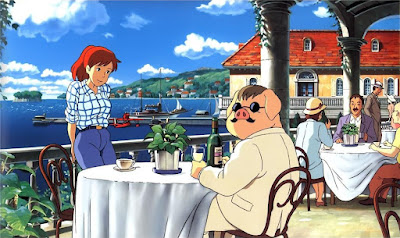
As someone who has stayed away from Studio Ghibli films, merely because I had not gotten around to these productions, it is still with a delight when I finally get to titles once and a while, able to see a film like Porco Rosso for the first time and arguably with a greater impact. There is less built up expectations as a result of how I have gotten to them, and Porco Rosso is fascinating from the get-go as I had a complete misassumption about the premise, based on a manga by Hayao Miyazaki with his love of planes and aviation, believing it was set during a war or was like an Indiana Jones adventure with more aerial dog fighting. What you get instead is still sweet with sombreness, with the lead a war veteran with the head of a pig, but is set in Italy after World War I. Despite being a light hearted work, it still evokes future real events as the eventual growth of fascism is explicitly detailed, the era of Benito Mussolini, even in this family friendly tale. This undercutting of the presumption I had was an added positive as, whilst having expected a war-set adventure story would have still been great, knowing Miyazaki's talent, the switch to a more playful but mature tale of aeronautics and love was a rewarding investment.

Saying Porco Rosso was great feels redundant, definitely not to waylay to the end of the review. This film does emphasis, despite his status for very popular crowd pleasing animated films, Hayao Miyazaki's position as a very adult filmmaker. Despite the reputation for a film like My Neighbour Totoro (1988), Miyazaki the man from his dour outlook to the times he has effectively retired, is an elder statesman, makes him very complex to view, someone who is simplified to the West in appearance both as a man (if you take into his very complicated relationship to his son Goro) to the films' themes as an auteur himself. Porco Rosso the titular character definitely feels like the lead of a film closest to Miyazaki himself. A grumpy but ultimately passionate figure, Porco Rosso is an outsider who, due to a curse never explicitly brought up in exposition or the narrative, has a pig head. The idealist younger man in flashbacks became a dashing and heroic older figure still, closer to middle age, but he hides on his desert beach on an island and leaves when paid to deal with sky plane pirates. Considering this character, even if wholesome, we undersell and simplify Miyazaki here in the West completely, and Porco Rosso's biggest virtue is how, in what is a slight story signposted around a growing rivalry with a hot headed American pilot named Curtis, this really has a lot a complexity in its heart.

The production of the film, during the outbreak of war in former Yugoslavia, clearly took on a different tone due to this reality outside. Originally meant to be a short funded by Japan Airlines, this however is a personal film, with the clear love and loving reinterpretation of bi-planes onscreen exquisite, but with mind to the consequences of conflict and politics. The setting is poignant, set between the twenties to thirties of Italy, its one eccentric touch of having a lead cursed with a pig's head more symbolic in hindsight, a plot point to being a defensive barrier from him and the world, including a woman from his childhood called Madame Gina who still pines for him in love, even if calm in her demeanour whilst others fall for her. The film is mostly fun in tone, set up immediately when Rosso, in his trademark red plane, has to deal with a motley crew of sea plane pirates having kidnapped a school of young girls, all of whom far more fascinating and excited by their predicament then scared.

The balance between humour, adventure and sombreness is a deft and perfect balance here. I admit my interest in Studio Ghibli over the years was more for Isao Takahata, a real underdog, but Miyazaki here has a complex film in mood and tone. The real setting is a surprise, in that all of this is set in a tremulous time in Europe where a growing ominous wave would eventually crossover. Porco Rosso never becomes bleak, but a weight is felt in how Rosso, a former WWI veteran, is part of a group of free people - mercenaries, sky pirates with hearts of gold - who will be outlawed and challenged, as a friend of his time from the war era comes to him to try to get him hired as part of the government's sponsored air force. Nowadays a film for a family audience would be called propaganda if the lead actually said "Better to be a pig than a fascist", and it is amazing to think we can turn to a line like this from an anime film as a needed motto to actually quote in the decades that have passed. Knowing the influence of the conflict in Yugoslavia at the time, which influenced a variety of films including Theo Angelopoulos' Ulysses' Gaze (1995) reflecting on the war, really makes a lot more sense of this film's more serious aspects fully now.

Even in the more light-hearted content, you see much politics and/or social comment in just how, needing his plane to be rebuilt, Rosso ends up with all the women of a town, where all the men have left for work, working on the machine as the film also introduces Fio. Continuing Miyazaki's strong hand for interesting female characters, the granddaughter of the designer called Fio is a really good character and a really nice introduction midway through the film. To Rosso, the world weary and cynical older pilot, the clichés of a more wide eyed and optimistic figure, a seventeen year old girl with a talent for aerial engineering and being outspoken, is when a cliché works entirely, a nice shot in the arm for the film. This does not talk down to viewers, children or adults, as a film which is a constant through its director's work, of a man who lives outside of society, with Fio the figure whose worldview brings what he treasures more upfront in his admiration for her. Even the sky pirates are eventually revealed to be noble when forced to, living in a world setting which here as in real life is becoming poisoned by the fascism of later, with them all who are truly free having to survive the growing change after the film ends. The surprise this did not take the route of a war film or Indiana Jones does bring a great deal of additional meaning for me now having seen what the movie is.

Instead of all things, this has an ending similar to John Ford's The Quiet Man (1952). Ford, a legendary American filmmaker known for many films but especially in Westerns, had ultimately a heartfelt attitude to life which The Quiet Man exemplified, where John Wayne as a man of Irish descent comes to Ireland to find himself. It is a film where a bitter rivalry with another male character is resolved in a prolonged fistfight to a huge crowd and friendship. That could be considered a spoiler for Porco Rosso, but ultimately it is not, as the figure of Curtis is not a villain either, and whilst real bullets are first used, their ultimate battle ends with those being ran out of and friendship coming after punching each other in the face. Not surprisingly, this theatrical film looks beautiful too, with a score by Joe Hisaishi which is great, but the film's juggling of tones and the moments which stand out really are special and why Porco Rosso succeeds. The humour stands but so does the most profound scenes - Gina's memories as a younger girl riding with Rosso on a plane, or the scene of Rosso himself recounting, during the war, of seeing his dead comrades in their planes rising up into the skies away from the Earth as heroes, whilst he was left to return back down. Porco Rosso is a personal film for Hayao Miyazaki but shows his skill with his production team, his deft touch in how the film can have its light heartedness with dashes of this serious grandeur truly rewarding.

Tuesday, 22 February 2022

#211: Dragon's Heaven (1988)


Director: Makoto Kobayashi

Screenplay: Ikuyo Koukami

Voice Cast: Iemasa Kayumi as Shaian; Yuko Minaguchi as Ikuuru; Daisuke Gouri as Orionis; Kei Tomiyama as Elmedain

Viewed in Japanese with English Subtitles


In the curious world of eighties OVAs, where anything could be commissioned as a short work or mini-series in the Japanese economic bubble, Dragon's Heaven is a fascinating demonstration of this, as this curious hybrid of a sci-fi anime story, live action and behind the scenes footage is something you would not sell like this a decade later even for the nineties OVA market. The beginning is not even animation but a stop motion version of Shaian, the conscious battle armour in the centre of this tale, which you will learn is a painstakingly put-together human sized model for the production, shot and moved just for a tiny scene of stylish live-action material. It sets up the main work of this OVA only fifty or less minutes long, and never was there a work where you literally could not have this commissioned this way a decade onwards. You would have to go out of your way as an independently made animated work in the 2000s onwards to produce this, or a strange short experimental television/online series to produce something like this again.

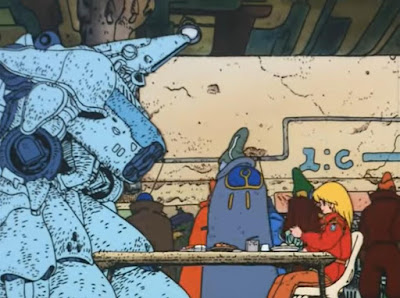
This is more so as the actual animated narrative, whilst of its country in tropes, also looks unique. This looks like a Mœbius art work, in lieu to Jean Giraud, the legendary French comic book author/graphic artist if interpreted in human character designers by Japanese tropes from the eighties. Dragon's Heaven is a striking work to look at, painstakingly animated as a result. Even the story, whilst slight, has its own little idiosyncrasies you could have run with. Namely that the central giant robot is actually sentient, with full consciousness than artificial intelligence, who when his pilot is killed in a conflict decides to hibernate. He is awoken by Ikuuru, a young woman, much later and they begin to immediately bond as a cute friendly couple, only in mind he will have to get her ready for the army he was facing originally. Strangely tied (least in the fan made subtitles for this obscurity) to being the Brazilian army of all things in this alien sci-fi world, which is repeated throughout, one of their members, another sentient robot that does not need a pilot, has plans with his squadron to invade her desert home and the main duo are the only force to stop them.

It is purely an aesthetic work, and a tech otaku or two working in lovingly rendered depictions, but it is compelling. Not surprisingly, whilst he directed one or two things, director Makoto Kobayashi is mostly as veteran mechanical designer and figure of various tasks on anything from Katsuhiro Otomo's Steamboy (2004) to even the Urotsukidôji franchise. He also wrote and drew the source material, so this was a personal property for him. The reference to European comics, and especially Mœbius, is justifiable too. The story you get is a simple one that purely on a visceral level is exquisite. It is, whilst slightly, to also see its amusing touches, where the robot is a conscious figure who will still be embarrassed by Ikuuru being naked, comfortable to bathe in front of him, or just hanging out with her at an intergalactic cafe outside with no one batting an eyelid, even if Shaian is bigger than most human beings as a battle mech in a tiny chair.

The slightness of the story - which is an artist's work of elaborate robots and a battle suit for Ikuuru - does not detract from how this combines its distinct style with something as ridiculous as a giant freaking gun called a Dragoon which bursts hellish laser flame, a work which I could have happily had a feature length work or a longer OVA project from. This is before you are reminded of Dragon's Heaven being a curious OVA production as, for a forty plus minute work, ten minutes after the credits is the behind the scenes footage of the crew working on the live action footage. Adding to this is knowing there were many fascinating titles like this from this era you can uncover - California Crisis: Gun Salvo (1986) for example is as fascinating for its visual style and Americana aesthetic, or To-Y (1987), a cult title even for fan subs - many of which were never released in the West officially. There are many which have very idiosyncratic art styles, narratives or are experiments like this of being three short pieces in one. Trying to sell this in the modern day is entire undercut by its short length, and whether the master materials have survived, but with mind experiments still transpire, it would be fascinating to see this project which combines live action tokusatsu footage, a unique sci-fi action narrative visually and behind-the-scene footage, and image if an animation studio ran with such a premise with a longer length even in terms of structure. Certainly, Dragon's Heaven is memorable just for this let alone the virtues of the material.

Sunday, 23 January 2022

#210: Jin-Roh - The Wolf Brigade (1999)


Director: Hiroyuki Okiura

Screenplay: Mamoru Oshii

Voice Cast: Eri Sendai as Nanami Agawa; Kenji Nakagawa as Isao Aniya; Kousei Hirota as Bunmei Muroto; Ryuichi Horibe as Shiroh Tatsumi; Yukihiro Yoshida as Hajime Handa

Viewed in Japanese with English Subtitles


Despite the weight of his name, a lot of Mamoru Oshii as a creator is obscurer then you would think in what most know him for. Ghost in the Shell (1995) is a significant anime film, not just for him, but by itself, it really does not contain all of the man. Few may have known he started in comedy, only growing as his work for the Urusei Yatsura franchise has been more freely available in the West, and coming back in an unexpected moment of revenge with Vladlove (2020-1), his first animated television series for decades. That he left animation, for live action films, for large periods of time is another obscurer and divisive section of his career - I hold a film like Avalon (2001) as a hidden gem, but it is a divisive area especially for fans. And, tying into this, there is the entirety of his multimedia creation the Kerberos Saga, to which Jin-Roh is probably the most well known piece of, but is written by Oshii and directed by Hiroyuki Okiura.

The Kerberos Saga feels like the world of post-Japanese culture in the sixties and seventies, of political protests and even the left wing terrorist group the Japanese Red Army, if it has extended to an extreme. The actual world building is even bleaker in how this is set in an alternative timeline when Germany won World War II, and yet the atomic bombs and post-war Japan of reality still took place with Japan finding itself at the place where the government has created a separate counter-terrorist group called Kerberos Panzer Corps. They are, as the iconic image of the entire franchise, figures as ferocious and morally dubious in their appearance as they are also seen in Jin-Roh, with their startling full body armour with red eyes, able to withstand explosions just by them, with mini-guns as standard weaponry.

The Kerberos Saga, despite its dystopia world being one you could sell, has become to Mamoru Oshii what the unfinished manga Phoenix (1955-86) was for Osamu Tezuka, what the Byston Well world is to Gundam creator Yoshiyuki Tomino, Oshii's personal obsession and "life's work" not as well regarded by the world as their best. Phoenix was simply one of many titles from the Godfather of manga, whose Astroboy alone became an institution, Tomino's Byston Well projects, because of titles like Garzey's Wing (1996) for the straight to video anime market, is divisive as much as Gundam became a legendary franchise. The Kerberos Saga is lesser known as Oshii took some frankly unconventional directions with this world, Jin-Roh as a theatrical animated film the most well known of a project which has existed in comic books, radio plays, films and even action figures and garage kits based on this dystopia.

Oshii himself adapted the world of his into low budget live action films like Stray Dog: Kerberos Panzer Cops (1991). Oshii made the live action The Red Spectacles (1987), a film I admire, but is a surreal adventure in the dystopia set around a missing woman. Oshii, to really emphasis the weird tangents you get as much as he himself is a very serious philosophical one too, the true dichotomy of the man who nearly became a Catholic priest only to become an anime/live action director, is how the one detail Jin-Roh never covers is the "Tachigui", stand up noodle shops from Japan. A reoccurring aspect of the world, in other sources, were how the Tachigui are illegal in the Kerberos world, becoming underground as is depicted in countless pieces of its own saga and characters, such as in a segment of The Red Spectacles, and being the subject of an entire experimental animated film from Oshii called Tachigui: The Amazing Lives of the Fast Food Grifters (2006).

Jin-Roh itself, baring one moment of a drunken salary man inadvertently catching a police officer's attention, is completely sombre. It is a bleak animated film, set in this alternative world dystopia, where even if it is based on fiction and lies, the one semblance of humanity is the concept of love, compromised by the cruelty of the world itself. Here our lead is Kazuki Fuse, a Kerberos member demoted back to training after an encounter with a "Red Riding Hood". The script continually refers to this fairy tale, in an alternative, in which the Red Riding Hoods are young women, in connection to real life cases of members of the public assisting terrorist groups, who transport bombs in bags for members to use against the police during riots. One is caught by Fuse and his squad, detonating herself, and Fuse's hesitance, a flicker of humanity, leaves him with nightmares and remorse expounded when a woman claiming to be her sister enters his life and love begins to bloom.

Even if it becomes a conspiracy, of those wishing to curb the Kerberos' power and the "Wolf Brigade", diehard members, this love between Fuse and the young woman Kei Amemiya is the closest thing to something meaningful even if this is a bleak film in resolution. The humanity to be found here contrasts Oshii's reputation for philosophising, especially as a very simple narrative drama is nestled within a conundrum which reflects back on his deeper thoughts. Even with context of this multimedia narrative's full back-story, the film seen by its own is one aware that its apparent heroes, the Kerberos Panzer Corps, whilst seen as ordinary people struggling through training here are still members of a military force whose basic firearms, a mini-gun, cut through people like tissue paper, and are a literal iron fist. That even their enemies, whilst in full context left wing figure fighting a fascistic world, are still locked in a war where innocent bystanders die, this is not a morally black and white world as a result. Even Fuse himself is dualistic, the soldier and the human being, as he is paired to Red Riding Hood as the wolf who devours her.

Anymore detail would not really explain what has to be seen and felt. From Production I.G., with realistic character designs from Tetsuya Nishio, this looks beautiful in its depressed urban environments. The music by composer/cellist Hajime Mizoguchi is touching and it is a film slowly paced, with moments of violence not comfortable at all to experience even if an action film in parts. Reoccurring haunting of the first Red Riding Hood, or nightmares of shooting down Kei, or his breathe of actual wolves mauling her, are a trauma Fuse has, which have a horror mood to them. The film's tone is, again, bleak and that is worth emphasising, as returning to Jin-Roh I was levelled by its virtues. Director Hiroyuki Okiura, with Mamoru Oshii and the production team all succeeded. Even if this still emphasised Mamoru Oshii as an auteur, the screenwriter and his voice still present, not only does it show the more complex nature of him as a creator, but you have seen everyone contributed their voices and turning Jin-Roh into an unsung gem as a result.