Wednesday, 29 May 2019

#1 to #100 Retrospective: Strangest Anime/Best Bonus Review

Continuing on from before, this is probably the longest list in terms of candidates as, considering my other blog is called Cinema of the Abstract, I do like the weird and the unconventional in my viewing, and there were so many examples from the 100 anime reviews I have written than it felt unfair not to increase the number to eighteen. It may be an awkward number, but all these titles need to be covered. 

As a bonus, as I have covered non-anime if it has a tentative tie - live action adaptations of the source material, adaptations of work by manga authors who have had anime adaptations, a Batman animation with prominent Japanese animators on staff, and a look at South Korean animation - I'll throw in the best three here too.

The Strangest Anime

Honorable mention goes to Requiem from the Darkness (2003), which visually with its Edo period setting as depicted in dream-like colours and non-human background characters, but is still a very straightforward horror tale of the worst in humanity. Aesthetically distinct productions will get a list for themselves and I'll bring this TV series up again. Gyo: Tokyo Fish Attack (2012) also needs to be mentioned just for adapting the original manga by Junji Ito, about undead fish on robot legs climbing out the sea and invading Japan, but for all its weird premise, alongside flatulence being a prominent aspect, this list has been difficult for just how many titles I kept forgetting needed to be included, so the list was weirder enough as it is without including this divisive OVA release. 


18. Wanna-Be's (1986) [REVIEW]
An OVA where a tag team of female pro-wrestlers must fight a conspiracy to blend alien DNA into female wrestlers to make stronger competitors? A little bit of a spoiler for Wanna-Be's, a project famed eighties character designer Kenichi Sonoda worked on, but damn that's a strange premise even for the OVA boom of the eighties where anything could be financed. Many a weird title will eventually be covered, but this had to be mentioned.


17. Plastic Neesan (2011-12) [REVIEW (OR HERE)]
As talked about in the review, the fact this was overtly weird, about a trio of female model enthusiasts more obsessed with hurting each other and encountering strange figures, is actually less weird than it was played straight and serious. However, unlike the reason it became an internet meme to post images from, particularly about the male character who explodes his own clothes off, director Tsutomu Mizushima and his misanthropic view of the world especially when it comes to his infamous "comedies" is strange and twisted enough to raise eyebrows.

16. Ghost Stories (2001/2005) [REVIEW; REVIEW [English Dub]]
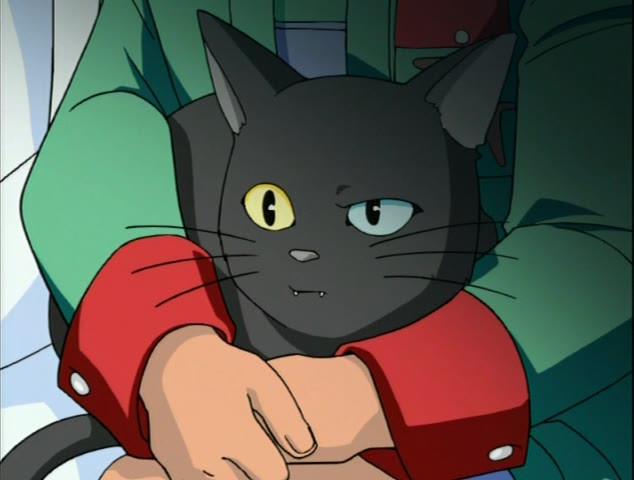
A show that ended up being reviewed twice on this blog which is strange enough. The reason how this project came to be, when ADV Films were given a sluggish children's horror show and given carte blanche to make a profane and mocking English dub, is one of the strangest production histories in US anime dubbing and why the series is still known. Neither dub is truly successful, but I'll be controversial (despite it taking four months to finish) to argue the original Japanese dub is the best; the English thought, marred by some of the jokes being too offensive and sophomoric alongside being stuck in 2005 for pop culture references. Nonetheless that more infamous dub is fascinating and when it actually succeeds does work, i.e. when veteran voice actress Monica Rial, actually given a great performance, is allowed to turn the character of Monoko from a Evangelical Christian piss-take into an Evangelical Christian who falls back into her real self occasionally, and Rob Mungle as a demonically possessed, egotistical cat. It's still a mess that has dated badly into the current day, but adds a weird legacy to a production that could've easily been forgotten. 


15. Salaryman Kintaro (2001) [REVIEW]
I regret getting rid of my DVD copy of this series, the least likely to ever get a UK release when only the Americans got an anime industry large enough in the 2000s for any weird title to get a release. This is one of the obscurest to hit the UK shelves and is weird for what it turned out to rather than being bizarre, more so as its a curiosity in what is actually seen onscreen. It's a melodrama for men about a former biker gang leader Kintaro who decides to become a salaryman and takes his headstrong mentality into the world of the construction industry, eventually becoming a tale of perseverance against corruption. Dramatic beats are entirely in the later episodes built business talk and ballots even if Kintaro occasionally fights people. Tonally it's odd too as for the most part its a family friendly work which does tackle some serious content, but you could imagine actually being on at six pm on Japanese television, until the moments you have actual female nudity, the kind some fetishistic echii shows shown after midnight have to have censored and never actually show. 

In lieu of an early 2000s production which in its earnestness and low budget is not a great series, its a curiosity to say the least when even the premise, melodrama about construction business corruption and white collar virtue from a biker punk, is unlike anything you'd see in Western animation. 


14. Yuki Terai - Secrets (2000) [REVIEW]
Speaking of obscurities released in the UK on DVD, a compilation of virtual "star" Yuki Terai through various music videos and short films, itself just in principal still weird even now we have the likes of Hachune Miku and Virtual YouTubers in existence in the 2010s. Mainly because the idea of virtual stars replacing real ones is an idea, no matter how hard is tried, isn't going to work unless we can recreate Sharon Apple from Macross Plus (1994), something to consider that I have covered Final Fantasy: The Spirits Within (2001), where a fictional actress was being promoted as a breakout star, the same time as Yuki Terai was and disappeared into obscurity. That in itself, with Terai virtually unknown in the West, is strange in a depressing way as even b-movie actresses can have a longevity in their fanbases decades later but fictional stars can fall into ruin, between being replaced by better animated new "stars" and the limitations of what roles they can do if their creators don't use them enough, with a harsher end of their careers. 

13. School Days (2007) [REVIEW]
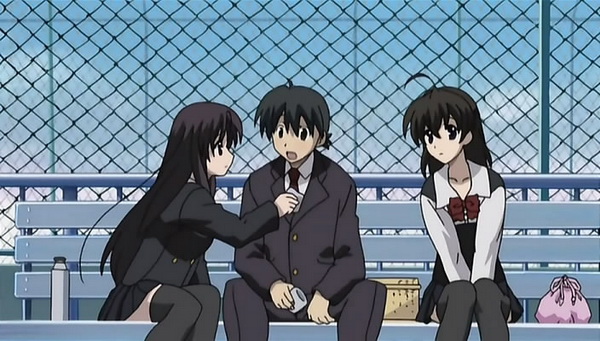
School Days is, again, an example of something stranger in experience and history then the content being surreal, as for me the entire concept and execution of this series is so unique and idiosyncratic.

When it was decided to make an animated series from the titular work, an erotic visual novel game with the convention of multiple endings which varied between the best to the most gruesome of conclusions, someone on staff had the brilliant idea to base the series on the worst possible ending you could achieve. That our bland, stereotypical male hero surrounded by many potential female love interests, the kind we rightly criticise but keeps being used for a male wish fulfillment fantasy, is so oblivious that he sees nothing wrong with cheating behind multiple girls' backs, all whilst they themselves and other members of the school  barring a couple of characters exhibit the worst decisions and attitudes possible, is like the worst bad trip experience for any viewer to have but is cathartic as a scorched earth tactic on this type of storytelling. It feels over the top and unlike real life in many ways, so extreme at point in mood its ridiculous if you weren't watching it between your fingers, and yet it still hits a sore point in also imagining teenagers as dumb and controlled by their hormones and moments of spitefulness, willing to do callous things to others in gossip and tricks as well as not take wise decisions, all which unfortunately (even if less exaggerated) is true to real life. 

In this case, all of this culminates into a final episode which had to be briefly pulled off air as it had the unfortunate timing to an actual murder, leading to an internet meme just for the really bad censorship decision one channel took in using a picture with a "nice boat" on it, a meme which lasted briefly and was referenced in other anime which itself is as strange as you could get. It is not a pleasant experience to watch School Days, like being continually punched in the gut as the user comments on Crunchyroll were themselves a spectacle of pain and agony from other viewers, but its one of the most unique experiences for me even if some of it, with its occasional leering shots and big eyes generic character designs, is possibly by accident. Its certainly deserving of more interest.


12. Paranoia Agent (2004) [REVIEW]
Surprisingly low on this list, but with another Satoshi Kon production observably higher, his sole television series must be viewed in mind that, whilst incredibly strange in its reality bending, Paranoia Agent is more an exceptional gem where the oddness of what subjective images (or ones that turn real) appear onscreen have a grounded and deep explanation behind them, a puzzle box whose surrealism is more in lieu for psychological existentialism than some of Kon's more overtly weird work elsewhere. That doesn't deny a show about a mythical boy who gives people amnesia with a golden baseball bat, an episode where a police interview enters a fantasy realm for metaphor, and an ending where hundreds of the cute dog mascot appearing isn't peculiar to say the least, so it had to be here.


11. Yurikama Arashi (2015) [REVIEW]
Honestly, in any other circumstances where there was fewer stronger rivals, all of them weird, all of them unique, some of the idiosyncratic creators and figures on this list would've been at Number #1, Kunihiko Ikuhara the kind of man who, unless you were talking about his days on Sailor Moon (and rumors he was on the animation staff for episodes of the original  Teenage Mutant Ninja Turtles series for a multi-episode story arc) would be the King of the Weirdness list, at least a prince or maybe a princess, among the heavy hitters of surreal anime, just so he can cosplay as a Sailor Moon character again as photographic evidence has proven. 

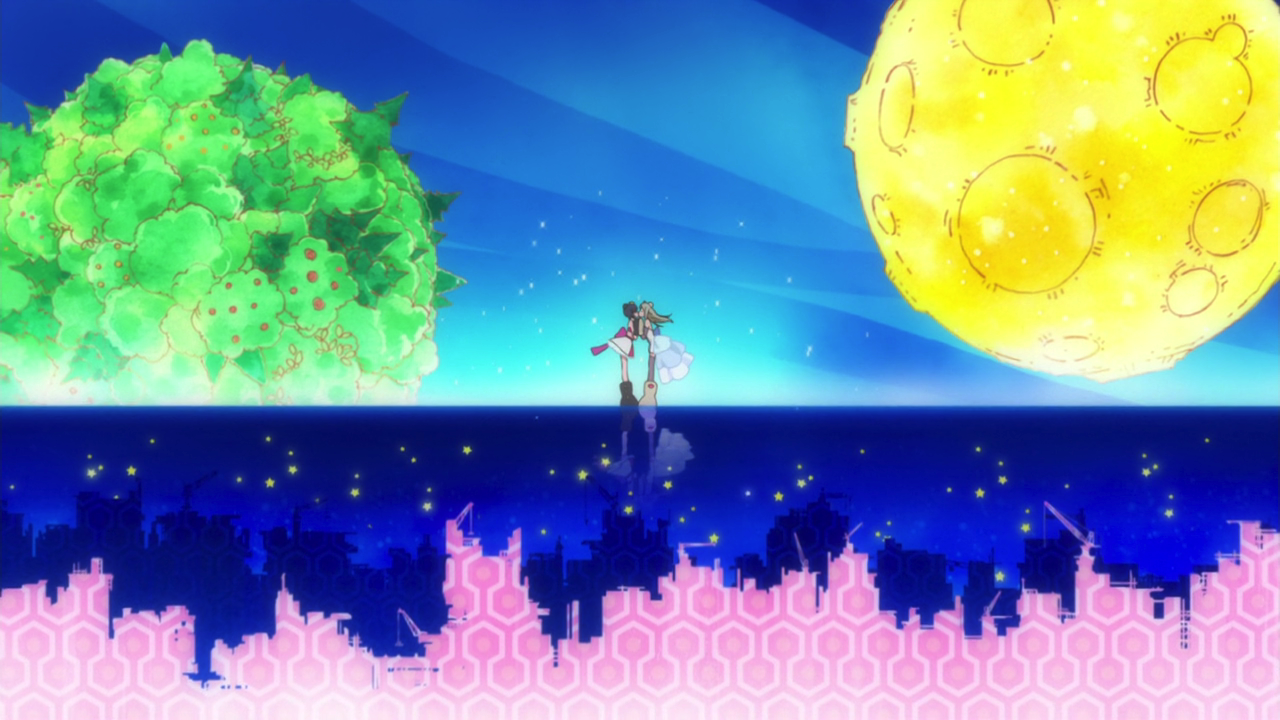
His tale of an (almost) entirely female world of bear girls and their conflict with human girls, and a love which dares not speak its name, doesn't even try to hide the fact its a challenge in terms of depicting lesbian concepts onscreen, with enough blatant flower imagery to not try to hide the yuri content is explicitly romantic and sexy. The show is as much strange and unique as with many of the figures on their list for taking premises and pushing even their presentation to overt levels. Ikuhara is a man with a damn good aesthetics game, where every colour and symbol is repeated throughout, where even material which probably doesn't make any sense to him is still imbued with an emotional connection so that, by its ending, Yurikama Arashi's as likely to lead to damp eyes as it is cheers.

It was, also, his last until 2019 with Sarazanmai, in which he proceeded to never inform the producers the plot would involve its story involving exorcism by inserting things up their butts, only to sneak it in afterwards when the project was greenlit, so he's thankfully not changed in the damnedest.


10. Boogiepop Phantom (2000) [REVIEW [OR HERE]]
Now that Boogiepop and Others (2019) exists, there may sadly be a chance that Boogiepop Phantom, the original animated adaptation of Kouhei Kadono's light novel series, will be abandoned and forgotten. As much of this, whilst the new series is meant to be as unconventional, is because rather than a first story, this 2000 series is an adaptation of a sequel novel which leaves a lot unexplained in this complex lore. But for me personally, once you expect this, Phantom is an incredible piece of experimental genre television which, for every detail that makes no sense, still (barring one plot point) is a concise one-series story, even more unconventional as (until the end) scenes are told in non-chronological order, with characters appearing in other episodes after having an episode devoted to them, and entirely within an aesthetically bold work. Working with what was available in the production schedule, it stands out as unique with an intentionally dulled look, muddied visuals, one of the best sound designs in all I have covered, and definitely getting weird at points just from the opening credits song being a sultry lounge ballad incongruous (yet strangely right) for the series. I wondered how this'd be experienced back on Japanese television after midnight, like stumbling on a mind bending UFO on television if you caught a middle episode or half way through one, and out of all the anime covered, Boogiepop Phantom is the one out of all of them which gets on the list with this in mind.


9. gdgd Fairies (2011/2013) [REVIEW [OR HERE]]
The trend for micro-series has come as much from new voices appearing and being allowed to helm projects. Most are comedy, which even take advantage of their cheapness in production for the joke. Out of all of them, Sōta Sugahara and Kōtarō Ishidate were pioneers with gdgd Fairies, and even when Kōtarō Ishidate left after Season One and different screenwriters were brought, I'd argue Sugahara  by himself  in the director's chair turned a fun series into something spectacular. As mad as a box of frogs, the initial premise to just bemuse the voice actresses with improvised dubbing pools, and gleefully raiding preexisting (and bad) CGI models turns into something glorious by Season 2 with a multi-episode time travel narrative, a word pun game involving the type of tires for a car that, even as a non-Japanese speaker, is turned into something legitimately incredible thanks to the precise subtitles making the jokes funny, a hot springs episode where five plus minutes are facing the ceiling, and the entire subplot of one cheap template, a purple haired old woman, becoming a side character completely naturally (as felt) in the production of the show just because voice actress Satomi Akesaka, even among a great trio of leads, kept falling into whiplash inducing voice changes and has a tendency to suddenly starting singing whenever they go to the dubbing pool. 

Micro-series were covered a bit, and whilst a few are weird in premise, a lot were one trick ponies that lessened in weirdness the harder they tried to be stranger (Onara Goro (2016) despite being about sentient farts) or even if charming in their daftness (Sparrow's Hotel (2013) being cheap as hell visibly in appearance and premise of a busty former mercenary turn hotel staff member) weren't really weird in a way beyond irony. gdgd Fairies was one of the first I covered, still the best, and the weirdest as much as this type of work despite its irony actually had a heart, something you can just tell as you enjoy the voice actresses at times actually slip up and giggle at how absurd the scenario foisted upon them is. 


8. Night is Short, Walk on Girl (2017) [REVIEW [OR HERE]]
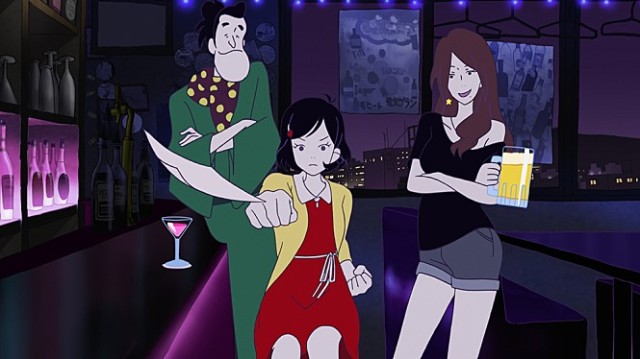
Masaski Yuasa's another figure who'd get on a strange anime list any day of the week, his return to the world of The Tatami Galaxy (2010) not necessarily following the characters you'd presumed, with those who return a wonderful reunion to meet again,. Instead his delirious take on one young woman's night of drinking and living life, of the God of Used Books and terrorist musical theater all provided through a psychedelic aesthetic and a heart. Even the one contentious aspect, that the lead male character is a problematic arsehole, is neutered knowing he gets his head kicked in and that, even if he and the girl are to fall in love, its through him having to change a lot through bizarre circumstances (and an army of libido cowboys, a cameo I didn't expect to return) whilst our female lead is happy, bright and never challenged on a wonderful night out. Not surprisingly, this work looks as good as you'd expect from him. More surprisingly, Yuasa a year or so afterwards from this would adapt Go Nagai, get on Netflix, and is looking like he's permanently going to get to helm whatever the hell he wants whilst everything's looking good, such a wonderful turn for a man who had such a difficult getting projects this unique off the ground and had most of his work unavailable in the West. 


7. Mononoke (2007) [REVIEW]
Managing, as a spin-off, to be much more well known than the original horror anthology Ayakashi: Samurai Horror Tales (2006) that first debuted its lead protagonist, Mononoke pushed the horror anthology in an utterly unique and symbolic art style and plotting which I adored, looking like little in terms of aesthetic but itself. But, a huge distinct, that material, as well as tackling incredibly dark material, is weird enough to get on this list, when voice actor Norio Wakamoto appears as a ghost fish playing a shamisen. That's before we get to screenwriter Chiaki J. Konaka, a man who has frustrated as many anime fans as won the likes of me over, when he spends an entire arc on a competition of perfume games referencing the Tale of Genji. Yes, its as peculiar as you'd expect from him.


6. Paprika (2006) [REVIEW [OR HERE]]
Speaking of Satoshi Kon, whilst he passed too early in the prime of his career, his last film at least was the weirdest of his career, naturally when adapting a Yasutaka Tsutsui novel about entering dreams depicting dreams and his own obsessions in as elaborate form as possible. Paprika is still a very narrative clear and driven conspiracy plot, but with the full power of Madhouse as a studio behind it, the phantasmagorical images shown here stay with you.


5. Urusei Yatsura 2: Beautiful Dreamer (1984) [REVIEW]
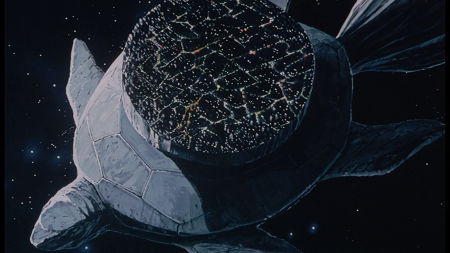
Speaking of dreams, Mamoru Oshii once used to be a director of comedy, which is a very strange thing to consider nowadays when he is known for cerebral material like Ghost in the Shell (1995). Even stranger, when he helped the franchise for Urusei Yatsura become a success in animated form, he was able to make this second theatrical film where that comedy was matched by the philosophy he'd dive head first into whilst still being a beloved part of the franchise. So he got to have his cake and eat it, between tanks inexplicably being found in the school swimming pool to giant turtles, which manages to be stranger for me than even Paprika and brought a together absurd fantasy comedy with absurd dense, beautifully illustrated existentialism together into something utterly unique.


4. Midori (1992) [REVIEW]
As independent productions go, none are as notorious and with such a complex history as Midori, Hiroshi Harada's adaptation of Suehiro Maruo's Mr. Arashi's Amazing Freak Show entirely made by himself over many years barring some additional help and with music by legendary avant-garde rockist J. A. Seazer. Even the nature of Midori is weird, only possible to see in Harada's homeland as part of a living carnival, and has only been probably available in a French DVD. The film, a grotesque but compelling piece of ero-guro, is disturbing and absolutely strange itself, something you should be cautious going in watching but is an incredible labor of work.


3. Ai City (1986) [REVIEW [OR HERE]]
In the midst of the ESPer/Psychics obsession in anime and manga, when everyone was including them as a plot point in the eighties, future Bee Train founder Kōichi Mashimo decided to helm this incredibly animated but utterly convoluted and illogical escapade in this sub genre. Plot points whip the viewer in violent new directions, details are not clearly defined, and that's before we get to how easy it is to break through reality like tissue paper or how, despite this being a serious sci-fi action tale set in a dystopian metropolis, there's inexplicably an anthropomorphic cat there alongside one of the female character spending most of the film in a Playboy bunny suit. With tiny men in giant man sized suits who can conjure giant floating heads with his mind, and an ending which screws with the viewer, it may seem ridiculous to have Ai City this high up, but not without good cause.


2. The Flying Luna Clipper (1987) [REVIEW]
This, instead, might be more controversal this high up, but I decided to have an underdog share some glory especially as this is tragically as obscure as I have covered, only possible to see because of amateur preservation and really deserving a proper release if the source code can be relocated. Inherently one of the strangest aspects is that this was animated using the polygons of a MSX2, a video games console/computer that was never released outside of Japan, emphasizing my curious choice of words beforehand. Even more stranger, justifying this high entry, is that you are still watching a film about an imaginary holiday on a flying clipper airplane where, among passengers and air hostesses who are anthropomorphic fruit and animals, your holiday is both to Hawaii and into dreams. Imaginative indeed.


1. Belladonna of Sadness (1973) [REVIEW]
Just knocking it off the top spot though is another one-off, which has likely influenced Kunihiko Ikuhara (who, bless him, as called this an influence) but for many is utterly alien to most modern anime. The last production of an already dying animation studio, studio Mushi Productions decided to throw caution to the wind with a work where, among limited animation but stunning Art Nouveau influenced imagery, decided to adapt non-fiction text Satanism and Witchcraft by Jules Michelet into a psychedelic and sexually transgressive tale of Jeanne in medieval France who, in the midst of corrupt of the higher classes and discrimination against women like her, is pushed to witchcraft and allegiance with the Devil. The best way to describe this, thankfully now available after years of merely being bootlegged, because of Cinelicious  restoring the source negative and Anime Limited in the UK also releasing it, is to just look up the trailer or images online, as among the harsher and strongest of competition, this is unlike anything in anime you could find.

====

Best Bonus Review

Honorable mention goes to Christoph Gans' Crying Freeman (1995) which, whilst it doesn't get on the list, is fascinating as a film that, whilst looking like a lot of the lurid straight-to-video action films from the time, was a FAITHFUL adaptation of the first chapters of the late Kazuo Koike's manga dripping in style, that use of capitals on purpose as it was actually being far more . Its a fascinating production, sadly one that never got a true US release unlike Europe, that is arguably one of the few successful adaptations of a Japanese property because Gans, whilst not a prolific filmmaker, is idiosyncratic in his labor. 


3. Uzumaki (2000) [REVIEW]
A great candidate for strangest if I was including live action films, Higuchinsky's adaptation of Uzumaki has a major flaw that, as Junji Ito's manga about a town terrorized by spirals got way too fantastical in the final chapters to be recreated on the film's budget, he likely had to leave the production on an abrupt anti-climax halfway through the story. A shame, but not without the Ukrainian born Japanese filmmaker managing to depict Ito's work through his own style, all whilst strangely evoking the Black Hole Sun music video by Soundgarden a few times. Considering attempts at adapting Ito have been difficult in animation - Gyo (2012) lurid fun but ridiculous, the Junji Ito Collection (2018) an unfairly criticized TV series but one straining under its lack of budget - maybe it was wiser as here to not try to recreate Ito's perfectionist layer of detail, the reason I'd argue his work is his own, and make it into one's own vision as here.


2. Guyver: Dark Hero (1994) [REVIEW]
The original 1991 live action Guyver film, produced by Brian Yuzna with special effects genius Screamin' Mad George co-directing with future Drive (1997) film maker Steve Wang, is a curiosity but not sometimes for the better. It's for large portions of it a campy film you'd have rented out by young teens, not the ultraviolent sentai tale as the original source (or the anime adaptations) portray it to be, barring the fact the original version of the film had the gore, and a cavalcade of cult stars like Michael Berryman, David Gale, Jeffrey Combs in a cameo, and Mark Hamill of all people as a grizzled cop who gets the weirdest (and best) of Mad George's insane special effects sequences. It's a film with incredible costumes and effects, because of George, but within bad slapstick comedy and the goofiness undercutting the tone; that the version I saw, the only one now available aside from a German release, is the "Director's Cut", adding comic book transition wipes but removing the gore, makes it a mess.

Wang came back for a sequel however, with future Solid Snake voice actor and future screenwriter of superhero films like of the 2009 Watchmen film, David Hayter, as the Guyver and, even if lower budget in terms of less elaborate effects, Dark Hero by itself is what pulp b-movie cinema should be. It's effectively a feature length Power Rangers episode if stunt people, in elaborate costumes, looked like they were actually kicking the shit out of each other onscreen to the point even the padding of those costumes looked like they wouldn't cushion some of the stunts that take place, wrapped in a cliched but effective story. Like Crying Freeman, it is probably one of the only Western adaptations of a Japanese property to "get" this material even if it had to transition it through limited resources, having to shoot in the woods (which isn't a bad thing at all here), and spend half its time letting the stunt team fight. Unlike Crying Freeman, I adored this film. A proper release of this, DVD or Blu-Ray, rather than the old DVD I have would be much appreciated.

1. Avalon (2001) [REVIEW]
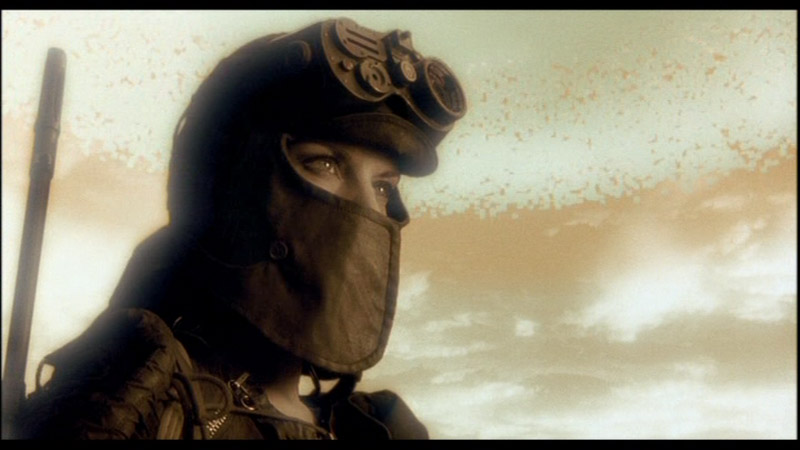
Finally, a Mamoru Oshii live action work; this aspect of his career is maligned, not necessarily looked highly upon, but I'd argue his Polish-Japanese co-production Avalon is an immensely rewarding experience that fits his philosophically heavy CV completely. Not trying to be realistic in the slightest, the inherently dated computer effects for a world which lives through a combat video game, and a world itself unstuck in any period barring its own, has left it ageless and Oshii (without ruining the plot) does play with tropes and ideas that may have appeared in mainstream cinema, The Matrix (1999) especially, but with his own distinct worldviews. It's as much a gem in Oshii's career, live action or animation, let alone in the live action work; if it was more easily available, I'll be gladly covering this maligned aspect of his career with optimism. 

Friday, 24 May 2019

#101: Vampire Wars (1990)

From http://s2.narvii.com/image/
5akcllhpzigfdusunbdbvduw3qij5jpa_00.jpg


Director: Kazuhisa Takenouchi
Screenplay: Hiroyuki Hoshiyama
Based on a novel series by Kiyoshi Kasai
Voice Cast: Masashi Sugawara as Kōzaburō Kuki; Shūichi Ikeda as Milcea Millere; Yuka Koyama as Kiki Lamia Vindau; Kaneto Shiozawa as Muraki; Masaru Ikeda as Mirucha; Masashi Sugawara as Kuki; Takeshi Aono as Charlie Milan; Toshiya Ueda as George Lazare; Yuka Koyama as Kiki; Yūko Mita as Brigit
Viewed in English Dub

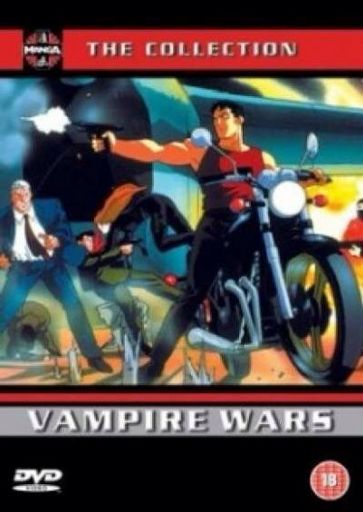
Considering the first review was an obscure OVA (Gestalt (1997)), its befitting number #101 is another obscure OVA, something ridiculous this time. Not to be confused with Psychic Wars (1991), but both were Manga Entertainment titles which were, yes, released on DVD again as part of "The Collection", likely an obsession for me because I've over watched the previews on them scored to classic music and the Mad Capsule Markets. Vampire Wars is also an example of Manga Entertainment's infamous tendencies for "15-ing", of adding swearing in the English dub to lift the age rating on their releases, but Vampire Wars is just about to hit "18-ing" in how comically potty mouthed the lead anti-hero gets to be. It does mean, whilst a fan base probably doesn't exist and reduces the chance of this ever happening, I wish I could've seen the original Japanese dub trying to be serious with this lurid material. This is an anime which tries to pack a story far too complex for less than fifty minutes without a conclusion or any major plot threads being finished, so the silliness of the expletives just makes the experience additionally absurd.

To start with, earning a MASSIVE SPOILER WARNING on the get-go, what is it with anime sometimes envisioning vampires coming from outer space? It's an obsession of mine I cannot really provide more than a handful for, but between this, Vampire Hunter D (which brought in gothic horror, dystopian sci-fi, even the western in its world) and Trinity Blood (2005) there were three titles I saw at an impressionable age that lead to this conclusion. All I can say is that, in exposition that never means anything of importance to the OVA even if a massive exposition dump near the end of its running time, we're told of two alien races, one who became our vampires, the others (who we never see) a technologically advance group who are a potential threat to Earth. None of this is worth when, truly, the plot is an utterly unlikable arsehole named Kōzaburō Kuki, a communist terrorist who has worked with figures who have killed many civilians, who is blackmailed by the French Secret Service to investigate a mysterious assault on a NASA base. This leads to vampires and a female celebrity Lamia who is being targeted by said vampires, and other human groups, who he does show some humanity to in protecting her.

Vampire Wars does belong to the even bigger phenomenon of vampires in anime in general. Vampires aren't natural to Japanese mythology or folklore unless you get to hopping corpses and Chinese vampires, so they have always had a fascinating touch in that, in some cases, they will have to explain whether in live action or animation their mythos with interesting results. Sometimes they don't bother as here. There's one great detail at first I wish vampire stories tried again, where a female vampire doesn't need to worry about being shot in the head, so doesn't wear any armour but a bullet proof vest where stakes would be dangerous to her. After that, they aren't really interesting until they're revealed to be aliens who turned to channelling their spiritual energy, anime's New Age tendencies surprisingly prominent in stories like this, to the point only blood is needed to sustain them.

From https://m.media-amazon.com/images/M/MV5BNTk1MzUwYTMtMDQ4M
i00ZjYzLTljNDEtMTVlOGJlN2YwMzI2L2ltYWdlL2ltYWdlXkEyXkFqcGdeQXVyMzM4MjM0Nzg@._V1_.jpg

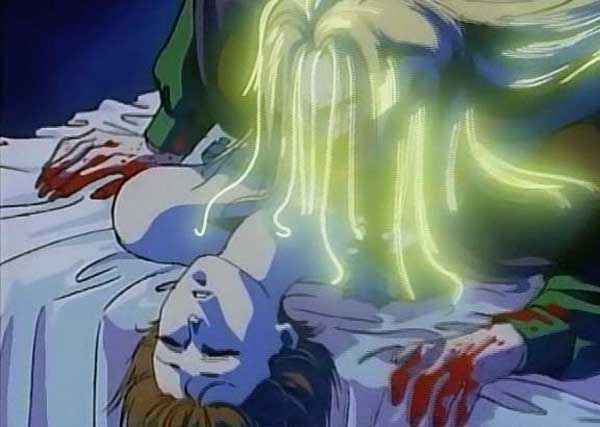
That there is no ending, no follow-up as a tie-in to a novel series, means Vampire Wars does suffer from being a diversion that lacks a lot of memorable detail in aesthetic, creativity or any sense of weirdness. Its definitely nasty, with the gore, the unfortunate treatment of French sex workers as one is murdered for blackmail, another punched in the face by the evil giant henchman, the general sense of sexism which sadly permeates this type of pulp, and with a slight moment of body horror with the vampire's mouths turning into maws when they need to eat, ripping throats out. It's not possible to take seriously in lieu of, unless you want to try to justify that nasty streak which is just grimy for the sake of it rather than dramatic and not advised. Obviously, the only sympathetic figure is Lamia, who is the stereotypical damsel in distress until (thankfully) she gets to unleash carnage in an airplane mid-air with a secret about herself and random objects, a nice touch too.

Like the rest of these Manga Entertainment titles, I find myself drawn to the likes of Vampire Wars nonetheless as time capsules as well as for morbidness. A Toei production, famous for the likes of the Dragonball franchise, it's a surprise to see something this violent like many other titles from this era. Not a lot of it is pleasant as mentioned, the tendency to macho touch (but boring) male characters and every women a damsel or victim is something we thankfully got past, but at the same time the mad dash to try to cram so much plot in such little time when its ultimately a doomed decision is strangely compelling. There's a fascinating premise inside the anime that could've made an interest multi-episode OVA, when your protagonist is completely hateable but goes through a literal transformation (even begrudgingly) to someone with a heart, all whilst in this crazy violent horror-action-science fiction hybrid. What you get instead is a sketch that lunges from a to p and skips letters in pace out. The English dub, comical in the swearing, feels appropriate for the material whilst also being utterly embarrassing too. How even in 1997, when titles like this were licensed and these dubs were churned out, this was considered a wise product for Manga Entertainment has to be asked even if affectionately.

And affectionately is to still be found as, from the hand drawn grime to the synth score, notable from Kazuhiko Toyama (who worked on the likes of Cyber City Oedo 808 (1990) and Darkside Blues (1994)), there are virtues in aesthetic to these little animated nasties that I wished were re-implemented in the modern day. Moments do show this - I wished Devilman: Crybaby (2018) was more readily available to see beyond Netflix as, by all accounts, letting an auteur like Masaaki Yuasa tackle a lurid Go Nagai premise meant the lurid hyper violent content was matched by a lot of rewarding content. I wish a lot of these titles borrowed even from the aesthetic of non-adult anime from the late eighties and nineties which Manga Entertainment also licensed (and sometimes add inappropriate swearing too) as, rather than nostalgia, switching out to J-pop for synths or just embracing old art styles, in a period of remaking old properties, feels like an artistic tool of interest. If Vampire Wars ever turned out to be a property to get a remake, which would be hilarious considering what it is, hopefully it might turn out to be a better vampire anime than a lot are and elaborate on this story further than you get here.


From https://www.clubdesmonstres.com/best/img/vampirewars1990e.jpg

Wednesday, 22 May 2019

#1 to #100 Retrospective: The Worst Anime Covered

Having a "best of" awards for a tiny blog like this might sound ridiculous, but as much the intention is to reflect back on the past, as much for myself to consider what I find the qualities of anime I appreciate in various forms for future reference, the titles that'll stand out for me over five years. It took too long to get to a hundred reviews, but a lot still lingers.

The Worst Anime

The "Worst" is in ways subjective, in that there are titles here that are worth seeing and that, reflecting this list, the highest ranking are those which are the blandest rather than the most offensive or egregious. If anything the point of this particular segment is to see the extremes of the list. A further irony is to be found that even these, the blandest, might not necessarily qualify for that term as, honestly, the anime which never got high or low praise from me and never made this list could be seen as the true "worst" of the last hundred reviews. Make of that what you will. 


Speaking of offensive, I'd wondered about Violence Jack (1986-1990) (reviews HERE, HERE and HERE), although to be honest, for all its crap moments offensiveness too memorable to qualify. In terms of the offensiveness, the only episode of real issue was Evil Town (1988), which brings about another issue in terms of reviewing it in that I only covered the censored English language release which drastically cut a lot of the three OVAs. Violence Jack is notorious for its censorship for good reason, and the reason I didn't track down the Japanese uncensored cut (even if Discotek unleased it in the United States finally in the 2010s) is entirely because of Evil Town. Upon research of what was censored, the decisions to how to depict lurid depictions of rape and sexual violence crossed even my boundaries on transgressive art. The gore, the grossness, the necrophiliac cannibalism, the misogyny and all feel like nothing compared to what Ichirō Itano in some idiotic creative decision did in this area from the descriptions I read of what was removed, taking a ridiculous Go Nagai project and making Evil Town, which is infamous in itself when it was only available uncensored in bootleg or from an Italian DVD release.

The other two episodes, however, are lurid and dump trash that I found compelling upon return even if they are utterly un-defendable. The future might sway me, when my old UK DVD release which even has versions visibly transferred from VHS, to have to bite the bullet and suffer through the uncensored versions, but the other two episodes are time capsules that should be watched, if you have the stomach, for just how the bottom of the barrel was scraped by the eighties OVA boom. And I admit, alongside a gnarly synth rock soundtrack, the English dub was hilarious at points, immediately disqualifying the OVA from the list.

So instead...


#5. Galerians: Rion (2002) [REVIEW]

It's unfair to include this feature length tie-in to an obscurer Playstation One game, as I did find it interesting and as an obsessive of anime horror I'll return to it, but honestly in my dabbling in early anime which was entirely animated in CGI, Rion is pretty generic. Even in terms of those titles I covered which didn't get picked for any of this retrospective, its still going to have to make up numbers for the bottom five just for how conventional it turned out. 

It's the most watchable work on this particular list as a result, but its very much a disposable creation. A large issue of the early age of this type of animation, before a title later on in this list killed them off, is that many were struggling with their animation let alone coming up with a unique premise. For one title like Malice @ Doll (2000), an underrated and strange one-off I'll cover one day, you have Rion, which was very late in the game and not rising out of its style even with nu-metal added to the English dub version.


#4 Blue Seagull (1994) [REVIEW]

Entering this list as the trash fire among them, the worst in every sense, this is not an anime, but a bonus work I covered in looking at the South Korean animation industry. Between this and another title I covered, Armageddon (1996), the industry has had to shake off a legacy of notorious work, and seeing Blue Seagull you see what they have had to do this right into the Millennium when titles started to get some worldwide attention and praise. 

Blue Seagull is poorly animated and laughable, an attempt to make an erotic thriller that starts with a female character who we never get the head off being brought to orgasm by a revved up motorbike seat, beginning the madness on a perfect inappropriate note. It's for a large portion of the film gleeful trash...then a major turning point comes a gross, distasteful moment which brings it all down. [Major Spoiler Warning] A major female character is raped off screen and dispatched soon after, and the entire work shuffles into even less competent content and an abrupt downbeat ending with no pace to it, as this terrible plot decision sapped away all the good nature I had for the production. [Spoilers End] The result is absolutely awful, and whilst I have never forgotten Blue Seagull since watching it, its to be approached with caution.

Adding to the experience is that the end credits are behind-the-scenes footage of the animators and creators on this production. Knowing their (visibly) hard work turned into Blue Seagull really develops a dark hindsight to this film, adding the experience by accident. 


#3. Kekko Kamen (1991-2) [REVIEW]
Speaking of poor taste, and also Go Nagai, one day he created a parody of one of the earliest Japanese superheros, Gekko Kamen, as a female hero who wears only a mask and shoes as a joke only for the publisher to ask him to create a manga series from it. It has had, to the current day, eleven live action films and this OVA, which is a distasteful, sluggish and unfunny farce where a sole female student at the Spartan Institute is molested by deranged new teachers until Kamen beats them up with the Spread Eagle technique. (Yes, its as crude as that implies.) Good taste and the lack of it is one thing, but the absorlutely dullness is another matter entirely too, an oddity that managed to get a DVD release in the States and UK through the late ADV Films, but really doesn't deserve anything but bafflement or yawns.


#2. Final Fantasy: The Spirits Within (2001) [REVIEW]
As mentioned earlier, there was a period of very primitive, early CGI animation which has long been forgotten. I covered  A.LI.CE (1999) very early in the blog, the first and a curiosity that is for a niche viewer, something which suffers from its generic plot and the limitations of its production, but was fascinating as a forgotten trailblazer. One to consider in the future is Blue Remains (2001), but this entire era was decimated by Final Fantasy: The Spirits Within, which made them all look like like Playstation One cut-scenes as entire films. Said project, glossy and big as it is, killed an entire animation company off for a good reason. Its fascinating, but Square Enix, the creators of the legendary RPG franchise, and their decision to enter the blockbuster industry was immediately misguided as their intention here was to make a bland Hollywood sci-fi in animated form, one which one matter how many recognizable actors you could include and then-state of the art animation was never going to be more than generic and expensive. 

The experience is weirder as I grew up with both the hype and the aftermath. That once people were viewing this, from the trailers and promotional art, as a huge production. Square Enix's ambitions were to even turn its lead character, the character design not actress Ming-Na Wen who voiced her, into a star who appeared in multiple films, leading to virtual actors. Hell, Maxim magazine, despite attempts to not eroticised a CGI character model, even had a bikini image of this figure in their magazine as they called her one of the sexiest women of 2001, thus prefiguring the 2010s when amateur SFM porn animation used video game characters like from Overwatch

That it all collapsed in box office failure and Square Enix just returning to video games is the natural irony to expect from all this. Trying to emulate Hollywood, they made a film like many from there where there's initial hype followed by incredible disappointment. 


#1. Abunai Sisters: Koko & Mika (2009) [REVIEW]
Arguably Blue Seagull is the worst in technical quality and taste, Final Fantasy in terms of  hype crashing down and its notoriety, and Kekko Kamen just in taste, but if any title deserves this spot its Abunai Sisters, whose history is ominous in itself. The project of half sisters Kyoko and Miko Kano, Japanese celebrities famous for their celebrity like Western equivalents before they're recently started becoming celebrity cosplayers, they made an announcement of a series at the 2008 version of US anime convention Otakon, a ten episode micro-series which was originally meant to be broadcast on Japanese channel AT-X only for the first two episodes only to be shown. Long thought lost even in Japan, a version of all the episodes had been made available online, and its not a surprise why its not highly regarded. Feeling like a mercenary job by the legendary production studio Production I.G, its a gauche and poor looking CGI animated comedy which isn't funny and feels like a bad American Saturday morning cartoon in the simplicity of its premise, only that the villains are after a "booby stone" and our heroines' alter-egos play up their history of plastic surgery in their breasts vibrating with "Spider-Sense" of danger and having helium high English speaking voices. It manages to both be memorable but also utterly forgettable at the same time. 

Friday, 17 May 2019

#100: Lupin III: The Mystery of Mamo (1978)


Director: Sōji Yoshikawa
Screenplay: Atsushi Yamatoya and Sōji Yoshikawa
Based on the manga by Monkey Punch
Voice Cast: Eiko Masuyama as Fujiko Mine; Gorō Naya as Inspector Zenigata; Kiyoshi Kobayashi as Jigen Daisuke; Kō Nishimura as Mamo/Howard Lockwood; Makio Inoue as Goemon Ishikawa XIII; Yasuo Yamada as Arsene Lupin III

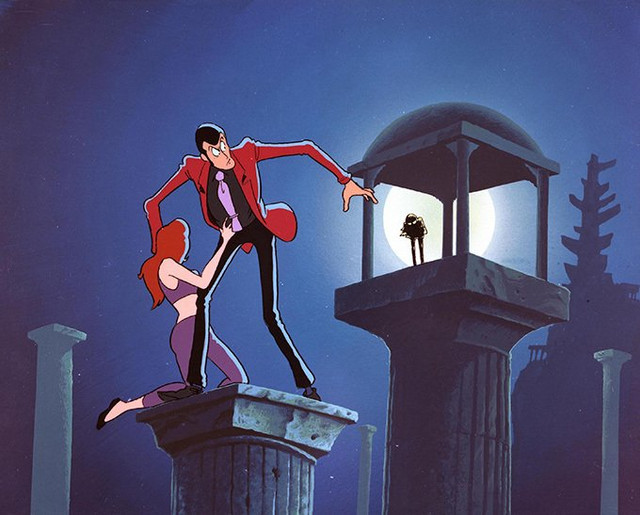
Monkey Punch, the late Kazuhiko Katō, create a few characters in his career as a manga artist. Since his 2019 death, a greater curiosity has swung, thanks to the 2003 TV series adapting it was released by Discotek, to Cinderella Boy, in which due to supernatural shenanigans a male detective and his female partner end up in the same body, turning into one another and switching gender. Also, there's Musashi Gundoh (1997), which infamously had a 2006 animated series so bad the Japanese fans demanded their DVD releases to include the original TV broadcast mistakes to be intact, thus helping export irony to the country. But Monkey Punch will be known for Lupin III, a character who, since his 1967 manga debut, has become a cultural pulp phenomenon in Japan who is still having animated tales made for, like Batman to the Americans and Sherlock Holmes to the British. This is ironic knowing the character is explicitly meant to be the grandson of Arsène Lupin, the legendary French pulp character of Maurice Leblanc, which for a while was a huge sore spot in terms of copyright until recently1. Thus from one cultural institution we got another in an entirely different country.

Like Batman, various versions of Lupin exist, and it's apt in lieu to how The Mystery of Mamo, as the first theatrical animated film in the franchise, turned out how it did. Note with this that, barely knowledgeable with the franchise and with an outsider's gap, I am at least aware of these versions are divided by the colour of Lupin's jacket. As much of it is based on the various TV series - "Green jacket" the original 1971-72 series, "Red Jacket" 1977-1980, "Pink Jacket" for 1984-1985, and "Blue Jacket" for the 2015 series on. But as much of it is based on tone too even if there are examples which do affect this, a loose framework for each. The 1971-2 series is famous for Hayao Miyazaki working on it, but it was only by his own theatrical debut The Castle of Cagliostro (1979) the Green Jacket version was cemented, the more family friendly version of the character with Lupin a more serious, debonair figure. Pink jacket, emphasised by the Seijun Suzuki co-directed The Legend of the Golden Babylon (1985), was divisive in that, knee deep into the eighties, it changed the character styles and also started including explicit sci-fi and supernatural material, something to bear in mind with The Mystery of Mamo. The Blue Jacket is one I need to see to make thought of, but from the 2015 Italian-Japanese co-produced series, I am aware the 2010s Lupin III deals with new details for the character like modern technology and is in lieu to modern animation production. Again, this is from an outsider delving further into these versions, so none of this is entirely canon in the slightest.

But it's important to point out as, whilst there are possible exceptions, Red Jacket has always been connected to the original Monkey Punch creation. More slapstick, but also adult, the idea at least with The Mystery of Mamo and other depictions that the Red Jacket version of Lupin III is the darker and edgier version of the character. Lupin in the manga was a cruder figure, has been depicted in adaptations as a literal id, a thief with an obsession with sex particularly with female thief and fatale Fujiko Mine. This is poignant knowing that in terms of the seventies version of Lupin, and the version most well known of the entire franchise, it's probably Hayao Mizayaki's The Castle of Cagliostro that is the most seen, the truest gentleman thief and good guy with none of this darker content thus making the experience likely to be completely jarring to change to this version.

Basically, like Arsène Lupin, Lupin III is a thief who scours the world for valuable objects. On his team includes Jigen, a grizzled crack shot of a gunslinger, and Goemon, meant to be a decendent of the real life figure Ishikawa Goemon, who is a wandering samurai in the current day. Fujiko Mine, who has the most fascinating revision when female anime director Sayo Yamamoto and female scriptwriter Mari Okada got to create the series The Woman Called Fujiko Mine (2012), is the female thief who has Lupin wrapped around her little finger, as in Mystery of Mamo as much likely to be on the opposite side as on his, whilst finally there's detective Zenigata, who is so obsessed with catching Lupin that, as Mamo has in a subplot, the fact you learn he has a daughter but has been outside of Japan all this time shows a pathological obsession with catching his prey.

Like many other stories in the Lupin III franchise, there is a valuable object in the centre, in this case a philosopher's stone Lupin has to acquire from an Egyptian pyramid, and an antagonist but The Mystery of Mamo is an odd one in how it is, whilst a great film, a curious piece in lieu of the way the character was being adapted to animation2 and in context to over decades of the character existing. With its villain being the titular Mamo, imagine Paul Williams in Phantom of the Paradise (1974) without the glasses, the story is already a peculiar mix of slapstick but with adult content at the start, in-between Fujiko having a lot of nude scenes to scenes incredibly rare in the franchise of people being gunned down in the French streets by a helicopter, all whilst adding upon this a schism dramatically between Lupin's rational scepticism of Mamo's claims but streaks of over surrealism dominating the tone. Literally, in one case as Lupin literally flees from goons through Salvador Dali's The Persistence of Time among other famous Surrealist paintings in one sequence, melted clocks and all ran over. In the midst of Mamo claiming to be a thousand year old godhead, you have cameos by Napoleon and Hitler in the then-modern day, a subplot which never goes anywhere in which a Lupin is publically executed (in the opening shot) by hanging, and a lot of Looney Tunes cartoon physics, where a giant American truck meant to run Lupin off the road makes French cop cars look like ants and Lupin himself moves about as a perverted Bugs Bunny.

From http://img1.ak.crunchyroll.com/i/spire2/12dff1132994
5762e26bc255ffd079961500987250_full.jpg

In lieu to that plot, where a large part of the story is Lupin dismissing Mamo as a charlatan who really only uses his wealth and goons to cause strange phenomena, all as Mamo tries to claim both the philosopher's stone and Fujiko for himself, what happens in the film concludes this schism in the strangest way possible. Without spoiling the ending, the final reveal of what Mamo is after the other twists twirls over the line into the fantastical with glee, a level of ridiculousness that is to be applauded but really feels like a peculiarity, when before this franchise kept in its own grounded (but cartoonish) format. It even more so jars with the later Castle of Cagliostro, released a mere year later, and feels like a prelude to future tales having actual UFOs and magic when you get to the Pink Jacket scenarios.

The other aspect is that, until the last decade, it'd probably be a shock to see a much more violent and sexual version of the characters despite being closer to Monkey Punch's source material. One of the greatest virtues of this franchise, like Batman to Sherlock Holmes, is that these characters all have their distinct personalities but can exist in any form. Lupin III is a trickster thief, Jigan the grumpy old veteran, Goemon in this film a literal monk in attitude, Zenigata relentless and obsessive, and Fujiko the gorgeous lady out for herself. They have versions in films, TV specials and series which can vary from a more wholesome adventure, to explicit excuses to nudity, to crossovers with other famous characters or a feminist revision of Fujiko in The Woman Called Fujiko Mine which is actually even darker, more sexually explicit and nastier in tone than The Mystery of Mamo. But it is a shock if you aren't prepared for The Mystery of Mamo.

Probably one of the more fascinating things is that, despite a really uncomfortable moment of Lupin trying to "seduce" Fujiko which is of its era, a huge subplot which comes to a boil in the end is that he and Fujiko are always meant to be with each other, actually the one emotional aspect to a bizarre, psychotronic romp.  At one point, witnessing the inside of Lupin's mind, this is emphasised when his mind consists entirely of real photographs of nude women, Fujiko naked and Zenigata like a super ego constantly interrupting this by threatening to arrest him3.

As a production, The Mystery of Mamo is an impressive production, as seventies as you can get in its style alongside the clear sense, even in its ridiculous escalation, that everyone on this project was a risk. Copyrighted objects are drawn onscreen, the aesthetic and style is this aforementioned mix of cartoon logic and grittiness, and the music lays on the jazz with disco influence in a way, just for the trademark Lupin III theme, that'll melt the heart of even the detractors of this film. Even the fact the film, whilst naming them as something else in the version I watched, effectively has Henry Kissinger, in the cast, as the Americans intervene on the plot and blown everything up, has a sense of a caustic, scattergun sense of satire and playfulness on the production.

Again, it's an odd circumstance that sandwiched in a period where the franchise was gaining steam, this film was made.  Despite being originally unsuccessful, repeats of the original series allowed a second to be made and the motion to begin in continually adapting the source material; this, a deliberate attempt at briefly capturing the original source material, stands out a lot in lieu to the various versions you'd get immediately in 1979 onwards. As much, a factor is knowledge that, in the decades to pass, many TV specials and other anime productions would be made and, for every one which might be a lot more explicit, those specials up to The Woman Called Fujiko Mine became more of an institution rather than something remotely as jarring and transgressive as this. It does feel a unique premiere to have seen in the cinema and, as the first these characters will have in my writing to be talked about, aptly emphasises how much the franchise has changed over the years. Certainly, for the one hundredth review, it felt appropriate to cover this.

From http://analoghousou.com/wp-content/uploads/2014/05/mamo_bottom.jpg

======
1) The irony is not lost, referencing these characters, that Maurice Leblanc infamously wrote Sherlock Holmes into one of his Lupin stories without permission, thus for a period having to change the name barely to not get Sir Arthur Conan Doyle on his back. It's a hilarious history to have when all three (Holmes, Lupin, Lupin III) are all immortalised pulp figures in the current day.

2) That's not even mentioning the 1974 live action Lupin the Third or the 2014 live action Lupin III, which are their own entities.

3) One of the biggest surprises, uncovered after Monkey Punch's death, is that he did actually make a manga Lupin Kozō (1975-6), about the son of Lupin and Fujiko, as a spin-off that adds dimensions to the parents in their relationship (canon or not).

Friday, 10 May 2019

#99: Ghost Stories [English Dub] (2000-2001)

From https://ssl-gfx.filmweb.pl/po/99/28
/309928/7077103.3.jpg


Director: Noriyuki Abe
Screenplay: Hiroshi Hashimoto
Based on the book series by Toru Tsunemitsu
Voice Cast: Hilary Haag as Satsuki Miyanoshita; Chris Patton as Hajime Aoyama; Christine Auten as Keiichirou Miyanoshita; Greg Ayres as Leo Kakinoki; Monica Rial as Momoko Koigakubo
Viewed in English Dub

The town of Ghost Stories is very haunted, beyond its bright colours a morbid place. This is apparent in that, over twenty episodes, even if anyone does die in the prologue for each episode, no one really bats an eye to this or any potential supernatural scenario. Clearly they're aware of how many monsters and ghosts occupy the world or are totally oblivious to this to the point of full amnesia, something to take in mind as all the beings sealed away by Satsuki's late mother have been reawaken due to major construction across town. Armed with her mother's (sometimes unreliable) ghost journal, Satsuki with her classroom friends must re-seal them all over again.

Just in the school, rebuilt but with the original decrepit school house still nearby on the property, there's enough to worry about, from demon hands forcing you to choose between red or blue toilet paper to one student resurrecting a school rabbit from the dead, let alone the entire town being occupied by the likes of headless bikers to cursed tower blocks. It also exists with a mirror world to itself. Not the mirror world of evil doppelgangers in one episode, who all wear glasses which are their own eyes and play video games on TVs with white noise, but an entire mirror world where one version has everyone being sincere and speaking in Japanese, the other full of foul mouthed vulgar heathens filling the English language full of laments of Christian Slater's failed career.

It feels like déjà vu, but I covered Ghost Stories before in its Japanese dub, the studio Pierrot production doing so poorly that it was felt that, when ADV Films got the license in 2005, they had to allow them carte blanche with the English dub to sell it to the States provided they kept character and ghost names; so ADV Films gave the dub director role to Steve Foster, a man whose relationship with faithful translations of anime scripts is like oil to water. Thus in his dark arts, creating two very different shows from the same footage, there was the original version and this new one. The original could frankly drag a lot; the problem, taking over four months to finish it, was that Ghost Stories' plots were the exact same, the group of lead characters encountering a new ghost or monster, trying to find a way to stop it, highlighted in the English version to sometimes be convoluted or the monster literally changing its mind at the last second, and repeat for the next episode. The version which Bloom brought in with the voice actors, improvised, turned it into a comedy with equal opportunities offensiveness.

Here, Satsuki (Hilary Haag) is no longer the plucky schoolgirl, Haag's trademark high voice portraying the brash and usually pissed off figure who, with a convoluted family background, has a gay deceased mother, a father who is a drunk perv, who finds herself constantly questioning her own sexuality, and has a little brother Keiichiro (Christine Auten) who has a learning disability and becomes incomprehensible in speech when he is emotional, leading to one of the many moments the world of Ghost Stories has dated drastically in ten years plus with jokes about this like using the term "shortbus".

Nerdy friend Leo (Greg Ayres) is now Jewish in this version, leading to some tasteless humour, alongside the running gag that he may be secretly gay. Hajime (Chris Patton) is now openly a pervert, which considering what are inappropriate amounts of underwear shots, considering Satsuki is a younger teenage girl in a children's show, is almost asking for such a character direction for Hajime to go further by turning him into a sex pest. Then there's Momoko (Monica Rial), once the meek older girl Satsuki's mother keeps possessing, now an Evangelical Christian, every stereotypical idea which keeps in mind that the dub was recorded in the midst of George Bush Jr.'s presidency and a lot of a Republican bashing which, alongside pop culture references, are entirely stuck within 2005 in reference.

This cast, nigh, no one in the town in this version of Ghost Stories is above comments about race, gender, sexuality and lots of material that over ten years later would have been flushed out when political correctness entered. They still live in a town with Japanese kanji everywhere, but everyone is now American, not only an excuse for cheap Asian jokes but with these amateur ghost hunters to obsess over mid 2000s references, voice actors working at ADV Films and the failing career of Christian Slater; thus what was a doll cemetery in the original for a cursed doll to be deposited to, where dolls of the dead are kept, is now in this world a place where gay publishers spend their free time recreating Slater films, the doll of use to play Tara Reid in Uwe Boll's Alone in the Dark. Before we continue, considering a lot of the references I have made have talked about a lot of gay and lesbian jokes, I must point out dub director Steve Foster is an openly gay man, so he has a lot of jokes involving gay Hell's Angel's and female ghosts looking like drag queens; he also uses the word "fag", characters having lisping voices and gay panic jokes however, which may un-impress LGBT viewers completely.

From https://img.sharetv.com/shows/episodes/standard/925822.jpg

The mirror worlds are in a strange position as, in both cases, the repetition of the plot structures is the huge handicap both had, let alone that with its bright aesthetic style. Ghost Stories is caught between wanting to be creepy but still a lot lighter in mood than horror usually is, what with the opening credits sequence juxtaposing horror imagery with a nice day at the beach, the end credits infamously having an utter earworm by CASCADE, a great song but in lieu to the audience meant originally to be family friendly, with inappropriate sexual connotations in the lyrics and the chorus including the phrase "sexy, sexy". It was cursed by simply being in a minor work in horror anime, not atmospheric enough and the English dub even mocking animation flaws in forth wall breaking.

The original version is sincere however - episodes are usually one-offs, but the nature of the mother's death is a major part of the show, the talk about life and death covered in a couple of episodes in a bitter sweet way that cannot help but be meaningful, even if one is in the episode where a bunny rabbit is resurrected from the dead and munches on everything that moves. Naturally, the other versions take the ever loving piss out of these serious segments as well as eventually lose steam, where even the sense of shock value is ebbing away in the final five episodes. Its arguably, when they beeped the swearing originally, when they given up with this and just have the expletives heard, a literal sense of giving up and with the sense that the English version is time stamped by its references and moments everyone is bond to cringe once at.

It does however have the more interesting characters as, unlike the original world of Ghost Stories, a lot more is to be found in the reoccurring jokes per characters that, even if they are stereotypes, they develop personalities. Even one off characters get more sometimes when the script's bothered to be more inventive - a creepy doll and its posse of toys is actually scarier when they're arguing which horror film to recreate on our protagonist as well as funny. Some of the characters get more from their voice actors and a few good one liners. I haven't even mentioned that, alongside having to rid the entire town of ghosts, Satsuki and Keiichiro's pet cat in the first episode is now possessed by the great demon Amanojaku, whose Japanese actor Ryusei Nakao is also great but gets interesting when Rob Mungle plays him in the English dub as a know-it-all egotist, reemphasising that, as he now enjoys licking himself as a cat, Amanojaku in both versions is an arse who until the final moment changes his mind and helps the cast, the charm in how much of a bastard he is and when he does sincerely show concern for the kids, even if the ending episode in the English dub is him wanting an Oscar winning performance before the show finishes.

The other standout, which interlinks with the amusing and actually emotional relationship between Satsuki and her late mother, is Momoko, who I was prepared to be a one note joke that'd get tiresome. Thankfully as the show goes on, whenever Monica Rial drops her high pitch voice down and Momoko's mask slips, some of the funnier lines of the entire show are to be found, not the sophomoric targeting at Evangelical Christians but when one in this case is a lot more complicated due to the script wanting to find more jokes for her. When she has more base thoughts and, in the funniest episode about a ghost nurse, has a more complicated back-story including an apple juice addiction. It's still very childish, trampling on one of the episodes entirely about Satsuki's mother, but it's the one moment the dub, which squanders itself for the most part of dumb humour, actually gets somewhere interesting.

These two versions exist in an odd couple fashion. More know and love the English dub, but time has immediately dated ADV Film's work; it even had a second (accurate) English dub from Aniplex, which just adds to the absurdity. Personally, it actually gains much more when you watch both - a mere change of dialogue literally creates two worlds from one, the first sluggish at points but with a fun to it, the other profane, frankly lazy, but more fascinating as occasionally it succeeds and when you know the source text its trampling on. Also, as I have spent nearly half a year watching this series twice, forty episodes altogether, it's stuck in my mind even if I tried to perform a mental exorcism.


From https://img.sharetv.com/shows/episodes/standard/925838.jpg

Thursday, 9 May 2019

#98: Urusei Yatsura 2: Beautiful Dreamer (1984)

From https://images-na.ssl-images-amazon.com/
images/I/51ZCHjkRLJL._SY450_.jpg


Director: Mamoru Oshii
Screenplay: Mamoru Oshii
Based on the manga by Rumiko Takahashi
Voice Cast: Fumi Hirano as Lum Invader; Toshio Furukawa as Ataru Moroboshi; Akira Kamiya as Shutaro Mendou; Kazuko Sugiyama as Ten; Saeko Shimazu as Shinobu Miyake; Machiko Washio as Sakura; Mayumi Tanaka as Ryuunosuke Fujinami; Shigeru Chiba as Megane; Akira Murayama as Perm; Shinji Nomura as Kakugari; Issei Futamata as Chibi; Kenichi Ogata as Ataru's Father; Natsumi Sakuma as Ataru's Mother; Michihiro Ikemizu as Onsen-Mark; Masahiro Anzai as Ryuunosuke's Father; Tomomichi Nishimura as the Principal; Ichirō Nagai as Cherry; Takuya Fujioka as Mujaki
Viewed in Japanese with English subtitles

Coming up to their school festival, the cast of comedy fantasy series Urusei Yatsura, from dumb horny Ataru Moroboshi to space alien princess Lum, slowly realise the day repeats over and over again. As people vanish and the world changes, questions arise to how this has come about in this Mamoru Oshii directed and scripted tale. Now with this premise in mind, to come to the world of Beautiful Dreamer (as I have) blind to the Urusei Yatsua franchise does add another detail to this plot that, whilst Beautiful Dreamer has gained a reputation by itself, you're throw into the deep end with these characters already existing. That the plot is about something else asks where the space princess who can fly and shoot lightning comes from alongside all the other miscreants who are our protagonists.

Some of you are probably blanking over the fact that, yes, you'd never presume the serious director Mamoru Oshii once animated comedy before he made films like Ghost in the Shell (1995).

Let's go back in history then to explain....legendary manga author Rumiko Takahashi, who'd create hits like Ranma ½ and Inuyasha thus becoming one of the most successful and financially well off manga authors of all time, started Urusei Yatsua in 1978, which was successful enough to start an animated series in 1981. It was only when Oshii, who started on the first episode, and the production changed the tone of the series halfway through that it is said the series gained its own successful reputation, a madcap series which lasted four seasons, six films (which Beautiful Dreamer belongs to) and twelve OVA episodes up to 2008. It was a franchise which played on absurd premises, comedy and mythology, Lum the space princess in her trademark tiger print bikini explicitly referencing a costume of Japanese omi (demons) among generally ridiculous jokes.

The premise is that Ataru Moroboshi, your typical sex obsessed teen male, was chosen as the human being to protect the Earth from a race of aliens by means of a game of tag between him and their representative Lum, an event explicitly reinterpreted in a later segment of Beautiful Dreamer. A misinterpretation, whilst he won, caused Lum to think he proposed to her as a wife, thus leading to her living on Earth, electrocuting him with super powers whenever he pervs on others; the other male students, led by military obsessed Shutaro Mendou1, were not happy of this situation so, as referenced in the film, have a group to protect Lum from him or at least try to make his life a living hell. Neither was Ataru's original human girlfriend Shinobu Miyake impressed too, a girl with superhuman strength stuck on the side to this farce.

From https://i.imgur.com/x3siNcbh.jpg

Beautiful Dreamer
is a film given a huge amount of weight by itself due to Mamoru Oshii's history, a director of a lot of comedy as well as cerebral material even into his early nineties run of live action work, something we don't know a lot about past the Millennium when he fully dived down on sombre writing. The sole screenwriter, lifting from a premise they used in an episode of the series but expanded in scope to full blown surrealism, this is still visible Oshii's work and no one else's. That it's in lieu to a comedy, and a beloved franchise that was already using carte blanche in its premise is the truly unique thing at hand; even without the original context, I was looking at something, even if Beautiful Dreamer was not a high budget work in its time, which went beyond and magnificently into the experimental and creative.

In this world, the introduction immediately sets up the chaotic slapstick and chaos when the initial premise is preparing for a school festival, the incredible energy and invention of the animation team felt fully. The characters are numerous, but you can establish their personalities with ease from their quirks, particularly as, when the film occasionally becomes very serious and existential, their simplicity allows them to suddenly develop nuisance. Even when there's material that might raise an eyebrow, the Nazi themed cafe somehow a good festival choice for your class, there's plenty already in the initial premise onscreen, like the numerous ridiculous pratfalls and sight gags, to amuse and catch your attention away. Even the issue that one of our protagonists is a pervert, Ataru, is thankfully something that also becomes nuisance, his clear romance with Lum something which becomes a huge part of the plot in the end; even when literally given his fantasy, as a result of plot machinations, her absence from him is felt and immediately called out. Plus there are so many characters onscreen, and others who take on just as many important roles, that it balances everything out. The truth is that, ironically, it's Lum herself despite being a huge figure in the franchise, and of this film's crux in terms of the resolution, who takes a background part, an interesting issue when a sci-fi supernatural figure like herself would've been the central premise in any other circumstance.

As for the world itself, of these lovable food obsessed and manic figures, their idyllic farce is undercut by the scenario when reality itself is distorted, where even when Lum exists as an alien who can fly and has a miniature friend called Chibi she is no way near as odd as when the tank abruptly appears in the school swimming pool, puddles of water teleport people, and individuals vanish. As time stops, enough for a room to be entirely covered in fungus and dust, and people eventually start to disappear, the film for all its light heartedness gets serious when it needs to, two diametrically different tones managing by pure, perfect preciseness to succeed. The constant changes to reality are vividly depicted, the various houses of the world being altered, from new floors to the school becoming a M.C. Escher illustration that bend physics, to the plot eventfully turning the world into a post apocalypse where the rules are even odder about their environment yet the buildings are ruined. Knowing Beautiful Dreamer is not the highest budgeted work, but still from this era of hand drawn animation, adds to how incredible an achievement it is, especially as the later plot machinations go as far as to include turning into genre vignettes and full blown cosmic psychedelic with characters on strands of DNA. When its revealed what is going on, thankfully it has a personification that its immediately memorable as a figure, one who you feel sorry for even if they are as much responsible for turning the film into an even greater spectrum of strangeness, between sci-fi pulp tragedy to even half finished scenarios built with cardboard.

And the style is matched by the moments of seriousness, which never override its comedic tone but work around it to actually have a startling effect. The Oshii I grew up with is here, first witnessed fully in one of the best scenes when nurse Sakura encounters the being behind it in a taxi cab, possessing the driver and getting into a conversation in a dark tunnel about how time is merely a construct of human beings, a sober atmosphere but detailing Oshii's obsession with characters having long philosophical discussions. Famously it would go even further to the point as if deliberately goading the viewer - his tie-in novel to Blood: The Last Vampire (2000) called Night of the Beasts, an action vampire story, stops halfway through for chapters of long discussion on vampire mythology around a table - but here it works perfectly. The legend of Urashima Tarō, a man who rode a turtle and did not age famous in Japanese culture, their equivalent to Rip Van Winkle, is evoked as is the idea of Zhuangzi, the Daoist thinker who dreamt he was a butterfly dreaming he was a man and developed an existential crisis as a result.

This all is still a comedy, one which resolves everything for a new day, a new story, but the production pushed the premise in drama and scope to an undeniable scale. It's for me because Oshii is such an obsessive for extrapolating on ideas, that he's able to push these premises into interesting tangents. Seeing one of his most overtly comedic works for the first time, it's also amazing for who could be a cold director to also see his heart, a whimsy here that is utterly lovably as well than absolutely suited to slapstick and school days bonding, something I've never seen yet in his career. Sadly he'd depart from the TV series by episode 106, going on far longer afterwards, his relationship with the original creator Rumiko Takahashi not by all accounts a great one and prone to conflict over ideas; what he produced here, resolved around the love between Ataru and Lum, is such a lovely, strange and delirious production I adored.

From https://i.pinimg.com/736x/3c/49/d4/3c49d4a5261cc6
1cb7e01f0109885356---anime-manga.jpg

=======
1) One character who immediately won me over, because his voice actor Akira Kamiya was incredible, is Shutaro Mendou, a diehard military obsessive who, in this world, can acquire an actual tank for the school festival cafe, has access to a fighter plane and yet, for his seriousness, can break out in a higher pitched exasperation when challenged or hoisted by his petard.

Monday, 6 May 2019

#97: Tonari no Seki-kun, The Master of Killing Time (2014)

From https://cdn.myanimelist.net/
images/anime/9/55489l.jpg


Director: Yūji Mutō
Based on the original manga by Takuma Morishige
Voice Cast: Hiro Shimono as Toshinari Seki; Kana Hanazawa as Rumi Yokoi; Satomi Satō as Sakurako Gotō; Shigeyuki Susaki  as Takahiro Maeda  
Viewed in Japanese with English Subtitles

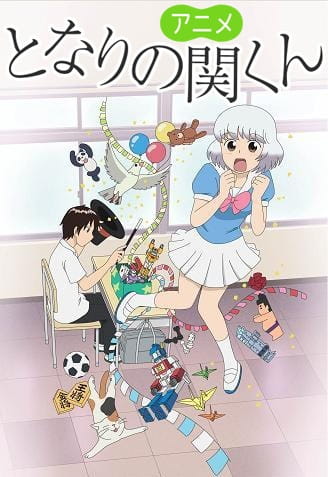
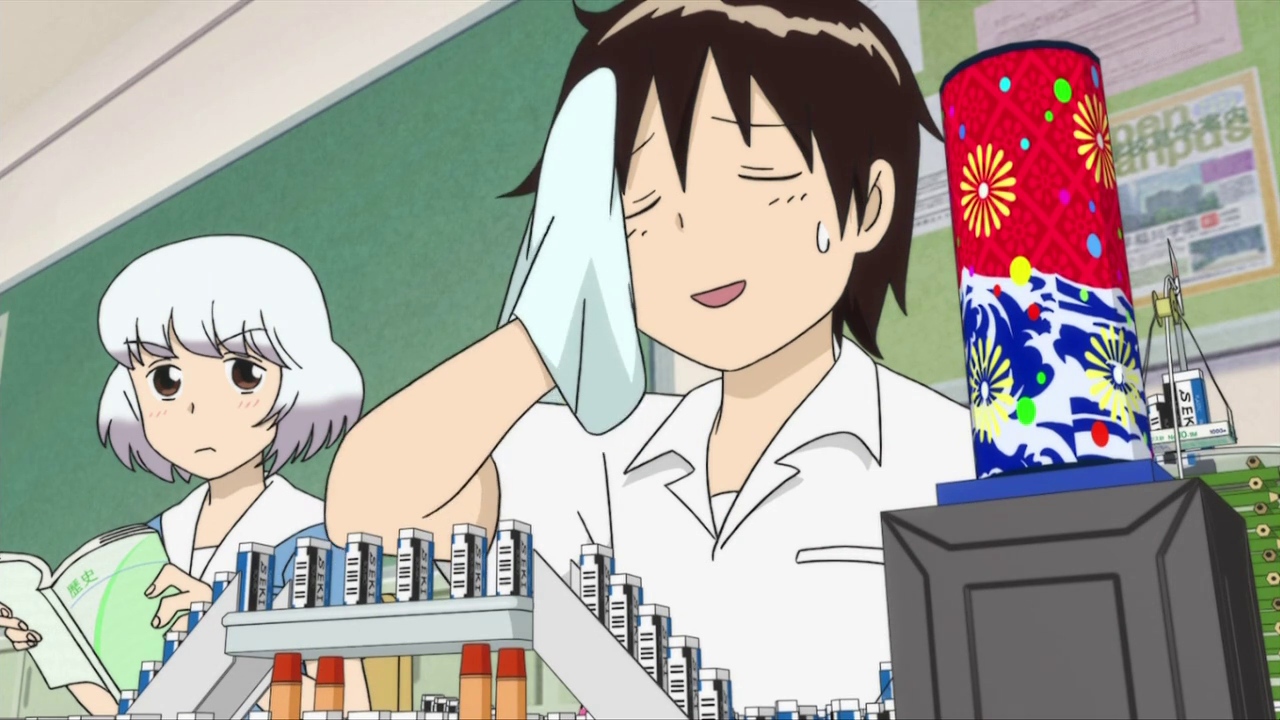
In class, Rumi is constantly distracted by Seki, who never is paying attention to lessons but always indulging in peculiar or elaborate hobbies mid-lesson. Thus, as a micro-series goes over twenty one episodes, seven minutes each, The Master of Killing Time is a perfect example amongst them of how to use minimal lengths to an advantage. From those I have previously encountered, there was one called Sparrow's Hotel (2013) which, even if it has only three minutes per episode and amusing, didn't take full advantage of its story of a former female soldier working as hotel staff, whilst another about sentient farts, Onara Goro (2016), is weird enough to be compelling but was looking like it was about to wear the joke thin if it went any longer. And then Pop Team Epic (2018), which was a fifteen minute episode repeated twice with differences between the versions, has the issue of being so insular with its references the humour's only gained for a few, and so chaotic it actually becomes less weird than a premise which is straightforward but has a weird detail.

The Master of Killing Time in contrast takes an odd premise, of a student who engages in increasingly bizarre activities instead of studying, and repeats with the virtue of having his "straight man", white haired and plucky schoolgirl Rumi, being pitched as the perfect foil, in both heart and her comic reactions to his behaviour. It's one joke, as Seki go from performing magic tricks to her to really odd pastimes, like setting up an optician's mirror at his desk and trying glasses on he'll never wear, but he has his own charms. He's also a sadistic at times, from playing his shogi set off as soldiers by bashing the pieces, to his sausages at lunch being shaped liked squid, thus creating a horrifying story of preservation being concocted by Rumi as she imagines him a monstrous devourer of a benevolent race of sausage squids.

Rumi is the reason the jokes work, voice actress Kana Hanazawa a shining star alongside everyone who both drew her facial reactions and came up with her various flights of fantasy based on what Seki is doing. A friendly chemistry is between her and Seki, never romantic, but a greater reward is to be found in her hyperactive imagination when she over elaborates on the shogi game, imagining a fantasy epic of betrayed kings and star-crossed lovers, to the robot family, the one longer form running gag where Seki has three robot toys, designed like a father and a mother and a child, who do thinks so earnestly that Seki doesn't. This joke, in mind that The Master of Killing Time is a bright and warm work with some clear craft behind it, but still economic in presentation, even gets a parody of a classic vocal song usually found in old animated robot shows in Japan, a reference you don't need to get when the song is so bombastic but the lyrics are about everyone loving scrambled eggs and robo father sleeping in late.

From https://ikilote.net/Galeries/News/Anime/AR/
Tonari_no_Seki-kun_-_ep01_047.jpg

Noticeably, with the seven minute lengths also including the opening and ending credits, a lot of the humour is able to work constantly as the joke is based on drawing it out over a long time, the elaboration and silliness based on the tension Rumi puts in her investment in the activities. The great structure is emphasised when a side character Sakurako Gotō gets to be the lead for two episodes; believing Rumi and Seki are actually romantically together, the two episodes are great themselves, particularly when she perceives a game of miniature golf on a larger shared desk is actually them engaging in some very personal romantic hijinks to her blushed shock.

It's a great example of creativity in minimal resources, quite a well animated work but in that it uses the limited movement of anime to its advantage, how the gags are based on sudden shocked reaction in Rumi's voice or a sudden change in facial movement. Its tells a lot from one joke, and to consider that the entire series, like the source material, is based on simply this peculiar premise, the kind you'd be hard to find in a lot of mainstream Western animation, is something to admire. Obviously the premise is helped by being minimalist - baring Gotō and the robo family, the only other true side character, whilst in populated classes, is Takahiro Maeda, a student who is oblivious to the odd behaviour Seki is doing on the desk behind him, even if it's using his back to represent a mountain for robot toys to perilously climb.

The sense of personality even comes around to the opening and ending credits too, not only in the good music but what they repeat - playful pop over the opening, Seki elaborately animating a scene of himself and Rumi like an actual anime production, the ending a lovely jazz piece that, as he plays an improvised instrument from materials like a pencil case, adds to the sense of Rumi secretly liking him for all his irritating habits. That there is no real conclusion to the series, barring the final episode adding the risk of him being caught for his shenanigans, isn't a disappointment but a natural ending, that unless the manga took a different direction, or amped the stakes to funnier heights, Seki is still going to be doing this, and Rumi is going to always miss something off the board to write down for her work.


From https://theglorioblog.files.wordpress.com/2014/03/seki-kun_6-9_4.jpg