Saturday, 8 April 2023

#247: Makura no Danshi (2015)


Studio: feel., Assez Finaud Fabric

Director: Sayo Aoi

Screenplay: Ayumi Sekine and Yuniko Ayana

Voice Cast: Natsuki Hanae as Merry; Ayumu Murase as Hareto Enokawa; Daisuke Kishio as Yonaga Sagiri; Daisuke Namikawa as Sōsuke Tanaka; Kousuke Toriumi as Shirusu Mochizuki; Nobunaga Shimazaki as Nao Sasayama; Shinnosuke Tachibana as Yayoi Sagiri; Sora Takahata as Eiji Kijinami; Toshiyuki Morikawa as Yūichirō Iida; Yoshimasa Hosoya as Kanade Hanamine; Yoshitsugu Matsuoka as Yū Maiki; Yuichiro Umehara as Ryūshi Theodore Emori

Viewed in Japanese with English Subtitles


Your butt gets tense...

Using that quote because I am incredibly juvenile, I was hoping to come into Makura no Danshi as a curiosity, not like any anime I have yet encountered, and with a significant change of pace in terms of its gaze being entirely on men as attractive figures which I deliberately wished to sort out. Even as not the target audience as a heterosexual man, this was a deliberate choice to place myself into the position of another audience, apt as when I get into this mini-series, it is entirely from first person. Sadly I have to damn this micro-series, twelve episodes and four minutes each, for one episode which is incredibly insidious and undefendable, and honestly, and as an anime series I had heard of as it appeared on lists of one of the strangest ever made, I also felt disappointed with the rest of the episodes as it completely misses the intended goal.

Broadcast summer 2015 originally before Crunchyroll brought it to the West on their streaming service, Makura no Danshi has a very idiosyncratic structure. Each episode presents a new male character who directly talks to the viewer, helping them to sleep in the end. Until one of the later episodes, the gender of you the viewer is never mentioned, only making the faceless protagonist female in that later episode, opening up an entire spectrum of perspectives for this show. The unfortunate episode undercuts this, but the point is that whether it is a male librarian to the slightly dim-witted hunk in school, you are to crush on this representations of archetypes animated and voiced by male actors. The title translates to "Pillow Boys", the idea of men who help one to sleep just by talking to them or as you never hear your own dialogue, just one half of a conversation, them talking to you. There is clearly a fetishishtic side to this, but is also something which in itself here is not a bad thing at all as a concept even with that attractive allure of these characters, especially as the opening credits are more explicit then the show itself in having some of these characters, drawn with abs of pure steel, with their shirts almost dissolved off in a dishevelled sexy look. This premise in a form already existed as well as a Japanese live action drama series Shima Shima (2011), in which a business ran by a divorced woman sent handsome men to help female customers sleep, sending them over for the night not as sex workers but a form of emotional conform for those suffering from sleeping issues.

The anime itself is very idiosyncratic as, with mentioned, the other character is you the viewer, and most of the conversations are half one communicating to the viewer from the first person. The anime, in one of its flaws structurally, does break this continuity for no particular reason, which adds to the strangeness of the premise but does undercut the illusion. In terms of the "boys" themselves, they follow archetypes, be it the intellectual one, to the miscreant outsider who broads on the roof of the school like a cat who is unaware he is now human. There is also unintentional creepiness in the flower arranging twins. Their episode is an accidental case of creepiness in which their playfulness, including the game of find the flower in their clothes, feels less erotic and more the viewer trapped about to be killed. Also, it is about here we get to the contentious episode, the one which frankly as a viewer makes me wary to return to the series. That is Episode 7, which is about Hareto Enokawa, who is a five year old boy. It is creepy, even though the dialogue is the equivalent of having to babysit the son of someone you know, obsessed with a sentai show and the pair of you feeling tired as he wears you out as your charge, but in context, when these characters are meant to be fantasies, this is an alarm bell moment. Considering the point of each is that these are meant to represent various forms of guy of interest, it raises uncomfortable questions, even if accidentally distorting something innocence, of what the target viewer for this episode takes from this kid. It is a terrible creative decision for the studio feel. and Assez Finaud Fabric to have made as, yes, whilst others are teenagers, which is just as dubious, this in itself is the kind of thing even with the cheery context which has uncomfortable implications whether a pure misguided decision or intentional, which would be even worse to consider.

The work as well is missing a lot of potential. This is a curious premise, notwithstanding that episode I feel comfortable bringing up, but one which is missing that one touch to make it something far more rewarding. None of these pillow boys barring one ever stand out, the one who does managing in less than four minutes to show you could have done a whole series about him, set in his setting, and still keep the first person perspective where you the viewer are interacting with him. That being the one old guy, Yūichirō Iida, proudly calling himself the creepy one despite being the perfect dad fantasy figure, the oden food stall man who drinks on the job, reads shoujo manga for inspiration (shoujo meaning targeted for girls), shows off his appendicitis scar like a fight wound, and admits his body is breaking down despite looking (even as a drawn character voiced and animated) like the ultimate fantasy of the bumpkin some anime fans (of both genders) would want to sweep off them off their feet. The dialogue in this episode is actually funny, and I give full credit to their voice actor for the episode too, voiced by Toshiyuki Morikawa, who at even this show was a veteran of the industry. He is also a veteran for the video game industry, and among the characters gamers will see as iconic he has voiced, anyone who has a passing interest in the legacy of Final Fantasy 7 (1997), in its tie-ins in animation and other games, will have heard Morikawa as Sephiroth, one of the whole Final Fantasy franchise's most iconic characters. In terms of how a seiyuu can make one appreciate even a show that is dubious and/or not great for their commitment, Morikawa in less than four minutes provided a memorable episode in what is, frankly, a weird curiosity which does not really get the potential of this show. As mentioned in this paragraph, imagining if this entire show as about the relationship between the unseen protagonist, you with possible narcolepsy, and the booze loving oden food stall man is an acquired taste not all viewers would like, but would have been a compellingly odd and enticing title if it had been pulled off. Even if they had made a show about a variety of "pillow boys" but had extended it out to multiple episodes with a few, and Toshiyuki Morikawa and this character were kept, we could have still gotten a good show regardless of its purpose and the target audience if the production focused on both a sleep aid but one disguising a set of character dramas.

Makura no Danshi even ends on a strange note with the first pillow boy bookending the show, the one behind the quote starting this review in his awkwardness, seemingly able to change ages and seemingly a sheep plush on your bed you imagined was a cute boy. This type of anime I admit fascinates me, when it is not just a narrative work but, with plot or not, it presents itself as deeply unconventional or with a purpose you rarely find in Western animation, in this case a sleep aid which is also depicts the various fantasies of men to gaze at as they talk to you. Unfortunately, one of these episodes means that I really cannot really recommend this, as it will be as creepy for many viewers as it was for me. Ultimately, as well, this is not a great anime too, a low budgeted affair which, even for its premise, even in terms of breaking its own cardinal rule of being entirely from first person, does not fully take advantage of its form and minimal production value to be something memorably quirky or a good sleep aid. It stays as a curiosity, from what I would call the "Crunchyroll era" of strange anime which you only get nowadays, when once it would have been fan made subbed releases, that only becomes available through that streaming service and others needing content. Stuff like this, especially these micro-series, are fascinating for what they are, even if as in this case, they are not always going to be great and even miss potential.

Tuesday, 4 April 2023

#246: Beast Fighter - The Apocalypse (2003)


Studio: Magic Bus

Director: Kenichi Maejima

Screenplay: Junki Takegami

Cast: Kentaro Ito as Shinichi Kuruma; Nana Mizuki as Ayaka Sanders; Shoko Kikuchi as Maria Tengai; Taiki Matsuno as Tomisaburō Tengai; Atsuko Yuya as Shizue Kuruma; Katsuhisa Houki as Genzo Kuruma

Viewed in Japanese with English Subtitles


How does one describe this adaptation of a Ken Ishikawa manga? The Bible as retold by pulp Japanese anime set in the post-apocalypse and made in the early digipaint 2000s era of anime. Ken Ishikawa, the source author, was a friend and collaborator of Go Nagai, together as a pair creating the Getter Robo franchise, whilst Ishikawa's own career as a manga author was prolific in its own right before his 2006 passing. Nagai's legacy in the West has grown as more of his work is available, especially after the success of Devilman Crybaby (2018), whilst Ichikawa is someone who many might not know of but has had adaptations of his material come to the West. Yakuza Weapon (2011), a live action film by Tak Sakaguchi and Yūdai Yamaguchi, is an adaptation of the manga author's work, whilst infamously there is the anime production Ninja Resurrection (1997-8). An adaptation of Ishikawa's manga, which is an adaptation of Futaro Yamada's 1967 novel Makai Tensho, I would argue it is infamous because a) it never had an ending and leaves on a cliff-hanger after two episodes, one which is more blatant in how the anime never really got going in its plot let alone concludes the manga, b) is pretty lurid for those who have seen it as a period samurai work with horror and supernatural content, and c) was likely released in the West with the desire to sell it off the success of Ninja Scroll (1993),  despite their only connections being a lead named Jubei.

Beast Fighter, if close to the source at all, and with knowledge that a 1990 straight to video version of this tale exists, shows a feverish insanity can seep through its author's work. This is a delirious production, once you get past it being a lower budgeted animated series, where its logical jumps are contrasted by the abrupt and sudden turn into emotional sincerity in its final act. Beast Fighter, as mentioned, is set in the post-apocalypse but one here where barring one ruined wasteland, is mostly well off. There is cities, government, train services, the news and even online porn sites as one joke point out, but there is at least an epicentre where children fend for themselves and murdering punks exist. There is also a credible threat, and this is where spoilers have to be brought up immediately, as in this world, God is an entity that is soon to awake, and there are two sides with their eye on this development. Genzo Kuruma is one of them, an evil scientist who sacrificed his wife, his son and his son's love to attain his power, who wishes to control God with his army of mutated humans, based on dinosaur DNA, and recreate Noah's Ark. The other is his son Shinichi Kuruma, melded with three animals (a lion, a bear and an eagle) into a powerful chimera, who wants pure revenge on his father as a result of all this.

The story begins properly with the introduction of Ayaka, a young woman saved by her father from a fatal heart disease but was an experiment with the intention of Genzo Kuruma to use his plans about God, thus kicking off this thirteen episode series. Alongside Tomisaburō Tengai, his comedy sidekick friend who is yet the head of the ninja clan and the brother of Maria, the woman Shinichi loved, Shinichi with his obvious father issues but with Maria's soul within him alongside the animals can either become a true hero or accidentally be turned into an entity far worse than Genzo that could annihilate humanity for good. Shinichi is going to immediately stick out as a lead. He is stereotypical for this medium, the stoic and angry lead with the positive contrast that he is capable of growing, and even feeling sadness like the best type of characters, but his powers are certainly memorable. Most heroes do not punch with an actual lion's head materialising from their arm in his full form, and it is surreal and certainly fun to witness, making close quarters combat with him dangerous alongside the bear's head in his chest and the eagle that he can send out from his back. Considering, however, this is a series where "pluripotent cells" is a key plot point, as is cloning God and needing "emotionless" blood to get the job done, alongside the evil dinosaur mutants, and you are dealing with an anime where this memorable lead is still one of the saner aspects to the production. It is a pulpy narrative which is an acquired taste but for those in harmony is compelling, and whilst there is gore and some luridness, a lot of the experience of Beast Fighter is a rollercoaster of abrupt plot events and all of its reinterpretation of Judo-Christian spirituality in curious ways.

Considering the screenwriter Junki Takegami also worked on Crystal Triangle (1987), a work about conspiracies which leads one to ask why would God need a spaceship, the tone is probably explained by him as much as the source author. There is also the studio behind this Magic Bus; founded in 1972, whilst they have assisted with other studios and made porn anime, they have their own productions and with the likes of Mad Bull 34 (1990–2) among their titles, Magic Bus has its own specific mood when they decide to make something very weird. Here with Beast Fighter, they proudly tell this tale without batting an eye or winking in irony at the material, and without the problematic threat of sexual violence found in Mad Bull 34 either. For this series specifically, the religious content is going to dumbfound a few, and it itself one of the more distinct pieces of this series. With episode titles based on different books of the Old and New Testament, such as Episode 3 being the Book of Job, this is Christianity from a standpoint of a country where Christianity is a minority religion.

There is a small minority of believers, and a history within the country which is prominent, this is entirely from someone reinterpreting the meanings of the Bible from an entirely different culture, in ways which are fascinating if eyebrow rising. Literalising communion as cannibalism is also going to offend some too, so be warned, as this has the famous story of Mary Magdalene being saved from stoning, "May he who casts the first stone without sin", conclude with everyone being chased off or having their head exploded off. All those willing to go along with this will find some curious interpretations of note, such as the emotionless blood concept being important as, contrary to what one would presume, cloning God's DNA does not lead to one's ideal figure but someone capable of true nobility much to your chagrin.

How this is a lower budget show also needs to be considered. The time period it was made in, the early 2000s, is reflected in how this is a production from the time larger budgeted animated shows in Japan would have been figuring out how to make the new tools look good in digital ink and paint.  Many still dated themselves, let alone this one, and now that this aesthetic style is nostalgic is both proof I am old, but is going to be its own factor. Either you can appreciate this, including the fact you will never get a proper 1080p resolution for this title, or it will be off-putting in itself. Your composer here too, Hiroshi Motokura, only has a few credits under their name including Ikki Tousen (2003), the original series of the franchise, and they are going to be a factor as their music is either going to be too cheesy or fits the tone perfectly. That includes how Motokura skates on thin ice with a heroic melody sounding suspiciously like Queen's We Will Rock You with just some of the notes changed, something which has to be heard to be believed.

It is an absurd series, least until after the halfway mark where it managed to get serious in the midst of all its absurdities, and contrasting this is how this is a very simplistic plot at its core. Genzo Kuruma wants his son's blood, especially as it now has absorbed Maria's, the Virgin Mary figure of this Biblical tale, until he eventually targets Ayaka, and most of the thirteen episode series is one of two henchmen, the scientists Genzo has serving for him, their mutant henchmen or an openly corrupt member of the Japanese government. Though his transformation into a rat man unfortunately leans into racist stereotypes used against Jewish people, that is not the anime's fault in being insensitive either, merely to something to warn of as an accident trigger; the character himself really says a lot, if accurate to the source material, of Ken Ishikawa's own views of his own country's government if the Defence Minister here is willing to blow up an entire hot springs resort with the army, kill everyone in the town, and blame an accident from a nearby chemical plant just to kill Shinichi and claim the powers of God for himself.

The logic of the show can be summed up in how Shinichi can happily sever his own arm off, and be able to reattach it again, just to shake out parasitic insects one enemy infected him with, or how this is the kind of show where the lead fights sharks to the death and then processes to break Leviathan in half with an Argentine Backbreaker without the show batting an eye. It is amazing to think that, by the final episodes, the show manages to get serious in a way than is emotionally sincere, even if the content is still absurd, because it takes a huge risk of killing a main character off and having the entire last episode effectively tackling the lead's grief and inability to mourn those he has lost turns him into a Satanic force. It is a truly strange sensation, for how this show cannot be taken serious at all initially, I found myself doing so by its ending. Because of how the conclusion is actually bleak and tragic, with the subject of mourning its key conclusion, this managed to surpass expectations, gleefully here for its interpretation of Bible stories and its pulpy style, by caring about its cast, the true conclusion not that evil is all defeated but one accepting lost. It was actually quite emotionally stirring, and again, earlier on in this series, even when dealing with children being killed in the cross fire of this religious war, it can have them being bounced off walls onscreen in a tonally absurd moment, or have one of Shinichi's foes being an actual island. So the show is still as mad as a box of frogs too, you will have to be willing to accept its own logic to get to this as I did myself, but this managed to not only live up to the hope of being entertaining, but it managed to actually try being dramatic too even if this is a show fully of moments which are baffling too.

Friday, 31 March 2023

#245: Yukikaze (2002-5)


Includes a review of Fighting Fairy Girl Rescue Me Mave-chan (2005)

Studio: Gonzo

Director: Masahiko Ōkura

Screenplay: Hiroshi Yamaguchi, Ikuto Yamashita, Masahiko Ōkura, Masashi Sogo, Seiji Kio and Yumi Tada

Based on the novel series by Chōhei Kambayashi

Voice Cast: Jōji Nakata as James "Jack" Bukhar; Masato Sakai as Rei Fukai; Masako Ikeda as Lynn Jackson; Miho Yamada as Edith Foss; Youko Asagami as Rydia Cooley

Viewed in Japanese with English Subtitles


You want me to psychoanalyze a fighter plane?

Thirty three years before this straight-to-video anime begins, the “JAM”, an alien race, invaded Earth through a wormhole from their planet to ours via the Antarctica. Now, based on the series of novels by Chōhei Kambayashi, the human race pushed them back through the passage, back to their planet “Fairy”, and keeps guard on that side. Yukikaze’s author, Chōhei Kambayashi, is a prolific author in science fiction, with this series one of his most known. It is neither the only one to have had an anime adaptation, as an obscure OVA series The Enemy's The Pirates! (1989) is based on another of his works, imagining a space cop duo where one of them in an alien talking cat.

Yukikaze is a considerably more somber premise, but to factor in as well, this was a ten year anniversary for the animation studio GONZO, which could seem odd as they were founded in 2000 as the studio most known them for. This ten year anniversary is because, whilst the animation studio most will known was founded in the year 2000, the original company Gonzo K.K. began in 1992, working with other companies and on video game cut scenes. Whilst they still exist, financial problems between 2008 and 2009 eventually led to the company being merged with Gonzo K.K., taking them out as a prominent animation company even if they still work to this day. GONZO before them, between 2000 to 2005 at least, were a prominent company for me as I got into anime at that time, as the late ADV Films released so many of their productions over in Britain, nostalgic to think of but with a sensibility to know their flaws. They had shows like Chrono Crusade (2003) I loved, but hesitate to return to, and others like Hellsing (2001-2) were works with were divisive to viewers. One of their biggest issues which was obvious even back in my barely developed years of taste, and is found with Yukikaze, is that they were a company cursed by the journey it took to keep a long form production consistent in narrative and quality, even in terms of pure sod’s law as both of the titles mentioned, for example, were cases where the source manga were unfinished and they had to create new endings within only a handful of episodes. They were once a high profile name, even to the point that arguably one of their most successful and highest profile productions was not a series but a Linkin Park music video, Breaking the Habit, which with the nu metal band was something non-anime fans would have seen at a time when anime and other pop culture crossed over multiple times.

Yukikaze however is an example of the problems with organizing and pacing their projects. For years my only knowledge of the show came from one of the longest lasting and running anime podcasts since 2005, Anime World Order, where the five part straight-to-video production was buried as a sci-fi story which absolutely failed. The build up over a decade plus means that I actually found material in Yukikaze of virtue, and what was once jokes on that podcast1 have by accident been more salient as this presents one of the most  (accidental and at times intentional) and compelling psychodramas one could have wished was in a better managed project. Truthfully the bar was set so low I found so much to enjoy here, something compelling but an undeniable mess that, could have actually succeeded. Even in terms of the unexpected content, the fact that the central relationship between its male leads, James "Jack" Bukhar and Rei Fukai, has moments beyond platonic friendship but potential romantic readings is something you are likely to find in a lot of anime. Sometimes it is deliberately placed in shows even if with its own moral questions, as this can be done in anime as a way to appeal to certain female audiences attracted to “yaoi” and subtext of possible relationships between male characters, something with its own questions as that means it is not necessarily for a gay viewer’s benefit first in characterization. What is unexpected, and was merely presumed a joke in that podcast I listened to many times, is how even if unintentional, this platonic relationship ends up being a triangle between these two men, struggling through this battle against an alien menace.. and a sentient fighter plane.

It feels less like a joke either to say that, as there are two sides to the Yukikaze project in terms of the production, and one of them (the most compelling) falls further into this even if an exaggeration of the actual content seen. One side, despite its sci-fi setting, is realistic aerial dog fight scenes which made this an expensive project, using what was cutting edge CGI animation for the sequences, and the other is a drama. The latter’s character dynamics became, even if by mistake, in certain dramatic choices more psychologically idiosyncratic and deeper than intended. Rei Fukai, our lead, is clearly written in script and in depiction as psychologically disconnect from the world, close to the point of becoming a savant who would not be able to function in the ordinary society back on Earth, but found harmony helming the Yukikaze, a fighter plane which has such advanced A.I. It and Rei have developed a bond, strong enough that he follows its advice to even shot what it consider an enemy without question.

Considering dreams Rei has include depicting him in a jail cell and Yukikaze itself, which means “snow wind”, depicted as a female fairy creature on the other side of the bar he yearns for, the production may have accidentally loaded so much more meaning to his bond to the plane, especially as the tension with his senior officer James Bukar reads too closely to a crush between them even if it was just meant to be a close friendship in dialogue. Even if pure accident, this is the material which is the strongest of all of Yukikaze because it is at least memorable, and aspects that are clear in dialogue suggest even Chōhei Kambayashi’s source writings had an unconventional characterization for Rei himself. One of the odder details is how the two met, James meeting Rei in a canteen mashing peaches and peas together in a meal, a bizarre touch showing Rei’s unsociable form, and there is a lot to Yukikaze which I would not be surprised is from the books and in a fully fleshed out form would have more eccentric but compelling to witness. Even if meant to be platonic friendship between the two, their drama is still interesting even if the result in this anime makes Yukikaze extremely weird. That would clearly be the idea of James being the one person who cared to help Rei, finding friendship with him, and the constant fear for his safety as Rei is attached to the Yukikaze more to ordinary life. It is obviously a metaphor for the dehumanization of war, where Rei only feels alive in the peril of danger and aerial combat, but when a female superior, Rydia Cooley, tells James he is losing Fukai to Yukikaze, you get one of the multiple moments where the show may have unintentionally made Yukikaze more compelling as a story by making that plane a rival for Rei’s heart and mind. The plane, thought it downloads its consciousness into another machine, even has a sad send off in Episode 1 to emphasis their place as the third main character of this material even over human characters.

The project without this idiosyncratic melodrama has a compelling premise which could have breathed into something truly engaging. It is a well worn one, an invading forced known as the JAM which are totally unlike human beings, but only seen as horrifying sentient goo, the plot also brings in an enticing twist in terms of a Body Snatchers concern, that the JAM are replacing members with copies to infiltrate their higher ranks. Even without the central relationship with James and Rei, the psychodrama of a plane’s A.I. being able to understand Rei more, this could have been an anime that could have knocked it out of the park as an intense sci-fi drama, set with some realism, where the war in the alien world has a greater paranoia as more members are said to be “taken”.  The anime can also be batshit with some ideas. I can just mention the character who has a plutonium powered atomic heart which prevents him from entering certain countries, never mentioned again after his episode, but the kind of idea out-of-nowhere that wins me over as well in terms of how imaginative this could have been.

The issue with Yukikaze is that it is neither fish nor fowl. The post digital animation look of the time, a muted realistic one of grays, is a contentious aesthetic touch to consider in itself, but the show also lacks energy, crossing over from a mood piece with an unintentional level of what you can read into it, with James’ fears for Rei in safety and psychologically the one thing keeping this for me from becoming sluggish. The aerial battles themselves are also the weakest segments of the entire production. Aging is less than issue with them but that, expensive to produce, they are not interesting and there are times where you will struggle with whom is who in the alien skies without combing through the scenes, not telling the plot visually well. Flaws creep in more and more into the script, and it is clear the show, with episodes two to four being thirty minutes long each, that the span of time was a bad sign to how it was moving along, only being fully released between 2002 to 2005 rather than taking a lot quicker to complete.

Basic explanation of the premise is not done, such that whilst it is explained at the beginning this is set on an alien planet, you forget in the seemingly normal desert this is set in an alien world, and a lot of characters are left with not enough given time to stand out. Rydia the female chief or Edith the psychologist (who is also her niece) are two examples, but more jarring is a figure who gets a lot of time for herself back on Earth, Lynn Jackson the journalist and acclaimed novelist who we get the back-story of. She is the face of the normal person who witnessed the JAM invasion as a child, by the news on Christmas with her parents, and devoted herself to researching the events when an adult. She has become the figure now standing out as someone who devoted her life to documenting the JAM invasion which many are wary in believing in nowadays, an enticing concept in how human beings do not learn from the past and become complacent. Her story is closed abruptly on Episode 4, when the story returns to Earth fully, and how her tale is a candle randomly snuffed out shows the problems this project had, considering how much time was devoted to her with one or two prominent scenes by herself. It shows one of GONZO’s biggest flaws as mentioned, not being able to finish a work without struggles in the plotting and pace.

Episode 5 is weird as suddenly the production trying to become The End of Evengelion (1997), where everything goes to hell, whilst everyone is having tea and cakes on the veranda as everything explodes. It is not this truthfully in a twist, which abruptly brings in fictional reality when never evoked before and makes this episode even messier in execution. It is by this point, whilst Yukikzae became entertaining for many reasons beforehand, why this production was forgotten, where even by this final episode there are key details it has to suddenly explain, the heavy burden also with the disappointment that this also includes tantalizing ideas it will now not be able to flesh out, such as that the portal would have been closed long before to the JAM if it was not for human greed, and the JAM’s ability to both tempt humanity with possible resources and to complete manipulate reality. It is a work which fascinates throughout its length but also left so much on the table. Even the unexpected sense of platonic love between your two male leads, arguably one of the few things that reaches a proper conclusion, could have been fleshed out even further then what we got.

Yukikaze got released through Bandai Visual, an ill-advised off-shot to Bandai Entertainment started in 2005 for the USA, and merged back into Bandai in 2008, which tried to bring Japanese pricing schemes to the West, which only Aniplex in the United States have managed to get away with, i.e. much more expensive cost for physical media like for Japanese anime fans. In Britain, Beez Entertainment, Bandai’s late European division, released the series. Sold by itself, despite being less than thirty minutes long, is a tie-in production called Fighting Fairy Girl Rescue Me Mave-chan which should be brought up too. This follows in a genre of anthropomorphizing non-sentient objects, like vehicles to even soda cans, into characters with a trend for cute girls if occasionally cute guys too. This is an early one, and it is a slight production, an ode to otaku promoting both Yukikaze and Stratos 4 (2003) to an audience who would have likely bought the DVDs in Japan beforehand.

A nervous teenage boy, braving himself to go to an anime convention, steps into a bathroom to calm a panic attack only to end up on Planet Fairy from Yukikaze, where the sentient planes are now young women who can fly and fight aliens. It is slight, though promises sequels and like Yukikaze, this has an abrupt aspect to it which is explicitly part of itself in script and meaning. This is not likely accidental thought, and is explicit in this case, as it has a very cynical idea that these characters know they are merely characters from an anime, brought to life by fans but knowing that when they are constantly under threat of obscurity. Once the fans are more interesting in a new show, they like other characters (like a blurred out parody of Lum from Urusei Yatsura) are to be forgotten and to disappear from existence into a literal void. It feels like Toy Story if you envision the toys discarded in the attic, and it is a bleak idea to centralize in a one-off episode, even if having a happy ending. Though it is clearly made to sell Yukikaze, even by cynically having a busty blue haired female character the most prominent even over the one (Mavi-chan) named after the show, you also cannot help but read into the creators through this premise. Made by GONZO too, it feels like a response to how for all the work into Yukikaze that took three years, a work to celebrate GONZO itself, it was going to disappear and be discarded by the new shiny animated production afterwards. It feels abruptly frank from the production team even if meant to be a cute tie-in.

It is even more ironic now as poor Mavi-chan is forgotten, whether the homicidal one who attack strangers with knives or the plane in a deep bond with its male pilot, a deeply flawed and messy production that was meant to celebrate an entire studio not one of the titles you bring up talking about GONZO. GONZO themselves, as mentioned, are still producing titles but are no longer upfront in their name being promoted alongside their anime productions, and it is perversely a review like this which talks of the deep flaws with Yukikaze which will also however nod to it out of respect too. There were ideas here which worked and some which probably hinted at a level of unconventionality it never likely intended. It managed to have the least expected psychodrama one would presume from this title, between two people in a bond and the combat plane which divides them, and I only wish that I could have said it managed to be this successfully. What could have been legitimately great in terms of its production and storytelling, if it had taken some radical steps to focus, is instead just a curiosity.

=====

1) Anime World Order Show # 81a – Rei Fukai, You Are Worse Than Michael Jordan, published on July 2nd 2009. I will warn that aspects of the podcast from this time, in humour and tone, have dated badly or may offend, which the hosts, who have started from 2005 into the 2020s, have admitted to. They have become a significantly better podcast into the 2020s just in terms of the quality of the reviews, but if you can step beyond some of the humour, older episodes like this one are still rewarding and in this case are apt to refer to. Listening to this episode over years perfectly sums up the lowered expectations until I finally saw Yukikaze myself.

Saturday, 25 March 2023

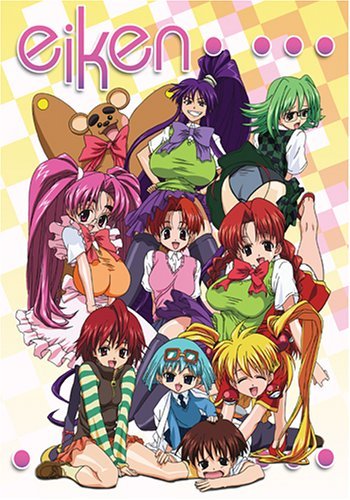
#244: Eiken (2003)


Studio: J.C. Staff

Director: Kiyotaka Ohata

Screenplay: Tomoyasu Okubo

Based on the manga by Seiji Matsuyama

Voice Cast: Akeno Watanabe as Densuke Mifune; Miwa Oshiro as Chiharu Shinonome; Emi Yabusaki as Yuriko Shinonome; Mai Kadowaki as Kyoko Morooka; Marina Ono as Komoe Harumachi; Masumi Asano as Kirika Misono; Touko Itou as Lin Grace

Viewed in Japanese with English Subtitles


J.C. Staff are a prolific company who have worked on some acclaimed titles - the TV series Revolutionary Girl Utena (1997) and Azumanga Daioh (2002) spring to mind - but they are still a company who worked over the years, leading to an eclectic catalogue which includes legitimately curiosities, ones you may have never heard of and others that you will scratch your head about. The straight to video work is a great example of this.  You can have Cat Soup (2001), a highly regarded and surreal avant-garde animation based on the work of manga author Nekojiru. You can however also have Garzey's Wing (1996-7), a notorious Yoshiyuki Tomino work, and they are a company who have put their hands into a curious number of tangents. Probably one of the most infamous, least in the USA because Media Blasters released this two episode work and the manga, is Seiji Matsuyama's Eiken. Eiken, if you just look at the screenshots, will lead to many running far from it as far as possible. Hell, the still images may even cause problems for those who maintain free blogging sites, unless you have the warning page for sensitive content up. Eiken, with fair warning for someone expecting this to be a review just viewing it as a gross perversion of anime sex comedy tropes may be mortified that this review, dare I say, may even become pretentious. Not to defend the anime at all, but from someone who viewed it only in mind to a morbid fascination, and left finding it a sexual nightmare tale masquerading in cute clothes with a lot to unpick. Even in terms of Matsuyama's accidental contributions as a manga author in real life Japanese politics, Eiken is a perfect example, whether a good anime, a bad anime, or an infamous one, you could write so much about even if entirely personal opinion, and it is all worth having written down.

This all also stems into the past. Let us not kid ourselves, even if the later sentence will sound crass, but anime and manga over the decades has had an obsession with the female bust, and this leads to the term "bakunyu", literally "exploding breasts" and means "enormous breasts", when you take the fixation found in many cultures for heterosexual males to its most extreme level. Eiken is infamous, even when larger busted characters have become commonplace within anime and manga, for being the one title to bring bakunyu to Shonen manga as, yes, this was targeted to adolescent boys in Weekly Shōnen Champion. The story is complicated knowing that its most notorious creative decision, the bust size of a lot of its female cast, was not from the get-go, but a decision made with the editor (with the author's interest) to redraw the characters from volume four in the manga tankōbon onwards, which is also notably where, in the US releases, Media Blasters' publications had to switch from an age rating of 16 plus to 18 plus1. Even if I advise caution against anyone watching this without warning, I came to this anime fully aware of what I was getting into, and finding rather than feeling dirty, as I will warn most will, the anime adaptation fascinated for what it inadvertedly became. The entire thing by pure accident comes as an adolescent male sexual neurosis onscreen even if that is clearly not the intention of the production at all, all with a perverse air to it that is more interesting to have witnessed for myself than the shock many would have with this title. 

It is not a parody, as it was clearly made as a tale with sex appeal if one with a kink or two few have, and as we will get into later, Seiji Matsuyama created a manga much more controversial, with wide scale effect on Japanese censorship, which is likely to be less defendable and place a more damning eye on this title too with hindsight. Coming to this, Eiken has all the tropes of other anime and manga which can be questionable and clichéd, the high school romance a common story line which can be done well and has questionable aspects to challenge, including the obsession with having so many and the idea one's high school life in a fantastical form is more worthy of anime over the worlds of adults. The difference is that this is anime high school if filtered through an adolescent hormonal nightmare. Our lead Densuke Mifune is so bland, like so many male protagonists in these in terms of his meek inability, that he is immediately set upon by the notorious Eiken club and its leader Kirika Misono on his first day at Zashono Academy, a place which is literally located on a blatant Freudian landmass. It is not redeemable as an anime, but the stereotypical clichés over these two episodes are here and they find themselves being more scrutinised due to how tasteless this show gets, exaggerating them to an extreme whilst still disguising itself as cutesy. The clichés are found in other shows - cute love interest Chiharu Shinonome, who is shy and Densuke crushes on, the school competition that could bring them closer, the former student who studied in the USA who is a threat as another romantic interest, and Densuke's own unfortunate curse to stumble into every clichéd moment of anime sex comedy at the worse moments. The differences beyond its lewdness could almost have been notable changes that the show never actually winked at, in that the most notorious part of the show, the breast sizes of several key female characters, could have just been shown onscreen and everything about the plot could have played out without ever raising the character designs as the anime actually does constantly, forcing one to register it and react with how even a crass choice undercuts everything. This anime is not subtle in the slightest so instead with Chiharu, the bakunyu change forces her to become distorted, the change turning these characters into hyper exaggerations that for a viewer may be a step into the off-putting. And some of the characters are younger and more ridiculously proportion, which makes this even moe perverse let alone more dubious in general before those aesthetic touches. 

If it was not obvious this was a bizarre product beamed from a specific series of circumstances, the alternative world version of this, which was more focused on being a twisted little parody, would have been inspired if off-putting for someone. Even in this dubious form it is in reality, I cannot help but view it like a two episode nightmare from another television show, censored for television censorship, where our lead dreams all of this in a state of delirium, representing all of his sexual anxieties and hang-ups as a teen boy, before he wakes up and encounters these characters with sensible proportions and with less lewdness onscreen. In another context, this would have still be uncomfortable viewing, but could have been a really twisted satire less on these tropes but on teen hormonal anxieties. This is more so considering how many anime sex comedies already have the curious "reward-punishment" trope that I find more and more curious to witness. Far from embarrassment, when I get older as an anime fan, watching work with fan service content, a lot of it is now, if not defendable as good sex comedy, becoming more psychologically compelling to unpick for how they represent sexual hang-ups and relationships. Whether the lead deserves it or by pure accident, any encounter with the opposite sex in terms of something lewd or sexual usually involves a male lead being humiliated and/or beaten up afterwards, something which has come off as more an anxiety of sex in general the more I see it in these stories, whether they are defendable or not.

Even the obsession with breasts, exaggerated here to an incredible extreme and an obsession for many men, filters through this anxious accidental tone; the idea that, whether any psychological or sociological reasons this part of the female anatomy is an obsession for many heterosexual men erotically, a large part of this likely as much due to an integral part of adolescence being how we all go through significant physical change. When one goes through puberty, male or female, your body physically changes and these changes, even if you suddenly become taller or stay short, become the aspect which others take in as they themselves physically and emotionally change, sometime they exaggerate in how they perceive you; this is including those who become attracted to you, and what they may take into consideration, as they themselves suddenly feel attraction to the opposite sex unless they go through the discovery of being gay or bisexual. All of this is amateur observation, so heckling in the comments is acceptable, but it is apt that, if this was a parody, Densuke's nightmare distorts the most prominent features of the girl he has a crush on. These are her shyness, with the Japanese vocal performance from Miwa Oshiro, a model whose only voice acting role is this show, exaggerates through the timidness in her high voice, and her figure, which if this was a sensible show, and not a fetish work, would be through the mind's eye of how one teen boy views her through this over-the-top physicality as the other female characters with similar proportions. Considering the hair styles of the female cast, regardless of figures, is just as exaggerated with how large they are, it befits this distortion. Someone like the leader of the Eiken club Kirika Misono and others are even more exaggerated in their proportions, and even with those which are not, their seemingly sexual openness, whilst not subtle and well done, could have been in a satire his fears of girls he is attracted to but are absolutely more aware of themselves physically and in desires then he and most of the males in the school ever can. The crass phallic food jokes do not help among many moments in this show, particularly with Kirika's obsession with things like bananas and not eating them conventionally, sight gags that you the viewer will hope no one comes into the room (with the whole work) when you are watching this; even those though would make sense if this was an actual satire if still crass. That being Densuke a case of someone with a sudden desire for the opposite sex but is terrified of them as confident, hypersexual figures in his view of them.

This is all death of the author logic, but I am coming to this title with its legacy being hyped, that I had heard for years this was to be approached with caution, a title you would scratch your eyes out in immediate contact of. Instead I watched Eiken only to find myself admitting I was not affected by it at all, even with some of the worse jokes that appear between the two twenty plus minute episodes, even finding a sick sense of humour to this with distance for how unintentionally un-erotic it is. My tastes for readers is also one that, appreciating the best of art, is also being someone with the taste for the weird, even a cinematic trash panda who can try to wonder what formed work that is never going to win many people. Again, let sanity come and point out this is all a viewpoint to a work proudly, and brazenly, perverse on purpose, but still I find one of the stranger moments in this anime was not sexual at all, that among the duo of female commentators on the sports events, both classmates, one of them decides to hold her finger to her top lip like a moustache and talk in a faux deep male voice to sound like an expert, which is stranger than anything else that is lewd and sexually symbolic. Far more disturbing for me is that the male student returning from the States is a predator, someone claiming to be Chiharu's knight in shining armour but emotionally twisting her, and forcing her to be intimate with him in the sports games in a non-consensual way as a team. That content is more problematic over the years in anime, making his punishment (even with the cheap joke at bald people) actually justifiable. 

This is all in mind that, even if you manage to get through episode one, episode two is going to be more off-putting for some. The first has a yoghurt water slide as a challenge, which is sexual innuendo giving up subtlety, but the later has a chocolate waterslide, which is unfortunate in what it looks like instead, and one off jokes, including involving eels, which will cause even those who got through that first episode to give up the anime broken. Yet it still feels like the sexual nightmare of Densuke, causing me to wonder why Seiji Matsuyama for his manga made most of the humour, if accurate to the manga in the adaptation, a male lead who is the butt of these jokes. There are moments when Densuke has some very kinky fantasies of his own about Chiharu, but they truly feel adolescent and are constantly undercut by how at a disadvantage he is in every situation, like a guy whose learnt of these in a dirty mag but would be in the deep end in an actual relationship with another human being. This is probably the one thing in this entire anime arguably close to real life even if I do not want to give Eiken credit for being smart. Even jokes that it has which are eyebrow raising, such as Chiharu's younger sister being openly flirtatious with him, are a) jokes we need to critique in other anime for having too, and b) itself another of the moments this show accidentally feels like one poor boy's hormones being his own enemy. The entire "gag" (with air quotes) of Densuke  being forced to wear a woman's swimming one piece (with ponytails) for the chocolate water slide challenge is loaded in itself, and would be still the same even if Seiji Matsuyama was to have admitted, if from the manga, he never considered anything more to it beyond thinking it a "gag" to casually include for one chapter.

A weird amount of sexual anxiety comes into anime even when it is playing to questionable tropes of girls being seen undressed or nude in changing rooms for a joke and titillation, not forgetting hot springs episodes or when by pure accident a slip of clothing in a pratfall transpires. There is likely afterwards to be the scene of the guy being physically injured in the transgression, or in this case Densuke constantly at the end of humiliation and belief from others he is a pervert. The Japanese voice performance, unlike the one from Bryce Papenbrook in the English dub, is a female voice actress Akeno Watanabe who plays him uncomfortable young in how high pitch he is, like a middle scholar including in his short height, but it adds to the sick joke of the poor lad trying to wrap his head around this world of hyper-figured women even taller than him let alone with a few wrapping him around their fingers. Suffering at the cruel hands of the writers (and manga author Seiji Matsuyama) falling back on the dated tropes of sex comedy, that this still feels like a conventional comedy barring its lewd details adds to this adds to this twisted nature. With its early 2000s look of bright colours, its nineties mah-jong videogame music score, and how cute it is all meant to be, the idea this is all meant to be like a regular anime comedy is weirder than any of the perversity onscreen. There is even a bear creature no one raises questions about being in the Eiken club with everyone else just to toy with any viewer who can tolerate how extreme it is, finding a new way to baffle.

Considering the stuff I have sat through where I have found more disturbing content in more inappropriate places, I find Eiken just perverse. Anime with uncomfortable levels of non-consensual eroticism like VS Knight Lamune & 40 Fresh (1997), a straight to video work which presents itself as a sexy action show only to be nasty in misogynistic ways in tonal whiplashes, make Eiken a lesser of two evils, more curious to prod as an oddity. It is tasteless and one I understand the reactions to, that it is gross and deserves the most negative reviews; the only things are that I have suffered through worse, and that this is a weird artefact too loaded with psychosexual aspects and unintentional weirdness that are compelling. It is not pleasant to watch the anime, but it was compelling in its own way. If someone like Guy Maddin made a story like this in live action, imagining now the perversity and surrealism of the Canadian filmmaker of Careful (1992) adapting this story, Eiken would be a film that would put people off, but it would one damn curious trip, considering that a film like Cowards Bend the Knees (2003), one of Guy Maddin's more transgressive films dealing with sexual kink, was a film about male sexual neurosis if by way of ice hockey. The fact this has no actual nudity either adds to its tone too. It is tame in what you do not see, but has content kinkier here than in actual animated porn, which will make people feel very filthy for watching this but adds to this perverse feverish idea even if entirely from this viewer's perspective. There is a lot of anime and manga which is entirely with this tone, meant to titillate with having sexy schoolgirls with ridiculous proportions and near undress, which has its own moral and gender issues rightly to unpack, but also usually come with a need to punish its male characters as if to punish the male viewers.  It is fascinating to watch what is held as one of the most notorious straight to video anime for many people and, rather than take it as it is, imagine what Sigmund Freud would have thought of it. Even if Freud's ideas on sex and women were always dubious, just to see him trying to figure it all would have been something I wished happened.

The one sobering point though, and this is something I have been wary to reach, is that the history after this for Seiji Matsuyama would let to him get into legitimate controversy with another of his works, a title called Oku-sama wa Shōgakusei (My Wife Is an Elementary Student), which, yes, does raise alarm bells as a premise even if a gag comedy. This controversy over this manga and others in 2011 was connected to a revised bill to amend the Youth Healthy Development Ordinance2, one that not only restricted those manga3 but was marked with concerns, under its new revised guideline, to restrict the sales of materials that were considered "to be excessively disrupting of social order"3. Bill 156 as the final revision became, through failures and revisions beforehand, was controversial, and whilst the material it targeted includes work which for many is difficult to defend, including manga that involve sexual relationships with minors, unfortunately one of the men who helped this revision finally get passed in 2010 was then-Tokyo governor Shintarō Ishihara. Ishihara, until the end of his tenure in office in 2012, is an incredibly problematic figure, a former novelist whose beliefs have been slammed as racist4a, misogynistic4b, and pertinent to Bill 156, included openly homophobic comments from 2000 that homosexuality was abnormal4c. The problem with Bill 156 at the time was a conundrum; that the materials it targeted would be incredibly difficult for many to defend, such as work in the lolicon and shotacon genre, minority genres of manga yet ones that challenge what freedom in manga as art is, but that it could have been abused for censoring LGBTQ voices under the auspices of protecting children, alongside those promoting views on controversial subjects done with intelligence and grace. Especially as difficult work for many, even those who believed in the freedom of art, could be pointed to as evidence to justify the censorship, the bill could have had great lasting damage, and considering it was Seiji Matsuyama's Oku-sama wa Shōgakusei that was shown on television by Tokyo Vice Governor Naoki Inose as corrupting and needing to be restricted5, part of a campaign leading to the birth of this bill, Matsuyama got his fingers burnt by this and it does reflect back on Eiken. Whilst it is its own perverse little thing, least in this short anime adaptation, the tone of Eiken if accurate to the manga does show a lewdness, including that it was sold for teenage boys, could have gotten more confrontational if he was allowed to push the envelope. It was a different title of Matsuyama's which got him in hot water, but he could have raised controversy from certain groups even from Eiken if remotely like the anime. 

Eiken itself managed to return, least the anime adaptation, when Media Blasters came back from a long hibernation in 2020. Media Blasters, who were founded in 1997, are fascinating as the little independent distributor in the United States who has never refused to give up the ghost, and despite a long period of absence, founder John Sirabella has kept the company afloat, coming back with a vengeance in 2020. The manga arm of the company is gone, but Eiken got a Blu Ray re-release that year6a and would be made available to watch on Crunchyroll for streaming by the end of 20206b. I would not be surprised , whilst Media Blasters sells actual porn anime and lewd ecchi anime, that Eiken's re-release comes with the knowledge of its notoriety after the passing time. Eiken is the title which, after its first release and its manga being published in English in the US, could be seen as the ultimate infamous title to dare to watch for some, the one too weird or perverse for others to see, and in my case the notorious title I spied with the aforementioned morbid curiosity. It is to be approached with caution, and if this had been a full television series of just thirteen episodes, my comments from these two episodes may have lead instead to me becoming a husk of a demoralised anime viewer after my initial cockiness. Considering the manga had eighteen volumes, even my perverse interest in the title may not want to know where it went with this premise beyond these sixty minutes, and knowing full well this is loaded with innuendo, sometimes something shorter is less painful over something significantly longer in terms of watching anime. As I have found, short anime, even those considered the worst, do not have that much power for me because they do not take too longer to sit through. At sixty minutes, Eiken is the kind of show John Sirabella's Media Blasters could re-release and take advantage of even negative legacy, and honestly, I admire them for taking advantage of this even if other people may not, probably regretting watching this even if they ignored warnings like mine in this review. 

======

1) Who Was Responsible For This Anime?, an insanely (and applaudably) detailed and intelligent YouTube documentary on Eiken from Hazel ("@hhhazel"). The video here and the channel here.

2) Full Tokyo Assembly Passes Youth Ordinance Bill, written by Egan Loo and published by Anime News Network on 15th December 2010.

3) Akamatsu's J-Comi Site Posts Adult Manga Restricted by Tokyo Law, written by Egan Loo and published by Anime News Network on 3rd October 2011.

4a) Alternative Report to the First and Second Periodic Report of JAPA on the International Convention on the Elimination of all Forms of Racial Discrimination. Section "3. Control of expression, incitement and violence related to racial discrimination", under "(2) Absence of provisions regulating and punishing discriminatory expression by public officials", under "C. Position of the JFBA". Written by the Japan Federation of Bar Associations  (JFBA) in January 19, 2001 and published online by Nichibenren.

4b) Committee on Elimination of Discrimination Against Women, The Third Consideration of Japanese Governmental Report: Proposal of List of Issues for Pre-sessional Working Group, written by the Japan Civil Liberties Union and published on 27th January 2003, archived on 23 November 2012.

4c) FEATURE: Ishihara's homophobic remarks raise ire of gays, written for Japan Policy & Politics and published April 3rd 2000. Archived on the Free Library.com

5) 4,000 Protest Takashi Murakami's Versailles Exhibit, written by Egan Loo and published on Anime News Network on 30th August 2010.

6a) Media Blasters to Release Eiken, Jungle de Ikou!, Jubei-Chan 2 Anime on Blu-ray Disc, written by Crystalyn Hodgkins, and published by Anime News Network on 21st February 2020.

6b) Crunchyroll Adds Eiken Anime to Catalog, written by Rafael Antonio Pineda and published by Anime News Network on 25th September 2020.

Tuesday, 21 March 2023

#243: Ninja Gaiden (1991)


Studio: Studio Junio

Director: Mamoru Kanbe

Screenplay: Tomofumi Nobe

Based on the video game by Tecmo

Voice Cast: Keiichi Nanba as Ryū Hayabusa; Norio Wakamoto as Robert T. Sturgeon; Yumi Touma as Irene Lew; Daisuke Gouri as Jeffrey Hammond; Saori Suzuki as Katherine Friedman; Shinji Ogawa as Prof. Bucky Wise; Unshō Ishizuka as Dr. Ned Friedman; Yoshiko Sakakibara as Sarah

Viewed in Japanese with English Subtitles


An eighties straight-to-video title at heart, though finding itself published in the early nineties, this is an obscure anime adaptation of a video game. This particular one has a fascinating history, as many may know this video game franchise first through a reboot series from Team Ninja, which were released entirely for Microsoft's consoles, part of their history of attempting to make the Xbox successful in Japan against stiff competition, starting with Ninja Gaiden (2004). This is adapting from the first era, of the Nintendo NES/Famicon era though with the original game a 1988 arcade cabinet. This anime was released at the time between Ninja Gaiden II: The Dark Sword of Chaos (1990) and Ninja Gaiden III: The Ancient Ship of Doom (1991), a franchise which had already established Ryū Hayabusa, a figure you may also know from the Dead or Alive beat em up game franchise, as Team Ninja developed those games and brought him from his own franchise to become a key member for that one, which is interesting as a rare case of someone not being a cameo character. It is also in knowledge that game series got a live action adaptation, DOA: Dead or Alive (2006), which means Hayabusa has also been played by Kane Kosugi, son of Japanese martial arts film star Sho Kosugi, a huge figure of the ninja boom of pop culture in the eighties which lead to Ninja Gaiden and Sega's Shinobi video game franchise existing, which is a deliciously intricate web of influences and crossovers.

The story here is very simple off the back of this franchise, good ninja versus an evil group in a forty plus minute anime, connecting to a previous demonic villain being defeated and the aftermath with the threat of their return transpiring. The feeling of this being an eighties anime in tone was a legitimate mistake, not realising until later this was released in the nineties, as it feels from the get-go from the same lineage of eighties straight-to-video titles, even the lower budget ones, which still had a style to them. It begins here with a shot, set in New York City, at night in the fog covered streets where our lead finds him being accosted by two masked assassins in suits and arm hidden blades, which shows there is some creativity that sparkles at times throughout. This is still the era you could get away with recreating the exact poster to Les Misérables, the 1980 musical version of Victor Hugo's novel, in the background to establish the location where Ryu the ninja is drawn closer to the Friedman Corporation, up to no good as with other corporations, with their head Professor Ned Friedman behind diabolic human experiments of a biotechnical kind. The gore in the work as well, and the weird monsters thrown about, regardless of the era it was actually made in feels distinct to at least the time when straight-to-video anime from these decades.

Anime straight-to-video titles were once so prolific that numerous ones like this existed, likely never had a Western release anywhere, and were entirely unknown of once time had passed. It is a generic story with only some drama in Ryu's love for a woman, working in a store with him, who forces him to confront the duality of his life, but this is an action work with a slant into horror first-and-foremost. It does evoke the most curious and enticing video game from this period you wish you could play with this horror slant, inexplicably evoking Castlevania if with ninjas, when you will have freakish white fish men or goons who have skinless faces with just eyes under their masks as antagonists, casually introduced in the character designs for a scene never to be seen again. (Let alone the human headed wolf in a motley crew of them in the final skirmish at the Friedman Corporation). It justifies the idea of how much creativity was burnt up even on a moderately interesting title like this one from the time, let alone one of the future classics of this medium of anime.

Studio Junio is a more obscure studio, one which has collaborated with other studios in areas like in-between animation. Their own work is a curious mix, from Amada Anime Series: Super Mario Brothers (1989), an obscure Mario tie-in in which the Nintendo characters reinterpret fairy tales, to Saber Marionette J (1996-7), likely their biggest title in terms of how it developed sequels and was once a huge title in the nineties. Founded in 1970 by Takao Kozai, their last title in animation was the 1999 film Gundress. Infamously an "unfinished" version had a theatrical premiere in Japan, this work based on the work of Masamune Shirow involved test animation and animatics being used for the ninety minute length in a story1. It was infamous for how customers were greeted with an apology note from the producers ("This film isn't finished at all") and a form to be sent a free finished VHS copy upon its release2. Tragically, this was how Studio Junio finished in the animation industry.

 Ninja Gaiden itself is not something to convert people to, one of the virtues also a flaw to these many OVAs from the past that so many of them were made, to the point that you will encounter ones like this that can have moments of virtue but also may not entirely be the best of its genre. What this is a generic story about guys with the tropes its small plot usually have,  one which eventually becomes macho, with a band of male soldiers who, unfortunately, when their female reporter friend wishes to help in the last raid, tie her at the base on a chair for a joke scene. Admittedly, there is also the moment where one of them named Jeff, mid-gun battle, talks of how military man like men as much as women and alcohol, so I also give credit for unexpected progressiveness in this anime too.

Beautifully as well, this slight work still introduces director Mamoru Kanbe back in my writings, who I knew original for the notorious Elfen Lied (2004), a television series whose flaws cannot undercut, for its lurid and transgressive content, the ideas which did stick out for me. He went on with The Promised Neverland (2019), the first season at least acclaimed at the time, and it is cool to stumble on this early production he directed without realising it; there is nothing here which could suggest a trademark, but when he was not directing comedy like Robonimal Panda-Z: The Robonimation (2004), which is literally about a giant panda robot, Kanbe throughout his career lent into horror and you can see it even here, a genre he would return to or be the right person to bring in for the likes of The Promised Neverland to a Go Nagai adaptation Demon Prince Enma (2006) which took the source into a much more adult version. He is becoming the unsung person I admire the more I find his work, and whilst the screenwriter only has a few credits, and the studio had a tragic ending, this also an obscure title for its animation director and character designer Osamu Horiuchi. Horiuchi would go on with a healthy career from this with the likes of the Full Metal Panic franchise in similar roles, making them a figure of note to pick out too if not a more prominent one. Figures already working in the industry at the time, and those who would be working into the 2000s on, crossed paths on this obscurity in a variety of roles, and yes, the fact that Ninja Gaiden would get a significant reboot in the original video games cannot be ignored either. That franchise would struggle into Ninja Gaiden 3 (2012) which adds its own tale-within-a-tale here too; with the controversial figurehead of Tomonobu Itagaki leaving, those in Team Ninja attempted to take a franchise into a more accessible form, originally designed to be hardcore difficult in gameplay, leading to a divisive inclusion. Alongside the Dead or Alive franchise slipping alone in later sequels, Ryū Hayabusa has found himself in a fascinating number of tales, even when they have been disasters or part of the unfortunate nature of any industry where your next title can fail or be released unfinished in the cinemas. This anime is one of the minor tales from his career, be it commerce or evil demon warriors, but it is an enticing curiosity which, at forty minutes, is too short and with enough within it to not watch.

=====

1) Shirow's Kids, part of The Mike Toole Show series of articles, written by Mike Toole and published for Anime News Network on July 3rd 2011.

2) Do Movies Experience "Production Crunch" Like TV Series Do?, written by Justin Sevakis and published by Anime News Network on June 12th 2019.