Wednesday, 27 March 2019

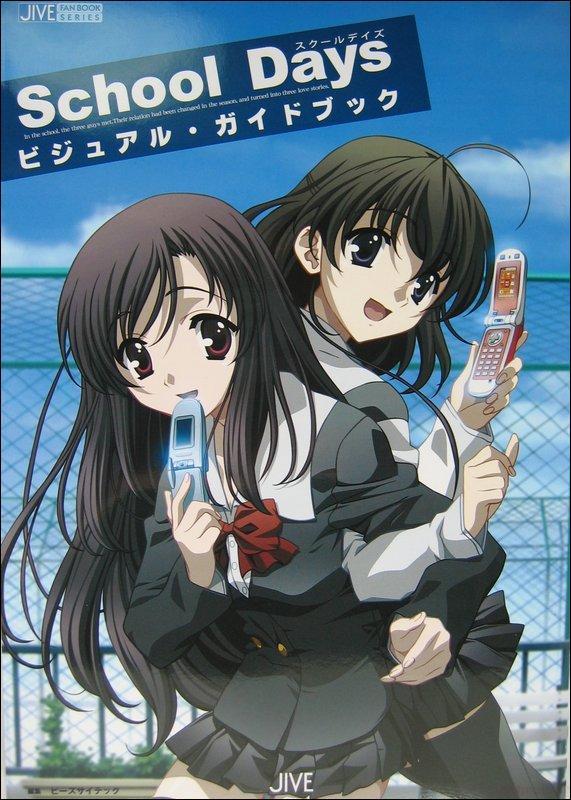
#92: School Days (2007)

From https://pics.filmaffinity.com/sukuru_deizu_
school_days_tv_series-259854327-large.jpg


Director: Keitaro Motonaga
Screenplay: Makoto Uezu
Based on the adult visual novel videogame by 0verflow
Voice Cast: Daisuke Hirakawa as Makoto Ito; Shiho Kawaragi as Sekai Saionji; Tae Okajima as Kotonoha Katsura; Chiaki Takahashi as Nanami Kanroji; Haruka Nagami as Otome Kato; Keiko Imoto as Setsuna Kiyoura; Megu Ashiro as Kokoro Katsura; Ryouko Tanaka as Hikari Kuroda; Yoshiaki Matsumoto as Taisuke Sawanaga
Viewed in Japanese with English Subtitles

Synopsis: In high school, Makoto Ito is encouraged by his female friend Sekai Saionji to start dating Kotonoha Katsura, a timid girl in another class. Sekai however has feelings for him herself, and Makoto is not your usual male anime protagonist when he starts getting bored with courting Kotonoha.

[FULL SPOILERS throughout; whilst a warning will be added to where they are, this is an immediate warning you don't mind knowing the full details of the plot.]

School Days is notorious for a good reason, though appearances for this anime series can be deceptive. Its original based an adult visual novel published in 2005. Visual novels are a popular medium especially in manga and anime culture, interactive novels which are popular in Japan that have multiple narrative paths and endings, and are entirely played by multiple choices (like a choose-your-own adventure book) inter-spliced with animation or visuals. "Adult" as, a sub genre in visual novels known as "eroge" (erotic games), the original work was pornographic with explicit sex scenes (barring Japanese censorship laws). The series was in lieu of a multimedia bonanza after the original work did very well.

The surprising thing with School Days the animated adaptation is that, with alarm bells ringing due to the series' erotic origins and its initial tone in the first three episodes, it changes into a dark chimera eventually of interest. Makoto Uezu is a prominent screenwriter, and to my absolute surprise, director Keitaro Motonaga also helmed Malice@Doll (2000), a work that I hold in high regard, though with the caveat that it's an odd creation as an early computer animated body horror sci-fi work which is truly peculiar; I viewed that one screenwriter (and premise creator) Chiaki J. Konaka's work more, but it was nice to see Motonaga again, though barring co-directing the Rayearth OVAs with Toshiki Hirano in 1997, he's not got a lot in his career that stands out and a bit of porn up until helming the recent Digimon Adventure tri. films, which create a large single work out of six films between 2015-2018, which is definitely a BIG deal for him alongside working in the background on a load of other prominent work.

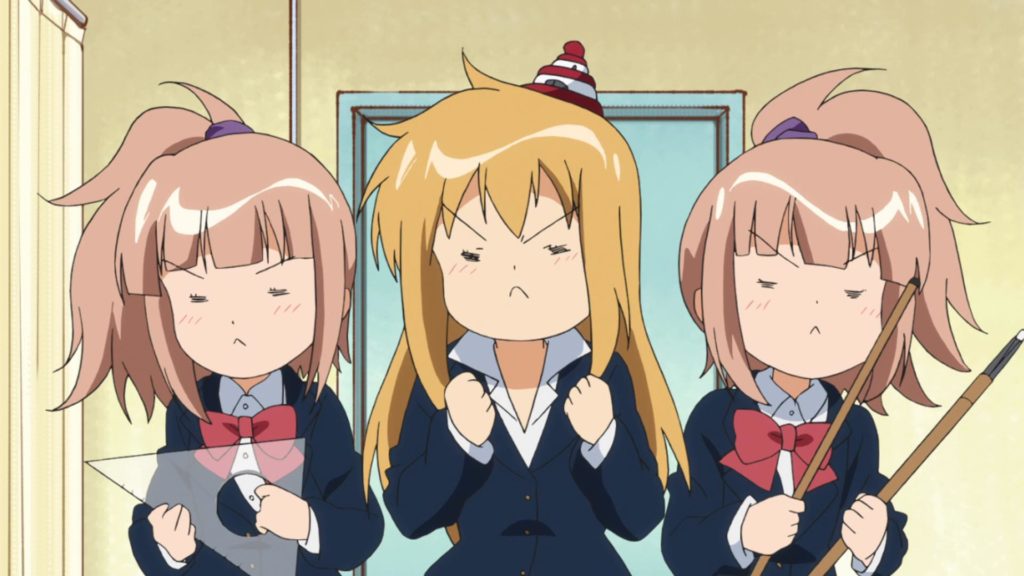
The premise itself could've easily descended in something bad on just the synopsis though, just a de-eroticised melodrama if you never heard of the game. School Days, with its conventional (stereotypical) TV look of bright colours and conventional characters designs are matched by a stereotypically bland male protagonist and many close-ups of female characters' figures, for more lurid and questionable in terms of a problematic male gaze and weirder because these are characters still in school.

Kotonoha, the girl he is initially pushed into dating by his tomboy female friend Sekai, is depicted as a voluptuous big eyed girl who is quiet and shy around men, all whilst Sekai herself spends her time arguing with him through exchanged notes in class. So for, it's a stereotype of anime plotting that also is part of the "harem" sub-genre. Harem, originally a term from ancient Muslim culture of a separate part of a household for wives, concubines, and female servants, as well as eventually turning into a completely sexual term for a group of women with one male lover, is its own anime/manga sub-genre which usually denotes one male surrounded by multiple female suitors; there is the "reverse harem", one woman and multiple male suitors, and LGBT variations, but harem stories that are the most famous (and divisive) include the Love Hina franchise where its one male, and many potential female suitors. Whatever one's opinion on the subject - whether polygamy (or polyandry) are morally acceptable or even practical, whether harem stories can be great or fall (especially with those with multiple female suitors) into crass or just badly written stories - School Days thankfully changes its tune soon into itself when the tale it sets up immediately goes sour.

[MAJOR Spoiler Warnings here]

And by sour, as in our male protagonist, eventually turning out to be a chronic womanizer with an ease in cheating on multiple girls, is murdered by one character, whilst another is disembowel. The diagram for the beginning to the ending, from the initial romance with light comedy at the beginning to where his head is severed and kept as a possession for a heartbroken suitor, is as jarring a tonal shift without a lot of context to how this happened.

[MAJOR Spoilers End]

Notoriously, and where the fascinating reward in School Days is found, even if it feels like being in a meat grinder for all twelve of its episodes, the original visual novel when it came to the "bad endings" got violent. Visual novels, due to their nature, have "good endings" and "bad endings" like some videogames, where the choices made in options will dictate where the story will progress.  So an inspired decision was clearly made to make a show based on the worst type of ending whilst, on purpose or with unintentionally greater weight, to turn this property into an anti-harem story.
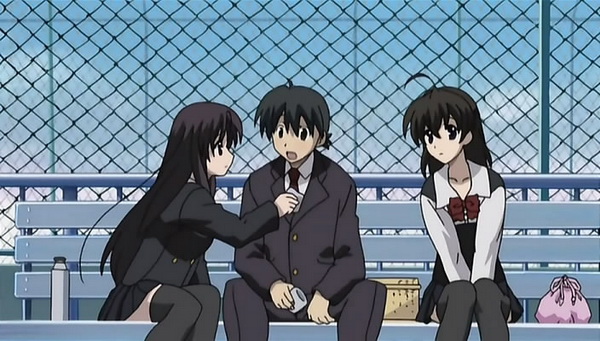
From https://canime.files.wordpress.com/2010/01/school-days702.jpg

Mainly because it shows the worst in its cast, as our male lead Makoto, as mentioned, is a womanzier, his friend Sekai, despite pushing him to another girl, has a crush on him, and the school (especially the girls) is full of bullies and individuals who think by their hormones or are cruel. The only innocent characters are Kotonoha, the initial romantic interest, and arguably a female character named Otome, who likes Makoto and has sex with him even when he's dating others, but is fleshed out as being more complicated in this dicey predicament, as is Setsuna, Sekai's own diminutive female friend also revealed to have a crush on him, and does some problematic things, but has the issue that about to leave for France, as a plot thread reveals, she's concerned for her friend Sekai's well being when she is no longer there. No one else, however, is above whale manure in some of the things they do; even Sekai, whilst the conflicted main female character with Kotonoha, is willingly dragged into a romance that is a disaster from the get-go.  Even Makoto's horn dog but wholesome male friend Taisuke eventually does something in a later episode which is horrifying.

The worst thing, and why for how ridiculous and way too cruel the story goes School Days actually succeeds, is that it's not morally black and white, but with everyone including Makoto himself being confused hormone driven teenagers. It's definitely gotten a reaction for viewers who expected clichés; the comments section of Crunchyroll added to my viewing experience, a curious tale in itself of viewers wanting to kill Makoto, slap everyone else and vile anguish whilst those in the know, who say the series already, teased the horrifying climax of it all. I myself was aware of the ending, that Makoto would eventually be shown as a womanzier, and that the comeuppance was a nasty one, but not only did I not know the full extent of said ending, but my knowledge didn't ruin the show but arguably improved it. Especially as it soothed over the awkward first three episodes, knowing where it went brought a sense of tragic finality to the proceedings. It added to the idea that a character like Makoto is not explicitly evil, even when near the end of the series has a foursome with three female classmates when he's already sleeping around and betraying multiple girlfriends, but something worse in his banality. Far more disturbing, even if exaggerated, is that he's just an apathetic and dumb young man who thinks with his smaller head, and has little wisdom of emotions, more honest as a moral ground for the series to take as a result even if it's more agonising for a viewer to experience.

And whilst their all stereotypes, that helps because of this attitude; Sekai, complicating things as she still helps him to date Kotonoha, has a strange relationship including practice foreplay sessions which are just as problematic as they should be to a viewer, naturally leading to complications. Setsuna, Sekai's friend, has a crush on Makoto too, as does Otome, all whilst their female peers can be vindictive and backstabbing, all feeling less like sexist depictions but like many teenagers misguided behaviour. It's an attempt at least at complexity in spite of itself, even a character like Kotonoha in that her hesitance in a physical relationship, pushing Makoto away, is due to having been teased for her figure at a young age alongside a sense, taking up knitting and devoted to her younger sister, that the character's meant for a viewer's perspective to have been a meek figure, the shy girl you cheer when she does muster a bravery to be bolder in her romance only for Makoto to be an oblivious cheater who dithers. Add to this that her female peers in her class bully her, a mean streak made worse when they will even film other female students secretly in a "break room" at the school festival to humiliate them publically, and Kotonoha's turn in the end to madness, glazed look looking at her phone on the street, is the real tragedy of it all.

The effect of this tragedy, the ending itself, gained School Days its notoriety as, tragically, it had the poor timing for the final episode to be about to be aired just when a real life murder took place. On September 18th 2007, a sixteen year old murdered her father, a 45-year-old police sergeant in the traffic division at Minami Police Station in Kyoto Prefecture, with an axe. Another series, part of the Higurashi: When They Cry franchise, was also affected by this in terms of its screening on television, but how TV Kanagawa dealt with School Days transferred from a legitimate tragedy, in terms of any murder ever taking place and the gristly nature of this particular one, to an accidental internet meme. Instead of the episode, they showed half an hour of scenery, including a lake with a Norwegian ferry on it, showed with Air on a G String playing over the images. "Nice Boat", as the meme came to be, came from a 4chan user commenting on the replacement material, and it became popular in Japan; whilst the creators of the game 0verflow arranged two screenings of the edited finale at the Akihabara 3D Theater on September 27, the meme even found its way into the Melancholy of Suzumiya Haruhi-chan, a straight-to-net spin-off of The Melancholy of Haruhi Suzumiya franchise, when the Kadokawa Pictures's YouTube channel uploaded a short montage of sailboats instead of the previously scheduled premiere of that ONA.

Even without this real life censorship which overrode its infamy, even the edited version doesn't detract the results; built up to over painful eleven episodes of miscommunication, cheating and broken emotions, the ending no matter how over-the-top it ends up, actually ending up on a sailboat in some perverse irony in the final shot, does have a weight to it from the tragic circumstances that lead to it. In fact, the idea that it's both an antidote to the problematic show trope of the harem anime as well as another example proves an advantage. The look of the show helps with this, the stereotypical character designs with big eyes emphasising the darker moments in vast contrast, and the leering fan service thankfully gives way to frankness about sex even in the dialogue. The series does, to lighten the tone and offer levity between the cesspool, have humour, reaching its crescendo (before departing) at the school festival, where the mascots of the classes jostle for crowds; once it goes, so does the series manage to get even darker than before when the gloves come off completely.

In fact, the entire aesthetic is perfect - "School Days" a perfect title that sounds innocuous, but develops a weight when it's the last episode title. The light pop songs used, even the fact the end credits are centred on a mobile phone, an object which plays such an important part in the drama as a catalyst for drama (such as blocking someone off one or secretly conversing to others with) is absolutely appropriate. The result, aware of how it bruised and batted me around through the twelve episodes, was unique, like a necessary poison and incredible idiosyncratic in lieu of what was purposeful or accidental creativity. So much so that it's accidental notoriety, whilst important for the series to be known in the West, only released in the West by Discotek for US DVD release in 2014, seems like the least interest detail.


From http://behind-the.nihonreview.com/wordpress
/wp-content/uploads/2007/09/kiyoura3_th.jpg

Sunday, 10 March 2019

#91: Plastic Neesan (2011-2012)

From https://yams.akamaized.net/Assets/93/345/l_p0020534593.JPG


Aka. +Tic Elder Sister
Director: Tsutomu Mizushima
Screenplay: Tsutomu Mizushima
Based on the manga by Cha Kurii
Voice Cast: Mari Kanou as Iroe "Neesan" Genma, Marina Inoue as Makina "Makimaki" Sakamazaki, Yumi Uchiyama as Hazuki "Okappa" Okamoto
Viewed in Japanese with English Subtitles
A Cinema of the Abstract Crossover

Synopsis: Neesan, with her friends Makimaki and Okappa, sets up a model making club at their high school; instead of actually making models, they spend their time over twelve episodes, two minutes each, exposing their hatreds for each other, encountering weird students, and learning of the mating dance of a female gorilla.

Sometimes there's an anime worthy of being covered on my other blog, Cinema of the Abstract, and this curious Original Net Anime (ONA) is pretty infamous at least if the Gifs of the show in the web are anything to go by.

The resulting review contemplates the strange paradox of how an anime can be pretty normal the more deliberately weird it tries to be, whilst trying to probe the brain of its director/screenwriter Tsutomu Mizushima. All at a click at a button HERE.


From https://anime-archive.com/wp-content/uploads/2017
07/87fc4e8c17c398afae5713ce920ea6c8-1024x576.jpg

Tuesday, 5 March 2019

#90: Genius Party Beyond (2008)


Directors: Various
Screenplay: Various
Voice Cast: Arata Furuta, Akiko Suzuki, Shôko Takada, Urara Takano
Viewed in Japanese with English Subtitles.

From http://1.bp.blogspot.com/-_A1oJF-NuzQ/VJyH
Kwlt_YI/AAAAAAAAPkU/h8B_mUl1Hg/s1600/Sem%2Bt%C3%ADtulo.jpg

Gala (Director: Mahiro Maeda)
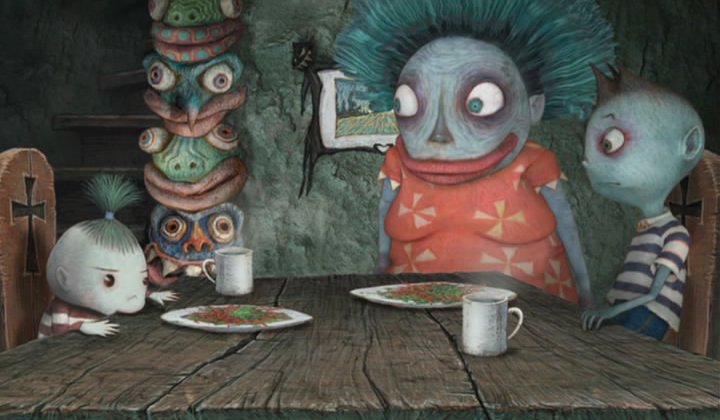
From Genius Party (2007) to Genius Party Beyond, a sequel to Studio 4°C's anthology film, and from the beginning I'll confess this is a much weaker work as a sequel than the original prequel. Gala, by Mahiro Maeda, does thankfully start off the anthology well; what feels like a generic fantasy world tale, in which a giant meteorite lands in a high fantasy period Japan where there's a general male protagonist, gets more interesting when he and his allies (a young woman and an anthropomorphic cat) are hired to be magical musicians riding on giant instruments in the sky and enchanting musical compositions to help soothe the meteorite. Descending into everyone bringing their instruments out into a mass orchestra, it becomes a full blown and beautiful cacophony of music and visuals, the closest to a lot of the motifs in the original Genius Party as a result in aesthetic exhaustion.

From https://jfdb.jp/data/photo/movie/7a/fe/da/24/
af641bb0b6c9bd2260b652deb4097151_640.jpg

Moondrive (Director: Kazuto Nakazawa)
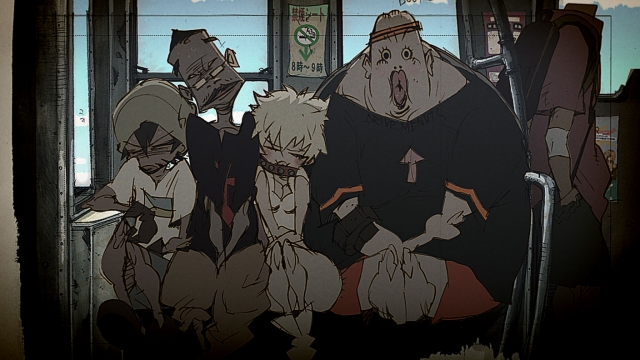
Moondrive's director Kazuto Nakazawa immediately stands out as the man who directed the animated segment of Kill Bill Vol. 1 (2003), one of the most striking moments for anime's recognition in Western culture in the early 2000s. Moondrive looks like the work of the same director only exaggerated even further, a crude farce, set on the moon in the future, about a motley group of thieves whose attempts to find treasure are constantly undercut by pitfalls (no money, losing money in a pool game, the transport not having enough fuel). It's a fun, misanthropic romp, with a distinct visual style although it does have a tasteless running gag which will immediately put many off where one of the two female members, a buxom blonde, is constantly bartered for sexual favours for people by the headstrong male leader who she calls masters. It's a joke, even if one has her audible being a dominatrix for one "client's" masochistic tendencies, which hasn't aged well at all in just a decade.

From http://1.bp.blogspot.com/_t6rfIoGCvjs/T
FwzLawVlNI/AAAAAAAAA2M/kY_tLQZ-Cf4/s1600/wanwa.jpg

Wanwa the Doggy (Director: Shinya Ohira)
Wanwa the Doggy by is definitely the most surreal of the five segments in this film, the fantasies of a young boy as his mother is in labour with a new sibling played out as a nightmarish journey against trolls who've kidnapped her. It evokes Masaki Yuasa's segment from the first Genius Party, notions of death and strange sights from an infant's perspective. Shinya Ohira's short takes a huge risk by making the segment look like a child's drawing in motion, sharp crude images and blocks of colour, It's a style which can became a little bit of an ugly and difficult to grasp in its final version. I have to defend the ambition even if doesn't completely work, although honestly the issue is just that it could've just had a little more pacing in structure to fully work. If that'd been the case, I'd be fully onboard with this ambition being an actual success because it befits what the premise is.

Noticeably with the first three segments, sadly not carried out in the last two, there's always an epilogue which feel meta or pull the rug under the viewer, going on longer than you'd presume in each short but with purpose. I won't spoil Gala's barring it being a circle of life that enters our world, but Moonride's reveals itself as having been a musical production on a red curtained stage with an orchestra, and Wanwa... does soften its flaws when a troll is revealed to be a man in a suit, sad to have not been in the dream we saw, only to be thankful that he got some screen time at the end.

From https://m.media-amazon.com/images/M/MV5BNjY5YWFlOG
MtZTBlNC00OWVhLTkxMWMtNWZiMWM2NDM2MzI5XkEyXkFqcGdeQXVyNTAyODkwOQ@@._V1_.jpg

Toujin Kit (Director: Tatsuyuki Tanaka)
Toujin Kit by Tatsuyuki Tanaka feels unlike the other segments, the most conventionally structure and aesthetically looking but also arguably the best, entering a dystopian world of police enforcers who are literal brains in jars on robot bodies and washed out grey industrial environments are all there is to see. The story simply follows a young woman illegally breeding multi-dimensional organisms within plush toys, giving the toys life as a result, only for law enforcement to crack down on her. Whether they are right to, believing the organisms will damage the dimensional form itself if they don't stop her, or it's a metaphor for the death of imagination is entirely for the viewer's discretion. The biggest surprise is that, expecting a big crescendo, you get an abrupt and bleak ending instead, which argues Toujin Kit is the best segment just for catching you off-guard completely next to everyone else.

From https://i.ytimg.com/vi/tkUukE3xBZo/maxresdefault.jpg

Dimension Bomb (Director: Koji Morimoto)
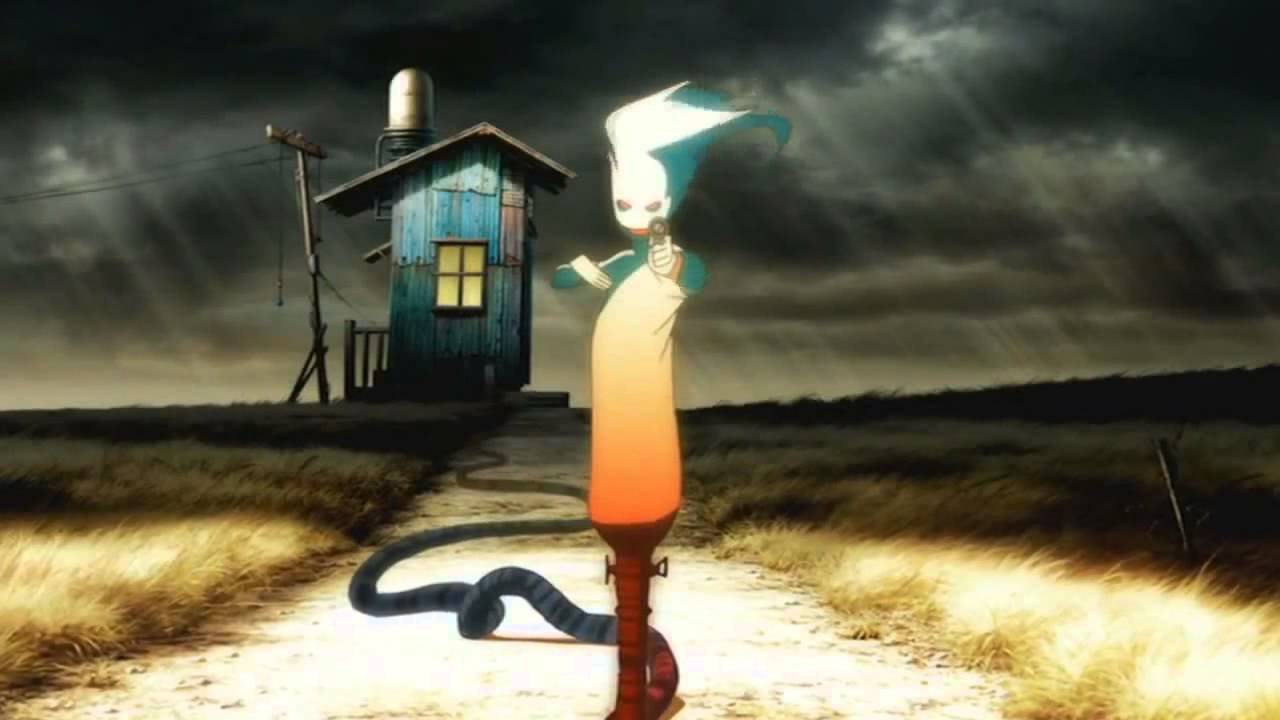
Sadly Dimension Bomb ends the short anthology on a flat note, more disappointed as its directed by Koji Morimoto, co-founder of Studio 4°C itself and a very good director himself known for stylistic innovation in his work. I'll probably warm to his segment, even understand what exactly it is about, in which you have a slightly spacey but intuitive young woman with powers and a demonic alien being she bonds with, but the immediate problem is that the short's a confusing if beautiful looking creation. Knowing how unconventional Morimoto can be, like with the short Noiseman Sound Insect (1997), the problem's entirely that of being merely confusing than compellingly vague, as well as being aesthetically beautiful in a more conventional way compared to some of his bolder experiments which stood out more.

Ultimately, Genius Party had far more rewarding pieces - as of this review, even Shinichirō Watanabe's Baby Blue (which I unfairly dismissed at first) became so much more stronger and good when thought about. In comparison, Genius Party Beyond feels like the runt of the little, charming but missing a great short in itself. As someone more sympathetic to anthologies than many, I'll warm up to it over time, but its definitely a weaker creation.

Friday, 1 March 2019

#89: Ghost Stories (2000-2001)

From https://images-na.ssl-images-amazon.com/
images/I/61byuSfXZxL._SY445_.jpg


Director: Noriyuki Abe
Screenplay: Hiroshi Hashimoto
Based on the book series by Toru Tsunemitsu
Voice Cast: Tomoko Kawakami as Satsuki Miyanoshita; Kumi Sakuma as Momoko Koigakubo; Takako Honda by Hajime Aoyama; Makoto Tsumura as Leo Kakinoki; Kurumi Mamiya as Keiichiro Miyanoshita; Ryusei Nakao as Amanojaku
Viewed in the Japanese language version with subtitles

Synopsis: In an idyllic Japanese town, Satsuki Miyanoshita moves into her new home with her father and younger brother Keiichiro. Her mother, passing away at a young age, was a gifted exorcist of ghosts and demons who captured them in various parts of the town as Satsuki learns through an old notebook she finds in an old schoolhouse. Unfortunately, as construction begins around said town, these beings start to escape and she has to take over her mother's task; all with the assistance of the cocky neighbour Hajime Aoyama, nerdy ghost enthusiast Leo Kakinoki, the meek older girl Momoko Koigakubo, and a demon named Amanojaku who has ended up possessing the body of her pet cat.

It took over four months to finish all twenty episodes of Ghost Stories, which I confess was laziness on my part. Immediately though I can explain as well this was due to the one issue with Ghost Stories in terms of its structure - that the series was clearly never meant to be marathoned, and that for a more family friendly audience in tone, it is a spoiler when you realise your cast (always at the centre of the ghost threats) will never be harmed or get even in more than mild peril until the ending. This is an issue in Eastern and Western storytelling which is going to sap tension to everything, a vast difference to anime horror series based on an anthology structure, where a central character is usually an outsider whilst the stories are depending on episode specific figures that can be written to have good or bad endings without restrictions. This was a frustrating aspect that contributed alongside my aforementioned laziness in the long time viewing the series.

From https://img1.ak.crunchyroll.com/i/spire3-tmb/
be8acd8de20518d1ec2c9f21ef7f929b1452213292_full.jpg

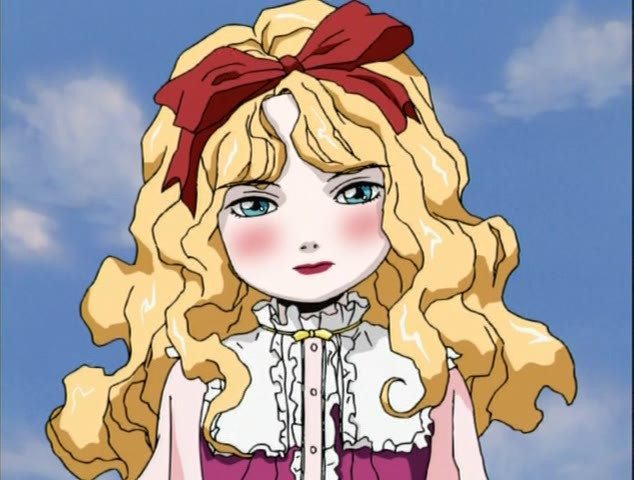
Passing into the early 2000s where computers were used to make animation, it has aged with the simple colourful look, the world an innocent one which just happens to have death and monsters. Death itself is occasionally talked about in depth and an important aspect of Satsuki's back story with her mother, one of the few plot threads whose ghost is both revealed to be possessing the character of Momoko, never attempted to be obfuscated for the viewer, but also having in one of the more effecting moments part of talking about death as a natural state with a semblance of weight. It does it a lot better, for example, then one episode that concludes in a monologue about the circle of life but after a young girl resurrects a school rabbit by voodoo doll only for it to become a were-rabbit, and not the nice Aardman Animations version either.

For most of it thought, it's the equivalent of a ghost ride, one which has an unintentional humour in how easy it is for the junior ghost team to come across them but still about chills for thrills in the outcome. Ghosts in this world have moved online or possessing the radio studio in the school, they're headless gang members on motorbikes, or Beethoven like psychopathic pianists, which I have to admit at least kept things unpredictable even if the plots were usually the gang of leads, together or in character specific episodes, accidentally coming across peril. It has some ghoulishness but for the most part, it's not dissimilar to the Goosebumps book series in the West by R.L. Stein that I grew up with. In fact, if it wasn't for the reoccurring jokes about Hajime constantly seeing Satsuki's underwear and her to constantly chastise him for it, or the little bit of blood which is more appropriate, this would easily play on Western television with a little bit of censorship.

Incidentally, before someone asks, this review is entirely about the original Japanese dub version, aware that Ghost Stories' legacy is entirely about the infamous ADV English dub. The series flopped in its home land, arguably why it has the unconventional twenty episodes length rather than the usual twenty four or twenty six. As long as the character names and plotting were the same per episode, ADV were told by the series creators, Pierrot and Aniplex, to do what they wanted to this pre-existing turkey as it was already viewed as a failure, ADV turning it into an intentionally comedic dub that took the piss out of the material and deliberately went for offensive jokes. It was improvised greatly but noticeably it's also a dub directed by Steven Foster, one of the most divisive English dub directors in existence for his notoriously "loose" translations of the original Japanese scripts.  The little I have seen sides on profanity, incredibly dated jokes in the George W. Bush era mocking Republicans and Evangelicals by turning Momoko into a mad Christian zealot, and frankly a tone that might be insufferable to see all twenty episodes of even if they cast a favourite voice actress of mine Hilary Haag, when I used to like English dubs, as the lead. The first episode, to its credit, is interesting but whether it sustained a full show is an issue with this official parody dub.

From https://vignette.wikia.nocookie.net/ghoststoriesanime/images/f/f7/
Akagad.png/revision/latest?cb=20110917203545

The Japanese dub version as it is was fine, only with the paradox that this team of reoccurring leads is both a hindrance and a virtue, on the short term repetitious in plotting but in virtue in how I grew to like these characters. In general, it's hard to kick to the curb a show, for all its low production value and moments of stumbling, when it's this innocuous. If it wasn't for the few inappropriate things, it would be a show for a kid which is charming. And in terms of the story of the lead's deceased mother, there's even an episode that actually tries tugging at the heartstrings. Eventually the repetition is just an excuse to focus on a cast who are significantly more naive; the paradox is compounded that due to the cast, characters more likely to be afraid and lost in the scenarios around them, it should arguably make the material more logical in how they react to it all in spite of the series' problems.

One good move, that does help, is that the story includes an actual demon in Amanojaku, who is at heart eventually going to love them as a group but is a mischievous figure, one who will help but only when he's bothered, and is compounded by the fact that he's stuck in the body of a cat after the end of episode 1. Like any Japanese horror anime, unless it's to do with vampires and Western tropes, I'm immediately going to be intrigued as they'll be showing Japanese mythology in all its idiosyncrasies even if the screenwriters were making stuff up; if Ghost Stories had expanded episodes to multiple parts, like Satsuki becoming involved in a group of girls involved in black magic, the series might've found a bit more meat to its bones without sacrificing the tone.

Beyond this, the only really ridiculous aspect is that end credit song, infamous in itself (Sexy Sexy by CASCADE) because of its highly suggestive lyrics and a chorus including the lines "sexy, sexy", a song that has become an earworm for me and is fun, but is in the wrong show even if (again with the paradox) it adds to the personality. Sadly the reason Ghost Stories is known still in the West, and deserving its own review, is that infamous English dub that has overridden the original version in niche anime culture. Whether that version is better for me or not depends on actually viewing it all; in the original Japanese version, I'm always going to have a soft spot for anime horror, not matter how many flaws Ghost Stories ultimately has.


Tuesday, 26 February 2019

#88: Onara Goro (2016)

From https://www.asiancrush.com/wp-content/uploads/
2018/03/ONARA_GORO_channel_poster.jpg


A.k.a. Onara Gorou
Director: Takashi Taniguchi
Viewed in Japanese with English Subtitles

Synopsis: The tale of a sentient fart, Onara Goro, who helps people with sage advice.

With a premise about a fart in the shape of a man, coming out of another man, who helps people in their lives, you'd think alongside its limited animation anime lets any bizarre premise through the planning stage. You'd be right, but with some of the vocal performances clearly wooden on purpose to the ear, Onara Goro is in on the joke. Another factor to consider is that this is a creator of an independent creator named Takashi Taniguchi, who had already created this project (alongside Onara Goro appearing in merchandise and promotional material including his own underwear) before he was giving the chance to make this anime, even setting up a crowd funding campaign on the Japanese site Makuake which was successful. Regardless of the absurdity of the project, which is clearly in the premise, this is a creator outside the industry who managed to have a show shown in Japan and globally streamed on Crunchyroll, which is an accomplishment with the added advantage like all these odd micro projects that they allow new voices to appear. He has made work before this, and has afterwards, including Yo! Daitouryou Trap-kun (2017) whose lead character suspiciously looks like Donald Trump, so he could eventually become a cult figure in his own right if titles like Onara Goro catch on. Screenshots of his work suggest that the aesthetic appearance of this series is a trademark of his already.  

Consisting of twelve plus three minute episodes, Onara Goro gets tired of its premise quite soon into itself and introduces other humanoid farts along the way, parodying various genres too like horror (I smelt what you did last summer?) or high school romantic drama in which a romantic love triangle is decided on a penalty kick out, all the ordinary human characters replicated by humanoid replicas made by fart gas attached by the rectum through clothing and going through the drama instead of their human counterparts. Looking like the denizens of a Ghostbusters cartoon in their rotund shape, these characters are deliberately silly - Onara Goro becomes Dr. Goro in one episode, able to cure anything by gas related supernatural healing but believing an ordinary person's life is as precious as a major political figure's.

From https://i.ytimg.com/vi/VsLpSECSVfs/maxresdefault.jpg

The limited animation plays to the deadpan nature, highly detailed visuals (with an etched drawn look) but with minimal movement. The absurdity is compounded by the automatic presumption of it being just another bizarre production from the anime industry, a joke reaching a madder point as the end credits is always a live action dance sequence between a five woman idol group and a life sized, plastic replica of Onara Goro himself, asking one to have psychic powers and be able to wonder what the idols were thinking having to do a choreographed dance sequence with a fart.

Like many of these micro series, Onara Goro is digestible and easy to finish quickly to the point of danger that they are entirely disposable; even if that was the original case, you look at one of the first of them to make a name, Gdgd Fairies (2011-13), and I am amazed (as someone who was already a fan of both its seasons) how that micro series has grown for me in quality, in comparison to all these I binge, and how many don't reach the point that one did, in how it managed with its second season to go beyond the original joke and get legitimately creative and even weirder for the better. This is not a detraction to Onara Goro, as it's clearly the work of a creator who can easily jump to another peculiar premise just through looking through a list of his of his creation. But in this case, it definitely feels like it was stuck at the moment it was either stretching the gag as far as it could go until it could go no further, or a fart humanoid dimension and becoming an action fantasy advantage would be the other way to have ended it....which it does for one of its final episodes, showing the possibility if this got a second season.


From https://www.watchcartoononline.io
/thumbs/onara-gorou-episode-8-english-subbed.jpg

Monday, 18 February 2019

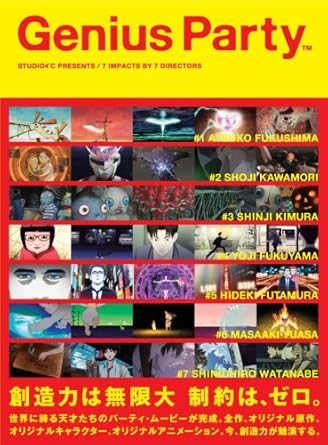
#87: Genius Party (2007)

From https://images-na.ssl-images-amazon.com
/images/I/61rGbDkHpoL._SY445_.jpg


Directors: Various
Screenplay: Yoji Fukuyama, Hideki Futamura, Shôji Kawamori, Mitsuyoshi Takasu, Masaaki Yuasa
Voice Cast: Tomoko Kaneda, Rinko Kikuchi, Kaoru Mizuhara, Lu Ningjuan, Taro Yabe, Yûya Yagira
Viewed in Japanese with English Subtitles

From https://cdn.animeuknews.net/app/uploads
/2017/12/Genius-Party-2-1-1024x576.jpg

Genius Party:
Director: Atsuko Fukushima
Known for their innovative, idiosyncratic animation you can forgive Studio 4°C for both creating two anthologies released over two years and calling them both "Genius Party". Befittingly the first segment by Atsuko Fukushima is also called Genius Party.

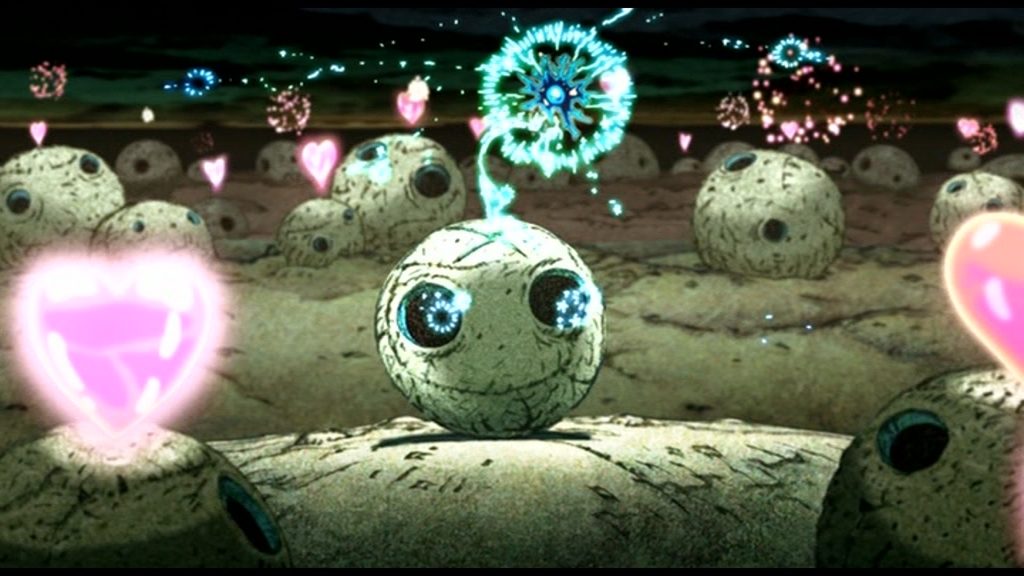
In a strange sci-fi desert, a birdman finds a living sphere with a soul heart attached to it, leading to a giddy enlightenment where all those involved (including the sphere and its peers) transform in an animation enthusiast's wet dream. Naturally it leads to these creatures inventing cinema, which is hilarious and acts as a long but perfect introduction for any anthology, only matched by Katsuhiro Otomo's humorously misanthropic bookends with added explosions for Robot Carnival (1987).

From https://jfdb.jp/data/photo/movie/bb/de/d3/
85/9ea3cc44b7ab386859941dd62473a417_640.jpg

Shanghai Dreams:
Director: Shoji Kawamori
Shanghai Dreams, from this beginning, splits Genius Party between two action heavy tales at the start before they become more introspective. Kawamori is definitely a genius before anyone asks, the legendary mecha designer/anime director/screenwriter/visual artist starting whilst a teenager in the industry, and among the anecdotes to him the kind of man at an anime panel in the US gladly demonstrating his craft by bringing intricate versions of his designs made out of Lego as tangible examples. He can also claim, among a large career CV, being the original creator of The Vision of Escaflowne (1996) and being involved with all the legendary Macross franchise baring Macross II (1992).

He decided to set a story in a present day China, with two languages including Japanese used, and envisions an alien invasion that can only be stopped by a distractible five year old boy given the ability to make his imagination real. Its befitting I mentioned Kawamori as someone with a healthy creativity, because it feels like a personal side is being shown here even if this premise doesn't go as you'd expect, a nice anti-climax with humour because giving a very young boy who interested in flights of fantasy isn't necessary the person expected to stop actual alien machinery. It does instead turn into a sweet ode to childhood imagination where the two soldiers from the future involved, with the their cybernetic bodies and guns, sympathise with the boy and the smarter young girl after it all blows over, lamenting and celebrating the idea of imagination that children are capable. Its arguably is one of the best shorts in a strong anthology, both as a sumptuous visual feast and feeling like a sincere creation from a very well regarded veteran.

From https://guriguriblog.files.wordpress.com/2010/02/bss_
genius_party_-_deathtic_4_dbe77e84-mkv_snapshot_01-06_2010-01-19_03-34-52.jpg

Deathtic 4:
Director: Shinji Kimura
Deathtic 4 shows us the world of the undead, where a young ghoul with a trio of super powered but thankless boys attempts attempt to take a living frog back to its world. Its idiosyncratic aesthetic stands out, alongside again being a kinetic short which emphasises a cleverness to action in giving it vibrancy and making every short count as its animated, not always found in live action. The aesthetic details given also invoke a living world with its own logic you wish you could see more of, just for the police force who are the show stealers of the segment, literal person sized balloons who use peddle bikes with bells as their pursuit vehicles.

From https://antiotaku.files.wordpress.com/2010/08/geniusparty042.png

Doorbell:
Director: Yoji Fukuyama
Doorbell as with the last segment, whilst they have grown in admiration, do have the unfortunate place of being the most conventional films to an anthology that mainly pushes for very unconventional art styles and structures within them in comparison. However, that's not necessarily a bad thing as Doorbell to its credit, in which a young male is cursed by a doppelganger that, when they reach a person's door first, leaves him an invisible spectre wandering the streets, is still an immensely engaging tale. Its neither merely metaphysical or supernatural, just a very open minded and curious tale open to interpretation whose more conventional art style, bright and calm, is helpful in making sure its tale and emotional depth is of priority.

From https://blogger.googleusercontent.com/img/b/R29vZ2xl/AVvXsEi1eH7_NjSUNhX3J8kDvxYyBoT_sRfO1Z1LlfcMmLN0l7w_oBn0yPo5XyCZbA2OcRC1v0hyEJFyySMtA0vPwcKA5PdJrf1BWcawWkwUwmCwZ04r7nYuwMCT0dfyUrg0DWVGlhWVMavW3PK4/s1600/%5BBSS%5D_Genius_Party_-_Limit_Cycle_%5B79563821%5D%5B13-12-22%5D.JPG

Limit Cycle:
Director: Hideki Futamura
Out of all the Genius Party, Futamura's segment is going to be the most divisive. Following a James Dean lookalike, this is a religious/spiritual mosaic in moving form, his life in a futuristic city a deadbeat job, blurred figures passing by and wanton sex with women as he searches for the truth of his existence. With a narrator talking of existential ideas in an oblique way, and with real religious and alchemical symbols and drawings onscreen, Limit Cycle could turn people off easily.

It asks, if you know exactly what everything used or spoken of means, whether it has actual depth or not, but an obvious problem is that religion and especially the alchemist material is subject matter not talked about by many unless you're a scholar (amateur or professional) of this material. It's clearly more deliberate than most anime and with a point, not like the notorious fact that, for all its depth, the Neon Genesis Evangelion franchise just used Christian and Judaic references just to look cool. Helping Limit Cycle is that, connecting the images together, it has a cognisant and easy to follow plot - one man finds his spiritual other half, his soul, and then finds God.

The monologue and the symbolism (including the Jewish symbol of the Tree of Life Evangelion has used itself) needs to be decoded, alongside the real life figure God himself is clearly designed as, in particularly as Alchemy is a very unconventional and fascinating choice to have referred; viewed in stereotype as men trying to turn base materials into gold, which many actually tried, it has however been interpreted especially with the Hermetic philosophy (based on the figure who dubbed himself Hermes who influenced alchemy over centuries) to clearly have a spiritual meaning, the transformation to gold a person's spirit rather than a base wealth. That kind of reference doesn't get used a lot, or properly to the actual source materials, so in the middle of Genius Party it's a curious and divisive choice to have done. Because I have some knowledge of this type of material, I'll confess to being the who admires Limit Cycle especially as it's still a visual feast, helped by its New Age score, whilst also recommending viewers to take the segment with a pinch of salt, particularly as I'd argue the narration more than the visual content is the aspect people will struggle with more.

From http://2.bp.blogspot.com/_eNuuX3apRtE/TSTZLiPpXDI/AAAAAAAAFFE/
0UQTsZ508sE/s1600/Genius%2BParty%2B-%2BHappy%2BMachine_1.JPG

Happy Machine:
Director: Masaaki Yuasa
After the divisiveness of Limit Cycle, trust Studio 4°C's genius Masaaki Yuasa to steal the entire anthology with Happy Machine, so visibly a metaphor of life and death in a curious tale of a baby who, raised in an artificial nursery with a robot wet nurse, then wanders the alien desert outside and encounters various creatures, all until a circle of life analogy takes place without the Elton John score from The Lion King (1994) being required.

Yuasa's style is clearly his own, but it is difficult to pinpoint why in clear precise detail despite all the work being visibly categorisable as his - he is referenced in lieu of the Superflat movement, and takes styles like cartoon exaggeration and using images of real people for characters amongst his many other idiosyncrasies. The influences he's opened up about (like Yellow Submarine (1968)) are visible in his world here, one with a beloved plant creature who eats all waste alongside denizens who could have cameoed in René Laloux's Fantastic Planet (1973). It stands tall as the best of Genius Party, a tale of a bitter sweetness nonetheless also with gleeful eccentricity that has always been his best trait as a director, someone whose work is legitimately adult in its emotional spectrum but playfully weird. Happy Machine also feels like it was made without breaking a sweat on his part, adding to the aura around him.

From https://goboiano.com/wp-content/uploads/2017/
08/Genius-Party-Baby-Blue.jpg

Baby Blue:
Director: Shinichiro Watanabe
In lieu of this, Cowboy Bebop director Shinichiro Watanabe's Baby Blue is unfairly forced to follow it and to end a strong line-up for the entire anthology. It's still a good segment, and in vast contrast to my original review I've grown fonder to it as a result, in which a boy and a girl decide to skip school and travel to a far off beach one day, one in the territory of naturalistic drama.

There is a mountain to climb with a premise like Baby Blue's in lieu to Makoto Shinkai making this type of subject his domain, and high school being a pathological obsession of anime in general nowadays, but it helps Watanabe's is a sweet hearted tale, one with some eccentricity to be allowed in which there's a subplot about a hand grenade of all things, something that in a tale of two people who love each other but are to depart definitely gives this domestic tale an edge with how that goes. It's modesty was what I originally (and unfairly) dismissed it with, when in reality it ends what was an anthology that was for too long difficult to see and now has been a worthwhile experience to finally see.

Wednesday, 13 February 2019

#86: Urban Square: In Pursuit of Amber (1986)

From https://a.ltrbxd.com/resized/film-poster/1/1/2/3/8/9/112389-
urban-square-in-pursuit-of-amber-0-230-0-345-crop.jpg?k=394762bb9f


Director: Akira Nishimori
Screenplay: Kazunori Itō
Voice Cast: Akiko Hiramatsu as Naomi; Eiko Yamada as Yuki Tamura; Kazuhiko Inoue as Ryou Matsumoto; Hirotaka Suzuoki as Shimohara; Kazumi Tanaka as Hasebu; Kei Wada as Professor Naratomo; Makio Inoue as Henmi; Nobuo Tanaka as Detective Mochizuki
Viewed in Japanese with English Subtitles

Synopsis: Failing author and deadbeat Ryou Matsumoto finds himself in the middle of mystery, potential love and the chance of losing his life when he witnesses a man being gunned down on the street in a chance encounter.

When Adolphe Sax invented the saxophone, did he envision his instrument being the soundtrack of cheesy eighties lounger jazz? As someone who played the alto sax until sixteen-eighteen, at college, I have a bias for arguably one for one of the best looking, designed and sounding instruments ever created (including the non-alto variants), but I am also painfully aware of how the nineteen eighties made the instrument a joke. It's not the "Sexy Sax Man" in the opening of The Lost Boys (1987) that's a bad example either, that example a meme which became awesome, but all the terrible soundtracks instead which marred the reputation of Sax's instrument. Its particularly poignant when one reads of Sax's life and how he nearly died multiple times in his childhood - a three floor fall, drinking vitriolized water by accident, swallowing a pin, burned twice, nearly being poisoned trice, near drowning and other freak mishaps - to the point his own mother thought him cursed to eventually die, only to realise how he managed to still scrape through, designing the saxophone alongside other cool looking instruments, only for really tacky muzak to besmirch his hard work. Now Urban Square's, actually getting to the anime OVA itself and the score by Chickenshack, isn't that bad, but it does have the cheesiest aspect to what is an anime very aware of its own clichés for good humour*.

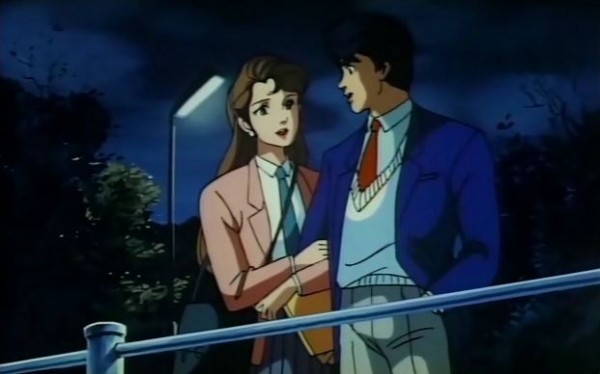
In this short form action thriller, which treats moments of death and potential severity as a playful farce, there's a reoccurring gag which plays on our hapless protagonist Ryou Matsumoto, who escapes bullet fire like a Lupid the 3rd character in cartoon motion, never wanting to write anything based on his own life despite people constantly recommending this advice to him. The irony is not lost when one character later introduced, a stereotypical hard boiled cop eventually thrown off the police force, shots a helicopter with just a big gun. It is a predictable narrative - one hero, villains who are very bad, a female love interest named Yuki Tamura who is sweet and in peril a few times - with the only real quirk being that the story's over faked relic certificates. The rest could've been a live action Hollywood film.

From http://animediet.net/wp-content/uploads/2012/11/US3-600x374.jpg

Probably the other idiosyncratic detail is the story being animated, which is important for myself as animating an action scene rather than shooting it on a set has a different effect. I must confess I can find action films dull despite the hard work making them, but due to the inherent hard work to put together an animated action scene, I had to appreciate animation when it's actually good, Urban Square for what it managed to do also good, especially as it is a solidly well made and stylish production. Noticeably as well, whilst it plays itself as comedic, it does play its actions sequences with real deaths involved, providing a sense of gristly consequence that does give the OVA an edge; all the while with its lead is still constantly referencing the clichés being used within the story itself for an added flavour to the material.

A large part of this is just because its screenwriter is Kazunori Itō, famous for the Patlabor franchise, the first 1995 Ghost in the Shell film and other famous productions which vary between serious and comedic tones. He is, alongside everyone involved with the production, playing to the clichés for fun. Whether it makes sense to or not doesn't clearly matter, one assassin sent after Ryou not a gun toting villain but a martial artist sent to just destroy him (and his entire apartment) with kicks and punches, nor the man versus helicopter segment which feels entirely from the American action films being made at the same time with more self awareness of itself as a moment.

Helping with Urban Square, as mentioned, is that it's one of the better made anime OVAs I've seen from the eighties. Beginning with Akemi Takada's character, her career with famous eighties work like Urusei Yatsura to Patlabor as well, it's a solid production whose action scenes are fluid and gleefully unfolding its clichés up front, from Ryou escaping an assassin with a giant machine gun to the hard boiled cop who risks his career for what he believes is right. There's even a properly executed joke just about a film the characters see within the narrative, a Friday the 13th pastiche where Jaws interrupts the proceedings. Because of moments like this, I've had to rethink my opinion of Urban Square: In Pursuit of Amber a lot in the time that's passed to this review. I was ready to dismiss it originally as predictable but now in lieu to a lot of time to have passed, the anime's developed a justifiable charm...even the eighties muzak jazz.  

From https://blogger.googleusercontent.com/img/b/R29vZ2xl/AVvXsEhRmkixoLVm7Mzv-Df_EmzhPzzciYGwMhEtIegB2MTSVJjebneZYXJ7GbtdBY1-XZKPbsGcSIUs565GhpcDZun0nwYwVXnoOtJr6IofnOq3clCZsVipDCA8jmYPCvOsYMjCqCNJpKXhKO8/s1600/Urban+Square+THAT+AIN%2527T+REGULATION.png

========
* Arguably, Lisa Simpson and her sax playing, which was why an impressionable young boy like me, who watched The Simpsons obsessively, started to learn the alto sax in inspiration from the character, was a major benefit to jazz's reputation just for the Bleeding Gums Murphy stories.