Showing posts with label Cinema of the Abstract Crossover. Show all posts

Thursday, 14 July 2022

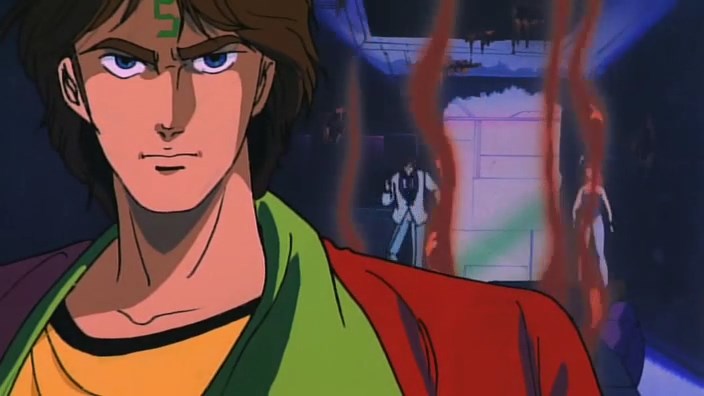
The Guyver (1991)


Director(s): Steve Wang and Screaming Mad George

Screenplay: Jon Purdy

Based on the manga by Yoshiki Takaya

Cast: Jack Armstrong as Sean Barker/The Guyver; Vivian Wu as Mizky Segawa; Mark Hamill as Max Reed; David Gale as Fulton Balcus; Michael Berryman as Lisker; Jimmie Walker as Striker

Bonus Review


Note: The version of The Guyver (1991) watched is the director's cut, which involved a flashy editing technique added to cut between scenes, but also visibly removing shots of violence which is brought up in the review.

This review will also be re-posted at my other blog Cinema of the Abstract for a little cross-promotion between them. Please take a look at a wide selection of reviews I do there as well.


Yoshiki Takaya's manga The Guyver was at one point one of the first Japanese manga and anime franchises to transition over to the West, and one of my earliest memories as a child to the idea of "manga" or "anime" involved the 1991 film itself, a small news article about The Guyver with the exceptionally deceiving poster of co-star Mark Hamill's face against one-half of the iconic Guyver helmet. In Japan itself, Yoshiki Takaya's manga started in 1985 and is still going thirty plus years on through multiple magazines, with two anime adaptations for straight-to-video, 1986 and 1989, and one I grew up with getting into anime, a television series between 2005 to 2006 which was an attempt rejuvenate the franchise. The OVAs, specifically the 1989 multi-episode one, gained an infamy when released in the West for its violence, whilst the TV series was undermined by not having ultra-violence that made the anime notorious, despite the late anime distributor ADV Films selling the series off this infamy, and that it does not have an actual ending. In the West, two live action films were made, one produced by Brian Yuzna with Steve Wang and Screaming Mad George making their directorial debuts, the sequel three years later with Steve Wang on his own in the director's chair and taking a drastically different direction in tone. Together they are curiosities.

Made as a Japanese co-production, Yuzna himself is a man I admire. Connected to Stuart Gordon, the director famous for Re-Animator (1985), Yuzna himself as a filmmaker has a fascinating series of strange and imaginative horror films, some involving Screaming Mad George, birth name Joji Tani, a practical effects designer from Japan whose reputation when he moved to the United States and worked in cinema have had a lasting legacy. Steve Wang, a Taiwanese makeup artist and creature designer who emigrated to the USA as a child, would comes into the directorial chair in his small filmography here as a co-director, and especially with a film called Drive (1997), gained himself cult recognition.

The Guyver, as the 1991 film, is however a strange mess. The plot is from the source - an evil corporation called Chronos are after an alien bio-armour, the titular Guyver. Set in the United States, a young man named Sean Barker (Jack Armstrong) finds the Guyver and is infected by it, creating living armour which grows from his body when he needs it. The Guyver is a tokusatsu influenced production, like an ultra-violent Power Rangers in the image most have of it, as Chronos has its members and test victims used in experiments where they turn into horrifying monsters. This is contrasted by the weapons the Guyver has, with its arm blades to a chest laser beam, designed to slice them the pieces.

Yuzna's Japan-US co-production decided not to follow his wheelhouse of gore and elaborate special effects in films like Society (1989) or Bride of Re-Animator (1990), but only have the special effects...at least at times. The director's cut, the more readily available version, has scenes of gore cut, but even the film without these missing fragments is incredibly goofy at times, creating a contradiction of a film you could not give to a child without causing potential nightmares, at least its most lasting moments, but other times has incredibly silly humour. The first Guyver film, the more easy to find, is a peculiar thing with its tendrils connected to Stuart Gordon and Yuzna, with the evil Chronos Corporation headed by leader Fulton Balcus, played by David Gale who is famous for Re-Animator. Balcus wants the Guyver bio-armour and sends "Zoanoids", humans who can turn into humanoid monsters, after Sean Barker.

The one success, the only success, in terms of consistency is the practical effects. Screaming Mad George is legendary and notorious for his work, from the human cockroach sequence from A Nightmare on Elm Street 4: The Dream Master (1988) to the "Shunting" scene from Society, visceral body horror which even if you can see the seams is so nightmarish and gooey that it borders surrealism. Moments show this in The Guyver, seeing him and everyone in the practical effect department having a field day with the premise. Whether it is horror film veteran Michael Berryman and various actors turning into various humanoid beasts or the spectacular Guyver armour itself, a warrior with cyberpunk and insect-like traits, they are all applaudable. It is, however, a film struggling with a premise, possible in anime and manga, which has an apocalyptic tone on a large scale, and also requires martial arts to pull off even fights between men in rubber suits. Guyver: Dark Hero will try to overcome this, to greater success, but this prequel struggles.

It is a really strange film, not in surrealism, but how it ended up as it did. Mark Hamill, the legendary Star Wars actor a year before he took on the voice of The Joker in Batman: The Animated Series, creating for him a career flourish as iconic as Luke Skywalker, does stand out, playing a cop on the edge trying to get the scope on the Chronos Corporation, with a sense of grandeur to his appearance. The late David Gale steals scenes with his bizarre intonations and wall chewing, even enraged by burning toast as he is by the incompetence of his minion. Vivian Wu, as the female love interest, is visibly struggling with her dialogue and not helped in the slightest by a wet, one dimensional female character she has. Alongside the fact she is cast as a Japanese character, which is dubious for her as it is as casting, she is a really strange inclusion as between Bernardo Bertolucci's The Last Emperor (1987), a huge film in his later career which was her onscreen debut, and Peter Greenaway's The Pillow Book (1996), Wu, a Chinese actress whose career is mostly in dramas in the West and China, found herself in this film sandwiched between a Bernardo Bertolucci film and Greenaway which is a curious tangent. Even her appearance in Teenage Mutant Ninja Turtles III (1993) at least makes sense as a second sequel to a franchise which was huge at the time and whose first feature film was a box office success.

Jack Armstrong as the hero sadly struggles out of the whole cast, in a role that, to be brutally honest, was made an a absolute charisma vacuum even by the standards of a pulp story that emphasises practical effects first, which does not help him out at all. These stories, and this is something I think of in terms of the Guyver television anime, is structured around protagonists, male leads, who are usually bland, especially in many ultra-violent anime too where the worlds and context around them are more meaningful. More so as he is put against Hamill, the advertising cynically suggesting a key Star Wars figure as the lead in some posters, as well as against Michael Berryman as the main henchmen, one of the most visually striking figure in cult cinema. Even Spice Williams, a prominent stunt actress who stands out physically here with Berryman as a physically imposing female henchwoman, gets to play out a more memorable and playful romance with Berryman in one of the few jokes of the film which do work.

Despite Steve Wang's later work such as with the Guyver sequel and Drive (1997), with fight choreography from the tokusatsu school, and of an incredibly high quality in terms of fighting and stunt work, the fights here look stilted and suffocated by the presentation, lacking what the sequel did. In sacrificing some of the practical effects in terms of beast designs in favour of men in rubber monster suits, likely injuring themselves in painful stunts but bringing an exhilarating air of chaos to the proceedings, that sequel as we get to found a kineticism which works. The result beforehand in the prequel is as stiff. More surprising is the lack of scale even by the standards of a small budget genre film, feeling like only a couple of rooms and some exterior shots were used, the script as swift in getting to its end without any sense of dramatic conflict being found.

The final issue, ultimately the creative decision which maims the film fatally at many times throughout itself, is deciding to play most of the film as a comedy, coming clearer to me now as a result of having to work around the limitations. Even if it worked on other Brian Yuzna productions like Re-Animator, the humour in those cases was incredibly grim even if there was slapstick. This has more broad, goofier with characters being buffoons, and one of the more contentious running gags being the character of Striker. Jimmie Walker, playing him, is a prolific comedian and actor especially in television, all the way back into the seventies with shows like Good Times (1974–1979), a spin-off of a series called Maude which is significant in terms of an American sitcom from that time period about an African-American family. I can see Walker's completely natural charisma here, though when he suddenly indulgences in some early nineties cheesy rap, you realise with The Guyver how tonally this is not an adaptation of Yoshiki Takaya's manga. His fish-monster character is a memorable costume, and he has one good gag of accidentally wandering on a cheap horror film scene with a Linnea Quigley cameo, but his character in general has mostly cringe inducing humour from Striker as a gag character, more an issue as his character in general and especially how his monster version looks has uncomfortable stereotyping that cannot be ignored.

This version of the concept does not really work with its material at all, and it is telling that, with a Director's Cut cutting out violence, there is a misinterpretation of the source material that undercuts it. There are moments you could not show children, and yet they are actually some of the most striking moments. Taken from the source, and recreated in the TV- series, is that the giant orb in the centre of the Guyver's head is its weakness, leading to the death of the lead and an absolutely memorable sequence of body-horror resurrection. Even if it is played for goofiness, with a knock-off Jaws theme riff, that sequence has a morbid grace, and has some humour which actually works beforehand, mainly the fact that Yuzna alumni Jeffrey Combs, of Re-Animator, makes a cameo chewing the scenery and is involved as a weird goat creature by that point. Famously [Spoiler Warning] this is the film where Luke Skywalker gets painfully turned, with Hamill submerged in practical effects latex, into a cockroach-locust hybrid, a moment that if it had been in another production would haveve been up there in Yuzna and Screaming Mad George's filmographies as being iconic. Here, the film around it does not live up to what, in between both films, is the best sequence of these American adaptations, a scene which is actually horrifying, actually tragic and adult, and is one of Screaming Mad George and the prosthetic team's best moments on this film. It is a scene which has clearly stayed with George as, alongside the woman turning into a cockroach in an Elm Street sequel, he is referring to this idea with Paranoiascape (1998), an experimental pinball game he worked on exclusively for the Japanese Playstation One market that explicitly references this as much as Society in some of the grotesque sights within it. [Spoilers End]

The Guyver is a film so painfully bad in its humour at times that it both makes little sense tonally but loses its power in context. It feels like a cheesy American action film from this era, not in terms of when they are fun, but just the clichés, whether it is the moment with a multi-ethnic gang of clumsy hoodlums, or the humour being at the expense of Michael Berryman, rather than embracing his comic timing and imposing nature more, or that no one is taken seriously even as comic characters. Jimmie Walker is even paired up with an actor named Peter Spellos as bumbling henchmen, with Spellos having a vague Eastern European accent, in scenes that undercut the actors themselves. Peter Spellos, who can go from Jim Wynorski films like Sorority House Massacre II (1990), sometimes playing the same character of Orville Ketchum, to a career in anime voice acting for work like Naruto to Cowboy Bebop (1998), is someone with clearly a lot of charisma to try to make this material work, but The Guyver is a case of a cast of fascinating individuals, from a variety of idiosyncratic areas of pop culture, not being helped by the script and tone. From anime voice acting to Star Wars to Peter Greenaway art films to prolific American sitcoms, everyone in and behind the film camera is a fascinating figure who could bring a lot to the table, but the work onscreen from the production really does not connect together.

Ultimately, it is the emphasis on the humour especially, against the paltry production, which makes The Guyver insufferable at times even when it can be charming at other times. A Jeffrey Combs goat demon, or Vivian Wu and Mark Hamill running away from what apparently is a flea monster, like characters in a one-reel silent film comedy, are charming to see, but in mind that this is The Guyver, a tokusatsu work at heart, whether you kept the gore or not, this feels like a project which grabbed at the wrong point. This is stranger considering Brian Yuzna, even if he might have not had a taste for martial arts, had a taste for horror films which got the tone for humour and the monstrous perfectly, or his fellow producer Aki Komine, who produced a series of films with Yuzna or by himself which did attempt manga adaptations with heavier leanings on action, by it Christoph Gans' Crying Freeman adaptation from 1995, or the Fist of the North Star film from 1995 which, whether good as an adaptation or not, was an attempt to get the original violent post-apocalyptic narrative to the screen1Komine, with Steve Wang, would also work on Kamen Rider: Dragon Knight (2008-9), Wang's attempt to bring the legendary Kamen Rider series from Japan to American children's television, so there was a sense of Komine being interesting in the type of storytelling The Guyver did not turn into inexplicably. With these curious names involved within its production, it feels instead a sense that, together, The Guyver whilst fascinating just did not gel at all in terms of creativity.

In contrast, Guyver: Dark Hero even with its own flaws managed to be more successful, but that is a review for another day....

To Be Continued...


=====

1) That and this Fist of the North Star adaptation has the curious mix of action star Gary Daniels, Malcolm McDowell, professional wrestler Leon "Vader" White,  Costas Mandylor, Downtown Julie Brown, Chris Penn, and African-American cinema pioneer Melvin Van Peebles involved, which is a strange cast to ever get in an adaptation of a Japanese manga.

Friday, 16 October 2020

#163: Puppet Princess (2000)


Director: Hirotoshi Takaya

Screenplay: Junichi Miyashita

Based on a manga short story by Kazuhiro Fujita

Voice Cast: Akiko Yajima as Rangiku Fumiwatari; Norio Wakamoto as Yasaburo Manajiri; Kouji Nakata as Sadayoshi Karimata; Takeshi Aono as Head of the Deathless Ninjas

Viewed in Japanese with English Subtitles


The following review is to be found on my other blog A Night of a Thousand Horror (Movies), part of its Halloween season of thirty one reviews per day and together a great way to promote both of them. If this is of interest to you the reader, follow the link HERE for many more reviews.

If there was ever a premise in desperate need for a television series, or a theatrical length adaptation, it would be Puppet Princess. There is however a reason against this. Created by Kazuhiro Fujita, famous for a manga series called Ushio and Tora (1990-6)Puppet Princess was only a short story, part of a group created by him between 1988-1994 that were compiled together into a work called Yoru no Uta (1995). So only if you had license to write more material, which could be a risk that does not pay off, or if Fujita ever decided to retell this narrative in a longer form, a forty minute straight-to-video anime OVA is all we have here.

It is surprisingly late for Puppet Princess to exist as an OVA, as even if there were titles into the mid to late 2000s created for the market, that format dwindled down into bonus episodes for other work rather than the rich format of the decades before. This one saddles the transitional era between the hand drawn and digital assisted animation too - I suspect some computer animation was used for assistance, but it does feel like an old school OVA in its style.

In period Japan, the narrator deliberately saying that this is an obscure tale forgotten of, a young woman carrying a giant box on her back, twice or more her height, wanders the countryside. Acting like the protagonist of a comedy, as she goes on her way with her pure hearted nature, she encounters a ninja whose team has been eliminated by "death-less" puppets, i.e. automatronic puppets that can move by themselves. The ninja Yasaburo and the young woman Rangiku realise they had the same goals, she actually the princess of a kingdom destroyed by Lord Karimata, wishing to hire Yasaburo to help her in revenge against Karimata, who killed her father, murdered her family, but with a greater concern for her the puppet he stole and created others from. Her father become so obsessed with puppetry he invested in them and created giant puppets that could fight, which she carries in the box and can control, alongside one that was entirely autonomous.

This premise is dispensed with quickly in forty minutes. A shame, but only because, from a short story which is in this form completes itself entirely, Fujita created a premise you could make a longer narrative from even if it could be in danger of padding. It is set up almost so, with Rangiku having four puppets, only for them to be barely used, again a shame as alongside their distinctions, the most prominent one used is a hulking samurai, the premise in terms of anime which have distinct logics common to them has one of note. That, having to control the puppets with her hands and feet, she is vulnerable to any attacks, hence why she wanted to hire Yasaburo.  It may seem a base thing to consider, especially as someone in live action who hates a lot of action scenes, as someone who likes comic book logic and martial arts films, these types of details actually become part of the character of anime stories, especially as they can be depicted with some creativity in the storytelling and art style.


It may have helped with the tonal shifts if this had been a longer work. This OVA juggles, even stumbles, over tone considerably. A lot is comedic. Sadly this does include a scene of bathing where implied ravishing is made a joke, even if thankfully the joke turns to Yasaburo being freaked out that Rangiku, somewhat cluelessly, is game in her optimism to try what he was trying to imply. It also stands out as, unsure why Puppet Princess is tagged as a horror anime when it is mostly an action period piece, it fully acquires it when it is revealed the puppet strings are made from the flayed skin of young children, even Rangiku's own as her mission is a conflicted one, arguably revenge but with knowledge her father was also a monster and that she wants to rid his creations from existence.

This material, again, would be a great longer premise, even if it would require new material to let it breathe. That complex little detail in itself adds a lot to this title as it is, but more could be taken from it in a longer story. As much of it is, to be even naive, that puppets are fascinating objects in themselves, and that knowing how in Japanese culture they have their own rich history, this world could have easily grown out the material with its idiosyncratic premise. Especially as it does have horror and comedy and action crammed together, particularly the horror aspects would have grown in weight if this material was allowed to breathe.

It did evoke for me Osamu Tezuka's Dororo (1967-9). Among the countless manga created by the proclaimed God of Manga, one of manga's (and anime's) most important figures, one such title he did not actually finish was also a period action work with a distinct premise and horror leanings, where a son who is sacrificed by his father to demons, leading them to steal as much of his body and organs as possible. Yet the boy in this world survives as a literal worm, going after his body parts as an adult with a mostly artificial form which, with arm swords and even knee missiles, is a literal weapon. Why Tezuka never actually finished that premise is unknown, but it was still enticing enough to have animated adaptations, a 2004 videogame version which had an ending, and even an acclaimed 2019 animated series which also completed the series and took new directions. Puppet Princess in this little shed of an idea, and that abrupt full formed turn to horror, could expand with similar richness.

But Puppet Princess as it is was a rewarding piece nonetheless. It is so slight it is difficult to either elaborate on the material, or to its advantage really criticise it as, in the spectrum of anime OVAs, this is a much more accomplished and rewarding one when, for every good one, there have been plenty of bad ones. The art style is worth bringing up though, idiosyncratic to the point some may find it ugly, at times with characters like Rangiku very supple and lithe, but with shots especially where the eyes are drawn with a weird shape even in the pupils, the teeth becoming sharper like fangs, becoming a style that here can switch easily from light hearted comedy to even the horror with ease in its artistic flairs. Again, it would have been fascinating to see this as a series or a long single narrative just to see how these character designs could develop.

Kazuhiro Fujita himself now also becomes a figure of interest for me. Adapted twice to animation, in the early nineties (as an OVA series) and the 2010s (as a television series), his Ushio and Tora is a well regarded title and, just from Puppet Princess, as an introduction it is a good one to Fujita himself. It says a bit in itself that, whilst known as a distributor nowadays who have been as elusive in releases like yeti sightings, and refuses to die, the American distributor Media Blasters first released soon after its 2000s release, and planned to release this on Blu-Ray in 2020 even as a forty minute only title, OVAS unless multiple episodes tragically maligned in the streaming and high definition era of anime. It was good on them, as this was with flaws but a surprise I was glad to see.

Tuesday, 27 August 2019

Re-Review: Sparrow's Hotel (2013)


Director: Tetsuji Nakamura
Based on a manga by Yuka Santō
Voice Cast: Daisuke Kishio as Misono-kun; Haruka Nagashima as Tamaki Shiokawa; Minori Chihara as Sayuri Satō; Asuka Yūki as Yū Kojō; Shūta Morishima as Sakai
Viewed in Japanese with English Subtitles
A Cinema of the Abstract/1000 Anime Crossover

[Over a year ago I first covered this anime, to which this is deliberately an attempt to see if any of my opinions changed in the passing time. I will provide the link to the original blog review HERE for comparison. This will also be a tie-in for my other blog, Cinema of the Abstract, where a duplicate will be made available and is why it'll have a certainly different tone than usual. A link to the blog in general is to be found HERE]

First thoughts? 480p resolution, as this particularly obscure anime oddity, three minutes per episode over twelve of them, is notorious for those who know of it for its aesthetic appearance and/or the highest quality you could screen it on an anime streaming site Crunchyroll. This gets weirder as that's only the first six episodes where that aesthetic is there, one of the many peculiarities of the kind of title you'd never have gotten a release of in the West were it not for streaming, a feature of modern entertainment which has allowed, in the ability now to have anime stream soon after its premieres on Japanese television, a similar premiere online for the West. (That, hey, it probably costs less to just license than to produce DVDs for, that also meant titles of a greater variety like Sparrow's Hotel can be made available) Considering how esoteric the subject matter is, the day-to-day management of a hotel, it certainly feels odd though that is tempered by aspects of the production. The first is that it's actually an adaptation of a "4-koma" manga, which are normally gag comic strips which have pages divided up by four panels. It's not that different from a Western comic strip in structure, just to give you an idea. The other is that it happens to be a hotel that hired a beauty buxom female employee, one named Sayuri Satō who happens to also have commando combat skills and assassination abilities. But still, pretty strange especially to someone used to the better known anime titles that crossed into the mainstream.

Some have speculated this is a parody of nineties straight-to-video animation, which had a history of high quality work, when it became an industry by the mid-eighties onwards to its down spell in the 2000s, but could also scrape the bottom of the barrel. I question this, having seen many bizarre anime premises especially in these "micro-series", and with knowledge that a lot of them use a lot of low-fi and frankly crude animation, sometimes for deliberate effect but some others clearly what was available. I wouldn't be surprised that this was a sincere production that, as I'll get into, was always meant to be a sex comedy/hotel hijinks show, where one of the jokes is a smaller female character smashing her face into Satō's giant bust as if that's a new concept, but had a major change of guard or how the episodes were being made halfway through.

Start with the first episode and the show's at least an experience, as whilst the second calms down and sets the pace, the first is (at merely three minutes including beginning credits) quick, hectic as it gallops along without pausing for breath as it introduces Satō, the carefree and sweet lass who is also the ultimate killing machine in the body of a voluptuous ditzy Venus, Tamaki Shiokawa the diminutive female manager, Shiokawa her older brother who is her superior and has a creepy incestuous fixation she is disturbed by, and bellboy Misono who is at first the meek, glasses wearing male employee but has a dark despondent side. It's a chaotic mess of a pilot, but the show in general is a series of vignettes which plays off those character traits. Whether they are actually any good is to question as the show never transitions further from just its surface. Yes, it is a curious subplot about Tamaki being freaked out by her older brother's advances (cough), and whilst even played out of humour that's a transgressive plot line to have, it never thankfully crosses into poor taste. Really, the only character who gets a lot of coverage is Satō, the figure on the manga covers who is significantly voiced by Minori Chihara, a singer who just happens to also play a side character, but still one of the main voice cast, of the huge franchise The Melancholy of Haruhi Suzumiya before Sparrow's Hotel.

It doesn't try to hide Satō as a figure of cheesecake fan service. She openly declares, creating the second episode title, that her best assists are her breasts and assassination skills to Tamaki, which leads to a dichotomy that is reoccurring in anime of voluptuous female characters who are nonetheless insanely powerful and/or violent. Is it demeaning or empowering to have these kinds of female characters who are very sexual but strong? It frankly comes off as a kink at times and there are definitely times where it is just a failure and proves sexist when the material's dreadful. Yet there is also the double standard danger of the stereotypical picture of femininity being negative being itself an insult, really the bigger concern with these kinds of characters is whether they are just for sex appeal or if they're going to have some emotion or characterisation to them. Even the case of Satō being very simple and at times naive isn't necessarily something that could be used as a negative characterisation if done properly. If anything, in a better and more fleshed out work, we could've had a lot to work on as already in this there is plenty of subversive material already there to mind - of a sedate, kind hearted soul who can yet can power lift a whole bed by herself, buys gym equipment the same way Tamaki does for handbags, and always carries kunai (Japanese throwing knives) under the skirt, with the ability to use them in an improvised game of William Tell at the company trip to a cherry blossom festival in the park.

The subject of the series is also to be asked about as, honestly, for what is a unique twist; sadly, the show never had enough time to run with its premise of hotel management further. Manga particularly has a heritage of the least expected subjects being covered in stories, and in what little we get here, Sparrow's Hotel had so much to mine here too. A tale in which rowdy people outside are an issue, booking crowds for a nearby anime/manga convention is stressful, or where one has to send off Satō to subdue a drunk and irate customer by knocking him out with a single chop. If it'd been a full length series, it could've easily become worse, but it could've also been actually more interesting and funny to see an anime set in hotel management, as seen in a later episode where a violent storm outside provides a huge swath of customers to the benefit of the empty hotel. As it stands, the show's too short for this, even if it is still to be found in slithers.

Beyond that the episodes' are so short, it's both difficult to analyze them but that in itself is a critique - that for humour, it's not the best but with some amusement, but as mentioned it never fully invests in its premise. There is an additional character of Yū Kojō, a hotel inspector whose attempts to keep that are secret are useless, but a lot of the show never drastically changes for the first half. Really, the moment where things get really interesting is with the art style. The first half follows the source manga in style but is infamous, for those who know of it, for its brash colours and crude character designs, a garishness matched by the manic pace that is compelling in a way but arguably limits the show's potential by being a one note mood. The transition, befittingly set against the episode where renovations lead to a new bathing area being created in the hotel, and the episodes having end credits instead of opening ones, is a shock.

Muted colours, softer character designs, and frankly a leap in budget or craft as the animation becomes more fluid and more ambitious even in the show's comedic double takes and gags; I forgot how impactful it was, the change absolutely distinct and looking like an entirely different adaptation of the same material. There is even a deliberately attempt as well to push the fan service, such as the end credits being a nude Satō sleeping surrounding by underwear and kunai on the bedspread. (Make of that what you will). It however even includes the cast, including Misono, being dressed in cute animal costumes in the mid-episode eye-catches that were added for the later episodes. It doesn't necessarily add more - alongside Kojō returning, there's a possibly American older male fighter named Billy who locks eyes on Satō as his rival, the show teasing the pair fighting continually. A lot of the show is still based on the initial premise mind - your main female staff member a killing machine, the manager is still creeped out by her older brother's thoughts of her, Misono is despondent. It doesn't particularly change a lot and that's honestly the real issue for Sparrow's Hotel even if the show was entertainment. It thankfully did change the aesthetic complelely thought, which is arguably why I feel those episodes pass the halfway mark are of a higher quality.

Personally, the fact I've rewatched Sparrow's Hotel shows it has had a lasting mark even an odd curiosity. The micro series as a concept is fascinating - allowing for new talent, odd premises like this can allow for a lot of creativity and opportunity just for strange content. The issue is really how slight the micro-series is, at literally under thirty minutes or so here with Sparrow's Hotel never pushing to a further level than it probably should've. I admit as much of the incentive to re-watch the show was how short it is altogether, but I have as I realise a fascination with these micro-series in general that isn't exactly a guilty pleasure, but a love directly from the gut. That doesn't mean I won't be honest mind.

Is it abstract or strange though? Strange definitely, but not as strange as it potentially could've been, one of the greater ironies beyond Japanese animation that if you play something off as comedy, unless you fully distort the structure or push yourself, it makes an odd premise more normal as a result. And as much as the three minute episode length a surprise, just in terms of how much storytelling you can try to tell with minimal time, Sparrow's Hotel isn't exactly unconventional. In fact it could've done with a lot more preciseness, more weirdness and probably less fan service, unless it was going to be more positive for the main character's depiction, and I might've had a little gem on my hands. Cause I don't know about you the reader, but a thirteen or twenty four episode normal length comedy show about the banalities about running a hotel, if pushed further even with these same characters, would be an utterly peculiar and interesting experience to sit through.


From https://www.fandompost.com/wp-content/uploads/
2013/06/Sparrows-Hotel-Episode-11.jpg

Saturday, 6 April 2019

#94: Ai City (1986)

From https://m.media-amazon.com/images/M/MV5BZjgxMDM2NjQtZDY2Zi00Nj
UzLWE0MGMtYTQyOGQ3ZTdkZTQ0XkEyXkFqcGdeQXVyMTA1OTEwNjE@._V1_.jpg


Director: Kōichi Mashimo
Screenplay: Hideki Sonoda
Based on the manga by SYUFO (Shuuhou Itahashi)
Voice Cast: Hirotaka Suzuoki as Kei; Yuki Ueda as Ai; Mami Koyama as K2; Banjou Ginga as Ii; Ichirō Nagai as Rai Ro Chin; Issei Futamata as Ryan; Jouji Yanami as Ti; Kenyuu Horiuchi as Mister J; Kiyoshi Kobayashi as Kuu Ragua Lee; Nachi Nozawa as Raiden; Seiko Nakano as S; Takeshi Watabe as Aroi
A Cinema of the Abstract Crossover

Fancy something strange and (frankly) batshit from the eighties? Covered HERE on my other blog, full spoilers but not in the slightest capturing the experience of viewing the directorial work of studio Bee Train's founder Kōichi Mashimo, Ai City is what happens when in the midst of a craze for psychic and ESP stories someone decided to make the eventual anime which is as mad as a box of frogs. No way near as difficult as I have heard it be, gorgeous to look at certainly, but I'm not going to suggest it's anything but incomprehensible at times.


From https://cdn.animenewsnetwork.com/thumbnails
/max1000x1500/cms/feature/106042/image08.jpg

Sunday, 10 March 2019

#91: Plastic Neesan (2011-2012)

From https://yams.akamaized.net/Assets/93/345/l_p0020534593.JPG


Aka. +Tic Elder Sister
Director: Tsutomu Mizushima
Screenplay: Tsutomu Mizushima
Based on the manga by Cha Kurii
Voice Cast: Mari Kanou as Iroe "Neesan" Genma, Marina Inoue as Makina "Makimaki" Sakamazaki, Yumi Uchiyama as Hazuki "Okappa" Okamoto
Viewed in Japanese with English Subtitles
A Cinema of the Abstract Crossover

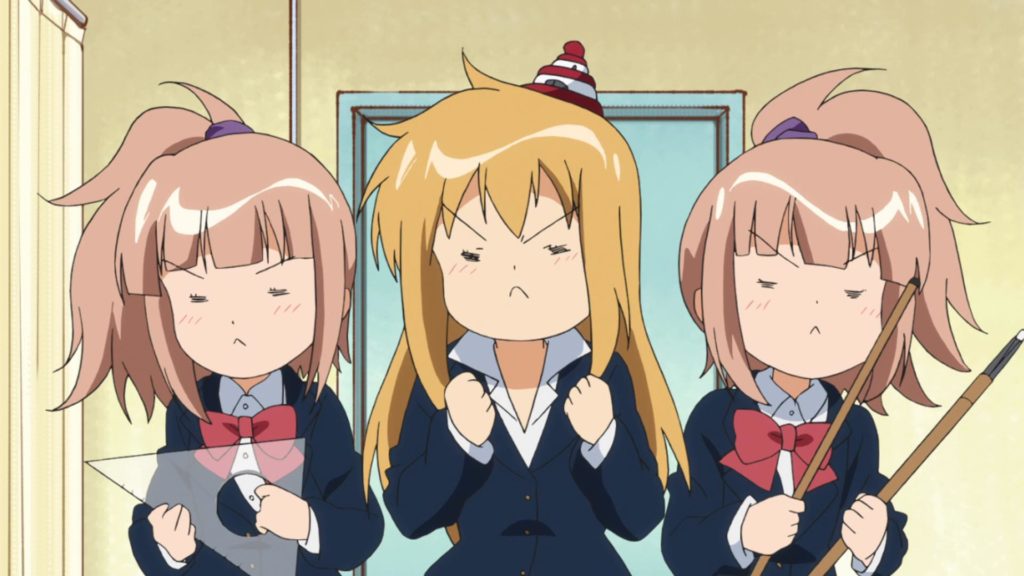
Synopsis: Neesan, with her friends Makimaki and Okappa, sets up a model making club at their high school; instead of actually making models, they spend their time over twelve episodes, two minutes each, exposing their hatreds for each other, encountering weird students, and learning of the mating dance of a female gorilla.

Sometimes there's an anime worthy of being covered on my other blog, Cinema of the Abstract, and this curious Original Net Anime (ONA) is pretty infamous at least if the Gifs of the show in the web are anything to go by.

The resulting review contemplates the strange paradox of how an anime can be pretty normal the more deliberately weird it tries to be, whilst trying to probe the brain of its director/screenwriter Tsutomu Mizushima. All at a click at a button HERE.


From https://anime-archive.com/wp-content/uploads/2017
07/87fc4e8c17c398afae5713ce920ea6c8-1024x576.jpg

Thursday, 16 August 2018

#61: Gdgd Fairies (2011-13)

From https://encrypted-tbn0.gstatic.com/images?q=tbn:ANd9GcTL1mtVcnoDOF9qjMiW5
KstnGzW13ldCFNbVIZgQYAHXLylcbrW


Director: Sōta Sugahara
Screenplay: Kōtarō Ishidate [Season One], Kazuyuki Osabe and Taizō Yamamoto [Season Two]
Voice Cast: Suzuko Mimori as pkpk; Kaoru Mizuhara as shrshr; Satomi Akesaka as krkr
Viewed in Japanese with English Subtitles
A Cinema of the Abstract Crossover

When you expect fairies at the bottom of the garden, you do not expect three female ones arguing about whether sorting laundry would be a waste of the last day of mankind or not over tea. Nor role-playing a superhero rescue where one of the heroes worries he's punching villains too hard.

From https://img.fireden.net/a/image/1507/71/1507717608149.jpg

Welcome to the Anime World Order and Mike Toole (from Anime News Network) approved comedy gdgd Fairies, where terrible character models and animation can be used as a great art form especially when the writers are penning the strangest, funniest material they can come up with, and the sole three voice actresses are more than capable to follow on from that written madness. As there are some anime that are appropriate to review on my other blog Cinema of the Abstract, about unconventional and weird cinema, I felt that review this two season oddity was more appropriate over there. You can find the full review to read HERE.


From http://i.imgur.com/Qutj0Qb.png

Monday, 6 June 2016

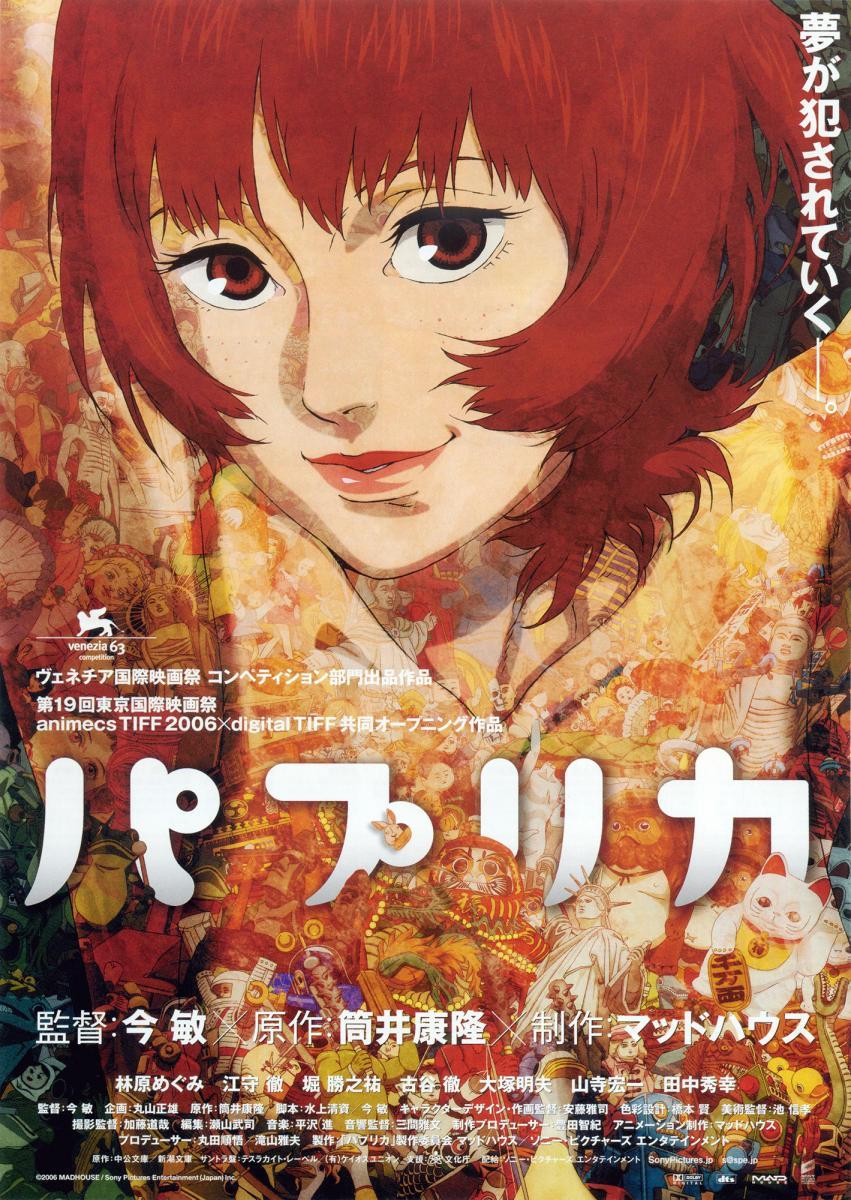
#26: Paprika (2006)

From http://pics.filmaffinity.com/Paprika_detective
_de_los_sue_os-439873032-large.jpg
Director: Satoshi Kon
Screenplay: Seishi Minakam and Satoshi Kon
Based on a novel by Yasutaka Tsutsui
Voice Cast: Megumi Hayashibara (as Doctor Atsuko Chiba/Paprika); Tōru Furuya (as Doctor Kōsaku Tokita); Tōru Emori (as Doctor Seijirō Inui); Katsunosuke Hori (as Doctor Toratarō Shima); Akio Ōtsuka (as Detective Toshimi Konakawa); Kōichi Yamadera (as Doctor Morio Osanai)

This would've been a difficult task - covering an anime by the late Satoshi Kon and explaining my admiration for him - regardless of which of his small filmography I choose, but it does also mean I got to revisit this film again and see why I admire him like so many do. Paprika is the one in his career which is the "flawed" film of his filmography, but you'll also see why I love it if you follow the link to the full review HERE.

From https://canime.files.wordpress.com/2007/11/paprika4.jpg

Friday, 15 April 2016

#23: Dead Leaves (2004)

From http://2.bp.blogspot.com/-ZOohJceHbdY/UVABsPSU1KI/
AAAAAAAAIv4/rAdH2BqhEnw/s1600/dead-leaves.jpg
Director: Hiroyuki Imaishi
Screenplay: Takeichi Honda
Voice Cast: Kappei Yamaguchi (as Retro); Takako Honda (as Pandy); Yuko Mizutani (as Galactica); 666 (as Mitsuo Iwata); 777 (as Kiyoyuki Yanada); Chinko (as Nobuo Tobita)
Viewed in Japanese with English Subtitles

In lieu of the unfortunate passing of Videotape Swapshop, I've decided to replace the absence of the tie-ins I planned for that site with linking this blog to my origin Cinema of the Abstract. This'll make a lot of sense with the more stranger and unconventional anime I'll end up covering, Dead Leaves a pretty great example of this type of anime with its maniac bullet heavy action. A link to the review can be found HERE