Showing posts with label Shotaro Ishinomori. Show all posts

Wednesday, 10 August 2022

#220: The Skullman (2007)


Studio: Bones

Director: Takeshi Mori

Screenplay: Yutaka Izubuchi (with writing by Hiroshi Ohnogi, Seishi Minakami and Shingo Takeba)

Based on the manga by Shotaro Ishinomori

Voice Cast: Hiroshi Tsuchida as Skull Man; Makoto Yasumura as Hayato Mikogami; Ayako Kawasumi as Kiriko Mamiya; Fumiko Orikasa as Maya Kuroshio; Hiroyuki Yoshino as Akira Usami; Katsunosuke Hori as Kyouichirou Tachigi; Masayuki Katou as Yoshio Kanzaki; Toshiyuki Morikawa as Masaki Kumashiro; Tomokazu Seki as Tsuyoshi Shinjou

Viewed in Japanese with English Subtitles


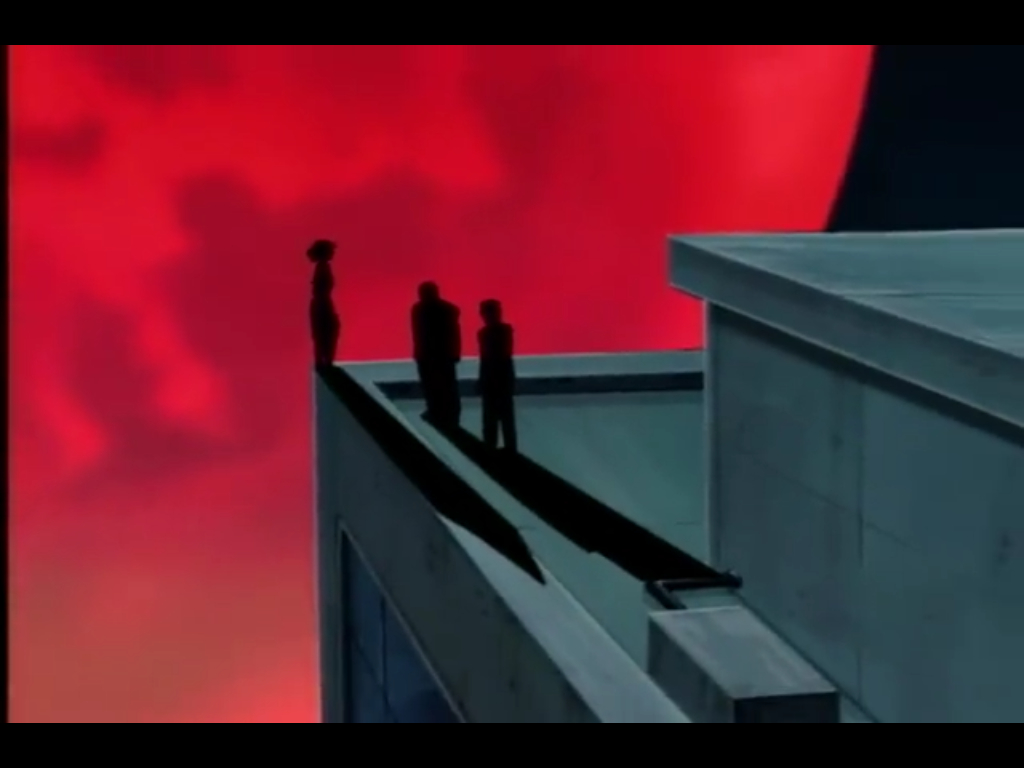
Skullman was created in 1970 as a one shot by the legendary manga author Shotaro Ishinomori, and in that text, including an expanded 1998-2001 manga by Kazuhiko Shimamoto with Ishinomori's contributions, the character was always an anti-hero, making this 2007 anime series not a bleak interpretation of a bright tokusatsu like character, but apt for the figure even if its own story. Skullman the series works as an interpretation in how the series is entirely around the titular figure, but for most of it, he is not the central character, instead a mystery in its centre of who he is and what his motives are, a mystery which will expand further on from this even when these two questions are answered in this interesting genre hybrid.

Set in an alternative world, where Japan is caught in a civil war, our protagonist is actually reporter Hayato Mikogami, who wishes to go to Ōtomo City, his place of birth and one caught in a tense political situation in terms of the ongoing war, with the intention of discovering who the urban myth of the Skullman is, the figure said to be behind the series of seemingly random murders of men and women in the city. Even in the opening credits, Skullman is first depicted as a monster, seemingly killing innocents, his first victim being a woman whose death is shot like a thriller not without purpose for hinting at this. Soon it becomes apparent, however, his mission, whilst at times edging to unjustifiable, is part of a more problematic conspiracy, much more dangerous to the world, and all circling all the victims seemingly being connected to the White Bell Association, a small religion entirely within Ōtomo City only that has a grip on the town and is very cultish. With Kiriko, a young woman who manages to wriggle her way into Hayato's life against his will, the pair finds themselves in a show where that, with only thirteen episodes to work with, does a stupendous job in using all thirteen economically to tell this tale.

There would be no time to have tangents or filler, but the production and writing team's credit, this manages to tell this story concisely, with a plot with juggles many genres which could not work, and manages to still have a unique personality, even humour of a cartoonish form at times. One of the twists, which it early on and really not a spoiler, is very reminiscent of Yoshiki Takaya's The Guyver, in which people are being turned into monsters, and the show is also a noir-tinged work of mystery, of drama, yet with a titular character who stands out, despite his anti-hero origins, influenced by tokusatsu action characters. It's tone is really idiosyncratic just from the opening, heavily leaning on the horror mood until one of the most curious opening tracks can be heard begins, jazz with funky layers, but the trumpet playing at a very odd time to the rest of the rhythm, or the backup vocals, whilst yet managing to work. One key character, an older man named Kyouichirou Tachigi who to Hayato seemingly knows everything, is a cool character but as much because of delightfully odd touches, like finding him fishing near the White Bell's church location, or that he is not only a man capable of handling himself, but within one scene revealed as a coffee aficionado who knows his obscurer blends in a coffee shop greatly.

The series composition was by Yutaka Izubuchi, with screenplay help from collaborators, and what is fascinating is that he is far more prolific as a mecha and character designer, with only a few screenplay credits in his prolific. This fact makes it to his credit and the other collaborators - Hiroshi Ohnogi, Seishi Minakami and Shingo Takeba - how good and interesting The Skullman's story is. The Skullman is a show whose episode titles are long, poetic and bleak, and Frederick Nietzsche is referenced and becomes a dialogue point between Hayato and Father Yoshio Kanzaki, a Christian priest who Hayato knows fondly from their youths. Until it gets completely serious, there is even exaggerated humour which fits the tone, such as a scene with food leading to characters having giant bellies, or the character of policeman Tsuyoshi Shinjou, who dogs Hayato believing him to be a suspect. That does not factor in, even very early in the show, the violence whether with the monsters or more conventional means which is still bloody and nasty. It manages as a curious tight walking act to all work, and it is a pulpy feat.

The Guyver comparison is apt, as in mind to spoilers, this involves alien artefacts, people being turned into monsters, against their will or willingly, and a conspiracy that involves a group very obviously connected to it, but there is more in just thirteen episodes which elaborates beyond this. Of government conspiracies, of an illegitimate son fostering contempt, of politicians being murdered by the Skullman which are more sobering to consider decades after, and that this is set in a war, one where a foreign group, even with the cartoonish super villain name of Brain Gear, are here to exploit the climate. With weapons that can literally disintegrate people, they are their own entity off to the side, in a show which pays a huge tribute to Shotaro Ishinomori by having characters and references based on his entire career, where there is a religious cult involved, and a far right imperialist Japanese group who wish to militarise and get hold of nukes, planning to stage a coup de trait even against the corrupt police force. The Skullman, as a result, also taps into some real politics even as a genre piece, which makes its ability to tell this all well even against monsters and a sci-fi plot more a further credit.

The Skullman's ending was open to a second season, even if a bleak turn, with characters becoming figures from Shotaro Ishinomori's Cyborg 009, yet still works as a conclusion in striking a balance between the tragedy that ends it, when a figure has their spirit crushed and becomes a weapon of the true villains, and the hope with the characters who have survived. There are a few side characters, and they are all interesting, be it Kyouichirou, a mysterious brother and sister revealed to be test subjects who can control their monster forms, Tsuyoshi, or even the daughter of a major political figure who acts as the voice of the White Bell Association, a frail and sympathetic figure clearly in love with Yoshio Kanzaki, transgressing her mother's views of talking to religious heretics by helping at his orphanage for children.

Even one off figures are interesting, such as episode ten introducing a troop of soldiers, from a war Yoshio was a front-line minister of rites on, who have been turned by cyborg killing machines by Brain gear, a sense of tragedy at hand just with one of them, unstable even for his peers, traumatised by not being called by his real name and a shell now giving dangerous access to a missile launching rig. The Skullman staying on path through its plot means there is not a lot of filler, its curious tangents all leading to a finale, all done with reward, with all characters getting a conclusion even if a bleak one. Even the fact there will be more than one Skullman is not worth marking as a spoiler as, without explaining detail, it comes instead as part of the really good dramatic turns of the show, actual drama even in the midst of a show as proudly a violent tokusatsu monster show with gore, with the downfall for one in sacrificing his soul for saving other, the other broken as a person whilst Ōtomo City turns into chaos in the final episodes, full on the streets of fanatics turning into monsters, a doomsday scenario being prepared for, and a coup de trait or two also transpiring.

It is an exceptional show, one that does stand out as being idiosyncratic as a sombre action take finds the balance between the genre touches fully, feeling adult without being contrived and manages to be serious even with explicitly fantastical touches. It was a title suddenly released in the United Kingdom in 2022 from MVM, a DVD only title for another curious touch, having been a Sentai Filmworks release in the United States before. Suddenly coming here decades after its first release adds something special as, clearly, this was worth release for all its virtues. It feels like a title very different from the type of anime show usually released, back then and still now, something very idiosyncratic and fantastic.

Sunday, 2 May 2021

#185: Genma Wars (2002)


Director: Tsuneo Tominaga

Screenplay: Shozo Uehara

Based on the mangas by Kazumasa Hirai and Shotaro Ishinomori

Voice Cast: Daisuke Namikawa as Jin; Kenji Nojima as Loof; Akemi Okamura as Rei; Chafurin as Aa; Fumiko Orikasa as Meena/Mimi; Hiroshi Naka as Nuu; Kinryuu Arimoto as Dar; Mami Kingetsu as Namie/ Non; Motomu Kiyokawa as Mah King; Susumu Chiba as Akira; Tamami Kaizuka as Ran; Tomoko Hiratsuji as Parome; Wataru Takagi as Dan

Viewed in Japanese with English Subtitles


I hope they enjoy eating me

Major Plot Spoilers Throughout

After initially being penned in 1967, as a collaboration between science fiction writer Kazumasa Hirai and legendary manga creator Shotaro Ishinomori, Genma Wars would continue over multiple manga and the series has been adapted twice to animation. The first is the Rintaro theatrical feature Harmagedon (1983), of the era of eighties anime theatrical spectacles with its two plus hour length and Keith Emerson, of British progressive rock band Emerson, Lake, & Palmer, composing the score. The other is Genma Wars, a television series which did get a Western release in the United States but is forgotten, and adaptation of Genma Wars: The Eve of Myth (1979-81), a follow up from Ishinomori. It is also, hearing of its negative reputation, something I have had to chew over. Because it is definately bad, a show whose existence comes to emphasise that, for every program which develops into a success and even a legacy, there are countless which are lost in time, and some I watch where I wonder how people reacted to this show in its original context. Screened on AT-X, TV Tokyo's anime satellite channel, I wonder what a Japanese television viewer might have thought, because a lot of the experience of the show far from just a bad production was also felt as if hallucinated as much as have to witness a show so awkwardly, and in cases problematic, wander towards a narrative.

The key aspect of the franchise is "Espers", i.e. psychics and the idea of psychic abilities, a concept in consideration to the New Age and alternative belief boom of sixties on here with characters able to command great power with just their minds. In the 1983 Harmagedon film, it sprawls a narrative where humanity is under threat of a force of entropy slowly coming forth to annihilate the Earth. Genma Wars, whilst from a different piece of the source, can be understood in its own narrative. Here, post-apocalypse, humanity has been crushed. Regressing to even pre-medieval times, they are mostly a slave labour force in what cannot help but evoke Planet of the Apes, with ape people ruling over them, and the main leaders of the landscape now the Mah tribe, demonic figures from afar. The Mah tribe's powerful leader, Genma, to the rage of his own wife has been having human women brought to him to sire children with, conceived with one such women two male twins Loof and Jin. They are separated, Loof raised in the watch of his father, the other Jin with the enslaved humans and their mother, with a former servant turned into a wolf who humanely has gone to look after him.

Obviously, or you would think, the narrative are the twins going to eventually come together and, both with incredible psychic power, will either turn on each other in a tragedy or take on their father. The narrative, and where it trips along, proves one of the aspects which will confound with this production. The immediate thing, that many will be put off with by Genma Wars before you attempt to wrap through the storytelling, is how such a cheap and messy looking show this is. This, especially, is a reminder that anime's origins as a production, with time scales and made on mass for television, is something to consider. This, especially because the earliest 2000s was the era of still having to adapt to the new post-hand drawn era into digital craft, is to be considered, as there are likely so many shows like this in existence which are haphazard or had little to work with in terms of budget.

The low animation quality does become an issue at hand, where the creators have to work around characters moving in cases and its simplified environments, but I will say on my part that this was never detracting. Having adapted to shows like this, and arguably encountered even worse cases, I never had any issues with the animation personally even though I  will be upfront in saying this will be a factor that many will have. Far more the concern for me is that, with its look as much part of the strangeness of the show, it is intertwined with the greater concern for me for what a mess Genma Wars turned out to be narratively. It is far more curious, as much as the programme's downfall, where in its initial stages, it sets out as a concise plot. It has lurid edges, which I will get to later on, but there is nothing that was suggested it would jump to the odd directions it would in its narrative of humanity, kicked to the curb in terms of superiority, fighting an evil demonic overlord by way of his own children. In fact, in the very little that is in existence about this show, very little prepared me for how early into the narrative, with Loof and Jin in separate narratives for a large section after the pilot episode, things get weird.

By Episode 4, after the introduction to the initial narrative, including Loof eventually encountering a young human woman with gifted abilities, you already have the inklings of a show which is scattershot. It is not sure what to be doing, and between the storytelling and its huge artistic problems, it will bumble along. By this earliest of stages of Episode 4, you are already having to wrap around this being a world where human children are apparently a delicacy to the ruling species, with boys' brains being noticeably spicier than girls as is elaborated on in a later episode, and a random tangent for one main character, in the same episode involving a ghost ship with (vibrating) skeleton pirates in the apocalypse wastelands and a super computer, in a tall office building, with its own religious cult.

This unpredictability unfortunately does have an unsavoury touch, in which this is show that racks up a list of terrible streak of the treatment of the women in the cast. Neither is this cheap liberal political correctness either, as it really does have a terrible habit of female characters get killed off frequently, being in the background, and with a lot of rape causally skimmed past. The last is especially common alongside consensual sex scenes, both with the main villain's obsession with lusting after human women, and even one of the leads Loof raping the young woman he meets, which cannot be viewed as anything else, only with them still going on to have a romantic relationship in their journey. Adding to this issue is that, in the original version of the show, there was clearly a lot of female nudity throughout, but for the Western release, it was visibly and crudely censored even for consensual sex scenes. AT-X, alongside having acclaimed shows like Azumanga Daioh (2002) to Mawaru Penguindrum (2011) broadcast is also, because of being a satellite channel, able to show work uncensored with a lot of nudity and titillation, such as Ikki Tousen and High School DxD franchises, so it does come blatantly obvious with the misting effects or strategic use of shadow censorship was introduced for the Western release. Who was responsible for the censorship is not clearly, but it has the unfortunate effect of emphasising the unsavoury content. This stuff is the aspect that I hold as the worst of the whole experience, the sexual violence even if never explicit and arguably tacky in tone context and even existence, as whilst I will warn the reader that Genma Wars  was a farce, nothing within it proved a problem as much as this.

It is just a piece of the show, but the amount of time it is skirted into, even occasionally, is really surprising for how the show touches into dark subject matter with a context (alongside the animation quality) that is out of place. Genma Wars in general contrasts what looks and feels like a very cheap action show for children in aesthetic, with a cartoon talking wolf among the leads, with a lot of adult content for a perplexing contrast. I will eventually get into the later half, but later you even have a brief moment in an urban society where there is a "fruit garden", named such as it is a public park where everyone goes to commit suicide, hanging themselves off tree branches on mass due to being economically destitute, content that in another circumstance would have linked to something more profound, but here is among the many fragments abruptly thrown at the viewer. Contrasting this is that, with the psychic powers, there are no rules to what is possible, with clear budget limitations meaning disintegrating demons, teleporting to compensate walking animation, and some levitation, narrowing what you can depict.

Not a lot progresses for a very simple narrative, one which could have told itself in a concise form in the thirteen episodes, as Jin and Loof's journeys even in terms of being seperate could have expanded this world to emphasis the narrative. Honestly, the animation quality is the least of the issues even if detracting to a huge disadvantage, more that this story feels it has had to cram in content jarringly within itself. It goes on tangents with new characters brought in abruptly, with key ones (especially the women) killed off, even an entire team of psychic warriors abruptly recruited to attack the main villain only for them to quickly be killed off in the same episode by his wife. A psychic demon baby appears at the same time, as the true villain, and throughout this the only character in all honesty who gets anything remotely complicated is Genma's wife, a Nosferatu vampire-like woman who with her female assistant, an eyeball with wings, has now been reduced into alcoholism and trying to kill off her step sons as her husband now just sleeps around with human women, on mass even in his psychic orgies with absorbing flesh walls oblivious to her being there.

Looking like the creation of a lot of old, gaudy toys from a car boot sale in aesthetic, with this strange and adult content, it is compelling for me even if this could have jettisoned the problematic content, for the better. I came into viewing this series with mind to it being held as bad, so I was expecting in a perverse way for this as an "entertainment", even if irony disinterests me, more the experience in terms of watching something unfold. It is frankly, even then, a show many will not get through. This in itself is a shame in its own twisted way as, when many might have understandably escaped the viewing experience half way through if not earlier, Genma Wars as an experience only really exists whether still held as an unwatchable disaster or with entertainment when you actually try to follow the narrative, only for it to get progressively weirder.

Including the fact that, whilst he is the titular figure, Genma as the big villain is quickly brushed aside and for the final four episodes, we abruptly transport the heroes into a dystopia metropolis, with the elite ruling over the humans including humans complicit in the schemes. This is where the "fruit trees" come in. Episode Four was already a warning, but by Episode Eleven, you have evil monkey worshippers, another unsavoury and pointless tangent where demons (including a demon slug) in disguise drug and trick schoolgirls with dreams of being idol singers, only for them to be used for sex by powerful figures in the metropolis, and even weird details like the mayor's private army, as they patrol the streets and occasionally massacre bikers on mass, having cheerleaders in a truck for parades.

Eventually this series, after it was meant to be a post-apocalypse story of two psychic half-humans overthrowing their father to save humanity, with a narrative string as far back as ancient mythology for all its flaws, ends with an invasion by humanoid monkeys from space, from a satellite, and nuclear annihilation in another dimension which is quickly forgotten to return to the heroes' original world. A show that, in truth, ends on an abrupt bitter sweet ending where almost everyone is dead, and the world still needs to be rebuilt and with a lot of problems to sweep up with no epilogue. Yes, this series does not make sense, anywhere in-between a debate to have punched the demon psychic baby now inside a woman's womb, to the tournament to the death, abruptly included with two episodes left, that is quickly jettisoned as a mere trap, Genma Wars caught me off-guard and probably even itself in never really getting anywhere but a lot happening. Rather than the bland title lost in history, it thankfully proved to be more compelling with all its plotting inconsistencies. It is also, however, also with good reason not held with great regard even if you may have never heard of it. The United States got the series through Media Blasters, a company who has quietly chugged on and survived despite large period of absence in the country's market, but even for a company who into the 2020s in their return focus on obscurer licences, this would be an odd one to resurrect even if it would be a morbid curiosity especially in uncut form. It is definitely with mind to Shotaro Ishinomori, a legendary manga creator, and tangent Kazumasa Hirai as well an embarrassment, even in mind that Rintaro's theatrical feature was already a divisive production in critical and fan opinion. It does not look good into terms of adapting the source material, an own goal completely as a result.