Showing posts with label Psychodrama. Show all posts

Thursday, 30 July 2020

#152: Hanebado! (2018)

Director: Shinpei Ezaki

Series Composition: Taku Kishimoto

Based on a manga by Kōsuke Hamada

Voice Cast: Hitomi Ohwada as Ayano Hanesaki; Miyuri Shimabukuro as Nagisa Aragaki; Ai Kayano as Yuika Shiwahime; Arisa Sakuraba as Nozomi Ishizawa; Asami Shimoda as Kaoruko Serigaya; Konomi Kohara as Erena Fujisawa; Mariya Ise as Conny Christensen; Mikako Komatsu as Miyako Tarōmaru; Nobuhiko Okamoto as Kentarō Tachibana; Sayaka Ohara as Uchika Hanesaki; Yuuna Mimura as Riko Izumi

Viewed in Japanese with Subtitles


With this, I begin my first foray into sports anime, a genre I had never really dived into at all until now. Sports shows in Japanese animation are numerous, and with cases like Star of the Giants (1968-71), a baseball series, they are important parts of the medium which have been neglected as in that particular case, that was a major mainstream success but has never been a title talked of in the West. In the West, few if any were imported into the United Kingdom, whilst they were never really financial successes for DVD runs in the United States. Now streaming exists this has opened the doors for them, and a title like Yuri on Ice (2016)¸ an ice skating series that also happened to be an LGBT drama, which managed to even gain recognition from professional ice skaters and be a cross-over hit, has helped considerably. I can see how sports titles can be sold to a Western audience, particularly now we do not have single disc releases of a couple of episodes like in the 2000s, but streaming and box sets.

Note the word "drama". That is the secret little detail, and that is where I am enticed now by this genre. I come to Hanebado, for example, expecting a badminton story about teen female players. Hanebado is actually a melodrama which drips with dark psychodrama, merely set in a world of girls' badminton, and it is compelling when this pulled the rug out from under me only a few episodes in. Premise wise, it sticks to two female leads Nagisa and Ayano. Both are traditional archetypes. Nagisa is the super tall and muscular tomboy, the powerful striking player who can hit the shuttlecock hard and would normally be the boss or minor boss in any other premise who joins the good guys, whilst Ayano is a quiet and meek girl who has to be dragged back into playing badminton by her best friend, quitting in spite of the fact she is insanely talented.  

Nagisa does at first have a withdrawn, cruel attitude to her fellow players in their badminton club, unresolved collateral damage to how Ayano beat her soundly, which she eventually overcomes to became a better person. Ayano, when returned to the game, turns out to be a monster, as seen in the first episodes, and psychologically damaged. Her mother, an international badminton champion, left her as a young girl, even currently in the story raising a protégée named Connie instead in another place, causing a huge psychological shock on Ayano where, when she fully absorbs herself into badminton again, she is remorseless and egotistical to even members of her own team. The show's hugest issue is that even at thirteen episodes, there is a lot that could have been fleshed out as well as it could have, particularly her relationship with her mother, but it is a surprise to find Hanebado is as it is. A huge factor to consider is that this anime takes drastic artistic license with the original source material, which is also liable to provoke controversy. Even without this detail, much to the horror of the Crunchyroll users following the comments section, this shows gets far more anguished then its light and artistically vibrant opening and ending credits suggests.

Inherently sports as a narrative, just seeing this, allows for stories of psychological growth. Nagisa, shaken by her defeat, is confronted for her selfishness early on by her best friend Riko, growing and preparing for a tournament in hope for facing Ayano again, also part of the same badminton club. Despite her size and prescience, Nagisa is an outsider, everyone from childhood presuming she had an innate advantage in games rather than from skill, significant as she has to overcome speed disadvantage and that using her power to win would not work against trickier opponents. Ayano is so insanely good, and having suffered emotional damage, that she almost has a split personality, the shy and almost childlike innocent who yet in wanting to symbolically abandon her own mother turns into a figure from Gothic literature plonked into a badminton story. She is still capable of being sweet and thoughtful, a simply signifier the cute whale keychain found on her sports bag, but like a succumbing poison, whenever she has a racket in her hands she gets intense and antisocial, even the production using creepy faces normally found in a horror anime. Whilst, again, the show does rush, this even gets to her best friend realising when it is too late how her own decision, playfully forcing Ayano's hand to join the club, has caused this to happen.

Ayano in particular, in my research, is one of the biggest changes from the source material. In taking a very big risk, turning a potential fan favourite into an at-times unlikable character, the production clearly wanted to take on the idea of how one's talent, and how one strives to win as is common sports drama, can actually turn one into a villain. A comment asked a few times between characters is why they actually play badminton, and whilst this is likeably to be even a cliché in the sports anime genre, it is already fascinating that this show tackles something arguably existential. One character, in the position of the ends justifying the means, becomes an innately sweet figure who yet when pushed turned into a demon, worse as Ayano, this aforementioned demon, is tragically a lost child, not that different from the young girl who kept wanting to play badminton even when her mother got tired and wanted to stop, seeking attention and ultimately love from another person. The gothic literature reference is not a joke in the slightest, as this kind of character whose fear of being isolated has added a toxic side to her personality, is a figure that has yet ended up in badminton, where it does make sense and not feel out of place. The character is likely controversial to fans of the manga this way - a depressed and emotionally broken one now - but as an outsider, her characterisation even if over-egged at times in the creepy faces is inspired.

Whilst badminton is still front and centre, there is a lot of drama alongside the doldrums of the activity. Here, when people loss they have to hold back tears. That there are members soon the graduate, with only one last chance to play the central narrative's tournament, comes to mind, alongside there still being practice and that, whilst the focus is on the female players, their club does have two male members who have to compete and ask whether they would want to keep on playing the game to a greater skill. There is one character who does stick out like a sore thumb, though I do like her, just because the figure of Kaoruko, with bright long pink hair and the demeanour of a cartoonish villain as Ayano's childhood rival, does suggest a figure from a more light hearted show (again) plonked into a more serious badminton show. Particularly as, alongside this show likely to enrage real sports players with a lot of the bad sportsmanship on play, the drama is central, so this figure who gets a little bit of time onscreen in the centre is a curiously flamboyant figure to even cross in real life if she ever was to exist.

Production wise, it is slick. A high bar has been reached in anime for me arguably, where unless you witness something really stumble, (cough, My Sister the Writer (2018)), there is not a chance of anything particularly dreadful appearing for the most part in the streaming era. It does mean that, if there is one potential issue for Hanebado entirely out of its hand, it is that, unlike Maasaki Yuasa's Ping Pong The Animation (2014), also a drama from the lens of male ping pong players but also wildly idiosyncratic in aesthetic, it does have to compete against other shows with similar character designs and high quality production even outside the sports genre, an annoyance as this does a lot of good things. I do have to admire the work Liden Films put into this project as an animation studio, and as they have only existed since 2012, they have a lot of potential in the future. I have to admire in particular the work they put into the actual scenes of badminton as, thankfully, there are no egregious attempts to work around movements, just a lot of hard work which was clearly put in. Those opening and ending animations are actually sumptuous too, the opening especially, more so as I have not really seen a lot of shows in my fandom where they have been really elaborate, a case of where even by itself as a mere music video, it looked like it had to be extensively constructed. It also works even in terms of drama, especially as even for all its lightness it does play to the psychodrama. I mean, with Ayano facing a figure on the other side of the net who is fragments of various characters' faces, including her own, before it turns into Nagisa, the badminton show is already getting in psychological metaphors 101 before it even started.

 Beyond this, the show baring Kaoruko's pink hair is fully grounded in naturalism, certainly staying to its drama and the excitement of the games contrasting each other. The only real aesthetic risk takes place in the last episode, when Nagisa and Ayano are playing each other finally over a three episode game, suddenly switching everything in terms of how the show has been presented as. Barring the requisite if absurd scenes of the cast at the sides, watching, explaining each person' special badminton techniques like fighting styles, the finale does escalate with their strain and anguish, going for everything and at their breaking points in the match, before suddenly everything shifts. Flashes of etched animation on white instead appear onscreen, the soundtrack entirely replaced by their breathing instead until the resolution abruptly happens. It is exceptional artistry pulled off fully, and it became the show's high point as a result.

[Major Plot Spoilers]

Those issues with the rushing of the plot do not help, but they could have been worse, and knowing this show actually took the risk to rewrite the source material, I suspect half of the issue is them having to adapt a long form manga, and also having to work with new ideas over only thirteen episodes, which for me is still not that many depending on the show. It is nice that, whilst she is still cocky at the end of the show, Ayano has her demons exorcised by losing the final game and is not just a bad person, just one needing a healthier environment, whilst Nagisa gets to prove herself with the drama around an injured knee meaning she has also had to overcome real adversity. Nagisa and Ayano softening can be seen for some as a cop-out happy ending, but it is established Ayano is a gentle figure, frankly a shy and damaged girl, the demonic personality only stemming when badminton became no longer a game but a psychological prison, both fed on a sense of superiority but mingled with fears of abandonment.

Her mother is the plot thread which could have done with more time - I can see where people are mortified when Ayano effectively forgives here, though it is not really forgiveness, just Ayano declining going out of Japan with her mother to stay with her team, arguably a subtle and more psychologically healthy form of distancing herself from her mother as she now has friends there for her. Her mother is also explicitly single, the father never seen, Ayano raised presumably by the grandparents, and admitting her failure, done to try to help Ayano become a better player but felt as a misguided action from an imperfect figure. She can still be seen as the most matter of fact of worst parents possible, a villain whose motivation is merely really bad parenting, but it is leading to the attempt by Hanebado to be psychologically complex. The commonts on Crunchyroll wishing Aynao had symbolically (or literally) slain her "evil" mother, enraged by the plotting, would have been childish and not fulfilling. Whilst I feel the show needed more time, it at least tried complexity and succeed for the most part. More so because the studio behind this show decided to write off the page, which was a bold risk and made the more darker, psychological melodrama actually more rewarding for me learning of it.

[Major Plot Spoilers Ended]

There could have been more episodes, to extrapolate and fill in potential narrative gaps especially for all the psychological wounds exposed. Hanebado as an anime was adapted considerably different from the source material which does actually bring a new question mind to how it could have extended the series without compromising its virtues. All this enticing drama is, by all accounts, not in the manga, so an extra episode or two from a source originally a sixteen volume manga could have scuppered the best aspects of the show. It also does the inspired decision of making Nagisa eventually the true protagonist and the most likable person once she grows, despite her appearance and demeanour a noble figure having to struggle through an existential crisis to becoming a better person and player. If Ayano was a more optimistic poster girl and a bigger central character in the manga, that could have lost me as a fan the way the show does make Nagisa earn that true protagonist moniker with a great final episode. So, I can live with what we got. What I got thankfully was a great introduction to the sports genre. Even next to giant robots, with all the sports (including made up ones) you could depict, this is a genre now that has a lot of common plotting tropes clearly visible, but a lot of ways you can tell them which is going to excite me, especially when one like this can improvise with its material and take a few risks. It has taken some knocks of derision, but those risks I have to admire.


Saturday, 22 June 2019

#105: Serial Experiments Lain (1998)

From https://image.tmdb.org/t/p/w500_and_h282_face/
oM55x1xvdqfW9rJ48Dl7wEkBPC9.jpg


Director: Ryutaro Nakamura
Screenplay: Chiaki J. Konaka
Voice Cast: Ayako Kawasumi as Mika Iwakura; Rei Igarashi as Miho Iwakura; Ryunosuke Ohbayashi as Yasuo Iwakura; Yoko Asada as Alice Mizuki
Viewed in Japanese with English Subtitles

When Neon Genesis Evangelion (1995) became a massive cultural supernova, including its 1997 theatrical alternative ending End of Evangelion, there were many attempts to ride its coat tails in terms of more adult anime. There were many attempts at an "Evangelion Killer", mecha shows which tried to follow varying from highly regarded work like RahXephon (2002) to failures like Brain Powrd (1998). The other aspect about Evangelion is that it almost became a giant flag held aloft for more unconventional and experimental anime television series to appear even if it never had any direct influence. Certainly though, between the controversies surrounding some of Evangelion's content and that, in the last half, Hideaki Anno's known personal and mental health issues were literally leading to episodes using line drawings, the fact Envangelion actually succeeded rather than crashed and burned would've allowed braver work to appear more easily if other production companies wondered if there was now a market to start creating them. Certainly experimental OVAs and theatrical films existed, but in terms of television series before Evangelion? A question to consider, mainly due to the difficult in watching every show that came before and after Evangelion to plot out a history, especially as under its shadow into the modern day, there's been many odd and bold creative works in existence even in micro-series comedies that have appeared. One of the earliest to appear immediately after Evangelion, which can be confirmed, was the cerebral sci-fi series Serial Experiments Lain, which still has a warm reputation in the West to this day.

Lain's story is incredibly relevant in the 2010s, amazingly prescient on issues we are coming to terms with about the internet and the potential existential and sociological problems with it, all in mind that whilst the internet is briefly references, this exists in a world where it's been replaced with the Navi instead of computers and its own form of the internet called the "Wired". Thankfully, this means, regardless of visual details, there's no concern of this having dated anyway since the technology already looked alien to any world and the ideas are of greater concern. It helps, from this, the series never tried to create an accurate vision of the future, instead looking at the fears and concerns of this machinery even in terms of spirituality as we follow the titular Lain, a teenage girl stuck in perpetual childishness at first and utterly computer illiterate until she and the girls in her class start getting texts from a classmate who had commit suicide previously. As she becomes obsessed with the Wired, head screenwriter Chiaki J. Konaka nosedives as she does into a world of philosophy, a potential God on the Wired communicating to her, and some sobering and accurate predictions on concerns we are getting to twenty plus years later from Serial Experiments Lain.

Identity theft and the obscurity the web allows? Lain finds there's an alternative version of herself online who is much bolder and even evil. Data security and personal information being compromised? Said version of Lain leads to Lain herself being accused as a peeping tom at school. Secret online groups and computer hacking? The Knights of Eastern Calculus, eerily similar to the semi-fictional organisation of expert Lisp and Scheme hackers called the Knights of the Lambda Calculus, a hacking group who will even lead people to being harmed or maimed by attacking any technology, such as traffic light systems to blurring a children's tag game with a shooter, who want to break the barrier between the "Real" World and the digital one. Existentialism and post-humanism? The idea some individuals want to evolve human beings to leave their bodies and becoming permanent consciousnesses online. Hell, throw in conspiracy theories in general too, though the only weird detail, which is weird and the only one which dates the series to back when the nineties run of The X-Files was, is where the hell the cameo by a literal green alien came from in Konaka's mind.

Lain as a series does eventually become esoteric; at first, it skims the waters of horror so much it feels like it's going to become a permanent resident, with literal phantoms haunting Lain even in the day and the telephone lines bleeding. It also emphasises how good the show was aesthetically. Now, probably the biggest surprise for me returning was that, having always been available on DVD through MVM, the original version was incredibly muddy in hindsight to the point it added to the mood, leaving the experience of seeing this thirteen episode series again on a recent restoration looking like a brand new work. Its emphasised how even on a television budget the production took its potential restrictions as an advantage, boldness in its natural look contrasting heightened colour and lighting choices. Of note too, more pertinent now in comparison to each other, the character designer is Yoshitoshi ABe, creator of the original dōjinshi of Haibane Renmei, adapted into a 2002 anime which also feels like it's in the shadow of Evangelion in terms of very creative and utterly unique animated television, a very unconventional afterlife parable with the same muted style and slow burn pace Serial Experiments Lain has1.

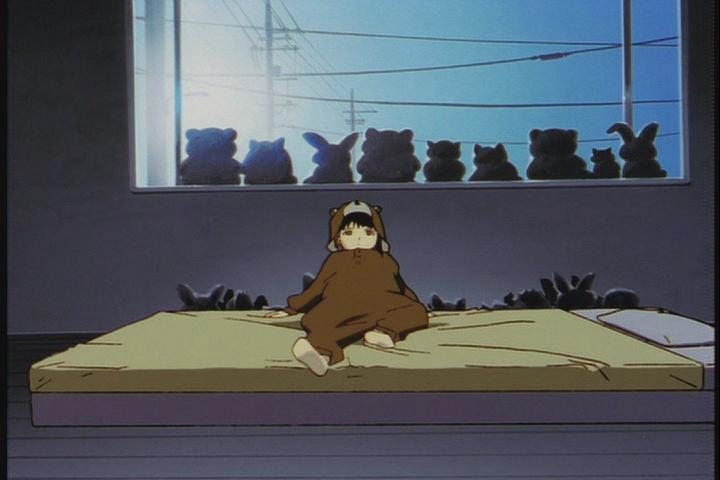
Again, as I've rightly remembered for years, the first few episodes feel like sci-fi horror, the images of humming electrical wires and the sense of desolate streets even in ordinary busy Japanese streets evoking what Kiyoshi Kurosawa would later go with for Pulse (2001). Contrast this with the night time scenes, with heavy neon green lighting, or the increasing influence of the computer technology through the plot, even turning into an almost bio-mechanical entity in Lain's bedroom, the floor wet in coolant, covering the entire room where once she still had plush toys everywhere. The world of the Wired is just as distinct and strange, metaphor and symbolically doing its best to perfectly imaging  an internet chatroom by representing gossiping avatars by being merely lips or eyes, or how in fear of others taking her identity, the same figures have mannequin heads of Lain on their shoulders in a darkened room in cyberspace. In knowledge that in this world, Lain herself practically enters the Wired beyond symbolic meaning, these literal visitations around unique environments are as much there to get to Chiaki J. Konaka's obsession with constantly breaking reality into pieces in most of what he writes, he both notorious and distinct in how the literal and the metaphorical are deliberately blurred in his work even for live action films like Evil Dead Trap 2 (1991); even for a children's show like Princess Tutu (2002) about ballet and fairy tales, when it gets to an inter-dimensional clockwork world where the "author" of the show exists, you can tell which episode Konaka was writing among other script writers when it's the one with the most meta and unconventional philosophy even if the target demographic was kids first.  

From https://i.imgur.com/a6PYSkO.jpg

Sound is also of importance, and not just for the inspired choice of a song by a British band on the opening credits, Bôa given a lasting cult reputation just from anime fans who had their song ] become an earworm, but on the emphasis too on sound design that crawls under the skin. It's completely comparable to Boogiepop Phantom (2000), another highly experimental show fromn this era, between them offering nuisance noise and electronic effects.

[Major Spoiler Warning]

As mentioned, this series is from Konaka, an incredibly divisive screenwriter who leads Lain to becoming difficult at points, early into the series shattering reality when even a giant deity like Lain, to her own surprise, appears up in the clouds for children to stare up to. Later episodes get into even arguments about the existence of God, an entire episode on intermingling real history of the internet and the likes of Project Xanadu with UFO conspiracy and the introduction of "Deus", a figure (Eiri) formerly human who has become a self proclaimed God of the Wired, and one episode (Infornography) whose first half if a compilation of images from previous episodes, all to represent Lain downloading an entire Navi system into her own brain, matched by a guitar riff you could grow a mullet from. Probably the biggest factor, though, which might divide viewers, is when Lain is shown not to merely by an ordinary character, who is brought into these strange events, but is part of a character arch of a unique one-off figure rediscovering her own abilities, a being (possibly through an ESP experiment talked of halfway through) capable of going beyond the Wired to actual God-like abilities. This is controversial as a plot point as, as shown in the worst examples of modern franchise blockbusters in fact, it does limit the connectability of the story from the viewer. I feel however that, especially as the first few episodes feel random, the narrowing of the narrative not only helps the show and but, as it focuses on specific characters, the real virtue of the characterisation appears.

[Spoilers End]

Another thing I forgot, for all its esoteric and eerie shenanigans, was how emotional the show eventually is. Here I admit, for its entire cool atmosphere, and general sense of complete strangeness, actually the real virtue turns out to be the bitter-sweet tale of Lain trying to find happiness. Only close to Alice Mizuki, a school friend, her isolation in the world and how attempt to grow on the Wired (literally) is fraught with further isolation, here a tale which does anchor the entire series with a greater meaning. All the philosophy is weighted ultimately by how as much it connects to her too, evoked when rather than the usual opening before the credits (a male voice over text) she opens the final episode talking directly to us about whether she actually exists or not. All the eccentricities are softened by how utterly emotional the show finally is within the final scenes.

This means Serial Experiments Lain earns its pretensions. Chiaki J. Konaka is notorious for his clear hatred for conventional linear storytelling, but there is so much about the dangers of the physical world against the digital one which have become ever more salient. It also makes sure the characters are of interest around Lain too. Her family, very disconnected, are so for a reason and builds itself to one single scene of emotional resonance; even two men in black, with cybernetic eyeglasses which stalk outside her house, get personalities and enough humanity to why they are there that their fate as everything turns pear shape is significant. That's ultimately, upon returning to this show, why I still love Serial Experiments Lain.

I once, on the first viewing, dismissed it with the same misguidedness I dismissed Boogiepop Phantom, another of these bold and innovative works from under the shadow of Neon Genesis Evangelion. Second time, many years later, it was the surreal and unconventional tone, on the borderline to horror and sci-fi, completely introspective and psychological, which won out. Now, this is in mind still but the drama is all what's left at the end and actually touching in the end. Certainly for me, when you start most series, you should hope for a progression where the final episode is that you'd never expect it to end as from just the first episode, said progression felt throughout natural or at least an escalation in drama, emotional and/or spectracle. Certainly, with Lain this is as good as you could get with this natural progression.

From https://ilarge.lisimg.com/image/754723/
740full-serial-experiments-lain-screenshot.jpg

=====
1) It would be an utter disservice not to mention producer Yasuyuki Ueda, who helped put together this show knowing the risk. He produced Lain, Haibane Renmei (working with Yoshitoshi ABe a lot), and a lot of work between the experimental to more adult, from Texhnolyze (2003) to Hellsing Ultimate (2006), that have been pretty well regarded and even successful.

Wednesday, 27 March 2019

#92: School Days (2007)

From https://pics.filmaffinity.com/sukuru_deizu_
school_days_tv_series-259854327-large.jpg


Director: Keitaro Motonaga
Screenplay: Makoto Uezu
Based on the adult visual novel videogame by 0verflow
Voice Cast: Daisuke Hirakawa as Makoto Ito; Shiho Kawaragi as Sekai Saionji; Tae Okajima as Kotonoha Katsura; Chiaki Takahashi as Nanami Kanroji; Haruka Nagami as Otome Kato; Keiko Imoto as Setsuna Kiyoura; Megu Ashiro as Kokoro Katsura; Ryouko Tanaka as Hikari Kuroda; Yoshiaki Matsumoto as Taisuke Sawanaga
Viewed in Japanese with English Subtitles

Synopsis: In high school, Makoto Ito is encouraged by his female friend Sekai Saionji to start dating Kotonoha Katsura, a timid girl in another class. Sekai however has feelings for him herself, and Makoto is not your usual male anime protagonist when he starts getting bored with courting Kotonoha.

[FULL SPOILERS throughout; whilst a warning will be added to where they are, this is an immediate warning you don't mind knowing the full details of the plot.]

School Days is notorious for a good reason, though appearances for this anime series can be deceptive. Its original based an adult visual novel published in 2005. Visual novels are a popular medium especially in manga and anime culture, interactive novels which are popular in Japan that have multiple narrative paths and endings, and are entirely played by multiple choices (like a choose-your-own adventure book) inter-spliced with animation or visuals. "Adult" as, a sub genre in visual novels known as "eroge" (erotic games), the original work was pornographic with explicit sex scenes (barring Japanese censorship laws). The series was in lieu of a multimedia bonanza after the original work did very well.

The surprising thing with School Days the animated adaptation is that, with alarm bells ringing due to the series' erotic origins and its initial tone in the first three episodes, it changes into a dark chimera eventually of interest. Makoto Uezu is a prominent screenwriter, and to my absolute surprise, director Keitaro Motonaga also helmed Malice@Doll (2000), a work that I hold in high regard, though with the caveat that it's an odd creation as an early computer animated body horror sci-fi work which is truly peculiar; I viewed that one screenwriter (and premise creator) Chiaki J. Konaka's work more, but it was nice to see Motonaga again, though barring co-directing the Rayearth OVAs with Toshiki Hirano in 1997, he's not got a lot in his career that stands out and a bit of porn up until helming the recent Digimon Adventure tri. films, which create a large single work out of six films between 2015-2018, which is definitely a BIG deal for him alongside working in the background on a load of other prominent work.

The premise itself could've easily descended in something bad on just the synopsis though, just a de-eroticised melodrama if you never heard of the game. School Days, with its conventional (stereotypical) TV look of bright colours and conventional characters designs are matched by a stereotypically bland male protagonist and many close-ups of female characters' figures, for more lurid and questionable in terms of a problematic male gaze and weirder because these are characters still in school.

Kotonoha, the girl he is initially pushed into dating by his tomboy female friend Sekai, is depicted as a voluptuous big eyed girl who is quiet and shy around men, all whilst Sekai herself spends her time arguing with him through exchanged notes in class. So for, it's a stereotype of anime plotting that also is part of the "harem" sub-genre. Harem, originally a term from ancient Muslim culture of a separate part of a household for wives, concubines, and female servants, as well as eventually turning into a completely sexual term for a group of women with one male lover, is its own anime/manga sub-genre which usually denotes one male surrounded by multiple female suitors; there is the "reverse harem", one woman and multiple male suitors, and LGBT variations, but harem stories that are the most famous (and divisive) include the Love Hina franchise where its one male, and many potential female suitors. Whatever one's opinion on the subject - whether polygamy (or polyandry) are morally acceptable or even practical, whether harem stories can be great or fall (especially with those with multiple female suitors) into crass or just badly written stories - School Days thankfully changes its tune soon into itself when the tale it sets up immediately goes sour.

[MAJOR Spoiler Warnings here]

And by sour, as in our male protagonist, eventually turning out to be a chronic womanizer with an ease in cheating on multiple girls, is murdered by one character, whilst another is disembowel. The diagram for the beginning to the ending, from the initial romance with light comedy at the beginning to where his head is severed and kept as a possession for a heartbroken suitor, is as jarring a tonal shift without a lot of context to how this happened.

[MAJOR Spoilers End]

Notoriously, and where the fascinating reward in School Days is found, even if it feels like being in a meat grinder for all twelve of its episodes, the original visual novel when it came to the "bad endings" got violent. Visual novels, due to their nature, have "good endings" and "bad endings" like some videogames, where the choices made in options will dictate where the story will progress.  So an inspired decision was clearly made to make a show based on the worst type of ending whilst, on purpose or with unintentionally greater weight, to turn this property into an anti-harem story.

From https://canime.files.wordpress.com/2010/01/school-days702.jpg

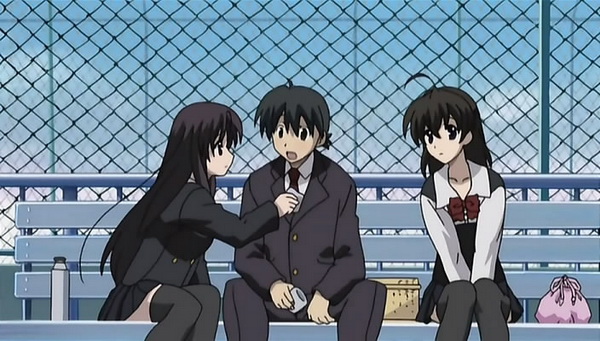
Mainly because it shows the worst in its cast, as our male lead Makoto, as mentioned, is a womanzier, his friend Sekai, despite pushing him to another girl, has a crush on him, and the school (especially the girls) is full of bullies and individuals who think by their hormones or are cruel. The only innocent characters are Kotonoha, the initial romantic interest, and arguably a female character named Otome, who likes Makoto and has sex with him even when he's dating others, but is fleshed out as being more complicated in this dicey predicament, as is Setsuna, Sekai's own diminutive female friend also revealed to have a crush on him, and does some problematic things, but has the issue that about to leave for France, as a plot thread reveals, she's concerned for her friend Sekai's well being when she is no longer there. No one else, however, is above whale manure in some of the things they do; even Sekai, whilst the conflicted main female character with Kotonoha, is willingly dragged into a romance that is a disaster from the get-go.  Even Makoto's horn dog but wholesome male friend Taisuke eventually does something in a later episode which is horrifying.

The worst thing, and why for how ridiculous and way too cruel the story goes School Days actually succeeds, is that it's not morally black and white, but with everyone including Makoto himself being confused hormone driven teenagers. It's definitely gotten a reaction for viewers who expected clichés; the comments section of Crunchyroll added to my viewing experience, a curious tale in itself of viewers wanting to kill Makoto, slap everyone else and vile anguish whilst those in the know, who say the series already, teased the horrifying climax of it all. I myself was aware of the ending, that Makoto would eventually be shown as a womanzier, and that the comeuppance was a nasty one, but not only did I not know the full extent of said ending, but my knowledge didn't ruin the show but arguably improved it. Especially as it soothed over the awkward first three episodes, knowing where it went brought a sense of tragic finality to the proceedings. It added to the idea that a character like Makoto is not explicitly evil, even when near the end of the series has a foursome with three female classmates when he's already sleeping around and betraying multiple girlfriends, but something worse in his banality. Far more disturbing, even if exaggerated, is that he's just an apathetic and dumb young man who thinks with his smaller head, and has little wisdom of emotions, more honest as a moral ground for the series to take as a result even if it's more agonising for a viewer to experience.

And whilst their all stereotypes, that helps because of this attitude; Sekai, complicating things as she still helps him to date Kotonoha, has a strange relationship including practice foreplay sessions which are just as problematic as they should be to a viewer, naturally leading to complications. Setsuna, Sekai's friend, has a crush on Makoto too, as does Otome, all whilst their female peers can be vindictive and backstabbing, all feeling less like sexist depictions but like many teenagers misguided behaviour. It's an attempt at least at complexity in spite of itself, even a character like Kotonoha in that her hesitance in a physical relationship, pushing Makoto away, is due to having been teased for her figure at a young age alongside a sense, taking up knitting and devoted to her younger sister, that the character's meant for a viewer's perspective to have been a meek figure, the shy girl you cheer when she does muster a bravery to be bolder in her romance only for Makoto to be an oblivious cheater who dithers. Add to this that her female peers in her class bully her, a mean streak made worse when they will even film other female students secretly in a "break room" at the school festival to humiliate them publically, and Kotonoha's turn in the end to madness, glazed look looking at her phone on the street, is the real tragedy of it all.

The effect of this tragedy, the ending itself, gained School Days its notoriety as, tragically, it had the poor timing for the final episode to be about to be aired just when a real life murder took place. On September 18th 2007, a sixteen year old murdered her father, a 45-year-old police sergeant in the traffic division at Minami Police Station in Kyoto Prefecture, with an axe. Another series, part of the Higurashi: When They Cry franchise, was also affected by this in terms of its screening on television, but how TV Kanagawa dealt with School Days transferred from a legitimate tragedy, in terms of any murder ever taking place and the gristly nature of this particular one, to an accidental internet meme. Instead of the episode, they showed half an hour of scenery, including a lake with a Norwegian ferry on it, showed with Air on a G String playing over the images. "Nice Boat", as the meme came to be, came from a 4chan user commenting on the replacement material, and it became popular in Japan; whilst the creators of the game 0verflow arranged two screenings of the edited finale at the Akihabara 3D Theater on September 27, the meme even found its way into the Melancholy of Suzumiya Haruhi-chan, a straight-to-net spin-off of The Melancholy of Haruhi Suzumiya franchise, when the Kadokawa Pictures's YouTube channel uploaded a short montage of sailboats instead of the previously scheduled premiere of that ONA.

Even without this real life censorship which overrode its infamy, even the edited version doesn't detract the results; built up to over painful eleven episodes of miscommunication, cheating and broken emotions, the ending no matter how over-the-top it ends up, actually ending up on a sailboat in some perverse irony in the final shot, does have a weight to it from the tragic circumstances that lead to it. In fact, the idea that it's both an antidote to the problematic show trope of the harem anime as well as another example proves an advantage. The look of the show helps with this, the stereotypical character designs with big eyes emphasising the darker moments in vast contrast, and the leering fan service thankfully gives way to frankness about sex even in the dialogue. The series does, to lighten the tone and offer levity between the cesspool, have humour, reaching its crescendo (before departing) at the school festival, where the mascots of the classes jostle for crowds; once it goes, so does the series manage to get even darker than before when the gloves come off completely.

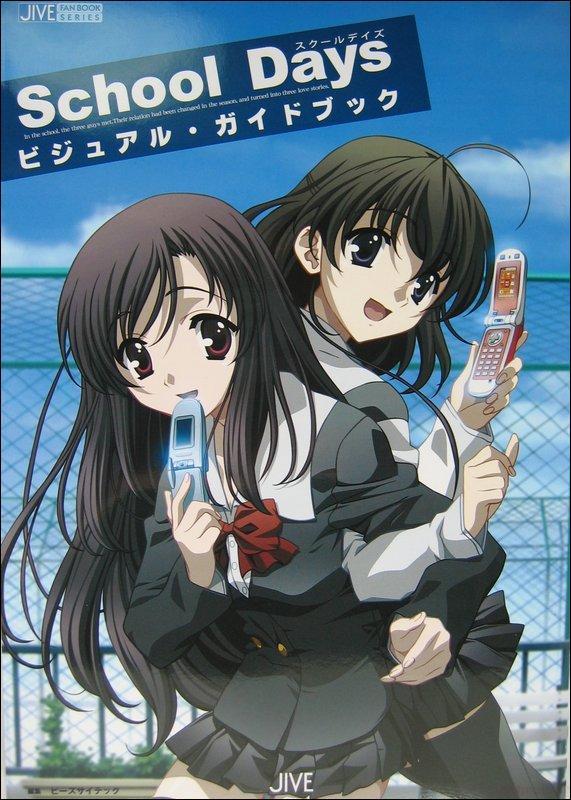
In fact, the entire aesthetic is perfect - "School Days" a perfect title that sounds innocuous, but develops a weight when it's the last episode title. The light pop songs used, even the fact the end credits are centred on a mobile phone, an object which plays such an important part in the drama as a catalyst for drama (such as blocking someone off one or secretly conversing to others with) is absolutely appropriate. The result, aware of how it bruised and batted me around through the twelve episodes, was unique, like a necessary poison and incredible idiosyncratic in lieu of what was purposeful or accidental creativity. So much so that it's accidental notoriety, whilst important for the series to be known in the West, only released in the West by Discotek for US DVD release in 2014, seems like the least interest detail.


From http://behind-the.nihonreview.com/wordpress
/wp-content/uploads/2007/09/kiyoura3_th.jpg

Saturday, 6 October 2018

#73: Boogiepop Phantom (2000)

From https://www.animeprintz.com/image/cache/b/
boogiepop-phantom-106211-8271-wd-800x500.jpg


Director: Takashi Watanabe
Screenplay: Sadayuki Murai
Based on the light novel series by Kouhei Kadono
Voice Cast: Mayumi Asano  as Boogiepop, Kyo Nagasawa as Kazuko Suema, Sanae Kobayashi as Manaka Kisaragi, Jun Fukuyama as Manticore Phantom, Rakuto Tochihara as Poom Poom, Kaori Shimizu as Touka Miyashita
Viewed in Japanese with English Subtitles
A Cinema of the Abstract Crossover

Into October, and Halloween, there should be some anime horror covered and this is a series that has taken me a long while to return to. Boogiepop Phantom was a series I viewed very early into my interest in the medium, and didn't understand in the slightest, one of the more challenging and innovated anime television shows in terms of structure.

My opinion now as an adult? Follow the link HERE and find out.


From https://img.fireden.net/a/image/1518/73/1518737297545.png

Tuesday, 27 June 2017

#44: Ichi the Killer: Episode Zero (2002)

From https://myanimelist.cdn-dena.com/
images/anime/11/34131l.jpg

Director: Shinji Ishihira
Screenplay: Sakichi Sato
Based on the manga Ichi the Killer (1998-2001) by Hideo Yamamoto
Voice Cast: Chihiro Suzuki (as Ichi); Sayaka Ohara (as Midori); Shinpachi Tsuji (as Jijii); Takashi Miike (as Kakihara); Atsushi Imaruoka (as Nobuo); Daisuke Sakaguchi (as Hirose); Ema Kogure (as Jiro); Eri Saito (as Mother)

Synopsis: A prequel to the Ichi the Killer narrative, following the origins of the titular figure, a sadistic assassin who cries as he kills and yet paradoxically enjoys inflicting pain on others in an extreme fashion. This short animation shows both how as a high school student constant bullying and a series of events placed him in prison for murder, and how after he's released a mysterious benefactor turn him into the cry-baby sociopath of the Ichi the Killer story.

Ichi the Killer: Episode Zero is a fascinating extra for Takashi Miike's infamous 2001 adaptation of the Hideo Yamamoto manga. However the word "extra" is apt. It even feels at odds with the film its meant to be an addition of in spite of the presence of the same screenwriter Sakichi Sato between them. Miike's film is a much more complex, subversive creation, which shows horrifying and taboo material only to twist a knife into the viewer's stomach for viewing it. Episode Zero instead of this feels like one of the final throwbacks to the idea of anime, especially in the West in the nineties, being adult and transgressive. Violent and adult anime is still being made, but particularly with the straight-to-video market (OVA) there was a lot of this nasty (and sometimes utterly cheap) anime in the late eighties and nineties before it ebbed out with this being one of the last gasps.

And Episode Zero is grotty, explicitly depicting material. That Ichi's parents, through consensual S&M sex the room next to their oldest son, are part of the cause of the confusion he has between sex and violence. How it depicts Ichi beginning to torture and kill small animals in school to relieve his inferiority from bullying, including the school rabbit which leads to him being blackmailed by another student. Clichés mixing with pertinent topics on Japanese culture, especially the issue of bullying and the stress school students and teenagers go through which appears in a lot of Japanese films, but without enough time forty minutes (six or so for end credits) to fully work. It's also an entire rewrite of the far more interesting back story for the Ichi character that you get in the live action film, a far more vague figure whose only past detail, about a trauma at high school, is fake and his handler (played by director Shinya Tsukamoto) being a much more interesting figure than the version found in the animated version. The cameo by the character Kakihara, voiced by Takashi Miike in what counts as merely grunts and a few words, isn't that interesting either when you have Tadanobu Asano as a fully fleshed out character in the feature film.

From https://assets.mubi.com/images/film/58024/image-w856.jpg?1445938925

The tone for Episode Zero, whilst with potential to be a deliberately provocative story like the live action film, does merely become scuzzy to the point I actually felt guilt viewing this, questioning having actually sat through the film. It's brazen in what it explicitly details but can come off as pointlessly offensive, particularly when you get to female martial artist, Midori, who takes an interest in Ichi only to be shown to be turned on by violence and eggs him on in a motel room to beat her up to erotic climax, barely stumbling on top of a knife's edge in terms of avoiding being crass and dubious. It's strange considering that the screenwriter was able to take similarly problematic ideas in the live action version and make such subjects more nuisance and provocative, the same found in a later Miike work Gozu (2003). As much the issue, alongside the tiny length, comes from the production itself feeling low budget, cheap and nasty in a way that's befitting the early processors but from a weird transition period of the early first few years of the 2000s, where the switch from hand drawn to computer assisted animation was awkward.

Even when placed next to another problematic anime from the yesteryear like Violence Jack (1986-1990), as notoriously cheap as some of them were gruesome, Episode Zero is dank in appearance even to those controversial works in character design and style. The exception is the music by Yui Takase which is the one thing of legitimate positive to take away from Episode Zero, memorable and helping to bandage up the glaring issues a little, an unnerving and edgy soundtrack to match the nastiness onscreen, including a peculiar hip hop song on the end credits where the rapped lyrics are heard under dialogue clips from the anime in a ramshackle way. (Sadly his only other credit on Anime News Network is Samurai XXX (2004), samurai themed hentai porn). Value to Episode Zero will vary drastically; for myself, it's curiosity, but as someone who'll defend the Miike film as an intelligent, transgressive cult movie, this pales in complete comparison and doesn't look good next to it. 

From https://2.bp.blogspot.com/-3aBMwrwEfy8/WSF-OhEG2aI/AAAAAAAAxww/7
J50YyZGY1Ajht_KUXkpf1jpYdM-rRdHQCLcB/s1600/cheiradora%2Bde%2Bpo%2Btentando%
2Bcheirar%2Bo%2Bbraco%2Bdo%2Bcara.png