Showing posts with label ONA. Show all posts

Wednesday, 23 June 2021

#190: Cat Shit One (2010)


Director: Kazuya Sasahara

Screenplay: Kazuya Sasahara and Hiroshi Sekisakai

Based on the manga by Motofumi Kobayashi

Voice Cast: Hiroshi Tsuchida as Packy; Satoshi Hino as Botasky; Masashi Nitta as Bowen; Sawaki Akimoto as CP; Kenta Sakai as Militia; Yuki Hirako as Militia

Viewed on Japanese with English Subtitles


Subtitled "The Animated Series", this original net animation was meant to go on to have a full season of storytelling based on the Motofumi Kobayashi manga of the same name1, more politely titled in the West Apocalypse Meow by ADV Vision's manga arm, ADV Manga, for release for the United States and United Kingdom. That was not a pointless change either, as the original manga was set during the Vietnam War and progressed on into the eighties for a later follow-up. Here, you have a story set within the Middle East during a conflict you could easily pluck from real life politics, be it the first or the second Gulf War. The weird thing is that, entirely grounded as a war narrative, these tales are told through anthropomorphic animals, the lead Packy both a sergeant in the manga but also a bunny rabbit.

Only a regular anime episode length, Cat Shit One is deceptively a strange title to witness, as in another context, it acts and feels like it could have been a live action American actor film, say Lone Soldier (2013) by Peter Berg with Mark Wahlberg for one I saw in the cinema in the past, only you have cast the leads with rabbits. Very un-politically correct, this has Arab Taliban cast with anthropomorphic camels, and they are explicitly Taliban in their costumes, and that with their dialogue not in Japanese or subtitles I swear to have least heard Allah a couple of times. The episode follows two members of Cat Shit One, set within this more modern day scenario in a ruined town in the middle of the desert, after two hostages ("canaries") captured by the Taliban. There is Packy, the cooler and more collected veteran and Botasky, the more nervous sniper who is criticised for having too many gizmos on his rifle, which make it heavier to carry, until it proves useful against blocking blades. They have no backup until they can get the hostages to safety and have to go into the enemy territory by themselves.

One thing clear with the episode as well is that this is a "military otaku" show in form, in that Cat Shit One was made to be a realistic war narrative and that, in the variety of nerd culture in Japan, otaku for military aesthetic and hardware exist to, in knowledge and obsession, so that I would not be surprised if the firearms and military vehicles you witness in this short action piece were accurate. This is all in mind you are watching, in three dimensional animation, cute rabbits in military fatigues with guns shooting at camels stood on hind legs with their costumes cut out in the back for their humps and with hands, with is surreal to witness.

Using the unnatural as metaphor is interesting as a concept. Retelling a narrative with anthropomorphic animals adds surreality but also a lot of great potential, including the metaphors between human and animal which it could offer. Art Spiegelman took a huge risk with Maus (1980-1991), his graphic novel telling his father's experience as a Jew during the Holocaust, by having the Jews depicted as mice and the Nazis as cats among choices, something we could forget when Maus proved a masterpiece of the medium, and that we do not consider the artistic choice a risk anymore that could have been tasteless and gauche. In a less serious contact, the choice of rabbits for American G.I.s is actually a pun, as the Japanese for rabbit is "usagi", a.k.a. USA G.I. being literalised. Cat Shit One might have skirted risks by having the Vietnamese as cats, but reading up on it they went as far as depict every country with the source material by various animals, including the Japanese themselves as monkeys and other choices which deliberately evoke stereotypes whether a wise decision or not. In Cat Shit One '80, the follow up which dealt with U.S. operations in Afghanistan against the Soviet Unions, the Middle Eastern characters are depicted not just with camels but cows and sheep, which could be considered offensive still but is in the same boat as the French in the manga being depicted as pigs, the British as rats or Russia as bears. The ONA is strange in that, looking closer to the first or second Gulf War in form, it does deviate from the sources considerably as the original cast, in the source, would be significantly older veterans by the early nineties or old rabbits by the 2000s.

Due to the little here, it is difficult anyway to speculate where this show would go as a pilot for a programme that never became. It feels like an action reel, even if a narrative is here, an eye catching attempt to win over potential investors as this was originally released on YouTube. It is fascinating as an oddity, especially as in terms of an ONA which uses 3D computer animation, I have seen considerably worse and this case being much more ambitious in look. It even involved motion capture actors, which adds a considerably weirder edge knowing an actor performing the motions of a military soldier would eventually be animated as a big fluffy bunny with big eyes, still moving with the worth of a soldier, and getting head shots on Taliban members. Thinking about this, an actor in a form that for many in another context is cuddly which is waddling along the Middle Eastern desert being shot at, is perversely funny the longer I think about it.

The source material fascinates reading more of it for this review's context, because whilst the use of stereotypes in casting nationalities per species may have been questionable, it does feel like Motofumi Kobayashi's source text is much more serious at least in that it has the cast interact with real figures of the wars being dealt with, in animalised form, and that it does not sanitise the conflicts at all even if it had action scenes like a Western military action comic book. The author Kobayashi is absolutely someone who deals with the subject of war, whether biographical or alternative history, with a complete fascination likely matched by extensive amounts of research, between this alongside the likes of tackling Operation Barbarossa (the Nazi invasion of Soviet Russia in 1941) in a 2001 manga or another title called Vietnam War (1999), a non- anthropomorphic telling of the story of that war.

Cat Shit One the animated product is curious. Director and co-writer Kazuya Sasahara helmed one other work after this, and honestly, I could not see Cat Shit One the show going on well even if it had gotten the series the project had intended to have. For starters, it may have eventually proved problematic tackling the Gulf War as it did, or in how, that would eventually make the show difficult to sell. Even fans of the source material may have had issues, as this adapts neither the source material nor the sequel, which took on earlier military history that eventually led to the likes of the Taliban in the Middle East. Whilst the source may have had action for the sake of action, the references to the likes of how the Gulf Wars have been depicted in Hollywood films I have seen is as much something this pilot was aiming to replicate, including short implements of slow motion for visceral effect, which honestly including the tone, mostly deathly serious, might have not sold well. I also see, whether a viewer's individual opinion of the animation, that unless you had a film or a huge budgeted show, you could not keep up the quality and use of motion capture acting to a steady form unless you were lucky or with skill in management, as television schedules would cause a show like this to possibly look dreadful or cheap as it chugged along.

As a one-off, it is in many ways the type of spectacle being pulled off that would appeal to others but I find dull, and honestly not the kind of thing normally found in anime. With the prolific voice actor Hiroshi Tsuchida in the lead, very much playing his character Packy as a tough veteran who can with one other person take on an entire group of Taliban by himself least for a while, it is well executed but paradoxically the kind of title that, were it not depicted with rabbits, feels university in appeal as a war action story, but does not stick out. Time has made this an obscurity for a television series that never came to be, too short and probably obscure despite that ADV Manga's release. Again, it is a subtly bizarre production just for one creative choice that makes it weird. And knowing this was not the first for this - Penguin’s Memory: A Tale of Happiness (1985), a very serious Vietnam War tale only with anthropomorphic penguins, as a feature length anime based on mascots for Suntory, a major alcoholic beer producer in Japan known for being involved with a lot of art to promote their work - just makes this an even weirder thing to consider.

=====

1) Twelve to be precise as is detailed HERE.

Thursday, 31 December 2020

#174: Wonder Momo (2014)


Director: Yutaka Kagawa

Screenplay: Ayumi Inabe

Based on the arcade game by Namco

Voice Cast: Yuka Fujiwara as Momoko; Atsushi Imaruoka as Glooder; Atsushi Tamaru as Natsuhiko; Misaki Komatsu as Akiho/Amazona; Anju Inami as Yumi; Halko Momoi as Momo/Original Wonder Momo

Viewed in Japanese with English Subtitles


But secretly eradicating aliens after school and not telling me?

This is an example of an extremely short anime, one whose back story is probably more significant than the anime itself. Wonder Momo is based on a Namco arcade from 1987 - a parody of the legendary Ultraman franchise, with a female lead, which involved playing an actress who played the heroine in a live stage show. It does predate the type of risqué stuff you would find in anime about female heroines, as it had a bit of fan service in pixel form; interestingly, whilst it suggests as much in the character designs and costumes, this anime adaptation is surprisingly restrained and not the title it suggests on the packaging. Instead, and more interesting, is that it was part of a project by ShiftyLook, a subsidiary of Bandai Namco Holdings that was focused on revitalizing older Namco franchises, starting with web comics for the likes of this, Klonoa, even a less obscurer title like Katamari Damacy among others. Wonder Mono's web comic began in 2012 with Wonder Momo: Battle Idol by Jim Zub, Erik Ko, and Omar Dogan, also one of the ones before the company's eventual closing to get a hardback published release.

From there, we got an online net animation for Wonder Momo1, which does have the immediate issue to deal with that, over five episodes long, each episode is only seven minutes long including opening and end credits, making the entire thing less than thirty minutes long. The premise is pretty obvious - a high school girl Momoko wishes to become an idol singer, but is approached by a weird green man who shots a super powered orb into her body in a subway. Thankfully, this is not for any nefarious reason, as he is one of the two aliens concerned to protect the Earth from another alien race. This abrupt intervention on Momoko's life allows her to be able to turn into a super heroine when the Putty Patrol, genderless goons in skin-tight black body costumes with red masks, terrorise the high school basketball players soon afterwards.

There is the inevitable problem of trying to review this when this is as short as it is. Even in mind to some of the bizarre short works I have seen you can cover a lot within, around this length, Wonder Momo at this length includes all the same opening and end credits footage you excise, followed by a lot of conventional plot moments you would expect in a longer version of this premise of a high school super-heroine. Suffice to say, if a long form title over thirteen episodes had existed, this would have been a goofy parody, where the super weapon is an energised hula hoop ("Wonder Hoop") and the monsters, in mind to this premise's clear debt to tokusatsu storytelling, look like weird creature costumes or toys. There is a potential love interest Natsuhiko, a student news photographer at her school who catches her first transformation and becomes a close confidant, and Akiho, a popular idol figure who is also Amazona, a loner super heroine who thinks Momoko butts in and is inept, the rival figure who together would inevitably have to team up to fight the big evil of the narrative at the ending.


Then there is the one character where Wonder Momo, if it had been a longer work, could have been inspired. Suddenly, in the midst of watching this, I had a thought about the magical girl genre, which this is also effectively a part of, a genre in which teen girls are able to become heroines like Sailor Moon. Sometimes the mind wanders and likes to imagine plot lines that would intrigue me, like whether an show or manga even as a joke imagined when any magical girl reached their thirties or even older, only for this anime the suddenly tease me with something brilliant in that similar idea. Actually revealed to be a sequel to the video game, it clearly read my mind when Momoko's mother Momo appears. Representing the original Wonder Momo from the video game, she could have been a central character to a premise herself, and in another longer title would have immediately delighted many anime fans if they have executed the character perfectly. An entire series of a mother who was once, or still is, a magical (woman) girl with her daughter now following her footsteps is a funny or even memorable premise in itself, barely covered here beyond getting her daughter and Akiho to stop arguing, and getting Momoko to do sit-ups at night to improve her cardio.

But, this is a short little titbit. In terms of its reputation, Wonder Momo was not held in high regard, but low expectations for me coming into viewing this title. I was surprised that this was not as bad as its reputation suggests. I feel as well Wonder Momo is excessively short to ever be able to shoot its own feet off with terrible creative decisions unless it did something insane bad, and that whilst we are on this decision, Namco with ShiftyLook could have done worse with a project. My mind went to Arcade Gamer Fubuki (2002-3), an OVA adaptation to a Mine Yoshizaki manga where Sega were perfectly happy to have their licensed titles shown in the three episodes. Some of it was actually funny, usually involving the figure of Mr. Mystery, a masked hero whose bravado is countered by moments like actually feeling the pain of jumping through a plate glass window. But it was also a show fixated on very young teen girls' panties among content which would make you embarrassed to be an anime fan, which makes Wonder Momo positively Shakespeare in comparison.

Wonder Momo's shortness is confounded by the fact it does not even have an ending. Even the recorded press conference for the series, included on the Crunchyroll streaming site alongside the five episodes, was over forty plus minutes long, double the length of the project itself. Even in terms of animation, I will argue there has been worse. Premise wise, it may have likely spun its wheels if longer but could have worked. Some of the humour means it would have been funny (even the Putty Patrol, actually called the Waru Soldiers, need to use pay phones to get backup). It could have likely indulged in a lot more fan service then it did, though it likely may have been tamer than most even when one of the gags was one of the good aliens finding a bikini photo of Akiho. (Dodging around one villain being a creepy octopus headed monster, a dime-a-dozen in anime, shows the series would have not likely have gone in that direction too far least to defeat the point of this reboot). Mom being an older Wonder Momo, with even her own retro attacks, is a funny idea especially as she is never mocked as being older, just as good if not the strongest of the three female leads who just has a cheery demeanour, with the unexpected thing (as no one probably thought about it) being her also being a single mother to Momoko. Even the show, for its modest animation and fights taking place under very cheap CGI purple haze, having the touch of on-screen sound effect text for attacks, even ones for "Victory" after battles, would have been fun to see if this had embraced its goofball antics and videogame origins.

That there is no ending or length means it is more a test run, and ShiftyLook themselves would be closed down by Namco only two years after its founding in March 2014, only a month after this show premiered in February of the same year. That proves a much more tragic and perverse ending for the series, than if we actually got to see the heroes, after entering an impromptu space portal, into the villains' headquarters, but it is memorable. Thus, we end this review with looking at a weird anomaly which blipped into existence and left; certainly, reading up on all this detail, this show has become a lot more fascinating just reading up this detail from when I was expecting this to be comically short as a piece.


======

1) A piece of a news announcement, which elaborates on the back story of this multi-media reboot, can be found HERE.

2) As disclosed HERE.

Friday, 19 June 2020

#148: Calamity of a Zombie Girl (2018)


Director: Hideaki Iwami

Screenplay: Kenichi Kanemaki

Based on a Light Novel written by Ryō Ikehata and illustrated by Hagane Tsurugi

Voice Cast: Saori Hayami as Euphrosyne Studion; Yui Ogura as Alma V; M.A.O as Yui Minagawa; Miyuki Sawashiro as Sayaka Kamoshida; Mugihito as Miyake; Ryoko Shiraishi as Mako Takanashi; Takahiro Miwa as Hiroshi Azuma; Tatsuhisa Suzuki as Masahiro Abe; Tomokazu Sugita as Shūichiro Takanashi; Yurika Kubo as Noriko Sudo

Viewed in Japanese Subtitles


Your text book kung fu won't work!

[WARNING - Some major plot spoilers are to be had in this review.]

Calamity of a Zombie Girl is an odd creature. Undoubtedly, this ONA (original net anime) feature length tale is one of the few modern titles to edge close to the old school era of adult, lurid OVA titles of the yesteryears, back when it was for videotape. Titles with that old school attitude, usually the gore, are rare nowadays. Most OVAs focus on extra story or selling nudity of the female cast, whilst even a throwback like The Island of Giant Insects (2020) does this (and in a version on Crunchyroll which warns of adult content) even censors the gore. It has been a while since I have seen a newer title which even renders spilt brains and detached eyeballs. Call it prurient, but it has a distinction for the tone and immediately stands out.

It is not quite a work like Genocyber (1994), because this light novel adaptation, which has surprisingly gained a UK blu-ray release in 2020, does feel of two sides. It is split between those old weird and lurid one-off genre titles Manga Entertainment used to release, who have now become more mainstream and safer for the most part in their releases whilst this is the release of Anime Limited, and a skewered tone that is partially because the tastes of the target audiences have changed over the decades. It is also because this is its own trashy and perplexing curiosity most have dismissed.

It is also a GONZO production. Co-made with studio Stingray, it is oddly befitting that this company that once dominated anime in the 2000s when they began, only to fade when finances eventually dealt a fatal blow, returns to the ONA format, something they did early in their first years with obscurities like Zaion: I Wish You Were Here (2001). Seeing Kadokawa in the credits, the Japanese publishing company to which the light novel was a release of their Kadokawa Sneaker Bunko imprint, also raised a smile as they have had an interesting relationship with anime over the years, specifically when Haruki Kadokawa, son of its founder Genyoshi Kadokawa, inherited the presidency of the company and stepped out into the film anime industries. In the eighties, his name as an executive producer can be found on titles like Rintaro's Harmagedon (1983), a figure of the era where he had so much money that he could have a full-size replica of Christopher Columbus' flagship Santa Maria built, sailed from Barcelona to Japan, in his free time before his unfortunate 1994 conviction for drug smuggling. Seeing the company here felt appropriate, considering that this is evokes old anime titles from the time despite being very much of its own period.

The premise begins with an old but necessary cliché. A group of young adults, part of an occult club, break into the secret room in a university library to steal a valuable object; said object, which one of the female members secretly pockets, is a gem from inside a female corpse, one of two preserved in a mummified state in caskets held in the room. Obviously, this is always a bad idea, and whilst it confuses what these two figures are (Mummies? Zombies? Revenants?), it does play to the idea that tampering with the past for greed is always of a dangerous game. It was also a stupid idea as, upon waking up this figure Euphrosyne Studion, with her maid/friend Alma V, she is revealed to be an immortal homunculus from the past. From the "Holy Roman Empire" explicitly in dialogue, meaning she comes from a multi-ethnic complex of territories in Western and Central Europe that originated during the Early Middle Ages and dissolved during the Napoleonic Wars in 1806, she is in flashback shown to be the daughter of a baron who, when she died, was brought back by supernatural black arts and continued on with each Baron who succeeded her father. With what residue energy from the gem left inside her, she and Alma want it back, and she is superhumanly strong and thus able to acquire the object keeping her immortal back even if it means things will get bloody.

We however are in a surprising position though that Euphrosyne and Alma are clearly meant to be sympathetic as we follow them the most. Whilst their European origin does undercut the point, it feels befitting that, rather than follow the old and problematic chestnut of the foreign and exotic form attacking the status quo, the individuals who are behind the theft have instead made a terrible mistake, and are not as innocent for many of them as you would presume from the initial prologue. Consider that this plot point of the ancient form, which could have been found in an old thirties or forties American b-picture, has inherent issues of this sinister exoticism, it is befitting this Japanese production decided to show some love to that exotic figure just in her costume design over everyone else. Euphrosyne is also a goof as, constantly, there is a lot of comedy which undercuts the presumed nature of this film, such as her research into Japanese culture when she just wakes up involving a gag of Alma noticing she was on a gaming website. However, there is also a curious tonal and emotional position with these two too...considering that, by this point upon waking up, they will have already killed a harmless janitor. Accidentally from Euphrosyne because of her superhuman strength, but Alma deliberately knowing this would happen, as his cranium gone flying into a pillar in the library Euphrosyne is doing research in when she swats him away.  

This film also has death by toilet mind, which is abrupt when it suddenly flied into shot and crushed a man's head, clearly humorous in a ghoulish way. The context of the film changes constantly as it goes along as, unlike the ultra serious OVAs in the past like Violence Jack (1986-1990), this has a lot of comedy throughout it which tonally is a 180 degree turn from the more serious moments. Euphrosyne in particular can be a klutz and even has to superglue her head back on at one point, all whilst Alma has that awkward moment when, knocking on a possible victim's door, she is caught off guard, has to apologise in a shirt sizes too long for her, with the sleeves hanging down, and leave to try again later embarrassed. Considering Euphrosyne was the Greek goddess of Good Cheer, mirth and joy, it is befitting (if strange) the monster is voiced and acted as a light hearted, sweet figure who yet happens to be able to swing a grown human being around by a mere leg and bash their brains in if provoked.

Yet Calamity of a Zombie Girl can be serious and lurid. There is nudity, some very explicit and detailed violence and, in one scene that viewers would understandably find uncomfortable, we see how evil the real villains are, a scientist and his maleficent young sister, as their experiment to turn her pet dog into a zombie involves first strapping it to its distress on a medical table and bashing its brains in with a cartoonish giant mallet, the closest to those older anime nasties of yore which had scenes like this in them for shock value. Even Alma, as she and Euphrosyne are not precisely defined to what type of undead they re, eats corpses, even able to bite a piece off someone alive or dead to be able to turn into them for a temporary time period. Even the nudity story wise is connected to Alma's ability to shape shift and that clothes naturally do not change sizes, diguising as these figures so she can help her friend.


Is this meant to be sickly funny? Well, aspects are serious, such as one character's death being humiliating and a betrayal by those they thought were with them. We also however witness someone have his arm ripped off clean in one distressed reaction to him perving on Euphrosyne, yet run away and go crying for help despite the fact even in terms of adrenaline he should be in shock and suffering from extreme blood lost, barely reacting to an appendage being missing. That the Occult Club is more complex in who they are then initially expected adds complication. Students still at the dorms where this story transpires, in the middle of Summer, they have made the ill advised mistake to rob the secret room in their library but they are not necessarily evil. One is proven an arrogant coward, one succumbing to lusts, and one woman in the group tragically is being toyed with. It is early on established they are all being used - as the door one is meant to unlocked is done so from a control panel by the real villains - but as the stereotypical leads usually found in an anime, they are the normal mortals who have accidentally crossed into a world that they will be maimed and killed within.

Call it nihilistic, but with the actual heroines in a realm of the supernatural different to our world, this is a common trope in Japanese anime horror, of the world in its own rules, that befits a country where spirituality and the mythological is still relevant to their culture. Instead, it is sad that the home schooled kung fu girl, who is likeable, makes the mistake to goad a figure to protect friends, only for that to be her undoing, whilst another female character, the innocent of the bunch, is to be left traumatised by her encounter with emissaries of the dark for all her life.

So yes, this is a weird experience if you dissect the film, particular as this film cuts from a church, lingering on those who have died within one scene in a sobering moment, to abruptly being at an indoor basketball court where basketballs are being thrown hard enough to dent walls and Euphrosyne getting her head stuck in a basketball net. Bear in mind, dear reader, I have an undeniable obsession and taste for anime horror even when it is trashy, and unlike The Island of Giant Insects, which was tedious and felt like you needed a bath afterwards, this is lurid but far more interesting than a lot of reviews suggest of it. Animation wise, it is adequate. There is a curious nature to the character designs where everyone has a big saucer eye; that sounds ridiculous when the stereotypes of anime include schoolgirls with big eyes, but Calamity of a Zombie Girl has characters that are on one hand more realistically drawn, yet their eyes are big and wide. I suspect a bit of digital touch-up has been used, which gives everything a surprisingly clean aesthetic in spite of the content.

In fact, if I have one real issue with this ONA, whilst I am happy with the realistic look of the film, and that they will go as far as lovingly depict a ripped out heart in anatomical detail, everything is too clean and lit. One aesthetic, for how indefensible some nasty anime OVAs from the past can be, I wish was taken back from them is that they almost all had a rich and intense atmosphere, even in terms of their use of shade, a lot of use of the colour black and shadow. A problem with some horror nowadays in anime is the crisp, post-digitally animated work is without texture or mood with some cases, and this is unfortunately one such case. The music at least, whilst updated to current day instruments than the synthesisers, is appropriately atmospheric with a leaning of electronica, but this aesthetic is the one actual detriment to a project I had low expectations for.

Which is a shame as, unlike a title like The Island of Giant Insects, this manages to have a ghoulish nature which stands out. Those sickly comedic moments or the completely nasty ones do work. There is even a scene, where Alma has to reattach Euphrosyne's head to a spare body, which does bring in an ero-guro tone perfectly, between eroticism and perversity of a headless body that is sensual in its nakedness but the host's head having to be sutured on, especially as it can move by itself and the neck has a perfect cut at the top like a piece of cartoon steak. Certainly this could have been ickier, more creative and so and so, but coming to this thinking I was going to sit through a terrible, bland attempt at a horror story from yore (again, burying The Island of Giant Insects a third time), this was a surprise.

In fact, the entire nature of the story, murkier in its very simple pulp narrative, is still a hell of a lot more compelling compared to an example of this from live action American cinema which would never want to dare play this tone. And, again, when I said I came to this anime ONA with low expectations, I was thinking low expectations. In fact this type of production, Calamity of a Zombie Girl initially announced in 2012 and only being released in 2018, is the type I wished was more common still alongside the bold and unique productions in any format for anime. Whilst we thankfully moved on from the more problematic aspects of the old OVAs, this type of adult material which is not just to titillate the fan base would be more welcome once in a while just to keep us on our toes, the mad and constant production of OVAs leading to a lot of strange and idiosyncratic productions as much as junk. Certainly more one-off titles, the kind which do not need to have time invested in them for a television series length, were vital for encouraging the fanbase to grow back when Manga Entertainment focused on them, and I would not be surprised in between major hits like Makoto Shinkai's Your Name (2016) or canonical titles like Perfect Blue (1997) that Anime Limited acquired the license out of this mentality.

Because someone would spot this on a shelf or on Amazon, would be intrigued by it even though its Goth Lolita dressed protagonist would appeal more for an anime fan base, and buy it out of curiosity whilst it had caught their eye. This is a common practice in anime, be it the rental era for the American fan base or even the DVD era here in Britain when companies like Manga Entertainment especially where releasing one-shots, not necessarily gory horror either, which caught the eye. That in itself is a wise attitude to return to, and this thankfully scratched an itch of mine that I enjoyed. Even as cheese, such as the jump scare with a cat which bookmarks the start and post end credits of the film, it was enjoyable to have the experience I have had recovering second hand old licenses, many I have covered, only for this to be a brand new title that was released for once.

Wednesday, 11 March 2020

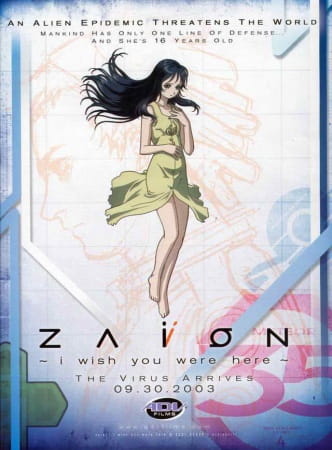
#141: Zaion: I Wish You Were Here (2001)


Director: Seiji Mizushima
Screenplay: Hiroyuki Nakamura, Manabu Ishikawa and Natsuko Takahashi
Voice Cast: Joe Odagiri as Yuji Tamiya; Yukari Tamura as Ai; Daisuke Gouri as Domeki; Hiroaki Hirata as Chanpua; Isao Yamagishi as Tatsumi; Jin Hirao as Kurosawa; Katsuyuki Konishi as Kaneshiro; Kotono Mitsuishi as Mitsuki; Nobuo Tobita as Satake; Romi Park as Tao; Tesshō Genda as Kudou
Viewed in Japanese with English Subtitles

Zaion is very much the project of a new company with too much ambition, not enough resources. Studio Gonzo were the anime studio I grew up with at their height in the 2000s as I got into anime, so there is a certain aura to them that I cannot help to have in spite of the obvious issues they had. The common idea, whether true or not, is that they always start strong on the first episode of their TV series, a company striving for the slicking productions, only for projects to suffer from budget or having to create original material when the manga sources weren't finished, something to attest to twice from my experience from Hellsing (2001-2) and Chrono Crusade (2003-4). This narrative should be held to debate in reality. What I can however say with true is how it's amazing to think that by the 2010s, whilst they're still around, they crashed and burned due to financial difficulties, having been founded in 1992, started anime production in 2000, and ended up having to delist themselves in 2008 and being merged with another company in 2009.

The best way to answer this question for myself, whether Gonzo were a good animation studio or one which failed, is only answerable by actually watching their work from their main period, in which between 2000 to 2008 they were very productive.  Zaion is a little different as, made in 2001, this is very early for the studio, just breaking into the industry in the 2000s as they originally began in video game animation, the same year as one of their earliest big titles Hellsing. It is also an "ONA", an early original net animation streamed directly on the internet.

Zaion also unfortunately has similarities to Mars of Destruction (2005), a notoriously "bad" anime OVA, if on a higher budget which is still a bad comparison for it. Like Mars of Destruction later, this is about a meteorite landing on Earth and causing an alien outbreak to transpire, in this case a virus that creates monsters from those infected. Unlike the later anime where it's a group of schoolgirls with guns inexplicably having to deal with them, this has a team pumped with nanobots in the blood stream that allow them to transform into effectively a sentai team. A new project, a girl called Ai with tremendous psychic powers, is planned to be the new secret weapon, but alongside a burgeoning relationship between her and Yuuji, a member of the team, the virus is evolving and starts to surpass the nanobots that protect from them.

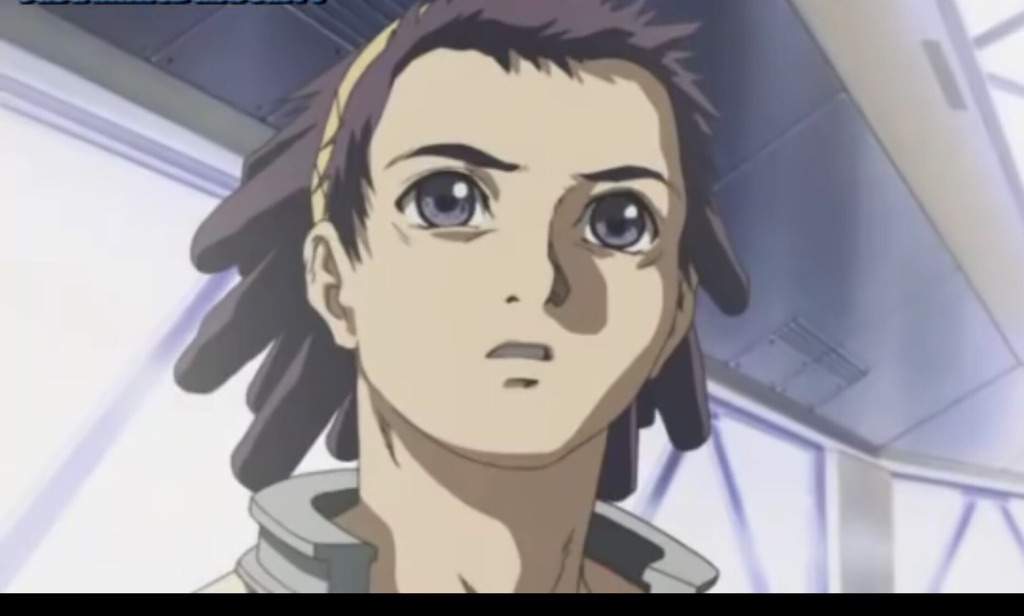
A four part ONA, it is pretty standard material for a plot, but with the notable detail being that it's directed by Seiji Mizushima. I liked Dai-Guard (1999-2000), a real surprise in the transition to computer assisted animation about ordinary office employees having to operate a giant robot, and he's known primarily for the first adaptation of Full Metal Alchemist (2003), which was a colossal boundary passing hit. Zaion, honestly, does feel like a job for hire, particularly as Zaion's biggest weakness is that story wise and in available resources, it's incredibly bland and doesn't do anything of interest with its basic material.


Even in knowledge that this was an attempt at something from a newly created studio, it cannot be denied the OVA feels impoverished. The plot is very conventional for anime, but if you add style, any can grow in quality even in four TV episode length parts. You can make even a generic premise grow. Zaion isn't that anime, not particularly investing any real pathos for the cast, including a bland snarky male lead, whilst the only character of note is one of the scientists being a middle aged slob who eats a lot of junk food for his main diet. Even the aliens aren't that inspired as, whilst a threat when they can melt together into one giant alien or infect anyone who survives them, there's a lack of any distinction between them.

Production wise this is felt too, not in the obviously dated early effects, which stand out jarringly even in terms of frame rate, but for how generic it is. This is particularly felt as, barring one shot of a crowded city of pedestrians (in the day), this exists in some of the most empty locations possible. Not since Mars of Destruction or even Ai City (1986) have I seen such empty environments, where skyscrapers were just background to the film. Zaion follows a pretty obvious plot you can guess from what I have already described, which leaves little space for this bland aesthetic to be deliberately changed.

The only aspect which stands out is that the production hired composer Kenji Kawai, a regular collaborator with Mamoru Oshii and a talented creator who brings his a-level talent here. Zaion to its credit, when everything else isn't interesting, has a great soundtrack, touching upon New Age and electronica with an incredible atmosphere.

Aside from this...yeah, this is difficult without just recounting how the story ends which defeats the purpose of the review. It ends with some tragedy and a happy ending, but I didn't care. There's generic plot points here that could grow and blossom into good stories - that the sentai team are a multinational steam willingly risking their lives by punching infected mutants when the remote controlled combat robots don't work, or the military are both covering up these alien outbreaks, and emotionally isolating a sixteen year old girl to turn her into a hologram projecting laser weapon - but they are the most basic interpretations of them. As a result, this isn't an artistic failure, just an insignificant production which is worse as people worked hard on the episodes only for this to be the result.


Sunday, 10 March 2019

#91: Plastic Neesan (2011-2012)

From https://yams.akamaized.net/Assets/93/345/l_p0020534593.JPG


Aka. +Tic Elder Sister
Director: Tsutomu Mizushima
Screenplay: Tsutomu Mizushima
Based on the manga by Cha Kurii
Voice Cast: Mari Kanou as Iroe "Neesan" Genma, Marina Inoue as Makina "Makimaki" Sakamazaki, Yumi Uchiyama as Hazuki "Okappa" Okamoto
Viewed in Japanese with English Subtitles
A Cinema of the Abstract Crossover

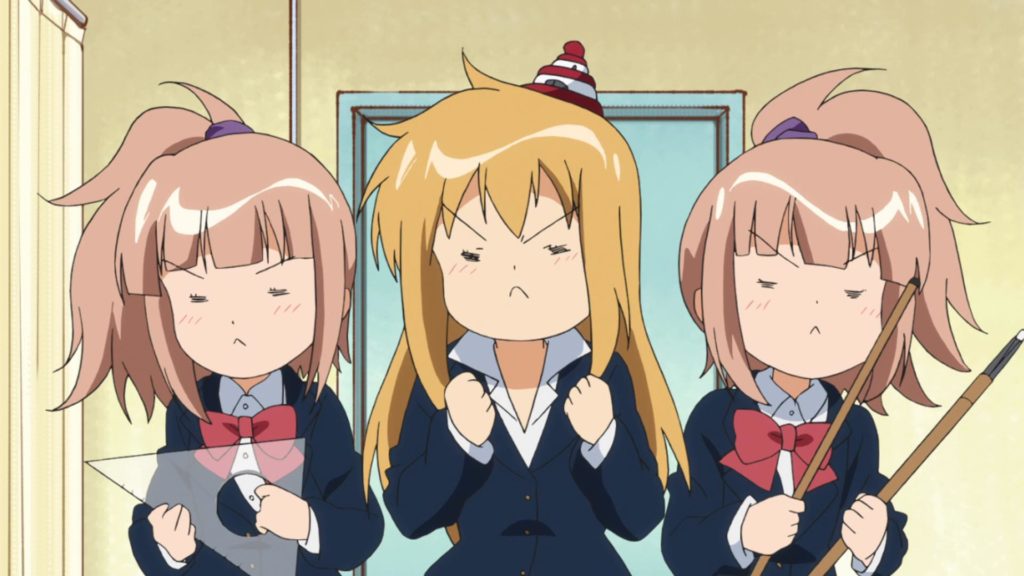
Synopsis: Neesan, with her friends Makimaki and Okappa, sets up a model making club at their high school; instead of actually making models, they spend their time over twelve episodes, two minutes each, exposing their hatreds for each other, encountering weird students, and learning of the mating dance of a female gorilla.

Sometimes there's an anime worthy of being covered on my other blog, Cinema of the Abstract, and this curious Original Net Anime (ONA) is pretty infamous at least if the Gifs of the show in the web are anything to go by.

The resulting review contemplates the strange paradox of how an anime can be pretty normal the more deliberately weird it tries to be, whilst trying to probe the brain of its director/screenwriter Tsutomu Mizushima. All at a click at a button HERE.


From https://anime-archive.com/wp-content/uploads/2017
07/87fc4e8c17c398afae5713ce920ea6c8-1024x576.jpg