Showing posts with label Letter: F. Show all posts

Saturday, 20 July 2024

#277: Casshan - Robot Hunter (1993–1994)


Studio: Tatsunoko, Artmic

Director: Hiroyuki Fukushima, Masashi Abe and Takashi Watanabe

Screenplay: Emu Arii, Hideki Kakinuma, Hiroyuki Fukushima and Shō Aikawa

Based on Neo-Human Casshern

Voice Cast: Takeshi Kusao as Tetsuya Azuma / Casshan, Yumi Touma as Luna Kozuki, Hirohiko Kakegawa as Admiral Montgomery Dr. Lester, Ikuya Sawaki as the Narrator, Issei Futamata as Akbone, Isshin Chiba as the Operator, Junichi Sugawara as Barashin, Juurouta Kosugi as Commander Tork, Keaton Yamada as Dr. Kotaro Azuma, Kenichi Ogata as Elder Asari, Kenji Utsumi as Buraiking Boss

Viewed in Japanese with English Subtitles


Tatsunoko, over its decades of existence since Tatsunoko, has been retelling and rebooting its franchises repeatedly, always trying to keep them in consciousness, and to their credit, they take artistic risks to do this. It is not just the nostalgic market or all the video game tie-ins over the years, but how their retellings of their most popular characters over the years can vary from the pretty radical, or in a case like this, at least stepping up to the new decade they were made within. It does not always work - rebooting Speed Racer (1967–1968) in the nineties led to an animated series Mach GoGoGo (1997) which most may not know of, a take which told one giant race for a large portion of its length alongside changed the character dynamics. Some have been really drastic, like Gatchaman Crowds (2013/2015), readapting its tokusatsu team dynamic that some may know from its Westernised Battle of the Planets form, and turning it into something which striped the costumes, changed the tone, and was a superhero series over two seasons about mobile phone and online technology's potential to corrupt but also do good. Casshan himself has had some really idiosyncratic takes, created in 1973 as a superhero of android form defeating the robot empire of Buraiking Boss, who have enslaved humanity as this nineties re-adaptation sets up.  I think if I was to return to it, I would even defend the 2004 live action film, which was done in then-era CGI green screen with more emphasis on philosophical dialogue, for at least trying to be different. The 2008-9 Casshan Sins adaptation is the more radical for being a depressing epilogue to the original story, suggesting Earth is doomed anyway, as there is a rust-like virus even kills robots, and Casshan has to accept he is to blame for it over the series.

Robot Hunter is the least radical of the three, closer to its source premise even if with dashing of more adult content for the straight-to-video market, four half hour episodes released between 1993 and 1994, compiled into a feature length work for the Western Manga Entertainment release. In the world, robots have taken over and enslaved humanity, effectively predating The Terminator in the 1973 source material if with the caveat that, rather than kill us all, the Buraiking Boss realised we could be useful as slave labour in his robot factories. Casshan is spoken in reverence here, before his real introduction, as someone who will save humanity. He is actually Tetsuya Azuma, who in this story was a young man who willingly sacrificed himself to place his consciousness into an android to fight the Buraiking Boss, someone who, as in a lot of Japanese anime in terms of moral complexity, saw the only solution to preserve the Earth's natural resources and save the planet was to take over the planet.

The biggest issue with this adaptation is its length. It is nearly two hours long altogether, but if ever there was an anime that needed more episodes or lengthier ones over the forty minute mark even, Robot Hunter could have done with more elaboration on plot details. His father created Buraiking Boss whilst his mother's soul, literal and not metaphorically, was preserved by Buraiking inside a mechanical swan who without him realising she is passing her son information on his plans. There is enough in that in it, let alone the other plot aspects, to add greater melodrama to the proceedings. There is enough here even in this simple premise to pull form for at least a few more episodes, to elaborate on its science fiction premise, not just Casshan himself, accompanied by his android dog, man's best friend with flamethrower abilities, but also the human resistance. They still have enough forces and resources to fight back around the globe, but having to fight on the back foot. This includes the female lead Luna Kozuki, a love interest from Casshan's past that is yet emphasised as a member of the human resistance who is capable of handling herself.
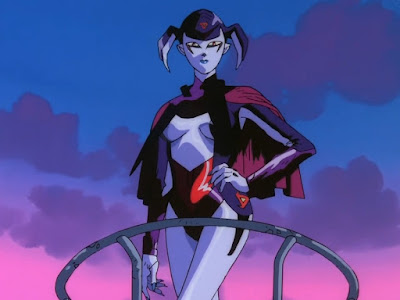

She does emphasise the few moments of edginess this adaptation has too, not just the fact that, even in the apocalypse, she can dress resplendently in short skirt and immaculate ponytails. More telling alongside the few moments of blood, it is from an era where if even Chung-Li, the Street Fighter 2 video game character, had a gratuitous shower scene in the (uncensored) version of Street Fighter II: The Animated Movie (1994), and there is a blatant one here for Luna. That is crass to have to point out, but whilst she thankfully has enough moments of being a competent heroine herself, Robot Hunter's more curious aspects are these nudges of adult content which stick out more because most of this is not close to the edgier titles Manga Entertainment were realising in the United Kingdom for the "beer and curry anime" image on videotapes. Most of this could be shown to a younger audience than the one it has for a few scenes, rated as suitable for twelve year olds in Britain, and with content in live action that would be fifteen certificate if still tamer than most action films at that rating. Barring the few nude scenes, the grittiness of seeing people shot by the villains, and one revolutionary's unfortunate end, crushed under a bridge girder with lots of raspberry jam around him in one moment in episode three, it really is not a gritty adaptation whatsoever, with the robot enemies effectively allowing one to get away with cartoonish violence. Maybe it is over thinking this when the bar for edginess, even in terms of additional swearing added to the English dubs from Manga Entertainment, but it feels like a concession with some of these scenes for this release. The shower scene especially feels like fan service for the sake of it.

The actual production is solid, though this is a case where three directors and four screenwriters does evoke, even if not necessarily the issue here, of a title which lack a complete voice of one figure. There is Shō Aikawa among the screenwriters, once a notorious screenwriter of ultra-violent work who became a more acclaimed one, but there is also the consistent voice of Yasuomi Umetsu as one of the production's two character designers. Notorious for his work in hentai, and titles like Kite (1998) that could only be created originally under that genre, Umetsu is nonetheless well regarded for his craft and detail, and alongside Tomonori Kogawa as his co-character designer, you get a then-update to the franchise which is good and would have been spectacular to image with an expanded narrative which let the pair take the designs they had further. Even Luna's character design, despite my joke about her immaculate costume jarring against the world, is still memorable, alongside whoever (including other designers on the title) who decided to give the Buraiking Boss a Goth female robot henchwoman, looking like cyber harlequin in black eyeliner. (For obvious reasons as well, with its elaborate action scenes, the mecha designers and animators also deserve their credits for their hard work too). Working with Tatsunoko, the studio Artmic are a product of this era, with their last work in the late nineties. Their catalogue of films and straight-to-video work is a cornucopia of nineties and eighties anime aesthetics and tropes in a filmography, from Bubblegum Crisis (1987-1991) to Genocyber (1994), always collaborating with other studios on their projects.

All my issues are with the plot structure. The plot as it is mapped out makes perfect sense - setting up the world and Casshan, with the final conflict as played here between him and Buraiking Boss as well done as you could hope - but is more the sense we could have done with more story beats. There is teased more androids with the ability to control the ecosystem, living on an isolated island, who sadly never properly appear, and the middle of the production, episodes two and three, could have been have multiplied and increased into more tangents and depth to details like these figures, from episode three, or the main characters themselves. Casshan himself, alongside the limitations of his body, including requiring solar energy to power, has the additional primary crisis of whether he will lose consciousness and become a killing machine, whilst Luna, from the original series, has the conflict of needing to both help save humanity, but naturally concerned for the man she loved and hoping for the likelihood of him becoming Tetsuya Azuma again once the fight is over. There could have, in general, been more elaboration on the scenario, more emphasis on the human rebellion and the Buraiking Boss' forces, including a general sense of the grit and stakes at hand, especially with the uncomfortable idea leant into Buraiking's desire to replace humanity comes from his belief we humans will just destroy our planet, our failure to preserve it causing his existence to be. The slightness of some straight-to-video works has been a problem I have seen in quite a titles, and sadly this is a case, where everything here is perfect and could have been spectacular even as just a fun OVA, but we are just missing enough detail to nag.

Tuesday, 6 September 2022

#224: New Fist of the North Star (2003-4)


Studio: A.C.G.T

Director: Takashi Watanabe

Screenplay: Hiroshi Toda and Nobuhiko Horie

Based on the serial novel Fist of the North Star: The Cursed City by Buronson and Tetsuo Hara

Voice Cast: Takehito Koyasu as Kenshiro; Akimitsu Takase as Tobi; Gackt as Seiji; Romi Park as Bista (Doha); Unshō Ishizuka as Sanga; Yurika Hino as Sara

Viewed in Japanese with English Subtitles


This was my first Fist of the North Star. This franchise, from the manga by writer Buronson and illustrator Tetsuo Hara, who wrote the source novel which ties this three part anime and their franchise together, had less recognition in the United Kingdom than it did the United States. Manga Entertainment did release a tiny bit of the 1984 television series, but beyond this, especially into the DVD age when I got into anime, all I had to go with was the 1995 live action Fist of the North Star film, which is not a great interpretation of the premise, and this, which we got from ADV Films, tied to the source in that, whilst set after the original story, its creators were directly involved with.

Introducing this franchise to me as an outsider, as the OVA tells it, civilisation was totalled by nuclear war, leaving the survivors to fend for themselves. Those desiring power prey on those wishing just to survive, and as we see early in the set up of the world in the first episode, polluted water which kills you instantly means clear drinkable water is a huge resource, even more so than petrol as, in this version, is never a concern as cars and motorbikes can be used without issue. Kenshiro, our franchise lead, is a wandering martial artist, the sole heir of Hokuto Shinken, an art form which forces only one master to exist, and fights to stop others claiming the art. His talents with this include the ability to touch pressure points that can even cause a man's head to swell up like a balloon and explode. Unlike the 1995 film which briefly touched on this, and censorship for the television anime series, this version has the gore there fully, but also, unlike the live action film where Gary Daniels played a conflicted but one dimensional figure, Kenshiro here is ridiculous as a stoic muscle man but is also one with a moral compass.

The paradox this OVA claims as a virtue, whilst not perfect even in telling it, is that this contrasts its more lurid content with moral dramas. Kenshiro is fully aware his art is a curse, as he must hunt down other practitioners of the art form, and he is heroic too. Though he can violently explode people, his heart is in saving people, protecting them, even for villains to redeem themselves if he has not made them implode already, willing to have let them live if they redeemed themselves as happens in the finale here. The paradox, that this is gory ultra violent macho anime, yet is full of sentimentality and would get away with manly tears and melodrama in its toe, really stood out as its best aspect returning to this anime, effectively a three hour animated film which sets up the virtues of the source to interest me.

Episode one sets up the premise, that a town is attacked by Sanga, the dictator ruling Last Land, a kingdom where he controls clean water supplies and has brought in religious fanaticism, with a boy who can do magician parlor tricks, to keep his subjects under foot. He requires Sara, a female healer from that now destroyed town whose lineage clearly was one of the Hokuto Shinken clans who were beaten, as her skill is in pressure points that can make miraculous and unnatural healing transpire, something Sanga can exploit to pretend she is a goddess. Touches like this is where this as pulp has something more magical to it, such as that this will come to ahead even when Sanga is out of the story, including the downfall of the boy's older brother Tobi, an ally of Kenshiro who will try to weld this religious fanaticism in a Holy War with the newest ruler when power corrupts him. There is nuances, and the story properly begins with the introduction of Seiji, a figure who has acquired the style Kenshiro has but, abandoned by his father as a boy, has turned into a vengeance seeking nihilistic who believes only in power.

Seiji is also voiced by musician Gackt, who provides the opening and ending themes. Clearly this production was as much to sell Gackt as a star too, even in how, unsubtly and heavy handed, this tries its hardest to make a morally evil figure actually a damaged one who finds humanity, the ending credits even looking like a music video when it cuts to Gackt himself in a post-apocalypse costume screaming to the sky. The music is good, so I will not complain, even if I cannot claim to whether his vocal acting is good or not. Trying to make Seiji, a heinous character, into a complex one is among the virtues of New Fist of the North Star but also where this does struggle, try as it does admirably to do, with an almost comedic number of abrupt inclusions, even an aunt never seen before who appears in Episode 3. 

A lot of New Fist of the North Star will put people off. It is violent, where unlike the previous versions as mentioned, you can have intestines and brains here even if this is past the Millennium, meaning we are no longer in the sickening yet lovingly depicted organs of hand drawn OVAs. There is also an implied rape scene, which is attempt at a moral complexity which does fail. It is not too explicit, and not one to damn the production, but alongside that Sara ends up in the skimpiest of costumes, stuck as a caged bird for Seiji, this is where the complexity this story wanted does falter because the storytelling itself slips, trying to deal with this moment that transpires between Sara and Seiji. It is always problematic to have sexual violence, and in this case, the complexity is enough without this - that Sara knows Seiji, because he once saved her from a wolf attack as children, her decision even to ignore a chance to escape clearly a wish to try to save him or try to bring him to reason. It connects with Tobi's own trajectory, infatuated with her, leading him in his downward spiral in trying for a Holy War when he feels she has been seduced by Seiji. Only that there has to be the rape scene, including her own divided reaction to it, causes the problem, entirely because this is not a subject decades on which can easily be broached in narrative story telling well, and with New Fist of the North Star, in its one huge storytelling flaw, not making Seiji's humane side feel less abrupt than it is its one huge flaw, alongside that this one scene, far more tastefully tackled, is still not as carefully dealt with as it could have been.

But that this gory production is trying at complexity, Seiji a nihilistic sadist who yet is psychologically scared by the idea of people having the concept of love, even to die for, is admirable even if it faltered. That this comes off at times schmaltzy is actually a virtue in this production's favour. This is not Violence Jack, Go Nagai's original 1973-4 manga written long before Fist of the North Star, but the notorious 1986-1990 anime OVA clearly coasting from its success. Even the sexual violence here is not a cheap shock tactic, just not told well, whilst much of this story as a simple action tale has moments where it gets morality over better than other anime trying to be complex. The destruction of a town, including the horror that a disabled girl has been killed among the civilians, is actually not cheap and means a lot, as it is shown enough without being shocking, and with emphasis that this Kenshiro, not a brainless thug, is a heroic figure who, whilst a stoic muscle man, takes the deaths of innocents with anger and remorse in his own way. His decision to try to save the boy from tetanus infection, driving through the mountains to where mysterious mountain men kill everyone who tries to pass, leads to the best moment, where I see the virtues of Fist of the North Star as a legacy franchise fully, that it comes apparent these men, a martial arts temple, only do this because their mountain has a huge silo of nuclear and biological weapons from the old civilization they do not want back in the world. In a moment like this, you see this as a macho melodrama written and crafted by creators where it is about morality as much as the animators even make gags about goons in danger of their heads imploding.

In mind that this is not perfect, that some of it has aged, and some of it will come off as ridiculous, I am glad to return to New Fist of the North Star now able to appreciate it. Its only technical flaw, not storytelling, is that made into the early 2000s, you see the early use of computer animation for vehicles, which became more common and looks obvious here. What it has in comparison though is that this became a gateway for me to want to see Fist of the North Star, the original source work, which is a huge virtue for this to have even if it was not seen as a key piece of the franchise.

Wednesday, 27 July 2022

Bonus #14: Fist of the North Star (1995)


Director: Tony Randel

Screenplay: Peter Atkins and Tony Randel

Based on the manga by Buronson and Tetsuo Hara

Cast: Gary Daniels as Kenshirô; Malcolm McDowell as Ryuken; Costas Mandylor as Lord Shin; Downtown Julie Brown as Charlie; Dante Basco as Bat; Nalona Herron as Lynn; Melvin Van Peebles as Asher; Clint Howard as Stalin; Andre Rosey Brown as Sandman; Paulo Tocha as Stone; Chris Penn as Jackal; Tracey Walter as Paul McCarthy; Rowena Guinness as Jill McCarthy; Isako Washio as Julia


Is it peaches? Sounds like peaches.

My knowledge of Fist of the North Star was limited to the point that this, in honesty, was one of the first versions of Buronson and Tetsuo Hara's legendary manga I had seen. The first was anime, New Fist of the North Star (2003-4), but worth mentioning is that, if the history of bringing Fist of the North Star into the United States only took to the late 2010s into 2020s to succeed, we in Britain got less of this legendary series. The United States finally got the full and uncut 1984-8 television series only in 2010s with Discotek, whilst in Britain, we only had 36 episodes of Manga Entertainment's attempt to sell the show, coming in the mid-2000s in a long gone box set. Fist of the North Star, this curious attempt to sell this franchise in the West, had the advantage in the DVD era that Hong Kong Legends picked this up as a title. A British DVD company, now long gone, who strove to preserve and release Hong Kong martial arts cinema with a care for extras and full versions pre-dating the Blu-Ray era, where even Criterion is preserving titles they once released, unexpectedly included Fist of the North Star itself among their catalogue.

This is not the first live action version, bootleg or otherwise, but with Clint Howard having his name over pro wrestler Leon "Vader" White on the opening credits, it is clear this is a curious adaptation. To those with no knowledge of the franchise, as this film tells, the world has descended into the post-apocalypse, with those who wish to acquire power having taken over as marauding hoodlums. One figure named Lord Shin (Costas Mandylor), having dominated with an iron fist, as the practitioner of the Southern Cross martial arts style, has created a city, his desire to improve the world contrasted by his ego and letting his men commit atrocity by invading smaller communities for supplies and slaves. His rival, who he has taken his love Julia (Isako Washio) from, now a caged songbird to him, and marked his body in permanent scars, is Kenshirô (Gary Daniels), practitioner of the North Star style. North Star, as interpreted in the manga, in the anime, but also here, is that contacting certain pressure points on the human body causes that person to explode, as gory as that sounds, and Kenshirô approaches Shin's world in attempt to defeat him.

Gary Daniels as Kenshirô looks like the muscular brother of Benedict Cumberbatch, who can still make your head explode, which is a compliment to both men. Daniels, a martial arts action star of films like Bloodmoon (1996), born in London, was also the person who came to this as a fan of Fist of the North Star, enough to call his son Kenshiro Daniels, who would go on to become a football (soccer) player when he grew up. Things obviously however made it clear the Fist of the North Star, this live action film, is not quite what it should be. It is conventional, which is the biggest sin it commits, that Tony Randel, most famous for Hellbound: Hellraiser II (1988), came to this film and made it very conventional, more concerned with trying to give the character of Kenshirô angst-ridden rather than a narrative exploiting its premise. Even for a lower budgeted film, it has a lot to get the tone right, the production design team and model builders deserving all their praises for a film which, when exterior location shots, feels post-apocalyptic, but those involved beyond this clearly missed the point.

Despite being part of the wave of pop culture films from the 1990s that I am obsessed over, this is just has one pace, to tell a very simplistic tale of this Kenshirô beating Lord Shin, and not a lot else to work with. A film presenting Clint Howard, Ron's memorable acting brother, getting to be a murdering bastard in the first half, shooting people indiscriminately should sound like a lurid pulpy movie, especially as this does have fight scenes, and one of the most curious casts you could imagine for such a film. One thing you cannot deny, and should have excited people coming to this film, because Randel comes to this as a horror director behind films like Ticks (1993), is that they did not ignore how these characters can make people explode with a punch, or Lord Shin's special glowing hands attack causes veins in the biceps to burst in jets of gore. Even then, however, this does pull back, and never was there a film whose personality is against itself with moments this adult and violent, against content you would expect in tone from a child-friendly comic book adaptation.

Explain, for example, that this is a film with moments of gore, where the troops of Lord Shin, the South Crossmen, are explicitly raping, pillaging and murdering nearby locations, but contrasts this with a blond haired teen male character (Dante Basco) who is a goof and a wannabe kung fu expert, whose friend is a cute blind moppet who Kenshirô cures of her blindness. The film’s narrative is incredibly generic, and for a film that needs good fight scenes to work, the compromise to their presentation undermines the whole project, alongside the fact that, for the few moments of gore here, there are also points where the gore from the original manga are removed for the most part too. What it becomes is a strange concoction of who managed to end up in the film. Even in style there are weird moments that show this, like inexplicably, for a sombre toned film with an orchestral score by Christopher L. Stone, for it to suddenly splice in a Machine Head song A Thousand Lives into the soundtrack.

Malcolm McDowell, entirely separated off from everyone in his scenes, is a North Star martial arts master named Ryuken existing in the afterlife, continuing the obvious concern of Western actors having Japanese characters to play, levitating in a room or inexplicably appearing as a zombie to Kenshirô, voicing another actor, to tell him to not flee his role as a hero. Vader, the legendary pro wrestler, especially in Japan as much as in the West, is perfect as a Fist of the North Star baddie, and is just being Vader, pulling a promo on a small girl, as awesome as that sounds whilst performing moves on Gary Daniels. But with that fight ending in an anti-climax belittling both of them, even Vader is misused. Melvin Van Peebles is a really curious choice, a legend in African American cinema for directing Sweet Sweetback's Baadasssss Song (1971) alone, here as an actor, as with Downtown Julie Brown, a British video jockey (VJ) and personality, neither ultimately given much to do as members of a village Lord Shin is terrorising. Unfortunately as a result, neither were really worth having hired in the first place despite both, Van Peebles especially, are inspired figures to have hired.

Costas Mandylor himself is also a curious choice as that unfortunately means, as a former soccer/football player with no martial arts training, they had to work around this with stunt doubles, in a film which has Gary Daniels but not many who can do the martial arts fights. Japanese actress Isako Washio likewise, an actress from films like Bloom in the Moonlight (1993) is also stuck here trying to perform in a language not her own and feeling lost too. The one curious choice who managed to grab something from this is Chris Penn as Jackal. Penn steals the film, the actor from films like Reservoir Dogs (1992), with the advantage, playing a sleaze ball goon who managed to tape his head together before Kenshirô's blows caused his head to explode, that he could find a character he could relish the lines of.

It is a project which ended up with people who really had no idea what to do with this - co-screenwriter Peter Atkins mostly worked on Hellraiser and Wishmaster films, making this frankly a case of someone dropped with a title they had no investment it, Tony Randel likewise feeling entirely out of place here. Even in mind that huge chunks are clearly missing, such as the aforementioned Clint Howard disappearing entirely eventually, the live action Fist of the North Star film feels entirely at odds with what it is was adapting, a franchise which would have to take decades to finally get a lot more recognition in the West. This is a fascinating film to see, and has aspects which are worthwhile, just in how it looks, but never was there a film which really did not have a lot going on despite having such a curious production on and off screen.

Monday, 19 August 2019

#113: Full Metal Panic? Fumoffu (2003)

From https://i.pinimg.com/originals/84/9c/3a/
849c3a0d02206f7d6526c75b5f618485.jpg


Director: Yasuhiro Takemoto
Screenplay: Shoji Gatoh and Fumihiko Shimo
Based on the Light Novel series by Shoji Gatoh illustrated by Shiki Douji
Voice Cast: Satsuki Yukino as Kaname Chidori; Tomokazu Seki as Sousuke Sagara; Tomoko Kaneda as Bonta-kun; Akiko Hiramatsu as Youko Wakana; Akio Ohtsuka as Andrei Kalinin; Ikue Kimura as Kyouko Tokiwa; Jun Fukuyama as Issei Tsubaki; Mamiko Noto as Shinji Kazama; Michiko Neya as Melissa Mao; Rie Tanaka as Ren Mikihara; Shinichiro Miki as Kurz Weber; Tomomichi Nishimura as Richard Mardukas; Yukana as Teletha "Tessa" Testarossa
Viewed in Japanese with English Subtitles

[Disclaimer: Uncomfortably my revisiting and review of Fumoffu has coincided with the unfortunate passing of its director Yasuhiro Takemoto, and other staff at Kyoto Animation, after the arson attack that took place in July 2019. The review will be honest in terms of my opinion of the show, thankfully a very positive one, but it is a sad incident to have to write the review around since a key creator of Fumoffu was sadly one of those who was killed.]

You'd presume Fumoffu would only work in knowledge of its source, as a comedy side story to Shoji Gatoh's Full Metal Panic!, the tale of a young male solider Sousuke Sagara, born in war, sent to protect Kaname Chidori, a schoolgirl with a subconscious superhuman knowledge of machinery and technology; as a big franchise, followed by a proper sequel in 2005, and a return in 2017-18, these adaptations of Gatoh's light novels have their fan base. Fumoffu is interesting however in how, by itself, it's had a fan base entirely by itself, with the fact that barring some characters introduced in cameo later, the comedy spin-off which deals with the ordinary lives of Sousuke and Chidori, without any mention of giant robots and conflict against terrorist organisations part of the main series, works entirely by itself. Instead, it takes a pleasure in the fact Sousuke, born in conflict all his life, is hopelessly alienated from the ordinary civilian world and, having to go to high school with Chidori in his off-time, he has no social skills to speak off. The first half of the first episode shows that he has a bad tendency, even with love letters, to detonate his school locker with explosives when he thinks someone's tampered with it and placed a dangerous trap within, so other concepts normal to high school melodrama are going to lead to a lot of property damage and miscommunication. 

Admittedly it's a lot more difficult in the current day to find guns being fired in schools funny, but initially the concept of someone in Sousuke Sagara who has literally been breed for war stuck in ordinary society is hilarious, especially as (even if a lot more darker and difficult humour now) it still plays off the fact that firing a gun in the air to demand a plain roll from the cafeteria staff is socially unacceptable from him. Chidori, as the traditional tsundere character, prone to violent temper (only with good cause here) even if she does openly like him, has a lot of justifiable reason as the female protagonist to look at him with horror. Her objections to his behaviour, such as actually trapping women for a dating challenge in a very later episode, which can even lead to her kicking the shit out of him in slapstick violence is a troupe of anime since the dawn of time but here there's both a sense that, yes, he does things that would drive people insane, and that when it comes to their friendship, maybe even more, she will gladly be there for him as a friend with kindness. It helps as well, alongside the show from the get-go making the pair both sympathetic, that her voice actress Satsuki Yukino is exceptional alongside the animators who depicted her facial reactions to his behaviour and worse case situations. Even the blitheness in how she puts up with being kidnapped, more than once, has an incredibly higher weight than in most anime comedy because there's an entire context, helped by the source material, filtered in the characters even for this absurdist comedy.

It is hard to describe the show as its almost completely episodic, early on two half stories within the usual twenty plus minutes but also later including more full length stories, but from there the show expands to include a cast including equally likable class mates and curious figures like Issei Tsubaki, a martial arts fighter for a karate class about to be kicked out their room, who in shy around women and near sighted despite being an incredible fighter, or Atsunobu Hayashimizu, the president of the Student Council  whose stepped out a Kunihiko Ikuhara production in his elegance, alongside his equally elegant female assistant (and daughter of a yakuza boss) Ren Mikihara, but is prone to moments of absurdity in more subtle details like how he speaks pretentiously.

Early on, Fumoffu probably already has its best episodes. Actually, the best segment is in the second story of episode two, in which Sousuke forgetting Chidori's notes leads to a trip back to his house that includes some of the best comedic timing, the best of Chidori's reactions in terms of the performance and animation, sweet emotional drama which early on shows the pair love each other, and a car against bicycle car chase with an almost deranged female traffic cop...made now funnier, as the voice actress playing her is Hiramatsu Akiko, knowing she and her female partner are meant to be the lead female cops of the You're Under Arrest franchise making a cameo, to which Akiko is a key voice actor one of those lead characters.

But that doesn't say the show doesn't lose a step after that. Episode two starts with the aforementioned incident with the cafeteria where the gym teacher, who hates students working for themselves, finds trying to get one over them isn't possible due to Sousuke's habit of booby trapping objects. Episode 3, the first full story episode Summer Illusion of Steel, has Chidori meet a young boy whose happiness to meet someone also means sending his staff (all former mercenaries) after Sousuke who presumes she was kidnapped. Episode five, introducing Issei, also leads to the reveal that the school janitor is the most dangerous person in the school despite his meekness, to the point that even Sousuke will be left quivering like jelly at his inability to defeat him. Episode six includes two "horror" stories, one which skirts tastelessness about a horse headed man who forcibly combs women's hair against their will into pony tails, but thankfully stays on the right side of funny1 alongside bringing back the homicidal female cop.

From https://geekandsundry.com/wp-content/
uploads/2015/08/Fumoffu-cover.jpg

There's Episode 7, which dangerously veers to the joke just being about a rugby team being so nice and polite to the point of being useless, which could just turn into a joke about them being emasculated and lesser men, but thankfully ends with incredible dark humour as, with Sousuke helping them by way of military training and R. Lee Ermey approved (bleeped) cursing, he gives them a blood thirst on the pitch that has probably corrupted their souls even if it means the team will continue. Episode four is also the introduction to the best running gag, and the explanation of where the subtitle "Fumoffu" comes from, the sound made whilst wearing the Bonta-kun, an amusement park mascot costume that Sousuke acquires as part of the second part story, Sousuke finding a way of turning it into actual combat appropriate equipment that returns constantly when he needs more than just guns.

Arguably the reason the show is so highly regarded, managing to gain popularity over even the original Full Metal Panic, is just because it's a comedy show which is of a high quality of work that few touch. No episode, although I will talk of one, falls into any bad humour, with the moments which may have come off as too dark, thankfully staying on the path of not becoming offensive. Even the moment, when I first saw the series, I found offensive when Chidori compares a rival rugby player to a type of gorilla nearly going extinct due to a war in the African continent, thus causing a riot, isn't as bad as I thought it was, even if it's probably the one curious moment in the whole series which jars in pretty succicient and funny dialogue. Even the fact that school students with weapons has become less easy to find humour in isn't as much an issue when most of the humour eventually comes to the fact Sousuke is utterly hopeless as a regular school student, most of the humour eventually leading more to his habit of booby traps and that he can just be as dangerous with a bean bag cannon. And the fact you can watch the show by itself and immediately get a premise, of the child solider stuck in school, which is consistently worked upon for humour means this is a lot more consistent and focused than most shows of its ilk.

It's also exceptionally well made in context of what the show is. Kyoto Animation is highly regarded, but with the exception of The Melancholy of Haruhi Suzumiya (2006)2, an entirely different kettle of fish in its quirks that needs to be covered in a few reviews to fully talk of, this is the only work of theirs I've lived with in my anime watching. Returning to Fumoffu, it's amazing effortless in how it is paced and consistent in its comedy when, honestly, even anime comedy I have appreciated whether full or micro-series length have usually been scattershot and/or not exactly ambitious. Subdued and quiet, Fumoffu does pull for some ridiculous gags, like the Bonta-kun eventually acquiring an army of itself in an episode tribute to Kinji Fukasaku, famous above all else for his contributions to the yakuza genre of cinema and even made just around the same time as the legendary director passed. Even the music feels like a higher quality - normally not a fan of J-pop in opening and ending credits, the song for the opening is sweet and appropriate, whilst the one for ending credits ("Kimi ni fuku kaze" by Mikuni Shimokawa) is arguably one of the best of its genre for me and suits the tone of the show PERFECTLY.

In terms of any flaws, there's none barring a few jokes that don't land, such as that curious gorilla one mentioned in a paragraph earlier. Beyond that, the issue for a show like this is that, as is the case with anime comedy shows, those without an actual plot progression can suffer from the fact the last episodes just end the series. Thankfully Fumoffu does better where even arguably the worst episode, A Goddess Comes to Japan (Part 2: The Hot Spring), is still better than most series' best episodes. The only two partner, the "Goddess" is Tessa Testarossa, a character from Full Metal Panic's main story who is a submarine commander and Sousuke's superior in rank despite the fact she's a quiet and meek teenage girl, leading to other cameos from cast from the main series as she wants to briefly live life as a regular student with Sousuke. The first part is hilarious, as stuck between a rock and a hard place, the sympathetic for Sousuke is felt in how even being told to sod himself is metaphorically felt in his growing delirium of being left to die on a battlefield with Tessa living in the same apartment and being threatened to protect her with his life.

Part two, which is the stereotypical hot springs episode, has unfortunately a gag about leering over the female cast nude. It's weird because they're meant to be teenagers, and because even if it wasn't a concern, the show suffers from the prurient paradox of nonetheless censoring itself with strategically placed objects, done here specifically with a rubber duck that it evokes a joke from the Michael Myers' Austin Powers films. It feels bad because, like a lot of anime, it's a juvenile idea to want to have fanservice by showing the female characters nude, but never actually showing any nudity even in the uncensored scene, which is more problematic than if the show embraced sexuality with a gender positive balance and just went for sexiness. (Again, they're teenagers, which does cause a problem in itself though, but that's an entire issue too complex to unpack) Thankfully, the episode pulls this to a great running joke where the men, being perverts who want to spy on the women at the hot springs, didn't expect Sousuke to literally put perilous traps including turrets in the way to stop them as a gentleman should.

Thankfully, beyond this the bar of quality is higher than most anime comedy. In fact the last episode tries its hardest to get past probably the biggest issue that you have to deal with in anime comedy, that their final episodes unless part of an ongoing plot as mentioned are going to be anti-climatic. I blame (and praise) Excel Saga (1999) in my youth spoiling me as it actually managed, (as one of the deliberately chaotic and shambolic shows of its time), to lead to a climax in a post-apocalypse that was compelling. Even a show I love like gdgd Fairies (2011-13) arguably left its final season episode on an anti-climax, but got past it by both how gleefully weird the show had become and because the final episode of the first season was a great conclusion. Fumoffu decides Sousuke accidentally acquiring a dangerous bio weapon and his entire class being infected is the way to go, as dark as you get for humour but managing to succeed for a climax. I won't reveal the twist but, for a show that only occasionally goes for sex comedy, what is revealed is hilarious without any sense of inappropriateness, as its equal opportunity, and ends the show with the sound of voices baying for Sousuke's head.

Altogether, it's a great show, and with it I admit sadness with that opinion as, tragically, director Yasuhiro Takemoto was killed in the arson attack on Kyoto Animation in July 2019, said to be one of the biggest crimes of its time in Japan for many decades, which is more than likely going to make it a very disturbing incident even for a Japanese citizen who never watches their country's animation let alone the fact a lot of talented people passed as a result. Kyoto Animation in general have sounded like the studio who quietly paved a path of goodwill for high quality work - they took over for the second season of Full Metal Panic, after Gonzo for the first, and have the likes of the Free! franchise under their belt. They were also adamant for far more gender equality and paying their staff well, with a general sense, in all the good will sent their way after the tragedy, that they were a studio held highly and fondly. Certainly after revisiting Fumoffu, Takemoto's career is now ripe for me to see, in respect for him as a director, as is Kyoto Animation's. I'd have to anyway, because they've been responsible for some of the heaviest hitters in the anime ballpark, but more so now in the pleasantry of Fumoffu's virtues and as a respect (whatever my opinions) to circumnavigate the unnecessary tragedy their company had to go through. Certainly it felt weird to watch Fumoffu in the spectre of the incident; but what a perfect tribute to nullify that fact and think of the best of Kyoto instead?

======
1) Unfortunately, the fact he is voiced by Vic Mignogna in the English dub hasn't. For the unknown, this once very popular male voice actor has been accused in 2018-19 of deeply unsavoury behaviour against women, including a female voice actress, which has weighed down on him in a scandal. The episode skirts the right side of funny in the Japanese dub, but I wouldn't be surprised if the English dub version now has that unfortunate coincidence...

2) There's also Lucky Star (2007), also made by Fumoffu's director, who stepped in a few episodes into the production to drastically change the tone, but that one just sits there in the memories really needing a revisit.

From http://3.bp.blogspot.com/-IcBUYO-422g/UNHy3RvnxaI/A
AAAAAAAFi8/V23G1eQsO6A/s1600/Full+Metal+Panic+Fumoffu+Sousuke.png

Monday, 6 August 2018

#59: Five Star Stories (1989)

From https://media-cache.cinematerial.com/p/500x/
bdyjkomb/five-star-stories-movie-cover.jpg


Director: Kazuo Yamazaki
Screenplay: Akinori Endo
Based on the manga by Mamoru Nagano
Voice Cast: Ryo Horikawa as Ladios Sopp; Hideyuki Tanaka as Dr. Clome Ballanche; Ichirō Nagai as Archduke Juba Bardaim; Kazuhiko Inoue as Colus XXIII; Maria Kawamura as Lachesis; Norio Wakamoto as Voards Viewlard; Rei Sakuma as Clotho
Viewed in Japanese with English Subtitles

Synopsis: Far into the future, in a five-star universe known as the Joker Cluster, the various nations are kept in peace by the use of Mortar headds, giant robots which are as much for status as they are combat. They are all, usually, co-piloted alongside a human being known as a headdliner, with incredible skill to use the robots, with a Fatima, an artificially made robot/human hybrid always female. The fate of one Fatima named Lachesis, the prized creation of a doctor named Dr. Ballanche alongside her sister Clotho, is intertwined with a young man named Ladios Sopp. Sopp's attempt to protect Lachesis and her sister, against the corrupt leader of the region named Yubar, is to intervene with the ceremony necessary for all Fatima where they must name their masters. The outcome of this intervention, alongside Sopp's conflict about his love for Lachesis, will have seismic effect on the entire Joker Cluster through the decades to come.

Five Star Stories is sadly another example of a vast story, a vast world created in manga, we only get a slither of. This is always worse when, after viewing this theatrical adaptation, I found myself falling in love with the adaptation's melodrama and fantastical sci-fi world. The chances for a sequel were doomed anyway even if Five Star Stories had been successful. The production was done behind the back of the original author, Mamoru Nagano, and for whatever factor it lead to bad blood that would've made continuing on from the film significantly difficult or at least awkward. Even what we have is merely over an hour or so, and is a prologue to a work which barely deals with its mix of giant robot battles, space opera and a romance tale that spans millennia, many characters and across time and space.

It's merely a page of the curious tale of Five Star Stories, Nagano's personal obsession where he has worked on side manga, art books and even musical concept albums on. It's also, however, a manga which started all the way back in April of 1986 and is still to the current day unfinished and ongoing. Nagano, fascinatingly, gave away the ending of whole saga near the beginning, his belief instead of how the events will transpire in his tale being more important a really interesting creative decision. It does however leave one with a beloved, cult manga which is vying with Kentaro Miura's Berserk and CLAMP's X for which unfinished manga from years ago, and have had adaptations and strong fan bases, will end first. That may take a while, like the most frustrating game of endurance possible.  So it is something close to the heart for the manga artist/musician/essayist/animator/mecha designer/cosplayer and former fashion designer. The context also makes the film adaptation more tragic as, a slither of Nagano's obsession is beautiful in itself even if not fully informed by him, but with the caveat of how far it goes making the adaptation like one of the destroyed fragments of a Dead Sea Scroll1.

From http://i.imgur.com/hASz4TJ.png

The best word to describe Five Star Stories is "exquisite". One of the biggest reasons, even if the film doesn't have Nagami's involvement, it enraptured me is his world and his designs are some of the most glamorous for science fiction. There is a potential issue how the story uses crude stereotyping of the glamorous "beautiful" characters are good whilst the villains are all physically "ugly", at least with the character Yubar, the stereotypical overweight and corrupt figure who tries to molest Lachesis until his heart problems take hold in one scene. It's a crass way to designate characters physically which Nagano is not the first person to fall into. Everything else about his personal obsession is immensely compelling nonetheless. Barring his preference for rock music, (though the score to this adaptation by Tomoyuki Asakawa is special itself,) it's a distinct world. One where even the clothes and uniforms are idiosyncratic. The Fatima are thin artificial maidens with long hair and sinewy figures, closer to fairies and maidens from fantasy rather than robots from sci-fi. Even the men, whilst not all of them, can be extremely feminine, purposeful androgyny found to a characters like Sopp, our protagonist, whose character design could've easily been that of a woman's. Jokes are even made of people confusing him as a woman through the film. The robots and their design are another distinction of Five Star Stories. Sandwiched between Go Nagai's crazy super robots and the realistic depictions of war machines of hard sci-fi, these elaborate creations with extraneous flair and potentially supple forms are closer to built for show rather than practical use, apt in a cosmos where these giants robots are meant to represent their nations' wealth as much as for combat, and the main " Mortar headd" is entirely made of gold.

That this only adapts the prologue does raise the problem that it barely touches upon Five Star Stories and what it actually entails. As Five Star Stories is a space opera involving giant robot battles, you are stuck on one planet, and only have one robot fight at the end with the golden Mortar headds. Major characters never appear, and the appearance of figures known as the Mirage Knights, superhuman warriors who protect royalty, feels like a cameo for important figures or at least fan favourites. What you get instead is a sci-fi drama with an aesthetic which ingest old medieval iconography, set in an almost feudal world with castle locations, with hints at a space western (a Fatima escaping into a frontier town for peasants). It becomes openly supernatural material eventually as well as our lead Sopp is hounded by an ethereal female figure who views his meeting with Lachesis as a fate he needs to accept, as much of this short film's length entirely on his conflict of intervening to rescue her. With only seventy minutes or so for the running time, it could've still tackled a lot of material but instead this adaptation takes its time which making sure the drama has emotional resonance. It also means that, barring that one robot fight in the desert and some action scenes, with a surprising amount of violence for story with a very wistful tone, you are not getting the whole of the source material in the slightest.

From https://cuteproxy.files.wordpress.com/2010/04/fivestar.jpg

Why Five Star Stories is still worthy to see is that all of this, hand drawn, is gorgeous and can still whisk you off your feet. Helped by the fact as well, unlike other anime in this scenario, that it still has an ending even if its merely a prelude to a greater, more elaborate tale. Whilst with some action scenes, it's a story more inclined to the fantastical, evoking a decade later the series The Vision of Escaflowne (1996) with its fantasy world containing elaborate giant robots and an integral romance plot of tragedy and love. Five Star Stories is openly theatrical as well, which drastically contrasts attempts at more realistic sci-fi but hinting at a comic science fiction in the final epilogue. Again, it's a shame Five Star Stories never went any further in terms of animated adaptations. If done right, such a story would be incredibly rewarding, with only the concern that such elaborate designs would have to be adapted into computer assisted animation rather than hand drawn now. Particularly as the series is about giant robots, that many are animated digitally in the current day does raise concerns of how Nagani's thin, unconventional designs would transition from the page. If it did work however, his personal obsession would be one of the most fabulous looking and lovely science fiction stories you could ever see.


From http://animuze.com/blog/wp-content/
uploads/2012/07/five_star_stories.jpg

Tuesday, 20 June 2017

#43: The Flying Luna Clipper (1987)

From https://www.msx.org/sites/default/files/news/2017
/04/tumblr_nz510npb8C1unpujno1_1280.jpg

Director: Ikko Ono
Viewed in English Language with Japanese Subtitles

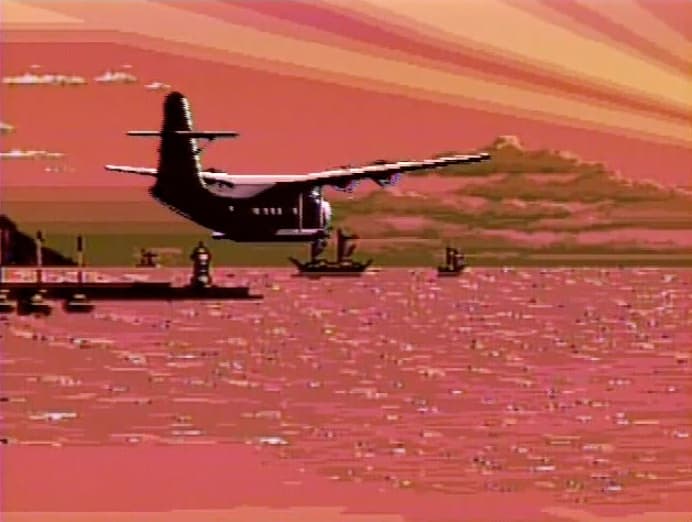
Synopsis: Having acquired a rare boat plane from the early 20th century, a Martin M-130, and renovated it to flyable again, a company offers a luxurious holiday trip in the Hawaiian Pacific for those who are the "deepest dreamers". Made with the graphical capabilities of a MSX game console, this film follows the flight patrons through a compilation of lessons and strange experimental shorts within its near hour length.

While this blog is meant to cover Japanese anime, it's be a crime to ignore the other areas of animation(1) that come from Japan alongside anime. The Flying Luna Clipper's existence, as a near hour long film made in glorious 8-bit game console graphics, wouldn't have even been known outside of obscurity in Japan if a blogger by the name of Matt Hawkins hadn't had found a second hand laserdisc copy. The result's a fascinating curiosity; the MSX is one of many Japanese video consoles from an early period of video gaming that would've only been known in its homeland, where the Metal Gear franchise began in fact, used here as an example of creative individuals experimenting with video game consoles beyond merely playable games to outright artistic experiments, be they interactive or not.

From https://i.ytimg.com/vi/6uD6pfH4q1s/hqdefault.jpg

Sadly, like many before and after, these experiments tend to end up doomed to obscurity or beloved cult works that are hampered by archival preservation yet to be publically provided to videogames, especially those which required idiosyncratic controls or require actually being re-released again rather than tracking down second hand, rare copies or online uploads of. It's a shame here as this is a proto-vaporwave head trip to experience, where the 8-bitera of illustration and character design created a colourful, Tropicana world of snowmen wandering around sunny Honolulu and palm trees at dusk. In spite of the limited animation, there's a lush charm from the incredible (and painstaking) detail, an old arcade game in its bright lights and sincerity. Adding to its strangeness and its warm hearted sense of accessibility is that it was likely made to appeal to Western viewers as its dialogue is mostly in English, moments of odd pronunciations in the voice acting against more solid performances which yet come from the mouths of moving portraits of cartoonish oddness. A black bird business tycoon, an air hostess whose a bespectacled banana, Polynesian bananas in coconut bras and grass skirts, a green haired chimp or living singing Hawaiian volcanoes =part of a more sexualised version of a Fantasia (1940) musical number.

From http://68.media.tumblr.com/9d5cdcc78b0362fc3059812988af41ac/
tumblr_nz510npb8C1unpujno5_1280.jpg

Japanese pop surrealism, the type of bubblegum surrealism not just found in videogames but in all their media, is absolutely charming. Unless you're viewing the spectrum which follows the traditions of the original movement in being transgressive, there's no sense of the more eccentric side of it of being merely commercial product, instead of cornucopia of full of cute anthropomorphic animals, talking plants, bright colours and spectacle, something I grew up with having a port of the scrolling shooter parody Parodius (1995) for the Sega Satan and hazy memories of episodes of Samurai Pizza Cats (1990-1). For all the darker, illicit areas of Japanese horror and dark fantasy which cross into the unreal and the mind bending, there's this opposite even when its occasionally morbid and full of sexual innuendo that's cute, silly and playful. The Flying Luna Clipper becomes a literal series of dreams for both the passengers of the ship and the viewer them self, the director of the animation literally one of the co-pilots of the clipper as it travels across the pacific ocean and even into outer space briefly. Barring one unfortunate image of a blackface character, on a TV in the background of a single scene, it's a surrealism that's a playful escapade.

From https://www.msx.org/sites/default/files/news/
2017/04/tumblr_nz510npb8C1unpujno6_1280.jpg

Alongside a lesson on the Holose taught by a seahorse with a Germanic accent, to music numbers, you also have material that could be shorts by themselves, one of the most memorable likely an older project by the director in 1986 which is live action, a playful music video of babies falling over, waterfalls and diving women that's charming as its strange, feeling the most dated of the whole work but not a detraction to its value. The whole film in general makes an argument, now becoming known again in a post-vaporwave world, for a period of late eighties and early to mid nineties pop culture as escapes for audiences that shouldn't inherently be dismissed outright for that reason, a lot of anime to videogames even in commercial industries that emphasised escape, dreamscapes and the purely fantastical. Far from cynical, The Flying Luna Clipper feels sincerely fun, more so as its brazenly (proudly) weird even next to a lot of actual anime, its end playing as a series of dreams as the closet to an actual protagonist swears the clipper has been a giant pelican for all this time in the tourist trip.

From http://68.media.tumblr.com/7fcd20cdd7e96eec6fabbbf2d048ac01/
tumblr_nz6uvp8CYj1unpujno1_1280.jpg

It's sadly a work that, unless a drastic re-evaluation takes place and enough people keep bringing it up in online topic, will be only known in a YouTube presentation, eternal gratitude to the man who pull the film again out of subterranean cultural memory but with an unknown time period of how long the upload will exist. Whilst from a period just before my birth let along childhood, it revisiting it for this review is why it was fitting to have moved away from videogames by the end of the PlayStation 2 to my permanent love for cinema instead. Less brightness and unexpected weirdness, the joys of childhood playing videogames scored by the soundtrack of Daytona USA (1993) and set in fantastical elaborate worlds, replaced by more "realistic" turgid aesthetics and a restriction in how games are meant to present themselves. I occasionally flick over reviews and clips online of new games, and alongside the cost and space required for new consoles, most of the actual games now are uninteresting for me to return to the medium. In spite of the apparent maturity of the medium in terms of storytelling, which I have to admire, as an outsider I'm put off by the mirrored sense of the bloated, store brand tone that also exists in mainstream cinema having infected the industry as well. In spite of its strangeness, there's a greater knowing sense of playfulness here in The Flying Luna Clipper I'd gladly recommend people explore if just as an antidote of this issue.

-------
(1) The last time something different from the mould was covered was number #24 Yuki Terai - Secrets (2000), a compilation of shorts and music videos for an entirely fictional female star which you can read the review of HERE

Tuesday, 8 March 2016

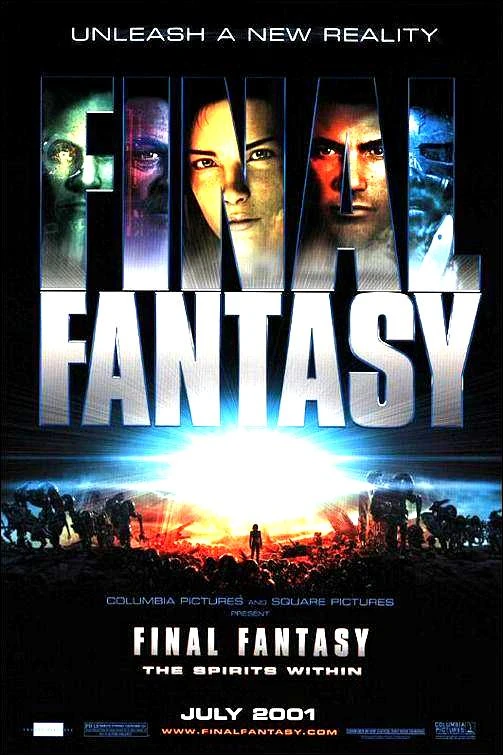
#20: Final Fantasy - The Spirits Within (2001)

From http://vignette2.wikia.nocookie.net/finalfantasy/images/4/
4a/FFTSWPoster.jpg/revision/latest?cb=20130405010722
Director: Hironobu Sakaguchi
Screenplay: Al Reinert and Jeff Vintar
Inspired by the videogame series produced by Square Enix
Voice Cast: Ming-Na Wen (as Doctor Aki Ross); Alec Baldwin (as Captain Gray Edwards); Ving Rhames (as Ryan); Steve Buscemi (as Neil); Peri Gilpin (as Jane); Donald Sutherland (as Dr. Sid); James Woods (as General Hein)
Viewed with English Dub

Over the last twenty reviews there's been an inexplicable build-up towards a review of Final Fantasy: The Spirits Within, a spin-off adaptation of the legendary RPG videogame franchise. A US-Japan co-production, it would be the only feature film made by Square Enix's film department Square Pictures before the box office failure of this film collapsed them,  only to be heard again one last time to contribute to The Animatrix (2003), an anthology tribute to The Matrix's clear anime influences. The first anime film which used three dimensional character designs and landscapes was (entry #3) A.LI.CE (1999), a brave experiment but less than the sun of its parts, whilst many films and straight-to-video works that would come after it of the same ilk would become doomed  by the hype that surrounded this big blockbuster. The likes of A.LI.CE, Malice@Doll (2001)  and (entry #16) Galerians: Rion (2002) would become immediately obsolete in comparison to this film and its than state-of-the-art and realistic character designs and budget. The hype, that I remember still to this day growing up when this film was supposed to mean something, was huge, the scope of it meant to revolutionise this type of filmmaking. Like many of hyped blockbuster before it actually gets released, the future is reaped with irony. What might've been a warning sign that this hype might've been a bit silly, if I was an adult back then, was that like anime heroines and fictitious female characters from games like Lara Croft, there was already a cheesecake shot of Professor Aki Ross, who in the film is a meek and sombre woman who is more interested in gathering plants and animals to save the Earth, in a bikini before there was proof that she'd be remembered as an iconic character. There were plans for the character design to be a reoccurring actress in more animated films like one of Osamu Tezuka's favourite roll call of characters who'd appear in multiple roles in different manga of his.

From http://theredlist.com/media/database/graphisme/3d/3d_begginings/final_fantasy_creatures
_de_lesprit/021_final_fantasy_creatures_de_lesprit_theredlist.jpg
Then it failed at the box office. With fifteen years of hindsight, it was an admirable and important push for realism and scope that shouldn't be ignored. The idea that it would lead to actors being replaced with computer generated people however is utterly comical and ironically, based around the destruction of humanity by ghost-like aliens who can literally pull the life-essence from people, the last surviving humans living in closed-off cities, it was like many videogames used to promote new graphics first than plot that's dated greatly as technology improved. Now it's as dated as a work like A.LI.CE; whilst it's still technically superior than many anime that use three-dimensional designs, its shown its age compared to how this computer animation would greatly improve over the decade in large budget cinema, and without a distinct look that wouldn't have aged it shows cracks in the sheen. You can see how few actual characters and environments there are, even a massively expensive and bold project like this limited by the practicalities of the technology, able to make realistic looking characters but not able to be ridiculously expansive in the mythology of its world. Baring the main cast, you mostly have soldiers who wear the same masks or faceless civilians, whilst locations are wasteland, an empty wasteland city and corridors only. Exactly like Galerians: Rion but on a significantly bigger budget, to fill in more detail would've cost prohibitive and more time consuming than it already would've been.

From http://i1.2pcdn.com/node14/image/article/
201506/01/20150601051532a0e40c55bwizczwv.jpg
The area which hasn't aged, and is the main draw now, is the non-human entities which populate the film; non-human characters are less problematic in animation, and not surprisingly for a work based on Final Fantasy, they're inventive from malformed humanoid grunts, flying snake dragons and strange monolithic entities with tendrils and spiders' legs straight from HP Lovecraft fan art. The bright idea to make the aliens orange and the life-force of Earth blue, the later to be collected by the heroes as a final way to end the alien threat, also helps in preventing the grey and golden brown post-apocalyptic environments from becoming drab, adding some aesthetic distinction to the proceedings. Particularly now when, for the hard work on them, the human cast shown the limits of the time badly now, these designs make up for the beginnings of trying to create realistic human beings onscreen. A lot of lavish care was put on the female lead Aki with her freckled, meek look but the rest of the cast particularly the males are as generic as you can get in this day and age. The worst offender, for example, being the main villain General Hein with permanently sinister brow line, frozen in maliciousness in his desire to use his giant space laser on the aliens by any means necessary and signposted as bad from the facial deformity before you recognise James Wood is voicing him.

From http://cineplex.media.baselineresearch.com
/images/305294/305294_full.jpg
As for the plot, this is where the film was ultimately doomed. One could immediately go to the mythology and blame it as esoteric gobbledegook - that the heroes, including the heroine and soldiers lead by an old flame, need to tap into the life-force of Gaea, Earth as a living entity, found in anything from plants to soldiers' bio-battery packs, to protect themselves from what are actual alien ghosts with no consciousness of their violence, restless and destructive - but that's the interesting part of the film that's barely dealt with. These parts are the clear influence of this being a part-Japanese production as this is the type of storytelling you find in many anime - like the failed, but admirable, attempt to make Hein and his scowling frown a more complicated character, with a moral reason behind his malice, these are admirable attempts at bringing greyness and a more interesting depth even for an action sci-fi film. The problem I'd squarely blame on the US side of the co-production, adapting the film for a Western audience. As much as a film from Japan could be just as terrible as one from the US if the script is poor, the problem exactly is an irksome tendency prevalent in American cinema, one still plaguing current blockbusters, where there's a common and over repeated through line for the plot, the repetition of the hero's journey plot with the same character archetypes and, worse, a stagnated and marketed version of the phrase "believing in yourself" rather than letting the viewers think this for themselves. When I now spot these habits, I have a Pavlovian reaction suspecting a film's going to immediately collapse in quality even after the first ten minutes.

From http://1.bp.blogspot.com/-xi59pyCjgM8/UcDf5Zy415I/AAAAAAAAI8E/
x9UPLSqEbJU/s1600/finalfantasyphantom.jpg
The interesting ideas that the film had eventually become complicit in its failure, making the obsession with Gaea theory and life force padding on the rotten structure. The characters are so generic and provided with such bad dialogue that, considering the calibre of some of the voice actors for the English dub, it becomes worse. Steve Buscemi has made a name for himself, as well as being a great character actor, for being the comedic sidekick too, the one here without any decent jokes. Ving Rhames is stuck in the background, James Wood is the aforementioned villain only defined for most of his screen time by a menacing brow, and inexplicably its Alec Baldwin who's the romantic love interest, as bland as white bread military captain Aki loves, when he should have literal brass balls in his hand as he does in Glengarry Glen Ross (1992). Slight desperation can even be found in the tough female solder (clearly copying Pvt. Vasquez from Aliens (1986) without the charisma or anything to differentiate that archetype from this version. Probably the worst thing is that, given a leading voice role for something she immediately wanted to make, Ming-Na Wen as Aki Ross, in a curious career that includes The Joy Luck Club (1993) to playing Chung-Li in Street Fighter (1994) to Mulan (1998) and voice acting, is stuck with a film around her that lets down the chance to get centre stage.

From https://galacticpillow.files.wordpress.com/
2001/07/final-fantasy-the-spirits-within_02.jpg
I had hoped to write about a folly, possibly one with virtues to redeem it or at least memorable as a box office bomb and in context of all the other three dimensional anime that faded into obscurity because of it. What I've ended up with however is a casebook example of the many flaws with English language plot writing for mainstream films.  This is not like a Battlefield Earth (2000) in collapsing spectacularly, or in context of anime a compelling example of ambition crashing and burning at the box office like Odin: Photon Space Starlight (1985), but a bland, lifeless movie that has thankfully disappeared into obscurity baring its innovation in CGI. I sadly couldn't come to this as a fan of the original games, haven't never played a whole of one, but as a videogame adaptation, as tentative a one as possible, this is the sort of thing that'd crush a fan's heart if they went to see it on its original cinema release. In general it would've been a worse sensation for a devoted fan as, with the exception of Final Fantasy: Advent Children (2005), which was a direct sequel to one of the most loved games of the series, the anime adaptations of Final Fantasy have been infamous for their lack of quality. The Spirits Within would probably be the most painful to sit through, with those other adaptations all possible to cover depending on their accessibility to me, due to the expectation and budget behind it, collapsing like many videogame adaptations have. It ends with a shot of a valley with a dreary, Lord of the Rings-light ballad, one that finishes it appropriately with a deathly wheezing.