Showing posts with label Rotoscope. Show all posts

Monday, 19 October 2020

#164: Kowabon (2015)


Director: Kazuma Taketani

Screenplay: Hiromu Kumamoto

Viewed in Japanese with English Subtitles


A micro-series, thirteen episodes that are three minutes long each, but rather than absurdist comedy as many I have seen are, this is a horror series, the likes of which are becoming as common too in Japanese animation as bite-sized length series. This one as well is very much an aesthetic experiment too with is rewarding. All the episodes are based upon a piece of technology,  be it a video call to mobile phones, being haunted by a female ghost with malicious intent, something which is very common in Japanese pop culture.

The entire series has episodes ending predictably, where eventually a wholesome start becomes creepier, until eventually no one ends their story well, including the guy in his online show stupid enough to go to the haunting site of the previous episode before him. Japan in its popular culture has been documenting how ghosts would haunt out technology for decades now, and it always feels natural from an outsider's perspective because a) the frequency to which such a modern country shows it yet is still connected to its past, meaning that the supernatural and folklore have not been alienated, and b) there is a flawlessness in how, if there ever was something cheesy about a premise, it would be for a joke unless you came across a bad work, whilst most of the time it is taken more seriously. Their ghosts and monsters are not as likely to be broad, if you are going off the biggest horror films in this area like Ringu (1998) or Pulse (2001), so nothing is out of place or gauche about the combination of the two due to cohabitation. As much of it is how matter-of-fact these stories are, that the ghosts were always there, and likewise here we never get the sensation of these episodes having to reintroduce the female ghost, but that this is always going to happen. Her existence is never even explained, and she is just a malicious figure hanging over the world.

The stories are really spooky scares, more broadly fun scary than the atmosphere of those films mentioned, but it is interesting the choices taken even for three minute narratives. A video call with parents new to the tech, where it is the caller haunted. The video camera at a front door, where another concern is people trying to sell you insurance. Selfies and online blogging of one's self, which evokes self esteem and that, even in the nineties long before a lot of this technology existed, Satoshi Kon's debut film Perfect Blue (1997) and the series Serial Experiments Lain (1998) have stayed relevant just for the fear of a doppelganger who claims to be you being online. A lot of why Kowabon works is that, whilst the show throws caution to the wind and embraces the jolts and evil looking ghosts of a haunted house ride, it still resonates with the fear that even when technology is against us, when it malfunctions or just briefly flickers, there is enough room to induce a dread.

Also, indirectly, the stories for all the ones that are pure scares, some have more to them to read between the lines. The woman at odds with her own online self, and a commenter who is likely ghost, who withers away, as much able to be held as a comment on depression and the dangers of online self image. A wannabe idol, filming a dance video in the park, who is literally corrupted by her own doubt and self-destructs. That video call with parents mutated into only one, a ghost, judging their son for not calling them before. Eerie icing on these cakes.

The other thing of note is that the series is animated with rotoscoping. Ending in the credits with behind-the-scenes footage, the production filmed live action performances at locations first and then animated over them. It has a really practical use here as, alongside not being as potentially time constraining to animate, it offers real necessary use as it means Kowabon does not have to rely on cheap looking digital effects. Instead, it can use the animation for the supernatural content with a stylistic flair. It manages, immensely so, to balance the clear reality of actors onscreen with the more fantastical images from the lack of the restrictions with animation fully.

So, as a result for me, this is as much an experimental series too which succeeded with this idea. Due to the slightness of the episodes, it is difficult to write in greater detail about work which does not have a lot of time in three minutes to work with. The aesthetics however make a huge part of the experience, a very multicoloured contrast to its fights which contrasts the horror with an intentionally cartoonish supernatural tone, especially when the end credits is set to a bouncy J-pop song and cute horror figures bouncing along. At times it even feels like a Superflat pop collage, if Takashi Murakami's work had gone for more spookiness with bouncing skulls, its plasticity against the real actors and locations animated over compelling. In another timeline, we could have easily had a sequel series with even longer episode, if only under fifteen minutes, and separate narratives. In this timeline, Kowabon works well by itself.

Saturday, 22 February 2020

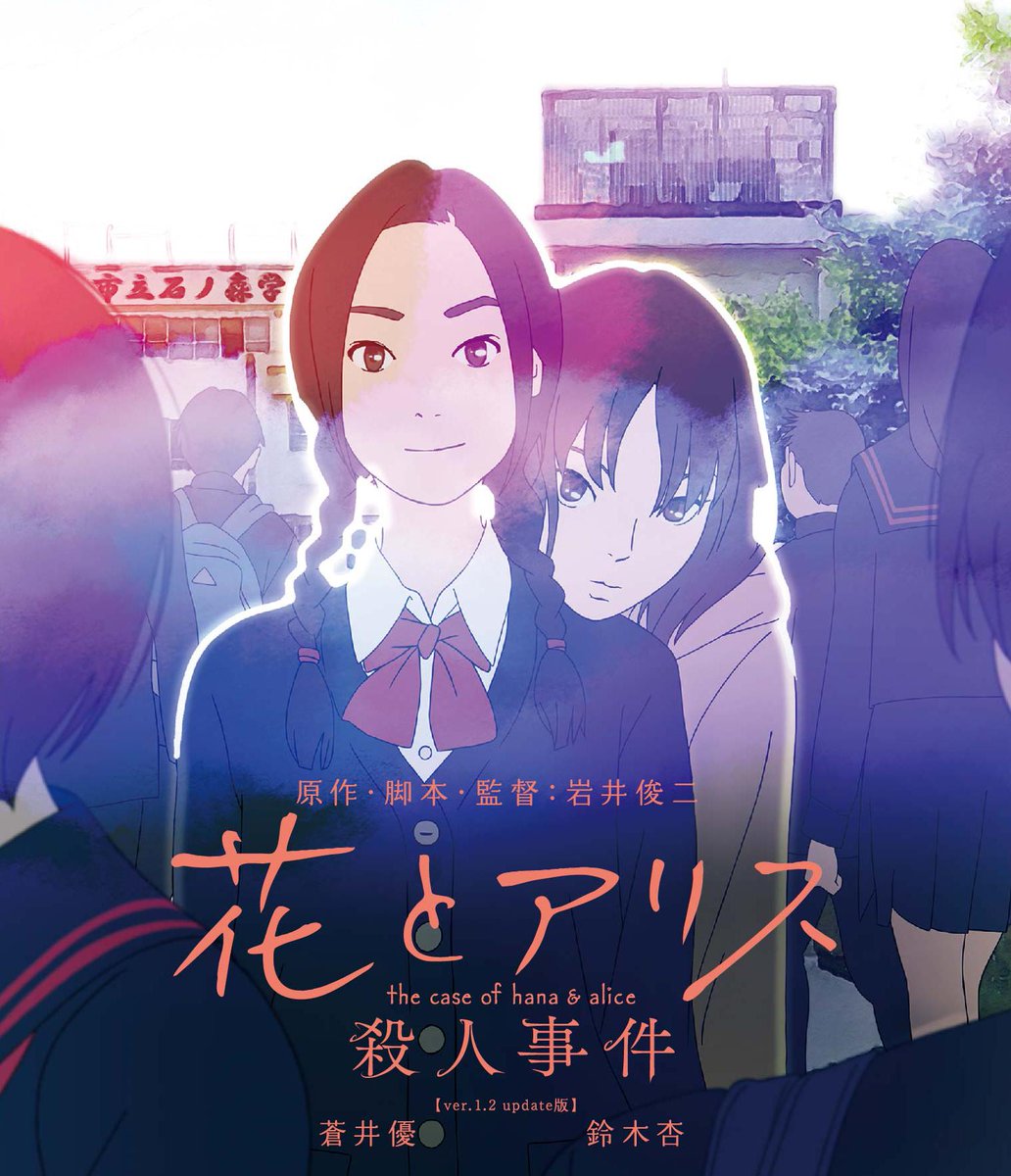
#135: The Case of Hana & Alice (2015)


Director: Shunji Iwai
Screenplay: Shunji Iwai
Cast: Yū Aoi as Tetsuko "Alice" Arisugawa; Anne Suzuki as Hana Arai; Ryo Katsuji as Kotaro Yuda; Haru Kuroki as Ogino; Tae Kimura as Yuki Sakaki; Sei Hiraizumi as Kenji Kuroyanagi; Shoko Aida as Kayo Arisugawa; Ranran Suzuki as Mutsu Mutsumi; Tomohiro Kaku as Tomonaga; Midoriko Kimura as Tomomi Arai
Viewed in Japanese with English Subtitles

Today we have a curious one-off in that the director of Hana & Alice is not an anime industry director but Shunji Iwai, a well regarded Japanese director behind titles like All About Lily Chou-Chou (2001), a figure still obscure to many but is held highly by others who know of him. In context, The Case of Hana & Alice follows from Vampire (2011), an American set horror film which qualifies as a tangent in itself as his first English language film, whilst the film I am talking about today makes more sense when you know it's a prequel to a live action 2004 production of his called Hana and Alice.

That the same leads Yū Aoi (as Alice) and Anne Suzuki (as Hana) have return explains the choice for animation as time has passed for this tale following two schoolgirls. We are first introduced to who we learn to be Alice, the other Hana not fully introduced until considerably later on, a mysterious girl next door to Alice's new home who keeps in her bedroom as a hikikomori. Live action directors making animation is rare, the likelihood for more animators to make live action films, with one of the few exceptions being Wes Anderson, who has done two films in stop motion and has effectively suggested as much that the first wasn't an oddity but a considered interest.

There's also Richard Linklater, who's the perfect person to evoke as his tangents into animation were rotoscope, which is the exact technique The Case of Hana & Alice uses. It's a type of animation which is divisive; I half suspect it's partially a sense of dismissal compared to drawing from scratch, but also because it's a curious aesthetic with very real figures (actors) and sometimes locations drawn over in drawings with a strange aura as a result. The only other prominent example of rotoscope in anime from the same period was The Flowers of Evil (2013), a TV series which was ultra divisive for this aesthetic choice and because it really looked different from the source manga.


It works in Hana & Alice, actresses reprising roles they would be too old to play, fourteen or so year old girls, but with many advantages of actually having actors in staged performances. Once you past the look, and weight is one of the aspects rotoscope has to try to traverse alongside a sense of distance even animation doesn't have, you get the advantage of actor ticks and movements difficult to animate. Prominently Alice is a former ballet student getting back into this among her various charming eccentricities, alongside Hana being the odd figure of the pair whose distinct personality is felt a lot more easily in body language than with a fully animated figure. That the world drawn around them is a heavily detailed modern urban Japan which is just as rich as the best examples found in other theatrical anime helps considerably make the choice of rotoscoping absolutely perfect and a rich aesthetic by itself.

Plot wise, Hana & Alice pulls a fast one. It originally starts as almost as a set-up to a horror anime as the students in Alice's new homeroom have bizarre rituals over the "death" of a male student, even leading to her being spiritually purified by the girl in the class behind this all, said to have been possessed by a ghost and now top dog as a result. It ducks and dives expectations, really coming ahead when Hana is introduced - to the initiated, hikikomori are people who shut themselves off from the outside world fully, a huge phenomenon in modern Japanese culture which is a major issue and a subject that has been covered in anime and manga before. Her choice to be as this is connected to this mysterious death, until eventually her encouragement of Alice to solve the mystery pulls her from her fears out the door.

As an outsider to the medium, Iwai does bring some idiosyncrasy to his tale, yet he could have made a great side job in anime screenwriting if he ever wants to, taking this initial premise and using it to spin a lot of personality in his characters. Little changes and layers are found in them which are peeled away or revealed, and when he gets to the investigation of the case, the film plays as a comedy with wrong people being followed, late night ramen on the run, and eventually a lot of soul searching. His sense of humanity is just to be found in the side plot of an older salaryman who is roped into this case, not play for anything else but light comedy and tenderness as a generational divide doesn't stop some emotional bonding. This is all in mind that, initially setting up a mystery, the story eventually deflates it completely and becomes a great film as a result, the script sparking with a considerable mix of playfulness and heart. The result shouldn't be elaborated on any further. It was a curiosity and a one-off which got a decent release from Anime Limited in the United Kingdom, so it has proudly sat among big titles on the DVD shelf. Again, if Iwai wants to come back to anime at some point he'd be welcomed by me with open arms as he was great here.