Showing posts with label Susumu Hirasawa. Show all posts

Friday, 1 January 2021

#175: Detonator Orgun (1991)


Director: Masami Obari

Screenplay: Hideki Kakinuma

Voice Cast: Kōichi Yamadera/Roger May as Tomoru Shindo /Orgun; Emi Shinohara/Katherine Devaney as Yoko Mitsurugi; Nobuo Tanaka/Justin Thompson as I-Zack; Yumi Touma/Joanna MacInnes as Michi Kanzaki; Bouya Ueda as Bannings ; Hiroko Kasahara as Kumi Jefferson/Mhiku; Kenji Utsumi/Bill Roberts as Zoa; Kiyoyuki Yanada as Wedge; Masashi Ebara as Virgil; Norio Wakamoto as Lang/Simmons

Viewed in the English Dub1


Detonator Orgun, from the era of OVAs' heyday, has many interesting factors. A solidly made three part sci-fi story with elaborate mecha designs, it naturally has Masami Obari, known as much as a talented mecha/character designer and animator, in the director's seat long before his career went into tangents such as fighting game anime and even hentai. Susumu Hirasawa, in the first time he composed a score for an anime in its entirety. Also in its very nature, Detonator Orgun's world itself is an intriguing one to step into especially in context to how anime science fiction changed or altered the type of tropes and clichés it would have over the decades away from this.

Set far in the future, at least past 2100, Orgus can be argued to be set in a world of both great advancement but also a dystopian is you found the world cold and disheartening. In a world where his city is just called City 5, Tomoru is a young man who is not interested in the modern day, he fixates in the 20th century especially the early decades of aviation and heroics during the World Wars. The only thing of any real interest to him of the modern day, dressing clothes considered gauche due to them looking more 20th century, is that alongside humankind having expanded into space he also has access to technology to record dreams or have artificial ones where he fantasises of heroics of the past he feels he will never take part in.

Beyond this, Detonator Orgun is a pretty easy to follow narrative. There is a biomechanical alien race called the Evoluders fixated on war and conquering the galaxy, their single minded goal they have been taking part in all this time, only for one of them called Orgus to defect and on Earth to protect it. By luck, and contact through the dream technology he uses, Tomoru is picked by this figure, a being whose body is mostly a robotic form that, whilst effectively sacrificing himself, lets himself by a machine for Tomoru to be fused into the defend his planet, his memories intertwining with Tomoru's and revealing where this invading force is from cryptically. Not a lot of this series really movies in very different tangents from this - but that is interesting in itself as, in its conventions, there is not a lot that is similar to work decades later with the same premise. Even though Tomoru is your stereotypical young male lead, this without a high school student involved is alien and immediately different; once probably because of the type of anime distributed in the West by the likes of Manga Entertainment, you seemingly had a lot more adult male protagonists alongside the teen ones, which even if artificially constructed as an illusion really time stamps this to a different era.

It is also very well made and distinct, a case of meat-and-potatoes storytelling, where it fully embraces a mechanical, manmade world of elaborate cityscapes, contrasted by the more mystical details which becomes one of the more curious touches. In this plot, eventually the relationship between the Earthlings and the opposite force of Evoluders (whose main lair is dubbed "Zoma the Combat Planet" in the Manga Entertainment) will have more complexity, and there is a female psychic named Kumi Jefferson who is popular on television and able to predict disasters, who also has an importance to the narrative as well. There are plot points which never are elaborated on further, such as the lead female character Yohko, a scientist, being bred from a special project, never elaborated on at all. There are also moments, such as Orgus' love interest, a female robot, appearing in the second episode only to ungraciously leave, which do show that this was not entirely firing on all cylinders in terms of the story telling.

It also is a production where the mech animators and designers were encouraged to push themselves, which is not a surprise considering Obari's talents in the field, and that does succeed. It is weird that someone as highly regarded as Obari, known for his craft in mecha design, did not direct as many mecha anime until into the later 1990s and 2000s, and deviated in video game adaptations games and porn. Here in his element, naturally the robots and combat scenes are elaborate.

This OVA, in truth, does feel like it is merely dabbling in very interesting ideas. Coming from a rich era of science fiction for anime, you find a bit of playfulness, including having a fake promotional commercial for the outer space military group "the Link Men", all bombast and even a cute female mascot asking viewers to join them. Its one virtue is presenting an elaborate world of sci-fi, where human beings are colonising the universe and where one of the side characters is actually I-Zack, the A.I. intelligence Yohko works with who even has a face from computer graphics on the screen. Even if it never really has the ability to expand even further, it is amazing how many anime, even these forgotten straight-to-video titles, can build up interest landscapes even from unoriginal material. Even if this is mostly an action story, of a lot of robot versus robot fight scenes, this is a huge factor to consider.

Also worthy of interest is this being the first time Susumu Hirasawa was the composer for an entire anime production, which would be the start after this show's three soundtrack albums' worth of music of a very interesting career. His anime soundtrack career however is surprisingly small, sadly more so since the passing of his regular collaborator Satoshi Kon, as Hirasawa's career as a musician is significantly larger than his work as a composer, the only other work he has really worked on being the Berserk franchise. Hirasawa himself has been documented as not being fond of this production, especially when with the third album, though finding it a building block for his work on the 1997 Berserk animated series1. Here you can feel it as the early steps, with some very dated (if charming) synth of the time, but eventually by the end credit song Root of Spirit, which closes off the Manga Entertainment release, a little gem in itself is heard and you see immediately how significantly Hirasawa's career in the medium would be despite the small CV.

Detonator Orgun altogether is not a perfect work. It does feel conventional in context to other anime of the era, even if there has always been a reason (just for the Hirasawa's score and art style) which keeps bringing me back. The show definitely gets a bit peculiar when it reaches its final, a sci-fi tale which gets far more esoteric then you would presume it. This for me personally is actually fun. One of my favourite clichés, the out-of-body dreamscape, appears in all its delight, and whilst I openly admit a finale involving something using their psychic powers to move the sun is ridiculous, I am amused by this ridiculousness. The English dub is poor, which has never helped the title, additional swearing in the rewrite and all. Certainly, in the grand scheme of this era, it is not the best, but as someone with an interest, there was still so much to appreciate.

Even in context to Masami Obari as a director, this is interesting, as whilst Fatal Fury: The Motion Picture (1994), his next project which is held one of the better video game adaptations, his career in general as a director has been very divisive. Just his nineties work took an odd director for sure, with the likes of Voltage Fighter Gowcaiser (1996) and Virus Buster Serge (1997) not very well regarded. He also went further in more sexualised content, even with shows like Gravion (2002) and its sequel Gravion Zwei (2004), fun mecha shows, made at the same time as the hentai titles. Here, you do get a few showers scenes, but this is incredible chaste in comparison.  Even in terms of one of his most distinct and divisive trademarks, his very idiosyncratic characters designs which became more exaggerated over the decade, that is not to play here either as the character designer for Detonator Orgun was Michitaka Kikuchi, who under his manga pseudonym Asamiya Kia, alongside a career in the anime industry, created the series Silent Möbius (1989–1999). It is, in context, an outlier of all things.


======

1) The English dub for the anime, for the old Manga Entertainment release, who also put together the episodes into a feature length production for the 2003 DVD release, is bad to the point of affecting the film immensely, something worth elaborating beyond the little mention of in the main review. Just the amount of times characters are calling each other "bastard", part of the company's habit of increasing the language to raise the age rating in the United Kingdom, this dub has not aged well in the slightest.

2) As remarked upon by him in this interviewer HERE.

Friday, 26 April 2019

#96: Paranoia Agent (2004)


Director: Satoshi Kon
Screenplay: Seishi Minakami and Tomomi Yoshino
Voice Cast: Daisuke Sakaguchi as Shonen Bat; Mamiko Noto as Tsukiko Sagi; Halko Momoi as Maromi; Makoto Tsumura as Shogo Ushiyama; Ryūji Saikachi as Old Person; Shōzō Iizuka as Keiichi Ikari; Toshihiko Nakajima as Masami Hirukawa; Toshihiko Seki as Detective Maniwa                                       
Viewed in Japanese with English Subtitles

Synopsis: One night a female illustrator Tsukiko Sagi is assaulted by whom she describes as a young male wearing golden inline skates with a bent, golden baseball bat. Thus "Lil' Slugger" (or Shonen Bat in the original Japanese) is christened, and to the police's bafflement, he can abruptly appear to all his targets, all of which are seemingly people either connected to each other and/or pushed to the edge of despair.

In his short and tragically short career, only living to forty six due to pancreatic cancer, Satoshi Kon made four films and this one anime series, but has developed a cult reputation that has even stepped outside of anime itself. When being in your forties is still considered a young upstart in the anime industry, Kon could've (and likely) would've pushed the medium of anime into more idiosyncratic directions. Based around various strands of ideas he felt shouldn't be wasted, what Paranoia Agent is isn't necessarily vignettes but all tied into a very elaborate thirteen episode series. Contrary to my original beliefs, such a long time since seeing this series, Paranoia Agent is a very precise tale.

Ten episodes follow the tale of Lil' Slugger, an urban legend who yet is actually responsible for smashing people in the skull with a golden baseball bat, strangely targeting people all interlinked by them reaching a crisis point in their lives. The three episodes which feel like side plots, the entirety of disc three of the original UK DVD release, back when anime used to be (inexplicably) released by three or four episodes over many months, are still connected to the main story and add character to the world being depicted.

In said world, as his other work, Kon blurred reality itself with the exception of Tokyo Godfathers (2003), tackling subjects like dreams or subjectivity under mental distress. Even when Paranoia Agent can only work as being supernatural for certain plot incidents, it's using a lot of visual metaphors to depict the distorting mental states of its cast. Flights into an idolised youth, literally a cardboard town of two dimensional people, a woman whose split personality in combat with her leaves answering machine messages, a police interview which (in the funniest episode) turns into a stereotypical Western high fantasy quest based on delusions of being in a video game, or the first victim of Lil' Slugger, character illustrator Tsukiko Sagi, having her mascot character Maromi as a talking figure who constantly tells her to just ignore any prang of concern she has about anything.

Ultimately, Kon emphasises a long trodden obsession of his of the absolute dangers of escaping reality no matter how painful it is, one of the only exceptions being Millennium Actress (2001), a tale of an aging actress which was clearly indebted to real life Japanese actresses Setsuko Hara and Hideko Takamine. Here in Paranoia Agent is his most overt thesis of this concern as it's the central plot. Following intertwined characters - Sagi, two cops Keiichi Ikari (older and old fashioned) and Mitsuhiro Maniwa (younger and dangerously open minded), and various reoccurring side characters - the tale of Lil' Slugger, at first seen merely as a hoodlum, is visibly even in the subjective world view of the series a supernatural entity or one giant metaphor for escape that has become an actual, real destructive force. He targets those pleading to escape pain - neurosis, anxiety, a downward spiral of crime, general chaos in one's life - called in hope he'll roll in on golden inline skates and in one case knock someone's skull in so hard they completely forget who they are and all they've suffered through.

From https://i0.wp.com/the-avocado.org/wp-content/uploads/
2018/02/PA12_shot4.png?zoom=2.625&resize=371%2C173&ssl=1

Not desiring to spoil the series, his mirror is Maromi, that lovable cartoon dog that Tsukiko Sagi created at the beginning of the series, a stand-in to a phenomenon like Hello Kitty who is an immediate success and becomes an insanely huge marketing property that the populous becomes obsessed with. We'll get to Susumu Hirasawa's music later, but it's not a surprise in lieu to how sinister this dog's influence is, at least in Kon's eye, that the end credits has every character laid asleep around a giant version of Maromi, in a grassy field, whilst an unnervingly calm but eerie piece of music is playing.

The series also an attempt at tackling various cultural issues; Kon's work all did, Tokyo Godfather breaking a taboo by talking about the homeless in Japan, but Paranoia Agent is basically sewing together various different issues at once through one long form project. The anime obsessed otaku, a minor side character, who in the gaze of all his female figurines hires a sex worker. The gossiping women, who have an episode, trying to have more elaborate tales about Lil' Slugger over the others. The episode on suicide, as three members of an online forum for this act meet up, an elderly man and a young man horrified the third in a young girl.* The general sense, coming to ahead in the finale, of a collective attempt to bury one's emotions that becomes completely destructive.

In lieu to how TV anime is likely more hectic to produce and with less time to manage resources, Paranoia Agent is still a great series in terms of craft, even with a sense of humour at the expensive of this area of the medium being incredibly stressful as, for an episode, it follows a lowly and useless staff member on an upcoming Maromi animated show, explaining various details of real staff member positions in digressions and probably touching on some real angst, being let out, of how utterly agonising working on a show production schedule probably is. Kon is also a fascinating case where, an absolute definition of an "auteur" where his directorial work bares his obsessions, he also shows how many auteurs how important voices working under them who don't negate their status as directors, but are great collaborators. Character designer Masashi Ando, who worked on him on Tokyo Godfather and his last film Paprika (2006), has helped a lot in terms of the trademark realistic character designs which have allowed a grounded sense of reality to these works, perfect for when they transition into the unnatural.

Likewise is his frequent musical collaborator Susumu Hirasawa, who started working with Kon fron Millennium Actress and, alongside his work in anime like the soundtracks for the various Berserk adaptations, is likely better known through them than his musical albums in the West. This is sad, but not a detrimental argument against said soundtracks, Paranoia Agent just as compelling. The best way to describe him is Peter Gabriel's soundtrack to Birdy (1984) crossed with New Age and electronic pop, folk ideas matched with all the peculiar electronic equipment he has had on stage over the years, all matched by a falsetto to die for. That, and I swear to this, even yodelling or the closest thing to it. Seeing his work in a TV series, whilst it does repeat motifs, is a very interesting change of pace, even an amusing choice of using the opening theme within an episode to freak a character out. And befittingly, whilst it's joyful, the lyrics in translation are aptly dark and for consideration alongside the opening credits animation itself, held with high regard as an opening itself by a puzzle box to decipher. Even the next episode previews, including a side character of an old man who is presumed to be delusional but has a strange knowledge, add to this by using animal nicknames for characters for part nonsense, part clue based monologues.

Sadly, this was Satoshi Kon's only television series, but among his small output, Paranoia Agent stands out as also one of the best series from the 2000s with good cause. Arguably, with a career that beforehand included being a manga author and working up in the anime industry itself to also consider, Kon had one of the best runs as a director regardless of medium, four films and one series which are as high a bar in talent as you could get. Again, its stepped in tragedy and loss, but God he was good.

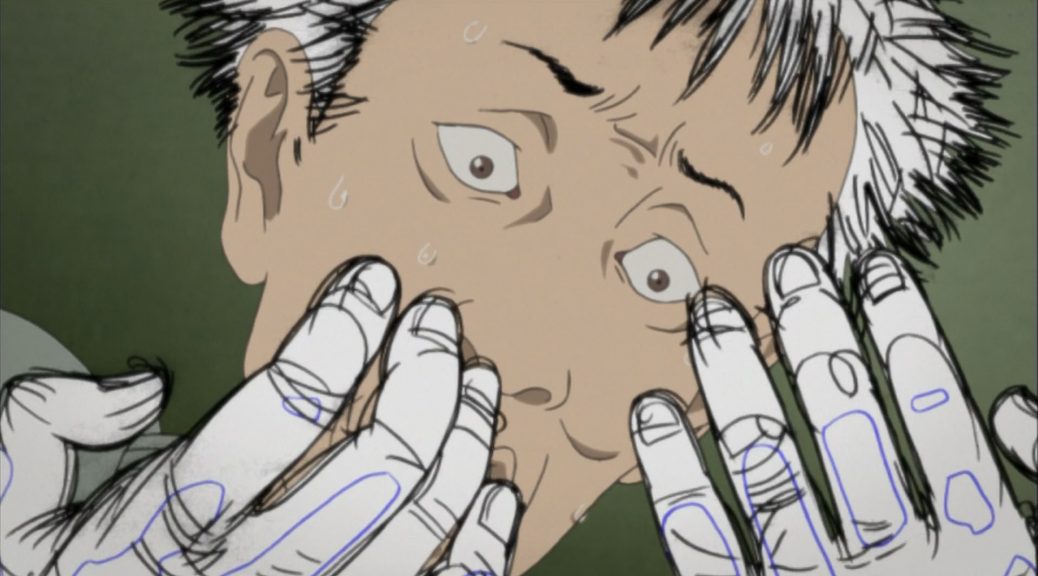
From https://blog.sakugabooru.com/wp-content/
uploads/2017/12/tfw-houkai-1038x576.jpg

======
* Unfortunately, within the UK, whilst the offending scene is seen in the next episode preview beforehand, that episode was censored for a hanging scene and is still like this in 2019. At the same time, when this took place, an episode of Ren & Stimpy was censored for a gag about hanging too for DVD; despite Paranoia Agent being an adult work still rated for only eighteen year olds to see due to this episode, I have always speculated that it was picked on as well for being animated and depicting a form of suicide as well. It's still one of the biggest reasons, despite all their good virtues, I have always had a distrust of the British Board of Film Classification (BBFC) where every motion media work has to be rated through.