Showing posts with label Light Novel Adaptation. Show all posts

Sunday, 9 October 2022

Bonus #15: Boogiepop and Others (2000)


Director: Ryu Kaneda

Screenplay: Sadayuki Murai

Based on the light novel series by Kouhei Kadono

Cast: Sayaka Yoshino as Tôka Miyashita / Boogiepop; Maya Kurosu as Nagi Kirima; Daijirô Kawaoka as Keiji Takeda; Ayana Sakai as Minako Yurihara / Manticore; Asumi Miwa as Naoko Kamikishiro; Mami Shimizu as Kazuko Suema; Kai Hirohashi as Kei Shinkoku; Tetsu Sawaki as Akio Kimura; Hassei Takano as Saotome Masami; Hideyuki Kasahara as Shirô Tanaka

Live Action Adaptation


This is not the 2019 animated series by studio Madhouse being covered, but a live action adaptation of the first Boogiepop light novel released the same year as the first ever animated adaptation, Boogiepop Phantom (2000). It offers an interesting layer in explaining Boogiepop as a franchise, in that it is a deeply unconventional story in terms of lore but also in its storytelling in just the adaptations themselves, all of them unconventional even if the 2019 anime series is the most cognizant and does heavy lifting in explaining the lore to its basics.

The live action tale is aptly a puzzle box as much as Boogiepop Phantom, immediately disarming in how it has jazz cocktail piano music set to images such as a high school girl seductively licking the eyeball of another girl who is clearly dead. It is one of a few abrupt fragments we see in the prologue, in this Toei Video co-production, introducing all the students we will follow, as this film is told out of order, told in fragments over a timeline in different chronology to how they actually played out. It is, thankfully, fleshed out fully in the end with only certain passages not seen until the end of the film itself, with interlude segments in-between which add additional context. Screenwriter Sadayuki Murai, whilst working in live action here, is predominantly a screenwriter for animation, including for Boogiepop Phantom. He also penned Satoshi Kon's Perfect Blue (1997) and Millennium Actress (2001), so he is someone I have immense respect for, his craft on hand here in making sure this all makes sense in the end whilst taking a huge risk in depicting this tale in this idiosyncratic method of non-chronological storytelling.

This is also where the logic of Boogiepop is curious, just attempting it like any anime/light novel into live action as the Boogiepop costume alone, the titular figure a mysterious form who shares a body with a highschool girl named Tôka Miyashita (Sayaka Yoshino), looks really strange in the middle of a school or ordinary urban Japan at the time, looking like a Dune planet traveller is striking purple. Boogiepop, an urban legend presumed to kill people, is actually there to protect people from unearthly forms actually responsible for this, co-existing as separate entities in one body, and in terms of the tale being told, it tells the chapter in the 2019 anime which made up episodes one to three, Boogiepop Does Not Laugh. In this tale, there is a "manticore" disguised as a school girl, devouring the brains of fellow female classmates and whose tears, with an assitant, are being peddled as a mind sapping drug to bring more victims to her. There is the boy who loves Tôka who has to contend with how she is unaware of Boogiepop, and there is a girl who has found "Echoes", an alien entity in a human body connected to the manticore but is a form of good against them. And then there is Nagi Krima (Maya Kurosu), whose depiction here I loved. She is the other character of importance just in the Boogiepop adaptations alone - the daughter of a murdered novelist who, learning of the unnatural entities around her and Boogiepop, brings technology and her own martial arts skill to compensate for being a mortal young woman. This version as played by Maya Kurosu, as a short haired tomboy breaking students' arms, is a really cool one that sadly never was followed with and only has a short part to this narrative, one of the issues inherently with adapting merely a piece of this franchise when the series can expand on the character.


Telling a short piece of the source material, it is curious to see this version, which does have the limitations of a lower budget and the limitations of live action, stripping away some of the context and lore to its most practical version to adapt. Boogiepop is odd as a premise anyway, a sci-fi laced work with its horror touches and its esoteric world of artificial people, alien forms and monstrous entities picking on mortals. Boogiepop and Others, the 2019 version is the most conventional version as it is a series of four different stories like an anthology, whilst this live action version, because it shares a same screenwriter, is as esoteric as Boogiepop Phantom in how it plays out, which is a really unconventional experience even in context of this era's Japanese genre and horror films from the time. I have had ambivalence on all the lore, even as someone who admires all three adaptations as their own franchise without the source material, coming entirely from finding the 2000 Boogiepop Phantom an opaque and difficult anime in my youth, fully appreciating it now knowing it was a sequel novel adaptation which barely explains its world, becoming something abstract as a result and compelling as a result. It was also one where the real meat came from how the stories, no matter how unnatural, came from human behaviour, such as a plot line of someone who causes people to escape as their inner children, abandoning their adult selves as living husks in the normal world. Boogiepop Phantom out of all three also has the most distinct and incredible aesthetic and mood, but this live action interpretation glances at many of the franchise's virtues, including in how all these stories still connect to human folly and behaviour, slightly glanced over here with the subplot about the drug being taken for escape by students.

This does thankfully create its own atmosphere even in its own way. The urban Japan of this era of horror movies, especially the lower budget ones, has always compelling for me, more so in the case of this premise which, baring CGI which was aged back then, is having to work around its very unconventional content in the confines of what could be done practically and with the budget. It feels more compelling as horror and genre cinema that, hidden among the Japanese classrooms and in darkened alleyways, these strange visitors and incidents are transpiring, which you do not really see from lower budgeted North American films from the era unless with the lowest of budgets, always feeling restricted in their own confined sets as a result. Also the music, by composer Yuki Kajiura, is just as idiosyncratic as the two animated productions - not only does this have Boogiepop Phantom's opening theme at the end, sultry male vocal lounge music, but the smooth jazz score is delightfully unconventional, proto vaporwave, like the purple hue some scenes have.

Arguably this is the weakest of the three versions, even if the simplest of reasons that the others have longer to expand and shift with their narratives, whilst this has the time to tell just one of these tales. It is however a fascinatingly curious twist to low budget Japanese horror cinema from this era, even without the context of being an adaptation of a light novel, for how esoteric and unconventional the tropes of science fiction and horror are used within it. Able to see this, it is also the one adaptation of a source that became famous with its animated adaptations that managed to not come off as a compromised version. It struggles and it has to minimalize the more out-there aspects of the source work, but it manages to succeed in its own way to adapt the material, which is an achievement in itself.

Friday, 12 August 2016

#31: Vampire Hunter D: Bloodlust (2000)

From http://static1.comicvine.com/uploads/
original/3/38826/2379618-bloodlustposter.jpg
Director: Yoshiaki Kawajiri
Screenplay: Yoshiaki Kawajiri (and Brian Irving)
Based on the light novel Demon Deathchase by Hideyuki Kikuchi
Voice Cast: Andy Philpot (as D); Mike McShane (as D's Left Hand); John Rafter Lee (as Meier Link); Wendee Lee (as Charlotte Elbourne); Pamela Adlon (as Leila); Matt McKenzie (as Borgoff)
Viewed with English Dub

Synopsis: In the far future, the world is left in a post-apocalyptic state where vampires and other creatures of the night exist within the land. D, a half vampire and half human dhampir, is one of the best and most feared hunters of vampires, sent after the Baron Meier Link when he is said to have abducted the mortal woman Charlotte Elbourne. With another group called the Marcus Brothers, led by Borgoff, sent after the Count as competition, the result will become violent and morally complex with both the mutants hired to protect Meier Link extremely dangerous and the real nature of his relationship with Charlotte having real love behind it.

From http://comp.judging.it/content/Vampire%20Hunter%20D%20-%20Bloodlust/720p-1/Xell%20SD/Vampire.Hunter.D.Bloodlust.2000.German.DTS.ML
.576p.HDTV.x264-Xell_(00-01-22.415)_01.png
Many view Bloodlust as the superior take on Vampire Hunter D. I'd argue that if the 1985 anime adaptation represents its era - the bright coloured but phantasmagoric content of the era - than Bloodlust is the full blown gothic symphony in terms of aesthetic and presentation. Created as a Japanese-American co-production, the franchise gladly entrenched itself with Western influences which allows this version to work incredibly. Like the first adaptation, one of the best aspects of the world is how it combines numerous genres - gothic horror, sci-fi-, the western - into one seamless form which can cherry pick from them all in plot and visual palette.

From http://i2.photobucket.com/albums/y2/MaverickHunterZero
/936full-vampire-hunter-d-bloodlust-screenshot.jpg
Bloodlust more than the original takes advantage of this further, helped by the fact that the film is helmed by Kawajiri; known for making films like Ninja Scroll (1993) with simplistic plots but exceptional production quality, he also has the gift of having so many ideas that he attempts to cram into each work that the material around the plots is always compelling. It can be easily argued Bloodlust is one of his best films as, while the earlier work that made his name is notorious for its extreme content, this fully embraces the world's template for his most outlandish and imaginative ideas but is also haunting in how its depicted. While gory and violent it lashes onto the chance to be as elegant as possible. It's an anime which can have its cake and eat it, starting like a classic Universal horror movie with a phantom carriage traversing cobble streets from a Victorian city only to quickly become a sci-fi western hybrid when D is introduced, gunslingers with rifles on the beams of a gothic ruin when the dhampir takes on a bounty where, if Charlotte is turned into a vampire, he is asked to kill her.

From http://i.imgur.com/rS4PLgQ.png
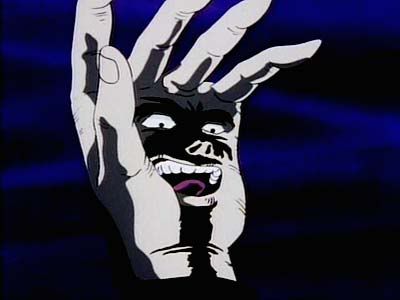
The high quality of the feature film is matched by how imaginative it is. The realistic character designs that are a trademark of Kawajiri's productions, the emphasis on the characters looking like real people even when they're superhuman or distorted, allows the tone to get away with the more fantastical content. The world itself is already one of the truly strange and unexpected in terms of what the source material has, such as D's talking left hand, a parasitic entity with a face on his palm that, here, is a comedic sidekick who whinges or mocks D as they move along, taken further than in the original 1985 adaptation as a cranky but lovable entity. Kawajiri, known for his taste in the bizarre especially for villainous henchmen and writing the screenplay, is allowed to bring in henchmen with supernatural powers through the world's conceit of mutants also existing, from a demon clown with shadow abilities similar to a minion from Ninja Scroll to a wolfman who, in his full lycanthrope transformation, has a giant wolf's head with sharp teeth grow from his chest. With Bloodlust the world feels so detailed and fleshed out that the result has a visceral beauty to it; while the 1985 anime was a spectacle of morbid colourfulness, with splatter and nudity, this is closer to a symbolist's wet dream, one filtered through gorgeous animation and a score by Marco D'Ambrosio that fittingly crosses genres, classical orchestra mixed with soul stirring choral chants and brief moments of science fiction electronic hums.

From http://www.animeviews.com/images/screenshots/vhd3.jpg
The other significant reason Bloodlust is amongst Kawajiri's best work is that, for a man infamous for gore and simplistic action plots, this film attempted a greater emotional scope for him because of the source novel's plot and actually succeeded even if there's moments of sincerely naivety to it. The world of Bloodlust itself is depicted, after hundreds of years of the apocalypse reshaping the land, as both a threatening but also awe inspiring place, the usual signs of the wasteland found but also western frontier towns and magical places existing, from an immense garden where a key dramatic scene plays out or the desert landscape where giant, flying mantas - the aquatic creatures mixed with the worms from the Dune novels - flying out from under the sand on mass into the air. The high level of artistic production allows it to be a menacing but also colourful world that does add an emotional effect already. The other is in the plot itself, Kawajiri as the screenwriter stepping out of his comfort zone. The main plot is between D and Leila, a female member of the Marcus Brothers who develops a mutual bond with him, but the really interesting aspect is Meier Link and Charlotte, how they are actually in love with each other and how much of a conflict is involved with the bounty hunters after them when they realise this. Even when the real antagonist is introduced near the end, a full on vamp feeding into the characters' subconscious and a costume off a catwalk, the result is still gothic melodrama delightfully found in the midst of an action horror film. That Bloodlust is as dynamic in style as it is, where rocket ships like look like church spires with actual stain glass windows on their sides, adds to this emotion with morbid beauty.

From http://comicattack.net/wp-content/uploads/2012/
08/4687043505_4aed47b173_z.jpg
Of course, there's the one conundrum that, if this is an American co-production where the English dub came first, does this technically count as an anime for this blog? Yes for me in the sense that, based on a work legendary in its homeland, this feels like a connection of two different countries to create an epic regardless of which country is was designed to be released in first, paradoxically entrenched in gothic influences from the West but undeniably a Japanese anime in style and tone. The only real disappointment with Vampire Hunter D: Bloodlust is that, barring some other high profile American-Japanese co-productions (The Animatrix (2003) and Production I.G's animated sequence for Kill Bill Vol. 1 (2003), these type of productions dwindled immensely by the late 2000s. Especially for Kawajiri his later co-productions with the US became compromised creatively, Highlander: The Search of Vengeance (2007) having the potential to be great but merely a deeply flaw, and at times silly, curiosity. Thankfully there is a significant attempt from two American companies, Unified Pictures and Digital Frontier, to bring back Vampire Hunter D as a television series, giving this world another tale if they succeed. One of the most interesting things about Vampire Hunter D is that, not only have the light novels that originated it created a franchise that's lasted, but the franchise at least in the animated versions developed a following the US, Bloodlust likely to be one of the best ways to introduce a person new to anime to the medium in how it does everything right. While I still hold the 1985 version as a good anime itself, I realise its limitations, whilst Bloodlust is a high recommend and one of the best horror based anime of its kind, a magnum opus even if it's only ninety or so minutes that still stands strong in quality. 

From http://www.judging.it/wp-content/gallery/vampire-hunter-d/Judgment-
Vampire-Hunter-D-Bloodlust-55687BCB_01-24-02.496_01.png

Monday, 22 February 2016

#19: Vampire Hunter D (1985)

From https://41.media.tumblr.com/c2a3162baa311844f2b7d7
c070267079/tumblr_nn6dycyAiD1spaq6ho1_500.jpg
Director: Toyoo Ashida
Screenplay: Yasushi Hirano
Based on the light novels by Hideyuki Kikuchi
Cast: Kaneto Shiozawa/Michael McConnohie (as D); Michie Tomizawa/Barbara Goodson (as Doris Lang); Satoko Kitô/Edie Mirman (as Lamika); Seizo Katou/Jeff Winkless (as Count Magnus Lee); Ichirô Nagai (as Left Hand); Kazuyuki Sogabe/Kerrigan Mahan (as Rei Ginsei)
Watched with English Dub

From http://static1.squarespace.com/static/5138a6d4e4b0908a3a990080/t/
52e435e7e4b0eeee546814ba/1390687722352/vampire-hunter-d-conde-magnus-lee.jpg
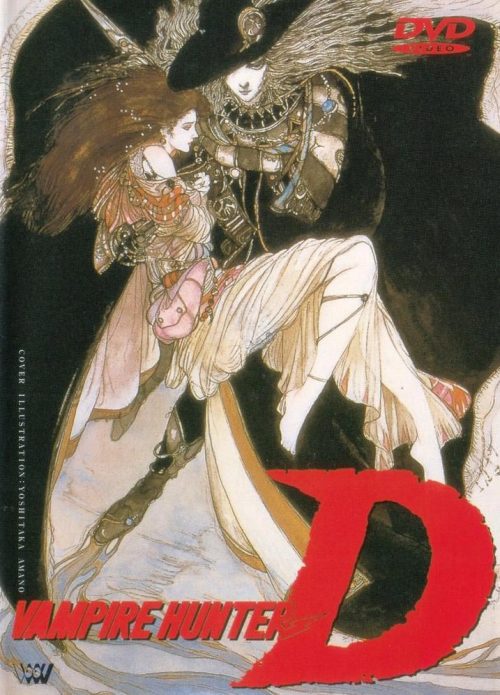
Having only known of Vampire Hunter D through its two animated adaptations, the one I'm covering today and the more critically acclaimed follow up from 2000 by Yoshiaki Kawajiri, I'm a novice in my knowledge of a momentous pop cultural franchise. Like (entry # 16) Galerians: Rion (2002), I first heard of the franchise through a videogame tie-in in one of my old Playstation One magazines, though its origin as a series of light novels would go on to spawn many a tie-in beyond that game. A huge factor to these books' reputation is the art by Yoshitaka Amano, whose work if you research him on Google is some of the most beautiful and artistically satisfying to be created for a Japanese pop cultural object. His work and Vampire Hunter D in general, including the anime adaptations, are heavily influenced by European art and genre motifs, to the point the most beloved of the two anime, Vampire Hunter D: Bloodlust by Kawajiri, was a US-Japanese co-production where the English dub came first.

From https://i.ytimg.com/vi/mPuu9HNUcN4/hqdefault.jpg
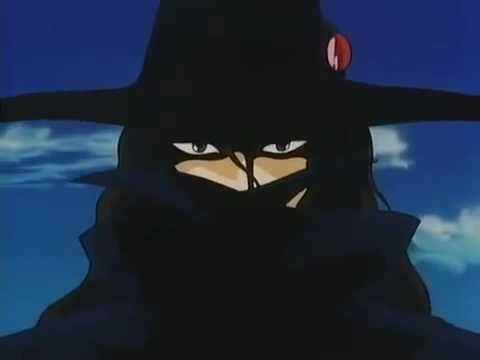
The influences and how Vampire Hunter D used them to create its unique world is ultimately the best virtue of the 1985 version alongside its OVA quality animation. Melding Gothic horror with the post-apocalyptic, with frontier western vibes crashing against post-medieval towns, it envisions a world thousands of years in the future where, after a calamity, mankind survives in a society scattered across apocalyptic wasteland where demons and mutants gladly co-exist, where werewolves prowl the lands and, in lieu of the title, vampires stalk the night and require paid vampire hunters to eliminate. A dhampir named D, half vampire and half mortal man, wanders the landscape being paid for jobs, the only constant being his left hand which, with a human face, is sentient and cannot shut up, mocking his attempts at resisting his vampiric blood. The plot is pretty basic after this established character is introduced over eighty minutes, a young woman named Doris Lang hiring D after an ancient vampire Count Magnus Less has marked her to be his bride. Like a lot of pulpy characters, as much in anime like this, its these characters including those introduced for a single story that bring out the personality, the plot thickened by a mutant who'll gladly help the Count in hope for immortality and the Count's own daughter Lamika who is appalled about both the idea of a mortal peasant joining their royal lineage and becoming her mother-in-law.

From http://img.photobucket.com/albums/v517/
richardsplash/INVASIAN/VampireHunterD2.jpg
The basic nature of said plot, where D has to repeatedly struggle against new obstacles each scene, from ghouls to the aforementioned mutant, means that the entertainment is in the world itself being depicted onscreen. Horror, as mentioned in previous posts last year for Halloween, is a surprisingly neglected genre in anime, only starting to pick up in amount within the last ten years and especially with stuff like Tokyo Ghoul (2014) getting popular in animated and paperback form. While action orientated, seeing a Japanese work entirely devout to a fetish of European horror, even in the big eyed eighties character designs, is utterly welcoming.  The melding of science fiction and gothic horror manages, despite being potentially awkward bedfellows, to work in these two anime adaptations, reined in by the general tone and looks of both. They exhibit one of the most extreme, but ultimately satisfying, examples of a genre melting pot in how many influences there are - period townsfolk and frontier western clothing against robot horses, the vampire count dressed like Bela Lugosi against the bloodier violence of straight-to-video anime - and yet because of the art style this first adaptation makes it all seamlessly work together.

From https://thomfiles.files.wordpress.com/2012/06/vampire-hunter-d.jpg
The animation style does add to the film immensely. The only real botch to this version decades on is that the female lead occasionally looks like a twelve year old in scenes, even in the context of the eighties character designs, certainly cringe worthy when you notice it when there's a scene where she melancholically tries to seduce D only for him to struggle with wanting to bite her neck. The gothic, realistic character designs of the 2000 version are the best, but as a film meant to bring the D character and his world to the video screen, the original eighties version is still handsome in quality and gets right the most important of the story in terms of the fantastical nature of it. Against anything from giants to an imp-like witch, the protagonist D exists in a world of the phantasmagoric melded with sci-fi; where the ruined castles would have to be dank and oppressive, where the pits below have the centuries old skeletons laid about from a war and snake women to seduce people, as the post-apocalyptic content is as appropriately bleak. The more unconventional aspects, such as D's talking hand, add to this is giving the film its own distinct personality. The only thing that spoils the general mood that is so well added are that, one, the original English dub is terrible with stilted line readings and, two, the end credit song is a wildly inappropriate New Wave influenced J-pop number, especially after the ending takes on both a sudden abstract series of seasonal changes and both a sombre, clean act of saying goodbye. The dub is only a problem depending on the version of Vampire Hunter D you see; now with the recent American re-release of the film, the company realising it Sentai Films had to create a new English dub due to the original dub's materials being too damaged for restoration. The end credit song however is one you're stuck with. 

Saturday, 26 September 2015

#6: High School DxD (2012)

From http://media.animevice.com/
uploads/0/69/595575-high_school_dxd.jpg
Director: Tetsuya Yanagisawa
Screenplay: Takao Yoshioka
Based on light novels by Ichiei Ishibumi
Voice Actors: Yōko Hikasa (as Rias Gremory); Yuuki Kaji (as Issei Hyōdō); Ayana Taketatsu (as Koneko Tōjō); Azumi Asakura (as Asia Argento); Shizuka Itou (as Akeno Himejima); Kenji Nojima (as Yūto Kiba)
Viewed in Japanese with English subtitles

Update 26th March 2016: Originally this was a link to the review for Videotape Swapshop but unfortunately as of the start of 2016 the site no longer exists. This only effects this blog in that the following now, when you click this modified post, is the full review left as it was originally. Additional footnotes have been added with new reflections.

High School DxD if it was a live action exploitation film from the seventies would be one about demonic schoolgirls that would be promoted as being too illicit for the faint of heart. The only difference is that they would've been played by actors in their thirties than drawn characters. That the series was banned in New Zealand does add an infamy, but it was also passed uncut and suitable for fifteen year olds to buy at a counter on DVD in the United Kingdom too1. For all the nudity, the lurid commercial break stills of female characters contorting in various states of undress and sleaze its managed only a fifteen certificate, which shows a surprising moment of progressiveness from the British censors. No lynch mobs have appeared, though I dread the mother or father who stumbles in on their fifteen year old watching this, as it makes some of the sleazier Italian movies of the seventies, with higher age ratings, look tame in comparison. High School DxD rightly is available to buy as it was intended to be, whether it's good for you or offensive, though when one of the bonus mini-episodes has undo noodles come to life and molest the female cast like tentacles, I have to wonder what the hell was in the water cooler at the BBFC when it was decided "nah, an eighteen certificate would be too harsh."

As in many an anime, the lead is a hapless male school student called Issei Hyodo. Somehow anime can make it sound logical, even just to itself, that he can be affable and ultimately a wonderfully kind hearted person but also a pervert who hides with his friends in the women's changing room all the time. His luck seemingly changes when a shy girl asks him to be her boyfriend...then reveals she's an evil fallen angel after him because he is blessed, like many an anime protagonist, with a special ability called a Sacred Gear and kills him. What could be the shorted show possible is lengthened drastically when a female demoness and fellow school student of his, the red haired and young head of the demon family called Rias Gremory, resurrects him as a demon to be taken under her leathery wings as a beloved underling. With him as he learns the ropes are her vice president Akeno Himejima, a sadistic thunder maiden who share's Rias' ridiculous Russ Meyer inspired character proportions2; Koneko Toujou, a diminutive female tank who will gladly knock his head off for being a pervert; and Yuto Kiba, the only other male of Riass group who together gain pacts with humans and convene together. Later on in the first main story of the series a female European named Asia Argento is introduced who can heal people and is a very shy, affable girl. Yes, she's named after Dario Argento's youngest daughter and star of Land of the Dead (2005), though I can't say if it's a reference or a freak coincidence.

The series is split into two halves - the first with Argento and the evil fallen angels who plan to manipulate her, the second half with the head of another demon family who wants to take Rias as his wife forcibly. The real point of the series is for its titillation, more of a sex comedy which lunges into drama and fantasy action very abruptly at points. Sacrificing a great story potential doesn't help. It's not original but you can make something from it as with any plot. However the incongruous mix of the comedy and fantasy doesn't work when it should've stayed only as a fantasy comedy. Neither does it help that it splashes in mythological ideas it has no real interest in taking further unless it's a joke, like the fact demons can't read Bibles without getting a horrible headache, the rest underserved of its potential in favour of arousing the viewers. You have demons, fallen angels, wars between them and the normal angels, familiars, pacts with human and a various stew of ideas that never get any lip service. There are two more series from this, but here little is used in twelve episodes. It really becomes a pain when the series especially pulls out a really esoteric reference once in a while that raises eyebrows - it's a slight spoiler for the ending, but Issei's Sacred Gear, which is the conventional anime trope of something which gives someone unlimited power and turns his hand into a red dragon claw, turns out to be Y Ddraig Goch, the red dragon of Welsh mythology on their nation's flag, a reference that just abruptly appears in the final episode and comes out of nowhere in context of everything else. It does get pushed later into something else as the franchise by Ichiei Ishibumi grew out from his light novels, but the anime series never runs with this or many of the ideas it comes up with.

As for the titillation, there is a lot of it and a LOT of animated nudity, going further than other shows which merely tease the viewer to the point of desensitisation. Shredded clothes. Lots of low camera angles. Cotton eating slime in a scene that references Pokemon. Cat girls welding chainsaws. Shrine maidens and various fetishised costumes. Suggestive groans. Jiggle physics a videogame would be proud of. Lots of shower scenes to the point there is one in Rias' office she or anyone else can step into whenever they like. The only fan service in terms of men is Yuto Kiba being a handsome guy and a butch comedy character who dresses as a magical girl. If this was a year or so ago I'd be ashamed for liking some of the stuff in High School DxD. Now I feel kink is a good thing for anyone and my problems with this series in this area is a lot more complicated. To sound crass, a few of the surface issues, especially why it was banned in New Zealand, would've been resolved if this series was set at a university, especially as this is an exaggerated version of a school setting where, barring the uniforms, many of the characters are drawn like they are in their early twenties. In the best of worlds, this would just encourage fifteen year old Brits, if they saw it, to develop a thing for red heads and Goths.3

The real problems in terms of the portrayal of this content - barring the few tinges of lolicon, unintentional or not, that are just creepy regardless of context for me - is with the tone and oversaturation of it. Immediately it has to be pointed out, like many of these anime shows, there's no actual sex between characters. Barring in mind cultural differences with Japan, Issei for all his thoughts about sex turns into a deer in the headlights when someone actually propositions to him, and there is a convoluted if very dubious concept as with other modern sex comedy anime that virginity is prided upon yet still allows the viewer to perv up the young women, a concept as problematic in the West but sticks to some of this animation the worst. Even when you accept the cultural differences, there's something already wrong with a show so willing to throw carefully drawn naked breasts at your face and be tawdry about it, yet finds the idea that one of its ridiculously dressed and proportioned female characters might be serious in her sexual desires or might want to kiss Issei tasteless, the later only happen in the last episode.

Also there's an uncomfortable amount of humiliation and aggressiveness. It doesn't feel like something from BDSM or roleplay where everyone is playing out a fantasy, or transgression for the point of shocking the viewer with intention, but bad tonal shifts, inappropriate moments of titillation and, speaking of transgression, a lopsided version of it based on a gender bias. When the first episode has Argento molested in a sexualised way at the same time as a serious scene is taking place around the moment, it's scuzzy as one sees in many exploitation films and is so badly put together it's more of a bad taste in the mouth. Even as someone who admits having the Hanzo the Razor trilogy (1972-4) and the UK cut of Legend of the Overfiend (1989) in his DVD collection, I've never been comfortable with this type of material even as I defend the idea of transgression in art,  especially with the bugbear of poor plotting and mishandling of female characters. 4

Ironically it's the female characters who are the interesting thing about the series in terms of redeeming value. It's what sells the DVDs in the first place. It's what someone, if they aren't put off by the series, might want to cosplay as. It's them behind most of the stuff that I found funny and entertaining in the show. But you are stuck with characters that feel like they were written by twelve year olds afraid of girls in their class for male otaku who are afraid of women. This ultimately is what drags the series down when most of the sex humour eventually revolves around this secretly and the drama isn't to par to save everything. The titillation immediately from the first episode, while some joy in the perversity is to be found, falters when you realise this, the need for a grown up or a woman to be involved writing a lewd sex comedy desperately needed.  

Thankfully it could've been worse. It could've been about a naive childlike girl who'd decapitate herself trying to use a toothbrush in her uselessness that promotes a incestuous-paedophilic ideal that the concept of "moe" dangerously veers to5.  It's probably more progressive and more watchable if your female lead is a confident head of a family who welds great power in her hands and is so relaxed with her body that she will sleep next to the male protagonist naked in his bed without any shame. But when the writing even for a comedic character writes her merely as a fetish object rather than an erotised archetype who has their dimensions and personality detailed, any hope for that progression or better entertainment than you get dies flat on its face. Eventually the story leads to Rias, a collected and powerful demon, being saved like a damsel in distress by the same guy who learns the secret technique of causing women's clothes to explode and for them to presumably die in shame. Thus the series enforces how stone dead its potential might've been that wasn't stained by some of the dubious ideals it holds, still able to have offended the Kiwis but might've actually been something one would've found sexy, funny, imaginative and actually good.  High School DxD could've been much worse but there's so much still wrong with it as well.

--------
1 The curious leniency the British film classifiers have on anime like this, only giving 18 certificates to very extreme depictions of violence, sex or sexual violence, is surprising even for a liberal guy like myself. The fact that this has lead to some questionable decisions, like rating a single episode of Mawaru Penguindrum (2011) 18 rated, while the rest is acceptable for twelve year olds, because of restrained references to child abuse and bondage, especially in contrast to High School DxD's lurid depictions, makes it even stranger.

2 There are many anime and manga that the late Russ Meyer would've approved of, making one wonder if anyone slipped him any examples before his passing in 2004...

3 Most of the problem, barring the portrayals of women in some anime, is entirely to do with anime's obsession with schoolgirls. This isn't just a problem with Japanese pop culture, as the famous Britney Spears' video Hit Me Baby One More Time can attest to, but anime isn't the same as casting late twenty year olds to play people attending high school. Frankly with some of these character designs, the proportions are so over the top it's impossible to imagine them as teenagers, but it's an area of art that's brought about controversy because of how murky it is as a subject.

4 The screenwriter was Takao Yoshioka, whose also done work for the Ikki Tousen franchise which is also known for depicting sex with some dubious aspects and, ironically, had one of its series banned in New Zealand thus pulling the plug on the franchise continuing there. He also wrote (entry #21) Elfen Lied (2004), a series I'll defend even for some of the same strange titillation, but with that case there was such a serious and dark narrative at play that it negated most of it, the narrative reigning it in. With comedy and work that's more for the sake of said fan service rather than a rich story - he also wrote for the infamous Queen's Blade series - he has very bad tendencies in depicting sexuality despite his good virtues that will put people off.

5 To salvage this mess of a sentence, it's better that at least the female characters in this are meant to be independent and strong willed rather than the innocent waif that "moe", a popular term in anime, usually promotes that couldn't survive without a big brother figure to protect her and sub-textually romance her, especially as one learns of the many pornography H-games on the subject from Japan. Unfortunately High School DxD doesn't go beyond merely the taste of this preferable attitude to female characters in actually giving them strong wills to match the eye popping proportions, leading to one of the biggest regrets with quite a bit of anime as a fan - the lack of erotic or sensual anime that one wouldn't be embarrassed about because of gender politics regardless of how kinky it was.