Showing posts with label Sunrise. Show all posts

Wednesday, 29 June 2022

#216: Outlaw Star (1998)


Studio: Sunrise

Director: Mitsuru Hongo

Screenplay: Katsuhiko Chiba

Based on a manga by Takehiko Itō

Voice Cast: Ayako Kawasumi as Melfina; Shigeru Shibuya as Gene Starwind; Rica Matsumoto as James 'Jim' Hawking; Sayuri as 'Twilight' Suzuka; Yūko Miyamura as Aisha Clanclan

Viewed in Japanese with English Subtitles


Outlaw Star is a space western. One of the best virtues of the series is how its world is elaborated upon, including almost every episode pre-opening credits having the narrator explain context to the entire universe we will catch a snippet of. To start from the beginning and give a brief summary however, this is set in a far flung future when humanity has ventured into the outer reaches of space. Frontier environments and encounters with aliens have already happened, and in the middle of this, from Sentinel III, is Gene Starwind who is a bounty hunter, and a general job man for monety and his colleague and friend Jim Hawking, an eleven year child prodigy. Crossing paths with a female outlaw named Hilda, they are surprised to encounter, in a giant case she has been carrying, a grown young woman named Melfina hibernating inside until she wakes up, someone who is of great importance in the end for many groups, even through violence, to have with them.

Outlaw Star, truthfully over its twenty six episodes, is not really about its narrative. Unless you focus on Melfina, whose narrative is the real conclusion to this, this is a show you will find the conclusion a disappointment for. The story she and the titular spaceship are connected to, a space ship co-built by the military and space pirates she literally becomes one with, controlling inside a glass tube and become conscious inside, is a McGuffin. The plot connecting her to the Galactic Leyline ultimately becomes less important that the world and characters, whilst the personality of this Sunrise production is far more interesting. Outlaw Star, which had a lasting impact in being screened on Cartoon Network's Toonami block, beginning on January 15, 2001 and ended on February 21, 20011, feels like a first season to a franchise that, setting up its characters through these episodes, would grow out into a larger production on the second.

Once it starts bringing its key parts together in terms of characters in the first episodes, the show's virtues alongside its world are set up. The ship's computer alone, a sentient figure who takes umbrage to insults and to ill-advised ideas, is a virtue in him, but he is thankfully a standout character matched by others of equal batting. That there is a balance of female main cast members is distinct, more so as, in one of the aspects of Outlaw Star which has not aged well, some of its humour includes Gene Starwind being the kind of horn dog who is touchy-feely in an inappropriate way, the one failure in a character who, despite arguably being the less interesting as the generic male lead, is nonetheless the one of the best of the traditional male hot head lead as you could get.

Thankfully alongside Jim Hawking, a great straight man to Gene in terms of a likable duo, and Melfina, who becomes the most compelling figure in terms of drama, you have also Suzuka, a female samurai contract killer in this galaxy originally after someone close to Gene as a contract, and Aisha Clanclan. Aisha from the Ctarl-Ctarl alien race is, to use a Star Trek comparison, if the Klingons in Gene Roddenberry's franchise were, as a war life alien race of headstrong emotions, slightly goofier cat humanoids. It is an excuse for a catgirl on the crew, one whose mannerisms including Yūko Miyamura's voice performance might annoy some, but alongside the fact that you hear a key cast member from the Neon Genesis Evangelion franchise play an entirely different character, as Aisha is definitely not an Asuka Langley from that franchise, but said change of pace and showing for Miyamura's comedic chops also happens to be a buff muscled cat girl who is able to turn into a giant monstrous werecat. In any other context, she is a fun character, but everyone in the main cast is also as memorable.

Aspects have not aged as mentioned. There is a scene, whilst Melfina is asleep, where Gene considers grouping her that is played as a joke. One character, in a trope that did not leave even a decade later, is Fred Luo, an arms dealer and the Outlaw Star's key financer who is explicitly meant to be gay and, despite being a likable character, is played up to as a gay panic character in how he flirts with Gene. It is to Outlaw Star's advantage these moments do not detract when even Fred Luo, excluding this aspect, is also a really good side character, especially when it leads up to an episode about him. His character, alongside being a fun one in being an arms dealer who is very relaxed about bailing Gene out with cash for his ventures, also has a wrestling episode where a female suitor, who he was trying to stop from marrying him and taking away his bachelorhood, decided to prove she was the strongest woman in the galaxy by trying to win a wrestling tournament open to all species of alien three times. There are serious moments, which we will get to, but Outlaw Star for me was definitely the show at its best when it was elaborating about its universe, whilst building its characters up in one-time stories even when it was doing so in openly silly plots.

There is an emotional core, and it is Melfina. The eventual love interest, she is also a likable figure, certainly distinct in the character and costume design, but also someone who inherently scratches a little into science fiction ideas, as a biomechanical android woman who has full consciousness, stuck in an existential crisis of why she exists. The Galactic Leyline is the McGuffin, with everyone requiring her to unlock access to them, so she is the real figure in terms of emotional weight bearing some exceptional moments throughout. Most of Outlaw Star, in contrast, is a very fun show set in a rich lore which has no shame being silly as it is well made. The world is fascinating in how barely glimpsed it is, be it in the species seen or details like religion still existing, least for the lizard species as Melfina briefly visits one of their temples during her existential crisis. This is a world of space station metropolises, of spaceship races with sponsors that the Outlaw Star is entered in for needed cash, and elaborate science fiction, but one of a variety of aesthetics, be it its own distinct touches to explicitly Chinese iconography. This goes further as Taoist magic is real in this world and has even been weaponized, through Gene's rare "Caster" bullets for a specialist gun and a group after Melfina, and how one episode or two, to fund their exploits.

There is a through line throughout, including that aforementioned group of assassins, or the MacDougal brothers, criminals who are connected to the death of Gene's father, but for a show which has characters die, one prominently early on, this also has, four episodes before the end, a hot springs planet episode with an excuse for the female cast in bikinis, and nudity. That, by an ending which gets esoteric in dream virtual realities and the cast finding themselves, does show the strange yet worthwhile duality of Outlaw Star, becoming an episode of pure slapstick, involving Gene having to record the female head of the temple presiding on a mountain naked so he can acquire Caster shells.

This show does not take itself seriously when it wants to, and the best episode can be summed up for having a psychic cactus alien, which is as strange as that sounds, and barely spoils the episode itself for how memorable it became. Said episode midway within itself, Advance Guard from Another World, ties into a one-shot episode tale a conspiracy about an ice cream stand that gets all the customers despite average products, an alien beast loose in the city sewers Aisha is after, and Gene trying to woo a female character from the spaceship race episode on a date. That episode gets over the top, yet develops characters and the world, so it is brilliant and is a perfect example of a mid-run episode, specifically those from twenty six or so long anime shows, which can be unpredictable as one-off stories for a tangent, yet win you over with how the characters and the worlds get a flourish of additional context for them.

The show's style helps greatly. It has even in its tropes distinctions to this as a sci-fi show, such as the fact that this show has "grappler" spaceships, which are absurd in that they have arms, even their own hand weapons and guns the ships are controlled to fire, but are distinct and are among the many traits which give Outlaw Star its own personal touches. The end credits alone, two different takes with different songs, are distinct as pencil illustrated images closer to a Möbius/European comic book style, which are really good. For all the humour as well, when this does decide to be serious, it does so well. There are two deaths in the series, both done well. One is a surprise early on, especially as the character leaves their mark on the series onwards in implied death, whilst the other is a one-episode story which is also a really good one and one of the best of the series. It is strange in its own way with talking assassin cats with their own little spaceships, but contrasting that image is at its centre a tragedy of two characters, one of the main cast and this figure, developing a crush as innocents and going on a date or so. That it is a moment telling a tale of children on enemy sides, where one will die in spaceship combat, does show Outlaw Star taking itself serious when it is right to. There are flaws for Outlaw Star, or least the sense this should have had a second season with the good will it had, but a lot of Outlaw Star does win me over fondly in terms of the characters, the personality, and key episodes like that one.

There was a spin-off series by Sunrise set in this world, called Angel Links (1999), but this is an obscure work. There was a proposal for a straight-to-video OVA follow-up called Outlaw Star 2: Sword of Wind2, but that never came to be. This is a shame, considering that the series had a lot of good virtue which could have gone further than this. This, as well as never having that season, is just based on a three volume manga which is not a lot in itself, so there was a lot you could created from this world, and considering how much personality this has, in spite of a main plot that feels like a mere prelude, that is a huge amount of praise to give this series.

========

1) Cartoon Network Outlaw Star Broadcast, posted on December 28th 2000 on Anime News Network.

2) Outlaw Star 2 Visualization project! !!, from I-Morningstar.com, preserved on Web.Archive from between October 18th 2000 and September 27th 2021.

Wednesday, 3 March 2021

#182: Escaflowne: The Movie (2000)


Director: Kazuki Akane

Screenplay: Kazuki Akane and Ryota Yamaguchi

Voice Cast: Maaya Sakamoto as Hitomi Kanzaki; Tomokazu Seki as Van of Adom; Jouji Nakata as Dune / Folken; Aki Takeda as Millerna; Chafurin as Mole Man; Ikue Ōtani as Merle; Jūrōta Kosugi as Dryden; Mayumi Iizuka as Sora; Minami Takayama as Dilandau; Shinichiro Miki as Allen

Viewed in Japanese with English Subtitles


I admit I hesitated watching this, a theatrical reinterpretation of a 1996 television series that I am a huge admirer of. The Sunrise produced television series, spearheaded by Shōji Kawamori, was a fantasy series, proto-isekai, where a young teen girl named Hitomi is whisked off to a realm where there are giant robots but the world is entirely high Western fantasy in iconography, with a huge emphasis on romance as much as drama. It is held with high regard to the modern day, with note to the fact that, whilst gendered audiences are an absurd thing to consider, Escaflowne had a lot on its side to appeal to a female audience, which it did, as well as being an excellent show for any viewer to watch. That aspect of a gendered audience though was a huge influence for Kazuki Akane, director of the series, to take a huge leap in an opposite direction for his theatrical version1 by changing the narrative and, effectively, making it a more serious story for a more male audience as a contrast. The theatrical film is not well regarded at all, as time has passed.

Notably, this film sets a different tone in that, with the original series heavily influenced by Western aesthetics, including medieval iconography and high fantasy tropes, the world of Gaea the film is set in is instead heavily influenced by Eastern and Japanese aesthetics. It is also a beautiful film to behold, and for any comment I will make, Escaflowne the film is a feast for the eyes. Tragically, this also leaves this film in the cursed world of theatrical anime which were gorgeously put together, but divisive in content. One of the biggest changes in terms of the tone is that Hitomi, a bright optimistic figure in the series for those uninitiated to the narrative, is here a depressed teenage who even flirts with suicide, being caught by a friend with a suicide note and her shoes left by her side laying on a school building rooftop when she had changed her mind.

Even if you do not include the shadow of the television series, and view this film as its separate entity, there is a fascinating suicide and depression theme that could have been the most rewarding aspect of the film if fleshed out considerably. It is the most rewarding aspect still in the actual film as, feeling lost and wishing to isolate herself, Hitomi is not connected to a past as was the case in the series, but instead entering Gaea as a person at the point she wished to just disappear as a person. The only lore is that she is the "Wing Goddess" connected to the Escaflowne, a mythological giant robot which can either destroy Gaea or help save it, itself hinted at in this simplistic lore with connections to the depression metaphors. This is effectively a darker take on the material, even if light still thankfully brightens its edges, but that in itself would have been a fascinating new direction to take with a series which did, to its credit, have a lot of serious moments.


In this, there is still a sense of the emotion connection from the series, and even as its own separate story some can be found. Even if Van, the male protagonist, is introduced cutting off limbs without care of his enemies in bloody effect, this film is not as grim as its reputation suggested to me. Even Hitomi herself becomes the optimistic figure of the show eventually, just with some legwork. A lot of the streamlining is due to how extensive the plot and the cast were, for a twenty six episode narrative, and even if you have no idea of the series, the biggest problem is that this film has an overt sense of a film post-Star Wars and eighties high fantasy films that wished to form a plot in 90 minutes with short hand, McGuffins and simplified characterisation, cinema which can entertain from any country but can also be very reductive and unoriginal. I can bang on about the details changed - Princess Millerna has less scenes and now dresses as a warrior woman, important figures like Allen  no longer of any real importance, or Van's brother is now just a villain who destroys only because he was snubbed from their throne - but that would be reductive baring the amusing touch that Mr. Mole, a comedic figure in the series, is the one character who gets upgraded to a quack fortune teller in the one progression in roles. Honestly, the real issue is condensing the premise of an epic into ninety minutes and being very conventional, borrowing from other sources.  

That characters like Van and his brother Folken suddenly have mental force powers, borrowed from Star Wars and anime's flirting with psychics in the eighties, exemplified this. The original series, whilst unbelievably eccentric, was unpredictable with more time to flesh out its cast and leaning heavily on esoteric mysticism, both in Folken being the henchman for a villain never included here and altering fate being a huge narrative (and moral) drama, even managing to make the mythical city of Atlantis a huge plot point. Some details here are interesting especially in contest to the series - the beast people of the world get prominence here, and in mind to the dangers of piloting the Escaflowne originally, as it connects to a person's spirit, this brings in body horror of literally bleeding the pilot into the machine itself to run it. The suicide and depression metaphors, finding hope and purpose, including Van as a king with no land to rule and Hitomi gaining a bond to him, would have worked. But the Achilles' Heel is that this is an oversimplified and bland take undercut as much by its length as it is by the story changes.

This is more miserable as the visuals offer moments of pure beauty. The white wings characters produce from their backs, feathers falling in the air. Hitomi's entrance to Gaea, of a sports stadium in twilight, and suddenly water rising up to her knees as she enters an alien world. The fantasy world itself, of lush natural landscape of green foliage and animals in the wild. The music as well by Yoko Kanno, with Hajime Mizoguchi and Inon Zur, even having to challenge her work against the series is special to consider too in its ethereal and even quieter tone. There will be moments which I will not forget from this film, enough for it to eventually gain a fondness to the feature, but there will be the unfortunate emotion lingering of how it made many mistakes still.

Even without the emotional connection to the series, this has issues, and even in the world of theatrical anime which look beautiful and yet have huge plotting issues, it has a lot which is too predictable to fully embrace as I have found in other titles. I think of Rintaro's X (1996), which must have frustrated fans of CLAMP's unfinished manga, trying to cram a narrative including its own ending into just ninety minutes, yet I still see a gothic dark piece of incredible beauty I admit the flaws of but also adore. Escaflowne the Movie could end up in the same place for me, but knowing as well the original series was also weirder as much as more emotional - blood transfusions which provide luck based powers for example - Escaflowne the film also has the issue that the creators decided to take less risks in places as much as do so in others. As a result, it turned into a bad idea.

======

1) Taken a 2002 Bandai interview him for the US R1 DVD, referred in an Anime UK News review HERE: "I wanted the Escaflowne television series to be supported by female fans. And it happened. But it turned out to be too popular among girls (80% of the fans are female in Mr. Akane’s opinion). In addition, there were certain elements that were not allowed on TV – I wanted to show a battle of life and death. To emphasize life, namely sword battles – that automatically requires there to be more graphic visuals – blood, swordplay etc.. These elements led the theatrical version to be different."

Monday, 2 March 2020

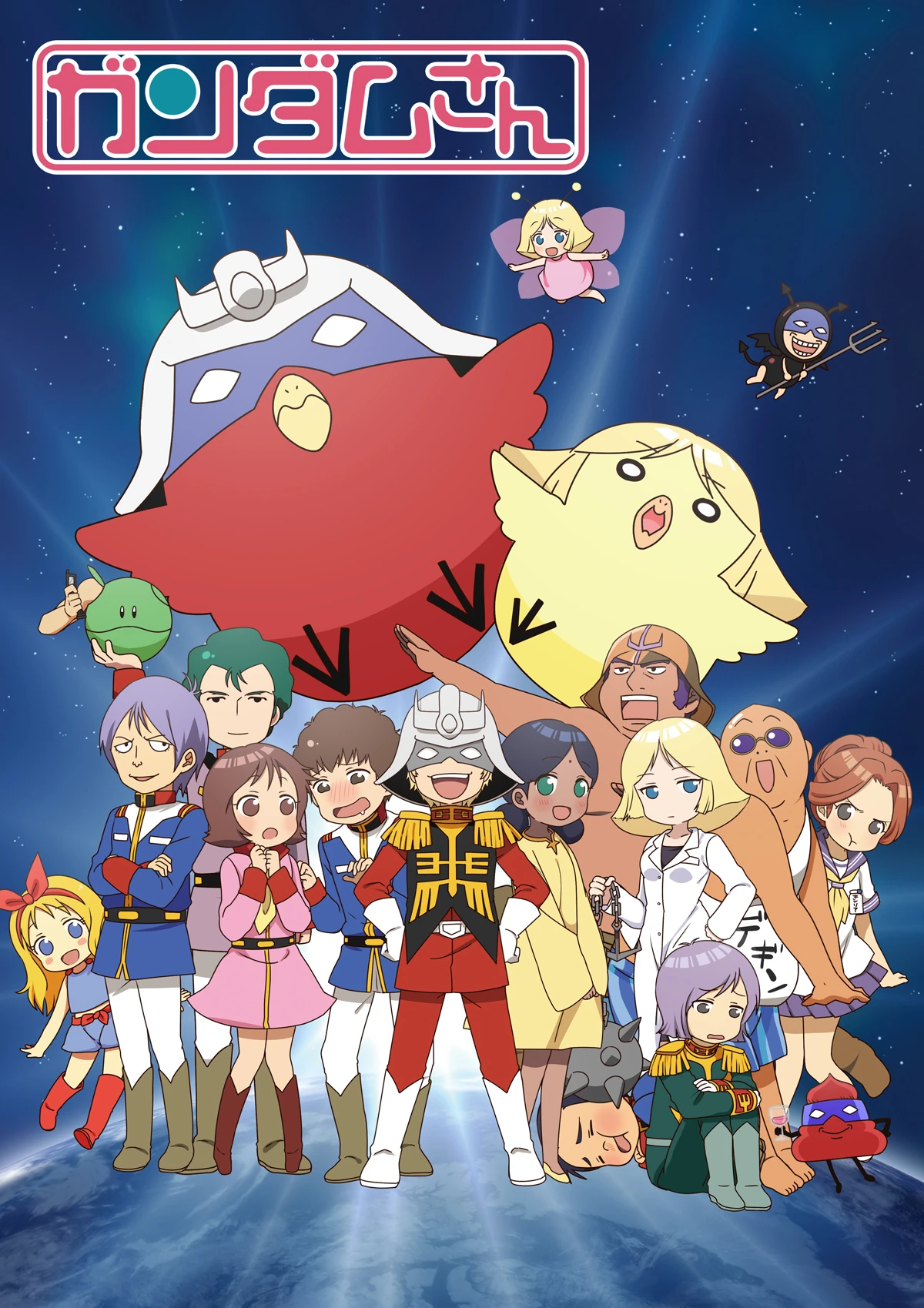
#138: Mobile Suit Gundam-san (2014)


Director: Mankyū
Screenplay: Hideki Ohwada and Mankyū
Based on the parody manga by Hideki Ohwada
Voice Cast: Katsuyuki Konishi as Char-san/Suisei Hiyoko; Megumi Han as Lalah-san; Tsubasa Yonaga as Amuro-san; Kaori Nazuka as Artepiyo/Sayla-san; Kazuyuki Okitsu as Garma-san; Keiko Han as Proverb explanations; Rikako Yamaguchi as Fraw-san; Ryotaro Okiayu as Bright-san
Viewed in Japanese with English Subtitles

I promise I'll actually review a true Gundam series, as yes, it's ridiculous that I have yet to see any of the main titles of this legendary franchise started with Mobile Suit Gundam (1979-1980). (No, Gundam Reconguista in G (2014) doesn't qualify even if I have fondness for its scatterbrained weirdness, because if any show really shouldn't be recommended as your first Gundam as it was for me, that's it). For the third, I promise, to watch an actual series in the main franchise or alternative world versions, be it the original, Seed, Destiny, maybe be wary of OO and its divisive sequel, maybe Wing as a breakout mainstream success, definitely not G Gundam as whilst I want to see it, a strange decision to turn a show about war and politics into giant robot tournament fights with humour is not connected to the franchise's main premises.

Until then, Char Aznableas interpreted as an evil red chick wearing a little helmet.

Because if anything, parodies of original properties which are officially sanctioned is a common concept in anime and manga, and a great way for an outsider like myself to be slowly introduced into these shows. Even if half the jokes here only really make sense to a fan, like the character of Garma Zabi who is clearly infamous for a series of misfortunate events to himself, if I can still see this officially commissioned piss take based on a four panel manga and find stuff of interest, I can now see the original serious work's significance in popularity, get a taste of it and now want to see the show both because of this and in happiness the Gundam creators at Sunrise have a sense of humour.

Parodies are their own cottage industry, even in the midst of a production of a sereis a chance of a short comedy micro-series to be created for the physical releases as a bonus, something I have come to love when they actually exist just for seeing the voice cast and production unwind and subvert their material. Neon Genesis Evangelion (1995) had a radio drama Evangelion: After the End (1996) where Megumi Hayashibara, who played the meek character Rei, got to play her as a motor mouth slapping cast members and creator Hideaki Anno himself as an evil villain. Fist of the North Star (1983-8) and its 1984-7 TV series, the influential manga that inspired the likes of JoJo's Bizarre Adventure, is as sustained as much now by DD Fist of the North Star (2013) (about the cast of post apocalypse muscle men if the nuclear apocalypse didn't happen and they had to find work) as much as tie-in and remakes. Manga even has "omake", side pieces which might not always be directly about the work, or even a parody, but can have light hearted, and even have the creators both talk about their work and be playful about their persona, be it horror author Junji Ito for Uzumaki depict himself as going almost crazed researching the power of the spiral, or in Miyuki-chan in Wonderland (1993-5), the whole of the four woman manga team CLAMP to admit they drew that manga just because they wanted to see questionable girl on girl titillation.

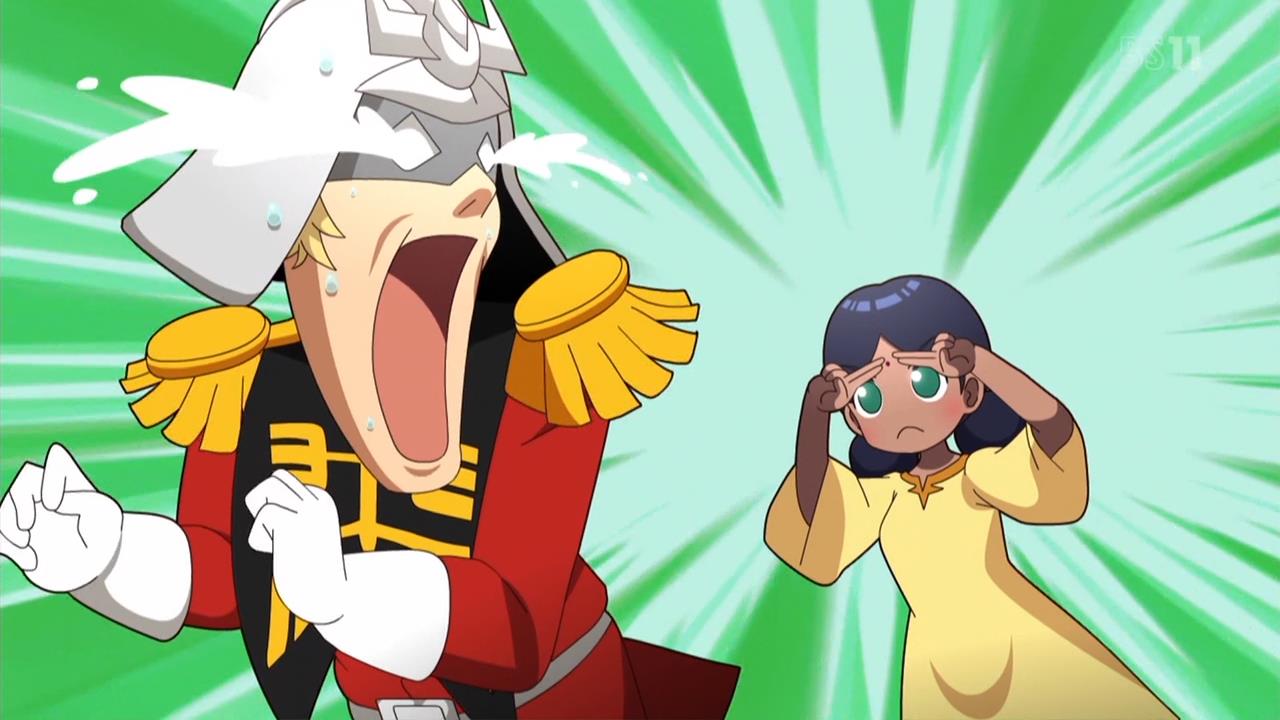
Gundam-San, as a licensed product by the creators of Gundam, also can get away with being profane. I know, even having never seen Gundam yet, the importance of a character like Char, the famous antagonist who wears red and never takes off an iconic helmet that obscures his face. The first episode takes a scorched earth policy to this image, in less than three minutes, with a) Char being an idiots who gleefully likes being nude, and b) having his female second-in-command Lalah Sun (who is by all accounts much meeker in the original series) devastate him when she informs him painting his giant robot red doesn't make it go faster. It's completely hilarious even if I have no context for either character in their importance to the fanbase.


Gundan-San is slight, I'll be upfront with it, but if they ever bankrolled a longer series, I'd be there to watch it with interest because these versions of the characters can be played with for many possibilities. Char is useless, Lalah much more reliable. The male protagonist of the original Amuro Ray, the stereotypical plucky teenage hero, is a gleeful mocking of teenage hormones as awkwardly portrayed as possible, especially as he is a psychic (a "Newtype" in Gundam lore) which allows him to notice if someone's bra is unhooked. Likewise the female protagonist Sayla Mass gets to confess to a sadistic side to enjoying slapping people about, part of a funny traditional of gentle or/and stoic female characters getting to be played by voice actresses in bawdy, crude or even comically violent ways. Probably the best episode, number three, informs us the robot mascot Haro has actual flesh arms inside itself who also, on the phone when not seen, is a working guy with a family and issues with if wife, as if say Star Wars had R2D2 had to go off to the side and deal with his wife leaving him over a mobile phone between space battles.

Then there's chicken Char, which envisions Char as a red feathered chick with the exact same helmet. The closest thing to a narrative in the thirteen episodes is the ongoing struggle between Char and chicken Char, who are trying to off each other behind Lalah's back. I think my one disappointment with Gundam-San is that this semblance of a plot could've been taken to another funnier climatic punch line and ended the series on a high note, just instead abruptly ending with the last episode just being about Char presuming the mole on Lalah's head allowing her to psychically shot lasers out of it. Obviously, this is extra material for a fuller work, so the slightness is to be expected, but that running gag would've paid off if ran for at least one more episode.

What you get, like many of these parodies, is a more relaxed and playful attitude to animation too, as they play up to the greater limitations of it for humour.  I swear, when the titular Gundam robots appear, they're actual models. These type of pastiches are a way to have fun, and if anything even a novice on this subject has to be impressed that the end theme, a traditional Japanese sing-along, has three versions to reflect Char, Amuro and Garma, that hapless guy whose episode is entirely about Char being a dick tormenting him. The playfulness comes from an institution, so even those songs have a refrain to shout aloud the three's famous lines to play this up for a sense of amusement among fans. It even mocks some details that might be unintentionally funny from the main series, such as leader of Amuro's ship Bright Noa clearly liked to slap crew around, as an episode is based around him going to consoling about this fact and sharing a similar bond with Sayla.

The crassness, from the sex gags to the end credits even having Amuro nude tied up on a gym horse in red bondage ropes and a S&M gag, is felt with a healthiness to it rather than being tasteless, in allowing a series to become stronger by commissioning a sacred cow to be mocked officially. And it's consistently funny, so Gundam-San at least got right what it was meant to do.   Even if it's an odd choice to have made for myself in seeing this as one of the first Gundam properties, it does show promise when the official parody is as enticing to the main material as it is. Whilst there are probably equivalents in Western pop culture, this is definitely a concept very prevalent in Japanese anime and manga for the better, something heart warming to the fact its encouraged for production star and talent to let their hair down and do something as ridiculous as this from time to time.