Showing posts with label Thriller. Show all posts

Wednesday, 10 August 2022

#220: The Skullman (2007)


Studio: Bones

Director: Takeshi Mori

Screenplay: Yutaka Izubuchi (with writing by Hiroshi Ohnogi, Seishi Minakami and Shingo Takeba)

Based on the manga by Shotaro Ishinomori

Voice Cast: Hiroshi Tsuchida as Skull Man; Makoto Yasumura as Hayato Mikogami; Ayako Kawasumi as Kiriko Mamiya; Fumiko Orikasa as Maya Kuroshio; Hiroyuki Yoshino as Akira Usami; Katsunosuke Hori as Kyouichirou Tachigi; Masayuki Katou as Yoshio Kanzaki; Toshiyuki Morikawa as Masaki Kumashiro; Tomokazu Seki as Tsuyoshi Shinjou

Viewed in Japanese with English Subtitles


Skullman was created in 1970 as a one shot by the legendary manga author Shotaro Ishinomori, and in that text, including an expanded 1998-2001 manga by Kazuhiko Shimamoto with Ishinomori's contributions, the character was always an anti-hero, making this 2007 anime series not a bleak interpretation of a bright tokusatsu like character, but apt for the figure even if its own story. Skullman the series works as an interpretation in how the series is entirely around the titular figure, but for most of it, he is not the central character, instead a mystery in its centre of who he is and what his motives are, a mystery which will expand further on from this even when these two questions are answered in this interesting genre hybrid.

Set in an alternative world, where Japan is caught in a civil war, our protagonist is actually reporter Hayato Mikogami, who wishes to go to Ōtomo City, his place of birth and one caught in a tense political situation in terms of the ongoing war, with the intention of discovering who the urban myth of the Skullman is, the figure said to be behind the series of seemingly random murders of men and women in the city. Even in the opening credits, Skullman is first depicted as a monster, seemingly killing innocents, his first victim being a woman whose death is shot like a thriller not without purpose for hinting at this. Soon it becomes apparent, however, his mission, whilst at times edging to unjustifiable, is part of a more problematic conspiracy, much more dangerous to the world, and all circling all the victims seemingly being connected to the White Bell Association, a small religion entirely within Ōtomo City only that has a grip on the town and is very cultish. With Kiriko, a young woman who manages to wriggle her way into Hayato's life against his will, the pair finds themselves in a show where that, with only thirteen episodes to work with, does a stupendous job in using all thirteen economically to tell this tale.

There would be no time to have tangents or filler, but the production and writing team's credit, this manages to tell this story concisely, with a plot with juggles many genres which could not work, and manages to still have a unique personality, even humour of a cartoonish form at times. One of the twists, which it early on and really not a spoiler, is very reminiscent of Yoshiki Takaya's The Guyver, in which people are being turned into monsters, and the show is also a noir-tinged work of mystery, of drama, yet with a titular character who stands out, despite his anti-hero origins, influenced by tokusatsu action characters. It's tone is really idiosyncratic just from the opening, heavily leaning on the horror mood until one of the most curious opening tracks can be heard begins, jazz with funky layers, but the trumpet playing at a very odd time to the rest of the rhythm, or the backup vocals, whilst yet managing to work. One key character, an older man named Kyouichirou Tachigi who to Hayato seemingly knows everything, is a cool character but as much because of delightfully odd touches, like finding him fishing near the White Bell's church location, or that he is not only a man capable of handling himself, but within one scene revealed as a coffee aficionado who knows his obscurer blends in a coffee shop greatly.

The series composition was by Yutaka Izubuchi, with screenplay help from collaborators, and what is fascinating is that he is far more prolific as a mecha and character designer, with only a few screenplay credits in his prolific. This fact makes it to his credit and the other collaborators - Hiroshi Ohnogi, Seishi Minakami and Shingo Takeba - how good and interesting The Skullman's story is. The Skullman is a show whose episode titles are long, poetic and bleak, and Frederick Nietzsche is referenced and becomes a dialogue point between Hayato and Father Yoshio Kanzaki, a Christian priest who Hayato knows fondly from their youths. Until it gets completely serious, there is even exaggerated humour which fits the tone, such as a scene with food leading to characters having giant bellies, or the character of policeman Tsuyoshi Shinjou, who dogs Hayato believing him to be a suspect. That does not factor in, even very early in the show, the violence whether with the monsters or more conventional means which is still bloody and nasty. It manages as a curious tight walking act to all work, and it is a pulpy feat.

The Guyver comparison is apt, as in mind to spoilers, this involves alien artefacts, people being turned into monsters, against their will or willingly, and a conspiracy that involves a group very obviously connected to it, but there is more in just thirteen episodes which elaborates beyond this. Of government conspiracies, of an illegitimate son fostering contempt, of politicians being murdered by the Skullman which are more sobering to consider decades after, and that this is set in a war, one where a foreign group, even with the cartoonish super villain name of Brain Gear, are here to exploit the climate. With weapons that can literally disintegrate people, they are their own entity off to the side, in a show which pays a huge tribute to Shotaro Ishinomori by having characters and references based on his entire career, where there is a religious cult involved, and a far right imperialist Japanese group who wish to militarise and get hold of nukes, planning to stage a coup de trait even against the corrupt police force. The Skullman, as a result, also taps into some real politics even as a genre piece, which makes its ability to tell this all well even against monsters and a sci-fi plot more a further credit.

The Skullman's ending was open to a second season, even if a bleak turn, with characters becoming figures from Shotaro Ishinomori's Cyborg 009, yet still works as a conclusion in striking a balance between the tragedy that ends it, when a figure has their spirit crushed and becomes a weapon of the true villains, and the hope with the characters who have survived. There are a few side characters, and they are all interesting, be it Kyouichirou, a mysterious brother and sister revealed to be test subjects who can control their monster forms, Tsuyoshi, or even the daughter of a major political figure who acts as the voice of the White Bell Association, a frail and sympathetic figure clearly in love with Yoshio Kanzaki, transgressing her mother's views of talking to religious heretics by helping at his orphanage for children.

Even one off figures are interesting, such as episode ten introducing a troop of soldiers, from a war Yoshio was a front-line minister of rites on, who have been turned by cyborg killing machines by Brain gear, a sense of tragedy at hand just with one of them, unstable even for his peers, traumatised by not being called by his real name and a shell now giving dangerous access to a missile launching rig. The Skullman staying on path through its plot means there is not a lot of filler, its curious tangents all leading to a finale, all done with reward, with all characters getting a conclusion even if a bleak one. Even the fact there will be more than one Skullman is not worth marking as a spoiler as, without explaining detail, it comes instead as part of the really good dramatic turns of the show, actual drama even in the midst of a show as proudly a violent tokusatsu monster show with gore, with the downfall for one in sacrificing his soul for saving other, the other broken as a person whilst Ōtomo City turns into chaos in the final episodes, full on the streets of fanatics turning into monsters, a doomsday scenario being prepared for, and a coup de trait or two also transpiring.

It is an exceptional show, one that does stand out as being idiosyncratic as a sombre action take finds the balance between the genre touches fully, feeling adult without being contrived and manages to be serious even with explicitly fantastical touches. It was a title suddenly released in the United Kingdom in 2022 from MVM, a DVD only title for another curious touch, having been a Sentai Filmworks release in the United States before. Suddenly coming here decades after its first release adds something special as, clearly, this was worth release for all its virtues. It feels like a title very different from the type of anime show usually released, back then and still now, something very idiosyncratic and fantastic.

Sunday, 6 December 2020

#166: Electromagnetic Girlfriend (2009)


a.k.a. Denpa Teki na Kanojo

Director: Mamoru Kanbe

Screenplay: Hiroyuki Yoshino

Based on a light novel series by Kentarō Katayama and Yamato Yamamoto

Voice Cast: Ryou Hirohashi as Ame Ochibana; Yoshimasa Hosoya as Jū Jūzawa; Akemi Satō as Kanako Fujishima; Ami Koshimizu as Ichiko Ayase; Eri Kitamura as Nao Hirose; Kana Ueda as Kaori Shiraishi; Kozue Yoshizumi as Hikaru Ochibana; Mai Nakahara as Yukihime Kirishima; Mitsuki Saiga as Madoka Endō; Yu Kobayashi as Miya Satsuki; Hideki Tasaka as Kiyoshi Kakura

Viewed in Japanese with English Subtitles


Some Major Spoilers onwards

Whilst it can be found, hence why this review even exists, here we have a real obscurity, a two part OVA in itself is distinct as that format that became a rarity by the late 2000s, in terms of original content rather than tie-ins to pre-existing work being what was released straight-to-video than a series or theatrical production. Also because, based on a three novel series, its rarity comes from being only available with copies of Kure-nai, a manga adaptation of the work by the original light novel creators behind Electromagnetic Girlfriend's source text. This has meant the show is very likely to be unheard of; a shame as with its flaws to consider, Electromagnetic Girlfriend is a fascinating piece.

This also has a personal weight for me as its director, for both forty plus minute episodes, was Mamoru Kanbe, an obscure name I know of for Elfen Lied (2004), a popular but vary divisive series from studio Arms, original a hentai studio who made a break into the mainstream and had that show as a huge dividing line between this transition. Ultraviolent and with material which is of issue, I will nonetheless defend that show, for all its flaws, for what it did well and as a result I have always been fascinated by the man in the directorial chair and wonder if his other projects showed the same inspiration. Kanbe to my surprise, in a career of only a few directorial project and other roles, has however gained an unexpected jewel in his cap of universal claim, as the director of the first season of The Promised Neverland (2019-), a dark fantasy tale which was of acclaim which is a good thing.

Before then there was Electromagnetic Girlfriend, and whilst not necessarily because it is original, it is fascinating because it feels like The Garden of Sinners (2007-2011), an ambitious multi part work including feature length chapters which in the late 2000s was an elaborate and dark tale mixing the supernatural with very adult, even uncomfortable, subject matter. Electromagnetic Girlfriend has differences, including the fact only three novels were released and this is based on the first and third of them. But alongside the edgier attitude, this comes off as the more quirky (if still messed up) cousin. The oddness is from its initial premise- school loner Juu Juuzawa finds himself messaged to meet up with a female student named Ame Ochibana under a tree, claiming that he is a reincarnation of a lord and her once his servant, wishing to follow from this by being there under his command as his "knight". It is asked by many in the story whether this is real or her own delusions, her younger sister Hikaru when introduced thinking Juu is taking advantage of her mental faculties, whilst a choice line talks of her sister and mother preventing her from cooking in the kitchen, adding more ominous detail or that, if a harmless comment, Ame observing she is treated with kid gloves even by her younger sister. Whatever the case, she definitely has an uncanny psychic link to Juu, where the "denpa" of the original Japanese title comes in. A term which translated to "electromagnetic wave", it has (alongside creating a niche music genre around this phenomenon) become a term to denote people who feel disconnected from their environment or act oddly, originating from the idea of hearing voices or instruction from electromagnetic radiation; in this case, she can tell whenever Juu is in danger, and does come to his aid throughout, so there is more to her then being with a mental illness.

The darkness comes, wrapped in a presentation which obscures, immediately before our leads are introduced in the first episode onwards as Electromagnetic Girlfriend tackles very heavy subject matter. The first episode more so, the first scene of this OVA work is a woman being raped, even punched, by a male assailant with both faces obscured for plot reasons, with mind to warn the viewer about how the show goes about in terms of mature content whilst mentioning it is tastefully done without any context, just shown as something awful that transpires with future context in the episode. It is extreme to begin with, and if anything Electromagnetic Girlfriend's biggest issue in its entirety, alongside some unintentionally ill advised plotting choices, is that its tone is jarring and not appropriate for tackling this type of material all the time. It has a lot of humour and comedy, which definitely for the first episode, where a killer is attacking people with a baseball ball and using wire to finish them, is inappropriate at times in tone.

And yet, in the midst of this, it is still compelling. One foot in the unnatural, the other in the nature, this has the right ideas in terms of tone, style and plotting that would have been a great story for me personally, and it is definitely fascinating. It does rush through the plot of the first OVA, but it does also have a clear style which is distinct. The show wants to be existential, and whilst it does not succeed completely, its attempts are admirable including cutting to text which has an unseen voice ruminating existence, particularly as the art style includes different fonts including as if the letters were cut from different materials. It never gets pretentious either, because whilst the show's darker tone proves its undoing, I also like the contrast in the humour when it does work.

And that the leads are actually interesting is a huge virtue, adamant to an idea, whether you like his work or not, of the late manga writer Kazuo Koike that characters were always more important to his stories then the plots, to which this two part OVA has two main characters (and side ones) who are worth having more stories on. The male lead Juu is not invulnerable in the slightest and is actually more than a bland stock protagonist, whilst Ame as an eccentric character with an insane case of uncombed hair is fascinating too, someone with her head basked in fantasy but also between a form of possible mental vulnerability and a wisdom beyond her years which means she is still a vital figure to have to keep you protected. When they are properly introduced in the second episode, more exaggerated and fantastical than appropriate for the tone, her female co-workers at a maid cafe, one a shorter girl who asks obstinate questions and is a bit too happy to hurt people, the other significantly taller and (in an odd joke) hates both men and broccoli, they are immediately interesting and worthy of more stories which were more appropriate to their character types.

If anything, even with the absurd touches, this show has moments of interest and even unexpected intelligence which I have to admire. Even if it is with faults, even the premises for both narratives have ambition. The first is a murder who, believing they are killing aliens disguised as people, includes twists such as a disturbing case of Stockholm syndrome that, whilst potentially offensive in how it was actually executed, is a complex puzzle which could have been of worth if pulled off in a better context. The second is surprisingly relevant still, more so now and a better episode, in which a game is being played by classmates of Juu and Ame's school to cause awful things to others to collect "happiness stars", which is hauntingly more relevant as the internet is both a place of trying to gain similar tokens online and of "awful" behaviour, putting probably too lightly how bad people can be online without identity. The aesthetic as is has sparks of creativity, in-between some awkward designs of faces and obvious CGI, particularly a habit of intercutting two moments in a scene together in the same shot. One example proves the best moment: in a moment of horror, where someone is trying to force another to mutilate herself, it has Ame in a moment of emotional shock being comforted by Juu which is abruptly emotional.

And the stories have clever touches. Some of it is coated in dumb touches, such as Ame having a bad tendency to pick up evidence in an immediate crime scene, and others have to be understood later on when more is known, such as how photos just before murders and during appear on the internet, but there is also a surprising amount of mature moments. Dealing with a villain by rationally picking apart their ideals, even if ridiculous, is creative, as is Juu, when he accidentally causes Hikaru, an eccentric martial artist, to lose a potential boyfriend acts in a kind way to her, even finding a way to patch them up by having a fight with the guy off-camera just to let him beat him up.  

The two episodes do however have an issue, if accidental, of touching problematic subjects without real care made, making it an issue with Electromagnetic Girlfriend that has to be considered. The first episode, as mentioned, involved Stockholm syndrome, actually the female rape victim and a fellow classmate who joined the killer in his work in the episode's main twist. It is a lot more carefully done than that sounds, but it is not sufficiently depicted (alongside being rushed) to tackle a troubling subject, the idea of a female character who is psychologically damaged to the point she joins in the work of her victimiser requiring a lot more care if even an acceptable subject for some to tackle at all.

The second episode is not helped by the initial set-up being that Juu is falsely accused of groping a woman on a subway train as part of the Happiness Game. False accusations of molestation and rape are a plot trope in fiction are problematic, in whether there are actually any real cases of this or a sufficient amount at all, whether you can tackle them at all as a concept and with care, and that unfortunately it is something that in its nature does fall into the web of how women in real life have not had their cases of real rape and molestation taken seriously. That last point is why this plot idea will always have the stigma to it, and bear in mind that after the #MeToo movement, where men were being ousted finally for committing such acts or even misogynistic behaviour over the internet by their female victims, these type of plot points will be much more difficult to digest regardless of the artistic virtue or lack thereof. It is not helped as this plot point is one which is not a one-off here never seen anywhere else, one that has existed in other forms, whether the number that exist was merely slim.

It neither helped that both stories involve women are the antagonists or psychologically damaged; I am not accusing the production or its creators for anything from that, like accusations of misogyny, just pure bad coincidence considering that, whilst I am someone who will defend these two episodes for good ideas and content, they do represent the inevitable danger of trying to make your pulp narrative tackle edgier content to come off more adult, especially when its gendered in the archetypes or plots you used, rather than a gender-neutral attitude even for deliberately offensive and transgressive horror. Nevertheless, that slither of ambition does also pay with some reward. As much of this review is going to be that, if you are comfortable sitting through its mistakes and can even find the two OVAs, Electromagnetic Girlfriend was a curiosity worth seeing. One I have had an interest in for a while; it suits my general fascination with flaws curiosities worthy of more notice just for their mere existence, and it also fits perfectly into that category of premises which I wished had lasted longer, in tighter written and more tonally appropriate work to let interesting characters as here breathe and be developed.

Thursday, 29 October 2020

#165: Perfect Blue (1997)


Director: Satoshi Kon

Screenplay: Sadayuki Murai

Based on the novel by Yoshikazu Takeuchi

Voice Cast: Junko Iwao as Mima Kirigoe; Rica Matsumoto as Rumi; Emi Shinohara as Eri Ochiai; Emiko Furukawa as Yukiko; Hideyuki Hori as Sakuragi; Masashi Ebara as Murano; Shiho Niiyama as Rei; Shinichiro Miki as Taku; Shinpachi Tsuji as Tadokoro; Tohru Furusawa as Yatazaki; Yoku Shioya as Shibuya; Yousuke Akimoto as Tejima

Viewed in Japanese with English Subtitles


The following review is to be found on my other blog A Night of a Thousand Horror (Movies) as well as part of its Halloween season of thirty one reviews per day. (Also a great way to promote both of them too). If this is of interest to you the reader, follow the link HERE for many more reviews.


Who are you?

Once seen, a long time ago, Perfect Blue has stayed with me for a long time. The irony is that, in another context, this plot would have become a lurid and dumb thriller, as clichéd as the one in the television show, Double Bind, that lead Mima Kirigoe transitions to from an idol singer to an up-and-coming actress from her idol group Cham. Alongside the fact Satoshi Kon was a one-off, this also became an animated production, the tone and rules changed alongside the people behind the theatrical film taking the best route forwards to make a great film from such material. The irony is that this production was meant to be live action, adapting Yoshikazu Takeuchi's source material, only for the 1995 Kobe earthquake to prevent that version and an alternative animated version from Madhouse studios to be created on a lower budget. It says the final film's advantage that, even with a 2002 live action existing, this Kon helmed version is the definitive adaptation to many.

Returning to Perfect Blue, this film's deconstructive nature immediately begins with a live tokusatsu performance beginning the film as a cold opening. These are a cultural detail, especially with knowledge of this film getting such notice in the West it even inspired American filmmaker Darren Aronofsky, that I have seen in many anime but are very idiosyncratic and likely to be ignored without batting an eyelid, where actors dress as Power Ranger-like heroes or monstrous villains to entertain kids at theme parks or at least outside, two stating how disappointing this looked to the original television show. Cham are introduced, a three woman idol singing group who are struggling to find success, and the film intercuts the performance with the banality of our lead Mima away from work buying groceries.

Satoshi Kon, who tragically died at too early an age at only forty six, due to pancreatic cancer, would build a reputation as a director, baring Tokyo Godfathers (2003), of stories breaking down reality, exploring psychological states and even dreams. This is where, literalised, Perfect Blue takes a new level as a suspense thriller, where Mima is transitioned by her agency to become an actress, with a stalker soon to murder people "debasing" her. Throughout there is a meta tone, as when we are on the TV show Double Bind, where she is a secondary character on, there are scenes being acted out and also behind-the-scenes ones of the cast breaking character. Mima, as she fears a doppelganger of her exists, is also beholden to her old self to obsessive fans despite trying to grow as a person.

All the fans of the idol group with their own versions of Mima are seen, including the sinister Me-Mania, an obsessive fan connected to the doppelganger. I could not help but think of how much of the film now is tackling gender politics, as this film is structured around a fragmentation between an idealised version of Mima as the Cham idol singer, the star of a lurid TV show and who poses in nude photographs, and Mima Kirigoe herself, a twenty or so year old woman not from the metropolis, wandering along in this career of hers as work, who is neither. The idol singer is another cultural aspect from Japan that is distinct. It is in itself not a squeaky clean industry, but it is also prominent how strict some of the rules imposed on female idol singers can be, some including not even allowing their stars to date, to impose an idealised image for fandom without scandal.  

Mima, as she fears a doppelganger dressed in her old Cham costume haunts her, is beholden to her old self to obsessive fans. All the fans have their own versions of her as mentioned which we see, Kon himself tackling this subject of obsession in a negative light, from this to nostalgia, throughout his career, but in this particular case there is an added poignancy of following a young woman having to step out of her squeaky clean persona, an innocent who sings twee love songs only to now become a fully formed human being, who lives in a tiny apartment and has a regular life. Even though this was based on a novel by a man, and directed by a man, bearing in mind the animators and production team too, there was on this viewing a lot which stood out in terms of gender politics, a strikingly poignant line in particularly, when confronted by her doppelganger, when the other mocks her with the equivalent of "nobody likes idols with tarnished reputations".

But the other side is not glamorous either. Probably one of the darkest theatrical anime made, it has one of the most uncomfortable but morally well executed rape scenes in either live action or animation, involving one Mima acts out on the Double Blind TV show as her character turns to stripping only to be mobbed by the male pundits. It includes the behind-the-scenes of everyone breaking character, the main rapist just an actor asking between takes if she is okay, yet the scene is still uncomfortable with emotional aftershocks for her, acted out in the shooting of the film in full with complete intensity to the content. Now there is a new edge that, in the machinations, there is an added creepiness of the screenwriter writing a scene for an ex-idol, as spoken in the dialogue in regards to her agency wanting more of a role for her, to shed her innocence. Even that it leads to her character developing a multiple personality and being revealed to be the killer of women feels more like a lurid shock to get TV viewers on this viewing, Mima having to put up with this to become a great actor as she goes along.

Outside of notoriously lurid anime like Urotsukidôji or others with dangle precariously (or fall into) the same ball park, Perfect Blue is a dark and intense production in terms of adult content but without stepping over into trashiness. With industrial synth and eerie group vocals adding to the mood, by Masahiro Ikumi before Kon found his frequent collaborator Susumu Hirasawa, Perfect Blue does quality as a thriller but is definitely of the horror genre in mood and content. Even the one dated aspect, from a time when the internet was new and had weird terminology like "URLs", is still uncomfortably relevant about false personas, a false autobiographical diary of Mima's life she finds online scaring her, starting her psychological breakdown, because of how it even knows accurately what foot she steps off a subway train with first.

It is a bloody film, probably the most intense in Kon's career thought his work could be very adult, even over Paranoia Agent (2004) which did not shy away from subjects like suicide, but there is a tone and details here that in the modern day would startle even the world of uncut fan pleasing anime with erotic content. Some of it is unexpectedly subversive, such as how most of the victims in a series of murders are male characters. Some of it is the intensity of scenes of violence in general. One such thing is that, with Mima's nude photo shoot, you have depiction of female pubic hair. In Japanese culture, I have seen male and female genitals blurred in art, and even Japanese pornography is censored for depictions, and whether Perfect Blue was an exception in its home land or not, it would have a greater shock for a viewer (even Western fans outside of uncensored hentai) to see. One scene, where a male victim is stabbed to death with a phallic weapon of a screwdriver, even goes as far as have cuts to the nude photo shot mid-stab, and projected on the television in the background of the murder, intercutting an eroticised female body to a man being penetrated violently with a weapon.

Where Perfect Blue fully hits its stride is when all reality breaks down, starting with little tricks, such as seeing police sirens in the next scene but only to pull back to see a child riding a toy ride-on vehicle. With very realistic character designs, even having a playful touch of cutting to an exaggerated stereotype of a female anime character in one scene, a toy model with comically big eyes up against the camera, you could wonder why this could not be in live action aside from the fact that Kon's film is completely plastic in its ability to distort reality as a result. Literalising psychological states, contrasting the real Mima with a Cham idol Mima whose skin even glows and looks unreal, and with far more preciseness get away with the "it was all a dream" twists by television plotting invading her real life and bending reality. Double Blind scenes blur to psychological analysis Mima herself with obvious ideas, clichés from a trite TV show coming more meaningful when she herself is scrutinised. This became Kon's trademark, a willingness to bend his worlds to scrutinise its characters.

[Major Spoiler Warnings] You can argue this uses broad caricature. The culprit is actually Rumi, an older larger woman, and Me-Mania looks completely alien, but Perfect Blue is thankfully still more complicated than this. This is a very simple plot, with resolution, a clear conclusion where Mima even states in the last shot and line she has found herself, but the execution completely succeeds in adding weight...especially when the final scene I have mentioned, in the Japanese dub, has a play with which voice actor says the final line for added distortion of what is real. [Spoilers End]

Returning to Perfect Blue, it is still a success. It did not come from an abrupt spark of genius mind. Kon worked his way up as an animator, as well as in writing screenplays, and this was created by Madhouse, so this was a collaborative effort where everyone was on fire creating with. The great thing is that, making a lasting impression when Manga Entertainment acquired the licence, Perfect Blue is still held aloft, not an obscurity, and that Satoshi Kon in his brief career never dropped the ball after this initial promise.

Friday, 9 October 2020

#162: Government Crime Investigation Agent Zaizen Jotaro (2006)


Director: Hidetoshi Ōmori

Screenplay: Hideki Mitsui

Based on the manga by Ken Kitashiba and Yasuhiro Watanabe

Voice Cast: Teruaki Ogawa as Jotaro Zaizen; Hiroshi Ohtake as Keiichi Suzuki; Kōzō Shioya as Takumi Mochizuki; Rica Fukami as Junko Yoshioka; Rintarou Nishi as Ryuichi Jinnai; Seizo Katou as Kozo Soneya; Tetsu Inada as Naoto Todo; Tomomichi Nishimura as Seijiro Matsuzaka

Viewed in Japanese with English Subtitles1

Da bomb!

We will call this review a tribute to the Anime World Order podcast, which started in December 2005 and still continued into the 2020s. It has outlasted other podcasts about anime, even anime distributors in the USA and even companies from Japan. They have seen one form of anime distribution, that insane idea of selling three to four episodes per full price disc for a whole series, die out in favour of streaming, even seen the brief HD DVD versus Blu-Ray war, even saw when Crunchyroll, a beloved streaming service, used to bootleg anime and were suspicious until gaining much respectability, admiration and even co-funded original titles for their streaming service.

I feel the people we admire - authors, writers, commentators - as much influence our obsessions as much as the first of anything we discover in youth. The first anime I saw will leave an impression, but also the titles (alongside manga) that podcast have brought up, and still need to get to, have influenced me over the years too. They also obsess us with obscurities we wish to track down, or at least for myself the oddities they and no one else bring up become like sacred items to at least see once. I seriously doubt anyone else covered Zaizen Jotaro, as we will call this show for short in this review, but they did back in August 2007, and even then, they only covered six of eleven episodes, a rare case where, for the most part covering the entirety of a work, they did not. Back then, it was still being fan subbed by the morbidly curious. Whilst it may seem an odd tribute to choose what is not a good show in the slightly, they have covered worse, and it was always the oddities, as much as a best, which always tantalised me and I am still tracking down.

What Zaizen Jotaro is, and I am glad to finally knock this show off that list to see, is what you do, adapting a manga started in 2004, to try to sell the type of heroic pulp figure of the "Seinen" genre to an older salaryman if he does not fancy any of those fantasy and science fiction tales. Seinen, a type of story meant to be sold to adult men between their teen years and middle age, has evolved over the years. What is actually represents in what the term means is varied nowadays. It can find connections to the "Gekiga" movement, coined by manga author Yoshihiro Tatsumi to move away from children's comics to those for adults, but it can vary between the more violent and adult content to even comedies about high school girls. It has become as flexible as other "genres" targeted to gendered audience, as "Shōjo" is meant for young girls but could go from science fiction by female authors to dramas. Hence, it cannot really be held as one thing or another. This, nonetheless, for me was clearly an attempt at that type of dynamic storytelling from their more action packed, adult tales....somewhere to a target older male reader's world, not assassinating people like Golgo 13 or fighting in fantasy world, but stamping down on political and financial corruption especially in the construction business.

Now, as anime and manga have proven, no idea is too dull or ridiculous if you can pull it off. Here, I could not help but think of the 2001 anime series adaptation of Salaryman Kintaro, based on the Hiroshi Motomiya manga and probably one of the obscurest anime titles to actually get a release on DVD in the United Kingdom. In that show, a former motorbike gang leader with a noble heart entered respectable white collar work in the construction industry; it was not a perfect show, but it was fascinating in terms of trying to make a melodramatic story in ordinary working life, with all the heightened drama and suspense expected for an action story, and this will not be the last time I evoke this show with Zaizen Jotaro. Zaizen Jotaro has more licensed for bombast as it follows the titular figure, a former cop who had his death faked and is a member of the independently ran anti-corruption group the Government Crime Investigation Agency (GCIA). He is a hot headed but noble figure who believes in justice and has carte blanche to take on corrupt politicians, embezzling business managers, and even the criminal underworld backing them.

He can fight, but his secret weapon is unlimited money. Whilst Batman is a millionaire with the advantage of his class privilege, he at least went into exile to learn martial arts and various techniques just in case technology and wealth were not enough. Jotaro, who exiled to the "deserts of Great Britain" (??), has the ultimate credit card which he waves around also as his badge, the designer gold black card which allows him to hire anything he needs. Giant construction trucks, hired armed back-up, anything. He is armed to take on idiosyncratic and colourful figures, such as a gang leader who loves theatre, and between them throw Shakespeare quotations at each other, to the ultimate villain, a ninety plus year old gang boss who yet has the physique of a forty year old man, looking with his huge muscles like a villain from a Fist of the North Star rip-off, and all those decades to build up a group known as the Black Dragon Group who control everything.

Before we actually get to the truth, as I learnt of this show, Zaizen Jotaro is not a subjectively good show in the slightest, but let us step back rather than merely trash it. Reconsider at least that, yet, this is still the same idealised male image of the man found in other Japanese pop culture. One who woos all beautiful women who he encounters; one who can talk back and be cocky in a culture where, infamously, the phrase "the nail that sticks out gets hammered down" appears a bit in, and as a fighter for truth and justice, especially to stop corrupt people stealing the populous' tax money, he is a bad ass who can out think or just out style anyone else. The difference is he is now in a realm of the ordinary working man, someone who is suave and stylish even in the world of construction business corruption where their crimes are smaller scale like making cheaper (but more dangerous to use) concrete by mixing in sand.

Jotaro, even with eyebrows so sharp he could open cans with them, to borrow a joke from that AWO Podcast review, is a fantasy ideal for a male reader to imagine himself as. Definitely a ladies' man as, whilst chaste, there is one sex scene and almost every woman he encounters (side agents, criminal mistresses, kept women of luxury) becomes almost the equivalent of the harem genre female characters, joining the GCIA and looking on lovingly at him. (There is even some slapstick of him having wandering eyes; also unfortunately some material, groping people from behind, not acceptable even from the pervert male high school student nowadays). The fantasy of luxury, in spite of this being about the fantasy of swatting down corrupt politicians, cannot be ignored either. Barely really touching the common man, baring at least the police or the one company employee who Jotaro rescues and has on his team, it is as much about middle class or luxurious people with unlimited money to have the best suits, the best food and alcohol etc.

Truthfully as well, this is in context to a very silly show with is also insanely cheap. Before we even get to the series' narrative, this is a rudimentary looking programme to say the least, with the added quirk of its attempt at style. Shorthand that looks jarring, such as many swipe pans to transition to new scenes, one involving a gun being waved across the screen from right to left to cut to the next scene. Or cutting within a shot an extreme close up of a character or an image, in the space originally of the initial shot, in what is like a collage-like hybrid of two different shots which, actually, stands out but is beholden to how cheap the show looks.

The first episode belies this as well as, for a show meant to be about the edgy subject of corruption in Japanese culture, suggesting a detailed and labyrinth mystery, this show is also comically broad. From his introduction our titular protagonist is a cartoon, buzzing an airport control tower, including bending reality of electronics by being able to project his face in a panel, to being able to snap his fingers and have an army of people dress him smartly in public. Even his catchphrase - "Da bomb" - is goofy, and never spoken (in English) in a logical circumstance where it makes sense to. The show tones down considerably, but in that first episode you get a highway over run with large 18-wheelers trying to run him over, to monks, Christian not Buddhist, inexplicably trying to off him, setting the stage for what may seem a hyper-exaggerated farce.

Even beyond then, it does feel like a child's fantasy of cops and robbers, grown to an adult's with no real sense of what it is trying to tackle in political corrupt and a lot of abruptness. I learnt some things, I kid you not reader, of worth to be a better man, quotations of Shakespeare to what foods are detoxins that can help one live longer, like plums, when Zotaro is finally introduced to the main villain by buying the hospital he is at. The show is useless if you wanted any plot to elaborate on what actual business corrupt is. Salaryman Kintaro, whilst also ridiculous, at least had a scene where Kintaro learns how construction companies bid on projects to do the work on, needed as exposition for when Kintaro is aware of people attempting to rig the ballots; if remotely accurate to how Japanese business work, that exposition in itself was at least of worth. Here, there is never even an elaborate plot explanation for the world, even before it leads to business men being assassinated or forced to kill themselves, about the intricacies of embezzlement even if simplified.

Even if broad, even if still pandering to this macho fantasy, even with the limited animation, this show would have been fascinating as a melodramatic tale, with gangs and manly tears being shed, police officers firing their pistols in the air in salute to their fallen comrade at a funeral and a confrontation at the beach, which elaborated on a world of business and political corruption from them. Even for a show as ridiculous as having the daughter of that fallen officer be the one who inspires everyone with words beyond her years yet naive, this could have been an intently over-the-top but in-depth tale. Even a show where the lead literally becomes a superhero by disguising himself like a caricature of a chauffeur could have some gravitas. Anime's greatest virtue is that, grown up with even if usually shown after midnight on Japanese television, it is not that it is more mature, as children's shows existing can attest to, but that like manga you have the ability to tackle any premise or tone. The series Hidetoshi Ōmori, whilst that show is not known about anymore, adapted a shonen (young teen audience) manga called Dan Doh!!!  in 2004 for television, a story about golf. So a business crime narrative would have worked. A man with a credit card for a weapon against greedy fatcats is still credible. Neither is actually done well.

Most of Zaizen Jotaro is amusingly naff instead. An ending of an episode abruptly ends cutting in a  shot of a fighter plane abruptly exploding in the sky, Jotaro not since a film serial lead fraught with fighting against episode end cliff-hangers, others following suit in their unexpected abrupt turns. Characters, usually the men, metaphorically beat their chests about justice and helping Japan be the best without corruption, not necessary jingoistic either as the GCIA is meant to be the Japanese equivalent of the FBI. In another show, it would have had weight that many of the figures we meant are old men, or men in their middle age, which saw Japan rebuild itself after World War II or were there as the country was slowly gaining economic stability, but here it is lost.

I would be amused if it ever got a proper Blu Ray release or streamed in the West. All anime should be available. I cannot hate Zaizen Jotaro, because it is too charming in what it is in spite of what is wasted. But nonetheless, I will not kid the reader that this is a good show. Lowered expectations are not enough to get around the moments that drift along, or the problematic gender politics where one female character just get killed for an emotional weight, or that it does not have a real ending either, just a form of abrupt conclusion, and that most of the show's most dynamic scenes are just conferences by businessmen being really polite as they apologise for scandals that the plot does not explain. It is however an odd, amusing piece of time capsule, with some interest, some entertainment, and some fascination.


======

1) Unreleased in the West, I had to rely for this piece on a version, found in the year 2020, where the subtitles were clearly translated by someone (or a computer software) with not the most perfect grasp of English specifically in sentence structure, which could be awkwardly put together at times. I am still glad to have been able to see the show, and it still made sense, so my heart goes out to the person (or even software) that let this review even happen.

Monday, 15 July 2019

#109: Mad Bull 34 (1990-2)

From https://images-na.ssl-images-amazon.com/
images/I/61VHFNHD4eL._SY445_.jpg


Director: Satoshi Dezaki
Screenplay: Kazumi Koide and Toshiaki Imaizumi
Based on the manga by Kazuo Koike and Noriyoshi Inoue
Voice Cast: Akio Ohtsuka as John "Sleepy" Estes (a.k.a. Mad Bull); Yasunori Matsumoto as Daizaburō "Eddie" Ban; Gara Takashima as Perine Valley; Takkou Ishimori as Captain Allen; Masako Katsuki as Cindy Murphy; Naoko Matsui as Jaqueline Moyert ; Mitsuo Senda as Nichol the Electrician
Viewed in Japanese with English Subtitles1

It wasn't a good idea to revisit Mad Bull 34 in one sitting, over three hours for all four episodes, yet it feels befitting in a perverse way. One episode by itself is enough to melt the brain, mainlining the entirety of it is insane but the only right experience for a truly notorious OVA series. The fact that this is one of the first anime I ever knew of as a kid, from an advertisement for the first episode (as released by Manga Entertainment) was included in a gaming magazine I had, is sickly humorous if mortifying. It's the promotional image everyone knows for Mad Bull 34 if they know of it: the iconic image of a New York police car approaching the viewer, a burly policeman with a shotgun, woman (head unseen) merely wearing revealing underwear. Little do you know, from a manga by Kazuo Koike, that it wasn't really a suffice warning for the easily offended, as good God Mad Bull 34 isn't politically correct or even palatable for me at times, hardened on weird perversity, and wasn't really a warning for how, when it is at least entertaining rather than gross, it's as mad as a box of frogs and then some.

The late Koike is an acclaimed manga writer, not the illustrator to which Noriyoshi Inoue drew Mad Bull, and its known whilst he has a deserved legacy, from the likes of Lone Wolf and Cub (1970-76), Koike did belong to a type of extreme pulp that, forced on hard and short work schedules and having to top his previous work, meant he was using a lot of extreme content, which includes sexual violence which is problematic but not synonymous to only his work, or even anime and manga for that matter, nor just Japanese pop entertainment. Honestly the issue with Mad Bull 34 for me and likely many, in which Episode One follows new cop Daizaburō "Eddie" Ban on his first day with the worst cop to be placed with, a veteran named John "Sleepy" Estes known for "shot-first, ask-later" Dirty Harry tactics and working with sex workers for cash on the side, is the sexual violence and threat of rape through the first three episodes, worst as its depicted as titivating as it is lurid, always threatened to the female cast only and gross.

I don't view it as a damnation of Koike, director Satoshi Dezaki or anyone who worked on the OVA, especially aware that there are significantly worse examples in anime, (the uncensored version of Ichiro Itano's Violence Jack: Evil Town (1988), for example, is probably more deplorable by account), but unfortunately it became an easily plot point for rising escalation to have female characters threatened like this, that this was the only valid threat to a female character, and it was played for sexual as well as plot reasons. American exploitation is as duplicitous for this, and frankly even implied threats without any nudity or violence are a trope in multiple forms of storytelling, even D.W. Griffith with The Birth of a Nation (1915) effectively having this, when Lillian Gish's character is in peril, within a film with layers of other significant problems a viewer has to deal with.

As a result, you have to endure this material with Mad Bull 34. When it isn't this, or the incredible sexism, the OVA is batshit insane and memorable, where if those problematic details weren't there you would have plenty of ridiculous, cheap but memorable schlock to ingest. For, you see, Sleepy is actually shown to be a good guy, one who blows a masked roller-skating store thief's head off with a shotgun, but loves his community and, whilst having sex with all the sex workers he is with and steals their money, uses said money to help them and rape victims. Yes, this is all in bad taste, and even this as the first episode conclusion is enough to dismiss the OVA as utter tripe, but it all comes off as absurd, the material which has nothing to do with the problematic scenes having a tone so earnest inspite of their unintentional exaggeration that the only reflect even for the gore and prurient content is to laugh.

A pertinent idea to consider is how Mad Bull 34 feels like an interpretation of American exports of their television and cinema. Some have suggested the OVA is an extreme parody, whilst I wonder this is just what happened when Koike tried to make a story set in New York City, with an insane amount of detail (like his original manga) in terms of depicting the city, right down to the aesthetic of the cop cars and locations. But the material instead blended together all the worst clichés of American pop culture into this extreme distillation. Certainly, this is still New York City before Rudolph Giuliani, whose public image is that when he became major of New York City he cleaned up the cesspool it was at least depicted and exaggerated in American cinema, rife with crime and poverty, to the modern city we have now. Certainly, the material in this, even the more overt sci-fi details as we will get to with Episode Four, isn't that far off strange material that this had. 

From https://66.media.tumblr.com/tumblr_p7dh0rAY491um3c88_frame3.jpg

I forgot so much. That it spliced humour in at even deeply inappropriate moments. That Sleepy Eddie who is slowly being won over by his senior's beliefs, prevent a near rape of a female reporter whilst dressed up as women. That the first episode has, and I kid you not, a James Brown song even on the Discotek DVD release over the end credits, Brown someone who would've been horrified if he found out his song (against three pop songs over the other episodes) was used for an OVA where someone gets minced by a passing subway train for the first episode's finale.

Animation wise, it's just better than many titles from this era, but also part of the notorious amounts of schlock from the late eighties and early nineties which was just competent, still with detail and style but not exactly the highest bar of this era. It's also made by Satoshi Dezaki - not, as presumed, legendary director Osamu Dezaki, but his older brother. The same who also directed They Were Eleven (1986), a great sci-fi story which is the polar opposite to this in its mood, a tale adapted from legendary female shōjo manga writer Moto Hagio, which (from a source originally for a young female audience) locks various alien space cadets in a dangerous situation and, with the creator's themes of gender politics within it, very feminist readings especially for a character whose world has the young choose their gender despite her initially being the sole woman in the crew, with all the biases for women on her planet a burden to the choice. How he also, by all accounts, made Mad Bull 34 raises more than an eyebrow. Screenwriter Kazumi Koide too, who wrote Episodes Two to Four of Mad Bull 34 but also They Were Eleven.

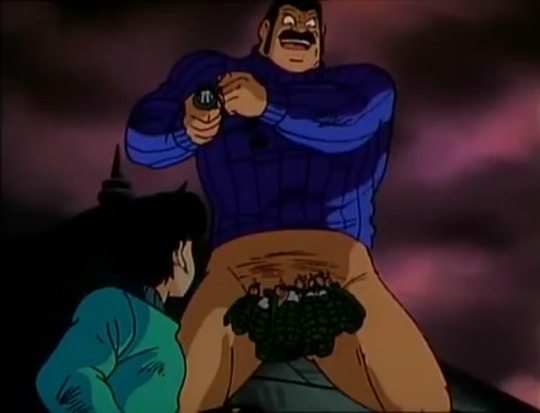
Episode two, introducing female officer Perine Valley who Eddie develops a crush on, does show the schism you do have to deal with. It's scuzzy, and with a mob boss with revenge desired on Perine for leaving him mostly robot stuck in a wheelchair, the desired revenge also unfortunately includes sexual violence of a leering, objectifying sort. Yet there's also the insane detail that, if by itself, would've developed the reputation Mad Bull 34 has but without the caveat of all the uncomfortable details. Like Sleepy bringing hand grenades to a stake out, hidden in his trousers tied to his pubic hair, or the challenge of picking the right canned coffee that isn't actually an explosive, introducing a fun side character who Sleepy can always pick out for his scent of urine and sugar, a homeless (yet dangerous) guy who will help the good guys later but still wants to be the guy who offs Sleepy in a perverse form of honour. Or the death bed wedding, which in itself represents the famous odd logic of Koike, even found in the live action adaptations where a Lone Wolf and Cub sequel had the titular Wolf having to kill various people to be lead to the target he is actually meant to be killing.

Arguably Episode Three is the same story repeated, as a result the weakest episode, following a female reporter chasing after a supposed rapist-murderer with a lot of power on his side, again the ongoing issue still there of that theme being too much of an obsession of the OVA. It does have a merciless (and openly suicidal) Chinese mercenary gang that, possibly offensive or just from the Crying Freeman school of intercontinental ridiculousness, at least offers something much more serious and a credible threat. It does also lead to their leader bursting into the finale with a tank. As evoked, the 1988-1992 anime adaptation of Crying Freeman, also a Koike manga originally, is felt as a comparison and honestly, whilst there is one plot threat later on which is offensive, Freeman despite being prurient and lurid feels like Mad Bull 34 if you felt less guilty for its uncomfortable content and instead was on the right side of lurid weirdness which you could feel less guilty about.

Thankfully, Episode Four, even if it has the questionable ender politics still, thankfully changed the pace and is arguably the most entertain episode, getting some actual atmosphere in the first night time city shots before a Predator wanders onscreen killing police officers. A literal one, as much as you could get away with for copyright reasons, just after Predator 2 (1990) had an actual one carved through future Los Angeles rather than a figure here in high tech armour attacking the New York Police force.  It becomes a convoluted and at times hilarious melodrama, in-between a challenge in Yankee Stadium with a power suit borrowed from Aliens (1986), and a finale of over ripened drama which involved a marriage-suicide, and as a result its naturally so much more compelling than repeating the grime of the previous episodes, even with all the strangeness with a love interest/enemy that borders into strange incestuous undertones adding to the oddness.

It thankfully also jettisons to nastiness of the previous three episodes, still utter trash but with its final shots of snow falling on the New York Streets set to synth pop ballad, it's the kind of compelling absurdity which, in honesty, is what Kazuo Koike at least in adaptation should be. It's this we should return to these infamous adaptations and as much why, whilst not a lot of his career is actually published in English, his manga should be revisiting, the heightened emotion and insanity of his male dominated stories which followed his belief that character, not plot, was of greater importance. It's not that bizarre in hindsight his apprentices can vary between Tetsuya Saruwatari, co-author of the original Riki-Oh manga (even more insane than the 1991 Hong Kong adaptation), and Rumiko Takahashi, the legendary and insanely successful authoress of the likes of Urusei Yatsura; maybe the gore and luridness might not apply to both, but distinct characters and escalation is likely what Koike drilled into his students' heads. Mad Bull 34 is NOT the best way to experience his work, for good reason, but let it be known the infamy of the OVA, whilst also for tasteless material we could live without, is also from a strain of hyper-storytelling whose ridiculousness is compelling to say the least.

From https://www.animeclick.it/images/serie/MadBull34/MadBull3423.jpg

=====
1) Adding to Mad Bull's notoriety is the infamous English dub by Manga Entertainment, in which British voice actors attempted playing their characters with New York accents. Honestly, the prospect wasn't a tempting one, so forgive my sin of not watching these OVA episodes in the way many have come to know and even love them through.

Friday, 26 April 2019

#96: Paranoia Agent (2004)


Director: Satoshi Kon
Screenplay: Seishi Minakami and Tomomi Yoshino
Voice Cast: Daisuke Sakaguchi as Shonen Bat; Mamiko Noto as Tsukiko Sagi; Halko Momoi as Maromi; Makoto Tsumura as Shogo Ushiyama; Ryūji Saikachi as Old Person; Shōzō Iizuka as Keiichi Ikari; Toshihiko Nakajima as Masami Hirukawa; Toshihiko Seki as Detective Maniwa                                       
Viewed in Japanese with English Subtitles

Synopsis: One night a female illustrator Tsukiko Sagi is assaulted by whom she describes as a young male wearing golden inline skates with a bent, golden baseball bat. Thus "Lil' Slugger" (or Shonen Bat in the original Japanese) is christened, and to the police's bafflement, he can abruptly appear to all his targets, all of which are seemingly people either connected to each other and/or pushed to the edge of despair.

In his short and tragically short career, only living to forty six due to pancreatic cancer, Satoshi Kon made four films and this one anime series, but has developed a cult reputation that has even stepped outside of anime itself. When being in your forties is still considered a young upstart in the anime industry, Kon could've (and likely) would've pushed the medium of anime into more idiosyncratic directions. Based around various strands of ideas he felt shouldn't be wasted, what Paranoia Agent is isn't necessarily vignettes but all tied into a very elaborate thirteen episode series. Contrary to my original beliefs, such a long time since seeing this series, Paranoia Agent is a very precise tale.

Ten episodes follow the tale of Lil' Slugger, an urban legend who yet is actually responsible for smashing people in the skull with a golden baseball bat, strangely targeting people all interlinked by them reaching a crisis point in their lives. The three episodes which feel like side plots, the entirety of disc three of the original UK DVD release, back when anime used to be (inexplicably) released by three or four episodes over many months, are still connected to the main story and add character to the world being depicted.

In said world, as his other work, Kon blurred reality itself with the exception of Tokyo Godfathers (2003), tackling subjects like dreams or subjectivity under mental distress. Even when Paranoia Agent can only work as being supernatural for certain plot incidents, it's using a lot of visual metaphors to depict the distorting mental states of its cast. Flights into an idolised youth, literally a cardboard town of two dimensional people, a woman whose split personality in combat with her leaves answering machine messages, a police interview which (in the funniest episode) turns into a stereotypical Western high fantasy quest based on delusions of being in a video game, or the first victim of Lil' Slugger, character illustrator Tsukiko Sagi, having her mascot character Maromi as a talking figure who constantly tells her to just ignore any prang of concern she has about anything.

Ultimately, Kon emphasises a long trodden obsession of his of the absolute dangers of escaping reality no matter how painful it is, one of the only exceptions being Millennium Actress (2001), a tale of an aging actress which was clearly indebted to real life Japanese actresses Setsuko Hara and Hideko Takamine. Here in Paranoia Agent is his most overt thesis of this concern as it's the central plot. Following intertwined characters - Sagi, two cops Keiichi Ikari (older and old fashioned) and Mitsuhiro Maniwa (younger and dangerously open minded), and various reoccurring side characters - the tale of Lil' Slugger, at first seen merely as a hoodlum, is visibly even in the subjective world view of the series a supernatural entity or one giant metaphor for escape that has become an actual, real destructive force. He targets those pleading to escape pain - neurosis, anxiety, a downward spiral of crime, general chaos in one's life - called in hope he'll roll in on golden inline skates and in one case knock someone's skull in so hard they completely forget who they are and all they've suffered through.

From https://i0.wp.com/the-avocado.org/wp-content/uploads/
2018/02/PA12_shot4.png?zoom=2.625&resize=371%2C173&ssl=1

Not desiring to spoil the series, his mirror is Maromi, that lovable cartoon dog that Tsukiko Sagi created at the beginning of the series, a stand-in to a phenomenon like Hello Kitty who is an immediate success and becomes an insanely huge marketing property that the populous becomes obsessed with. We'll get to Susumu Hirasawa's music later, but it's not a surprise in lieu to how sinister this dog's influence is, at least in Kon's eye, that the end credits has every character laid asleep around a giant version of Maromi, in a grassy field, whilst an unnervingly calm but eerie piece of music is playing.

The series also an attempt at tackling various cultural issues; Kon's work all did, Tokyo Godfather breaking a taboo by talking about the homeless in Japan, but Paranoia Agent is basically sewing together various different issues at once through one long form project. The anime obsessed otaku, a minor side character, who in the gaze of all his female figurines hires a sex worker. The gossiping women, who have an episode, trying to have more elaborate tales about Lil' Slugger over the others. The episode on suicide, as three members of an online forum for this act meet up, an elderly man and a young man horrified the third in a young girl.* The general sense, coming to ahead in the finale, of a collective attempt to bury one's emotions that becomes completely destructive.

In lieu to how TV anime is likely more hectic to produce and with less time to manage resources, Paranoia Agent is still a great series in terms of craft, even with a sense of humour at the expensive of this area of the medium being incredibly stressful as, for an episode, it follows a lowly and useless staff member on an upcoming Maromi animated show, explaining various details of real staff member positions in digressions and probably touching on some real angst, being let out, of how utterly agonising working on a show production schedule probably is. Kon is also a fascinating case where, an absolute definition of an "auteur" where his directorial work bares his obsessions, he also shows how many auteurs how important voices working under them who don't negate their status as directors, but are great collaborators. Character designer Masashi Ando, who worked on him on Tokyo Godfather and his last film Paprika (2006), has helped a lot in terms of the trademark realistic character designs which have allowed a grounded sense of reality to these works, perfect for when they transition into the unnatural.

Likewise is his frequent musical collaborator Susumu Hirasawa, who started working with Kon fron Millennium Actress and, alongside his work in anime like the soundtracks for the various Berserk adaptations, is likely better known through them than his musical albums in the West. This is sad, but not a detrimental argument against said soundtracks, Paranoia Agent just as compelling. The best way to describe him is Peter Gabriel's soundtrack to Birdy (1984) crossed with New Age and electronic pop, folk ideas matched with all the peculiar electronic equipment he has had on stage over the years, all matched by a falsetto to die for. That, and I swear to this, even yodelling or the closest thing to it. Seeing his work in a TV series, whilst it does repeat motifs, is a very interesting change of pace, even an amusing choice of using the opening theme within an episode to freak a character out. And befittingly, whilst it's joyful, the lyrics in translation are aptly dark and for consideration alongside the opening credits animation itself, held with high regard as an opening itself by a puzzle box to decipher. Even the next episode previews, including a side character of an old man who is presumed to be delusional but has a strange knowledge, add to this by using animal nicknames for characters for part nonsense, part clue based monologues.

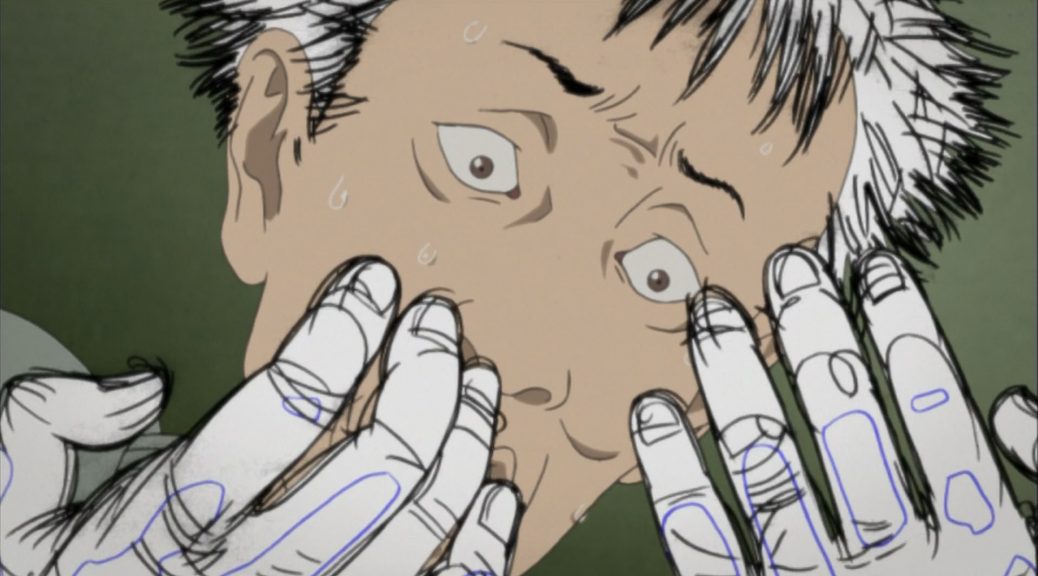
Sadly, this was Satoshi Kon's only television series, but among his small output, Paranoia Agent stands out as also one of the best series from the 2000s with good cause. Arguably, with a career that beforehand included being a manga author and working up in the anime industry itself to also consider, Kon had one of the best runs as a director regardless of medium, four films and one series which are as high a bar in talent as you could get. Again, its stepped in tragedy and loss, but God he was good.

From https://blog.sakugabooru.com/wp-content/
uploads/2017/12/tfw-houkai-1038x576.jpg

======
* Unfortunately, within the UK, whilst the offending scene is seen in the next episode preview beforehand, that episode was censored for a hanging scene and is still like this in 2019. At the same time, when this took place, an episode of Ren & Stimpy was censored for a gag about hanging too for DVD; despite Paranoia Agent being an adult work still rated for only eighteen year olds to see due to this episode, I have always speculated that it was picked on as well for being animated and depicting a form of suicide as well. It's still one of the biggest reasons, despite all their good virtues, I have always had a distrust of the British Board of Film Classification (BBFC) where every motion media work has to be rated through.