Showing posts with label Cyberpunk. Show all posts

Wednesday, 3 January 2024

#273: Cyber City Oedo 808 (1990–1991)


Studio: Madhouse

Director: Yoshiaki Kawajiri

Screenplay: Akinori Endo

Voice Cast: Hiroya Ishimaru as Shunsuke Sengoku, Kaneto Shiozawa as Merrill "Benten" Yanagawa, Tesshō Genda as Rikiya "Goggles" Gabimaru, Emi Shinohara as Remi Masuda, Kyousei Tsukui as Versus, Mitsuko Horie as Kyōko "Okyō" Jōnouchi, Norio Wakamoto as Juzo Hasegawa

Viewed in Japanese with English Subtitles


Madhouse would have success with Wicked City in 1987, one of their more infamous titles which helped when its director Yoshiaki Kawajiri pushed for a theatrical release and it paid dividends for the studio1. That was however an adaptation, based on the work of author Hideyuki Kikuchi, and with Cyber City Oedo, Madhouse and Kawajiri decided to create their own original intellectual property, one which was meant to be a multimedia one. This came to be true as there was a video game, the 1991 game for the PC-Engine CD-ROM², and a novel1. Cyber City itself, made for the straight to video format, was only to last for three forty plus minute episodes, never leading to anything further, but still became a cult anime in the decades after, even if by way of alternative dubs and music tracks being created for the images as we will get into.

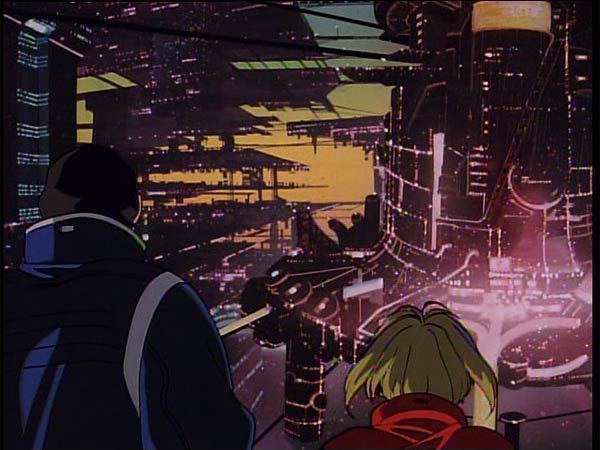
Oedo is a cyberpunk tale where, with criminal sentences possible to reach longer than the average human lifespan, prisoners are forced to live in the orbit of space, presumably in a way to extend their lives to suffer for their cybercrimes. Three prisoners housed in an orbital prison are offered an alternative by Juzo Hasegawa, a police chief, that they can reduce their life sentences for each criminal they bring in, with each having to ability to return with life on Earth but with explosive neck collars permanently on that, able to be timed, prevents any prisoner to take this offer to flee once they are back in public. This explicitly nods to period chambara tropes places in the future as "Oedo" is likely a reference to "Edo", the original name for Tokyo, whilst in Japanese history, the weapon they are all assigned, jitte, if a science fiction version of a weapon, with sai-like blunt ends, that was used by police in Edo-period Japan. Beyond this, the straight to video series is a hyper-exaggerated world, where in episode one, the main location is a space-scraper, a skyscraper so comically impractical in height, now in orbit at the top, that if the central threat managed to disable the gyroscope fully and cause it to fall, it would have led to a natural disaster of cataclysmic proportions. This has a variety of tropes and clichés of this type of “cyberpunk” of androids, cyborgs with psychic powers, and one of our leads having monomolecular wire, a concept the likes of author William Gibson, a huge figure in cyberpunk fiction, among other writers were obsessed with where you have weaponised wire so sharp on a molecular level that it could cut through anything, even through the neck of a cyber enhanced saber-toothed tiger. The leads, interconnecting as regular characters, however do get the starring role each for the three episodes, Shunsuke Sengoku the lead for episode one in the space-scraper. Sengoku is your typical hothead, who is heroic as an anti-hero figure but also anti-authoritarian, with a love-hate relationship with Juzo and especially against the sentient computer that occupancies them. This computer is arguably the fourth lead and deserving it, as the deadpan retorts in the Japanese dub are very funny, all from the perspective as an AI which cannot understand some of the insults thrown at it, such as when it has to explain how, with an internal geo-map system, it cannot possibly “get lost” on command. For episode one, with Sengoku and his constant argument with this robot, you get a great first episode to begin this work, where the serious tone in spite of how absurd this is in truth works fully.


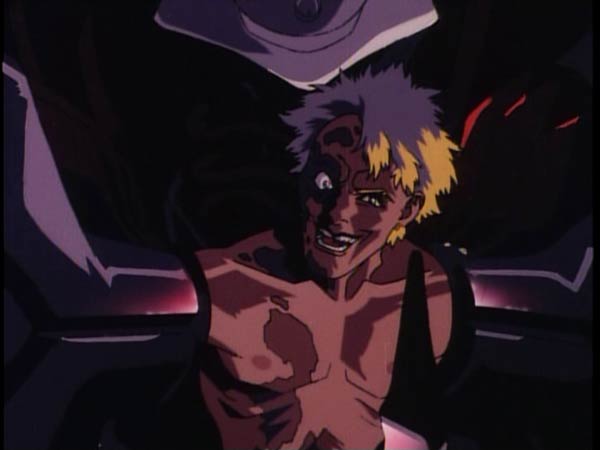
Rikiya "Goggles" Gabimaru stands out as a character that would rarely get to be a lead in an anime, an older man if with a Mohawk, the more conventional of the noble anti-heroes despite his visual look.  His is the type of macho melodrama, which is secretly sentimental and melancholic if filtered through acion tropes, encountering an old partner of crime who was also his old flame, involved in a conspiracy involving the corrupt military project of psychic robots. The owner of the monomolecular wire, and lead of the third episode, is Merrill "Benten" Yanagawa. Benten inherently stands out of the cast as, among very distinct characters in the history of anime, even minor ones, you have here an ultra androgynous final lead, a really distinct figure who is probably the most iconic for the whole production, bringing up a combination of glam rock feminization, with red lipstick and hyper feminine features, with kabuki aesthetic and a shock white mullet, aged in designed but entirely timeless. His episode also is the most idiosyncratic even in a very stylish and creative production, in that this brings horror tropes into science fiction with artificially created vampires. The result of this brings a gothic and moody sensibility to the proceedings with the first ounces even of tragedy to the production, as it involves a woman cryogenically preserved doomed in this life forced onto her by another, as it ups the gore in imagining an undead individual being driven out an airlock in space. It is this episode particularly where the show's ability to be serious despite also being ridiculous shows the virtue of this tightrope act, intentionally and unintentionally.

It is a ridiculous anime in a good way, where we are dealing with a premise where there is never a moment stopping to question its own logic or feeling contrived in a way that undercuts faith in the material. Cybernetic saber tooth tigers is a high watermark in the absurd, as mentioned earlier in the review, but found in episode three, this takes it further with them kept in a cryogenic hub in tubs among three hundred year old patients, a place in outer space connected to a hospital by a space elevator, and armed with lasers, with the anime managing to add more flourishes to these sort of moments. This is throughout each episode with all these "questionable" moments becoming highlights alongside the tone and style of the work winning you over. The seriousness of the production helps, feeling like the delirium usually found in a video game from this time, and helping this is how this is Madhouse at their highest of quality. Yoshiaki Kawajiri is an insanely talented figure in anime, even when he is in the animation department after his directorial career seemingly ended into the 2010s, but as much of the virtues is the entire staff too, where your mechanical animation director for an example is Takeshi Koike, the future director of Redline (2009), one of the most underrated theatrical anime in need of greater attention and showing where his work here before came from.

The audio is its own curious history for the OVA. I watched this in the original Japanese version, but the history needs to be marked how, whilst Manga Entertainment bought the license with great interest, they took their own decisions which added more to the story beyond a good pulp anime. They were known infamously for "fifteening" their dubs already, where to increase the age rating with the British film classification for all physical home releases, they added swearing into the dialogue alongside adding their own flourishes. This is an idiosyncratic production however in that they went further in changing the music track. I like the moody synth provided by composer Kazz Toyama, but if you are talking of Cyber City Oedo, specifically to its British release as the Central Park Media/U.S. Manga Corps release decided to not go forwards with this choice in the United States, you have to talk about this version as it is part of the legacy in the West. Rory McFarlane's contribution, combining hard rock, thrash metal and synth, even influenced by Mountain's Nantucket Sleighride (to Owen Coffin)1, is a distinct score to hear, and thus it is worth talking about too as a highlight even heard in snippets. For Kawajiri himself, this is getting into the golden period of his career between the late eighties to the 2000s, one where you see here that, for all his notoriety with certain titles for their transgression, what his trademark was, whether the screenwriter of the story or not as in this case, his trademark where these kinetic stories of larger than life figures, in larger than life scenarios, which never for all their moments of absurdities feel entirely a high quality in grandeur for this era of pulp anime storytelling. Even Ninja Scroll (1993), which shared in the more notorious content of his career, showed this and, in spite of the knowledge Cyber City Oedo was not the biggest hit as Manga Entertainment hoped for1, that would benefit from the virtues found here, in a period chambara tale, and gain even bigger status in Western anime pop culture among the other titles Kawajiri would helm.

=======

1) Taken from the documentary Inside Cyber City Oedo (2020), directed by Andy Hanley.

Wednesday, 27 October 2021

#206: Genocyber (1994)


Director: Koichi Ohata

Screenplay: Emu Arii, Koichi Ohata and Shou Aikawa

Based on the manga1 by Tony Takezaki

Voice Cast: Akiko Hiramatsu as Elaine Reed/Diana Reed; Kaoru Shimamura as Rat; Kazuyuki Sogabe as Grimson Rockwell; Kouji Tsujitani as Ryuu; Kumiko Nishihara as Mel; Masako Katsuki as Myra; Seizo Katou as Kenneth Reed; Shigeru Chiba as Radneck; Toshihiko Seki as Sakomizu

Viewed in Japanese with English Subtitles


Genocyber is a notorious anime, but this is a work, over five episodes, which is a bit more complicated as a viewing experience. To be honest, even saying it is an ultra violent sci-fi horror anime of notoriety is suspect, when arguably one of its five episodes is with lasting impact, and the gore itself is a slither a production which shifts content very erratically.

I was introduced to this by acquiring an old Manga Entertainment videotape of the first episode, watching it on my grandmother's VHS player by myself with shut curtains, all transpiring in my mid-twenties but, when there was a brief moment of finding obscure VHS tapes in British charity shops, having a lasting impact with titles which felt completely inappropriate to come from somewhere you buy second hand clothing from, alongside the two mid-era Godzilla films which proved more playfully memorable. And since this was the era of the internet, firmly, finding the other episodes of Genocyber online was not an issue, but it is the first episode then, and still now, which left a lasting mark. I will talk, for all this production's huge undefendable flaws, positively of this production least for the first episode. It is of its era and was a production clearly spat into existence with warts and all, which you can guess of knowing that Manga Entertainment, who only released this in VHS only in Britain, never released episodes four and five, and not because they were censored nor offensive but likely due to what was made in contrast to the previous three episodes.

This is a Koichi Ohata production, so this has an added infamy even with Shou Aikawa on the production as a screenwriter, the future author of some acclaimed anime narratives but also a writer on the likes of Urotsukidôji and Violence Jack. Koichi Ohata is more infamous, least for my guess, in the United States because M.D. Geist (1986), one of his most well known titles, became something of a lucky rabbit's foot and an obsession for Central Park Media, an American anime distributor, and its head John O'Donnell. Koichi Ohata, whose work in this era was released in the US by O'Donnell's company, had a moment in the OVA boom of the eighties and nineties to make lurid sci-fi orientated work with mechanical and monster designs, even if the production budgets and productions themselves could be a mess in the final results. Ohata is well regarded, to bear in mind, as a mecha and mechanical designer, on the likes of Gunbuster (1988) and Mobile Suit Gundam: Char's Counterattack (1988), but he has an infamy for the likes of M.D. Geist, which got even a "director's cut" helped by Central Park Media, and Genocyber, whilst anyone who has seen M.D. Geist II: Death Force (1996), also coming into existence with Central Park Media's help, can also attest to how erratic his work is even if I admit enjoying the accused thing more than the prequel.

Episode 1 of Genocyber, which is different from the other four in being over forty plus minutes long rather than less than thirty as the others, is a curious production by itself, already setting itself up as idiosyncratic with real photos being used in the opening credits. For all the flaws with this entire work, in plot and point, a trashy cyberpunk narrative initially in the first episode set in early 21st century Hong Kong, the first episode is memorable. It is surprising in the level of experimentation which transpires here, as much likely due to budgetary reasons but creative in inspired ways, alongside its nihilistic tone. The plot is over complicated, but can be boiled down to how, as a result of an experiment into what is the "vajra", a ritual weapon in the likes of Hindu and Buddhists faiths in reality, the psychic force all human beings could tap into in this anime, one scientist created a machine to fully access this and led to two sisters being born by his wife. One called Diana has a completely disabled body, able to move through a robotic one, who is kept with a sinister scientist, responsible for her father's death and working for the Kuryu Group, in his own world working on his own obsessions and with the Kuryu Group ultimately intending to take his project away from him. This project requires the other sister Elaine, effectively the protagonist, has a fully working body but a mind close between a little girl and a feral animal, who has escaped into Hong Kong who the group want to recapture, even if the Kuryu Group will send their own cybernetically enhanced mercenaries sent to get her alive. The Genocyber of the title, the intended goal of reuniting the sisters, is a form both sisters can fuse into, a horrifying humanoid capable of wiping out a whole country as an apocalyptic entity, the creation of humanity's worse tendencies as, linked to Elaine especially with pain and agony wakening it.

What stands out is that, for what was clearly made as much for the sake of gore, this first episode has the unpredictability I want from anime. Alongside the cool ethereal score, the production was clearly working against some huge budget restrictions, but found innovative ways to work around this. Early CGI is used, but also fine pencil still drawings for flashbacks. Live action is used for memories for characters, and sometimes the animated characters are animated over real images, such as Elaine and a boy she meets over a photo of a street, or the back-story of the machine to access the Vajra being an actual handmade model in the background. The most infamous aspect of the first episode, alongside its gore and body horror, is the use of clay, actual red clay, for certain scenes. A foetus sculpted in clay is one thing, but it is used to emphasis gore scenes too, including for a scene of a mercenary after Elaine, when psychically influenced to think there are insects inside his head crawling on his brain, cutting to fake insects on a clay sculpted brain.

The gore and the body horror is extreme if not constant, including episode 2 later on, where it is obvious despite the serious tone this is a work meant to reveal in the grotesque. A detective exists in the first episode, for considerable screen time, only to just be an excuse for an ultraviolent gore sequence. One where, with the scientist having a swarm of deranged masked surgeons out of Silent Hill on his side, they completely butcher the occupants of a hospital, intestines lovingly rendered stuck on the ceiling and, for a really obscure and grotesque reference, leaving someone alive to experience being a perverted version of a Dr. Guther von Hagens display2. It is immature as an episode, but I find a work like this compelling for their tone. It is uniquely disturbing in presentation, including a brief moment of cybernetic body-horror, where the mercenaries distort and transmogrify into bio-mechanical monstrosities. That the episode takes no prisoners, with people killed off [Major Spoiler Warning] and Hong Kong being obliterated off the map entirely [Spoilers End], Genocyber for this episode does leave the screen with an impact I have to admire.

The episodes after is where Genocyber becomes complicated as, whilst the first episode could have been released by itself, the others do become less consistent. The art style of before, the experimentation, is entirely stripped away. The second episode, in its first minutes, is probably the most infamous moment of the OVA, where with Elaine in a warzone kids are graphically machine gunned down by a helicopter, still drawings but rendered in full graphic detail of organs that, traversing the taboo of killing children onscreen, can get away with mocking said taboo in animated form. It is after that, whilst with body horror content, a bog standard narrative from Koichi Ohata, where a cybernetic Vajra powered entity created to fly combat planes, as the United States is fighting the middle eastern country of "Karain", becomes more unstable and violent when Ellen is rescued and brought on the aircraft carrier it is housed on. Its creator wishes, corrupted, to further its powers, even if it means engulfing the whole ship and crew into a horrifying flesh-machine battleship, with the story becoming the third episode a kaiju monster versus monster narrative. It is of its time, still compelling for me but, even with the moments of gore, a narrative which feels like a side chapter, especially as it never gets into plot details brought up and disposed of in exposition, such as Karain having magnetic sand which makes it impossible to use modern weaponry, nor that war being of importance in the first place. Only the narrative of a female doctor on board, a figure who is connected traumatically to Genocyber's first apocalyptic attack, has a trajectory which is a little fleshed out, which can be best described as that of a Lovecraft protagonist for all that unfortunately entails.

It is a production which feels erratic, possessing aspects which made these OVA compelling for me over the years but feeling, especially as these were produced in relatively short time to each other, a work which feels abrupt in what narratives we got. As much as this is still compelling, it is a disjointed work where a lot of it is not as well thought out after the initial first episode. Even one of its virtues and a minor detail, a rocking end song, emphasises how this entire production is a mess, as the most inappropriate song to have in context, about "wishing you a rainbow" and called Fairy Dreamin', even if it is a hugely impactful song in mood to the production. This issue is more so with Episodes 4 and 5, which are the most contentious to deal with, with knowledge they were never released on the British VHS, and with only Central Park Media funding an English dub for them where they released the whole OVA series. They were episodes I was initially hesitant to revisit because, originally, these were an incredible low point to reach. Now I find virtues in them, and they connect to the entire narrative arch, what is there, with greater worth, but this is where the erratic nature of Genocyber is a huge aspect to deal with.

Because, far from being offensive, this is a huge tonal shift, a time and narrative shift with no ultra violence to speak of and feeling like an attempt at seriousness out of place. This is set in the post-apocalypse, when Genocyber finally destroyed civilisation after the Kuryu Group funded as much as it could to destroy the beast, a potentially fascinating turn of events for a larger series of narratives as a result truncated here. That at least a hundred years has passed afterwards, with humanity having rebuilt itself with a new city in the centre of the narrative called Ark de Grande. Run by a dictatorship under one politician who has secret police, it is obvious material but it has stuff of interest in this context. I have softened to these episodes for the few inspired aspects, such as the fact that there is a religious group, who is against the corrupt upper classes and with the rebels underground, who pray to Genocyber, believing them to have been a God that, if angered, will cleanse the corruption of the city, its form also petrified and kept in the further depths of their hideaway without them realising it is said God.

The issue with Episodes 4 and 5, and still is the problem, is how slow and conventional this arch is especially as this follows two new characters that are not that interesting. They are a young male knife thrower and his blind girlfriend, who he takes to the city to earn enough to help with her blindness and find themselves chewed up by the evil of the metropolis. They have no emotional investment over the two episodes to care for, and in plot terms their only real connection as is entirely how she, as a psychic, connects mind-to-mind with the Genocyber, specifically the reintroduced Diana, part of the consciousness with Elaine. Aside from this, this is very predictable and, with that lack of violence and gore, it is unnecessary. Even if I have been won over a bit more with its little lore for the whole narrative and melancholic happy ending, it feels a jarring tonal shift for a work which was already on shaky footing with what it wanted to do from the second episode. If Genocyber had lasted just its first OVA, it would have still gained an infamy even if, in the modern day, trying to sell a work only under an hour is less common in the market unless it is something very specific or a company like Media Blasters in the USA that can still release such title. It is strange to think, looking back, how this work ended up this way, and it cannot be ignored many people will find, for all this title's reputation, it becomes an anti-climax for the gorehound and is still a very erratic work in general quality.

I have a soft spot for Koichi Ohata, which is why this review even for a very nasty little work like this is still bizarrely whimsical. He is an example of a man fixated on his obsessions and an auteur in a way for anime, who got his way to produce his ideas for a brief window of time. He had an attempt at moving on in the 2000s, where I was actually introduced to Ohata as a director with Burst Angel (2004), an animated series I encountered at a formation stage as an anime fan when studio Gonzo were a thing. He works to the modern day, but bearing directing later seasons of the Ikki Tousen, a fighting show entirely fixated on softcore titillation despite its female cast being reincarnations of figures of the Romance of the Three Kingdoms, he is not commonly in the director's seat nowadays. His reputation outside of mechanical designs is not a well regarded one, truth be frank, but it is a sad tale to think that, as his career trajectory became obscurer, the type of anime made in later decades meant not even one Genocyber in a while alongside the good titles we could only get in the modern day. Again, Genocyber is a mess, but even something which kept this work's energy but avoided a lot of the mistakes would be appreciated once in a while.


======

1) The original manga is worth bringing up as, a case of one that was cancelled barely into its run, but also getting English publication in the early nineties, its author Tony Takezaki comes from this older era of the likes of A.D. Police, which he wrote the manga of, among the many "adult" titles from this era.

2) Hagens, a German anatomist who invented the preserving technique of "plastination", is controversial for both the Body Works exhibits of persevered and dissected bodies, including human beings, and for how I know of him, that he had public autopsies including ones broadcast on the British channel Channel 4, terrestrial television and not satellite, one programme called Autopsy: Life and Death (2006) likely the one my patents watched and I remember. Hence, the obscure reference that felt appropriate for that one gory scene in Genocyber.

Friday, 17 January 2020

#131: Parasite Dolls (2003)


Director: Kazuto Nakazawa, Naoyuki Yoshinaga and Yasuhiro Geshi
Screenplay: Chiaki J. Konaka and Kazuto Nakazawa
Voice Cast: Akemi Okamura as Michaelson; Kazuhiko Inoue as Buzz; Soumei Uchida as Kimbell; Kikuko Inoue as Angel; Masaru Ikeda as Takahashi; Toshio Furukawa as Myer
Viewed in Japanese with English Subtitles

I like Chiaki J. Konaka, the divisive screenwriter of a lot of anime, and it is of immediate interest that he worked on the following project. The other figure of note, whilst there are three directors, is Kazuto Nakazawa. Nakazawa is the director who worked on Kill Bill Vol. 1 (2003) no less, the man responsible for the animated back story of the character O-Ren when Quentin Tarantino literally knocked on Production I.G,'s door, probably one of the biggest hit points in anime's mainstream popularity, alongside animating the video for Breaking the Habit, the Linkin Park song whose video was a mainstray of my childhood watching Kerrang television in the early 2000s. Parasite Dolls is also another interpretation of Bubblegum Crisis (1987-1991), a big popular OVA series (in spite of the fact its planned run was cancelled) that got quite a few follow ons At this point with Parasite Dolls, there was the very badly regarded sequel Bubblegum Crash (1991-2), A.D. Police Files (1990) which we will get to in a moment, and two parts of a reboot, Bubblegum Crisis Tokyo 2040 (1998-9) which Konaka wrote, and A.D. Police: To Protect and Serve (1999), another TV series.

A.D. Police Files, the 1990 OVA, is appropriate to talk about here. That title had none of the main cast, a group of women armed with power suits, and was a prequel entirely about the AD Police, set up to deal with malfunctioning robots named Boomers in a world of futuristic Neo-Tokyo where they are mass produced for everything from manual work to even paid sex. It was a dark, violent and seedy OVA, one I have grown to admire in spite of its problematic gender politics because of its style, the three stories told as the dark cyberpunk side of the world where cybernetic implants and robots are commonplace in a rundown metropolis, and an eighties J-pop soundtrack which is endlessly listenable because of how moody it is. For two thirds of Parasite Dolls, you get something trying for this again. Something lurid but still attempting a very thoughtful piece, arguably more so then A.D. Police Files which came from the tail end of lurid eighties OVAs.


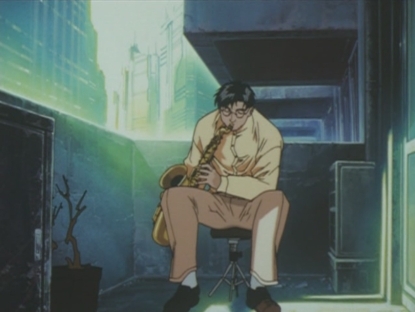
It does have the stereotype of the grizzled old veteran in just his late thirties, who never carries a gun and even plays a saxophone, which presents something a bit absurd to begin with, but for the first thirty minute episode, we get a fascinating snapshot of this world. This is a rundown city, drastically contrasted by the rich being behind dubious behaviour, be it the company behind the Boomers secretly covering up malfunctioned creations, to a dark pleasure to connect to Boomers on a rampage directly through the brain as part of a nude orgy. Building from this, side characters of interest are there, the naive but tough female or the lead's partner, a Boomer on the force whose attempts to gain semblance of human freewill make him a pretty good cop and an immediately rewarding figure to follow.

The style of the OVA is interesting, a very distinct one, matched by an incredibly rewarding soundtrack which immediately caught my attention. The depiction of Neo-Tokyo is not as sordid as A.D. Police Files, Parasite Dolls instead coming from a curious period where the OVA would diminish completely baring as tie-ins to other productions or porn. It's a handsome creation nonetheless, which is definitely felt in episode two when there are more unconventional aspects to consider, about a being killing female sex boomers. Ironically A.D. Police Files had a similar storyline about someone targeting human female sex workers, whilst this take is the episode where the virtues of Parasite Dolls appear, following the female lead and getting into both grotesque horror (the boomer sex worker killer) and weirdness as [Huge Spoiler] I keep coming across titles which teach viewers to distrust cats completely.

Episode Three, the finale one, takes a sudden and surprising direction where all hell breaks loose. This is not glib either, as it immediately gets darker than the other episodes just from the opening where an anti-Boomer fanatic is having sex with one in front of his cult and a corrupt police officer, monologuing only to then blow the poor robot's head off mid coitus and then talk of how they are just machines next to humans, proving this by shooting a young minion in the knee. This episode will eventually lead to most of Neo-Tokyo blown up, with most of the cast dead and a cultural shockwave to permanently scar the world. It would, in a full length Bubblegum Crisis film or series, be jaw dropping and an incredible conclusion.


Here however I have to confess, hiding this until now when I pull the rug under Parasite Doll's legs, I went from having an energy rush from just sitting through the three OVA episodes, thinking it was a forgotten gem, only for it to dissipate in my mind only a few days after. I entirely blame the finale, not its existence but that there's barely any build up to it and that the production shot itself in the legs by only having three episodes and not enough time to make this work. Characters we barely see die and little is witnessed, squandering a lot. That the episodes are only less than thirty minutes each, like a TV series, doesn't help as, more common later on, older OVAs like A.D. Police Files had over forty minutes per its three episodes alongside just being vignettes of separate stories in the same world, having a better effect as a result.  

Whilst I appreciate the technical quality of this anime, I don't feel the enthusiasm. The other thing is that, whilst I applaud the chutzpah with the ending episode destroying the world of a beloved franchise, I find this surprisingly normal for Chiaki J. Konaka. Disappointingly so as one of the few people who love his abstract leaps, which is also why Episode 2 is the best episode of Parasite Dolls, closer to his trademarks whilst taking from this franchise in its bizarreness (a bio-robot death machine), cerebralness (can a female robot have a personality?) in very little time to work with, and abstracting as said Boomer is haunted by a female ghost child.

It sucks how Parasite Dolls is affected by its own slightness as, if it had been longer, every episode here would work and the ending would be perfect. But as it stands, this does become an example of style over substance in a bad way, as there would've been a lot more to appreciate if we had actually gotten enough time for this material, where even the lead not carrying a gun is a reference to a tragic back-story which is abruptly included in at the end, rather than naturally introduced. The lack of balance between what wants to be a serious cyberpunk story and the presentation, which would've been more successful if it had just been an action work, is felt immensely. That this is the last Bubblegum Crisis animated production also adds a sadness in that, whilst I have somehow only seen the spin-offs, that original OVA series was popular. Of the time, as eighties as you could get, but one you'd think would get reboots. A work like Parasite Dolls might've been frankly too controversial, as there's nothing in the original premise here, but it was an attempt at brining the material to the new decade even if it has big problems structurally. Only an anniversary celebration or a drastic reboot coming to be might be the only way we get anything new.


Thursday, 6 September 2018

#66: Armitage III - Poly-Matrix (1997)

From https://shinden.pl/res/images/genuine/201476.jpg


Directors: Hiroyuki Ochi, Satoshi Saga, Takuya Satō and Yukio Okamoto
Screenplay: Chiaki J. Konaka
Voice Cast: Elizabeth Berkley as Naomi Armitage, Kiefer Sutherland as Ross Sylibus, Dan Woren as D'anclaude, Barry Stigler as Asakura, Bryan Cranston as Eddie, Dorothy Fahn as Kathy/Kelly McCanon, Ellyn Stern as Rosalind

Synopsis: The moment he steps into a space port on colonised Mars, a member of Earth's police force Ross Sylibus (Kiefer Sutherland) finds himself immediately involved with a conspiracy when a female country singer is not only found murdered, but revealed to be a highly advanced form of bio-mechanical robot. Amidst Mars and the growing anti-robot sentiment among the human populous, he also meets the mysterious and cocky police officer Naomi Armitage (Elizabeth Berkley), a ball of fiery energy whose emotional investment in the case, as more advanced robots are targeted by a lunatic, is of great significance.

[Major Spoiler Warnings]

Armitage III: Poly-Matrix is a fascinating curiosity of earlier Western anime fandom. This is, significantly, a theatrical re-edit of a four episode 1995 OVA series where the run time is at least over two hours, making this a ninety minute production which still works as a story but had to excise a lot to get its length. It's also very well known for the casting of known Hollywood actors in the leads. The female lead Naomi Armitage by Elizabeth Berkley, post Save By The Bell and just after the infamy of Showgirls (1995), and as male lead Ross Sylibus by Kiefer Sutherland, son of Donald Sutherland and an underrated actor in his own right. As a result, I can review the original OVA version, which was released before and after the alternative English language cut, as a separate entity. When it comes to the feature version, there's both the virtues of the original material, and their problems, which ultimately stand out the most, the decisions to make the film marketable to English speaking countries afterwards merely slurring material that is curious and not perfectly explained in this version's form.

From http://www.capsulecomputers.com.au/wp-content/
uploads/2012/07/armitage-III-review-2.png

The story of Poly-Matrix is both interesting but scuppered. It does offer a fascinating idea that there are robots in this futuristic world so advanced to the point they both have real emotions but, mostly female, they can also even conceive children in their bio-mechanical forms. This leads to the one theme which could've been more interested if dwelt more carefully on but, especially in the truncated version, has severe flaws which could be accused as problematic. Its revealed just near the end of the film, which doesn't allow enough time to delve into this, but Earth has become a feminised society, with a female leader, who in potential talks with Mars are severely concerned with how the Martians, in a decadent dystopian future-scape, have female robotic sexbots and servants everywhere, for added touch many looking like stereotypical Moe anime heroines with big eyes and multi-coloured hair in contrast to ordinary human women. It has to be asked whether it's the truncation or the original story which is an issue as, once the conspiracy is revealed, it adds an unintentionally problematic spin on feminism by accident of the theatrical version not providing enough time to clearly define its ideas.

At the same time that leads to a fascinating spin that could've worked. That even Earth, with a female leader and meant to be progressive, can yet be being a conspiracy with deeply problematic moral sliding has a darker, more poignant touch in real life when the #MeToo movement and attempts at helping women, even by other women, sadly has been punctured by issues which harm women, even has women harming other women through unintentional means. (A good example I thought of in the middle of Poly-Matrix was when Meryl Streep, Kate Winslet, Emma Thompson and Lena Dunham challenged Amnesty International to withdraw support for decriminalisation of sex work, only for female sex workers to challenge these major figures back by arguing Amnesty International's decision would actual protect them, signing their own petitions back to have Amnesty stick to their choice1).

From https://static.anarchivism.org/cyberpunkreview-
archive/www.cyberpunkreview.com/images/armitage3-13.jpg

There is also the film tackling, as many sci-fi works, the relationship between human beings and machines.  There is a sobering nature to the Martian populous massacring robots in protests, the protests done with understandable reasons of losing work to the robots, but made horrifying as humanoid figures who are built to look like them are torched alive and their machinery piled up in morbid decorations around graveyards. The added issue that the robots seen punished are all female those which are generic machines already having uncomfortable connotations before you get to those in the story with actual emotions. Their deaths makes this intentionally more mortifying, one figure shown briefly to have a life and relationships, a romance with her female model as a painter, only to be a burnt husk on a pyre next to less advanced robots regardless of her real humanity. The end, where female robots watch on at a battle onscreen between the leads and an army sent to silence them, turning their heads with their big eyed gazes despite being merely functioning machinery, has a power to it as if hinting of a potential revolution.

Unfortunately the material is not as refined and expanded upon as one would hope. It is built as well in a generic sci-fi action anime, like many from the era and not as unique as them. The issue that Poly-Matrix isn't that unique, baring it mind it was once a longer length production, is more surprising when its screenwriter is Chiaki J. Konaka. One of my favourite screenwriters, argubly an auteurist voice in his own right, who is known both for being esoteric and having frustrated many an anime fan with deliberately ambiguous endings and his work eventually undermining reality against unreality without defining which is which. For a very interesting screenwriter, a literal auteur in his penmanship, even a superfan like myself for every good idea this has confesses this is pretty conventional and sluggish by his standards. Barring an occasional taste of his unconventional style - eventually Sylibus and Armitage are in a desert compound where hulking robot-tree hybrids lumber around like gardening Ents - but he could've gone further to his weirder tendencies and especially clarified the themes he was tackling more carefully of gender politics.

From https://static.anarchivism.org/cyberpunkreview-archive/
www.cyberpunkreview.com/images/armitage3-17.jpg

There's also the elephant in the room called Ghost in the Shell (1995), which undercuts this production immensely. Mamoru Oshii's adaptation of the Masamune Shirow manga is difficult, in spite of being a seminal work in Japanese animation, long before Oshii became even more difficult and idiosyncratic with the 2004 sequel, but between hairpin turns from action to heavy philosophy he is a very good auteur when it comes to diving carefully into these type of ideas and tackling the likes of robotics and the nature of the human soul with very thoughtful ideas. Poly-Matrix relies on a lot of clichéd tropes common in sci-fi anime, such as the touch but scantily dressed heroine, and throughout you have to wade through an anime that feels significantly more dated than the two Oshii helmed Ghost in the Shell for said clichés. Oshii would've at least taken the potentially problematic gender politics and refined them to actually have a more pointed, morally thorough take with teeth. He would've even gone far, like his later work, to having an action sci-fi story abruptly stop for a long scene of characters sat down discussing gender politics and robotics, even if it enraged most anime viewers and lasted over ten minutes, just to make sure he was as thorough as possible on said subject2.

Production wise, the OVA quality artistry is good, missed dearly (when it was once so common) to have this type of insanely detailed, colourful dystopian cityscape of the future. Mars, as what we see, is already swollen with urban sprawl unless you go to a desert that has already had the atmospheric process from Total Recall taking place to allow breathable air. The lead characters are an issue though, in script, design and (English) voice acting. Not surprisingly, as individuals who work in this medium for their careers, the regulars of English anime voice acting like Steven Blum blend in perfectly. Ironically, or maybe not as they would have experience with anime voice acting, it's the regulars of a production like this like Steve Blum who blend in perfectly. Elizabeth Berkley, I confess, at least tries. We find her character Naomi in Showgirls to be ridiculous, but it suits the character of Naomi Armitage to have casted her. As with Showgirls, where Joe Eszterhas' script was as much an issue for Berkley to overcome, the same issue is here with Armitage being a paradox. Both the tough cop yet like a teenager in size and obsession with things like ice cream, a confusing figure for anyone to have to work with. The hot red leather shorts and shades are a giveaway Berkley was already dealing with the ridiculous tough yet sexy anime heroine stereotype from this era that would handicap anyone. If her performance is broad, its only because the character in spite of her dramatic narrative, being one of those bio-mechanical robots with her own consciousness, is a broad figure anyway.

From http://www.anime-kun.net/animes/screenshots/armitage-iii-3897.jpg

She at least tries. What happened to Kiefer Sutherland, and how he seems to be sleepwalking through his lines, is another thing entirely. It's an embarrassing vocal performance from an actor at this point in his career, even if he had loss his lustre of earlier work and had to wait until the 24 series to become known again, showed he was actually a great actor in oddities like Freeway (1996). For me, like his father Donald, Kiefer Sunderland has always been a character actor, the best kind who could front a major picture but like in Freeway could radiate pure, incredible acting chops in any circumstance. How lifeless his voice sounds as Ross Sylibus here is embarrassing. It neither helps his character is stricken with boring male protagonist syndrome, a plague in anime. This isn't even the worse example, when creators try to appeal more to otaku with blank and shy adolescents in the male lead roles, blank slates for viewers to place themselves as vicariously surrounded by many cute girls. But it's not a credit to Sylibus still as a lead, the stereotypical cop on edge who hates robots because one murdered his female partner, yet even with that or his growing romance with Armitage coming off as mandatory due to Sutherland's performance and the scriptwriting.  One of the most pertinent observations I've found as an anime fan that, even if it's in a fan service heavy and objectifying work, in most anime the female characters are the figures you remember with the most personality even when they are crass stereotypes, whilst the males meant to be protagonists have the personality of papier-mâché. Sylibus is effectively the protagonist, and even if Sutherland  wasn't sounding like he has dazed, that wouldn't be helped by the blandness of said character.

All in all, Armitage III: Poly-Matrix, followed by a sequel called Armitage: Dual-Matrix (2002) where Juliette Lewis took the titular role over, is fascinating as a curiosity. It earns enough to justify a revisit in terms of its ideas, but does with noticeable flaws both in its original material and the Western adaptation that cuts the legs off some of its best moments considerably. It does suffer under the weight of other anime which have tackled this material better or with more idiosyncrasies, but when there is a stand out moment, it does shine. The decision to compile it into a feature was, likely, a detriment and it's not a surprise that this is a rare case nowadays when the faithful, original versions of anime usually are released in the West too.

From http://www.capsulecomputers.com.au/wp-content/
uploads/2012/07/armitage-III-review-3.png

====

1) Whilst this strays far from this being a review of Armitage III: Poly-Matrix, and is likely to be controversial, I felt including articles discussing that example I gave will give you ideas of why I felt the comparison was apt:


2) Another tangent, but considering Oshii's own spin off of Blood: The Last Vampire (2000), a light novel named Blood: The Last Vampire: Night of the Beasts (2000), abruptly halts a vampire horror story halfway through for a prolonged, chapters long segments of characters at around  a table discussing mythology of vampires, Oshii even to the point of unintentional comedy or to deliberate screw with an audience would draw the philosophy out for a long, long period of time more than most if he felt like it was necessary.

Friday, 17 August 2018

#62: Bubblegum Crash! (1991)

From https://m.media-amazon.com/images/M/MV5BZGNmNWE5NDYtNmNhMS00YT
diLTk1NDgtNDFjN2ZmYzBlYzBlXkEy
XkFqcGdeQXVyNTAyODkwOQ@@._V1_SY1000_CR0,0,712,1000_AL_.jpg


Directors: Hiroshi Ishiodori (Episodes 1 and 3), Hiroyuki Fukushima (Episode 2)
Screenplay: Emu Arii
Voice Cast: Akiko Hiramatsu /Barbara Barnes [Manga UK Dub] as Nene Romanova; Michie Tomizawa/ Stacey Gregg [Manga UK Dub]  as Linna Yamazaki; Ryōko Tachikawa/ Julia Brahms [Manga UK Dub] as Priscilla S. "Priss" Asagiri; Yoshiko Sakakibara/ Tamsin Hollo [Manga UK Dub]  as Sylia Stingray; Kenyuu Horiuchi /Michael McGhee [Manga UK Dub] as Daley Wong, ; Toshio Furukawa /Matthew Sharp [Manga UK Dub] as Leon McNichol
Viewed in English

Synopsis: 2034, two years after they helped Tokyo deal with rouge "Boomers", humanoid robots who have malfunctioned, the all female group known as the Knight Sabres have vanished from the scene. Three members - pop star Priss Asagiri, hacker Nene Romanova and Linna Yamazaki - presume, as their leader Sylia Stingrayhas been absent, that their previous role is over. When Sylia returns however, it's time for them to put the powered armour back on as a series of Boomer related incidents rock Tokyo again.

In 1987, a straight-to-video series started called Bubblegum Crisis. Futuristic Japan, directly inspired by Ridley Scott's Blade Runner (1982) (and Walter Hill's rock 'n' roll action oddity Streets of Fire (1984), which was much more successful in Japan than in its homeland). A story where mass produced robots nicknamed "Boomers" exist, only for there to be the problem that exists in most anime and manga stories, that they can go kill-crazy and malfunction all the time. Four female leads donned cybernetic power armour, dubbed themselves the Knights Sabres and over eight episodes in 1991 dealt with tasks even the A.D. Police, specifically founded to deal with Boomer related crime, cannot handle. Bubblegum Crisis was a success, not only in Japan but with a following the West for a certain generation. Naturally striking the iron whilst it was still hot, not always something anime producers have done, this popular series was followed by two tie-ins. Inexplicably, whilst Bubblegum Crisis was released in the UK, you're more likely to find these tie-ins second hand still than the original, as they were licensed by our home-grown company Manga Entertainment, which gives you a peculiar issue where some have probably never seen the original unless they got those episodes from a separate company or imported US releases.

In general the story of the franchise after Bubblegum Crisis is not that well regarded either, lasting to 2003 and really given a critical dubbing. One of the only tie-ins to succeed for some, and it's a divisive creation for some still, was one of the entries Manga Entertainment picked up named A.D Police (1990). Made part of the way through the main series' releases, it is in vast contrast to the original or its sequel, A.D. Police not only a prequel set before the Knight Sabres existed, but a lurid and nasty cyberpunk noir with more gore, sleazy sexuality and a very bleak tone, even to the point of ridiculousness of how masochistic the dialogue could be. Less regarded however, out of Manga Entertainment's acquisitions, is the actual sequel Bubblegum Crash! started the same year Crisis finished. Even in context of one of their lesser releases - part of The Collection of licenses transferred from VHS to DVD, ropey English dub and removing the end credits screen for a black one with text - it feels like a bad follow on. Even without seeing the original Crisis, which I have to confess now before I feel like I'm lying, I utterly see why Crash! is not well regarded as, even without the original context, it's not a good sci-fi action anime even by itself.

From https://m.media-amazon.com/images/M/MV5BYTEwNjViZTM
tZjBjNi00YzY0LWI4YmYtNjh
kMGZjODE0MjJiXkEyXkFqcGdeQXVyNTAyODkwOQ@@._V1_.jpg

Crash!
, contrary to my original opinion, only takes half of its first episode to bring back the heroines properly, who stay as friends but returned to their old lives, rather than a whole episode. However, as the OVA series consists of only three episodes in the first place, there's not a lot of time to work with and what does happen it exceptionally bland. A little joy is found in Crash!, at least in its awesome opening theme song of eighties synth rock, but the rest feels like a missed opportunity. Episode one, having to devote time to bring back the gang, skims over a mercenary army with cybernetic implants, all part of the series wide plot of a shady figure behind the machinations as that particular group rob banks. Pretty basic, cheerful action sci-fi. More egregious, and wasting a whole episode with its clichés, is Episode  2 following a more advanced form of Boomer with its own consciousness who is the target for theft. The member of the Knights Sabres who hates Boomers, Priss, is naturally the one who ends up with him and, not justifying its tale of her overcoming her hatred for robots to admire him, is syrup poured onto clichés, death to sit through. Neither does it help that, without the context of the original series, these characters for all the series are not interesting. Figures without the spark and colour their appearances and power armour suggest. The English performances are egregious as well, particular as for the Manga UK release an entirely different English language cast for the four main leads was hired, in contrast to the same one for an alternative dub who played the characters in Bubblegum Crisis.

The only interesting aspects of the first two episodes are the background details, a world with its own character that should've been pushed into the foreground more. Advertising and goofy promotional films for the A.D. Police, who are practically useless through these episodes. How the two A.D. Police with personality, Leon and Daley, get scenes like having to deal with a female cafe Boomer whose internal coffee machine has failed, pouring out coffee beans instead of the desired beverage. Material that makes the first two episodes more tolerable, at least more interesting. It's also specifically the comedy and exponential material which has nothing to do with the Knight Sabres as, especially in the English dub, what should be by all right interesting, tough female characters are the blandest gang of four you can get, where someone like Priss (here tough and hard boiled, and little else) is out staged by how camp the English voice for her slimy music producer is.

From https://m.media-amazon.com/images/M/MV5BZjM3N2IyY
TYtOWYwYS00NDA3LWI3ZDEtMDE5
NWNmN2NlN2ZmXkEyXkFqcGdeQXVyNTAyODkwOQ@@._V1_.jpg

Episode 3, starting with construction site Boomers in hard hats and robo-dungarees going murder-death-kill on humans, is the one truly redeemable part of Bubblegum Crash. Still an average series, but in context of the motley group of titles Manga Entertainment put together called The Collection, the only episode out of three where there's the trashiness I can enjoy as in some of the dumber entries from that series. It's certainly a lot more energetic and proudly trashy in an inventive way, when Boomers on mass crowd in the streets due to a virus that causes them to rebel, forming together into a giant bio-mechanical beast latched on a skyscraper, and leading to the heroes having to fire at it from an aerial vehicle. Something that's at least novel next to the predictability of the rest before, at least with the English dub providing a hoot of a line where the monstrosity screams, after it intends to kill them, to steal their data in that order. The episodes reintroduces a character from the prequel, making it the only episode of importance even if the plot's built from the first two, and generally has more on the line. A nuclear power plant in danger that could blow up all of Tokyo. A giant, street sized war machine on treads. The Knight Sabres in actual trouble, with inventive and scary looking robot designs. Even my pet obsession with characters entering phantom zones out-of-body makes an appearance, common in these old Manga Entertainment acquisitions, in this case an excuse for nudity and floating above the Earth for a weird cross pollination of sci-fi and psychic imagery.

In lieu of all the old licences Manga Entertainment put together as The Collection, Bubblegum Crash! is one of only two that [so far in 2018] have been made available on DVD in the 2010s. (The other is unfortunately the infamous Violence Jack OVAs, but that's for another day's review). They make a vast contrast next to the company in the current day who licences more respectable work like Dragonball Z and live action Power Rangers series. Out of those so far in The Collection, however, Bubblegum Crash! barring that final episode is one of the least rewarding I've seen, even with the third episode sadly both the most well known of two but the least interesting even paired next to the likes of Psychic Wars (1991) [Reviewed HERE] or the shambolic South Korean failure Armageddon (1996) [Reviewed HERE], bland and adequate rather than an utter, compelling disaster or something good.

From https://m.media-amazon.com/images/M/MV5BYTFm
MGNkNDAtY2ZmNy00YTllLWE5N2UtZ
WE5MWZjNjY4ZGY5XkEyXkFqcGdeQXVyNTAyODkwOQ@@._V1_.jpg