Showing posts with label Slice of Life. Show all posts

Thursday, 19 May 2022

#214: Azumanga Daioh (2002)


Director: Hiroshi Nishikiori

Screenplay: Ichiro Okouchi

Based on the manga by Kiyohiko Azuma

Voice Actors: Chieko Higuchi as Tomo Takino; Houko Kuwashima as Kagura; Rie Tanaka as Koyomi "Yomi" Mizuhara; Tomoko Kaneda as Chiyo Mihama; Yuki Matsuoka as Ayumu "Osaka" Kasuga; Yuu Asakawa as Sakaki; Akiko Hiramatsu as Yukari Tanizaki; Aya Hisakawa as Minamo "Nyamo" Kurosawa; Kōji Ishii as Kimura; Norio Wakamoto as Chiyochichi; Sakura Nogawa as Kaorin

Viewed in Japanese with English Subtitles


Azumanga Daioh has been a long time to return to for me, fond of this series originally, but returning to this now as an adult. Azumanga's source material, a manga by Kiyohiko Azuma, has been published in the West, and was originally for Dengeki Daioh, a manga for teen males, thus undercutting any preconceptions of a target audience. Some sex jokes aside, and the idea the all-female leads are "cute" for the target audience, this is incongruous to the "moe" genre which would emphasise cute school girls doing things. In contrast, this series is a much more whimsical work for the better. The best way to start with Azumanga Daioh is actually to look at the adaptations before. Azumanga was gauged with a tiny little short, an ONA very early in that medium, called Azumanga Web Daioh (2000), clearly a taster to see if there was an audience for this. Baring some very dated school corridors made in early polygons for the medium, Web Daioh is fascinating both in how it is far less common than the other tiny short work. Alongside all three having different looks, it is just a snapshot of what would be entailed, but with a plotline which is not referred to in a form in any of the full television series. Namely, that the main have been given a film camera to record what will be a time capsule, in a short which, if anything, does not have as much of the humour as would come later.

Far more striking is Azumanga Daioh: The Very Short Movie (2001), a short originally made for theatrical screenings1, which ADV Film's included in the last of their DVD releases when anime, in the early to mid 2000s used to be split up per episodes in sets over multiple DVDs. It is a strange work to experience in how, whilst the series for me has a memorable, this is J.C. Staff as a studio (before they worked on the series) flexed in a huge level of quality animation for what was a taster. Characters look thinner than they would be in the series, with more dark highlights on their designs, and whilst a strange choice of words to use, this feels even atmospheric for what is a high school comedy about a troupe of female students which, whilst capable of being very surreal, is also matter-of-fact and gentle in its pace. It is fascinating to see this short, as with any television series of note, in terms of seeing its theatrical reinterpretation even if this came beforehand (see Escaflowne from its 1996 television series to the 2000 theatrical reinterpretation). It is also good the short was made available, as whilst this replicates jokes that would be expanded with the series, this has one imaginative reinterpretation of one later used, exclusive to this and flexing the animation budget, where Ayumu "Osaka" Kasuga imagines her classmate Chiyo Mihama, a child prodigy who is a ten year old moved up into high school, searching for her pigtails which ran off on a journey where carrots grow as giant tress in mysterious lands.

The animated series proper, produced by J.C. Staff and aired from the April 8, 2002 until the week of September 30, 2002 - on TV Tokyo, TV Aichi, TV Osaka, and AT-X - was also different from how most in the West would have experienced it, as it was originally five minutes segments shown every weekday, than repeated as a 25 minute compilation that week, leading to a 26 episode collection most of us know this as now. Azumanga Daioh in whatever form is a series of vignettes tied by its cast, spending the three years in a high school for the five (and quickly six) main female students in one class with a few side characters. Chiyo, as mentioned, starts as a ten year old girl so smart who was moved into high school past a few grades. She is the closest character to the "moe" archetype, that jokes include her being adorable as a child in this adult environment, a later episode running with how sticking her in a penguin costume even causes the hardest of hearts in their school (even their boorish homeroom teacher Yukari) to melt seeing her. This is also a show, able to get away with this in animation, which finds humour in her being knocked about in violent slapstick. Sakaki is the quiet and thoughtful one, the most adult of the group in how, to her classmates, she is the elegant and cool figure, beauty and great at sports, taller than everyone else, but is obsessed with animals and cute things with a lot of eccentricities, including imagining back stories to plush toys she owns. This includes the repeated issue, with her mother having allergies, she cannot have pets of her own and, with the repeated joke about this, cats or at least one particular grey one on her way to school have a tendency to bite her.

Tomo is the hyperactive tomboy with very impulsive behaviour and lack of whit, including learning that reindeer do exist, whilst Koyomi "Yomi" Mizuhara, who comes off as the most generic of the initial five until later on, is there as the despondent straight man putting up with Tomo, clearly loving each other in their love-hate relationship even if they do bicker a lot. Introduced properly in episode ten, when she is transferred to their class, Kagura is the athletic sports figure, stuck with the "bone heads" group with Tomo due to struggling with her grades, but is more sensible and just enthusiastic with what she does. The other member of the boneheads' trio is Osaka, who is the one more likely to be a meme from this entire franchise. She as well emphasises that, whilst this became a show which translates to the West well, was very much a work meant for a Japanese audience. Osaka, nicknamed as such for coming from that city, is the ultimate extreme of someone on an entirely different wavelength or picking up signals from a different dimensions, baring one running joke that works more for those who understand Japanese, even if they translated, of her being God-like with puns and jokes about kanji in the Japanese language which can look like other words.

There are only a couple of additional characters. Kaori deserves to be mentioned as the classmate whose crush on Sakaki. Baring some mania in her love for, Kaori is blatantly with a gay crush for her female classmate which, barring the joke being her bad luck trying to enjoy the experiences, has actually grown in weight as a sweet side character. Hers is also a character who really emphasises the cultural distinctions of this comedy; her type of character comes from a perspective as far back as the 1910s, connected to the cultural phenomena of girls having crushes on other girls in schools in Japan known as "Class S"2/3. A 1919 novel Yaneura no Nishojo by Yoshiya Nobuko connected to this is a romantic work about a lesbian romance between women in an all-girls school which, alongside a happy ending, has been argued to be the cultural spring from which the yuri genre of all-female romance in anime and manga took inspiration from4, Kaori even if a caricature finding herself part of this rich heritage in her own way. 

There are the two female teachers, who are important inclusions, their homeroom teacher Yukari, a good English teacher (in the original Japanese dub) when she is focused, but a tempestuous and impulsive figure of rowdiness, laziness and hangovers, contrasted by her high school friend and straight laced fellow teacher Minamo "Nyamo" Kurosawa, the P.E. teacher who contrasts her as another straight-man. There are very few male characters, barring Chiyo's dog Mr. Tadakichi and Chiyo-Father, the personification of Chiyo's father as imagined by Sakaki and Osaki who is a omnipresent orange cat humanoid which, in the Japanese is voiced Norio Wakamoto, a voice actor who through that I grew up with the Anime World Order podcast became a cult figure for a certain audience for his recognisable voice, especially as Chiyo-Father is as strange as he is funny to witness even for this show. Sadly, this also includes Kimura, who is sadly going to be the one aspect which undermines this entire series and may be off-putting for him, because his entire joke is that Kimura is a classical Japanese language teacher who lusts after schoolgirls. I half suspect he is meant to be a parody of this idea of a perverted male teacher, as the female cast (and the female teachers) are skeeved out by him, but he has not aged at all because, rightly, the idea of a male teacher creeping on high school/secondary school students is unacceptable in real life.

Daioh has some adult jokes, but barring those about breasts between the female students, usually for Sakaki to end up blushing, as the most "adult" of the troupe in figure, most of the jokes are cleverer and rarely sex related, one of the few explicit actually one of the best because you do not hear the conversation at all, when at the summer home Nyamo, drunk, accidentally teaches the teenagers the birds and the bees when commenting on her own sex life with a montage of flowers and other quant items cut too, and a lot of stern proud nods from everyone (barring a confused Chiyo) to her horror. Kimura himself is not subtle. I admit a guilty laugh or too finding a few jokes funny, including when his wife is introduced and, seen as a sweet (if clumsy) woman that raises questions from the cast of how on Earth she is married to him, but he unfortunately is the albatross that you have to get over for this series, especially when everything else is perfect as it is.

Because beyond this, I think Azumanga Daioh has aged like fine wine. Structured around the three years of starting in their first year to graduation, with the repetition of sports day, the cultural festival and summer, where everyone goes to Chiyo's summer home, Daioh has a lot of creativity surrounding its simple structure of five minute vignettes. The source material was a "4-koma" manga which used four panels per page, so the adaptation had the ability to improvise around the source in creative ways. It is incredibly whimsical, eventually fleshing every character out from archetypes and even devoting episodes to certain figures, like Chiyo or Sakaki. It even does so unofficially, Yomi even technically getting an episode, starting off as seemingly the weakest character only to emphasise her as the most ordinary of the group as a positive, a person who loves food but is conscious of her weight, clearly likes Tomo (as vice-versa) despite their antagonism, and unfortunately getting ill the day before she is meant to go with the group to a theme park.

The archetypes everyone begins as are funny enough, but everyone grows in titbits of them we learn, even Chiyo despite being the broadest character of the lot you can gleefully knock flying in the air as a slapstick gag. Contrast this with a later show, I watched back in the day as an ADV Films release, like Pani Poni Dash! (2005), which was a far more over-the-top and absurd, contrasting even Daioh's strangest moments, including its own cat that exists in a vending machine who claims is God, with a far more broader and frankly weirder cast of characters who were not deliberately fleshed out as people. Azumanga Daioh when it wants to be weird gets very weird, but contrasts with what is called the "slice of life" genre, of ordinary life depicted in animation, as equally. There is an entire episode, with too many good ones to choose from in their compiled version, about weird New Year's Day dreams, where Chiyo-Father is introduced, which stands out, as does Osaka's belief Chiyo's pigtails are sentient. There is also however one set in spring, where there is cherry blossom on the trees, which is entirely a calm character building piece, where Nyamo (being at the stage of wondering if she should marry) and Yukari bond, meeting a well-off friend from their school days, contrasted by clearly seeing Tomo and Yomi like each other when Tomo climbs through Yomi's bedroom window to hang out and tease each other.

Knowledge of the show's original five minute form makes its structure more admirable, in how running jokes are allowed to grow and cultivate perfectly throughout even for an episodic level. One of the best is the Yukari-mobile, that Yukari is not only a terrible drive but one, when originally hinted at early in the series, causes Chiyo to suffer permanent PTSD after the first summer house, and if eventually being paid off onscreen after so much build up off-screen. Sakaki's journey with cats, in contrast, provides a sweet conclusion after, during a school trip to Okinawa, they encounter a wild iriomote kitten.

The presentation is Daioh's biggest virtue. The show will pace jokes and even extend them to the point they become funnier in a proto-anti-humour. For parts, this even feels like a proto-version of decades-later series like gdgd Fairies (2011-13) which were entirely based around female voice actresses, usually with low budgets, in character having conversations and sometimes breaking out of them. The opening credits alone are magical - a prelude to events through the series whilst being visually dynamic, with a lovely and surreal song by Oranges & Lemons about magical cake to set the tone perfectly. The music by Masaki Kurihara throughout is as vibrant and playful for a show that can juggle sweetness with silliness. Sadly, their career is significantly short, which is sad barring the delightful strangeness that, among their tiny CV for anime music, it includes California Crisis: Gun Salvo (1986), a truly idiosyncratic OVA title from when money was plentiful for one-offs.

Azumanga Daioh is a series worth discover, even if nostalgia exists for the series. Barring the one unfortunate character in Kimura, I think the series is a success. It was released again after ADV Film's first DVD run with the 2016 Sentai Filmworks compilation in the United States, but sadly not in Britain, a shame as it is a delight to experience.

======

1) The short, according to the Anime News Network entry for the short film, was intended to play in theatres alongside Slayers Premium (2001) and Di Gi Charat: A Trip to the Planet (2001) as a opener for Sakura Wars: The Movie (2001), as distinct a marathon of animated work as you could get.

2) Don’t Throw Class S Out Entirely by Zeria, published on November 20th 2017 for Floating Bliss.

3) Women-Loving Women in Modern Japan by Erin Subramian, taken from Yuricon.com among its older essays.

4) Yuri Novel: Yaneura no Nishojo, written conversation between Erica Friedman and Hafl published May 9th 2010 for Okazu.yuricon.com

Monday, 14 October 2019

#122: Tesagure! Bukatsu-mono Encore (2014)

From https://blogger.googleusercontent.com/img/b/R29vZ2xl/AVvXsEjRxBk5VbchYNILizad0evFVeLXZWYhD1mNJLPkhyS8Tg1dkd3XM4UQF7tir7vJbkOafEtliFMeXXQAk_FIAu3Fs3KOiICTCn0eHGkLV0eM4vyh4O5fYUC8KkPrVlbXrkn1WGhUHD7u9zA/s1600/tesagure+bukatsu-mono+encore+0.jpg


Director: Kōtarō Ishidate
Screenplay: Kōtarō Ishidate
Voice Cast: Asuka Nishi as Yua Suzuki; Satomi Akesaka as Hina Satou; Karin Ogino as Aoi Takahashi; Ayaka Ōhashi as Koharu Tanaka
Viewed in Japanese with English Subtitles

This is going to be difficult to review as, following from Season 1, Kōtarō Ishidate's micro-series Tesagure... doesn't drastically change the template in the slightest. The premise is a high school club of girls that doesn't officially exist on the books, but exists regardless, devoted to entirely be about talking about other clubs and new alternatives, going through anime and manga clichés along the way. To its advantage, Tesagure... never explicitly references any other manga or anime, so even a novice to this medium could appreciate this series as you'd learn about these clichés, even for genres you've never encountered, and still find it funny. Like Ishidate's other work, improvisation where the voice actresses, who are predominantly the main leads for his work rather than voice actors, takes place where they have to actually improvise jokes even if the mistakes and embarrassment are kept in and animated around.

Here, redacting the melancholic ending of the first season, the youngest members Koharu (shy, put upon) and Aoi (the brash and energetic one obsessed with puns) decide to not follow a natural chronology and instead just repeat their original school year with their seniors Yua (the club leader) and Hina (meek, and explicitly this time uncomfortable with even saying crude things) again. It leads to more conversations about group activities and leading to the actresses involved building off the initial characterisations for further humour.

The series does even begin by breaking the fourth wall, the cast having to work around the animators being restricted in resources, even leading to what can be described as the most jarring (but funny) uses of recycled footage in even shots of the characters you could get. If anything, this season feels over the usual length of episodes, twelve that are merely eleven minutes each, as a stretching the original minimalist template to new layers, just in terms of playing with the opening credits being "sung" on the first lyric by different people to the content afterwards.

The only structural difference is there are less of the group activities this time, which ended the episodes with reinterpretations of famous games, some episodes happy to drag the conversations out for the whole episode. The few activities we get are memorable - kaiju volleyball, where you have to project model buildings on your side of the net from the giant volleyball, or a game of trying to create poetry by way of painting abstract images quickly. There's even a school festival episode where the quartet have to take over from the absent musical band meant to perform, which is also memorable.

From https://ikilote.net/Galeries/News/Anime/
#AR/Tesagure!_Bukatsu-mono_Encore_-_ep02_015.jpg

Notably as well, the characters have grown in ticks even as stereotypical figures, as little aspects of their personalities (and, frankly, their actresses' as well) grow - be it Koharu not being able to catch a break, until the one moment she succeeds by slurring her words for a joke, and getting nicknames she doesn't want, to Hina being meek to the point she doesn't like cruder topics in the slightest, the shots stretching her position as far back in the room used well. Even the running gag about "worn panties" from the first season returns, more than likely the result of letting your cast improvise and, getting a friendly banter, recollecting old jokes as friends would.

Anime clichés are still parodied, still without using examples so anyone can still learn from the joke, but more striking if you get the references. Probably the best, as it's a question I have always asked myself, is about the fact anime high school always has characters eventually going on the roof, when they should be locked; others including the oblivious male protagonist having a male friend who knows everything, and an amusing touch in this show where the apparently prolific amount of security cameras around this campus are actually modesty protectors for the female students, demonstrated to Koharu'ss chagrin.

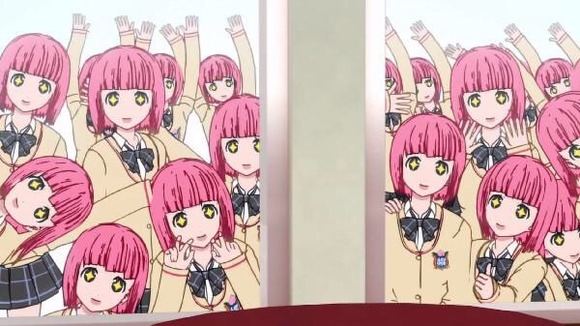
Even the Sonata sisters, insanely numerous identical sisters introduced from the first series, looking the same as star eyed and pink haired schoolgirls all voiced by the same person, have more to do this time. Even the voice actress Reina Ueda gets a moment, getting annoying at one point when the other cast members demand her to create new family siblings, male and female, just to have her do more silly voices.

Again, they even manage to have a sweet final ending again, seeing a side of a character when they were not quite the pun obsessed figure of after. In general, its small steps taking place here, but in this context it's all very well done. This type of dialogue heavy and minimal work is becoming more common, as its likely to be a lot more easier and cheaper to produce, but alongside being a great training ground for actors, just because comedy usually demands them eventually pulling out odd voices on various ranges of the tonal and emotional scale, even helium voice here, but because even this is a fine art as a series to try to pull off. Even the limited animation quality becomes a joke in the first quarter, so the creators are even aware of how to economise their limitations and even make jokes at its expense.

From here, the final series takes a different director. A larger cast and normal twenty plus minute episodes are what are added to this franchise for Season 3, which could make or break the premise completely in execution; whatever the result, it'll be fascinating to see Tesagure... take a giant leap in structure. Certainly in terms of this type of series, when it's hard to say any particular episode stands out but the quality is so high it sticks, the greater risk does evoke questions of what to expect.


From https://3.bp.blogspot.com/-Z2lyUfVr8pU/WWYPmWv2l9I/AAAAAAAAn-0/mwdkr
A42mY4ui8TCKjcqTmzwt5A-Hnq8gCLcBGAs/s1600/tesagure%2Bbukatsu-mono%2Bencore%2B3.jpg

Monday, 16 September 2019

#118: Tesagure! Bukatsu-mono (2013)

From https://cdn.shopify.com/s/files/1/0318/2649/products/
51N7_2B1mu3CL_large.jpeg?v=1417967489


Director: Kōtarō Ishidate
Screenplay: Kōtarō Ishidate
Voice Cast: Asuka Nishi as Yua Suzuki; Satomi Akesaka as Hina Satou; Karin Ogino as Aoi Takahashi; Ayaka Ōhashi as Koharu Tanaka
Viewed in Japanese with English Subtitles

Returning to Kōtarō Ishidate, co-creator of the first season of gdgd Fairies (2011), Tesagure! presents an interesting conundrum for me as whilst it follows his trademark style - improvisations from the voice actresses, sketches, absurdity and thought bubbles with absurd whims being depicted - this is definitely his style distilled down to its most purified form, almost entirely dialogue in which four high school girls, one roped into this unofficial club of three, spend the first season here discussing the clichés of various clubs, and anime/manga clichés about their activities, until it descends into silliness. Baring some sketches where the cast play out these activities with absurd new premises - like baseball with players blindfolded and being told where to hit/throw/catch by bystanders - and sometimes a cold opening which mocks a troupe of anime, it's mostly this dialogue, with the cast speaking around their club room table.

It is definitely difficult work to scrutinise as that premise never drastically changes, and yes, this is made more poignant as this has three seasons in existence, meaning this is technically in terms of time Ishidate's most successful creation so far. Series one, the subject of today, is frankly as idiosyncratic as you can get. Openly, its cast do spend their time playing very predictable characters, which proves a problem in terms of actually reviewing them as, barring those few exceptions I mentioned, the show is mostly in the cast's club room and dialogue. The cast does grow into idiosyncrasies, but they are definitely caricatures - the meek older student who blushes at the others' crudity, the eccentric red head who hates almost every hobby and is energetic, the one who is roped into the club, and the fourth who is the club leader - meaning that the fact that improvisation is an integral part is a godsend, as it leads to farces where these characters develop far more personality then their initial profiles. Also of mentioned are the Sonota sisters - an insane number of identical sisters, pink hair and stars for eyes, who are helpful if they need players for a baseball game or an audience when one of their ideas is put their conversations on stage as acted theatre.

Production wise, it's a low budget cel shaded 3D animated work, not as deliberately crude as gdgd Fairies but definitely working to its limitations, helped by the show being about the conversations primarily. The depth of references is severe, but never referencing actual manga and anime - instead, almost quickly to the point you can miss content if you even get distracted for a few seconds, these characters elaborate on the clichés and always create their own anime/manga story based on said clichés, so much so as whilst it could be off-putting for some viewers, others might find this rewarding for prodding types of storytelling in these mediums new to them. People who might get the references will definitely find them funnier, but its poignant I didn't need to get baseball manga reference but could hear about all the absurd clichés and get a lot of humour from them anyway. The references lead to tiny additional sketches and jokes which add a lot as well, such as the fact a pair of students, one male and one female, will always get trapped behind a closed door, or that one joke that cheerleaders should wear worn panties leads to a running gag about worn panties to the main cast, one where it feels like the voice actresses themselves are gleefully ribbing each other and having so much fun in their work.

From https://img1.ak.crunchyroll.com/i/spire1/c
7096b7945d08a90de4270144bd6c28e1447503112_full.png

Experiencing Ishidate's work so far, and these micro-series in general, (here, eleven minutes per twelve episodes), I realise there is a huge danger to dismiss these anime programmes, particularly when they are minimal in animation, not to be expansive and artistically incredible. But even Tesagure! is still pushing the format in some way; here, whilst very subdued, the show is taking the piss out of the medium in a warm hearted way, coming from a love of it, but in a way that even an outsider with some patience could get the joke is worthwhile, never namedropping a single anime to my memory and getting the absurd plot clichés over as the joke instead. This is very different from what a lot of anime does, which makes it insolar and in danger of dating greater, whilst this could age very well. For me, some references I did get and were funny as a result, but for others I didn't still there was a pleasure in still having them explained as the joke, leading to a silly air especially when the plots the cast come up with got more idiosyncratic as these characters barnstormed them. The sketches, where they attempt new versions of the activities, are also funny enough, especially as you could try to make them real in some cases.

And of course, the improvisations are the real meat of Ishidate's style, more subdued but with the same style as before as the animation is clearly built around what the actresses do and react, even out of character which is audibly apparent. A lot stands out for this - when the cast members stumble into failed jokes which are commented upon by the others,  get into crude tangents which always leads to the character of Hina, the meek one, to blush and be depicted far away from the table briefly, or the running gag of Aoi, the energetic redhead, trying to find word play puns in everything they talk about no matter how laboured they could be to reach.

Its charming, and god bless the series, whilst they deliberately undercut this in the second season with humour, the final episode of Tesagure! is actually bitter sweet, to the point the series could've ended here and ended on a high note, as the two seniors graduate and try to leave their club to the youngest members, heartbreak following. Even the ending animation, which is the same one, is given life as, based around a dance, there's new dialogue each time which builds on the awkward attempts to improve with a lot of self-deprecation. The result is sweet like tea and cake than Himote House (2018), a latter work which hit for more absurd and bolder jokes but did feel unfortunately a victim to an erratic structure. It's fascinating that this got two more seasons, and already before I even cover them, arguably Kōtarō Ishidate is an auteur on the basic level as he's honed this style over and over again. Pointedly with Ishidate, barring one show about Transformers where they from my knowledge argue about their franchise's lore, he's been obsessed with a female cast in new character roles playing to this dialogue based premises, and keeps going. That he's always provided voice actresses, in shows which from what I've seen of his never have any male characters of prominence, and give them so much to do, is awesome especially as he's creative. (And that's also from seeing how, for all the show's flaws, Himote House could suddenly turn into a critique of Japan mistreats the LGBT community in a "Yuri Game of Life" episode, thus exposing an even more surprising side to him and anyone involved with that show that's positive). That's going to be interesting to come back to when it comes to seasons two and three, and best thing is that, for all my fear this review would've been stupidly short, stuck in trying how to describe this show, I can thankfully (hopefully) give it the positive review it deserves.


From http://livedoor.blogimg.jp/tekitou_matome-sao/imgs/a/9/a922ac1e-s.jpg

Monday, 28 November 2016

#35: Haibane Renmei (2002)

From http://vignette2.wikia.nocookie.net/haibanerenmei/images
/d/d1/Main_Page.jpg/revision/latest?cb=20111213204251

Director: Tomokazu Tokoro
Screenplay: Yoshitoshi ABe
Based on the dōjinshi manga by Yoshitoshi ABe
Voice Cast: Junko Noda (as Reki); Ryou Hirohashi (as Rakka); Akiko Yajima (as Kuu); Aya Hisakawa (as Kuramori); Chihiro Suzuki (as Hyouko); Eri Miyajima (as Kana); Fumiko Orikasa (as Hikari); Kazusa Murai (as Nemu)

[THIS REVIEW CONTAINS MAJOR PLOT SPOILERS]

Haibane Renmei is incredible. Openly in the first sentences I'll confess it's an exceptional thirteen episode series, a incredibly fantastical premise but one which tackles exceptionally an adult subject, namely death and the afterlife. After the first scene of the series where she's falling from the sky, our female protagonist is literally reborn as an angel, without memories of her past but aware of this fact, violently growing wings from her back and being presented a freshly cooked halo that permanently hovers over head. Rechristened Rakka, after her dream, she has become a Haibane living amongst a whole home of female Haibane, and male and female children, in an abandoned old mill that's being provided to them as a home. The Haibane - the caring older sister figure for Rakka called Reki, the dozy Nemu who's the oldest of the Haibane, the cocky tomboy Kana, the boyish younger Kuu, the nerdy and kind Hikari - are clearly the dead, living in a form of afterlife that is peaceful but requires them to follow the rules of a council that looks after them, living in harmony with a town of mortals behind a wall neither group can leave from, the kindness and donations of the town keeping the Haibane in comfortable life.

The greatest virtue of Haibane Renmei is that, as thirteen episodes isn't a lot of time for a large scale story and is ill-advised for epics unless a sequel is possible, it's world is deep enough to have gone on longer but there're only two small character based plots in the centre of this series, bookending each other, the first being Rakka adapting to her new life, the later dealing with the emotional strife of the "Day of Flight", where a Haibane leaves gracefully from existence to (clearly) a higher plain of existence, leaving emotional turmoil if their remaining friends aren't able to cope with their departure. This is worse for a person like Reki who, starting off as the edgier, cigarette smoking big sister devoted to Rekka, is revealed to have deep psychological issues about her existence as a Haibani since she was hatched, coming to terms with the possibility of her own "Day of Flight" and how it may never happen to her if she cannot come to turns with her own baggage. As a result, concentrating on this small internal drama both allows the world to grow naturally whilst portraying a story with enough emotional depth to have an immense impact on the viewer.

From https://myanimelist.cdn-dena.com/s/common/uploaded_files/1459280787-e1aaa7882402160c3022781d2898a25c.jpeg

The quietness of the show is understated to an extreme. While it cut quicker than I thought it would to an immensely downbeat drama soon into itself, the world of the Haibane is never presented as sinister or leading to the cliché of a morally dubious force being secrelty behind it, instead a timeless reality which has motorised scooters and a second hand clothing ship but feels like travelling to a rural town or a seaside community which has a sense of being closed, everyone knowing each other or at least with the rules put in place for the mortals and Haibane to interact a sense of public responsibility. Even the masked men who dictate the Haibanes' lives, whilst exceptionally restrictive in their rules, are ultimately out to help the Haibane live happily and being spiritually fulfilled, thankfully avoiding the cliché of them being villains for the protagonist to rebel against.

Instead of the clichés of fantasy, i.e. crow barring unnecessary action into a fairytale, the conflict is entirely personal drama, how Rakka has to adapt to her new life with questions but also the emotions of those amongst struggle with the baggage of lives they can no longer remember. Technically the show can be added to the "Slice of Life" anime and manga sub-genre which is exactly as it sounds, the ordinary lives of the Haibane who, whilst treated by the mortals in a way that could accidentally come off as patronising, as in one scene which leads to Rakka snapping in the midst of immense emotional pain, are just like everyone else in their community baring their unique social structure, working at the libraries or the clock makers and paying for their goods with notebook pages in place of regular money. Anything more than this is cryptic, the most blatant a book Nemu tries to complete as a gift for a colleague going on pregnancy leave which is explicitly the Christian mythology of how God created the world, thanks to Rakka adding how He rested at the end.

From https://myanimelist.cdn-dena.com/s/common/uploaded_files/1449730777-ead8100a94796ef5216641a0d5c65c19.jpeg

The religious content is so un-highlighted its ultimately more powerful for the subtle hints to it, imagining purgatory as actually a pleasant and wonderful place ifone has no emotions anxieties from the previous life, with friendship and idyllic countryside around them, but the travel to either heaven or reincarnation through the Day of Flight causing as much pain for the Haibane left behind as the death of a loved one would. Explicitly Reki is cursed with being sin bound, black wings when she birthed from her egg, caused by a sin that isn't necessarily a transgression but depending on your views as a viewer the result of how the person died, like suicide, or how they left their mortal life with a grave error committed. (Such as Rakka, also sin bound, realising she rejected someone in her previous life there for her, believing she was entirely alone, only to take a couple of episodes on a small journey of symbolic existentialism to cleanse herself of this error). Unable to learn why she is sin bound, and unable to remember her whole dream in the egg, trying to paint it to existence constantly, Reki's agony is played out as a literal dark night of the soul, Rakka trying to help but the emotions devastating in the final episode, literalising the agony in physical form for the pair, before closure is felt. As a result, Haibane Renmei becomes an exceptional take on grief and acceptance on a spiritual level but ironically at a more realistic level than a lot of anime melodrama, which is more fantastic than this despite Haibane Renmei having its central character possessing wings and halos.

It terms of the style and structure of the show, its helped by the original creator Yoshitoshi ABe having a pronounced role of the adaptations of his original work, the show a mellow and quietly told story with a light touch in terms of aesthetic, naturally timeless in terms of setting and colour palette. The music as well, particularly when it gets closer to the end and emotional devastation being restrained by characters, is impeccable from Kō Ōtani, electronic and folk influence felt throughout. Altogether it's now surprisingly how much of a sleeper hit Haibane Renmei was, still enjoyed and admired today, as within only a small baker's dozen of episodes it manages to tackle its theme with immense grace and subtlety, hints at a great fantastical tone which are greater because it's used to tackle realistic issues. 

From http://2.bp.blogspot.com/-bRJNHc3dhrw/UBc5zbyU39I/
AAAAAAAAA9s/eNWsBacc2U4/s1600/10-187.jpg