Showing posts with label Videogame. Show all posts

Thursday, 7 October 2021

#201: Digital Devil Story: Megami Tensei (1987)


Director: Mizuho Nishikubo

Screenplay: Mizuho Nishikubo

Based on the Novels by Aya Nishitani

Voice Cast: Saeko Shimazu as Shirasagi Yumiko; Yū Mizushima as Akemi Nakajima; Fumihiko Tachiki as Susumu Takai; Houchu Ohtsuka as Loki; Mari Yokoo as Ohara; Masaharu Satō as Hiroyuki Kondou; Masako Katsuki as Izanami; Megumi Hayashibara as Kanou Fuyuki; Takurō Kitagawa as Teacher Iida;; Yukio Yamagata as Kaneto Muraki; Yuuri Sugimoto as Kyoko Takamizawa

Viewed in Japanese with English Subtitles


First of all, to talk about Digital Devil Story, we need to get into the complicated history of the source material, as this originates from the novel series from Aya Nishitani. Digital Devil Story: Megami Tensei, based on the novels, exists in both this OVA one-off and a 1987 video game, the anime more of a tie-in, but connected to the novels together. After a 1990 sequel, the franchise as video games would become 1992's Shin Megami Tensei, which would become a decade spanning franchise of dark fantasy and horror. Shin Megami Tensei would have its own spin-off, Shin Megami Tensei If... (1994), and that game's premise of basing narratives around a high school setting would lead to the Persona franchise. That franchise, into its decades run, would eventually become a popular franchise in the West for video gamers, making this convoluted history worth mentioning, as from this obscure OVA most do not know of, you have an institution whose popularity reaches the West and the East. That is not even getting into how we did get the Shin Megami Tensei anime OVA, the Manga Entertainment released Tokyo Revelation (1995), in the West too, so this franchise that mostly exists in video games has had a wide and curious reach over the passage of time.

This is a curious history to ponder, in mind to the novels and games they were less an ongoing narrative but individual stories set around themes. A lot of mythologies, a lot of horror, some Christian symbolism, and many different concepts have intermingled over the years in this cross-media franchise. Hell even Adolf Hitler appears as a villain in Persona 2: Innocent Sin (1999), as the "Fuhrer" using the Spear of Destiny, which shows someone was aware of the Nazis' history of trying acquire occult objects among their other obsessions. This franchise, leading to its popularity in the West with costumed vigilante teenagers in Persona 5 (2016), entering human subconscious to deal with maleficent emotions, has had a run of trying many ideas. Digital Devil Story the OVA finds itself cribbing in the same premise ballpark as Evilspeak (1981), an American horror film caught up in the British Video Nasties wave of banning horror films on video tape, starting Clint Howard as a teenager who summons Satan with a computer. Here this is evoked for me by introducing us to Akemi, at first through the narrative not a likable male protagonist as he starts the narrative having summoned Loki, a demon who he keeps appeased here by having one of his female teachers be a sexual sacrifice in a student run occult ritual, all with the power of virtual reality headgear and polygons summoning demons. Yes, this narrative is bloody ridiculous, before anyone reading this asks.

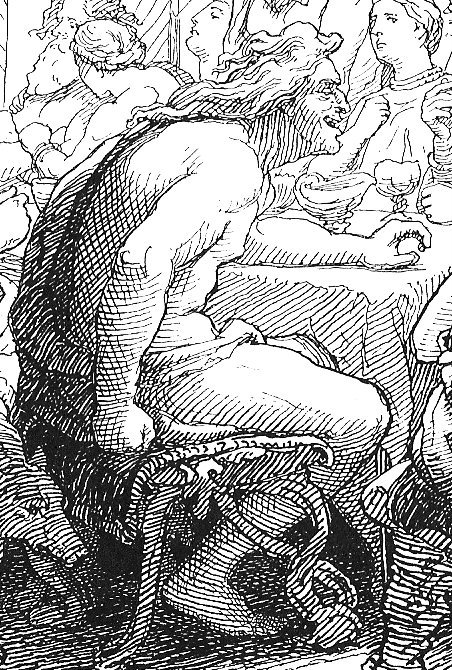
Only forty plus minutes, this covers the first novel of the original series, in which Akemi has summoned Loki through a demon summoning programme in his school, whilst a new female transfer student Yumiko finds herself drawn towards his secret rituals as a potential sacrificial victim. Adding to the lengthy back-story to the franchise, this single OVA barely scratches the surface of how vast just the novels' get, with even the female teacher a key figure, and future antagonist, or that Loki even if a minor figure appears through the franchise of games1. The hint in the end of the anime, suggesting a sequel with the Egyptian God Set being summoned, is not surprisingly a nod to a later novel. If you are going to talk of how in depth the references are even for all the unintentionally strange ideas here, even Loki's design is based on 19th century Danish illustrator Lorenz Frølich's depictions of Loki in the 1895 poem Lokasenna2. This is going to be a short review in terms of describing the narrative in some ways, as the plot is not a lot. Loki eventually is sick of being confided in the computer, gets assistance from the sacrificed teacher Ohara, and rampages by shooting out shocking pink goo which smothers and crushes students and bank tellers alike with blood geysers coming out the gooey mass, having to eventually be stopped even by Akemi with Yumiko. But it is perplexing having to write a review only to find this tiny fragment is literally that, not merely a one-off as in some OVA titles from this era, which never got anything else baring a manga we never heard of in the West, but a forgotten piece of a huge franchise we would know of. Even joking about unintentional references to Clint Howard movies makes sense when writing this review as, to my delight, there is so much to write of in terms of a single forty minute animated work, lost in time, without feeling like padding and being important to its context and virtues.

With very eighties synth on the score, these horror OVAs are also fascinating as for their aesthetics. Even their fixation of sex and horror, clearly there to sell to an audience in the day but a concept constantly found in Japan's occult pop media at times, stands out, alongside how so many of these titles in the day, even in the nineties, had a reoccurring obsession with nocturnal primary and secondary colour palettes to depict scenes - blues, reds and purples especially alongside something obvious as black to associate with darkness and the supernatural. You can raise an eyebrow at the computers of this era, insanely obsolete technology including a line of reel-to-reel tape machines in the student computer room, or a Star of David (even by accident or misguided cultural appropriation) being the summoning area for the carnal sacrifice of a woman to Loki when Yumiko first learns of what is going on, cheese to be found here. But there a lot still there, including anime and manga being obsessed for better and for worse with appropriate non-Eastern religious symbolism, of technology and the supernatural co-existing, which is something Japanese storytelling and even folklore has little difficulty in doing or sexuality intermingling with the monstrous, that even if lurid and problematic in gender depictions it is something aesthetically heightened in their art even if at times having to find ways around censorship and intermingled with the grotesque.

There are even references to Japanese mythology and lore as Yumiko has more connection to Akemi, with his reoccurring nightmares in an ancient setting being chased by an undead female ghoul, [Spoiler Warning] including the fact Yumiko is a reincarnation of Izanami, the Japanese goddess of creation and death. [Spoilers End] This still ends as an action sequence, with an "Electric Beast Cerberus" being ridden, but the mood and context was catnip for me. It has its gruesome edges too, to match its cousins from this era of anime, even if not the most extreme of them - brainwashed students, even if programmed by a computer programme, killing classmates as a horde is a creepy touch, as is the fact that Akemi's decision to summon a demon is for a juvenile reason, having being brutally beaten up by a tougher classmate in a scene just as bloody as any other for being too close to his girlfriend. (Then there is one moment, only implied, involving one female student, brainwashed, biting another in an area that is frankly perverse as a death scene, even in mind to some of the extreme content actually shown in anime OVAs in the eighties). It is not a great OVA, but for me it fascinates as this dark forgotten little narrative tale, compacting together details and tropes from other anime from this era, which also happens to be connected to a large ongoing franchise.

Even its director/writer Mizuho Nishikubo is a figure of note as, whilst obscurer as a name, he worked over decades in an eclectic number of areas and in just his directorial work. Starting in the seventies with the likes of the Gatchaman franchise, he made OVAs like this or California Crisis (1986), a really peculiar and artistically unique work from this era of obscure straight to video anime, the television series Otogi zôshi (2004), fascinating as a samurai narrative which pulls the rug out from under the viewer with a drastic tone and setting change, and films that vary as wildly as Musashi: The Dream of the Last Samurai (2009), an animated documentary on swordsman Miyamoto Musashi, to Giovanni's Island (2014), a drama set post World War II. Even when not in the director's chair, Nishikubo was also the animation or sequence director on the likes of Patlabor 2: The Movie (1993) and Ghost in the Shell (1995), so he is someone significant. Seeing this in his career, this curious directorial production, in such a career softens me to the work more so. As a fascinating crosspollination between a variety of different areas, even this obscurity's history befits a franchise which in mythological, spiritual and even Jungian ideas are mixed together as they have over the decades.


==========

1) Just going through the fan-made Wikepedia, the first novel has many aspects and characters which progress onwards, as can be read of HERE.

2) Loki's inspiration.

Friday, 30 July 2021

#195: Hi-sCool! Seha Girls (2014)


Director: Sōta Sugahara

Screenplay: Sōta Sugahara and Masayuki Kibe  

Voice Cast: M.A.O as Dreamcast; Minami Takahashi as Sega Saturn; Shiori Izawa as Mega Drive; Yuji Naka as Center

Viewed in Japanese with English Subtitles

The immediate thing to talk about, re-interested in video games again, is in mind that I missed a great deal of the history of gaming even in my childhood, but especially after the mid-2000s onwards when I left video games in favour of cinema as a hobby. If I decided to invest in a console whose content interested me, it would also have to be a console that took to my tastes, or if a PC was able to be sustained to play idiosyncratic games, as even in my childhood I was more inclined to odder and more colourful games. Only limited pocket money undercut me, missing out on a lot of titles which are sadly very expensive to buy second hand, the kind due to an unfortunate habit of the medium being young and archiving not fully invested by all by admirable individuals (or publishers), are titles that would have to be sustained on emulation to preserve and play them whether a good thing or not. Some thankfully are restored and re-released, hopefully something that will grow as a sevrice, but a lot of videogame history is still out of reach.

This is of note as, whilst the past is full of deceptively hard games, and some terrible games regardless of age, what we call "retro" appeals particularly in the nineties, a time I barely sat through, is important in both the background of today's review and place in its history I have growing fascination with. This was the fifth generation of consoles came to be, and this is actually worth bringing up in this review as, whilst one of the consoles talked of in the show comes in the sixth generation, this was the time in the nineties which would tragically lead to Sega's downfall, the video game software company who was once a hardware developer too here celebrating itself here by collaborating with Sōta Sugahara, one of the creators of gdgd Fairies franchise.

It is impossible to think of their legacy in this odd premise, to use anthropomorphism to their hardware as cute girls. Entering Sega Highschool, where their anthem is as short as can be if you know the famous "Sega!" musical cue in front of their old games, they are Mega Drive, Saturn and Dreamcast. They represent a history where Sega would leave the hardware race. Under the shadow of Nintendo, whom had a chokehold on gaming, Sega found a success especially in the West with the Mega Drive, here portrayed a bookworm who is intelligent but cannot dance to save her life. Saturn, portrayed as the straight faced figure aghast at the absurdity, has a complicated history as a gaming system: the fifth generation was when three dimensional polygons over sprites became a factor, leading to the future but also leading to great sprite based 2D art being dismissed, and a lot of consoles like the Saturn awkwardly having tech added to have 3D games, a console which was a failure in my home country of Britain but has a cult legacy of a longer time in Japan. Dreamcast, here the eccentric and silly one, whose ability to access the internet sadly comes with a long load time, probably deals with the most tragic of the three real consoles, a console which innovated in the likes of internet connection, but only lasted between 1998 to 2001, leading to Sega giving up hardware fully.

There is a lot of this show, a farce where the trio have to win over a hundred medals in games to graduate, that requires knowledge of Sega to get the jokes, but also one which paradoxically does not do this enough or not embrace this in the end fully. I think, in hindsight, this would have been a much better show, alongside the issue of how quickly and abruptly it concludes over thirteen episodes over eleven minutes each, if it had really stuck to being a time capsule to Sega's rich gaming past, and its weirder productions, with the gdgd Fairies template allowing for affectionate parody and a lot of deeply surreal results of mangling old properties or them straight faced.

The first episode continues the trademark of gdgd Fairies of inane conversations between the main cast, but it is immediately followed up by one of the two best episodes, parodying Virtual Fighter (1993), a game I did have growing up with the Saturn. You do not really need to know the game for the jokes, though they went as far as reference famous real players in competitions; instead, the humour about when the game fails or what can be exploited. You can still find it funny when the episode mocks certain moves being so destructive they can be spammed, Dreamcast borrowing a Virtual Fighter character's diving head butt for wiping out most of the opponents, or when the game has to drag in unexpected competitors. You learn, with a giant beetle getting involved, that Sega did make a game based on the (problematic) Japanese activity of capturing beetles and having them wrestle each other, or an anime connection, that alongside the Saturn in Japan being a well of tie-in video games, Sega and the console were the genesis of Sakura Wars, a franchise originally in video game form, set in an alternative 1920s Japan, which in still going and has animated adaptations.

The other great episode does not even need references to be funny, its subject Space Channel 5 (1999) already an eccentric product, a musical story with sixties sci-fi space pop aesthetic about a female reporter stopping an alien invasion of a space station by dance. Already it is strange, it is stranger when the main leads have to worry about ratings as her fellow co-reporters, and then the game malfunctions, when a fighter from Virtual Fighter (the Australian Aboriginal character Jeffrey) becomes a ratings hit with just being shirtless and only able to say "I win!", and when Saturn gains the affections from a dwarf character from the fantasy game Golden Axe. It is weird, in a perplexing way, that part of the running jokes is Saturn being forced into a bikini to increase the ratings; it is funny she is docked medals in the end due to offending family standard groups, but again throughout the series having a console I did have become the gazed over female character is weird. That she is the one, in the series' running gag, viewed as the most attractive one and sexualised, that did become strange for this and raising a completely awkward question about these shows about anthropomorphising an object probably not wise to delve into for the sake of taste.

The thing of note is that, at thirteen episodes, there is not a long time to really delve into this premise, especially as no sequel or spin-off was ever commissioned as an immediate tie-in, a huge issue with many of these micro series. This, with its ultra obscure references, had enough to parody for a longer time, causing one to think this had to be cut hastily in production by its swiftness in closure, or the more likely issue, that micro-series in their nature really have an issue of being too short to stick out unless you have something really idiosyncratic on your hands. gdgd Fairies was a one-off in many ways, from others I have seen, just for having a second season, let alone a theatrical film and spin-off, where they already established the premise and could run into stranger and more creative directions, even a multi-episode arch involving time travel paradoxes. The humour is curious here as well as after a while, it does not jump fully even into the videogame structure baring recreating gaming scenes as action sequences. Automatically you would think a lot of it would be hard Sega references, including titles never released outside Japan, such as one episode being around the arcade mecha game Border Break that never came to the West, but instead a lot is light hearted slapstick and silly dialogue you would get into other shows. It never gets as weird as gdgd Fairies sadly, nor as weird as Sega could be, as we never even get a reference to Seaman (1999), a virtual pet simulator if you had a human faced fish creature you could talk to and had Leonard Nimoy as your guide.

Neither is there the dubbing pond from gdgd Fairies, where the voice actors for real adlibbed over footage of pre-existing computer models, and many of the games covered are eventually Sega's more modern games rather than ones famous and included in the opening credits, even divisive ones like Altered Beast (1988) which, whether you think is good or overrated, is also among the weird things that company made worth intentional humour. The Sonic the Hedgehog episode, as the company's main intellectual property, is played as a straight faced Sonic animation. It clearly was a moment where the production cannot go with its flow, in case of mocking the blue hedgehog character, but also presents the annoying fact Sega is known for most people only for Sonic. That is not to dismiss that character's lasting impact, to kids and fans, but aside from some retro titles, sadly Sega in terms of archive is not as easily assessable as one would hope. It is also not a great episode, evoking the issue I have seen in micro series and this one has that it really does not get a lot done, and in the time it does have available squanders episodes to material not as funny as its earlier highs.

Even in spite of its energy and moments of funniness, this does creep over the show, and neither can it help to still be melancholic for an odd climax. Deliberately so as it refers back to the main trio not being young women but the video gaming hardware, which is impossible to look back onto without the actual history. You can call it a nostalgic celebration of their glories, which is admirable, but it is stepped in knowledge that, history being recorded by the winners it was not even their rivals Nintendo who beat them in the fifth generation nor the sixth, but upstarts Sony. A technological company, Sony struck gold with the Playstation One and then had a juggernaut called Playstation 2 that maimed the Dreamcast. Nintendo survived, but Sega eventually made and produced software for other companies, and whilst games still appear which are distinct, many of their idiosyncratic choices have had to be put on the wayside. Alongside disappointment in the final production's slightness, one cannot help but also feel a little depressed by its finale too, only tempered by the fact that, even if a lot is rarer to come by, people still talk of Sega's legacy in all its vibrant idiosyncrasies. 

In terms of my own history, I transitioned very quickly to the original Playstation after the Saturn, both consoles with weird titles I wish I then had the money, space and wherewithal to horde even if, honesty, I was not even a great gamer in skill back then. Looking back, this era in general the show mostly nods to, even the Dreamcast released within this period, was an era of incredible flux. That Playstation I transitioned to was the console which off most of the competition in this weird time of doomed endeavours, companies like Atari dying after their Jaguar console failed, full motion video and digitized characters being seen as a good idea, and only getting re-evaluated by a small minority of indie games of note decades later, even Nintendo making the bad creative decision to have a Virtual Boy, and a lot of historical dead ends. This sympathy for the losers of the era, the games never released outside Japan, the doomed spectrum of cult hits and oddities, also includes how Sega bungled through this time. That sadness cannot help to permeate what is just an okay micro-series, one which when worked was funny and sweet, but could have been a lot of inventive and had more episodes in the end.

Thursday, 23 January 2020

#132: Arcade Gamer Fubuki (2002)


Director: Yūji Mutō
Screenplay: Ryota Yamaguchi
Based on the manga by Mine Yoshizaki
Voice Cast: Sakura Nogawa as Fubuki Sakuragasaki; Hiroshi Fujioka as Leader; Kaori Shimizu as Hanako Kokubunji; Masaki Yamamoto as Sanpeita; Megumi Toyoguchi as Honey; Satsuki Yukino as Alka; Shinnosuke Furumoto as Arashi; Toru Furuya as Mr. Mystery; Yuu Asakawa as Chizuru Jyumonji

Veronica Taylor as Fubuki Sakuragasaki; Bob Orlikoff as Masao; Brad Bradford as Arashi/Mr. Mystery; Dan Green as Leader/Narrator; Jamie McGonnigal as Sanpeita; John Paul George Jones as Groepie; Lisa Ortiz as Chizuru Jyumonji; Rebecca Honig as Ruriko Sakuragasaki; Sharon Becker as Alka
Viewed in English Dub

This, viewed by itself without context, would be an embarrassment for someone to see as his or her first anime. It's a title to point to so anyone could dismiss anime as a bad thing. There's no way around this sense of shame with Arcade Gamer Fubuki, and yet it's entirely blameable (no matter how wrong it sounds to write this) because the production was more fixated on teenage panties than a potentially fun fever dream, envisioning an evil cabal wanting to take over the world who can only be defeated by playing video games.

Technically, I viewed Fubuki as a notoriously bad anime, though it's never brought up with the infamy of a Garzy's Wing (1996) and that ilk. It only got to my attention because of Justin Sevakis. Among his many hats over his career, he was the in-house video and subtitle editor for the DVDs of Central Park Media, writer and co-podcaster in the Anime News Network, alongside Blu-Ray/DVD Authoring and Restoration of titles currently for Discotek Media. Authoring is an unsung position, as restoration in cinema let alone anime has always been a task with arduous struggles before the successes, testament to the poor guy with the restoration of Discotek's release of Cyborg 009 The Cyborg Soldier, the 2001-2 TV anime of Shotaro Ishinomori's manga which never got a full run or DVD release in the United States, and was a horror story in when Sevakis got the master materials to restore. Suffice to say, it took a year to complete, just for the uncut dub alone, because the master tapes were in a frightful state, aspects of restoration we don't consider even in terms of non-anime cinema let alone for one man who worked on the project with these issues in front of him.

Sevakis wrote of the subject of this review as part of his Buried Treasures articles on Anime News Network, which I openly admit to still tracing through the archives of to locate titles to see and review, many thankfully getting re-releases but also quite a lot talked of from a man who authored titles like them or from different eras of anime over the decades as obscurities. Fubuki comes from the occasional "Buried Garbage" sections which talk about the worst of anime, the idea like a carnival freak show but with the knowledge of his career so you learn something from them. Arcade Gamer Fubuki is for him the worst anime he ever saw, which wasn't helped when he had to work on the title in his time in Central Park Media; bear in mind, for all the good titles that company released, like part of Revolutionary Girl Utena (1997), but also had the schlock fest MD Geist (1986) as one of its successful titles to sell as well as a lot of hentai (porn) anime that would horrify some, a lot Sevakis has talked about working on in his time there too.

Whether Arcade Gamer Fubuki is the worst is a debate, without wanting him to hear of this review and come punch me in the face. There has been worse made anime, as this is a nicely animated OVA with a handful of redeemable aspects, but good grief besides the toe curling plot point of the "Passion Panties", which I will be forced to get to, this is a premise of some fun squandered in the end. Probably the worst thing that can happen to an anime is when it deflates good will from the first episode onwards. The calibre surprises as it's based on a manga by Mine Yoshizaki, whose Sgt. Frog manga is one of his most popular work, the TV series infamously a property ADV Films got the license to but sat on for a few years in the 2000s despite the company being known for being prolific in their releases and the amount of time they worked on releasing it.

The title as mentioned also has an amusing premise in imagining a standard anime tale, a plucky young heroine versus a world dominated evil group, by way of arcade cabinet tournaments. It's ludicrous, but if anime should teach outsiders anything, along the cerebral and intelligent work it creates, it can have a multi-series work like Yakitate!! Japan (2004-6) which is about competitive bread making, so we can have a plucky young heroine named Fubuki fight a group wanting to take over the world with videogames. We can have a groupthat includes an evil villainess who manages a bunch of despondent masked goons, acting more like the disgruntled staff of an ICT company, and even a velociraptor that is brought back by gene manipulation and can somehow operate an arcade cabinet, let alone perceive with intelligence what to do with it.

It is also bright and slickly made, a handsome four episode production that went as far as even getting license to use Sega videogames of old, such as Fighting Vipers 2 (1998) to Fantasy Zone (1986). The irony is not lost, whilst never a video gamer but just a curious outsider who knows a bit, that this was the time of the Dreamcast, their last games console before giving up on them as, like an ominous sick joke at how Arcade Gamer Fubuki tanks the good will in the license, that console didn't do well in the damndest.  The show itself with all its good ideas - as the heroine wishes to win the world arcade game tournament, fight the villains and find out what happened to her absentee father from her childhood - doesn't even try as that company did with the console.


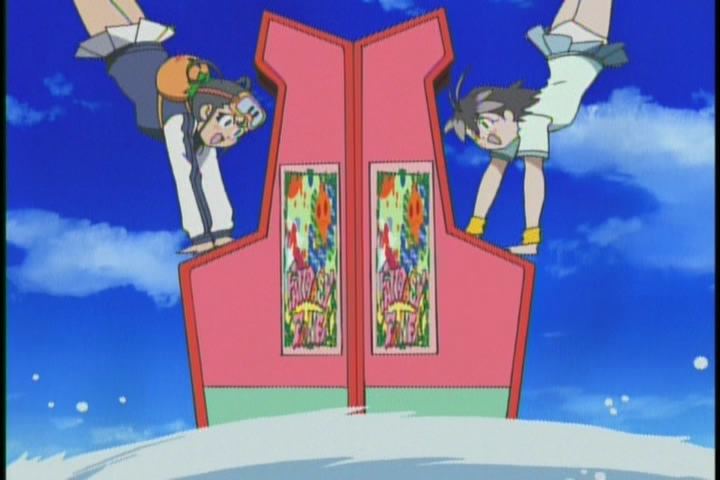
The immediate issue, and where you roll your eyes in embarrassment, is that to power up, as to be the best arcade player you have to jump high into the air and play the arcade cabinets upside down in gravity defying gymnastics, is that she has the "Passion Panties", which means having her female friend expose them with a fan and means exposed panty shots. It's bad enough to have the leering nature of anime, especially as the medium has all the potential to deal with sex with better fun and grace than this, but you then have to realise female characters within them are meant to be underage teenagers a lot of the time, regardless if their character designs and proportions suggest otherwise. Fubuki is, what, meant to be only between ten to twelve, which makes this worse, also with mind her nemesis is another girl, who travels on rollerblades and is an expert on shooter games, is reduced to this as well. It's really low, creepy, idiotic hanging fruit particularly when you know this OVA title is targeted to grown men.

The other issue though is my biggest takeaway, that Arcade Gamer Fubuki is lazy. Its fan service is as much part of the problem, alongside how it squanders its premise. I can thankfully say that its director Yūji Mutō went to better work, as he made Tonari no Seki-kun: The Master of Killing Time (2014), a hilarious micro-series about a guy in a class mucking about with bizarre activities with none of the issues here and perfect comic timing, which makes Fubuki's existence in his early career a shame*. Its say a lot to a four episode OVA that it fails so blandly in spite of having all the weird and potentially fun details you could want, from the velociraptor playing videogames to that the minions, led by a stereotypical female villain who uses the famous noblewoman's "ho ho ho" laugh used in a lot of anime, being a bunch of regular employees who get drunk with her in a bar and put up with their lot clearly just to get paid.

A lot of the premise never is dealt with as a result, like the tournament where a cavalcade stereotypes appear to duel, and most of the cast is underutilised. One character that could've been done without, or shot into space by the cast when he appeared, is a young boy whose obsession with just taking exposed panty shot photos of Fubuki is stalking in all but name. Many however are underutilised, even the stereotypical busty American cowgirl who is the best at dancing games as, in a better work, that she's actually on the villains' payroll but a) is lovely and b) immediately adores Fubuki as a friendly older sister figure is at least fun in premise. Probably the only character who gets fully fleshed out, even though he sadly still has to go on about those damned Passion Panties and a creepiness to his shadow over Fubuki in characterisation, is Mr Mystery. Mr Mystery is the noble masked guide to help Fubuki, a buff guy in just a wrestler's pair of pants and mask whose virtues and strength don't negate that, when he jumps through a plate glass window for example, it still hurts and black humour comes from him being liable to injury even if he does good in the end. As much as this is due to his voice actor Brad Bradford, watching the OVA in English, being the only stand out as he clearly go the memo to boom his lines to the back row of the theatre and in gravitas. The sense that he's of interest is found as much in when he's finally revealed beneath the mask - he looks identical to the protagonist of a 1978-1984 manga called Game Center Arashi about a videogame player, which clearly is meant as a nod and had its own anime in the early eighties.

Beyond this, well, it would still be possible to make four twenty plus minute episodes succeed, just accepting the gross fanservice as the sad aspect most productions are stuck with to sell, but the time is wasted on a lot of dumb jokes like the female rival wearing a dog costume or content which is ignorant of its creepiness, like the villains in Episode 2 stealing Fubuki's Passion Panties. In a perfect world, this would've been a tournament fighting story with tokusatsu villains, absurdity embraced like contests taking on top of a skyscraper or the promise suggested in one of the best and earliest moments, in which the villains try to rid of Fubuki by setting a literal trap on her walk to school, an invisible barrier which forces her and her friend to dodge giant barrels trying to crush them like an actual videogame of yore. The lack of actual videogame logic barring occasionally just adds to the grievances. As much as it pays lip service to the passion of the gamer, with all that lucrative Sega merchandise on display, it barely plays on the aesthetic or style. In a better world, for an example, we could've have Fubuki trying to avoid being crushed by Tetris blocks or a parody of Street Fighter with a world arcade gamer tournament. Maybe it could have even flipped the bird at Nintendo, say by having an evil Italian plumber as a villain. I wonder how much of the many problems are due to sticking to the source manga, but I know animated adaptations can take liberties with only occasionally some fan complaints.

The OVA also suddenly tried to become serious in the fourth and final episode, introducing a main villain who is a cross between Akuma from the Street Fighter series and Go Nagai's Violence Jack. Connected to Fubuki, the villain drags this silly farce into the most abrupt tonal change possible as he's a videogame developer who was horrified when his technology was used for ballistic missiles in warzones. Even if there's an absurd moment where, super strong and buff with his shirt off, he stops a missile with his strength just as it is about to hit him, only for it to explode, this is suddenly Arcade Gamer Fubuki getting into territory that looks ludicrous and misguided to fall into. It's interesting, don't get me wrong, but utterly ill advised in a production that hasn't succeeded at all.

The result was forgotten. I only know of Arcade Gamer Fubuki through someone else's vitriol. Whilst I can find some joys here, I feel exasperation at so much squandered potential that is on display. "Bad" is subjective in use, but "bad" in failing is really the crime here and stinks miserably to witness.


=====
*Studio Shaft, who created the OVA, also thankfully went onto better things. Mainly collecting all that Puella Magi Madoka Magica and Monogatari money. 

Saturday, 27 October 2018

Bonus#10: Avalon (2001)

From http://2.bp.blogspot.com/-pNL6aOmmUX8/U6DxOrukkZI/
AAAAAAAAEEE/CA292vELw0g/s1600/2014-06-18+01:53:11++00001.jpg


Director: Mamoru Oshii
Screenplay: Kazunori Itō
Cast: Małgorzata Foremniak as Ash, Władysław Kowalski as Game Master, Jerzy Gudejko as Murphy, Dariusz Biskupski as Bishop, Bartek Świderski as Stunner, Katarzyna Bargielowska as the Receptionist, Alicja Sapryk as Jill, Michał Breitenwald as Murphy of Nine Sisters, Zuzanna Kasz as the Ghost
Viewed in Polish with English Subtitles

Synopsis: In futuristic Poland, Ash (Małgorzata Foremniak) is a successful player of an illegal virtual reality game named Avalon. Her awareness of someone who has been watching her from afar within the game, who cannot be identified, leads her to the search for the Seven Sisters and a secret level of Avalon only accessed by a literal ghost in the game.

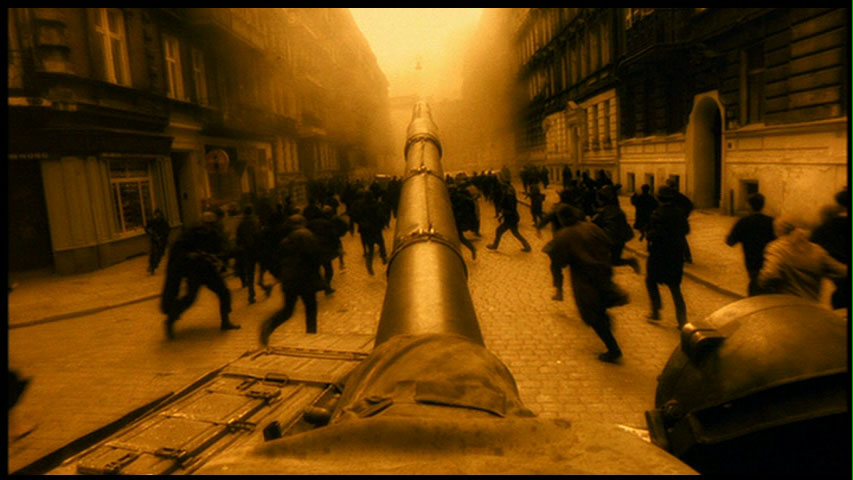
Mamoru Oshii's career trajectory is fascinating. On one hand, he's known for the likes of Ghost in the Shell (1995) and works like the first two Patlabor theatrical films. For most of his career however, with the exception of starting with the likes of the Urusei Yatsura franchise, he's always been an experimental director who yet managed one major success, one that broke into the mainstream and altered pop culture as a result, and has thankfully had the ability to be constantly in work even if his post-2000s work is mainly difficult to find and divisive even for Oshii fans. Beyond this, he was always this experimental director even at the beginning, one of his contributions to Urusei Yatsura the feature film Beautiful Dreamer (1984), a experimental rumination on reality, or Angel's Egg (1985), exploring his own lapsed religious faith by way of Yoshitaka Amano's gorgeous art. He was always "difficult", even in Ghost in the Shell with its turns into philosophy in the middle of action scenes, especially the divisive 2004 sequel. He's also made a lot of live action work since 1987's The Red Spectacles.

From http://1.bp.blogspot.com/-7H1KKPrQIts/U6Dzngw7k0I/
AAAAAAAAEFQ/qbuRn0DPIHE/s1600/2014-06-18+02:03:50++00001.jpg

With this in mind, Avalon's an interesting one-off for Oshii as its a Japanese production but set and co-produced with Poland, a curious choice that yet works to Avalon's favour. The spectre of Communist Europe is felt large in the mostly sepia tone and futuristic drudgery of this world, lost in time and with Avalon the whole point of life for many in response to this, an illegal game where many devote their time and can be able to afford luxuries with the pay from, in spite of posters on the walls proclaiming it should stop. The VR game itself is a constant war zone which exists in ruins and isolated industrial environments, evoking the Cold War era but also World War II. Also, it should be kept in mind that Mamoru Oshii has always been influenced by Western culture - as a man who has packed so much philosophy in his world, he references Western culture as much as Japanese culture so it's not surprising he'd eventually make one film outside his homeland once. Avalon the film is entirely about the search for the titular "Avalon" as well, the afterlife realm for heroes found in Arthurian legend, at one point in his trademark exposition dialogue linking it to another similar idea in Norse mythology too, in this futuristic world the closest thing a virtual reality game which allows Oshii to play with the notion of our perception of what reality truly is whilst offering a world for a player to find those lost in a form of afterlife.

If Avalon has a message, it is still a very relevant take on both the subjectivity of reality, as Ash ultimately ends up in an experimental stage where the film manages to pull a rug under another rug it pulled at the start of the segment, a rarity it manages to make work, and also the increasing sense as video games and virtual reality become more precedent in terms of their relation to reality and our lives, where one can make a career out of it and feels more true life than ours out of it. The decision to depict it through an antiquated, post-Cold War aesthetic absolutely helps avoid technical obsoletion in the themes, the computers here inherently old back in 2001, and the world in and out the Avalon game is barring flashes of colour in sepia.

From https://thefunambulistdotnet.files.wordpress.com/2010/12/avalon8.jpg

As with all Oshii works, unless we're talking about the reoccurring Bassett hounds in his work (an animal lover by all accounts), all his films are precise in their references and symbolism. Arguably, Avalon is one of his simpler stories to understand, one that would reward upon repeat viewings but can be absorbed on the first viewing in story and in terms of the spectacle. The film, deliberately artificial in its CGI, dating with grace due to this factor, is matched by its sense of the grandiose, emphasised further by Kenji Kawai's score or the use of classical music especially in the most emotionally powerful moment, an entire performance of the Warsaw Philharmonic Orchestra intercut between an important dramatic incidents in the plot. Whilst known as a cerebral director to a fault for some viewers, Mamoru Oshii was always concerned with human drama and happy to blend it with action, and in this world this is implicit throughout.

This is as well with the danger of the virtual world being unable to be taken seriously. If videogames have a distance to them, then one could never be able to take any threat seriously or any drama involved with it without any sense of absurdity. Here the threat is there, especially when a giant monolithic moving fortress appears at one moment; the drama is here too, Ash part of an undefeated group who collapsed due a moment of failure, or how one member with her in that group has been left comatose in a hospital, the game of Avalon and VR in this world with danger to its use. Whilst it may sound ridiculous to have this type of seriousness to games, Oshii sees games as being worthy of elaborate existentialism, as with even his more light hearted material of yore. And Avalon ultimately succeeds, enough that I wish the film was better known. Unfortunately, Oshii's availability especially from the 2000s, and his career in general, in terms of filmography, is still an issue. A shame especially as Avalon proves worthy of re-evaluation as with a lot of his career.


From https://drnorth.files.wordpress.com/2009/01/vlcsnap-614491.png

Tuesday, 20 June 2017

#43: The Flying Luna Clipper (1987)

From https://www.msx.org/sites/default/files/news/2017
/04/tumblr_nz510npb8C1unpujno1_1280.jpg

Director: Ikko Ono
Viewed in English Language with Japanese Subtitles

Synopsis: Having acquired a rare boat plane from the early 20th century, a Martin M-130, and renovated it to flyable again, a company offers a luxurious holiday trip in the Hawaiian Pacific for those who are the "deepest dreamers". Made with the graphical capabilities of a MSX game console, this film follows the flight patrons through a compilation of lessons and strange experimental shorts within its near hour length.

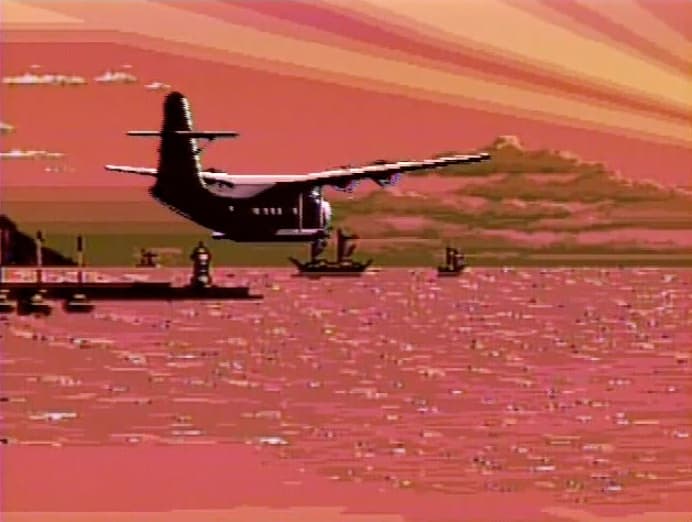
While this blog is meant to cover Japanese anime, it's be a crime to ignore the other areas of animation(1) that come from Japan alongside anime. The Flying Luna Clipper's existence, as a near hour long film made in glorious 8-bit game console graphics, wouldn't have even been known outside of obscurity in Japan if a blogger by the name of Matt Hawkins hadn't had found a second hand laserdisc copy. The result's a fascinating curiosity; the MSX is one of many Japanese video consoles from an early period of video gaming that would've only been known in its homeland, where the Metal Gear franchise began in fact, used here as an example of creative individuals experimenting with video game consoles beyond merely playable games to outright artistic experiments, be they interactive or not.

From https://i.ytimg.com/vi/6uD6pfH4q1s/hqdefault.jpg

Sadly, like many before and after, these experiments tend to end up doomed to obscurity or beloved cult works that are hampered by archival preservation yet to be publically provided to videogames, especially those which required idiosyncratic controls or require actually being re-released again rather than tracking down second hand, rare copies or online uploads of. It's a shame here as this is a proto-vaporwave head trip to experience, where the 8-bitera of illustration and character design created a colourful, Tropicana world of snowmen wandering around sunny Honolulu and palm trees at dusk. In spite of the limited animation, there's a lush charm from the incredible (and painstaking) detail, an old arcade game in its bright lights and sincerity. Adding to its strangeness and its warm hearted sense of accessibility is that it was likely made to appeal to Western viewers as its dialogue is mostly in English, moments of odd pronunciations in the voice acting against more solid performances which yet come from the mouths of moving portraits of cartoonish oddness. A black bird business tycoon, an air hostess whose a bespectacled banana, Polynesian bananas in coconut bras and grass skirts, a green haired chimp or living singing Hawaiian volcanoes =part of a more sexualised version of a Fantasia (1940) musical number.

From http://68.media.tumblr.com/9d5cdcc78b0362fc3059812988af41ac/
tumblr_nz510npb8C1unpujno5_1280.jpg

Japanese pop surrealism, the type of bubblegum surrealism not just found in videogames but in all their media, is absolutely charming. Unless you're viewing the spectrum which follows the traditions of the original movement in being transgressive, there's no sense of the more eccentric side of it of being merely commercial product, instead of cornucopia of full of cute anthropomorphic animals, talking plants, bright colours and spectacle, something I grew up with having a port of the scrolling shooter parody Parodius (1995) for the Sega Satan and hazy memories of episodes of Samurai Pizza Cats (1990-1). For all the darker, illicit areas of Japanese horror and dark fantasy which cross into the unreal and the mind bending, there's this opposite even when its occasionally morbid and full of sexual innuendo that's cute, silly and playful. The Flying Luna Clipper becomes a literal series of dreams for both the passengers of the ship and the viewer them self, the director of the animation literally one of the co-pilots of the clipper as it travels across the pacific ocean and even into outer space briefly. Barring one unfortunate image of a blackface character, on a TV in the background of a single scene, it's a surrealism that's a playful escapade.

From https://www.msx.org/sites/default/files/news/
2017/04/tumblr_nz510npb8C1unpujno6_1280.jpg

Alongside a lesson on the Holose taught by a seahorse with a Germanic accent, to music numbers, you also have material that could be shorts by themselves, one of the most memorable likely an older project by the director in 1986 which is live action, a playful music video of babies falling over, waterfalls and diving women that's charming as its strange, feeling the most dated of the whole work but not a detraction to its value. The whole film in general makes an argument, now becoming known again in a post-vaporwave world, for a period of late eighties and early to mid nineties pop culture as escapes for audiences that shouldn't inherently be dismissed outright for that reason, a lot of anime to videogames even in commercial industries that emphasised escape, dreamscapes and the purely fantastical. Far from cynical, The Flying Luna Clipper feels sincerely fun, more so as its brazenly (proudly) weird even next to a lot of actual anime, its end playing as a series of dreams as the closet to an actual protagonist swears the clipper has been a giant pelican for all this time in the tourist trip.

From http://68.media.tumblr.com/7fcd20cdd7e96eec6fabbbf2d048ac01/
tumblr_nz6uvp8CYj1unpujno1_1280.jpg

It's sadly a work that, unless a drastic re-evaluation takes place and enough people keep bringing it up in online topic, will be only known in a YouTube presentation, eternal gratitude to the man who pull the film again out of subterranean cultural memory but with an unknown time period of how long the upload will exist. Whilst from a period just before my birth let along childhood, it revisiting it for this review is why it was fitting to have moved away from videogames by the end of the PlayStation 2 to my permanent love for cinema instead. Less brightness and unexpected weirdness, the joys of childhood playing videogames scored by the soundtrack of Daytona USA (1993) and set in fantastical elaborate worlds, replaced by more "realistic" turgid aesthetics and a restriction in how games are meant to present themselves. I occasionally flick over reviews and clips online of new games, and alongside the cost and space required for new consoles, most of the actual games now are uninteresting for me to return to the medium. In spite of the apparent maturity of the medium in terms of storytelling, which I have to admire, as an outsider I'm put off by the mirrored sense of the bloated, store brand tone that also exists in mainstream cinema having infected the industry as well. In spite of its strangeness, there's a greater knowing sense of playfulness here in The Flying Luna Clipper I'd gladly recommend people explore if just as an antidote of this issue.

-------
(1) The last time something different from the mould was covered was number #24 Yuki Terai - Secrets (2000), a compilation of shorts and music videos for an entirely fictional female star which you can read the review of HERE