Showing posts with label Hideaki Anno. Show all posts

Saturday, 30 January 2021

#181: Submarine 707R (2003)


Director: Shoichi Masuo

Screenplay: Hiroshi Ohnogi

Based on the manga by Satoru Ozawa

Voice Cast: Akira Ishida as Goro Kusaka; Ben Hiura as Youhei Hayami; Daisuke Sakaguchi as Senta Umino; Hideo Ishikawa as Ichiro Suzuki; Hiroshi Yanaka as Hayato Nango; Kensho Ono as Kenji Minahaya; Unshō Ishizuka as Admiral Red

Viewed in Japanese with English Subtitles


Adapted from a manga first started in 1963, and adapted once already for a 1997 one-shot OVA, Submarine 707R is another title from the transition of Manga Entertainment into the early 2000s, where there would still be OVAs over the decade but eventually television shows alongside theatrical features would dominate their catalogue. Released by Geneon USA in the United States, that company (an off-shot of NBCUniversal Entertainment Japan) would fold in 2007, with the added fascination that this is also an Aniplex title. Aniplex are more known in the States, and are more controversial from the 2010s onwards for distributing their titles for physical media under prices closer to the Japanese market, which means very expensive and limited print runs, managing (unlike Bandai Visual in the 2000s) to actually succeed. This is almost quaint to look back on, with this two part OVA, before they were ever that company and merely one of the producers of such titles as Submarine 707R, perverse to consider.

Submarine 707R is what is says on the tin, about submarines, all that entails with eluding attacks from other submarines and ships above water, all with the danger that if the lead vessel is destroyed, the crew cannot escape the bottom of the ocean. The one touch which you may not gather even if you read the synopsis is that this is effectively set in an unknown future, a war between the world above the ocean on land, united despite frictions, and the USR (the Undersea Silence Revolution), an underwater civilisation where members like Admirable Red in his submarine attack boats and ships above to stop the surface civilisation exploiting the ocean. A lot of anime has had villains fighting, even wishing to destroy humanity, to protect the Earth's ecosystem, always a fascinating conundrum. That we see Red's family - his wife, three daughters and one infant son - shows an alternative to someone who can be seen as a cartoonish figure here otherwise, and enticing lead in for moral complexity.

Contrasting him is Captain Yōhei Hayami, captain of the 707, originally an older diesel ship not held in high regard until, whilst being taken to a conference for all nations, appears when everyone is being attacked with ease by Red, Hayami sacrificing his vessel to protect others after most were decimated beforehand. With the first episode dealing with a lot of the narrative prologue, the 707 is resurrected as a new ship immediately afterwards. As a straightforward plot progression, that Hayami is to clash with Captain Red once again, this adds a nice touch as he contrasts as a portly man who yet, alongside a talented crew, has an incredible mind for tactics.

Here I must confess that I accidentally put on the second episode on first, before stopping a quarter of its length in and watching Episode 1. As an accident, this emphasised the disappointments with the OVAs greatly. Watching Episode 2 blind, before realising the mistake, I have a more enticing work in front of me of a science fiction world, set in media res revealed to actually by the underwater civilisation of the USR, with a dominant number of female characters, including three older women commanding battleships for the surface. The show suggests an atmospheric and distinct nautical story, barring one odd creative choice, especially in a work you could show to kids, of a female staff member having a pronounced bounce in her bust moving in her seat in a scene, which is crass to point out if not so abruptly and deliberately animated by a potentially bored animator.

In reality, the OVA proves to be far less interesting than this, starting off with the true leads being a submarine ran entirely by men, including a trio of male teenagers, who never really stand out. The exception is Hayami himself, as a commander who does not use brawn but his mind, but even then you do not get much with him. Odder is that, whilst it is good we get to see his home life with his wife and daughter, there is an uncomfortable and pointless interest in his child daughter as a moe character, including an end credits for the first OVA, all in spite of not being a real character of note at all.  

In the first OVA, the pair effectively making up a feature length narrative, a lot of plot happens, including the destruction of the original 707, but the show never really hits a high gear. Considering the villain is effectively an eco-terrorist, or gets into the whole issue of the entire ocean becoming its own sovereignty, the anime does not really provide enough time to flesh this out. The first episode does tell a lot, all mentioned in the synopsis, but also a bit of jingoism. That, when all other nations boost of their new ships and squabble over who commands as they are all being obliterated, a little Japanese submarine that could wins. It is cheese, never good regardless of the country which does it, but thankfully less of a concern after that when it is about one ship, for all the surface nations, with a good captain against another submarine in a game of whit. It is perplexing though that, devoting the second episode entirely to that conflict, it manages to last over forty minutes and yet feels like nothing happened which is the ultimate flat note in spite of the promise.

The production also feels its age. Post the 2000s, this was created when digital animation took over. The notable thing for me is the clear use of digital models such as for the submarine, which would become common place into the decades after, but look noticeably separate from the normal animation in appearance with jarring effect. It is a work that, barring one scene in between its credit sequences, does not really stand out in imagination. That one scene, when I accidentally watched the first quarter of Episode 2, is Captain Red's wife on a giant industrial elevator with orchestral music playing, leading to her with her children in a domed room as outside is seemingly in Arctic tundra, completely masked in white snow. Even if the digital models for the elevator look aged, it all had an appropriate atmosphere which you do not find elsewhere. Everything else is pretty basic, and the irony is that the one really elaborate aspect of the production aesthetically, the best of the entire OVA, is the opening credits. Set to calm jazz, we see blueprints of the titular submarine being built and animation that is designed to look like sketch works as the submarine is created. That opening was directed by Hideaki Anno, of Neon Genesis Evangelion (1995), with Submarine 707R being directed by Shoichi Masuo, who worked on that series and Anno's own Nadia: The Secret of Blue Water (1990-1) series, as a Episode Director, so it makes sense for Anno to be involved.

But it says a lot that the opening credits are the one thing I pick out but cannot elaborate further from. Submarine 707R is a case of an anime which, with all the potential there, is just average. Simple as that, and it is not worth elaborating on.

Thursday, 13 December 2018

No 79: Gunbuster (1988-89)

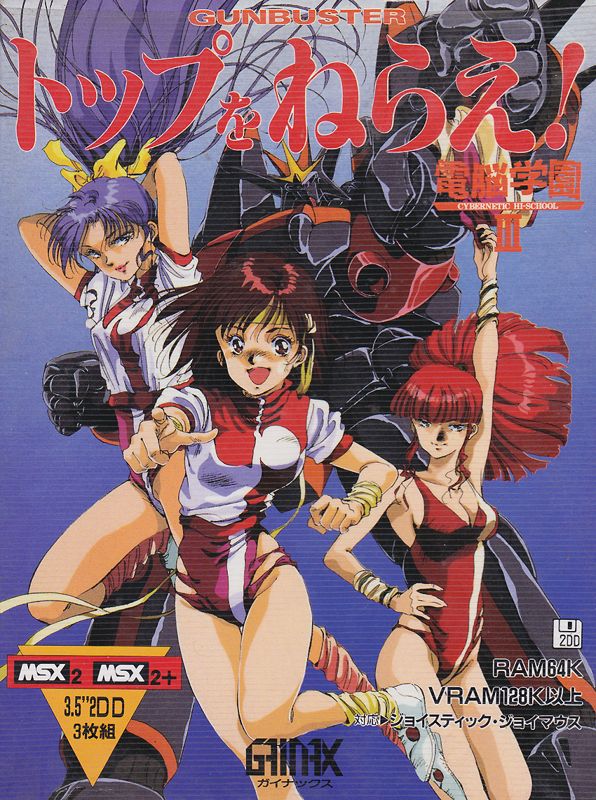
From https://www.mobygames.com/images/covers/l/254841-
cybernetic-hi-school-part-3-gunbuster-msx-front-cover.jpg


a.k.a Aim for the Top! Gunbuster
Director: Hideaki Anno
Screenplay: Hideaki Anno, Hiroyuki Yamaga and Toshio Okada
Voice Cast: Noriko Hidaka as Noriko Takaya; Rei Sakuma as Kazumi "Onee-sama" Amano; Kazuki Yao as Smith Toren; Maria Kawamura as Jung Freud; Masako Katsuki as Kimiko Akai/Reiko Kashiwara; Norio Wakamoto as Kouichiro "Coach" Ohta; Tamio Ohki as Captain Tatsumi Tashiro

Synopsis: In the future, Noriko Takaya (Noriko Hidaka) is a young student at a high school that trains robot pilots to protect the Earth from a hostile alien race. Hoping to follow her father's example, lost to outer space, she strives to become the best regardless of any doubts and handicaps in front of her.

[Major Spoilers Throughout]

Gunbuster has not been helped by its chequered history in terms of availability in the West, nor the potential and pointless handicap in terms of marketability of never having an English dub, is nonetheless a legendary work from Gainax. I will state, outright, that any flaws that I find in the work are subsumed by the lasting thoughts of all Gunbuster does right and what an ambitious project the then-fledgling studio was with hindsight. Being sandwiched between Royal Space Force: The Wings of Honnêamise (1987), arguably Gainax's most intelligent and ambitious projects, and the cultural behemoth that was Neon Genesis Evangelion (1995) doesn't help either as whilst Gainax's legacy is strong due to so many idiosyncratic titles, it does unfortunately mean they have to be jostled in competition for superiority when they're all good.

Six episodes is actually not a lot in terms of length for Gunbuster as, thirty minutes each, they aren't a lot of time for a work which had a bit of ambition beyond its initial premise. In particular it is a curious hybrid of genres and styles that is definitely of the eighties with its synth pop music and style but visibly leaning towards the next decade in themes and tonal shifts. The first episode of Gunbuster however always completely betrays what your expectations are, and also prepare you for the brave if erratic structure of the OVA, that it is entirely an extended parody of the sports drama, in which protagonist Noriko Takaya is the plucky heroine who is chosen to go into outer space, much to the derision of other students, and thus must prove herself to "Coach" Kouichiro Ohta. That it's entirely through giant pilot robots we see using giant skipping ropes, jog across the track and field, and do push-ups is inherently (and deliberately) humorous, right down to a pastiche of Vangelis' Chariots of Fire (1981) score that was removed in subsequent releases.

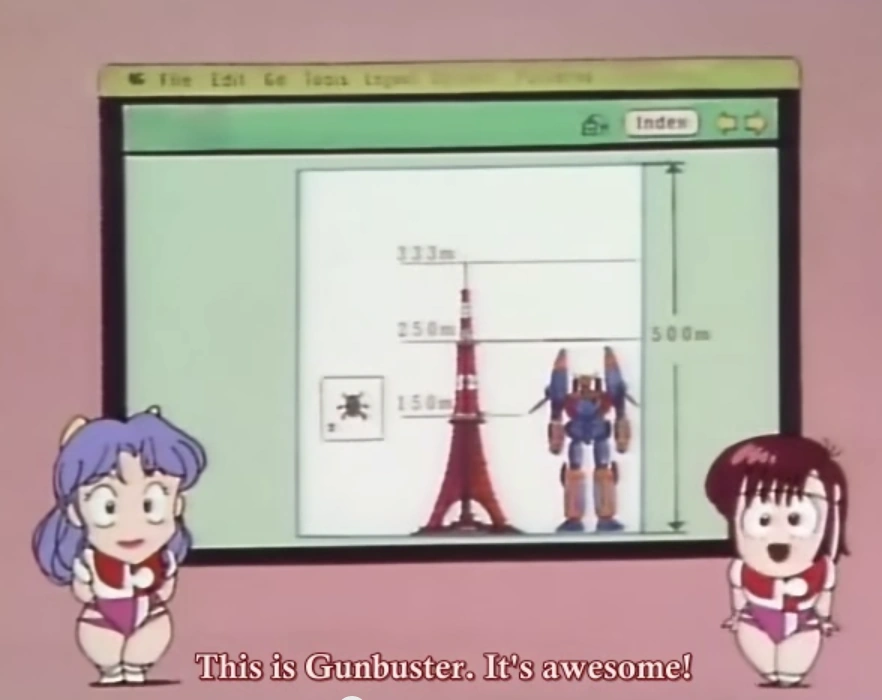
From http://animuze.com/blog/wp-content
/uploads/2017/01/gubusterscreepcap3-1024x773.jpg

This belies Hideaki Anno's directorial career, how he juxtaposes tones to an extreme. The eighties aesthetic, alongside incredible and painstakingly hand drawn animation, even includes a vibrant and frankly un-cool sweetness to the proceedings, the opening and ending credit songs even into the darker later episodes cute synth pop about striving to be the best, the end credits one even set over crayon drawn comedy gag stills for emphasis. The sense of humour is to be found as well in the omake, made for the series during its production and even with a few additions for later releases, which are parodies of short science lessons where the science by the cast, all drawn in "chibi" form (squat, exaggerated versions like gnomes), is detailed and realistic but utterly made-up. The gag in Episode 3 of having a character's full and convoluted scientific dissertation in white text on a black background, whilst a karaoke duet about a man and a woman getting drunk takes place between the casts' off-time, is just a cherry on the cake for this playfulness. Between these and the first episode, Gunbuster starts off as a light hearted sci-fi romp but it's already establishes clues to where the plot will go.

And in taking such risks, Hideaki Anno having to sacrifice pace for this tonal shifting, there are issues to be had. There is something very unique, in context of when the OVAs were first released in the late eighties, where this even in the early episodes can still have the humour and titillating fan service, introducing a space station and characters like the Russian female pilot Jung Freud with additional space bathing, whilst there's still the gravity of the threat, the alien forces truly monstrous multi-coloured bio-mechanical masses who implant eggs into suns and planets destroying them, the plot emphasising that this feels like humanity fighting against a natural process of the universe in desperation. Some of the risks haven't aged well, mainly episode third to be honest because it falls on a trope, introducing a character only to kill them off in that same piece, that's been done better elsewhere. It's famous for calling a character for that episode Smith Toren, named after the Canadian manga translator and founder of Studio Proteus who had first hand interaction with Gainax staff through his contributions to Western anime and manga fan culture. It's a wonderful tribute to the late Toren, but as the first crush of Noriko's it does have to be compared to other examples of one character being introduced to an episode and a tragedy taking place, to which Kaiba (2008) and a very early episode of Full Metal Alchemist (2003) show a lot more nuisance to this risk.

From https://sqwabb.files.wordpress.com/2013/07/gunbuster-dilation.jpg

It certainly predates by decades Christopher Nolan's Interstella (2014) in terms of the idea of time dilation, an irony that Nolan's career is practically cursed by anime works which predate his films (Paprika (2006) < Inception (2010) for another example) and does the ideas better. The entire plot of Noriko's trajectory, in lieu as well to the time dilation, becomes one of Gunbuster's greatest successes. Bear in mind, whilst it's named after a monolithic robot that is Earth's secret super weapon, one of the largest in anime still until Gainax's own Gurren Lagann (2007) got ridiculous, is only introduced in action in the last minutes of episode four. Instead, alongside a sense of hope and courage against dire situations, it's the emotional drama which Gunbuster tries its damndest with and succeeds with completely.  

It gets melodramatic, plot twists exposed as it weaves Noriko's own conflicts with her abilities with her senior and co-pilot Kazumi Amano's romanctic longings for Coach, Noriko's own doubts and fears fighting the aliens especially confounded by the time dilation, where merely a few hours in space are months on Earth, those she loves like her high school friend aging as she is still a teenager. The swipe at Christopher Nolan's Interstellar is actually appropriate, as, its legitimately arguable Gunbuster is a more subtle work that tackles the subject more fully, as characters' lives beyond the story are what Hideaki Anno actually deals with rather than the giant robot versus alien plot the likes of me expected. And yes, it absolutely sets up Anno's own career trajectory as Neon Genesis Evangelion, even having the silly humour in early episodes, would do the same thing. The marvel is that the proud otaku who by all accounts still plays with Ultraman toys in the bathtub was always interested in human emotions for his pulp characters from the get-go in his career.

From https://deculture101.files.wordpress.com/2008/12/vlcsnap-5083404.jpg

Also in terms of production, Gainax cannot be accused of being poor, even into the 2000s when their reputation weathers financial and political strife in-house and questionable projects are started, because they always have had very distinct works in premise, aesthetic and. Fully embracing high sci-fi here, there's an attention to detail in even the mechanics of spaceships of the imagination that even a laymen to animation would applaud. As the story takes risks, so the hard work on the production is likewise the same.

Then episode six, the last, appears and whilst its one of the best of any OVA or TV series, it makes a case that whilst he's one of Gainax's best voices before departing for his own studio called Studio Khara, Anno at least to the 2000s was cursed for real, as his output from here to the late nineties shows. Nadia: The Secret of Blue Water (1990-1), a NHK/Toho/Korad co-production, took a turn when the infamous "island" episodes had to be made to pad out the series, filler so bad it traumatises viewers to this day. Neon Genesis Evangelion's production history is very well documented, Anno's mental health issues so bad that later next episode previews were actual sketches rather than animation and the more overt experimentation came in as much for practicality. Anyone who has seen The End of Evangelion (1997) can attest to where that went to traumatise viewers and His and Her Circumstances (1998-9) had the unfortunate scenario where the original authoress hated where the series went with her source material, affecting it as it went along. Anno is a good argument for the auteur theory even in terms of how this streak of bad luck, the chaotic production histories, helped shape the final materials as much as his hard work.

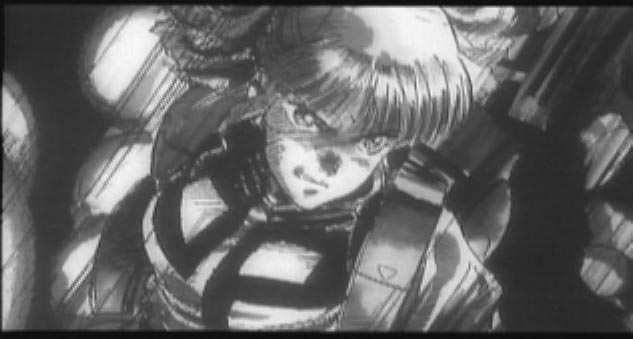
From https://vignette.wikia.nocookie.net/gunbuster/
images/a/a6/It_big.png/revision/latest?cb=20150820201753

Gunbuster's
no different as it immediately starts in monochrome; the last episode barring the final moment is entirely animated in black-and-white and the result is a drastic change in tone because of this. It is stylish but it's clearly a production or financial issue which caused this as for a major space battle between the aliens and Earth's space fleets, it's depicted entirely in a montage of still shots and a text scrawl documenting the survivor numbers afterwards1. And yet, in spite of this, ultimately Gunbuster succeeds as it rakes the viewer over the coals in sadness yet is actually a triumphant, happy ending on display, one of the few examples in any art where a story justifies its happy conclusion by making it a worthy thing succeeded in acquiring. And that's why, flaws and all, I see Gunbuster works and know why it's beloved, a very idiosyncratic work that would be a breath of fresh air back in the late eighties, still idiosyncratic today.

Admittedly that's in mind of it being a show of such a status that's not easily available, the existence of a theatrical cut which removes material that was also released in the West complicated things. As even Evangelion has been picked up by Netflix and to be made available again, Gunbuster is one of the last jewels in Gainax's crown that is harder to glimpse, not helped that whilst worthy of its own stature, the ill-advised decision to effectively sell Diebuster (2004-6) as Gunbuster II in the West didn't go down so well, a show set in the same world (and in hindsight, mirroring the ending of Gunbuster with its own ending with a greater meaning now for me) but an entirely different animal. The talk about Diebuster however is for another day...Gunbuster, the prequel, is something that needs to return back in availability.

From https://www.forbiddenplanet.org/Gunbuster/Visual/Episode6/gb604.jpg

======
1) And not necessarily because the black-and-white ink instead of colour being used was a cost cutting measure either...either way, the final episode finds a way to overcome material limitations as is another trademark of Hideaki Anno's.