Showing posts with label Harem. Show all posts

Tuesday, 3 March 2020

#139: My Sister, The Writer (2018)


Director: Hiroyuki Furukawa
Screenplay: Yūichirō Momose
Based on the light novel by Seiji Ebisu
Voice Cast: Reina Kondo as Suzuka Nagami; Tasuku Hatanaka as Yū Nagami; Ayumi Mano as Esaka-san; Chinatsu Akasaki as Ahegao W Peace Sensei; Eri Kitamura as Reika Shinozaki; Kazusa Aranami as Sakura Minazuki; Yua Nagae as Haruna Kanzaka; Yui Nakajima as Akino Kanzaka; Yui Ogura as Mai Himuro
Viewed in Japanese with English Subtitles

In 2018, one show in the winter schedule quickly became infamous. The premise, comic and light, was a light novel adaptation about a young teen light novelist who scores success but, likely to get into trouble as her school bars students from having income on the side, asks her older brother and aspiring light novelist to pose as her in public, necessary as her first volume is a success in a competition and officially published. Before we even arrive to the notoriety, of how the production quickly capsized immediately, let us get past the immediate concern that she also has a crush on her biological brother that is kept a secret. This is the first time incest is brought up in an anime I have covered as a main plot. If this amateur work of mine is meant to reflect watching all types of anime, this will not be the last time either.

Most anime which covers this isn't, say, Koi Kaze (2004), a drama which is meant to tackle the subject with incredible weighted nuisance, but uses incest as a kink popular in anime and light novels as step siblings and step parents are in 2010s porn onwards.The entire concept is merely a drop of water in the ocean, that curious place where this is not reflective of the entirety of a medium but also happens to be popular enough in a minority its covered a lot in titles like Kissxsis (2010). Why incest is this common in this subsection is probably more complex than a merely misinformed presumption on Japanese culture, but against God knows the joke I have made about step family porn being popular in the West on porn sites isn't a mere jest either, so this taboo has become a growing ellicit one. A work like My Sister, The Writer doesn't hedge its bet on these two being step siblings either.

The irony is that in spite of this premise, as the sister wrote a novel about a brother loving his little sister reflecting her crush for him, it feels insidiously tame and not the thing we jaded anime fans batted an eyelid at. Even in knowledge of how arguably filthy the show is in spite of its wholesome tone, with many fetishes approached as the siblings negotiate around their new career path, it's not the moral quandaries which have been the talk of the net about this series. No, the real notoriety was also because the show right into episode two dropped so much in animation quality it became a meme.

Animation faults happen in television, as schedules are tight and usually cleaned up for Blu Ray, only an occasional mishap being really notorious, from cabbages looking like green balls or characters suddenly having distorted or comically flat features in one shot. A show Samurai Flamenco (2013-14), which I loved, could gain poor luck for its television run as, whilst I and others could see the cleaned up physical releases, the viewers for the broadcast saw animation failures which coloured the experience. When it gets so bad, you get a Gun-dou Musashi (2006), a notorious Monkey Punch adaptation and one of the first examples of irony from Japanese otaku, who demanded the DVD release to have the bad television broadcast quality animation rather than something attempting to salvage the production. My Sister, The Writer by the second episode had howlers in terms of animation posted online, made worse as this was a simulcast in the West through Crunchyroll, unlike shows of decades past like Musashi, which led to more eyes on the product.

I was ready to be controversial by saying it wasn't so bad in the first episode. I have seen some infamous examples of badly animated work before. Then by the second episode to the middle of these ten episodes, until I accepted this issue, I would make hissing noises in embarrassment even by myself watching the show. The animation problems, not comical examples like the sister Suzuka Nagami (in a pink pair of fetishishtic bunny pyjamas) melting on her bed, are really painful when it comes to facial expressions in particular. This is a common problem in television animation, with eyes too far from the nose or like they have had faces drawn as if on a paper plate, but here some of them alongside other animation are teeth grinding in how bad it gets.

The production history is more talked about than the show, which is ultra generic. The show does develop as a generic harem story, in which our bland male protagonist Yu Nagami doesn't try to negotiate around the situations he is in with all the female attention he has. He is another bland protagonist who is psychologically meek and complacent to the point it is a concern, easily replaceable with a potato without any change among female fetish stereotypes smitten by him. There's the busty publicist who has a tendency to call him about work whilst bathing. There's another light novelist writer who wants to know his secrets as a successful writer, a tsundere whose trademarks is her red hair and that, as a tsundere, she follows the trope of the hostile and aggressive female character that secretly hides a softer side to our potato-kun hero. There's also a voice actress who is blonde and bubbly, whose fandom of the light novel is to the point she wants to be his little sister to his real sister's annoyance, part of this circle around our hero with the personality of starch.

And then there's Ahegao W Peace Sensei, who needs her own paragraph as the only character of note. An erotic illustrator, the thing to bear in mind is that she stands out more for her voice actress Chinatsu Akasaki, playing a busty and energetic blonde, being utterly professional as her character at one point at a Comiket, a real major Japanese fan convention, says that she enjoys "degrading rape porn too much". That will put people off, just referring to real dialogue she has; some might be put off just from her preferred nickname Ahegao, which is the term in anime and manga porn for a shot of a (usually female) character having had a violent orgasm to the point of comically over the top facial expressions and looking like one's mind has been blown. Ahegao in another story would actually be a fascinating if controversial female character, a proud and independent creator who just happens to have a very transgressive catalogue of sexual fetishes she enjoys. We exist still with a gender bias where we don't presume in mainstream culture women can have fetishes and sexual interests which can be uncomfortable to many, which would make Ahegao such a fascinating character if handled in an anime that was actually good. This is especially as she never comes off as a deviant; she says openly crude and sexual things when it would be deeply inappropriate in public, but a subtler take of this carefree, very talented and sweet figure would be a challenge to tackle with interest. This is My Sister, The Writer though so don't expect it to take this character and ask these questions from her, asking the challenging ideas she has the potential to suggest1.


Come to think about it, as one man who actually watched the whole series rather than just the first two episodes, not a lot actually happens at all in all I saw. The show's infamy got a deeper layer when the production staff started hiding messages in the production credits, like the name “Shojiki Komata” which is likely shojiki komatta, meaning “We’re in serious trouble.” It is pointless to argue about gender politics, whether it's acceptable to fetishize incest, when the back story of this show was a show capsizing from the beginning and getting bad to the point the staff themselves were sending messages of help to the viewers. This was the reason I ever considered watching this series, and in a world which promotes romance between biological siblings, without anyone onscreen arguing the ethical problems involved, it's not something to be shocked by in the blandness of the show. Or the bigger ethical issue, in real life, that someone confirmed none of the staff on the show were being paid2.

If you ignore this, the issue falls to the side as the cutesy tone manages to plain out all the fetishes this about whilst being utterly sleazy inherently. It is explicit to the point the television broadcast, which I saw on Crunchyroll, had to censor the nudity with onscreen "stickers", contrasting a tameness which is surprising as this deals with a lot of fetishes distinct to this pop culture, a running joke that Suzuka wants a term explained to her only to blush and be shocked when someone (usually Ahegao) does. The light novel aspect, super popular novellas with illustrations which have become a big part of anime in how many are adapted, is barely covered. There's a perversity in a notoriously bad show talking about a great light novelist, that Suzuka's work is so good it can generate female fans wanting to be her brother's little sister, or the many debates about what a good story should be. It doesn't bother even trying to show the world of light novel production, which would've be fascinating to see even in an exaggerated form, especially as we do have the character go to a real life fan convention here. Instead I have to write about something as absurd about the anime director, when this light novel gets so popular it is being produced for an adaptation, arguing with Yu that he is not liking cute little sisters enough to be a good writer. Many sane readers of this might be grossed by this. I just wondered in hindsight what bizarre world such an argument would make sense within.

Once I got accustomed to the animation problems, nothing really stands out. The main female cast are mostly insignificant, generic/buxom/cute characters baring Ahegao and Suzuka who are so generic this is a rare case of not even the character designs standing out, made worse as there's nothing credible or defendable about the main story about the lead siblings getting closer, as Yu has to play out being romantically attracted to his real sister to pose as a creator. It might've been a real transgressive streak if they went with the incestuous romance fully, but this a tedious romantic tale, some mild internal angst and the additional cast being roadblocks, which makes the relationship not that compelling either.

It's clearly a fetish delivery system of a show to be honest, and it goes for low laying fruit to the point My Sister, The Writer is inert. Little happens. An episode doing research at Suzuka's school summer festival, where they inexplicably end up as the romantic leads for a theatrical performance, just happens, and that applies to most of the plot points. There's no real conflict baring that anime director and two female light novel creating sisters, the youngest with a hugely broken friendship with Ahegao feeding her animosity to her. Neither conflict is dabbled in greatly, nor the sisters as they merely tag along with Yu as potential suitors. Beyond that, I honestly suspect the show was quietly put to pasture before it intended to, when your animators are having honest to God pleas for help in the credits.

They did however create a single two part OVA episode, in spite of this, whose existence was fully uncensored bared breasts. Both parts are about Ahegao having experimental virtual reality games, one where the women play a reverse netorare situation, "netorare" a type of adult manga and anime trope of adulterous relationships, where everyone is trying to steal the lead potato from the designated wife with simulated sex. The other inexplicably turns into a sexy version of Saw (2004), still with two people chained up in a grungy bathroom with a body, alongside Die Hard (1988) if re-imagined with nipple triggered bombs. Even with the nude and kink it would be tame, baring the discomfort of one character being the under aged teen sister of the lead, making the scene (and let's be blunt about the moment) where she messages her older brother's back in a bathtub with her chest probably one of the scuzziest things I've covered, especially when you consider an otaku has probably masturbated to this scene.

"Trangressive" is a questionable word to use as I don't consider My Sister, The Writer doesn't have its plot idea of incest to deliberately subvert or offend normalcy, but just as a token. Its neither to be forgotten that a lot of these incest kink shows are usually about cute little sisters, a sense of "moe" and such concepts' sinister underbellies being popular as unlike an actual girlfriend, a cute younger girl fantasy is more appealing as they can be told to be quiet so the male can play his videogames. Aesthetically, by the conclusion probably the worst thing alongside the morality is that this was already as bland as you could get, that is colourful and bright with its pop credit songs but looking like everything else initially anyway, with additional atrocious animation and questionable story pacing that makes the experience worse. This isn't School Days (2007), bright and bland but with an intentional dark heart, instead My Sister, The Writer the kind of show we would thankfully have forgotten and buried weren't it not for how much of a conceptual disaster it turned into.  


=====
1) Ahegao is also meant to be British, which really is a surprise as a British viewer to learn. I mean we're secretly kinky over here, but should I proudly embrace this character or not? There's not even any sense of Britishness in the character seen in the series, even tea drinking, so it's a character trait that's a non entity.

2) HERE

Wednesday, 19 February 2020

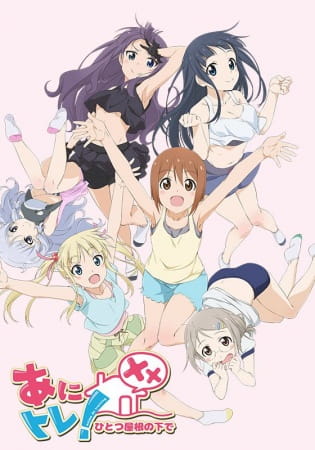
#134: Anitore! XX - Hitotsu Yane no Shita de (2016)


Director: Atsushi Nigorikawa
Screenplay: Daisuke Ishibashi
Voice Cast: Miku Itō as Asami Hoshi, Azumi Waki as Eri Higuchi, Eri Suzuki as Sakura Izumi, Kanon Takao as Yū Hiraoka, Maria Naganawa as Shion Tachibana, Miyu Komaki as Shizuno Saotome
Viewed in Japanese with English Subtitles

Adding to the bad thoughts about Anitore! is that I accidentally watched the second season without realising so until halfway through. It really doesn't feel like something is lost as a result admittedly.  When I spotted this show on Crunchyroll and found it a) fascinating as an idea and b) short enough to pique my interest, I wasn't expecting this to be this painfully banal.

The series is interesting on paper - a micro series where the idea is anime girls teaching the viewer how to exercise. Sounds positive enough, letting otaku get healthy and buff, especially as in 2019 a show called How Heavy Are the Dumbbells You Lift? runs with the virtue of exercise in normal length episodes years later to popularity. What you get is something else, a little bit exercise training, more ecchi where you ogle animated girls bending over, and a peculiar first person harem work.

Let's get pass that detail. The show is set up entirely from first person from a male character, harem genre storytelling dictating that (unless a reverse harem with a woman/girl surrounded by men/boys) it's a male character surrounded by female characters, usually tickling fancies (i.e. fetishes) for the male viewer, and usually so bland it's to the point that it feels like they're just cloning the same character, over multiple decades, with the point of being a stand-in for fantasies only on the surface but revealing an uncomfortable amount of psychological issues for men in their quietness and extreme meekness. We never hear our protagonist but the female cast address him and directly to us as well; the ideas is unmistakeably voyeuristic, done alongside usual tropes from the harem genre of sec comedy about compromising positions or a girl falling on him (us). The show has effectively boiled down these bland, blander than white bread male character to the perfect extreme - you, not you the reader, but the metaphorical (male) you. It's weird in a bad way, and the show also breaks its own structural rules numerous and arbitrary amounts of time, cutting to camera angles (like two girls sideways that clearly aren't from a person's perspective) and thus making it an odd creative decision not really implemented. Before you even ask if it's just crass, again I'd have actually been intrigued if this had fully went with this experimental style of first person if it had been more than just for titilation.

In terms of a show, it has the pretence of being educational. When it is, there is a semblance of a fun show here, covering basics as the best ways to do exercise stretches to even cool down techniques, done by way of chiba representations of the cast, diminutive (and cute) versions whose proportions are shrunk to a pocket size version, a trope that exists here with the chibi addressing the audience. (In one of the few funny gags, though it completely destroys reality itself, one chibi is squashed by her normal sized version mid-exercise). Even if some of it, like exercising on a crowded train, might seem absurd it nonetheless is of interest.

It becomes obvious Anitore! is meant to be more of a regular fetish show when a lot of the exercise segments have the girls literally orgasming from the final push of their exercise. I'm not suggesting people don't experience this in real life sometimes, but when it's this frequent, it's quite obvious which side of its bread the show butters. And its continual, with pratfalls and near nudity, never actively placating the horny viewer with actual nudity. It even goes as far as continue a trope I have surprisingly seen a few times in anime to make this a trope now, of a mischievous pet ferret, in this case one that's obsessed with burying itself into a girl's cleavage or making off with underwear/swimming tops1.

I've never actually mentioned the cast yet but the other issue is that this cast is bland. Your male lead is literally non-existent, the final culmination of all the bland males whittled down to negative space, and this is a rare case where even the female cast in visual design is as generic as you can get. One is defined just by being meek and wearing glasses, another just from having a significantly larger bosom than anyone else has, and so forth. The exceptions are a Segway rider who collects plush toys and lives in a fantasy realm within her own head, and also one character who did redeem this show a little, that of a girl who wants to be the occult Goth in contact to Eldritch Gods but is actually working at a convenience stand and has a really sweet mother appear once to undermine her facade. The picture of someone trying to live a fictitious self is a great idea desperately needing to be rescued for a good show.

Nothing else is to be said as its vignettes of exercise and the actual concern of cheap titillation, to perv over the girls without any real sense of sexuality, just leering from a distance that objectifies them and is just tedious to sit through. The only sense of a real set piece through these episodes is when two of the girls go jogging for one episode, and that the final one is a Christmas episode, a sex fantasy just to see everyone in skimpy clothes. The show is pretty well made - colourful, full of energy as each episode is only four minutes long, a poppy end song set to characters entering doors in gravity defying reality - but it's so vapid and questionable in terms of why it exists it was an utter chore to sit through. And again, this was the second season I accidentally watched first, which works by itself and leads to the question of what would sitting through the first season be like...

========
1) Even censored hentai versions of Alien. Thank you Alien of Darkness (1996), for unfortunately being stuck in memory over the years due to that bloody ferret one of staff got included even if it was so tonally inappropriate to.

Wednesday, 27 March 2019

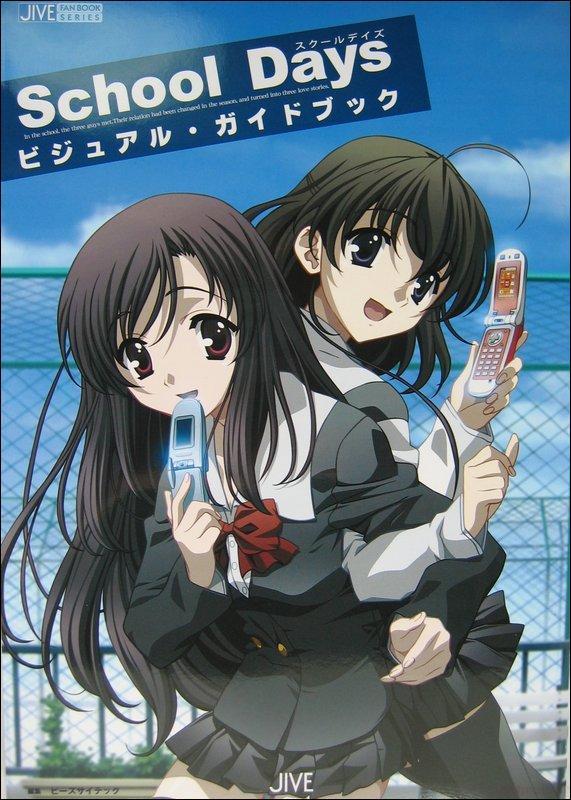
#92: School Days (2007)

From https://pics.filmaffinity.com/sukuru_deizu_
school_days_tv_series-259854327-large.jpg


Director: Keitaro Motonaga
Screenplay: Makoto Uezu
Based on the adult visual novel videogame by 0verflow
Voice Cast: Daisuke Hirakawa as Makoto Ito; Shiho Kawaragi as Sekai Saionji; Tae Okajima as Kotonoha Katsura; Chiaki Takahashi as Nanami Kanroji; Haruka Nagami as Otome Kato; Keiko Imoto as Setsuna Kiyoura; Megu Ashiro as Kokoro Katsura; Ryouko Tanaka as Hikari Kuroda; Yoshiaki Matsumoto as Taisuke Sawanaga
Viewed in Japanese with English Subtitles

Synopsis: In high school, Makoto Ito is encouraged by his female friend Sekai Saionji to start dating Kotonoha Katsura, a timid girl in another class. Sekai however has feelings for him herself, and Makoto is not your usual male anime protagonist when he starts getting bored with courting Kotonoha.

[FULL SPOILERS throughout; whilst a warning will be added to where they are, this is an immediate warning you don't mind knowing the full details of the plot.]

School Days is notorious for a good reason, though appearances for this anime series can be deceptive. Its original based an adult visual novel published in 2005. Visual novels are a popular medium especially in manga and anime culture, interactive novels which are popular in Japan that have multiple narrative paths and endings, and are entirely played by multiple choices (like a choose-your-own adventure book) inter-spliced with animation or visuals. "Adult" as, a sub genre in visual novels known as "eroge" (erotic games), the original work was pornographic with explicit sex scenes (barring Japanese censorship laws). The series was in lieu of a multimedia bonanza after the original work did very well.

The surprising thing with School Days the animated adaptation is that, with alarm bells ringing due to the series' erotic origins and its initial tone in the first three episodes, it changes into a dark chimera eventually of interest. Makoto Uezu is a prominent screenwriter, and to my absolute surprise, director Keitaro Motonaga also helmed Malice@Doll (2000), a work that I hold in high regard, though with the caveat that it's an odd creation as an early computer animated body horror sci-fi work which is truly peculiar; I viewed that one screenwriter (and premise creator) Chiaki J. Konaka's work more, but it was nice to see Motonaga again, though barring co-directing the Rayearth OVAs with Toshiki Hirano in 1997, he's not got a lot in his career that stands out and a bit of porn up until helming the recent Digimon Adventure tri. films, which create a large single work out of six films between 2015-2018, which is definitely a BIG deal for him alongside working in the background on a load of other prominent work.

The premise itself could've easily descended in something bad on just the synopsis though, just a de-eroticised melodrama if you never heard of the game. School Days, with its conventional (stereotypical) TV look of bright colours and conventional characters designs are matched by a stereotypically bland male protagonist and many close-ups of female characters' figures, for more lurid and questionable in terms of a problematic male gaze and weirder because these are characters still in school.

Kotonoha, the girl he is initially pushed into dating by his tomboy female friend Sekai, is depicted as a voluptuous big eyed girl who is quiet and shy around men, all whilst Sekai herself spends her time arguing with him through exchanged notes in class. So for, it's a stereotype of anime plotting that also is part of the "harem" sub-genre. Harem, originally a term from ancient Muslim culture of a separate part of a household for wives, concubines, and female servants, as well as eventually turning into a completely sexual term for a group of women with one male lover, is its own anime/manga sub-genre which usually denotes one male surrounded by multiple female suitors; there is the "reverse harem", one woman and multiple male suitors, and LGBT variations, but harem stories that are the most famous (and divisive) include the Love Hina franchise where its one male, and many potential female suitors. Whatever one's opinion on the subject - whether polygamy (or polyandry) are morally acceptable or even practical, whether harem stories can be great or fall (especially with those with multiple female suitors) into crass or just badly written stories - School Days thankfully changes its tune soon into itself when the tale it sets up immediately goes sour.

[MAJOR Spoiler Warnings here]

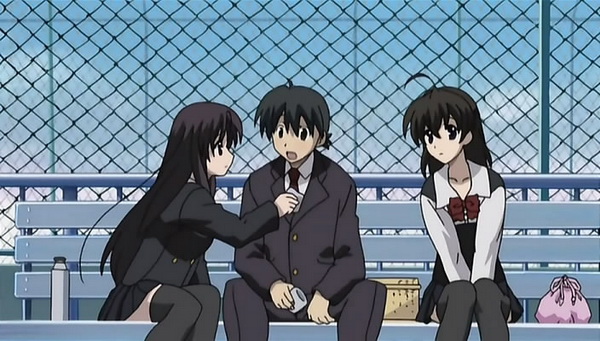
And by sour, as in our male protagonist, eventually turning out to be a chronic womanizer with an ease in cheating on multiple girls, is murdered by one character, whilst another is disembowel. The diagram for the beginning to the ending, from the initial romance with light comedy at the beginning to where his head is severed and kept as a possession for a heartbroken suitor, is as jarring a tonal shift without a lot of context to how this happened.

[MAJOR Spoilers End]

Notoriously, and where the fascinating reward in School Days is found, even if it feels like being in a meat grinder for all twelve of its episodes, the original visual novel when it came to the "bad endings" got violent. Visual novels, due to their nature, have "good endings" and "bad endings" like some videogames, where the choices made in options will dictate where the story will progress.  So an inspired decision was clearly made to make a show based on the worst type of ending whilst, on purpose or with unintentionally greater weight, to turn this property into an anti-harem story.

From https://canime.files.wordpress.com/2010/01/school-days702.jpg

Mainly because it shows the worst in its cast, as our male lead Makoto, as mentioned, is a womanzier, his friend Sekai, despite pushing him to another girl, has a crush on him, and the school (especially the girls) is full of bullies and individuals who think by their hormones or are cruel. The only innocent characters are Kotonoha, the initial romantic interest, and arguably a female character named Otome, who likes Makoto and has sex with him even when he's dating others, but is fleshed out as being more complicated in this dicey predicament, as is Setsuna, Sekai's own diminutive female friend also revealed to have a crush on him, and does some problematic things, but has the issue that about to leave for France, as a plot thread reveals, she's concerned for her friend Sekai's well being when she is no longer there. No one else, however, is above whale manure in some of the things they do; even Sekai, whilst the conflicted main female character with Kotonoha, is willingly dragged into a romance that is a disaster from the get-go.  Even Makoto's horn dog but wholesome male friend Taisuke eventually does something in a later episode which is horrifying.

The worst thing, and why for how ridiculous and way too cruel the story goes School Days actually succeeds, is that it's not morally black and white, but with everyone including Makoto himself being confused hormone driven teenagers. It's definitely gotten a reaction for viewers who expected clichés; the comments section of Crunchyroll added to my viewing experience, a curious tale in itself of viewers wanting to kill Makoto, slap everyone else and vile anguish whilst those in the know, who say the series already, teased the horrifying climax of it all. I myself was aware of the ending, that Makoto would eventually be shown as a womanzier, and that the comeuppance was a nasty one, but not only did I not know the full extent of said ending, but my knowledge didn't ruin the show but arguably improved it. Especially as it soothed over the awkward first three episodes, knowing where it went brought a sense of tragic finality to the proceedings. It added to the idea that a character like Makoto is not explicitly evil, even when near the end of the series has a foursome with three female classmates when he's already sleeping around and betraying multiple girlfriends, but something worse in his banality. Far more disturbing, even if exaggerated, is that he's just an apathetic and dumb young man who thinks with his smaller head, and has little wisdom of emotions, more honest as a moral ground for the series to take as a result even if it's more agonising for a viewer to experience.

And whilst their all stereotypes, that helps because of this attitude; Sekai, complicating things as she still helps him to date Kotonoha, has a strange relationship including practice foreplay sessions which are just as problematic as they should be to a viewer, naturally leading to complications. Setsuna, Sekai's friend, has a crush on Makoto too, as does Otome, all whilst their female peers can be vindictive and backstabbing, all feeling less like sexist depictions but like many teenagers misguided behaviour. It's an attempt at least at complexity in spite of itself, even a character like Kotonoha in that her hesitance in a physical relationship, pushing Makoto away, is due to having been teased for her figure at a young age alongside a sense, taking up knitting and devoted to her younger sister, that the character's meant for a viewer's perspective to have been a meek figure, the shy girl you cheer when she does muster a bravery to be bolder in her romance only for Makoto to be an oblivious cheater who dithers. Add to this that her female peers in her class bully her, a mean streak made worse when they will even film other female students secretly in a "break room" at the school festival to humiliate them publically, and Kotonoha's turn in the end to madness, glazed look looking at her phone on the street, is the real tragedy of it all.

The effect of this tragedy, the ending itself, gained School Days its notoriety as, tragically, it had the poor timing for the final episode to be about to be aired just when a real life murder took place. On September 18th 2007, a sixteen year old murdered her father, a 45-year-old police sergeant in the traffic division at Minami Police Station in Kyoto Prefecture, with an axe. Another series, part of the Higurashi: When They Cry franchise, was also affected by this in terms of its screening on television, but how TV Kanagawa dealt with School Days transferred from a legitimate tragedy, in terms of any murder ever taking place and the gristly nature of this particular one, to an accidental internet meme. Instead of the episode, they showed half an hour of scenery, including a lake with a Norwegian ferry on it, showed with Air on a G String playing over the images. "Nice Boat", as the meme came to be, came from a 4chan user commenting on the replacement material, and it became popular in Japan; whilst the creators of the game 0verflow arranged two screenings of the edited finale at the Akihabara 3D Theater on September 27, the meme even found its way into the Melancholy of Suzumiya Haruhi-chan, a straight-to-net spin-off of The Melancholy of Haruhi Suzumiya franchise, when the Kadokawa Pictures's YouTube channel uploaded a short montage of sailboats instead of the previously scheduled premiere of that ONA.

Even without this real life censorship which overrode its infamy, even the edited version doesn't detract the results; built up to over painful eleven episodes of miscommunication, cheating and broken emotions, the ending no matter how over-the-top it ends up, actually ending up on a sailboat in some perverse irony in the final shot, does have a weight to it from the tragic circumstances that lead to it. In fact, the idea that it's both an antidote to the problematic show trope of the harem anime as well as another example proves an advantage. The look of the show helps with this, the stereotypical character designs with big eyes emphasising the darker moments in vast contrast, and the leering fan service thankfully gives way to frankness about sex even in the dialogue. The series does, to lighten the tone and offer levity between the cesspool, have humour, reaching its crescendo (before departing) at the school festival, where the mascots of the classes jostle for crowds; once it goes, so does the series manage to get even darker than before when the gloves come off completely.

In fact, the entire aesthetic is perfect - "School Days" a perfect title that sounds innocuous, but develops a weight when it's the last episode title. The light pop songs used, even the fact the end credits are centred on a mobile phone, an object which plays such an important part in the drama as a catalyst for drama (such as blocking someone off one or secretly conversing to others with) is absolutely appropriate. The result, aware of how it bruised and batted me around through the twelve episodes, was unique, like a necessary poison and incredible idiosyncratic in lieu of what was purposeful or accidental creativity. So much so that it's accidental notoriety, whilst important for the series to be known in the West, only released in the West by Discotek for US DVD release in 2014, seems like the least interest detail.


From http://behind-the.nihonreview.com/wordpress
/wp-content/uploads/2007/09/kiyoura3_th.jpg

Saturday, 26 September 2015

#6: High School DxD (2012)

From http://media.animevice.com/
uploads/0/69/595575-high_school_dxd.jpg
Director: Tetsuya Yanagisawa
Screenplay: Takao Yoshioka
Based on light novels by Ichiei Ishibumi
Voice Actors: Yōko Hikasa (as Rias Gremory); Yuuki Kaji (as Issei Hyōdō); Ayana Taketatsu (as Koneko Tōjō); Azumi Asakura (as Asia Argento); Shizuka Itou (as Akeno Himejima); Kenji Nojima (as Yūto Kiba)
Viewed in Japanese with English subtitles

Update 26th March 2016: Originally this was a link to the review for Videotape Swapshop but unfortunately as of the start of 2016 the site no longer exists. This only effects this blog in that the following now, when you click this modified post, is the full review left as it was originally. Additional footnotes have been added with new reflections.

High School DxD if it was a live action exploitation film from the seventies would be one about demonic schoolgirls that would be promoted as being too illicit for the faint of heart. The only difference is that they would've been played by actors in their thirties than drawn characters. That the series was banned in New Zealand does add an infamy, but it was also passed uncut and suitable for fifteen year olds to buy at a counter on DVD in the United Kingdom too1. For all the nudity, the lurid commercial break stills of female characters contorting in various states of undress and sleaze its managed only a fifteen certificate, which shows a surprising moment of progressiveness from the British censors. No lynch mobs have appeared, though I dread the mother or father who stumbles in on their fifteen year old watching this, as it makes some of the sleazier Italian movies of the seventies, with higher age ratings, look tame in comparison. High School DxD rightly is available to buy as it was intended to be, whether it's good for you or offensive, though when one of the bonus mini-episodes has undo noodles come to life and molest the female cast like tentacles, I have to wonder what the hell was in the water cooler at the BBFC when it was decided "nah, an eighteen certificate would be too harsh."

As in many an anime, the lead is a hapless male school student called Issei Hyodo. Somehow anime can make it sound logical, even just to itself, that he can be affable and ultimately a wonderfully kind hearted person but also a pervert who hides with his friends in the women's changing room all the time. His luck seemingly changes when a shy girl asks him to be her boyfriend...then reveals she's an evil fallen angel after him because he is blessed, like many an anime protagonist, with a special ability called a Sacred Gear and kills him. What could be the shorted show possible is lengthened drastically when a female demoness and fellow school student of his, the red haired and young head of the demon family called Rias Gremory, resurrects him as a demon to be taken under her leathery wings as a beloved underling. With him as he learns the ropes are her vice president Akeno Himejima, a sadistic thunder maiden who share's Rias' ridiculous Russ Meyer inspired character proportions2; Koneko Toujou, a diminutive female tank who will gladly knock his head off for being a pervert; and Yuto Kiba, the only other male of Riass group who together gain pacts with humans and convene together. Later on in the first main story of the series a female European named Asia Argento is introduced who can heal people and is a very shy, affable girl. Yes, she's named after Dario Argento's youngest daughter and star of Land of the Dead (2005), though I can't say if it's a reference or a freak coincidence.

The series is split into two halves - the first with Argento and the evil fallen angels who plan to manipulate her, the second half with the head of another demon family who wants to take Rias as his wife forcibly. The real point of the series is for its titillation, more of a sex comedy which lunges into drama and fantasy action very abruptly at points. Sacrificing a great story potential doesn't help. It's not original but you can make something from it as with any plot. However the incongruous mix of the comedy and fantasy doesn't work when it should've stayed only as a fantasy comedy. Neither does it help that it splashes in mythological ideas it has no real interest in taking further unless it's a joke, like the fact demons can't read Bibles without getting a horrible headache, the rest underserved of its potential in favour of arousing the viewers. You have demons, fallen angels, wars between them and the normal angels, familiars, pacts with human and a various stew of ideas that never get any lip service. There are two more series from this, but here little is used in twelve episodes. It really becomes a pain when the series especially pulls out a really esoteric reference once in a while that raises eyebrows - it's a slight spoiler for the ending, but Issei's Sacred Gear, which is the conventional anime trope of something which gives someone unlimited power and turns his hand into a red dragon claw, turns out to be Y Ddraig Goch, the red dragon of Welsh mythology on their nation's flag, a reference that just abruptly appears in the final episode and comes out of nowhere in context of everything else. It does get pushed later into something else as the franchise by Ichiei Ishibumi grew out from his light novels, but the anime series never runs with this or many of the ideas it comes up with.

As for the titillation, there is a lot of it and a LOT of animated nudity, going further than other shows which merely tease the viewer to the point of desensitisation. Shredded clothes. Lots of low camera angles. Cotton eating slime in a scene that references Pokemon. Cat girls welding chainsaws. Shrine maidens and various fetishised costumes. Suggestive groans. Jiggle physics a videogame would be proud of. Lots of shower scenes to the point there is one in Rias' office she or anyone else can step into whenever they like. The only fan service in terms of men is Yuto Kiba being a handsome guy and a butch comedy character who dresses as a magical girl. If this was a year or so ago I'd be ashamed for liking some of the stuff in High School DxD. Now I feel kink is a good thing for anyone and my problems with this series in this area is a lot more complicated. To sound crass, a few of the surface issues, especially why it was banned in New Zealand, would've been resolved if this series was set at a university, especially as this is an exaggerated version of a school setting where, barring the uniforms, many of the characters are drawn like they are in their early twenties. In the best of worlds, this would just encourage fifteen year old Brits, if they saw it, to develop a thing for red heads and Goths.3

The real problems in terms of the portrayal of this content - barring the few tinges of lolicon, unintentional or not, that are just creepy regardless of context for me - is with the tone and oversaturation of it. Immediately it has to be pointed out, like many of these anime shows, there's no actual sex between characters. Barring in mind cultural differences with Japan, Issei for all his thoughts about sex turns into a deer in the headlights when someone actually propositions to him, and there is a convoluted if very dubious concept as with other modern sex comedy anime that virginity is prided upon yet still allows the viewer to perv up the young women, a concept as problematic in the West but sticks to some of this animation the worst. Even when you accept the cultural differences, there's something already wrong with a show so willing to throw carefully drawn naked breasts at your face and be tawdry about it, yet finds the idea that one of its ridiculously dressed and proportioned female characters might be serious in her sexual desires or might want to kiss Issei tasteless, the later only happen in the last episode.

Also there's an uncomfortable amount of humiliation and aggressiveness. It doesn't feel like something from BDSM or roleplay where everyone is playing out a fantasy, or transgression for the point of shocking the viewer with intention, but bad tonal shifts, inappropriate moments of titillation and, speaking of transgression, a lopsided version of it based on a gender bias. When the first episode has Argento molested in a sexualised way at the same time as a serious scene is taking place around the moment, it's scuzzy as one sees in many exploitation films and is so badly put together it's more of a bad taste in the mouth. Even as someone who admits having the Hanzo the Razor trilogy (1972-4) and the UK cut of Legend of the Overfiend (1989) in his DVD collection, I've never been comfortable with this type of material even as I defend the idea of transgression in art,  especially with the bugbear of poor plotting and mishandling of female characters. 4

Ironically it's the female characters who are the interesting thing about the series in terms of redeeming value. It's what sells the DVDs in the first place. It's what someone, if they aren't put off by the series, might want to cosplay as. It's them behind most of the stuff that I found funny and entertaining in the show. But you are stuck with characters that feel like they were written by twelve year olds afraid of girls in their class for male otaku who are afraid of women. This ultimately is what drags the series down when most of the sex humour eventually revolves around this secretly and the drama isn't to par to save everything. The titillation immediately from the first episode, while some joy in the perversity is to be found, falters when you realise this, the need for a grown up or a woman to be involved writing a lewd sex comedy desperately needed.  

Thankfully it could've been worse. It could've been about a naive childlike girl who'd decapitate herself trying to use a toothbrush in her uselessness that promotes a incestuous-paedophilic ideal that the concept of "moe" dangerously veers to5.  It's probably more progressive and more watchable if your female lead is a confident head of a family who welds great power in her hands and is so relaxed with her body that she will sleep next to the male protagonist naked in his bed without any shame. But when the writing even for a comedic character writes her merely as a fetish object rather than an erotised archetype who has their dimensions and personality detailed, any hope for that progression or better entertainment than you get dies flat on its face. Eventually the story leads to Rias, a collected and powerful demon, being saved like a damsel in distress by the same guy who learns the secret technique of causing women's clothes to explode and for them to presumably die in shame. Thus the series enforces how stone dead its potential might've been that wasn't stained by some of the dubious ideals it holds, still able to have offended the Kiwis but might've actually been something one would've found sexy, funny, imaginative and actually good.  High School DxD could've been much worse but there's so much still wrong with it as well.

--------
1 The curious leniency the British film classifiers have on anime like this, only giving 18 certificates to very extreme depictions of violence, sex or sexual violence, is surprising even for a liberal guy like myself. The fact that this has lead to some questionable decisions, like rating a single episode of Mawaru Penguindrum (2011) 18 rated, while the rest is acceptable for twelve year olds, because of restrained references to child abuse and bondage, especially in contrast to High School DxD's lurid depictions, makes it even stranger.

2 There are many anime and manga that the late Russ Meyer would've approved of, making one wonder if anyone slipped him any examples before his passing in 2004...

3 Most of the problem, barring the portrayals of women in some anime, is entirely to do with anime's obsession with schoolgirls. This isn't just a problem with Japanese pop culture, as the famous Britney Spears' video Hit Me Baby One More Time can attest to, but anime isn't the same as casting late twenty year olds to play people attending high school. Frankly with some of these character designs, the proportions are so over the top it's impossible to imagine them as teenagers, but it's an area of art that's brought about controversy because of how murky it is as a subject.

4 The screenwriter was Takao Yoshioka, whose also done work for the Ikki Tousen franchise which is also known for depicting sex with some dubious aspects and, ironically, had one of its series banned in New Zealand thus pulling the plug on the franchise continuing there. He also wrote (entry #21) Elfen Lied (2004), a series I'll defend even for some of the same strange titillation, but with that case there was such a serious and dark narrative at play that it negated most of it, the narrative reigning it in. With comedy and work that's more for the sake of said fan service rather than a rich story - he also wrote for the infamous Queen's Blade series - he has very bad tendencies in depicting sexuality despite his good virtues that will put people off.

5 To salvage this mess of a sentence, it's better that at least the female characters in this are meant to be independent and strong willed rather than the innocent waif that "moe", a popular term in anime, usually promotes that couldn't survive without a big brother figure to protect her and sub-textually romance her, especially as one learns of the many pornography H-games on the subject from Japan. Unfortunately High School DxD doesn't go beyond merely the taste of this preferable attitude to female characters in actually giving them strong wills to match the eye popping proportions, leading to one of the biggest regrets with quite a bit of anime as a fan - the lack of erotic or sensual anime that one wouldn't be embarrassed about because of gender politics regardless of how kinky it was.