Showing posts with label Satire. Show all posts

Saturday, 30 June 2018

#54: Call Me Tonight (1986)

From https://encrypted-tbn0.gstatic.com/images?q=tbn:ANd9Gc
Q5nWVk4SYFXSW7yFoHPDRRgSJxPiOYPVe-cDJ-hQ6raka1LBqq


Director: Tatsuya Okamoto
Screenplay: Tatsuya Okamoto
Voice Cast: Sakiko Tamagawa as Rumi Natsumi; Chie Koujiro as Oyuki; Katsumi Toriumi as Ryo Sugiura; Rumiko Ukai as Maki; Toshihiko Seki as Hayata
Viewed in Japanese with English Subtitles

Synopsis: Rumi Natsumi is the youthful founder of a phone sex company whilst still in school. One client who rings her all female business is Ryo Sugiura, a young man who literally turns into a horrifying monster whenever he becomes sexually aroused. Fascinated by this, Rumi decides to meet him herself face-to-face. When his claim is proven to be true in a cafe, Rumi is un-phased by this and desires to help him overcome this issue.

One of the most interesting sides of Japanese anime and manga is how they deal with sexuality. To be frank, however, let's not just praise Japanese animation and manga for depicting sexuality with greater depth as, for every good work, for every bawdy sex joke that lands successfully, there's as much a dark side to this as well. Whilst there is a willingness to tackle sex and sensuality, from mainstream to hentai pornographic work, which can be gratifying especially as gay and (to a lesser extent) lesbian themes appear in both, there's sadly the other side, the Hyde to Jekyll, the problematic gender politics, the downright misogynistic and gross material.

The subject which this obscure thirty minute anime Call Me Tonight tackles, in the same decade where the beginnings of straight-to-video anime started and both this production and hentai anime came up as product for the format, is parodied directly within a film-within-the-film when protagonists Rumi and Ryo hide in a cinema. A sci-fi film where the tentacle aliens kill the male astronaut and have sinister intentions for the female one, stripping her for nefarious reasons. It's a sanitised take on a concept at its most infamous for Urotsukidōji (1987-1994), on one hand an epic of almost Lovecraftian narrative, nihilistic and horrifying yet complex and full of scale, yet on the other a problematic title in how it tackles its intentional sexual transgression on slanted gender lines, the males strong and turning into tentacle monsters, the women merely there for sexual violence from said tentacle monsters, justifiably condemned as misogynistic and offensive even in the butchered feature length cut you could buy on British video and DVD. And yet, just before that series came into existance, when it was originally a multi-episode straight-to-video anime itself, you have Call Me Tonight mocking that kind of story by showing a strong, sexually confident young woman literally taming a man who turns into such a monstrosity every time he gets an erection or aroused, trying to help him towards an adult, mature sexual life as his improvised therapist.

Part of four OVAs called Pink Noise Vol. 1 - alongside Body Jack: Tanoshii Yutai Ridatsu (1987), Maryuu Senki (1987-89) and Campus Special Investigator Hikaruon (1987) - I suspect the creators of Call Me Tonight were doing this story as an excuse to draw gnarly creature designs, Ryo never turning into the same horrifying creature twice. There are numerous references to sci-fi and horror from the past throughout the short anime which prove this. (Such as the famous poster for the 1985 vampire film Fright Night as a jigsaw puzzle). However the jabs at hentai not far from its birth are so obvious, so much so that the explanation of Ryo's transformations as a life absorbing alien comes off as the one huge mark against the short. It's a terrible inclusion when as a metaphor of violent, destructive male libido these transformations are perfectly set up symbolically. Even the cliché of the nose bleed, a short hand in anime and manga to show sexual arousal when a character has a trickle of blood coming out their nose, is mocked in a gruesome way when, in a cafe, the blood doesn't stop flowing and covers the entire tiled floor.

At thirty minutes there's not a lot of time to explore the premise beyond its surface. Half the length is a series of light hearted gags, such as the sight (immortalised in many screenshot captures) of Ryo in monster form looking at a softcore porn magazine. Whilst its sexual politics are incredibly progressive, the anime's very much of the time in how eighties it is in aesthetic, the fashions replicated from the era and the music full of synthesizers, the colourfulness of the proceedings as memorable as much as a time capsule.

From http://2.bp.blogspot.com/-1Xi1BdtJpiA/TvBvoyhVj1I/AAAAAAAABRU/
ztUOtCYD29w/s1600/%255BTo-Y+RC%255D+Call+Me+Tonight+OVA+
%255Bed757e51%255D.mp4_000415081.jpg

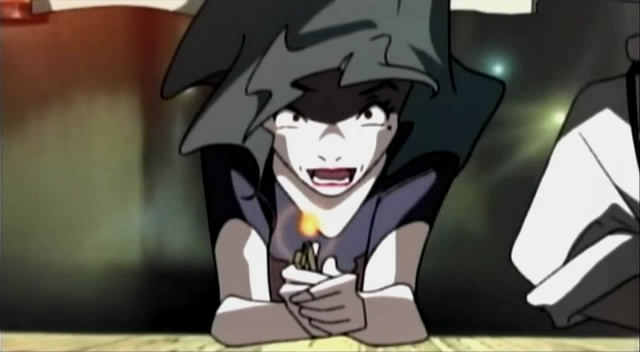
A new plot thread, including the unfortunate attempt at an alien back story, begins where a fellow schoolgirl Oyuki desires Ryo for the mere fact he is meant to turn into a monster. Willing to acquire goons and force him into a situation in a closed room with her, even if it leads to an immense danger, it presents a contrast in his destructive libido with how a person (male or female) can willingly put themselves in harm's way for their own. Even here the gender politics for a brisk, minor anime are interesting, the purpled haired Oyuki strong and assertive, her older sister who intervenes a muscular woman not drawn as traditionally feminine, both rocking leopard print pants and deciding to bring a bazooka to a monster fight when required.

[Spoiler Warning]

The other big surprise is that it offers a twist ending gag where Oyuki herself turns into a monstrous figure when aroused. It could link to the whole alien subplot, which just emphasises the terrible plot point, but as she transforms into a mass of tentacles for the final shot, it can also have a subversive quality when she, now working at the phone sex group, has embraced this side of herself. It may violently contrast the original point of this metaphor, destructive male libido, but at the same time it works in an interesting way if read further into. Even if the twist ending for Call Me Tonight is merely a shock "got-you!" moment, not surprising considering all the horror and sci-fi references within, it's a nice little subversion in itself.

Whilst the whole "tentacle porn" genre of hentai has always been problematic, entirely (and justifiably criticised) as being due to violence against women, the idea of monstrous sexuality literalised whilst transgressive should not necessarily be thrown onto the pyre as merely offensive. Considering this can originate as far back to The Dream of the Fisherman's Wife (1814), an iconic painting by legendary Japanese artist Hokusai which have had many replications (including gay depictions involving men) over the centuries, the idea of the idea of beastly sexuality is a form of intentionally provocative concept with artistic merit. The problem is that, within anime and manga, it is just an excuse for misogynistic ideas rather than used for something more progressive. Even as a twist ending, seeing this same destructive libido with a female character is more meaningful as the idea itself is not the issue to be condemned, rather stereotypical sexuality of men.  

[Spoiler Ends]

That we can have an anime which plays within thirty minutes there various ideas - the depiction of male libido as problematic and driven to violence, yet that monstrous sexuality itself is not inherently negative in the right context, a mysterious freakish (kinky) side of men and women that can be healthy or unhealthy - is a lot to admire. As one of the only anime from the Pink Noise selection that's been talked of decades later, that recognition says a lot to how through light sex comedy it managed to hit on a pertinent idea ahead of its time. That sadly this problematic side of sexuality in anime and manga is rarely parodied or questioned like this is a great shame, as it deserves to be done and had plenty of material to work with for mockery. It has admittedly helped Call Me Tonight stand out in spite its paltry form.

From https://encrypted-tbn0.gstatic.com/images?q=tbn:ANd9GcTRNDIo2bOiz27WTXJa67T8l31aQMju6SjZ1BKcohzUXu1xQPAj

Sunday, 25 March 2018

#52: Eternal Family (1997)

From http://3.bp.blogspot.com/_wBAGCeDbBnw/St8qRjOjyoI
/AAAAAAAAFlY/iMBulzJEm-Y/s400/et3uu5.jpg


Director: Kōji Morimoto
Screenplay: Kōji Morimoto and Dai Satou
Cast: Masashi Hirose, Yūko Mizutani, Wasabi Mizuta, Kappei Yamaguchi, Ako Mayama, Tie Kumashiro and Ken'ichi Ogata
Viewed in Japanese with English Subtitles

Synopsis: In the future, a group of miscreants are brainwashed into believing they are a family, the footage of them living in an enclosed living environment sold off as reality television. They become popular - Ben, the patriarch of the family who is in on the production itself, eldest daughter and pyromaniac Akiko, baby Michael, obsessed with scissors, violent eldest son Sasuke, mother A-ko, family dog Tamasaburo, and youngest daughter Sae, who speaks through a hand puppet. Unfortunately due to a mistake when the toilet gets blocked, they manage to escape into the real world again and the producers are forced to get them back.

Built from 30 second segments, which make up twenty nine minutes, Eternal Family is an odd proposition for anime marketing nowadays in terms of ever re-releasing it in the West, due to its small length. Yet an area of anime that is neglected, and in dire need of more attention even if it is by MP4 downloads, are experimental anime. Or, in the case of Eternal Family, that which is still pop experimentation but allowing their creators and animators to play and create material that is unconventional from most anime productions. Sometimes these pieces were part of anthologies. And in the last few years the premiers for the annual Japan Animator Expo have been made more easily available online for people to see, allowing new talent and veterans to experiment. Sometimes however these one-offs are released by themselves.

From https://www.animeclick.it/images/
Anime_big/EikyuuKazoku/EikyuuKazoku1.jpg

Studio 4°C
have carved a path for themselves in experimentation and in helping directors like Masaaki Yuasa begin their careers, making a lot of these types of short animation and idiosyncratic productions whilst paying for the bills through working on videogames, music videos and co-productions like the 2011 version of ThunderCats. The man behind Eternal Family, and other projects like Noiseman Sound Insect (1997), is Studio 4°C's co-founder Kōji Morimoto. His most well known work is likely his short for The Animatrix (2003) called Beyond. His most well regarded is his segment for Memories (1995) called Magnetic Rose, the most acclaimed of the three parts, written by the late Satoshi Kon, about a deep space salvage ship who end up trapped on a vessel which infects their memories. His work beyond this, entirely all short form work, is that of someone who likes to make distinct, idiosyncratic experiments which incredible animation. Someone given the keys to make shorts like Eternal Family in the nineties and taking advantage of that fact.

The final result is a combination of great animation, a vibrant and energetic work entirely filtered through very intentionally silly humour. One that should be taken serious in terms of its vibrant animation and colourful aesthetic, a dystopian cityscape of slums and giant electronic billboards with peculiar details, like the employees of the reality television show being dressed like St. Francisco de Xavier or quasi-rabbit costumes. The content itself is entirely ridiculous. You notice the father of this fake family has a sex doll constantly with him, the camera which films the TV show, already showing the tone's tongue in cheek. There is eventually the running gag that his fictitious wife has constipation which is thankfully just ridiculous rather than turning into bad toilet humour. But then the family dog is revealed to be able to balloon in size and throw a bark powerful enough to take out a Dragonball character and you are fully aware this belongs in the camp of surreal comedy anime is very known for. Since animation allows exaggeration and flights of fancy, Eternal Family like many can be as absurd as possible but with the difference that, due to the animation quality, the absurdity comes from the kinetic movement and style rather than gags common in the medium like sweat drops.

In regards to its structure, it was clearly released in segments and the full version does not try to hide this. There is something disarming about the first half all ending on the same flushing toilet shot, but it also evokes the bizarre Cartoon Network and Nickelodeon shorts I grew up with in the nineties. Similar to those experiments in scattergun satire and gross gags, this could have fitted in perfectly if it did not have the few moments of adult humour (or details like Akiko's pyromania, a subplot which is fleshed out with her obsession with a man once in her life connected to setting things on fire). The result is not necessarily high art in story content, but it is compelling as an energetic and fun production which never becomes tiresome. It also manages in such a short amount of time to have a plot with emotional content and progression to it, topping itself in more bizarre content, such as a chicken the family save from eating potentially having connections to an Illuminati group of fellow poultry. As an experiment, particularly in the early days of Studio 4°C it, it sets out and succeeds in its intentions.

From https://4.bp.blogspot.com/-9EFY-8b30nw/V4DZ-AUfndI
/AAAAAAAANHQ/1tGwiob6X5kLpFjKhmyAec
MTEJU_FmmSwCLcB/s1600/eternal-family-anime.png


Saturday, 28 November 2015

#13: Roujin Z (1991)

From https://animechronicleuk.files
.wordpress.com/2012/06/roujin.jpg
Director: Hiroyuki Kitakubo
Screenplay: Katsuhiro Otomo
Voice Cast: Chisa Yokoyama (as Haruko Mitsuhashi); Shinji Ogawa (as Takashi Terada); Chie Satō (as Nobuko Ohe); Kōji Tsujitani (as Mitsuru Maeda); Hikojiro Matsumura (as Kijuro Takazawa)
Viewed in Japanese with English Subtitles

From http://operationrainfall.com/wp-content/uploads/
2013/07/Roujin-Z-Screen-2.png
I'll openly admit my love for Roujin Z. The story of student nurse Haruko and her elderly client being used as a guinea pig for a nuclear powered, intelligent and multi-purpose nursing bed is one of the least conventional plots you could have for an animated feature film, even when there're still robots and explosions involved, and that's something I can immediately adore. The mark of how imaginative and playful this anime is, as were many from this era or so, is that the title is shown in a black-and-white live action scene of a hand painting it in Japanese kanji on scroll paper with a brush. For only over seventy minutes, you get a fully formed and interesting story as Haruko with her friends and a trio of elderly computer hackers attempt to rescue her client Kijuro Takazawa from the research project, only for the bed to develop an intelligence of its own, taking on the personality of its occupant's late wife and deciding to take him to the beach regardless of the police or military trying to stop her.

From http://anime-focus.com/images/2012/06/1-2.jpg
A factor revisiting the film for the blog is that I now work, while in the office, for a care organisation for the elderly. Roujin Z has not dated at all in its concerns and they have a greater emotional reference for me now because of my occupation, the bed created by the Ministry of Public Welfare to deal with the increasing grey population that needs to be cared for. Japan, as my college geography lessons taught me, has suffered from low birth rates and an increasingly aging population as medicine and technology has allowed people to live longer in first world countries. Other reading points out that many Japanese women would rather have careers than marry, with gender bias still problematic especially in the work place, the amount of births as a result effected. This theme of an aging populous is an international issue as well, as the elderly live longer in countries like my own in Britain, myself working in a care function which could provide a service even up to a whole twenty four hours for one person. Neither is the idea of a bed which feeds, exercises and washes a person, and has everything from communications and games on it obsolete now. Only that the technology has advanced so much and is considerably smaller in size differs from this film's original hypothesis and the rest can be seen as an intentional broad interpretation of the dangers of this technology if mishandled.

From http://s3.amazonaws.com/auteurs_production/
images/film/roujin-z/w448/roujin-z.jpg
Great sci-fi has three options to create something that stands out, all of which can come up in the anime I cover for the blog. Number 1, like Roujin Z you deal with real life and ask an uncomplicated "what-if" like how the future would deal with the elderly crisis; number 2, you make it as exaggerated and out-there as possible, like Osamu Dezaki's Space Adventure Cobra (1982), to the point the notion of datedness means nothing; or number 3 like Neon Genesis Evangelion (1995-6), the sci-fi tropes are there to reinterpret and bring out the most important factor, the emotions and characters, of a story. As the purveyor of number 1, Roujin Z is still relevant and the concern Haruko has of the coldness of the experimental bed feels more president in general about technology for me. It dangerous puts me close to being a luddite who yet enjoys his iPod, but my hesitance with simple small boxes which give people all their entertainment and house functions are enhanced especially by how mobile phones and the internet have effect how people interact with each other. The dangers of full dependency on single pieces of technology, especially when they're dictated by organisations, may sound paranoid but when this includes the protection and preservation of life, this takes a greater magnitude, as does the concerns of how technology can make people emotionally cold despite the paradox of it allow them to interact from afar. Especially in a care function, such as treating the elderly to the point of cleaning up bladder incontinence and potential embarrassing situations, human interaction is even more of an issue. Plus, as the Ministry of Public Welfare in this film learns when its too late, as many institutions in anime and cinema fail to realise before its too late, giving a test machine advanced biomechanical A.I. and the ability to move, in this case somehow becoming a transformer to their horror, is going to be disastrous.

From http://img11.hostingpics.net/pics/543999roujinzimage.jpg
And Roujin Z is fun mashing of sci-fi action and a comedy as well. The briskness of the film prevents it from becoming sluggish, an energy that practically gallops as the experimental bed escapes its pursuers and absorbs various objects into itself to get to its destination. The film is incredibly animated, with quite a few star names who worked on the project. Director Hiroyuki Kitakubo has already been on the blog for what was sadly his last directorial work, (blog entry #2) Blood: The Last Vampire (2000); someone with a clear talent, his filmography is very small but also very diverse, the work he would go to next a sex comedy series called Golden Boy (1995). Akira creator Katsuhiro Otomo wrote the screenplay, and the late Satoshi Kon worked as the art designer. Beyond this the film is incredibly kinetic when it fully gets going, scenes such as the bed scaling along an aerial monorail with both invention and exceptional detail to them. That this is all done for a metaphor about the treatment of the elderly is peculiar, as a military conspiracy is involved and a spider robot like a Masamune Shirow design makes an appearance, but that in itself gives the film a heart as well in its centre. The message being even more relevant now helps exceptionally, and it never conveys it with a heavy handedness, instead the humour spreading the content evenly out. From the zest of the elderly hackers, who have utter disregard to acting their age, to the doomed chivalrous attempts by a suitor of Haruko's who keeps getting frisked by the cops to save her,  the characters in the film are all memorable and add personality to the central ideas. The humanity goes as far as to include the bed itself as a character, turned by accident into a loving figure who only wants to protect the frail old man held within it. How the film manages to make its explosions and action scenes fit around such a serene and peaceful the great success of Roujin Z.

From http://www.el-mejoranime.es/web/fansub/wp-content/uploads/
2013/08/EMA-Roujin-Z-BD-Esp-Cat-Jap-720p-10-bits-C4287AE8_06.jpg